A LOT OF - MUCH - MANYA LOT OF - MUCH - MANY
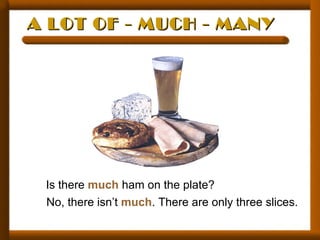
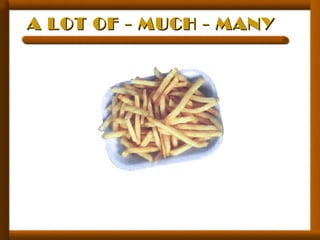
Is there much ham on the plate?
No, there isn’t much. There are only three slices.
A LOT OF - MUCH - MANYA LOT OF - MUCH - MANY
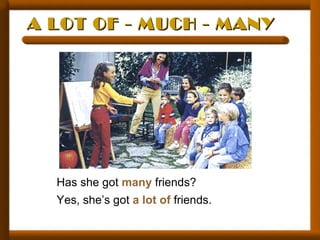
Has she got many friends?
Yes, she’s got a lot of friends.
A LOT OF - MUCH - MANYA LOT OF - MUCH - MANY
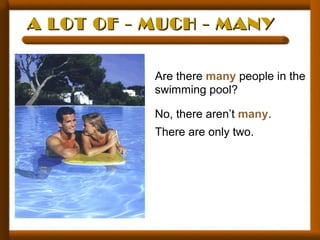
Are there many people in the
swimming pool?
No, there aren’t many.
There are only two.
A LOT OF - MUCH - MANYA LOT OF - MUCH - MANY
• We use a lot of/lots of with plural countable nouns
(books, cars, etc.) and uncountable nouns (e.g. sugar,
milk, etc.) in positive statements.
She’s got lots of/a lot of books.
There’s a lot of milk in the fridge.
Note: We omit of when a lot is not followed by a noun.
Are there many people in the room?
Yes, there are a lot.
A LOT OF - MUCH - MANYA LOT OF - MUCH - MANY
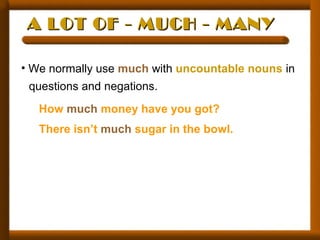
• We normally use much with uncountable nouns in
questions and negations.
How much money have you got?
There isn’t much sugar in the bowl.
A LOT OF - MUCH - MANYA LOT OF - MUCH - MANY
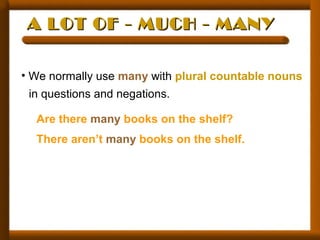
• We normally use many with plural countable nouns
in questions and negations.
Are there many books on the shelf?
There aren’t many books on the shelf.
A LOT OF - MUCH - MANYA LOT OF - MUCH - MANY
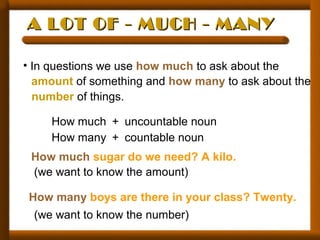
• In questions we use how much to ask about the
amount of something and how many to ask about the
number of things.
How much + uncountable noun
How many + countable noun
How much sugar do we need? A kilo.
(we want to know the amount)
How many boys are there in your class? Twenty.
(we want to know the number)
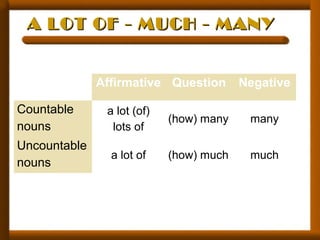
Affirmative Question Negative
Countable
nouns
a lot (of)
lots of
(how) many many
Uncountable
nouns
a lot of (how) much much
A LOT OF - MUCH - MANYA LOT OF - MUCH - MANY
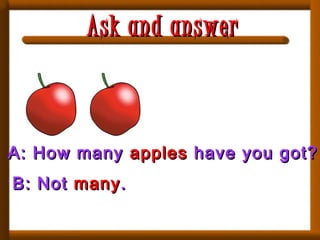
A: How manyA: How many applesapples have you got?have you got?
B: NotB: Not manymany..
Ask and answerAsk and answer
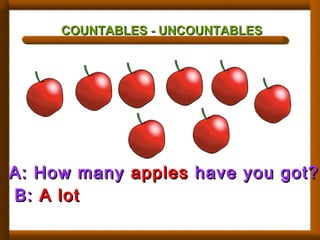
COUNTABLES - UNCOUNTABLESCOUNTABLES - UNCOUNTABLES
A: How manyA: How many applesapples have you got?have you got?
B:B: A lotA lot
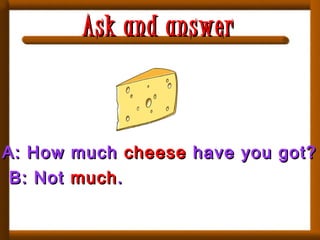
A: How muchA: How much cheesecheese have you got?have you got?
B: NotB: Not muchmuch..
Ask and answerAsk and answer
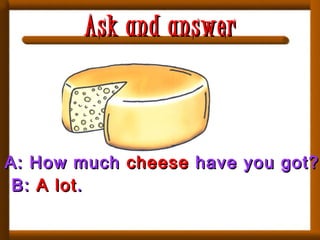
A: How muchA: How much cheesecheese have you got?have you got?
B:B: A lotA lot..
Ask and answerAsk and answer
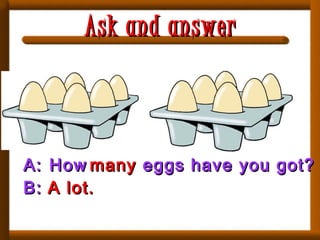
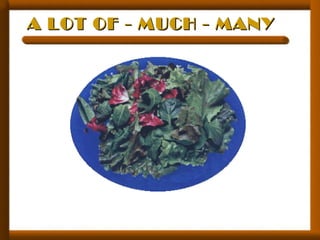
A:A: HowHow
B:B: A lot.A lot.
manymany eggs have you got?eggs have you got?
Ask and answerAsk and answer
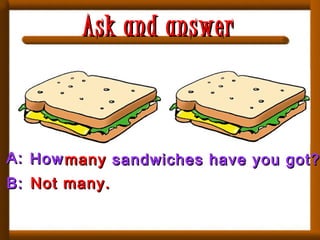
A:A:
B:B:
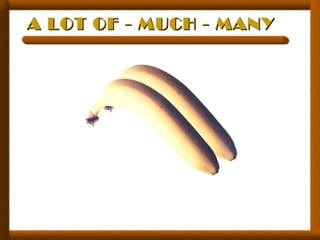
HowHow manymany sandwiches have you got?sandwiches have you got?
Not many.Not many.
Ask and answerAsk and answer
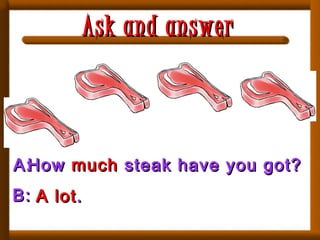
A:A:
B:B:
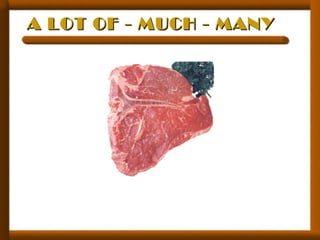
HowHow muchmuch steak have you got?steak have you got?
A lotA lot..
Ask and answerAsk and answer
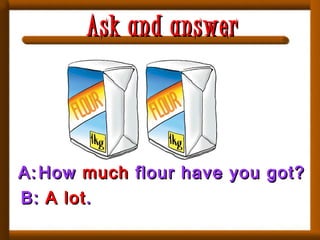
A:A: HowHow muchmuch flour have you got?flour have you got?
B:B: A lotA lot..
Ask and answerAsk and answer
COUNTABLES - UNCOUNTABLESCOUNTABLES - UNCOUNTABLES
A:A:HowHow manymany carrots have you got?carrots have you got?
B:B: Not many.Not many.
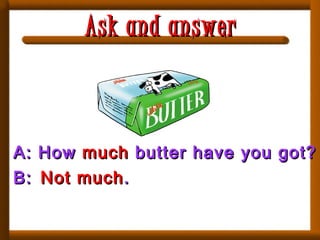
A:A: HowHow muchmuch butter have you got?butter have you got?
B:B: Not muchNot much..
Ask and answerAsk and answer
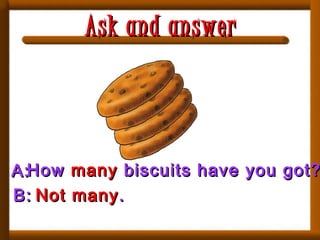
A:A:HowHow manymany biscuits have you got?biscuits have you got?
B:B: Not manyNot many..
Ask and answerAsk and answer
A LOT OF - MUCH - MANYA LOT OF - MUCH - MANY
(A) LITTLE - (A) FEW(A) LITTLE - (A) FEW
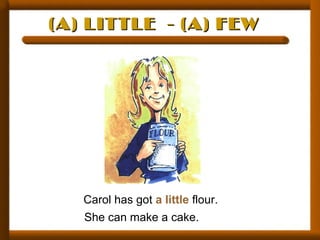
Carol has got a little flour.
She can make a cake.
(A) LITTLE - (A) FEW(A) LITTLE - (A) FEW
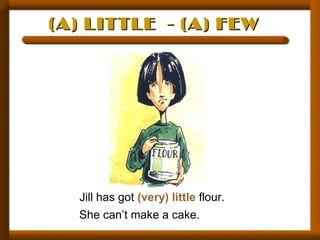
Jill has got (very) little flour.
She can’t make a cake.
(A) LITTLE - (A) FEW(A) LITTLE - (A) FEW
Carol has got a few strawberries.
She can make some jam.
(A) LITTLE - (A) FEW(A) LITTLE - (A) FEW
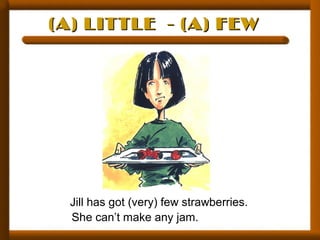
Jill has got (very) few strawberries.
She can’t make any jam.
(A) LITTLE - (A) FEW(A) LITTLE - (A) FEW
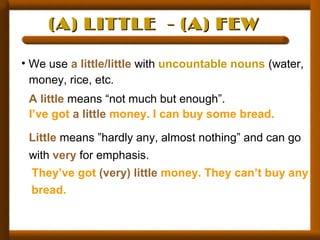
• We use a little/little with uncountable nouns (water,
money, rice, etc.
A little means “not much but enough”.
I’ve got a little money. I can buy some bread.
Little means ”hardly any, almost nothing” and can go
with very for emphasis.
They’ve got (very) little money. They can’t buy any
bread.
(A) LITTLE - (A) FEW(A) LITTLE - (A) FEW
• We use a few/few with plural countable nouns
(tomatoes, books, cups, etc.).
A few means “not many but enough”.
There are a few tomatoes. We can make a salad.
Few means “hardly any, almost none” and can go
with very for emphasis.
There are (very) few people in the cinema. It is
almost empty.
(A) LITTLE - (A) FEW(A) LITTLE - (A) FEW
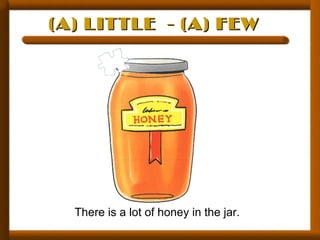
There is a lot of honey in the jar.
(A) LITTLE - (A) FEW(A) LITTLE - (A) FEW
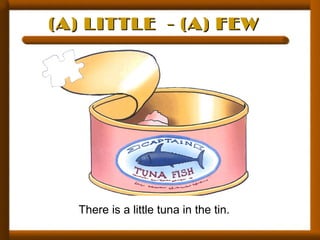
There is a little tuna in the tin.
(A) LITTLE - (A) FEW(A) LITTLE - (A) FEW
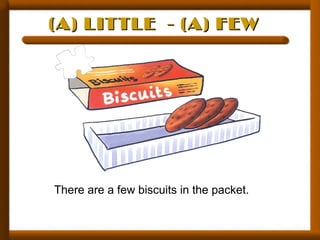
There are a few biscuits in the packet.
(A) LITTLE - (A) FEW(A) LITTLE - (A) FEW
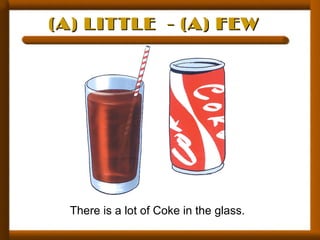
There is a lot of Coke in the glass.
(A) LITTLE - (A) FEW(A) LITTLE - (A) FEW
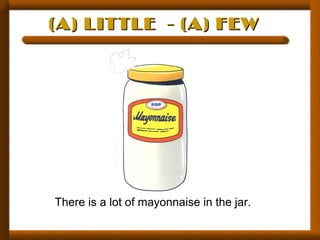
There is a lot of mayonnaise in the jar.
(A) LITTLE - (A) FEW(A) LITTLE - (A) FEW
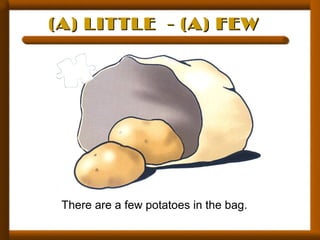
There are a few potatoes in the bag.

Adj.ques

  • 1.
    A LOT OF- MUCH - MANYA LOT OF - MUCH - MANY Is there much ham on the plate? No, there isn’t much. There are only three slices.
  • 2.
    A LOT OF- MUCH - MANYA LOT OF - MUCH - MANY Has she got many friends? Yes, she’s got a lot of friends.
  • 3.
    A LOT OF- MUCH - MANYA LOT OF - MUCH - MANY Are there many people in the swimming pool? No, there aren’t many. There are only two.
  • 4.
    A LOT OF- MUCH - MANYA LOT OF - MUCH - MANY • We use a lot of/lots of with plural countable nouns (books, cars, etc.) and uncountable nouns (e.g. sugar, milk, etc.) in positive statements. She’s got lots of/a lot of books. There’s a lot of milk in the fridge. Note: We omit of when a lot is not followed by a noun. Are there many people in the room? Yes, there are a lot.
  • 5.
    A LOT OF- MUCH - MANYA LOT OF - MUCH - MANY • We normally use much with uncountable nouns in questions and negations. How much money have you got? There isn’t much sugar in the bowl.
  • 6.
    A LOT OF- MUCH - MANYA LOT OF - MUCH - MANY • We normally use many with plural countable nouns in questions and negations. Are there many books on the shelf? There aren’t many books on the shelf.
  • 7.
    A LOT OF- MUCH - MANYA LOT OF - MUCH - MANY • In questions we use how much to ask about the amount of something and how many to ask about the number of things. How much + uncountable noun How many + countable noun How much sugar do we need? A kilo. (we want to know the amount) How many boys are there in your class? Twenty. (we want to know the number)
  • 8.
    Affirmative Question Negative Countable nouns alot (of) lots of (how) many many Uncountable nouns a lot of (how) much much A LOT OF - MUCH - MANYA LOT OF - MUCH - MANY
  • 9.
    A: How manyA:How many applesapples have you got?have you got? B: NotB: Not manymany.. Ask and answerAsk and answer
  • 10.
    COUNTABLES - UNCOUNTABLESCOUNTABLES- UNCOUNTABLES A: How manyA: How many applesapples have you got?have you got? B:B: A lotA lot
  • 11.
    A: How muchA:How much cheesecheese have you got?have you got? B: NotB: Not muchmuch.. Ask and answerAsk and answer
  • 12.
    A: How muchA:How much cheesecheese have you got?have you got? B:B: A lotA lot.. Ask and answerAsk and answer
  • 13.
    A:A: HowHow B:B: Alot.A lot. manymany eggs have you got?eggs have you got? Ask and answerAsk and answer
  • 14.
    A:A: B:B: HowHow manymany sandwicheshave you got?sandwiches have you got? Not many.Not many. Ask and answerAsk and answer
  • 15.
    A:A: B:B: HowHow muchmuch steakhave you got?steak have you got? A lotA lot.. Ask and answerAsk and answer
  • 16.
    A:A: HowHow muchmuchflour have you got?flour have you got? B:B: A lotA lot.. Ask and answerAsk and answer
  • 17.
    COUNTABLES - UNCOUNTABLESCOUNTABLES- UNCOUNTABLES A:A:HowHow manymany carrots have you got?carrots have you got? B:B: Not many.Not many.
  • 18.
    A:A: HowHow muchmuchbutter have you got?butter have you got? B:B: Not muchNot much.. Ask and answerAsk and answer
  • 19.
    A:A:HowHow manymany biscuitshave you got?biscuits have you got? B:B: Not manyNot many.. Ask and answerAsk and answer
  • 20.
    A LOT OF- MUCH - MANYA LOT OF - MUCH - MANY
  • 21.
    A LOT OF- MUCH - MANYA LOT OF - MUCH - MANY
  • 22.
    A LOT OF- MUCH - MANYA LOT OF - MUCH - MANY
  • 23.
    A LOT OF- MUCH - MANYA LOT OF - MUCH - MANY
  • 24.
    A LOT OF- MUCH - MANYA LOT OF - MUCH - MANY
  • 25.
    A LOT OF- MUCH - MANYA LOT OF - MUCH - MANY
  • 26.
    A LOT OF- MUCH - MANYA LOT OF - MUCH - MANY
  • 27.
    A LOT OF- MUCH - MANYA LOT OF - MUCH - MANY
  • 28.
    A LOT OF- MUCH - MANYA LOT OF - MUCH - MANY
  • 29.
    A LOT OF- MUCH - MANYA LOT OF - MUCH - MANY
  • 30.
    (A) LITTLE -(A) FEW(A) LITTLE - (A) FEW Carol has got a little flour. She can make a cake.
  • 31.
    (A) LITTLE -(A) FEW(A) LITTLE - (A) FEW Jill has got (very) little flour. She can’t make a cake.
  • 32.
    (A) LITTLE -(A) FEW(A) LITTLE - (A) FEW Carol has got a few strawberries. She can make some jam.
  • 33.
    (A) LITTLE -(A) FEW(A) LITTLE - (A) FEW Jill has got (very) few strawberries. She can’t make any jam.
  • 34.
    (A) LITTLE -(A) FEW(A) LITTLE - (A) FEW • We use a little/little with uncountable nouns (water, money, rice, etc. A little means “not much but enough”. I’ve got a little money. I can buy some bread. Little means ”hardly any, almost nothing” and can go with very for emphasis. They’ve got (very) little money. They can’t buy any bread.
  • 35.
    (A) LITTLE -(A) FEW(A) LITTLE - (A) FEW • We use a few/few with plural countable nouns (tomatoes, books, cups, etc.). A few means “not many but enough”. There are a few tomatoes. We can make a salad. Few means “hardly any, almost none” and can go with very for emphasis. There are (very) few people in the cinema. It is almost empty.
  • 36.
    (A) LITTLE -(A) FEW(A) LITTLE - (A) FEW There is a lot of honey in the jar.
  • 37.
    (A) LITTLE -(A) FEW(A) LITTLE - (A) FEW There is a little tuna in the tin.
  • 38.
    (A) LITTLE -(A) FEW(A) LITTLE - (A) FEW There are a few biscuits in the packet.
  • 39.
    (A) LITTLE -(A) FEW(A) LITTLE - (A) FEW There is a lot of Coke in the glass.
  • 40.
    (A) LITTLE -(A) FEW(A) LITTLE - (A) FEW There is a lot of mayonnaise in the jar.
  • 41.
    (A) LITTLE -(A) FEW(A) LITTLE - (A) FEW There are a few potatoes in the bag.