Innovative conservation since 1903
Addressing equity and poverty
in conservation
Current practice and future directions
Dr Helen Schneider
Director Conservation, Livelihoods & Governance
Expert Workshop on Equity, Justice & Well-being in Ecosystem Governance
March 26/27th, IIED
Innovative conservation since 1903Innovative conservation since 1903
Conservation Trends :‘Hot Topics’
• Illegal wildlife trade, law enforcement
• Use of technology
• Land/sea-scapes: land sharing/sparing, agric commodities
• Tenure and use rights: ICCAs, conservancies, LMMAs, CFIs
• Climate change adaptation and mitigation
• Conservation leadership
• Cultural values
• Biodiversity, ecosystem services and well-being
• Innovative financing and market-based mechanisms
Innovative conservation since 1903Innovative conservation since 1903
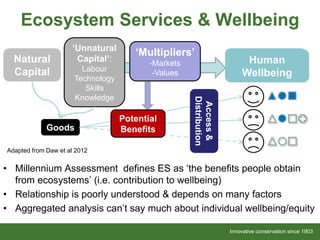
Natural
Capital
Human
Wellbeing
Ecosystem Services & Wellbeing
• Millennium Assessment defines ES as ‘the benefits people obtain
from ecosystems’ (i.e. contribution to wellbeing)
• Relationship is poorly understood & depends on many factors
• Aggregated analysis can’t say much about individual wellbeing/equity
Human
Wellbeing
‘Unnatural
Capital’:
Labour
Technology
Skills
Knowledge
Goods
‘Multipliers’
-Markets
-Values
Potential
Benefits
Access&
Distribution
Adapted from Daw et al 2012
Innovative conservation since 1903Innovative conservation since 1903
‘Innovative financing’ &
market-based mechanisms
• Nature-based tourism – economic viability, who benefits/loses?
• Certification schemes – social standards
• Bio-prospecting (ABS) – Nagoya Protocol
• REDD+/PES – standards and safeguards
• Biodiversity offsets – standards and safeguards
• Marine futures, environmental mortgages, buy-outs, bonds
• Forest impact bonds – shift risk?
• Impact investment – seek social as well as environmental impacts?
• Value chain/market system development, enterprise
development, jobs, ‘livelihoods projects’, Green Economy
Innovative conservation since 1903Innovative conservation since 1903
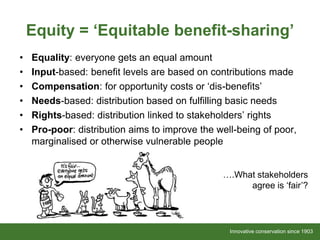
• Equality: everyone gets an equal amount
• Input-based: benefit levels are based on contributions made
• Compensation: for opportunity costs or ‘dis-benefits’
• Needs-based: distribution based on fulfilling basic needs
• Rights-based: distribution linked to stakeholders’ rights
• Pro-poor: distribution aims to improve the well-being of poor,
marginalised or otherwise vulnerable people
Equity = ‘Equitable benefit-sharing’
….What stakeholders
agree is ‘fair’?
Innovative conservation since 1903Innovative conservation since 1903
Equity Dimensions
• Recognition
o of stakeholders, their rights,
knowledge & institutions
• Procedure
o ‘meaningful’ participation
o access to info
o access to justice
• Distribution
o ‘equitable benefit-sharing’
o risks and costs (as well as benefits)
WHY and HOW
should we as
conservationists work
with poor, vulnerable
& marginalised
people?
Innovative conservation since 1903Innovative conservation since 1903
Understanding of poverty in conservation
• evidence for – and understanding of - links between
biodiversity, ES, conservation and poverty still mixed#
• broader understanding of poverty/well-being from purely
income to food security, health, education, water supply etc
• Gender and Indigenous People - rights, vulnerability,
disadvantage/marginalisation
BUT less emphasis on….
? equitable access to ‘tangible’ benefits (‘material domain’)*
? equitable distribution of ‘intangibles’ e.g. power/voice/agency,
self-esteem, sense of purpose & control, safety, social
cohesion, life satisfaction (‘relational & subjective domains’)
Innovative conservation since 1903Innovative conservation since 1903
Examples from practice
Bwindi ICD, Uganda
“local resentment over the inequity of costs and benefits from
conservation was just as important a driver of illegal activities as
rural poverty”
Ol Pejeta Conservancy, Kenya
• fence (reduced HWC) and security (reduced crime,
emergency transport) felt to provide most significant benefits >
Community Development Programme (CDP)
• s/economic benefits & associated goodwill undermined by:
o frustration over uneven distribution of projects
o perception that benefits are not going to those who experience
the highest negative impacts (crop raiding)
Innovative conservation since 1903Innovative conservation since 1903
Food for thought?
From a conservation
perspective, should we focus
on equity as much as – or
perhaps even more than –
poverty?
Inequity is both
a cause and
symptom of
poverty

Equity workshop: Addressing equity and poverty in conservation

  • 1.
    Innovative conservation since1903 Addressing equity and poverty in conservation Current practice and future directions Dr Helen Schneider Director Conservation, Livelihoods & Governance Expert Workshop on Equity, Justice & Well-being in Ecosystem Governance March 26/27th, IIED
  • 2.
    Innovative conservation since1903Innovative conservation since 1903 Conservation Trends :‘Hot Topics’ • Illegal wildlife trade, law enforcement • Use of technology • Land/sea-scapes: land sharing/sparing, agric commodities • Tenure and use rights: ICCAs, conservancies, LMMAs, CFIs • Climate change adaptation and mitigation • Conservation leadership • Cultural values • Biodiversity, ecosystem services and well-being • Innovative financing and market-based mechanisms
  • 3.
    Innovative conservation since1903Innovative conservation since 1903 Natural Capital Human Wellbeing Ecosystem Services & Wellbeing • Millennium Assessment defines ES as ‘the benefits people obtain from ecosystems’ (i.e. contribution to wellbeing) • Relationship is poorly understood & depends on many factors • Aggregated analysis can’t say much about individual wellbeing/equity Human Wellbeing ‘Unnatural Capital’: Labour Technology Skills Knowledge Goods ‘Multipliers’ -Markets -Values Potential Benefits Access& Distribution Adapted from Daw et al 2012
  • 4.
    Innovative conservation since1903Innovative conservation since 1903 ‘Innovative financing’ & market-based mechanisms • Nature-based tourism – economic viability, who benefits/loses? • Certification schemes – social standards • Bio-prospecting (ABS) – Nagoya Protocol • REDD+/PES – standards and safeguards • Biodiversity offsets – standards and safeguards • Marine futures, environmental mortgages, buy-outs, bonds • Forest impact bonds – shift risk? • Impact investment – seek social as well as environmental impacts? • Value chain/market system development, enterprise development, jobs, ‘livelihoods projects’, Green Economy
  • 5.
    Innovative conservation since1903Innovative conservation since 1903 • Equality: everyone gets an equal amount • Input-based: benefit levels are based on contributions made • Compensation: for opportunity costs or ‘dis-benefits’ • Needs-based: distribution based on fulfilling basic needs • Rights-based: distribution linked to stakeholders’ rights • Pro-poor: distribution aims to improve the well-being of poor, marginalised or otherwise vulnerable people Equity = ‘Equitable benefit-sharing’ ….What stakeholders agree is ‘fair’?
  • 6.
    Innovative conservation since1903Innovative conservation since 1903 Equity Dimensions • Recognition o of stakeholders, their rights, knowledge & institutions • Procedure o ‘meaningful’ participation o access to info o access to justice • Distribution o ‘equitable benefit-sharing’ o risks and costs (as well as benefits) WHY and HOW should we as conservationists work with poor, vulnerable & marginalised people?
  • 7.
    Innovative conservation since1903Innovative conservation since 1903 Understanding of poverty in conservation • evidence for – and understanding of - links between biodiversity, ES, conservation and poverty still mixed# • broader understanding of poverty/well-being from purely income to food security, health, education, water supply etc • Gender and Indigenous People - rights, vulnerability, disadvantage/marginalisation BUT less emphasis on…. ? equitable access to ‘tangible’ benefits (‘material domain’)* ? equitable distribution of ‘intangibles’ e.g. power/voice/agency, self-esteem, sense of purpose & control, safety, social cohesion, life satisfaction (‘relational & subjective domains’)
  • 8.
    Innovative conservation since1903Innovative conservation since 1903 Examples from practice Bwindi ICD, Uganda “local resentment over the inequity of costs and benefits from conservation was just as important a driver of illegal activities as rural poverty” Ol Pejeta Conservancy, Kenya • fence (reduced HWC) and security (reduced crime, emergency transport) felt to provide most significant benefits > Community Development Programme (CDP) • s/economic benefits & associated goodwill undermined by: o frustration over uneven distribution of projects o perception that benefits are not going to those who experience the highest negative impacts (crop raiding)
  • 9.
    Innovative conservation since1903Innovative conservation since 1903 Food for thought? From a conservation perspective, should we focus on equity as much as – or perhaps even more than – poverty? Inequity is both a cause and symptom of poverty