Straw-Bale Eco-Center
                            Demonstrating How to Live Sustainably in the Midwest


Student Team:          Student Team Members, Departments, and Institutions: All students working on the project are students at Ball State University.
These include architecture students Matthew T. Amore, Daniel G. Bajor, Geoffrey A. Burns, Evan T. Anderson-Decina, Geoffrey S. Desmit, Lindsey
Eckstein, Todd M. Ernstberger, Merritt M. Ertel, Luke J. Geers, Joshua T. Higginbotham, Brandon M. Hoopingarner, John L. Hudson, Teresa Klingensmith
Haines, Megan M. Leder, Stephanie L. McLeish, Martin A. Merkel, Brian W. Pace, Logan U. Parmele, Wesley W. Perkins, Michael D. Powers, Martin D. Sams,
Bradley J. Singer, Patrick W. Steffen, Chelsea A. Wait, and Nathan R. Ziulkowski. The project team included landscape architecture students Ryan J.
Alexander, Sharon M. Dougherty, Brad R. Faichild, Lawrence T. Fettig, Emily K. Harner, Alisha R. Koester, Bradley A. Kottkamp, Amy L. Lewis, Josh T.
Manwaring, Jason M. Reier, Justin A. Russell, Corey R. Seltenright, and Kelly A. Woodward. The team also included natural resources and
environmental management students Daniel A. Dyson, Kendra Frost; interior design student Alicia A. Hall, political science student
David M. Cain, and pre-journalism student Lauren Kenley.
Phase I:
-Resulted in the first built
component of a University
teaching and research “Land
Lab” envisioned for the site.


-Resulted in first load bearing
straw-bale building in Region.
LEED gold rating (phase II)


-Funded with a 10K EPA P3
grant obtained by Gray /
Motloch 2006, 8K for
construction and materials
-Have begun monitoring
performance:
 -Energy performance
 -Bale moisture content
Looking Southeast toward farmhouse


Looking Northwest toward site
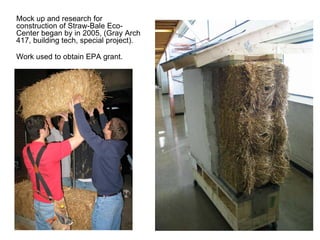
Mock up and research for
construction of Straw-Bale Eco-
Center began by in 2005, (Gray Arch
417, building tech, special project).

Work used to obtain EPA grant.
Design Process
-Identify players / permits req’d /establish schedule for work
-Design began with Gray 301 studio (2 week project)
-Develop / document/ price design with Gray ARCH 498; 4th / 5th year elective
Students discovered that architectural expression could exist within creative
manipulation of building systems, materials and assemblies.
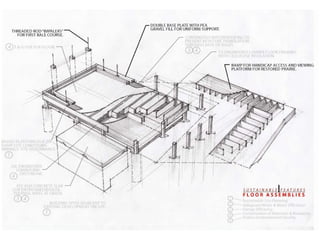
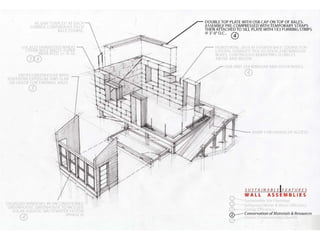
DIAGRAMS / EDUCATIONAL TOOL

-Help to explain thought process throughout
design
-Relate decisions to USGBC criteria
-Clarify the notion of “sustainable design”
        -Not the result of any one thing but
        the sum total of smart (and in this
        case simple) decisions throughout
        the process of design and
        construction


-De-emphasize significance of any single
component (i.e. straw –bale) in favor of
understanding sustainable strategies as a
collective and interrelated set of decisions.
CONSTRUCTION
2007-2008 Initiatives:
-Complete work on the straw-bale classroom building
-Complete design and implement phase two, integration of building w/ landscape
systems (pending funding)
-Participate as part of campus tour for the 2007 “Greening of the Campus”
Conference at BSU; a bi-annual national conference hosted by the University.
-Begin Delaware County K-12 tours of facility as part of “Christy Woods” nature
tour.
Straw Bale Construction
Phase II : Integrated site systems
BSU Eco Center; awaiting additional funding……………..

Straw-Bale Eco-Center

  • 1.
    Straw-Bale Eco-Center Demonstrating How to Live Sustainably in the Midwest Student Team: Student Team Members, Departments, and Institutions: All students working on the project are students at Ball State University. These include architecture students Matthew T. Amore, Daniel G. Bajor, Geoffrey A. Burns, Evan T. Anderson-Decina, Geoffrey S. Desmit, Lindsey Eckstein, Todd M. Ernstberger, Merritt M. Ertel, Luke J. Geers, Joshua T. Higginbotham, Brandon M. Hoopingarner, John L. Hudson, Teresa Klingensmith Haines, Megan M. Leder, Stephanie L. McLeish, Martin A. Merkel, Brian W. Pace, Logan U. Parmele, Wesley W. Perkins, Michael D. Powers, Martin D. Sams, Bradley J. Singer, Patrick W. Steffen, Chelsea A. Wait, and Nathan R. Ziulkowski. The project team included landscape architecture students Ryan J. Alexander, Sharon M. Dougherty, Brad R. Faichild, Lawrence T. Fettig, Emily K. Harner, Alisha R. Koester, Bradley A. Kottkamp, Amy L. Lewis, Josh T. Manwaring, Jason M. Reier, Justin A. Russell, Corey R. Seltenright, and Kelly A. Woodward. The team also included natural resources and environmental management students Daniel A. Dyson, Kendra Frost; interior design student Alicia A. Hall, political science student David M. Cain, and pre-journalism student Lauren Kenley.
  • 2.
    Phase I: -Resulted inthe first built component of a University teaching and research “Land Lab” envisioned for the site. -Resulted in first load bearing straw-bale building in Region. LEED gold rating (phase II) -Funded with a 10K EPA P3 grant obtained by Gray / Motloch 2006, 8K for construction and materials -Have begun monitoring performance: -Energy performance -Bale moisture content
  • 3.
    Looking Southeast towardfarmhouse Looking Northwest toward site
  • 5.
    Mock up andresearch for construction of Straw-Bale Eco- Center began by in 2005, (Gray Arch 417, building tech, special project). Work used to obtain EPA grant.
  • 6.
    Design Process -Identify players/ permits req’d /establish schedule for work -Design began with Gray 301 studio (2 week project) -Develop / document/ price design with Gray ARCH 498; 4th / 5th year elective
  • 7.
    Students discovered thatarchitectural expression could exist within creative manipulation of building systems, materials and assemblies.
  • 9.
    DIAGRAMS / EDUCATIONALTOOL -Help to explain thought process throughout design -Relate decisions to USGBC criteria -Clarify the notion of “sustainable design” -Not the result of any one thing but the sum total of smart (and in this case simple) decisions throughout the process of design and construction -De-emphasize significance of any single component (i.e. straw –bale) in favor of understanding sustainable strategies as a collective and interrelated set of decisions.
  • 19.
  • 32.
    2007-2008 Initiatives: -Complete workon the straw-bale classroom building -Complete design and implement phase two, integration of building w/ landscape systems (pending funding) -Participate as part of campus tour for the 2007 “Greening of the Campus” Conference at BSU; a bi-annual national conference hosted by the University. -Begin Delaware County K-12 tours of facility as part of “Christy Woods” nature tour.
  • 33.
  • 35.
    Phase II :Integrated site systems
  • 36.
    BSU Eco Center;awaiting additional funding……………..