Asian Development Bank &
Mongolia
FACT SHEET
As of 31 December 2014
The Asian Development Bank (ADB) has been Mongolia’s largest multilateral
development partner since 1991, playing a central role in the country’s
transformation to a middle-income, market-based economy.
Since 1991, Mongolia has received $1.6 billion in total resources, consisting
of 56 Asian Development Fund (ADF) and ordinary capital resources (OCR)
sovereign loans totaling $1.2 billion, 4 nonsovereign loans for $94.5 million,
12 ADF and 24 grants from the Japan Fund for Poverty Reduction and other
sources for $218.4 million, and 184 technical assistance projects for $110.9 million.
The current portfolio, as of 31 December 2014, consists of 18 loans ($544 million),
9 ADF grants ($129 million), and 30 technical assistance projects ($25 million).
In more recent times, Mongolia’s economic growth has eased from historic
highs, driven largely by mining, to more sustainable levels. The economy requires
diversification, with corresponding broadening of job opportunities and social
protection, to generate inclusive growth. Protection of the environment—
including grasslands, forests, rivers, and lakes—is also essential to ensure healthy
and productive livelihoods.
Cumulative disbursements to Mongolia for lending and grants financed by
OCR, the ADF, and other special funds amounted to $965.7 million.
ADB-Supported Projects and Programs
ADB assistance in Mongolia works to raise the country’s standard of living by
combining effective financing models with best practice knowledge products
and services.
Addressing inadequate access to clean water and sanitation, ADB
has supported modern water and sewerage systems across Mongolia. In
Ulaanbaatar, ADB is assisting the modernization of the informal ger (traditional
tented dwelling) areas with a facility of $160 million. In Darkhan, Mongolia’s
third-largest city, a project loan of $18.50 million will finance a modern
wastewater treatment plant, benefiting more than 80,000 people.
While Mongolia has a strong foundation in herding and agriculture, potential
export markets remain untapped. Efforts to establish Mongolian brands
and implement quality control procedures will help Mongolian companies
penetrate overseas markets. ADB, in response, has supported agroprocessing
companies, including MonFresh Foods, Erdenet Carpets, and Darkhan
Sheepskin. Nonsovereign financing of $40 million was approved in 2014 for
Khan Bank to develop micro, small, and medium-sized enterprises. ADB is
also supporting business development through XacBank and XacLeasing,
with a loan of $40 million approved in 2013. With a debilitating skills shortage
hampering the competitiveness of Mongolian firms, ADB provided $25 million
to develop technical and vocational education in agriculture, construction, and
transportation.
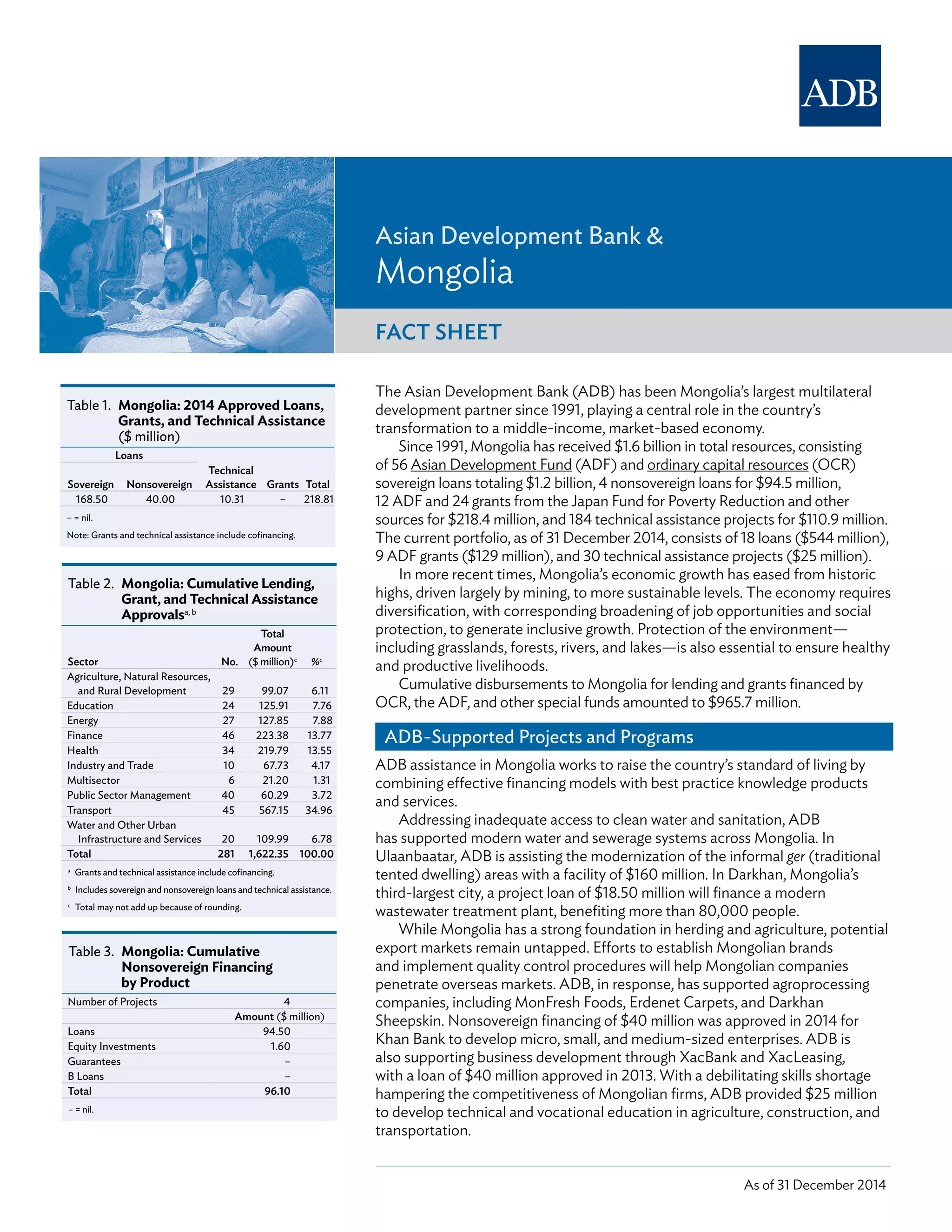
Table 2. Mongolia: Cumulative Lending,
Grant, and Technical Assistance
Approvalsa, b
Sector No.
Total
Amount
($ million)c
%c
Agriculture, Natural Resources,
 and Rural Development 29 99.07 6.11
Education 24 125.91 7.76
Energy 27 127.85 7.88
Finance 46 223.38 13.77
Health 34 219.79 13.55
Industry and Trade 10 67.73 4.17
Multisector 6 21.20 1.31
Public Sector Management 40 60.29 3.72
Transport 45 567.15 34.96
Water and Other Urban
 Infrastructure and Services 20 109.99 6.78
Total 281 1,622.35 100.00
a
 Grants and technical assistance include cofinancing.
b
 Includes sovereign and nonsovereign loans and technical assistance.
c
 Total may not add up because of rounding.
Table 1. Mongolia: 2014 Approved Loans,
Grants, and Technical Assistance
($ million)
Loans
Sovereign Nonsovereign
Technical
Assistance Grants Total
168.50 40.00 10.31 – 218.81
– = nil.
Note: Grants and technical assistance include cofinancing.
Table 3. Mongolia: Cumulative
Nonsovereign Financing
by Product
Number of Projects 4
Amount ($ million)
Loans 94.50
Equity Investments 1.60
Guarantees –
B Loans –
Total 96.10
– = nil.
Under the Central Asia Regional Economic Cooperation
(CAREC) Program, ADB supports Mongolia’s engagement
with its neighbors, to stimulate trade, investment, and jobs
growth. This includes a new road linking Ulaanbaatar to
the border with the People’s Republic of China (PRC) at
Zamyn-Uud, which has reduced travel time from 20 to
8 hours. Meanwhile, a $170 million transport project, of
which $125 million was approved in 2014, is constructing
293 kilometers of roads to establish an international
corridor in the isolated western region, adjoining the PRC
and the Russian Federation.
Technical assistance packages, totaling $9.95 million,
will support the conclusion of a major public–private
partnership in the energy sector; improve tax collection
through e-systems; tackle money-laundering schemes;
combat climate change; and prepare new projects in the
energy, transport, and finance sectors.
Nonsovereign Operations
As a catalyst for private investments, ADB provides direct
financial assistance to nonsovereign public sector and
private sector projects in the form of direct loans, equity
investments, guarantees, B loans, and trade finance.
Since its inception, ADB has approved $96.1 million for
four private sector projects in Mongolia’s finance sector.
Total outstanding balances and commitments of ADB’s
nonsovereign transactions in the country as of 31 December
2014 was $88.77 million, representing 1.12% of ADB’s total
nonsovereign portfolio.
ADB’s Trade Finance Program (TFP) fills market
gaps by providing guarantees and loans through partner
banks in support of trade. The TFP has done over 10,300
transactions supporting over $20.5 billion in trade and over
6,000 small and medium-sized enterprises since 2004.
In 2014, the TFP supported $3.8 billion in trade through
over 1,900 transactions. In Mongolia, the TFP works with
three banks and has supported $105.86 million in trade for
130 transactions. In addition to filling market gaps, the TFP’s
objective is to mobilize private sector capital/involvement
in developing Asia. In Mongolia, 36.66% of the
$105.86 million in trade supported through the TFP was
cofinanced by the private sector.
Cofinancing
Cofinancing operations enable ADB’s financing partners,
governments or their agencies, multilateral financing
institutions, and commercial organizations, to participate in
financing ADB projects. The additional funds are provided
in the form of official loans and grants, other concessional
financing, and commercial financing such as B loans, risk
transfer arrangements, parallel loans and equity, guarantee
cofinancing, and cofinancing for transactions under ADB’s TFP.
By the end of 2014, cumulative direct value-added
(DVA) official cofinancing for Mongolia amounted
to $102.7 million for 25 projects, and $25.6 million
for 31 technical assistance projects. Cumulative DVA
commercial cofinancing for Mongolia amounted to
$57.85 million for three investment projects.
A summary of projects with cofinancing from 1 January
2010 to 31 December 2014 is available at www.adb.org/
countries/mongolia/cofinancing
Partnerships
ADB and the Government of Mongolia are involved in
joint projects across different sectors, with the World
Health Organization, the European Investment Bank, and
the Japan International Cooperation Agency. ADB is also
working with local nongovernment organizations to bring
financial services to Mongolia’s poor, as well as to improve
child nutrition and health services.
ADB is partnering with banks—including XacBank, the
Trade and Development Bank, and Khan Bank—to help
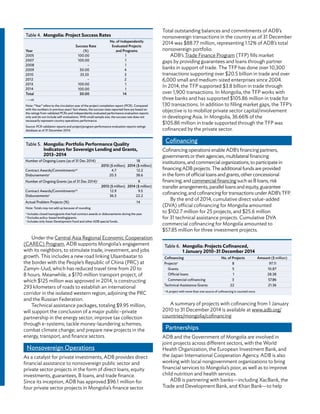
Table 5. Mongolia: Portfolio Performance Quality
Indicators for Sovereign Lending and Grants,
2013–2014
Number of Ongoing Loans (as of 31 Dec 2014) 18
2013 ($ million) 2014 ($ million)
Contract Awards/Commitmentsa,b
4.7 12.2
Disbursementsa
20.3 38.6
Number of Ongoing Grants (as of 31 Dec 2014)c
9
2013 ($ million) 2014 ($ million)
Contract Awards/Commitmentsa,b
12.9 9.5
Disbursementsa
36.3 22.2
Actual Problem Projects (%) 14
Note: Totals may not add up because of rounding.
a
Includes closed loans/grants that had contract awards or disbursements during the year.
b
Excludes policy-based lending/grants.
c
Includes only Asian Development Fund and other ADB special funds.
Table 6. Mongolia: Projects Cofinanced,
1 January 2010–31 December 2014
Cofinancing No. of Projects Amount ($ million)
Projectsa
8 97.11
 Grants 5 10.87
 Official loans 1 28.38
 Commercial cofinancing 3 57.86
Technical Assistance Grants 22 21.36
a
A project with more than one source of cofinancing is counted once.
Table 4. Mongolia: Project Success Rates
Year
Success Rate
(%)
No. of Independently
Evaluated Projects
and Programs
2005 100.00 1
2007 100.00 1
2008 – 1
2009 50.00 4
2010 33.33 3
2012 – 2
2013 100.00 1
2014 100.00 1
Total 50.00 14
– = nil.
Note: “Year” refers to the circulation year of the project completion report (PCR). Compared
with the numbers in previous years’ fact sheets, the success rates reported here are based on
the ratings from validated PCRs and independently evaluated performance evaluation reports
only and do not include self-evaluations. With small sample size, the success rate does not
necessarily represent country operations performance.
Source: PCR validation reports and project/program performance evaluation reports ratings
database as of 31 December 2014.
small and medium-sized enterprises access effective and
competitive finance, while partnerships with the Capital
Bank and the State Bank help provide financing for low-
income households to connect to the main water supply.
Underprivileged people can also access discounted or free
medications through the Monos pharmacy chain, thanks to
a grant supported by ADB.
Developing public–private partnerships has become
a central part of ADB operations in Mongolia. ADB is
supporting the construction of the $1.3 billion Combined
Heat and Power Plant #5, for which a consortium of
top-tier investors has already been engaged.
Procurement
Share of ADB’s Procurement Contracts
Each year, ADB provides loans, grants, and technical
assistance to fund projects and activities in its developing
member countries, and several billion dollars in contracts
to procure goods, works, and consulting services. Most
contracts were awarded on the basis of international
competition, which is open to firms and individuals from
any ADB member, regional or nonregional.
Procurement contracts for goods, works, and
related services under loan and grant operations totaled
$6.59 billion in 2013 and $8.58 billion in 2014. Cumulative
procurement, as of 31 December 2014, was $135.21 billion.
Procurement contracts for consulting services under
loan, grant, and technical assistance operations totaled
$511.13 million in 2013 and $555.30 million in 2014.
Cumulative procurement, as of 31 December 2014, was
$9.98 billion.
Consulting Services
From 1 January 1966 to 31 December 2014, consultants were
involved in 45,584 contracts for consulting services under
ADB loan, grant, and technical assistance projects worth
$9.98 billion. During the same period, 711 contracts were
awarded to consultants from Mongolia worth $20.06 million.
Goods, Works, and Related Services
From 1 January 1966 to 31 December 2014, contractors
and suppliers were involved in 194,667 contracts for goods,
works, and related services under ADB loan and grant
projects worth $135.21 billion. During the same period,
1,884 contracts were awarded to contractors and suppliers
from Mongolia worth $323.65 million.
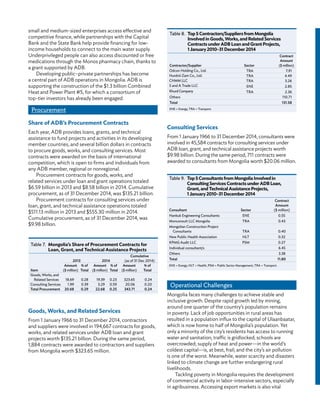
Table 8. Top5Contractors/SuppliersfromMongolia
InvolvedinGoods,Works,andRelatedServices
ContractsunderADBLoanandGrantProjects,
1 January2010–31December2014
Contractor/Supplier Sector
Contract
Amount
($ million)
Odcon Holding Co., Ltd. TRA 7.91
Hurdnii Zam Co., Ltd. TRA 4.49
CHMM LLC TRA 3.26
S and A Trade LLC ENE 2.85
Khurd Company TRA 2.36
Others 110.71
Total 131.58
ENE = Energy, TRA = Transport.
Operational Challenges
Mongolia faces many challenges to achieve stable and
inclusive growth. Despite rapid growth led by mining,
around one quarter of the country’s population remains
in poverty. Lack of job opportunities in rural areas has
resulted in a population influx to the capital of Ulaanbaatar,
which is now home to half of Mongolia’s population. Yet
only a minority of the city’s residents has access to running
water and sanitation; traffic is gridlocked; schools are
overcrowded; supply of heat and power—in the world’s
coldest capital—is, at best, frail; and the city’s air pollution
is one of the worst. Meanwhile, water scarcity and disasters
linked to climate change are further endangering rural
livelihoods.
Tackling poverty in Mongolia requires the development
of commercial activity in labor-intensive sectors, especially
in agribusiness. Accessing export markets is also vital
Table 7. Mongolia’s Share of Procurement Contracts for
Loan, Grant, and Technical Assistance Projects
Item
2013 2014
Cumulative
(as of 31 Dec 2014)
Amount
($ million)
% of
Total
Amount
($ million)
% of
Total
Amount
($ million)
% of
Total
Goods, Works, and
 Related Services 18.69 0.28 19.39 0.23 323.65 0.24
Consulting Services 1.99 0.39 3.29 0.59 20.06 0.20
Total Procurement 20.68 0.29 22.68 0.25 343.71 0.24
Table 9. Top5ConsultantsfromMongoliaInvolvedin
ConsultingServicesContractsunderADBLoan,
Grant,andTechnicalAssistanceProjects,
1January2010–31December2014
Consultant Sector
Contract
Amount
($ million)
Hankuk Engineering Consultants ENE 0.55
Monconsult LLC Mongolia TRA 0.43
Mongolian Construction Project
 Consultants TRA 0.40
New Public Health Association HLT 0.32
KPMG Audit LLC PSM 0.27
Individual consultant/s 6.45
Others 3.38
Total 11.80
ENE = Energy, HLT = Health, PSM = Public Sector Management, TRA = Transport.
In this publication, “$” refers to US dollars. Figures are estimated by ADB unless otherwise cited.
Data are as of 31 December 2014 unless otherwise indicated. Fact sheets are updated annually in April. April 2015
AboutMongoliaandADB
ADB Membership
Joined 1991
Shareholding and Voting Power
Number of shares held:	 1,596 (0.015% of total shares)
Votes:	 41,026 (0.311% of total membership,
	 0.477% of total regional membership)
Overall capital subscription:	 $23.12 million
Paid-in capital subscription:	 $1.16 million
Muhammad Sami Saeed is the Director and Gaudencio Hernandez, Jr. is the
Alternate Director representing Mongolia on the ADB Board of Directors.
Robert M. Schoellhammer is the ADB Country Director for Mongolia. The
Mongolia Resident Mission was opened in 2001, and provides the primary
operational link for activities between ADB and the government, the private sector,
civil society stakeholders, and development partners. The resident mission engages
in policy dialogue, country partnership strategy development and programming,
and portfolio management, while also acting as a knowledge base on development
issues in Mongolia.
The Mongolia government agencies handling ADB affairs are the Ministry of
Finance and the Bank of Mongolia (the Central Bank).
About the Asian Development Bank
ADB is a multilateral development bank owned by 67 members, 48 from the
region and 19 from other parts of the world. ADB’s main instruments for helping
its developing member countries are policy dialogue, loans, equity investments,
guarantees, grants, and technical assistance (TA). In 2014, lending volume was
$12.92 billion (113 projects), with TA at $158.88 million (256 projects) and grant-
financed projects at $405.34 million (17 projects). In addition, $9.24 billion was
generated in direct value-added cofinancing in the form of official loans and grants,
other concessional financing, and commercial cofinancing such as B loans, risk
transfer arrangements, guarantee cofinancing, parallel loans, parallel equity, and
cofinancing for transactions under ADB’s Trade Finance Program. From 1 January
2010 to 31 December 2014, ADB’s annual lending volume averaged $12.10 billion.
In addition, investment grants and TA funded by ADB and special funds resources
averaged $697.97 million and $156.69 million in TA over the same period. As of
31 December 2014, the cumulative totals excluding cofinancing were $216.21 billion
in loans for 2,729 projects in 44 countries, $6.87 billion in 256 grants, and $3.75 billion
in TA grants, including regional TA grants.
Contacts
Mongolia Resident Mission
ICC Tower, Jamiyan Gun Street-4
Ulaanbaatar 14240, Mongolia
Tel +976 11 323507/329836/313440
Fax +976 11 311795
adbmnrm@adb.org
www.adb.org/mongolia
Ministry of Finance
Government Building No. 2
S. Danzan’s Street 5/1
Ulaanbaatar 15160, Mongolia
Tel +976 51 267468/266415
Fax +976 11 320247
Useful ADB websites
Asian Development Bank
www.adb.org
Asian Development Outlook
www.adb.org/publications/series/asian-
development-outlook
Annual Report
www.adb.org/documents/series/adb-annual-reports
Depository Libraries
www.adb.org/publications/depositories
To access a complete list of development
and economic indicators, visit:
Statistics and Databases
www.adb.org/data/statistics
to inclusive growth. However, costly transport, complex
logistics, and long transit times make trading across borders
expensive, eroding the competitiveness of Mongolian
exports.
Future Directions
The interim country partnership strategy (ICPS), 2014–2016
for Mongolia was approved in August 2014, providing two
strategic adjustments to the existing country partnership
strategy, 2012–2016. These adjustments reflect changed
government priorities for the inclusion of two additional
sectors—agriculture, natural resources, and rural
development; and finance—and the scaling up of available
OCR lending to meet pressing development needs.
The ICPS focuses on employment creation and
economic diversification. It addresses infrastructure gaps,
regional economic integration, access to basic urban
services, and the efficient delivery of health services. It also
emphasizes the need for education and training to address
skills deficits.
ADB assistance will support financial institutions and
boost private sector development. Multilateral initiatives—
particularly in power, heating, and other municipal
infrastructure—will transform service delivery, and
stimulate participation by the private sector. ADB will also
intensify its cofinancing partnerships, providing additional
resources and knowledge products to address Mongolia’s
most pressing development issues.

Adb mongolia factsheet

  • 1.
    Asian Development Bank& Mongolia FACT SHEET As of 31 December 2014 The Asian Development Bank (ADB) has been Mongolia’s largest multilateral development partner since 1991, playing a central role in the country’s transformation to a middle-income, market-based economy. Since 1991, Mongolia has received $1.6 billion in total resources, consisting of 56 Asian Development Fund (ADF) and ordinary capital resources (OCR) sovereign loans totaling $1.2 billion, 4 nonsovereign loans for $94.5 million, 12 ADF and 24 grants from the Japan Fund for Poverty Reduction and other sources for $218.4 million, and 184 technical assistance projects for $110.9 million. The current portfolio, as of 31 December 2014, consists of 18 loans ($544 million), 9 ADF grants ($129 million), and 30 technical assistance projects ($25 million). In more recent times, Mongolia’s economic growth has eased from historic highs, driven largely by mining, to more sustainable levels. The economy requires diversification, with corresponding broadening of job opportunities and social protection, to generate inclusive growth. Protection of the environment— including grasslands, forests, rivers, and lakes—is also essential to ensure healthy and productive livelihoods. Cumulative disbursements to Mongolia for lending and grants financed by OCR, the ADF, and other special funds amounted to $965.7 million. ADB-Supported Projects and Programs ADB assistance in Mongolia works to raise the country’s standard of living by combining effective financing models with best practice knowledge products and services. Addressing inadequate access to clean water and sanitation, ADB has supported modern water and sewerage systems across Mongolia. In Ulaanbaatar, ADB is assisting the modernization of the informal ger (traditional tented dwelling) areas with a facility of $160 million. In Darkhan, Mongolia’s third-largest city, a project loan of $18.50 million will finance a modern wastewater treatment plant, benefiting more than 80,000 people. While Mongolia has a strong foundation in herding and agriculture, potential export markets remain untapped. Efforts to establish Mongolian brands and implement quality control procedures will help Mongolian companies penetrate overseas markets. ADB, in response, has supported agroprocessing companies, including MonFresh Foods, Erdenet Carpets, and Darkhan Sheepskin. Nonsovereign financing of $40 million was approved in 2014 for Khan Bank to develop micro, small, and medium-sized enterprises. ADB is also supporting business development through XacBank and XacLeasing, with a loan of $40 million approved in 2013. With a debilitating skills shortage hampering the competitiveness of Mongolian firms, ADB provided $25 million to develop technical and vocational education in agriculture, construction, and transportation. Table 2. Mongolia: Cumulative Lending, Grant, and Technical Assistance Approvalsa, b Sector No. Total Amount ($ million)c %c Agriculture, Natural Resources,  and Rural Development 29 99.07 6.11 Education 24 125.91 7.76 Energy 27 127.85 7.88 Finance 46 223.38 13.77 Health 34 219.79 13.55 Industry and Trade 10 67.73 4.17 Multisector 6 21.20 1.31 Public Sector Management 40 60.29 3.72 Transport 45 567.15 34.96 Water and Other Urban  Infrastructure and Services 20 109.99 6.78 Total 281 1,622.35 100.00 a  Grants and technical assistance include cofinancing. b  Includes sovereign and nonsovereign loans and technical assistance. c  Total may not add up because of rounding. Table 1. Mongolia: 2014 Approved Loans, Grants, and Technical Assistance ($ million) Loans Sovereign Nonsovereign Technical Assistance Grants Total 168.50 40.00 10.31 – 218.81 – = nil. Note: Grants and technical assistance include cofinancing. Table 3. Mongolia: Cumulative Nonsovereign Financing by Product Number of Projects 4 Amount ($ million) Loans 94.50 Equity Investments 1.60 Guarantees – B Loans – Total 96.10 – = nil.
  • 2.
    Under the CentralAsia Regional Economic Cooperation (CAREC) Program, ADB supports Mongolia’s engagement with its neighbors, to stimulate trade, investment, and jobs growth. This includes a new road linking Ulaanbaatar to the border with the People’s Republic of China (PRC) at Zamyn-Uud, which has reduced travel time from 20 to 8 hours. Meanwhile, a $170 million transport project, of which $125 million was approved in 2014, is constructing 293 kilometers of roads to establish an international corridor in the isolated western region, adjoining the PRC and the Russian Federation. Technical assistance packages, totaling $9.95 million, will support the conclusion of a major public–private partnership in the energy sector; improve tax collection through e-systems; tackle money-laundering schemes; combat climate change; and prepare new projects in the energy, transport, and finance sectors. Nonsovereign Operations As a catalyst for private investments, ADB provides direct financial assistance to nonsovereign public sector and private sector projects in the form of direct loans, equity investments, guarantees, B loans, and trade finance. Since its inception, ADB has approved $96.1 million for four private sector projects in Mongolia’s finance sector. Total outstanding balances and commitments of ADB’s nonsovereign transactions in the country as of 31 December 2014 was $88.77 million, representing 1.12% of ADB’s total nonsovereign portfolio. ADB’s Trade Finance Program (TFP) fills market gaps by providing guarantees and loans through partner banks in support of trade. The TFP has done over 10,300 transactions supporting over $20.5 billion in trade and over 6,000 small and medium-sized enterprises since 2004. In 2014, the TFP supported $3.8 billion in trade through over 1,900 transactions. In Mongolia, the TFP works with three banks and has supported $105.86 million in trade for 130 transactions. In addition to filling market gaps, the TFP’s objective is to mobilize private sector capital/involvement in developing Asia. In Mongolia, 36.66% of the $105.86 million in trade supported through the TFP was cofinanced by the private sector. Cofinancing Cofinancing operations enable ADB’s financing partners, governments or their agencies, multilateral financing institutions, and commercial organizations, to participate in financing ADB projects. The additional funds are provided in the form of official loans and grants, other concessional financing, and commercial financing such as B loans, risk transfer arrangements, parallel loans and equity, guarantee cofinancing, and cofinancing for transactions under ADB’s TFP. By the end of 2014, cumulative direct value-added (DVA) official cofinancing for Mongolia amounted to $102.7 million for 25 projects, and $25.6 million for 31 technical assistance projects. Cumulative DVA commercial cofinancing for Mongolia amounted to $57.85 million for three investment projects. A summary of projects with cofinancing from 1 January 2010 to 31 December 2014 is available at www.adb.org/ countries/mongolia/cofinancing Partnerships ADB and the Government of Mongolia are involved in joint projects across different sectors, with the World Health Organization, the European Investment Bank, and the Japan International Cooperation Agency. ADB is also working with local nongovernment organizations to bring financial services to Mongolia’s poor, as well as to improve child nutrition and health services. ADB is partnering with banks—including XacBank, the Trade and Development Bank, and Khan Bank—to help Table 5. Mongolia: Portfolio Performance Quality Indicators for Sovereign Lending and Grants, 2013–2014 Number of Ongoing Loans (as of 31 Dec 2014) 18 2013 ($ million) 2014 ($ million) Contract Awards/Commitmentsa,b 4.7 12.2 Disbursementsa 20.3 38.6 Number of Ongoing Grants (as of 31 Dec 2014)c 9 2013 ($ million) 2014 ($ million) Contract Awards/Commitmentsa,b 12.9 9.5 Disbursementsa 36.3 22.2 Actual Problem Projects (%) 14 Note: Totals may not add up because of rounding. a Includes closed loans/grants that had contract awards or disbursements during the year. b Excludes policy-based lending/grants. c Includes only Asian Development Fund and other ADB special funds. Table 6. Mongolia: Projects Cofinanced, 1 January 2010–31 December 2014 Cofinancing No. of Projects Amount ($ million) Projectsa 8 97.11  Grants 5 10.87  Official loans 1 28.38  Commercial cofinancing 3 57.86 Technical Assistance Grants 22 21.36 a A project with more than one source of cofinancing is counted once. Table 4. Mongolia: Project Success Rates Year Success Rate (%) No. of Independently Evaluated Projects and Programs 2005 100.00 1 2007 100.00 1 2008 – 1 2009 50.00 4 2010 33.33 3 2012 – 2 2013 100.00 1 2014 100.00 1 Total 50.00 14 – = nil. Note: “Year” refers to the circulation year of the project completion report (PCR). Compared with the numbers in previous years’ fact sheets, the success rates reported here are based on the ratings from validated PCRs and independently evaluated performance evaluation reports only and do not include self-evaluations. With small sample size, the success rate does not necessarily represent country operations performance. Source: PCR validation reports and project/program performance evaluation reports ratings database as of 31 December 2014.
  • 3.
    small and medium-sizedenterprises access effective and competitive finance, while partnerships with the Capital Bank and the State Bank help provide financing for low- income households to connect to the main water supply. Underprivileged people can also access discounted or free medications through the Monos pharmacy chain, thanks to a grant supported by ADB. Developing public–private partnerships has become a central part of ADB operations in Mongolia. ADB is supporting the construction of the $1.3 billion Combined Heat and Power Plant #5, for which a consortium of top-tier investors has already been engaged. Procurement Share of ADB’s Procurement Contracts Each year, ADB provides loans, grants, and technical assistance to fund projects and activities in its developing member countries, and several billion dollars in contracts to procure goods, works, and consulting services. Most contracts were awarded on the basis of international competition, which is open to firms and individuals from any ADB member, regional or nonregional. Procurement contracts for goods, works, and related services under loan and grant operations totaled $6.59 billion in 2013 and $8.58 billion in 2014. Cumulative procurement, as of 31 December 2014, was $135.21 billion. Procurement contracts for consulting services under loan, grant, and technical assistance operations totaled $511.13 million in 2013 and $555.30 million in 2014. Cumulative procurement, as of 31 December 2014, was $9.98 billion. Consulting Services From 1 January 1966 to 31 December 2014, consultants were involved in 45,584 contracts for consulting services under ADB loan, grant, and technical assistance projects worth $9.98 billion. During the same period, 711 contracts were awarded to consultants from Mongolia worth $20.06 million. Goods, Works, and Related Services From 1 January 1966 to 31 December 2014, contractors and suppliers were involved in 194,667 contracts for goods, works, and related services under ADB loan and grant projects worth $135.21 billion. During the same period, 1,884 contracts were awarded to contractors and suppliers from Mongolia worth $323.65 million. Table 8. Top5Contractors/SuppliersfromMongolia InvolvedinGoods,Works,andRelatedServices ContractsunderADBLoanandGrantProjects, 1 January2010–31December2014 Contractor/Supplier Sector Contract Amount ($ million) Odcon Holding Co., Ltd. TRA 7.91 Hurdnii Zam Co., Ltd. TRA 4.49 CHMM LLC TRA 3.26 S and A Trade LLC ENE 2.85 Khurd Company TRA 2.36 Others 110.71 Total 131.58 ENE = Energy, TRA = Transport. Operational Challenges Mongolia faces many challenges to achieve stable and inclusive growth. Despite rapid growth led by mining, around one quarter of the country’s population remains in poverty. Lack of job opportunities in rural areas has resulted in a population influx to the capital of Ulaanbaatar, which is now home to half of Mongolia’s population. Yet only a minority of the city’s residents has access to running water and sanitation; traffic is gridlocked; schools are overcrowded; supply of heat and power—in the world’s coldest capital—is, at best, frail; and the city’s air pollution is one of the worst. Meanwhile, water scarcity and disasters linked to climate change are further endangering rural livelihoods. Tackling poverty in Mongolia requires the development of commercial activity in labor-intensive sectors, especially in agribusiness. Accessing export markets is also vital Table 7. Mongolia’s Share of Procurement Contracts for Loan, Grant, and Technical Assistance Projects Item 2013 2014 Cumulative (as of 31 Dec 2014) Amount ($ million) % of Total Amount ($ million) % of Total Amount ($ million) % of Total Goods, Works, and  Related Services 18.69 0.28 19.39 0.23 323.65 0.24 Consulting Services 1.99 0.39 3.29 0.59 20.06 0.20 Total Procurement 20.68 0.29 22.68 0.25 343.71 0.24 Table 9. Top5ConsultantsfromMongoliaInvolvedin ConsultingServicesContractsunderADBLoan, Grant,andTechnicalAssistanceProjects, 1January2010–31December2014 Consultant Sector Contract Amount ($ million) Hankuk Engineering Consultants ENE 0.55 Monconsult LLC Mongolia TRA 0.43 Mongolian Construction Project  Consultants TRA 0.40 New Public Health Association HLT 0.32 KPMG Audit LLC PSM 0.27 Individual consultant/s 6.45 Others 3.38 Total 11.80 ENE = Energy, HLT = Health, PSM = Public Sector Management, TRA = Transport.
  • 4.
    In this publication,“$” refers to US dollars. Figures are estimated by ADB unless otherwise cited. Data are as of 31 December 2014 unless otherwise indicated. Fact sheets are updated annually in April. April 2015 AboutMongoliaandADB ADB Membership Joined 1991 Shareholding and Voting Power Number of shares held: 1,596 (0.015% of total shares) Votes: 41,026 (0.311% of total membership, 0.477% of total regional membership) Overall capital subscription: $23.12 million Paid-in capital subscription: $1.16 million Muhammad Sami Saeed is the Director and Gaudencio Hernandez, Jr. is the Alternate Director representing Mongolia on the ADB Board of Directors. Robert M. Schoellhammer is the ADB Country Director for Mongolia. The Mongolia Resident Mission was opened in 2001, and provides the primary operational link for activities between ADB and the government, the private sector, civil society stakeholders, and development partners. The resident mission engages in policy dialogue, country partnership strategy development and programming, and portfolio management, while also acting as a knowledge base on development issues in Mongolia. The Mongolia government agencies handling ADB affairs are the Ministry of Finance and the Bank of Mongolia (the Central Bank). About the Asian Development Bank ADB is a multilateral development bank owned by 67 members, 48 from the region and 19 from other parts of the world. ADB’s main instruments for helping its developing member countries are policy dialogue, loans, equity investments, guarantees, grants, and technical assistance (TA). In 2014, lending volume was $12.92 billion (113 projects), with TA at $158.88 million (256 projects) and grant- financed projects at $405.34 million (17 projects). In addition, $9.24 billion was generated in direct value-added cofinancing in the form of official loans and grants, other concessional financing, and commercial cofinancing such as B loans, risk transfer arrangements, guarantee cofinancing, parallel loans, parallel equity, and cofinancing for transactions under ADB’s Trade Finance Program. From 1 January 2010 to 31 December 2014, ADB’s annual lending volume averaged $12.10 billion. In addition, investment grants and TA funded by ADB and special funds resources averaged $697.97 million and $156.69 million in TA over the same period. As of 31 December 2014, the cumulative totals excluding cofinancing were $216.21 billion in loans for 2,729 projects in 44 countries, $6.87 billion in 256 grants, and $3.75 billion in TA grants, including regional TA grants. Contacts Mongolia Resident Mission ICC Tower, Jamiyan Gun Street-4 Ulaanbaatar 14240, Mongolia Tel +976 11 323507/329836/313440 Fax +976 11 311795 adbmnrm@adb.org www.adb.org/mongolia Ministry of Finance Government Building No. 2 S. Danzan’s Street 5/1 Ulaanbaatar 15160, Mongolia Tel +976 51 267468/266415 Fax +976 11 320247 Useful ADB websites Asian Development Bank www.adb.org Asian Development Outlook www.adb.org/publications/series/asian- development-outlook Annual Report www.adb.org/documents/series/adb-annual-reports Depository Libraries www.adb.org/publications/depositories To access a complete list of development and economic indicators, visit: Statistics and Databases www.adb.org/data/statistics to inclusive growth. However, costly transport, complex logistics, and long transit times make trading across borders expensive, eroding the competitiveness of Mongolian exports. Future Directions The interim country partnership strategy (ICPS), 2014–2016 for Mongolia was approved in August 2014, providing two strategic adjustments to the existing country partnership strategy, 2012–2016. These adjustments reflect changed government priorities for the inclusion of two additional sectors—agriculture, natural resources, and rural development; and finance—and the scaling up of available OCR lending to meet pressing development needs. The ICPS focuses on employment creation and economic diversification. It addresses infrastructure gaps, regional economic integration, access to basic urban services, and the efficient delivery of health services. It also emphasizes the need for education and training to address skills deficits. ADB assistance will support financial institutions and boost private sector development. Multilateral initiatives— particularly in power, heating, and other municipal infrastructure—will transform service delivery, and stimulate participation by the private sector. ADB will also intensify its cofinancing partnerships, providing additional resources and knowledge products to address Mongolia’s most pressing development issues.