Adapting to 

Industry Turbulence
How to be a Lean Marketer in Any Environment
What counts as turbulence
for marketers?
Image by:Tim Sackton, Flickr
Shifting audience needs

and behaviors
Example:
Your client traditionally sponsors a big
industry conference every year, but due
to market conditions, their customers
have cut conference attendance from
their budgets.
Image by: Dave Dugdale, Flickr
Inconsistencies in brand
messaging and customer
promises
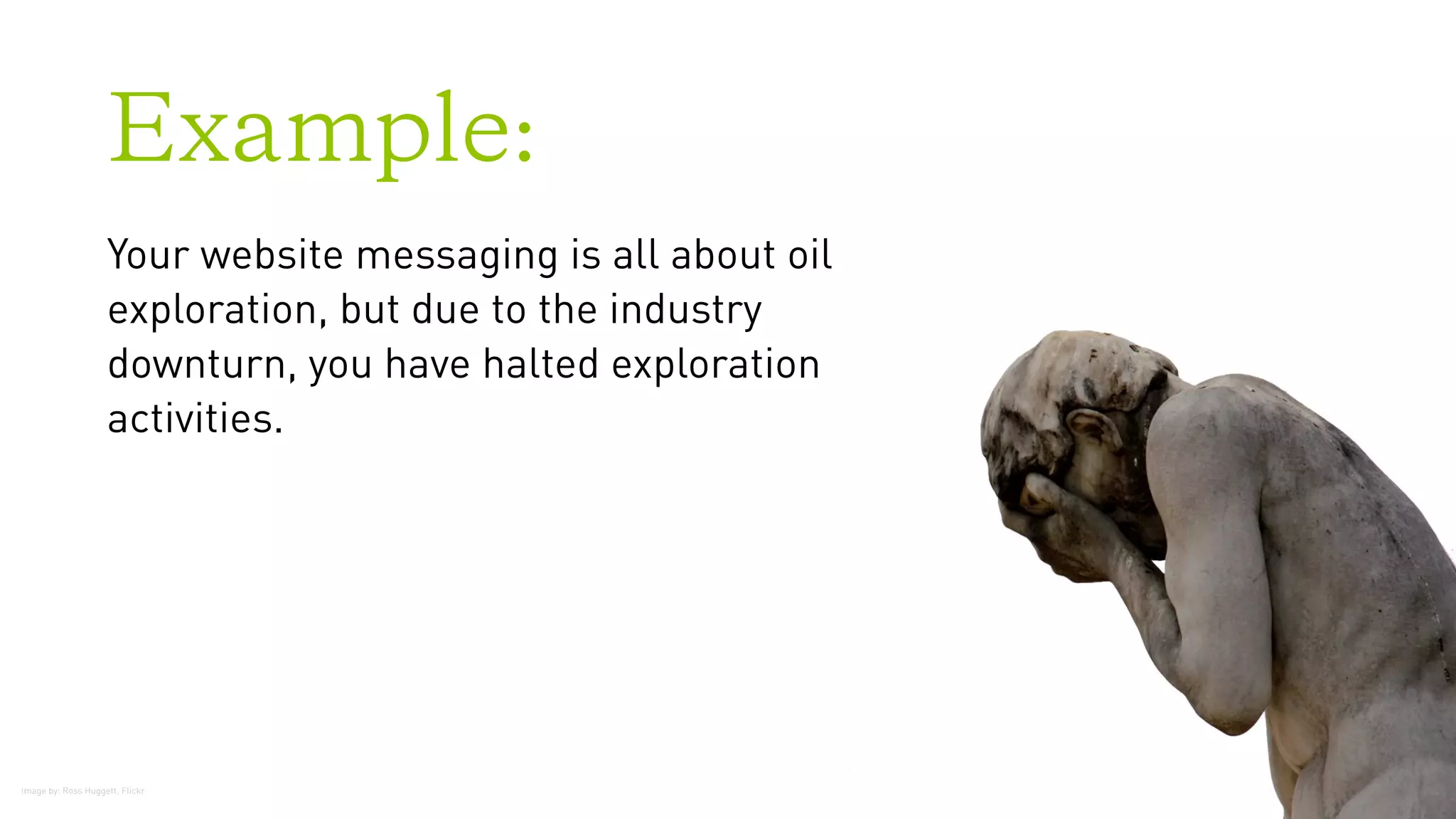
Example:
Your website messaging is all about oil
exploration, but due to the industry
downturn, you have halted exploration
activities.
Image by: Ross Huggett, Flickr
Skewed perception of

cost and value
Example:
Before turbulence hit, your client had
planned a large marketing campaign
launch. In light of recent layoffs, many
employees are now grumbling about the
expense of the campaign.
Image by: Leap Kye, Flickr
Image by: Mitchell Kohley, Flickr
How does it affect me
and my role?
Decreased marketing budget
What do I have to sacrifice?
How can I reprioritize my initiatives to get the most
impact?
Will I have enough people to get things done?
How can we expect to see an impact without my or my
clients’ full budget?
Reduced team
How do I move forward when resources I need are no
longer available to me?
How do I regain momentum?
All my advocates are gone or busy...who’s left to fight
my cause?
What if my main client contact is no longer there?
Increased need to prove your
value/ROI of your job
How do I keep proving marketing is worthwhile?
How do I move the needle?
What metrics can I track all by myself?
What is the most important ROI to track in this difficult
time?
Am I next?
Image by: cjuneau, Flickr
Get back on track.
Image by: Leonid Mamchenkov, Flickr
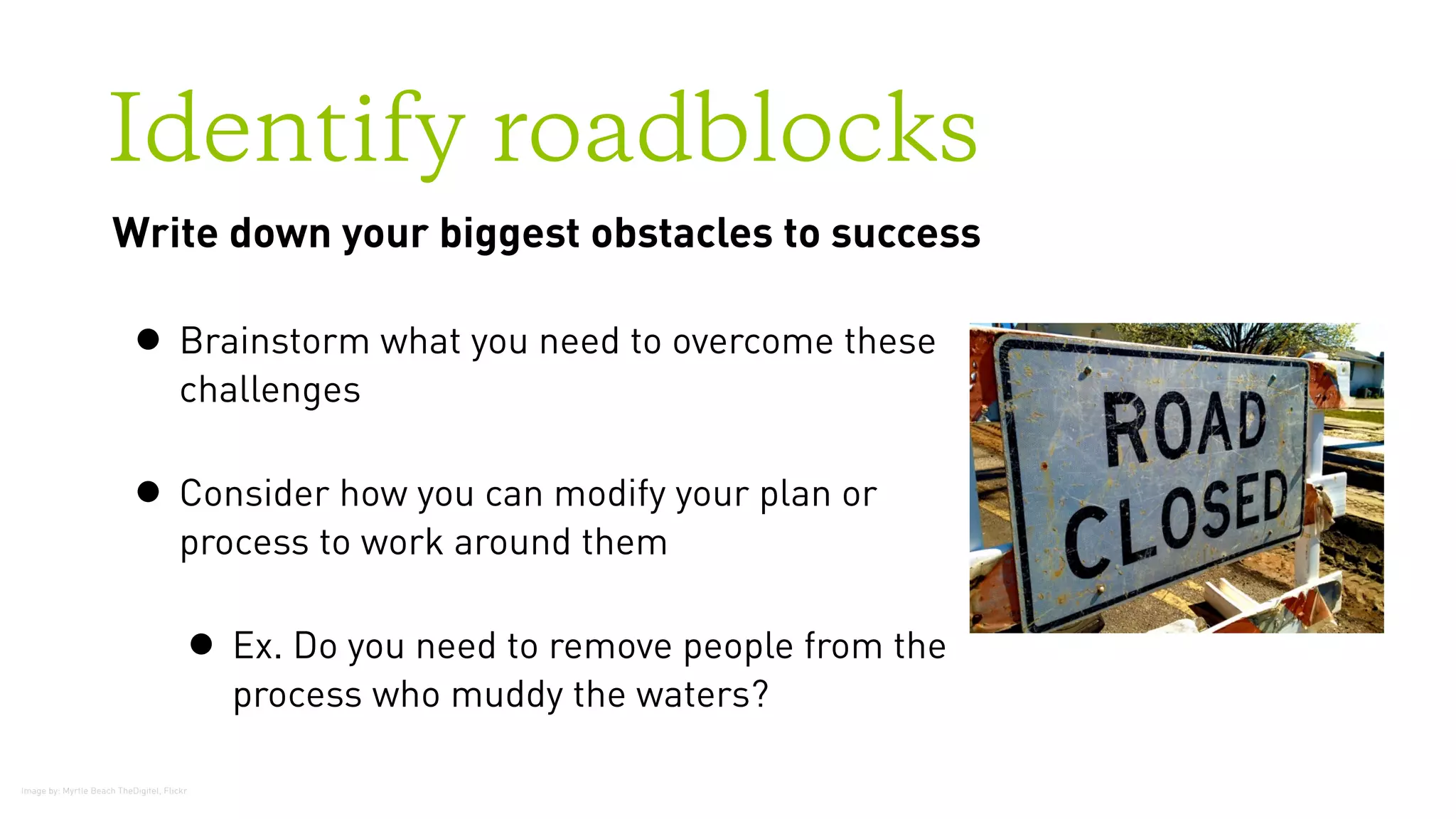
Identify roadblocks
Write down your biggest obstacles to success
• Brainstorm what you need to overcome these
challenges
• Consider how you can modify your plan or
process to work around them
• Ex. Do you need to remove people from the
process who muddy the waters?
Image by: Myrtle Beach TheDigitel, Flickr
Determine what needs to
happen to move forward
•Refine your marketing goals if necessary
•Don’t be afraid to scrap projects if the conditions
have changed and you need to reset — but give
yourself time to think about all the consequences
if you do
Take a realistic inventory
of your resources
• Determine which resources are still available to you
• Consider budget, people and time
• Identify remaining advocates for your marketing plan
(mentors, supervisors or project managers, etc.)
Learn to work more efficiently
•Investigate tools to bolster your efforts or crowdsource projects
•Turn to social media to leverage user-generated content
•Experiment with online tools to see if you can work more efficiently
•If possible, break larger projects down into more accomplishable
phases to reduce the strain on your resources
•Make progress while mapping out your plan for the next stage
Prioritize based on impact
and long term payoff
• Be careful not to cut back on small projects that seem like
distractions. They may impact the success of key initiatives
• Don’t make reactive choices based on short term resource issues
• Recognize areas where it would be more efficient to outsource
•Try to get the most life out of a single deliverable: Brainstorm how can
you repurpose, re-promote or templatize projects.
Examples
•Can you build just one landing page template that
will work for all your campaigns with only minor
copy and image changes?
•Instead of producing two blog posts a month, can
you cut back to one and focus more heavily on
content promotion?
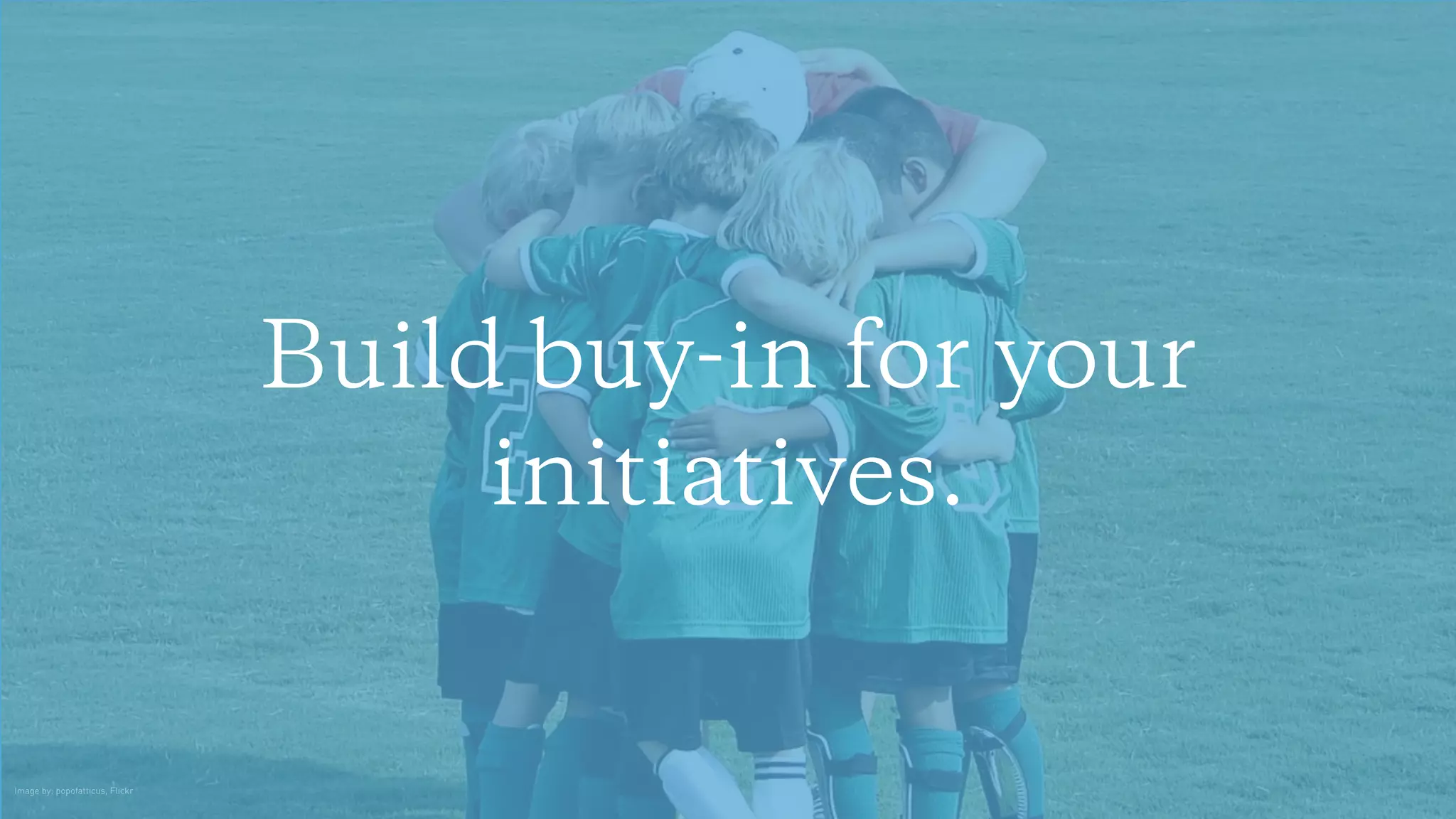
Build buy-in for your
initiatives.
Image by: popofatticus, Flickr
Trace the ROI of your
Marketing Plan
Business Objective
Marketing Strategy
Tactic
Take over the marketing world!
Build a visibility program
Start a breakfast event series
Formula Example
Business Objective
Marketing Strategy
Tactic
Take over the marketing world!
Build a visibility program
Start a breakfast event series
Formula Example
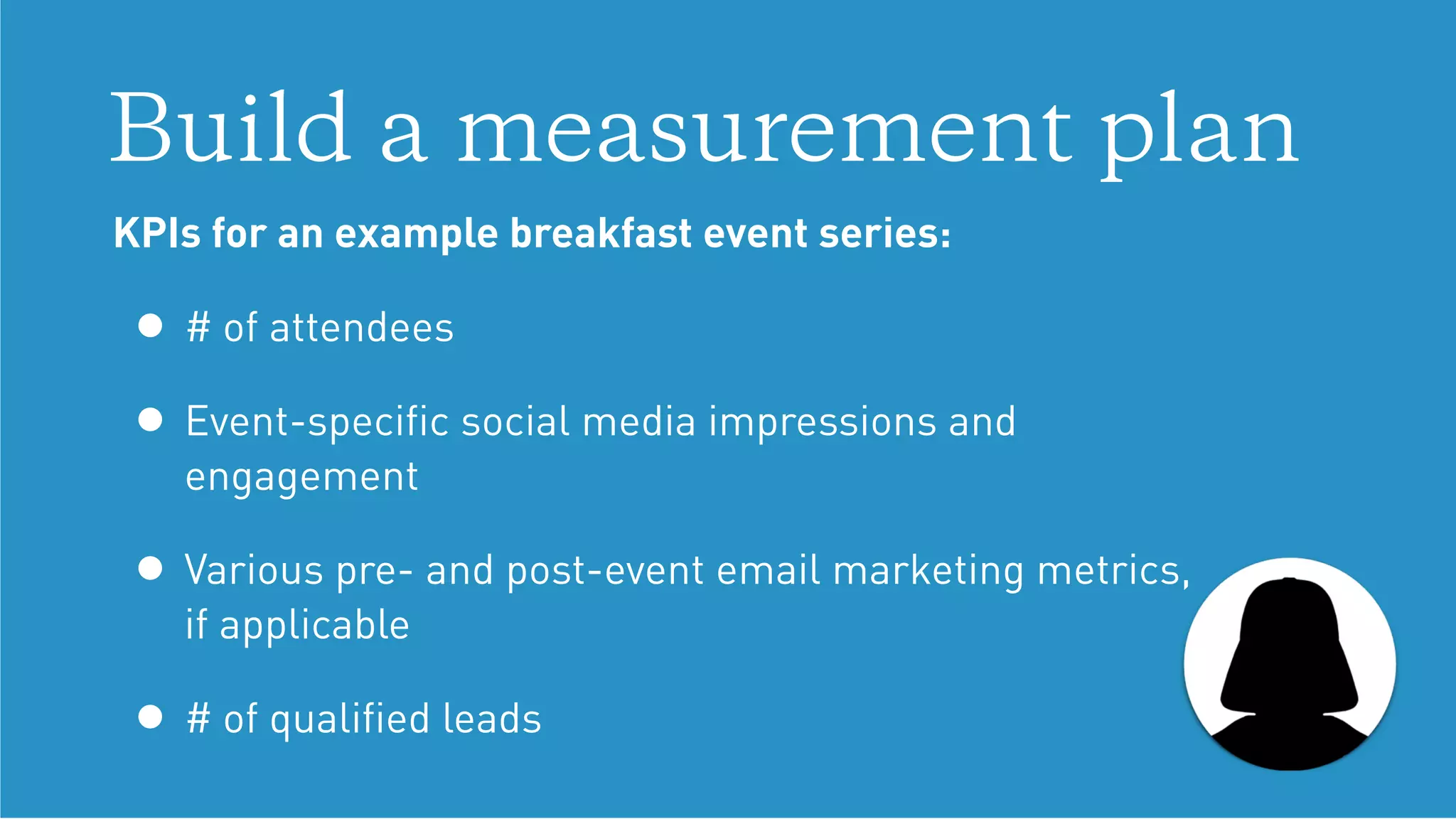
Build a measurement plan
KPIs for an example breakfast event series:
• # of attendees
• Event-specific social media impressions and
engagement
• Various pre- and post-event email marketing metrics, 

if applicable
• # of qualified leads
Report on your progress
• Create a reporting structure to stay accountable
and in touch with your boss
• Example: Schedule a monthly reporting
meeting
• Discuss next steps and recommendations, not
just metrics
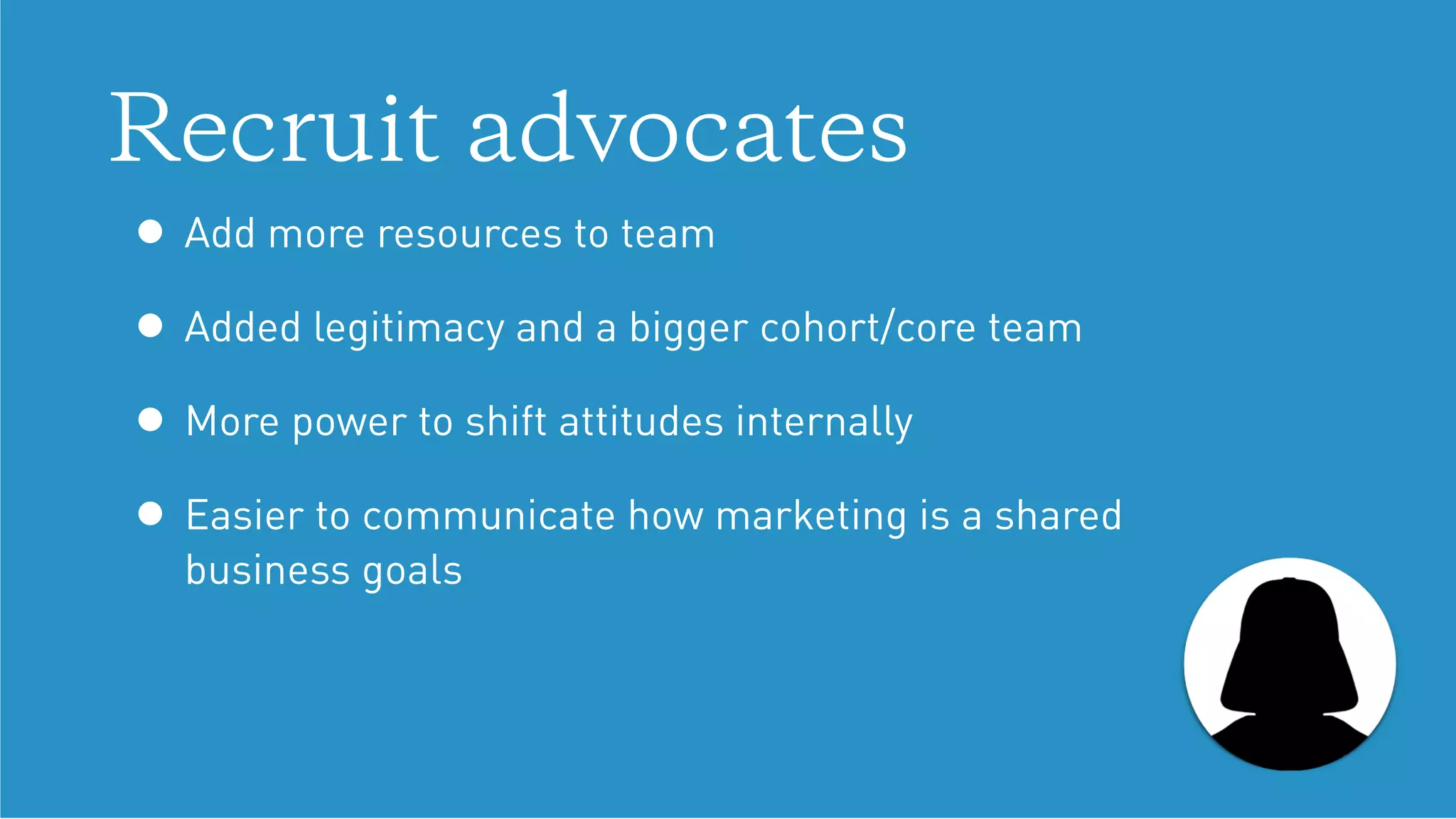
Recruit advocates
• Add more resources to team
• Added legitimacy and a bigger cohort/core team
• More power to shift attitudes internally
• Easier to communicate how marketing is a shared 

business goals
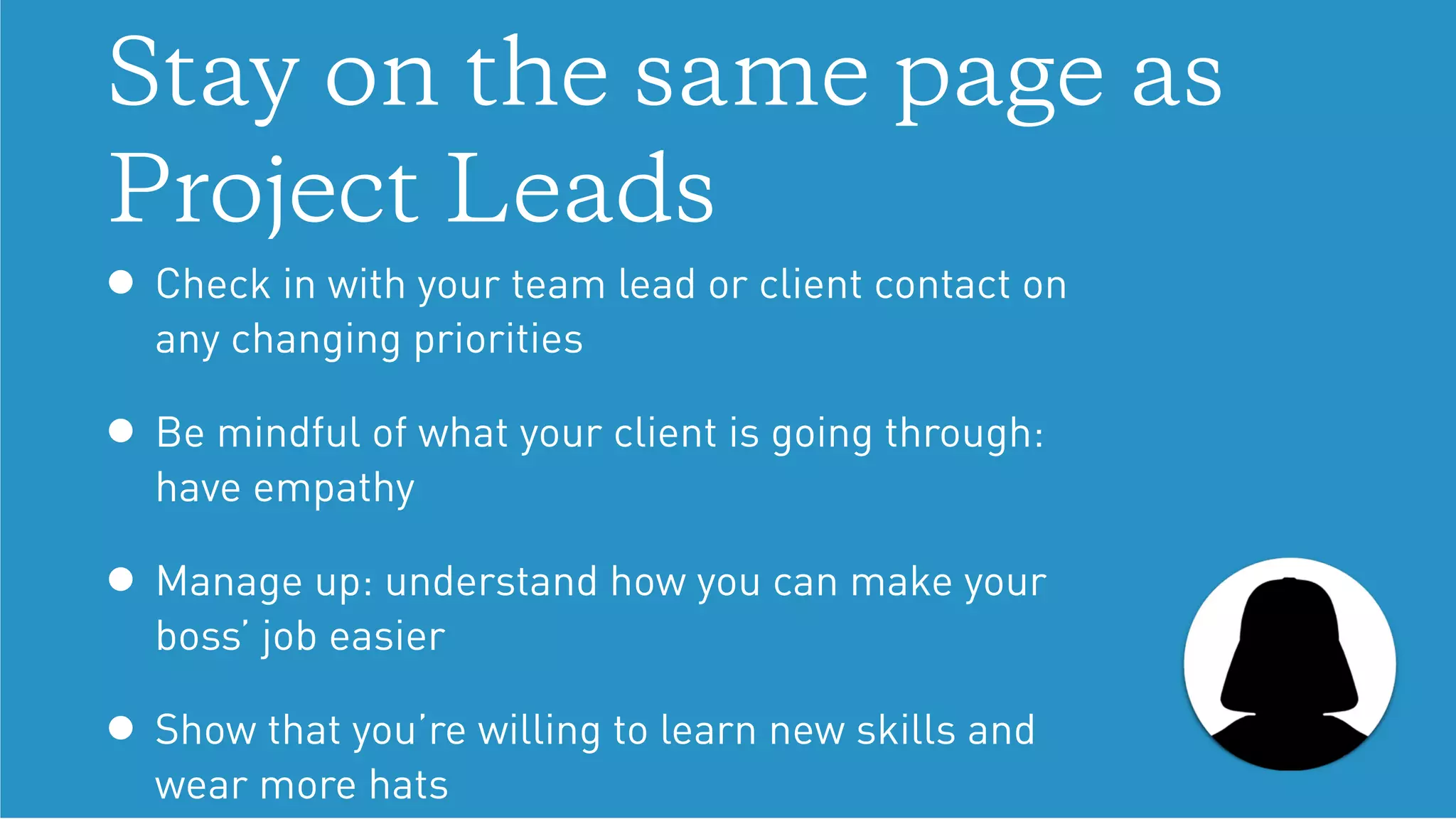
Stay on the same page as
Project Leads
• Check in with your team lead or client contact on
any changing priorities
• Be mindful of what your client is going through:
have empathy
• Manage up: understand how you can make your
boss’ job easier
• Show that you’re willing to learn new skills and
wear more hats
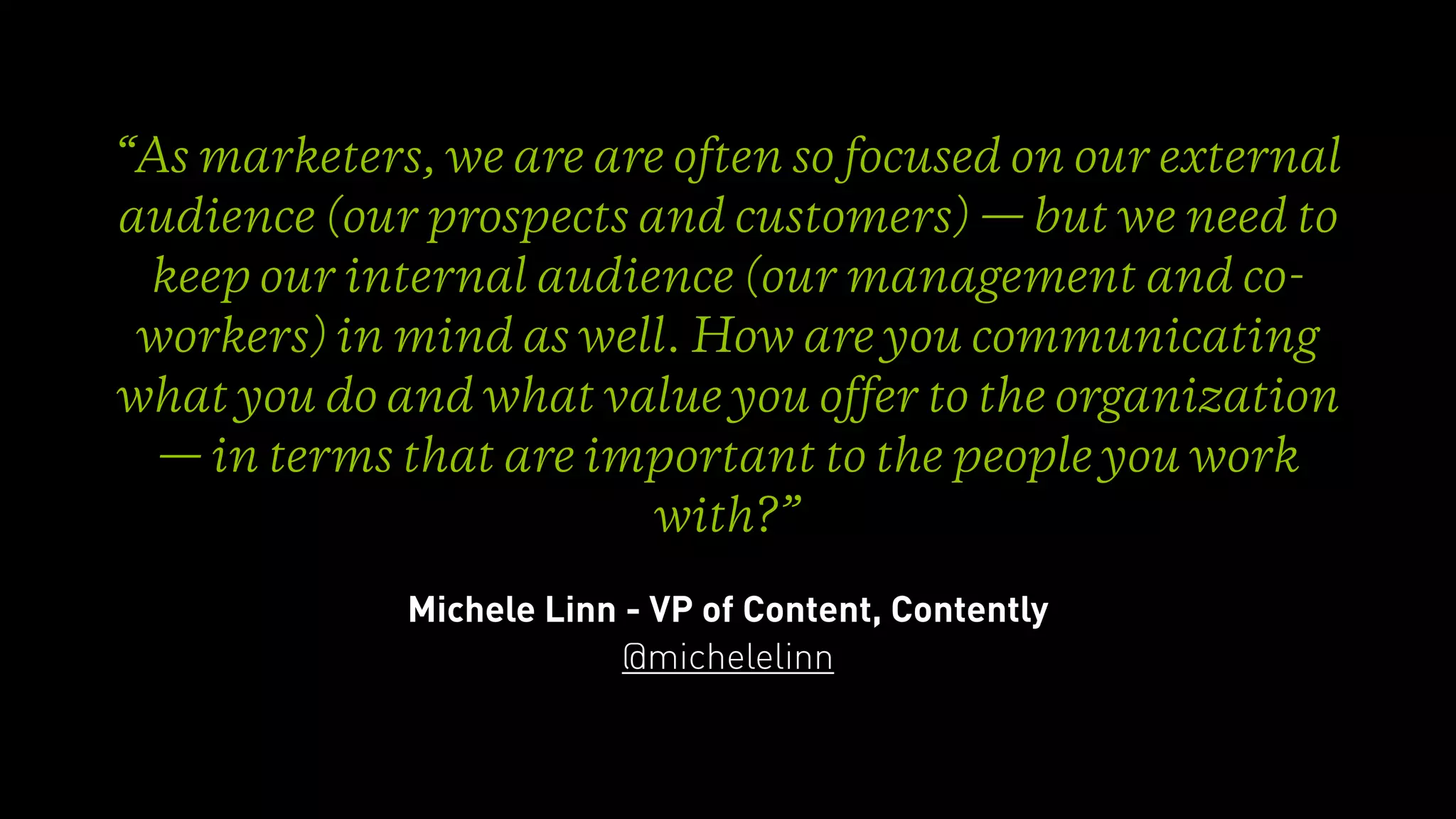
“As marketers, we are are often so focused on our external
audience (our prospects and customers) — but we need to
keep our internal audience (our management and co-
workers) in mind as well. How are you communicating
what you do and what value you offer to the organization
— in terms that are important to the people you work
with?”
Michele Linn - VP of Content, Contently
@michelelinn
Avoid traps.
Image by: royalty free, Flickr
Trap #1
During a turbulent period, you

(or your boss) may be tempted to

“lay low until the storm passes”
THIS IS THE TIME
FOR INCREASED
COMMUNICATION,
NOT LESS!
Image by: Evan Forester, Flickr
If you’re silent, clients and internal audiences will
look for information elsewhere.
You don’t want to look responsible for

lost sales or reduced confidence in your company
because you weren’t communicating.
Example:
A news outlet reports rumors that your
company is in a downward spiral. If you’ve
gone silent and have not communicated
assurance to prospective clients, they may
choose to partner with a competitor who
appears more stable.
Instead:
Emphasize the importance of remaining

pro-active with marketing.

Don’t let negative press or widespread

rumors fester.
Trap #2
Due to turbulence, you feel pressure to
make a change for the sake of change.
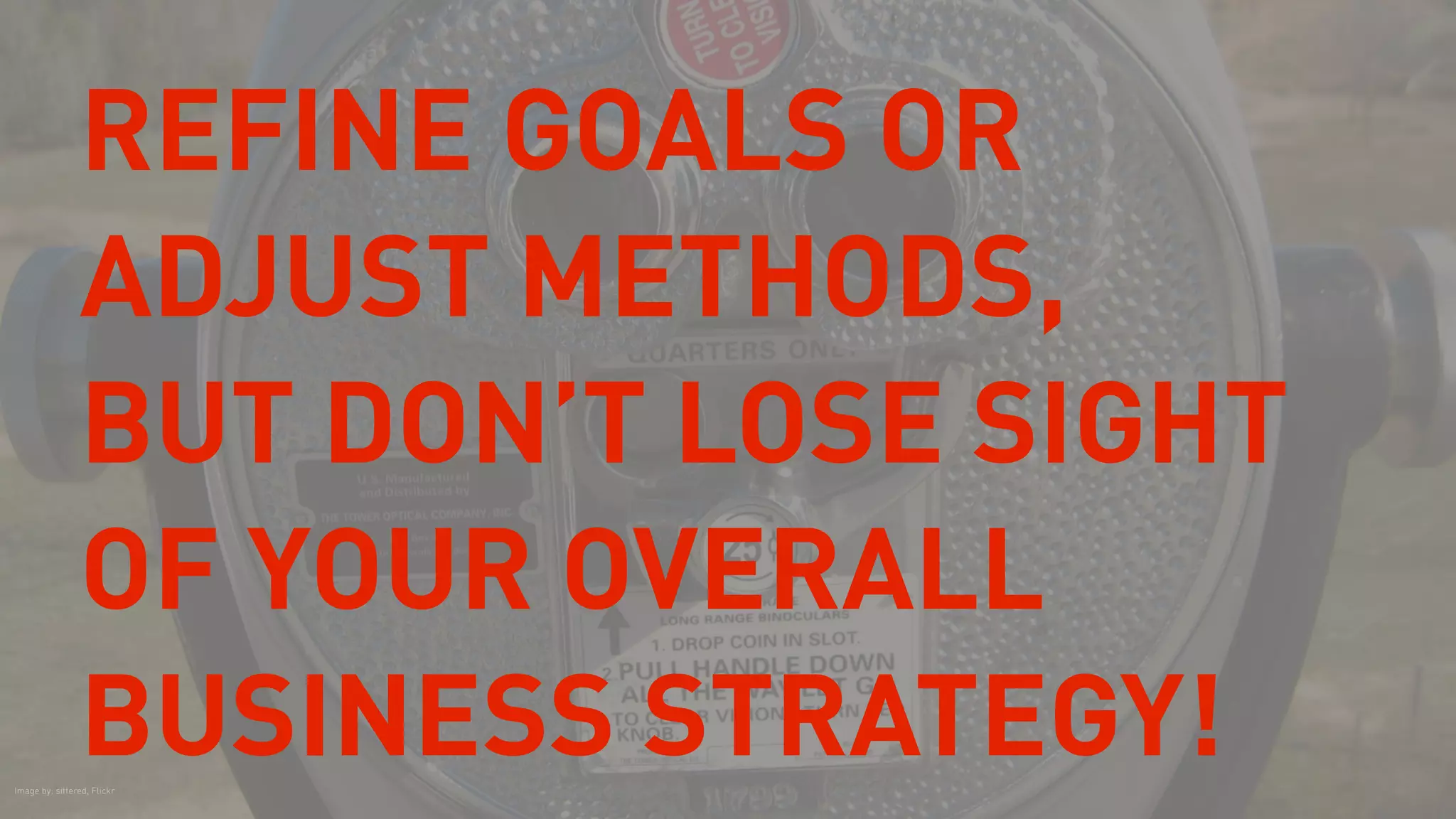
REFINE GOALS OR
ADJUST METHODS,
BUT DON’T LOSE SIGHT
OF YOUR OVERALL
BUSINESS STRATEGY!Image by: sittered, Flickr
Instead:
Look for opportunities, but don’t destroy
processes that still work just because you
panicked.

Beware changes not based on strategy:
If there’s no pay off towards your business
objectives, you’re just creating more work.
And remember…
THERE’S NO CRYING
IN BASEBALL.
Image by: TMAB2003, Flickr
“I have always been told to hope for the best, plan for the
worst, and always keep moving forward. Sometimes we
have to recognize that our projects might not be
recoverable, our boss might leave and you've lost your
internal advocate, or the business you are working for just
isn't working, and you get laid off. ”
John Doherty - Founder, Credo
@dohertyjf
“One of the best things young professionals can do is to
have side projects. I have talked to many hiring managers
who look for people who have outside passions to which
they can apply their marketing skills, such as writing a
blog, creating a video series and building an audience.
You are more valuable to your organization when they
know you have this kind of energy and skills.”
Michele Linn - VP of Content, Contently
@michelelinn
Further Reading
• The Role of Brand in a Downturn: Spotlight on
the Oil Industry
• How to Build ROI and Accountability into Your
Marketing Plan
Thank you.
If you want to learn more about Cynthia, Laura, and Caitlin, 

or BrandExtract, visit us at BrandExtract.com
Twitter: @BrandExtract

Lean Marketing Strategies: Adapt to Industry Turbulence

  • 1.
    Adapting to 
 IndustryTurbulence How to be a Lean Marketer in Any Environment
  • 2.
    What counts asturbulence for marketers? Image by:Tim Sackton, Flickr
  • 3.
  • 4.
    Example: Your client traditionallysponsors a big industry conference every year, but due to market conditions, their customers have cut conference attendance from their budgets. Image by: Dave Dugdale, Flickr
  • 5.
  • 6.
    Example: Your website messagingis all about oil exploration, but due to the industry downturn, you have halted exploration activities. Image by: Ross Huggett, Flickr
  • 7.
  • 8.
    Example: Before turbulence hit,your client had planned a large marketing campaign launch. In light of recent layoffs, many employees are now grumbling about the expense of the campaign. Image by: Leap Kye, Flickr
  • 9.
    Image by: MitchellKohley, Flickr How does it affect me and my role?
  • 10.
    Decreased marketing budget Whatdo I have to sacrifice? How can I reprioritize my initiatives to get the most impact? Will I have enough people to get things done? How can we expect to see an impact without my or my clients’ full budget?
  • 11.
    Reduced team How doI move forward when resources I need are no longer available to me? How do I regain momentum? All my advocates are gone or busy...who’s left to fight my cause? What if my main client contact is no longer there?
  • 12.
    Increased need toprove your value/ROI of your job How do I keep proving marketing is worthwhile? How do I move the needle? What metrics can I track all by myself? What is the most important ROI to track in this difficult time?
  • 13.
    Am I next? Imageby: cjuneau, Flickr
  • 14.
    Get back ontrack. Image by: Leonid Mamchenkov, Flickr
  • 15.
    Identify roadblocks Write downyour biggest obstacles to success • Brainstorm what you need to overcome these challenges • Consider how you can modify your plan or process to work around them • Ex. Do you need to remove people from the process who muddy the waters? Image by: Myrtle Beach TheDigitel, Flickr
  • 16.
    Determine what needsto happen to move forward •Refine your marketing goals if necessary •Don’t be afraid to scrap projects if the conditions have changed and you need to reset — but give yourself time to think about all the consequences if you do
  • 17.
    Take a realisticinventory of your resources • Determine which resources are still available to you • Consider budget, people and time • Identify remaining advocates for your marketing plan (mentors, supervisors or project managers, etc.)
  • 18.
    Learn to workmore efficiently •Investigate tools to bolster your efforts or crowdsource projects •Turn to social media to leverage user-generated content •Experiment with online tools to see if you can work more efficiently •If possible, break larger projects down into more accomplishable phases to reduce the strain on your resources •Make progress while mapping out your plan for the next stage
  • 19.
    Prioritize based onimpact and long term payoff • Be careful not to cut back on small projects that seem like distractions. They may impact the success of key initiatives • Don’t make reactive choices based on short term resource issues • Recognize areas where it would be more efficient to outsource •Try to get the most life out of a single deliverable: Brainstorm how can you repurpose, re-promote or templatize projects.
  • 20.
    Examples •Can you buildjust one landing page template that will work for all your campaigns with only minor copy and image changes? •Instead of producing two blog posts a month, can you cut back to one and focus more heavily on content promotion?
  • 21.
    Build buy-in foryour initiatives. Image by: popofatticus, Flickr
  • 22.
    Trace the ROIof your Marketing Plan
  • 23.
    Business Objective Marketing Strategy Tactic Takeover the marketing world! Build a visibility program Start a breakfast event series Formula Example
  • 24.
    Business Objective Marketing Strategy Tactic Takeover the marketing world! Build a visibility program Start a breakfast event series Formula Example
  • 25.
    Build a measurementplan KPIs for an example breakfast event series: • # of attendees • Event-specific social media impressions and engagement • Various pre- and post-event email marketing metrics, 
 if applicable • # of qualified leads
  • 26.
    Report on yourprogress • Create a reporting structure to stay accountable and in touch with your boss • Example: Schedule a monthly reporting meeting • Discuss next steps and recommendations, not just metrics
  • 27.
    Recruit advocates • Addmore resources to team • Added legitimacy and a bigger cohort/core team • More power to shift attitudes internally • Easier to communicate how marketing is a shared 
 business goals
  • 28.
    Stay on thesame page as Project Leads • Check in with your team lead or client contact on any changing priorities • Be mindful of what your client is going through: have empathy • Manage up: understand how you can make your boss’ job easier • Show that you’re willing to learn new skills and wear more hats
  • 29.
    “As marketers, weare are often so focused on our external audience (our prospects and customers) — but we need to keep our internal audience (our management and co- workers) in mind as well. How are you communicating what you do and what value you offer to the organization — in terms that are important to the people you work with?” Michele Linn - VP of Content, Contently @michelelinn
  • 30.
    Avoid traps. Image by:royalty free, Flickr
  • 31.
    Trap #1 During aturbulent period, you
 (or your boss) may be tempted to
 “lay low until the storm passes”
  • 32.
    THIS IS THETIME FOR INCREASED COMMUNICATION, NOT LESS! Image by: Evan Forester, Flickr
  • 33.
    If you’re silent,clients and internal audiences will look for information elsewhere. You don’t want to look responsible for
 lost sales or reduced confidence in your company because you weren’t communicating.
  • 34.
    Example: A news outletreports rumors that your company is in a downward spiral. If you’ve gone silent and have not communicated assurance to prospective clients, they may choose to partner with a competitor who appears more stable.
  • 35.
    Instead: Emphasize the importanceof remaining
 pro-active with marketing.
 Don’t let negative press or widespread
 rumors fester.
  • 36.
    Trap #2 Due toturbulence, you feel pressure to make a change for the sake of change.
  • 37.
    REFINE GOALS OR ADJUSTMETHODS, BUT DON’T LOSE SIGHT OF YOUR OVERALL BUSINESS STRATEGY!Image by: sittered, Flickr
  • 38.
    Instead: Look for opportunities,but don’t destroy processes that still work just because you panicked.
 Beware changes not based on strategy: If there’s no pay off towards your business objectives, you’re just creating more work.
  • 39.
  • 40.
    THERE’S NO CRYING INBASEBALL. Image by: TMAB2003, Flickr
  • 41.
    “I have alwaysbeen told to hope for the best, plan for the worst, and always keep moving forward. Sometimes we have to recognize that our projects might not be recoverable, our boss might leave and you've lost your internal advocate, or the business you are working for just isn't working, and you get laid off. ” John Doherty - Founder, Credo @dohertyjf
  • 42.
    “One of thebest things young professionals can do is to have side projects. I have talked to many hiring managers who look for people who have outside passions to which they can apply their marketing skills, such as writing a blog, creating a video series and building an audience. You are more valuable to your organization when they know you have this kind of energy and skills.” Michele Linn - VP of Content, Contently @michelelinn
  • 43.
    Further Reading • TheRole of Brand in a Downturn: Spotlight on the Oil Industry • How to Build ROI and Accountability into Your Marketing Plan
  • 44.
    Thank you. If youwant to learn more about Cynthia, Laura, and Caitlin, 
 or BrandExtract, visit us at BrandExtract.com Twitter: @BrandExtract