Adapting to Change: How to Accelerate ImpactJ. Rubiano1 S. Cook2, B. Douthwaite3, M.Rajasekaran2, V.Soto31 King’sCollege, University of London, jerubiano@gmail.com2 Basin Focal Project, CPWF3 International Center for Tropical Agriculture, CIAT, Colombia.2nd International Forum on Food and Water, Ethiopia 10th to 14th of November 2008
This analysis shows where local projects have regional or global potential to change the lives of millions.2nd International Forum on Food and Water, Ethiopia 10th to 14th of November 2008
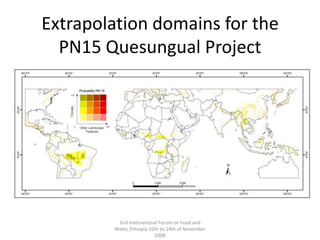
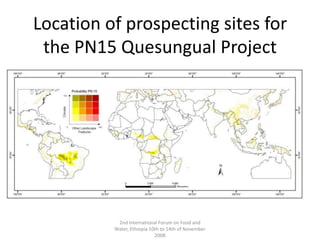
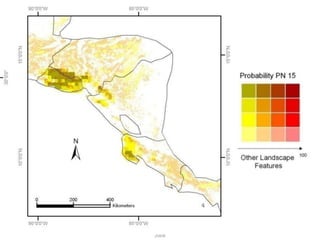
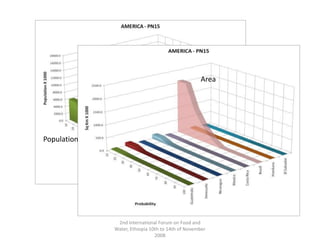
2nd International Forum on Food and Water, Ethiopia 10th to 14th of November 2008Extrapolation domains for the PN15 Quesungual Project
EDA2nd International Forum on Food and Water, Ethiopia 10th to 14th of November 2008
What is this work useful for?Assuming successful project interventions (technological/ institutional)To identify the potential for wide scale adoption (scaling out) and its impact while linked with Global (B&SEM) To link research with development  (partnerships) Add value to individual PNs’ and the CPWF Guide Investors (SDC, WB…etc…)2nd International Forum on Food and Water, Ethiopia 10th to 14th of November 2008
OutlineOverall conceptHow the method works?A graphical exampleAn example from a CPWF projectWhere to next?AssessmentRecomendations2nd International Forum on Food and Water, Ethiopia 10th to 14th of November 2008
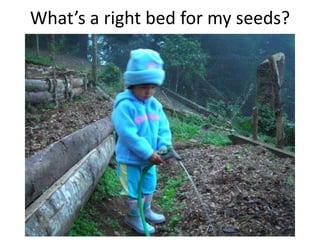
What’s a right bed for my seeds?2nd International Forum on Food and Water, Ethiopia 10th to 14th of November 2008
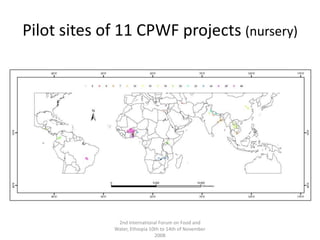
Pilot sites of 11 CPWF projects (nursery)2nd International Forum on Food and Water, Ethiopia 10th to 14th of November 2008
The extrapolation problemWhere else can we go with these projects?2nd International Forum on Food and Water, Ethiopia 10th to 14th of November 2008
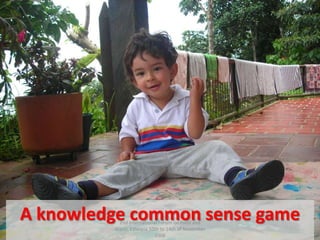
2nd International Forum on Food and Water, Ethiopia 10th to 14th of November 2008A knowledge common sense game2nd International Forum on Food and Water, Ethiopia 10th to 14th of November 2008
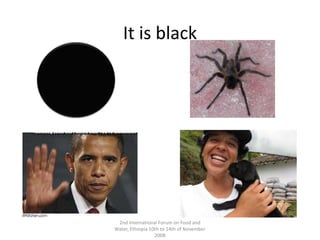
It is black2nd International Forum on Food and Water, Ethiopia 10th to 14th of November 2008
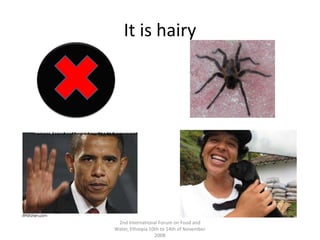
It is hairy2nd International Forum on Food and Water, Ethiopia 10th to 14th of November 2008
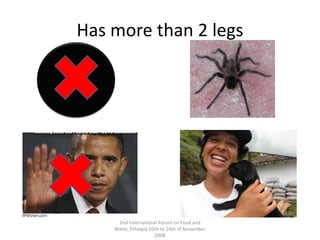
Has more than 2 legs2nd International Forum on Food and Water, Ethiopia 10th to 14th of November 2008
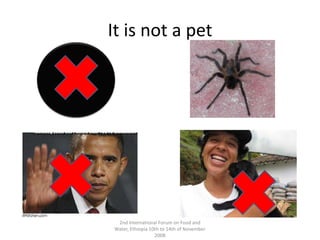
It is not a pet2nd International Forum on Food and Water, Ethiopia 10th to 14th of November 2008
2nd International Forum on Food and Water, Ethiopia 10th to 14th of November 2008
Back to the CPWFHow to realise about the potential of the CPWF projects?How to wisely use information?End of phase 1, 40+ CPWF funded projectsKnowledgeImproving our ability to adapt2nd International Forum on Food and Water, Ethiopia 10th to 14th of November 2008
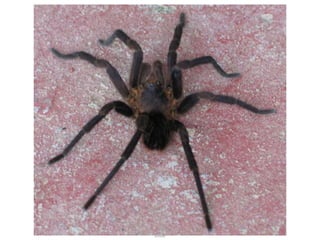
Use evidence and knowledge to estimate the likelihood  of an eventGiven an evidence…Black (one in four) - UncertainHairy (three in four) - MaybeHas more than three legs (two in four) - PerhapsIt’s not a pet (one in one) - CertainThe inference is a …2nd International Forum on Food and Water, Ethiopia 10th to 14th of November 2008
The extrapolation problem: Where else can we go with these projects?KnowledgeTell us factors are importantDataAbout the original and target locationAbout the distribution of important factorsA methodTo link these two components2nd International Forum on Food and Water, Ethiopia 10th to 14th of November 2008
How would I know a particular place is a good site for a project?From the project sites we know that particular factors are important for the project (e.g):Stony soilsMid altitude rangesLow to medium precipitationTechnical institutional supportPrevalence of povertyEtc…From spatial analysis we also know how important these factors are for the project2nd International Forum on Food and Water, Ethiopia 10th to 14th of November 2008
How to weight the contribution of each factor?2nd International Forum on Food and Water, Ethiopia 10th to 14th of November 2008
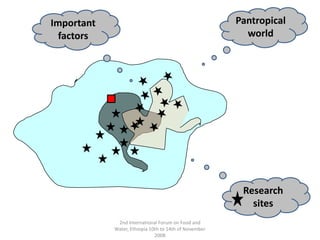
2nd International Forum on Food and Water, Ethiopia 10th to 14th of November 2008Pantropical worldImportant factorsResearch sites
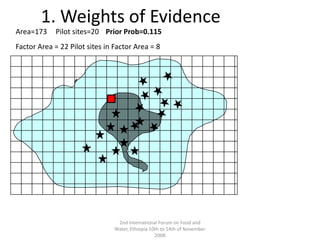
2nd International Forum on Food and Water, Ethiopia 10th to 14th of November 20081. Weights of EvidenceArea=173Pilot sites=20Prior Prob=0.115 Factor Area = 22 Pilot sites in Factor Area = 8
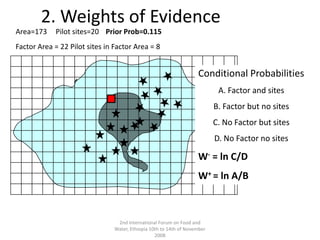
2nd International Forum on Food and Water, Ethiopia 10th to 14th of November 20082. Weights of EvidenceArea=173Pilot sites=20Prior Prob=0.115 Factor Area = 22 Pilot sites in Factor Area = 8Conditional ProbabilitiesA. Factor and sitesB. Factor but no sitesC. No Factor but sitesD. No Factor no sitesW- = ln C/DW+ = ln A/B
2nd International Forum on Food and Water, Ethiopia 10th to 14th of November 20084. Weights of EvidenceConditional ProbabilitiesA. Pattern and sites B. Pattern but no sites C. No pattern but sites D. No pattern no sitesW- = ln C/DW+ = ln A/BOdds Post = ln (Odds Prior + ∑(W+  +W-)Post Prob = Odds Post /(1+ Odds Post )Area=173Pilot sites=20Prior Prob=0.115 Evidential Pattern Area = 22 Pilot sites in Pattern = 8Test of Conditional Independence of the evidential layersPosterior Probability=0.14P(SjF1F2) =[P(F2jS) P(F1jS) P(S) ] / [P(F2) P(F1)]
How would I know a particular place is a good site for a project?Summarizing up to here….We use the contribution of each factor (positive and negative weights)Associate this information with the basic knowledge of the site (prior probability of pilot sites)Calculate a value per each potential new site (posterior probability)2nd International Forum on Food and Water, Ethiopia 10th to 14th of November 2008
How to read results?Check for total conditional independence and uncertaintyOrganised results in maps for dialogue with project team membersIterate after adjustmentsReview results to the light of complementary information2nd International Forum on Food and Water, Ethiopia 10th to 14th of November 2008
2nd International Forum on Food and Water, Ethiopia 10th to 14th of November 2008
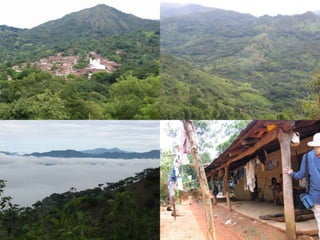
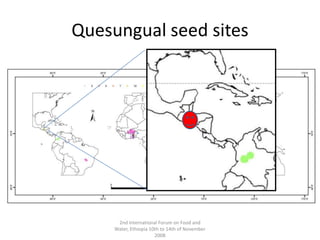
Quesungual seed sites2nd International Forum on Food and Water, Ethiopia 10th to 14th of November 2008
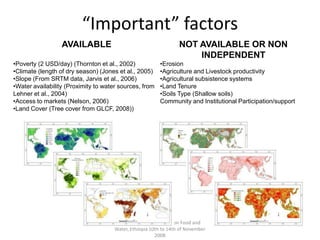
2nd International Forum on Food and Water, Ethiopia 10th to 14th of November 2008“Important” factorsAVAILABLEPoverty (2 USD/day) (Thornton et al., 2002)
Climate (length of dry season) (Jones et al., 2005)
Slope (From SRTM data, Jarvis et al., 2006)
Water availability (Proximity to water sources, from Lehner et al., 2004)
Access to markets (Nelson, 2006)
Land Cover (Tree cover from GLCF, 2008))NOT AVAILABLE OR NON INDEPENDENTErosion
Agriculture and Livestock productivity
Agricultural subsistence systems

Adapting to change

  • 1.
    Adapting to Change:How to Accelerate ImpactJ. Rubiano1 S. Cook2, B. Douthwaite3, M.Rajasekaran2, V.Soto31 King’sCollege, University of London, jerubiano@gmail.com2 Basin Focal Project, CPWF3 International Center for Tropical Agriculture, CIAT, Colombia.2nd International Forum on Food and Water, Ethiopia 10th to 14th of November 2008
  • 2.
    This analysis showswhere local projects have regional or global potential to change the lives of millions.2nd International Forum on Food and Water, Ethiopia 10th to 14th of November 2008
  • 3.
    2nd International Forumon Food and Water, Ethiopia 10th to 14th of November 2008Extrapolation domains for the PN15 Quesungual Project
  • 4.
    EDA2nd International Forumon Food and Water, Ethiopia 10th to 14th of November 2008
  • 5.
    What is thiswork useful for?Assuming successful project interventions (technological/ institutional)To identify the potential for wide scale adoption (scaling out) and its impact while linked with Global (B&SEM) To link research with development (partnerships) Add value to individual PNs’ and the CPWF Guide Investors (SDC, WB…etc…)2nd International Forum on Food and Water, Ethiopia 10th to 14th of November 2008
  • 6.
    OutlineOverall conceptHow themethod works?A graphical exampleAn example from a CPWF projectWhere to next?AssessmentRecomendations2nd International Forum on Food and Water, Ethiopia 10th to 14th of November 2008
  • 7.
    What’s a rightbed for my seeds?2nd International Forum on Food and Water, Ethiopia 10th to 14th of November 2008
  • 8.
    Pilot sites of11 CPWF projects (nursery)2nd International Forum on Food and Water, Ethiopia 10th to 14th of November 2008
  • 9.
    The extrapolation problemWhereelse can we go with these projects?2nd International Forum on Food and Water, Ethiopia 10th to 14th of November 2008
  • 10.
    2nd International Forumon Food and Water, Ethiopia 10th to 14th of November 2008A knowledge common sense game2nd International Forum on Food and Water, Ethiopia 10th to 14th of November 2008
  • 11.
    It is black2ndInternational Forum on Food and Water, Ethiopia 10th to 14th of November 2008
  • 12.
    It is hairy2ndInternational Forum on Food and Water, Ethiopia 10th to 14th of November 2008
  • 13.
    Has more than2 legs2nd International Forum on Food and Water, Ethiopia 10th to 14th of November 2008
  • 14.
    It is nota pet2nd International Forum on Food and Water, Ethiopia 10th to 14th of November 2008
  • 15.
    2nd International Forumon Food and Water, Ethiopia 10th to 14th of November 2008
  • 16.
    Back to theCPWFHow to realise about the potential of the CPWF projects?How to wisely use information?End of phase 1, 40+ CPWF funded projectsKnowledgeImproving our ability to adapt2nd International Forum on Food and Water, Ethiopia 10th to 14th of November 2008
  • 17.
    Use evidence andknowledge to estimate the likelihood of an eventGiven an evidence…Black (one in four) - UncertainHairy (three in four) - MaybeHas more than three legs (two in four) - PerhapsIt’s not a pet (one in one) - CertainThe inference is a …2nd International Forum on Food and Water, Ethiopia 10th to 14th of November 2008
  • 18.
    The extrapolation problem:Where else can we go with these projects?KnowledgeTell us factors are importantDataAbout the original and target locationAbout the distribution of important factorsA methodTo link these two components2nd International Forum on Food and Water, Ethiopia 10th to 14th of November 2008
  • 19.
    How would Iknow a particular place is a good site for a project?From the project sites we know that particular factors are important for the project (e.g):Stony soilsMid altitude rangesLow to medium precipitationTechnical institutional supportPrevalence of povertyEtc…From spatial analysis we also know how important these factors are for the project2nd International Forum on Food and Water, Ethiopia 10th to 14th of November 2008
  • 20.
    How to weightthe contribution of each factor?2nd International Forum on Food and Water, Ethiopia 10th to 14th of November 2008
  • 21.
    2nd International Forumon Food and Water, Ethiopia 10th to 14th of November 2008Pantropical worldImportant factorsResearch sites
  • 22.
    2nd International Forumon Food and Water, Ethiopia 10th to 14th of November 20081. Weights of EvidenceArea=173Pilot sites=20Prior Prob=0.115 Factor Area = 22 Pilot sites in Factor Area = 8
  • 23.
    2nd International Forumon Food and Water, Ethiopia 10th to 14th of November 20082. Weights of EvidenceArea=173Pilot sites=20Prior Prob=0.115 Factor Area = 22 Pilot sites in Factor Area = 8Conditional ProbabilitiesA. Factor and sitesB. Factor but no sitesC. No Factor but sitesD. No Factor no sitesW- = ln C/DW+ = ln A/B
  • 24.
    2nd International Forumon Food and Water, Ethiopia 10th to 14th of November 20084. Weights of EvidenceConditional ProbabilitiesA. Pattern and sites B. Pattern but no sites C. No pattern but sites D. No pattern no sitesW- = ln C/DW+ = ln A/BOdds Post = ln (Odds Prior + ∑(W+ +W-)Post Prob = Odds Post /(1+ Odds Post )Area=173Pilot sites=20Prior Prob=0.115 Evidential Pattern Area = 22 Pilot sites in Pattern = 8Test of Conditional Independence of the evidential layersPosterior Probability=0.14P(SjF1F2) =[P(F2jS) P(F1jS) P(S) ] / [P(F2) P(F1)]
  • 25.
    How would Iknow a particular place is a good site for a project?Summarizing up to here….We use the contribution of each factor (positive and negative weights)Associate this information with the basic knowledge of the site (prior probability of pilot sites)Calculate a value per each potential new site (posterior probability)2nd International Forum on Food and Water, Ethiopia 10th to 14th of November 2008
  • 26.
    How to readresults?Check for total conditional independence and uncertaintyOrganised results in maps for dialogue with project team membersIterate after adjustmentsReview results to the light of complementary information2nd International Forum on Food and Water, Ethiopia 10th to 14th of November 2008
  • 27.
    2nd International Forumon Food and Water, Ethiopia 10th to 14th of November 2008
  • 28.
    Quesungual seed sites2ndInternational Forum on Food and Water, Ethiopia 10th to 14th of November 2008
  • 29.
    2nd International Forumon Food and Water, Ethiopia 10th to 14th of November 2008“Important” factorsAVAILABLEPoverty (2 USD/day) (Thornton et al., 2002)
  • 30.
    Climate (length ofdry season) (Jones et al., 2005)
  • 31.
    Slope (From SRTMdata, Jarvis et al., 2006)
  • 32.
    Water availability (Proximityto water sources, from Lehner et al., 2004)
  • 33.
    Access to markets(Nelson, 2006)
  • 34.
    Land Cover (Treecover from GLCF, 2008))NOT AVAILABLE OR NON INDEPENDENTErosion
  • 35.
  • 36.