


parsonsbehle.com
June 16, 2022 | Marriott City Center Hotel
ADA, FMLA and Other Leave Essentials
Mark D. Tolman
801.536.6932
mtolman@parsonsbehle.com
2
This presentation is based on available information as of June 16,
2022, but everyone must understand that the information provided is
not a substitute for legal advice. This presentation is not intended and
will not serve as a substitute for legal counsel on these issues.
Legal Disclaimer
3
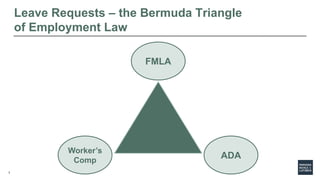
Leave Requests – the Bermuda Triangle
of Employment Law
FMLA
ADA
Worker’s
Comp
4
Family & Medical Leave Act (FMLA) in a Nutshell
 The FMLA requires that covered employers provide eligible
employees with unpaid, job-protected leave for specified family,
medical, and military reasons.
5
FMLA in a Nutshell
 What employers are covered under the FMLA?
 Which employees are eligible for FMLA leave?
 What are the family, medical, and military reasons that qualify for
leave?
 How much leave is required?
6
Covered Employers
 A private sector employer is covered by the FMLA IF:
o it employs 50 or more employees in 20 or more work weeks in the current
or previous calendar year.
o Note: The work weeks do not need to be consecutive.
7
Covered Employers
 Make sure you are counting employees correctly.
o All employees on your payroll in the United States or any US territory
(employees working outside the US do not count).
o All full-time, part-time, temporary, and seasonal employees.
o All employees on paid or unpaid leave, including suspensions, if you
reasonably expect that they’ll return to work.
8
Covered Employers
 A public sector employer is covered by the FMLA regardless of its
employee count.
 But note: public sector employees must meet the same eligibility
criteria as private sector employees. In other words, it is possible
that a small government employer that is covered by the FMLA will
have no FMLA-eligible employees.
9
What are the obligations of covered employers?
 Provide leave to eligible employees (including certain notices when
it learns of a need for an FMLA leave, which we’ll discuss in a
moment).
 Post the Department of Labor’s FMLA poster—in plain view where
all employees/applicants can see it.
 If the employer has an employee handbook, it must include an
FMLA notice in its handbook that includes the same basic
information as the FMLA poster.
10
Eligible Employees
 An employee of a covered employer (private or public sector) is
eligible for FMLA leave IF:
o they’ve worked for the covered employer for at least 12 months (need not
be consecutive);
o they’ve worked 1,250 hours during the 12-month period prior to the FMLA
leave start date; and
o they work within 75 miles of a worksite that employs at least 50
employees.
11
Qualifying Leave
 Eligible employees of a covered employer may take up to 12 weeks
of leave for the following qualifying reasons:
o Birth of a child (including for bonding time).
o Adoption or foster care of a child (including for bonding time).
o A serious health condition of the employee or the employee’s spouse,
child, or parent.
o A military exigency arising from the employee’s spouse, child, or parent’s
call to active-duty military status.
12
Serious Health Conditions
 Conditions requiring an overnight hospital stay.
 Conditions that incapacitate (e.g., unable to work, go to school, etc.)
for three or more consecutive days with ongoing medical treatment
(e.g., multiple medical appointments, or even a single doctor’s visit
coupled with follow up medical care like prescription medicine).
13
Serious Health Conditions
 Pregnancy conditions (including prenatal medical appointments,
incapacity due to morning sickness, required bed rest, etc.).
 Chronic conditions (e.g., diabetes, migraines, asthma) when the
employee sees a health care provider about it at least twice a year.
 Permanent or long-term conditions for which treatment is not
effective, provided that there is continuous supervision by a health
care provider.
14
Military Caregiver Leave
 Eligible employees of a covered employer may take up to 26 weeks
of leave in “a single 12-month period” to care for their spouse, child,
parent, or next of kin (i.e., the service member’s nearest blood
relative) if that family member is a military service member who
incurs a serious injury or illness in the line of duty on active duty.
15
Taking Leave: Calculating the 12-Month Leave Year
Eligible employees are entitled to up to 12 weeks of leave in a “leave
year.” Employers have a number of options for calculating the “leave
year.”
 Calendar year
 Fiscal year
 12 months measured forward from the first date an employee takes
FMLA leave.
 A rolling 12-month calendar measured backward from the date an
employee uses FMLA leave. Under this approach, each time an
employee takes FMLA leave, the remaining leave is the balance of the
12 weeks not used during the immediately preceding 12 months.
16
Taking Leave: Intermittent or Block Time
 FMLA leave may be taken in a block (e.g., 2, 4, 8, or 12 weeks at
once).
 FMLA leave may also be taken intermittently or on a reduced
schedule for serious health conditions or for military leave.
 Intermittent or reduced schedule leave is not available for birth,
adoption, or foster care issues (unless the employer agrees).
17
Taking Leave: Unpaid Leave/Benefits
 FMLA leave is unpaid.
o However, an employee may choose, or an employer may require, that
accrued paid leave run concurrently with the FMLA leave.
 Health insurance benefits must be maintained during an FMLA
leave.
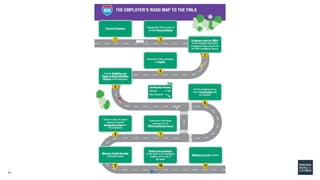
Department of Labor’s FMLA Road Map
The Employer’s Guide to the Family and Medical Leave Act
https://www.dol.gov/sites/dolgov/files/WHD/legacy/files/employerguide.pdf
19
20
Americans with Disabilities Act (ADA) a Nutshell
 The ADA require employers (with 15 or more employees) provide
equal employment opportunities in all terms and conditions of
employment to all qualified individuals with disabilities.
 This includes a prohibition against discriminating against an
applicant or employee because of a disability.
 And also requires employers to provide certain workplace
accommodations to disabled employees.
21
What Does “Disability” Mean Under the ADA?
 A “disability” under the ADA refers broadly to a physical or mental
impairment that substantially limits a major life activity (e.g.,
breathing, walking, hearing, seeing, communicating, bending, lifting,
learning, reading, concentrating, and working).
 The ADA also prohibits discrimination against those who are
perceived or “regarded as” disabled and who have a “record of” a
disability.
22
Disability is viewed expansively
 In its implementing ADA regulations, the federal Equal Employment
Opportunity Commission (EEOC) stated that “the primary object of
attention in cases brought under the ADA” is whether employers
have complied with their obligations to accommodate disabled
workers “and to convey that the question of whether an
individual’s impairment is a disability under the ADA should
not demand extensive analysis.”
23
Still, Not All Impairments are Disabilities
 The ADA does not apply to impairments that are temporary (lasting
less than six months) and minor.
 Examples of temporary and minor conditions that probably do not
qualify as a “disability” under the ADA include: colds, the flu, and a
sprained ankle.
24
Disability Accommodations
 Under the ADA, employers have a duty to provide reasonable
accommodations to remove workplace barriers for qualified
individuals with disabilities.
 Employers should engage employees (and their healthcare
providers when appropriate) in an “interactive process” to
determine if an accommodation works for the employee and
employer.
 Examples of accommodations: unpaid leave, job restructuring, part-
time or modified work schedules, acquiring or modifying equipment,
service/comfort animals, and (as a last resort) reassignment to a
vacant position.
25
How do you know when an employee might be
requesting a disability accommodation under the ADA?
 No magic words are required (e.g., they don’t have to say: “I’d like
an accommodation for a disability under the federal Americans with
Disabilities Act”).
 Instead, supervisors should be trained to listen for information that
suggests that the employee has a disability and may want
something to help them at work, e.g., “I’ve hurt my back, so it’s hard
for me to do my job.”
26
Sometimes accommodations make other
employees mad.
 The U.S. Supreme Court has said, “by definition any special
‘accommodation’ requires the employer to treat an employee with a
disability differently, i.e., preferentially.”
 What may an employer say to a disabled employee’s coworker who
thinks its unfair that their coworkers has received an accommodation that
they have not received?
o Do NOT tell them that the employee is disabled or needs an ADA accommodation.
The ADA prohibits employers from disclosing disability and other health
information. And stating that an employee has received an ADA accommodation
implies that the employee has a disability.
o EEOC has explained what an employer may say in such situations: “We are acting
for legitimate business reasons or in compliance with federal law.”
27
An employer may deny a disabled employee’s
requested accommodation when:
 The employee is seeking to be excused from an essential job
function.
 The accommodation is unreasonable or imposes an undue
hardship.
 You found an alternative accommodation that works (an
employee is not entitled to their preferred accommodation, if
something else also will work).
28
Workers Compensation in a Nutshell
 Worker’s compensation insurance provides no-fault benefits to
employees for workplace illnesses and injuries.
 In Utah, all employers (regardless of employee headcount) must
obtain workers compensation insurance for their employee(s), or
work with the State to become self-insured.
 In Utah, worker’s compensation benefits are the exclusive remedy
for all workplace illnesses and injuries.
29
Workers Compensation: Common Problems
 Form Failures: an employer must complete an “Employers First Report of
Injury or Illness Form,” and provide that form to its insurance carrier and its
employee, within 7 days of the injury or illness.
 Misclassification: Workers compensation need only be provided for
employees, and not independent contractors. So problems (and audits) arise
when employers misclassify employees as contractors.
 Wrongful Termination Lawsuits: employees may sue their employers in Utah
for “termination against public policy,” an exception to the at-will employment
doctrine. A common fact pattern in such cases is an employee who alleges
that their employer terminated them in retaliation for reporting a workplace
injury and/or for seeking workers compensation benefits.
The Bermuda Triangle of HR Law:
Balancing leave rights under the FMLA,
ADA, and Workers Compensation Laws
31
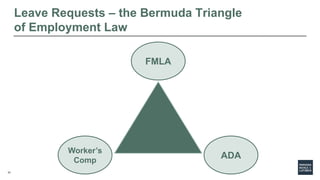
Leave Requests – the Bermuda Triangle
of Employment Law
FMLA
ADA
Worker’s
Comp
32
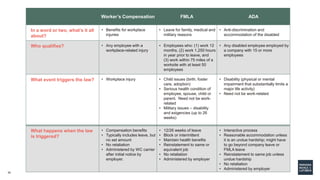
Worker’s Compensation FMLA ADA
In a word or two, what’s it all
about?
• Benefits for workplace
injuries
• Leave for family, medical and
military reasons
• Anti-discrimination and
accommodation of the disabled
Who qualifies? • Any employee with a
workplace-related injury
• Employees who: (1) work 12
months, (2) work 1,250 hours
in year prior to leave, and
(3) work within 75 miles of a
worksite with at least 50
employees
• Any disabled employee employed by
a company with 15 or more
employees
What event triggers the law? • Workplace injury • Child issues (birth, foster
care, adoption)
• Serious health condition of
employee, spouse, child or
parent. Need not be work-
related
• Military issues – disability
and exigencies (up to 26
weeks)
• Disability (physical or mental
impairment that substantially limits a
major life activity)
• Need not be work-related
What happens when the law
is triggered?
• Compensation benefits
• Typically includes leave, but
no set amount
• No retaliation
• Administered by WC carrier
after initial notice by
employer.
• 12/26 weeks of leave
• Block or intermittent
• Maintain health benefits
• Reinstatement to same or
equivalent job
• No retaliation
• Administered by employer
• Interactive process
• Reasonable accommodation unless
it is an undue hardship; might have
to go beyond company leave or
FMLA leave
• Reinstatement to same job unless
undue hardship
• No retaliation
• Administered by employer
33
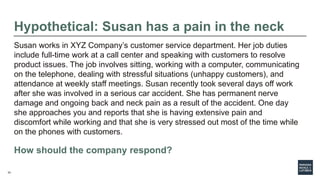
Hypothetical: Susan has a pain in the neck
Susan works in XYZ Company’s customer service department. Her job duties
include full-time work at a call center and speaking with customers to resolve
product issues. The job involves sitting, working with a computer, communicating
on the telephone, dealing with stressful situations (unhappy customers), and
attendance at weekly staff meetings. Susan recently took several days off work
after she was involved in a serious car accident. She has permanent nerve
damage and ongoing back and neck pain as a result of the accident. One day
she approaches you and reports that she is having extensive pain and
discomfort while working and that she is very stressed out most of the time while
on the phones with customers.
How should the company respond?
34
Hypothetical: Susan has a pain in the neck
 Step one: ask how can I help you?
 Step two: involve HR immediately to ensure a consistent approach.
 Step three: put on your three hats.
o Verify injury is not work related (i.e., eliminate workers compensation).
o Susan’s condition is likely a “serious health condition,” so discuss FMLA
options.
o Susan’s condition also is likely a “disability,” so engage in the “interactive
process.”
35
Hypothetical: Susan has a pain in the neck
 Susan is granted 12 weeks of continuous leave under the FMLA,
but is unable to return to work at the expiration of 12 weeks of
leave. May an employer deny Susan additional leave?
 It depends! Susan may be entitled to additional leave under the
ADA if such leave is reasonable and does not impose an undue
hardship.
o Indefinite leave is generally “unreasonable” and therefore not required
under the ADA.
o Extended, multi-month leave also is generally not required within the Tenth
Circuit. But note, not all courts agree (e.g., the Ninth Circuit) and the EEOC
also believes an individual, fact-specific inquiry is required even for an
extended (i.e., lengthy) leave request.
Policy Considerations Arising from the ADA,
FMLA, and Workers’ Compensation Laws
37
Policy Considerations - ADA
 If your company has at least 15 employees, an ADA policy is critical. Your policy
should clearly instruct employees that (a) reasonable accommodations will be
provided to qualified individuals with disabilities if the company can do so without an
undue hardship, and (b) how (and to whom) an accommodation request should be
made.
 In Utah, your ADA policy also must include a statement that reasonable
accommodations will be provided for employees arising from limitations related to
pregnancy, childbirth, breastfeeding, or related conditions.
o Example: The Company does not discriminate based on pregnancy, childbirth, breastfeeding, or
related conditions. Employees who are pregnant, are breastfeeding, or have other conditions related
to pregnancy and childbirth may require some accommodations at work. The Company may require a
medical certification from the employee’s health care provider concerning the need for such
accommodation. However, the Company will not require a medical certification for when an
employee needs more frequent restroom, food, or water breaks due to pregnancy or breastfeeding.
Employees who require accommodations for pregnancy, breastfeeding or related conditions should
contact Human Resources.
38
Policy Considerations - FMLA
 FMLA-covered employers must post the U.S. Department of Labor’s FMLA
poster in a conspicuous place. You’ll find the DOL poster at
www.dol.gov/agencies/whd/fmla/posters.
 AND if the employer maintains a handbook, that handbook must contain an
FMLA policy (which should be similar to, if not a verbatim recitation of, the DOL
poster).
 Remember, an employer is covered under the FMLA if it has 50 or employees
on 20 workweeks in the current or preceding year. This means that if an
employer’s twentieth workweek of 50 employees occurs in December 2021, its
FMLA coverage backdates to January 1, 2021. In other words, your
obligation to hang the DOL’s FMLA poster and to update your handbook
(and to otherwise comply with the FMLA), likely is triggered well before
you satisfy the 50 employees in 20 workweeks requirement.
39
Policy Considerations - Workers Comp.
 In Utah, employers must post a notice that it is compliant with the state’s
workers’ compensation laws. We recommend that you place this notice in your
handbook, in addition to posting it someplace conspicuous at the worksite (e.g.,
a breakroom). You’ll find this notice on the Utah Labor Commission’s website at
www.laborcommission.Utah.gov/divisions/industrial-accidents/resources/.
 Your policy (and training) should include clear instructions to managers and
supervisors that they must immediately report workplace injuries and illnesses
to HR (so that you’ll be able to comply with the seven-day deadline to complete
the “Employers First Report of Injury or Illness Form”).
Questions?
Thank You
To download a PDF handbook of today’s seminar,
including presentations and materials, please visit
parsonsbehle.com/emp-seminar
42
For more information, contact:
Mark D. Tolman
801.536.6932
mtolman@parsonsbehle.com

ADA, FMLA and Other Leave Essentials

  • 1.
    parsonsbehle.com June 16, 2022| Marriott City Center Hotel ADA, FMLA and Other Leave Essentials Mark D. Tolman 801.536.6932 mtolman@parsonsbehle.com
  • 2.
    2 This presentation isbased on available information as of June 16, 2022, but everyone must understand that the information provided is not a substitute for legal advice. This presentation is not intended and will not serve as a substitute for legal counsel on these issues. Legal Disclaimer
  • 3.
    3 Leave Requests –the Bermuda Triangle of Employment Law FMLA ADA Worker’s Comp
  • 4.
    4 Family & MedicalLeave Act (FMLA) in a Nutshell  The FMLA requires that covered employers provide eligible employees with unpaid, job-protected leave for specified family, medical, and military reasons.
  • 5.
    5 FMLA in aNutshell  What employers are covered under the FMLA?  Which employees are eligible for FMLA leave?  What are the family, medical, and military reasons that qualify for leave?  How much leave is required?
  • 6.
    6 Covered Employers  Aprivate sector employer is covered by the FMLA IF: o it employs 50 or more employees in 20 or more work weeks in the current or previous calendar year. o Note: The work weeks do not need to be consecutive.
  • 7.
    7 Covered Employers  Makesure you are counting employees correctly. o All employees on your payroll in the United States or any US territory (employees working outside the US do not count). o All full-time, part-time, temporary, and seasonal employees. o All employees on paid or unpaid leave, including suspensions, if you reasonably expect that they’ll return to work.
  • 8.
    8 Covered Employers  Apublic sector employer is covered by the FMLA regardless of its employee count.  But note: public sector employees must meet the same eligibility criteria as private sector employees. In other words, it is possible that a small government employer that is covered by the FMLA will have no FMLA-eligible employees.
  • 9.
    9 What are theobligations of covered employers?  Provide leave to eligible employees (including certain notices when it learns of a need for an FMLA leave, which we’ll discuss in a moment).  Post the Department of Labor’s FMLA poster—in plain view where all employees/applicants can see it.  If the employer has an employee handbook, it must include an FMLA notice in its handbook that includes the same basic information as the FMLA poster.
  • 10.
    10 Eligible Employees  Anemployee of a covered employer (private or public sector) is eligible for FMLA leave IF: o they’ve worked for the covered employer for at least 12 months (need not be consecutive); o they’ve worked 1,250 hours during the 12-month period prior to the FMLA leave start date; and o they work within 75 miles of a worksite that employs at least 50 employees.
  • 11.
    11 Qualifying Leave  Eligibleemployees of a covered employer may take up to 12 weeks of leave for the following qualifying reasons: o Birth of a child (including for bonding time). o Adoption or foster care of a child (including for bonding time). o A serious health condition of the employee or the employee’s spouse, child, or parent. o A military exigency arising from the employee’s spouse, child, or parent’s call to active-duty military status.
  • 12.
    12 Serious Health Conditions Conditions requiring an overnight hospital stay.  Conditions that incapacitate (e.g., unable to work, go to school, etc.) for three or more consecutive days with ongoing medical treatment (e.g., multiple medical appointments, or even a single doctor’s visit coupled with follow up medical care like prescription medicine).
  • 13.
    13 Serious Health Conditions Pregnancy conditions (including prenatal medical appointments, incapacity due to morning sickness, required bed rest, etc.).  Chronic conditions (e.g., diabetes, migraines, asthma) when the employee sees a health care provider about it at least twice a year.  Permanent or long-term conditions for which treatment is not effective, provided that there is continuous supervision by a health care provider.
  • 14.
    14 Military Caregiver Leave Eligible employees of a covered employer may take up to 26 weeks of leave in “a single 12-month period” to care for their spouse, child, parent, or next of kin (i.e., the service member’s nearest blood relative) if that family member is a military service member who incurs a serious injury or illness in the line of duty on active duty.
  • 15.
    15 Taking Leave: Calculatingthe 12-Month Leave Year Eligible employees are entitled to up to 12 weeks of leave in a “leave year.” Employers have a number of options for calculating the “leave year.”  Calendar year  Fiscal year  12 months measured forward from the first date an employee takes FMLA leave.  A rolling 12-month calendar measured backward from the date an employee uses FMLA leave. Under this approach, each time an employee takes FMLA leave, the remaining leave is the balance of the 12 weeks not used during the immediately preceding 12 months.
  • 16.
    16 Taking Leave: Intermittentor Block Time  FMLA leave may be taken in a block (e.g., 2, 4, 8, or 12 weeks at once).  FMLA leave may also be taken intermittently or on a reduced schedule for serious health conditions or for military leave.  Intermittent or reduced schedule leave is not available for birth, adoption, or foster care issues (unless the employer agrees).
  • 17.
    17 Taking Leave: UnpaidLeave/Benefits  FMLA leave is unpaid. o However, an employee may choose, or an employer may require, that accrued paid leave run concurrently with the FMLA leave.  Health insurance benefits must be maintained during an FMLA leave.
  • 18.
    Department of Labor’sFMLA Road Map The Employer’s Guide to the Family and Medical Leave Act https://www.dol.gov/sites/dolgov/files/WHD/legacy/files/employerguide.pdf
  • 19.
  • 20.
    20 Americans with DisabilitiesAct (ADA) a Nutshell  The ADA require employers (with 15 or more employees) provide equal employment opportunities in all terms and conditions of employment to all qualified individuals with disabilities.  This includes a prohibition against discriminating against an applicant or employee because of a disability.  And also requires employers to provide certain workplace accommodations to disabled employees.
  • 21.
    21 What Does “Disability”Mean Under the ADA?  A “disability” under the ADA refers broadly to a physical or mental impairment that substantially limits a major life activity (e.g., breathing, walking, hearing, seeing, communicating, bending, lifting, learning, reading, concentrating, and working).  The ADA also prohibits discrimination against those who are perceived or “regarded as” disabled and who have a “record of” a disability.
  • 22.
    22 Disability is viewedexpansively  In its implementing ADA regulations, the federal Equal Employment Opportunity Commission (EEOC) stated that “the primary object of attention in cases brought under the ADA” is whether employers have complied with their obligations to accommodate disabled workers “and to convey that the question of whether an individual’s impairment is a disability under the ADA should not demand extensive analysis.”
  • 23.
    23 Still, Not AllImpairments are Disabilities  The ADA does not apply to impairments that are temporary (lasting less than six months) and minor.  Examples of temporary and minor conditions that probably do not qualify as a “disability” under the ADA include: colds, the flu, and a sprained ankle.
  • 24.
    24 Disability Accommodations  Underthe ADA, employers have a duty to provide reasonable accommodations to remove workplace barriers for qualified individuals with disabilities.  Employers should engage employees (and their healthcare providers when appropriate) in an “interactive process” to determine if an accommodation works for the employee and employer.  Examples of accommodations: unpaid leave, job restructuring, part- time or modified work schedules, acquiring or modifying equipment, service/comfort animals, and (as a last resort) reassignment to a vacant position.
  • 25.
    25 How do youknow when an employee might be requesting a disability accommodation under the ADA?  No magic words are required (e.g., they don’t have to say: “I’d like an accommodation for a disability under the federal Americans with Disabilities Act”).  Instead, supervisors should be trained to listen for information that suggests that the employee has a disability and may want something to help them at work, e.g., “I’ve hurt my back, so it’s hard for me to do my job.”
  • 26.
    26 Sometimes accommodations makeother employees mad.  The U.S. Supreme Court has said, “by definition any special ‘accommodation’ requires the employer to treat an employee with a disability differently, i.e., preferentially.”  What may an employer say to a disabled employee’s coworker who thinks its unfair that their coworkers has received an accommodation that they have not received? o Do NOT tell them that the employee is disabled or needs an ADA accommodation. The ADA prohibits employers from disclosing disability and other health information. And stating that an employee has received an ADA accommodation implies that the employee has a disability. o EEOC has explained what an employer may say in such situations: “We are acting for legitimate business reasons or in compliance with federal law.”
  • 27.
    27 An employer maydeny a disabled employee’s requested accommodation when:  The employee is seeking to be excused from an essential job function.  The accommodation is unreasonable or imposes an undue hardship.  You found an alternative accommodation that works (an employee is not entitled to their preferred accommodation, if something else also will work).
  • 28.
    28 Workers Compensation ina Nutshell  Worker’s compensation insurance provides no-fault benefits to employees for workplace illnesses and injuries.  In Utah, all employers (regardless of employee headcount) must obtain workers compensation insurance for their employee(s), or work with the State to become self-insured.  In Utah, worker’s compensation benefits are the exclusive remedy for all workplace illnesses and injuries.
  • 29.
    29 Workers Compensation: CommonProblems  Form Failures: an employer must complete an “Employers First Report of Injury or Illness Form,” and provide that form to its insurance carrier and its employee, within 7 days of the injury or illness.  Misclassification: Workers compensation need only be provided for employees, and not independent contractors. So problems (and audits) arise when employers misclassify employees as contractors.  Wrongful Termination Lawsuits: employees may sue their employers in Utah for “termination against public policy,” an exception to the at-will employment doctrine. A common fact pattern in such cases is an employee who alleges that their employer terminated them in retaliation for reporting a workplace injury and/or for seeking workers compensation benefits.
  • 30.
    The Bermuda Triangleof HR Law: Balancing leave rights under the FMLA, ADA, and Workers Compensation Laws
  • 31.
    31 Leave Requests –the Bermuda Triangle of Employment Law FMLA ADA Worker’s Comp
  • 32.
    32 Worker’s Compensation FMLAADA In a word or two, what’s it all about? • Benefits for workplace injuries • Leave for family, medical and military reasons • Anti-discrimination and accommodation of the disabled Who qualifies? • Any employee with a workplace-related injury • Employees who: (1) work 12 months, (2) work 1,250 hours in year prior to leave, and (3) work within 75 miles of a worksite with at least 50 employees • Any disabled employee employed by a company with 15 or more employees What event triggers the law? • Workplace injury • Child issues (birth, foster care, adoption) • Serious health condition of employee, spouse, child or parent. Need not be work- related • Military issues – disability and exigencies (up to 26 weeks) • Disability (physical or mental impairment that substantially limits a major life activity) • Need not be work-related What happens when the law is triggered? • Compensation benefits • Typically includes leave, but no set amount • No retaliation • Administered by WC carrier after initial notice by employer. • 12/26 weeks of leave • Block or intermittent • Maintain health benefits • Reinstatement to same or equivalent job • No retaliation • Administered by employer • Interactive process • Reasonable accommodation unless it is an undue hardship; might have to go beyond company leave or FMLA leave • Reinstatement to same job unless undue hardship • No retaliation • Administered by employer
  • 33.
    33 Hypothetical: Susan hasa pain in the neck Susan works in XYZ Company’s customer service department. Her job duties include full-time work at a call center and speaking with customers to resolve product issues. The job involves sitting, working with a computer, communicating on the telephone, dealing with stressful situations (unhappy customers), and attendance at weekly staff meetings. Susan recently took several days off work after she was involved in a serious car accident. She has permanent nerve damage and ongoing back and neck pain as a result of the accident. One day she approaches you and reports that she is having extensive pain and discomfort while working and that she is very stressed out most of the time while on the phones with customers. How should the company respond?
  • 34.
    34 Hypothetical: Susan hasa pain in the neck  Step one: ask how can I help you?  Step two: involve HR immediately to ensure a consistent approach.  Step three: put on your three hats. o Verify injury is not work related (i.e., eliminate workers compensation). o Susan’s condition is likely a “serious health condition,” so discuss FMLA options. o Susan’s condition also is likely a “disability,” so engage in the “interactive process.”
  • 35.
    35 Hypothetical: Susan hasa pain in the neck  Susan is granted 12 weeks of continuous leave under the FMLA, but is unable to return to work at the expiration of 12 weeks of leave. May an employer deny Susan additional leave?  It depends! Susan may be entitled to additional leave under the ADA if such leave is reasonable and does not impose an undue hardship. o Indefinite leave is generally “unreasonable” and therefore not required under the ADA. o Extended, multi-month leave also is generally not required within the Tenth Circuit. But note, not all courts agree (e.g., the Ninth Circuit) and the EEOC also believes an individual, fact-specific inquiry is required even for an extended (i.e., lengthy) leave request.
  • 36.
    Policy Considerations Arisingfrom the ADA, FMLA, and Workers’ Compensation Laws
  • 37.
    37 Policy Considerations -ADA  If your company has at least 15 employees, an ADA policy is critical. Your policy should clearly instruct employees that (a) reasonable accommodations will be provided to qualified individuals with disabilities if the company can do so without an undue hardship, and (b) how (and to whom) an accommodation request should be made.  In Utah, your ADA policy also must include a statement that reasonable accommodations will be provided for employees arising from limitations related to pregnancy, childbirth, breastfeeding, or related conditions. o Example: The Company does not discriminate based on pregnancy, childbirth, breastfeeding, or related conditions. Employees who are pregnant, are breastfeeding, or have other conditions related to pregnancy and childbirth may require some accommodations at work. The Company may require a medical certification from the employee’s health care provider concerning the need for such accommodation. However, the Company will not require a medical certification for when an employee needs more frequent restroom, food, or water breaks due to pregnancy or breastfeeding. Employees who require accommodations for pregnancy, breastfeeding or related conditions should contact Human Resources.
  • 38.
    38 Policy Considerations -FMLA  FMLA-covered employers must post the U.S. Department of Labor’s FMLA poster in a conspicuous place. You’ll find the DOL poster at www.dol.gov/agencies/whd/fmla/posters.  AND if the employer maintains a handbook, that handbook must contain an FMLA policy (which should be similar to, if not a verbatim recitation of, the DOL poster).  Remember, an employer is covered under the FMLA if it has 50 or employees on 20 workweeks in the current or preceding year. This means that if an employer’s twentieth workweek of 50 employees occurs in December 2021, its FMLA coverage backdates to January 1, 2021. In other words, your obligation to hang the DOL’s FMLA poster and to update your handbook (and to otherwise comply with the FMLA), likely is triggered well before you satisfy the 50 employees in 20 workweeks requirement.
  • 39.
    39 Policy Considerations -Workers Comp.  In Utah, employers must post a notice that it is compliant with the state’s workers’ compensation laws. We recommend that you place this notice in your handbook, in addition to posting it someplace conspicuous at the worksite (e.g., a breakroom). You’ll find this notice on the Utah Labor Commission’s website at www.laborcommission.Utah.gov/divisions/industrial-accidents/resources/.  Your policy (and training) should include clear instructions to managers and supervisors that they must immediately report workplace injuries and illnesses to HR (so that you’ll be able to comply with the seven-day deadline to complete the “Employers First Report of Injury or Illness Form”).
  • 40.
  • 41.
    Thank You To downloada PDF handbook of today’s seminar, including presentations and materials, please visit parsonsbehle.com/emp-seminar
  • 42.
    42 For more information,contact: Mark D. Tolman 801.536.6932 mtolman@parsonsbehle.com