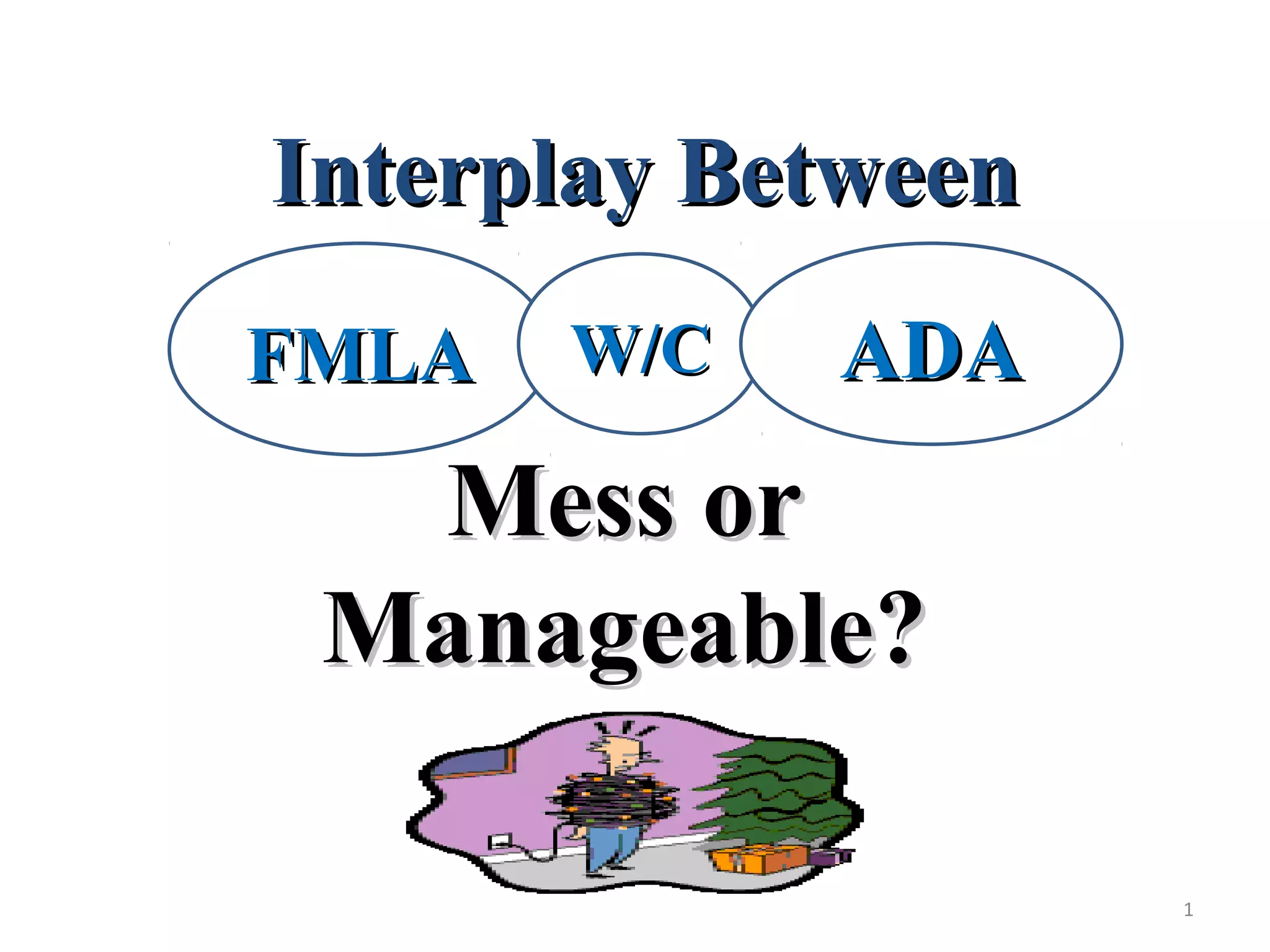
Interplay BetweenInterplay Between
Mess orMess or
Manageable?Manageable?
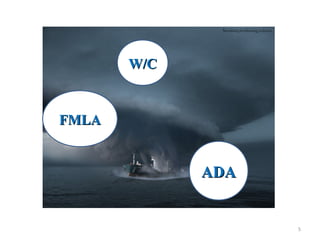
FMLAFMLA W/CW/C ADAADA
1
ADA v. FMLAADA v. FMLA
• The FMLA permits employees to take leave to
care for the serious health conditions” of
children, spouses and parents, not just the
employee.
• Short-term or part-time employees, who may
not be entitled to a leave under the FMLA due
to the period for eligibility, may be entitled to
leave as an accommodation under the ADA.
2
ADA v. Workers’ CompensationADA v. Workers’ Compensation
• An employee’s eligibility for benefits under workers’
compensation or other disability laws is not the
deciding factor in determining whether an employee
is covered by the ADA.
• Workers’ compensation ratings focus on an
employee’s inability to perform a job with no
accommodation, whereas the ADA requires an
employer to focus on whether a reasonable
accommodation will allow the employee to perform
the essential functions of the job.
3
FMLA v. Workers’FMLA v. Workers’
CompensationCompensation
• Employees eligible for FMLA leave may refuse
alternative work assignments, even if they are capable
of performing them. Employees on workers’
compensation leave, risk loss of benefits if they
refuse a light duty assignment which they are capable
of performing.
• FMLA leave (i.e. w/c), however, cannot be counted
against an employee for the purposes of applying an
absenteeism policy.
4
W/CW/C
FMLAFMLA
ADAADA
5
The RegulatoryThe Regulatory
RequirementsRequirements
•The Family Medical Leave Act (1993) Allows qualified
workers 12 weeks of unpaid leave with the continuation of
health benefits.
•NYS Workers Compensation Law Provides medical
benefits and compensation for workers who are injured on
the job.
•The Americans with Disabilities Act (1990) and as
amended in 2008 (ADAAA) & the NYS Human Rights
Law Requires that persons with a disability be provided
certain reasonable accommodations so that disabled
workers can perform the essential functions of their job
6
FMLAFMLA
•If employee has a serious health condition that
makes the employee unable to perform any of
the functions of the job.
•If the employer knows the worker is ill and
that the time off is covered by FMLA the
employer must give the FMLA information to
the worker.
•The employer has an affirmative obligation to
designate absences as FMLA.
7
Serious Health Condition (FMLA)Serious Health Condition (FMLA)
• Inpatient Care: any period of incapacity and
any subsequent treatment.
• Absence plus Treatment by a Health Care
Provider: any period of incapacity of more than
three consecutive days and any subsequent
treatment. Also involves treatment two or more
times by a health care provider or treatment on
one occasion that results in a regimen of
continuing treatment.
• Permanent/Long-Term Conditions Requiring
Supervision: any period of incapacity that is
permanent or long-term for which treatment
may not be effective.
8
Workers’ CompensationWorkers’ Compensation
•An employee who incurs an injury that
arises out of and in the course of the
employment relationship.
•An employee who has a preexisting
condition that is aggravated or accelerated
by the workplace.
•Weekly earnings of $808.65 (eff. 7/1/14)
and supplemental disability benefits (tax
free) available.
9
ADAAAADAAA
•The final regulations fundamentally
change the manner in which an employer
must treat and manage employees with
medical conditions in the workplace.
•It is now much easier for individuals to
establish that they are disabled.
10
Who is “disabled”Who is “disabled”
•Those with a Physical or Mental Impairment
(including physiological disorder, cosmetic
disfigurement, or anatomical loss affecting one or
more bodily functions) that Substantially Limits
One or More Major Life Activities;
•Those with a record of such an impairment;
•Those being regarding as having an impairment.
11
How should an employer handle leaveHow should an employer handle leave
for an employee covered by both thefor an employee covered by both the
ADA and FMLA?ADA and FMLA?
An employer should determine an
employee's rights under each statute
separately, and then consider whether the
two statutes overlap regarding the
appropriate actions to take.
12
Reasonable AccommodationsReasonable Accommodations
Will be made on a case-by-case basis to allow those
who are disabled to:
• performing the essential functions of a job,
• competing for a job, or
• enjoy the benefits and privileges of employment…
provided such accommodations do not impose an
undue financial and/or operational hardship or
endangers the health or safety of the individual or
others. 13
Reasonable Accommodations Include:Reasonable Accommodations Include:
• Change to the work environment or how a desired position
is customarily performed that enable a qualified employee
with a disability to be considered for the position;
• That which enables a qualified individual with a disability
to perform the essential functions of that position.
• The employer may choose among reasonable
accommodations as long as the chosen accommodation is
effective.
• Part of the interactive process, the employer may offer
alternative suggestions for reasonable accommodations
and discuss their effectiveness in removing the workplace
barrier that is impeding the individual with a disability.
14
Reasonable AccommodationsReasonable Accommodations
ExamplesExamples
•making existing facilities accessible;
•job restructuring;
•applicable leave of absence;
•part-time or modified work schedules;
•acquiring or modifying equipment;
•providing qualified readers or interpreters; and
•re-assignment to a vacant position (not necessarily a
promotion) for which the employee qualifies if he/she
can no longer perform the essential functions of
his/her current position, with or without reasonable
accommodations…55b for classified service.
15
Does an employer have to hold openDoes an employer have to hold open
an employee's job as an ADAan employee's job as an ADA
reasonable accommodation?reasonable accommodation?
Yes, but not necessarily indefinitely…
An employee with a disability who is granted leave
as a reasonable accommodation is entitled to return
to his/her same position unless the employer
demonstrates that holding open the position would
impose an undue hardship.
*See Section 71 of CS law & §23.8 of the UUP CBA.
16
MANDATORY ALTERNATE DUTYMANDATORY ALTERNATE DUTY
(MAD)(MAD)
•Designed to assist classified service employees in
returning to work prior to resumption of full job duties.
•Employee must be classified as partially disabled at 50
percent or less by the State Insurance Fund (SIF); and have
a prognosis of full recovery (defined as the ability to
perform the full duties of the job in which the employee
was injured) within 60 calendar days.
•If a qualified employee does not request an alternate duty
assignment, agency management may direct the employee
to return to work on an alternate duty basis.
17
MANDATORY ALTERNATE DUTYMANDATORY ALTERNATE DUTY
(MAD) CONTINUED(MAD) CONTINUED
• MAD may not necessarily fall within the
employee’s regular salary grade, title series or job
duties.
• When developing an assignment, management is
not restricted to the employee’s former work
location, work schedule, or workweek.
• Nothing in this policy abrogates management’s
rights to have the employee examined by a
physician selected by management as a condition
of allowing the employee to return to full duties.
18
Light Duty PolicyLight Duty Policy
•Provide eligible employees with the
opportunity to continue to or return to work
under a temporary work restriction
assignment prior to full medical clearance.
• This policy applies only to employees with
temporary limitations or restrictions and will
only be provided on a case-by-case basis if
there is a reasonable expectation that the
employee can resume his/her full duties within
the time designated (generally within 90 days).
19
Stay-At-Work/Claims Prevention ProcessStay-At-Work/Claims Prevention Process
• The Standard (LTD Carrier) helps eligible
employees to remain at work.
• Skilled clinical resources can assist employees
who are struggling to remain at work when
ongoing medical issues impair their ability to
function effectively on the job.
20
Case StudyCase Study
On June 1, 2014, a full-time CSEA-represented
employee (KBS 1) with five years of service is
hit by an automobile in the traffic circle on
campus on her way to report to work.
She is taken to the Emergency Room and is
admitted for six consecutive days.
You receive documentation from the
employee’s doctor that indicates that she cannot
return to work until September 16, 2014.
21
Case Study ContinuedCase Study Continued
• What forms need to be completed when you
become aware of the June 1 accident? Why?
• What portion of this leave (if any) will be
considered qualifying leave under the FMLA?
• What possible sources of income replacement
might this employee be eligible to receive?
22
Case Study ContinuedCase Study Continued
On September 16, 2014, the employee calls her supervisor and
states that she will need to be absent from work for another
two weeks.
On September 20 you receive a Certification of Health Care
Provider (CHCP) form that states the employee can return to
work on October 1st, but the following restrictions will apply
for a period of six weeks (thru 11/11/14):
-Can’t work in excess of three days each week
-Can’t lift more than 20 pounds
-No prolonged standing
The CHCP also indicates that a follow-up visit has been
scheduled for November 1
23
Case Study ContinuedCase Study Continued
On September 16, what do you tell the
employee when she calls to say that she
will be out another two weeks?
What do you do when you receive the
September 20 CHCP?
If the employee returns to work on light
duty on October 1 for six weeks and is
once again continuously absent due to the
same injury, what actions can you take?
24
Case Study ContinuedCase Study Continued
What happens if the employee remains out of work for a cumulative period of
one year?
What happens if the employee remains out of work for a cumulative period of
one year?
Can the employee be counseled or disciplined for her absence starting June 1,
2012?
How, if at all, would your answers to the questions noted above have changed
if the employee had a history of documented time and attendance abuses?
Can the employee be counseled or disciplined for her absence starting June 1,
2012?
How, if at all, would your answers to the questions noted above have changed
if the employee had a history of documented time and attendance abuses?
What happens if the employee remains out of
work for a cumulative period of one year?
Can the employee be counseled or disciplined for
her absence starting June 1, 2014?
How, if at all, would your answers to the
questions noted above have changed if the
employee had a history of documented time and
attendance abuses?
25
SeparationSeparation
• Review service/disability retirement options
(ERS)
• Retirement eligibility (ORP)
• Retiree health insurance entitlement
(NYSHIP)
• Social Security Disability
• LTD & Optional disability benefits
26

SUNY Presentation Interplay Between ADA, FMLA and WC (1)

  • 1.
    Interplay BetweenInterplay Between MessorMess or Manageable?Manageable? FMLAFMLA W/CW/C ADAADA 1
  • 2.
    ADA v. FMLAADAv. FMLA • The FMLA permits employees to take leave to care for the serious health conditions” of children, spouses and parents, not just the employee. • Short-term or part-time employees, who may not be entitled to a leave under the FMLA due to the period for eligibility, may be entitled to leave as an accommodation under the ADA. 2
  • 3.
    ADA v. Workers’CompensationADA v. Workers’ Compensation • An employee’s eligibility for benefits under workers’ compensation or other disability laws is not the deciding factor in determining whether an employee is covered by the ADA. • Workers’ compensation ratings focus on an employee’s inability to perform a job with no accommodation, whereas the ADA requires an employer to focus on whether a reasonable accommodation will allow the employee to perform the essential functions of the job. 3
  • 4.
    FMLA v. Workers’FMLAv. Workers’ CompensationCompensation • Employees eligible for FMLA leave may refuse alternative work assignments, even if they are capable of performing them. Employees on workers’ compensation leave, risk loss of benefits if they refuse a light duty assignment which they are capable of performing. • FMLA leave (i.e. w/c), however, cannot be counted against an employee for the purposes of applying an absenteeism policy. 4
  • 5.
  • 6.
    The RegulatoryThe Regulatory RequirementsRequirements •TheFamily Medical Leave Act (1993) Allows qualified workers 12 weeks of unpaid leave with the continuation of health benefits. •NYS Workers Compensation Law Provides medical benefits and compensation for workers who are injured on the job. •The Americans with Disabilities Act (1990) and as amended in 2008 (ADAAA) & the NYS Human Rights Law Requires that persons with a disability be provided certain reasonable accommodations so that disabled workers can perform the essential functions of their job 6
  • 7.
    FMLAFMLA •If employee hasa serious health condition that makes the employee unable to perform any of the functions of the job. •If the employer knows the worker is ill and that the time off is covered by FMLA the employer must give the FMLA information to the worker. •The employer has an affirmative obligation to designate absences as FMLA. 7
  • 8.
    Serious Health Condition(FMLA)Serious Health Condition (FMLA) • Inpatient Care: any period of incapacity and any subsequent treatment. • Absence plus Treatment by a Health Care Provider: any period of incapacity of more than three consecutive days and any subsequent treatment. Also involves treatment two or more times by a health care provider or treatment on one occasion that results in a regimen of continuing treatment. • Permanent/Long-Term Conditions Requiring Supervision: any period of incapacity that is permanent or long-term for which treatment may not be effective. 8
  • 9.
    Workers’ CompensationWorkers’ Compensation •Anemployee who incurs an injury that arises out of and in the course of the employment relationship. •An employee who has a preexisting condition that is aggravated or accelerated by the workplace. •Weekly earnings of $808.65 (eff. 7/1/14) and supplemental disability benefits (tax free) available. 9
  • 10.
    ADAAAADAAA •The final regulationsfundamentally change the manner in which an employer must treat and manage employees with medical conditions in the workplace. •It is now much easier for individuals to establish that they are disabled. 10
  • 11.
    Who is “disabled”Whois “disabled” •Those with a Physical or Mental Impairment (including physiological disorder, cosmetic disfigurement, or anatomical loss affecting one or more bodily functions) that Substantially Limits One or More Major Life Activities; •Those with a record of such an impairment; •Those being regarding as having an impairment. 11
  • 12.
    How should anemployer handle leaveHow should an employer handle leave for an employee covered by both thefor an employee covered by both the ADA and FMLA?ADA and FMLA? An employer should determine an employee's rights under each statute separately, and then consider whether the two statutes overlap regarding the appropriate actions to take. 12
  • 13.
    Reasonable AccommodationsReasonable Accommodations Willbe made on a case-by-case basis to allow those who are disabled to: • performing the essential functions of a job, • competing for a job, or • enjoy the benefits and privileges of employment… provided such accommodations do not impose an undue financial and/or operational hardship or endangers the health or safety of the individual or others. 13
  • 14.
    Reasonable Accommodations Include:ReasonableAccommodations Include: • Change to the work environment or how a desired position is customarily performed that enable a qualified employee with a disability to be considered for the position; • That which enables a qualified individual with a disability to perform the essential functions of that position. • The employer may choose among reasonable accommodations as long as the chosen accommodation is effective. • Part of the interactive process, the employer may offer alternative suggestions for reasonable accommodations and discuss their effectiveness in removing the workplace barrier that is impeding the individual with a disability. 14
  • 15.
    Reasonable AccommodationsReasonable Accommodations ExamplesExamples •makingexisting facilities accessible; •job restructuring; •applicable leave of absence; •part-time or modified work schedules; •acquiring or modifying equipment; •providing qualified readers or interpreters; and •re-assignment to a vacant position (not necessarily a promotion) for which the employee qualifies if he/she can no longer perform the essential functions of his/her current position, with or without reasonable accommodations…55b for classified service. 15
  • 16.
    Does an employerhave to hold openDoes an employer have to hold open an employee's job as an ADAan employee's job as an ADA reasonable accommodation?reasonable accommodation? Yes, but not necessarily indefinitely… An employee with a disability who is granted leave as a reasonable accommodation is entitled to return to his/her same position unless the employer demonstrates that holding open the position would impose an undue hardship. *See Section 71 of CS law & §23.8 of the UUP CBA. 16
  • 17.
    MANDATORY ALTERNATE DUTYMANDATORYALTERNATE DUTY (MAD)(MAD) •Designed to assist classified service employees in returning to work prior to resumption of full job duties. •Employee must be classified as partially disabled at 50 percent or less by the State Insurance Fund (SIF); and have a prognosis of full recovery (defined as the ability to perform the full duties of the job in which the employee was injured) within 60 calendar days. •If a qualified employee does not request an alternate duty assignment, agency management may direct the employee to return to work on an alternate duty basis. 17
  • 18.
    MANDATORY ALTERNATE DUTYMANDATORYALTERNATE DUTY (MAD) CONTINUED(MAD) CONTINUED • MAD may not necessarily fall within the employee’s regular salary grade, title series or job duties. • When developing an assignment, management is not restricted to the employee’s former work location, work schedule, or workweek. • Nothing in this policy abrogates management’s rights to have the employee examined by a physician selected by management as a condition of allowing the employee to return to full duties. 18
  • 19.
    Light Duty PolicyLightDuty Policy •Provide eligible employees with the opportunity to continue to or return to work under a temporary work restriction assignment prior to full medical clearance. • This policy applies only to employees with temporary limitations or restrictions and will only be provided on a case-by-case basis if there is a reasonable expectation that the employee can resume his/her full duties within the time designated (generally within 90 days). 19
  • 20.
    Stay-At-Work/Claims Prevention ProcessStay-At-Work/ClaimsPrevention Process • The Standard (LTD Carrier) helps eligible employees to remain at work. • Skilled clinical resources can assist employees who are struggling to remain at work when ongoing medical issues impair their ability to function effectively on the job. 20
  • 21.
    Case StudyCase Study OnJune 1, 2014, a full-time CSEA-represented employee (KBS 1) with five years of service is hit by an automobile in the traffic circle on campus on her way to report to work. She is taken to the Emergency Room and is admitted for six consecutive days. You receive documentation from the employee’s doctor that indicates that she cannot return to work until September 16, 2014. 21
  • 22.
    Case Study ContinuedCaseStudy Continued • What forms need to be completed when you become aware of the June 1 accident? Why? • What portion of this leave (if any) will be considered qualifying leave under the FMLA? • What possible sources of income replacement might this employee be eligible to receive? 22
  • 23.
    Case Study ContinuedCaseStudy Continued On September 16, 2014, the employee calls her supervisor and states that she will need to be absent from work for another two weeks. On September 20 you receive a Certification of Health Care Provider (CHCP) form that states the employee can return to work on October 1st, but the following restrictions will apply for a period of six weeks (thru 11/11/14): -Can’t work in excess of three days each week -Can’t lift more than 20 pounds -No prolonged standing The CHCP also indicates that a follow-up visit has been scheduled for November 1 23
  • 24.
    Case Study ContinuedCaseStudy Continued On September 16, what do you tell the employee when she calls to say that she will be out another two weeks? What do you do when you receive the September 20 CHCP? If the employee returns to work on light duty on October 1 for six weeks and is once again continuously absent due to the same injury, what actions can you take? 24
  • 25.
    Case Study ContinuedCaseStudy Continued What happens if the employee remains out of work for a cumulative period of one year? What happens if the employee remains out of work for a cumulative period of one year? Can the employee be counseled or disciplined for her absence starting June 1, 2012? How, if at all, would your answers to the questions noted above have changed if the employee had a history of documented time and attendance abuses? Can the employee be counseled or disciplined for her absence starting June 1, 2012? How, if at all, would your answers to the questions noted above have changed if the employee had a history of documented time and attendance abuses? What happens if the employee remains out of work for a cumulative period of one year? Can the employee be counseled or disciplined for her absence starting June 1, 2014? How, if at all, would your answers to the questions noted above have changed if the employee had a history of documented time and attendance abuses? 25
  • 26.
    SeparationSeparation • Review service/disabilityretirement options (ERS) • Retirement eligibility (ORP) • Retiree health insurance entitlement (NYSHIP) • Social Security Disability • LTD & Optional disability benefits 26

Editor's Notes

  • #2 This training is designed to: Outline the interplay between these very distinct laws and regulatory requirements, within the backdrop of CS laws, Time & Attendance rules and the various CBA. Provide a description of each of the laws regarding the FMLA, ADA and NYS W/C… See FMLA, ADA, and W/C Chart. Share best practices when it comes to compliance and look at a “real” life example.
  • #3 Not all “disabilities” under the ADA are “serious health conditions” under the FMLA and vice-versa. Generally speaking, the FMLA tends to cover a much broader range of conditions than those protected under the ADA but under the 2008 amend ADAAA, there is a much broad definition under which one could be deemed “disabled”. Current substance abuse is considered a “serious health condition” under the FMLA, but it is not a “disability” under the ADA. Thus, the FMLA affords leave for inpatient treatment of substance abuse. However, current substance abusers who do not seek protection under the FMLA (i.e., who do not seek treatment) can be disciplined or discharged. Unlike the ADA, there is no “undue hardship” exception under the FMLA (except the very narrow “key employee” exception). The ADA permits leave only if such an accommodation may help an employee eventually perform the essential functions of the job. The FMLA does not require any certification that the leave will lead to a return to work. The obligation under the FMLA to provide unpaid leave to an eligible employee who requests it exists regardless of whether other accommodations are available that would allow the employee to remain at work. By contrast, the ADA allows an employer to deny an employee’s request for leave and instead to provide the employee with an alternative reasonable accommodation that requires the employee to remain on the job. Again, under the FMLA an ee could refuse a “light duty” assignment (assuming they have supporting medical documentation) for the 1st 12 weeks of leave and then request such an assignment subsequent to this period of time (again assuming the medical documentation allows for such). While both the ADA and the FMLA authorize intermittent leave and reduced schedules, different criteria apply. Under the ADA, an employer is required to permit such schedules only after certification that such an accommodation would enable the employee to perform the essential functions of the job in the future. Under the FMLA, the only prerequisite to eligibility for intermittent leave or a reduced schedule is medical necessity because of a serious health condition. Moreover, employers are allowed to temporarily transfer an employee to a job that better accommodates recurring periods of leave. An employee who has exhausted his or her FMLA leave may assert that a “reasonable accommodation” under the ADA for his or her disability would be additional paid time off in excess of the FMLA allowance. Thus, the fact that an employee has exhausted his or her 12 weeks of available FMLA leave does not necessarily discharge the employer from its obligation to provide additional leave under the ADA as a reasonable accommodation, absent undue hardship. Reinstatement rights under the ADA are, in the first instance, to the same position unless the employee cannot perform the essential functions of that job with reasonable accommodation. Reinstatement rights under the FMLA are to an “equivalent” position.
  • #4 An award of workers’ compensation benefits or the assignment of a substantial disability rating does not automatically trigger protection under the ADA, nor does it provide the employee with a “record” of a disability. (i.e., temporary job-related injuries, such as a broken leg, are not disabilities under the ADA). Impairments resulting from occupational injuries may not be severe enough to substantially limit a major life activity, or they may be only temporary, non-chronic injuries with no long-term impact. Although an occupational injury compensable under workers’ compensation may not qualify as a disability under the ADA, an employer may violate the ADA if the employee is “regarded as” disabled. Thus, when an employee has fully recovered from a temporary back impairment caused by lifting at work, an employer can violate the ADA by firing that employee because it believes that he will re-injure his back and become totally incapacitated. Under the workers’ compensation act, the statutory duty to provide light duty jobs (where available) ends when: (a) the employee’s medical treatment or rehabilitation is discontinued; or (b) the employee has reached a maximum level of rehabilitation in judgment of the workers’ compensation commissioner. The ADA has no such cut-off.
  • #5 Leaves will simultaneously be covered by FMLA (if based on a “serious illness”) and must be designated in writing to the eligible employee. Employees must call ACCIDENT REPORTING SYSTEM ARS at 888-800-0029 to report a work-related injury or illness. To have the leave properly designated as FMLA by HR, medical documentation is required regardless what is provided by the health care provider to the SIF. Classified service employees may be due supplemental pay, with SIF determining level of compensation based on degree of injury. Eligible CSEA and PEF represented employees may also be entitled to a supplemental wage payment not to exceed nine months per injury Supplemental payments will be paid to employees whose disability is classified by the evaluating physician as "total" or "marked“. The total of the statutory payment and the supplemental payment provided equals 60 percent of employee’s pre-disability gross wages. Unclassified service employees on w/c have option of being paid by SIF or remaining in a full paid status using their available accruals (which are subject to be restored on a pro-rated basis 66% max. and the agency reimbursed subsequent to a WCB decision).
  • #6 This is why the combination of these regulations are often referred to as the “BERMUDA TRIANGLE of EMPLOYMENT LAW”…as similar to the myth of this dangerous area off the US coast where ships and plans falloff the face of the earth and never seen again, the same can be said of ees who fall under FMLA, W/C or ADA…as employers we can simply lose track of these ees NEVER TO BE SEEN AGAIN!
  • #7 This enforcement guidance concerns the interaction between Title I of the Americans with Disabilities Act of 1990 (ADA) and state workers' compensation laws as well as FMLA protection. FMLA allows qualified workers 12 weeks of unpaid leave with the continuation of health benefits. On the other hand, the purpose of a workers' compensation law is to provide a system for securing prompt and fair settlement of employees' claims against employers for occupational injury and illness. The purpose of Title I of the ADA is to prohibit employers from discriminating against qualified individuals because of disability in all aspects of employment. The new focus has moved from whether an ee is substantially limited in a major life function and in turn disabled, to whether or not an employer discriminated and failed to investigate/provide reasonable accommodations. Remember all w/c claims may not rise to the level of a disability under the ADA, but generally all w/c leaves will be counted as part of an eligible ee’s FMLA entitlement.
  • #8 Employee must have been employed for at least 12 months & worked at least 1,250 hours in the 12 months prior to the leave request. Absences resulting from a personal serious health condition (i.e. w/c) that makes an employee unable to perform the functions of his/her job. The campus must notify the employee concerning their eligibility for FMLA leave. Upon receipt of satisfactory medical documentation, the agency must notify the employee of designation of the leave as FMLA-qualifying using DOL forms. Update CHCP form required for continuous, intermittent or new absences due to a qualifying serious health condition after the start of every new year…Section 71 termination may need to be delayed at the beginning of the calendar year if ee has FMLA eligibility in new year.
  • #10 This type of “insurance” is in exchange for mandatory relinquishment of the employee's right to sue his or her employer for the tort of negligence. The tradeoff between assured, limited coverage and lack of recourse outside the worker compensation system is known as "the compensation bargain.“ Under these rules, employees who are absent because of a job-related injury or disease may be granted leave with pay (current maximum per week $808.65 per week or 2/3rds. salary-whichever is greater) without charge to leave credits, subject to a 5-day waiting period, and cont. to earn accruals! Provides that an employee absent from service by reason of occupational injury or disease shall be entitled to a leave of absence for a cumulative of one year & two years for a disability resulting from an assault sustained in the course of or arising out of employment See “Mama Compensation” Video 5 Minutes: http://www.youtube.com/watch?v=gkwL8QOYWbk
  • #11 The focus for employers is less on whether or not an ee is disabled and unable to perform the essential functions of their job, with a greater emphasis on whether or not an employer has made a good faith effort in providing “reasonable accommodations”.
  • #12 Under the new final regulations, short-term impairments and chronic impairments with short-term symptoms may be considered disabilities. In the past, many courts declined to extend ADA coverage to individuals whose impairments were substantially limiting for only a short or limited period of time. The new regulations reject this reasoning and prescribe that the duration of an impairment or symptom should not be dispositive in determining whether an individual is disabled. Thus, it is conceivable that individual with a temporary impairment, such as a broken hand, may be disabled because the impairment substantially limits a major life activity. It is still likely that certain impairments of short duration which are expected to heal quickly, such as a common cold or a sprained ankle, will not be considered disabilities. However, the regulations make clear that employers must consider all impairments, even short term ones, on a case-by-case basis. Even Episodic Impairments under the ADAAA, including an impairment in remission, is a disability if the impairment would substantially limit a major life activity when active. This means that an individual with a serious chronic condition such as epilepsy or cancer could be considered disabled under the Act even if that person rarely or never experiences symptoms that would impact their employment. The regulations provide specific examples of impairments that may be episodic in nature, including epilepsy, cancer, multiple sclerosis, hypertension, diabetes, asthma, major depressive disorder, bipolar disorder and schizophrenia that are covered under the ADA.
  • #13 If light duty job offered during FMLA leave, employer cannot force employee to take it in lieu of FMLA leave. After 12 weeks of FMLA entitlement expires, ee can then request reasonable accommodations that may equate to the previously offered light duty assignment! Under the ADA, an employee who needs leave related to his/her disability is entitled to such leave if there is no other effective accommodation and the leave will not cause undue hardship: The purpose of a leave as an accommodation is to give the employee time to become able to perform the essential functions of her position upon return to work, with or without a reasonable accommodation. The need for leave must be related to the disability and the leave must be likely to enable the employee to return to work. An employer must allow the individual to use any accrued paid leave first, but, if that is insufficient to cover the entire period, then the employer should grant unpaid leave. An employer must continue an employee's health insurance benefits during his/her leave period only if it does so for other employees in a similar leave status. As for the employee's position, the ADA requires that the employer hold it open while the employee is on leave unless it can show that doing so causes undue hardship. When the employee is ready to return to work, the employer must allow the individual to return to the same position (assuming that there was no undue hardship in holding it open) if the employee is still qualified (i.e., the employee can perform the essential functions of the position with or without reasonable accommodation). The EEOC's Enforcement Guidance on Reasonable Accommodation and Undue Hardship Under the ADA specifically provides that so-called "no-fault" leave policies, under which employees are automatically terminated after they have been on leave for a specified period of time, are illegal under the ADA.   If it is an undue hardship under the ADA to hold open an employee's position during a period of leave, or an employee is no longer qualified to return to his/her original position, then the employer could reassign the employee (absent undue hardship) to a vacant position for which s/he is qualified as a reasonable accommodation. The EEOC's construction of the ADA has found support in the courts.  There are a number of decisions that have required employers to grant additional leave to disabled employees as a reasonable accommodation.  For example, in Garcia-Ayala v. Lederle Parenterals, Inc. (1st Cir. 2000), an employee requested an extension of her leave of absence after the one-year period of leave under the employer's policy had expired.  In response, the employer terminated the employee and she sued under the ADA.  The First Circuit Court of Appeals found for the former employee, rejecting the employer's argument that the ADA can never impose an obligation on a company to grant an accommodation beyond the leave allowed under the company's own leave policy.  The court of appeals also concluded that the employee's requested accommodation of an additional five months of leave time was not per se unreasonable.  The court held that there must be an individual factual determination in each case that continuing the leave of absence would be an undue hardship for the employer. In Hwang v. Kansas State University (5/29/14), the 10th Circuit court of appeals held an employer did not have to offer a leave of absence greater than six months to accommodate an employee’s disability, and that an employer can have an inflexible leave of absence policy that places a hard cap on an employee’s medical leave of absence. The standards most courts still follow is the ADA still does not obligate an employer to grant indefinite leaves of absence to disabled employees as a reasonable accommodation. See Myers v. Hose (4th Cir. 1995) (holding that a  "reasonable accommodation [did] not require the [employer] to wait indefinitely for Myers' medical conditions to be corrected . . .").  Under the FMLA, an eligible employee is entitled to a maximum of 12 weeks of leave per 12 month period. The FMLA guarantees the right of the employee to return to the same position or to an equivalent one. An employer must allow the individual to use any accrued paid leave first, but if that is insufficient to cover the entire period, then the employer should grant unpaid leave. The FMLA requires an employer to continue the employee's health insurance coverage during the leave period, provided the employee pays his/her share of the premiums.
  • #14 EXAMPLES: Visually impaired nurse provided intermittent leave under the FMLA when “flare-ups” occur. Hearing impaired NP provided an amplified stethoscope (via SAW program through the Standard). Surgical tech with dermatitis who needed hypo-allergenic gown and face mask. Migraine headaches brought on by sleep deprivation provided a reassignment onto day shift to regulate more regular sleep pattern. NA 2 with degenerate discs who could not lift patients, placed as a NSC 1 under 55b.
  • #15 When trying determine reasonable accommodations keep in mind: It’s INTERACTIVE – Employer must communicate with employee, and vice versa It’s an ONGOING PROCESS – Not a one-time event Obligation to interact with employee continues if original accommodation is not effective, or if employee’s / employer’s circumstances change It’s INDIVIDUALIZED for each employee Consider employee’s position, impairment, limitations, personal reactions, etc. – no “one size fits all” Purpose of the interactive process: To find a workplace accommodation That enables the employee with an impairment To perform the essential functions of his position Example A: An employee with an ADA disability needs 13 weeks of leave for treatment related to the disability. The employee is eligible under the FMLA for 12 weeks of leave (the maximum available), so this period of leave constitutes both FMLA leave and a reasonable accommodation. Under the FMLA, the employer could deny the employee the thirteenth week of leave. But, because the employee is also covered under the ADA, the employer cannot deny the request for the thirteenth week of leave unless it can show undue hardship. The employer may consider the impact on its operations caused by the initial 12-week absence, along with other undue hardship factors. Example B: An employee with an ADA disability has taken 10 weeks of FMLA leave and is preparing to return to work. The employer wants to put her in an equivalent position rather than her original one. Although this is permissible under the FMLA, the ADA generally requires that the employer return the employee to her original position, unless the employer can show that this would cause an undue hardship, or that the employee is no longer qualified for her original position (with or without reasonable accommodation). Example C: An employee with an ADA disability has taken 12 weeks of FMLA leave. He notifies his employer that he is ready to return to work, but he no longer is able to perform the essential functions of his position or an equivalent position. Under the FMLA, the employer could terminate his employment, but under the ADA the employer must consider whether the employee could perform the essential functions with reasonable accommodation (e.g., additional leave, part-time schedule, job restructuring, or use of specialized equipment). If not, the ADA requires the employer to reassign the employee if there is a vacant position available for which he is qualified, with or without reasonable accommodation, and there is no undue hardship.
  • #16 An indefinite exemption from the essential functions of a job is not a reasonable accommodation under the ADA. The 10th U.S. Circuit Court of Appeals recently addressed that question in the context of a county employee who, because of back surgery and an ongoing joint dysfunction, was unable to undertake the essential functions of her position as an Adult Intensive Supervision Officer. In that case, the court determined that the county’s decision to discharge the employee when she was unable to return to work after a medical leave did not violate the ADA. Robert v. Board of County Commissioners of Brown County, Kansas, et al, 10th Cir., No. 11-3902, August 29, 2012. The importance of written job descriptions in this scenario cannot be overstated. Employers should assure that such descriptions should be reviewed regularly to assure that they are accurate, objective, and thorough, in order to allow their use in cases such as this one. Seventh Circuit Reverses Itself on Reassignments as a Reasonable Accommodation Under the ADA Over the years, courts and employers have struggled with the extent of this obligation when an employee with a disability seeks reassignment to a vacant/ lateral position . In its 2012 decision, the Seventh Circuit overruled its prior 2000 decision in EEOC v. Humiston-Keeling. In doing so, the Seventh Circuit contends that Humiston-Keeling was at odds with the Supreme Court's 2002 decision in US Airways v. Barnett (in which the Supreme Court held that a non-contractual but consistently followed seniority policy ordinarily takes precedence over the reasonable accommodation requirement). Finally, the United Airlines court also interpreted decisions from two other circuits (D.C. and the Tenth Circuit) as embracing the EEOC's view of a requirement to make reassignments so long as an employee is qualified, absent an undue hardship.
  • #17 Disability Leaves of Absence, Termination and Reinstatement--CS law section 71-- set forth the due process which must be provided to employees (including probationary employees)…WAIT FOR THE “MIRACLE” CURE!!! Regulation 5.9 supplements Section 71 with detailed procedures for: restoration to duty from workers’ compensation leave termination of service upon exhaustion or termination of workers’ compensation leave or reinstatement following termination due to a disability arising from occupational injury or disease §23.8 Disability Leave Upon being discontinued from service in accordance with provisions of the State University Group Disability Insurance Program, an employee shall be granted a leave without pay for disability and shall be continued on such leave without pay until the disability ceases, the employee reaches age 65, or death, whichever event occurs first. Notwithstanding the foregoing, after five calendar years on such leave, an employee shall not have any right or entitlement to be restored to regular employment status.
  • #18 This Benefit Program allows injured employees to work prior to full recovery whether pursuant to the Mandatory Alternate Duty Program or agency discretionary procedures. Many MAD will be determined based on SIF IMEs. In the event that an employee's status when returning to work is less than a full time basis prior to recovery, and returns to work on a part-time basis for some period of time before returning to full duties on a full-time basis, the employee's time records should reflect workers' compensation disability leave for the portion of the individual's schedule he/she is not scheduled to be at work. Since this leave status entitles the person to be treated as though he/she were on leave with pay, the employee continues to receive full leave accruals, seniority and continuous service credit, retirement service credit, Employee Benefit Fund contributions and health insurance for this period.As with any return to work in less than full capacity, the details of the assignment and the end date should be made clear to the employee at the beginning of the assignment. Also, the State Insurance Fund should be notified because the employee may qualify for continuing wage replacement payments from the SIF during this period based on a reduced earning capacity.
  • #20 Generally, "light duty" refers to temporary or permanent work that is physically or mentally less demanding than normal job duties. Some employers use the term "light duty" to mean simply excusing an employee from performing those job functions that s/he is unable to perform because of an impairment. "Light duty" also may consist of particular positions with duties that are less physically or mentally demanding created specifically for the purpose of providing alternative work for employees who are unable to perform some or all of their normal duties. Further, an employer may refer to any position that is sedentary or is less physically or mentally demanding as "light duty. Light duty can be a form of reasonable accommodation. If an employer offers light duty for workers' compensation injuries, it might have to offer light duty on the same basis to employees with non-occupational related disabilities. For this reason, from an ADA standpoint, employers may want to consider placing a strict time limit on "make-work" light duty (for example, a cutoff after 90 days). However, workers' compensation carriers generally prefer that light duty be offered for a much longer period. The 7th U.S. Circuit Court of Appeals has held that neither the Family and Medical Leave Act (FMLA) nor the Americans with Disabilities Act (ADA) creates an obligation for an employer to provide light duty work to an individual who is unable – with or without accommodation – to return to the essential functions of his job. James v. Hyatt Regency Chicago, 7th Cir., No. 1:09-cv-07873, February 13, 2013.
  • #21 The accommodations and professional services for these stay-at-work (SAW) cases are provided as a claim cost; therefore, the Standard must obtain documentation that the employee has a diagnosis and is undergoing treatment for limitations and restrictions impacting their ability to perform essential job functions. This also helps ensure that the employer’s premiums are not impacted by claim expenses. Finally, it serves the important function of assuring that any accommodations provided will address the medical barriers appropriately. Examples of “accommodations” lighting for migraine headache sufferers, amplified stethoscope for hearing impaired and voice recognition computer program for visually impaired. It is important to note that this program does not replace the employer’s process for ergonomic services, responding to ADA-AA requests, Workers’ Compensation, or absence issues. The Standard assist in more complex situations related to these issues, but the usual process followed by each employer should be initiated before we are called in.
  • #27 Besides Section 71 termination of classified service ees and 5 year leave rights under Article 23.8 of the UUP CBA for unclassified service ees, campuses will want to try to explore these options whenever possible in advance of these time limits. The key is to remain in contact periodically with leave employee to let them know you have not forgotten about them. Note that under CS NYSHIP requirements, ees injured under w/c with or without 10 years of service regardless of age, can qualify for retiree health insurance if deemed qualified for a disability retirement under ERS. Employees who are enrolled in ERS:  a.) Ordinary disability retirement: For an ordinary (not work-related) disability retirement, the age requirement is waived, but you must meet the minimum service requirement. b.) Work-related disability retirement: For a disability retirement resulting from a work-related illness or injury, the age requirement and the minimum service requirement are waived.