Created by Simpo PDF Creator Pro (unregistered version)
               http://www.simpopdf.com


     UFOs – Unidentified Flying Objects

     Ufology –            is a neologism coined to describe the collective
     efforts of those who study reports and associated evidence of
     unidentified flying objects (UFOs).


     Ufologist –            A ufo investigator is called a ufologist


     Ufo Sightings-               Some eye witnesses to the UFOs


     Roswell Incident- called the Roswell UFO crash
     1947


     UFO Conspiracy – Worldwide UFO cover Ups and
     related theories


     Alien- An extra-terrestrial being is called an alien
The Bermuda
Triangle of Leave Laws
             ADA, FMLA and Workers Compensation
                                      Instructor: Brenda JM Sabin, CBP
       Director of Operations and Site Administration for HRSentry, LLC
Today we are talking about these Federal
 Leave Laws:
  The American’s with Disabilities Act (ADA)
  The Family and Medical Leave ACT (FMLA)
  Workers Compensation (WC)
 We will look at each law separately then
 weave them together


             Its like putting a puzzle together
             blindfolded!

Overview
Americans with Disabilities Act of 1990
(Titles 1 and V) pertains to:
 ◦   Private employers with 15 or more employees,
 ◦   State and local governments,
 ◦   Employment agencies and labor unions
 ◦   The ADA's nondiscrimination standards also apply to federal
     sector employees under section 501 of the Rehabilitation Act,
     as amended


ADA
Employees with disabilities must:
   have an equal opportunity to apply for jobs and to
   work in jobs for which they are qualified;
      Provides protection from hiring discrimination
      Also provides protection from job loss due to disability
   have an equal opportunity to be promoted once
   they are working;
   have equal access to benefits and privileges of
   employment that are offered to other employees,
   such as employer-provided health insurance or
   training; and
   must not be harassed because of their disability.


ADA
As defined by the ADA, an individual with a
 disability is a person who:
  ◦ has a physical or mental impairment that
    substantially limits one or more major life
    activities;
       seeing, hearing, speaking, walking, breathing,
       performing manual tasks, learning, caring for
       oneself, working, etc…..

  ◦ has a record of such an impairment; or
  ◦ is regarded as having such an impairment


What is a disability?
Under the ADA you as an employer are
required to make reasonable
accommodations unless it creates undue
hardship for your business
A reasonable accommodation is determined by: employee size, revenue
and type of business on a case by case basis


ADA
Reasonable accommodation may include, but is
 not limited to:
 ◦ Making existing facilities used by employees readily accessible to and usable by
   persons with disabilities

 ◦ Job restructuring, modifying work schedules, reassignment to a vacant position;

 ◦ Acquiring or modifying equipment or devices, adjusting or modifying
   examinations, training materials, or policies, and providing qualified readers or
   interpreters.


Reasonable Accommodations
An employer never has to provide any
 reasonable accommodation that causes
 undue hardship, meaning significant
 difficulty or expense.
 ◦ Undue hardship refers not only to financial
   difficulty, but to reasonable accommodations
   that are unduly extensive or disruptive, or
   those that would fundamentally alter the
   nature or operation of the business.


Undue Hardship
Reinstatement Rights –
   ◦ Must be to the SAME job unless doing so causes
     undue hardship to the employer
   ◦ No time limit on reinstatement
   ◦ Employer is obligated to make reasonable
     accommodations based on the essential functions of
     the job
Essential functions are the fundamental job duties performed in a position.
   The term "essential functions" does not include the marginal functions of the
   position. A function may be essential because:
          The position exists to perform that function.
          There are a limited number of employees available who could perform that
          function.
          The function is highly specialized.


 ADA
Family Medical Leave Act (Federal)

 Some states have their own Family Leave
 Laws

 Whichever law is more beneficial to the
 employee must be followed


FMLA
FMLA
  Job protection
  12 weeks unpaid leave in a 12 month period
  Intermittent leave is allowed
  Reasons why:
    Birth or adoption
        Check state law definitions for spouse’s working for
        same employer
    Serious health condition
        Yourself
        Immediate family member
           Check state laws for difference in definitions of
           immediate family
FMLA
H.R. 4986, the National Defense
          Authorization Act for FY 2008
          (NDAA), Pub. L. 110-181.(eff.
          01/28/2008)

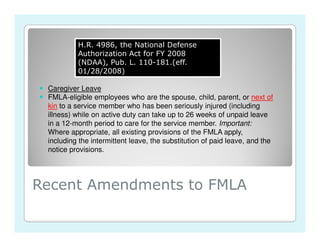
 Caregiver Leave
 FMLA-eligible employees who are the spouse, child, parent, or next of
 kin to a service member who has been seriously injured (including
 illness) while on active duty can take up to 26 weeks of unpaid leave
 in a 12-month period to care for the service member. Important:
 Where appropriate, all existing provisions of the FMLA apply,
 including the intermittent leave, the substitution of paid leave, and the
 notice provisions.


Recent Amendments to FMLA
H.R. 4986, the National Defense
                     Authorization Act for FY 2008
                     (NDAA), Pub. L. 110-181.(eff.
                     01/28/2008)

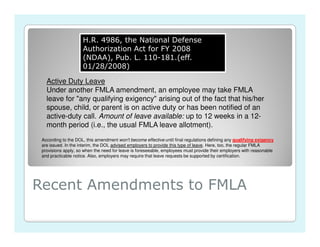
   Active Duty Leave
   Under another FMLA amendment, an employee may take FMLA
   leave for "any qualifying exigency" arising out of the fact that his/her
   spouse, child, or parent is on active duty or has been notified of an
   active-duty call. Amount of leave available: up to 12 weeks in a 12-
   month period (i.e., the usual FMLA leave allotment).
 According to the DOL, this amendment won't become effective until final regulations defining any qualifying exigency
 are issued. In the interim, the DOL advised employers to provide this type of leave. Here, too, the regular FMLA
 provisions apply, so when the need for leave is foreseeable, employees must provide their employers with reasonable
 and practicable notice. Also, employers may require that leave requests be supported by certification.


Recent Amendments to FMLA
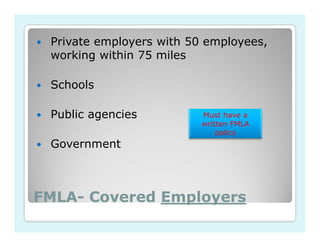
Private employers with 50 employees,
 working within 75 miles

 Schools

 Public agencies          Must have a
                          written FMLA
                              policy
 Government


FMLA-
FMLA- Covered Employers
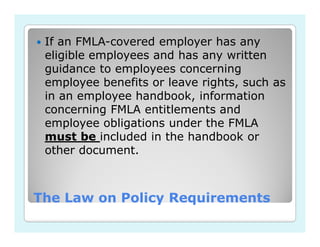
If an FMLA-covered employer has any
 eligible employees and has any written
 guidance to employees concerning
 employee benefits or leave rights, such as
 in an employee handbook, information
 concerning FMLA entitlements and
 employee obligations under the FMLA
 must be included in the handbook or
 other document.


The Law on Policy Requirements
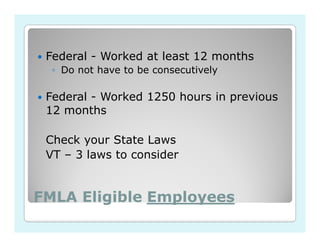
Federal - Worked at least 12 months
  ◦ Do not have to be consecutively

 Federal - Worked 1250 hours in previous
 12 months

 Check your State Laws
 VT – 3 laws to consider


FMLA Eligible Employees
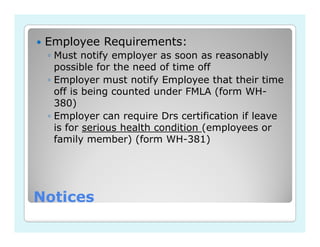
Employee Requirements:
 ◦ Must notify employer as soon as reasonably
   possible for the need of time off
 ◦ Employer must notify Employee that their time
   off is being counted under FMLA (form WH-
   380)
 ◦ Employer can require Drs certification if leave
   is for serious health condition (employees or
   family member) (form WH-381)


Notices
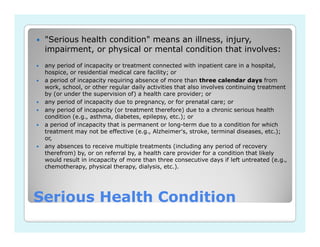
"Serious health condition" means an illness, injury,
 impairment, or physical or mental condition that involves:
 any period of incapacity or treatment connected with inpatient care in a hospital,
 hospice, or residential medical care facility; or
 a period of incapacity requiring absence of more than three calendar days from
 work, school, or other regular daily activities that also involves continuing treatment
 by (or under the supervision of) a health care provider; or
 any period of incapacity due to pregnancy, or for prenatal care; or
 any period of incapacity (or treatment therefore) due to a chronic serious health
 condition (e.g., asthma, diabetes, epilepsy, etc.); or
 a period of incapacity that is permanent or long-term due to a condition for which
 treatment may not be effective (e.g., Alzheimer's, stroke, terminal diseases, etc.);
 or,
 any absences to receive multiple treatments (including any period of recovery
 therefrom) by, or on referral by, a health care provider for a condition that likely
 would result in incapacity of more than three consecutive days if left untreated (e.g.,
 chemotherapy, physical therapy, dialysis, etc.).


Serious Health Condition
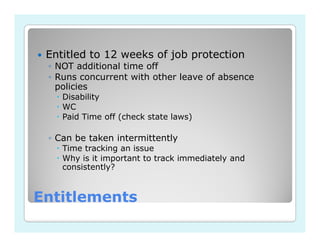
Entitled to 12 weeks of job protection
 ◦ NOT additional time off
 ◦ Runs concurrent with other leave of absence
   policies
    Disability
    WC
    Paid Time off (check state laws)

 ◦ Can be taken intermittently
    Time tracking an issue
    Why is it important to track immediately and
    consistently?


Entitlements
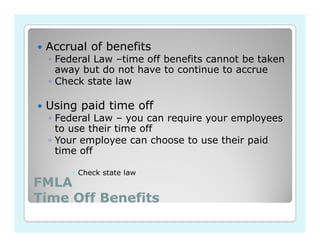
Accrual of benefits
  ◦ Federal Law –time off benefits cannot be taken
    away but do not have to continue to accrue
  ◦ Check state law

 Using paid time off
  ◦ Federal Law – you can require your employees
    to use their time off
  ◦ Your employee can choose to use their paid
    time off

        Check state law
FMLA
Time Off Benefits
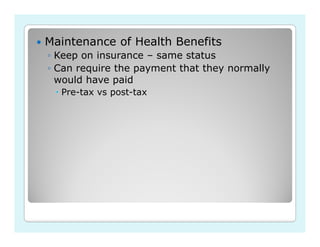
Maintenance of Health Benefits
◦ Keep on insurance – same status
◦ Can require the payment that they normally
  would have paid
  Pre-tax vs post-tax
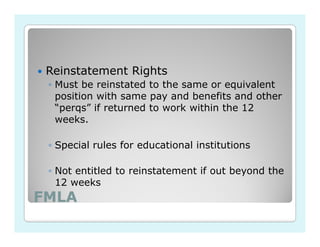
Reinstatement Rights
 ◦ Must be reinstated to the same or equivalent
   position with same pay and benefits and other
   “perqs” if returned to work within the 12
   weeks.

 ◦ Special rules for educational institutions

 ◦ Not entitled to reinstatement if out beyond the
   12 weeks
FMLA
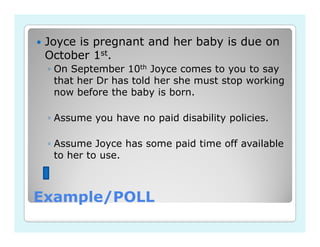
Joyce is pregnant and her baby is due on
 October 1st.
 ◦ On September 10th Joyce comes to you to say
   that her Dr has told her she must stop working
   now before the baby is born.

 ◦ Assume you have no paid disability policies.

 ◦ Assume Joyce has some paid time off available
   to her to use.


Example/POLL
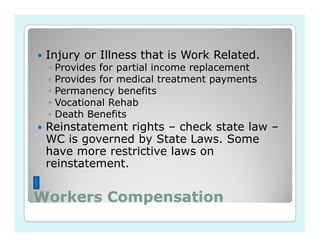
Injury or Illness that is Work Related.
 ◦   Provides for partial income replacement
 ◦   Provides for medical treatment payments
 ◦   Permanency benefits
 ◦   Vocational Rehab
 ◦   Death Benefits
 Reinstatement rights – check state law –
 WC is governed by State Laws. Some
 have more restrictive laws on
 reinstatement.


Workers Compensation
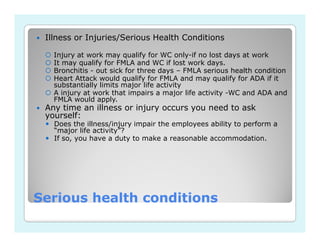
Illness or Injuries/Serious Health Conditions

   Injury at work may qualify for WC only-if no lost days at work
   It may qualify for FMLA and WC if lost work days.
   Bronchitis - out sick for three days – FMLA serious health condition
   Heart Attack would qualify for FMLA and may qualify for ADA if it
   substantially limits major life activity
   A injury at work that impairs a major life activity -WC and ADA and
   FMLA would apply.
 Any time an illness or injury occurs you need to ask
 yourself:
   Does the illness/injury impair the employees ability to perform a
   “major life activity”?
   If so, you have a duty to make a reasonable accommodation.


Serious health conditions
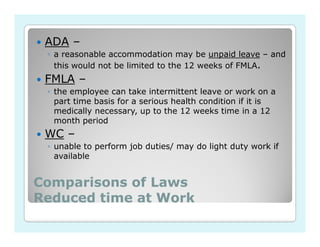
ADA –
 ◦ a reasonable accommodation may be unpaid leave – and
   this would not be limited to the 12 weeks of FMLA.
 FMLA –
 ◦ the employee can take intermittent leave or work on a
   part time basis for a serious health condition if it is
   medically necessary, up to the 12 weeks time in a 12
   month period
 WC –
 ◦ unable to perform job duties/ may do light duty work if
   available


Comparisons of Laws
Reduced time at Work
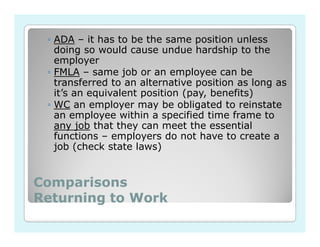
◦ ADA – it has to be the same position unless
   doing so would cause undue hardship to the
   employer
 ◦ FMLA – same job or an employee can be
   transferred to an alternative position as long as
   it’s an equivalent position (pay, benefits)
 ◦ WC an employer may be obligated to reinstate
   an employee within a specified time frame to
   any job that they can meet the essential
   functions – employers do not have to create a
   job (check state laws)


Comparisons
Returning to Work
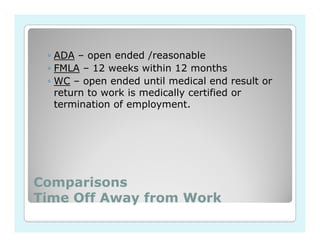
◦ ADA – open ended /reasonable
 ◦ FMLA – 12 weeks within 12 months
 ◦ WC – open ended until medical end result or
   return to work is medically certified or
   termination of employment.


Comparisons
Time Off Away from Work
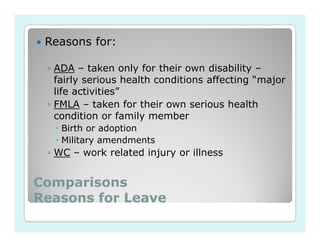
Reasons for:

 ◦ ADA – taken only for their own disability –
   fairly serious health conditions affecting “major
   life activities”
 ◦ FMLA – taken for their own serious health
   condition or family member
   Birth or adoption
   Military amendments
 ◦ WC – work related injury or illness


Comparisons
Reasons for Leave
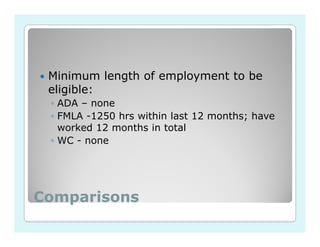
Minimum length of employment to be
 eligible:
 ◦ ADA – none
 ◦ FMLA -1250 hrs within last 12 months; have
   worked 12 months in total
 ◦ WC - none


Comparisons
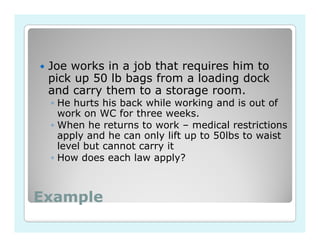
Joe works in a job that requires him to
 pick up 50 lb bags from a loading dock
 and carry them to a storage room.
 ◦ He hurts his back while working and is out of
   work on WC for three weeks.
 ◦ When he returns to work – medical restrictions
   apply and he can only lift up to 50lbs to waist
   level but cannot carry it
 ◦ How does each law apply?


Example
WC Claim
 ◦ Pays for medical and partial lost wages
 FMLA
 ◦ Start the clock ticking as soon as he goes out
   of work
 ADA – is there a disability?


How the laws may interact
◦ Answer: It depends --- ADA is looked at on a
   case by case basis.


 ◦ The medical restrictions– can they be
   accommodated reasonably?

 ◦ The essential job function is to “move” the
   bags, not necessarily carry them….


Case by Case…..
Make every qualifying leave an FMLA event

 Revise existing policies of sick, personal, disability etc to run
 concurrent with FMLA

 Designate and provide notice of such

 Identify essential functions of ALL jobs

 Provide FMLA training especially to front line supervisors and
 managers

 Maintain separate confidential records

 Document all time away from work

 Establish a reinstatement procedure and/or return to work
 program (light duty)

What to do! Best Practices
Have information available – quickly

 Keep up to date and current on law
 changes and revisions

 Document all your steps and procedures


What to do continued….
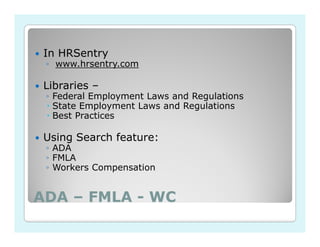
In HRSentry
 ◦ www.hrsentry.com

 Libraries –
 ◦ Federal Employment Laws and Regulations
   State Employment Laws and Regulations
   Best Practices

 Using Search feature:
 ◦ ADA
 ◦ FMLA
 ◦ Workers Compensation


ADA – FMLA - WC
Q&A
 www.hrsentry.com - take the tour! Browse
 the site

 support@hrsentry.com(for information on
 sign up and group rates)

 admin@hrsentry.com (for help inside
 HRSentry)


Wrap Up

315 bermuda triangle

  • 1.
    Created by SimpoPDF Creator Pro (unregistered version) http://www.simpopdf.com UFOs – Unidentified Flying Objects Ufology – is a neologism coined to describe the collective efforts of those who study reports and associated evidence of unidentified flying objects (UFOs). Ufologist – A ufo investigator is called a ufologist Ufo Sightings- Some eye witnesses to the UFOs Roswell Incident- called the Roswell UFO crash 1947 UFO Conspiracy – Worldwide UFO cover Ups and related theories Alien- An extra-terrestrial being is called an alien
  • 2.
    The Bermuda Triangle ofLeave Laws ADA, FMLA and Workers Compensation Instructor: Brenda JM Sabin, CBP Director of Operations and Site Administration for HRSentry, LLC
  • 3.
    Today we aretalking about these Federal Leave Laws: The American’s with Disabilities Act (ADA) The Family and Medical Leave ACT (FMLA) Workers Compensation (WC) We will look at each law separately then weave them together Its like putting a puzzle together blindfolded! Overview
  • 4.
    Americans with DisabilitiesAct of 1990 (Titles 1 and V) pertains to: ◦ Private employers with 15 or more employees, ◦ State and local governments, ◦ Employment agencies and labor unions ◦ The ADA's nondiscrimination standards also apply to federal sector employees under section 501 of the Rehabilitation Act, as amended ADA
  • 5.
    Employees with disabilitiesmust: have an equal opportunity to apply for jobs and to work in jobs for which they are qualified; Provides protection from hiring discrimination Also provides protection from job loss due to disability have an equal opportunity to be promoted once they are working; have equal access to benefits and privileges of employment that are offered to other employees, such as employer-provided health insurance or training; and must not be harassed because of their disability. ADA
  • 6.
    As defined bythe ADA, an individual with a disability is a person who: ◦ has a physical or mental impairment that substantially limits one or more major life activities; seeing, hearing, speaking, walking, breathing, performing manual tasks, learning, caring for oneself, working, etc….. ◦ has a record of such an impairment; or ◦ is regarded as having such an impairment What is a disability?
  • 7.
    Under the ADAyou as an employer are required to make reasonable accommodations unless it creates undue hardship for your business A reasonable accommodation is determined by: employee size, revenue and type of business on a case by case basis ADA
  • 8.
    Reasonable accommodation mayinclude, but is not limited to: ◦ Making existing facilities used by employees readily accessible to and usable by persons with disabilities ◦ Job restructuring, modifying work schedules, reassignment to a vacant position; ◦ Acquiring or modifying equipment or devices, adjusting or modifying examinations, training materials, or policies, and providing qualified readers or interpreters. Reasonable Accommodations
  • 9.
    An employer neverhas to provide any reasonable accommodation that causes undue hardship, meaning significant difficulty or expense. ◦ Undue hardship refers not only to financial difficulty, but to reasonable accommodations that are unduly extensive or disruptive, or those that would fundamentally alter the nature or operation of the business. Undue Hardship
  • 10.
    Reinstatement Rights – ◦ Must be to the SAME job unless doing so causes undue hardship to the employer ◦ No time limit on reinstatement ◦ Employer is obligated to make reasonable accommodations based on the essential functions of the job Essential functions are the fundamental job duties performed in a position. The term "essential functions" does not include the marginal functions of the position. A function may be essential because: The position exists to perform that function. There are a limited number of employees available who could perform that function. The function is highly specialized. ADA
  • 11.
    Family Medical LeaveAct (Federal) Some states have their own Family Leave Laws Whichever law is more beneficial to the employee must be followed FMLA
  • 12.
    FMLA Jobprotection 12 weeks unpaid leave in a 12 month period Intermittent leave is allowed Reasons why: Birth or adoption Check state law definitions for spouse’s working for same employer Serious health condition Yourself Immediate family member Check state laws for difference in definitions of immediate family FMLA
  • 13.
    H.R. 4986, theNational Defense Authorization Act for FY 2008 (NDAA), Pub. L. 110-181.(eff. 01/28/2008) Caregiver Leave FMLA-eligible employees who are the spouse, child, parent, or next of kin to a service member who has been seriously injured (including illness) while on active duty can take up to 26 weeks of unpaid leave in a 12-month period to care for the service member. Important: Where appropriate, all existing provisions of the FMLA apply, including the intermittent leave, the substitution of paid leave, and the notice provisions. Recent Amendments to FMLA
  • 14.
    H.R. 4986, theNational Defense Authorization Act for FY 2008 (NDAA), Pub. L. 110-181.(eff. 01/28/2008) Active Duty Leave Under another FMLA amendment, an employee may take FMLA leave for "any qualifying exigency" arising out of the fact that his/her spouse, child, or parent is on active duty or has been notified of an active-duty call. Amount of leave available: up to 12 weeks in a 12- month period (i.e., the usual FMLA leave allotment). According to the DOL, this amendment won't become effective until final regulations defining any qualifying exigency are issued. In the interim, the DOL advised employers to provide this type of leave. Here, too, the regular FMLA provisions apply, so when the need for leave is foreseeable, employees must provide their employers with reasonable and practicable notice. Also, employers may require that leave requests be supported by certification. Recent Amendments to FMLA
  • 15.
    Private employers with50 employees, working within 75 miles Schools Public agencies Must have a written FMLA policy Government FMLA- FMLA- Covered Employers
  • 16.
    If an FMLA-coveredemployer has any eligible employees and has any written guidance to employees concerning employee benefits or leave rights, such as in an employee handbook, information concerning FMLA entitlements and employee obligations under the FMLA must be included in the handbook or other document. The Law on Policy Requirements
  • 17.
    Federal - Workedat least 12 months ◦ Do not have to be consecutively Federal - Worked 1250 hours in previous 12 months Check your State Laws VT – 3 laws to consider FMLA Eligible Employees
  • 18.
    Employee Requirements: ◦Must notify employer as soon as reasonably possible for the need of time off ◦ Employer must notify Employee that their time off is being counted under FMLA (form WH- 380) ◦ Employer can require Drs certification if leave is for serious health condition (employees or family member) (form WH-381) Notices
  • 19.
    "Serious health condition"means an illness, injury, impairment, or physical or mental condition that involves: any period of incapacity or treatment connected with inpatient care in a hospital, hospice, or residential medical care facility; or a period of incapacity requiring absence of more than three calendar days from work, school, or other regular daily activities that also involves continuing treatment by (or under the supervision of) a health care provider; or any period of incapacity due to pregnancy, or for prenatal care; or any period of incapacity (or treatment therefore) due to a chronic serious health condition (e.g., asthma, diabetes, epilepsy, etc.); or a period of incapacity that is permanent or long-term due to a condition for which treatment may not be effective (e.g., Alzheimer's, stroke, terminal diseases, etc.); or, any absences to receive multiple treatments (including any period of recovery therefrom) by, or on referral by, a health care provider for a condition that likely would result in incapacity of more than three consecutive days if left untreated (e.g., chemotherapy, physical therapy, dialysis, etc.). Serious Health Condition
  • 20.
    Entitled to 12weeks of job protection ◦ NOT additional time off ◦ Runs concurrent with other leave of absence policies Disability WC Paid Time off (check state laws) ◦ Can be taken intermittently Time tracking an issue Why is it important to track immediately and consistently? Entitlements
  • 21.
    Accrual of benefits ◦ Federal Law –time off benefits cannot be taken away but do not have to continue to accrue ◦ Check state law Using paid time off ◦ Federal Law – you can require your employees to use their time off ◦ Your employee can choose to use their paid time off Check state law FMLA Time Off Benefits
  • 22.
    Maintenance of HealthBenefits ◦ Keep on insurance – same status ◦ Can require the payment that they normally would have paid Pre-tax vs post-tax
  • 23.
    Reinstatement Rights ◦Must be reinstated to the same or equivalent position with same pay and benefits and other “perqs” if returned to work within the 12 weeks. ◦ Special rules for educational institutions ◦ Not entitled to reinstatement if out beyond the 12 weeks FMLA
  • 24.
    Joyce is pregnantand her baby is due on October 1st. ◦ On September 10th Joyce comes to you to say that her Dr has told her she must stop working now before the baby is born. ◦ Assume you have no paid disability policies. ◦ Assume Joyce has some paid time off available to her to use. Example/POLL
  • 25.
    Injury or Illnessthat is Work Related. ◦ Provides for partial income replacement ◦ Provides for medical treatment payments ◦ Permanency benefits ◦ Vocational Rehab ◦ Death Benefits Reinstatement rights – check state law – WC is governed by State Laws. Some have more restrictive laws on reinstatement. Workers Compensation
  • 26.
    Illness or Injuries/SeriousHealth Conditions Injury at work may qualify for WC only-if no lost days at work It may qualify for FMLA and WC if lost work days. Bronchitis - out sick for three days – FMLA serious health condition Heart Attack would qualify for FMLA and may qualify for ADA if it substantially limits major life activity A injury at work that impairs a major life activity -WC and ADA and FMLA would apply. Any time an illness or injury occurs you need to ask yourself: Does the illness/injury impair the employees ability to perform a “major life activity”? If so, you have a duty to make a reasonable accommodation. Serious health conditions
  • 27.
    ADA – ◦a reasonable accommodation may be unpaid leave – and this would not be limited to the 12 weeks of FMLA. FMLA – ◦ the employee can take intermittent leave or work on a part time basis for a serious health condition if it is medically necessary, up to the 12 weeks time in a 12 month period WC – ◦ unable to perform job duties/ may do light duty work if available Comparisons of Laws Reduced time at Work
  • 28.
    ◦ ADA –it has to be the same position unless doing so would cause undue hardship to the employer ◦ FMLA – same job or an employee can be transferred to an alternative position as long as it’s an equivalent position (pay, benefits) ◦ WC an employer may be obligated to reinstate an employee within a specified time frame to any job that they can meet the essential functions – employers do not have to create a job (check state laws) Comparisons Returning to Work
  • 29.
    ◦ ADA –open ended /reasonable ◦ FMLA – 12 weeks within 12 months ◦ WC – open ended until medical end result or return to work is medically certified or termination of employment. Comparisons Time Off Away from Work
  • 30.
    Reasons for: ◦ADA – taken only for their own disability – fairly serious health conditions affecting “major life activities” ◦ FMLA – taken for their own serious health condition or family member Birth or adoption Military amendments ◦ WC – work related injury or illness Comparisons Reasons for Leave
  • 31.
    Minimum length ofemployment to be eligible: ◦ ADA – none ◦ FMLA -1250 hrs within last 12 months; have worked 12 months in total ◦ WC - none Comparisons
  • 32.
    Joe works ina job that requires him to pick up 50 lb bags from a loading dock and carry them to a storage room. ◦ He hurts his back while working and is out of work on WC for three weeks. ◦ When he returns to work – medical restrictions apply and he can only lift up to 50lbs to waist level but cannot carry it ◦ How does each law apply? Example
  • 33.
    WC Claim ◦Pays for medical and partial lost wages FMLA ◦ Start the clock ticking as soon as he goes out of work ADA – is there a disability? How the laws may interact
  • 34.
    ◦ Answer: Itdepends --- ADA is looked at on a case by case basis. ◦ The medical restrictions– can they be accommodated reasonably? ◦ The essential job function is to “move” the bags, not necessarily carry them…. Case by Case…..
  • 35.
    Make every qualifyingleave an FMLA event Revise existing policies of sick, personal, disability etc to run concurrent with FMLA Designate and provide notice of such Identify essential functions of ALL jobs Provide FMLA training especially to front line supervisors and managers Maintain separate confidential records Document all time away from work Establish a reinstatement procedure and/or return to work program (light duty) What to do! Best Practices
  • 36.
    Have information available– quickly Keep up to date and current on law changes and revisions Document all your steps and procedures What to do continued….
  • 37.
    In HRSentry ◦www.hrsentry.com Libraries – ◦ Federal Employment Laws and Regulations State Employment Laws and Regulations Best Practices Using Search feature: ◦ ADA ◦ FMLA ◦ Workers Compensation ADA – FMLA - WC
  • 38.
    Q&A www.hrsentry.com -take the tour! Browse the site support@hrsentry.com(for information on sign up and group rates) admin@hrsentry.com (for help inside HRSentry) Wrap Up