DMITRI POPOV. PHD, RADIOBIOLOGY.
MD (RUSSIA)
ADVANCED MEDICAL TECHNOLOGY AND
SYSTEMS INC. CANADA.
Acute Radiation Disease.
Countermeasure Development.
Acute Radiation Disease. Countermeasure Development.
 Complete Protease Inhibitor Cocktail
 ProteoGuard is a complete EDTA-free protease inhibitor
cocktail containing an optimized mixture of protease
inhibitors—specially designed to protect proteins from
being digested by endogenous proteases that can be
released during protein extraction from cell lysates.

http://www.clontech.com/US/Products/Protein_Expres
sion_and_Purification/Reagents/Protease_Inhibitors?p
mc=proteoguard&sitex=10020:22372:US&gclid=CjwKE
AiA0uGmBRDwj7mE1v-
LlCYSJADxH16OLoe5QqhHAFtFrXkzw7KY3ROHknf0t7
WVR4wLofv6CBoCCdzw_wcB
Acute Radiation Disease. Countermeasure Development.
 Mild and Moderate doses and of radiation exposure
induces apoptosis (controlled, programmed death of
radiosensitive cells) without significant levels of
specific radiation-induced toxin formation and
without of inflammatory response.
Acute Radiation Disease. Countermeasure Development.
 Moderate and high doses of radiation induces
necrosis of radiosensitive cells with the subsequent
formation of radiation toxins and their induced acute
inflammatory processes. Radiation necrosis is the
most substantial and most severe form of radiation
induced injury, and when widespread, has grave
therapeutic implications.
Acute Radiation Disease. Countermeasure Development.
 Caspases, or cysteine-aspartic proteases or cysteine-
dependent aspartate-directed proteases are a family
of cysteine proteasesthat play essential roles
in apoptosis (programmed cell death), necrosis,
and inflammation.[2]
 Caspases are essential in cells for apoptosis, or
programmed cell death such as Necrptosis,
in development and most other stages of adult life, and
have been termed "executioner" proteins for their roles
in the cell. Some caspases are also required in
the immune system for the maturation of lymphocytes.
Acute Radiation Disease. Countermeasure Development.
 Caspases are regulated at a post-translational level,
ensuring that they can be rapidly activated. They are first
synthesized as inactive pro-caspases, that consist of a
prodomain, a small subunit and a large subunit. Initiator
caspases possess a longer prodomain than the effector
caspases, whose prodomain is very small. The prodomain
of the initiator caspases contain domains such as a CARD
domain (e.g., caspases-2 and caspase-9) or a death
effector domain (DED) (caspases-8 and caspase-10) that
enables the caspases to interact with other molecules that
regulate their activation. These molecules respond to
stimuli that cause the clustering of the initiator caspases.
Such clustering allows them to activate automatically, so
that they can proceed to activate the effector caspases.
Acute Radiation Disease. Countermeasure Development.
 The caspase cascade can be activated by:
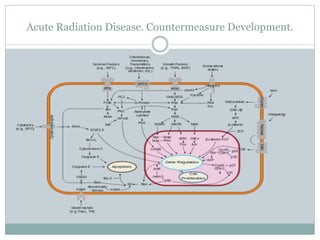
 Overview of signal transduction pathways involved
in apoptosis.
 granzyme B (released by cytotoxic T
lymphocytes and NK cells), which is known to
activate caspase-3 and -7
 death receptors (like Fas, TRAIL receptors and TNF
receptor), which can activate caspase-8 and -10
 the apoptosome (regulated by cytochrome c and
the Bcl-2 family), which activates caspase-9.
Acute Radiation Disease. Countermeasure Development.
 Serine proteases (or serine endopeptidases)
are enzymes that cleave peptide bonds in proteins, in
which serine serves as thenucleophilic amino acid at
the (enzyme's) active site.[1] They are found
ubiquitously in both eukaryotes and prokaryotes.
Serine proteases fall into two broad categories based
on their structure: chymotrypsin-like (trypsin-like)
or subtilisin-like.[2] In humans, they are responsible
for co-ordinating various physiological functions,
including digestion, immune response, blood
coagulation and reproduction
Acute Radiation Disease. Countermeasure Development.
 The MEROPS protease classification system counts
16 superfamilies (as of 2013) each containing
many families. Each superfamily uses the catalytic
triad or dyad in a different protein fold and so
represent convergent evolution of the catalytic
mechanism. The majority belong to the S1 family of
the PA clan (superfamily) of proteases.
 For superfamilies, P = superfamily containing a mixture
of nucleophile class families, S = purely serine proteases.
superfamily. Within each superfamily, families are
designated by their catalytic nucleophile (S = serine
proteases).
Acute Radiation Disease. Countermeasure Development.
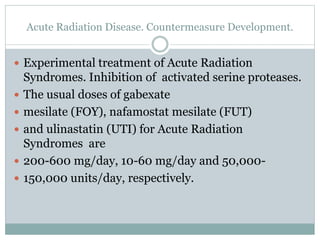
 Experimental treatment of Acute Radiation
Syndromes. Inhibition of activated serine proteases.
 The usual doses of gabexate
 mesilate (FOY), nafamostat mesilate (FUT)
 and ulinastatin (UTI) for Acute Radiation
Syndromes are
 200-600 mg/day, 10-60 mg/day and 50,000-
 150,000 units/day, respectively.
Acute Radiation Disease. Countermeasure Development.
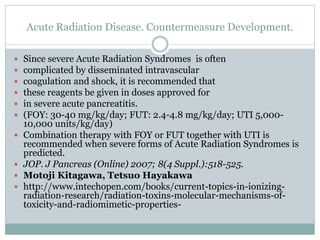
 Since severe Acute Radiation Syndromes is often
 complicated by disseminated intravascular
 coagulation and shock, it is recommended that
 these reagents be given in doses approved for
 in severe acute pancreatitis.
 (FOY: 30-40 mg/kg/day; FUT: 2.4-4.8 mg/kg/day; UTI 5,000-
10,000 units/kg/day)
 Combination therapy with FOY or FUT together with UTI is
recommended when severe forms of Acute Radiation Syndromes is
predicted.
 JOP. J Pancreas (Online) 2007; 8(4 Suppl.):518-525.
 Motoji Kitagawa, Tetsuo Hayakawa
 http://www.intechopen.com/books/current-topics-in-ionizing-
radiation-research/radiation-toxins-molecular-mechanisms-of-
toxicity-and-radiomimetic-properties-

Acute radiation disease,countermeasure development.

  • 1.
    DMITRI POPOV. PHD,RADIOBIOLOGY. MD (RUSSIA) ADVANCED MEDICAL TECHNOLOGY AND SYSTEMS INC. CANADA. Acute Radiation Disease. Countermeasure Development.
  • 2.
    Acute Radiation Disease.Countermeasure Development.  Complete Protease Inhibitor Cocktail  ProteoGuard is a complete EDTA-free protease inhibitor cocktail containing an optimized mixture of protease inhibitors—specially designed to protect proteins from being digested by endogenous proteases that can be released during protein extraction from cell lysates.  http://www.clontech.com/US/Products/Protein_Expres sion_and_Purification/Reagents/Protease_Inhibitors?p mc=proteoguard&sitex=10020:22372:US&gclid=CjwKE AiA0uGmBRDwj7mE1v- LlCYSJADxH16OLoe5QqhHAFtFrXkzw7KY3ROHknf0t7 WVR4wLofv6CBoCCdzw_wcB
  • 3.
    Acute Radiation Disease.Countermeasure Development.  Mild and Moderate doses and of radiation exposure induces apoptosis (controlled, programmed death of radiosensitive cells) without significant levels of specific radiation-induced toxin formation and without of inflammatory response.
  • 4.
    Acute Radiation Disease.Countermeasure Development.  Moderate and high doses of radiation induces necrosis of radiosensitive cells with the subsequent formation of radiation toxins and their induced acute inflammatory processes. Radiation necrosis is the most substantial and most severe form of radiation induced injury, and when widespread, has grave therapeutic implications.
  • 5.
    Acute Radiation Disease.Countermeasure Development.  Caspases, or cysteine-aspartic proteases or cysteine- dependent aspartate-directed proteases are a family of cysteine proteasesthat play essential roles in apoptosis (programmed cell death), necrosis, and inflammation.[2]  Caspases are essential in cells for apoptosis, or programmed cell death such as Necrptosis, in development and most other stages of adult life, and have been termed "executioner" proteins for their roles in the cell. Some caspases are also required in the immune system for the maturation of lymphocytes.
  • 6.
    Acute Radiation Disease.Countermeasure Development.  Caspases are regulated at a post-translational level, ensuring that they can be rapidly activated. They are first synthesized as inactive pro-caspases, that consist of a prodomain, a small subunit and a large subunit. Initiator caspases possess a longer prodomain than the effector caspases, whose prodomain is very small. The prodomain of the initiator caspases contain domains such as a CARD domain (e.g., caspases-2 and caspase-9) or a death effector domain (DED) (caspases-8 and caspase-10) that enables the caspases to interact with other molecules that regulate their activation. These molecules respond to stimuli that cause the clustering of the initiator caspases. Such clustering allows them to activate automatically, so that they can proceed to activate the effector caspases.
  • 7.
    Acute Radiation Disease.Countermeasure Development.  The caspase cascade can be activated by:  Overview of signal transduction pathways involved in apoptosis.  granzyme B (released by cytotoxic T lymphocytes and NK cells), which is known to activate caspase-3 and -7  death receptors (like Fas, TRAIL receptors and TNF receptor), which can activate caspase-8 and -10  the apoptosome (regulated by cytochrome c and the Bcl-2 family), which activates caspase-9.
  • 8.
    Acute Radiation Disease.Countermeasure Development.
  • 9.
    Acute Radiation Disease.Countermeasure Development.  Serine proteases (or serine endopeptidases) are enzymes that cleave peptide bonds in proteins, in which serine serves as thenucleophilic amino acid at the (enzyme's) active site.[1] They are found ubiquitously in both eukaryotes and prokaryotes. Serine proteases fall into two broad categories based on their structure: chymotrypsin-like (trypsin-like) or subtilisin-like.[2] In humans, they are responsible for co-ordinating various physiological functions, including digestion, immune response, blood coagulation and reproduction
  • 10.
    Acute Radiation Disease.Countermeasure Development.  The MEROPS protease classification system counts 16 superfamilies (as of 2013) each containing many families. Each superfamily uses the catalytic triad or dyad in a different protein fold and so represent convergent evolution of the catalytic mechanism. The majority belong to the S1 family of the PA clan (superfamily) of proteases.  For superfamilies, P = superfamily containing a mixture of nucleophile class families, S = purely serine proteases. superfamily. Within each superfamily, families are designated by their catalytic nucleophile (S = serine proteases).
  • 11.
    Acute Radiation Disease.Countermeasure Development.  Experimental treatment of Acute Radiation Syndromes. Inhibition of activated serine proteases.  The usual doses of gabexate  mesilate (FOY), nafamostat mesilate (FUT)  and ulinastatin (UTI) for Acute Radiation Syndromes are  200-600 mg/day, 10-60 mg/day and 50,000-  150,000 units/day, respectively.
  • 12.
    Acute Radiation Disease.Countermeasure Development.  Since severe Acute Radiation Syndromes is often  complicated by disseminated intravascular  coagulation and shock, it is recommended that  these reagents be given in doses approved for  in severe acute pancreatitis.  (FOY: 30-40 mg/kg/day; FUT: 2.4-4.8 mg/kg/day; UTI 5,000- 10,000 units/kg/day)  Combination therapy with FOY or FUT together with UTI is recommended when severe forms of Acute Radiation Syndromes is predicted.  JOP. J Pancreas (Online) 2007; 8(4 Suppl.):518-525.  Motoji Kitagawa, Tetsuo Hayakawa  http://www.intechopen.com/books/current-topics-in-ionizing- radiation-research/radiation-toxins-molecular-mechanisms-of- toxicity-and-radiomimetic-properties-