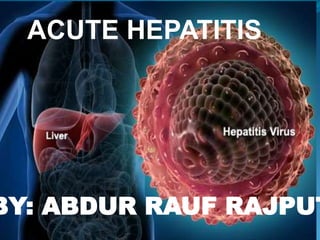
ACUTE HEPATITIS
BY: ABDUR RAUF RAJPUT
HEPATITIS
ļ‚— Acute parenchymal liver damage can be caused by many agents.
ļ‚— Implies inflammation of liver characterized by presence of
inflammatory cells in the tissue of liver.
ļ‚— The condition can be self limiting, healing on its own or can
progress to scaring of liver .
ļ‚— Hepatitis is acute when it last less than 6 weeks and chronic
when it persist longer.
ļ‚— A group of viruses known as hepatitis viruses causes most cases
of liver damage worldwide.
ļ‚— Hepatitis can also be due to toxin (Alcohol) other infection or
from auto immune process
ļ‚— It may run a subclinical course when the affected person may
not feel ill.
ļ‚— The patient become unwell and symptomatic when disease
impair liver function.
CAUSES OF ACUTE HEPATITIS
• Viral hepatitis: Hepatitis A,E (more than 95% of viral
cause), B,C.
• Herpes simplex, CMV, EBV, yellow fever virus.
• Non viral infection: Toxoplasma, leptospira, Q fever.
• Alcohol
• Toxins: Amanita toxin in mushroom, carbon
tetrachloride
• Drugs: Paracetamol
• Autoimmune condition
• Metabolic Disease e.g. Wilson disease.
SYMPTOMS
• Clinically, the course of acute hepatitis varies widely from mild
symptoms requiring no treatment to fulminant hepatic failure .
ļ‚— Acute viral hepatitis is more likely to be asymptomatic in younger
people. Symptomatic individuals may present after convalescent
stage of 7 to 10 days, with the total illness lasting 2 to 6 weeks.
ļ‚— Initial features are of nonspecific flu-like symptoms, common to
almost all acute viral infections and may include malaise, muscle
and joint aches, fever, nausea or vomiting, diarrhea, and headache.
ļ‚— More specific symptoms, which can be present in acute hepatitis
from any cause, are: profound loss of appetite, aversion to smoking
among smokers, dark urine, yellowing of the eyes and skin (i.e.,
jaundice) and abdominal discomfort.
ļ‚— Physical findings are usually minimal, apart from jaundice (33%) an
tender hepatomegaly (10%). There can be occasional
lymphadenopathy (5%) or splenomegaly (5%).
HEPATITIS A VIRUS
• It`s a member of picorna virus family.
• Single stranded RNA virus.
• Incubation period 2-6 weeks.
• Mode of Transmission Feco-Oral Route.
• Epidemiology HAV is most common type of viral hepatitis
occurring world wide.
ļ‚— Disease common in children in young adult
ļ‚— It is common in day care Centre, prisons , travelers to
developing countries.
ļ‚— No carrier state
ļ‚— No chronic hepatitis
ļ‚— No hepatocellular carcinoma
INVESTIGATION
ļ‚— Liver biochemistry
ļ‚— A raised serum AST and ALT which can some time be
very high
ļ‚— In icteric stage the serum biluribin will be high
ļ‚— Hematological test: leucopinia with relative
lymphocytosis
ļ‚— ESR is raised.
ļ‚— SEROLOGY :
ļ‚— Active infection Anti HAV IgM
ļ‚— RECOVERY Anti HAV IgG
COURSE & PROGNOSIS
• The prognosis is excellence with most patient making
a complete recovery.
• Mortality in young adult is 0.1% but it Increase with
age.
• Death is due to fulminant hepatic necrosis.
• HAV never progress to chronic liver disease.
TREATMENT
SYMPTOMATIC
• Prevention:
ACTIVE VACCINATION
PASSIVEIMMUNOGLOBULINS
Who should be vaccinated
Individual with chronic HBV & HCV.
Individual with close contact/
Individual specially who are male homosexual.
Peoples traveling to Endemic areas.
• Immunoglobulins can be effective in outbreak of
hepatitis in school & nursery.
HEPATITIS E VIRUS
ļ‚— Hepatitis E
ļ‚— Hepatitis E virus (HEV) is an RNA virus , which causes a
hepatitis clinically very similar to hepatitis A. It is enterally
transmitted, usually by contaminated water.
ļ‚— Epidemics have been seen in many developing
countries. It has a mortality from fulminant hepatic failure
of 1-2% which rises to 20% in pregnant women.
ļ‚— There is no carrier state and it does not progress to
chronic liver disease.
• An ELISA for IgG and IgM anti-HEV is available for
diagnosis.
• HEV RNA can be detected in the serum or stools by PCR
(polymerase chain reaction).
ļ‚— Prevention and control depend on good sanitation and
hygiene.
HEPATITIS D VIRUS
ļ‚— This is caused by the hepatitis D virus (HDV or delta virus).
ļ‚— It is an incomplete RNA particle enclosed in a shell of HBsAg.
It is unable to replicate on its own but is activated by the
presence of HBV.
ļ‚— It is particularly seen in intravenous drug abusers but can
affect all risk groups for HBV infection.
ļ‚— Hepatitis D viral infection can occur either as a co-infection
with HBV or as a superinfect ion in an HBsAg-positive patient..
ļ‚— Diagnosis is confirmed by finding serum IgM anti-delta. Super
infection results in an acute flare-up of previously quiescent
chronic HBV infection. A rise in serum AST or ALT may
indication of infection.
ļ‚— Fulminant hepatitis can follow both types of infection but is
more common after co-infection.
HEPATITIS B VIRUS
ļ‚— Double stranded DNA virus
ļ‚— Incubation period 4-20 weeks
ļ‚— Mode of Transmission
BLOOD
SEXUAL
BREAST FEEDING
PREGNANCY
HBV is one of the most comman cause of chronic liver
disease and hepatocellular carcinoma worldwide.
EPIDEMOLOGY:-
Approximately 1/3rd of population have serological
evidence of past or current infection with hepatitis B-
virus and approx: 350-400 millions are chronic HBsAg
carrier.
• The virus can be seen in semen and saliva.
• Vertical transmission during prenatal period is most
comman cause of infection worldwide and carries high
risk of ongoing chronic infection.
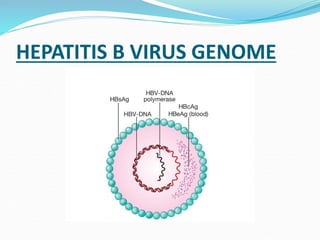
HEPATITIS B VIRUS GENOME
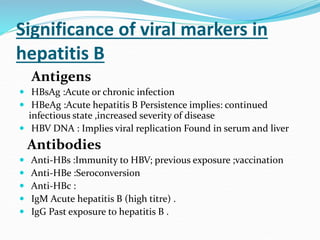
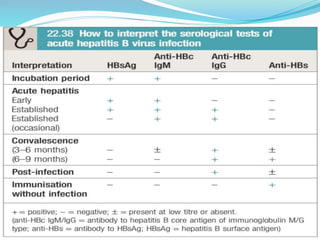
Significance of viral markers in
hepatitis B
Antigens
ļ‚— HBsAg :Acute or chronic infection
ļ‚— HBeAg :Acute hepatitis B Persistence implies: continued
infectious state ,increased severity of disease
ļ‚— HBV DNA : Implies viral replication Found in serum and liver
Antibodies
ļ‚— Anti-HBs :Immunity to HBV; previous exposure ;vaccination
ļ‚— Anti-HBe :Seroconversion
ļ‚— Anti-HBc :
ļ‚— IgM Acute hepatitis B (high titre) .
ļ‚— IgG Past exposure to hepatitis B .
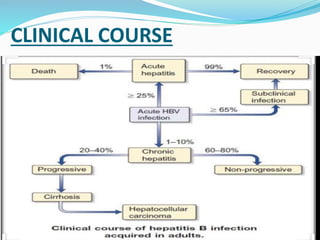
CLINICAL COURSE
TREATMENT OF HBV
SYMPTOMATIC:
ļ‚— PREVENTION:
ļ‚— ACTIVE VACCINATION
ļ‚— PASSIVEIMMUNOGLOBULINS
WHO SHOULD BE VACCINATED?
ļ‚— Doctors & Nurses
ļ‚— Pregnant mothers having hepatitis B infection
ļ‚— Paramedic staff.
COMPLICATION ACUTE VIRAL
HEPATITIS
ļ‚— Acute liver failure
ļ‚— Cholestatic hepatitis
ļ‚— Aplastic anemia
ļ‚— Chronic liver disease e.g cirrhosis
ļ‚— Relapsing hepatitis.
Acute hepatitis
Acute hepatitis

Acute hepatitis

  • 2.
  • 3.
    HEPATITIS ļ‚— Acute parenchymalliver damage can be caused by many agents. ļ‚— Implies inflammation of liver characterized by presence of inflammatory cells in the tissue of liver. ļ‚— The condition can be self limiting, healing on its own or can progress to scaring of liver . ļ‚— Hepatitis is acute when it last less than 6 weeks and chronic when it persist longer. ļ‚— A group of viruses known as hepatitis viruses causes most cases of liver damage worldwide. ļ‚— Hepatitis can also be due to toxin (Alcohol) other infection or from auto immune process ļ‚— It may run a subclinical course when the affected person may not feel ill. ļ‚— The patient become unwell and symptomatic when disease impair liver function.
  • 4.
    CAUSES OF ACUTEHEPATITIS • Viral hepatitis: Hepatitis A,E (more than 95% of viral cause), B,C. • Herpes simplex, CMV, EBV, yellow fever virus. • Non viral infection: Toxoplasma, leptospira, Q fever. • Alcohol • Toxins: Amanita toxin in mushroom, carbon tetrachloride • Drugs: Paracetamol • Autoimmune condition • Metabolic Disease e.g. Wilson disease.
  • 5.
    SYMPTOMS • Clinically, thecourse of acute hepatitis varies widely from mild symptoms requiring no treatment to fulminant hepatic failure . ļ‚— Acute viral hepatitis is more likely to be asymptomatic in younger people. Symptomatic individuals may present after convalescent stage of 7 to 10 days, with the total illness lasting 2 to 6 weeks. ļ‚— Initial features are of nonspecific flu-like symptoms, common to almost all acute viral infections and may include malaise, muscle and joint aches, fever, nausea or vomiting, diarrhea, and headache. ļ‚— More specific symptoms, which can be present in acute hepatitis from any cause, are: profound loss of appetite, aversion to smoking among smokers, dark urine, yellowing of the eyes and skin (i.e., jaundice) and abdominal discomfort. ļ‚— Physical findings are usually minimal, apart from jaundice (33%) an tender hepatomegaly (10%). There can be occasional lymphadenopathy (5%) or splenomegaly (5%).
  • 6.
    HEPATITIS A VIRUS •It`s a member of picorna virus family. • Single stranded RNA virus. • Incubation period 2-6 weeks. • Mode of Transmission Feco-Oral Route. • Epidemiology HAV is most common type of viral hepatitis occurring world wide. ļ‚— Disease common in children in young adult ļ‚— It is common in day care Centre, prisons , travelers to developing countries. ļ‚— No carrier state ļ‚— No chronic hepatitis ļ‚— No hepatocellular carcinoma
  • 7.
    INVESTIGATION ļ‚— Liver biochemistry ļ‚—A raised serum AST and ALT which can some time be very high ļ‚— In icteric stage the serum biluribin will be high ļ‚— Hematological test: leucopinia with relative lymphocytosis ļ‚— ESR is raised. ļ‚— SEROLOGY : ļ‚— Active infection Anti HAV IgM ļ‚— RECOVERY Anti HAV IgG
  • 8.
    COURSE & PROGNOSIS •The prognosis is excellence with most patient making a complete recovery. • Mortality in young adult is 0.1% but it Increase with age. • Death is due to fulminant hepatic necrosis. • HAV never progress to chronic liver disease.
  • 9.
    TREATMENT SYMPTOMATIC • Prevention: ACTIVE VACCINATION PASSIVEIMMUNOGLOBULINS Whoshould be vaccinated Individual with chronic HBV & HCV. Individual with close contact/ Individual specially who are male homosexual. Peoples traveling to Endemic areas. • Immunoglobulins can be effective in outbreak of hepatitis in school & nursery.
  • 10.
    HEPATITIS E VIRUS ļ‚—Hepatitis E ļ‚— Hepatitis E virus (HEV) is an RNA virus , which causes a hepatitis clinically very similar to hepatitis A. It is enterally transmitted, usually by contaminated water. ļ‚— Epidemics have been seen in many developing countries. It has a mortality from fulminant hepatic failure of 1-2% which rises to 20% in pregnant women. ļ‚— There is no carrier state and it does not progress to chronic liver disease. • An ELISA for IgG and IgM anti-HEV is available for diagnosis. • HEV RNA can be detected in the serum or stools by PCR (polymerase chain reaction). ļ‚— Prevention and control depend on good sanitation and hygiene.
  • 11.
    HEPATITIS D VIRUS ļ‚—This is caused by the hepatitis D virus (HDV or delta virus). ļ‚— It is an incomplete RNA particle enclosed in a shell of HBsAg. It is unable to replicate on its own but is activated by the presence of HBV. ļ‚— It is particularly seen in intravenous drug abusers but can affect all risk groups for HBV infection. ļ‚— Hepatitis D viral infection can occur either as a co-infection with HBV or as a superinfect ion in an HBsAg-positive patient.. ļ‚— Diagnosis is confirmed by finding serum IgM anti-delta. Super infection results in an acute flare-up of previously quiescent chronic HBV infection. A rise in serum AST or ALT may indication of infection. ļ‚— Fulminant hepatitis can follow both types of infection but is more common after co-infection.
  • 12.
    HEPATITIS B VIRUS ļ‚—Double stranded DNA virus ļ‚— Incubation period 4-20 weeks ļ‚— Mode of Transmission BLOOD SEXUAL BREAST FEEDING PREGNANCY HBV is one of the most comman cause of chronic liver disease and hepatocellular carcinoma worldwide.
  • 13.
    EPIDEMOLOGY:- Approximately 1/3rd ofpopulation have serological evidence of past or current infection with hepatitis B- virus and approx: 350-400 millions are chronic HBsAg carrier. • The virus can be seen in semen and saliva. • Vertical transmission during prenatal period is most comman cause of infection worldwide and carries high risk of ongoing chronic infection.
  • 14.
  • 15.
    Significance of viralmarkers in hepatitis B Antigens ļ‚— HBsAg :Acute or chronic infection ļ‚— HBeAg :Acute hepatitis B Persistence implies: continued infectious state ,increased severity of disease ļ‚— HBV DNA : Implies viral replication Found in serum and liver Antibodies ļ‚— Anti-HBs :Immunity to HBV; previous exposure ;vaccination ļ‚— Anti-HBe :Seroconversion ļ‚— Anti-HBc : ļ‚— IgM Acute hepatitis B (high titre) . ļ‚— IgG Past exposure to hepatitis B .
  • 17.
  • 18.
    TREATMENT OF HBV SYMPTOMATIC: ļ‚—PREVENTION: ļ‚— ACTIVE VACCINATION ļ‚— PASSIVEIMMUNOGLOBULINS WHO SHOULD BE VACCINATED? ļ‚— Doctors & Nurses ļ‚— Pregnant mothers having hepatitis B infection ļ‚— Paramedic staff.
  • 19.
    COMPLICATION ACUTE VIRAL HEPATITIS ļ‚—Acute liver failure ļ‚— Cholestatic hepatitis ļ‚— Aplastic anemia ļ‚— Chronic liver disease e.g cirrhosis ļ‚— Relapsing hepatitis.