Peter Lucantoni
Activities for
developing
speaking skills
Peter Lucantoni
• Started teaching in 1979 in UK, MA TESOL
University of Edinburgh, lived and worked in
Europe and Middle East, now based in Cyprus
• Author, Educational Consultant & Teacher
Trainer for Cambridge University Press
• Cambridge TKT, CELTYL, CELTA & DELTA
trainer and Cambridge CELTYL assessor
• Examiner for Cambridge ESOL speaking
examinations
• What do the experts say?
• What does speaking involve?
• Pairwork and groupwork
• Making it motivating
• Activities
• Conclusions
Overview
• The ability to speak a second … language
well is a very complex task (Jack
Richards, 2002)
• Learning to speak a foreign language
requires more than knowing its
grammatical and semantic rules (Kang
Shumin, 2002)
• Speaking is in many ways an undervalued
skill (Martin Bygate, 2000)
What do the experts say?
• Getting students to talk is the major
and one of the most difficult tasks
confronting any teacher (C N Candlin,
1990)
• We often make judgements about a
person’s social, cultural or educational
background on the basis of the quality
of their spoken language (Lucantoni,
2002)
What do the experts say?
• Discuss with your colleagues and try to
agree on the different things that
speaking involves.
recall of appropriate words
What does speaking involve?
• recall of appropriate words
• organisation of words into units
• movement of lips & tongue to form
sounds
• monitoring sounds and correcting if
necessary
• awareness of cultural conventions
Speaking involves …
• 1 carry out ‘routine’ exchanges
• 2 take part in ‘unpredictable’ exchanges
• Think of examples of both types of
exchanges
What do learners need to practise and learn?
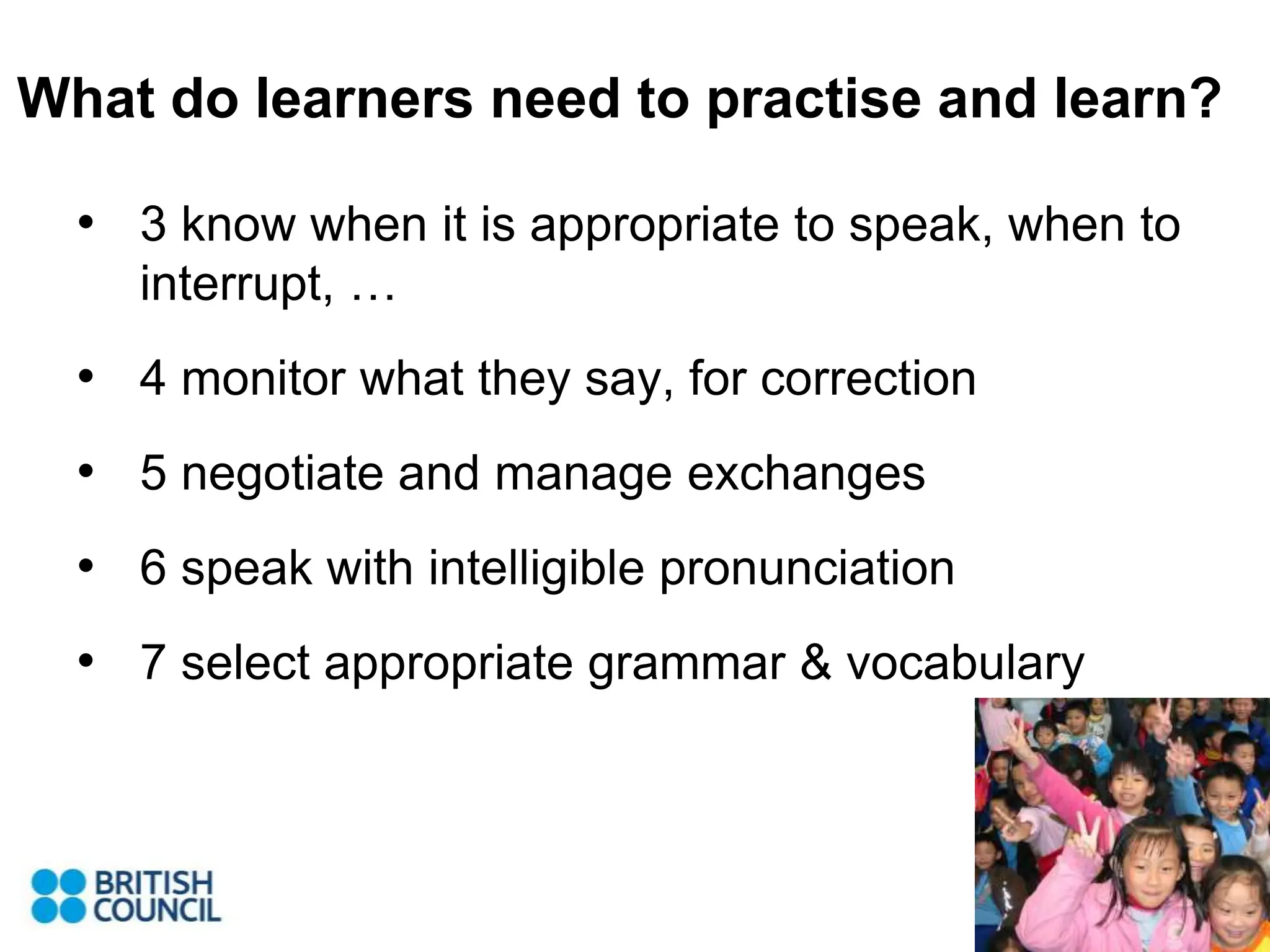
• 3 know when it is appropriate to speak, when to
interrupt, …
• 4 monitor what they say, for correction
• 5 negotiate and manage exchanges
• 6 speak with intelligible pronunciation
• 7 select appropriate grammar & vocabulary
What do learners need to practise and learn??
• Grammar & vocabulary learning involves
oral practice
• Receptive skills lessons often involve
speaking
• Speaking often bound up in everything
else we do in classroom
Do we need to teach speaking skills?
• Many learners say that speaking is the
most important skill for them
• Dedicated speaking lessons are useful
• Provides safe rehearsal for the real world
Do we need to teach speaking skills?
• Greatly increases amount of time
students can talk in class – best way to
maximise class time
• Improves quality of talking, more natural –
hesitation, mixed structures, unfinished …
• Natural framework for interaction
• Encourages communal classroom, helps
to individualise learning
Pairwork & group work
• Students learn by doing things for themselves
• Focus on fluency rather than accuracy
• Confidence building
• Teacher freer to listen to more students
• Classes more active/interactive and fun,
therefore more motivating
Pairwork & group work
• Make speaking relevant
• Make speaking real
• Don’t forget pronunciation
• Show them how much they can say (not
what they can’t say)
Making it motivating
• Don’t criticise mistakes
• Encourage free expression
• Provide feedback
• Give them the words they need
• Speaking means listening too
Making it motivating
Find someone who ...
Name Details
can ...
can’t ...
likes ...
doesn’t like ...
would like to ...
didn’t ...
is going to ...
• You – Hassan, can you drive a car?
• Hassan – Yes, I can.
• You – When did you learn to drive?
• Hassan – Two years ago.
Find someone who ...
Name Details
can ... Hassan He learned two years ago
can’t ...
likes ...
doesn’t like ...
would like to ...
didn’t ...
is going to ...
Find someone who ...
• You – Salma, would you like to
come for dinner?
• Salma – Yes, I would.
• You – What would you like to eat?
• Salma – Not meat – I’m vegetarian.
Find someone who ...
Name Details
can ... Hassan He learned two years ago
can’t ...
likes ...
doesn’t like ...
would like to ... Salma Doesn’t eat meat
didn’t ...
is going to ...
Find someone who ...
• Think of the area where you live –
streets, shops, buildings, restaurants, etc
• Draw a simple map and name/label the
details from the first stage
• Look through your notes and books and
pick out 10-12 useful words or phrases
that you want to revise, eg,
swim/swam/swum
Swim swam swum street
• Now rename the details on the map,
using the vocabulary you want to revise,
for example: Swim Swam Swum Street,
On the Other Hand Restaurant, Most
Comfortable Bank
• In pairs or small groups, present new
maps to each other, reinforcing
vocabulary to be revised
Swim swam swum street
• Sometimes we answer a question with
another question
• Why? Try to think of three reasons
Question-Question
Question-Question
Ali >>> <<< Badra
Pretty good. Where
are you going?
I’m nosey. Can I
come with you?
I said ‘How are you?’
Hi, Badra, how are
you?
I’m ok. What about
you?
What did you say?
Ahhh, that’s my
secret! Why do you
want to know?
Are you crazy?
Ali Hello, how are you?
Badra What did you say?
Ali I said ‘How are you?’
Badra I’m ok, what about you?
Ali Pretty good. Where are you going?
Badra Ahhh, that’s my secret! Why do you
want to know?
Ali I’m nosey! Can I come with you?
Badra Are you crazy?!
Useful questions
What did you say?
Why do you ask?
Can you say that again?
Can we stop this?
Are you deaf?
What do you mean?
The world
• Listen to the words
• Think about in which country you can
write them
• Example: ‘coffee’ could go in Italy
because the coffee is good there, or in
Brazil because coffee beans grow there
• Discuss with your partners and give
reasons for your choices
The world
Where did you put coffee?
I put coffee in Brazil
So did I / I didn’t
Why did you put coffee in Brazil?
I chose Brazil because …
I agree / disagree
The world
coffee
peace
water
music
coffee
football
history
wild animals
oil
chocolate
mountains
fishing
Presenting a new product
•Umbrella
•Paper clip
•Candle
•Fork
•Coat hanger
•Highlighter
•Chopsticks
• Choose the product you want to
present
• Think of five new features for it
• Draw and label it, showing the
new features
Presenting a new product
1. Laser pointer
2. Multi-
coloured
3. ________________
4. _______________
5. _______________
• Look at the talk skeleton and
make notes about your product
• Prepare and deliver your
presentation to the class
Presenting a new product
• Thank you very much for coming
to our presentation!
• Our wonderful new product is
called ……….
• I’m going to tell you about it.
Afterwards, you can ask
questions.
Presenting a new product
• The ………. is fantastic!
• Firstly ……….
• Secondly ……….
• Also ……….
• And ……….
• Finally ……….
Presenting a new product
• We believe that our ………. is
……….
• I have time to answer two or three
questions now
• Thank you all for listening!
Presenting a new product
• Competence in speaking is just as much
about how as what
• Building learners’ confidence is an
essential part of the whole speaking
process
• Don’t sacrifice creativity for accuracy
• Don’t sacrifice accuracy for creativity
• Scaffold, scaffold, scaffold …
Conclusions
Any
questions?
peter@cup-training.org

activities-for-developing-speaking-skills.ppt

  • 1.
  • 2.
    Peter Lucantoni • Startedteaching in 1979 in UK, MA TESOL University of Edinburgh, lived and worked in Europe and Middle East, now based in Cyprus • Author, Educational Consultant & Teacher Trainer for Cambridge University Press • Cambridge TKT, CELTYL, CELTA & DELTA trainer and Cambridge CELTYL assessor • Examiner for Cambridge ESOL speaking examinations
  • 3.
    • What dothe experts say? • What does speaking involve? • Pairwork and groupwork • Making it motivating • Activities • Conclusions Overview
  • 4.
    • The abilityto speak a second … language well is a very complex task (Jack Richards, 2002) • Learning to speak a foreign language requires more than knowing its grammatical and semantic rules (Kang Shumin, 2002) • Speaking is in many ways an undervalued skill (Martin Bygate, 2000) What do the experts say?
  • 5.
    • Getting studentsto talk is the major and one of the most difficult tasks confronting any teacher (C N Candlin, 1990) • We often make judgements about a person’s social, cultural or educational background on the basis of the quality of their spoken language (Lucantoni, 2002) What do the experts say?
  • 6.
    • Discuss withyour colleagues and try to agree on the different things that speaking involves. recall of appropriate words What does speaking involve?
  • 7.
    • recall ofappropriate words • organisation of words into units • movement of lips & tongue to form sounds • monitoring sounds and correcting if necessary • awareness of cultural conventions Speaking involves …
  • 8.
    • 1 carryout ‘routine’ exchanges • 2 take part in ‘unpredictable’ exchanges • Think of examples of both types of exchanges What do learners need to practise and learn?
  • 9.
    • 3 knowwhen it is appropriate to speak, when to interrupt, … • 4 monitor what they say, for correction • 5 negotiate and manage exchanges • 6 speak with intelligible pronunciation • 7 select appropriate grammar & vocabulary What do learners need to practise and learn??
  • 10.
    • Grammar &vocabulary learning involves oral practice • Receptive skills lessons often involve speaking • Speaking often bound up in everything else we do in classroom Do we need to teach speaking skills?
  • 11.
    • Many learnerssay that speaking is the most important skill for them • Dedicated speaking lessons are useful • Provides safe rehearsal for the real world Do we need to teach speaking skills?
  • 12.
    • Greatly increasesamount of time students can talk in class – best way to maximise class time • Improves quality of talking, more natural – hesitation, mixed structures, unfinished … • Natural framework for interaction • Encourages communal classroom, helps to individualise learning Pairwork & group work
  • 13.
    • Students learnby doing things for themselves • Focus on fluency rather than accuracy • Confidence building • Teacher freer to listen to more students • Classes more active/interactive and fun, therefore more motivating Pairwork & group work
  • 14.
    • Make speakingrelevant • Make speaking real • Don’t forget pronunciation • Show them how much they can say (not what they can’t say) Making it motivating
  • 15.
    • Don’t criticisemistakes • Encourage free expression • Provide feedback • Give them the words they need • Speaking means listening too Making it motivating
  • 16.
    Find someone who... Name Details can ... can’t ... likes ... doesn’t like ... would like to ... didn’t ... is going to ...
  • 17.
    • You –Hassan, can you drive a car? • Hassan – Yes, I can. • You – When did you learn to drive? • Hassan – Two years ago. Find someone who ...
  • 18.
    Name Details can ...Hassan He learned two years ago can’t ... likes ... doesn’t like ... would like to ... didn’t ... is going to ... Find someone who ...
  • 19.
    • You –Salma, would you like to come for dinner? • Salma – Yes, I would. • You – What would you like to eat? • Salma – Not meat – I’m vegetarian. Find someone who ...
  • 20.
    Name Details can ...Hassan He learned two years ago can’t ... likes ... doesn’t like ... would like to ... Salma Doesn’t eat meat didn’t ... is going to ... Find someone who ...
  • 21.
    • Think ofthe area where you live – streets, shops, buildings, restaurants, etc • Draw a simple map and name/label the details from the first stage • Look through your notes and books and pick out 10-12 useful words or phrases that you want to revise, eg, swim/swam/swum Swim swam swum street
  • 22.
    • Now renamethe details on the map, using the vocabulary you want to revise, for example: Swim Swam Swum Street, On the Other Hand Restaurant, Most Comfortable Bank • In pairs or small groups, present new maps to each other, reinforcing vocabulary to be revised Swim swam swum street
  • 23.
    • Sometimes weanswer a question with another question • Why? Try to think of three reasons Question-Question
  • 24.
    Question-Question Ali >>> <<<Badra Pretty good. Where are you going? I’m nosey. Can I come with you? I said ‘How are you?’ Hi, Badra, how are you? I’m ok. What about you? What did you say? Ahhh, that’s my secret! Why do you want to know? Are you crazy?
  • 25.
    Ali Hello, howare you? Badra What did you say? Ali I said ‘How are you?’ Badra I’m ok, what about you? Ali Pretty good. Where are you going? Badra Ahhh, that’s my secret! Why do you want to know? Ali I’m nosey! Can I come with you? Badra Are you crazy?!
  • 26.
    Useful questions What didyou say? Why do you ask? Can you say that again? Can we stop this? Are you deaf? What do you mean?
  • 27.
    The world • Listento the words • Think about in which country you can write them • Example: ‘coffee’ could go in Italy because the coffee is good there, or in Brazil because coffee beans grow there • Discuss with your partners and give reasons for your choices
  • 28.
    The world Where didyou put coffee? I put coffee in Brazil So did I / I didn’t Why did you put coffee in Brazil? I chose Brazil because … I agree / disagree
  • 29.
  • 30.
    Presenting a newproduct •Umbrella •Paper clip •Candle •Fork •Coat hanger •Highlighter •Chopsticks
  • 31.
    • Choose theproduct you want to present • Think of five new features for it • Draw and label it, showing the new features Presenting a new product
  • 32.
    Presenting a newproduct 1. Laser pointer 2. Multi- coloured 3. ________________ 4. _______________ 5. _______________
  • 33.
    • Look atthe talk skeleton and make notes about your product • Prepare and deliver your presentation to the class Presenting a new product
  • 34.
    • Thank youvery much for coming to our presentation! • Our wonderful new product is called ………. • I’m going to tell you about it. Afterwards, you can ask questions. Presenting a new product
  • 35.
    • The ……….is fantastic! • Firstly ………. • Secondly ………. • Also ………. • And ………. • Finally ………. Presenting a new product
  • 36.
    • We believethat our ………. is ………. • I have time to answer two or three questions now • Thank you all for listening! Presenting a new product
  • 37.
    • Competence inspeaking is just as much about how as what • Building learners’ confidence is an essential part of the whole speaking process • Don’t sacrifice creativity for accuracy • Don’t sacrifice accuracy for creativity • Scaffold, scaffold, scaffold … Conclusions
  • 38.
  • 39.