Active Recreation
Recreation
Is a voluntary participation in an
activity during free and
unobligated time that gives
enjoyment.
Three Sets of Time
Existence- biological needs such
as eating, sleeping and rest
Subsistence- attending to classes
in school, attending to work-
related functions
Free Time- time for enjoyment and
relaxation
Outdoor Recreation- when the activity is
undertaken in a natural, rural or open
space outside the confines of building,
usually large land area that is close to
nature.
Indoor Recreation- when the activity is
within the premises of your comfort
zone at home or inside a building
The way we live
you life in an
everyday basis is
you LIFESTYLE.
How do you maintain a
healthy lifestyle?
1.Engage yourself in a regular physical
activity
2.Eat a healthy food
3.Find time to manage stress
4.Follow a good personal healthy habits
The HELP Philosophy
HEALTH – those who believe the benefits of healthy
lifestyle are more likely to engage in healthier
behavior
EVERYONE- Healthy Lifestyle can be practiced by
everyone “HEALTH FOR ALL”
LIFETIME- The longer healthy lifestyles are practice,
the grater the beneficial benefits
PERSONAL- No two people are exactly the same.
Your personal needs is the basis of your lifestyle
change
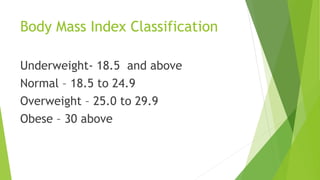
Body Mass Index Classification
Underweight- 18.5 and above
Normal – 18.5 to 24.9
Overweight – 25.0 to 29.9
Obese – 30 above
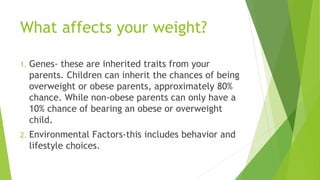
What affects your weight?
1. Genes- these are inherited traits from your
parents. Children can inherit the chances of being
overweight or obese parents, approximately 80%
chance. While non-obese parents can only have a
10% chance of bearing an obese or overweight
child.
2. Environmental Factors-this includes behavior and
lifestyle choices.
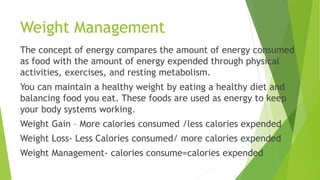
Weight Management
The concept of energy compares the amount of energy consumed
as food with the amount of energy expended through physical
activities, exercises, and resting metabolism.
You can maintain a healthy weight by eating a healthy diet and
balancing food you eat. These foods are used as energy to keep
your body systems working.
Weight Gain – More calories consumed /less calories expended
Weight Loss- Less Calories consumed/ more calories expended
Weight Management- calories consume=calories expended

Active Recreation.pptx

  • 1.
  • 2.
    Recreation Is a voluntaryparticipation in an activity during free and unobligated time that gives enjoyment.
  • 3.
    Three Sets ofTime Existence- biological needs such as eating, sleeping and rest Subsistence- attending to classes in school, attending to work- related functions Free Time- time for enjoyment and relaxation
  • 4.
    Outdoor Recreation- whenthe activity is undertaken in a natural, rural or open space outside the confines of building, usually large land area that is close to nature. Indoor Recreation- when the activity is within the premises of your comfort zone at home or inside a building
  • 5.
    The way welive you life in an everyday basis is you LIFESTYLE.
  • 6.
    How do youmaintain a healthy lifestyle? 1.Engage yourself in a regular physical activity 2.Eat a healthy food 3.Find time to manage stress 4.Follow a good personal healthy habits
  • 7.
    The HELP Philosophy HEALTH– those who believe the benefits of healthy lifestyle are more likely to engage in healthier behavior EVERYONE- Healthy Lifestyle can be practiced by everyone “HEALTH FOR ALL” LIFETIME- The longer healthy lifestyles are practice, the grater the beneficial benefits PERSONAL- No two people are exactly the same. Your personal needs is the basis of your lifestyle change
  • 8.
    Body Mass IndexClassification Underweight- 18.5 and above Normal – 18.5 to 24.9 Overweight – 25.0 to 29.9 Obese – 30 above
  • 9.
    What affects yourweight? 1. Genes- these are inherited traits from your parents. Children can inherit the chances of being overweight or obese parents, approximately 80% chance. While non-obese parents can only have a 10% chance of bearing an obese or overweight child. 2. Environmental Factors-this includes behavior and lifestyle choices.
  • 10.
    Weight Management The conceptof energy compares the amount of energy consumed as food with the amount of energy expended through physical activities, exercises, and resting metabolism. You can maintain a healthy weight by eating a healthy diet and balancing food you eat. These foods are used as energy to keep your body systems working. Weight Gain – More calories consumed /less calories expended Weight Loss- Less Calories consumed/ more calories expended Weight Management- calories consume=calories expended