Acid Base Balance in Human Body
Dr. Vinod Kumar Patil
Assistant Professor
Department of Food and Nutrition
Faculty of Science
Khaja Bandanawaz University
Kalaburagi, Karnataka
• Maintenance of the internal environment is one of the vital functions (circulation or
respiration).
• Maintaining a stable anion and cation concentrations in blood plasma is denoted as
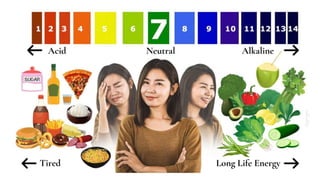
ISOIONIA. Maintaining of constant proton (H) concentration. Maintenance of stable pH,
also called ISOHYDRIA, is one of the basic components of the internal environment.
• pH is used for express concentration of the protons: pH = – log c(H)
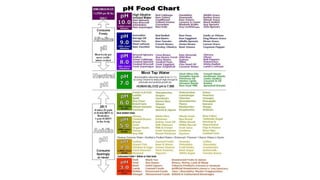
• Plasma and extracellular space concentrations of the protons are held in very narrow
physiologic range of the pH is 7.36-7.44.
• Value of pH higher than 7.44 in arteries is denoted as ALKALEMIA,
pH lower than 7.36 is ACIDEMIA.
• Extensive deviations of pH value can cause serious consequences. For example change
of protein structure (i.e. enzymes), membranes permeability, and electrolyte
distribution. Value of pH in arterial blood higher than 7.8, resp. lower than 6.8 are
incompatible with life as they apply for arterial blood.
• This corresponds to fact that there is 2.5 fold difference between intracellular and
arterial H concentration. This concentration gradient drives the movement of H+
from
cells to blood. Therefore it is not surprising that venous pH and pH of interstitial fluid
is lower (i.e. more acidic) than arterial pH. Approximate value is 7.35.
• Source of acids in the body is chiefly metabolism, source of bases is predominantly
nutrient.
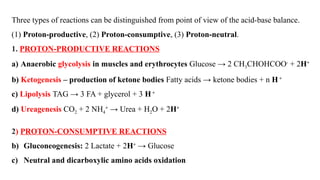
Three types of reactions can be distinguished from point of view of the acid-base balance.
(1) Proton-productive, (2) Proton-consumptive, (3) Proton-neutral.
1. PROTON-PRODUCTIVE REACTIONS
a) Anaerobic glycolysis in muscles and erythrocytes Glucose → 2 CH3CHOHCOO-
+ 2H+
b) Ketogenesis – production of ketone bodies Fatty acids → ketone bodies + n H+
c) Lipolysis TAG → 3 FA + glycerol + 3 H+
d) Ureagenesis CO2 + 2 NH4
+
→ Urea + H2O + 2H+
2) PROTON-CONSUMPTIVE REACTIONS
b) Gluconeogenesis: 2 Lactate + 2H+
→ Glucose
c) Neutral and dicarboxylic amino acids oxidation
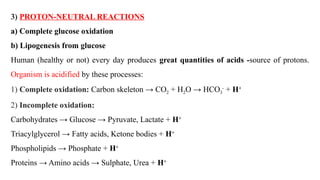
3) PROTON-NEUTRAL REACTIONS
a) Complete glucose oxidation
b) Lipogenesis from glucose
Human (healthy or not) every day produces great quantities of acids -source of protons.
Organism is acidified by these processes:
1) Complete oxidation: Carbon skeleton → CO2 + H2O → HCO3
-
+ H+
2) Incomplete oxidation:
Carbohydrates → Glucose → Pyruvate, Lactate + H+
Triacylglycerol → Fatty acids, Ketone bodies + H+
Phospholipids → Phosphate + H+
Proteins → Amino acids → Sulphate, Urea + H+
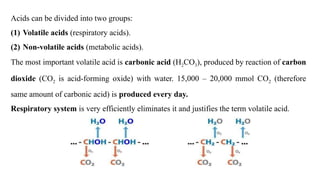
Acids can be divided into two groups:
(1) Volatile acids (respiratory acids).
(2) Non-volatile acids (metabolic acids).
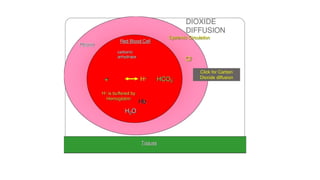
The most important volatile acid is carbonic acid (H2CO3), produced by reaction of carbon
dioxide (CO2 is acid-forming oxide) with water. 15,000 – 20,000 mmol CO2 (therefore
same amount of carbonic acid) is produced every day.
Respiratory system is very efficiently eliminates it and justifies the term volatile acid.
• Two groups are distinguished among non-volatile acid: (1) Organic, and (2) Inorganic.
• 1 mmol/kg of body weight is produced every day.
• Non-volatile acid could be either (1) metabolised, or (2) excreted (using mainly kidneys).
• Organic non-volatile acids are for example: (1) lactic acid, (2) fatty acids, (3) ketone
bodies (acetoacetic acid, β-hydroxybutyric acid).
• Continually produced by metabolism (incomplete oxidation of TAG, carbohydrates,
proteins). As organic non-volatile acids are products of metabolism in normal conditions
they are oxidized completely to CO2 and H2O. Therefore they have no influence on proton
overall balance.
• Inorganic non-volatile acids are:
(1) H2SO4 (sulphuric acid is produced by oxidation of sulfhydryl groups – e.g. in amino
acids that contain sulphur, i.e. cysteine, methionine).
(2) H3PO4 (phosphoric acid is produced by hydrolysis of phosphoproteins, phospholipids,
nucleic acids). Inorganic non-volatile acids are predominantly excreted in urine.
• ATP production is coupled with H+
production. Human body is evolutionary capable to
handle acid load.
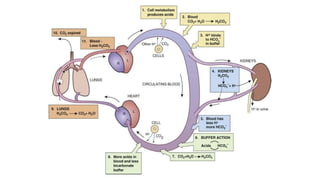
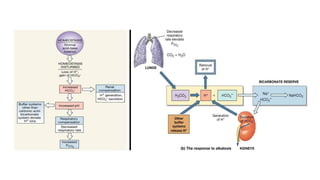
Systems responsible for maintenance of the acid-base balance:
1) Chemical buffering systems
Chemical buffering systems deal with pH deviations in common metabolism, chemical
buffers act immediately (acute regulation) only in the short-term.
2) Respiratory system
Respiratory system regulates carbon dioxide and is able to change pCO2 by its elimination
or retention. Respiratory centre is in brainstem and reacts in 1-3 minutes.
3) Kidneys
Their role in acid-base balance is very complex and react in hours-days.
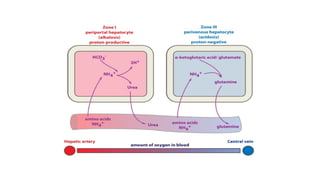
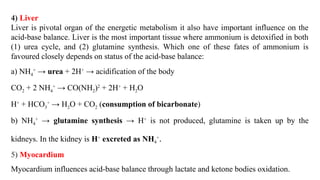
4) Liver
Liver is pivotal organ of the energetic metabolism it also have important influence on the
acid-base balance. Liver is the most important tissue where ammonium is detoxified in both
(1) urea cycle, and (2) glutamine synthesis. Which one of these fates of ammonium is
favoured closely depends on status of the acid-base balance:
a) NH4
+
→ urea + 2H+
→ acidification of the body
CO2 + 2 NH4
+
→ CO(NH2)2
+ 2H+
+ H2O
H+
+ HCO3
+
→ H2O + CO2 (consumption of bicarbonate)
b) NH4
+
→ glutamine synthesis → H+
is not produced, glutamine is taken up by the
kidneys. In the kidney is H+
excreted as NH4
+
.
5) Myocardium
Myocardium influences acid-base balance through lactate and ketone bodies oxidation.
Buffering systems
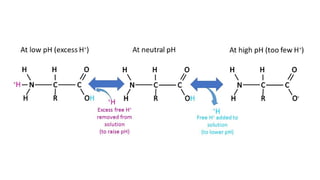
Buffers are substances capable of releasing and binding H+
. Short-term and acute changes
in acid-base balance can be balanced by buffers. Each buffer keeps its particular pH.
This pH could be calculated by means of the Henderson-Hasselbalch equation:
pH = pK + log [conjugated base]/[acid]
Henderson-Hasselbalch equation for bicarbonate buffer (HCO3
-
/CO2):
pH = pK H2CO3 + log ([HCO3
-
] / [H2CO3])
pH = pK H2CO3 + log ([HCO3
-
] / α x pCO2)
pH = pK ± 1 is range where buffers work optimally.
The ratio in bicarbonate buffer is 20:1 (HCO3
-
: CO2)
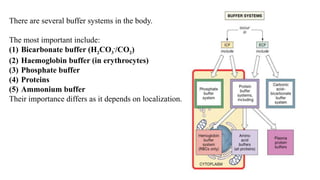
There are several buffer systems in the body.
The most important include:
(1) Bicarbonate buffer (H2CO3
-
/CO2)
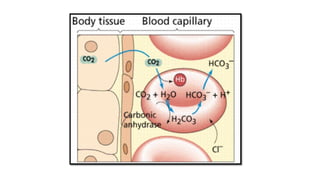
(2) Haemoglobin buffer (in erythrocytes)
(3) Phosphate buffer
(4) Proteins
(5) Ammonium buffer
Their importance differs as it depends on localization.
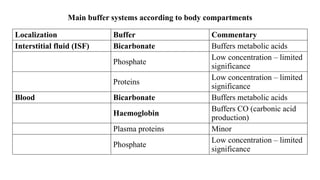
Localization Buffer Commentary
Interstitial fluid (ISF) Bicarbonate Buffers metabolic acids
Phosphate
Low concentration – limited
significance
Proteins
Low concentration – limited
significance
Blood Bicarbonate Buffers metabolic acids
Haemoglobin
Buffers CO (carbonic acid
production)
Plasma proteins Minor
Phosphate
Low concentration – limited
significance
Main buffer systems according to body compartments
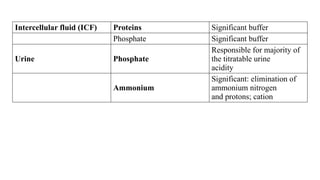
Intercellular fluid (ICF) Proteins Significant buffer
Phosphate Significant buffer
Urine Phosphate
Responsible for majority of
the titratable urine
acidity
Ammonium
Significant: elimination of
ammonium nitrogen
and protons; cation
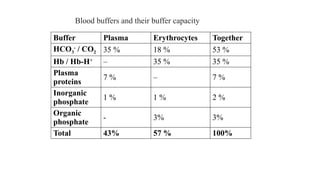
Buffer Plasma Erythrocytes Together
HCO3
-
/ CO2 35 % 18 % 53 %
Hb / Hb-H+
– 35 % 35 %
Plasma
proteins
7 % – 7 %
Inorganic
phosphate
1 % 1 % 2 %
Organic
phosphate
- 3% 3%
Total 43% 57 % 100%
Blood buffers and their buffer capacity
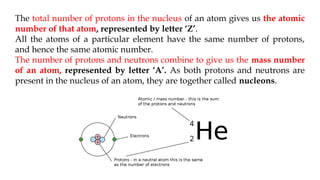
The total number of protons in the nucleus of an atom gives us the atomic
number of that atom, represented by letter ‘Z’.
All the atoms of a particular element have the same number of protons,
and hence the same atomic number.
The number of protons and neutrons combine to give us the mass number
of an atom, represented by letter ‘A’. As both protons and neutrons are
present in the nucleus of an atom, they are together called nucleons.
Chemical bonds form when electrons can be simultaneously close to two or more
nuclei, but beyond this, there is no simple, easily understood theory that would not
only explain why atoms bind together to form molecules, but would also predict
the three-dimensional structures of the resulting compounds as well as the energies
and other properties of the bonds themselves.
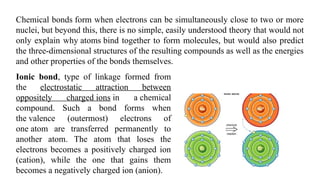
Ionic bond, type of linkage formed from
the electrostatic attraction between
oppositely charged ions in a chemical
compound. Such a bond forms when
the valence (outermost) electrons of
one atom are transferred permanently to
another atom. The atom that loses the
electrons becomes a positively charged ion
(cation), while the one that gains them
becomes a negatively charged ion (anion).
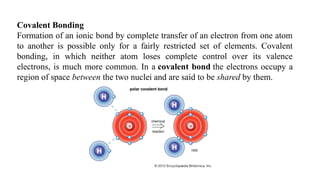
Covalent Bonding
Formation of an ionic bond by complete transfer of an electron from one atom
to another is possible only for a fairly restricted set of elements. Covalent
bonding, in which neither atom loses complete control over its valence
electrons, is much more common. In a covalent bond the electrons occupy a
region of space between the two nuclei and are said to be shared by them.
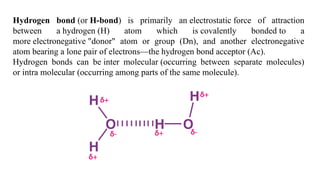
Hydrogen bond (or H-bond) is primarily an electrostatic force of attraction
between a hydrogen (H) atom which is covalently bonded to a
more electronegative "donor" atom or group (Dn), and another electronegative
atom bearing a lone pair of electrons—the hydrogen bond acceptor (Ac).
Hydrogen bonds can be inter molecular (occurring between separate molecules)
or intra molecular (occurring among parts of the same molecule).
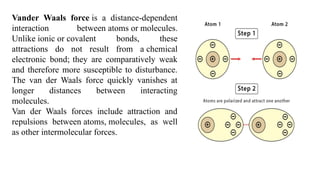
Vander Waals force is a distance-dependent
interaction between atoms or molecules.
Unlike ionic or covalent bonds, these
attractions do not result from a chemical
electronic bond; they are comparatively weak
and therefore more susceptible to disturbance.
The van der Waals force quickly vanishes at
longer distances between interacting
molecules.
Van der Waals forces include attraction and
repulsions between atoms, molecules, as well
as other intermolecular forces.

Acid base balance in human body and buffer system

  • 1.
    Acid Base Balancein Human Body Dr. Vinod Kumar Patil Assistant Professor Department of Food and Nutrition Faculty of Science Khaja Bandanawaz University Kalaburagi, Karnataka
  • 2.
    • Maintenance ofthe internal environment is one of the vital functions (circulation or respiration). • Maintaining a stable anion and cation concentrations in blood plasma is denoted as ISOIONIA. Maintaining of constant proton (H) concentration. Maintenance of stable pH, also called ISOHYDRIA, is one of the basic components of the internal environment. • pH is used for express concentration of the protons: pH = – log c(H) • Plasma and extracellular space concentrations of the protons are held in very narrow physiologic range of the pH is 7.36-7.44. • Value of pH higher than 7.44 in arteries is denoted as ALKALEMIA, pH lower than 7.36 is ACIDEMIA.
  • 3.
    • Extensive deviationsof pH value can cause serious consequences. For example change of protein structure (i.e. enzymes), membranes permeability, and electrolyte distribution. Value of pH in arterial blood higher than 7.8, resp. lower than 6.8 are incompatible with life as they apply for arterial blood. • This corresponds to fact that there is 2.5 fold difference between intracellular and arterial H concentration. This concentration gradient drives the movement of H+ from cells to blood. Therefore it is not surprising that venous pH and pH of interstitial fluid is lower (i.e. more acidic) than arterial pH. Approximate value is 7.35. • Source of acids in the body is chiefly metabolism, source of bases is predominantly nutrient.
  • 4.
    Three types ofreactions can be distinguished from point of view of the acid-base balance. (1) Proton-productive, (2) Proton-consumptive, (3) Proton-neutral. 1. PROTON-PRODUCTIVE REACTIONS a) Anaerobic glycolysis in muscles and erythrocytes Glucose → 2 CH3CHOHCOO- + 2H+ b) Ketogenesis – production of ketone bodies Fatty acids → ketone bodies + n H+ c) Lipolysis TAG → 3 FA + glycerol + 3 H+ d) Ureagenesis CO2 + 2 NH4 + → Urea + H2O + 2H+ 2) PROTON-CONSUMPTIVE REACTIONS b) Gluconeogenesis: 2 Lactate + 2H+ → Glucose c) Neutral and dicarboxylic amino acids oxidation
  • 5.
    3) PROTON-NEUTRAL REACTIONS a)Complete glucose oxidation b) Lipogenesis from glucose Human (healthy or not) every day produces great quantities of acids -source of protons. Organism is acidified by these processes: 1) Complete oxidation: Carbon skeleton → CO2 + H2O → HCO3 - + H+ 2) Incomplete oxidation: Carbohydrates → Glucose → Pyruvate, Lactate + H+ Triacylglycerol → Fatty acids, Ketone bodies + H+ Phospholipids → Phosphate + H+ Proteins → Amino acids → Sulphate, Urea + H+
  • 7.
    Acids can bedivided into two groups: (1) Volatile acids (respiratory acids). (2) Non-volatile acids (metabolic acids). The most important volatile acid is carbonic acid (H2CO3), produced by reaction of carbon dioxide (CO2 is acid-forming oxide) with water. 15,000 – 20,000 mmol CO2 (therefore same amount of carbonic acid) is produced every day. Respiratory system is very efficiently eliminates it and justifies the term volatile acid.
  • 11.
    • Two groupsare distinguished among non-volatile acid: (1) Organic, and (2) Inorganic. • 1 mmol/kg of body weight is produced every day. • Non-volatile acid could be either (1) metabolised, or (2) excreted (using mainly kidneys). • Organic non-volatile acids are for example: (1) lactic acid, (2) fatty acids, (3) ketone bodies (acetoacetic acid, β-hydroxybutyric acid). • Continually produced by metabolism (incomplete oxidation of TAG, carbohydrates, proteins). As organic non-volatile acids are products of metabolism in normal conditions they are oxidized completely to CO2 and H2O. Therefore they have no influence on proton overall balance.
  • 12.
    • Inorganic non-volatileacids are: (1) H2SO4 (sulphuric acid is produced by oxidation of sulfhydryl groups – e.g. in amino acids that contain sulphur, i.e. cysteine, methionine). (2) H3PO4 (phosphoric acid is produced by hydrolysis of phosphoproteins, phospholipids, nucleic acids). Inorganic non-volatile acids are predominantly excreted in urine. • ATP production is coupled with H+ production. Human body is evolutionary capable to handle acid load.
  • 13.
    Systems responsible formaintenance of the acid-base balance: 1) Chemical buffering systems Chemical buffering systems deal with pH deviations in common metabolism, chemical buffers act immediately (acute regulation) only in the short-term. 2) Respiratory system Respiratory system regulates carbon dioxide and is able to change pCO2 by its elimination or retention. Respiratory centre is in brainstem and reacts in 1-3 minutes. 3) Kidneys Their role in acid-base balance is very complex and react in hours-days.
  • 14.
    4) Liver Liver ispivotal organ of the energetic metabolism it also have important influence on the acid-base balance. Liver is the most important tissue where ammonium is detoxified in both (1) urea cycle, and (2) glutamine synthesis. Which one of these fates of ammonium is favoured closely depends on status of the acid-base balance: a) NH4 + → urea + 2H+ → acidification of the body CO2 + 2 NH4 + → CO(NH2)2 + 2H+ + H2O H+ + HCO3 + → H2O + CO2 (consumption of bicarbonate) b) NH4 + → glutamine synthesis → H+ is not produced, glutamine is taken up by the kidneys. In the kidney is H+ excreted as NH4 + . 5) Myocardium Myocardium influences acid-base balance through lactate and ketone bodies oxidation.
  • 16.
    Buffering systems Buffers aresubstances capable of releasing and binding H+ . Short-term and acute changes in acid-base balance can be balanced by buffers. Each buffer keeps its particular pH. This pH could be calculated by means of the Henderson-Hasselbalch equation: pH = pK + log [conjugated base]/[acid] Henderson-Hasselbalch equation for bicarbonate buffer (HCO3 - /CO2): pH = pK H2CO3 + log ([HCO3 - ] / [H2CO3]) pH = pK H2CO3 + log ([HCO3 - ] / α x pCO2) pH = pK ± 1 is range where buffers work optimally. The ratio in bicarbonate buffer is 20:1 (HCO3 - : CO2)
  • 17.
    There are severalbuffer systems in the body. The most important include: (1) Bicarbonate buffer (H2CO3 - /CO2) (2) Haemoglobin buffer (in erythrocytes) (3) Phosphate buffer (4) Proteins (5) Ammonium buffer Their importance differs as it depends on localization.
  • 18.
    Localization Buffer Commentary Interstitialfluid (ISF) Bicarbonate Buffers metabolic acids Phosphate Low concentration – limited significance Proteins Low concentration – limited significance Blood Bicarbonate Buffers metabolic acids Haemoglobin Buffers CO (carbonic acid production) Plasma proteins Minor Phosphate Low concentration – limited significance Main buffer systems according to body compartments
  • 19.
    Intercellular fluid (ICF)Proteins Significant buffer Phosphate Significant buffer Urine Phosphate Responsible for majority of the titratable urine acidity Ammonium Significant: elimination of ammonium nitrogen and protons; cation
  • 20.
    Buffer Plasma ErythrocytesTogether HCO3 - / CO2 35 % 18 % 53 % Hb / Hb-H+ – 35 % 35 % Plasma proteins 7 % – 7 % Inorganic phosphate 1 % 1 % 2 % Organic phosphate - 3% 3% Total 43% 57 % 100% Blood buffers and their buffer capacity
  • 25.
    The total numberof protons in the nucleus of an atom gives us the atomic number of that atom, represented by letter ‘Z’. All the atoms of a particular element have the same number of protons, and hence the same atomic number. The number of protons and neutrons combine to give us the mass number of an atom, represented by letter ‘A’. As both protons and neutrons are present in the nucleus of an atom, they are together called nucleons.
  • 26.
    Chemical bonds formwhen electrons can be simultaneously close to two or more nuclei, but beyond this, there is no simple, easily understood theory that would not only explain why atoms bind together to form molecules, but would also predict the three-dimensional structures of the resulting compounds as well as the energies and other properties of the bonds themselves. Ionic bond, type of linkage formed from the electrostatic attraction between oppositely charged ions in a chemical compound. Such a bond forms when the valence (outermost) electrons of one atom are transferred permanently to another atom. The atom that loses the electrons becomes a positively charged ion (cation), while the one that gains them becomes a negatively charged ion (anion).
  • 27.
    Covalent Bonding Formation ofan ionic bond by complete transfer of an electron from one atom to another is possible only for a fairly restricted set of elements. Covalent bonding, in which neither atom loses complete control over its valence electrons, is much more common. In a covalent bond the electrons occupy a region of space between the two nuclei and are said to be shared by them.
  • 28.
    Hydrogen bond (orH-bond) is primarily an electrostatic force of attraction between a hydrogen (H) atom which is covalently bonded to a more electronegative "donor" atom or group (Dn), and another electronegative atom bearing a lone pair of electrons—the hydrogen bond acceptor (Ac). Hydrogen bonds can be inter molecular (occurring between separate molecules) or intra molecular (occurring among parts of the same molecule).
  • 29.
    Vander Waals forceis a distance-dependent interaction between atoms or molecules. Unlike ionic or covalent bonds, these attractions do not result from a chemical electronic bond; they are comparatively weak and therefore more susceptible to disturbance. The van der Waals force quickly vanishes at longer distances between interacting molecules. Van der Waals forces include attraction and repulsions between atoms, molecules, as well as other intermolecular forces.