Mit Consultants – The Knowledge Transfer Company: Copyrighted Material. Not to be reproduced without prior written consent.
Achieving Organisational Goals - Introduction
Claude Maley
The Webinar Will Start Shortly
Achieving Organisational Goals
Mit Consultants – The Knowledge Transfer Company: Copyrighted Material. Not to be reproduced without prior written consent.
Achieving Organisational Goals - Introduction
Housekeeping
• Slides will be available on our SlideShare page; the link will be emailed to
you
• Recording of the webinar will be available to download; the link will be
emailed to you
• Take the time to complete a post-webinar survey that will pop up at the
end
• You can type your questions throughout the session
• Time will be allocated in the end for the speaker to address your questions
Mit Consultants – The Knowledge Transfer Company: Copyrighted Material. Not to be reproduced without prior written consent.
Achieving Organisational Goals - Introduction
Your Presenter
Claude Maley is Managing Director of Mit Consultants, a consultancy
and education practice servicing international clients in change
management, and Chairman of a business solutions company.
His functional management and consulting experience with major
corporations such as Alcatel, BP, Cadbury Schweppes, Cartier,
Caterpillar, Cisco, Ericsson, GE, Hewlett-Packard, IMS International,
Motorola, Organon, Overseas Containers Limited, Pechiney, Renault
Automobile, Siemens to name a few, has spanned more than 40 years
in engineering, production and manufacturing, distribution,
transportation and marketing services sectors.
Mit Consultants – The Knowledge Transfer Company: Copyrighted Material. Not to be reproduced without prior written consent.
Achieving Organisational Goals - Introduction
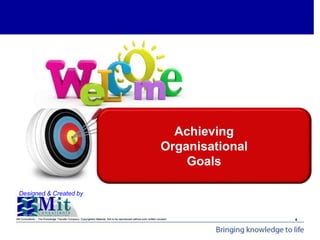
Designed & Created by
4
Achieving
Organisational
Goals
Mit Consultants – The Knowledge Transfer Company: Copyrighted Material. Not to be reproduced without prior written consent.
Achieving Organisational Goals - Introduction
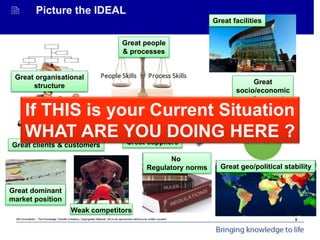
Great clients & customers
 Picture the IDEAL
Great organisational
structure
Great people
& processes
Great facilities
Great suppliers
Great dominant
market position
Weak competitors
No
Regulatory norms
Great
socio/economic
environment
Great geo/political stability
If THIS is your Current Situation
WHAT ARE YOU DOING HERE ?
5
Mit Consultants – The Knowledge Transfer Company: Copyrighted Material. Not to be reproduced without prior written consent.
Achieving Organisational Goals - Introduction
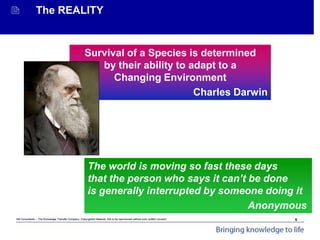
 The REALITY
The world is moving so fast these days
that the person who says it can’t be done
is generally interrupted by someone doing it
Anonymous
Survival of a Species is determined
by their ability to adapt to a
Changing Environment
Charles Darwin
6
Mit Consultants – The Knowledge Transfer Company: Copyrighted Material. Not to be reproduced without prior written consent.
Achieving Organisational Goals - Introduction
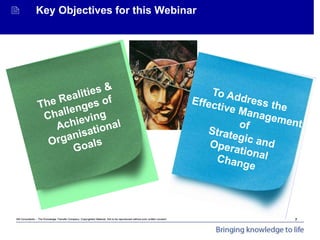
 Key Objectives for this Webinar
7
Mit Consultants – The Knowledge Transfer Company: Copyrighted Material. Not to be reproduced without prior written consent.
Achieving Organisational Goals - Introduction
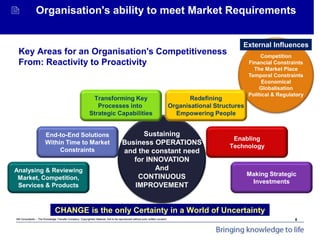
Competition
Financial Constraints
The Market Place
Temporal Constraints
Economical
Globalisation
Political & Regulatory
External Influences
 Organisation's ability to meet Market Requirements
Key Areas for an Organisation's Competitiveness
From: Reactivity to Proactivity
CHANGE is the only Certainty in a World of Uncertainty
Sustaining
Business OPERATIONS
and the constant need
for INNOVATION
And
CONTINUOUS
IMPROVEMENT
Making Strategic
Investments
Redefining
Organisational Structures
Empowering People
Enabling
Technology
Transforming Key
Processes into
Strategic Capabilities
Analysing & Reviewing
Market, Competition,
Services & Products
End-to-End Solutions
Within Time to Market
Constraints
8
Mit Consultants – The Knowledge Transfer Company: Copyrighted Material. Not to be reproduced without prior written consent.
Achieving Organisational Goals - Introduction
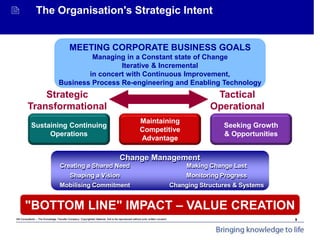
 The Organisation's Strategic Intent
MEETING CORPORATE BUSINESS GOALS
Managing in a Constant state of Change
Iterative & Incremental
in concert with Continuous Improvement,
Business Process Re-engineering and Enabling Technology
"BOTTOM LINE" IMPACT – VALUE CREATION
Making Change Last
Monitoring Progress
Changing Structures & Systems
Creating a Shared Need
Shaping a Vision
Mobilising Commitment
Change Management
Strategic
Transformational
Tactical
Operational
Seeking Growth
& Opportunities
Maintaining
Competitive
Advantage
Sustaining Continuing
Operations
9
Mit Consultants – The Knowledge Transfer Company: Copyrighted Material. Not to be reproduced without prior written consent.
Achieving Organisational Goals - Introduction
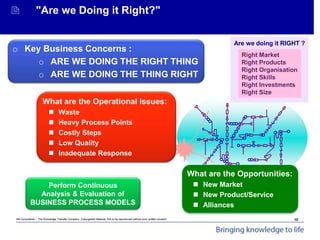
 "Are we Doing it Right?"
Are we doing it RIGHT ?
Right Market
Right Products
Right Organisation
Right Skills
Right Investments
Right Size
Perform Continuous
Analysis & Evaluation of
BUSINESS PROCESS MODELS
What are the Opportunities:
 New Market
 New Product/Service
 Alliances
o Key Business Concerns :
o ARE WE DOING THE RIGHT THING
o ARE WE DOING THE THING RIGHT
What are the Operational Issues:
 Waste
 Heavy Process Points
 Costly Steps
 Low Quality
 Inadequate Response
10
Mit Consultants – The Knowledge Transfer Company: Copyrighted Material. Not to be reproduced without prior written consent.
Achieving Organisational Goals - Introduction
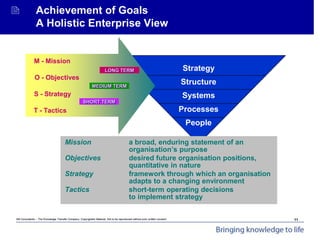
 Achievement of Goals
A Holistic Enterprise View
Strategy
Structure
Systems
Processes
People
M - Mission
O - Objectives
S - Strategy
T - Tactics
SHORT TERM
MEDIUM TERM
LONG TERM
Mission a broad, enduring statement of an
organisation’s purpose
Objectives desired future organisation positions,
quantitative in nature
Strategy framework through which an organisation
adapts to a changing environment
Tactics short-term operating decisions
to implement strategy
11
Mit Consultants – The Knowledge Transfer Company: Copyrighted Material. Not to be reproduced without prior written consent.
Achieving Organisational Goals - Introduction
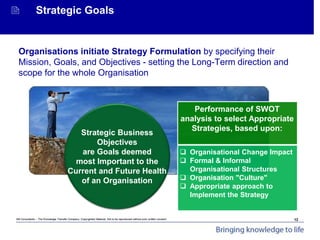
 Strategic Goals
Organisations initiate Strategy Formulation by specifying their
Mission, Goals, and Objectives - setting the Long-Term direction and
scope for the whole Organisation
Performance of SWOT
analysis to select Appropriate
Strategies, based upon:
 Organisational Change Impact
 Formal & Informal
Organisational Structures
 Organisation "Culture"
 Appropriate approach to
Implement the Strategy
Strategic Business
Objectives
are Goals deemed
most Important to the
Current and Future Health
of an Organisation
12
Mit Consultants – The Knowledge Transfer Company: Copyrighted Material. Not to be reproduced without prior written consent.
Achieving Organisational Goals - Introduction
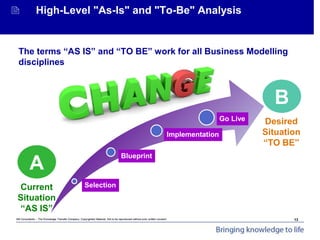
 High-Level "As-Is" and "To-Be" Analysis
The terms “AS IS” and “TO BE” work for all Business Modelling
disciplines
B
Desired
Situation
“TO BE”
A
Current
Situation
“AS IS”
Selection
Blueprint
Implementation
Go Live
13
Mit Consultants – The Knowledge Transfer Company: Copyrighted Material. Not to be reproduced without prior written consent.
Achieving Organisational Goals - Introduction
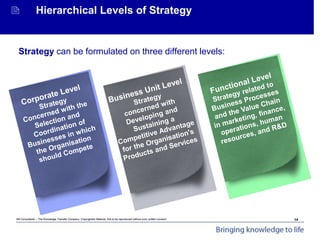
 Hierarchical Levels of Strategy
Strategy can be formulated on three different levels:
14
Mit Consultants – The Knowledge Transfer Company: Copyrighted Material. Not to be reproduced without prior written consent.
Achieving Organisational Goals - Introduction
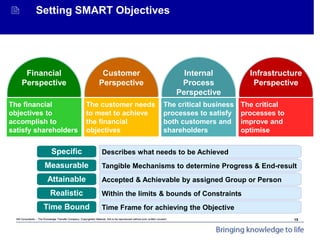
 Setting SMART Objectives
Customer
Perspective
The customer needs
to meet to achieve
the financial
objectives
Internal
Process
Perspective
The critical business
processes to satisfy
both customers and
shareholders
Financial
Perspective
The financial
objectives to
accomplish to
satisfy shareholders
Infrastructure
Perspective
The critical
processes to
improve and
optimise
Describes what needs to be AchievedSpecific
Measurable
Attainable
Realistic
Time Bound
Tangible Mechanisms to determine Progress & End-result
Accepted & Achievable by assigned Group or Person
Within the limits & bounds of Constraints
Time Frame for achieving the Objective
15
Mit Consultants – The Knowledge Transfer Company: Copyrighted Material. Not to be reproduced without prior written consent.
Achieving Organisational Goals - Introduction
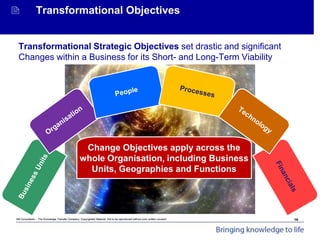
 Transformational Objectives
Transformational Strategic Objectives set drastic and significant
Changes within a Business for its Short- and Long-Term Viability
Change Objectives apply across the
whole Organisation, including Business
Units, Geographies and Functions
16
Mit Consultants – The Knowledge Transfer Company: Copyrighted Material. Not to be reproduced without prior written consent.
Achieving Organisational Goals - Introduction
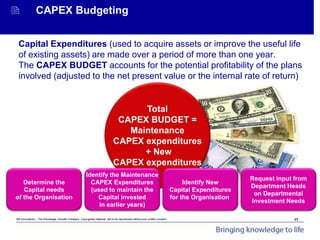
 CAPEX Budgeting
Capital Expenditures (used to acquire assets or improve the useful life
of existing assets) are made over a period of more than one year.
The CAPEX BUDGET accounts for the potential profitability of the plans
involved (adjusted to the net present value or the internal rate of return)
Total
CAPEX BUDGET =
Maintenance
CAPEX expenditures
+ New
CAPEX expenditures
Determine the
Capital needs
of the Organisation
Identify the Maintenance
CAPEX Expenditures
(used to maintain the
Capital invested
in earlier years)
Identify New
Capital Expenditures
for the Organisation
Request input from
Department Heads
on Departmental
Investment Needs
17
Mit Consultants – The Knowledge Transfer Company: Copyrighted Material. Not to be reproduced without prior written consent.
Achieving Organisational Goals - Introduction
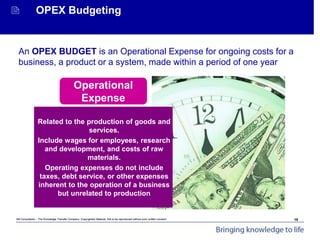
 OPEX Budgeting
An OPEX BUDGET is an Operational Expense for ongoing costs for a
business, a product or a system, made within a period of one year
Operational
Expense
Related to the production of goods and
services.
Include wages for employees, research
and development, and costs of raw
materials.
Operating expenses do not include
taxes, debt service, or other expenses
inherent to the operation of a business
but unrelated to production
18
Mit Consultants – The Knowledge Transfer Company: Copyrighted Material. Not to be reproduced without prior written consent.
Achieving Organisational Goals - Introduction
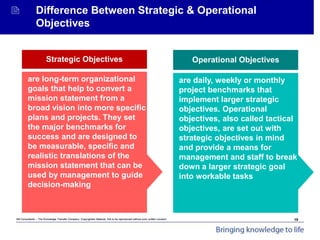
 Difference Between Strategic & Operational
Objectives
Operational Objectives
are daily, weekly or monthly
project benchmarks that
implement larger strategic
objectives. Operational
objectives, also called tactical
objectives, are set out with
strategic objectives in mind
and provide a means for
management and staff to break
down a larger strategic goal
into workable tasks
Strategic Objectives
are long-term organizational
goals that help to convert a
mission statement from a
broad vision into more specific
plans and projects. They set
the major benchmarks for
success and are designed to
be measurable, specific and
realistic translations of the
mission statement that can be
used by management to guide
decision-making
19
Mit Consultants – The Knowledge Transfer Company: Copyrighted Material. Not to be reproduced without prior written consent.
Achieving Organisational Goals - Introduction
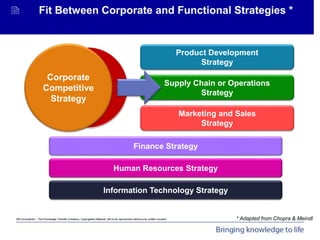
 Fit Between Corporate and Functional Strategies *
* Adapted from Chopra & Meindl
Corporate
Competitive
Strategy
Product Development
Strategy
Supply Chain or Operations
Strategy
Marketing and Sales
Strategy
Finance Strategy
Human Resources Strategy
Information Technology Strategy
Mit Consultants – The Knowledge Transfer Company: Copyrighted Material. Not to be reproduced without prior written consent.
Achieving Organisational Goals - Introduction
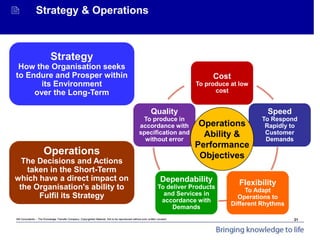
 Strategy & Operations
Cost
To produce at low
cost
Speed
To Respond
Rapidly to
Customer
Demands
Flexibility
To Adapt
Operations to
Different Rhythms
Dependability
To deliver Products
and Services in
accordance with
Demands
Quality
To produce in
accordance with
specification and
without error
Operations
Ability &
Performance
Objectives
Strategy
How the Organisation seeks
to Endure and Prosper within
its Environment
over the Long-Term
Operations
The Decisions and Actions
taken in the Short-Term
which have a direct impact on
the Organisation's ability to
Fulfil its Strategy
21
Mit Consultants – The Knowledge Transfer Company: Copyrighted Material. Not to be reproduced without prior written consent.
Achieving Organisational Goals - Introduction
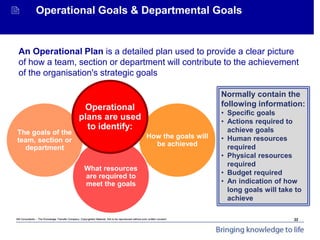
 Operational Goals & Departmental Goals
An Operational Plan is a detailed plan used to provide a clear picture
of how a team, section or department will contribute to the achievement
of the organisation's strategic goals
Normally contain the
following information:
• Specific goals
• Actions required to
achieve goals
• Human resources
required
• Physical resources
required
• Budget required
• An indication of how
long goals will take to
achieve
How the goals will
be achieved
What resources
are required to
meet the goals
The goals of the
team, section or
department
Operational
plans are used
to identify:
22
Mit Consultants – The Knowledge Transfer Company: Copyrighted Material. Not to be reproduced without prior written consent.
Achieving Organisational Goals - Introduction
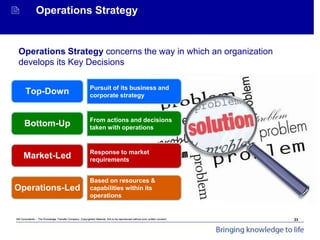
 Operations Strategy
Operations Strategy concerns the way in which an organization
develops its Key Decisions
Top-Down Pursuit of its business and
corporate strategy
Bottom-Up From actions and decisions
taken with operations
Market-Led Response to market
requirements
Operations-Led
Based on resources &
capabilities within its
operations
23
Mit Consultants – The Knowledge Transfer Company: Copyrighted Material. Not to be reproduced without prior written consent.
Achieving Organisational Goals - Introduction
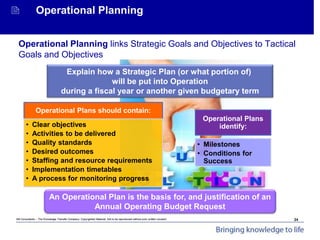
 Operational Planning
Operational Planning links Strategic Goals and Objectives to Tactical
Goals and Objectives
Explain how a Strategic Plan (or what portion of)
will be put into Operation
during a fiscal year or another given budgetary term
An Operational Plan is the basis for, and justification of an
Annual Operating Budget Request
Operational Plans should contain:
• Clear objectives
• Activities to be delivered
• Quality standards
• Desired outcomes
• Staffing and resource requirements
• Implementation timetables
• A process for monitoring progress
Operational Plans
identify:
• Milestones
• Conditions for
Success
24
Mit Consultants – The Knowledge Transfer Company: Copyrighted Material. Not to be reproduced without prior written consent.
Achieving Organisational Goals - Introduction
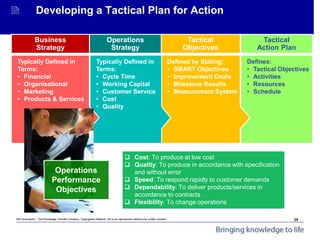
 Developing a Tactical Plan for Action
Defines:
• Tactical Objectives
• Activities
• Resources
• Schedule
Tactical
Action Plan
Tactical
Objectives
Defined by Stating:
• SMART Objectives
• Improvement Goals
• Milestone Results
• Measurement System
Operations
Strategy
Typically Defined in
Terms:
• Cycle Time
• Working Capital
• Customer Service
• Cost
• Quality
Business
Strategy
Typically Defined in
Terms:
• Financial
• Organisational
• Marketing
• Products & Services
 Cost: To produce at low cost
 Quality: To produce in accordance with specification
and without error
 Speed: To respond rapidly to customer demands
 Dependability: To deliver products/services in
accordance to contracts
 Flexibility: To change operations
Operations
Performance
Objectives
25
Mit Consultants – The Knowledge Transfer Company: Copyrighted Material. Not to be reproduced without prior written consent.
Achieving Organisational Goals - Introduction
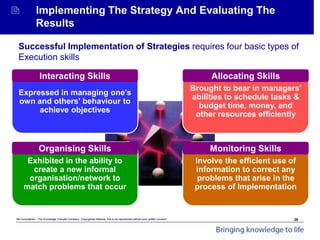
 Implementing The Strategy And Evaluating The
Results
Successful Implementation of Strategies requires four basic types of
Execution skills
Expressed in managing one's
own and others' behaviour to
achieve objectives
Interacting Skills
Brought to bear in managers'
abilities to schedule tasks &
budget time, money, and
other resources efficiently
Allocating Skills
Exhibited in the ability to
create a new informal
organisation/network to
match problems that occur
Organising Skills
Involve the efficient use of
information to correct any
problems that arise in the
process of Implementation
Monitoring Skills
26
Mit Consultants – The Knowledge Transfer Company: Copyrighted Material. Not to be reproduced without prior written consent.
Achieving Organisational Goals - Introduction
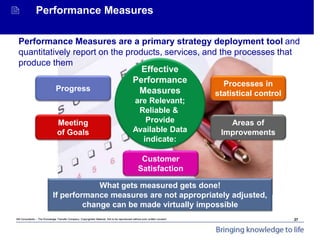
 Performance Measures
Performance Measures are a primary strategy deployment tool and
quantitatively report on the products, services, and the processes that
produce them
Progress
Meeting
of Goals
Effective
Performance
Measures
are Relevant;
Reliable &
Provide
Available Data
indicate:
Customer
Satisfaction
Processes in
statistical control
Areas of
Improvements
What gets measured gets done!
If performance measures are not appropriately adjusted,
change can be made virtually impossible
27
Mit Consultants – The Knowledge Transfer Company: Copyrighted Material. Not to be reproduced without prior written consent.
Achieving Organisational Goals - Introduction
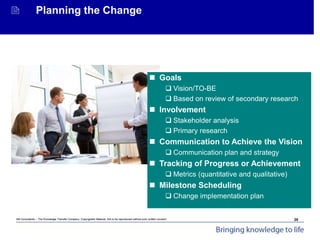
 Planning the Change
 Goals
 Vision/TO-BE
 Based on review of secondary research
 Involvement
 Stakeholder analysis
 Primary research
 Communication to Achieve the Vision
 Communication plan and strategy
 Tracking of Progress or Achievement
 Metrics (quantitative and qualitative)
 Milestone Scheduling
 Change implementation plan
28
Mit Consultants – The Knowledge Transfer Company: Copyrighted Material. Not to be reproduced without prior written consent.
Achieving Organisational Goals - Introduction
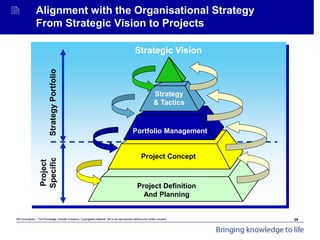
 Alignment with the Organisational Strategy
From Strategic Vision to Projects
StrategyPortfolio
Project Definition
And Planning
Project Concept
Portfolio Management
Strategy
& Tactics
Strategic Vision
29
Mit Consultants – The Knowledge Transfer Company: Copyrighted Material. Not to be reproduced without prior written consent.
Achieving Organisational Goals - Introduction
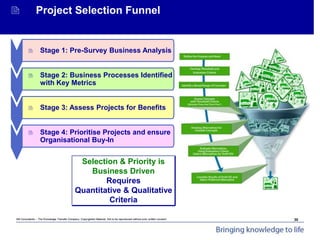
 Project Selection Funnel
 Stage 1: Pre-Survey Business Analysis
 Stage 2: Business Processes Identified
with Key Metrics
 Stage 3: Assess Projects for Benefits
 Stage 4: Prioritise Projects and ensure
Organisational Buy-In
Selection & Priority is
Business Driven
Requires
Quantitative & Qualitative
Criteria
30
Mit Consultants – The Knowledge Transfer Company: Copyrighted Material. Not to be reproduced without prior written consent.
Achieving Organisational Goals - Introduction
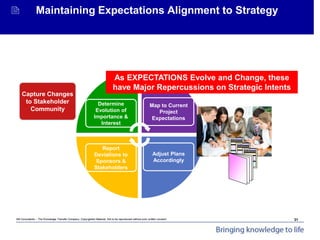
 Maintaining Expectations Alignment to Strategy
Report
Deviations to
Sponsors &
Stakeholders
Determine
Evolution of
Importance &
Interest
Adjust Plans
Accordingly
Map to Current
Project
Expectations
Capture Changes
to Stakeholder
Community
As EXPECTATIONS Evolve and Change, these
have Major Repercussions on Strategic Intents
31
Mit Consultants – The Knowledge Transfer Company: Copyrighted Material. Not to be reproduced without prior written consent.
Achieving Organisational Goals - Introduction
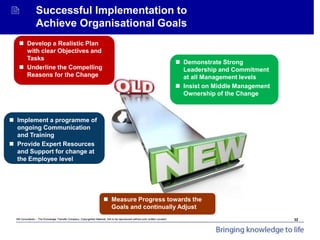
 Successful Implementation to
Achieve Organisational Goals
 Develop a Realistic Plan
with clear Objectives and
Tasks
 Underline the Compelling
Reasons for the Change
 Implement a programme of
ongoing Communication
and Training
 Provide Expert Resources
and Support for change at
the Employee level
 Measure Progress towards the
Goals and continually Adjust
 Demonstrate Strong
Leadership and Commitment
at all Management levels
 Insist on Middle Management
Ownership of the Change
32
Mit Consultants – The Knowledge Transfer Company: Copyrighted Material. Not to be reproduced without prior written consent.
Achieving Organisational Goals - Introduction
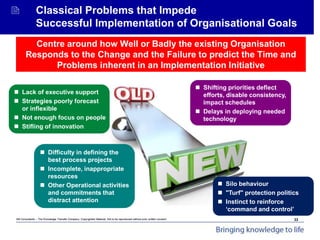
 Classical Problems that Impede
Successful Implementation of Organisational Goals
Centre around how Well or Badly the existing Organisation
Responds to the Change and the Failure to predict the Time and
Problems inherent in an Implementation Initiative
 Lack of executive support
 Strategies poorly forecast
or inflexible
 Not enough focus on people
 Stifling of innovation
 Difficulty in defining the
best process projects
 Incomplete, inappropriate
resources
 Other Operational activities
and commitments that
distract attention
 Silo behaviour
 "Turf" protection politics
 Instinct to reinforce
‘command and control’
 Shifting priorities deflect
efforts, disable consistency,
impact schedules
 Delays in deploying needed
technology
33
Mit Consultants – The Knowledge Transfer Company: Copyrighted Material. Not to be reproduced without prior written consent.
Achieving Organisational Goals - Introduction
34

Achieving organisational goals - Webinar Slides

  • 1.
    Mit Consultants –The Knowledge Transfer Company: Copyrighted Material. Not to be reproduced without prior written consent. Achieving Organisational Goals - Introduction Claude Maley The Webinar Will Start Shortly Achieving Organisational Goals
  • 2.
    Mit Consultants –The Knowledge Transfer Company: Copyrighted Material. Not to be reproduced without prior written consent. Achieving Organisational Goals - Introduction Housekeeping • Slides will be available on our SlideShare page; the link will be emailed to you • Recording of the webinar will be available to download; the link will be emailed to you • Take the time to complete a post-webinar survey that will pop up at the end • You can type your questions throughout the session • Time will be allocated in the end for the speaker to address your questions
  • 3.
    Mit Consultants –The Knowledge Transfer Company: Copyrighted Material. Not to be reproduced without prior written consent. Achieving Organisational Goals - Introduction Your Presenter Claude Maley is Managing Director of Mit Consultants, a consultancy and education practice servicing international clients in change management, and Chairman of a business solutions company. His functional management and consulting experience with major corporations such as Alcatel, BP, Cadbury Schweppes, Cartier, Caterpillar, Cisco, Ericsson, GE, Hewlett-Packard, IMS International, Motorola, Organon, Overseas Containers Limited, Pechiney, Renault Automobile, Siemens to name a few, has spanned more than 40 years in engineering, production and manufacturing, distribution, transportation and marketing services sectors.
  • 4.
    Mit Consultants –The Knowledge Transfer Company: Copyrighted Material. Not to be reproduced without prior written consent. Achieving Organisational Goals - Introduction Designed & Created by 4 Achieving Organisational Goals
  • 5.
    Mit Consultants –The Knowledge Transfer Company: Copyrighted Material. Not to be reproduced without prior written consent. Achieving Organisational Goals - Introduction Great clients & customers  Picture the IDEAL Great organisational structure Great people & processes Great facilities Great suppliers Great dominant market position Weak competitors No Regulatory norms Great socio/economic environment Great geo/political stability If THIS is your Current Situation WHAT ARE YOU DOING HERE ? 5
  • 6.
    Mit Consultants –The Knowledge Transfer Company: Copyrighted Material. Not to be reproduced without prior written consent. Achieving Organisational Goals - Introduction  The REALITY The world is moving so fast these days that the person who says it can’t be done is generally interrupted by someone doing it Anonymous Survival of a Species is determined by their ability to adapt to a Changing Environment Charles Darwin 6
  • 7.
    Mit Consultants –The Knowledge Transfer Company: Copyrighted Material. Not to be reproduced without prior written consent. Achieving Organisational Goals - Introduction  Key Objectives for this Webinar 7
  • 8.
    Mit Consultants –The Knowledge Transfer Company: Copyrighted Material. Not to be reproduced without prior written consent. Achieving Organisational Goals - Introduction Competition Financial Constraints The Market Place Temporal Constraints Economical Globalisation Political & Regulatory External Influences  Organisation's ability to meet Market Requirements Key Areas for an Organisation's Competitiveness From: Reactivity to Proactivity CHANGE is the only Certainty in a World of Uncertainty Sustaining Business OPERATIONS and the constant need for INNOVATION And CONTINUOUS IMPROVEMENT Making Strategic Investments Redefining Organisational Structures Empowering People Enabling Technology Transforming Key Processes into Strategic Capabilities Analysing & Reviewing Market, Competition, Services & Products End-to-End Solutions Within Time to Market Constraints 8
  • 9.
    Mit Consultants –The Knowledge Transfer Company: Copyrighted Material. Not to be reproduced without prior written consent. Achieving Organisational Goals - Introduction  The Organisation's Strategic Intent MEETING CORPORATE BUSINESS GOALS Managing in a Constant state of Change Iterative & Incremental in concert with Continuous Improvement, Business Process Re-engineering and Enabling Technology "BOTTOM LINE" IMPACT – VALUE CREATION Making Change Last Monitoring Progress Changing Structures & Systems Creating a Shared Need Shaping a Vision Mobilising Commitment Change Management Strategic Transformational Tactical Operational Seeking Growth & Opportunities Maintaining Competitive Advantage Sustaining Continuing Operations 9
  • 10.
    Mit Consultants –The Knowledge Transfer Company: Copyrighted Material. Not to be reproduced without prior written consent. Achieving Organisational Goals - Introduction  "Are we Doing it Right?" Are we doing it RIGHT ? Right Market Right Products Right Organisation Right Skills Right Investments Right Size Perform Continuous Analysis & Evaluation of BUSINESS PROCESS MODELS What are the Opportunities:  New Market  New Product/Service  Alliances o Key Business Concerns : o ARE WE DOING THE RIGHT THING o ARE WE DOING THE THING RIGHT What are the Operational Issues:  Waste  Heavy Process Points  Costly Steps  Low Quality  Inadequate Response 10
  • 11.
    Mit Consultants –The Knowledge Transfer Company: Copyrighted Material. Not to be reproduced without prior written consent. Achieving Organisational Goals - Introduction  Achievement of Goals A Holistic Enterprise View Strategy Structure Systems Processes People M - Mission O - Objectives S - Strategy T - Tactics SHORT TERM MEDIUM TERM LONG TERM Mission a broad, enduring statement of an organisation’s purpose Objectives desired future organisation positions, quantitative in nature Strategy framework through which an organisation adapts to a changing environment Tactics short-term operating decisions to implement strategy 11
  • 12.
    Mit Consultants –The Knowledge Transfer Company: Copyrighted Material. Not to be reproduced without prior written consent. Achieving Organisational Goals - Introduction  Strategic Goals Organisations initiate Strategy Formulation by specifying their Mission, Goals, and Objectives - setting the Long-Term direction and scope for the whole Organisation Performance of SWOT analysis to select Appropriate Strategies, based upon:  Organisational Change Impact  Formal & Informal Organisational Structures  Organisation "Culture"  Appropriate approach to Implement the Strategy Strategic Business Objectives are Goals deemed most Important to the Current and Future Health of an Organisation 12
  • 13.
    Mit Consultants –The Knowledge Transfer Company: Copyrighted Material. Not to be reproduced without prior written consent. Achieving Organisational Goals - Introduction  High-Level "As-Is" and "To-Be" Analysis The terms “AS IS” and “TO BE” work for all Business Modelling disciplines B Desired Situation “TO BE” A Current Situation “AS IS” Selection Blueprint Implementation Go Live 13
  • 14.
    Mit Consultants –The Knowledge Transfer Company: Copyrighted Material. Not to be reproduced without prior written consent. Achieving Organisational Goals - Introduction  Hierarchical Levels of Strategy Strategy can be formulated on three different levels: 14
  • 15.
    Mit Consultants –The Knowledge Transfer Company: Copyrighted Material. Not to be reproduced without prior written consent. Achieving Organisational Goals - Introduction  Setting SMART Objectives Customer Perspective The customer needs to meet to achieve the financial objectives Internal Process Perspective The critical business processes to satisfy both customers and shareholders Financial Perspective The financial objectives to accomplish to satisfy shareholders Infrastructure Perspective The critical processes to improve and optimise Describes what needs to be AchievedSpecific Measurable Attainable Realistic Time Bound Tangible Mechanisms to determine Progress & End-result Accepted & Achievable by assigned Group or Person Within the limits & bounds of Constraints Time Frame for achieving the Objective 15
  • 16.
    Mit Consultants –The Knowledge Transfer Company: Copyrighted Material. Not to be reproduced without prior written consent. Achieving Organisational Goals - Introduction  Transformational Objectives Transformational Strategic Objectives set drastic and significant Changes within a Business for its Short- and Long-Term Viability Change Objectives apply across the whole Organisation, including Business Units, Geographies and Functions 16
  • 17.
    Mit Consultants –The Knowledge Transfer Company: Copyrighted Material. Not to be reproduced without prior written consent. Achieving Organisational Goals - Introduction  CAPEX Budgeting Capital Expenditures (used to acquire assets or improve the useful life of existing assets) are made over a period of more than one year. The CAPEX BUDGET accounts for the potential profitability of the plans involved (adjusted to the net present value or the internal rate of return) Total CAPEX BUDGET = Maintenance CAPEX expenditures + New CAPEX expenditures Determine the Capital needs of the Organisation Identify the Maintenance CAPEX Expenditures (used to maintain the Capital invested in earlier years) Identify New Capital Expenditures for the Organisation Request input from Department Heads on Departmental Investment Needs 17
  • 18.
    Mit Consultants –The Knowledge Transfer Company: Copyrighted Material. Not to be reproduced without prior written consent. Achieving Organisational Goals - Introduction  OPEX Budgeting An OPEX BUDGET is an Operational Expense for ongoing costs for a business, a product or a system, made within a period of one year Operational Expense Related to the production of goods and services. Include wages for employees, research and development, and costs of raw materials. Operating expenses do not include taxes, debt service, or other expenses inherent to the operation of a business but unrelated to production 18
  • 19.
    Mit Consultants –The Knowledge Transfer Company: Copyrighted Material. Not to be reproduced without prior written consent. Achieving Organisational Goals - Introduction  Difference Between Strategic & Operational Objectives Operational Objectives are daily, weekly or monthly project benchmarks that implement larger strategic objectives. Operational objectives, also called tactical objectives, are set out with strategic objectives in mind and provide a means for management and staff to break down a larger strategic goal into workable tasks Strategic Objectives are long-term organizational goals that help to convert a mission statement from a broad vision into more specific plans and projects. They set the major benchmarks for success and are designed to be measurable, specific and realistic translations of the mission statement that can be used by management to guide decision-making 19
  • 20.
    Mit Consultants –The Knowledge Transfer Company: Copyrighted Material. Not to be reproduced without prior written consent. Achieving Organisational Goals - Introduction  Fit Between Corporate and Functional Strategies * * Adapted from Chopra & Meindl Corporate Competitive Strategy Product Development Strategy Supply Chain or Operations Strategy Marketing and Sales Strategy Finance Strategy Human Resources Strategy Information Technology Strategy
  • 21.
    Mit Consultants –The Knowledge Transfer Company: Copyrighted Material. Not to be reproduced without prior written consent. Achieving Organisational Goals - Introduction  Strategy & Operations Cost To produce at low cost Speed To Respond Rapidly to Customer Demands Flexibility To Adapt Operations to Different Rhythms Dependability To deliver Products and Services in accordance with Demands Quality To produce in accordance with specification and without error Operations Ability & Performance Objectives Strategy How the Organisation seeks to Endure and Prosper within its Environment over the Long-Term Operations The Decisions and Actions taken in the Short-Term which have a direct impact on the Organisation's ability to Fulfil its Strategy 21
  • 22.
    Mit Consultants –The Knowledge Transfer Company: Copyrighted Material. Not to be reproduced without prior written consent. Achieving Organisational Goals - Introduction  Operational Goals & Departmental Goals An Operational Plan is a detailed plan used to provide a clear picture of how a team, section or department will contribute to the achievement of the organisation's strategic goals Normally contain the following information: • Specific goals • Actions required to achieve goals • Human resources required • Physical resources required • Budget required • An indication of how long goals will take to achieve How the goals will be achieved What resources are required to meet the goals The goals of the team, section or department Operational plans are used to identify: 22
  • 23.
    Mit Consultants –The Knowledge Transfer Company: Copyrighted Material. Not to be reproduced without prior written consent. Achieving Organisational Goals - Introduction  Operations Strategy Operations Strategy concerns the way in which an organization develops its Key Decisions Top-Down Pursuit of its business and corporate strategy Bottom-Up From actions and decisions taken with operations Market-Led Response to market requirements Operations-Led Based on resources & capabilities within its operations 23
  • 24.
    Mit Consultants –The Knowledge Transfer Company: Copyrighted Material. Not to be reproduced without prior written consent. Achieving Organisational Goals - Introduction  Operational Planning Operational Planning links Strategic Goals and Objectives to Tactical Goals and Objectives Explain how a Strategic Plan (or what portion of) will be put into Operation during a fiscal year or another given budgetary term An Operational Plan is the basis for, and justification of an Annual Operating Budget Request Operational Plans should contain: • Clear objectives • Activities to be delivered • Quality standards • Desired outcomes • Staffing and resource requirements • Implementation timetables • A process for monitoring progress Operational Plans identify: • Milestones • Conditions for Success 24
  • 25.
    Mit Consultants –The Knowledge Transfer Company: Copyrighted Material. Not to be reproduced without prior written consent. Achieving Organisational Goals - Introduction  Developing a Tactical Plan for Action Defines: • Tactical Objectives • Activities • Resources • Schedule Tactical Action Plan Tactical Objectives Defined by Stating: • SMART Objectives • Improvement Goals • Milestone Results • Measurement System Operations Strategy Typically Defined in Terms: • Cycle Time • Working Capital • Customer Service • Cost • Quality Business Strategy Typically Defined in Terms: • Financial • Organisational • Marketing • Products & Services  Cost: To produce at low cost  Quality: To produce in accordance with specification and without error  Speed: To respond rapidly to customer demands  Dependability: To deliver products/services in accordance to contracts  Flexibility: To change operations Operations Performance Objectives 25
  • 26.
    Mit Consultants –The Knowledge Transfer Company: Copyrighted Material. Not to be reproduced without prior written consent. Achieving Organisational Goals - Introduction  Implementing The Strategy And Evaluating The Results Successful Implementation of Strategies requires four basic types of Execution skills Expressed in managing one's own and others' behaviour to achieve objectives Interacting Skills Brought to bear in managers' abilities to schedule tasks & budget time, money, and other resources efficiently Allocating Skills Exhibited in the ability to create a new informal organisation/network to match problems that occur Organising Skills Involve the efficient use of information to correct any problems that arise in the process of Implementation Monitoring Skills 26
  • 27.
    Mit Consultants –The Knowledge Transfer Company: Copyrighted Material. Not to be reproduced without prior written consent. Achieving Organisational Goals - Introduction  Performance Measures Performance Measures are a primary strategy deployment tool and quantitatively report on the products, services, and the processes that produce them Progress Meeting of Goals Effective Performance Measures are Relevant; Reliable & Provide Available Data indicate: Customer Satisfaction Processes in statistical control Areas of Improvements What gets measured gets done! If performance measures are not appropriately adjusted, change can be made virtually impossible 27
  • 28.
    Mit Consultants –The Knowledge Transfer Company: Copyrighted Material. Not to be reproduced without prior written consent. Achieving Organisational Goals - Introduction  Planning the Change  Goals  Vision/TO-BE  Based on review of secondary research  Involvement  Stakeholder analysis  Primary research  Communication to Achieve the Vision  Communication plan and strategy  Tracking of Progress or Achievement  Metrics (quantitative and qualitative)  Milestone Scheduling  Change implementation plan 28
  • 29.
    Mit Consultants –The Knowledge Transfer Company: Copyrighted Material. Not to be reproduced without prior written consent. Achieving Organisational Goals - Introduction  Alignment with the Organisational Strategy From Strategic Vision to Projects StrategyPortfolio Project Definition And Planning Project Concept Portfolio Management Strategy & Tactics Strategic Vision 29
  • 30.
    Mit Consultants –The Knowledge Transfer Company: Copyrighted Material. Not to be reproduced without prior written consent. Achieving Organisational Goals - Introduction  Project Selection Funnel  Stage 1: Pre-Survey Business Analysis  Stage 2: Business Processes Identified with Key Metrics  Stage 3: Assess Projects for Benefits  Stage 4: Prioritise Projects and ensure Organisational Buy-In Selection & Priority is Business Driven Requires Quantitative & Qualitative Criteria 30
  • 31.
    Mit Consultants –The Knowledge Transfer Company: Copyrighted Material. Not to be reproduced without prior written consent. Achieving Organisational Goals - Introduction  Maintaining Expectations Alignment to Strategy Report Deviations to Sponsors & Stakeholders Determine Evolution of Importance & Interest Adjust Plans Accordingly Map to Current Project Expectations Capture Changes to Stakeholder Community As EXPECTATIONS Evolve and Change, these have Major Repercussions on Strategic Intents 31
  • 32.
    Mit Consultants –The Knowledge Transfer Company: Copyrighted Material. Not to be reproduced without prior written consent. Achieving Organisational Goals - Introduction  Successful Implementation to Achieve Organisational Goals  Develop a Realistic Plan with clear Objectives and Tasks  Underline the Compelling Reasons for the Change  Implement a programme of ongoing Communication and Training  Provide Expert Resources and Support for change at the Employee level  Measure Progress towards the Goals and continually Adjust  Demonstrate Strong Leadership and Commitment at all Management levels  Insist on Middle Management Ownership of the Change 32
  • 33.
    Mit Consultants –The Knowledge Transfer Company: Copyrighted Material. Not to be reproduced without prior written consent. Achieving Organisational Goals - Introduction  Classical Problems that Impede Successful Implementation of Organisational Goals Centre around how Well or Badly the existing Organisation Responds to the Change and the Failure to predict the Time and Problems inherent in an Implementation Initiative  Lack of executive support  Strategies poorly forecast or inflexible  Not enough focus on people  Stifling of innovation  Difficulty in defining the best process projects  Incomplete, inappropriate resources  Other Operational activities and commitments that distract attention  Silo behaviour  "Turf" protection politics  Instinct to reinforce ‘command and control’  Shifting priorities deflect efforts, disable consistency, impact schedules  Delays in deploying needed technology 33
  • 34.
    Mit Consultants –The Knowledge Transfer Company: Copyrighted Material. Not to be reproduced without prior written consent. Achieving Organisational Goals - Introduction 34