Achieving Holistic Cybersecurity:
2016 Progress Report
A Candid Survey of Federal Leaders
April 2016
Underwritten by
Table of Contents
—
Overview / 3

—
Executive Summary / 5

—
Research Findings

Confidence in Federal Cybersecurity / 6 

Breaking Down the Cyber Threat / 9

The Internet of Things / 12

Current State of Cyber Defenses / 16

—
Final Considerations / 19

—
Respondent Profile / 20

—
Appendix / 23


Government Business Council
Page 2
Overview
—
Purpose

The past few years have seen an explosion of cyber attacks, and with the 2015 Office of
Personnel Management (OPM) breaches underscoring the vulnerability of government data,
agencies are racing to implement proactive, holistic cybersecurity measures. In order to learn
more about the current state of agency cybersecurity, Government Business Council (GBC)
and Dell Security undertook an in-depth research study. This survey is a follow-up to a
previous June 2014 GBC study and serves to measure changing perceptions and
experiences of federal leaders regarding the present threat landscape.


—
Methodology

Government Business Council and Dell Security released a survey on February 23, 2016 to a
random sample of Government Executive, Nextgov, and Defense One print and online
subscribers. 464 senior-level federal employees completed the survey, including those at the
GS/GM 11 to 15 grade levels and members of the Senior Executive Service. 54% of
respondents are GS/GM 13 and above, and all are familiar with cybersecurity. Respondents
include representatives from over 30 federal agencies, including both defense and civilian
agencies.

To view a full demographic detail, methodology, and findings of the previous June 2014
survey, please click here.


Government Business Council
Page 3
“Cyber threats cannot be eliminated entirely, but they
can be managed much more effectively. And we can
best do this by aligning and focusing our efforts, by
properly funding necessary cyber investments, by
building strong partnerships across government and
industry, and by drawing on the best ideas and talent
from across the country to tackle this quintessential
problem of the 21st century.” 
Federal CIO Tony Scott
“Strengthening & Enhancing Cybersecurity for the 21st Century,” July 2015.
Government Business Council
Page 4
Executive Summary
—
Federal leaders are significantly less confident in agency
cybersecurity than they were two years ago

In 2014, a substantial majority of respondents felt that their agency’s defensive measures
were capable of successfully combating cyber threats. Confidence has since decreased
dramatically – just 35% of respondents in 2016 are confident or very confident in their
agency’s ability to protect information systems. Fewer than 1 in 3 feel confident in their
agency’s ability to protect employees’ personal information or keep up with evolving cyber
threats.

—
Workforce hygiene continues to be an overarching point of concern
when it comes to top cyber threats

Respondents identified email embedded with malware and phishing/spear phishing as top
cyber threats – both targeting workforce cyber literacy and awareness. Moreover, they most
commonly identify cybersecurity personnel and workforce education as cyber defense
elements in need of significant improvement, indicating major gaps in the organizational side
of agency cybersecurity more so than in technical/structural security.

—
Agencies face a range of challenges in bolstering cyber defenses

While respondents remain largely confident in the security of networked physical devices
and information systems, they still express greater uncertainty toward organizational
capabilities than they did two years ago. Furthermore, agencies have yet to make meaningful
progress in leveraging the Internet of Things (IoT) or in implementing IoT cybersecurity.
Budget constraints, procurement delays, and bureaucratic inertia are most commonly
identified as obstacles to more comprehensive defense measures, suggesting that
organizational barriers present a greater challenge than technical issues with regard to
agency cybersecurity enhancement.
Government Business Council
Page 5
Confidence in Federal Cybersecurity
Federal employees have lost confidence in overall agency information security
Government Business Council
Page 6
—
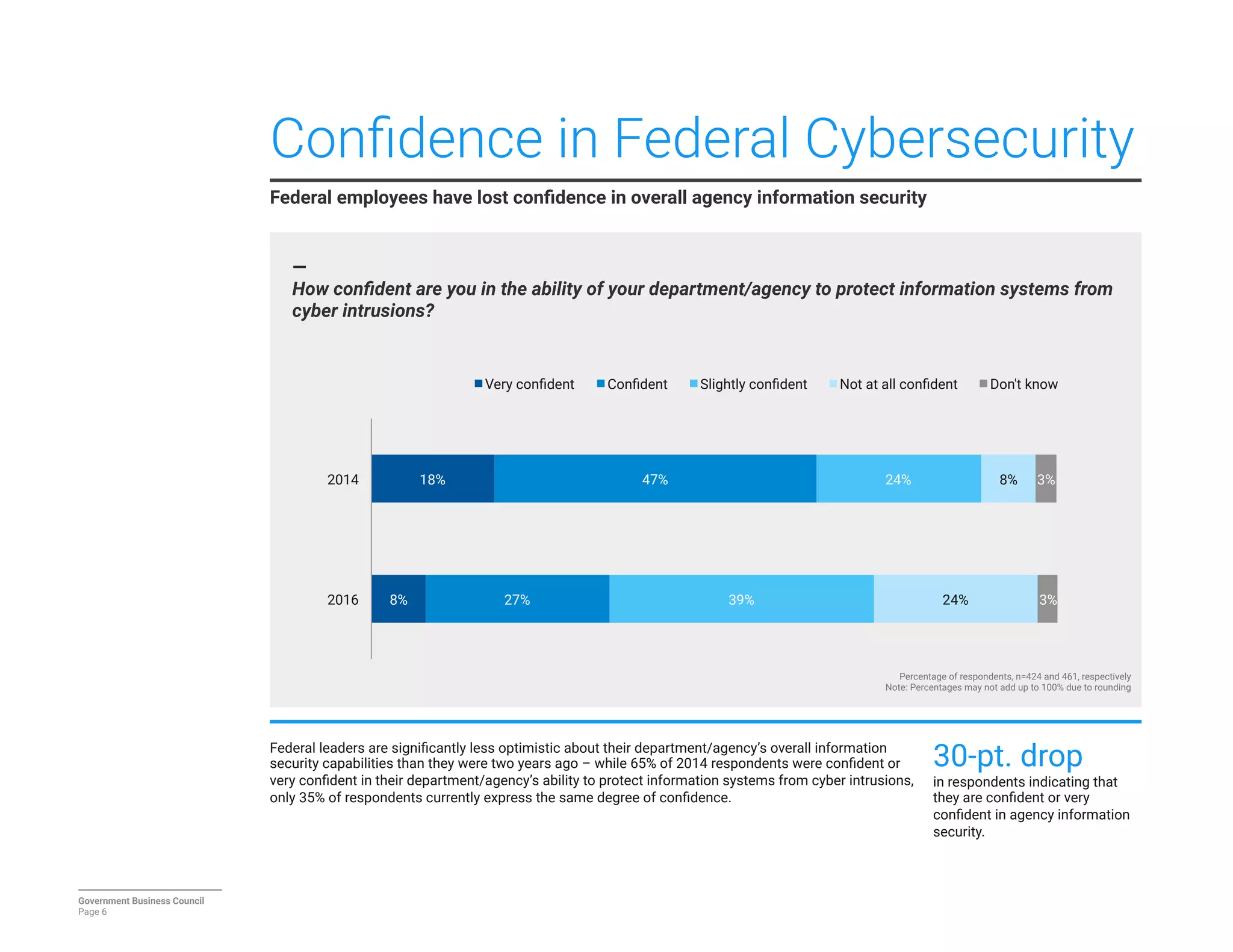
How confident are you in the ability of your department/agency to protect information systems from
cyber intrusions?
Percentage of respondents, n=424 and 461, respectively
Note: Percentages may not add up to 100% due to rounding
Federal leaders are significantly less optimistic about their department/agency’s overall information
security capabilities than they were two years ago – while 65% of 2014 respondents were confident or
very confident in their department/agency’s ability to protect information systems from cyber intrusions,
only 35% of respondents currently express the same degree of confidence.
30-pt. drop
in respondents indicating that
they are confident or very
confident in agency information
security.
8%
18%
27%
47%
39%
24%
24%
8%
3%
3%
2016
2014
Very confident
 Confident
 Slightly confident
 Not at all confident
 Don't know
Respondents are less confident in the security of their personal information / 
Confidence in Federal Cybersecurity
—
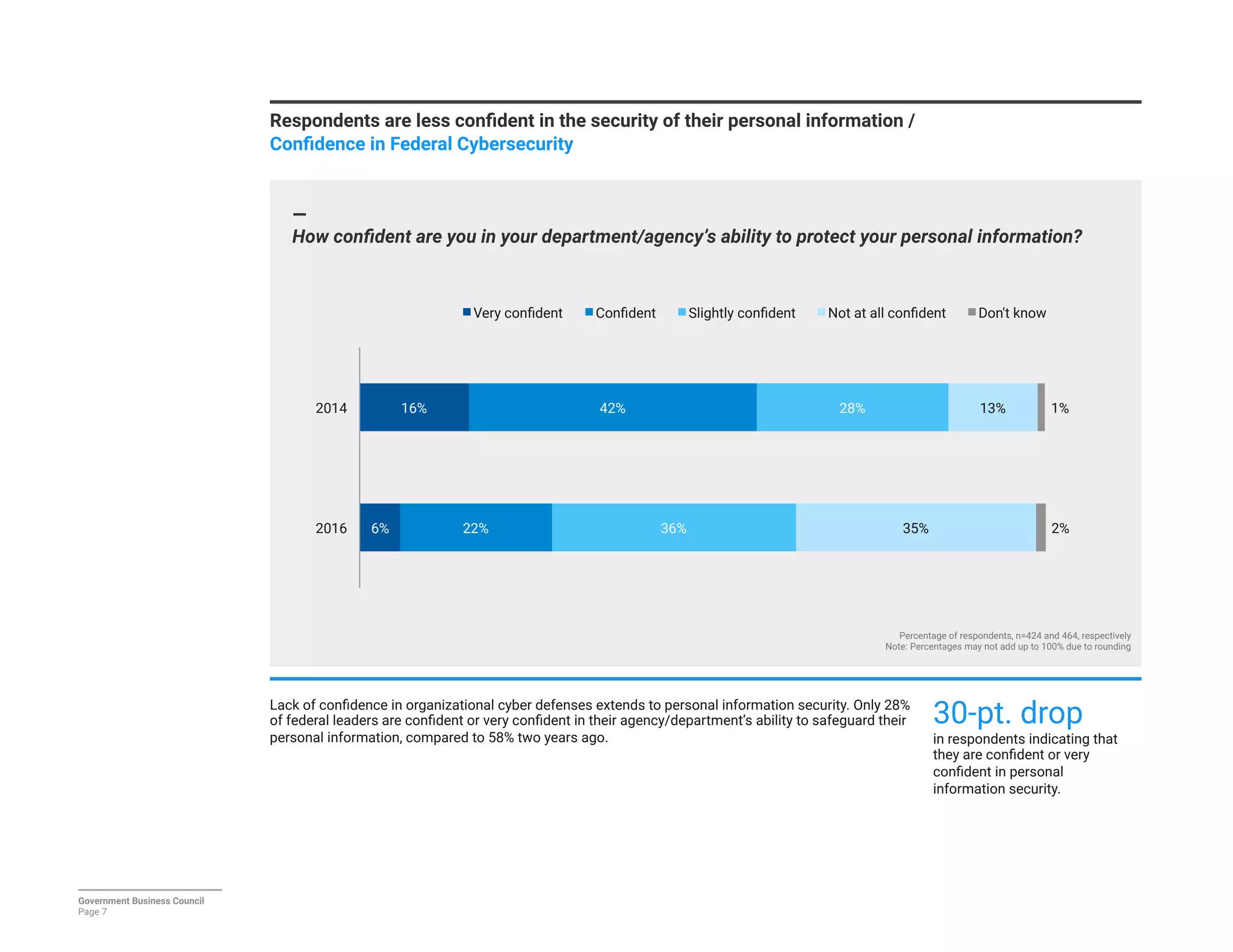
How confident are you in your department/agency’s ability to protect your personal information?
Percentage of respondents, n=424 and 464, respectively
Note: Percentages may not add up to 100% due to rounding
Government Business Council
Page 7
6%
16%
22%
42%
36%
28%
35%
13%
2%
1%
2016
2014
Very confident
 Confident
 Slightly confident
 Not at all confident
 Don't know
Lack of confidence in organizational cyber defenses extends to personal information security. Only 28%
of federal leaders are confident or very confident in their agency/department’s ability to safeguard their
personal information, compared to 58% two years ago.
30-pt. drop
in respondents indicating that
they are confident or very
confident in personal
information security.
Respondents are unsure of their organization’s ability to keep pace with evolving cyber threats / 
Confidence in Federal Cybersecurity
—
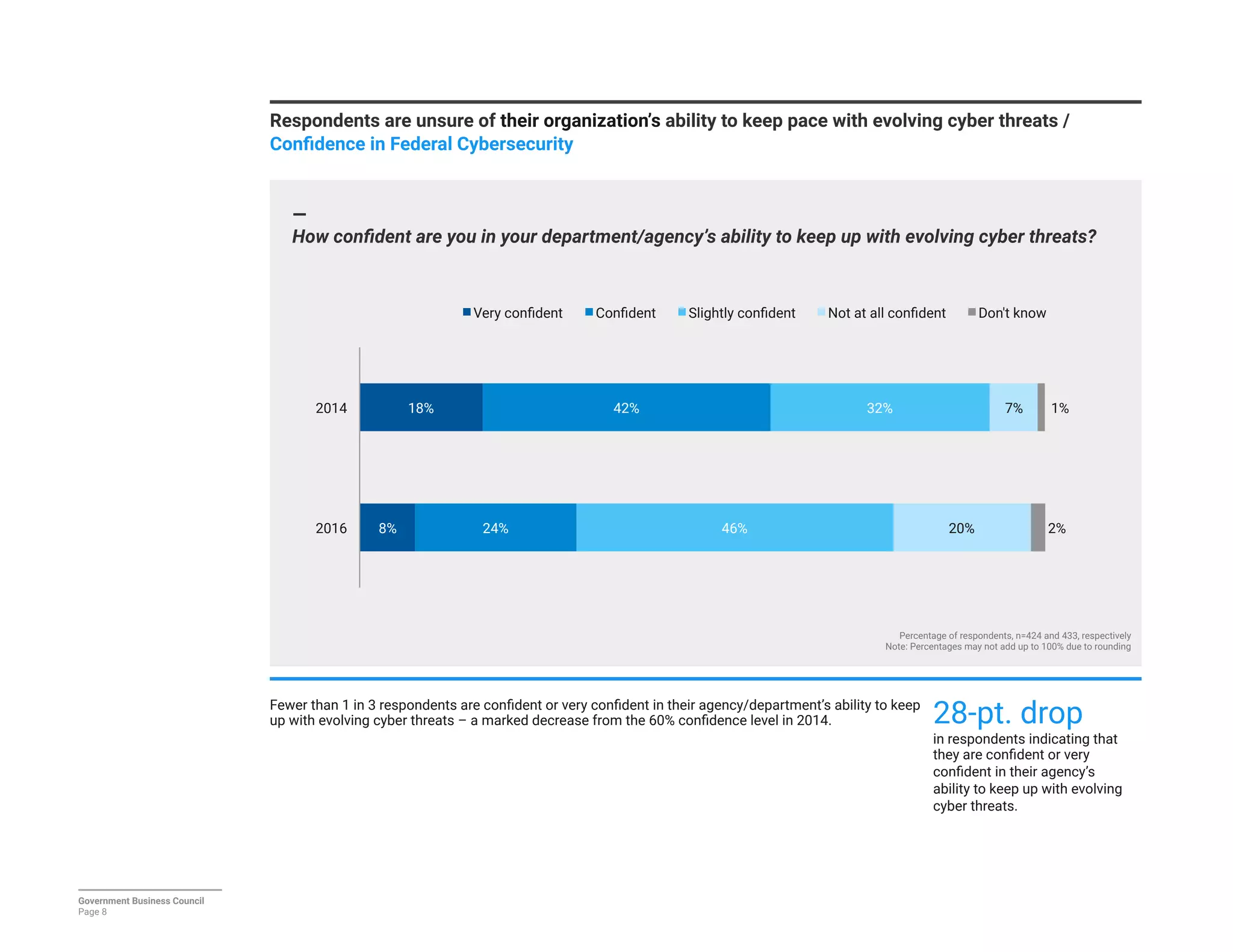
How confident are you in your department/agency’s ability to keep up with evolving cyber threats?
Percentage of respondents, n=424 and 433, respectively
Note: Percentages may not add up to 100% due to rounding
Government Business Council
Page 8
8%
18%
24%
42%
46%
32%
20%
7%
2%
1%
2016
2014
Very confident
 Confident
 Slightly confident
 Not at all confident
 Don't know
Fewer than 1 in 3 respondents are confident or very confident in their agency/department’s ability to keep
up with evolving cyber threats – a marked decrease from the 60% confidence level in 2014.

28-pt. drop
in respondents indicating that
they are confident or very
confident in their agency’s
ability to keep up with evolving
cyber threats.
Breaking Down the Cyber Threat
Federal employees are largely uncertain of the current cyber threat landscape

Government Business Council
Page 9
—
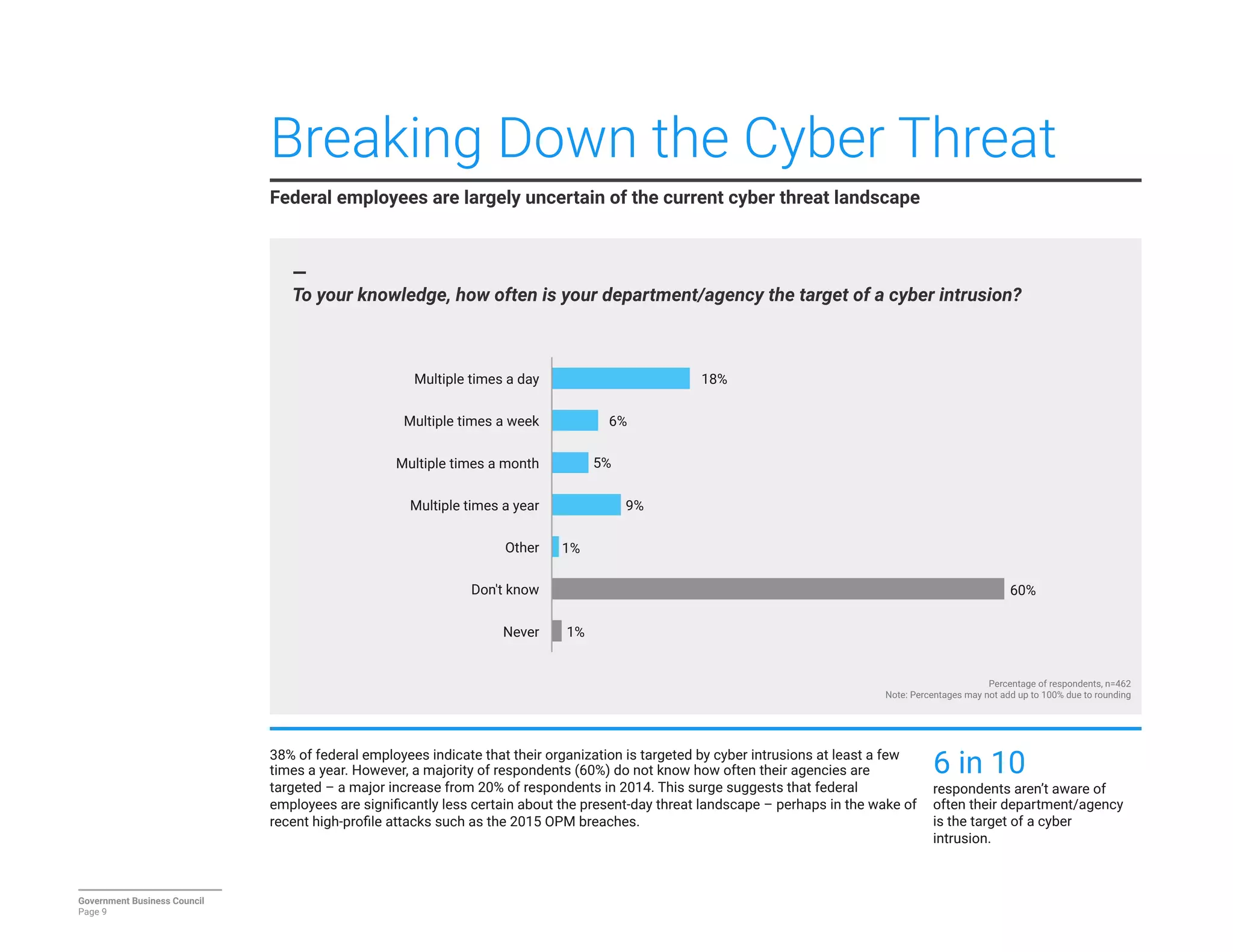
To your knowledge, how often is your department/agency the target of a cyber intrusion?
1%
60%
1%
9%
5%
6%
18%
Never
Don't know
Other
Multiple times a year
Multiple times a month
Multiple times a week
Multiple times a day
Percentage of respondents, n=462
Note: Percentages may not add up to 100% due to rounding
38% of federal employees indicate that their organization is targeted by cyber intrusions at least a few
times a year. However, a majority of respondents (60%) do not know how often their agencies are
targeted – a major increase from 20% of respondents in 2014. This surge suggests that federal
employees are significantly less certain about the present-day threat landscape – perhaps in the wake of
recent high-profile attacks such as the 2015 OPM breaches.

6 in 10
respondents aren’t aware of
often their department/agency
is the target of a cyber
intrusion.
Human interaction continues to factor into top cyber threats / Breaking Down the Cyber Threat
—
Significant Cyber Threats
Government Business Council
Page 10
19%
1%
2%
5%
9%
10%
11%
12%
21%
28%
50%
62%
63%
Don't know
None of the above
Other
Zero-day attack
SQL insertion
Cross-site scripting
Ransomware
Denial of service
Exploitation of flaws in open source software
Internal unauthorized access
Virus/worm
Phishing/spear phishing
Email embedded with malware
Percentage of respondents, n=457
Respondents were asked to select all that apply
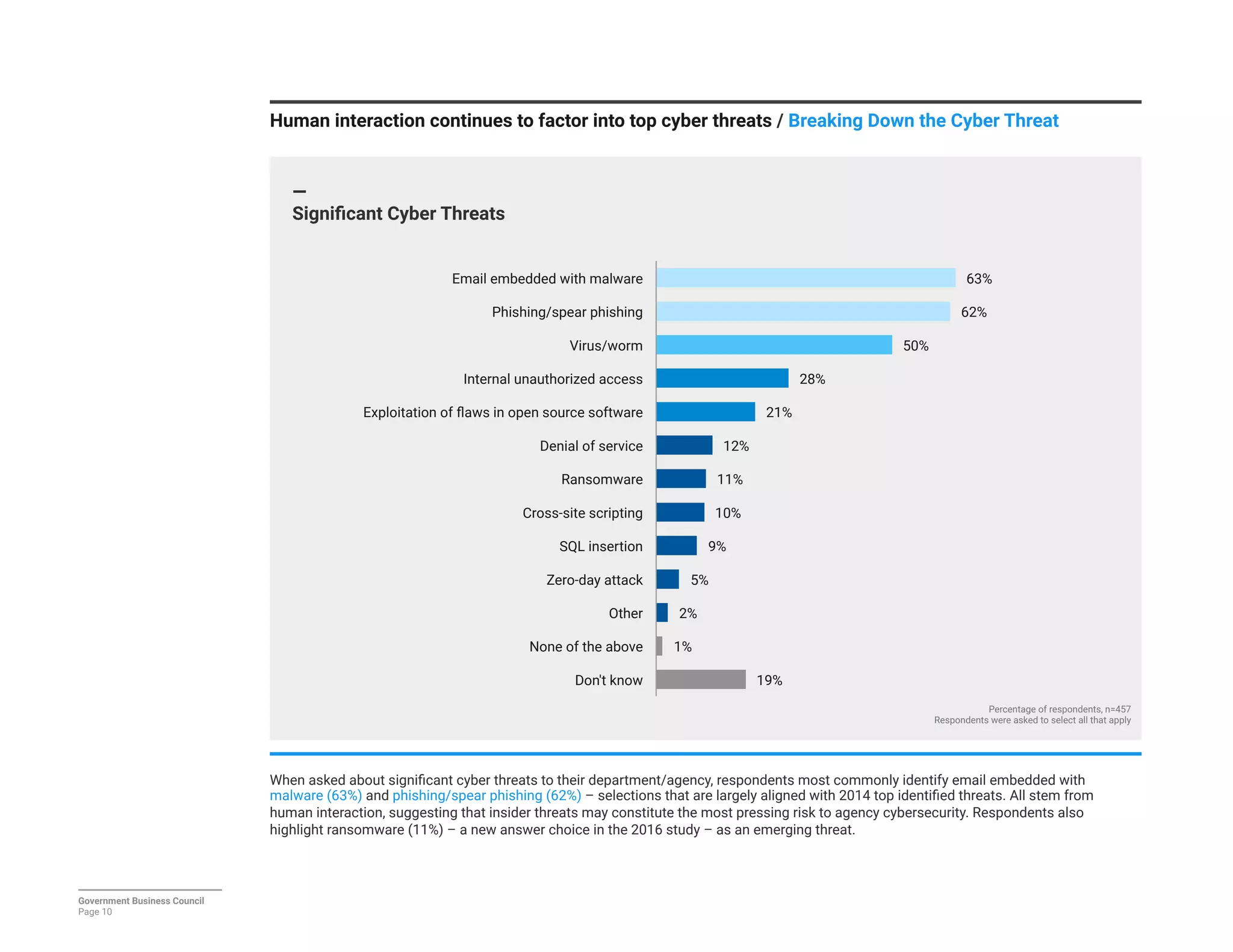
When asked about significant cyber threats to their department/agency, respondents most commonly identify email embedded with
malware (63%) and phishing/spear phishing (62%) – selections that are largely aligned with 2014 top identified threats. All stem from
human interaction, suggesting that insider threats may constitute the most pressing risk to agency cybersecurity. Respondents also
highlight ransomware (11%) – a new answer choice in the 2016 study – as an emerging threat.
Hacktivists are identified as the greatest source of cyber threats / Breaking Down the Cyber Threat

—
Greatest Cyber Threat Sources
Ranked by respondents in order of threat severity
Ranked by Borda count, n=437
Hacktivists (2096 pts)
1st
Nation-states (1711 pts)

Criminal organizations (1528 pts)

State-sponsored actors (1416 pts)

4th
Insiders (1301 pts)

5th
6th
 Script kiddies (1094 pts)

Government Business Council
Page 11
3rd
2nd
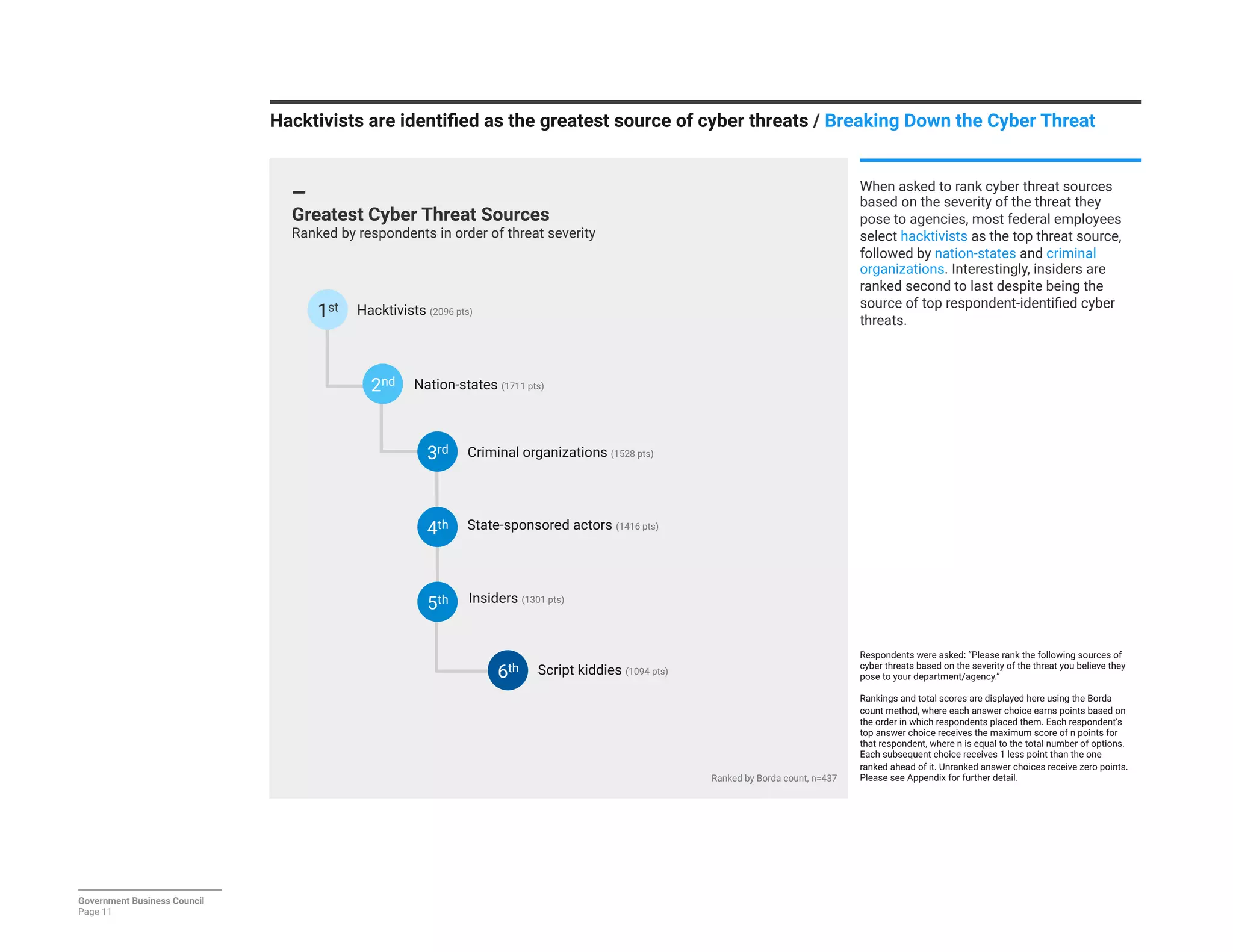
When asked to rank cyber threat sources
based on the severity of the threat they
pose to agencies, most federal employees
select hacktivists as the top threat source,
followed by nation-states and criminal
organizations. Interestingly, insiders are
ranked second to last despite being the
source of top respondent-identified cyber
threats.
Respondents were asked: “Please rank the following sources of
cyber threats based on the severity of the threat you believe they
pose to your department/agency.”

Rankings and total scores are displayed here using the Borda
count method, where each answer choice earns points based on
the order in which respondents placed them. Each respondent’s
top answer choice receives the maximum score of n points for
that respondent, where n is equal to the total number of options.
Each subsequent choice receives 1 less point than the one
ranked ahead of it. Unranked answer choices receive zero points.
Please see Appendix for further detail.
The Internet of Things
Agencies are still in the early stages of leveraging the Internet of Things
Government Business Council
Page 12
—
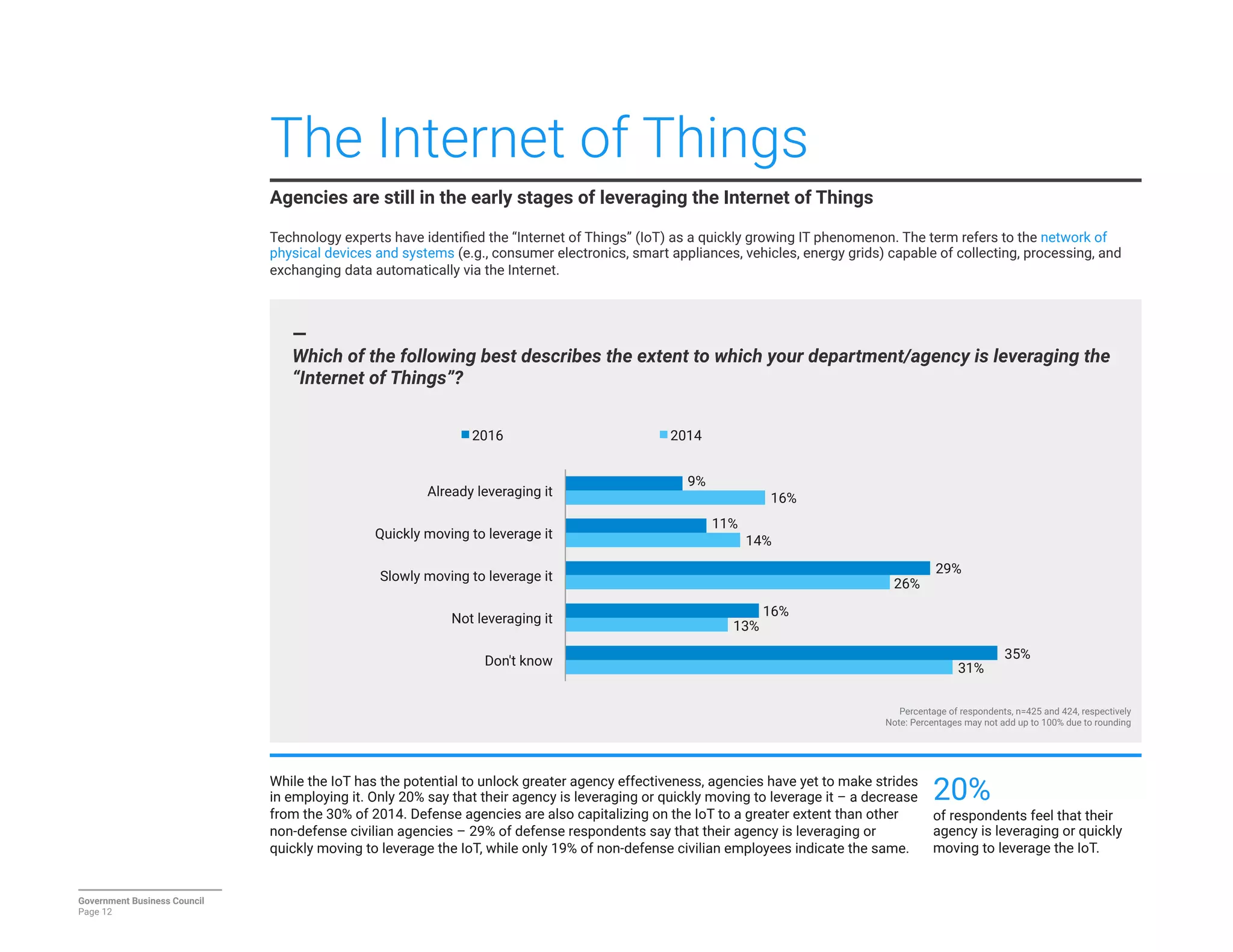
Which of the following best describes the extent to which your department/agency is leveraging the
“Internet of Things”?
31%
13%
26%
14%
16%
35%
16%
29%
11%
9%
Don't know
Not leveraging it
Slowly moving to leverage it
Quickly moving to leverage it
Already leveraging it
2016
 2014
Percentage of respondents, n=425 and 424, respectively
Note: Percentages may not add up to 100% due to rounding
While the IoT has the potential to unlock greater agency effectiveness, agencies have yet to make strides
in employing it. Only 20% say that their agency is leveraging or quickly moving to leverage it – a decrease
from the 30% of 2014. Defense agencies are also capitalizing on the IoT to a greater extent than other
non-defense civilian agencies – 29% of defense respondents say that their agency is leveraging or
quickly moving to leverage the IoT, while only 19% of non-defense civilian employees indicate the same.
20%
of respondents feel that their
agency is leveraging or quickly
moving to leverage the IoT.

Technology experts have identified the “Internet of Things” (IoT) as a quickly growing IT phenomenon. The term refers to the network of
physical devices and systems (e.g., consumer electronics, smart appliances, vehicles, energy grids) capable of collecting, processing, and
exchanging data automatically via the Internet.
Respondents remain largely confident in the security of existing networked physical devices / 
The Internet of Things
—
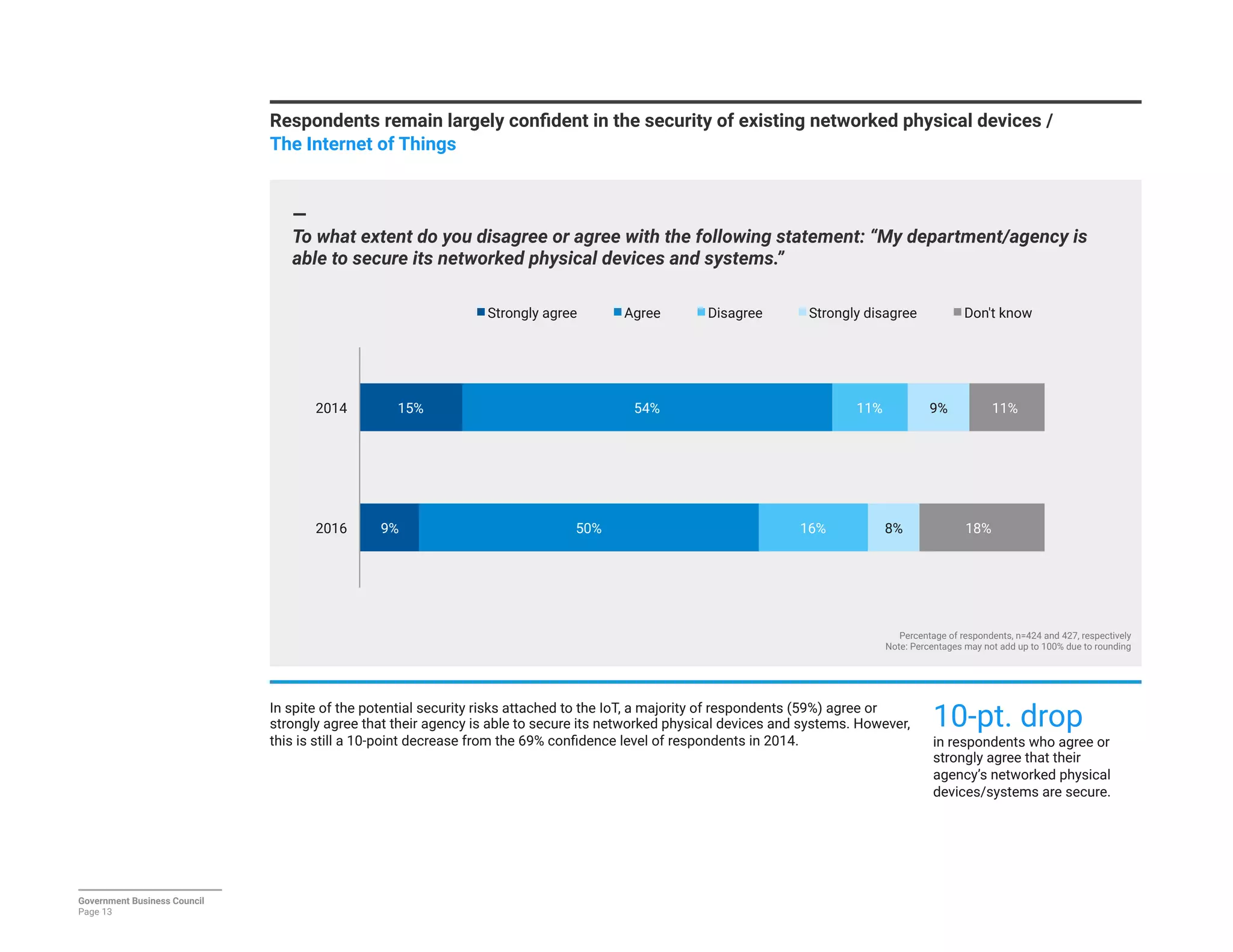
To what extent do you disagree or agree with the following statement: “My department/agency is
able to secure its networked physical devices and systems.”
Percentage of respondents, n=424 and 427, respectively
Note: Percentages may not add up to 100% due to rounding
Government Business Council
Page 13
9%
15%
50%
54%
16%
11%
8%
9%
18%
11%
2016
2014
Strongly agree
 Agree
 Disagree
 Strongly disagree
 Don't know
In spite of the potential security risks attached to the IoT, a majority of respondents (59%) agree or
strongly agree that their agency is able to secure its networked physical devices and systems. However,
this is still a 10-point decrease from the 69% confidence level of respondents in 2014.

10-pt. drop
in respondents who agree or
strongly agree that their
agency’s networked physical
devices/systems are secure.
Respondents are less confident in agency supply chain security / The Internet of Things

—
How confident are you in the ability of your department/agency to validate the security of its IT
supply chain?
Percentage of respondents, n=424 and 420, respectively
Note: Percentages may not add up to 100% due to rounding
Government Business Council
Page 14
7%
13%
26%
37%
35%
30%
15%
9%
18%
11%
2016
2014
Very confident
 Confident
 Slightly confident
 Not at all confident
 Don't know
While 50% of 2014 respondents were confident or very confident in the security of their agency’s IT
supply chain, only 33% of respondents currently express the same degree of confidence. Meanwhile, 50%
are just slightly or not at all confident, representing a sizeable level of concern.
17-pt. drop
in respondents who are
confident or very confident in
their agency’s ability to secure
its IT supply chain.
—
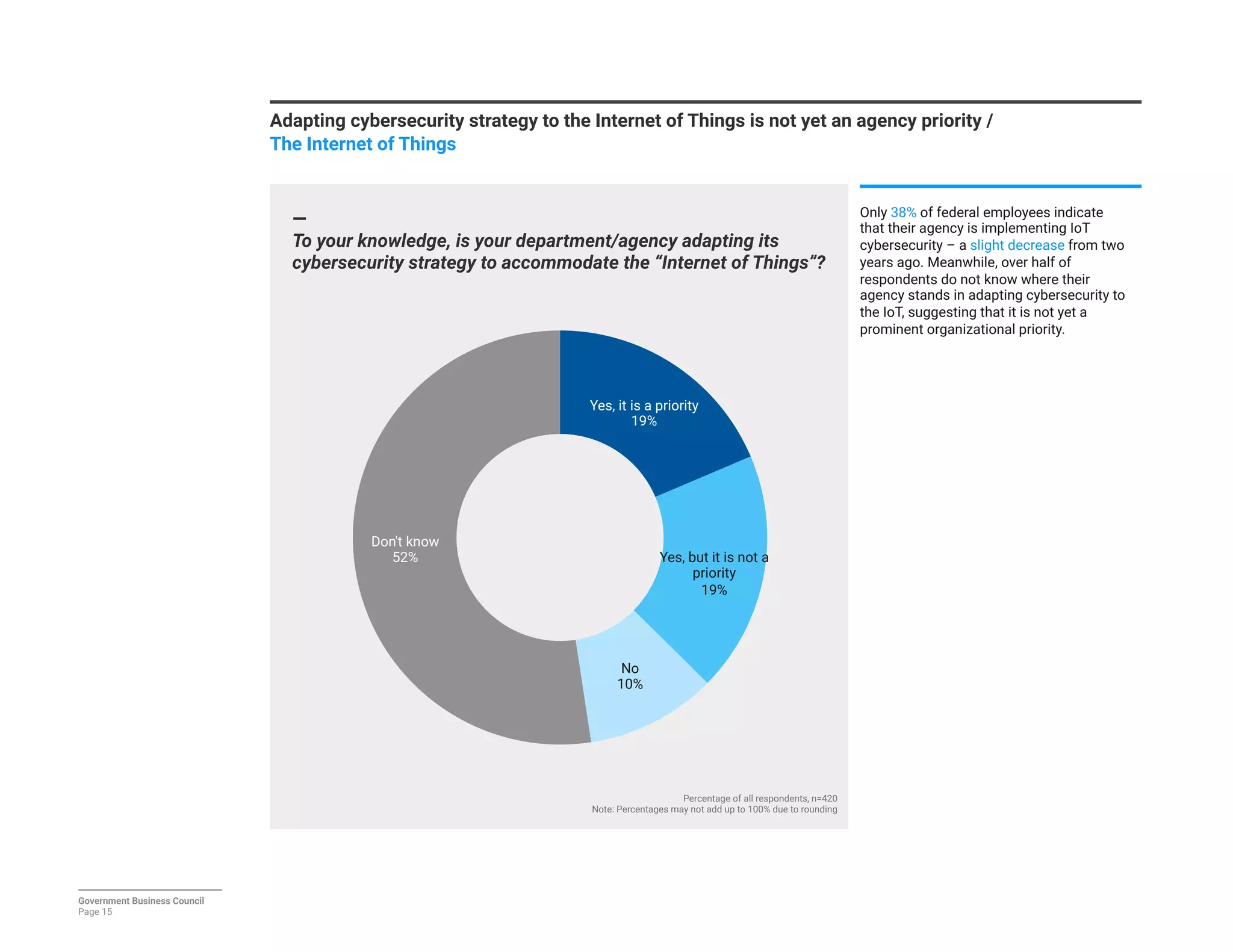
To your knowledge, is your department/agency adapting its
cybersecurity strategy to accommodate the “Internet of Things”?
Percentage of all respondents, n=420
Note: Percentages may not add up to 100% due to rounding
Yes, it is a priority
19%
Yes, but it is not a
priority
19%
No
10%
Don't know
52%
Government Business Council
Page 15
Adapting cybersecurity strategy to the Internet of Things is not yet an agency priority / 
The Internet of Things

Only 38% of federal employees indicate
that their agency is implementing IoT
cybersecurity – a slight decrease from two
years ago. Meanwhile, over half of
respondents do not know where their
agency stands in adapting cybersecurity to
the IoT, suggesting that it is not yet a
prominent organizational priority.
Current State of Cyber Defenses
Despite a drop in confidence, respondents still feel that agency information systems layers are secure 
Government Business Council
Page 16
—
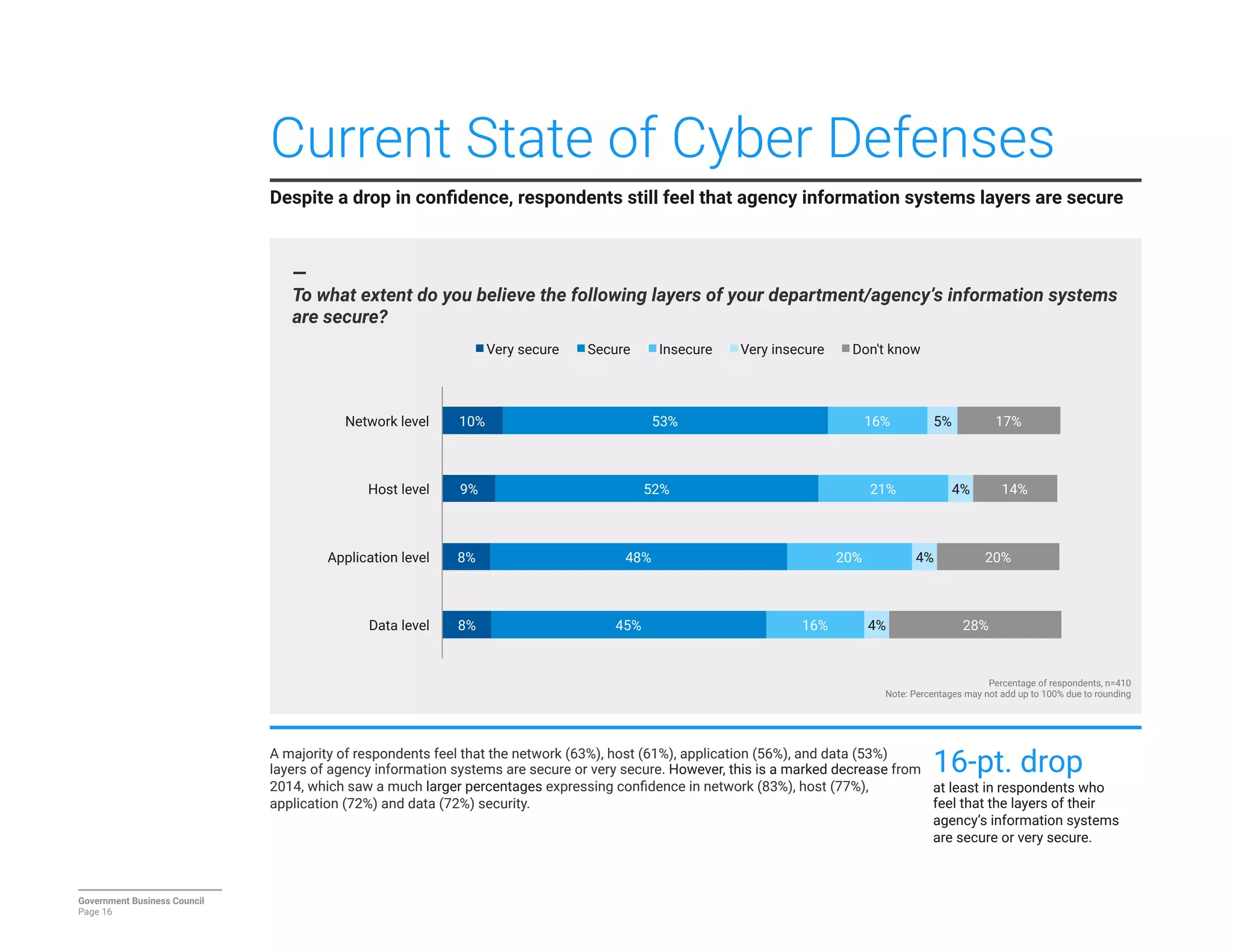
To what extent do you believe the following layers of your department/agency’s information systems
are secure?
Percentage of respondents, n=410
Note: Percentages may not add up to 100% due to rounding
8%
8%
9%
10%
45%
48%
52%
53%
16%
20%
21%
16%
4%
4%
4%
5%
28%
20%
14%
17%
Data level
Application level
Host level
Network level
Very secure
 Secure
 Insecure
 Very insecure
 Don't know
A majority of respondents feel that the network (63%), host (61%), application (56%), and data (53%)
layers of agency information systems are secure or very secure. However, this is a marked decrease from
2014, which saw a much larger percentages expressing confidence in network (83%), host (77%),
application (72%) and data (72%) security.
16-pt. drop
at least in respondents who
feel that the layers of their
agency’s information systems
are secure or very secure.
Federal leaders indicate greatest cyber gaps are workforce-related / Current State of Cyber Defenses
—
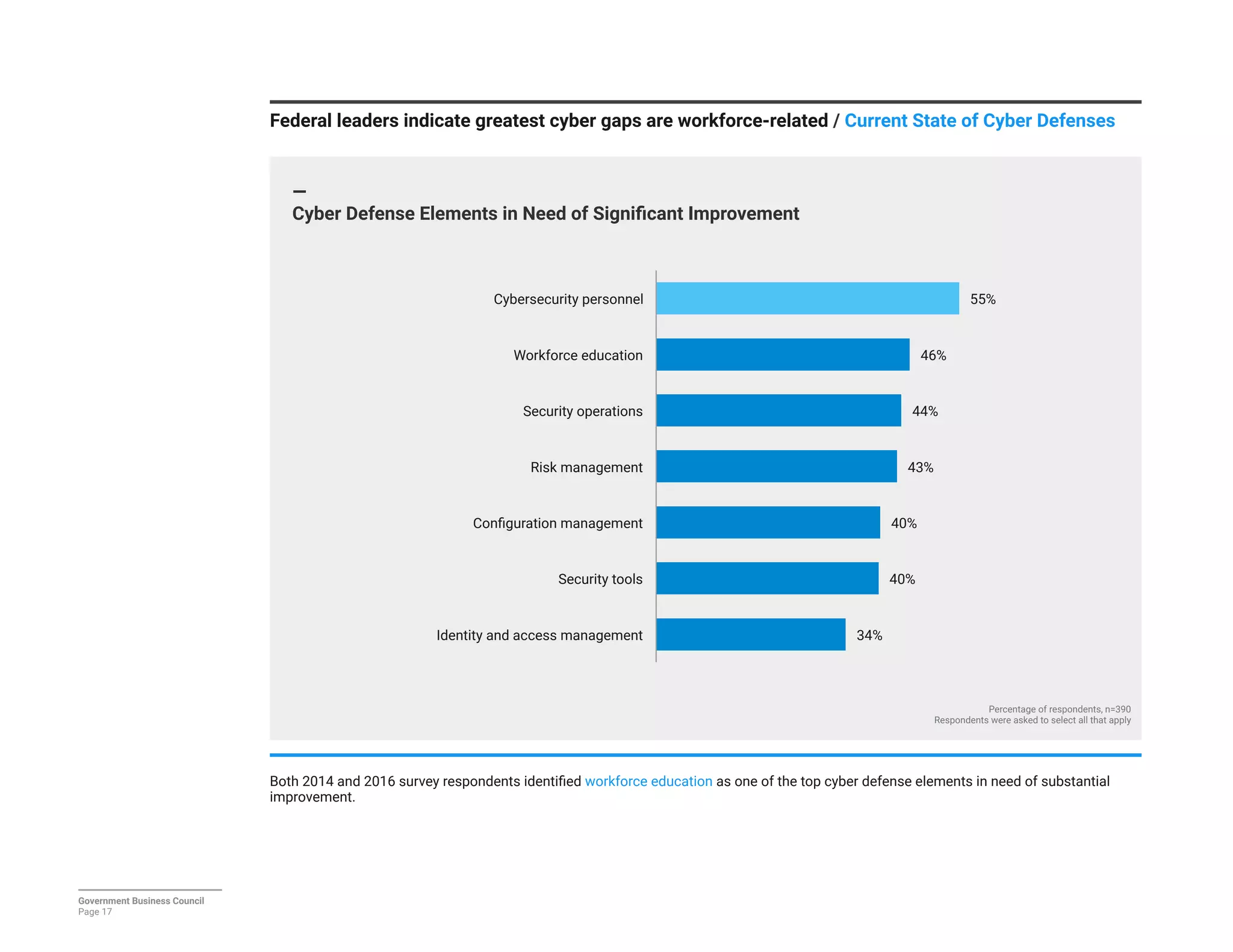
Cyber Defense Elements in Need of Significant Improvement
Government Business Council
Page 17
34%
40%
40%
43%
44%
46%
55%
Identity and access management
Security tools
Configuration management
Risk management
Security operations
Workforce education
Cybersecurity personnel
Percentage of respondents, n=390
Respondents were asked to select all that apply
Both 2014 and 2016 survey respondents identified workforce education as one of the top cyber defense elements in need of substantial
improvement.
Bureaucratic obstacles continue to present the greatest impediment to enhanced cybersecurity / 
Current State of Cyber Defenses
—
Obstacles to Holistic Cybersecurity
Government Business Council
Page 18
17%
1%
2%
20%
21%
21%
29%
33%
35%
36%
44%
49%
58%
Don't know
None of the above
Other
Privacy concerns
Inadequate security strategy
Lack of leadership buy-in
Wide array of stakeholders
Lack of interoperability among security systems
Lack of understanding/awareness
Lack of technical expertise
Bureaucratic inertia
Slow technology acquisition process
Budget constraints
Percentage of respondents, n=402
Respondents were asked to select all that apply
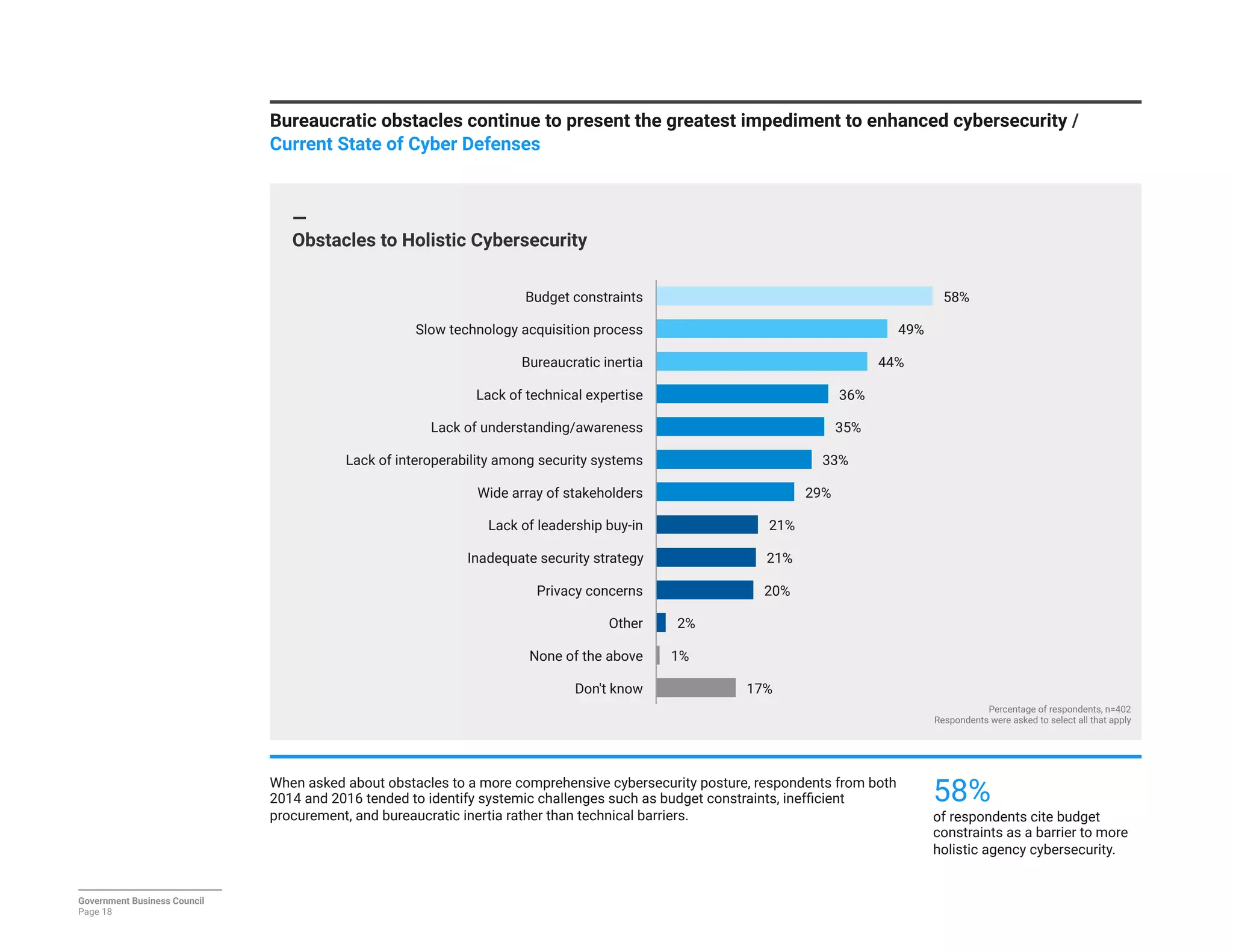
When asked about obstacles to a more comprehensive cybersecurity posture, respondents from both
2014 and 2016 tended to identify systemic challenges such as budget constraints, inefficient
procurement, and bureaucratic inertia rather than technical barriers.
58%
of respondents cite budget
constraints as a barrier to more
holistic agency cybersecurity.
Final Considerations
When seeking to achieve a more comprehensive cybersecurity posture:

—
Focus on mitigating both human and technical risks 

Federal leaders consistently point to the human element of cyber risks. When it comes to top
cyber threats, respondents most commonly identify malware-embedded emails, phishing,
and internal unauthorized access as top concerns; in other words, methods that often target
agency employees rather than technical or structural vulnerabilities. Furthermore, most
respondents believe that agencies should prioritize recruiting cybersecurity personnel and
improving workforce cyber literacy. To address these vulnerabilities, organizations might
consider enhancing defensive measures to prevent and mitigate insider threats.

—
Address the systemic obstacles hindering the implementation of
more robust defensive measures

Cyber breaches are an increasingly salient threat to agency information security. However,
the federal government appears to still be in the beginning stages of constructing more
robust cybersecurity strategies, and respondents cite budget constraints, slow technology
acquisition processes, and bureaucratic inertia as the chief barriers to a more holistic agency
cybersecurity posture. Moving forward, agencies need to focus on tackling institutional
obstacles in order to move forward with bolstering organizational cybersecurity.
Government Business Council
Page 19
Respondent Profile
Survey respondents are largely senior federal leaders
—
Job grade
—
Reports/oversees
Percentage of respondents, n=404
Note: Percentages may not add up to 100% due to rounding
54%
of respondents rank GS/GM-13 or above, including
members of the Senior Executive Service (SES).
7%
12%
10%
17%
23%
17%
12%
2%
Other
GS/GM-10 or below
GS/GM-11
GS/GM-12
GS/GM-13
GS/GM-14
GS/GM-15
SES
42%
of respondents are supervisors who oversee at least
one employee, either directly or through direct reports.
16%
 18%
4%
 3%
 1%
58%
1 to 5
 6 to 20
 21 to 50
 51 to 200
 Over 200
 None
Percentage of respondents, n=404
Note: Percentages may not add up to 100% due to rounding
“Other” includes those employed under other pay scales or ranking systems
(e.g., Military, Foreign Service, Federal Wage System, Executive Schedule, etc.)
Government Business Council
Page 20
Respondents represent a wide range of federal agencies and job functions / Respondent Profile
—
Departments and agencies represented
—
Job function
Departments and agencies are listed in order of frequency.
Respondents were asked to choose which single response best
describes their primary job function.
8%
2%
3%
3%
4%
4%
4%
4%
5%
5%
7%
8%
9%
10%
11%
15%
Other
Information technology
Facilities, fleet, real estate
Communications/PR
Legal
Healthcare professions
Audit/inspectors general
Agency leadership
Policy research/analysis
Law enforcement/public safety
Finance
Acquisition/procurement
Human resources
Technical/scientific
Administrative/office services
Program/project management
Percentage of respondents, n=404
Note: Percentages may not add up to 100% due to rounding
Treasury
Agriculture
Homeland Security
Veterans Affairs
Transportation
Air Force
Interior
Health and Human
Services
Justice
Army
Social Security
Administration
Navy
Office of the Secretary of
Defense
Commerce
Labor
Energy
Small Business
Administration
Environmental Protection
Agency
General Services
Administration
National Aeronautics and
Space Administration
Government Accountability
Office
Housing and Urban
Development
Education
State
Congress/Legislative
Branch
Agency for International
Development
National Science
Foundation
Combatant Commands
Joint Chiefs of Staff
Nuclear Regulatory
Commission
Office of Personnel
Management
Other Independent
Agencies
Government Business Council
Page 21
Respondents are familiar with cybersecurity / Respondent Profile

—
Familiarity with cybersecurity
Government Business Council
Page 22
21%
50%
22%
7%
Slightly familiar
Moderately familiar
Very familiar
Extremely familiar
Percentage of respondents, n=464
Note: Percentages may not add up to 100% due to rounding
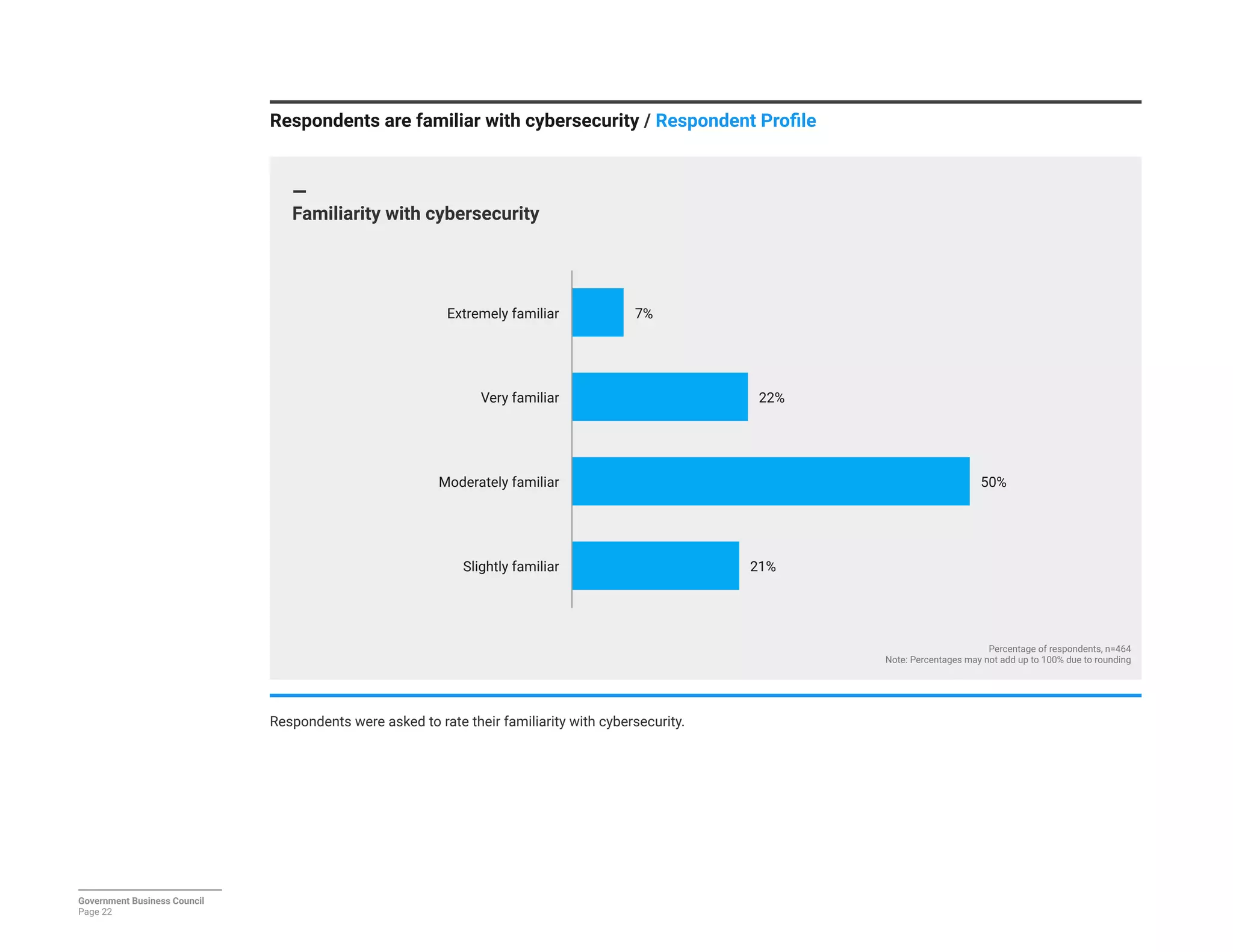
Respondents were asked to rate their familiarity with cybersecurity.
Appendix
Government Business Council
Page 23
—
Please rank the following sources of cyber threats based on the severity of the threat you believe
they pose to your department/agency.
Rankings and total scores are displayed here using the Borda count method, where each answer choice earns points based on the order in
which respondents placed them. Each respondent’s top answer choice receives the maximum score of n points for that respondent, where n
is equal to the total number of options. Each subsequent choice receives 1 less point than the one ranked ahead of it. Unranked answer
choices receive zero points. 

For instance, if a respondent’s ranked choices were 1) hacktivists, 2) criminal organizations, and 3) insiders, those responses would receive
6,5, and 4 points respectively. These points would be added to Borda count of each answer choice.

With 437 respondents and 6 choices, the maximum score possible for any single answer choice (i.e., if every respondent ranked it as their
top outcome) is equal to 2622 points (437 x 6). 


Count per rank
Total
Borda
count
1
 2
 3
 4
 5
 6
Hacktivists
 198
 77
 77
 54
 22
 9
 437
 2096
Nation-states
 90
 93
 90
 70
 45
 46
 434
 1711
Criminal organizations
 44
 85
 89
 98
 71
 47
 434
 1528
State-sponsored actors
 50
 73
 56
 81
 110
 64
 434
 1416
Insiders
 47
 56
 55
 78
 86
 113
 435
 1301
Script kiddies
 8
 52
 68
 53
 100
 155
 436
 1094
Number of respondents
 437
 436
 435
 434
 434
 434
 - -
Ranked by Borda count, n=437
—
Government Business Council

As Government Executive Media Group's research division,
Government Business Council (GBC) is dedicated to advancing the
business of government through analysis, insight and analytical
independence. As an extension of Government Executive's 40 years
of exemplary editorial standards and a commitment to the highest
ethical values, GBC studies influential decision makers from across
government to produce intelligence-based research and analysis. 

Report Author: Rina Li


—
Dell Security

Dell Security solutions help you create and maintain a strong
foundation with interconnected solutions that span your agency.
From endpoints and users to networks, data and identity, Dell
Security solutions mitigate risk and reduce complexity so you can
meet your mission. http://software.dell.com/govern-protect/.

About

—
Contact

Mark Lee
Manager, Research & Strategic Insights
Government Executive Media Group
Tel: 202.266.7574
Email: mlee@govexec.com

govexec.com/insights
@GovExecInsights


Government Business Council
Page 24

Achieving Holistic Cybersecurity: 2016 Progress Report

  • 1.
    Achieving Holistic Cybersecurity: 2016Progress Report A Candid Survey of Federal Leaders April 2016 Underwritten by
  • 2.
    Table of Contents — Overview/ 3 — Executive Summary / 5 — Research Findings Confidence in Federal Cybersecurity / 6 Breaking Down the Cyber Threat / 9 The Internet of Things / 12 Current State of Cyber Defenses / 16 — Final Considerations / 19 — Respondent Profile / 20 — Appendix / 23 Government Business Council Page 2
  • 3.
    Overview — Purpose The past fewyears have seen an explosion of cyber attacks, and with the 2015 Office of Personnel Management (OPM) breaches underscoring the vulnerability of government data, agencies are racing to implement proactive, holistic cybersecurity measures. In order to learn more about the current state of agency cybersecurity, Government Business Council (GBC) and Dell Security undertook an in-depth research study. This survey is a follow-up to a previous June 2014 GBC study and serves to measure changing perceptions and experiences of federal leaders regarding the present threat landscape. — Methodology Government Business Council and Dell Security released a survey on February 23, 2016 to a random sample of Government Executive, Nextgov, and Defense One print and online subscribers. 464 senior-level federal employees completed the survey, including those at the GS/GM 11 to 15 grade levels and members of the Senior Executive Service. 54% of respondents are GS/GM 13 and above, and all are familiar with cybersecurity. Respondents include representatives from over 30 federal agencies, including both defense and civilian agencies. To view a full demographic detail, methodology, and findings of the previous June 2014 survey, please click here. Government Business Council Page 3
  • 4.
    “Cyber threats cannotbe eliminated entirely, but they can be managed much more effectively. And we can best do this by aligning and focusing our efforts, by properly funding necessary cyber investments, by building strong partnerships across government and industry, and by drawing on the best ideas and talent from across the country to tackle this quintessential problem of the 21st century.” Federal CIO Tony Scott “Strengthening & Enhancing Cybersecurity for the 21st Century,” July 2015. Government Business Council Page 4
  • 5.
    Executive Summary — Federal leadersare significantly less confident in agency cybersecurity than they were two years ago In 2014, a substantial majority of respondents felt that their agency’s defensive measures were capable of successfully combating cyber threats. Confidence has since decreased dramatically – just 35% of respondents in 2016 are confident or very confident in their agency’s ability to protect information systems. Fewer than 1 in 3 feel confident in their agency’s ability to protect employees’ personal information or keep up with evolving cyber threats. — Workforce hygiene continues to be an overarching point of concern when it comes to top cyber threats Respondents identified email embedded with malware and phishing/spear phishing as top cyber threats – both targeting workforce cyber literacy and awareness. Moreover, they most commonly identify cybersecurity personnel and workforce education as cyber defense elements in need of significant improvement, indicating major gaps in the organizational side of agency cybersecurity more so than in technical/structural security. — Agencies face a range of challenges in bolstering cyber defenses While respondents remain largely confident in the security of networked physical devices and information systems, they still express greater uncertainty toward organizational capabilities than they did two years ago. Furthermore, agencies have yet to make meaningful progress in leveraging the Internet of Things (IoT) or in implementing IoT cybersecurity. Budget constraints, procurement delays, and bureaucratic inertia are most commonly identified as obstacles to more comprehensive defense measures, suggesting that organizational barriers present a greater challenge than technical issues with regard to agency cybersecurity enhancement. Government Business Council Page 5
  • 6.
    Confidence in FederalCybersecurity Federal employees have lost confidence in overall agency information security Government Business Council Page 6 — How confident are you in the ability of your department/agency to protect information systems from cyber intrusions? Percentage of respondents, n=424 and 461, respectively Note: Percentages may not add up to 100% due to rounding Federal leaders are significantly less optimistic about their department/agency’s overall information security capabilities than they were two years ago – while 65% of 2014 respondents were confident or very confident in their department/agency’s ability to protect information systems from cyber intrusions, only 35% of respondents currently express the same degree of confidence. 30-pt. drop in respondents indicating that they are confident or very confident in agency information security. 8% 18% 27% 47% 39% 24% 24% 8% 3% 3% 2016 2014 Very confident Confident Slightly confident Not at all confident Don't know
  • 7.
    Respondents are lessconfident in the security of their personal information / Confidence in Federal Cybersecurity — How confident are you in your department/agency’s ability to protect your personal information? Percentage of respondents, n=424 and 464, respectively Note: Percentages may not add up to 100% due to rounding Government Business Council Page 7 6% 16% 22% 42% 36% 28% 35% 13% 2% 1% 2016 2014 Very confident Confident Slightly confident Not at all confident Don't know Lack of confidence in organizational cyber defenses extends to personal information security. Only 28% of federal leaders are confident or very confident in their agency/department’s ability to safeguard their personal information, compared to 58% two years ago. 30-pt. drop in respondents indicating that they are confident or very confident in personal information security.
  • 8.
    Respondents are unsureof their organization’s ability to keep pace with evolving cyber threats / Confidence in Federal Cybersecurity — How confident are you in your department/agency’s ability to keep up with evolving cyber threats? Percentage of respondents, n=424 and 433, respectively Note: Percentages may not add up to 100% due to rounding Government Business Council Page 8 8% 18% 24% 42% 46% 32% 20% 7% 2% 1% 2016 2014 Very confident Confident Slightly confident Not at all confident Don't know Fewer than 1 in 3 respondents are confident or very confident in their agency/department’s ability to keep up with evolving cyber threats – a marked decrease from the 60% confidence level in 2014. 28-pt. drop in respondents indicating that they are confident or very confident in their agency’s ability to keep up with evolving cyber threats.
  • 9.
    Breaking Down theCyber Threat Federal employees are largely uncertain of the current cyber threat landscape Government Business Council Page 9 — To your knowledge, how often is your department/agency the target of a cyber intrusion? 1% 60% 1% 9% 5% 6% 18% Never Don't know Other Multiple times a year Multiple times a month Multiple times a week Multiple times a day Percentage of respondents, n=462 Note: Percentages may not add up to 100% due to rounding 38% of federal employees indicate that their organization is targeted by cyber intrusions at least a few times a year. However, a majority of respondents (60%) do not know how often their agencies are targeted – a major increase from 20% of respondents in 2014. This surge suggests that federal employees are significantly less certain about the present-day threat landscape – perhaps in the wake of recent high-profile attacks such as the 2015 OPM breaches. 6 in 10 respondents aren’t aware of often their department/agency is the target of a cyber intrusion.
  • 10.
    Human interaction continuesto factor into top cyber threats / Breaking Down the Cyber Threat — Significant Cyber Threats Government Business Council Page 10 19% 1% 2% 5% 9% 10% 11% 12% 21% 28% 50% 62% 63% Don't know None of the above Other Zero-day attack SQL insertion Cross-site scripting Ransomware Denial of service Exploitation of flaws in open source software Internal unauthorized access Virus/worm Phishing/spear phishing Email embedded with malware Percentage of respondents, n=457 Respondents were asked to select all that apply When asked about significant cyber threats to their department/agency, respondents most commonly identify email embedded with malware (63%) and phishing/spear phishing (62%) – selections that are largely aligned with 2014 top identified threats. All stem from human interaction, suggesting that insider threats may constitute the most pressing risk to agency cybersecurity. Respondents also highlight ransomware (11%) – a new answer choice in the 2016 study – as an emerging threat.
  • 11.
    Hacktivists are identifiedas the greatest source of cyber threats / Breaking Down the Cyber Threat — Greatest Cyber Threat Sources Ranked by respondents in order of threat severity Ranked by Borda count, n=437 Hacktivists (2096 pts) 1st Nation-states (1711 pts) Criminal organizations (1528 pts) State-sponsored actors (1416 pts) 4th Insiders (1301 pts) 5th 6th Script kiddies (1094 pts) Government Business Council Page 11 3rd 2nd When asked to rank cyber threat sources based on the severity of the threat they pose to agencies, most federal employees select hacktivists as the top threat source, followed by nation-states and criminal organizations. Interestingly, insiders are ranked second to last despite being the source of top respondent-identified cyber threats. Respondents were asked: “Please rank the following sources of cyber threats based on the severity of the threat you believe they pose to your department/agency.” Rankings and total scores are displayed here using the Borda count method, where each answer choice earns points based on the order in which respondents placed them. Each respondent’s top answer choice receives the maximum score of n points for that respondent, where n is equal to the total number of options. Each subsequent choice receives 1 less point than the one ranked ahead of it. Unranked answer choices receive zero points. Please see Appendix for further detail.
  • 12.
    The Internet ofThings Agencies are still in the early stages of leveraging the Internet of Things Government Business Council Page 12 — Which of the following best describes the extent to which your department/agency is leveraging the “Internet of Things”? 31% 13% 26% 14% 16% 35% 16% 29% 11% 9% Don't know Not leveraging it Slowly moving to leverage it Quickly moving to leverage it Already leveraging it 2016 2014 Percentage of respondents, n=425 and 424, respectively Note: Percentages may not add up to 100% due to rounding While the IoT has the potential to unlock greater agency effectiveness, agencies have yet to make strides in employing it. Only 20% say that their agency is leveraging or quickly moving to leverage it – a decrease from the 30% of 2014. Defense agencies are also capitalizing on the IoT to a greater extent than other non-defense civilian agencies – 29% of defense respondents say that their agency is leveraging or quickly moving to leverage the IoT, while only 19% of non-defense civilian employees indicate the same. 20% of respondents feel that their agency is leveraging or quickly moving to leverage the IoT. Technology experts have identified the “Internet of Things” (IoT) as a quickly growing IT phenomenon. The term refers to the network of physical devices and systems (e.g., consumer electronics, smart appliances, vehicles, energy grids) capable of collecting, processing, and exchanging data automatically via the Internet.
  • 13.
    Respondents remain largelyconfident in the security of existing networked physical devices / The Internet of Things — To what extent do you disagree or agree with the following statement: “My department/agency is able to secure its networked physical devices and systems.” Percentage of respondents, n=424 and 427, respectively Note: Percentages may not add up to 100% due to rounding Government Business Council Page 13 9% 15% 50% 54% 16% 11% 8% 9% 18% 11% 2016 2014 Strongly agree Agree Disagree Strongly disagree Don't know In spite of the potential security risks attached to the IoT, a majority of respondents (59%) agree or strongly agree that their agency is able to secure its networked physical devices and systems. However, this is still a 10-point decrease from the 69% confidence level of respondents in 2014. 10-pt. drop in respondents who agree or strongly agree that their agency’s networked physical devices/systems are secure.
  • 14.
    Respondents are lessconfident in agency supply chain security / The Internet of Things — How confident are you in the ability of your department/agency to validate the security of its IT supply chain? Percentage of respondents, n=424 and 420, respectively Note: Percentages may not add up to 100% due to rounding Government Business Council Page 14 7% 13% 26% 37% 35% 30% 15% 9% 18% 11% 2016 2014 Very confident Confident Slightly confident Not at all confident Don't know While 50% of 2014 respondents were confident or very confident in the security of their agency’s IT supply chain, only 33% of respondents currently express the same degree of confidence. Meanwhile, 50% are just slightly or not at all confident, representing a sizeable level of concern. 17-pt. drop in respondents who are confident or very confident in their agency’s ability to secure its IT supply chain.
  • 15.
    — To your knowledge,is your department/agency adapting its cybersecurity strategy to accommodate the “Internet of Things”? Percentage of all respondents, n=420 Note: Percentages may not add up to 100% due to rounding Yes, it is a priority 19% Yes, but it is not a priority 19% No 10% Don't know 52% Government Business Council Page 15 Adapting cybersecurity strategy to the Internet of Things is not yet an agency priority / The Internet of Things Only 38% of federal employees indicate that their agency is implementing IoT cybersecurity – a slight decrease from two years ago. Meanwhile, over half of respondents do not know where their agency stands in adapting cybersecurity to the IoT, suggesting that it is not yet a prominent organizational priority.
  • 16.
    Current State ofCyber Defenses Despite a drop in confidence, respondents still feel that agency information systems layers are secure Government Business Council Page 16 — To what extent do you believe the following layers of your department/agency’s information systems are secure? Percentage of respondents, n=410 Note: Percentages may not add up to 100% due to rounding 8% 8% 9% 10% 45% 48% 52% 53% 16% 20% 21% 16% 4% 4% 4% 5% 28% 20% 14% 17% Data level Application level Host level Network level Very secure Secure Insecure Very insecure Don't know A majority of respondents feel that the network (63%), host (61%), application (56%), and data (53%) layers of agency information systems are secure or very secure. However, this is a marked decrease from 2014, which saw a much larger percentages expressing confidence in network (83%), host (77%), application (72%) and data (72%) security. 16-pt. drop at least in respondents who feel that the layers of their agency’s information systems are secure or very secure.
  • 17.
    Federal leaders indicategreatest cyber gaps are workforce-related / Current State of Cyber Defenses — Cyber Defense Elements in Need of Significant Improvement Government Business Council Page 17 34% 40% 40% 43% 44% 46% 55% Identity and access management Security tools Configuration management Risk management Security operations Workforce education Cybersecurity personnel Percentage of respondents, n=390 Respondents were asked to select all that apply Both 2014 and 2016 survey respondents identified workforce education as one of the top cyber defense elements in need of substantial improvement.
  • 18.
    Bureaucratic obstacles continueto present the greatest impediment to enhanced cybersecurity / Current State of Cyber Defenses — Obstacles to Holistic Cybersecurity Government Business Council Page 18 17% 1% 2% 20% 21% 21% 29% 33% 35% 36% 44% 49% 58% Don't know None of the above Other Privacy concerns Inadequate security strategy Lack of leadership buy-in Wide array of stakeholders Lack of interoperability among security systems Lack of understanding/awareness Lack of technical expertise Bureaucratic inertia Slow technology acquisition process Budget constraints Percentage of respondents, n=402 Respondents were asked to select all that apply When asked about obstacles to a more comprehensive cybersecurity posture, respondents from both 2014 and 2016 tended to identify systemic challenges such as budget constraints, inefficient procurement, and bureaucratic inertia rather than technical barriers. 58% of respondents cite budget constraints as a barrier to more holistic agency cybersecurity.
  • 19.
    Final Considerations When seekingto achieve a more comprehensive cybersecurity posture: — Focus on mitigating both human and technical risks Federal leaders consistently point to the human element of cyber risks. When it comes to top cyber threats, respondents most commonly identify malware-embedded emails, phishing, and internal unauthorized access as top concerns; in other words, methods that often target agency employees rather than technical or structural vulnerabilities. Furthermore, most respondents believe that agencies should prioritize recruiting cybersecurity personnel and improving workforce cyber literacy. To address these vulnerabilities, organizations might consider enhancing defensive measures to prevent and mitigate insider threats. — Address the systemic obstacles hindering the implementation of more robust defensive measures Cyber breaches are an increasingly salient threat to agency information security. However, the federal government appears to still be in the beginning stages of constructing more robust cybersecurity strategies, and respondents cite budget constraints, slow technology acquisition processes, and bureaucratic inertia as the chief barriers to a more holistic agency cybersecurity posture. Moving forward, agencies need to focus on tackling institutional obstacles in order to move forward with bolstering organizational cybersecurity. Government Business Council Page 19
  • 20.
    Respondent Profile Survey respondentsare largely senior federal leaders — Job grade — Reports/oversees Percentage of respondents, n=404 Note: Percentages may not add up to 100% due to rounding 54% of respondents rank GS/GM-13 or above, including members of the Senior Executive Service (SES). 7% 12% 10% 17% 23% 17% 12% 2% Other GS/GM-10 or below GS/GM-11 GS/GM-12 GS/GM-13 GS/GM-14 GS/GM-15 SES 42% of respondents are supervisors who oversee at least one employee, either directly or through direct reports. 16% 18% 4% 3% 1% 58% 1 to 5 6 to 20 21 to 50 51 to 200 Over 200 None Percentage of respondents, n=404 Note: Percentages may not add up to 100% due to rounding “Other” includes those employed under other pay scales or ranking systems (e.g., Military, Foreign Service, Federal Wage System, Executive Schedule, etc.) Government Business Council Page 20
  • 21.
    Respondents represent awide range of federal agencies and job functions / Respondent Profile — Departments and agencies represented — Job function Departments and agencies are listed in order of frequency. Respondents were asked to choose which single response best describes their primary job function. 8% 2% 3% 3% 4% 4% 4% 4% 5% 5% 7% 8% 9% 10% 11% 15% Other Information technology Facilities, fleet, real estate Communications/PR Legal Healthcare professions Audit/inspectors general Agency leadership Policy research/analysis Law enforcement/public safety Finance Acquisition/procurement Human resources Technical/scientific Administrative/office services Program/project management Percentage of respondents, n=404 Note: Percentages may not add up to 100% due to rounding Treasury Agriculture Homeland Security Veterans Affairs Transportation Air Force Interior Health and Human Services Justice Army Social Security Administration Navy Office of the Secretary of Defense Commerce Labor Energy Small Business Administration Environmental Protection Agency General Services Administration National Aeronautics and Space Administration Government Accountability Office Housing and Urban Development Education State Congress/Legislative Branch Agency for International Development National Science Foundation Combatant Commands Joint Chiefs of Staff Nuclear Regulatory Commission Office of Personnel Management Other Independent Agencies Government Business Council Page 21
  • 22.
    Respondents are familiarwith cybersecurity / Respondent Profile — Familiarity with cybersecurity Government Business Council Page 22 21% 50% 22% 7% Slightly familiar Moderately familiar Very familiar Extremely familiar Percentage of respondents, n=464 Note: Percentages may not add up to 100% due to rounding Respondents were asked to rate their familiarity with cybersecurity.
  • 23.
    Appendix Government Business Council Page23 — Please rank the following sources of cyber threats based on the severity of the threat you believe they pose to your department/agency. Rankings and total scores are displayed here using the Borda count method, where each answer choice earns points based on the order in which respondents placed them. Each respondent’s top answer choice receives the maximum score of n points for that respondent, where n is equal to the total number of options. Each subsequent choice receives 1 less point than the one ranked ahead of it. Unranked answer choices receive zero points. For instance, if a respondent’s ranked choices were 1) hacktivists, 2) criminal organizations, and 3) insiders, those responses would receive 6,5, and 4 points respectively. These points would be added to Borda count of each answer choice. With 437 respondents and 6 choices, the maximum score possible for any single answer choice (i.e., if every respondent ranked it as their top outcome) is equal to 2622 points (437 x 6). Count per rank Total Borda count 1 2 3 4 5 6 Hacktivists 198 77 77 54 22 9 437 2096 Nation-states 90 93 90 70 45 46 434 1711 Criminal organizations 44 85 89 98 71 47 434 1528 State-sponsored actors 50 73 56 81 110 64 434 1416 Insiders 47 56 55 78 86 113 435 1301 Script kiddies 8 52 68 53 100 155 436 1094 Number of respondents 437 436 435 434 434 434 - - Ranked by Borda count, n=437
  • 24.
    — Government Business Council AsGovernment Executive Media Group's research division, Government Business Council (GBC) is dedicated to advancing the business of government through analysis, insight and analytical independence. As an extension of Government Executive's 40 years of exemplary editorial standards and a commitment to the highest ethical values, GBC studies influential decision makers from across government to produce intelligence-based research and analysis. Report Author: Rina Li — Dell Security Dell Security solutions help you create and maintain a strong foundation with interconnected solutions that span your agency. From endpoints and users to networks, data and identity, Dell Security solutions mitigate risk and reduce complexity so you can meet your mission. http://software.dell.com/govern-protect/. About — Contact Mark Lee Manager, Research & Strategic Insights Government Executive Media Group Tel: 202.266.7574 Email: mlee@govexec.com govexec.com/insights @GovExecInsights Government Business Council Page 24