Financial Intelligence
Ayo-Oluwa Baptist Church Iseyin
27 August 2023
Bible Ref.
• Luke 19: 11-21/ Mat. 25:20
• Prov. 22:2 & Ecl. 5:9
• Mindset is the difference between the rich
and the poor
• Money/cash is only a receipt of your richness
• Entitlement mentality
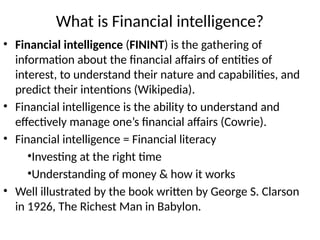
What is Financial intelligence?
• Financial intelligence (FININT) is the gathering of
information about the financial affairs of entities of
interest, to understand their nature and capabilities, and
predict their intentions (Wikipedia).
• Financial intelligence is the ability to understand and
effectively manage one’s financial affairs (Cowrie).
• Financial intelligence = Financial literacy
•Investing at the right time
•Understanding of money & how it works
• Well illustrated by the book written by George S. Clarson
in 1926, The Richest Man in Babylon.
Benefits of gaining financial skills
• Control your financial future - Better
financial decision-making
• Achieve your life goals
• Provide for yourself and your family -
Improved quality of life
• Be a smarter consumer
• Reduce stress and sleep better
• Be confident that you can manage your
finances
• Increased financial stability and security
What are the components of financial
intelligence?
• Financial literacy is the knowledge and understanding of
financial concepts, such as budgeting, saving, investing,
and debt management.
• Numeracy involves the ability to use and interpret
numerical data, such as financial statements, ratios, and
investment performance metrics.
• Emotional intelligence is the ability to manage emotions,
and behaviours related to money, such as impulse buying,
financial stress, and procrastination.
Competence required for Financial intelligence
• Budgeting: Creating and maintaining a budget, allocating
money to different expenses and savings goals.
• Investing: Understanding different types of investments, risks,
and returns, and choosing appropriate investment strategies.
• Debt management: Understanding the costs and risks
associated with borrowing money and managing debt
responsibly.
• Financial planning: Developing and implementing long-term
financial plans that align with personal goals and priorities.
• Risk management: Understanding and managing financial
risks, such as loss of income, unexpected expenses, and
market volatility.
How do I become financially intelligent?
• Being Frugal is key i.e. the
quality of
being economical with
money or food; thriftiness.
• Millionaires living a simple
life (iPhone, home theater,
aso ebi, aso obinrin
How do I become financially intelligent?
• Increase your financial knowledge
The first step in building financial intelligence is to increase your financial
knowledge. Learn about budgeting, investing, saving, debt management, and other
personal finance topics. Financial literacy is the foundation of financial intelligence.
• Track your spending
 This can help you identify areas where you can cut back and save money. You
can use tools such as budgeting apps or spreadsheets to track your expenses
and create a budget.
 What do you do with what you have?
 Effort and knowing what to do is key
• Start saving
It is important to start saving early and consistently. Set up automatic transfers to a
savings or investment account. The key is to make saving a habit and prioritize it
over unnecessary expenses. This is necessary for emergencies and investment.
When you spend all you have you have mortgaged your future
How do I become financially intelligent?
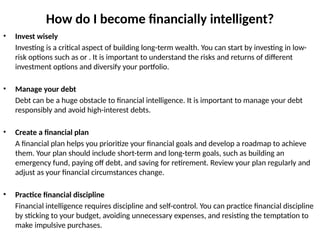
• Invest wisely
Investing is a critical aspect of building long-term wealth. You can start by investing in low-
risk options such as or . It is important to understand the risks and returns of different
investment options and diversify your portfolio.
• Manage your debt
Debt can be a huge obstacle to financial intelligence. It is important to manage your debt
responsibly and avoid high-interest debts.
• Create a financial plan
A financial plan helps you prioritize your financial goals and develop a roadmap to achieve
them. Your plan should include short-term and long-term goals, such as building an
emergency fund, paying off debt, and saving for retirement. Review your plan regularly and
adjust as your financial circumstances change.
• Practice financial discipline
Financial intelligence requires discipline and self-control. You can practice financial discipline
by sticking to your budget, avoiding unnecessary expenses, and resisting the temptation to
make impulsive purchases.
Things to ponder
• Prov. 14:8 -The wisdom of the prudent is
to understand his way.
• Planning - Prov. 21:5 - The plans of the
diligent lead surely to plenty
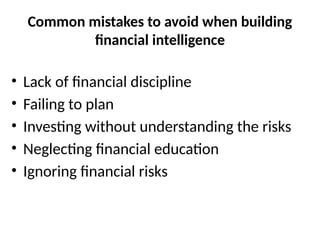
Common mistakes to avoid when building
financial intelligence
• Lack of financial discipline
• Failing to plan
• Investing without understanding the risks
• Neglecting financial education
• Ignoring financial risks
Where can you get information on financial
intelligence improvement?
• Books
• Financial Blogs and Websites
• Financial Advisors
• Financial Podcasts
• Bottom Line
How to be financially intelligent
• Personal success drive about wellbeing of your
finances (1 Kg. 11:28)
• Seek knowledge and be informed (Prov. 1:5)
- invest in yourself (Prov. 19:20)
- Read, 2 Tim. 4:13
- Do your research, Acts 17:11
- Ask questions and open your eyes to whhat is
happening around you,
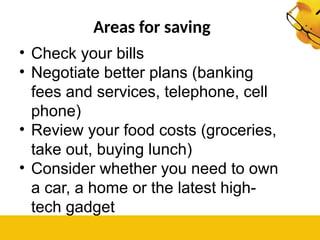
Areas for saving
• Check your bills
• Negotiate better plans (banking
fees and services, telephone, cell
phone)
• Review your food costs (groceries,
take out, buying lunch)
• Consider whether you need to own
a car, a home or the latest high-
tech gadget
Negotiate better plans
Call each service provider and ask:
• How can I cut back my monthly bills?
• Am I currently on any plans?
• Do you have a better plan or deal for me?
• If so, what is the timeframe?
• Will I be put on contract for any new deals?
• Can I bundle services to save money?
• Can I avoid interest or late payment penalties?
Reduce banking costs
• What am I paying in monthly service
charges?
• How much am I paying for ATM fees?
• Can I save by doing more banking online?
• Am I eligible for a low-fee deal if I’m a
student?
• Can I get a reduced fee if I keep a minimum
balance?
• Can you suggest a better plan for me?
How to save on food
• Eat breakfast at home
• Bring your lunch, drinks, snacks, and coffee
• “Veg out” on low-cost meatless meals at
least once a week
• Cook one big dish on weekends and freeze
• Shop with a buddy at discount supermarkets
and split quantities
• Set a budget and stick to it
Save when you shop for groceries
• Plan meals and snacks in advance
• Bring a list and buy only what you need
• Buy fresh when in season, freeze extras for later
• Buy canned and frozen vegetables and fruit
• Know which stores near you are the best value
• Check for discounts and coupons (a mobile app can help)
• Buy non-food items at a discount store
• Don’t shop on an empty stomach
Do you really need a car?
• Add up the real costs of ownership (gas, insurance, depreciation,
interest and maintenance)
• Compare the full costs of car ownership and leasing against
alternatives
• Be wary of long-term financing
• Car sharing
• Can save money if you drive less than 10,000 km per year
• Fees and rules vary — Compare different services
• If you don’t own a car, consider car sharing for trips too
long to cycle or when you have a big load to carry
Reduce impulse buying
• Avoid unnecessary trips to stores
and shopping malls and online
buying sites
• Use cash to pay for your purchases
and/or carry only the cash you are
willing to spend
• Sleep on it and see if you still want it
the next day
• Practice what you’ve learned about FI (Prov. 6:6,
Prov. 10:4)
• Keep track of your spending & identify where you
need to cut down on expenses or intensify efforts
to earn additional income (Prov. 16:21)
• Have proper & detailed records of all your income
and expenditures (2 Chron. 34:16-18)
• Surround yourself with the right people who share
similar values (Prov. 13:20; 27:17)
• Pray for divine wisdom on what and when to
invest your resources (James 1:5; Is. 30:21).
RECAP
• Keep track of your income and your expenses in a budget
• Save money by reviewing your bills and reducing your “latte
factor” (It's about any seemingly trivial discretionary expense
we incur).
• Shop around for the best bank accounts, credit cards and
service plans
• Pay yourself first with automatic savings
• Build an emergency fund equal to three months’ income
• Pay all debts on time and in full, if possible
• Set clear savings goals
• Use registered savings plans to let your savings grow tax-
free
• Find a licensed financial advisor for long-term investment
guidance
• Secure your identity and avoid identity theft.
Thank you for listening

Achieving Financial Intelligence 101.ppt

  • 1.
    Financial Intelligence Ayo-Oluwa BaptistChurch Iseyin 27 August 2023
  • 2.
    Bible Ref. • Luke19: 11-21/ Mat. 25:20 • Prov. 22:2 & Ecl. 5:9 • Mindset is the difference between the rich and the poor • Money/cash is only a receipt of your richness • Entitlement mentality
  • 3.
    What is Financialintelligence? • Financial intelligence (FININT) is the gathering of information about the financial affairs of entities of interest, to understand their nature and capabilities, and predict their intentions (Wikipedia). • Financial intelligence is the ability to understand and effectively manage one’s financial affairs (Cowrie). • Financial intelligence = Financial literacy •Investing at the right time •Understanding of money & how it works • Well illustrated by the book written by George S. Clarson in 1926, The Richest Man in Babylon.
  • 4.
    Benefits of gainingfinancial skills • Control your financial future - Better financial decision-making • Achieve your life goals • Provide for yourself and your family - Improved quality of life • Be a smarter consumer • Reduce stress and sleep better • Be confident that you can manage your finances • Increased financial stability and security
  • 6.
    What are thecomponents of financial intelligence? • Financial literacy is the knowledge and understanding of financial concepts, such as budgeting, saving, investing, and debt management. • Numeracy involves the ability to use and interpret numerical data, such as financial statements, ratios, and investment performance metrics. • Emotional intelligence is the ability to manage emotions, and behaviours related to money, such as impulse buying, financial stress, and procrastination.
  • 7.
    Competence required forFinancial intelligence • Budgeting: Creating and maintaining a budget, allocating money to different expenses and savings goals. • Investing: Understanding different types of investments, risks, and returns, and choosing appropriate investment strategies. • Debt management: Understanding the costs and risks associated with borrowing money and managing debt responsibly. • Financial planning: Developing and implementing long-term financial plans that align with personal goals and priorities. • Risk management: Understanding and managing financial risks, such as loss of income, unexpected expenses, and market volatility.
  • 8.
    How do Ibecome financially intelligent? • Being Frugal is key i.e. the quality of being economical with money or food; thriftiness. • Millionaires living a simple life (iPhone, home theater, aso ebi, aso obinrin
  • 9.
    How do Ibecome financially intelligent? • Increase your financial knowledge The first step in building financial intelligence is to increase your financial knowledge. Learn about budgeting, investing, saving, debt management, and other personal finance topics. Financial literacy is the foundation of financial intelligence. • Track your spending  This can help you identify areas where you can cut back and save money. You can use tools such as budgeting apps or spreadsheets to track your expenses and create a budget.  What do you do with what you have?  Effort and knowing what to do is key • Start saving It is important to start saving early and consistently. Set up automatic transfers to a savings or investment account. The key is to make saving a habit and prioritize it over unnecessary expenses. This is necessary for emergencies and investment. When you spend all you have you have mortgaged your future
  • 10.
    How do Ibecome financially intelligent? • Invest wisely Investing is a critical aspect of building long-term wealth. You can start by investing in low- risk options such as or . It is important to understand the risks and returns of different investment options and diversify your portfolio. • Manage your debt Debt can be a huge obstacle to financial intelligence. It is important to manage your debt responsibly and avoid high-interest debts. • Create a financial plan A financial plan helps you prioritize your financial goals and develop a roadmap to achieve them. Your plan should include short-term and long-term goals, such as building an emergency fund, paying off debt, and saving for retirement. Review your plan regularly and adjust as your financial circumstances change. • Practice financial discipline Financial intelligence requires discipline and self-control. You can practice financial discipline by sticking to your budget, avoiding unnecessary expenses, and resisting the temptation to make impulsive purchases.
  • 11.
    Things to ponder •Prov. 14:8 -The wisdom of the prudent is to understand his way. • Planning - Prov. 21:5 - The plans of the diligent lead surely to plenty
  • 12.
    Common mistakes toavoid when building financial intelligence • Lack of financial discipline • Failing to plan • Investing without understanding the risks • Neglecting financial education • Ignoring financial risks
  • 13.
    Where can youget information on financial intelligence improvement? • Books • Financial Blogs and Websites • Financial Advisors • Financial Podcasts • Bottom Line
  • 14.
    How to befinancially intelligent • Personal success drive about wellbeing of your finances (1 Kg. 11:28) • Seek knowledge and be informed (Prov. 1:5) - invest in yourself (Prov. 19:20) - Read, 2 Tim. 4:13 - Do your research, Acts 17:11 - Ask questions and open your eyes to whhat is happening around you,
  • 15.
    Areas for saving •Check your bills • Negotiate better plans (banking fees and services, telephone, cell phone) • Review your food costs (groceries, take out, buying lunch) • Consider whether you need to own a car, a home or the latest high- tech gadget
  • 16.
    Negotiate better plans Calleach service provider and ask: • How can I cut back my monthly bills? • Am I currently on any plans? • Do you have a better plan or deal for me? • If so, what is the timeframe? • Will I be put on contract for any new deals? • Can I bundle services to save money? • Can I avoid interest or late payment penalties?
  • 17.
    Reduce banking costs •What am I paying in monthly service charges? • How much am I paying for ATM fees? • Can I save by doing more banking online? • Am I eligible for a low-fee deal if I’m a student? • Can I get a reduced fee if I keep a minimum balance? • Can you suggest a better plan for me?
  • 18.
    How to saveon food • Eat breakfast at home • Bring your lunch, drinks, snacks, and coffee • “Veg out” on low-cost meatless meals at least once a week • Cook one big dish on weekends and freeze • Shop with a buddy at discount supermarkets and split quantities • Set a budget and stick to it
  • 19.
    Save when youshop for groceries • Plan meals and snacks in advance • Bring a list and buy only what you need • Buy fresh when in season, freeze extras for later • Buy canned and frozen vegetables and fruit • Know which stores near you are the best value • Check for discounts and coupons (a mobile app can help) • Buy non-food items at a discount store • Don’t shop on an empty stomach
  • 20.
    Do you reallyneed a car? • Add up the real costs of ownership (gas, insurance, depreciation, interest and maintenance) • Compare the full costs of car ownership and leasing against alternatives • Be wary of long-term financing • Car sharing • Can save money if you drive less than 10,000 km per year • Fees and rules vary — Compare different services • If you don’t own a car, consider car sharing for trips too long to cycle or when you have a big load to carry
  • 21.
    Reduce impulse buying •Avoid unnecessary trips to stores and shopping malls and online buying sites • Use cash to pay for your purchases and/or carry only the cash you are willing to spend • Sleep on it and see if you still want it the next day
  • 22.
    • Practice whatyou’ve learned about FI (Prov. 6:6, Prov. 10:4) • Keep track of your spending & identify where you need to cut down on expenses or intensify efforts to earn additional income (Prov. 16:21) • Have proper & detailed records of all your income and expenditures (2 Chron. 34:16-18) • Surround yourself with the right people who share similar values (Prov. 13:20; 27:17) • Pray for divine wisdom on what and when to invest your resources (James 1:5; Is. 30:21).
  • 23.
    RECAP • Keep trackof your income and your expenses in a budget • Save money by reviewing your bills and reducing your “latte factor” (It's about any seemingly trivial discretionary expense we incur). • Shop around for the best bank accounts, credit cards and service plans • Pay yourself first with automatic savings • Build an emergency fund equal to three months’ income • Pay all debts on time and in full, if possible • Set clear savings goals • Use registered savings plans to let your savings grow tax- free • Find a licensed financial advisor for long-term investment guidance • Secure your identity and avoid identity theft.
  • 24.
    Thank you forlistening