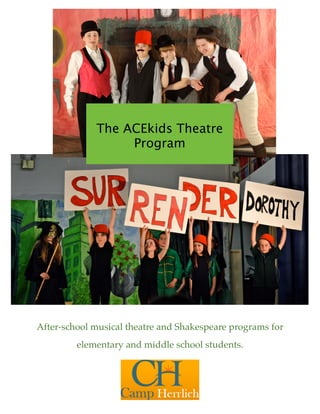
After-school musical theatre and Shakespeare programs for
elementary and middle school students.
The ACEkids Theatre
Program
The ACEkids Theatre Program for
students in grades K - 8 provides
weekly after-school musical theatre
and Shakespeare classes that
culminate in two annual Spring
productions for the Pawling
community.
It began as a Shakespeare program
for elementary school students in
the Fall of 2009 at Pawling
Elementary School. “A Midsummer
Night’s Dream” was the first
production in the Spring of 2010. The
following year, the program was
opened up to middle school
students, who took the bus to the
elementary school. That year
students from grades K-8 performed
“The Tempest,” and the following
year they performed “Macbeth.”
In 2013, the Shakespeare program
was moved to Pawling Central
Middle School and became a
program exclusively for middle
school students. They have
produced “Romeo and Juliet,”
“Much Ado About Nothing,” and
“Hamlet” on the middle school
stage. This year students are
working on a production of “Julius
Caesar” to be performed on April 22,
2016.
When the Shakespeare program
moved to the middle school,
Pawling Elementary School became
the home of the musical theatre
program for students in grades K-4.
They have since produced
“Enchanted Sleeping Beauty,”
“Disney’s Beauty and the Beast, Jr.”
and “The Wonderful Wizard of Oz”
in the Pawling Elementary School
multi-purpose room. They will
perform “Disney’s The Little
Mermaid, Jr.” on May 6, 2016.
The programs are open to students
from all schools and school
districts. Students from Mizzentop
Day School and other local public
school districts in New York and
Connecticut have participated.
The programs are financially
supported by student tuition
payments, and small donations
from local donors, such as the
Pawling Shakespeare Club. The
Pawling Central School District
provides the use of the school
buildings for the programs.
Members of the community have
donated their time to give ACEkids
students lessons in Shakespeare,
history, fencing, and singing. Other
volunteers have painted backdrops,
built props, and created costumes
and make-up for productions. High
school student volunteers (often
alumnae) have worked as teaching
assistants, stage managers and
sound engineers. The Quaker Hill
Country Club has loaned sound
equipment for the musical theatre
productions. The Akin Library and
Natural History Museum annually
invites the Shakespeare program to
give an encore performance of their
play in their large meeting room.
The response from our students’
families, school, and community
has been overwhelmingly positive.
Laura Leahy, who has put three of
her children in the program over the
years, wrote, “When I saw the
information come home in the
beginning of the year about the after
school drama program I literally got
tears in my eyes because I knew that
Cara would be over the moon!! 
Thursday is her favorite day of the
week!! Just wanted to let you know
how special this experience is for
Cara and for us!! In a family of 5
kids it's Cara's special time to
shine!! THANK YOU!”
The academic benefits of a theatre education.
Drama can improve skills and academic performance
in children and youth with learning disabilities.
Information provided from “The Effects of Theatre
Education,” American Alliance for Theatre and
Education
Drama activities improve reading comprehension, and both
verbal and non-verbal communication skills.
Drama helps to improve school attendance and reduce
high school dropout rates.
Students involved in drama performance coursework or experience
outscored non-arts students on the 2005 SAT by an average of 65
points in the verbal component and 34 points in the math component.
A 2005 Harris Poll revealed that 93% of the public
believes that arts, including theatre, are vital to a well-
rounded education.
About our instructor
A former child actress herself and the mother of two dramatic boys, Amy Emke enjoys sharing
her love of theatre with children and has been teaching theatre programs in New York and
Connecticut for over a decade. Amy is now in her seventh year with the ACEkids Theatre
Program, which she founded with Dolores Ragsdale for the after-school program for the
Pawling Central School District. A graduate in theatre from the Baltimore School for the Arts,
Amy also studied at the Experimental Theatre Wing of New York University’s Tisch School of
the Arts. She holds a B.A. in Liberal Arts from the City College of C.U.N.Y., where she
graduated Cum Laude, Phi Beta Kappa. In her spare time, Amy performs and directs
regularly for local community theaters, and is a member of the Hawk Rock Theater. She
recently stepped down from the board of Pawling Public Radio, where she served for three
years, two of them as vice-chair. Amy is a member of the New York State Theatre Education
Association, and is currently on the board of trustees of the Trinity Players.
“Romeo and Juliet” at Pawling Central Middle School, 2013

ACEkid's brochure

  • 1.
    After-school musical theatreand Shakespeare programs for elementary and middle school students. The ACEkids Theatre Program
  • 2.
    The ACEkids TheatreProgram for students in grades K - 8 provides weekly after-school musical theatre and Shakespeare classes that culminate in two annual Spring productions for the Pawling community. It began as a Shakespeare program for elementary school students in the Fall of 2009 at Pawling Elementary School. “A Midsummer Night’s Dream” was the first production in the Spring of 2010. The following year, the program was opened up to middle school students, who took the bus to the elementary school. That year students from grades K-8 performed “The Tempest,” and the following year they performed “Macbeth.” In 2013, the Shakespeare program was moved to Pawling Central Middle School and became a program exclusively for middle school students. They have produced “Romeo and Juliet,” “Much Ado About Nothing,” and “Hamlet” on the middle school stage. This year students are working on a production of “Julius Caesar” to be performed on April 22, 2016. When the Shakespeare program moved to the middle school, Pawling Elementary School became the home of the musical theatre program for students in grades K-4. They have since produced “Enchanted Sleeping Beauty,” “Disney’s Beauty and the Beast, Jr.” and “The Wonderful Wizard of Oz” in the Pawling Elementary School multi-purpose room. They will perform “Disney’s The Little Mermaid, Jr.” on May 6, 2016. The programs are open to students from all schools and school districts. Students from Mizzentop Day School and other local public school districts in New York and Connecticut have participated. The programs are financially supported by student tuition payments, and small donations from local donors, such as the Pawling Shakespeare Club. The Pawling Central School District provides the use of the school buildings for the programs. Members of the community have donated their time to give ACEkids students lessons in Shakespeare, history, fencing, and singing. Other volunteers have painted backdrops, built props, and created costumes and make-up for productions. High school student volunteers (often alumnae) have worked as teaching assistants, stage managers and sound engineers. The Quaker Hill Country Club has loaned sound equipment for the musical theatre productions. The Akin Library and Natural History Museum annually invites the Shakespeare program to give an encore performance of their play in their large meeting room. The response from our students’ families, school, and community has been overwhelmingly positive. Laura Leahy, who has put three of her children in the program over the years, wrote, “When I saw the information come home in the beginning of the year about the after school drama program I literally got tears in my eyes because I knew that Cara would be over the moon!!  Thursday is her favorite day of the week!! Just wanted to let you know how special this experience is for Cara and for us!! In a family of 5 kids it's Cara's special time to shine!! THANK YOU!”
  • 3.
    The academic benefitsof a theatre education. Drama can improve skills and academic performance in children and youth with learning disabilities. Information provided from “The Effects of Theatre Education,” American Alliance for Theatre and Education Drama activities improve reading comprehension, and both verbal and non-verbal communication skills. Drama helps to improve school attendance and reduce high school dropout rates. Students involved in drama performance coursework or experience outscored non-arts students on the 2005 SAT by an average of 65 points in the verbal component and 34 points in the math component. A 2005 Harris Poll revealed that 93% of the public believes that arts, including theatre, are vital to a well- rounded education.
  • 4.
    About our instructor Aformer child actress herself and the mother of two dramatic boys, Amy Emke enjoys sharing her love of theatre with children and has been teaching theatre programs in New York and Connecticut for over a decade. Amy is now in her seventh year with the ACEkids Theatre Program, which she founded with Dolores Ragsdale for the after-school program for the Pawling Central School District. A graduate in theatre from the Baltimore School for the Arts, Amy also studied at the Experimental Theatre Wing of New York University’s Tisch School of the Arts. She holds a B.A. in Liberal Arts from the City College of C.U.N.Y., where she graduated Cum Laude, Phi Beta Kappa. In her spare time, Amy performs and directs regularly for local community theaters, and is a member of the Hawk Rock Theater. She recently stepped down from the board of Pawling Public Radio, where she served for three years, two of them as vice-chair. Amy is a member of the New York State Theatre Education Association, and is currently on the board of trustees of the Trinity Players. “Romeo and Juliet” at Pawling Central Middle School, 2013