Just the Basics: An E-Discovery 
Primer for Paralegals and 
Litigation Support 
Royce F. Cohen 
Michael Quartararo 
Stroock & Stroock & Lavan LLP 
September 3, 2014
ACEDS Membership Benefits 
Training, Resources and Networking for the 
E-Discovery Community 
Exclusive News and Analysis 
Weekly Web Seminars 
Podcasts 
On-Demand Training 
Networking 
Resources 
Jobs Board & Career Center 
bits + bytes Newsletter 
CEDS Certification 
And Much More! 
“ACEDS provides an excellent, much needed forum to train, network and stay current 
on critical information.” 
Kimarie Stratos, General Counsel, Memorial Health Systems, Ft. Lauderdale 
Join Today! aceds.org/join
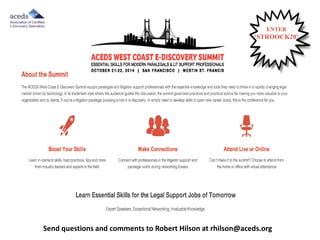
ENTER 
‘STROOCK20’ 
Send questions and comments to Robert Hilson at rhilson@aceds.org
Presenters 
Royce F. Cohen 
rcohen@stroock.com 
As Special Counsel at Stroock & Stroock & Lavan LLP, based in New York, Royce is a 
founding member and co-chair of Stroock’s eDiscovery and Information Governance Practice 
Group. She is also a member of the Sedona Conference, Working Group 1. Royce has 
extensive experience representing both insurers and reinsurers in complex insurance and 
reinsurance matters. She has led some of the firm’s largest electronic discovery projects, from 
the collection of ESI, through processing, review and production. She frequently speaks and 
moderates panel discussions and CLE presentations on topics related to electronic discovery 
and her reinsurance practice. 
Michael Quartararo 
mquartararo@stroock.com 
As Director of Litigation Support Services at Stroock & Stroock & Lavan LLP, Mike is 
responsible for the development and implementation of Firm policy relating to electronic 
discovery and the development of ediscovery best practices, project-oriented protocols, and 
the design and delivery of training programs. As a member the Firm’s eDiscovery and 
Information Governance Practice Group, Mike regularly consults with attorneys and clients on 
electronic discovery issues. Mike is a certified Project Management Professional, a Certified 
E-Discovery Specialist, and a member of the ACEDS Advisory Board. He is also a part-time 
graduate instructor of ediscovery and project management and an advisory board member at 
Bryan University.
Presentation Overview 
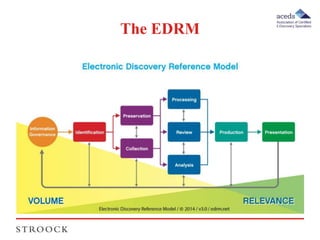
• The Electronic Discovery Reference Model (EDRM) 
• Information Governance 
• Identification 
• Preservation 
• Collection 
• Processing 
• Review and Analysis 
• Production 
• Presentation
First, the Facts 
Hypothetical Scenario: 
• Party A and Party B enter into a contract incepting 1/1/09 
• Pursuant to the Contract, payments are made by Party B quarterly 
• Party B has not made a payment since 1/1/13 
• Party A files a complaint on 4/1/14 alleging that Party B breached the contract 
among other allegations 
• You represent Party B 
• Party B has two offices – one in San Francisco and the other in Denver. 
• Each office has their own file server on which local user files are created and stored 
related to that office. There is one email server for the entire company in San 
Francisco. All employees use Windows-based PCs in the office, except 
salespeople, who also utilize laptops while traveling. Senior and middle 
management have Blackberry and smartphone mobile devices, and all email on 
those devices passes through the email server. Text and phone messages are not 
captured or retained. Backup tapes exist for the previous 12 months only.
The EDRM
Information Governance 
Information Governance (IG) pertains to a client organization’s 
internal policies and practices related to records and information 
management, including how they create, store, secure and 
manage ESI and paper documents. 
• IG is a client Responsibility 
• IG maximizes the value of information and minimizes risk 
• IG saves time and reduces cost 
• It’s not just records management 
• And it’s not just policies 
Is your client prepared for litigation?
Identification 
Identification is the process of identifying reasonably accessible 
sources of ESI and documents that may be relevant to litigation. 
• Confer with client and client IT personnel 
• Determining the scope of the project 
• Learn about the client systems (interviews, data map, questionnaire) 
• Identify people who may possess relevant information (Custodians) 
• Identify the relevant date range 
• Most common sources of ESI 
– Email servers 
– File Servers 
– PCs and laptops 
• Estimate the volume of potentially relevant ESI
Preservation 
Preservation is the process of ensuring that ESI is protected 
against alteration, deletion or destruction. 
• The preservation process involves two steps: 
1. Implement a litigation hold within the client organization 
2. Sequester the ESI (either through collection or otherwise) 
• The obligation to preserve ESI stems from the common law 
• The obligation is the clients and counsel 
• Document the process
Collection 
Collection is the process of physically and defensibly gathering 
ESI and documents from identified sources within a client 
organization. 
• Factors to consider: 
– Sources of ESI 
– Accessibility of data 
– Number of custodians 
– Size/volume of collection 
• Collection tools and procedures 
• Acquisition report 
• Chain of custody documentation
Processing 
Processing: involves the use of software to convert ESI to forms 
more suitable for review and analysis. 
• Two goals in processing: 
– Reduce volume of ESI 
– Unify ESI for systematic review 
• Extract and index metadata and text 
• De-NISTing, De-duplication and Search 
• Reporting and exceptions 
• Deliverable: Tiff images, native files, metadata and text
Review and Analysis 
Document review and analysis is the process of reviewing and 
evaluating ESI and documents for content and context and then 
coding for responsiveness and privilege in preparation for 
production to other parties. 
• Goals 
• Define scope 
• Responsiveness Coding & Issue Coding 
• Confidentiality 
• General Rules 
• Use of Analytics/Predictive Coding 
• Quality Control
Production 
• Production is the process of preparing and delivering ESI and 
documents to other parties in appropriate forms and using 
appropriate delivery mechanisms. 
• Identify documents to produce 
• Prepare a written production specification 
• Form of production 
• Quality control
Presentation 
• Presentation involves displaying ESI before people and 
audiences (at depositions, hearings, trials, etc.), to elicit further 
information, validate existing facts or positions, or persuade an 
audience. 
• From one Million to one Hundred 
• Exhibit preparation 
• Using technology to present evidence
Questions

ACEDS-Stroock 9-4-14 Webcast Presentation

  • 1.
    Just the Basics:An E-Discovery Primer for Paralegals and Litigation Support Royce F. Cohen Michael Quartararo Stroock & Stroock & Lavan LLP September 3, 2014
  • 2.
    ACEDS Membership Benefits Training, Resources and Networking for the E-Discovery Community Exclusive News and Analysis Weekly Web Seminars Podcasts On-Demand Training Networking Resources Jobs Board & Career Center bits + bytes Newsletter CEDS Certification And Much More! “ACEDS provides an excellent, much needed forum to train, network and stay current on critical information.” Kimarie Stratos, General Counsel, Memorial Health Systems, Ft. Lauderdale Join Today! aceds.org/join
  • 3.
    ENTER ‘STROOCK20’ Sendquestions and comments to Robert Hilson at rhilson@aceds.org
  • 4.
    Presenters Royce F.Cohen rcohen@stroock.com As Special Counsel at Stroock & Stroock & Lavan LLP, based in New York, Royce is a founding member and co-chair of Stroock’s eDiscovery and Information Governance Practice Group. She is also a member of the Sedona Conference, Working Group 1. Royce has extensive experience representing both insurers and reinsurers in complex insurance and reinsurance matters. She has led some of the firm’s largest electronic discovery projects, from the collection of ESI, through processing, review and production. She frequently speaks and moderates panel discussions and CLE presentations on topics related to electronic discovery and her reinsurance practice. Michael Quartararo mquartararo@stroock.com As Director of Litigation Support Services at Stroock & Stroock & Lavan LLP, Mike is responsible for the development and implementation of Firm policy relating to electronic discovery and the development of ediscovery best practices, project-oriented protocols, and the design and delivery of training programs. As a member the Firm’s eDiscovery and Information Governance Practice Group, Mike regularly consults with attorneys and clients on electronic discovery issues. Mike is a certified Project Management Professional, a Certified E-Discovery Specialist, and a member of the ACEDS Advisory Board. He is also a part-time graduate instructor of ediscovery and project management and an advisory board member at Bryan University.
  • 5.
    Presentation Overview •The Electronic Discovery Reference Model (EDRM) • Information Governance • Identification • Preservation • Collection • Processing • Review and Analysis • Production • Presentation
  • 6.
    First, the Facts Hypothetical Scenario: • Party A and Party B enter into a contract incepting 1/1/09 • Pursuant to the Contract, payments are made by Party B quarterly • Party B has not made a payment since 1/1/13 • Party A files a complaint on 4/1/14 alleging that Party B breached the contract among other allegations • You represent Party B • Party B has two offices – one in San Francisco and the other in Denver. • Each office has their own file server on which local user files are created and stored related to that office. There is one email server for the entire company in San Francisco. All employees use Windows-based PCs in the office, except salespeople, who also utilize laptops while traveling. Senior and middle management have Blackberry and smartphone mobile devices, and all email on those devices passes through the email server. Text and phone messages are not captured or retained. Backup tapes exist for the previous 12 months only.
  • 7.
  • 8.
    Information Governance InformationGovernance (IG) pertains to a client organization’s internal policies and practices related to records and information management, including how they create, store, secure and manage ESI and paper documents. • IG is a client Responsibility • IG maximizes the value of information and minimizes risk • IG saves time and reduces cost • It’s not just records management • And it’s not just policies Is your client prepared for litigation?
  • 9.
    Identification Identification isthe process of identifying reasonably accessible sources of ESI and documents that may be relevant to litigation. • Confer with client and client IT personnel • Determining the scope of the project • Learn about the client systems (interviews, data map, questionnaire) • Identify people who may possess relevant information (Custodians) • Identify the relevant date range • Most common sources of ESI – Email servers – File Servers – PCs and laptops • Estimate the volume of potentially relevant ESI
  • 10.
    Preservation Preservation isthe process of ensuring that ESI is protected against alteration, deletion or destruction. • The preservation process involves two steps: 1. Implement a litigation hold within the client organization 2. Sequester the ESI (either through collection or otherwise) • The obligation to preserve ESI stems from the common law • The obligation is the clients and counsel • Document the process
  • 11.
    Collection Collection isthe process of physically and defensibly gathering ESI and documents from identified sources within a client organization. • Factors to consider: – Sources of ESI – Accessibility of data – Number of custodians – Size/volume of collection • Collection tools and procedures • Acquisition report • Chain of custody documentation
  • 12.
    Processing Processing: involvesthe use of software to convert ESI to forms more suitable for review and analysis. • Two goals in processing: – Reduce volume of ESI – Unify ESI for systematic review • Extract and index metadata and text • De-NISTing, De-duplication and Search • Reporting and exceptions • Deliverable: Tiff images, native files, metadata and text
  • 13.
    Review and Analysis Document review and analysis is the process of reviewing and evaluating ESI and documents for content and context and then coding for responsiveness and privilege in preparation for production to other parties. • Goals • Define scope • Responsiveness Coding & Issue Coding • Confidentiality • General Rules • Use of Analytics/Predictive Coding • Quality Control
  • 14.
    Production • Productionis the process of preparing and delivering ESI and documents to other parties in appropriate forms and using appropriate delivery mechanisms. • Identify documents to produce • Prepare a written production specification • Form of production • Quality control
  • 15.
    Presentation • Presentationinvolves displaying ESI before people and audiences (at depositions, hearings, trials, etc.), to elicit further information, validate existing facts or positions, or persuade an audience. • From one Million to one Hundred • Exhibit preparation • Using technology to present evidence
  • 16.

Editor's Notes

  • #2 Hello and welcome to this ACEDS webcast, “Just the Basics: An E-Discovery Primer for Paralegals and Litigation Support,” presented by Stroock & Stroock & Lavan. I’m your host Robert Hilson of ACEDS and I’m joined today by two excellent presenters who I’ll introduce in a moment, but first I have a couple of brief announcements.
  • #3 For those of you who aren’t familiar with us, We are a members-only association that provides training, resources, and networking to the e-discovery community. We also offer the Certified E-Discovery Specialist credential, which is held by hundreds of professional across the Americas, Europe and Asia. You can join today and start receiving a number of benefits exclusive to our members, including news content, on-demand web seminars, our bits+bytes newsletter and discounts on certification and our West Coast E-Discovery Summit in October.
  • #4 The presentation today is intended to give attendees to our West Coast E-Discovery Summit, and those who are new to the field, a baseline understanding of the e-discovery practices common to paralegals and litigation support professionals. If you want a deeper dive, I encourage you to register to attend either in person or online for the Summit. We will be gathering at the historic Westin St. Francis in San Francisco on October 21 and 22. We have a great lineup of presenters, one of whom you’ll hear from today. And it’s their mission to broaden both your e-discovery skill set and career opportunities in the field. It should be a really neat event. You can register now for as low as $295. If that’s going to break the bank for you, send me an email at rhilson@aceds.org and we can work something out… And as a special thank you for attending today’s program, if you enter the code “STROOCK20,” you will receive a 20 percent discount.
  • #5 So without further adieu, I’d like to introduce the two great presenters I mentioned. Royce Cohen is an attorney at Stroock in New York who is a founding member and co-chair of the firm’s E-Discovery and Information Governance Practice Group. She is also an active participant of the Sedona Conference Working Group 1. Royce has extensive experience representing both insurers and reinsurers in complex matters. And she has handled some of the firm’s largest e-discovery projects, from collection, through to processing, review and production. She also presented at the ACEDS Annual Conference this past spring, and we’re very happy to have her back. Royce, thanks for being here. Royce is joined by Mike Quartaro, director of litigation support services at Stroock where he is responsible for development and implementation of firm policy relating to e-discovery and the development of e-discovery best practices, as well as project-oriented protocols, and the design and delivery of training programs. He is also a member of the firm’s E-Discovery and Information Goverance Practice Group, and regularly consults with attorneys and clients on e-discovery. Mike is also a member of the advisory boards of Bryan University and ACEDS, is CEDS certified, and was instrumental in helping to create the certification. And he’ll be presenting at the West Coast Summit in October. Mike, it’s been a while. How you doing? Okay, I’m going to turn it over to Mike and Royce to go over the agenda for today’s program and get started. But I want to first encourage everyone to ask questions through the question box on the right of your screen. And we’ll try to field as many as possible during the course of the presentation.