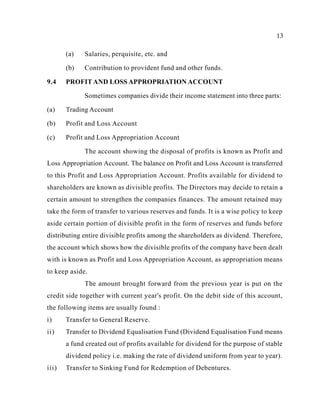
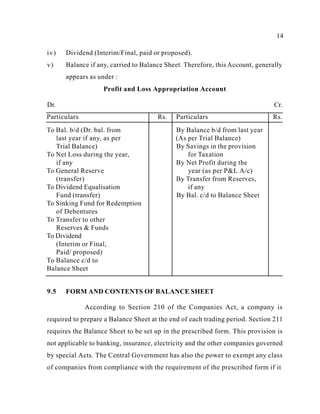
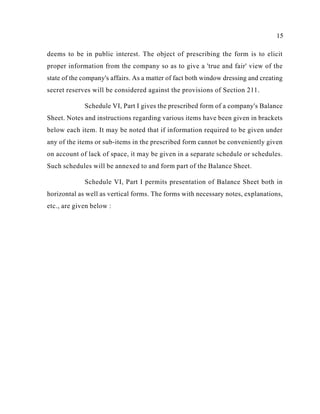
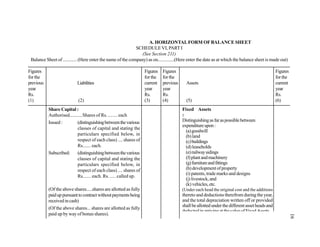
MASTER |SCHOOL| OF| MANAGEMENT 1996
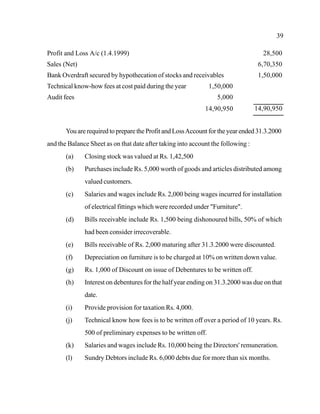
BOOK KEEPING AND ACCOUNTING COMPILED BY: - PROF.RAJ MISHRA
MO. 9999921393
BOOK KEEPING AND ACCOUNTING
STRUCTURE
1.1 Objective
1.2 Introduction
1.3 Origin and Growth of Accounting
1.4 Meaning of Accounting
1.5 Distinction between Book-Keeping and Accounting
1.6 Distinction between Accounting and Accountancy
1.7 Nature of Accounting
1.8 Objectives of Accounting
1.9 Users of Accounting Information
1.10 Branches of Accounting
1.11 Role of Accounting
1.12 Limitations of Accounting
1.13 Systems of Accounting
1.14 Summary
1.15 Keywords
1.16 Self Assessment Question
INTRODUCTION
Accounting has rightly been termed as the language of the business. The basic
function of a language is to serve as a means of communication
Accounting also serves this function. It communicates the results of
business operations to various parties who have some stake in the
business viz., the proprietor, creditors, investors, Government and
other agencies. Though accounting is generally associated with business but
it is not only business which makes use of accounts.
ORIGIN AND GROWTH OF ACCOUNTING
3
Accounting is as old as money itself. However, the act of accounting was not as
developed as it is today because in the early stages of civilisation, the number of
transactions to be recorded were so small that each businessman was able to
record and check for himself all his transactions. Accounting was practised in India
twenty three centuries ago as is clear from the book named "Arthashastra" written
by Kautilya, King Chandragupta's minister. This book not only relates to politics
and economics, but also explain the art of proper keeping of accounts.
However, the modern system of accounting based on the principles of double entry
system owes it origin to Luco Pacioli who first published the principles of Double
Entry System in 1494 at Venice in Italy. Thus, the art of accounting has been
practised for centuries but it is only in the late thirties that the study of the subject
'accounting' has been taken up seriously.
4
1.1 MEANING OF ACCOUNTING
The main purpose of accounting is to ascertain profit or loss during
a specified period, to show financial condition of the business on a particular
date and to have control over the firm's property. Such accounting records are
required to be maintained to measure the income of the business and communicate
the information so that it may be used by managers, owners and other interested
parties. Accounting is a discipline which records, classifies, summarises and
interprets financial information about the activities of a concern so that intelligent
decisions can be made about the concern. The American Institute of Certified
Public Accountants has defined the Financial Accounting as "the art of recording,
classifying and summarising in as significant manner and in terms of money
transactions and events which in part, at least of a financial character, and
interpreting the results thereof".
From the above the following attributes of accounting emerge :
(i) Recording : It is concerned with the recording of financial transactions in
an orderly manner, soon after their occurrence In the proper books of accounts.
(ii) Classifying : It Is concerned with the systematic analysis of the recorded
data so as to accumulate the transactions of similar type at one place. This function
is performed by maintaining the ledger in which different accounts are opened to
which related transactions are posted.
(iii) Summarising : It is concerned with the preparation and presentation of
the classified data in a manner useful to the users. This function involves the
5
preparation of financial statements such as Income Statement, Balance Sheet,
Statement of Changes in Financial Position, Statement of Cash Flow, Statement
of Value Added.
(iv) Interpreting : Nowadays, the aforesaid three functions are performed by
electronic data processing devices and the accountant has to concentrate mainly
on the interpretation aspects of accounting. The accountants should interpret the
statements in a manner useful to action. The accountant should explain not only
what has happened but also (a) why it happened, and (b) what is likely to happen
under specified conditions.
1.2 DISTINCTION BETWEEN BOOK-KEEPING AND ACCOUNTING
Book-keeping is a part of accounting and is concerned with the
recording of transactions which is often routine and clerical in nature, whereas
accounting performs other functions as well, viz., measurement and
communication, besides recording. An accountant is required to have a much
higher level of knowledge, conceptual understanding and analytical skill than is
required of the book-keeper.
An accountant designs the accounting system, supervises and checks
the work of the book-keeper, prepares the reports based on the recorded data and
interprets the reports. Nowadays, he is required to take part in matters of
management, control and planning of economic resources.
1.3 DISTINCTION BETWEEN ACCOUNTINGAND ACCOUNTANCY
Although in practice Accountancy and Accounting are used
interchangeably yet there is a thin line of demarcation between them. The word
Accountancy is used for the profession of accountants - who do the work of
accounting and are knowledgeable persons. Accounting is concerned with
6
recording all business transactions systematically and then arranging in the form
of various accounts and financial statements. And it is a distinct discipline like
economics, physics, astronomy etc. The word accounting tries to explain the nature
of the work of the accountants (professionals) and the word Accountancy refers
to the profession these people adopt.
1.4 NATURE OFACCOUNTING
The various definitions and explanations of accounting has been
propounded by different accounting experts from time to time and the following
aspects comprise the nature of accounting :
i) Accounting as a service activity
Accounting is a service activity. Its function is to provide quantitative
information, primarily financial in nature, about economic entities that is intended
to be useful in making economic decisions, in making reasoned choices among
alternative courses of action. It means that accounting collects financial
information for the various users for taking decisions and tackling business issues.
Accounting in itself cannot create wealth though, if it produces information which
is useful to others, it may assist in wealth creation and maintenance.
(ii) Accounting as a profession
Accounting is very much a profession. A profession is a career that
involve the acquiring of a specialised formal education before rendering any
service. Accounting is a systematized body of knowledge developed with the
development of trade and business over the past century. The accounting education
is being imparted to the examinees by national and international recognised the
bodies like The Institute of Chartered Accountants of India (ICAI), New Delhi in
India and American Institute of Certified Public Accountants (AICPA) in USA
7
etc. The candidate must pass a vigorous examination in Accounting Theory,
Accounting Practice, Auditing and Business Law. The members of the professional
bodies usually have their own associations or organisations, where in they are
required to be enrolled compulsorily as Associate member of the Institute of
Chartered Accountants (A.C.A.) and fellow of the Institute of Chartered
Accountants (F.C.A.). In a way, accountancy as a profession has attained the stature
comparable with that of lawyer, medicine or architecture.
(iii) Accounting as a social force
In early days, accounting was only to serve the interest of the owners.
Under the changing business environment the discipline of accounting and the
accountant both have to watch and protect the interests of other people who are
directly or indirectly linked with the operation of modern business. The society
is composed of people as customer, shareholders, creditors and investors. The
accounting information/data is to be used to solve the problems of the public at
large such as determination and controlling of prices. Therefore, safeguarding of
public interest can better be facilitated with the help of proper, adequate and
reliable accounting information and as a result of it the society at large is benefited.
(iv) Accounting as a language
Accounting is rightly referred the "language of business". It is one
means of reporting and communicating information about a business. As one has
to learn a new language to converse and communicate, so also accounting is to be
learned and practised to communicate business events.
A language and accounting have common features as regards rules
and symbols. Both are based and propounded on fundamental rules and symbols.
In language these are known as grammatical rules and in accounting, these are
8
termed as accounting rules. The expression, exhibition and presentation of
accounting data such as a numerals and words and debits and credit are accepted
as symbols which are unique to the discipline of accounting.
(v) Accounting as science or art
Science is a systematised body of knowledge. It establishes a
relationship of cause and effect in the various related phenomenon. It is also based
on some fundamental principles. Accounting has its own principles e.g. the double
entry system, which explains that every transaction has two fold aspect i.e. debit
and credit. It also lays down rules of journalising. So we can say that accounting
is a science.
Art requires a perfect knowledge, interest and experience to do a
work efficiently. Art also teaches us how to do a work in the best possible way by
making the best use of the available resources. Accounting is an art as it also
requires knowledge, interest and experience to maintain the books of accounts in
a systematic manner. Everybody cannot become a good accountant. It can be
concluded from the above discussion that accounting is an art as well as a science.
(vi) Accounting as an information system
Accounting discipline will be the most useful one in the acquisition
of all the business knowledge in the near future. You will realise that people will
be constantly exposed to accounting information in their everyday life. Accounting
information serves both profit-seeking business and non-profit organisations. The
accounting system of a profit-seeking organisation is an information system
designed to provide relevant financial information on the resources of a business
and the effect of their use. Information is relevant and valuable if the decision
makers can use it to evaluate the financial consequences of various alternatives.
9
Accounting generally does not generate the basic information (raw financial data),
rather the raw financial data result from the day to day transactions of the business.
As an information system, accounting links an information source
or transmitter (generally the accountant), a channel of communication (generally
the financial statements) and a set of receivers (external users).
1.5 OBJECTIVES OF ACCOUNTING
The following are the main objectives of accounting :
1. To keep systematic records : Accounting is done to keep a systematic
record of financial transactions. In the absence of accounting there would have
been terrific burden on human memory which in most cases would have been
impossible to bear.
2. To protect business properties : Accounting provides protection to
business properties from unjustified and unwarranted use. This is possible on
account of accounting supplying the following information to the manager or the
proprietor:
(i) The amount of the proprietor's funds invested in the business.
(ii) How much the business have to pay to others?
(iii) How much the business has to recover from others?
(iv) How much the business has in the form of (a) fixed assets, (b) cash
in hand, (c) cash at bank, (d) stock of raw materials, work-in-progress
and finished goods?
Information about the above matters helps the proprietor in assuring
that the funds of the business are not necessarily kept idle or underutilised.
10
3. To ascertain the operational profit or loss : Accounting helps in
ascertaining the net profit earned or loss suffered on account of carrying the
business. This is done by keeping a proper record of revenues and expense of a
particular period. The Profit and Loss Account is prepared at the end of a period
and if the amount of revenue for the period is more than the expenditure incurred
in earning that revenue, there is said to be a profit. In case the expenditure exceeds
the revenue, there is said to be a loss.
Profit and Loss Account will help the management, investors,
creditors, etc. in knowing whether the business has proved to be remunerative or
not. In case it has not proved to be remunerative or profitable, the cause of such a
state of affairs will be investigated and necessary remedial steps will be taken.
4. To ascertain the financial position of the business : The Profit and Loss
Account gives the amount of profit or loss made by the business during a particular
period. However, it is not enough. The businessman must know about his financial
position i.e. where he stands ?, what he owes and what he owns?
5. To facilitate rational decision making : Accounting these days has taken
upon itself the task of collection, analysis and reporting of information at the
required points of time to the required levels of authority in order to facilitate
rational.decision-making.
11
Information System : Accounting functions as an information system for
collecting and communicating economic information about the business enterprise.
This information helps the management in taking appropriate decisions. This
function, as stated, is gaining tremendous importance these days.
1.6 USERS OFACCOUNTING INFORMATION
The basic objective of accounting is to provide information which is
useful for persons inside the organisation and for persons or groups outside the
organisation. Accounting is the discipline that provides information on which
external and internal users of the information may base decisions that result in
the allocation of economic resources in society.
I. External Users of Accounting Information : External users are those
groups or persons who are outside the organisation for whom accounting function
is performed. Following can be the various external users of accounting
information:
1. Investors, Those who are interested in investing money in an organisation
are interested in knowing the financial health of the organisation of know how
safe the investment already made is and how safe their proposed investment will
be. To know the financial health, they need accounting information which will
help them in evaluating the past performance and future prospects of the
organisation. Thus, investors for their investment decisions are dependent upon
accounting information included in the financial statements. They can know the
profitability and the financial position of the organisation in which they are
12
interested to make that investment by making a study of the accounting information
given in the financial statements of the organisation.
2. Creditors. Creditors (i.e. supplier of goods and services on credit, bankers
and other lenders of money) want to know the financial position of a concern
before giving loans or granting credit. They want to be sure that the concern will
not experience difficulty in making their payment in time i.e. liquid position of
the concern is satisfactory. To know the liquid position, they need accounting
information relating to current assets, quick assets and current liabilities which
is available in the financial statements.
3. Members of Non-profit Organisations. Members of non-profit
organisations such as schools, colleges, hospitals, clubs, charitable institutions
etc. need accounting information to know how their contributed funds are being
utilised and to ascertain if the organisation deserves continued support or support
should be withdrawn keeping in view the bad performance depicted by the
accounting information and diverted to another organisation. In knowing the
performance of such organisations, criterion will not be the profit made but the
main criterion will be the service provided to the society.
4. Government. Central and State Governments are interested in the accounting
information because they want to know earnings or sales for a particular period
for purposes of taxation. Income tax returns are examples of financial reports
which are prepared with information taken directly from accounting records.
Governments also needs accounting information for compiling statistics
concerning business which, in turn helps in compiling national accounts.
5. Consumers. Consumers need accounting information for establishing good
accounting control so that cost of production may be reduced with the resultant
13
reduction of the prices of goods they buy. Sometimes, prices for some goods are
fixed by the Government, so it needs accounting information to fix reasonable
prices so that consumers and manufacturers are not exploited. Prices are fixed
keeping in view fair return to manufacturers on their investments shown in the
accounting records.
6. Research Scholars. Accounting information, being a mirror of the financial
performance of a business organisation, is of immense value to the research
scholars who wants to make a study to the financial operations of a particular
firm. To make a study into the financial operations of a particular firm, the research
scholar needs detailed accounting information relating to purchases, sales,
expenses, cost of materials used, current assets, current liabilities, fixed assets,
long term liabilities and shareholders' funds which is available in the accounting
records maintained by the firm.
II Internal Users of Accounting Information. Internal users of accounting
information are those persons or groups which are within the organisation.
Following are such internal users :
1. Owners. The owners provide funds for the operations of a business and
they want to know whether their funds are being properly used or not. They need
accounting information to know the profitability and the financial position of the
concern in which they have invested their funds. The financial statements prepared
from time to time from accounting records depicts them the profitability and the
financial position.
2. Management. Management is the art of getting work done through others,
the management should ensure that the subordinates are doing work properly.
Accounting information is an aid in this respect because it helps a manager in
appraising the performance of the subordinates. Actual performance of the
14
employees can be compared with the budgeted performance they were expected
to achieve and remedial action can be taken if the actual performance is not upto
the mark. Thus, accounting information provides "the eyes and ears to
management".
The most important functions of management are planning and
controlling. Preparation of various budgets, such as sales budget, production
budget, cash budget, capital expenditure budget etc., is an important part of
planning function and the starting point for the preparation of the budgets is the
accounting information for the previous year. Controlling is the function of seeing
that programmes laid down in various budgets are being actually achieved i.e. actual
performance ascertained from accounting is compared with the budgeted
performance, enabling the manager to exercise controlling case of weak
performance. Accounting information is also helpful to the management in fixing
reasonable selling prices. In a competitive economy, a price should be based on
cost plus a reasonable rate of return. If a firm quotes a price which exceeds cost
plus a reasonable rate of return, it probably will not get the order. On the other
hand, if the firm quotes a price which is less than its cost, it will be given the
order but will incur a loss on account of price being lower than the cost. So,
selling prices should always be fixed on the basis of accounting data to get the
reasonable margin of profit on sales.
3. Employees. Employees are interested in the financial position of a concern
they serve particularly when payment of bonus depends upon the size of the profits
earned. They seek accounting information to know that the bonus being paid to
them is correct.
1.7 BRANCHES OF ACCOUNTING
To meet the ever increasing demands made on accounting by different
15
interested parties such as owners, management, creditors, taxation authorities etc.,
the various branches have come into existence. There are as follows :
1. Financial accounting. The object of financial accounting is to ascertain
the results (profit or loss) of business operations during the particular period and
to state the financial position (balance sheet) as on a date at the end of the period.
2. Cost accounting. The object of cost accounting is to find out the cost of
goods produced or services rendered by a business. It also helps the business in
controlling the costs by indicating avoidable losses and wastes.
3. Management accounting. The object of management accounting is to supply
relevant information at appropriate time to the management to enable it to take
decisions and effect control.
In this lesson we are concerned only with financial accounting.
Financial accounting is the oldest and other branches have developed from it. The
objects of financial accounting, as stated above, can be achieved only by recording
the financial transactions in a systematic manner according to a set of principles.
The art of recording financial transactions and events in a systematic manner in
the books of account is known as book-keeping. However, mere record of
transactions is not enough. The recorded information has to be classified, analysed
and presented in a manner in which business results and financial position can be
ascertained.
1.8 ROLE OF ACCOUNTING
Accounting plays an important and useful role by developing the
information for providing answers to many questions faced by the users of
accounting information :
16
(1) How good or bad is the financial condition of the business?
(2) Has the business activity resulted in a profit or loss ?
(3) How well the different departments of the business have performed in the
past?
(4) Which activities or products have been profitable?
(5) Out of the existing products which should be discontinued and the production
of which commodities should be increased?
(6) Whether to buy a component from the market or to manufacture the same?
(7) Whether the cost of production is reasonable or excessive?
(8) What has been the impact of existing policies on the profitability of the
business?
(9) What are the likely results of new policy decisions on future earning
capacity of the business?
(10) In the light of past performance of the business how should it plan for future
to ensure desired results?
Above mentioned are few examples of the types of questions faced
by the users of accounting information. These can be satisfactorily answered with
the help of suitable and necessary information provided by accounting.
Besides, accounting is also useful in the following respects :
(a) Increased volume of business results in large number of transactions and
no businessman can remember everything. Accounting records obviate the
necessity of remembering various transactions.
17
(b) Accounting records, prepared on the basis of uniform practices, will enable
a business to compare results of one period with another period.
(c) Taxation authorities (both income tax and sales tax) are likely to believe
the facts contained in the set of accounting books if maintained according
to generally accepted accounting principles.
(d) Accounting records, backed up by proper and authenticated vouchers, are
good evidence in a court of law.
(e) If a business is to be sold as a going concern, then the values of different
assets as shown by the balance sheet helps in bargaining proper price for
the business.
1.9 LIMITATIONS OF FINANCIALACCOUNTING
Advantages of accounting discussed in this lesson do not suggest that
accounting is free from limitations. Any one who is using accounting information
should be well aware of its limitations also. Following are the limitations :
(a) Financial accounting permits alternative treatments
No doubt accounting is based on concepts and it follows "generally
accepted accounting principles", but there exist more than one principle for the
treatment of any one item. This permits alternative treatments within the
framework of generally accepted accounting principles. For example, the closing
stock of a business may be valued by any one of the following methods : FIFO
(First-in-first-out); LIFO (Last-in-first-out)
(b) Financial accounting is Influenced by personal judgments
18
Inspite of the fact that convention of objectivity is respected in
accounting but to record certain events estimates have to be made which requires
personal judgement. It is very difficult to expect accuracy in future estimates and
objectivity suffers. For example, in order to determine the amount of depreciation
to be charged every year.
(c) Financial accounting ignores important non-monetary information
Financial accounting takes into consideration only those transactions
and events which can be described in money. The transactions and events, however
important, if non-monetary in nature are ignored i.e., not recorded. For example,
extent of competition faced by the business, technical innovations possessed by
the business, loyalty and efficiency of the employees etc. are the important matters
in which management of the business is highly interested but accounting is not
tailored to take note of such matters.
(d) Financial accounting does not provide timely information
Financial accounting is designed to supply information in the form
of statements (Balance Sheet and Profit and Loss Account) for a period, normally,
one year. So the information is, at best, of historical interest and only postmortem
analysis of the past can be conducted. The business requires timely information
at frequent intervals to enable the management to plan and take corrective action.
For example, if a business has budgeted that during the current year sales should
be Rs. 12,00,000 then it requires information – whether the sales in the first
month of the year amounted to Rs. 1,00,000 or less or more?
(e) Financial accounting does not provide detailed analysis
The information supplied by the financial accounting is in reality
aggregate of the financial transactions during the course of the year. Of course, it
enables to study the overall results of the business activity during the accounting
period. For proper running of the business the information is required regarding
19
the cost, revenue and profit of each product but financial accounting does not
provide such detailed information product-wise
(f) Financial accounting does not disclose the present value of the business
In financial accounting the position of the business as on a particular
date is shown by a statement known as balance sheet. In balance sheet the assets
are shown on the basis of going concern concept. Thus it is presumed that business
has relatively longer life and will continue to exist indefinitely, hence the asset
values are going concern values. The realised value of each asset if sold today
can't be known by studying the balance sheet.
1.10 SYSTEMS OF ACCOUNTING
The following are the main systems of recording business
transactions:
(a) Cash System. Under this system, actual cash receipts and actual cash
payments are recorded. Credit transactions are not recorded at all until the cash
in actually received or paid. The Receipts and Payments Account prepared in case
20
of non-trading concerns such as a charitable institution, a club, a school, a college,
etc. and professional men like a lawyer, a doctor, a chartered accountant etc. can
be cited as the best example of cash system. This system does not make a complete
record of financial transactions of a trading period as it does not record
outstanding transactions like outstanding expenses and outstanding incomes. The
system being based on a record of actual cash receipts and actual cash payments
will not be able to disclose correct profit or loss for a particular period and will
not exhibit true financial position of the business on a particular day.
(b) Mercantile (Accrual) system. Under this system all transactions relating to
a period are recorded in the books of account i.e., in addition to actual receipts
and payments of cash income receivable and expenses payable are also recorded.
This system gives a complete picture of the financial transactions of the business
as it makes a record of all transactions relating to a period. The system being
based on a complete record of the financial transactions discloses correct profit
or loss for a particular period and also exhibits true financial position of the
business on a particular day.
1.11 KEYWORDS
Book-keeping: It is the art of recording in the books of accounts the monetary
aspect of commercial or financial transactions.
Accounting: It is the means of collecting, summarising and reporting in monetary
terms, information about the business.
Financial accounting: Financial accounting deals with the maintenance of books
of accounts with a view to ascertain the profitability and the financial status of
the business.
Transaction: A transaction is a stimulus from one person and a related response
from the another.
21
1.12 SELF ASSESSMENT QUESTIONS
1. Define accounting. Discuss the objectives of accounting.
2. What are the various interested parties which use accounting information?
3. What is meant by book-keeping and accounting? Is accounting a science or art?
4. Briefly describe the various branches of accounting.
5. Distinguish between :
(a) Accounting and Accountancy
(b) Cash and Mercantile System of Accounting
Subject : Accounting for Managers
Code : CP-104 Updated by: Dr. M.C. Garg
Lesson : 2
ACCOUNTING CONCEPTS AND CONVENTIONS
STRUCTURE
2.1 Objective
2.2 Introduction
2.3 Meaning and essential features of Accounting Principles
2.4 Accounting Principles
2.5 Accounting Concepts
2.6 Accounting Conventions
2.7 Accounting Standards
2.8 Summary
2.9 Keywords
2.10 Self Assessment Questions
2.1 INTRODUCTION
Accounting is often called the language of business because the purpose of
accounting is to communicate or report the results of business operations and its
various aspects to various users of accounting information. In fact, today, account-
ing statements or reports are needed by various groups such as shareholders, credi-
tors, potential investors, columnist of financial newspapers, proprietors and others.
In view of the utility of accounting reports to various interested parties, it becomes
imperative to make this language capable of commonly understood by all. Account-
(1)
ing could become an intelligible and commonly understood language if it is based
on generally accepted accounting principles. Hence, you must be familiar with
the accounting principles behind financial statements to understand and
use them properly.
2.2 MEANINGAND FEATURES OFACCOUNTING PRINCIPLES
For searching the goals of the accounting profession and for expand-
ing knowledge in this field, a logical and useful set of principles and pro-
cedures are to be developed. We know that while driving our vehicles, fol-
low a standard traffic rules. Without adhering traffic rules, there would be
much chaos on the road. Similarly, some principles apply to accounting.
Thus, the accounting profession cannot reach its goals in the absence of a
set rules to guide the efforts of accountants and auditors. The rules and
principles of accounting are commonly referred to as the conceptual frame-
work of accounting.
Accounting principles have been defined by the Canadian Institute of
Chartered Accountants as “The body of doctrines commonly associated with
the theory and procedure of accounting serving as an explanation of current
practices and as a guide for the selection of conventions or procedures
where alternatives exists. Rules governing the formation of accounting axi-
oms and the principles derived from them have arisen from common expe-
rience, historical precedent statements by individuals and professional bod-
ies and regulations of Governmental agencies”. According to Hendriksen
(1997), Accounting theory may be defined as logical reasoning in the form
of a set of broad principles that (i) provide a general frame of reference by
which accounting practice can be evaluated, and (ii) guide the development
of new practices and procedures. Theory may also be used to explain exist-
ing practices to obtain a better understanding of them. But the most impor-
tant goal of accounting theory should be to provide a coherent set of logi-
(2)
cal principles that form the general frame of reference for the evaluation
and development of sound accounting practices.
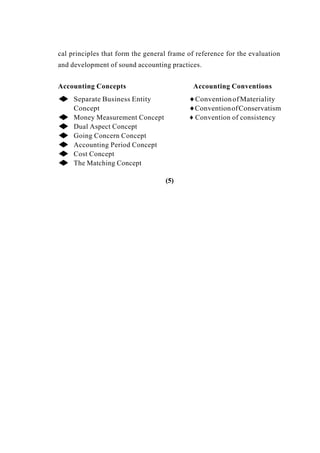
Accounting Concepts Accounting Conventions
◆ Separate Business Entity ♦ConventionofMateriality
Concept ♦ConventionofConservatism
◆ Money Measurement Concept ♦ Convention of consistency
◆ Dual Aspect Concept
◆ Going Concern Concept
◆ Accounting Period Concept
◆ Cost Concept
◆ The Matching Concept
(5)
◆ Accrual Concept
◆ Realisation Concept
2.3 ACCOUNTING CONCEPTS
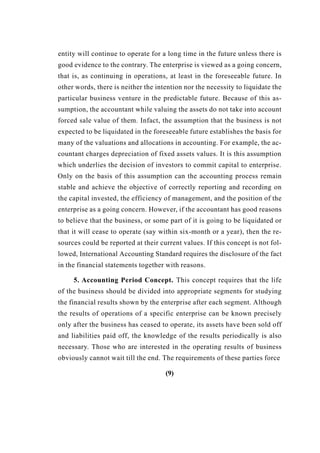
The more important accounting concepts are briefly described as follows:
1. Separate Business Entity Concept. In accounting we make a dis-
tinction between business and the owner. All the books of accounts records
day to day financial transactions from the view point of the business rather
than from that of the owner. The proprietor is considered as a creditor to
the extent of the capital brought in business by him. For instance, when a
person invests Rs. 10 lakh into a business, it will be treated that the busi-
ness has borrowed that much money from the owner and it will be shown as
a ‘liability’ in the books of accounts of business. Similarly, if the owner of
a shop were to take cash from the cash box for meeting certain personal
expenditure, the accounts would show that cash had been reduced even though
it does not make any difference to the owner himself. Thus, in recording a
transaction the important question is how does it affects the business ? For
example, if the owner puts cash into the business, he has a claim against the
business for capital brought in.
In sofar as a limited company is concerned, this distinction can be easily main-
tained because a company has a legal entity of its own. Like a natural person it can
engage itself in economic activities of buying, selling, producing, lending, borrow-
ing and consuming of goods and services. However, it is difficult to show this dis-
tinction in the case of sole proprietorship and partnership. Nevertheless, account-
ing still maintains separation of business and owner. It may be noted that it is only
for accounting purpose that partnerships and sole proprietorship are treated as sepa-
rate from the owner (s), though law does not make such distinction. Infact, the busi-
ness entity concept is applied to make it possible for the owners to assess the per-
formance of their business and performance of those whose manage the enterprise.
(6)
The managers are responsible for the proper use of funds supplied by owners,
banks and others.
2. Money Measurement Concept. In accounting, only those business
transactions are recorded which can be expressed in terms of money. In
other words, a fact or transaction or happening which cannot be expressed
in terms of money is not recorded in the accounting books. As money is
accepted not only as a medium of exchange but also as a store of value, it
has a very important advantage since a number of assets and equities, which
are otherwise different, can be measured and expressed in terms of a com-
mon denominator.
We must realise that this concept imposes two limitations. Firstly,
there are several facts which though very important to the business, cannot
be recorded in the books of accounts because they cannot be expressed in
money terms. For example, general health condition of the Managing Di-
rector of the company, working conditions in which a worker has to work,
sales policy pursued by the enterprise, quality of product introduced by the
enterprise, though exert a great influence on the productivity and profit-
ability of the enterprise, are not recorded in the books. Similarly, the fact
that a strike is about to begin because employees are dissatisfied with the
poor working conditions in the factory will not be recorded even though
this event is of great concern to the business. You will agree that all these
have a bearing on the future profitability of the company.
Secondly, use of money implies that we assume stable or constant value
of rupee. Taking this assumption means that the changes in the money value
in future dates are conveniently ignored. For example, a piece of land pur-
chased in 1990 for Rs. 2 lakh and another bought for the same amount in
1998 are recorded at the same price, although the first purchased in 1990
(7)
may be worth two times higher than the value recorded in the books be-
cause of rise in land values. Infact, most accountants know fully well that
purchasing power of rupee does change but very few recognise this fact in
accounting books and make allowance for changing price level.
3. Dual Aspect Concept. Financial accounting records all the trans-
actions and events involving financial element. Each of such transactions
requires two aspects to be recorded. The recognition of these two aspects
of every transaction is known as a dual aspect analysis. According to this
concept every business transactions has dual effect. For example, if a firm
sells goods of Rs. 10,000 this transaction involves two aspects. One aspect
is the delivery of goods and the other aspect is immediate receipt of cash
(in the case of cash sales). Infact, the term ‘double entry’ book keeping has
come into vogue because for every transaction two entries are made. Ac-
cording to this system the total amount debited always equals the total
amount credited. It follows from ‘dual aspect concept’ that at any point in
time owners’ equity and liabilities for any accounting entity will be equal
to assets owned by that entity. This idea is fundamental to accounting and
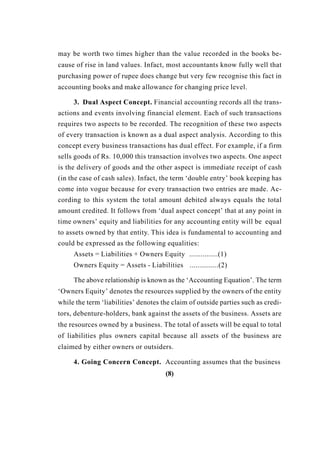
could be expressed as the following equalities:
Assets = Liabilities + Owners Equity ...............(1)
Owners Equity = Assets - Liabilities ...............(2)
The above relationship is known as the ‘Accounting Equation’. The term
‘Owners Equity’ denotes the resources supplied by the owners of the entity
while the term ‘liabilities’ denotes the claim of outside parties such as credi-
tors, debenture-holders, bank against the assets of the business. Assets are
the resources owned by a business. The total of assets will be equal to total
of liabilities plus owners capital because all assets of the business are
claimed by either owners or outsiders.
4. Going Concern Concept. Accounting assumes that the business
(8)
entity will continue to operate for a long time in the future unless there is
good evidence to the contrary. The enterprise is viewed as a going concern,
that is, as continuing in operations, at least in the foreseeable future. In
other words, there is neither the intention nor the necessity to liquidate the
particular business venture in the predictable future. Because of this as-
sumption, the accountant while valuing the assets do not take into account
forced sale value of them. Infact, the assumption that the business is not
expected to be liquidated in the foreseeable future establishes the basis for
many of the valuations and allocations in accounting. For example, the ac-
countant charges depreciation of fixed assets values. It is this assumption
which underlies the decision of investors to commit capital to enterprise.
Only on the basis of this assumption can the accounting process remain
stable and achieve the objective of correctly reporting and recording on
the capital invested, the efficiency of management, and the position of the
enterprise as a going concern. However, if the accountant has good reasons
to believe that the business, or some part of it is going to be liquidated or
that it will cease to operate (say within six-month or a year), then the re-
sources could be reported at their current values. If this concept is not fol-
lowed, International Accounting Standard requires the disclosure of the fact
in the financial statements together with reasons.
5. Accounting Period Concept. This concept requires that the life
of the business should be divided into appropriate segments for studying
the financial results shown by the enterprise after each segment. Although
the results of operations of a specific enterprise can be known precisely
only after the business has ceased to operate, its assets have been sold off
and liabilities paid off, the knowledge of the results periodically is also
necessary. Those who are interested in the operating results of business
obviously cannot wait till the end. The requirements of these parties force
(9)
the businessman ‘to stop’ and ‘see back’ how things are going on. Thus, the
accountant must report for the changes in the wealth of a firm for short
time periods. A year is the most common interval on account of prevailing
practice, tradition and government requirements. Some firms adopt finan-
cial year of the government, some other calendar year. Although a twelve
month period is adopted for external reporting, a shorter span of interval,
say one month or three month is applied for internal reporting purposes.
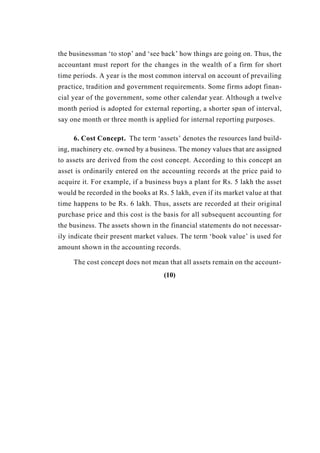
6. Cost Concept. The term ‘assets’ denotes the resources land build-
ing, machinery etc. owned by a business. The money values that are assigned
to assets are derived from the cost concept. According to this concept an
asset is ordinarily entered on the accounting records at the price paid to
acquire it. For example, if a business buys a plant for Rs. 5 lakh the asset
would be recorded in the books at Rs. 5 lakh, even if its market value at that
time happens to be Rs. 6 lakh. Thus, assets are recorded at their original
purchase price and this cost is the basis for all subsequent accounting for
the business. The assets shown in the financial statements do not necessar-
ily indicate their present market values. The term ‘book value’ is used for
amount shown in the accounting records.
The cost concept does not mean that all assets remain on the account-
(10)
ing records at their original cost for all times to come. The asset may sys-
tematically be reduced in its value by charging ‘depreciation’, which will
be discussed in detail in a subsequent lesson. Depreciation have the effect
of reducing profit of each period.
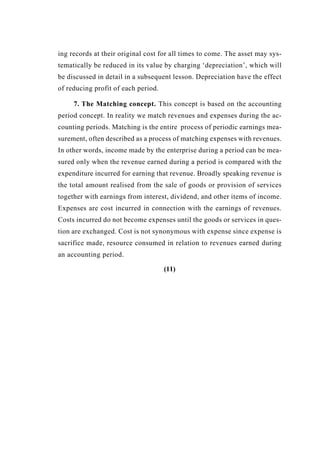
7. The Matching concept. This concept is based on the accounting
period concept. In reality we match revenues and expenses during the ac-
counting periods. Matching is the entire process of periodic earnings mea-
surement, often described as a process of matching expenses with revenues.
In other words, income made by the enterprise during a period can be mea-
sured only when the revenue earned during a period is compared with the
expenditure incurred for earning that revenue. Broadly speaking revenue is
the total amount realised from the sale of goods or provision of services
together with earnings from interest, dividend, and other items of income.
Expenses are cost incurred in connection with the earnings of revenues.
Costs incurred do not become expenses until the goods or services in ques-
tion are exchanged. Cost is not synonymous with expense since expense is
sacrifice made, resource consumed in relation to revenues earned during
an accounting period.
(11)
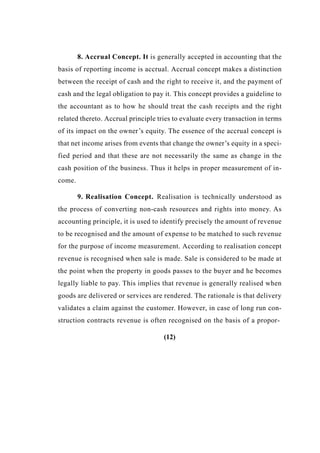
8. Accrual Concept. It is generally accepted in accounting that the
basis of reporting income is accrual. Accrual concept makes a distinction
between the receipt of cash and the right to receive it, and the payment of
cash and the legal obligation to pay it. This concept provides a guideline to
the accountant as to how he should treat the cash receipts and the right
related thereto. Accrual principle tries to evaluate every transaction in terms
of its impact on the owner’s equity. The essence of the accrual concept is
that net income arises from events that change the owner’s equity in a speci-
fied period and that these are not necessarily the same as change in the
cash position of the business. Thus it helps in proper measurement of in-
come.
9. Realisation Concept. Realisation is technically understood as
the process of converting non-cash resources and rights into money. As
accounting principle, it is used to identify precisely the amount of revenue
to be recognised and the amount of expense to be matched to such revenue
for the purpose of income measurement. According to realisation concept
revenue is recognised when sale is made. Sale is considered to be made at
the point when the property in goods passes to the buyer and he becomes
legally liable to pay. This implies that revenue is generally realised when
goods are delivered or services are rendered. The rationale is that delivery
validates a claim against the customer. However, in case of long run con-
struction contracts revenue is often recognised on the basis of a propor-
(12)
tionate or partial completion method. Similarly, in case of long run instal-
ment sales contracts, revenue is regarded as realised only in proportion to
the actual cash collection. In fact, both these cases are the exceptions to
the notion that an exchange is needed to justify the realisation of revenue.
2.4 ACCOUNTING CONVENTIONS
1. Convention of Materiality. Materiality concept states that items
of small significance need not be given strict theoretically correct treat-
ment. Infact, there are many events in business which are insignificant in
nature. The cost of recording and showing in financial statement such events
may not be well justified by the utility derived from that information. For
example, an ordinary calculator costing Rs. 100 may last for ten years.
However, the effort involved in allocating its cost over the ten year period
is not worth the benefit that can be derived from this operation. The cost
incurred on calculator may be treated as the expense of the period in which
it is purchased. Similarly, when a statement of outstanding debtors is pre-
pared for sending to top management, figures may be rounded to the near-
est ten or hundred.
.
(13)
2. Convention of Conservatism. This concept requires that the ac-
countants must follow the policy of ‘’playing safe” while recording busi-
ness transactions and events. That is why, the accountant follow the rule
anticipate no profit but provide for all possible losses, while recording the
business events. This rule means that an accountant should record lowest
possible value for assets and revenues, and the highest possible value for
liabilities and expenses. According to this concept, revenues or gains should
be recognised only when they are realised in the form of cash or assets
(i.e. debts) the ultimate cash realisation of which can be assessed with rea-
sonable certainty.
The principle of conservatism may also invite criticism if not ap-
plied cautiously. For example, when the accountant create secret reserves,
by creating excess provision for bad and doubtful debts, depreciation, etc.
The financial statements do not present a true and fair view of state of
affairs. American Institute of Certified Public Accountant have also indi-
cated that this concept need to be applied with much more caution and care
as over conservatism may result in misrepresentation.
4. Convention of Consistency. The convention of consistency re-
quires that once a firm decided on certain accounting policies and methods
and has used these for some time, it should continue to follow the same
methods or procedures for all subsequent similar events and transactions
(14)
unless it has a sound reason to do otherwise. In other worlds, accounting
practices should remain unchanged from one period to another. For example,
if depreciation is charged on fixed assets according to straight line method,
this method should be followed year after year. Analogously, if stock is
valued at ‘cost or market price whichever is less’, this principle should be
applied in each subsequent year.
2.5 KEYWORDS
Accounting principle: Accounting principles are the assumptions and roles
of accounting, the methods and procedures of accounting and the applica-
tion of these rules, methods and procedures to the actual practice of ac-
counting.
Accounting concept: It refers to assumptions and conditions on which
accounting system is based.
Accounting convention: Accounting convention refers to the customs and
traditions followed by accountants as guidelines while preparing account-
ing statements.
2.6 SELF-ASSESSMENT QUESTIONS
1. State whether the following statements are true or false :
a) The ‘materiality concept’ refers to the state of ignoring small items
and values from accounts.
b) Accounting principles are rules of action or conduct which are
adopted by the accountants universally while recording accounting transac-
(18)
tions.
c) ) The ‘separate entity concept’ of accounting is not applicable to
sole trading concerns and partnership concerns.
d) The ‘dual aspect’ concept result in the accounting equation:
Capital+Liabilities = Assets.
e) ) The ‘conservatism concept’ leads to the exclusion of all
unrealised profits.
f) The balance sheet based on ‘Cost concept’ is of no use to a potential
investor.
g) Accounting standards are statements prescribed by government regu-
latory bodies.
h) Accounting statements are statements prescribed by professional
accounting bodies.
i) Accounting concepts are broad assumptions.
Ans : a) False b) True c) False d) True e) True
f) True g) False h) True i) True
2. Choose the correct answer from the alternations given :
(I) Accounting standards are statements prescribed by
a) Law b) Bodies of shareholders
c) Professional accounting bodies
(II) Accounting Principles are generally based on
a) Practicability b) Subjectivity
c) Convenience in recording
(III) The Policy of ‘anticipate no profit and provide for all possible
losses’ arises due to convention of
a) Consistency b) Disclosure c) Conservatism
(IV) Which is the accounting concept that requires the practice of
crediting closing stock to the trading account
(19)
1
Subject:Accounting for Managers Updated by:Dr. MaheshChandGarg
Course Code : CP-104
Lesson No. : 3
ACCOUNTING PROCESS : EQUATION, RULES,
PREPARATION OF JOURNAL AND LEDGER
STRUCTURE
3.1 Objective
3.2 Introduction
3.3 Accounting Equation
3.4 Rules of Debit and Credit
3.5 Meaning and format of Journal.
3.5.1 Meaning of Journalising
3.5.2 Compound Journal Entry
3.5.3 Opening Entry
3.5.4 Goods Account
3.6 Ledger
3.6.1 Relationship between Journal and Ledger
3.6.2 Posting
3.6.3 Rules of Posting
3.6.4 Balancing of an Account
3.7 Summary
3.8 Keywords
3.9 Self Assessment Questions
2
3.1 INTRODUCTION
Any economic transaction or event of a business which can be expressed in
monetary terms should be recorded. Traditionally, accounting is a method of
collecting, recording, classifying, summarizing, presenting and interpreting
financial data of an economic activity. The series of business transactions occurs
during the accounting period and its recording is referred to an accounting process/
mechanism. An accounting process is a complete sequence of accounting
procedures which are repeated in the same order during each accounting period.
Therefore, accounting process involves the following steps :
i ) Identification of Transaction : In accounting, only financial transactions
are recorded. A financial transaction is an event which can be expressed in terms
of money and which brings change in the financial position of a business enterprise.
An event is an incident or a happening which may or may not bring any change in
the financial position of a business enterprise. Therefore, all transactions are
events but all events are not transactions. A transaction is a complete action, to an
expected or possible future action.
Illustration 1
State with reasons whether the following events are transactions or
not to Mr. Nikhil, Proprietor, Delhi Computers
(i) Mr. Nikhil started business with capital (brought in cash)Rs. 40,000.
(ii) Paid salaries to staff Rs. 5,000.
3
(iii) Purchased machinery for Rs. 20,000 in cash.
(iv) Placed an order with Sen & Co. for goods for Rs. 5,000.
(v) Opened a Bank account by depositing Rs. 4,000.
Solution :
Here, each event is to be considered from the view point of Mr.
Nikhil's business. Those events which will change the financial position of the
business of Mr. Nikhil, should be regarded as transaction.
(i) It is a transaction, because it changes the financial position of Mr. Nikhil's
business. Cash will increase by Rs. 40,000 and Capital will increase by Rs.
40,000.
(ii) It is a transaction, because it changes the financial position of Mr. Nikhil's
business. Cash will decrease by Rs. 5,000 and Salaries (expenses) will
increase by Rs. 5,000
(iii) It is a transaction, because it changes the financial position of Mr. Nikhil's
business. Machinery comes in and cash goes out.
(iv) It is not a transaction, because it does not change the financial position of
the business.
(v) It is a transaction, because it changes the financial position of the business.
Bank balance will increase by Rs. 4,000 and cash balance will decrease by
Rs. 4,000.
4
ii) ) Recording the transaction : Journal is the first book of original
entry in which all transactions are recorded event-wise and date-wise and
presents a historical record of all monetary transactions. Journal may further be
divided into sub-journals as well.
iii) Classifying : Accounting is the art of classifying business transactions.
Classification means statement setting out for a period where all the similar
transactions relating to a person, a thing, expense, or any other subject are grouped
together under appropriate heads of accounts.
iv) Summarising : Summarising is the art of making the activities of the
business enterprise as classified in the ledger for the use of management or other
user groups i.e. sundry debtors, sundry creditors etc. Summarisation helps in the
preparation of Profit and Loss Account and Balance sheet for a particular financial
year.
v) Analysis and Interpretation : The financial information or data is recorded
in the books of account must further be analysed and interpreted so to draw
meaningful conclusions. Thus, analysis of accounting information will help the
5
management to assess in the performance of business operation and forming future
plans also.
vi) Presentation or reporting of financial information : The end users of
accounting statements must be benefited from analysis and interpretation of data
as some of them are the "share holders" and other one the "stake holders".
Comparison of past and present statements and reports, use of ratios and trend
analysis are the different tools of analysis and interpretation.
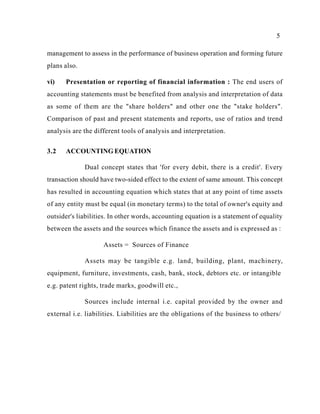
3.2 ACCOUNTING EQUATION
Dual concept states that 'for every debit, there is a credit'. Every
transaction should have two-sided effect to the extent of same amount. This concept
has resulted in accounting equation which states that at any point of time assets
of any entity must be equal (in monetary terms) to the total of owner's equity and
outsider's liabilities. In other words, accounting equation is a statement of equality
between the assets and the sources which finance the assets and is expressed as :
Assets = Sources of Finance
Assets may be tangible e.g. land, building, plant, machinery,
equipment, furniture, investments, cash, bank, stock, debtors etc. or intangible
e.g. patent rights, trade marks, goodwill etc.,
Sources include internal i.e. capital provided by the owner and
external i.e. liabilities. Liabilities are the obligations of the business to others/
6
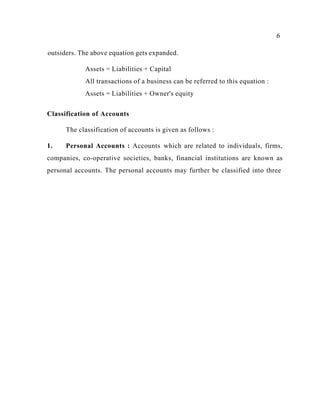
outsiders. The above equation gets expanded.
Assets = Liabilities + Capital
All transactions of a business can be referred to this equation :
Assets = Liabilities + Owner's equity
Classification of Accounts
The classification of accounts is given as follows :
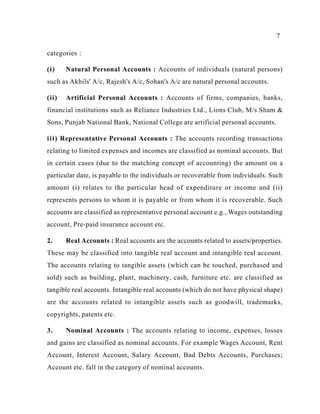
1. Personal Accounts : Accounts which are related to individuals, firms,
companies, co-operative societies, banks, financial institutions are known as
personal accounts. The personal accounts may further be classified into three
7
categories :
(i) Natural Personal Accounts : Accounts of individuals (natural persons)
such as Akhils' A/c, Rajesh's A/c, Sohan's A/c are natural personal accounts.
(ii) Artificial Personal Accounts : Accounts of firms, companies, banks,
financial institutions such as Reliance Industries Ltd., Lions Club, M/s Sham &
Sons, Punjab National Bank, National College are artificial personal accounts.
iii) Representative Personal Accounts : The accounts recording transactions
relating to limited expenses and incomes are classified as nominal accounts. But
in certain cases (due to the matching concept of accounting) the amount on a
particular date, is payable to the individuals or recoverable from individuals. Such
amount (i) relates to the particular head of expenditure or income and (ii)
represents persons to whom it is payable or from whom it is recoverable. Such
accounts are classified as representative personal account e.g., Wages outstanding
account, Pre-paid insurance account etc.
2. Real Accounts : Real accounts are the accounts related to assets/properties.
These may be classified into tangible real account and intangible real account.
The accounts relating to tangible assets (which can be touched, purchased and
sold) such as building, plant, machinery, cash, furniture etc. are classified as
tangible real accounts. Intangible real accounts (which do not have physical shape)
are the accounts related to intangible assets such as goodwill, trademarks,
copyrights, patents etc.
3. Nominal Accounts : The accounts relating to income, expenses, losses
and gains are classified as nominal accounts. For example Wages Account, Rent
Account, Interest Account, Salary Account, Bad Debts Accounts, Purchases;
Account etc. fall in the category of nominal accounts.
8
3.3 RULES OF DEBIT AND CREDIT
Basically, debit means to enter an amount to the left side of an account
and credit means to enter an amount to the right side of an account. In the
abbreviated form Dr. stands for debit and Cr. stands for credit. Both debit and
credit may represent either increase or decrease depending upon the nature of an
account.
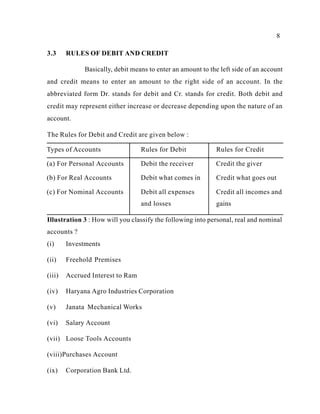
The Rules for Debit and Credit are given below :
Types of Accounts Rules for Debit Rules for Credit
(a) For Personal Accounts Debit the receiver Credit the giver
(b) For Real Accounts Debit what comes in Credit what goes out
(c) For Nominal Accounts Debit all expenses Credit all incomes and
and losses gains
Illustration 3 : How will you classify the following into personal, real and nominal
accounts ?
(i) Investments
(ii) Freehold Premises
(iii) Accrued Interest to Ram
(iv) Haryana Agro Industries Corporation
(v) Janata Mechanical Works
(vi) Salary Account
(vii) Loose Tools Accounts
(viii)Purchases Account
(ix) Corporation Bank Ltd.
9
(x) Capital Account
(xi) Brokerage Account
(xii) Toll Tax Account
(xiii) Dividend Received Account
(xiv) Royalty Account
(xv) Sales Account
Solution :
Real Account : (i), (ii), (vii), (viii), (xv)
Nominal Account : (vi), (xi), (xii), (xiii), (xiv)
Personal Account : (iii), (iv), (v), (ix), (x)
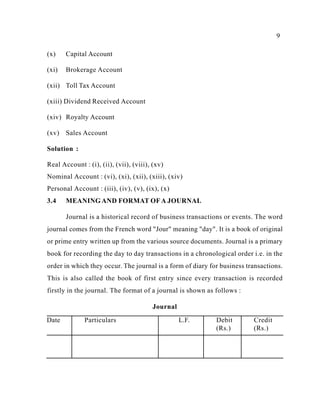
3.4 MEANING AND FORMAT OFA JOURNAL
Journal is a historical record of business transactions or events. The word
journal comes from the French word "Jour" meaning "day". It is a book of original
or prime entry written up from the various source documents. Journal is a primary
book for recording the day to day transactions in a chronological order i.e. in the
order in which they occur. The journal is a form of diary for business transactions.
This is also called the book of first entry since every transaction is recorded
firstly in the journal. The format of a journal is shown as follows :
Journal
Date Particulars L.F. Debit
(Rs.)
Credit
(Rs.)
10
(a) Date Column : This column shows the date on which the transaction is
recorded. The year and month is written once, till they change.
(b) Particular Column : Under this column, first the names of the accounts to
be debited, then the names of the accounts to be credited and lastly, the narration
(i.e. a brief explanation of the transaction) are entered.
(c) L.F., i.e. Ledger Folio Column : Under this column, the ledger page number
containing the relevant account is entered at the time of posting.
(d) Debit amount Column : Under this column, the amount to be debited is
entered.
(e) Credit amount Column : Under this column, the amount to be credited is
entered.
3.4.1 Meaning of Journalising
The process of recording a transaction in the journal is called
journalising. The various steps to be followed in journalising business transactions
are given below :
Step 1 Ascertain what accounts are involved in a transaction.
Step 2 Ascertain what is the nature of the accounts involved.
Step 3 Ascertain which rule of debit and credit is applicable for each of the
accounts involved.
Step 4 Ascertain which account is to be debited and which is to be credited.
Step 5 Record the date of transaction in the 'Date column'.
Step 6 Write the name of the account to be debited, very close to the left hand
side i.e. the line demarcating the 'Date column' and the 'Particulars
11
column') along with the abbreviation 'Dr.' on the same line against the
name of the account in the 'Particulars column' and the amount to be
debited in the 'Debit Amount column' against the name of the account.
Step 7 Write the name of the account to be credited in the next line preceded by
the word 'To' at a few spaces towards right in the 'Particulars column' and
the amount to be credited in the 'Credit Amount column' against the name
of the account.
Step 8 Write 'Narration' (i.e. a brief description of the transaction) within brackets
in the next line in the 'Particulars column'.
Step 9 Draw a line across the entire 'Particulars column' to separate one Journal
Entry from the other.
Advantages of Journal
1. The transactions are recorded in journal as and when they occur so the
chances of error is minimized.
2. It help in preparation of ledger.
3. Any transfer from one account to another account is made through Journal.
4. The entry recorded in journal are self explanatory as it includes narration
also.
5. It can record any such transaction which cannot be entered in any other
books of account.
6. Every transaction is recorded in chronological order (date wise) so the
chances of manipulations are reduced.
7. Journal shows all information in respect of a transaction at one place.
8. The closing balances of previous year of accounts related to assets and
liabilities can be brought forward to the next year by passing journal entry
in journal.
12
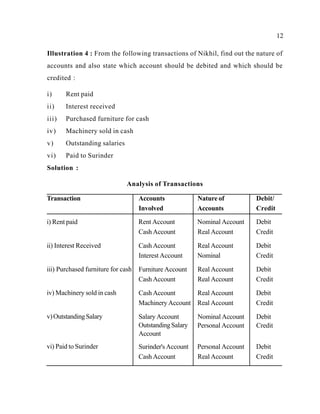
Illustration 4 : From the following transactions of Nikhil, find out the nature of
accounts and also state which account should be debited and which should be
credited :
i) Rent paid
ii) Interest received
iii) Purchased furniture for cash
iv) Machinery sold in cash
v) Outstanding salaries
vi) Paid to Surinder
Solution :
Analysis of Transactions
Transaction Accounts
Involved
Nature of
Accounts
Debit/
Credit
i) Rent paid
ii) Interest Received
iii) Purchased furniture for cash
iv) Machinery sold in cash
v)OutstandingSalary
vi) Paid to Surinder
Rent Account
Cash Account
Cash Account
Interest Account
Furniture Account
Cash Account
Cash Account
Machinery Account
Salary Account
OutstandingSalary
Account
Surinder's Account
Cash Account
Nominal Account
Real Account
Real Account
Nominal
Real Account
Real Account
Real Account
Real Account
Nominal Account
Personal Account
Personal Account
Real Account
Debit
Credit
Debit
Credit
Debit
Credit
Debit
Credit
Debit
Credit
Debit
Credit
13
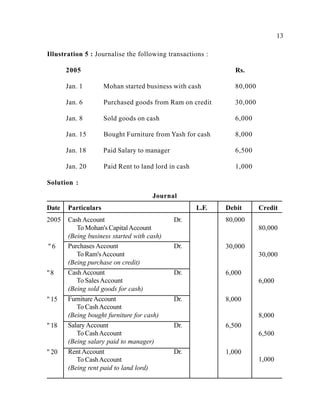
2005 Rs.
Jan. 1 Mohan started business with cash 80,000
Jan. 6 Purchased goods from Ram on credit 30,000
Jan. 8 Sold goods on cash 6,000
Jan. 15 Bought Furniture from Yash for cash 8,000
Jan. 18 Paid Salary to manager 6,500
Jan. 20 Paid Rent to land lord in cash 1,000
Solution :
Journal
Illustration 5 : Journalise the following transactions :
Date Particulars L.F. Debit Credit
2005 Cash Account
To Mohan's CapitalAccount
(Being business started with cash)
Dr. 80,000
80,000
" 6 Purchases Account
To Ram'sAccount
(Being purchase on credit)
Dr. 30,000
30,000
"8 Cash Account
To SalesAccount
(Being sold goods for cash)
Dr. 6,000
6,000
" 15 Furniture Account
To CashAccount
(Being bought furniture for cash)
Dr. 8,000
8,000
" 18 Salary Account
To CashAccount
(Being salary paid to manager)
Dr. 6,500
6,500
" 20 Rent Account
To CashAccount
(Being rent paid to land lord)
Dr. 1,000
1,000
14
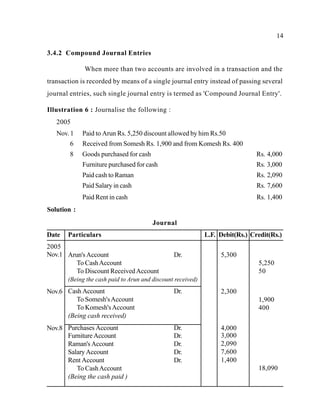
3.4.2 Compound Journal Entries
When more than two accounts are involved in a transaction and the
transaction is recorded by means of a single journal entry instead of passing several
journal entries, such single journal entry is termed as 'Compound Journal Entry'.
Illustration 6 : Journalise the following :
2005
Nov. 1 Paid to Arun Rs. 5,250 discount allowed by him Rs.50
6 Received from Somesh Rs. 1,900 and from Komesh Rs. 400
8 Goods purchased for cash Rs. 4,000
Furniture purchased for cash Rs. 3,000
Paid cash to Raman Rs. 2,090
Paid Salary in cash Rs. 7,600
Paid Rent in cash Rs. 1,400
Solution :
Journal
Date Particulars L.F. Debit(Rs.) Credit(Rs.)
2005
Arun'sAccount Dr.
To CashAccount
To Discount ReceivedAccount
(Being the cash paid to Arun and discount received)
5,300
5,250
50
Nov.1
Nov.6 Cash Account Dr.
To Somesh'sAccount
To Komesh'sAccount
(Being cash received)
2,300
1,900
400
Nov.8 Purchases Account Dr.
Furniture Account Dr.
Raman'sAccount Dr.
Salary Account Dr.
Rent Account Dr.
To CashAccount
(Being the cash paid )
4,000
3,000
2,090
7,600
1,400
18,090
15
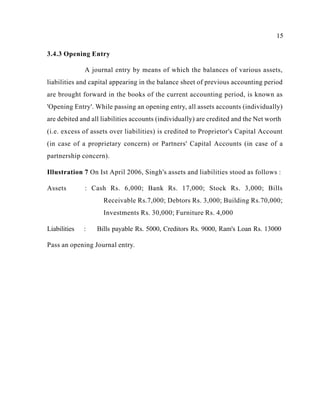
3.4.3 Opening Entry
A journal entry by means of which the balances of various assets,
liabilities and capital appearing in the balance sheet of previous accounting period
are brought forward in the books of the current accounting period, is known as
'Opening Entry'. While passing an opening entry, all assets accounts (individually)
are debited and all liabilities accounts (individually) are credited and the Net worth
(i.e. excess of assets over liabilities) is credited to Proprietor's Capital Account
(in case of a proprietary concern) or Partners' Capital Accounts (in case of a
partnership concern).
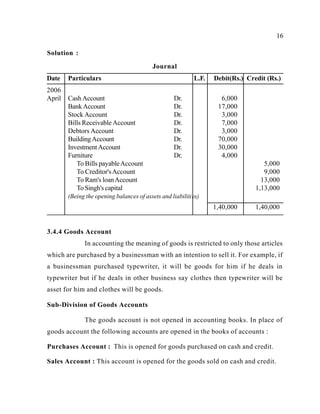
Illustration 7 On Ist April 2006, Singh's assets and liabilities stood as follows :
Assets : Cash Rs. 6,000; Bank Rs. 17,000; Stock Rs. 3,000; Bills
Receivable Rs.7,000; Debtors Rs. 3,000; Building Rs.70,000;
Investments Rs. 30,000; Furniture Rs. 4,000
Liabilities : Bills payable Rs. 5000, Creditors Rs. 9000, Ram's Loan Rs. 13000
Pass an opening Journal entry.
16
Date Particulars L.F. Debit(Rs.) Credit (Rs.)
2006
April Cash Account Dr.
BankAccount Dr.
Stock Account Dr.
Bills Receivable Account Dr.
Debtors Account Dr.
BuildingAccount Dr.
InvestmentAccount Dr.
Furniture Dr.
To Bills payableAccount
To Creditor'sAccount
To Ram's loanAccount
To Singh's capital
(Being the opening balances of assets and liabiliti s)
6,000
17,000
3,000
7,000
3,000
70,000
30,000
4,000
5,000
9,000
13,000
1,13,000
1,40,000 1,40,000
Solution :
Journal
e
3.4.4 Goods Account
In accounting the meaning of goods is restricted to only those articles
which are purchased by a businessman with an intention to sell it. For example, if
a businessman purchased typewriter, it will be goods for him if he deals in
typewriter but if he deals in other business say clothes then typewriter will be
asset for him and clothes will be goods.
Sub-Division of Goods Accounts
The goods account is not opened in accounting books. In place of
goods account the following accounts are opened in the books of accounts :
Purchases Account : This is opened for goods purchased on cash and credit.
Sales Account : This account is opened for the goods sold on cash and credit.
19
Purchase Returns Account or Return Outward Account : This account is
opened for the goods returned to suppliers.
Sales Returns Account or Return Inward Account : This account is opened for
the goods returned by customers.
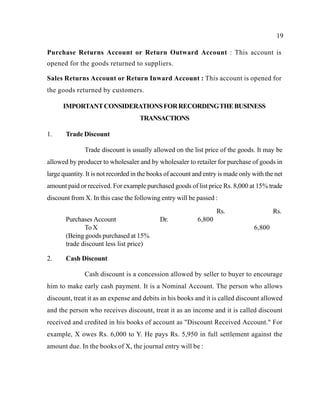
IMPORTANTCONSIDERATIONSFORRECORDINGTHEBUSINESS
TRANSACTIONS
1. Trade Discount
Trade discount is usually allowed on the list price of the goods. It may be
allowed by producer to wholesaler and by wholesaler to retailer for purchase of goods in
large quantity. It is not recorded in the books of account and entry is made only with the net
amount paid or received. For example purchased goods of list price Rs. 8,000 at 15% trade
discount from X. In this case the following entry will be passed :
Rs. Rs.
Purchases Account Dr. 6,800
To X 6,800
(Being goods purchased at 15%
trade discount less list price)
2. Cash Discount
Cash discount is a concession allowed by seller to buyer to encourage
him to make early cash payment. It is a Nominal Account. The person who allows
discount, treat it as an expense and debits in his books and it is called discount allowed
and the person who receives discount, treat it as an income and it is called discount
received and credited in his books of account as "Discount Received Account." For
example, X owes Rs. 6,000 to Y. He pays Rs. 5,950 in full settlement against the
amount due. In the books of X, the journal entry will be :
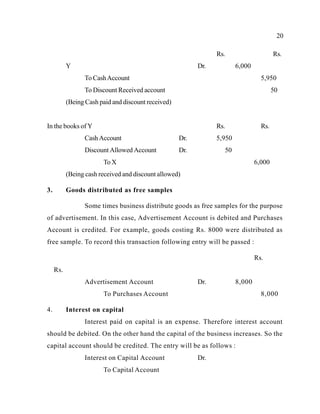
20
Rs. Rs.
Y Dr. 6,000
To CashAccount 5,950
To Discount Received account 50
(Being Cash paid and discount received)
In the books of Y Rs. Rs.
Cash Account Dr. 5,950
Discount Allowed Account Dr. 50
To X 6,000
(Being cash received and discount allowed)
3. Goods distributed as free samples
Some times business distribute goods as free samples for the purpose
of advertisement. In this case, Advertisement Account is debited and Purchases
Account is credited. For example, goods costing Rs. 8000 were distributed as
free sample. To record this transaction following entry will be passed :
Rs.
Advertisement Account Dr. 8,000
Rs.
To Purchases Account 8,000
4. Interest on capital
Interest paid on capital is an expense. Therefore interest account
should be debited. On the other hand the capital of the business increases. So the
capital account should be credited. The entry will be as follows :
Interest on Capital Account Dr.
To Capital Account
21
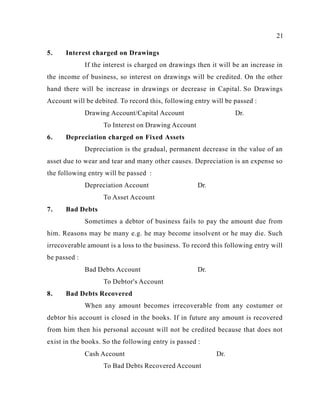
5. Interest charged on Drawings
If the interest is charged on drawings then it will be an increase in
the income of business, so interest on drawings will be credited. On the other
hand there will be increase in drawings or decrease in Capital. So Drawings
Account will be debited. To record this, following entry will be passed :
Drawing Account/Capital Account Dr.
To Interest on Drawing Account
6. Depreciation charged on Fixed Assets
Depreciation is the gradual, permanent decrease in the value of an
asset due to wear and tear and many other causes. Depreciation is an expense so
the following entry will be passed :
Depreciation Account Dr.
To Asset Account
7. Bad Debts
Sometimes a debtor of business fails to pay the amount due from
him. Reasons may be many e.g. he may become insolvent or he may die. Such
irrecoverable amount is a loss to the business. To record this following entry will
be passed :
Bad Debts Account Dr.
To Debtor's Account
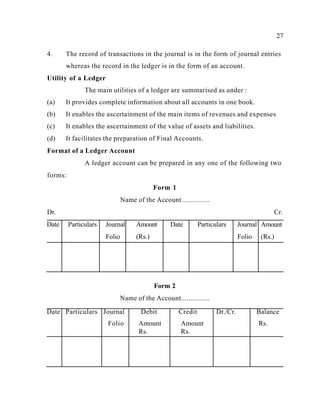
8. Bad Debts Recovered
When any amount becomes irrecoverable from any costumer or
debtor his account is closed in the books. If in future any amount is recovered
from him then his personal account will not be credited because that does not
exist in the books. So the following entry is passed :
Cash Account Dr.
To Bad Debts Recovered Account
22
Loss by fire/Accident/theft Account Dr.(for loss)
InsuranceCompany Account Dr. (for insurance claim admitted)
11.
To PurchasesAccount
Income Tax Paid
9. Purchase and Sale of investment
When business has some surplus money it may invest this amount is
shares, debentures or other types of securities. When these securities are
purchased, these are recorded at the purchase price paid. At the time of sale of
investment the sale price of an investment is recorded in the books of accounts.
The following entry is passed to record the purchase of investment :
Investment Account Dr.
To Cash Account
In case of sale of these securities the entry will be :
Cash Account Dr.
To Investment Account
10. Loss of Goods by Fire/Accident/theft
A business may suffer loss of goods on account of fire, theft or
accident. It is a business loss and a nominal account. It also reduces the goods at
cost price, and increases the loss/expenses of the business. The entry will be passed
as :
Income Tax paid should be debited to Capital Account or Drawings
Account and credited to Cash Account in case of sole proprietorship and
partnership firms. The reason behind this is that income tax is a personal expense
for the sole trader and partners because it is paid on income of proprietor. The
entry will be as follows :
23
Capital Account/Drawing Account Dr.
To Cash Account
12. Bank Charges
Bank provide various services to their customers. Bank deducts some
charges by debiting the account of customers. It is an expense for the business.
To record this, Bank charges account is debited and bank account is credited in
the books of customer.
13. Drawings Account
It is a personal account of the proprietor. When the businessman
withdraws cash or goods from the business for his personal/domestic use it is
called as 'drawings'. Drawings reduce the capital as well as goods/cash balance of
the business. The journal entry is :
DrawingsAccount Dr.
To CashAccount
To PurchasesAccount
14. Personal expenses of the proprietor
When the private expenses such as life insurance premium, income tax, home
telephone bill, tuition fees of the son of the proprietor etc. are paid out of the cash or bank
account of business it should be debited to the DrawingsAccount of the proprietor.
15. Sale of Asset/Property
When the asset of a business is sold, there may occur a profit or loss
on its sale. Its journal entry is :
(i) In case there is a profit on sale of Property/Assets
Cash/BankAccount Dr.
To Asset/PropertyAccount
To Profit on sale of Asset Account
24
(ii) In case of a loss on sale of asset
Cash/BankAccount Dr.
Loss on sale of Asset Account Dr.
ToAssetAccount
16. Amount paid or Received on behalf of customer
(i) When the business entity pays the amount on behalf of old reputed
customers such as carriage in anticipation of recovering the same later on, carriage
account should not be opened because carriage is not the expense of the seller. It
should be debited/charged to customer's Personal account.
(ii) When the business entity receives the amount on behalf of customers
from the third party as mutually settled between the third party and the customer,
the account of the third party/person making the payment should not be opened in
the books of the receiving entity. The journal entry in the books of the entity is :
Cash/Bank Account Dr.
To Customer/Debtor's Account
17. Amount paid on behalf of creditors
When the creditors/supplier instructs the business entity to make
payment on their behalf, the amount so paid should be debited to creditors account
and liability of the business will decrease accordingly.
18. The events affecting business but they do not involve any transfer/exchange
of money for the time being, they would not be recorded in the financial books.
19. Paid wages/installation charges for erection of machinery
Wages and installation charges are the expenses of nominal nature.
But for erection of machinery no separate account should be opened for such
expenses because these expenses are of capital nature and it will be merged/debited
25
to the cost of assets i.e. machinery. The journal entry is:
3.5 LEDGER
Machinery Account Dr.
To Cash/Bank Account
(Being wages/installation charges paid
for the erection of machinery)
Journal is a daily record of all business transactions. In the journal
all transactions relating to persons, expenses, assets, liabilities and incomes are
recorded. Journal does not give a complete picture of the fundamental elements
of book keeping i.e. properties, liabilities, proprietorship accounts and expenses
and incomes at a glance and at one place. Business transactions being recurring in
nature, a number of entries are made for a particular type of transactions such as
sales, purchases, receipts and payments of cash, expenses etc., through out the
accounting year. The entries are therefore scattered over in the Journal. In fact,
the whole Journal will have to be gone through to find out the combined effect of
various transactions on a particular account. In case, at any time, a businessman
wants to now :
i) How much he has to pay to the suppliers/creditors of goods ?
ii) How much he has to receive from the customers ?
iii) What is the total amount of purchases and sales made during a particular
period?
iv) How much cash has been spent/incurred on various items of expenses such
as salaries, rent, carriage, stationery etc.
v) What is the amount of profit or loss made during a particular period ?
vi) What is the financial position of the unit on a particular date ?
The above mentioned information cannot be easily gathered from the
journal itself because the details of such information is scattered all over the
26
journal. It is thus of dire need to get a summarised/grouped record of all the
transactions relating to a particular person, or a thing or an expenditure to take
managerial decisions. The mechanics of collecting, assembling and summarising
all transactions of similar nature at one place can better be served by a book known
as 'ledger' i.e. a classified head of accounts.
Ledger is a principal book of accounts of the enterprise. It is rightly
called as the 'King of Books'. Ledger is a set of accounts. Ledger contains the
various personal, real and nominal accounts in which all business transactions of
the entity are recorded. The main function of the ledger is to classify and
summarise all the items appearing in Journal and other books of original entry
under appropriate head/set of accounts so that at the end of the accounting period,
each account contains the complete information of all transaction relating to it.
A ledger therefore is a collection of accounts and may be defined as a summary
statement of all the transactions relating to a person, asset, expense or income
which have taken place during a given period of time and shows their net effect.
3.5.1 Relationship between Journal and Ledger
Journal and Ledger are the most useful books kept by a business
entity. The points of distinction between the two are given below :
1. The journal is a book of original entry where as the ledger is the main book
of account.
2. In the journal business transactions are recorded as and when they occur
i.e. date-wise. However posting from the journal is done periodically, may
be weekly, fortnightly as per the convenience of the business.
3. The journal does not disclose the complete position of an account. On the
other hand, the ledger indicates the position of each account debit wise or
credit wise, as the case may be. In this way, the net position of each account
is known immediately.
27
4. The record of transactions in the journal is in the form of journal entries
whereas the record in the ledger is in the form of an account.
Utility of a Ledger
The main utilities of a ledger are summarised as under :
(a) It provides complete information about all accounts in one book.
(b) It enables the ascertainment of the main items of revenues and expenses
(c) It enables the ascertainment of the value of assets and liabilities.
(d) It facilitates the preparation of Final Accounts.
Format of a Ledger Account
A ledger account can be prepared in any one of the following two
forms:
Form 1
Name of the Account ..............
Dr. Cr.
Date Particulars Journal
Folio
Amount
(Rs.)
Date Particulars Journal
Folio
Amount
(Rs.)
Form 2
Name of the Account...............
Date Particulars Journal
Folio
Debit
Amount
Rs.
Credit
Amount
Rs.
Dr./Cr. Balance
Rs.
28
3.5.2 Posting
Posting refers to the process of transferring debit and credit amounts
from the Journal or subsidiary books to the respective heads of accounts in the
ledger. Journal will have at a minimum of one debit and one credit for each
transaction. The ledger will have either a debit or a credit for each account used
in the Journal. Posting may be done daily, weekly fort nightly or monthly according
to the convenience and requirements of the business, but care should be taken to
complete it before the preparation of annual financial statements.
3.5.3 Procedure/Rules of Posting
The following rules should be followed while posting business
transactions to respective accounts in the ledger from the journal :
i) Enter the date and year of the transaction in the date column.
ii) Open separate account in the ledger for each person, asset, revenue, liability,
expense, income and loss appearing in the Journal.
iii) The appropriate/relevant account debited in the Journal will be debited in
the ledger, but the reference should be given of the other account which
has been credited.
iv) Similarly, the account credited in the Journal should be credited in the
ledger, but the reference has to be given of the other account which has
been debited in the Journal.
v) The debit posting should be prefixed by the word 'To' and credit posting
should be prefixed by the word 'By'.
vi) In the Journal Folio (J.F.) column the page number of the book of original
entry (Journal) is entered. This is explained with the following example :
Illustration 8 : Goods sold to Ravi for Rs. 1000 on credit on Ist April 2006.
Record this transaction in the journal and the ledger.
29
Date Particulars J.F. Amount
(Rs.)
Date Particulars J.F. Amount
(Rs.)
2006
April1 By Ravi's Acc unt 1,000
Solution :
The journal entry will be
Date Particulars L.F. Dr. (Rs.) Cr.(Rs.)
2006
April 1
Ravi's Account Dr.
To Sales Account
(Being Credit Sales of Goods to Ravi)
1,000
1,000
The above journal entry will appear in the ledger in two accounts as
follows. On the debit side of Ravi's Account, we will write "To Sales Account" and
on the credit side of Sales Account we will write "By Ravi's Account".
Dr. Ravi's Account Cr.
Date Particulars J.F. Amount
(Rs.)
Date Particulars J.F. Amount
(Rs.)
2006
April 1
To SalesAccount 1,000
Dr. Sales's Account Cr.
o
Posting of Compound Journal Entry
When a single entry is passed to record more than one transaction, it
is known as a compound journal entry. However, it will be treated as several
separate entries while posting. The following example will make the point clear:
30
Illustration 9
Rs.
2006 March 31 Purchased stationary 1,000
Paid salary 7,000
Paid wages 600
Paid rent 1,200
Solution :
Pass the necessary journal entry and prepare ledger accounts.
The Journal entry will be
Date Particulars Dr. (Rs.) Cr.(Rs.)
2006
March 31
Stationary Account Dr.
Salary Account Dr.
Wages Account Dr.
Rent Account Dr.
To Cash Account
(Being cash paid for the above)
1,000
7,000
600
1,200
9,800
Then it will be posted as under :
Dr. Stationary's Account Cr.
Date Particulars J.F. Rs. Date Particulars J.F. Rs.
2006
March 31
To CashAccount 1,000
Dr. Salary's Account Cr.
Date Particulars J.F. Rs. Date Particulars J.F. Rs.
2006
March 31
To CashAccount 7,000
31
Dr. Rent Account Cr.
Date Particulars J.F. Rs. Date Particulars J.F. Rs.
2006
March 31
To CashAccount 1200
Dr. Wages Account Cr.
Date Particulars J.F. Rs. Date Particulars J.F. Rs.
2006
March 31
To CashAccount 600
Dr. Cash Account Cr.
Date Particulars J.F. Rs. Date Particulars J.F. Rs.
2006
By Stationary A/c 1,000March 31
March 31 By Salary A/c 7,000
March 31 By Rent A/c 1,200
March 31 By WagesA/c 600
3.5.4 Balancing of an Account
After transferring the entries from Journal to the ledger, the next
stage is to ascertain the net effect of all the transactions posted to relevant account.
When the posting is completed, most of the accounts may have entries on both
sides of the accounts i.e. debit entries and credits entries. The process of finding
out the difference between the totals of the two sides of a Ledger account is
known as balancing and the difference of the total debits and the total credits of
accounts is known as balance.
32
If the total of the credit side is bigger than the total of the debit side,
the difference is known as credit balance. In the reverse case, it is called debit
balance.
Steps for Balancing Ledger Account
Ledger accounts may be balanced as and when it is required. The
balances of various accounts are ascertained as under :
1. Make the total of both sides of an account in a worksheet.
2. Write down the higher amount on the side obtained e.g. if the total of the
debit side is 6,000 and the credit side is 5,500, the amount Rs. 6,000 is first
inserted in the total on the debit side.
3. Also write down the same total on the other side of the account i.e. the
total of Rs. 6,000 is written against the total on the credit side also.
4. Find out the difference between the two sides of the account. In this example
debit side is more than credit side; therefore, there is a debit balance of Rs. 500.
5. This debit balance of Rs. 500 is to be shown as "By Balance c/d" in the
account on the credit side.
6. Finally, the amount of the closing balance should be brought down as the
opening balance at the beginning of the next day. Remember that if the opening
balance is not written on the next day, the balancing is incomplete.
Balancing of different accounts
Balancing is done either weekly, monthly, quarterly, biannually or
annually, depending on the requirements of the business concern.
Personal Accounts : Personal accounts are balanced regularly to know the
amounts due to the persons or due from the persons. A debit balance of this account
indicate that the person concerned is a debtor of the business concern and a credit
balance indicates that he is a creditor of the business concern. If a personal account
shows no balance at all, it means that the amount due to him or due from him is
settled in full.
33
Real Accounts : Real accounts are generally balanced at the end of the accounting
year when final accounts are prepared and always shows debit balances. But, bank
account may show either a debit balance or a credit balance.
Nominal Accounts : In fact, nominal accounts are not balanced, as they are to be
closed by transferring them to the final accounts i.e. Trading and Profit and Loss
Account.
Illustration 10 : Enter the following transactions in the Journal of Ramesh, and
post them to the Ledger.
2006
Jan. 1 Assets in hand : Cash Rs. 630; Cash at Bank Rs. 23,100;
Rs.
" 2
Stock of goods; Rs. 26,400; M. & Co., Rs. 6,750.
Liabilities : Marathi & Co. Rs. 3,880; Ram & Sons Rs. 3000.
Received a cheque from M. & Co. in full settlement 6,650
" 4 Sold goods to Chand & Sons on credit 1,440
Carriage paid 35
Sold goods to G. & Co. for cash 3,120
" 5 Brought goods from Ram & Sons on credit 4,000
Paid Marathi & Co. by cheque in full settlement 3,800
" 6 Bought goods from Chatterjee 6,300
" 13 Returned goods to Chatterjee (not being up to specifications) 300
" 16 Goods used personally by proprietor 50
" 17 Sold goods to M. & Co 5,000
" 20 Cheque received from Chand & Sons 1,440
" 22 Bank advises Chand & Sons cheque returned unpaid
" 24 Cash deposited with bank 2,000
" 27 Cheque sent to Chatterjee (Discount allowed Rs. 150) 5,850
" 31 Paid salaries 600
Paid rent 300
Drew for personal use out of bank 500
34
Solution :
Journal
Date Particulars L.F. Dr. (Rs.) Cr. (Rs.)
2006
Cash A/c
BankA/c
Stock of Goods A/c
M. & Co.
To Marathi & Co.
To Ram & Sons
To Ramesh's Capital A/c
(Being balances of various assets
& liabilities brought forward)
Dr.
Dr.
Dr.
Dr.
630
23,100
26,400
6,750
3,880
3,000
50,000
Jan. 1
2 Bank A/c Dr.
Discount Allowed A/c Dr.
To M. & Co.
(Being a cheque received from M.
& Co. & Discount allowed)
6,650
100
6,750
4 Chand & Sons A/c Dr.
To Sales A/c
(Being goods sold on credit)
1,440
1,440
4 Carriage Outwards A/c Dr.
To Cash A/c
(Being the carriage paid)
35
35
4 Cash A/c Dr.
To Sales A/c
(Being goods sold for cash)
3,120
3,120
5 Purchases A/c Dr.
To Ram & Sons
(Being goods purchased on credit)
4,000
4,000
35
5 Marathi & Co. A/c Dr.
To Bank A/c
To Discount A/c
(Being payment made to Marathi & Co.
in full settlement & discount received)
3,880
3,800
80
6 Purchases A/c Dr.
To Chatterjee
(Being goods purchased on credit)
6,300
6,300
13 Chatterjee Dr.
To Returns Outwards A/c
(Being goods returned to Chatterjee)
300
300
16 Drawings A/c Dr.
To Purchases A/c
(Being goods withdrawn for
personal use)
50
50
17 M. & Co. Dr.
To Sales A/c
(Being goods sold on credit)
5,000
5,000
20. Bank A/c Dr.
To Chand & Sons A/c
(Being a cheque received from
Chand & Sons)
1,440
1,440
22 Chand & Sons A/c Dr.
To Bank A/c
(Being the cheque of Chand &
Sons dishonoured)
1,440
1,440
24 Bank A/c Dr.
To Cash A/c
(Being cash deposited into bank)
2,000
2,000
36
27 Chatterjee A/c Dr.
To Bank A/c
To Discount Received A/c
(Being payment made to Chatterjee
and discount received)
6,000
5,850
150
31 Salaries A/c Dr.
To Cash A/c
(Being salaries paid)
600
600
31 Rent A/c Dr.
To Cash A/c
(Being rent paid)
300
300
31 Drawings A/c Dr.
To Bank A/c
(Being cash withdrawn from bank
for personal use)
500
500
Ledger of Ramesh
Dr. Capital Account Cr.
Date Particulars J.F. Rs. Date Particulars J.F. Rs.
2006
Jan. 31 To Balance c/d 50,000
2006
Jan.1
Feb. 1
ByBalanceb/f
ByBalance b/d
50,000
50,000 50,000
50,000
Dr. Stock of Goods Account Cr.
Date Particulars J.F. Rs. Date Particulars J.F. Rs.
2006
Jan. 1
Feb.1
ToBalanceb/f
Balance b/d
26,400
2006
Jan.31 ByBalance c/d 26,400
26,400 26,400
26,400
37
Dr. Cash Account Cr.
Date Particulars J.F. Rs. Date Particulars J.F. Rs.
2006
Jan. 1
4
Feb.1
ToBalanceb/f
To SalesA/c
To Balance b/d
630
3,120
2006
Jan. 4
24
31
31
31
By Carriage Out-
wards A/c
By Bank A/c
BySalariesA/c
ByRent A/c
ByBalance c/d
35
2,000
600
300
815
3,750 3,750
815
Dr. Bank Account Cr.
Date Particulars J.F. Rs. Date Particulars J.F. Rs.
2006
ToBalanceb/f 23,100
2006
By Marathi & Co. 3,800Jan. 1 Jan. 5
2 To M. & Co. 6,650 22 By Chand & Sons 1,440
20 To Chand & Sons 1,440 27 ByChatterjee 5,850
24 To CashA/c 2,000 31 ByDrawings 500
31 ByBalance c/d 21,600
Feb.1 Balance b/d
33,190 33,190
21,600
Dr. M. & Co.'s Account Cr.
Date Particulars J.F. Rs. Date Particulars J.F. Rs.
2006
Jan. 1
17
Feb.1
ToBalanceb/f
To SalesA/c
To Balance b/d
6,750
5,000
2006
Jan. 1
2
By Bank A/c
ByDiscount
AllowedA/c
ByBalance c/d
6,650
100
5,000
11,750 11,750
5,000
38
Dr. Marathi & Co.'s Account Cr.
Date Particulars J.F. Rs. Date Particulars J.F. Rs.
2006
Jan. 5
5
To BankA/c
ToDiscount
ReceivedA/c
3,800
80
2006
Jan. 1 ByBalanceb/f 3,880
3,880 3,880
Dr. Ram & Sons's Account Cr.
Date Particulars J.F. Rs. Date Particulars J.F. Rs.
2006
Jan. 31 To Balance c/d 7
2006
Jan. 1
5
Feb. 1
ByBalanceb/f
By PurchaseA/c
ByBalance b/d
3,000
4,000
7,000 7,000
7,000
Dr. Chand & Sons' Account Cr.
Date Particulars J.F. Rs. Date Particulars J.F. Rs.
2006
To SalesA/c 1,440
2006
By Bank A/c 1,440Jan.4 Jan. 20
22 To BankA/c 1,440 31 Bybalance c/d 1,440
Feb. 1 To Balance b/d
2,880 2,880
1,440
Dr. Chatterjee's Account Cr.
Date Particulars J.F. Rs. Date Particulars J.F. Rs.
2006
Jan. 13
27
27
ToReturns
Outwards A/c
To BankA/c
ToDiscount
ReceivedA/c
300
5,850
150
2006
Jan. 6 By Purchases A/c 6,300
6,300
6,300
39
Dr. Purchases Account Cr.
Date Particulars J.F. Rs. Date Particulars J.F. Rs.
2006
Jan. 5
6
Feb. 1
To Ram & Sons
To Chatterjee
To Balance b/d
4,000
6,300
2006
Jan.16
Jan. 31
ByDrawingsA/c
ByBalance c/d
50
10,250
10,300 10,300
10,250
Dr. Sales Account Cr.
Date Particulars J.F. Rs. Date Particulars J.F. Rs.
Jan. 31 To Balance c/d 9,560
2006
By Chand & Sons /c 1,440Jan. 4
4 By Cash A/c 3,120
17 By M. & Co. 5,000
9,560
Feb.1 ByBalance b/d
9,560
9,560
Dr. Discount Allowed Account Cr.
Date Particulars J.F. Rs. Date Particulars J.F. Rs.
2006
Jan. 2
Feb. 1
To M. & Co.
To Balance c/d
100
2006
Jan. 31 ByBalance c/d 100
100 100
100
Dr. Carriage Outwards Account Cr.
Date Particulars J.F. Rs. Date Particulars J.F. Rs.
2006
Jan. 4
Feb. 1
To CashA/c
To Balance b/d
35
2006
Jan. 31 ByBalance c/d 35
35 35
35
40
Dr. Discount Received Account Cr.
Date Particulars J.F. Rs. Date Particulars J.F. Rs.
2006
To Balance c/d 230
2006
By Marathi & Co. 80Jan. 5
Jan. 31 27 By Chatterjee A/c 150
Feb. 1 ByBalance b/d
230
230
230
Dr. Return Outwards Account Cr.
Date Particulars J.F. Rs. Date Particulars J.F. Rs.
2006
Jan. 31 To balance c/d 300
2006
Jan. 13
Feb. 1
ByChatterjee
ByBalance b/d
300
300 300
300
Dr. Drawings Account Cr.
Date Particulars J.F. Rs. Date Particulars J.F. Rs.
2006
To PurchasesA/c 50
2006
ByBalance c/d 550
Jan. 16
31 To BankA/c 500 Jan. 31
Feb. 1 To Balance b/d
550
550
550
Dr. Salaries Account Cr.
Date Particulars J.F. Rs. Date Particulars J.F. Rs.
2006
Jan. 3
Feb. 1
To CashA/c
To Balance b/d
600
2006
Jan. 31 ByBalance c/d 600
600 600
600
41
Dr. Rent Account Cr.
Date Particulars J.F. Rs. Date Particulars J.F. Rs.
2006
Jan. 31
Feb. 1
To CashA/c
To Balance b/d
300
2006
Jan. 31 ByBalance c/d 300
300 300
300
3.6 SUMMARY
Accounting as an information system is the process of identifying, measuring
and communicating the economic information of an organisation to its users who
need the information for making decisions. An accounting process is a complete
sequence with the recording of the transactions and ending with the preparation
of the final accounts. Journal is concerned with the recording of financial
transactions in an orderly manner, soon after their occurrence. The function of
systematic analysis of the recorded data to accumulate the transactions of similar
type at one place is performed by maintaining the ledger in which different
accounts are opened to which transactions are posted.
3.7 KEYWORDS
Accounting equation: Accounting equations is an accounting formula expressing
equivalence of the two expressions of assets and liabilities.
Journal: Journal is a tabular record in which business transactions are recorded
in a chronological order.
Journal entry: The record of the transaction in the journal is called a journal
entry.
Ledger: Ledger is the principal book of accounts where similar transactions
relating to a particular person or thing are recorded.
42
Posting: It is the process of transferring debit and credit amounts from the journal
or subsidiary books to the respective heads of accounts in the ledger.
Compound journal entry: A journal entry which includes more than one debit or
more than one credit is called compound journal entry.
3.8 SELF ASSESSMENT QUESTIONS
1. What is meant by Journal ? Enumerate the steps in journalising.
2. Define ledger. Explain the procedure for balancing a ledger account.
3. What is meant by posting? How is posting made from the journal in the
ledger? Explain with suitable examples.
4. Pass necessary Journal entries in the books of Narender for the month of
March, 2006 :
i) An old machinery appearing in books exchanged for a new machinery of
Rs. 5,000.
ii) Issued a cheque for Rs. 1,000 in favour of landlord for a rent for the month
of March.
iii) Paid electricity bill of Rs. 450 by cheque.
iv) The goods destroyed by theft Rs. 3,000.
v) Paid wages for the installation of machinery Rs. 5,000.
vi) Accrued interest Rs. 1100.
vii) Goods worth Rs. 4,000 given away by way of charity.
viii) Goods taken by Proprietor worth Rs. 10,000 for personal use.
5. From the following transactions of Mr. Kamal Mahajan write up journal
43
entries and post them into ledger.
2006
Jan.1 Assets-Cash in hand Rs. 2,000, Cash at bank Rs. 5,000, Stock of goods Rs.
4,000, Machinery Rs. 9000, Furniture Rs. 2,000, Sham owes Rs. 500,
Ram owes Rs. 3,500. Liabilities - Loan Rs. 4,000; sum owing to Y Rs.
3,000.
Jan.2 Sold goods to Pawan Rs. 3,000.
Jan. 5 Received Rs. 2,950 from Pawan in full settlement of his accounts.
Jan. 6 Payment made to Y Rs. 1,975 by cheque, he allowed discount of Rs. 25.
Jan. 8 Old furniture sold for Rs. 200.
Jan. 10 Ram pays Rs. 3,400 by cheque and discount allowed to him Rs. 100,
cheque deposited in bank.
Jan. 13 Paid for repairs to machinery Rs. 250
Jan. 15 Bank intimates the cheque of Ram has been returned dishonoured.
Jan. 18 Paid municipal taxes Rs. 200.
Jan. 22 Bought goods from Sita & Co. Rs. 1,000.
Jan. 25 Goods worth Rs. 600 given away as charity.
Jan. 31 Returned goods to Sita & Co. Rs. 1,000.
Jan. 31 An amount which was written off as bad debts in 1998 recovered Rs. 1,000.
44
6. Pass necessary journal entries and post them in the appropriate Ledger
Accounts of Kamal for the month of January 2006 :
1 Started business with Rs. 2,00,000 in the bank and Rs. 40,000 cash.
1 Bought shop fitting Rs. 40,000 and a van Rs. 60,000, both paid by cheque.
2 Paid rent by cheque Rs. 5,000.
3 Bought goods for resale on credit from Zakir & Co. Rs. 50,000.
5 Cash sales Rs. 5,000.
8 Paid wages of assistant in cash Rs. 1,000.
10 Paid insurance by cheque Rs. 500
12 Cash sales Rs. 8,000
15 Goods returned to Zakir & Co. Rs. 6,000.
17 Paid Zakir & Co. Rs. 30,000 by cheque.
24 Bought stationery and paid in cash Rs. 500.
25 Cash sales Rs. 15,000.
27 Paid Rao & Co. Rs. 14,000 by cheque.
31 Paid Rs. 20,000 into the bank.
3.9 SUGGESTED READINGS
1. S.N. Maheshwari, Advanced Accountancy
2. R.L. Gupta, Advanced Accountancy
3 M.C. Sukhla and T.S. Grewal, Advanced Accounts
Subject : Accounting for Managers
Code : CP-104 Updated by: Dr. M.C. Garg
Lesson : 4
TRIAL BALANCE
STRUCTURE
4.1 Objective
4.2 Introduction
4.3 Objectives of Preparing Trial Balance
4.4 Limitations of Trial Balance
4.5 Methods of Preparation Of Trial Balance
4.6 Accounting Errors
4.7 Steps for Location of Errors
4.8 Summary
4.9 Keywords
4.10 Self Assessment Questions
4.11 Suggested Readings
4.1 OBJECTIVE
After reading this lesson, you should be able to
(a) Define Trial Balance and explain the methods
of preparation of Trial Balance.
(b) Define accounting errors and steps for location
of accounting errors.
1
4.2 INTRODUCTION
A Trial Balance is a two-column schedule listing the titles and
balances of all the accounts in the order in which they appear in the
ledger. The debit balances are listed in the left-hand column and the
credit balances in the right-hand column. In the case of the General
Ledger, the totals of the two columns should agree.
We, now, know the fundamental principle of double entry system
of accounting where for every debit, there must be a corresponding
credit. Therefore, for every debit or a series of debits given to one or
several accounts, there is a corresponding credit or a series of credits of
an equal amount given to some other account or accounts and vice-
versa. Hence, according to this principle, the sum total of debit amounts
must equal the credit amounts of the ledger at any date. If the various
accounts in the ledger are balanced, then the total of all debit balances
must be equal to the total of all credit balances. If the same is not true
then the books of accounts are arithmetically inaccurate.
It is, therefore, at the end of the financial year or at any other
time, the balances of all the ledger accounts are extracted and are
recorded in a statement known as Trial Balance and finally totalled up
to see whether the total of debit balances is equal to the total of credit
balances. A Trial Balance may thus be defined as a statement of debit
and credit totals or balances extracted from the various accounts in the
ledger books with a view to test the arithmetical accuracy of the books.
The agreement of the Trial Balance reveals that both the aspects
of each transaction have been recorded and that the books are
arithmetically accurate. If both the sides of Trial Balance do not agree
2
to each other, it shows that there are some errors, which must be
detected and rectified if the correct final accounts are to be prepared.
Thus, Trial Balance forms a connecting link between the ledger
accounts and the final accounts.
4.3 OBJECTIVES OF PREPARING TRIAL BALANCE
The following are the main objectives of preparing the trial
balance:
(i) To check the arithmetical accuracy of books of
accounts: According to the principle of double entry
system of book-keeping, every business transaction has two
aspects, debit and credit. So, the agreement of the trial
balance is a proof of the arithmetical accuracy of the books
of accounts. However, it is not a conclusive evidence of
their accuracy as their may be certain errors, which the
Trial Balance may not be able to disclose.
(ii) Helpful in preparing final accounts: The trial balance
records the balances of all the ledger accounts at one place
which helps in the preparation of final accounts,
i.e. Trading and Profit and Loss Account and Balance
Sheet. But, unless the trial balance agrees, the final
accounts cannot be prepared. So, if the trial balance does
not agree, errors are located and necessary corrections
are made at the earliest, so that there may not be
unnecessary delay in the preparation of the final accounts.
3
(iii) To serve as an aid to the management: By comparing
the trial balances of different years changes in figures of
certain important items such as purchases, sales, debtors
etc. are ascertained and their analysis is made for taking
managerial decisions. So, it serves as an aid to the
management.
4.4 LIMITATIONS OF TRIAL BALANCE
The following are the main limitations of the Trial Balance:
(i) Trial Balance can be prepared only in those concerns where
double entry system of accounting is adopted.
(ii) Though trial balance gives arithmetic accuracy of the books
of accounts but there are certain errors, which are not
disclosed by the trial balance. That is why it is said that
trial balance is not a conclusive proof of the accuracy of the
booksofaccounts.
(iii) If trial balance is not prepared correctly then the final
accounts prepared will not reflect the true and fair view of
the state of affairs of the business. Whatever conclusions
and decisions are made by the various groups of persons
will not be correct and will mislead such persons.
4.5 METHODS OF PREPARATION OF TRIAL BALANCE
A trial balance can be prepared by the following two methods:
4
1. Total method: In this method, the debit and credit totals
of each account are shown in the two amount columns (one
for the debit total and the other for the credit total).
2. Balance Method: In this method, the difference of each
amount is extracted. If debit side of an account is bigger in
amount than the credit side, the difference is put in the
debit column of the Trial Balance and if the credit side is
bigger, the difference is written in the credit column of the
Trial Balance.
A specimen of the Trial Balance is given as follows:
TRIALBALANCEOF……………ASON……………..
Serial
No.
Name of the Account
Dr.
Balance
Rs.
Cr.
Balance
Rs.
Of the two methods of the trial balance preparation, the second is
usually used in practice because it facilitates the preparation of the
final accounts.
Illustration 4.1: following Trial Balance has been prepared
wrongly. You are asked to prepare the Trial Balance correctly.
The
5
Name of Accounts
Debit
Balance (Rs.)
Credit
Balance (Rs.)
Cash in hand 7,000
Purchases returns 8,000
Wages 8,000
Establishment expenses 12,000
Sales returns 7,000
Capital 22,000
Carriageoutwards 2,000
Discount received 1,200
Commission earned 800
Machinery 20,000
Stock 10,000
Debtors 8,000
Creditors 12,000
Sales 44,000
Purchases 1,28,000
Bank overdraft 1,14,000
Manufacturing expenses 14,000
Loan from Ashok 14,000
Carriageinward 1,000
Interest on investments 1,000
Total 2,17,000 2,17,000
6
Solution: Correct Trial Balance as on ……..
Name of Accounts
Debit
Balance (Rs.)
Credit
Balance (Rs.)
Cash in hand 7,000
8,000Purchases returns
Wages 8,000
Establishment expenses 12,000
Sales returns 7,000
Capital 22,000
Carriageoutwards 2,000
Discount received 1,200
Commission earned 800
Machinery 20,000
Stock 10,000
Debtors 8,000
Creditors 12,000
Sales 44,000
Purchases 1,28,000
Bank overdraft 1,14,000
Manufacturing expenses 14,000
Loan from Ashok 14,000
Carriageinward 1,000
Interest on investments 1,000
Total 2,17,000 2,17,000
4.6 ACCOUNTINGERRORS
If the two sides of a trial balance agree it is a prima facie evidence
of the arithmetical accuracy of the entries made in the Ledger. But even
7
if the trial balance agrees, it does not necessarily mean that the
accounting records are free from all errors, because there are certain
types of errors, which are not revealed by a Trial Balance. Therefore a
Trial Balance should not be regarded as a conclusive proof of accuracy
ofaccounts.
In accounting an error is a mistake committed by the book-keeper
(Accountant/Accounts Clerk) while recording or maintaining the books
of accounts. An error is an innocent and non-deliberate act or lapse on
the part of the persons involved in recording business transactions. It
may occur while the transactions are originally recorded in the books of
original entries i.e. Journal, Purchase Book, Sales Book, Purchase
Return Book, Sales Return Book, Bills Receivable Book, Bills Payable
Book and Cash Book, or while the ledger accounts are posted or
balanced or even when the trial balance is prepared. These errors may
affect the arithmetical accuracy of the trial balance or may defeat the
very purpose of accounting. These errors can be classified as follows:
1. Clerical errors
2. Errors of Principle
A brief description of the above errors is given below:
(a) Clericalerrors
Clerical errors are those errors, which are committed by the
clerical staff during the course of recording business transactions in the
books of accounts. These errors are:
1. Errors of omission
2. Errors of commission
3. Compensating errors
8
4. Errors of duplication
Errors of omission: When business transaction is either
completely or partly omitted to be recorded in the books of prime entry
it is called an ‘error of omission’. When a business transaction is
omitted completely, it is called a ‘complete error of omission”, and when
a business transaction is partly omitted, it is called a “partial error of
omission”. A complete error of omission does not affect the agreement of
trial balance whereas a partial error of omission may or may not affect
the agreement of trial balance.
Omission of recording a business transaction either completely or
partly, omission of ledger posting, omission of casting and balancing of
an account and omission of carrying forward are some examples of the
errors of omission.
An example of a complete error of omission is goods purchased or
sold may not be recorded in the purchase book or sales book at all. This
error will not affect the trial balance. An example of a partial error of
omission is goods purchased for Rs. 5,500 recorded in Purchase Book for
Rs. 550. This is a partial error of omission. This error will also not affect
the agreement of trial balance. Another example of a partial error of
omission is that if goods purchased for Rs. 5,500 is recorded in the
Purchase Book for Rs. 5,500 but the personal account of the supplier is
not posted with any amount on the credit side in the ledger, it is a
partial error of omission and it will affect the agreement of trial
balance.
Error of commission: Such errors are generally committed by
the clerical staff due to their negligence during the course of recording
9
business transactions in the books of accounts. Though, the rules of
debit and credit are followed properly yet some mistakes are committed.
These mistakes may be due to wrong posting of a business transaction
either to a wrong account or on the wrong side of an account, or due to
wrong casting (addition) i.e. over-casting or under-casting or due to
wrong balancing of the accounts in the ledger.
Compensating errors: Compensating errors are those errors,
which cancel or compensate themselves. These errors arise when an
error is either compensated or counter-balanced by another error or
errors so that of the other on the debit or credit side neutralizes the
adverse effect of one on credit side or debit side. For example, over-
posting on one side may be compensated by under posting of an equal
amount on the same side of the same account or over posting of one side
of an account may be compensated by an equal overprinting on the
opposite side of some other account. But these errors do not affect the
trial balance.
Errors of duplication: When a business transaction is recorded
twice in the prime books and posted in the Ledger in the respective
accounts twice, the error is known as the ‘Error of Duplication’. These
errors do not affect the trial balance.
(b) Errors of principle
When a business transaction is recorded in the books of original
entries by violating the basic/fundamental principles of accountancy it
is called an error of principle. Some examples of these errors are:
10
(i) When revenue expenditure is treated as capital expenditure
or vice-versa, e.g. building purchased is debited to the
purchase account instead of the building account.
(ii) Revenue expenses debited to the personal account instead
of the expenses account, e.g. salary paid to Mr. Ashok, a
clerk, for the month of June, debited to Ashok’s account
instead of salary account. These errors do not affect the
Trial Balance.
The disagreement of the Trial Balance will disclose the
following errors:
(i) An item omitted to be posted from a subsidiary book into
the Ledger i.e. a purchase of Rs. 6,000 from Satpal omitted
to be credited to his account. As a result of this error, the
figure of sundry creditors to be shown in the Trial Balance
will reduce by Rs. 6,000 and the total of the credit side of
the Trial Balance will be Rs. 6,000 less as compared to the
debit side of the Trial Balance.
(ii) Posting of wrong amount to a ledger account i.e. credit sale
of Rs. 12,000 to Nisha wrongly posted to her account as Rs.
1,200. The effect of this error will be that the figure of
sundry debtors will reduce by Rs. 10,800 and the total of
the debit side of the Trial Balance will be Rs. 10,800 less
than the total of the credit side of the Trial Balance.
(iii) Posting an amount to the wrong side of the ledger account
i.e. Rs. 150 discount allowed to a customer wrongly posted
11
to the credit instead of the debit of the Discount Account.
As a result of this error, the credit side of the Trial Balance
will exceed by Rs. 300 (double the amount of the error).
(iv) Wrong additions or balancing of ledger account, i.e. while
balancing Capital Account at the end of the financial year,
credit balance of Rs. 1,89,000 wrongly taken as Rs.
1,79,000. As a result of this error, the credit total of the
Trial Balance will be short by Rs. 10,000.
(v) Wrong totalling of subsidiary books, i.e. Sales Book is
overcast by Rs. 1,000. As a result of this error, Credit side
of the Trial Balance will be excess by Rs. 1,000 because
Sales Account will appear at a higher figure on the credit
side of the Trial Balance.
(vi) An item in the subsidiary book posted twice to a ledger
account, i.e. a payment of Rs. 9,000 to a creditors posted
twice to his account.
(vii) Omission of a balance of an account in the Trial Balance,
i.e. cash and bank balances may have been omitted to be
included in the Trial Balance.
(viii) Balance of some account wrongly entered in the Trial
Balance i.e. a balance of Rs. 614 in Stationery Account
wrongly entered as Rs. 416 in the Trial Balance.
(ix) Balance of some account written to the wrong side of the
Trial Balance, i.e., balance of Commission Earned Account
12
wrongly shown to the debit side instead of the credit side of
the Trial Balance.
(x) An error in the totalling of the Trial Balance will bring the
disagreement of the Trial Balance.
Illustration 4.2: Ramniwas, a book-keeper, taking out a trial
balance as on 31st March 2005, found that its debit and credit columns
did not agree. He proceeded to check the entries and discovered the
following errors:
1. A credit sale of Rs. 1,000 to Ajay had been correctly
entered in the Sales Book but Ajay’s Account had been
debited with Rs. 100 only.
2. The total of the Bills Payable Book Rs. 5,000 had been
posted to the credit of Bills Receivable Account.
3. Rs. 2,500 paid to Ram had been wrongly posted to Shyam.
4. Rs. 100 owing by a customer had been omitted from the list
of debtors.
5. The discount column of the Cash Book representing
discount allowed to customer has been over-added by Rs.
10.
6. Goods worth Rs. 100 taken by the proprietor omitted to be
recorded in the books.
7. Depreciation on furniture Rs. 100, had not been posted to
Depreciation Account.
8. The total of Sales Book had been added Rs. 1,000 short.
Which of the above errors caused the totals of the Trial Balance to
disagree and by how much did the totals differ?
13
Solution: The effect of the above noted errors on the Trial
Balance will be as follows:
1. Ajay’s account has been given fewer debits for Rs. 900, so
the debit side of the Trial Balance would be short by s. 900.
2. This error will not affect the agreement of the Trial Balance
because the posting of the Bills Payable Book has been
made to the correct side but in the wrong Account.
The credit given to Bills Receivable Account instead of
Bills Payable Account does not affect the agreement of the
Trial Balance.
3. This error will not affect the agreement of the Trial
Balance because the amount paid has been posted to
right side through to a wrong account.
4. Sundry debtors have been shown in the Trial Balance with
a less amount of Rs. 100, so debit side of the Trial Balance
is short by Rs. 100.
5. Discount Account has been given an excess debit of Rs. 10
so debit side of the Trial Balance exceeds by Rs. 10.
6. This error will have no affect on the agreement of the Trial
Balance because the dual aspect of the entry has been
omitted i.e., neither of the two accounts involved in this
transaction has been given debit or credit.
14
7. Depreciation of furniture has not been debited to
Depreciation Account, so debit side of the Trial Balance will
be short by Rs. 100.
8. Sales Account has been given less credit for Rs. 1,000, so
credit side of the Trial Balance would be short by Rs. 1,000.
The combined affect of all the errors is that the credit side of the
Trial Balance would exceed the debit side by Rs. 90.
4.7 STEPS FOR LOCATION OF ERRORS
Whenever a Trial Balance disagrees, the following steps should
be taken to locate the causes of the difference:
1. Recheck the total of the Trial Balance and ascertain the
exact amount difference in the Trial Balance.
2. Divide the difference of the Trial Balance by two and find
out if there is any balance of the same amount in the Trial
Balance. It may be that such a balance might have been
recorded on the wrong side of the Trial Balance, thus
causing a difference of double the amount.
3. If the mistake is not located by the above steps, the
difference in the Trial Balance should be divided by 9. If
the difference is evenly divisible by 9, the error may be
due to transposition or transplacement of figures. A
transposition occurs when 57 is written as 75, 197 as 791
and so on. A transplacement takes place when the digits
of the numbers are moved to the left or right e.g. when Rs.
5,694 is written
15
as Rs. 56.94 or s. 569.40. If there is a transposition or
transplacement of figures, the search can be narrowed
down to numbers where these errors might have been
made.
4. See that the balances of all accounts including cash and
bank balances have been included in the Trial Balance.
5. See that the opening balances have been correctly brought
forward in the current year’s books.
6. If the difference is of a large amount, compare the Trial
Balance of the current year with that of the previous year
and see that the figures under similar head of account are
approximately the same as those of the previous year and
whether their balances fall on the same side of the Trial
Balance. If the difference between the previous year figures
and the current year figures is large one, establish the
causes of difference.
7. If the above listed steps fail to detect the errors, check your
work as follows:
(i) Check the totals of the subsidiary books paying
particular attention to carry forwards.
(ii) Check the posting made from the Journal or
(iii)
subsidiary books in the ledger.
Re-check the balances extracted from ledger.
(iv) Re-cast the list of balances.
16
If all the efforts fail to locate the errors, all the books of primary
entry (subsidiary books) must be cast, and, if necessary, the postings to
the ledger should be re-checked.
4.8 SUMMARY
As air, food and water are indispensable to life, Trial Balance is
indispensable to accounting. It serves as a lubricant for the smooth
movement and completion of the accounting cycle. Moreover, it forms a
useful connecting link between ledger accounts and final accounts. The
agreement of a Trial Balance is not a conclusive proof as to the absolute
accuracy of the books. It only gives an indication of the arithmetical
accuracy. Even if both the sides of trial Balance agree to each other yet
there may be some errors in the books of accounts.
4.9 KEYWORDS
Trial Balance: A Trial Balance is a statement of debit and credit
balances extracted from all the ledgers with a view to ascertain
arithmetical accuracy of posting of all transactions into the respective
ledgers.
Clerical Errors: Those errors which are committed by the clerical staff
during the course of recording business transactions in the books of
accounts is known as clerical errors.
Compensating Errors: Compensating errors are those errors which
cancel or compensate themselves.
17
Errors of Principle: When a transaction is recorded in the books of
accounts by violating the basic principle of accounting, it is called an
error of principle.
4.10 SELF ASSESSMENT QUESTIONS
1. What do you mean by a Trial Balance? Discuss the
objectives and methods of preparing a Trial Balance.
2. Is the agreement of Trial Balance a conclusive proof of the
accuracy of books of accounts? If not, what are the errors,
which remain undetected by the Trial Balance?
3. In case of disagreement of the Trial Balance in what order
you would follow to locate the errors?
4. The cashbook of Mr. Sheru shows Rs. 8,364 as bank balance
on 31st December 2005. But you find that this does not
agree with the balance as shown by passbook. On scrutiny
you find the following discrepancies:
(a) On 15th Dec. 2005 the payment side of cashbook was
undercast by Rs. 100.
(b) A cheque for Rs. 131 issued on 25th December 2005
was taken in cash column.
(c) One deposit of Rs. 150 was recorded in cash book as if
there is not bank column therein.
(d) On 18th Dec. 2005 the debit balance of Rs. 1,526 as on
the previous day was brought forward as credit
balance.
18
(e) Of the total cheques amounting to Rs. 11,514 drawn
in last week of December 2005, cheques aggregating
Rs. 7,815 encashed in December.
(f) Dividends of Rs. 250 collected by bank and
subscription of Rs. 200 paid by it were not recorded in
cashbook.
(g) One outgoing cheque of Rs. 350 was recorded twice in
the cash book.
5. From the following Trial Balance (containing obvious
errors) prepare a correct Trial Balance:
Dr. (Rs.) Cr. (Rs.)
Purchases 60,000
1,00,000
Reverse fund 20,000
Sales
Purchase returns 1,000
Sales returns 2,000
Opening stock 30,000
Closing stock 40,000
Expenses 20,000
Outstanding expenses 2,000
Bank balance 5,000
Assets 50,000
Debtors 80,000
Creditors 30,000
Capital 94,000
Suspense account (difference in books) 10,000
2,72,000 2,72,000
19
6. The following balances appear in various accounts on
31.12.2005. You are asked to prepare a Trial Balance:
Rs. Rs.
Capital 20,000 Apprentice premium 300
Machinery 8,000 Insurance premium 200
Building 9,000 Interest on investment 600
Rates and taxes 500 Investments 6,000
Debtors 6,000 Bank charges 100
Stationery 900 Printing 300
Bills payable 1,950 Creditors 3,000
Loan from Raju and Co. 8,000 Office expenses 650
Opening stock 500 Wages 1,200
Bank 1,500 Sales 9,000
Cash 500 Purchases 3,500
Drawings 2,000 Furniture 2,000
4.11 SUGGESTED READINGS
1. Aggarwal and Jain, Advanced Financial Accounting.
2. S.N. Maheshwari, Introduction to Accounting.
3. R.L. Gupta, Advanced Accountancy.
4. Shukla and Grewal, Advanced Accounts.
5. Tulsin, Financial Accounting.
20
Subject : Accounting for Managers
Code : CP-104 Updated by: Dr. M.C. Garg
Lesson : 5
SUBSIDIARY BOOKS
STRUCTURE
5.1 Objective
5.2 Introduction
5.3 Classification of Accounts
5.4 Rules of Debit and Credit
5.5 Journal, Ledger and Balancing
5.6 SubsidiaryBooks
5.7 Benefits of Specific Journals
5.8 CashBook
5.9 Summary
5.10 Keywords
5.11 Self assessment questions
5.12 Suggested readings
5.1 OBJECTIVE
The main objective of this lesson is to make the students lean about the
preparing of a Subsidiary Books and their relevance in accounting process
while preparing the financial statements or books of accounts of an
organization.
5.2 INTRODUCTION
Any economic transaction or event of a business, which can be
expressed in monetary terms, should be recorded. Traditionally, accounting is
a method of collecting, recording, classifying, summarizing, presenting and
1
interpreting financial data aspect of an economic activity. The series of
business transaction occurring during the accounting period and its recording
is referred to an accounting process/mechanism. An accounting process is a
complete sequence of accounting procedures, which are repeated, in the same
order during each accounting period. Therefore, accounting process involves
the following stages or steps starting from identification of business
transaction and ending with reverse entries for prepaid and occurred
expenses:
1. Identificationoftransaction
A number of transactions take place in a business enterprise in a
particular accounting year. Every transaction or event, which occurs, must
influence the financial position of a business enterprise. These transactions
may be external (between a business entity and second party) or internal (not
involve second party) i.e. depreciation etc.
2. Recording the transaction
Journal is the first book of original entry in which all transactions are
recorded event wise and date-wise and presenting a historical record of all
monetary transactions. Journal may further be divided into sub-journals as
well.
3. Classifying
Accounting is the art of classifying business transactions. Classification
means statement setting out for a period where all the similar transactions
relating to a person, a thing, expense, or any other subject are grouped
together under appropriate heads of accounts.
2
4. Summarizing
Summarizing is the art of making the activities of the business
enterprise as classified in the ledger for the use of management or other user
groups i.e. sundry debtors, sundry creditors etc. Summarization helps in the
preparation of Profit and Loss Account and Balance Sheet for a particular
fiscal year.
5. Analysis and interpretation
The financial information or data is recorded in the books of account
must further be analyzed and interpreted so to draw meaningful conclusions.
Thus, analysis of accounting information will help the management to assess
in the performance of business operation and forming future plans also.
6. Presentationorreportingoffinancialinformation
The end users of accounting statements must be benefited from
analysis and interpretation of data as some of them are the ‘stock-holders’
and other one the ‘stake holders’. Comparison of past and present statements
and reports, use of ratios and trend analysis are the different tools of analysis
and interpretation.
From the above discussion one can conclude that accounting is an art
which starts and includes steps right from recording of business transactions
of monetary character to the communicating or reporting the results thereof
to the various interested parties. For this purpose, the transactions are
classified into various accounts, the description of which follows in the next
section.
3
5.2 CLASSIFICATION OF ACCOUNTS
An account is a summary of the relevant transactions at one place
relating to a particular head. It records not only the amount of transaction
but also their effect and direction. The classification of accounts is given
below:
1. Personal accounts
Accounts, which are related with accounts of individuals, firms,
companies, co-operative societies, financial institutions are known as personal
accounts. The personal accounts may further be classified into three
categories:
(i) Natural personal accounts: Accounts of individuals (natural
persons) such as Akhils’ A/c, Rajesh’s A/c, and Sohan’s A/c are
natural personal accounts.
(ii) Artificial personal accounts: Accounts of firms, companies,
institutions such as Reliance Industries Ltd., Lions Club, M/s
Sham and Sons, National College are artificial personal
accounts.
(iii) Representative personal accounts: The accounts which represent
some person such as wages outstanding account, prepaid
insurance account, accrued interest account are considered as
representative personal accounts.
2. Real accounts
Real accounts are the accounts related to assets/properties. These may
be classified into tangible real account and intangible real account. The
accounts relating to tangible assets such as building, plant, machinery, cash,
4
furniture etc. are classified as tangible real accounts. Intangible real accounts
are the accounts related to intangible assets such as goodwill, trademarks,
copyrights, patents etc.
3. Nominal accounts
The accounts relating to income, expenses, losses and gains are
classified as nominal accounts. For example, Wages account, Rent account,
Interest account, Salary account, Bad debts accounts etc. fall in the category
of nominal accounts.
5.3 RULES OF DEBIT AND CREDIT
Basically, debit means to enter an amount on the left side of an account
and credit means to enter an amount of the right side on an account. In the
abbreviated form Dr. stands for debit and Cr. Stands for credit. Both debit
and credit may represent either increase or decrease depending upon the
nature of an account.
Rules for debit and credit
Types of accounts Rules for debit Rules for credit
(a) For personal accounts Debit the receiver Credit the giver
(b) For real accounts Debit what comes in Credit what goes out
(c) For nominal accounts Debit all expenses
and losses
Credit all incomes
and gains
5.4 JOURNAL, LEDGER AND BALANCING
Journal
A journal is a book in which transactions are recorded in the order in
which they occur i.e. in chronological order. A journal is called a book of prime
entry (also called a book of original entry) because all business transactions
5
are entered first in this book. The process of recording a transaction in the
journal is called journalising. An entry made in the journal is called a Journal
Entry.
Ledger
Ledger is a principal book of accounts of the enterprise. It is rightly
called as the ‘King of Books’. Ledger is a set of accounts. An accounting
system typically contains a large number of accounts and the number of
accounts can be added as they are needed and anticipated. Ledger contains
the various personal, real and nominal accounts in which all business
transactions of the entity are recorded. The main function of the ledger is to
classify and summarize all the items appearing in Journal and other books of
original entry under appropriate head/set of accounts so that at the end of the
accounting period, each account contains the complete entire information of
all transaction relating to it. So ledger is a book of final entry wherein all the
accounts find their place. Thus, to have a consolidated view of the similar
transactions different accounts are prepared in the ledger. A ledger therefore
is a collection of accounts and may be defined as a summary statement of all
the transactions relating to a person, asset, expense or income which have
taken place during a given period of time and shows their net effect.
Balancingofdifferentaccounts
Balancing is done either weekly, monthly quarterly, biannually or
annually, depending on the requirements of the business concern.
Personal accounts
Personal accounts are balanced regularly to know the amounts due to
the persons or due from the persons. A debit balance of this account indicate
that the person concerned is a debtor of the business concern and a credit
6
balance indicates that he is a creditor of the business concern. If a personal
account shows no balance at all, it means that the amount due to him or due
from him is settled in full.
Real accounts
Real accounts are generally balanced at the end of the accounting year
when final accounts are prepared and always shows debit balances. But, bank
account may show either a debit balance or a credit balance.
Nominal accounts
In fact, nominal accounts are not balanced, as they are to be closed by
transferring them to the final accounts i.e. Trading and Profit and Loss
Account.
5.5 SUBSIDIARY BOOKS
When numbers of transactions are large, it is practically impossible to
record all the transactions through one journal because of the following
reasons:
(a) The system of recording all transactions in a journal requires
(i) Writing down of the name of the account involved as many
times as the transactions occur; and
(ii) An individual posting of each account debited and credited
and hence, involves the repetitive journalizing and posting
labour.
(b) Such a system does not provide the information on a prompt
basis.
7
(c) Such a system does not facilitate the installation of an internal
check system since only one person can handle the journal.
(d) The journal becomes bulky and voluminous.
To overcome the shortcomings of the use of the journal only as a book
of original entry, the journal is sub-divided into special journals. It is sub-
divided in such a way that a separate book is used for each category of
transactions, which are repetitive in nature and are sufficiently large in
number. Subsidiary books refer to the journals meant for specific transactions
of similar nature.
The proforma and number of special journals vary according to the
requirements of each enterprise. In any large business, the following special
journalsaregenerallyused:
Name of the special journal Specific transactions to be
recorded
I. Cash Journal
(a) Single column cash book
(b) Double column cash
book
(c) Triple column cash book
(d) Petty cash book
II. Goods journal
(a) Purchase book
(b) Salesbook
(c) Sales returns book (or
Return Inwards book)
(d) Purchase returns book
(or Return outwards
book)
Cash transactions
Cash and discount transactions
Cash, bank and discount transactions
Petty cash transactions
Credit purchase of goods
Credit sales of goods
Goods returned by those customers to
whom goods were sold on credit
Goods returned to those suppliers
from whom goods were purchased on
credit
8
III. Bills journal
(a) Bills receivable book Bills receivable drawn
(b) Bills payable book Bills payable accepted
IV. Journal proper Transactions not covered elsewhere
5.6 BENEFITS OF SPECIFIC JOURNALS
The benefits of using special journals are as under:
(a) Facilitates: The accounting work can be divided among many
persons.
(b) Permits the installation of internal check system: The
accounting work can be divided in such a manner that another
person automatically checks the work of one person. With the
use of internal check, the possibility of occurrence of error/fraud
may be avoided.
(c) Permits the use of specialized skill: The accounting work
requiring specialized skill may be assigned to a person
possessing the required skills. With the use of a specialized skill,
prompt, economical and more accurate supply of accounting
information may be obtained.
(d) Time and labour saving in journalizing and posting: For
instance, when a Sales Book is kept, the name of the sales
account will not be required to be written down in the Journal as
many times as the sales transactions occur and at the same
time, sales account will not be required to be posted again and
again since, only a periodic total of sales book is posted to the
sales account.
9
5.7 CASH BOOK
A cash book is a special journal, which is used for recording all cash
receipts and cash payments.
5.7.1 Cash book-both a journal and a ledger
The cash book is a book of original entry (or prime entry) since
transactions are recorded for the first time from the source documents. The
cash book is a ledger in the sense that it is designed in the form of a cash
account and records cash receipts on the debit side and cash payments on the
credit side. Thus, the cash book is both a journal and a ledger.
5.7.2 Types of cash book
The various types of cash book from the point of view of uses may be as
follows:
1. Single-column cash book: This cash book has one amount
column on each side. All cash receipts are recorded on the receipt
side and all cash payments on the payment side. In fact, this
book is nothing but a Cash Account. Hence, there is no need to
open this account in the ledger. Its format is shown below:
SINGLE-COLUMN CASH BOOK
Receipts Payments
Date Particulars L.F.
Amount
(Rs.)
Date Particulars L.F.
Amount
(Rs.)
10
2. Two-column cash book: This cash book has two amount
columns (one for cash and another for discount) one each side.
All cash receipts and discount allowed are recorded on the
receipt side and all cash payments and discount received are
recorded on the payment side. It format is shown as follows:
CASH BOOK WITH DISCOUNT COLUMN
Receipt Payment
Date Particulars L.F. Discount
(Rs.)
Cash
(Rs.)
Date Particulars L.F. Discount
(Rs.)
Cash
(Rs.)
3. Three-column cash book: This cash book has three amount
columns (one for cash, one for bank and one for discount) on each
side. All cash receipts, deposits into bank and discount allowed
are recorded on receipt side and all cash payments, withdrawls
from bank and discount received are recorded on the payment
side. In fact, a three-column cash book serves the purpose of
Cash Account as well as Bank Account. Hence, there is no need
to open these two accounts in the ledger. Its format is shown
below:
THREE-COLUMN CASH BOOK
Receipts Payments
Date Particulars L.F. Discount
(Rs.)
Cash
(Rs.)
Bank
(Rs.)
Date Particulars L.F. Discount
(Rs.)
Cash
(Rs.)
Bank
(Rs.)
11
Illustration 5.1: Prepare a three-column cash book from the following
particulars of Jan. 2006:
1. Cash in hand Rs. 50,000
2. Paid into bank Rs. 10,000
3. Bought goods from Harris for Rs. 500 for cash.
4. Bought goods for Rs. 2,000 paid cheque for them, discount
allowed 1%.
5. Sold goods to Mohan for cash Rs. 250.
6. Bank notified that Shay’s cheque has been returned dishonoured
and debited to the account in respect of charges Rs. 10.
7. Shay settled his account by means of a cheque for Rs. 820, Rs. 20
being interest charged.
8. Withdrew from bank Rs. 10,000.
9. Withdrew for personal use Rs. 1,000.
10. Paid trade expenses Rs. 2,000.
11. Withdrew from bank for private expenses Rs. 1,500.
12. Issued cheque to Ram Saran for purchase of furniture Rs. 1,575.
13. Rajesh who owned us Rs. 500 became bankrupt and paid us 50
paisa in a rupee.
14. Received payment of a loan of Rs. 5,000 and deposited Rs. 3,000
out of it into bank.
15. Paid rent to landlord by a cheque of Rs. 500.
16. Interest allowed by bank Rs. 30.
12
THREE-COLUMN CASH BOOK
Date Particulars L.F. Discount
(Rs.)
Cash
(Rs.)
Bank
(Rs.)
Date Particulars L.F. Discount
(Rs.)
Cash
(Rs.)
Bank
(Rs.)
2006 2006
Jan. 1 To Balance c/d 50,000 Jan. 2 By Bank A/c C 10,000
2 To cash C 10,000 3 By purchases A/c 500
5 To Sales A/c 250 4 By Purchases A/c 20 1,980
6 To Shay 100 700 8 By Typewriter 200
11 To Shay 800 9 By Shay 100 700
To Interest 20 By Bank charges 10
12 To Bank C 10,000 12 By Cash C 10,000
29 To Rajesh 250 22 By Drawings 1,000
30 To Loans 5,000 24 By Trade expenses 2,000
30 To Cash C 3,000 25 By drawings 1,500
To Interest 30
To Balance c/d
(Bank overdraft)
120 1,765 27 By Furniture 1575
30 By Bank 3000
30 By Rent 500
By Bank charges 50
By Balance c/d 49,100
Total 120 65,500 16,315 Total 120 65,500 16315
13
Contra entry: An accounting transaction involves two accounts and
there may be a transaction where both cash account and bank account are
involved. Since in the ledger there is no separate cash account and bank
account, therefore, no posting will be done from the cash book to the ledger in
case of such a transaction. The transaction will be recorded on both the side of
the cash book. Such an accounting entry, which is recorded on the both the
sides of the cash book, is known as contra entry. In order to give hint for the
purpose the word ‘C’ is written in the ledger folio.
4. Petty cash book: This book is used for the purpose of recording
the petty expenses so that the main cash book is relieved of the
detailed records of these petty expenses. Normally, one person is
handed over a small amount to meet the petty expenses of a
given period (say, week, fortnight or month) and is authorized to
make such payments and to record them in a separate cash
book. Such person, such amount and such cash books are called
as ‘Petty Cashier’, ‘Imprest’ and ‘Petty cash Book’ respectively.
The Petty Cash Book may or may not be maintained on ‘Imprest
System’. Under both the systems (i.e. Imprest and Non-imprest),
the petty cashier submits the Petty Cash Book to the Head
Cashier who examines the Petty Cash Book. Under the Imprest
system, the Head Cashier makes the reimbursement of the
amount spent by the Petty Cashier but under Non-imprest
system, the Head Cashier may handover the Cash to the Petty
Cashier equal to/more than less than the amount spent. The
format of Petty Cash Book may be designed according to the
requirements of the business.
14
Receipts Payments
Date Particulars
Cash
Book
Folio
Date Particulars
Voucher
No.
Postage
Telegram
(Rs.)
Conveyance
Travelling
(Rs.)
Staff Welfare
Entertainment
(Rs.)
Cartage
(Rs.)
Printing
and
Stationary
(Rs.)
Miscellaneous
Items (Rs.)
Total
15
5.8 SUMMARY
According as an information system is the process of identifying,
measuring and communicating the economic information of an organization
to its users who need the information for making decisions. An accounting
process is a complete sequence with the recording of the transactions and
ending with the preparation of the final accounts. Journal is concerned with
the recording of financial transactions in an orderly manner, soon after their
occurrence. Maintaining the ledger in which different accounts are opened to
which transactions are posted performs the function of systematic analysis of
the recorded data to accumulate the transactions of similar type at one place.
When number of transactions are large, it is practically impossible to record
all the transactions through one journal, the journal is subdivided in such a
way that a separate book is used for each category of transactions which are
repetitive in nature and are sufficiently large in number. All such books are
known as subsidiary books or special journals.
5.9 KEYWORDS
Cash book: Cash book is a book in which receipts and payment of cash are
recorded.
Petty cash book: A petty cash book is used to record all cash payments of
smaller demoniations.
Contra entry: If the same entry appears on both debit and credit side then
the entry is referred to as contra entry.
5.10 SELF ASSESSMENT QUESTIONS
1. What is meant by posting? How is posting made from the journal
in the ledger? Explain with suitable examples.
16
2. What do you understand by subsidiary books? Describe the
purpose of preparing such books.
3. Pass necessary journal entries in the books of Hardener for the
month of March 2001:
i) An old machinery appearing in books exchanged for a new
machinery of Rs. 5,000.
ii) Issued a cheque for Rs. 1,000 in favour of landlord for
a rent for the month of March.
iii) Paid electricity bill of Rs. 450 by cheque.
iv) The goods destroyed by theft Rs. 3,000.
v) Paid wages for the installation of machinery Rs. 5,000.
vi) Accrued interest Rs. 1100.
vii) Goods worth Rs. 4,000 given away by way of charity.
viii) Goods taken by Proprietor worth Rs. 10,000 for personal
use.
4. Pass necessary journal entries and post them in the appropriate
subsidiary books of Kampala for the month of January 2001:
i) Started business with Rs. 2,00,000 in the bank and Rs.
40,000 cash.
ii) Bought shop fitting Rs. 40,000 and a van Rs. 60,000, both
paid bycheque.
iii) Paid rent by cheque Rs. 5,000.
17
iv) Bought goods for resale on credit from Fakir and Co. Rs.
50,000.
v) Cash sales Rs. 5,000.
vi) Paid wages of assistant in cash Rs. 1,000.
vii) Paid insurance by cheque Rs. 500
viii) Cash sales Rs. 8,000
ix) Goods returned to Fakir and Co. Rs. 6,000
x) Paid Fakir and Co. Rs. 30,000 by cheque.
xi) Bought stationery and paid in cash Rs. 500.
xii) Cash sales Rs. 15,000.
xiii) Paid Raju and Co. Rs. 14,000 by cheque.
xiv) Paid Rs. 20,000 into the bank.
5.11 SUGGESTED READINGS
1. Aggarwal and Jain, Advanced Financial Accounting.
2. R.L. Gupta, Advanced Accountancy.
3. Sukhla and Grewal, Advanced Accounts.
18
Subject : Accounting for Managers
Code : CP-104 Updated by: Dr. M.C. Garg
Lesson : 6
INVENTORY VALUATION METHODS
STRUCTURE
6.1 Objective
6.2 Introduction
6.3 Objectives of Inventory Valuation
6.4 Methods of recording inventory
6.5 Methods of Valuation of Inventories
6.6 Summary
6.7 Keywords
6.8 Self Assessment Questions
6.9 Suggested Readings
6.1 OBJECTIVE
After reading this lesson, you should be able to
(a) Understand the meaning and objectives of inventory
valuation.
(b) Describe the methods of recording and valuation
of inventories.
(c) Explain the advantages, disadvantages and suitability of
variousmethodsofinventoryvaluation.
6.2 INTRODUCTION
The literary meaning of the word inventory is stock of goods. To
the finance manager, inventory connotes the value of raw materials,
1
consumable, spares, work-in-progress, finished goods and scrap in
which a company’s funds have been invested. It constitutes the second
largest items after fixed assets in the financial statements, particularly
of manufacturing organisation. It is why that inventory valuation and
inventory control have become very important functions of the
accountants and finance managers. The persons interested in the
accounting information assume that the financial statements contain
accurate information. However, it is often observed that the financial
statements don’t provide actual information about some of the items,
e.g. inventory and depreciation. This may be because of the variety of
inventory valuation methods available with the accountant.
According to the International Accounting Standard-2 (IAS-2),
‘Inventories’ mean tangible property held;
(a) for sale in the ordinary course of business,
(b) in the process of production for such sale, or
(c) for consumption in the production of goods or services for
sale.
Hence, the term inventory includes stock of (i) raw material and
components, (ii) work-in-progress and finished goods. In case of
manufacturing concern, inventory consists of raw materials,
components, stores, semi-finished products and finished goods in case of
a trading concern inventory primarily consists of finished goods.
6.3 OBJECTIVES OF INVENTORY VALUATION
Following are the objectives of inventory valuation:
2
a) Determination of Income: A major objective of inventory
valuation is the proper determination of income through the process of
matching appropriate cost against revenues. Gross profit is found out
by deducting cost of goods sold from sales. Cost of goods sold is
purchases plus opening stock minus closing stock. Hence, closing stock
must be properly valued and brought into accounts. Over valuation of
closing stock leads to inflation of the current year profits and deflation
of the profits of succeeding years. Similarly, undervaluation leads to
deflation of current years profit and inflation of the profit of the
succeeding years.
b) Determination of financial position: In the balance
sheet, “inventory’ is a very important item. It is to be shown as current
asset in the balance sheet at the end of the year. If the inventory is not
properly and correctly valued, to that extent the balance sheet does not
give true and fair view of the financial position of the business. Keeping
in view the above objectives the auditor’s duty in relation to the
verification and valuation of inventories becomes more important.
Therefore, while verifying he should ensure that stock taking is done by
responsible a officer, stock figures match with that of stock registers,
and the basis of valuation has been consistently the same from year to
year. Moreover, he should carry out test checks to ensure the accuracy
of valuation.
6.4 METHODS OF RECORDING INVENTORY
The records of quantity and value of inventory can be made in
two ways. These as follows:
(i) Periodic Inventory System
3
(ii) Perpetual Inventory System
I) Periodic Inventory System: Under this system the
quantity and value of inventory is ascertained by physically counting
the stock at the end of the year and as on the accounting date. In case of
big business houses, annual stock taking may even take a week at the
end of the year in finalising the stock in hand on continuous basis. In
case of this system certain items are physically counted, while others
are weighed in kilos or tonnes or measured in litters. For stock taking
stock sheets are used. The firms evolve such a performa of stock sheet
on which all the relevant informations like particulars of inventory,
numbers of units, price per unit, total value, etc. can be listed and
added so as to get the figure of inventory. This method offers the
advantage of simplicity. Also, there is no used to maintain the various
records to be maintained under perpetual inventory system. However,
the limitation of this method is that discrepancies and losses in
inventory will never come to light as it makes no accounting for theft,
losses, shrinkage and wastage.
II) Perpetual Inventory System: This system provides as
running record of inventories on hand because under this method stock
registers are maintained which will give the inventory balance at any
time desired. According to the Institute of Cost and Management
Accountants, London, it is “a system of records maintained by the
controlling department which reflects the physical movement of stocks
and their current balance.” The stores ledger will give the balance of
raw materials, work-in-progress and finished goods on hand. Because of
this it is for the management to provide for continuous stock-taking, so
4
that by comparing the physical balance with book balance, any
discrepancies are ascertained immediately.
In this system business need not be suspended for the purpose of
stock taking. The main advantage of this method is that it provides
details about the quantity and value of stock of each item all times.
Thus it provides a basis for control. The main drawback of this system
is that it requires elaborate organisation and records and, therefore, it
is more expensive.
6.5 METHODS OF VALUATION OF INVENTORIES
The basic methods of valuation of inventories are as follows:
(a) Historical cost based method
(b) Sale price based method
(c) Lower of cost or sale price
Methods based on Historical cost
According to AS-2 historical cost is the aggregate of costs of
purchases, costs of conversion and other costs incurred in the normal
course of business in bringing the inventories to their present locations
and condition. Cost of purchase comprises purchase price, duties and
taxes, freight inwards and other expenditure directly attributable to
acquisitions. However, selling expenses such as advertisement expenses
or storage cost should not be included.
The valuation of inventory at cost price will be in consonance with
the realisation concept. According to this concept, revenue is not
realised until the sale is complete and the inventory is converted into
5
either cash or accounts receivable. There can thus be no recognition of
revenue accretion except at the point of sale.
This is a method with very high objectivity since the inventory
valuer has to base it on a transaction which is completely verifiable.
The main limitation of this method is its inability to distinguish
operational gains from holding gains during period of inflation. (Note:
Holding gain refers to profits which arises as a result of holding
inventories during inflation). They may be attributed to the fact that
this method matches the past inventories against revenues which have
current relations. Thus, this system will result in the inclusion of
“inventory profits” (i.e. holding gain) in the income statements during
periods of rising prices.
Now, we shall describe the various methods for assigning
historical costs to inventory and goods sold.
1. First In First Out Method (FIFO): This method is based
on the assumption that the materials which are purchased first are
issued first. Issues of inventory are priced in order of their purchases.
Inventory issues/sales are priced on the same basis until the first lot of
material of goods purchased is exhausted. Thus, units issued are priced
at the oldest cost price listed on the stock ledger sheets. Under this
system it is not necessary that the material which were longest in stock
are exhausted first. But the use of FIFO necessarily mean that the
oldest costs are first used for accounting purposes. In practice, an
endeavour is made by most business houses to sell of oldest
merchandise or materials first. Hence when this system is followed the
closing stock does not consist of most recently purchased goods.
6
Advantages. The following are the advantages of this method:
(i) This method is easy to operate, provided the prices of
materials do not fluctuate frequently.
(ii) It gives such a value of closing stock which is vary near to
current market prices since closing inventory is made of
most recently purchased goods.
(iii) It is a realistic method because it takes into account the
normal procedure of issuing goods/inventory, i.e. the
materials are issued to production in the order of their
receipts.
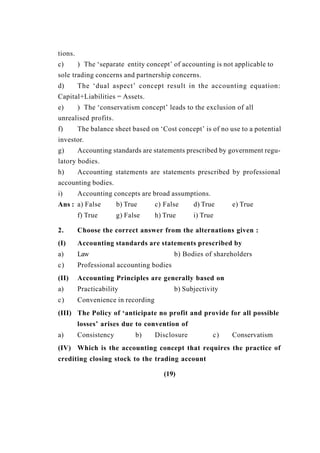
(iv) As it is based on historical cost, no unrealised profit enters
into the financial statements for the period.
Disadvantages: This method suffers from the following
limitations:
(i) Because of violent changes in prices of materials, it involves
somewhat complicated calculations and, therefore, it
involves somewhat complicated calculations and, therefore,
increase the changes of clerical errors.
(ii) The prices of issues of materials may not reflect current
market prices and, therefore, during the period of inflation,
the charge to production is unreasonably low.
(iii) Comparison between different jobs executed by the firm
becomes sometimes difficult. A job commenced a few
minutes before another job might have consumes the supply
of lower priced stock. This is particularly because of that
7
Jan. 2 Received 500 Units @ Rs.20 per unit
Jan. 3 Received 400 Units @ Rs. 21 per unit
Jan. 15 Received 300 Units @ Rs. 19 per unit
Jan. 28 Received 400 Units @ Rs. 20 per unit
January 28 Purchases 400 units @ Rs. 20 = Rs. 8000
January 15 Purchases 200 units @ Rs. 19 = Rs. 3800
Rs. 11, 800
the fact the first job might have completely exhausted the
supply of materials of a particular lot.
Suitability: FIFO method is considered more suitable during the
periods of falling prices. The reason is that the higher price at which
the purchase of materials was made earlier stands recovered in cost.
This method is suitable when the size of purchases is large but not
much frequent. The moderate fluctuations in the prices of materials,
and easy comparison between different jobs are also the important
conditions for the use of this method.
Illustration 1: The following is the record of receipts of certain
materials during the month of January 2006:
The physical inventory taken on 31st January, 2006 shows that
there are 600 units in hand. Compute the inventory value on 31st
January, 2006 by FIFO method.
Solution: Under FIFO method, closing inventory includes recent
purchases at most recent prices. Hence, the value of the inventory on
31st January will be as follows:
Here, the value of inventory as on 31st January 2006 has been
arrived as on the presupposition that the firm uses periodic inventory
8
system, the value of inventory would remain the same even if the
perpetual inventory system is in use. To take an example, if out of 1000
units issued, 300 units were issued on January 5, while 700 units were
issued on January 16, the valuation of inventory using perpetual
inventory system will be done as follows:
STOCK LEDGER
Date Receipts Issues Balance
Qty. Rate Amount
(Rs.)
Qty. Rate Amount
(Rs.)
Qty. Amount
(Rs.)
Jan.2 500 20 10,000 -- -- -- 500 10,000
Jan.3 400 21 8.400 -- -- -- 900 18,400
Jan. 5 -- -- -- 300 20 6000 600 12,400
Jan.l5 300 19 5,700 -- -- -- 900 18,100
Jan.16 -- -- -- 200 20 4,000
400 21 8,400
100 19 1,900 200 3,800
Jan.28 400 20 8,000 -- -- -- 600 11,800
From the above stock ledger it is obvious that the value of ending
inventory under FIFO method is same in case of both periodic and
perpetual inventory systems.
2. Last in First Out Method (LIFO): Under this method, it
is assumed that the material/goods purchased in the last are issued
first for production and those received first issued/sold last. In case a
new delivery is received before the first lot is fully used, price become
the ‘last-in’ price and is used for pricing issued until either the lot is
exhausted or a new delivery is received.
9
As stated above, materials are issued to production at cost which
may be vary near to current marked price. However, inventories at the
end will be valued at old prices which may be out of tune with the
current maked price.
Advantages
(i) This method takes into account the current market
circumstances while valuing materials issued to various
jobs or ascertaining the cost of goods sold.
(ii) No unrealised profit or loss is usually made in case this
methodisfollowed.
Disadvantages
(i) The stock in hand is valued at a price which have become
out-of-date when compared with the current inventory
prices.
(ii) This method may not be acceptable for taxation purposes
since the value of closing inventory may be quite different
from the current market value.
(iii) Comparison among similar jobs is very difficult because
they may bear different issue prices for materials
consumed.
Suitability: This method is most suitable for materials which are
of a bulky and non-perishable type.
Illustration 2: With the information given in illustration (1),
compute the inventory value on 31st Jan. 1998 by LIFO method. Also
10
prepare a store ledger account showing how the receipts and issues on
5th Jan and 700 units issued on 16th January 2006.
Solution: Under LIFO method, closing inventory includes most
old purchases remaining unissued till last date. Hence, valuation of
inventory under periodic inventory system would be as follows:
Hence, the value of the inventory on 31st January will be as
follows:
Jan. 2 Purchases 200 units @Rs.20 = Rs. 4,000
Jan. 28* Purchases 400 units @Rs.20 = Rs.8,000
Rs. 12,000
Valuation of Inventory under perpetual inventory system
Date
STOCK LEDGER
Receipts Issues Balance
Qty Rate Amt.
(Rs.)
Qty Rate Amt.
(Rs.)
Qty Amt.
(Rs.)
Jan 2 500 20 10,000 - - - 500 10,000
Jan 3 400 21 8,400 - - - 900 18,400
Jan 5 - - - 300 21 6,300 600 12,100
Jan 15 300 19 5,700 - - - 900 17,800
Jan 16 - - - 300 19 5,700
100 21 2,100
300 19 6,000 200 4,000
Jan 28 400 20 8,000 - - - 600 12,000
Jan 31 - - - - - - 600 12,000
11
*Closing entry of 600 units includes 200 units purchased on 2nd
January but remained unissued and 400 units purchased on 28th
January remaining unissued upto 31st January.
Implications of FIFO and LIFO method in case of rising
and falling prices: Both these methods value the products
manufactured at true costs because both are based on actual cost. But
in period of rising and falling prices both have conflicting result.
In periods of rising prices the cost of production will be lower in
case of FIFO method. This is simply because of the lowest material cost.
Contrary to this, LIFO method will result in charging products at
highest materials cost. Thus in case of rising price the application of
FIFO method will result in higher profitability, and higher income tax
liability, whereas the application of LIFO method result in lower
profitability, which in turn will reduce income tax liability.
In periods of falling market, the cost of product will tend to be low
with reference to the overall cost of inventory in case material cost is to
be charged according to LIFO method. Hence, this method will be
resulting in inflating of profits and increasing the tax liability. The
reverse will be the case if FIFO method is followed. Production will be
relatively overcharged. This will deflate the profits and reduce the
income tax liability.
In periods of falling prices the ending inventory will be valued in
FIFO method at a price lower than in case of LIFO method. The reverse
will be the case when the prices are rising. Interestingly, on the basis of
above discussion, it may be concluded that in periods of falling prices,
LIFO method tends to give a more meaningful balance sheet but less
12
realistic income statement, whereas FIFO method gives a more
meaningful income statement but a less realistic balance sheet. The
reverse will be the situation in periods of rising prices.
Now the question arises about the superiority of the LIFO and
FIFO methods. Based on forgoing discussion about implications of these
methods in case of both rising and falling markets, it may be concluded
that each method has its own merits and demerits depending upon the
circumstances prevailing at a particular moment of time. Thus, no
generalisation can be made regarding superiority of LIFO over FIFO or
vice-versa.
3. Highest-in-First-our (HIFO): According to this method,
the highest priced materials are treated as being issued first
irrespective of the date of purchase. In fact, the inventory of materials
or goods are kept at the lowest possible price. In periods of rising prices
the closing inventory is undervalued and thus secret reserves are
created. However, the highest cost of materials is recovered first.
Consequently, the closing inventory amount remains at the minimum
value. Hence, this method is very appropriate when the prices are
frequently fluctuating. As this method involves calculation more than
that of LIFO and FIFO methods, it has not been adopted widely.
4. Base stock method: The base stock method assume that
each business firm whether small or large must held a minimum
quantity of materials finished foods at all times in order to carry on
business smoothly. These minimum quantity of inventories are valued
at the cost at which the base stock was acquired. It is assumed that the
base stock is created out of the lot purchased. Inventories over and
13
above the base stock are valued according to some other appropriate
method such as FIFO, LIFO, etc.
AS-2 recommends the use of this method in exception
circumstances only. This is because of the fact that a large number of
companies customarily maintain a minimum stock level at all times
irrespective of its requirement. Actually, sometimes base stock method
is used without its justification. Therefore, this method requires a clear
existence of the circumstances which require that a minimum level of
charging out inventory of raw material and finished goods at actual cost
along with merits and demerits of the method which is used for
valuation other than the base stock method.
5. Specific Identification Method: Under this method,
each item of inventory is identified with its cost. The value of inventory
will be constituted by the aggregate of various cost so identified. This
method is very suitable for job order industries which carry out
individual or goods have been purchased for a specific job or customer.
In other words, this method can be applied only where materials used
can be specifically and big items such as high quality furniture,
paintings, metal jewellery, cars, etc.
However, this method is not appropriate in most industries
because of practical problems. For instance, in case of manufacturing
company having numerous items of inventory, the task of identifying
the cost of every individual item of inventory becomes very
cumbersome. Also, it promotes the chances of manipulating the cost of
goods sold. It can be done by selecting items that have a relatively high
cost or a relatively low cost, as he desires.
14
Example: Suppose that following information is available from
records:
Opening inventory of material as on Jan. 1 , 2000 at Rs.20 = 200
units.
Purchases of materials as on Jan. 16, 2000 at Rs. 24 = 100 units.
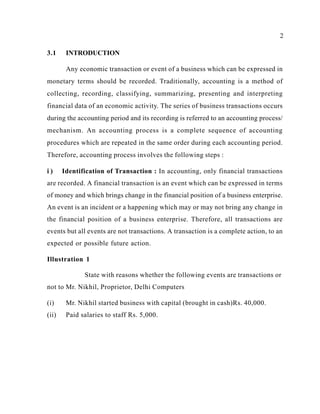
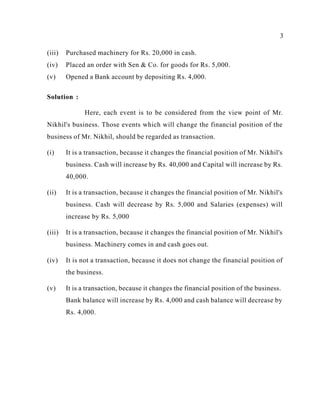
Purchases of materials as on Jan.26, 2000 at Rs.30 = 150 units
Total units available for sale = 450 units
Units sold during January = 260 units
Inventory of materials at January end = 190 units
Now, if it assumed that the firm selected 200 items of materials
that had a unit cost of Rs. 20 and 60 units of items that had a unit cost
Rs. 24, the cost of goods sold for the firm would be as follow:
Cost of 200 items = 200 × 20 = Rs. 4000
Cost of 60 items = 60 × 24 = Rs. 1440
Rs. 5440
Whereas, if 260 items having highest cost are selected, then the
cost of goods sold would be Rs. 7100 [(l50×30) + (l00×24) + (10×20)].
5. Simple average Price (SAP): This is the average of prices
of different lots of purchase. Under this method no consideration is
given to the quantity of purchases in various lots. For example the
purchases of 500 units of materials at Rs. 10 per unit are made as on
5th January, 1995 and 800 units of materials at Rs. 14 per unit on 10th
January. If at the end 200 units remains unissued/unsold, these will be
valued at Rs. 12 = [(10 + 14)/2]per unit and hence, the closing inventory
will be shown at Rs. 2400 (200 × 12 = 2400). Infact, this method
operated on the principle that when items of materials are purchased in
15
big lots and are put in godown, their identity is lost and, therefore,
issues should be priced at the average price of the lots in godown.
6. Weighted Average Price (WAP): Under this method, the
quantity of material purchased in various lots of purchases is
considered as weight while pricing the materials. Weighted average
price is calculated by dividing the total cost of material in stock by the
total quantity of material at the end. When this method is adopted, the
question of profit or loss out of varying prices does not arise because it
evens out the effect of widely fluctuating prices of different lots of
purchases. This method is very popular because it reduces calculations
and is based on quantity and value of material purchased.
Illustration 3: The following are the details of transactions
regarding receipt and issue of materials:
Date Quantity received Rate Quantity
issued
Jan.2,2006 100 Rs. 1.00 —
Jan.9,2006 150 Rs. l.20 —
Jan.14, 2006 — — 125
Jan.17, 2006 250 Rs. l.30 —
Jan.19, 2006 — — 100
You are required to prepare a stock ledger pricing the issue at (i)
Simple average price and (ii) Weighted average price.
Solution
(i) Simple Average Price Method:
16
STOCK LEDGER
Date Receipts Issues Balance
2006 Qty. Rate Amount Qty. Rate Amount Qty. Amount
Jan.2 100 l.00 100 — — — 100 100
Jan.9 150 1.20 180 — — — 250 280
Jan.14 — — — 125 1.10a 137.50 125 143
Jan.17 250 1.30 325 - - — — 375 518
Jan.19 — — — 100 1.25b 125.00 275 393
Working Notes
Average price on 14.1.2006 = (1.00 + 1.20)/2 = Rs. 1.10
Average price on 19.1.2006 = (1.20 + 1.30)/2 = Rs. 1.25
The price of the purchases that were made on 2nd January has
been ignored while computing average price on 19.1.2006 since we have
assumed that issue of 125 units on 14.1.2006 comprises all the 100
units purchased on 2.1.2006.
(i) Weighted Average Price Method
Date Receipts Issues Balance
2006 Qty. Rate Amt Qty. Rate Amt Qty. Amt
Jan.2 100 1.00 100 -- - - -- 100 100
Jan.9 150 1.20 180 -- -- -- 250 280
Jan.14 -- -- -- 125 1.12 140 125 140
Jan.17 250 1.30 325 -- -- -- 375 465
Jan. 19 -- -- -- 100 1.24 124 275 341
Working Notes
Weighted average price on January 14=280/250= 1.12
17
Weighted average price on January 19 = 465/375 = 1.24
Illustration 4: The Hisar Dal Mills Ltd. does not maintain a
perpetual inventory of gram which it buys and issues to the mills. The
physical inventory taken of 31st March, 2005 shows the following
quantity of gram on hand:
10 tonnes @ 840 per tonne.
The purchases during April as follows:
5-4-1995 100 tonnes @ 850 per tonne
15-4-1995 50 tonnes @ Rs. 900 per tonne
29-4-1995 10 tonnes @ Rs. 920 per tonne
A physical inventory on 30th April, 2005 shows a stock of 15
tonnes of gram on hand. Complete inventory value on 30th April, 2005
by (i) FIFO method (ii) Weighted Average Price Method.
Solution
(i) FIFO Method. In case of FIFO method, earlier purchases
are charged to earlier issues and the ending inventory includes the
most recent purchases at the most recent prices. Thus, stock of 15
tonnes include 10 tonnes @ Rs. 920 per tonne purchased on 29-4-2005
and 5 tonnes @ Rs. 900 per tonne purchased on 15-4-2005. The
inventory valuation will be as follows:
10 tonnes @ Rs. 920 per tonne Rs. 9,200
5 tonnes @ Rs. 900 per tonne Rs. 4,500
Inventory value on 30.4.05 Rs.13,700
18
(ii) WeightedAveragePriceMethod
10 tonnes @Rs. 840 8,400
100 tonnes @Rs. 850 85,000
50 tonnes @Rs.900 45,000
10 tonnes @Rs. 920 9200
170 tonnes 1,47,600
Average price per tonne = 1,4,600/170 = 868.24
Closing inventory (30-4-05): 15 tonnes @ Rs. 868.24=Rs. 13,023.60
B. Method Based on Sale Price: The inventories may be
valued at marked or sale prices. Important among these prices are
current selling prices, and net realisable value. Both of these are
discussed as follows:
1. Current Selling Prices: The method is used in case of the
product of which market as well as prices are controlled by a
Government. Marketing costs being negligible are ignored under this
method. This method is followed in the case of sugar industries, metal
industries, etc.
2. Net Realisable Value. According to IAS-2, the net
realisable value means, “the estimate selling price in the ordinary
course of business costs of completion and less costs necessarily to be
incurred in order to make the sale.” Estimates of net realisable value
should not be guided by temporary fluctuations in market prices.
However, these should be arrived at after taking into consideration all
expenses which might have to be incurred for making sales. Such cases
where it is difficult to estimate the appropriate costs, say agriculture
19
output, inventory are valued consistently at market values. This
procedure of valuation is accepted because of the saleability of the
output at quoted prices.
C. The Lower of Cost or Market Price (LCM Rule)
This method is based on the accounting principle of’ conservatism
according to which profits should not be anticipated but all losses
foreseen should be provided for. For instance, the ending inventory
consist of items purchased at cost of Rs.210 per unit. But the market
price has fallen to Rs.200 per unit at the time of valuation of inventory.
Hence, the items should be valued at Rs.200 per unit. This rule violate
the matching concept which requires matching of revenues with the
related product costs. This method also leads to inconsistency since in
one year the valuation may be based on cost while in another it may be
based on market price. However, even the critics of this rule favour the
application of this rule for valuing obsolete or damaged inventories.
About inventories valuation AS-2, recommends that the general
rule of valuing inventories should be at lower of historical cost and net
realisable value subject to certain exceptions. The historical of the
inventories should normally be determined by using ‘FIFO’, ‘LIFO’ or
Average ‘Cost’ method. Inventory of by-products cannot be separately
determined. It should be valued at net realisable value.
LCM rule can be applied in anyone of the following ways:
1. Aggregate/total inventory method: In this method, cost
price of the total inventory is ascertained and then compared with total
net realisable price to arise at stock valuation.
20
2. Group Method: Under this method, groups are formed of
similar or interchangeable articles of inventory. The cost and the net
realisable value of each group so formed are found out. The LCM rule is
applied to each group.
3. Item-by-item-method: According to this method, the cost
and net realisable prices of each item of inventory are found out and the
lower of the figures is taken into account for valuation of inventory.
Both IAS-2 and AS-2 have recommended the use of “Group method” and
“Item-by-Item” method for valuation of inventory. The first method
namely “Aggregate or Total Inventory method” have not been
recommended by both the standards. The learner’s will understand the
difference between all the three methods from the following illustration.
Illustration 5: Given the following data about inventors as at
31st December, 2005.
Category No. of Items Cost (Rs.) Net Realisable Value (Rs.)
A 10 21 20
A 16 15 14
B 20 30 40
B 10 18 16
C 9 40 45
C 7 30 25
D 8 8 10
D 8 6 5
21
Calculate the value of inventory on the basis of lower of cost and
net realisable value (1) by the aggregate method, (2) by the group and
(3) by item-by-item method.
Solution
1. AggregateMethod:
Quantity Unit Price Quantity X Price LCM(Rs.)
Cost
(Rs.)
Net
realisable
Value (Rs.)
Cost
(Rs.)
Net Realisable
Value (Rs.)
10 20 21 200 210
16 15 14 240 224
20 30 40 600 800
10 18 16 180 160
9 40 45 360 405
7 30 25 210 175
8 8 10 64 80
8 6 5 48 40
1902 2094 1902
2. Group Method:
Group Qty Unit Price Qty X Price Lower of
cost or net
Realisable
value
Cost
(Rs.)
Net
Realisable
Value
Cost
(Rs.)
Net
Realisable
Value
Group A 10 20 21 200 210
434
16 15 14 240 224
Group B 20 30 40
440 434
600 800
22
Group C
10 18 16 180 160
780
9 40 45
780 960
360 405
7 30 25 210 175
Group D 8 8 10
570 580 570
112
64 80
8 6 5 48 40
112 120
1896
3. Item-by-item method
Quantity Unit Price Quantity X Price Lower of
Cost or Net
Realisable
Value (Rs.)
Cost (Rs.) Net
realisable
value (Rs.)
Cost (Rs.) Net
realisable
value (Rs.)
10 20 21 200 210 200
16 15 14 240 224 224
20 30 40 600 800 600
10 18 16 180 160 160
9 40 45 360 405 360
7 30 25 210 175 175
8 8 10 64 80 64
8 6 5 48 40 40
1823
5. Valuation of inventory for Balance Sheet purpose
In certain cases, it is not possible for the business to take
inventory on the date of balance sheet. It might have been taken on a
date earlier or later than the date of balance sheet. In such a case,
when student are required to calculate the value of stock on the date of
preparation of final accounts, then they should take into consideration
23
information about additional transactions which occur during the
period. For example, if value of stock on 28th March is given, then in
order to find the value of stock on 31st March all purchases between
these dates will be added. Likewise, if value of stock on 4th April is
given and value of stock on the proceeding 31st March is required then
purchases during the period will be deducted and issues/sales (at
acquisition price) during this period will be added. Both of the above
mentioned cases could be understood and elaborated as under:
(i) When the Position of stock is given on a date prior to the
balance sheet date
In this case, the following adjustments will generally be required:
(a) Add purchases made during the period.
(b) Deduct purchases returns during the said period.
(c) Deduct inventory issued/sold between the two dates.
(d) Add sales returns between the two dates.
(ii) When the position of stock is given on a date after the
balance sheet date
For example, if the balance sheet is to be prepared as on 31st
March, 2005 and the stock position has been given as on 15th April,
2005thefollowingadjustmentswillberequired:
(a) Less purchases made between 1st April, 2005 to 15th April,
2005.
(b) Add purchases returns between 1st April, 2005 to 15th April,
2005.
(c) Add sales (at cost price) between 1st April, 2005 to 15th
April,2005.
24
(d) Less sales returns between 1st April, 2005 to 15th April,
2005.
Illustration 6: The financial year of Sultan S. & Co. ends on 31st
December 2005. Stock taking continues upto 10th January, 2006. You
are required to determine, the value of costing stock (at cost) as on 31st
December, 2005 from the following information:
(i) The closing stock (valued at cost) came to Rs. 50,000 on
10th January, 2006.
(ii) Purchases made in the first 10 days of January 2006
amounted to Rs. 2000.
(iii) Sales made from 1st January to 10th January in 2006
amounted to Rs. 8000. The firm makes a gross profit of 25%
on sales.
Solution: Valuation of closing stock
Value of stock as on January 10, 2006 50,000
Less: Purchases after 31st December 2,000
48,000
Add: Cost of goods sold during first
10 days of January, 2006 (75% of 8000) 6,000
Value of stock as on 31st Dec. 2005 54,000
Illustration 7: The financial year of Mr. Ratan Lal & Co. ends on
30th June 2006, but the actual stock is physically only on 7th July,
2006, when it is estimated at Rs. 20,000.
Additional information:
1. Purchases between 30th June and July are Rs. 2000.
25
2. Purchases returns between 30th June and 7th July are Rs.
200.
3. Sales between 30th June and 7th July are Rs. 4000.
4. Sales returns between 30th June and 7th July are Rs. 100.
5. The firm makes a gross profit at 25% on cost.
Calculate the value of stock on 30th June, 2006.
Solution
MR RATAN LAL & CO.
VALUATION OF CLOSING STOCK
Stock as on July 7 Rs. 20,000
Less: Purchases between June 30 and July 7 2,000
18,000
Add: Purchases returns between June 30 and July 7 200
18,200
Add: Sales (at cost price) between June 30 and July 7
[4000-onefifthof4,000]
3,200
21,400
Less: Sales returns (at cost price) between June 30 and
July 7 [Rs.100-20]
80
Stock on June 30, 2006 21,320
Illustration 8: The Profit and Loss Account of Cardamom for the
year ended 31st December, 2005 showed a net profit of Rs. 2,400 after
taking into account the closing stock of Rs. 2,400. On a scrutiny of the
books the following information could be obtained:
26
(1) Cardamom has taken goods valued Rs. 800 for his personal
use without making entry in the books.
(2) Purchases of the year included Rs. 400 spent on acquisition
of a ceiling fan for his shop.
(3) Invoices for goods amounting to Rs.2600 have been entered
on 29th December, but such goods were not included in
stock.
(4) Rs. 350 have been included in closing stock in respect of
goods purchased and invoiced on 28th December, 2005 but
included in purchases for January 2006.
(5) Sale of goods amounting to Rs. 405 sold and delivered in
December, 2005 had been entered in January, 2006 sales.
You are required to ascertain the correct amount of closing stock
as on 31st December, 2005 and the adjusted net profit for the year
ended on that date.
Solution
Calculation of stock as on December 31, 2005:
Stock (as given already) Rs. 2400
Add Purchase not included Rs. 2600
Rs. 5000
PROFIT AND LOSS ADJUSTMENT ACCOUNT
To supplier’s account*
Rs.
By Profit (given)
Rs.
350 2,400
To Net Profit 6,255 By Drawings 800
(balancing figure)
27
By Fixtures and Fittings 400
(Ceiling Fan)
By Closing Stock (Goods 2,600
in transit)
By Customer’s account 405
6,605 6,605
*The treatment of these items in 2006 will have to be cancelled.
6.6 SUMMARY
The word ‘inventory’ means stock of goods. To the finance
manager, inventory connotes the value of raw materials, consumable,
spares, work-in-progress, finished goods and scrap in which a
company’s funds have been invested. A major objective of inventory
valuation is the proper determination of income through the process of
matching appropriate cost against revenues. The records of quantity
and value of inventory can be made in two ways: (i) Periodic inventory
system; (ii) Perpetual inventory system. The basic methods of valuation
of inventories are: (a) Historical cost based method; (b) Sale price based
method; (c) Lower of cost or sale price
6.7 KEYWORDS
Market Price: Market price means net realisable value in the ordinary
course of business.
Cost: Cost means the total of the amount paid to the supplier and the
expenses incurred till the goods reach the firm’s premises but expenses
thereafter will not be included.
28
Periodic Inventory System: In this system, the quantity and the
value of inventory is ascertained by physically counting the stock at the
end of the year and as on the accounting date.
Net Realisable Value: It is the estimated selling price in the ordinary
course of business less the estimated cost of completion and the
estimated costs necessary to make the sale.
6.8 SELF ASSESSMENT QUESTIONS
1. What are the various methods of inventory valuation?
Discuss the impact of each method on working results.
2. What is the principle behind valuation of inventory at cost
or market price whichever is lower?
3. Differentiate the following:
(a) LIFO and FIFO method
(b) Periodic inventory valuation and Perpetual inventory
valuation
(c) Item-by-item method and Group method
4. What is the need of valuing inventory properly? Discuss. To
what extent this need is fulfilled by various methods of
valuing inventories.
5. Arvind Ltd. uses large quantities of a sweetening material
for its products. The following figure relates to this material
during the calendar year 2000:
Quarter
ended
(Tonnes)
Purchases Invoice Cost
per Tonne
Rs.
Consumption
(Tonnes)
March 31 1,000 620 600
29
June 30 2,100 630 1,200
September 30 700 640 1,500
December 31 1,200 670 1,350
The stock of material on December 31, 1999 was 1,000
tonnes valued for accounting purposes at cost of Rs. 600 a
tonne. Delivery of goods to the factory is made on the first
day of each quarter. You are required to compute the value
of stock as on December 31, 2000 applying LIFO and FIFO
methods.
6. Purchases of certain product during March, 2004 are set
outbelow:
March 1 100 units @ Rs. 10
12 100 units @ Rs. 9.80
15 50 units @ Rs. 9.60
20 100 units @ Rs. 9.40
Units sold during the month were as follows:
March 10 80 units
14 100 units
30 90 units
No opening inventories
You are required to determine the cost of goods sold for
March under three different valuation methods viz, FIFO,
LIFO and Weighted Average Cost.
7. M/s Swadeshi Cotton Mills Ltd. take a periodic inventory of
their stock of chemically at the end of each month. The
physical inventory taken on 30 shows a balance of 1,000
litres of chemically in hand @ Rs. 2.28 per litre.
The following purchases were made during July:
30
July 1 14,000 litres @ Rs. 2.30 per litre
July 7 10,000 litres @ Rs. 2.32 per litre
July 1 14,000 litres @ Rs. 2.30 per litre
July 25 5,000 litres @ Rs. 2.35 per litre
A physical inventory on July 31 discloses that there is a
stock of 10,000 litres. You are required to compute the
inventory value on July 31, by each of the following
methods:
(i) First in First out; (ii) Last in First out; and (iii) Average
cost method.
8. Following are the details regarding inventories of a
manufacturing concern as on 31st December, 2005:
Inventories categories Cost (Rs.) Market Prices (Rs.)
Category 1: A 6,000 9,000
B 10,000 9,500
Category 2: C 15,000 17,000
D 20,000 14,000
Total 51,000 49,000
You are required to determine inventory value using “lower of
cost or market value basis”, according to each of the following methods:
(i) Aggregate or total inventory method; (ii) Group method; (iii)
Item-by-item method.
9. The financial year of Shri X ends on 31st March, 2004, but
the stock in hand was physically verified only on 7th April,
2004. You are required to determine the value of closing
stock (at cost) as at 31st March, 2004 from the following
information:
31
(i) The stock (valued at cost) as verified on 7th April,
2004 was Rs. 15,000.
(ii) Sales have been entered in the sales day book only
after the despatch of goods and sales returns only on
receiptofgoods.
(iii) Purchases have been entered in the purchases day
book on receipt of the purchases invoice irrespective
of the date of the goods.
(iv) Sales as per the sales day book for the period 1st
April, 2004 to 7th April, 2004 (before the actual
verification) amounted to Rs. 6,000 of which goods of
a sale value of Rs. 1,000 had not been delivered at the
time of verification.
(v) Purchases as per the purchases day book for the
period 1st April, 2004 to 7th April, 2004 (before
the actual verification) amounted to Rs. 6,000 of
which goods for purchase of Rs. 1,500 had not been
received at the date of verification and goods for
purchases of Rs. 2,000 had been received prior to 31st
March, 2004.
(vi) In respect of goods costing Rs. 5,000 received prior to
31st March invoices had not been received up to the
date of verification of stock.
(vii) The gross profit is 20% on sales.
6.9 SUGGESTED READINGS
1. Financial Accounting by Tulsian.
2. Introduction to Financial Accounting by S.N. Maheshwari.
3. Advanced Accountancy by R.L. Gupta.
32
SUBJECT : ACCOUNTING FOR MANAGERS
COURSE CODE : CP-104 UPDATEDBY:DR.M.C.GARG
LESSON NO. : 7
STRUCTURE
DEPRECIATION ACCOUNTINGAND POLICY
7.1 Objective
7.2 Meaning of Depreciation
7.3 Causes of Depreciation
7.4 Need for Providing Depreciation
7.5 Basic Elements of Depreciation
7.6 Methods of Calculating Depreciation
7.7 Methods of Recording Depreciation
7.8 Sale of an Asset
7.9 Change of Depreciation Method
7.10 Summary
7.11 Keywords
7.12 Self Assessment Questions
7.13 Suggested Readings
7.0 OBJECTIVE
After reading this lesson, you should be able to
(a) Define depreciation and describe the causes of depreciation.
(b) Discuss the various methods of charging depreciation.
(c) Explain the accounting treatment of depreciation
7.1 MEANINGOFDEPRECIATION
Generally, the term depreciation is used to denote decrease in value but in
accounting, this term is used to denote decrease in the book value of fixed asset.
Depreciation is the permanent and continuous decrease in the book value of a fixed
asset due to use, affluxion of time, obsolescence, expiration of legal rights or any
other cause. According to the Institute of Chartered Accountants of England and
(1)
Wales, “Depreciation represents that part of the cost of a fixed asset to its owner
which is not recoverable when the asset is finally out of use by him. Provision
against this loss of capital is an integral cost of conducting the business during the
effective commercial life of the asset and is not dependent on the amount of profit
earned”.
Depreciation is not the result of fluctuations in the value of fixed assets since, the
fluctuation is concerned with the market price of the fixed asset whereas the
depreciation is concerned with the historical cost.
An analysis of the definition given above highlights the characteristics of
depreciation as follows :
(a) It is related to fixed assets only.
(b) It is a fall in the book value of an asset.
(c) The fall in the book value of an asset is due to the use of the asset in business
operations, effluxion of time, obsolescence, expiration of legal rights or
any other cause.
(d) It is a permanent decrease in the book value of an asset.
(e) It is a continuous decrease in the book value of an asset.
Depreciation, Depletion and Amortisation
The terms depreciation, depletion and amortisation are used often interchangeably.
However, these different terms have been developed in accounting usage for
describing this process for different types of assets. These terms have been
described as follows:
Depreciation
Depreciation is concerned with charging the cost of man made fixed assets to
operation (and not with determination of asset value for the balance sheet). In other
words, the term 'depreciation' is used when expired utility of physical asset (building,
machinery, or equipment) is to be recorded.
Depletion
This term is applied to the process of removing an available but irreplaceable
(2)
resource such as extracting coal from a coal miner or oil out of an oil well.
Depletion differs from depreciation in that the former implies removal of a natural
resource, while the latter implies a reduction in the service capacity of an asset.
Amortisation
The process of writing off intangible assets is termed as amortisation. The intangible
assets like patents, copyrights, leaseholds and goodwill are recorded at cost in the
books of account, Many of these assets have a limited useful life and are, therefore,
written off.
Obsolescence
It refers to the decline in the useful life of an asset because of factors like (i)
technological advancements, (ii) changes in the market demand of the product, (iii)
legal or other restrictions, or (iv) improvement in production process.
Meaning of Depreciation Accounting
According to the American Institute of Certified Public Accountants (AICPA),
“Depreciation Accounting is a system of accounting which aims to distribute cost or
the basic value of tangible capital assets less salvage (if any), over the estimated useful
life of the unit (which may be group of assets) in a systematic and rational manner. It is
a process of allocation and not of valuation.
7.2 CAUSESOFDEPRECIATION
The main causes of depreciation include the following :
(a) Physical wear and tear : When the fixed assets are put to use, the value of
such assets may decrease. Such decrease in the value of assets is said to be due to
physical wear and tear.
(b) With the passage of time : When the assets are exposed to the forces of nature
like whether, winds, rains, etc., the value of such assets may decrease even if they are
not put to any use.
(c) Changes in economic environment : The value of an asset may decrease due
to decrease in the demand of the asset. The demand of the asset may decrease due to
technological changes, changes in the habits of consumers etc.
(3)
(d) Expiration of legal rights : When the use of an asset (e.g., patents, leases) is
governed by the time bound arrangement, the value of such assets may decrease with
the passage of time.
7.3 NEEDFORPROVIDINGDEPRECIATION
The need for providing depreciation in accounting records arises due to any one or
more of the following objectives to be achieved :
(a) To ascertain true results of operations : For proper matching of costs with
revenues, it is necessary to charge the depreciation (cost) against income (revenue) in
each accounting period. Unless the depreciation is charged against income, the result
of operations would stand overstated. As a result the Income Statement would fail to
present a true and fair view of the result of operations of an accounting entity.
(b) To present true and fair view of the financial position : For presenting a
true and fair view of the financial position, it is necessary to charge the depreciation. If
the depreciation is not charged, the unexpired cost of the asset concerned would be
overstated. As a result, the Position Statement (i.e. the Balance Sheet) would not present
a true and fair view of the financial position of an accounting entity.
(c) To ascertain the true cost of production : For ascertaining the cost of
production, it is necessary to charge depreciation as an item of cost of production. If
the depreciation on fixed assets is not charged, the cost records, would not present a
true and fair view of the cost of production.
(d) To comply with legal requirements: In case of companies, it is compulsory
to charge depreciation on fixed assets before it declares dividend [Sec. 205(1) of the
Companies Act, 1956].
(e) To accumulate funds for replacement of assets : A portion of profits is set
aside in the form of depreciation and accumulated each year to provide a definite amount
at a certain future date for the specific purpose of replacement of the asset at the end
of its useful life.
7.4 BASIC ELEMENTS OFDEPRECIATION
In order to assess depreciation amount to be charged in respect of an asset in an
accounting period the following three important factors should be considered :
(4)
1. Cost of the asset : The knowledge about the cost of the asset is very essential
for determining the amount of depreciation to be charged to the profit and
loss account. The cost of the asset includes the invoice price of the asset
less any trade discount plus all costs essential to make the asset usable.
Cost of transportation and transit insurance are included in acquisition cost.
However, the financial charges such as interest on money borrowed for the
purchase for the purchase of the asset, should no be included in the cost of
the asset.
2. Estimated life of the asset : Estimated life generally means that for how
many years or hours an asset could be used in business with ordinary repairs
for generating revenues. For estimating useful life of an asset one must begin
with the consideration of its physical life and the modifications, if any, made,
factors of obsolescence and experience with similar assets. Infact, the
economic life of an asset is shorter than its physical life. The physical life
is based mostly on internal policies such as intensity of use, repairs,
maintenance and replacements. The economic life, on the other hand, is based
mostly on external factors such as obsolescence from technological changes.
3. Scrap. Value of the Asset : The salvage value of the asset is that value which
is estimated to be realised on account of the sale of the asset at the end of
its useful life. This value should be calculated after deducting the disposal
costs from the sale value of the asset. If the scrap value is considered as
insignificant, it is normally regarded as nil
7.5 METHODS OFCALCULATINGDEPRECIATION
The following are various methods of allocating depreciation in use :
1. Fixed instalment method or straight line method.
2. Machine hour rate method.
3. Diminishing Balance method.
4. Sum of years digits method
5. Annuity method
6. Depreciation Fund Method
7. Insurance Policy Method
8. Depletion Method.
(5)
1. Straight Line Method : This is also known as fixed instalment method.
Under this method the depreciation is charged on the uniform basis year
after year. When the amount of depreciation charged yearly under this method
is plotted on a graph paper, we shall get a straight line. Thus, the straight line
method assumes that depreciations is a function, of time rather than use in
the sense that each accounting period received the same benefit from using
the asset as every other period. The formula for calculating depreciation
charge for each accounting period is :
amount of annual Depreciation =
For example, if an asset cost Rs. 50,000 and it will have a residual value of Rs.
2000 at the end of its useful life of 10 years, the amount of annual depreciation
will be Rs. 4800 and it will be calculated as follow :
Depreciation =
This method has many shortcomings. First, it does not take into consideration the
seasonal fluctuations, booms and depression. The amount of depreciation is the
same in that year in which the machine is used day and night to that in the another
year in which it is used for some months. Second, it ignores the interest on the
money spent on the acquisition of that asset. Third, the total charge for use of asset
(i.e., depreciation and repairs) goes on increasing form year to year though the
assets might have been use uniformly from year to year. For example, repairs cost
together with depreciation charge in the beginning years is much less than what it
is in the later year. Thus, each subsequent year is burdened with grater charge for
the use of asset on account of increasing cost on repairs.
Illustration - I : H. Ltd. purchased a machinery on 1st January. 2000 for Rs. 29000
and spent Rs. 2000 on its cartage and Rs. 1,000 on its erection. Machinery is
estimated to have a scrap value of Rs. 5000 at the end of its useful life of 5 year.
The accounts are closed every year on 31st December. Prepare the machinery
account for five years charging depreciation according to straight line method.
(6)
Solution :
Machinery Account
Date Particulars Rs. Date Particulars Rs.
1990 To Bank 22000 Dec. 31 By Depreciation 4000
Jan. 1 To Bank 2000 " By Balance C/d 21000
To Bank 1000
2001 To Balance b/d
25000
2001 By Depreciation
25000
21000 4000
17000Jan.1 Dec.31 Balance c/d
2002 To Balance/b/c
21000
2002 By Depreciation
21000
17000 4000
13000Jan.1 Dec. 31 By Balance c/d
2003 To Balance b/c
17000
2003 By Depreciation
17000
13000 4000
9000Jan.1 Dec.31 By Balance
2004 To Balance b/d
13000
2004 By Depreciation
13000
9000 4000
5000
Jan.1 Dec.31 By Balance c/d
9000 9000
This method is very suitable particularly in case of those assets which get depreciated
more on account of expire of period e.g. lease hold properties, patents, etc.
2. Machine Hour Rate Method : In case of this method, the running
time of the asset is taken into account for the purpose of calculating the
amount of depreciation. It is suitable for charging depreciation on plant and
machinery, air-crafts, gliders, etc. The amount of depreciation is calculated
as follows :
For example, if machinery has been purchased for Rs. 20000 and it will
have a scrap value of Rs. 1000 at the end of its useful life of 1900 hours, the
amount of depreciation per hour will be computed as follows :
(7)
Depreciation =
=
= Rs. 10 per hour
If in a particular year, the machine runs for 490 hours, the amount of depreciation
will be Rs. 4900 (i.e., Rs. 10x490). It is obvious from this example that under
machine hour rate method the amount of depreciation is closely related with the
frequency of use of an asset. The simplicity in calculations and under standing is
the main advantage of this methods. However, it can be used only in case of those
assets whose life can be measured in terms of working time.
3. Written Down Value Method : This is also known as Diminishing Balance
method. Under the diminishing balance method depreciation is charged at fixed
rate on the reducing balance (i.e., cost less depreciation) every year. Thus, the
amount of depreciation goes on decreasing every year. Under this method also the
amount of depreciation is transferred to profit and loss account in each of the year
and in the balance sheet the asset is shown at book value after reducing depreciation
from it. For example, if an asset is purchased for Rs. 10,000 and depreciation is to
be charged at 20% p.a. on reducing balance system then the depreciation for the
first year will be Rs. 2000. In the second year, it will Rs. 1600 (i.e. 20% of 8000),
in the third year Rs. 1280 (i.e. 20% of 6400) and so on. The rate of depreciation
under this method can be computed by using the following formula :
Depreciation rate = -1
For example, if the cost of an asset is 27000, scrap value Rs. 3375, economic life
3 year, the rate of depreciation would be :
Depreciation Rate = 1-3
= 1 - = 50%
(8)
Merits of Diminishing Balance Method : (i) It is very easy to understand and
calculate the amount of depreciation despite the early variation in the book value
after depreciation (ii) This method put an equal burden for use of the asset on each
subsequent year since the amount of depreciation goes on decreasing for each
subsequent year while the charge for repairs goes on increasing for each subsequent
year. (iii) This method has also been approved by the income tax act applicable in
India (iv) Asset is never reduced to zero because if the rate of depreciation is (say)
20%. Then even when asset is reduced to very small value, there must remain the
80% of that small value as on written off balance.
Demerit : (i) It ignores the interest on the capital committed to purchase that
asset. (ii) It does not provide adequately for replacing the asset at the end of its
life. (iii) The calculation of rate of depreciation is not so simple. (iv) The formula
for calculating the rate of depreciation can be applied only when there is some
residual of the asset.
Suitability : This method is suitable in those cases where the receipts are expected
to decline as the asset gets older and, it is believed that the allocation of depreciation
of depreciation ought to be related to the pattern of assets expected receipts.
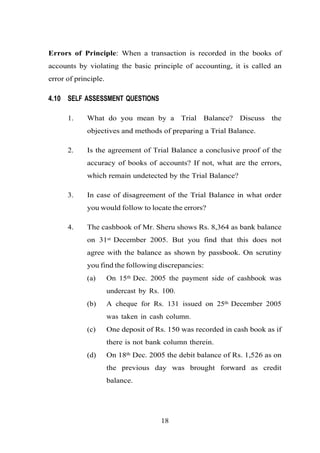
Illustration 2 : A company purchases Machinery on 1st April 1990 for Rs.
20,000. Prepare the machinery account for three years charging depreciation @
25% p.a. according to the written Down value Method.
Machinery Account
Date Particulars Rs. Date Particulars Rs.
1990 To Bank 20000 2001 By Depreciation 5000
Apr. 1 Mar. 31 By Balance C/d 15000
2001 To Balance b/d
20000
2002 By Depreciation
20000
15000 3750
11250Apr.1 Mar.31 By Balance c/d
2002 To Balance b/d
15000
2003 By Depriciation
15000
11250 2812.5
8437.5Apr/ Mar.31 By Balance c/d
11250 11250
(9)
4. Sum of Years digits (SYD) Method: Under this method also the amount of
depreciation goes on diminishing in the future years similar to that under
diminishing Balance method.
For calculating the amount of depreciation to be charged to the profit and loss
account this method takes into account cost, scrape value, and life of the asset. The
following formula is used for determining depreciation :
For example, an asset having an effective life of 5 years is purchased at a cost of
Rs. 20,000. It is estimated that its scrap value at the end of its effective life will be
Rs. 2000. The depreciation on this asset, if SYD method is followed, will be
calculated as follows from one to five years :
Year Depreciation Amount
1 = __________ x 18000 = Rs. 6000
2. = __________ x 18000 = Rs. 4800
3. = __________ x 18000 = Rs. 3600
4. = __________ x 18000 = Rs. 2400
5. = __________ x 18000 = Rs. 1200
5. Annuity Method : Sofar we have described such methods of charging
depreciation which ignore the interest factor. Also, some times it becomes
inconvenient for a company to follow any of the methods discussed earlier. Under
such circumstances the company may use some special depreciation systems.
Annuity method is one of these special systems of depreciation. Under this system,
the depreciation is charged on the basis that besides losing the acquisition cost of
the asset the business also loses interest on the amount used for purchasing the
asset. Here, interest refers to that income which the business would have earned
otherwise if the money used in buying the asset would have been committed in
(10)
some other profitable investment. Therefore, under the annuity method the amount
of total depreciation is determined by adding the cost of the and interest thereon at
an expected rate. The annuity table is used to help in the determination of the amount
of depreciation. A specimen of Annuity Table is as follows :
Annuity Table
Year 3% 4% 5% 6%
4 0.269027 0.275490 0.282012 0.288591
5 0.218335 0.224627 0.230975 0.237376
6 0.184598 0.190762 0.197012 0.203363
7. 0.160506 0.166610 0.172820 0.179135
8. 0.142456 0.148528 0.154722 0.161036
9. 0.128434 0.134493 0.140690 0.147022
10. 0.117231 0.12391 0.129505 0.135868
In case depreciation is charged according to this method, the following accounting entries are
passed :
(i) Purchase of an asset
Asset Account Dr.
To Bank
(ii) For Charging interest
Asset Account Dr.
To InterestAccount
(iii) For Charging depreciation :
Depreciation Account Dr.
To Asset Account
Evaluation of Annuity Method
Merits : (i) This method keep into account interest on money spent on the purchase of
the asset. (ii) The value of the asset become zero at the end of life.
Demerits. (i) This method is comparatively more difficult than the methods discussed so far.
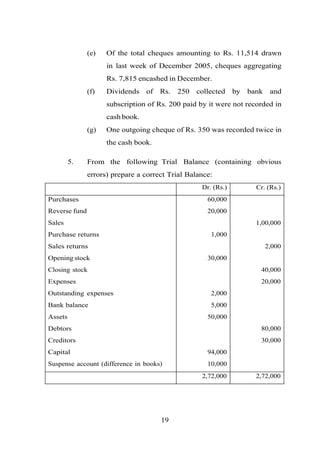
(ii) It makes no arrangement of money to replace the old asset with the new one at the expiry
of its life. (iii) Under this method the burden on the profit and loss account is no similar in each
year because the depreciation remains constant year after year but the interest goes on
decreasing.
Illustration 3. On 1st January, 2000 a firm purchased a leasehold property for 4 year at a
cost of Rs. 24000. It decides to depreciate the lease by Annuity Method by charging interest
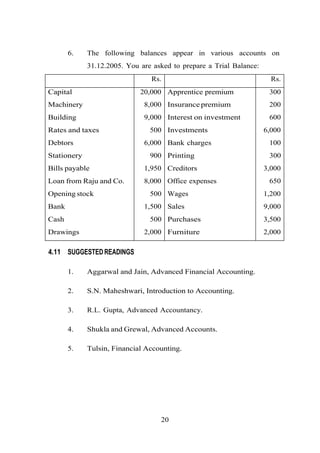
at 5% per annum. TheAnnuity Table shows that the annual necessary to write off Rs. 1 at 5%
Rs. 0.282012. You are required to prepare the lease Hold PropertyAccount for four years
and show the net amount to be charged to the profit and loss account for these four years.
(11)
Lease Hold Property Account
Date Particulars Rs. Date Particulars Rs.
2000
Jan. 1
2001
Jan.1
Dec.31
2002
Jan.1
Dec. 31
2003
Jan.1
D 31
To Bank
To interest
To balance b/d
To Interest
To balance b/d
To Interest
To balance b/d
24000.00
1200.00
2000
Dec. 3
Dec.31
2001
Dec.31
Dec.31
2002
Dec.31
Dec.31
2003
Dec.31
By Depreciation
By balance c/d
By Depreciation
By Balance c/d
By Depreciation
By Balance c/d
By Depreciation
By Balance c/d
6768.29
18431.71
25200.00 25200.00
18431.71
921.59
6768.29
12585.01
19353.30 19353.30
12585.01
629.25
6768.29
6445.97
13214.26 13214.26
6445.97
322.30
6768.29
9000
13000
6768.27 6768.27
Net Amount chargeable to the profit and loss account
Year Depreciation
debited
Interest Credited Net Charge
against Profit
2000 6768.29 1200.00 5568.29
2001 6768.29 921.59 5846.70
2002 6768.29 629.25 6139.04
2003 6768.29 322.30 6445.99
Rs. 27073.16 3073.14 24000.02
6. Depreciation Fund Method : Business assets become useless at the expiry
of their life and, therefore, need replacement. However, all the methods of
depreciation discussed above do not help in accumulating the amount which can be
readily available for the replacement of the asset its useful life comes to an end
(12)
Depreciation fund method takes care of such a contingency as it incorporates the
benefits of depreciating the asset as well as accumulating the necessary amount for
its replacement. Under this method, the amount of depreciation charged from the
profit and loss account is invested in certain securities carrying a particular rate of
interest. The interest received on the investment in such securities is also invested
every year together with the amount of annual depreciation. In the last of the life of
asset the depreciation amount is set aside interest is received as usual. But the
amount is not invested because the amount is immediately needed for the purchase
of new asset. Rather all the investments so far accumulated are sold away. Cash
realised on the sale of investments is utilised for the purchase of new asset. The
following accounting entries are generally made in order to work out this system
of depreciation.
1. At the end of the first year
(i) for setting aside the amount of depreciation : The amount to be charge
by way of depreciation is determined on the basis of sinking Fund Table given as an
Appendix at the end of every book of accountancy.
Depreciation Account Dr.
To Depreciation FundAccount (or Sinking Fund A/c)
(ii) For investing the amount charged by way of depreciation :
Depreciation Fund Investment A/c Dr.
To BankA/c
In the second and subsequent years
(i) For receiving interest. The interest on the balance of Depreciation
Fund Investment outstanding in the beginning of each year will be received by the
end of the year. This entry is :
Bank Account Dr.
To Depreciation FundAccount
(ii) For setting aside the amount of depreciation
Profit and Loss A/c Dr.
To Depreciation Fund A/c
(iii) For investing the amount
Depreciation Fund Investment A/c Dr.
To BankA/c
(Annual instalment of depreciation and interest received invested)
(13)
3. In the last year
(i) For receiving interest :
Bank A/c Dr.
To Depreciation Fund A/c
(ii) For setting aside the amount of depreciation
Profit and loss A/c Dr.
To depreciation Fund A/c
Note : In the last year no investment will be made, because the amount is
immediately required for the purchase of new asset.
(iii) For the sale of investment :
Bank A/c Dr.
To Depreciation Fund InvestmentA/c
(iv) For the transfer of profit or loss on sale on investments : The profit
or loss on the sale of these investments is transferred to the Depreciation Fund
Account.
The entry for loss :
Depreciation Fund A/c Dr.
To Depreciation Fund Investment A/c
The entry for profit
Depreciation Fund Investment A/c
To Depreciation Fund A/c
(v) For the sale of old asset :
Bank A/c Dr.
To asset A/c
(vi) The depreciation fund is transferred to asset account and any balance
left in the asset account is transferred to profit and loss account. The entry is :
Depreciation Fund A/c. Dr.
To asset A/c
(vii) The balance in Asset Account represents profit or loss. Therefore it
will be transferred to the profit and loss account.
(14)
(viii) The cash realised on the sale of investments and the old asset is utilised
for the purchase of new asset.
Illustration 4. Amitabh Company Ltd. purchased 4 year lease on January ,
2000 for Rs. 60,000. The company decided to charge depreciation according to
depreciation fund method. It is expected that investments will earn interest @5%
p.a. Sinking Fund Table shows that Rs. 0.232012 invested each year will produce
Rs. 1 at the end of 4 years at 5% p.a. At the expiry of lease , the Depreciation Fund
Investments were sold for Rs. 45200. A new lease is purchased for Rs. ................
on 1.1.2004. Show the journal entries and prepare the necessary accounts in the
book the company.
Journal
Date Particulars Debit Credit
1.1.2000
31.12.00
31.12.00
.
31.12.01
31.12.01
Lease A/c Dr.
To BankA/c
(Being the purchase of lease)
Depreciation A/c Dr.
To Depreciation Fund A/c
(Being annual amount of depreciation
as per sinking fund tables)
Depreciation Fund InvestmentA/c Dr.
To BankA/c
(Being purchase of the investments
against the depreciation fund)
BankA/c Dr.
To depreciation fund A/c
(Being the receipt of interest on
depreciation fund investment A/c
transfer to depreciation fund A/c
Depreciation A/c Dr.
To Depreciation Fund A/c
(Being annual depreciation set-aside)
60,000
13920.7
13920.7
696.0
13920.7
60,000
13920.7
13920.7
696.0
13920.7
(15)
31.12.1 Depreciation Fund InvestmentA/c Dr. 14616.7 14616.7
To BankA/c
(Being purchase of the investments
against the depreciation fund)
31.12.2 BankAccount Dr. 1426.9 1426.9
To depreciation fund A/c
Being receipt of interest and its
transfer to depreciation fund A/c)
31.12.02 Depreciation A/c Dr. 13920.7 13920.7
To depreciation fund A/c
(Being annual depreciation set aside
31.12.2 Depreciation Fund InvestmentA/c Dr. 15347.6 15347.6
To BankA/c
(Being purchase of investments)
31.12.3 BankA/c Dr. 2194.3 2194.3
to depreciation fund A/c
(Being receipt of interest on
depreciation fund investment
31.12.03 Depreciation A/c Dr. 13920.7 13920.7
To depreciation A/c
(Being annual depreciation set aside)
31.12.00 BankA/c Dr. 45200 45200
To depreciation fund investmentA/c
(being sale of Dep fund investment A/c)
31.12.03 Depreciation Fund InvestmentA/c Dr. 1315.0 1315.0
To depreciation fund A/c
(Being profit on sale investment
transferred)
(16)
31.12.03 Depreciation fund A/c Dr. 61315.0 61315.0
to lease A/c
(Being the transfer of depreciation
fund A/c to lease A/c)
31.12.03 Lease A/c Dr. 1315.0 1315.0
To PCLA/c
(Being Balance of lease A/c
transferred to place
1.1.04 Lease A/c Dr. 70000.0 70000.0
To BankA/c
Depreciation Fund Account
Date Particulars Rs. Date Particulars Rs.
31.12.00
31.12.01
31.12.02
31.12.03
By Balance c/d
To Balance c/d
By Balance c/d
To lease A/c
13920.7 31.12.00
1.1.01
31.12.01
31.12.01
1.1.02
31.12.02
31.12.02
1.1.03
31.12.03
31.12.03
By Dep. a/c
By Balance b/d
By Bank A/c Int.
By Dec. a/c
By Balance c/d
By Bank A/c Int.
By Dep. A/c
By Balance b/d
By Bank Interest
By Dep. a/c
13920.7
13920.7 13920.7
28537.4 13920.7
696.0
13920.4
28537.4 28537.4
43885.0 28537.4
1426.9
13920.7
43885.0 43885.0
61315.0 43885.0
3194.3
61315.0
61315.0 61315.0
(17)
Lease Account
Date Particulars Rs. Date Particulars Rs.
1.1.1 To BankA/c 60000 31.12.00 By Balance c/d 60000
60000 60000
1.1.2 To Balance b/d 60000 31.12.01 By Balance c/d 60000
60000 60000
1.1.3 To Balance b/d 60000 31.12.02 By Balance c/d 60000
60000 60000
1.1.4 To Balance b/d 60000 31.12.03 By Balance c/d 60000
60000 60000
31.12.03 To Balance b/d 60000
31.12.03 To P & L A/c 1315
(Profit) 61315 61315
Depreciation Fund Investment A/c
Date Particulars Rs. Date Particulars Rs.
31.12.00 To BankA/c 13920.7 31.12.00 By Balance c/d 13920.7
13920.7 13920.7
1.1.01 To Balance b/d 13920.7 31.12.01 By Balance c/d 28537.4
31.12.02 To BankA/c 14616.7
28537.4 28537.4
1.1.02 To Balance b/d 28537.4 31.12.02 By Balance c/d 43885.0
31.12.02 To BankA/c 15347.6
43885.0 43885.0
1.1.03 To Balance b/d 43885.0 31.12.03 By Bank a/c 45200.0
To Dep. Fund a/c 1315.0
45200.0 45200.0
7. Insurance Policy Method : Under this method, instead of investing the
money in securities an insurance policy for the required amount is taken. The amount
(18)
of the policy is such that it is adequate to replace the asset when it is worn out. A
fixed sum equal to the amount do depreciation is paid as premium every year.
Company receiving premium allows a small rate of interest on compound basis. At
the maturity of the policy, the insurance company pays the agreed amount with
which the new asset can be purchased. Accounting entries will be made as follows.
1. First and every subsequent years :
(a) Depreciation Insurance policy A/c Dr.
To Bank
(Entry in the beginning of the year for payment of insurance premium)
(b) Profit and loss Account Dr.
To Depreciation fund A/c
(Entry at the end of the year for providing depreciation )
2. Last year :
(a) Bank A/c Dr.
To Depreciation Policy A/c
(Entry for the amount of policy received)
(b) For transfer of profit on insurance policy :
Depreciation Insurance Policy A/c Dr.
To Depreciation Fund A/c
(c) For transfer of accumulated depreciation to the asset account :
Depreciation Fund A/c Dr.
To Asset A/c
(d) On purchase of new asset :
On purchase of new asset :
New Asset A/c Dr.
To Bank
Illustration 5. On 1.1.2003, a firm purchased a lease for four years for Rs.
50,000. It decided to provide for its replacement by means of an insurance policy
for Rs. 50,000. The annual premium is Rs. 11,000. On 1.1.1997, the lease is renewed
(19)
for a further period of 4 years for the same amount. Show the necessary ledger
accounts.
Lease Account
Date Particulars Rs. Date Particulars Rs.
1.1.03 To BankA/c 50000 31.12.03 By Balance c/d 50000
1.1.04 To Balance b/d 50000 31.12.04 By Balance c/d 50000
1.1.05 To BankA/c 50000 31.12.05 By Balance c/d 50000
1.1.06 To BankA/c 50000 31.12.06 By Balance c/d 50000
Depreciation Insurance Policy A/c
Date Particulars Rs. Date Particulars Rs.
1.1.03 To Balance A/c 11000 31.12.03 By Balance c/d 11000
1.1.04 To Balance b/d 11000 31.12.04 By Balance c/d 22000
To BankA/c 11000
22000 22000
1.1.05 To Balance b/d 22000 31.12.05 By Balance c/d 33000
To BankA/c 11000
33000 33000
1.1.06 To Balance b/d 33000 31.12.06 By Bank 50000
To Bank 11000
Dec.31 To profit
Transferred to
Dep. Fund A/c
6000
50000 50000
(20)
Depreciation Fund Account
Date Particulars Rs. Date Particulars Rs.
1.1.03 To Balance c/d 11000 31.12.03 By P. & L c/c 11000
1.1.04 To Balance c/d 22000 31.12.04 By Balance b/d 11000
Dec. 31 By P. & L a/c 11000
22000 22000
1.1.05 To Balance c/d 33000 31.12.05 By Balance b/d 22000
By P. & L. a/c 11000
33000 33000
1.1.06 To Lease a/c 50000 31.12.06 By Balance b/d 33000
Dec. 31 By P. & L. a/c 11000
Dec. 31 By Dep. Insurance
Policy a/c
6000
50000 50000
8. Depletion Method : This is also known as productive output method.
In this method it is essential to make an estimate of the units of output the asset
will produce in its life time. This method is suitable in case of mines, queries, etc.,
where it is possible to make an estimate of the total output likely to be available.
Depreciation is calculated per unit of output. Formula for calculating the
depreciation rate is as under: r =
Example : If a mine is purchased for 50,000 and it is estimated that the total
quantity of mineral in the mine is 1,00,000 tonnes, the rate of depreciation would
be :
r =
Rs. 50,000 = Rs. 0.5
1,00,000
Hence, the rate of depreciation is 50 praise per tonne. In case output in a year is
20,000 tonnes, the amount of depreciation to be charged to the profit and loss
account would be Rs. 10,000 (i.e., 20,000 tonnes X Rs. 0.50).
(21)
This method is useful where the output can be measured effectively, and the utility
of the asset is directly related to its production use. Thus, the method provides the
benefit of correlating the amount of depreciation with the productive use of asset.
7.6 METHODSOFRECORDINGDEPRECIATION
In order to record depreciation, a provision for depreciation may or may
not be maintained. In case a ‘Provision for Depreciation Account’ is maintained, the
respective asset appears at its original cost since the depreciation is credited to
‘Provision for Depreciation Account’ instead of the ‘Respective Asset Account’. In
case a ‘Provision for Depreciation Account’ is not maintained, the respective asset
appears at a written down value since the depreciation is credited to the ‘Respective
AssetAccount’.Theaccountingentriesunderboththesecasesaresummarisedasunder:
Case WhenaProvisionforDepreciation
Accountismaintained
WhenaProvisionforDepreciation
Accountisnotmaintained
(a) Forproviding Depreciation Dr. Depreciation A/c Dr.
depreciation To Provision for To Asset A/c
Depreciation
(b) For closure of Profit and Loss A/c Dr. Profit and Loss A/c Dr.
Depreciation A/c To Depreciation A/c To Depreciation A/c
(c) On disposal of an (i) For transfer of original (i) For recording sale proceeds
Asset cost of asset disposed off Cash A/c/Bank A/c Dr.
Asset Disposal A/c Dr. To Asset A/c
To Asset A/c (ii) For transfer of Profit/loss on
(ii) For transfer of accumulated asset disposed off
depreciation on asset disposed (a) In case of profit
off Asset A/c Dr.
Provision for Depreciation A/c Dr. To Profit and Loss A/c
To Asset Disposal A/c (b) In case of loss, reverse of
(iii) For recording sale proceeds the above entry will be passed.
Cash A/c/Bank A/c Dr.
To Asset Disposal A/c
(iv) For transfer of the balance in
Asset Disposal Account
(a) In case of profit
Asset Disposal A/c Dr.
To Profit & Loss A/c
(b) In case of loss, reverse of the
above entry will be passed.
(22)
Notes :
(i) Book Value as on date of Sale = Original Cost–Total Depreciation till date of
sale
(ii) Profit=Sale Proceeds – Book Value as on date of sale
(iii) Loss=Book value as on date of sale – Sale Proceeds
(iv) In case of exchange of an asset, sale proceeds imply the ‘Trade in allowance’
(i.e. the amount at which the vendor agrees to acquire the old asset).
(v) In case of destruction/damage of an insured asset by fire or accident, sale
proceeds imply claim admitted by Insurance company together with salvage
value (if any).
Illustration 6 : On Ist Jan. 2006, X Ltd. purchased a machinery for Rs. 12,00,000. On
Ist July 1998, a part of the machinery purchased on Ist Jan. 2006 for Rs. 80,0000 was
sold for Rs. 45,000 and a new machinery at a cost of Rs. 1,58,000 was purchased and
installed on the same date. The company has adopted the method of providing 10% p.a.
depreciation on the original cost of the machinery.
Required : Show the necessary leader accounts assuming that (a) Provision for
Depreciation Account is not maintained, (b) Provision for Depreciation Account is
maintained.
Solution :
(a) When Provision for Depreciation Account is not maintained
Dr. Machinery Account Cr.
Date Particulars Rs. Date Particulars Rs.
01.01.06 To BankA/c 12,00,000 31.12.06 ByDepreciationA/c 1,20,000
ByBalance c/d 10,80,000
12,00,000 12,00,000
01.01.97 To Balance b/d 10,80,000 31.12.97 ByDepreciationA/c 1,20,000
ByBalance c/d 9,60,000
10,80,000 10,80,000
01.01.98 To Balance b/d 9,60,000 01.07.98 By Bank A/c 45,000
01.07.98 To BankA/c 1,58,000 By Profit & Loss A/c 15,000
31.12.98 ByDepreciationA/c 1,23,900
ByBalance c/d 9,34,100
11,18,000 11,18,000
(23)
(b) When ‘Provision for Depreciation Account is maintained
Dr. Machinery Account (at original cost) Cr.
Date Particulars Rs. Date Particulars Rs.
01.01.06 To BankA/c 12,00,000 31.12.06 ByBalance c/d 12,00,000
01.01.97 To Balance b/d 12,00,000 31.12.97 ByBalance c/d 12,00,000
01.01.98 To Balance b/d 12,00,000 01.07.98 ByAsset Disposal A/c 80,000
01.07.98 To BankA/c 1,58,000 31.12.98 By Balance c/d 12,78,000
13,58,000 13,58,000
Dr. Provision or Depreciation Account Cr.
Date Particulars Rs. Date Particulars Rs.
31.12.06 To Balance c/d 1,20,000 31.12.06 By Profit & Loss A/c 1,20,000
31.12.97 To Balance c/d 2,40,000 01.01.97 ByBalance b/d 1,20,000
31.12.97 By Profit & Loss A/c 1,20,000
2,40,000 2,40,000
01.07.98 ToAsset DisposalA/c 20,000 01.01.98 ByBalance b/d 2,40,000
31.12.98 To Balance c/d 3,43,900 31.12.98 By Profit & Loss A/c 1,23,900
3,63,900 3,63,900
Dr. Asset Disposal Account Cr.
Date Particulars Rs. Date Particulars Rs.
01.07.98 ToMachineryA/c 80,000 01.07.98 ByProvisionfor
DepreciationA/c 20,000
By Bank A/c 45,000
By Profit & Loss A/c 15,000
Working Notes :
(Loss on sale)
80,000 80,000
(i) Calculation of Loss on Sale of Machinery Rs.
A. Original Cost as on 1.1.06 80,000
B. Less : Depreciation @ 10% p.a. on Rs. 80,000 8,000
C. Balance as on 1.1.97 (A–B) 72,000
D. Less : Depreciation @ 10% p.a. on Rs. 80,000 8,000
E. Balance as on 1.1.98 (C–D) 64,000
(24)
F. Less : Depreciation @ 10% p.a. on Rs. 80,000 for 6 months 4,000
G. Balance as on 1.7.98 (E–F) 60,000
H. Less: Sale proceeds 45,000
I. Loss on Sale (G–H) 15,000
(ii) Calculation of Depreciation for 1998
(a) On Rs. 11,20,000 for 1 year 1,12,000
(b) On Rs. 60,000 for 1/2 year 4,000
(c) On Rs. 1,58,000 for 1/2 year 7,900
1,23,900
Illustration 7 : Rahul Ltd. which depreciates the machines @ 25% p.a. on the reducing
balance method, provides you the following particulars :
Cost on 31.12.95 Rs. 2,46,000. Provision for Depreciation (on
31.12.95) Rs. 1,24,000. No amounts being charged in the year of sale but full charge is
being made for the years during which addition is made. On 1.7.97, one new machine
was purchased for Rs. 24,000 and old machinery purchased on 1.7.1994 for Rs. 20,000
was discarded but could not be sold immediately. However, it was expected to realise
Rs. 5,000 for same. Prepare (a) machinery Account, (b) Provision for Depreciation
Account, and (c) Machinery Disposal Account for the years 1996 and 1997.
Solution
Dr. Machinery Account Cr.
Date Particulars Rs. Date Particulars Rs.
01.01.96 To Balance b/d 2,46,000 31.12.96 ByBalance c/d 2,46,000
01.01.97 To Balance b/d 2,46,000 01.07.97 ByMachinery
01.07.97 To BankA/c 24,000 DisposalA/c 20,000
31.12.97 ByBalance c/d 2,50,000
2,70,000 2,70,000
Dr. Provision for Depreciation Account Cr.
Date Particulars Rs. Date Particulars Rs.
31.12.96 To Balance c/d 1,54,500 01.01.96 ByBalance b/d 1,24,000
31.12.96 ByDepreciationA/c
[25% of (Rs. 2,46,000)
- Rs. 1,24,000] 30,500
1,54,500 1,54,500
(25)
01.07.97 ToMachinery 11,563 01.01.97 ByBalance b/d 1,54,500
Disposala/c 31.12.97 ByDepreciation
31.12.97 ByBalance c/d 1,69,703 [25% of (Rs. 2,50,000-
Rs. 1,54,500+Rs.11,563] 26,766
1,81,266 1,81,266
Dr. Machinery Disposal Account Cr.
Date Particulars Rs. Date Particulars Rs.
01.07.97 ToMachinery 20,000 01.07.97 ByProvisionfor
DepreciationA/c 11,563
By P&L A/c (Loss)
(Purchase concept) 3,437
ByBalance c/d 5,000
20,000 20,000
Working Note : Calculation of Depreciation provided on Machine discarded
A. OriginalCost
Book
Value
Rs.
20,000
Accumulated
Depreciation
Rs.
–
B. Less : Depreciation for 1994 5,000 5,000
C. Book value on 1.1.1995 15,000
D. Less : Depreciation for 1995 3,750 3,750
E. Book Value on 1.1.1996 11,250
F. Less : Depreciation for 1996 2,813 2,813
8,437 11,563
7.7 SALE OF AN ASSET
An enterprise may sell an asset either because of obsolescence or inadequacy or
even for other reasons. In case an asset is sold during the course of the year, the
amount realised should be credited to the Asset Account. The amount of
depreciation for the period of which the asset has been used should be written off
in the usual manner. Any balance in the Asset Account will represent profit or loss
on disposal of the asset. This balance in the Asset Account should be transferred to
the profit and loss account.
(26)
Illustration 8: A company purchased a machinery costing Rs. 60,000 on
1.4.2000. The accounting year of the company ends on 31st December every year.
The company further purchased machinery on 1st October, 2000 costing Rs. 40,000.
On 1st January, 2002, one-third of the machinery which was installed on 1.4.2000,
became obsolete and was sold for Rs. 5000. Show how the machinery account would
appear in the books of the company. The depreciation is to be charged at 10% p.a.
on written down value method.
Machinery Account
Date Particulars Rs. Date Particulars Rs.
1.4.00 To Bank 60000 31.12.00 By Depreciation 45000
Oct. 1 To Bank 40000 on Rs. 60000 for
9 month on Rs.
40000 for 3 month 1000
Dec.31 By Balance c/d 94500
100000 100000
1.1.01 To Balance b/d 94500 31.12.01 By Depreciation 9450
on Rs. 94500 for
1 year
Dec. 31 By Balance c/d 85050
1.1.02 To Balance b/d
94500
31.12.01 By Bank (sale pro)
94500
85050 5000
Jan. 1 By Profit Loss
11650
account loss on sale
(16650-5000)
Dec. 31 By Depreciation 6840
Dec. 31 By Balance c/d 61560
85050 85050
*Total written down value as on Jan. 1, 2002 85050
Less written down value of 1/3 of Machinery
sold (2000-(1500+1850) 16650
68400
Depreciation at 10% on Rs. 68400 6840
(27)
Depreciation on an asset purchased in the course of a year
Two alternatives are available regarding charging of depreciation on assets which
have been bought during the course of an accounting year. These are as follows :
1. Depreciation may be charged only for the part of the year for which the
asset could have been made available for use after purchase of it.
2. Depreciation may be charged for the full year irrespective of the date of
purchase. It will be ascertained at the given rate of depreciation. The Income tax
authorities also permit this.
Important Note : If there is no specific instruction in the question about depreciation,
the students should give the assumption made by them in this regard. But, in case
rate of depreciation has been given as a certain percentage per annum and the
purchasing date has been given, it is suggested to calculate depreciation only for
the part of the year for which the asset has been made available for its use.
7.8 CHANGE OFDEPRECIATION METHOD
To ensure comparability of results from year to year, it is essential that once a
method of depreciation is selected by the management it should be followed
consistently. However, sometimes a change in the method of depreciation may be
required. The change may be required either because of statutory compulsion or
required by an accounting standard or change would result in more appropriate
presentational the financial statements.
The change in the method of depreciation may be desired from the current year
onwards. In such a case, depreciation will be charged according to the new method
from the current year.
Illustration : 9 Om Ltd. purchased a computer for Rs. 50,000 on 1.1.2003. It has
five years life and a salvage value of Rs. 5,000. Depreciation was provided on straight
line basis. With effect from 1.1.2005, the company decided to change the method
of depreciation to Diminishing Balance method @20% p.a. Prepare computer
account from 2003 to 2006. Assume, the company prepare final accounts on 31st
December every year.
(28)
Computer Account
Date Particulars Rs. Date Particulars Rs.
1.1.03
1.1.04
1.1.05
1.1.06
To Cash A/c
To Balance b/d
To Balance b/d
To Balance b/d
50000 31.12.03
"
31.12.04
"
31.12.05
"
31.12.06
"
By Depreciation
By Balance c/d
By Depreciation
By Balance c/d
By Depreciation
By Balance c/d
By Depreciation
By Balance c/d
9000
41000
50000 50000
41000 9000
32000
41000 41000
32000
32000
25600
6400
25600
32000
5120
20480
25600 25600
Working Notes :
1) Depreciation on straight line basis = Rs. 50000 -5000 = Rs. 9000
5
2) Depreciation on written down value basis during 2005
(Book value Rs. 32000) = Rs 32000 x 20 = Rs. 6400
100
Change in the Method of Depreciation from a back date
Sometimes a change in the method of depreciation is effected retrospectively. In
such a case, the following steps are required :
(i) Find out the depreciation which has already been charged according to the
old method or at the old rate.
(ii) Compute the amount of depreciation that is to be charged according to the
new method form the back date upto the end of the previous year.
(iii) Find the difference, if any, under (i) and (ii) mentioned above.
(iv) In the current year in addition to the depreciation for the current year charge
also the difference found under step (iii).
(29)
Illustration 10: Taking the facts as in the illustration 7, prepare computer account
for 2005 and 2006, if the firm decides on 1.1.2005 to charge depreciation according
to Diminishing Balance method. Assume the change in the depreciation policy is
effected by the firm since the date of purchase.
Solution :
Computer Account
Date Particulars Rs. Date Particulars Rs.
1.1.05 To Balance 32000 31.12.05 By Depreciation
NilDifference for
earlier year (1)
current year (2) 6400
Dec. 31 By Balance c/d 25600
1.1.06 To Balance
32000
31.12.06 By Depreciation
32000
25600 5150
20480" By Balance
25600 25600
Working Notes :
1) 1.1.2003 Acquisition cost of computer 50000
31.12.03 Depreciation @ 20% p.a. on 50000 10000
1.1.04 Balance 40000
31.12.04 Depreciation @ 20% on Rs/ 4000 8000
Depreciation according to Diminishing
Balance 18000
method for the year 2003 and 2004 (10,000+8,000)
Less Depreciation according to straight line basis 18000
(9000+9000) Nil
Difference
2) 1.195 Balance 32000
(30)
31.12.05 Depreciation @ 20% p.a. on 32000 6400
1.1.06 Balance 25600
31.12.06 Depreciation @ 20% on 25600 5120
31.12.06 Balance 20480
7.9 SUMMARY
Depreciation is a gradual reduction in the economic value of an asset from any
cause. The depreciation occurs because of constant use, passage of time, depletion,
obsolescence, accidents and permanent fall in the market value. The need for
providing depreciation arises to ascertain the profit or losses, to show the assets at
its reasonable value, for replacement of assets, to reduce income tax, etc. The various
methods of allocating depreciation include : fixed instalment methods, machine
hour rate method, diminishing balance method, sum of years digits method, annuity
method, depreciation fund method, insurance policy method and depletion method.
The straight line method is very suitable particularly in case of those assets which
get depreciated more on account of expire of period i.e. lease hold properties,
patents etc. Diminishing balance method is suitable in those cases where the
receipts are expected to decline as the asset gets older and, it is believed that the
allocation of depreciation ought to be related to the pattern of assets expected
receipts. In case an asset is sold during the course of the year, the amount realised
should be credited to the Asset Account. The amount of depreciation for the period
of which the asset has been used should be written off in the usual manner. Any
balance in the Asset Account will represent profit or loss on disposal of the asset.
7.10 KEYWORDS
Depreciation: It is the gradual and permanent decrease in the value of an asset
from any cause.
Depletion: Depletion refers to the reduction in the workable quantity of a wasting
asset.
Obsolescence: It represents loss in the value of an asset on account of its becoming
obsolete or out of date.
Fixed instalment method: Under this method, the assets are depreciated at a fixed
amount throughout its life span.
Written down value method: Under this method, the depreciation is calculated
every year on the diminishing value of the asset.
(31)
7.11 SELF ASSESSMENT QUESTIONS
1. Why is it necessary to calculate depreciation ? Discuss various factors which
are considered for calculating depreciation
2. How do the matching principle and going concern concept apply to
depreciation.
3. Distinguish between the following :
(a) Straight line method and diminishing balance method.
(b) Annuity method and depreciation Fund method.
(c) Depreciation and depletion
4. Explain the circumstances under which different methods of depreciation
can be employed.
5. Discuss the advantages and disadvantage of Insurance Policy Method and
Straight Line Methods.
6. What is 'sum of the year-digits method' to depreciation ? In what way does it
differ from sinking fund method of depreciation
7. A firm purchases a plant for a sum of Rs. 10,000 on 1st January 2000.
Installation charges are Rs. 2,000. Plant is estimated to have a scrap value of Rs.
1,000 at the end of its useful life of five years. You are required to prepare the
plant account for five years charging depreciation according to Straight Line Method
8. A transport company purchases 5 trucks at Rs. 2,00,000 each on April 1, 2006.
The company writes off depreciation @ 20% per annum on original cost and observes
calendar year as its accounting year. On October 1, 1998 one of the trucks is involved
in an accident and is completely destroyed. Insurance company pays Rs. 90,000 in full
settlement of claim. On the same day, the company purchases a used truck for Rs.
1,00,000 and spends Rs. 20,000 on its overhauling. Prepare Truck Account for the
three years ending on 31st December 2005.
[Loss on one truck Rs. 10,000, BookValue–Old trucks Rs. 3,60,000, NewTruck Rs. 1,14,000].
9. A plant is purchased for Rs. 20,000. It is depreciated at 5% per annum on
reducing balance for five years when it becomes obsolete due to new method of
production and is scrapped. The scrap produces Rs. 5,385. Show the plant account
in the ledger.
(An Loss on sale Rs. 10,091; Depreciation 1st year Rs. 1,000; 2nd years Rs. 950;
3rd year Rs. 902; 4th year RS. 857; 5th year Rs. 815.)
(32)
10. The machinery account of a factory showed a balance of Rs. 1,90,000 on 1st
January 1998. 1st accounts were made up on 31st December each year and
depreciation is written off at 10% p.a. under the Diminishing Balance Method.
On 1st June 1998, New Machinery is acquired at a cost of Rs. 28,000 and
installation charges incurred in erecting the machines works out to Rs. 892 on the
same date. On 1st June 1998 a machine which had cost Rs. 6,000 on 1st January
2003 was sold for Rs. 750, another machine which had cost Rs. 600 on 1st January
2004, was scrapped on the same date and it realised nothing.
Write up plant and MachineryAccount for the year 1998, allowing the same
rate of Depreciation as in the past calculating Depreciation to the nearest multiple
of a Rupee. (Ans. Loss on Sale Rs. 2,645, Loss on scrapping Rs. 377, Closing
Balance Rs. 1,94,665).
11. A company purchased a four years lease on January, 1, 1985 for Rs. 20,150.
It is decided to provide for the replacement of the lease at the end of four years by
setting up a Depreciation Fund. It is expected that investments will fetch interest at
4 per cent. Sinking Fund tables show that to provide the requisite sum at 4 percent
at the end of four years, an investment of Rs. 4,745.02 is required. Investments are
made to the nearest rupee.
On December 31, 1988, the investments are sold for Rs. 14,830 On 1st
January, 1989, the same lease is renewed for a further period of 4 years by payment
of Rs. 22,000.
Show journal entries and give the important ledger account to record the
above. (Ans. Amount credited to the profit and loss account at the end of December,
1988 Rs. 17,56)
12. Chillies Ltd, acquired a long-term lease of property on payment of Rs. 60,000.
A leasehold Redemption Policy was taken out on which an annual premium of Rs.
1,440 was payable. The surender value of the policy on 31st March, 1997 was Rs.
12,896 to which amount the policy account stood adjusted. Next premium was
paid on 20th December, 1997 and the surrender value on 31st March, 1978 was Rs.
14,444.
(i) Show the Redemption fund account and the policy account for the year ended
31st March, 1998
(ii) Assuming that of maturity, a sum of Rs. 60,100 was received and the balance
in policy account then stood at Rs. 59,920 give the ledger accounts showing the
entries necessary to close the accounts concerned. (Ans. (i) Balance at the end of
1998 FundA/c & Policy A/c Rs. 14,444 (ii) Transfer to P & L a/c profit on maturity
Rs. 100). (33)
1
Subject:Accounting for Managers Updated by: Dr. Mahesh Chand Garg
Course Code : CP-104
Lesson No. : 8
PREPARATION OF FINAL ACCOUNTS OF NON-
CORPORATE ENTITIES
STRUCTURE
8.1 Objective
8.2 Introduction
8.3 Trading Account
8.4 Manufacturing Account
8.5 Profit and Loss Account
8.6 Balance Sheet
8.6.1 Classification of Assets and Liabilities
8.6.2 Grouping and Marshalling of Assets and Liabilities
8.7 Adjustment Entries
8.8 Summary
8.9 Keywords
8.10 Self Assessment Questions
8.11 Suggested Readings
8.1 OBJECTIVE
This lesson will make you familiar with preparation of
* Trading Account.
* Manufacturing Account.
* Profit and Loss Account.
* Balance Sheet.
* Final accounts giving effect to adjustments.
8.2 INTRODUCTION
The transactions of a business enterprise for the accounting period
are first recorded in the books of original entry, then posted therefrom into
the ledger and lastly tested as to their arithmetical accuracy with the help
of trial balance. After the preparation of the trial balance, every businessman
is interested in knowing about two more facts. They are : (i) Whether he
2
has earned a profit or suffered a loss during the period covered by the trial
balance, and (ii) Where does he stand now? In other words, what is his
financial position?
For the above said purposes, the businessman prepares financial
statements for his business i.e. he prepares the Trading and Profit and Loss
Account and Balance Sheet at the end of the accounting period. These
financial statements are popularly known as final accounts. The preparation
of financial statements depends upon whether the business concern is a
trading concern or manufacturing concern. If the business concern is a
trading concern, it has to prepare the following accounts along with the
Balance Sheet :
(i) Trading Account; and
(ii) Profit and Loss Account.
But, if the business concern is a manufacturing concern, it has to
prepare the following accounts along with the Balance Sheet:
(i) Manufacturing Account;
(ii) Trading Account ; and
(iii) Profit and Loss Account.
Basically, two types of statements are prepared namely "Income
Statement" and 'Position Statement". The Income Statement is generally
known as Profit and Loss Account. This Profit and Loss Account is further
sub-divided either into three parts or two parts according to the nature of
the business. As stated above, if the concern is a manufacturing one, the
Profit and Loss Account is divided into three sub-sections viz, Manufacturing
Account, Trading Account and Profit and Loss Account. On the other hand,
if it is a trading concern, then this account is divided into two sub-sections,
namely Trading Account and Profit and Loss Account.
The second statement i.e. the "Position Statement" which is popularly
known as the "Balance Sheet" is prepared by every type of business concern.
3
The Balance Sheet is a statement which shows the position of the assets,
liabilities and capital in money terms, of an accounting entity as on a given
date. A Balance Sheet is a formal representation of the accounting equation
indicating that the assets are always equal, in value, to the liabilities plus capital.
Trading Account is prepared to know the Gross Profit or Gross Loss.
Profit and Loss Account discloses net profit or net loss of the business.
Balance sheet shows the financial position of the business on a given date.
For preparing final accounts, certain accounts representing incomes or
expenses are closed either by transferring to Trading Account or Profit and
Loss Account. Any Account which cannot find a place in any of these two
accounts goes to the Balance Sheet.
8.2 TRADING ACCOUNT
After the preparation of trial balance, the next step is to prepare
Trading Account. Trading Account is one of the financial statements which
shows the result of buying and selling of goods and/or services during an
accounting period. The main objective of preparing the Trading Account is
to ascertain gross profit or gross loss during the accounting period. Gross
Profit is said to have been made when the sale proceeds exceed the cost of
goods sold. Conversely, when sale proceeds are less than the cost of goods
sold, gross loss is incurred. For the purpose of calculating cost of goods
sold, we have to take into consideration opening stock, purchases, direct
expenses on purchasing or manufacturing the goods and closing stock. The
balance of this account i.e. gross profit or gross loss is transferred to the
Profit and Loss Account.
Format of Trading Account
A Trading Account is prepared in "T" form just like every other
account. Though it is an account, yet it is not exactly an ordinary ledger
4
account. It is one of the accounts which are prepared only once in an
accounting period to ascertain the gross profit or gross loss of the business.
As it is prepared once in a year, columns for date and journal folio are not
provided. While preparing a Trading Account, an important point that must
be kept in mind is that a closing journal entry is to be recorded in the journal
proper. At the end of every accounting period, items of revenue and direct
expenses are closed by transferring their respective balances to the Trading
Account. The format of a Trading Account and the usually appearing entries
therein are shown below :
TRADING ACCOUNT
For the year ended 31st March, 2006
Particulars Amount
Rs.
Particulars Amount
Rs.
To Opening Stock
To Purchases
Less Purchases Returns
To Direct Expenses:
Carriage Inward
Freight and Insurance
Wages
Fuel, Power and Lighting
expenses
Manufacturing Expenses
Coal, Water and Gas
Motive Power
Octroi
Import Duty
Custom Duty
Consumable Stores
Royalty on manufactured
Goods
Packing charges
To Gross Profit transferred
to P & L A/c
By Sales
Less Sales Returns
By Closing Stock
By Gross Loss
transferred to
P & L A/c
5
Balancing of Trading Account
After recording the relevant items of various accounts in the
respective sides of the Trading Account, the balance is calculated to
ascertain Gross Profit or Gross Loss. If the total of the credit side is more
than that of the debit side, the excess represents Gross Profit. Conversely,
if the total the debit side is more than that of the credit side, the excess
represents Gross Loss. Gross Profit is transferred to the credit side of the
Profit and Loss Account and Gross loss to the debit side of the Profit and
Loss Account.
Closing Entries for Trading Account
The journal entries necessary to transfer opening stock,
purchases, sales and returns to the Trading Account are called closing
entries, as they serve to close these accounts. These are as follows:
1. For transfer of opening stock, purchases and direct
expenses to Trading A/c
Trading A/c Dr.
To Stock (Opening) A/c
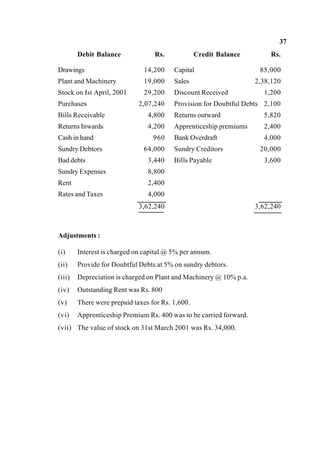
To Purchases A/c
To Direct Expenses A/c
(Being opening stock, purchases and direct expenses transferred to
Trading Account)
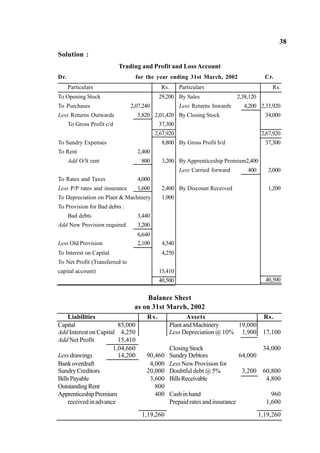
2. For transfer of sales and closing stock to Trading A/c
Sales A/c Dr.
Stock (Closing) A/c Dr.
To Trading A/c
(Being sales, closing stock transferred to Trading Account)
6
3.(a) For Gross Profit
Trading A/c Dr.
To Profit & Loss A/c
(Being gross profit transferred to Profit and Loss Account)
(b) For Gross Loss
Profit & Loss A/c Dr.
To Trading A/c
(Being gross loss transferred to Profit and Loss Account)
Important Points Regarding Trading Account
1. Stock
The term 'stock' includes goods lying unsold on a particular date.
The stock may be of two types:
(a) Opening stock
(b) Closing stock
Opening stock refers to the closing stock of unsold goods at the
end of previous accounting period which has been brought forward in the
current accounting period. This is shown on the debit side of the Trading
Account.
Closing stock refers to the stock of unsold goods at the end of
the current accounting period. Closing stock is valued either at cost price
or at market price whichever is less. Such valuation of stock is based on the
principle of conservatism which lays down that the expected profit should
not be taken into account but all possible losses should be duly provided
for.
Closing stock is an item which is not generally available in the
trial balance. If it is given in Trial Balance, it is not to be shown on the
credit side of Trading Account but appears only in the Balance Sheet as an
7
asset. But if it is given outside the trial balance, it is to be shown on the
credit side of the Trading Account as well as on the asset side of the Balance
Sheet.
2. Purchases
Purchases refer to those goods which have been bought for resale.
It includes both cash and credit purchases of goods. The following items
are shown by way of deduction from the amount of purchases:
(a) Purchases Returns or Return Outwards.
(b) Goods withdrawn by proprietor for his personal use.
(c) Goods received on consignment basis or on approval basis or on hire
purchase.
(d) Goods distributed by way of free samples.
(e) Goods given as charity.
3. Direct Expenses
Direct expenses are those expenses which are directly attributable
to the purchase of goods or to bring the goods in saleable condition. Some
example of direct expenses are as under:
(a) Carriage Inward
Carriage paid for bringing the goods to the godown is treated as
carriage inward and it is debited to Trading Account.
(b) Freight and insurance
Freight and insurance paid for acquiring goods or making them
saleable is debited to Trading Account. If it is paid for the sale of goods,
then it is to be charged (debited) to Profit and Loss Account.
(c) Wages
Wages incurred in a business are direct expenses, when they are
incurred on manufacturing or merchandise or on making it saleable. Other
8
wages are indirect wages. Only direct wages are debited to the Trading
Account. Other wages are debited to the Profit and Loss Account. If it is
not mentioned whether wages are direct or indirect, it should be assumed
as direct and should appear in the Trading Account.
(d) Fuel, Power and Lighting Expenses
Fuel and power expenses are incurred for running the machines.
Being directly related to production, these are considered as direct expenses
and debited to Trading Account. Lighting expenses of factory are also
charged to Trading Account, but lighting expenses of administrative office
or sales office are charged to Profit and Loss Account.
(e) Octroi
When goods are purchased within municipality limits, generally
octroi duty has to be paid on it. It is debited to Trading Account.
(f) Packing Charges
There are certain types of goods which cannot be sold without a
container or proper packing. These form a part of the finished product. One
example is ink, which cannot be sold without a bottle. These type of packing
charges are debited to Trading Account. But if the goods are packed for
their safe despatch to customers, i.e. packing meant for transportation or
fancy packing meant for advertisement, will appear in the Profit and Loss
Account.
(g) Manufacturing Expenses
All expenses incurred in manufacturing the goods in the factory
such as factory rent, factory insurance etc. are debited to Trading Account.
(h) Royalties
These are the payments made to a patentee, author or landlord
for the right to use his patent, copyright or land. If royalty is paid on the
9
basis of production, it is debited to Trading Account and if it is paid on the
basis of sales, it is debited to Profit and Loss Account.
4. Sales
Sales include both cash and credit sales of those goods which
were purchased for resale purposes. Some customers might return the goods
sold to them (called sales return) which are deducted from the sales in the
inner column and net amount is shown in the outer column. While
ascertaining the amount of sales, the following points need attention:
(a) If a fixed asset such as furniture, machinery etc. is sold, it should
not be included in sales.
(b) Goods sold on consignment or on hire purchase or on sale or
return basis should be recorded separately.
(c) If goods have been sold but not yet despatched, these should not
be shown under sales but are to be included in closing stock.
(d) Sales of goods on behalf of others and forward sales should also
be excluded from sales.
Illustration 1: From the following information, prepare the Trading Account
for the year ending on 31March 2002 :
Opening Stock Rs. 1,50,000, Cash Sales Rs. 60,000, Credit
Sales Rs. 12,00,000, Returns Outwards Rs. 10,000, Wages Rs. 4,000,
Carriage Inward Rs. 1,000, Freight Inward Rs. 3,000, Octroi Rs. 2,000, Cash
Purchases Rs. 50,000, Credit Purchases Rs. 10,00,000, Returns Inward Rs.
20,000, Closing Stock as on 31.3.2002 Rs. 84,000.
10
Solution :
To Freight Inwards 3,000
To Octroi 2,000
To Carriage Inwards 1,000
To Wages 4,000
To Gross Profit tfd. to P&L A/c 1,24,000
13,24,000
Trading Account
Dr. for the year ending on 31March, 2002 Cr.
Particulars Rs. Particulars Rs.
To Opening Stock 1,50,000 By Sales
To Purchases Cash Sales 60,000
Cash Purchases 50,000 Credit Sales 12,00,000
Credit Purchases 10,00,000 Total Sales 12,60,000
Total Purchase 10,50,000 Less : Return
Less : Return Inward 20,000 12,40,000
Outwards 10,000 10,40,000 By Closing Stock 84,000
8.3 MANUFACTURINGACCOUNT
13,24,000
Manufacturing Account is prepared by an enterprise engaged
in manufacturing activities. It is prepared to ascertain the cost of goods
manufactured during an accounting period. This account is closed by
transferring its balance to the debit of the Trading Account. A general format
of a Manufacturing Account is shown below :
11
Dr. Manufacturing Account of ...... for the period ending on........
Cr.
Particulars Rs. Particulars Rs.
To OpeningWork-in-progress
ToRawmaterialconsumed
OpeningStock
Add : Purchases
Add : Cartage Inwards
Add : Freight Inwards
Less : Return Outwards
Less : Closing Stock
To Wages
To Salary ofWorks Manager
To Power, Electricity &Water
ToFuel
To Postage &Telephone
ToDepreciationon:
Plant&Machinery
FactoryLand&Buildings
To Repairs to :
Plant&Machinery
FactoryLand&Building
ToInsurance
Plant&Machinery
FactoryLand&Building
To Rent and Taxes
ToGeneralExpenses
To Royaltybased onproduction
By Sale of Scrap
ByClosingWork-in-progress
ByTradingAccount
(Cost of goods produced transferred)
12
Trading Account Manufacturing Account
1. Trading Account is prepared to
find out the Gross Profit/Gross
Loss.
2. The balance of the Trading
account is transferred to the
Profit and Loss Account.
3. Sale of scrap is not shown in the
Trading Account.
4. Stocks of finished goods are
shown in the Trading Account.
5. Trading Account is a part of the
Profit and Loss Account.
Manufacturing account is prepared
to find out the cost of goods
produced.
The balance of the Manufacturing
Account is transferred to the
Trading Account.
Sale of crap is shown in the
Manufacturing Account.
Stocks of raw materials and work-
in-progress are shown in the
Manufacturing Account.
Manufacturing Account is a part of
the Trading Account.
DIFFERENCE BETWEEN TRADING ACCOUNT AND
MANUFACTURINGACCOUNT
Illustration 2 : From the following information, prepare a Manufacturing Account
for the year ending on 31 March 2002 :
Work-in-progress (1.4.2001)
Rs.
4,000 Wages
Rs.
20,000
Raw Material (31.3.2002) 90,000 Salary of Works Manager 8,000
Carriage Inwards 3,000 Power, Electricity & Water 6,000
Freight Inwards 2,000 Fuel 4,000
Return Outwards 2,700 Depreciation :
Sales of Scrap 1,000 Plant & Machinery 8,000
Work-in-progress (31.3.2002) 5,000 Factory Building 4,000
Raw Materials (1.4.2001) 74,000 Repairs & Insurance :
Raw Material Purchased 45,000 Plant & Machinery 6,000
General Expenses 2,000 Factory Building 2,000
Factory Rent & Taxes 10,000
13
Solution :
ManufacturingAccount
Dr. for the year ending on 31 March 2002 Cr.
Particulars Rs. Particulars Rs.
To OpeningWIP
ToRawMaterialsconsumed
OpeningStock 74,000
Add : Purchases 45,000
4,000 By Sale of Scrap
ByClosingWIP
ByTradingA/c (Cost of goods
manufacturedtransferred)
1,000
5,000
99,800
Add : Carriage Inwards 3,000
Add : Freight Inwards 2,000
Less : Returns Outwards 2,200
Less : Closing Stock 90,000 31,800
To Wages 20,000
To Salary ofWorks Managers 8,000
To Power, Electricity &Water 6,000
ToFuel 4,000
ToDepreciation
Plant&Machinery 8,000
FactoryBuilding 4,000
To Repairs & Insurance
Plant&Machinery 6,000
FactoryBuilding 2,000
To Factory Rent & Taxes 10,000
ToGeneralExpenses 2,000
1,05,800 1,05,800
8.4 4 PROFIT AND LOSS ACCOUNT
Trading Account results in the gross profit/loss made by a
businessman on purchasing and selling of goods. It does not take into
consideration the other operating expenses incurred by him during the course
of running the business. Besides this, a businessman may have other sources
of income. In order to ascertain the true profit or loss which the business
has made during a particular period, it is necessary that all such expenses
and incomes should be considered. Profit and Loss Account considers all
14
such expenses and incomes and gives the net profit made or net loss suffered
by a business during a particular period. All the indirect revenue expenses
and losses are shown on the debit side of the Profit and Loss Account, where
as all indirect revenue incomes are shown on the credit side of the Profit
and Loss Account.
Profit and Loss Account measures net income by matching
revenues and expenses according to the accounting principles. Net income
is the difference between total revenues and total expenses. In this
connection, we must remember that all the expenses, for the period are to
be debited to this account - whether paid or not. If it is paid in advance or
outstanding, proper adjustments are to be made (Discussed later). Likewise
all revenues, whether received or not are to be credited. Revenue if received
in advance or accrued but not received, proper adjustment is required.
A proforma of the Profit and Loss Account showing probable items
therein is as follows :
15
PROFIT AND LOSS ACCOUNT
For the year ended ...............
Particulars Rs. Particulars Rs.
To Gross Loss b/d
To Management Expenses:
Rent, Rates and Taxes
Heating and Lighting
Office Salaries
Printing & Stationary
Postage & Telegrams
Telephone Charges
Legal Charges
Audit Fees
Insurance
General Expenses
To Selling and Distribution
Expenses :
Advertisement
Tavellers' Salaries
Expenses & Commission
Godown Rent
Export Expenses
Carriage Outwards
Bank Charges
Agent's Commission
Upkeep of Motor Lorries
To Depreciation and
Maintenance :
Depreciation
Repairs & Maintenance
To Financial Expenses :
Discount Allowed
Interest on Loans
Discount on Bills
To Abnormal Losses:
Loss by fire (not
covered by Insurance)
Loss on Sale of Fixed
Assets
Loss on Sale of Investments
To Net profit transferred to
Capital A/c
By Gross Profit b/d
By Other Income :
Discount received
Commission received
By Non-trading Interest :
Bank Interest
Rent of property let-out
Dividend from shares
By Abnormal Gains :
Profit on sale of machinery
Profit on sale of investment
By Net Loss transferred to
Capital Account
16
Important Points in Profit and Loss Account
(i) Salaries. These include salaries paid to office, godowns and
warehouse staff and should be shown in Profit and Loss Account being
indirect expenses. Salaries to partners must be debited separately.
If salaries are paid after deduction of Income tax or Provident Fund then
these should be added back to the salaries in order to have gross figure of salaries
to be shown in Profit and Loss Account. If salaries are paid in kind by providing
certain facilities to the employees such as house free of rent, meals or cloth or
washing facility free of charge, then the value of such facilities should be regarded
as salaries.
(ii) Rent, Rates and Taxes. These include offices and warehouse rent, municipal
rates and taxes. Factory rent, rates and taxes should be debited to TradingAccount
and others to Profit and Loss Account. If any rent is received on subletting of the
building, the same should be shown separately on the credit side of the Profit and
Loss Account. If rent is paid after deduction of some taxes then these should be
added back to know the correct amount of rent payable.
(iii) Interest. Interest paid on loans, overdrafts and bills overdue is an expense
and is taken to the debit side of Profit and Loss Account. Interest received on loans
advanced by the firm, on deposits and on securities is a gain and is shown on the
credit side of Profit and Loss Account. Interest on capital should be shown separately
on the debit side and interest on drawing on the credit side of Profit and Loss
Account.
(iv) Commission. Commission received for doing the work of other firms may
be credited to Profit and Loss Account as a gain and commission payable to the
agents employed to sell the firm's goods is debited to Profit and Loss Account as
an expense.
(v) Repairs. Repairs and small renewals or replacements relating to the plant
and machinery, fixtures, fittings and utensils etc. are generally included under this
17
heading and such expenditure, being as expense, is debited to Profit and Loss
Account.
(vi) Depreciation. It is an expense due to wear and tear, lapse of time and
exhaustion of assets used in business. This is loss sustained by fixed assets and
should be charged to Profit and Loss Account.
(vii) Advertising . All sums spent on advertising should be charged to Profit and
Loss Account. If a large amount is paid under a contract covering two or three
years, proportionate part should be charged to Profit and Loss Account and the
balance appears as an asset in the Balance Sheet.
Expenses not to be shown in Profit and Loss Account
(i) Domestic and Household Expenses. These expenses are not shown in Profit
and Loss Account, as these are personal expenses of the proprietor and should be
treated as drawings.
(ii) Income tax. It should be treated as a personal expense of the proprietor and
added to drawing. It should not be shown as an expense in Profit and Loss Account.
(iii) Life Insurance Premium. Premium paid on the life police of the proprietor
should be charged to the Drawings Account.
Closing Entries for Profit and Loss Account
(i) For transfer of various expenses to Profit & Loss A/c
Profit and Loss A/c Dr.
To Various Expenses A/c
(Being various indirect expenses transferred to Profit and Loss
Account)
(ii) For transfer of various incomes and gains to Profit & Loss A/c
Various Incomes & Gains A/c Dr.
To Profit & Loss A/c
(Being various incomes & gains transferred to Profit and Loss
Account)
18
(iii)(a) For Net Profit
Profit & Loss A/c Dr.
To Capital A/c
(Being Net Profit transferred to capital
(b) For Net Loss
Capital A/c Dr.
To Profit & Loss A/c
(Being Net Loss transferred to Capital Account)
DISTINCTION BETWEEN TRADING ACCOUNT AND
PROFIT AND LOSS ACCOUNT
Trading Account Profit and Loss Account
1. Trading Account is prepared as
a part or section of the Profit
and Loss Account.
2. Direct Expenses are taken in
Trading Account.
3. Gross Profit or Gross Loss is
ascertained from Trading
Account.
4. The Balance of the Trading
Account i.e. Gross Profit or
Gross Loss is transferred to the
Profit and Loss Account.
5. Items of account written in the
Trading Account are few as
compared the Profit and Loss
Account.
Profit and Loss Account is
prepared as a main account.
Indirect expenses are taken in
Profit and Loss Account.
Net Profit or Net Loss is
ascertained from the Profit and
Loss Account.
The balance of the Profit and
Loss Account i.e. Net Profit or
Net Loss is transferred to
proprietor's Capital Account.
Items of accounts written in the
Profit and Loss Account are
much more as compared to the
Trading Account.
8.5 5 BALANCE SHEET
A Balance Sheet is a statement of financial position of a
business concern at a given date. It is called a Balance Sheet because it is a
sheet of balances of those ledger accounts which have not been closed till
the preparation of Trading and Profit and Loss Account. After the preparation
19
of Trading and Profit and Loss Account the balances left in the trial balance
represent either personal or real accounts. In other words, they either
represent assets or liabilities existing on a particular date. Excess of assets
over liabilities represent the capital and is indicative of the financial
soundness of a company.
A Balance Sheet is also described as a "Statement showing
the Sources and Applications of Capital". It is a statement and not an account
and prepared from real and personal accounts. The left hand side of the
Balance Sheet may be viewed as description of the sources from which the
business has obtained the capital with which it currently operates and the
right hand side as a description of the form in which that capital is invested
on a specified date.
Characteristics
The characteristics of a Balance Sheet are summarised as under:
(a) A Balance Sheet is only a statement and not an account. It has no
debit side or credit side. The headings of the two sides are 'Assets'
and 'Liabilities'.
(b) A Balance Sheet is prepared at a particular point of time and not for
a particular period. The information contained in the Balance Sheet
is true only at that particular point of time at which it is prepared.
(c) A Balance Sheet is a summary of balances of those ledger accounts
which have not been closed by transfer to Trading and Profit and Loss
Account.
(d) A Balance Sheet shows the nature and value of assets and the nature
and the amount of liabilities at a given date.
20
8.5.1 Classification of Assets and Liabilities
Assets
Assets are the properties possessed by a business and the
amount due to it from others. The various types of assets are :
(a) Fixed Assets
All assets which are acquired for the purpose of using them in the
conduct of business operations and not for reselling to earn profit are called
fixed assets. These assets are not readily convertible into cash in the normal
course of business operations. Examples are land and building, furniture,
machinery, etc.
(b)Current Assets
All assets which are acquired for reselling during the course of
business are to be treated as current assets. Examples are cash and bank
balances, inventory, accounts receivables, etc.
(c) Tangible Assets
These are definite assets which can be seen, touched and have volume
such as machinery, cash, stock, etc.
(d)Intangible Assets
Those assets which cannot be seen, touched and have no volume but
have value are called intangible assets. Goodwill, patents and trade marks
are examples of such assets.
(e) Fictitious Assets
Fictitious assets are not assets at all since they are not represented
by any tangible possession. They appear on the asset side simply because
of a debit balance in a particular account not yet written off e.g. provision
for discount on creditors, discount on issue of shares etc.
21
(f) Wasting Assets
Such assets as mines, quarries etc. that become exhausted or reduce
in value by their working are called wasting assets.
Liabilities
A liability is an amount which a business is legally bound to
pay. It is a claim by an outsider on the assets of a business. The liabilities
of a business concern may be classified as :
(a) Fixed Liabilities
These are those liabilities which are payable only on the
termination of the business such as capital contributed by the owner.
(b) Long Term Liabilities
The liabilities or obligations of a business which are not payable within
the next accounting period but will be payable within next five to ten years
are known as long term liabilities. Public deposits, debentures, bank loan
are the examples of long term liabilities.
(c) Current Liabilities
All short term obligations generally due and payable within one year
are current liabilities. This includes trade creditors, bills payable etc.
(d) Contingent Liabilities
A contingent liability is one which is not an actual liability but which
may become an actual one on the happening of some event which is uncertain.
Thus such liabilities have two characteristics : (a) uncertainty as to whether the
amount will be payable at all, and (b) uncertainty about the amount involved.
Examples of such liabilities are :
(a) Claims against the companies not acknowledged as debts.
(b) Uncalled liability on partly paid up shares.
(c) Arrears of fixed cumulative dividend.
(d) Estimated amount of contracts remaining to be executed on capital
account and not provided for.
22
(e) Liability of a case pending in the court.
(f) Bills of exchange, guarantees given against a particular firm or person.
8.5.2 Grouping and Marshalling of Assets and Liabilities
The arrangement of assets and liabilities in certain groups and in a
particular order is called Grouping and Marshalling of the Balance Sheet of a
business. Assets and liabilities can be arranged in the Balance Sheet into two
ways :
(i) In order of liquidity.
(ii) In order of permanence.
(i) In order of liquidity. When assets and liabilities are arranged according
to their reliability and payment preferences, such an order is called liquidity
order. Such arrangement is given in the Balance Sheet (I).
Balance Sheet (I)
Liabilities Rs. Assets Rs.
Current Liabilities :
Bills Payable
Sundry Creditors
BankOverdraft
Long Term Liabilities :
Loan from Bank
Debentures
Fixed Liabilities :
Capital
Liquid Assets :
Cash inHand
Cash at Bank
Floating Assets :
Sundry Debtors
Investments
Bill Receivable
Stock in Trade
Prepaid Expenses
Fixed Assets :
Machiner
y Building
Furniture & Fixtures
Motor Car
Fictitious Assets :
Advertisement
Misc. Expenses
Profit & Loss A/c
Intangible Assets
Goodwill
Patents
Copyright
23
(ii) In order of permanence. When the order is reversed from that what is
followed in case of liquidity, it is called order of permanence. This order is
followed in case of joint stock companies compulsorily but can be followed in
other forms of business organisations also. Fixed assets and liabilities are shown
first on the assumption that these will be sold or paid only on the insolvency of
a business. This order of Balance Sheet is given below in Balance Sheet (II).
Balance Sheet (II)
Liabilities Rs. Assets Rs.
Fixed Liabilities
Long Term Liabilities
Current Liabilities
Intangible Assets
Fictitious Assets
Fixed Assets
Floating Assets
Liquid Assets
Illustration 3: The following balances are extracted from the books of Nikhil &
Co. on 31st March, 2002. You are required to make the necessary closing entries
and to prepare the Trading and Profit and LossAccount and a Balance Sheet as on
that date :
Opening Stock
Rs.
500 Commission (Cr.)
Rs.
200
B/R 2,250 Returns Outwards 250
Purchases 19,500 Trade Expenses 100
Wages 1,400 Office Fixtures 500
Insurance 550 Cash inHand 250
Sundry Debtors 15,000 Cash at Bank 2,375
CarriageInwards 400 Rent &Taxes 550
Commission (Dr.) 400 Carriage Outwards 725
Interest on Capital 350 Sales 25,000
Stationary 225 Bills Payable 1,500
Returns Inwards 650 Creditors 9,825
Capital 8,950
The Closing Stock was valued at Rs. 12,500.
24
Solution :
Closing Entries
Date Particulars Dr. Cr.
2002
TradingAccount
To Stock A/c
To PurchasesA/c
To WagesA/c
To Returns InwardsA/c
To Carriage InwardsA/c
(Beingbalancetransferred)
Dr.
Amount Amount
Rs. Rs.
March 31 22,450
500
19,500
1,400
650
400
" Sales A/c
Returns Outwards A/c
ToTradingAccount
(Beingbalancestransferred)
ClosingStockA/c
ToTradingA/c
(Beingvalueofclosingstock)
Dr.
Dr.
Dr.
25,000
250
12,500
25,250
12,500
" TradingAccount
To Profit and LossA/c
(Beinggrossprofittransferred)
Dr. 15,300
15,300
" ProfitandLoss Account
To InsuranceA/c
ToCommissionA/c
To Interest on CapitalA/c
ToStationaryA/c
ToTrade ExpensesA/c
To Rent and TaxesA/c
To Carriage OutwardsA/c
(Beingbalancestransferred)
Dr. 2,900
550
400
350
225
100
550
725
" CommissionA/c
To Profit & LossA/c
(Beingbalancetransferred)
Dr. 200
200
" Profit and Loss A/c
To CapitalA/c
(Beingnetprofittransferred)
Dr. 12,600
12,600
25
Trading & Profit and Loss A/c of Messers Nikhil & Co.
for the year ended 31st March, 2002
Particulars Rs. Particulars Rs.
To Opening Stock
To Purchases 1
Less: Returns Outwards
To Wages
To Carriage Inwards
To Gross Profit c/d
ToInsurance
ToCommission
To Interest on Capital
ToStationary
ToTrade Expenses
To Rent and Taxes
To Carriage Outwards
To Net Profit transferred to Ca
9,500
250
500
19,250
1,400
400
15,300
BySales
Less: Returns Inwards
ByClosingStock
By Gross Profit b/d
ByCommission
25,000
650 24,350
12,500
pital A/c
36,850 36,850
550
400
350
225
100
550
725
12,600
15,300
200
15,500 15,500
Balance Sheet of Messers Nikhil & Co.
as on 31st March, 2002
Liabilities Rs. Assets Rs.
Creditors
8,950
9,825 Cashin Hand 250
BillsPayable 1,500 Cash at Bank 2,375
Capital BillReceivable 2,250
March 31, 2002
Stock 12,500
Add : Net Profit 12,600 21,550 SundryDebtors 15,000
OfficeFixtures 500
32,875 32,875
26
8.6 ADJUSTMENT ENTRIES
While preparing Trading and Profit and Loss Account one point
that must be kept in mind is that expenses and incomes for the full trading
period are to be taken into consideration. For example if an expense has
been incurred but not paid during that period, liability for the unpaid amount
should be created before the accounts can be said to show the profit or
loss. All expenses and incomes should properly be adjusted through entries.
These entries which are passed at the end of the accounting period are
called adjusting entries . Some important adjustments which are to be made
at the end of the accounting year are discussed in the following pages.
1. Closing Stock
This is the stock which remained unsold at the end of the
accounting period. Unless it is considered while preparing the Trading
Account, the gross profit shall not be correct. Adjusting entry for closing
stock is as under :
Closing Stock Account Dr.
To Trading Account
(Being closing stock brought in to books)
Treatment in final accounts
(i) Closing stock is shown on the credit side of Trading Account.
(ii) At same value it will be shown as an asset in the Balance Sheet.
2. Outstanding Expenses
Expenses which have become due and have not been paid by the
end of financial year, are called outstanding expenses.
For example, when Profit and Loss Account is being prepared on
31st March 31, 2002, it may be found that salaries for the month of March have
become due on March 31, 2002 but have not been paid till that date. This must
27
be shown on the debit side of Profit and Loss Account being prepared on March
31, 2002. The entry will be as under :
Salary account Dr.
To Outstanding salary account
(Being salary due but not paid)
Treatment in final accounts :
(i) The amount of outstanding salary shall be added to particular
expenses on the debit side of Profit and Loss Account.
(ii) In balance sheet the same amount will be shown as a liability.
3. Unexpired or Prepaid Expenses
Those expenses which have been paid in advance, i.e., whose benefit
will be available in future are called unexpired or prepaid expenses. For example,
if a fire insurance policy is taken for a year paying Rs. 1,000 as insurance
premium on Ist July, 2000 and will expire on 30th June, 2001, the position on
31st March 2001, when accounts are closed, will be that Rs. 750, i.e., premium
from Ist July, 2000 to 31st March, 2001 will be an expense but Rs. 250 i.e.,
premium from Ist April, 2001 to 30th June, 2001 will be unexpired expense. In
order to bring this into account on 31st March, 2001, the following entry will
be passed :
Prepaid Insurance Premium A/c Dr. Rs. 250
To Insurance PremiumA/c Rs. 250
The two-fold effect of prepaid expenses will be :
(i) Prepaid expenses will be shown in the Profit and Loss Account by way of
deduction from the expenses and
28
(ii) These will be shown on the assets side of the Balance Sheet as prepaid
expenses. In the beginning of the next year, a reverse entry will be passed
to nullify the effect of adjusting entry.
4. Accrued Income
That income which has been earned but not received during the accounting
year is called accrued income. For example, if the business has invested Rs.
10,000 in 5% gilt edged securities on Ist April, 2001 but during the year Rs.
350 has been received as interest on securities. Then Rs. 150 interest on
securities earned and due for payment on 31st March, 2002 but not received,
will be accrued interest for the year 2001-2002. In order to bring accrued interest
into books of account, the following adjusting entry will be passed :
Accrued Interest A/c Dr. Rs. 150
To Interest A/c Rs. 150
The two-fold effect of accrued income will be :
(i) It will be shown on the credit side of Profit and Loss Account by way of
addition to the income, and
(ii) It will be shown on the assets side of the Balance Sheet as Accrued
Income.
Next year, in the beginning, a reverse entry will be passed in order to
eliminate the effect of adjusting entry and to bring the same to the correct
position.
5. Income Received in Advance
Income received but not earned during the accounting year is called as
income received in advance. For example, if building has been given to a tenant
on Rs. 2,400 per annum but during the year Rs. 3,000 has been received, then
Rs. 600 will be income received in advance. In order to bring this into books of
29
account, the following adjusting entry will be made at the end of the accounting
year :
Rent A/c Dr. Rs. 600
To Rent Received inAdvanceAccount Rs. 600
The two-fold effect of this adjustment will be :
(i) It is shown on the credit side of Profit and Loss Account by way of
deduction from the income, and
(ii) It is shown on the liabilities side of the Balance sheet as income received
in advance.
A reverse entry will be passed at the beginning of the next year to
nullify the effect of adjusting entry.
6. Depreciation
Depreciation is the reduction in the value of fixed asset due to
its use, wear and tear or obsolescence. When an asset is used for earning
purposes, it is necessary that reduction due to its use, must be charged to
the Profit and Loss Account of that year in order to show correct profit or
loss and to show the asset at its correct value in the Balance Sheet. There
are various methods of charging depreciation on fixed assets. Suppose
machinery for Rs.10,000 is purchased on 1.1.2001, 20% p.a. is the rate of
depreciation. Then Rs.2,000 will be depreciation for the year 2001 and will
be brought into account by passing the following adjusting entry :
Depreciation A/c Dr. Rs.2,000
To Machinery A/c Rs.2,000
The two-fold effect of depreciation will be :
(i) Depreciation is shown on the debit side of Profit and Loss
Account, and
30
(ii) It is shown on the asset side of the Balance Sheet by way of
deduction from the value of concerned asset.
7. Interest on Capital
The amount of capital invested by the trader in his business is
just like a loan by the firm. Charging interest on capital is based on the
argument that if the same amount of capital were invested in some securities
elsewhere, the businessman would have received interest thereon. Such
interest on capital is not actually paid to the businessman. Interest on capital
is a gain to the businessman because it increases its capital, but it is a loss
to the business concern.
Interest is calculated on the opening balance of the capital at
the given rate for the full accounting period. If some additional amount of
capital has been brought in the business during the course of accounting
period, interest on such additional amount of capital is calculated from the
date of introduction to the end of the accounting period. The following
adjustment entry is passed for allowing interest on capital :
Interest on Capital Account Dr.
To Capital Account
Treatment in final accounts
(i) Interest allowed on capital is an expense for the business and is
debited to Profit and Loss Account, i.e. it is shown on the debit
side of the Profit and Loss Account.
(ii)Such interest is not actually paid in cash to the businessman but
added to his capital account. Hence, it is shown as an addition to
capital on the liabilities side of the Balance Sheet.
8. Interest of Drawings
It interest on capital is allowed, it is but natural that interest
on drawings should be charged from the proprietor, as drawings reduce
31
capital. Suppose during an accounting year, drawings are Rs.10,000 and
interest on drawings is Rs.500. In order to bring this into account, the
following entry will be passed :
Drawings A/c Dr. Rs.500
To Interest on Drawings A/c Rs.500
The two-fold effect of interest on drawings will be :
(i) Interest on drawings will be shown on the credit side of Profit
and Loss Account, and
(ii)Shown on the liabilities side of the Balance Sheet by way of
addition to the drawings which are ultimately deducted from the
capital.
9. Bad Debts
Debts which cannot be recovered or become irrecoverable are
called bad debts. It is a loss for the business. Such a loss is recorded in the
books by making following adjustment entry :
Bad Debts A/c Dr.
To Sundry Debtors A/c
The two-fold effect of bad debts will be that bad debts will be :
(i) Shown on the debit side of Profit and Loss Account, and
(ii) Shown on the assets side of the Balance Sheet by way of deduction from
sundry debtors.
10. Provisions for Doubtful Debts
In addition to the actual bad debts, a business unit may find on
the last day of the accounting period that certain debts are doubtful, i.e.,
the amount to be received from debtors may or may not be received. The
amount of doubtful debts is calculated either by carefully examining the
position of each debtor individually and summing up the amount of doubtful
32
debts from various debtors or it may be computed (as is usually done) on
the basis of some percentage (say 5%) of debtors at the end of the
accounting period. The percentage to be adopted is usually based upon the
past experience of the business. The reasons for making provision for
doubtful debts are two as discussed below :
(a) Loss caused by likely bad debts must be charged to the Profit and
Loss Account of the period for which credit sales have been made to
ascertain correct profit of the period.
(b) For showing the true position of realisable amount of debtors in the
Balance Sheet, i.e., provision for doubtful debts will be deducted from
the amount of debtors to be shown in the Balance Sheet.
For example, sundry debtors on 31.03.2002 are Rs.55,200.
Further bad debts are Rs.200. Provision for doubtful debts @ 5% is to be
made on debtors. In order to bring the provision for doubtful debts of
Rs.2,750, i.e., 5% on Rs.55,000 (55,200-200), the following entry will be
made :
Profit and Loss A/c Dr. Rs.2,750
To Provision for Doubtful Debts A/c Rs.2,750
It may be carefully noted that further bad debts (if any) will be
first deducted from debtors and then a fixed percentage will be applied on
the remaining debtors left after deducting further debts. It is so because
percentage is for likely bad debts and not for bad debts which have been
decided to be written off.
Treatment in final accounts
(i) The amount of provision for doubtful debts is a provision against a
possible loss so it should be debited to Profit and Loss Account.
33
(ii) The amount of provision for doubtful debts is deducted from sundry
debtors on the assets side of the Balance Sheet.
11. Provision for Discount on Debtors
It is a normal practice in business to allow discount to
customers for prompt payment and it constitutes a substantial sum.
Sometimes the goods are sold on credit to customers in one accounting
period whereas the payment of the same is received in the next accounting
period and discount is to be allowed. It is a prudent policy to charge this
expenditure (discount allowed) to the period in which sales have been made,
so a provision is created in the same manner, as in case of provision for
doubtful debts i.e.
Profit and Loss Account Dr.
To Provision for Discount on Debtors Account
Treatment in final accounts
(i) Provision for discount on debtors is a probable loss, so it should be
shown on the debit side of Profit and Loss Account.
(ii) Amount of provision for discount on debtors is deducted from sundry
debtors on the assets side of the Balance Sheet.
Note : Such provision is made on debtors after deduction of further bad
debts and provision for doubtful debts because discount is allowable to
debtors who intend to make the payment.
12. Reserve for Discount on Creditors
Prompt payments to creditors enables a businessman to earn
discount from them. When a businessman receives cash discount regularly,
he can make a provision for such discount since he is likely to receive the
discount from his creditors in the following years also. The discount
received being a profit, the provision for discount on creditors amounts to
an addition to the profit.
34
Accounting treatment of Reserve for Discount on Creditors is
just reverse of that in the case of Provision for Discount on Debtors. The
adjustment entries for Reserve for Discount on Creditors is as follows :
Reserve for Discount on Creditors Account Dr.
To Profit and Loss Account
Treatment in final accounts
i) Reserve for discount on creditors is shown on the credit side of Profit
and Loss Account.
ii) In the liabilities side of the Balance Sheet, the reserve for discount
on creditors is shown by way of deductions from Sundry Creditors.
13. Deferred Revenue Expenditure
The expenditure done in the initial stage but the benefit of which will
also be available in subsequent years is called deferred revenue expenditure.
Part of such expenditure will be written off in each year and the rest will be
capitalised. The entry for this expenditure (say advertisement Rs. 2,000 which
will be spread over 5 years) will be :
Profit and Loss A/c Dr. Rs. 400
ToAdvertisement A/c Rs. 400
The two-fold effect of such expenditure will be :
(i) It is shown on the debit side of Profit and Loss Account, and
(ii) It is shown on the assets side by way of deduction from capitalised
expense.
14. Loss of Stock by Fire
In business, the loss of stock may occur due to fire. The position of the
business may be :
35
(a) All the stock is fully insured.
(b) The stock is partly insured.
(c) The stock is not insured at all.
If the stock is fully insured, the whole loss (say Rs. 15,000) will
be claimed from the insurance company. The following entry will be passed :
Insurance Co. A/c Dr. Rs. 15,000
To TradingA/c Rs. 15,000
The double effect on this entry will be :
(i) It will be shown on the credit side of the Trading Account, and
(ii) It is shown on the assets side of the Balance Sheet.
If the stock is not fully insured, the loss of stock covered by
insurance policy (say Rs. 10,000) will be claimed from the insurance company
and the rest of the amount (say Rs. 5,000) will be loss for the business. The
following entry will be passed:
Insurance Co. A/c Dr. Rs. 10,000
Profit & Loss A/c Dr. Rs. 5,000
To TradingA/c Rs. 15,000
The two-fold effect of this entry will be :
(i) It will be shown on the credit side of the Trading Account with the value
of stock and shown on the debit side of the Profit and Loss Account for
that part of the stock which is not insured, and
(ii) It is shown on the assets side of the Balance Sheet with the amount which
is to be realised from the Insurance Co., i.e., that part of the loss which is
insured.
36
If the stock is not insured at all, whole of the loss (say Rs. 15,000)
will be borne by the firm. The entry for this will be :
Profit and Loss A/c Dr. Rs. 15,000
To TradingA/c Rs. 15,000
The double effect of this entry will be :
(i) It is shown on the credit side of the Trading Account, and
(ii) It is shown on the debit side of the Profit and Loss Account.
16. Goods Distributed as Free Samples
Sometimes in order to promote the sale of goods, some of the produced
goods are distributed as free samples. For example, if goods worth Rs. 2,000
are distributed as free samples then it will be an advertisement for the concern
and on other hand stock will be less by such goods. In order to bring this into
books of account, the following entry is passed :
Advertisement A/c Dr. Rs. 2,000
To Trading or Purchases A/c Rs. 2,000
The two-fold effect of this entry will be :
(i) It is shown on the credit side of the Trading Account, or deducted from
the purchases, and
(ii) It is also shown on the credit side of the Profit and Loss Account as
advertisement expenses.
Illustration 4 : From the following Trial Balance of Mr. Nitin, prepare Trading
and Profit and Loss Account for the year ending 31st March, 2002 and Balance
Sheet on that date :
37
Debit Balance Rs. Credit Balance Rs.
Drawings 14,200 Capital 85,000
Plant and Machinery 19,000 Sales 2,38,120
Stock on Ist April, 2001 29,200 Discount Received 1,200
Purchases 2,07,240 Provision for Doubtful Debts 2,100
Bills Receivable 4,800 Returns outward 5,820
Returns Inwards 4,200 Apprenticeship premiums 2,400
Cash in hand 960 Bank Overdraft 4,000
Sundry Debtors 64,000 Sundry Creditors 20,000
Bad debts 3,440 Bills Payable 3,600
Sundry Expenses 8,800
Rent 2,400
Rates and Taxes 4,000
3,62,240 3,62,240
Adjustments :
(i) Interest is charged on capital @ 5% per annum.
(ii) Provide for Doubtful Debts at 5% on sundry debtors.
(iii) Depreciation is charged on Plant and Machinery @ 10% p.a.
(iv) Outstanding Rent was Rs. 800
(v) There were prepaid taxes for Rs. 1,600.
(vi) Apprenticeship Premium Rs. 400 was to be carried forward.
(vii) The value of stock on 31st March 2001 was Rs. 34,000.
38
Bad debts 3,440
Add New Provision required 3,200
6,640
Less Old Provision 2,100 4,540
To Interest on Capital
To Net Profit (Transferred to
capital account)
4,250
15,410
40,500
Solution :
Trading and Profit and Loss Account
Dr. for the year ending 31st March, 2002 Cr.
Particulars Rs. Particulars Rs.
To Opening Stock 29,200 By Sales 2,38,120
To Purchases 2,07,240 Less Returns Inwards 4,200 2,33,920
Less Returns Outwards 5,820 2,01,420 By Closing Stock 34,000
To Gross Profit c/d 37,300
2,67,920 2,67,920
To Sundry Expenses 8,800 By Gross Profit b/d 37,300
To Rent 2,400
Add O/S rent 800 3,200 By Apprenticeship Premium2,400
Less Carried forward 400 2,000
To Rates and Taxes 4,000
Less P/P rates and insurance 1,600 2,400 By Discount Received 1,200
To Depreciation on Plant & Machinery 1,900
To Provision for Bad debts :
40,500
Balance Sheet
as on 31st March, 2002
Liabilities Rs. Assets Rs.
Capital 85,000 PlantandMachinery 19,000
Add Interest on Capital 4,250 Less Depreciation @ 10% 1,900 17,100
Add Net Profit 15,410
1,04,660 ClosingStock 34,000
Lessdrawings 14,200 90,460 SundryDebtors 64,000
Bankoverdraft 4,000 Less New Provision for
SundryCreditors 20,000 Doubtful debt @ 5% 3,200 60,800
BillsPayable 3,600 BillsReceivable 4,800
OutstandingRent 800
ApprenticeshipPremium 400 Cashinhand 960
receivedinadvance Prepaidrates andinsurance 1,600
1,19,260 1,19,260
39
8.7 SUMMARY
Financial statements are the means of conveying to management, owners
and interested outsiders a concise picture of profitability and financial position
of the business. The preparation of the final accounts is not the first step in the
accounting process but they are the end products of the accounting process which
give a concise accounting information of the accounting period after the
accounting period is over. In order to know the profit or loss earned by a firm,
Trading and Profit and LossAccount is prepared. Balance Sheet will portray the
financial condition of the firm on a particular date.
8.8 KEYWORDS
Trading account: It is an account which is prepared to ascertain the gross profit
or loss of the business.
Manufacturing account: It is prepared in order to know the cost of production
of goods or services manufactured.
Profit and Loss account: The object of profit and Loss Account is to reveal
the net profit or loss of the business.
Balance sheet: A balance sheet is a statement which portrays the financial
position of the business.
Grouping and marshalling of assets and liabilities: The arrangement of
assets and liabilities in certain groups and in a particular order is called grouping
and marshalling of the balance sheet of a business.
Prepaid expenses: Those expenses which have been paid in advance i.e. whose
benefit will be available in future are called prepaid expenses.
40
8.9 SELF ASSESSMENT QUESTIONS
1. Distinguish between Trading Account and Profit & Loss Account.
Give a specimen of Trading and Profit & Loss Account with imaginary
figures.
2. What is a Balance Sheet? What do you understand by Marshalling
used in the Balance Sheet ? Illustrate the different forms of
marshalling.
3. What are closing entries. Give the closing entries which are passed
at the end of the accounting period.
4. What are adjustment entries? Why are these necessary for preparing
final account.
5. Prepare a Trading Account of a businessman for the year ending 31st
December, 1998 from the following data :
Rs.
Stock on 1.1.1998 2,40,000
Cash purchases for the year 2,08,000
Credit purchases for the year 4, 00,000
Cash sales for the year 3,50,000
Credit sales for the year 6,00,000
Purchases returns during the year 8,000
Sales returns during the year
Direct expenses incurred :
Freight
10,000
10,000
Carriage 2,000
Import Duty 8,000
Clearing Charges 12,000
Cost of goods distributed as free samples during the year 5,000
Goods withdrawn by the trader for personal use 2,000
Stock damaged by fire during the year 13,000
The cost of unsold stock on 31st December, 1998 was Rs.1,20,000
but its market value was Rs.1,50,000.
41
6. The following Trading and Profit and Loss Account has been prepared
by a junior accountant of a firm. Criticise it and redraft it correctly.,
TRADING & PROFIT AND LOSS A/c
For the year ended 31st March, 1999
Particulars Rs. Particulars Rs.
To
To
To
To
Opening stock of raw
material
Purchases
Sundry creditors
Carriage inwards
7,352
63,681
25,375
2,654
By Closing stock of raw
material
By Sales
By Sundry debtors
By Gross Loss c/d
9,368
1,70,852
40,659
8,182
To Carriage outwards 394
To Salaries 24,370
To Wages 51,963
To Rent, Rates & Taxes 3,981
To Repairs to factory 35,368
To Insurance 13,923
2,29,061 2,29,061
PROFIT & LOSS ACCOUNT
Particulars Rs. Particulars Rs.
To Gross Loss b/d
To Interest on loans
To Dividend from
investments
To Furniture purchases
8,182
6,180
9,375
17,681
By Bank overdraft
By Interest on bank
overdraft
By net loss transferred
to Balance Sheet
17,681
123
39,691
To Telephone charges 985
To Electric charges 2,756
To Depreciation - Plant & 663
machinery
To Charges general 11,673
57,495
57,495
42
7. On 31st March, 1997, Mr. Rohin's Debtors totalled Rs. 11,600, While
making up final accounts of his business, he created a provision of 5% on debtors
for doubtful debts. During the year ending on 31st March, 1998, actual bad debts
were Rs. 480. Sundry Debtors on 31st March, 1998 amounted to Rs. 15,000 on
which a provision of 5% was considered necessary.
Show : i) Adjusting entries for two years.
ii) Provision for Doubtful Debts Account for two years.
8. On 31st March, 2002 the following Trial Balance was extracted from
the books of Mr. Deepak Kumar :
Debit Balances Rs. Credit Balances Rs.
Sundry Debtors 20,100 Capital 28,000
Drawings 3,000 Loan On Mortgage 9,500
Bills receivable 6,882 Rent Received 250
Interest on Loan 300 Bill Payable 2,614
Cash at Bank 3,555 Discount Received 540
Motor Van 10,000 Sales 1,10,243
Stock on Ist April, 2001 6,839 Sundry Creditor 10,401
Cash in hand 2,050 Bad debts Reserve 710
Land and Building 12,000 Return Inwards 1,346
General Expenses 3,489
Advertising 3,264
Rent, Rates, Taxes and Insurance 2,891
Salaries 9,097
Bad debts 525
Purchases 66,458
Returns Inwards 7,821
Carriage Inwards 2,929
Carriage Outwards 2,404
1,63,604 1,63,604
43
Preparing Trading and Profit and LossAccount for the year ending
31st March, 2002 and Balance Sheet as on that after making following
adjustments :
(i) Closing stock is valued at Rs. 6,250
(ii) Depreciate Land and Building at 2%, Motor van at 20%
(iii) Salaries Rs. 750 and rates Rs. 350 are outstanding.
(iv) Goods costing Rs. 500 were sent to a customer on sale or return for Rs.
600.
(v) Goods costing Rs. 1,000 were taken by proprietor for private use, had
been treated as credit sales.
(vi) Prepaid insurance Rs. 150.
(vii) Provision for Bad debts is to be maintained at 5% on Debtors.
(viii) Provide interest on loan on mortgage 6% p.a. for 6 months.
(ix) Provide for manager's commission at 10% on net profits after charging
such commission.
8.10 SUGGESTED READINGS
1. R.L. Gupta,AdvancedAccountancy.
2. S.N. Maheshwari,AdvancedAccountancy.
3. M.C. Shukla, T.S. Grewal,AdvancedAccounts.
1
Subject:Accounting for Managers Updated by:Dr. MaheshChandGarg
Course Code : CP-104
Lesson No. : 9
PREPARATION OF FINAL ACCOUNTS OF A JOINT STOCK
COMPANY AND ACCOUNTING PACKAGES LIKE TALLY, EX
STRUCTURE
9.1 Objective
9.2 Introduction
9.3 General Requirements of Companies Act
9.4 Form and contents of Profit and Loss Account
9.5 Profit and Loss Appropriation Account
9.6 Forms and Contents of Balance Sheet
9.7 Accounting Treatment of Special Items
9.8 Accounting Packages
9.9 Summary
9.10 Keywords
9.11 Self Assessment Questions
9.12 Suggested Readings
9.0 OBJECTIVES
You will learn from this lesson :
(a) Requirements of the Companies Act for presentation of Final Accounts of
a Company.
(b) Treatment of Special Items relating to Company Final Accounts
(c) Accounting Packages
9.1 INTRODUCTION
The joint stock companies, are legally required to prepare a set of
financial statements to periodically assess the profits earned and to know the
financial position of the company as on a specified date. Thus, like other business
2
enterprises, a limited company prepares the Income Statement and the Balance
Sheet at the close of accounting year. However, in the case of companies registered
under the Companies Act, the Act specifies that the books of accounts be
maintained and also prescribes the format and contents in which financial
statements are to be prepared. In addition to this, the Act provides that accounts
must be audited by an external person called the auditor and the auditor has to
submit its report in the prescribed format to the shareholders.
Since the owners or shareholders elect Board of Directors to manage
company affairs and rely on the ability and skills of these directors to conduct
the business in the most profitable manner, the Companies Act tries to protect
the shareholders interest by prescribing a set of convents according to which the
financial statements are to be prepared and presented to the shareholders. The
objective of the Companies Act in laying down various provisions with regard to
accounts and audit is to ensure that adequate information is provided to the
shareholders in order for them to judge the performance of the directors during
an accounting period. The legal requirements laid down by the Companies Act
therefore, assume a great importance in the preparation of the financial statements
of a joint stock company. It is further relevant to point out here that the general
principles for the preparation of profit and loss account and balance sheet of a
company are the same as applicable to a sole proprietor/partnership business
except that in case of a company these are prepared as per the set proforma with
details as given in the Act. Whereas in case of individual proprietor or partnership
no proforma has been prescribed. In case of a company accounts, relevant
provisions of the companies law are to be taken care of.
9.1 GENERAL REQUIREMENTS OF COMPANIES ACT
Books of Accounts
Section 209 of the Companies Act prescribes for the maintenance
of books of accounts by a company. According to this section, every company
should keep at its registered office proper books of accounts with respect to :
3
(a) all sums of money received and expended by the company and the matters
in respect of which the receipt and expenditure take place
(b) all sales and purchases of goods by the company
(c) the assets and liabilities of the company.
Further, in the case of companies which are engaged in manufacturing,
production, processing or mining activities, in addition to the financial accounts
mentioned above, a set of cost accounts (if prescribed by the Central Government)
must be maintained to show the utilization of material, labour and other items of
cost.
This section also specifies that a company will not be deemed to be
maintaining proper books of accounts unless,
(i) all books necessary to give a true and fair view of the state of affairs of the
company and to explain the transactions are maintained, and
(ii) the books of accounts are maintained on accrual basis and according to the
double entry system of accounting.
Preparation of Final Accounts
From sections 210-233 of the Companies Act deal with those
provisions which have bearing on the preparation, presentation and publication of
final accounts of a company. A brief description of these provisions is as follows:
1. Section 210 deals with the preparation and presentation of the final accounts
of a company at its annual general meeting.
2. Section 211 prescribes 'form' and 'contents' of the Balance Sheet and Profit
and Loss Account.
3. Section 212 provides for disclosure of certain details in the Balance Sheet
of a holding company in respect of its subsidiaries.
4
4. Section 213 provides for the financial year of the holding company and
subsidiary company.
5. Section 214 makes provisions regarding the rights of the representatives
of the holding company to inspect books of account kept by any of its
subsidiaries.
6. Section 215 provides that the Balance Sheet and Profit and Loss Account
of a company shall be authenticated (signed) on behalf of the board of
directors by its manager or secretary, if any, and by not less than two
directors of the company, one of whom shall be a managing director, where
there is one.
7. Section 216 provides that the Profit and Loss Account shall be treated as
an annexure to the Balance Sheet and auditor's report as an enclosure thereto.
8. Section 217 provides that the report of the board of directors should be
attached to every Balance Sheet laid before the shareholders at one general
meeting.
9. Section 218 provides for penalty for improper issue, circulation or
publication of Balance Sheet or Profit and Loss Account.
10. Section 219 deals with the right of the members to copies of Balance Sheet
and Profit and Loss Account, auditor's report and every other document
required by law to be annexed or attached to the Balanced Sheet which is to
be presented in the general meeting.
11. Section 220 provides that three copies of Balance Sheet and Profit and
Loss Account have to be sent to the registrar within 30 days after an annual
general meeting.
5
12. Section 221 prescribes for giving details of the payments made to any
director or other person, any other company, body corporate, firm or person.
13. Section 222 provides that where any information which is required to be
given in the accounts and is allowed to be given in the statement annexed to
the accounts, it may be given in the board's report instead of in the account.
Such a report of the directors shall be treated as an annexure to the accounts
and the auditors shall report thereon only in so far as it gives the said
information.
14. Section 223 deals with certain companies like banking company, insurance,
company, etc. who are required as per this section, to publish a statement
in the form in Table F in Schedule I of the Companies Act.
The Companies Act further specifies the following with regard to
the annual accounts to be drawn up by a company :
(i) At every annual general meeting of the shareholders, the board of directors
of the company should lay before the shareholders, a Balance Sheet as at
the end of the accounting period which has just ended and also a Profit and
Loss Account for such accounting period.
(ii) The annual accounts of the company must be submitted in an annual general
meeting within six months counted from the last day of the accounting period
to which the accounts relate.
The periods to which the accounts relate is known as the financial
year and it may be less than, equal to or greater than 12 months but cannot exceed
15 months. Where special permission has been granted by the registrar, the
financial year may be extended to eighteen months.
6
9.3 FORM AND CONTENTS OF PROFIT AND LOSS ACCOUNT
The Companies Act, 1956, has not prescribed any standard format in
which this account is to be presented. Section 211 (2) simply states that it will
contain such information which may help in disclosing a true and fair view of the
operations of the company and shall comply with the requirements of Part II
Schedule VI so far as they are applicable thereto. The Profit and Loss Account
should also disclose every material feature, including credits or receipts and debits
or expenses in respect of non-recurring transactions or transactions of an
exceptional nature. Various items of receipts and expenses should be arranged
under the most convenient heads. The legal requirements with regard to Profit
and Loss Account are summarised below :
Revenues
With respect to revenues received by a company, the following are required to be
shown as per Part II of Schedule VI :
(a) The turnover or the aggregate amount of sales effected by the company. If
more than one class of goods have been sold by the company, then the amount
of sales in respect of each class of goods sold along with details of
quantities sold should be disclosed.
(b) In the case of companies rendering or supplying services, the gross income
derived from services rendered or supplied.
(c) Amount of income from investment distinguishing between trade
investments and other investments
(d) Other income, specifying the nature of income.
(e) Profits on investments.
7
(f) Profits (which are material in amount) in respect of transactions which are
of a kind not usually undertaken by the company or undertaken in
circumstances of an exceptional or non-recurring nature.
(g) Miscellaneous income.
(h) Dividends from subsidiary companies.
Expenses
The following are the expenses which must be disclosed in the Profit
and Loss Account :
(a) In the case of manufacturing companies, the value of the raw materials
consumed, giving item-wise break-up and the quantities consumed. While
giving this break-up, as far as possible, all important basic raw materials
should be shown as separate items. In the case of intermediates or
components procured from other manufacturers are consumed, if the number
of items are too many to be included in the break-up, then such items should
be grouped under suitable headings without mentioning the quantities.
However, all those items which in value individually account for 10 per
cent or more of the total value of the raw material consumed should be
shown distinctly in the break up with details of quantities consumed.
(b) In the case of manufacturing companies, the opening and closing stock of
goods produced, giving break-up in respect of each class of goods indicating
the quantities of each class of goods produced.
(c) In the case of trading companies, the value of purchases made and of the
opening and closing stocks. This information should be provided in respect
of each class of goods traded by the company. The quantity details should
also be provided.
8
(d) If a company is both a manufacturing and a trading company, it is sufficient
if the total amounts are shown in respect of the opening and closing stocks,
purchases, sales and consumption of raw material with value and quantity
details.
(e) In the case of companies having works in progress, the opening and closing
values of the works in progress.
(f) The amount provided for depreciation, renewals or diminution in value of
fixed assets. If no provision has been made for depreciation, this fact should
be stated and the quantum of arrears of depreciation should be disclosed by
way of a note.
(g) Consumption of stores and spare parts.
(h) Power and fuel.
(i) Repairs to buildings.
(j) Repairs to machinery.
(k) Salaries, wages and bonus.
(l) Contribution to provident fund and other funds.
(m) Workmen and staff welfare expenses.
(n) Insurance.
(o) Rates and taxes, excluding taxes on income.
(p) Miscellaneous expenses. Any item under which expenses exceed one per
cent of the total revenue of the company or Rs. 5,000, whichever is higher,
must be shown as a separate and distinct item against an appropriate account
head in the Profit and Loss Account and should not be combined with any
other item and shown under this head of 'Miscellaneous Expenses'.
9
(q) Losses on investments.
(r) Losses on transactions which are of a kind, not usually undertaken by the
company or undertaken in circumstances of an exceptional or non-recurring
nature.
(s) The amount of interest on the company's debentures and other fixed loans
stating separately the amount of interest, if any, paid or payable to the
managing director or manager.
(t) The amount of income tax payable.
(u) The aggregate amount of the dividends paid, and proposed, and stating
whether such amounts are subject to deduction of income-tax or not.
(v) Provisions for losses of subsidiary companies.
(w) Amounts reserved for repayment of share capital and repayment of loans.
(x) Any material amounts set aide to reserves, but not including provisions made
to meet any specific liability, contingency or commitment. Any material
amounts withdrawn from such reserves.
(y) Any material amounts set aside to provisions made for meeting specified
liabilities, contingencies or commitments. Any material amounts withdrawn
form such provisions, as no longer required.
In addition to the above expenses, expenses relating to sales, such as
commission paid to sole selling agents and other selling agents, brokerage and
discount on sales, other than the usual trade discount should also be shown
separately.
The amount by which any items shown in the Profit and Loss Account
are affected by any change in the basis of accounting, if material, should be
disclosed separately.
10
In respect of all items shown in the Profit and Loss Account, the
corresponding amounts for the immediately proceeding financial year should also
be given.
Notes to Profit and Loss Account
According to Part II of Schedule VI, certain information has to be
provided by way of notes to Profit and Loss Account. The information to be so
provided is outlined below :
1. The following payments provided or made during the financial year to the
directors (including managing directors or manager, if any, by the company, the
subsidiaries of the company and any other person) :
(a) Managerial remuneration paid or payable under Section 198 of the
Companies Act.
(b) Other allowances and commission including guarantee commission.
(c) Any other perquisites or benefits in cash or in kind (stating approximate
money value where practicable).
(d) Pensions.
(e) Gratuities.
(f) Payments from provident funds, in excess of own subscriptions and interest
thereon.
(g) Compensation for loss of office.
(h) Consideration in connection with retirement from office.
If commission is payable to the directors including managing director
or manager as a percentage of profits, then the notes should give a statement
showing the computation of net profit in accordance with the Act and also gives
details of the calculation of such commission.
11
2. The notes should contain detailed information with regard to amounts paid
to the auditor, whether as fees, expenses or otherwise for services rendered. These
payments should be classified into payments received by the auditor as :
(a) Auditor
(b) As adviser, or in any other capacity, in respect of
(i) taxation matters
(ii) company law matters
(iii) management services, and
(c) In any other manner.
3. In the case of manufacturing companies, the notes should give detailed
quantitative information in respect of each class of goods manufactured with regard
to the following :
(a) The licensed capacity (where license is in force)
(b) The installed capacity and
(c) The actual production
4. The notes to the Profit and Loss Account should also contain the following
information :
(a) Value of imports calculated on C.I.F. basis by the company during the
financial year in respect of :
(i) raw materials
(ii) components and spare parts
(iii) capital goods.
12
(b) Expenditure in foreign currency during the financial year on account of
royalty, know-how, professional consultation fees, interest and other
matters.
(c) Value of all imported raw materials, spare parts and components consumed
during the financial year and the value of all indigenous raw materials, spare
parts and components similarly consumed and the percentage of each of
total consumption
(d) The amount remitted during the year in foreign currencies on account of
dividends, with a specific mention of the non-resident shareholders and the
number of shares held by them on which dividends were paid.
(e) Earnings in foreign exchange classified under the following heads, namely:
(i) Export of good calculated in F.O.B. basis
(ii) Royalty, know-how, professional and consultation fees
(iii) Interest and dividend
(iv) Other income, indicating the nature thereof.
5. The notes to the Profit and Loss Account should also contain break-up of
the expenditure incurred on employees who
(i) If employed throughout the financial year were in receipt of remuneration
for that year which in the aggregate was not less than Rs. 3,00,000 or
(ii) if employed for part of the financial year were in receipt of remuneration
for any part of that year at a rate which in the aggregate was not less than
Rs. 25,000 per month.
This note should also indicate the number of employees falling in
each of the above two categories. Usually the remuneration paid is broken up
into:
13
(a) Salaries, perquisite, etc. and
(b) Contribution to provident fund and other funds.
9.4 PROFIT AND LOSS APPROPRIATION ACCOUNT
Sometimes companies divide their income statement into three parts:
(a) Trading Account
(b) Profit and Loss Account
(c) Profit and Loss Appropriation Account
The account showing the disposal of profits is known as Profit and
Loss Appropriation Account. The balance on Profit and Loss Account is transferred
to this Profit and Loss Appropriation Account. Profits available for dividend to
shareholders are known as divisible profits. The Directors may decide to retain a
certain amount to strengthen the companies finances. The amount retained may
take the form of transfer to various reserves and funds. It is a wise policy to keep
aside certain portion of divisible profit in the form of reserves and funds before
distributing entire divisible profits among the shareholders as dividend. Therefore,
the account which shows how the divisible profits of the company have been dealt
with is known as Profit and Loss Appropriation Account, as appropriation means
to keep aside.
The amount brought forward from the previous year is put on the
credit side together with current year's profit. On the debit side of this account,
the following items are usually found :
i) Transfer to General Reserve.
ii) Transfer to Dividend Equalisation Fund (Dividend Equalisation Fund means
a fund created out of profits available for dividend for the purpose of stable
dividend policy i.e. making the rate of dividend uniform from year to year).
iii) Transfer to Sinking Fund for Redemption of Debentures.
14
iv) Dividend (Interim/Final, paid or proposed).
v) Balance if any, carried to Balance Sheet. Therefore, this Account, generally
appears as under :
Profit and Loss Appropriation Account
Dr. Cr.
Particulars Rs. Particulars Rs.
To Bal. b/d (Dr. bal. from
last year if any, as per
Trial Balance)
To Net Loss during the year,
if any
To General Reserve
(transfer)
To Dividend Equalisation
Fund (transfer)
To Sinking Fund for Redemption
of Debentures
To Transfer to other
Reserves & Funds
To Dividend
(Interim or Final,
Paid/ proposed)
To Balance c/d to
Balance Sheet
By Balance b/d from last year
(As per Trial Balance)
By Savings in the provision
for Taxation
By Net Profit during the
year (as per P&L A/c)
By Transfer from Reserves,
if any
By Bal. c/d to Balance Sheet
9.5 FORM AND CONTENTS OF BALANCE SHEET
According to Section 210 of the Companies Act, a company is
required to prepare a Balance Sheet at the end of each trading period. Section 211
requires the Balance Sheet to be set up in the prescribed form. This provision is
not applicable to banking, insurance, electricity and the other companies governed
by special Acts. The Central Government has also the power to exempt any class
of companies from compliance with the requirement of the prescribed form if it
15
deems to be in public interest. The object of prescribing the form is to elicit
proper information from the company so as to give a 'true and fair' view of the
state of the company's affairs. As a matter of fact both window dressing and creating
secret reserves will be considered against the provisions of Section 211.
Schedule VI, Part I gives the prescribed form of a company's Balance
Sheet. Notes and instructions regarding various items have been given in brackets
below each item. It may be noted that if information required to be given under
any of the items or sub-items in the prescribed form cannot be conveniently given
on account of lack of space, it may be given in a separate schedule or schedules.
Such schedules will be annexed to and form part of the Balance Sheet.
Schedule VI, Part I permits presentation of Balance Sheet both in
horizontal as well as vertical forms. The forms with necessary notes, explanations,
etc., are given below :
16
A. HORIZONTALFORM OFBALANCE SHEET
SCHEDULE VI, PART I
(See Section 211)
Balance Sheet of ............ (Here enter the name of the company) as on..............(Here enter the date as at which the balance sheet is made out)
Figures
forthe
previous
year
Rs.
(1)
Liabilities
(2)
Figures
forthe
current
year
Rs.
(3)
Figures
forthe
previous
year
Rs.
(4)
Assets
(5)
Figures
forthe
current
year
Rs.
(6)
Share Capital :
Authorised...........Shares of Rs. ........ each
Issued: (distinguishingbetweenthevarious
classes of capital and stating the
particulars specified below, in
respect of each class) .... shares of
Rs....... each.
Subscribed: (distinguishingbetweenthevarious
classes of capital and stating the
particulars specified below, in
respect of each class) .... shares of
Rs....... each. Rs. ..... called up.
(Of the above shares.....shares are allotted as fully
paiduppursuanttocontractwithoutpaymentsbeing
receivedincash)
(Of the above shares... shares are allotted as fully
paid up by way of bonus shares).
Fixed Assets
:
Distinguishingasfaraspossiblebetween
expenditureupon:
(a)goodwill
(b)land
(c)buildings
(d)leaseholds
(e)railwaysidings
(f)plantandmachinery
(g)furnitureandfittings
(h)developmentofproperty
(i) patents, trade marks and designs
(j) livestock,and
(k) vehicles,etc.
(Under each head the original cost and the additions
thereto and deductions therefrom during the year,
and the total depreciation written off or provided
shallbeallottedunderthedifferentassetheadsand
deductedinarrivingat thevalue ofFixedAssets
17
(1) (2) (3) (4) (5) (6)
(Specify the sources from which bonus shares are
issued, e.g., capitalisation of profits or Reserves or
fromSharesPremiumAccount.
Less : Callsunpaid:
(ii)ByDirectors
(iii)Byothers
Add: Forfeitedshares:
(amountoriginallypaidup)
(Anycapitalprofit onreissue offorfeited
shares should be transferred to Capital
Reserve)
Notes :
1. Terms of redemption or conversion (if any) of
any redeemable preference capital are to be
stated together with earliest date of redemption
orconversion.
2. Particulars of any option on unissued Share
Capital are to be specified.
3. Particularstothedifferentclassesofpreference
shares are to be given.
These particulars are to be given along with Share
Capital.
In the case ofsubsidiarycompanies,thenumber of
shares held by the holding company as well as by
the ultimate holding company and its subsidiaries
shall be separately stated in respect of Subscribed
Share Capital. The auditor is not required to certify
the correctness of such shareholdings as certified
bythemanagement.
Reserves and Surplus :
1. CapitalReserves
2. CapitalRedemptionReserves
In every case where the original cost cannot be
ascertained, without unreasonable expense or delay,
the valuationshownby the books is to begiven.For
the purpose of this paragraph, such valuation shall
be the net amount at which an asset stood in the
company's books at the commencement of this Act
after deduction of the amounts previously provided
orwrittenofffordepreciationordiminutioninvalues,
andwhere anysuchassetis sold, the amount ofsale
proceeds shall be shown as deduction.
Where sums have been written off on a reduction
of capital or a revaluation of assets, every Balance
Sheet, (after the first Balance Sheet) subsequent to
the reduction or revaluation shall show the reduced
figures with the date of the reduction in place of the
originalcost.
Each Balance Sheet for the first five years
subsequent to the date of the reduction, shall show
alsotheamount ofthereductionmade.
Similarly, where sums have been added bywriting
uptheassets,everyBalanceSheetsubsequenttosuch
writingupshallshowthe increasedfigures withthe
dateoftheincreaseinplaceoftheoriginalcost.Each
Balance Sheet for the first five years subsequent to
thedateofthewritingupshallalsoshowtheamount
ofincreasemade.
Investments :
Showing nature of investments and mode of
valuation, for example, cost or market value, and
distinguishingbetween:
1. InvestmentsinGovernmentorTrustSecurities.
2. Investment in shares,debentures or bonds
18
(1) (2) (3) (4) (5) (6)
3. Shares Premium Account (Showing details of
its utilisation in the manner provided in Section
78intheyearofutilisation).
4. Other reserves specifying the nature of each
Reserve andthe amount inrespect thereof.
Less : Debit balance in Profit and Loss
Account(ifany)
(The debit balance in the Profit and Loss Account
shallbeshownasadeductionfromtheuncommitted
reserves,ifany)
5. Surplus,i.e.balanceinProfitandLossAccount
after providing for proposed allocations namely;
Dividend,BonusorReserves
6. Proposed additions to Reserves.
7. SinkingFunds.
(Additions and deductions since last balance sheet
tobe shownundereachofthe specifiedheads.The
word"funds"inrelationtoany"Reserve"shouldbe
used only where such Reserve is specifically
represented byearmarked investments).
Secured Loans :
1. Debentures.
2. Loans and Advances fromBanks
3. LoansandAdvancesfromSubsidiaries.
4. Other Loans and Advances.
(Loans from directors and/or manager should be
shown separately). Interest accrued and due on
Secured Loans should be included under the
appropriate sub-heads under the head "Secured
Loans".
(Showingseparatelysharesfullypaidupandpartly
paidupandalsodistinguishingthe different classes
of shares and showing also in similar details
investment in shares, debentures or bonds of
subsidiarycompanies).
3. Immovableproperties
4. Investmentsinthecapitalofpartnershipfirms
(Aggregate amount of company's quoted
investments and also the market value thereof shall
be shown).
(Aggregate amount of company's unquoted
investmentshallalsobeshown).
Current Assets, Loans and Advances :
(A) Current Assets :
1. InterestAccruedonInvestments.
2. Stores and Spare Parts.
3. LooseTools
4. Stock-in-Trade
5. Work-in-Progress
[In respect of (2) and (4), mode of valuation of
stock shall be stated and the amount in respect of
raw materials shall also be stated separately where
practicable. Mode of valuation of work-in-progress
shall be stated].
6. SundryDebtors
(a) ebts Outstanding for a period exceeding six
months.
(b) Other Debts
Less : Provision
(The amounts to be shown under Sundry Debtors
shall include the amounts due in respect of goods
19
(1) (2) (3) (4) (5) (6)
The nature of security to be specified in each case.
Where loans have been guaranteed by managers and/or
directors a mention thereof shall also be made and also
the aggregate amount ofsuchloans under each head.
In case of Debentures, terms of redemption or conversion
(if any) are to be stated together with earliest date of
redemptionorconversion.
Unsecured Loans :
1. FixedDeposits
2. LoansandAdvancesfromSubsidiaries
3. ShortTerm Loans andAdvances :
(a) From Banks (b) From Others
(Short term loans include those which are due for
repaymentnotlaterthanoneyearasatthedateofbalance
sheet).
4. Other Loans and Advances :
(a) From Banks (b) From Others
(Loans from directors and/or manager should be shown
separately.
Interest accrued and due on Unsecured Loans should be
included under the appropriate sub-head under the head
"UnsecuredLoans".
Where Loans have been guaranteed by manager, and/or
directors, a mention thereof shall also be made together
withtheaggregateamountofsuchloansundersuchhead.
This does not apply to Fixed Deposits).
Current Liabilities and Provisions :
A. Correct Liabilities
1. Acceptances.
2. SundryCreditors
3. SubsidiaryCompanies
4. Advance payments and unexpired discounts for the
portionforwhichvaluehasstilltobegiven,i.e.,inthe
caseofthefollowingcompanies:
Newspapers, Fire Insurance, Thereatres, Clubs,
Banking,Steamshipcompanies,etc.
sold or services rendered or in respect of other
contractualobligationsbutshallnotincludetheamounts
whichareinthenatureofloans or advances).
In regard to sundry debtors particulars to be given
separately of :
(a) debts considered good and in respect of which the
company is fully secured;
(b) debtsconsideredgoodforwhichthecompanyholds
no security other than the debtor's personal security;
and
(c) debts considered doubtfulor bad.
Debts due by directors or other officers of the company
or any ofthemeither severally or jointly with any other
person or debts due by firms or private companies
respectively in which any director is a partner or a
director or a member to be separately stated.
Debts due from other companies under the same
management within the meaning of sub-section(IB) of
Section 370 to be disclosed with the names of the
companies. The maximum amount dueby directors or
other officers of the company at any time during the
year to be shown by way of a note.
The Provision to be shown under this head should not
exceed the amount of debts stated to be considered
doubtful or bad and any surplus of such Provision, if
already created, should beshown atevery closing under
"Reserves and Surplus" (in the Liabilities side) under a
separate sub-head "Reserve for Doubtful or Bad
Debts".
7A. Cash balance on hand.
7B. Bank Balance :
(a) with Scheduled Banks.
(b) with others.
(InregardtoBankbalancesparticularstobegiven
separately of :
(a)thebalanceslyingwithScheduledBanksoncurrent
accounts,callaccountsanddepositaccounts
(b) the names of the bankers other than Scheduled
Banksandthebalanceslyingwitheachsuchbankeron
current account, call account and deposit account and
themaximumamountoutstandingatanytimeduringthe
year with each such banker; and
20
(1) (2) (3) (4) (5) (6)
5. UnclaimedDividends.
6. OtherLiabilities(ifany).
7. Interest accrued but not due on loans.
B. Provisions
8. ProvisionforTaxation.
9. ProposedDividends.
10.ForContingencies.
11. For Provident FundScheme.
12. For Insurance, pension and similar staff benefit
schemes.
13. Otherprovisions.
A foot-note to the balance sheet may be added to show
separately:
1. Claims against the company not acknowledged as
debts.
2. Uncalledliabilityonsharespartlypaid.
3. Arrearsoffixedcumulativedividends.
(The period for which the dividends are in arrears or if
there is more than one class of shares, the dividends on
each such class that are in arrears shall be started. The
amount shall be stated before deduction of income-tax,
except that in the case of tax-free dividends the amount
shall be shown free of income-tax and the fact that it is so
shownshall be stated).
4. Estimated amount of contracts remaining to be
executed oncapital account and not provided for.
5. Othermoneysforwhichthecompanyiscontingently
liable.
The amount of any guarantees given by the company on
behalf of directors or other officers of the company shall
be stated and where practicable, the general nature and
amount ofeachsuchcontingentliability,ifmaterialshall
alsobe specified.
(c) the natureofthe interest, ifany, ofanydirector or
his relative in each of the bankers (other than
Scheduled Banks referred to in (b) above)).
(B) Loans and Advances :
8. (a) Advances and loanstosubsidiaries.
(b) Advances and loans to partnership firm in
whichthe company or any of its subsidiaries
is a partner.
9. BillsofExchange.
10.Advances recoverable in cash or in kind or for
valuetobereceived,e.g.,Rates,Taxes,Insurance,
etc.
11.Balances with Customs, Port Trust, etc. (where
payable on demand).
[TheinstructionsregardingSundryDebtorsapply
to "Loans and Advances" also. The amounts due
fromothercompaniesunderthesamemanagement
withinthemeaningofsub-section(IB)ofSection
370 should also be given with the names of
companies;themaximumamountduefromevery
one of these at any time during the year must be
sown].
Miscellaneous Expenditure
(to the extent not written off or adjusted).
1. Preliminaryexpenses.
2. Expenses including commission or brokerage or
under-writing or subscription of shares or
debentures.
3. Discountallowedontheissueofsharesordebentures.
4. Interestpaidoutofcapitalduringconstruction(also
statingtherateofinterest).
5. Developmentexpenditurenotadjusted.
6. Otherssums(specifyingnature).
Profit and Loss Account
(Show here the debit balance of Profit and Loss
Account carried forward after deduction of the
uncommittedreserves,ifany).
21
Notes :
1. Paise can also be given in addition to Rupees, if desired.
2. Dividends declared by subsidiary companies after the date of the Balance Sheet
should not be included unless they are in respect of a period which closed on or
before the date of the Balance Sheet.
3. Any reference to benefits expected from contracts to the extent not executed shall
not be made in the Balance Sheet but shall be made in the Board's report.
4. Particulars of any redeemed debentures which the company has power to issue
should be given.
5. Where any of the company's debentures are held by a nominee or a trustee for the
company, the nominal amount of the debentures and the amount at which they are
stated in the books of the company shall be stated.
6. A statement of investments (whether shown under "Investments" or under "Current
Assets" as Stock-in-Trade) separately classifying trade investments and other
investments should be annexed to the Balance Sheet, showing the names of the
bodies corporate (including separately the names of the bodies corporate under the
same management) in whose shares or debentures, investments have been made
(including all investments whether existing or not, made subsequent to the date as
at which the previous Balance Sheet was made out) and the nature and extent of the
investments so made in each such body corporate; provided that in the case of an
investment company, that is to say, a company whose principal business is the
acquisition of shares, stock, debentures or other securities, it shall be sufficient if
thestatementshowsonlytheinvestmentsexistingonthedateasatwhichtheBalance
22
Sheet has been made out. In regard to the investments in the capital of partnership
firms, the names of the firms (with the names of all their partners, total capital and
the shares of each partner) shall be given in the statement.
7. If, in the opinion of the Board, any of the current assets, loans and advances have
not a value on realisation in the ordinary course of business at least equal to the
amount at which they are stated, the fact that the Board is of that opinion shall be
stated.
8. Except in the case of the first Balance Sheet laid before the company after the
commencement of the Act, the corresponding amounts of the immediately preceding
financial year for all items shown in the Balance Sheet shall be also given in the
Balance Sheet. The requirements in this behalf shall in case of companies preparing
quarterly or half-yearly accounts, etc., relate to the Balance Sheet for the
corresponding date in the previous year.
9. Current accounts with Directors and Manager, whether they are in credit or debit,
shall be shown separately.
10. The information required to be given under any of the items or sub-items in the
Form, if it cannot be conveniently included in the Balance Sheet itself, shall be
furnished in a separate Schedule or Schedules to the annexed to and form part of
the Balance Sheet. This is recommended when items are numerous.
11. Where the original cost of fixed assets and additions and deductions thereto, relate
to any fixed asset which has been acquired from a country outside India, and in
consequence of a change in the rate of exchange at any time after the acquisition of
such assets, there has been an increase or reduction in the liability of the company,
as expressed in India currency, for making payment towards the whole or a part of
23
the cost of the asset, or for repayment of the whole or a part of moneys borrowed
by the company from any person, directly or indirectly, in any foreign currency
specifically for the purpose of acquiring the asset (being in either case the liability
existing immediately before the date on which the change in the rate of exchange
takes effect), the amount by which the liability is so increased or reduced during
the year, shall be added to, or as the case may be, deducted from the cost, and the
amount arrived at after such addition or deduction shall be taken to be the cost of
the fixed assets.
Explanation 1: This paragraph shall apply in relation to all Balance Sheets that may be
made out as at the 6th day of June, 1966, or any day thereafter and where, at the date of
issue of the notification of the Government of India, in the Ministry of Industrial
Development and Company Affairs (Department of Company Affairs), G.S.R. No. 129,
dated the 3rd day of January, 1968, any Balance Sheet in relation to which the paragraph
applies, has already been made out and laid before the company in annual general meeting,
the adjustment referred to in this paragraph may be made in the first Balance Sheet made
out after the issue of the said notification.
Explanation 2 : In this paragraph, unless the context otherwise requires, the expressions
"rate of exchange", "foreign currency" shall have the meanings respectively assigned to
them under sub-section (1) of section 43Aof the Income Tax Act, 1961 (43 of 1961), and
Explanation 2 and Explanation 3 of the said sub-section shall, as far as may be, apply in
relation to the said paragraph as they apply to the said sub-section (1).
24
Name of the Company ................
Balance Sheet as at .....................
B.VERTICALFORM
(1)
Schedule
No.
(2)
Figures as at the
end of current
financial year
(3)
Figures as at the
end of previous
financial year
(4)
1. Sources of Funds
(1) Shareholders funds :
(a) Capital
(b) Reserves and surplus
(2) Loans funds :
(a) Secured loans
(b) Unsecured loans
Total
II Application of Funds
(1) Fixed assets :
(a) Gross block
(b) Less : depreciation
(c) Net block
(d) Capital work-in-progress
(2) Investments
(3) Current assets, loans and advances:
(a) Inventories
(b) Sundry debtors
(c) Cash andbank balances
(d) Other current assets
(e) Loansandadvances
Less:CurrentLiabilities&provisions
(a) Liabilities
(b) Provisions
Net current assets
(4) (a) Miscellaneous Expenditure to the
extent not written off or adjusted
(b) Profit and Loss Account
Total
25
Notes :
1. Details under each of the items in Vertical Balance Sheet shall be given in separate
Schedules. The Schedules shall incorporate all the information required to be
given under A-Horizontal Form read with notes containing general instructions
of preparation of Balance Sheet.
2. The Schedules referred to above, accounting policies and explanatory notes that
may be attached shall form an integral part of the Balance Sheet.
3. The figures in the Balance Sheet may be rounded off to the nearest '000 or '00
as may be convenient or may be expressed in terms of decimals of thousands.
4. A footnote to the Balance Sheet may he added to show separately contingent
liabilities.
In India, a joint stock company can prepare its Balance Sheet either in
horizontal or vertical form. Of the two forms of the Balance Sheet, vertical form is a
better form because it speaks out the correlation of every item with the other items
and coveys more meaning to the layman.
Abridged Balance Sheet
As an economy device, the Companies (Amendment) Act, 1988 introduced
the concept of Abridged Balance Sheet vide Section 219(1) (b) (iv). As per this
provisions, the companies need not send the detailed Balance Sheet together with many
schedules and reports to shareholders and may send only the abridged Balance Sheet,
Profit and Loss Account, Directors's Report and Auditors' Report as annual report.
Numerous schedules to the Balance Sheet and detailed statements need not be a part
of the annual report. However, SEBI has prescribed that a detailed Balance Sheet has to
be furnished in the case of listed companies.
26
9.6 ACCOUNTINGTREATMENTOFSPECIALITEMS
In addition to the provisions and general principles prescribed for the
preparation of financial statements of a company, there are some items which require
specific accounting treatment.
1. Interest on Debentures
Debentures interest is a business expenses and therefore, it is a charge
against profit and as such Profit and Loss Account is debited with the total amount of
interest payable during the accounting year whether the company has earned the profit
or not.
2. Discount on the Issue of Debentures
Discount or costs, e.g. commission, brokerage, etc. incurred on the issue
of debentures should normally be written off as early as possible but in no case later
than the date of redemption. The unwritten balance will be shown in the Balance Sheet
under Miscellaneous expenditure on the asset side.
3. Preliminary Expenses
Such expenses include the costs of formation of a company and since
their amount is usually large, it is not desirable to write off them in one year. Instated
preliminary expenses are spread over a number of years and Profit and Loss Account
is debited with certain fraction every year. The unwritten amount is shown under
Miscellaneous Expenditures on the asset side of the Balance Sheet.
4. Call-in-Arrears
This item represents the amount not paid by the shareholders on the calls
made on them by the company. If this item is given in the trial balance, it is shown in
the Balance Sheet on the liabilities side as a deduction from the called up amount
under the main head of share capital. But if this item is given outside the trial balance
as an adjustment, it would mean that the trial balance shows only the paid up capital and
27
not called up capital. The amount of call-in-arrears is then added to the paid up capital
to make the later as called up capital and then deducted again.
5. Calls-in Advance
It is a debt on the company until the calls are made and the amount
received in advance is adjusted. A company may also pay interest on calls-in-advance
and the rate of interest is usually stated in the articles. It should be treated as a current
liability and shown under the heading current liabilities and provisions.
6. Auditors Payments
Payments made to auditors for auditing the accounts and for doing any
other work for the company should be mentioned separately.
7. Managerial Remuneration
The remuneration paid to managerial personal (e.g. directors, managing
directors or manager) of a company in any form or made is charge against profits and
thus shown in the debit side of the Profit and Loss Account. The mode of payment of
the remuneration may include the fee for attending the meetings of the Board, monthly
salary, a fixed percentage of profit and so on.
The Companies Act has imposed severe restrictions on the managerial
remuneration payable by a public company or a private company which is a subsidiary
of a public company.
Section 198(i) provides that the total managerial remuneration in respect
of any year is subject to an overall limit of 11 per cent of the net profits of the company
in that year.
8. Dividends
Dividends may be defined as the share of profits that is payable to each
shareholder of the company. The Companies Act lays down that dividends can be paid
out of profits only and prohibits the payment of any dividend out of capital. Also,
28
dividends shall be paid in cash only. A company may pay dividends from any or all of
the three following sources :
(I) profits of the current year
(II) undisturbed profits of previous years
(III) moneys provided by the Central or any State Government for the payment of
dividends in pursuance of a guarantee given by the Government concerned.
A dividend once declared, becomes a debt. Dividend is paid out of profits
on paid-up capital of the company. Calls-in-Advance cannot be treated as part of paid
up capital for declaration of dividends.
(a) Proposed Dividend : The dividend recommended by the directors is termed as
"Proposed Dividend". Unless otherwise stated, the dividend at given rate is calculated
on paid-up capital and it is (amount of proposed dividend) is debited to Profit and Loss
Appropriation Account and shown on the liability side of the Balance Sheet under the
heading "Provisions".
(b) Interim Dividend : An Interim Dividend is a dividend paid by the directors at any
time between two annual general meetings. It is always debited to Profit and Loss
Appropriation Account. The interim dividend is usually paid for a period of six months.
Its calculation depends upon the language of the rate of dividend.
The directors may recommend another dividend when the final figures
of profits are available. Such dividend is known as final dividend. When final dividend
is declared, interim dividend is not adjusted unless the resolution specifies otherwise.
(c) Unclaimed Dividend : Dividend declared but not claimed by some shareholders
for some reason, such amount of dividend (not claimed) is known as "Unclaimed
Dividend". It is always shown on the liability side of the Balance Sheet under the heading
"Current Liabilities".
29
Illustration-1 : The Steamship Company Limited has an Authorised Capital of 1,50,000
Equity Shares of Rs. 100 each. The following balances have been extracted on 31st
March, 2002 from the books of the company :
Rs. Rs.
SubscribedCapital
Steamers at cost
Purchase of S.S. Jalaganga
on 1.10.2001
FurnitureandFittingsless
Depreciation Rs. 36,000
UnexpiredInsurance
GeneralReserve
Steamer's Purchase Reserve
Provisions andStores
Coal
Book Debts of which
Rs. 2,87,500 are doubtful
Loanto Directors
MiscellaneousVoyageExpenses
ExpensesofManagement
1,00,00,000
1,31,00,000
40,75,000
1,42,500
1,88,250
26,00,000
8,02,500
26,03,000
31,89,000
16,59,000
75,000
31,51,000
16,04,000
DividendEqualisationReserve
ProvisionforDoubtfulDebts
UnclaimedDividends
SundryCreditors
Final Call unpaid on2,500 shares
Stock of Provision, Stores,Coal etc.
Investments(at costinshares of
Companies)
Dividendaccrued onthe above
VoyageReceipts
Steamer'sDepreciationAccount
DividendfromInvestments
ProfitandLoss Account
(CreditBalance)
Cash and Bank
Balances
21,00,000
2,62,000
89,250
9,93,500
62,500
3,58,000
8,54,000
22,500
1,11,89,450
37,00,000
78,900
1,29,000
8,60,850
You are required to prepare the Profit and LossAccount and the Balance Sheet of
the Company in a form which complies with the requirements of the Companies Act, after
taking the following information into consideration and after necessary assumptions :
1. The Articles of Association of the Company provide as under :
(a) Depreciation at the rate of 6% should be charged to the Profit and Loss
Account on the original cost of steamers owned by the Company;
(b) Surplus, if any, over the book value of a steamer on realisation should be
provided for;
(c) In the event of inadequacy of profits, Dividend Equalisation Reserve should
be made use of to the extent it is necessary to make good the deficiency in
the proposed amount of dividend.
2. S.S. Jalbharat was acquired at a cost of Rs. 35,00,000 on 1.8.1999. It met with an
accident on 1.12.2001 and proved a total loss. The underwriters have agreed to
settle the claim for Rs. 17,50,000.
3. The Equity shares on which the final call was unpaid were forfeited by the Board
during the year and have not been reissued.
30
4. Furniture is to be depreciated a ten per cent on original cost.
5. In the Profit and Loss Account of the year 1999-2000, a provision of Rs. 1,25,000
was made in respect of a claim for damages. This claim was settled in December,
2001 for Rs. 89,000 and the balance of the provision is included in the item "Sundry
Creditors".
6. The directors propose to pay a dividend of Rs.5 per share, subject to deduction of
tax.
Solution :
Profit and Loss Account of the Steamship Company Ltd.
Dr. for the year ending 31st March, 2002 Cr.
To Coal Consumed
To Provision and Stores
ToMiscellaneousVoyageExpenses
ToExpensesofManagement
ToDepreciation:
Steamers 8,20,500
FurnitureandFittings 17,850
To Loss on S.S. Jalbharat
destroyed inan accident (1)
To Net Loss b/d
Rs.
ByVoyageReceipts
ByDividendfromInvestments
By Net Loss c/d
ByBalance b/dfromprevious year
ByProvisionforclaimnolonger
required (1,25,000-89,000)
ByTransferfromDividend
EqualisationReserve
By Balance carried to the Balance She
Rs.
31,89,000
26,03,000
31,51,000
16,04,000
8,38,350
13,30,000
1,11,89,450
78,900
14,47,000
1,27,15,350 1,27,15,350
14,47,000 1,29,000
To Proposed Dividend @ Rs. 5 per
4,87,500 36,000share on 97,500 shares
3,22,500
et14,47,000
19,34,500 19,34,500
31
Working Notes :
(1) Loss on S.S. Jalbharat destroyed in an accident has been calculated as follows :
Rs.
Cost of S.S. Jalbharat purchased in 1999-2000 35,00,000
Less : Depreciation for 2 years (1999-2000 & 2000-2001) @ 6% on original cost 4,20,000
Book value on 1.4.2001 30,80,000
Less : Claimadmittedbythe underwriters 17,50,000
Loss 13,30,000
Balance Sheet of Steamship Company Limited
as on 31st March, 2001
Share Capital– as per Schedule A
Reserve and Surplus–as per Schedule B
Current Liabilities and Provisions–
as per Schedule C
Rs.
99,37,500
37,33,000
15,34,250
Fixed Assets– as per Schedule D
Investment–Share at Cost
Current Assets, Loans and Advances
as per Schedule E
Rs.
96,99,150
8,54,000
46,51,600
1,52,04,750 1,52,04,750
SCHEDULES FORMINGPART OFTHE BALANCE SHEET
Schedule A : Share Capital
Authorised : 1,50,000 Equity Shares of Rs. 100 each 1,50,00,000
Issued : 1,00,000 Equity Shares of Rs. 100 each 1,00,00,000
Subscribed : 97,500 (1,00,000–2,500 shares forfeited) Equity
Shares of Rs. 100 each fully paid up 97,50,000
Add : Forfeited Shares (Amount received on 2,500 shares forfeited) 1,87,500
99,37,500
Schedule B : Reserves and Surplus
Rs Rs.
Steamers' Purchase Reserve 8,02,500
General Reserve : Balance on 1.4.2001 26,00,000
Less : Debit Balance of Profit and Loss Account 14,47,000 11,53,000
Dividend Equalisation Reserve : Balance on 1.4.2001 21,00,000
Less : Transfer Profit and LossAccount 3,22,500 17,77,500
37,33,000
Cost Depreciation
Assets Cost upto
31.3.2001
Addition
During
2001-2002
Cost of
Assets
sold or
destroyed
Cost
upto
31.3.2002
Depreciation
upto
31.3.2001
On assets
sold or destroyed
upto 31.3.2001
During
the year
2001-02
Upto
31.3.2002
Net Boo
Value
Steamers
Rs. Rs. Rs. Rs. Rs. Rs. Rs. Rs. Rs.
1,31,00,000 40,75,000 35,00,000 1,36,75,000 37,00,000 4,20,000 8,20,500 41,00,500 95,74,50
Furniture 1,78,500 – – 1,78,500 36,000 – 17,850 53,850 1,24,65
and
Fittings
1,32,78,500 40,75,000 35,00,000 1,38,53,500 37,36,000 4,20,000 8,38,350 41,54,350 96,99,15
32
Schedule D : Fixed Assets
k
0
0
0
33
A. Current Assets :
AccruedDividendsonInvestments
Stock of Provisions, Stores, Coals etc.
Book Debts (Unsecured-assumed) :
More than 6months (assumed)
Others (assumed)
Less : Provision for Bad Debts
Debts Considered Good 1
DebtsConsideredDoubtful
1
Cash and Bank Balance :
B. Loans and Advances :
ClaimDuefromUnderwriters
Loans to Directors
PrepaidInsurance
3,71,500
2,87,500
2,50,000
14,09,000
22,500
3,58,000
13,97,000
8,60,850
16,59,000
2,62,000
17,50,000
75,000
1,88,250
6,59,000
26,38,350
20,13,250
46,51,600
Sundry Creditors (Less claim of Rs. 36,000 no longer required) 9,57,500
UnclaimedDividends 89,250 10,46,750
Schedule C : Current Liabilities and Provisions
Rs. Rs.
Current Liabilities :
Provisions :
ProposedDividend 4,87,500
15,34,250
Schedule E : Current Assets, Loans and Advances
Rs. Rs.
34
9.7 ACCOUNTINGPACKAGES
Since mid-seventies, there has been an incredible change in the way people
work and do business. One of the most significant contributors to this change is the large
scale acceptance of computers. Computers have also made place in the area of accounting.
Nowadays, there are financial accounting softwares that are used to store and maintain
daily business transactions like purchase, sales, receipts, payments, purchase returns, sales
returns, deposits and withdrawals etc.
Tally
Tally is the number one financial accounting package in India and is also
used abroad.WithTallyyoucouldbetheowner,thefinancialcontroller,accountant,manager,
auditor or anyone connected with accounts. Tally is a popular software because:
1. It is user friendly and can be used even by everyone giving you full control over
every aspect of your business accounting.
2. No more wait for day-ends to have a quick look of the financial status of your
Business/Firms. Tally provide instant results.
3. Do more memorisation of codes for accounts, Debtors and Creditors.
4. It is flexible and can be customised to suit your daily work schedules and needs like
Customising Vouchers, Balance Sheets etc.
5. Highly secured against data tempering. Different labels of security designed with
different privileges to access and use the data.
6. Help features to bail you out from any confusion.
35
Ex
Ex is a financial accounting software and is a product of Tata Consultancy
Services. There are two products under Ex
a) Ex Personal Accountant
b) Ex Next Generation
a) Ex Personal Accountant : Ex Personal Accountant is a new re-engineered
accounting software that helps keep track of every aspect of a business at a pick of mouse
and keeps pace with changing business needs. It is a fully functional business accounting
software. It is simple, easy to use, goes online in seconds and requires no support at all. It
is designed to run onWindows 95/98/NT and above.
Features :
1. Ready templates for individuals, traders and manufacturers.
2. Fully support multi-company accounting.
3. Stockmanagement-allowstheusertogenerateStockStatementsandStockValuation
Reports.
4. Generic document facility yet flexible enough to match various invoicing needs.
5. Do exhaustive reports designed in consultation with chartered accountants to meet
statutory and business requirements.
6. Quick information retrieval of any customers/supplies.
7. Smart Finder – An easy to use tool for adhoc queries.
8. Data Export – Supports export of selected reports to MS Word and MS Excel-
allows you to create your own report formats.
36
9. Full support for dot matrix printing apart from support for laserjet/deskjet through
windows.
b) Ex Next Generation : Ex Next Generation is comprehensive business accounting
software with document designer and extensive reporting capabilities perfect for medium
sized businesses. For larger corporations with higher volume requirements, the robust,
reliable and extendable accounting solution is - the Ex Next Generation 1.5 Multi User on
SQL Server 7.0 TM.
Features :
1. Easy to use Graphical User Interface
2. Security at the individual activity level – Different passwords can be set for various
activities.
3. Layout designing of various documents
4. Code-Less Accounting
5. Multi-CompanyAccounting
6. Smart Finder facility for Ledgers and other documents
7. Monitoring of receivables and payables
8. Stock valuation
– Two methods are used i.e.WeightedAverage method and MovingWeighted
AverageMethod
9. Company accounts Consolidation Facility
10. OLEAutomation Support
11. 32 bit Open Database Connectivity (ODBC)
37
9.8 SUMMARY
Final accounts, as we know, are prepared to show business profit over a period
of time and to reveal the business position (financial) at a point of time. A company, like
any other forms of business organisation, has also to prepare its final accounts every year.
Preparation of final accounts is compulsory for a company. The CompaniesAct has made
it obligatory for every limited company to prepare, present and publish its final accounts
every year, in order to protect and safeguard the interest of the Owners. Section 209 and
Section 210 deal with the provisions of preparation of final accounts for a company. Section
209 makes it compulsory for a company to keep certain books of account and Section 210
governs the preparation of the final accounts.
9.9 KEYWORDS
Revenue: Revenue is the monetary expression of the aggregate of products or services
transferred by an enterprise to its customers during a period of time.
Profit and loss appropriation account: The account showing the disposal of profits is
known as profit and loss appropriation account.
Dividend: Dividends may be defined as the share of profits that is payable to each
shareholder of the company.
Deferred revenue expenditure: When a huge amount is spent on the expense and its
effect is to last for a long time, it is called a deferred revenue expenditures.
9.10 SELFASSESSMENTQUESTIONS
1. "Every Balance Sheet of Company shall give a true and fair view of the state of
affairs of the company as at the end of the financial year and shall subject to the
provision of Section 211 of the Companies Act, be in the form set out in Part I of
ScheduleVI......."
Amplify and give the form of Balance Sheet.
38
2. Whatarethevariousheadsunderwhichprofitsareusuallyappropriatedbycompanies
and for what reason?
3. The authorised capital of X Limited is Rs. 5,00,000 consisting of 2,000 6%
preference shares of Rs. 100 each and 30,000 equity shares of Rs. 10 each. The following
was the Trial Balance of X Limited as on 31.3.2000 :
TRIALBALANCE
as on 31.3.2000
Dr. Cr.
Rs. Rs.
Investment in shares at cost 50,000
Purchases 4,90,500
Selling expenses 79,100
Stock on 1.4.1999 1,45,200
Salaries andwages 52,000
Cashonhand 12,000
Interim preference dividend for the half year to 30.9.99 6,000
Discount on issue of Debentures 2,000
Preliminary expenses 1,000
Bills receivable 41,500
Interest on Bank Overdraft 7,800
Interest on Debentures upto 30.9.99 3,750
Sundry Debtors and Creditors 50,100 87,850
Freehold property at cost 3,50,000
Furniture at cost less Depreciation of Rs. 15,000 35,000
6% Preference share capital 2,00,000
Equity share capital fully paid up 2,00,000
5% Mortgage Debentures secured on freehold properties 1,50,000
Income Tax paid in advance for 1999-2000 10,000
Dividends 4,250
39
Profit and Loss A/c (1.4.1999) 28,500
Sales (Net) 6,70,350
Bank Overdraft secured by hypothecation of stocks and receivables 1,50,000
Technical know-how fees at cost paid during the year 1,50,000
Audit fees 5,000
14,90,950 14,90,950
You are required to prepare theProfit and LossAccount for the year ended 31.3.2000
and the Balance Sheet as on that date after taking into account the following :
(a) Closing stock was valued at Rs. 1,42,500
(b) Purchases include Rs. 5,000 worth of goods and articles distributed among
valued customers.
(c) Salaries and wages include Rs. 2,000 being wages incurred for installation
of electrical fittings which were recorded under "Furniture".
(d) Bills receivable include Rs. 1,500 being dishonoured bills, 50% of which
had been consider irrecoverable.
(e) Bills receivable of Rs. 2,000 maturing after 31.3.2000 were discounted.
(f) Depreciation on furniture is to be charged at 10% on written down value.
(g) Rs. 1,000 of Discount on issue of Debentures to be written off.
(h) Interest on debentures for the half year ending on 31.3.2000 was due on that
date.
(i) Provide provision for taxation Rs. 4,000.
(j) Technical know how fees is to be written off over a period of 10 years. Rs.
500 of preliminary expenses to be written off.
(k) Salaries and wages include Rs. 10,000 being the Directors' remuneration.
(l) Sundry Debtors include Rs. 6,000 debts due for more than six months.
COMPLETE NOTES ONACCOUNTING

COMPLETE NOTES ONACCOUNTING

  • 1.
    MASTER |SCHOOL| OF|MANAGEMENT 1996 BOOK KEEPING AND ACCOUNTING COMPILED BY: - PROF.RAJ MISHRA MO. 9999921393 BOOK KEEPING AND ACCOUNTING STRUCTURE 1.1 Objective 1.2 Introduction 1.3 Origin and Growth of Accounting 1.4 Meaning of Accounting 1.5 Distinction between Book-Keeping and Accounting 1.6 Distinction between Accounting and Accountancy 1.7 Nature of Accounting 1.8 Objectives of Accounting 1.9 Users of Accounting Information 1.10 Branches of Accounting 1.11 Role of Accounting 1.12 Limitations of Accounting 1.13 Systems of Accounting 1.14 Summary 1.15 Keywords 1.16 Self Assessment Question
  • 2.
    INTRODUCTION Accounting has rightlybeen termed as the language of the business. The basic function of a language is to serve as a means of communication Accounting also serves this function. It communicates the results of business operations to various parties who have some stake in the business viz., the proprietor, creditors, investors, Government and other agencies. Though accounting is generally associated with business but it is not only business which makes use of accounts. ORIGIN AND GROWTH OF ACCOUNTING
  • 3.
    3 Accounting is asold as money itself. However, the act of accounting was not as developed as it is today because in the early stages of civilisation, the number of transactions to be recorded were so small that each businessman was able to record and check for himself all his transactions. Accounting was practised in India twenty three centuries ago as is clear from the book named "Arthashastra" written by Kautilya, King Chandragupta's minister. This book not only relates to politics and economics, but also explain the art of proper keeping of accounts. However, the modern system of accounting based on the principles of double entry system owes it origin to Luco Pacioli who first published the principles of Double Entry System in 1494 at Venice in Italy. Thus, the art of accounting has been practised for centuries but it is only in the late thirties that the study of the subject 'accounting' has been taken up seriously.
  • 4.
    4 1.1 MEANING OFACCOUNTING The main purpose of accounting is to ascertain profit or loss during a specified period, to show financial condition of the business on a particular date and to have control over the firm's property. Such accounting records are required to be maintained to measure the income of the business and communicate the information so that it may be used by managers, owners and other interested parties. Accounting is a discipline which records, classifies, summarises and interprets financial information about the activities of a concern so that intelligent decisions can be made about the concern. The American Institute of Certified Public Accountants has defined the Financial Accounting as "the art of recording, classifying and summarising in as significant manner and in terms of money transactions and events which in part, at least of a financial character, and interpreting the results thereof". From the above the following attributes of accounting emerge : (i) Recording : It is concerned with the recording of financial transactions in an orderly manner, soon after their occurrence In the proper books of accounts. (ii) Classifying : It Is concerned with the systematic analysis of the recorded data so as to accumulate the transactions of similar type at one place. This function is performed by maintaining the ledger in which different accounts are opened to which related transactions are posted. (iii) Summarising : It is concerned with the preparation and presentation of the classified data in a manner useful to the users. This function involves the
  • 5.
    5 preparation of financialstatements such as Income Statement, Balance Sheet, Statement of Changes in Financial Position, Statement of Cash Flow, Statement of Value Added. (iv) Interpreting : Nowadays, the aforesaid three functions are performed by electronic data processing devices and the accountant has to concentrate mainly on the interpretation aspects of accounting. The accountants should interpret the statements in a manner useful to action. The accountant should explain not only what has happened but also (a) why it happened, and (b) what is likely to happen under specified conditions. 1.2 DISTINCTION BETWEEN BOOK-KEEPING AND ACCOUNTING Book-keeping is a part of accounting and is concerned with the recording of transactions which is often routine and clerical in nature, whereas accounting performs other functions as well, viz., measurement and communication, besides recording. An accountant is required to have a much higher level of knowledge, conceptual understanding and analytical skill than is required of the book-keeper. An accountant designs the accounting system, supervises and checks the work of the book-keeper, prepares the reports based on the recorded data and interprets the reports. Nowadays, he is required to take part in matters of management, control and planning of economic resources. 1.3 DISTINCTION BETWEEN ACCOUNTINGAND ACCOUNTANCY Although in practice Accountancy and Accounting are used interchangeably yet there is a thin line of demarcation between them. The word Accountancy is used for the profession of accountants - who do the work of accounting and are knowledgeable persons. Accounting is concerned with
  • 6.
    6 recording all businesstransactions systematically and then arranging in the form of various accounts and financial statements. And it is a distinct discipline like economics, physics, astronomy etc. The word accounting tries to explain the nature of the work of the accountants (professionals) and the word Accountancy refers to the profession these people adopt. 1.4 NATURE OFACCOUNTING The various definitions and explanations of accounting has been propounded by different accounting experts from time to time and the following aspects comprise the nature of accounting : i) Accounting as a service activity Accounting is a service activity. Its function is to provide quantitative information, primarily financial in nature, about economic entities that is intended to be useful in making economic decisions, in making reasoned choices among alternative courses of action. It means that accounting collects financial information for the various users for taking decisions and tackling business issues. Accounting in itself cannot create wealth though, if it produces information which is useful to others, it may assist in wealth creation and maintenance. (ii) Accounting as a profession Accounting is very much a profession. A profession is a career that involve the acquiring of a specialised formal education before rendering any service. Accounting is a systematized body of knowledge developed with the development of trade and business over the past century. The accounting education is being imparted to the examinees by national and international recognised the bodies like The Institute of Chartered Accountants of India (ICAI), New Delhi in India and American Institute of Certified Public Accountants (AICPA) in USA
  • 7.
    7 etc. The candidatemust pass a vigorous examination in Accounting Theory, Accounting Practice, Auditing and Business Law. The members of the professional bodies usually have their own associations or organisations, where in they are required to be enrolled compulsorily as Associate member of the Institute of Chartered Accountants (A.C.A.) and fellow of the Institute of Chartered Accountants (F.C.A.). In a way, accountancy as a profession has attained the stature comparable with that of lawyer, medicine or architecture. (iii) Accounting as a social force In early days, accounting was only to serve the interest of the owners. Under the changing business environment the discipline of accounting and the accountant both have to watch and protect the interests of other people who are directly or indirectly linked with the operation of modern business. The society is composed of people as customer, shareholders, creditors and investors. The accounting information/data is to be used to solve the problems of the public at large such as determination and controlling of prices. Therefore, safeguarding of public interest can better be facilitated with the help of proper, adequate and reliable accounting information and as a result of it the society at large is benefited. (iv) Accounting as a language Accounting is rightly referred the "language of business". It is one means of reporting and communicating information about a business. As one has to learn a new language to converse and communicate, so also accounting is to be learned and practised to communicate business events. A language and accounting have common features as regards rules and symbols. Both are based and propounded on fundamental rules and symbols. In language these are known as grammatical rules and in accounting, these are
  • 8.
    8 termed as accountingrules. The expression, exhibition and presentation of accounting data such as a numerals and words and debits and credit are accepted as symbols which are unique to the discipline of accounting. (v) Accounting as science or art Science is a systematised body of knowledge. It establishes a relationship of cause and effect in the various related phenomenon. It is also based on some fundamental principles. Accounting has its own principles e.g. the double entry system, which explains that every transaction has two fold aspect i.e. debit and credit. It also lays down rules of journalising. So we can say that accounting is a science. Art requires a perfect knowledge, interest and experience to do a work efficiently. Art also teaches us how to do a work in the best possible way by making the best use of the available resources. Accounting is an art as it also requires knowledge, interest and experience to maintain the books of accounts in a systematic manner. Everybody cannot become a good accountant. It can be concluded from the above discussion that accounting is an art as well as a science. (vi) Accounting as an information system Accounting discipline will be the most useful one in the acquisition of all the business knowledge in the near future. You will realise that people will be constantly exposed to accounting information in their everyday life. Accounting information serves both profit-seeking business and non-profit organisations. The accounting system of a profit-seeking organisation is an information system designed to provide relevant financial information on the resources of a business and the effect of their use. Information is relevant and valuable if the decision makers can use it to evaluate the financial consequences of various alternatives.
  • 9.
    9 Accounting generally doesnot generate the basic information (raw financial data), rather the raw financial data result from the day to day transactions of the business. As an information system, accounting links an information source or transmitter (generally the accountant), a channel of communication (generally the financial statements) and a set of receivers (external users). 1.5 OBJECTIVES OF ACCOUNTING The following are the main objectives of accounting : 1. To keep systematic records : Accounting is done to keep a systematic record of financial transactions. In the absence of accounting there would have been terrific burden on human memory which in most cases would have been impossible to bear. 2. To protect business properties : Accounting provides protection to business properties from unjustified and unwarranted use. This is possible on account of accounting supplying the following information to the manager or the proprietor: (i) The amount of the proprietor's funds invested in the business. (ii) How much the business have to pay to others? (iii) How much the business has to recover from others? (iv) How much the business has in the form of (a) fixed assets, (b) cash in hand, (c) cash at bank, (d) stock of raw materials, work-in-progress and finished goods? Information about the above matters helps the proprietor in assuring that the funds of the business are not necessarily kept idle or underutilised.
  • 10.
    10 3. To ascertainthe operational profit or loss : Accounting helps in ascertaining the net profit earned or loss suffered on account of carrying the business. This is done by keeping a proper record of revenues and expense of a particular period. The Profit and Loss Account is prepared at the end of a period and if the amount of revenue for the period is more than the expenditure incurred in earning that revenue, there is said to be a profit. In case the expenditure exceeds the revenue, there is said to be a loss. Profit and Loss Account will help the management, investors, creditors, etc. in knowing whether the business has proved to be remunerative or not. In case it has not proved to be remunerative or profitable, the cause of such a state of affairs will be investigated and necessary remedial steps will be taken. 4. To ascertain the financial position of the business : The Profit and Loss Account gives the amount of profit or loss made by the business during a particular period. However, it is not enough. The businessman must know about his financial position i.e. where he stands ?, what he owes and what he owns? 5. To facilitate rational decision making : Accounting these days has taken upon itself the task of collection, analysis and reporting of information at the required points of time to the required levels of authority in order to facilitate rational.decision-making.
  • 11.
    11 Information System :Accounting functions as an information system for collecting and communicating economic information about the business enterprise. This information helps the management in taking appropriate decisions. This function, as stated, is gaining tremendous importance these days. 1.6 USERS OFACCOUNTING INFORMATION The basic objective of accounting is to provide information which is useful for persons inside the organisation and for persons or groups outside the organisation. Accounting is the discipline that provides information on which external and internal users of the information may base decisions that result in the allocation of economic resources in society. I. External Users of Accounting Information : External users are those groups or persons who are outside the organisation for whom accounting function is performed. Following can be the various external users of accounting information: 1. Investors, Those who are interested in investing money in an organisation are interested in knowing the financial health of the organisation of know how safe the investment already made is and how safe their proposed investment will be. To know the financial health, they need accounting information which will help them in evaluating the past performance and future prospects of the organisation. Thus, investors for their investment decisions are dependent upon accounting information included in the financial statements. They can know the profitability and the financial position of the organisation in which they are
  • 12.
    12 interested to makethat investment by making a study of the accounting information given in the financial statements of the organisation. 2. Creditors. Creditors (i.e. supplier of goods and services on credit, bankers and other lenders of money) want to know the financial position of a concern before giving loans or granting credit. They want to be sure that the concern will not experience difficulty in making their payment in time i.e. liquid position of the concern is satisfactory. To know the liquid position, they need accounting information relating to current assets, quick assets and current liabilities which is available in the financial statements. 3. Members of Non-profit Organisations. Members of non-profit organisations such as schools, colleges, hospitals, clubs, charitable institutions etc. need accounting information to know how their contributed funds are being utilised and to ascertain if the organisation deserves continued support or support should be withdrawn keeping in view the bad performance depicted by the accounting information and diverted to another organisation. In knowing the performance of such organisations, criterion will not be the profit made but the main criterion will be the service provided to the society. 4. Government. Central and State Governments are interested in the accounting information because they want to know earnings or sales for a particular period for purposes of taxation. Income tax returns are examples of financial reports which are prepared with information taken directly from accounting records. Governments also needs accounting information for compiling statistics concerning business which, in turn helps in compiling national accounts. 5. Consumers. Consumers need accounting information for establishing good accounting control so that cost of production may be reduced with the resultant
  • 13.
    13 reduction of theprices of goods they buy. Sometimes, prices for some goods are fixed by the Government, so it needs accounting information to fix reasonable prices so that consumers and manufacturers are not exploited. Prices are fixed keeping in view fair return to manufacturers on their investments shown in the accounting records. 6. Research Scholars. Accounting information, being a mirror of the financial performance of a business organisation, is of immense value to the research scholars who wants to make a study to the financial operations of a particular firm. To make a study into the financial operations of a particular firm, the research scholar needs detailed accounting information relating to purchases, sales, expenses, cost of materials used, current assets, current liabilities, fixed assets, long term liabilities and shareholders' funds which is available in the accounting records maintained by the firm. II Internal Users of Accounting Information. Internal users of accounting information are those persons or groups which are within the organisation. Following are such internal users : 1. Owners. The owners provide funds for the operations of a business and they want to know whether their funds are being properly used or not. They need accounting information to know the profitability and the financial position of the concern in which they have invested their funds. The financial statements prepared from time to time from accounting records depicts them the profitability and the financial position. 2. Management. Management is the art of getting work done through others, the management should ensure that the subordinates are doing work properly. Accounting information is an aid in this respect because it helps a manager in appraising the performance of the subordinates. Actual performance of the
  • 14.
    14 employees can becompared with the budgeted performance they were expected to achieve and remedial action can be taken if the actual performance is not upto the mark. Thus, accounting information provides "the eyes and ears to management". The most important functions of management are planning and controlling. Preparation of various budgets, such as sales budget, production budget, cash budget, capital expenditure budget etc., is an important part of planning function and the starting point for the preparation of the budgets is the accounting information for the previous year. Controlling is the function of seeing that programmes laid down in various budgets are being actually achieved i.e. actual performance ascertained from accounting is compared with the budgeted performance, enabling the manager to exercise controlling case of weak performance. Accounting information is also helpful to the management in fixing reasonable selling prices. In a competitive economy, a price should be based on cost plus a reasonable rate of return. If a firm quotes a price which exceeds cost plus a reasonable rate of return, it probably will not get the order. On the other hand, if the firm quotes a price which is less than its cost, it will be given the order but will incur a loss on account of price being lower than the cost. So, selling prices should always be fixed on the basis of accounting data to get the reasonable margin of profit on sales. 3. Employees. Employees are interested in the financial position of a concern they serve particularly when payment of bonus depends upon the size of the profits earned. They seek accounting information to know that the bonus being paid to them is correct. 1.7 BRANCHES OF ACCOUNTING To meet the ever increasing demands made on accounting by different
  • 15.
    15 interested parties suchas owners, management, creditors, taxation authorities etc., the various branches have come into existence. There are as follows : 1. Financial accounting. The object of financial accounting is to ascertain the results (profit or loss) of business operations during the particular period and to state the financial position (balance sheet) as on a date at the end of the period. 2. Cost accounting. The object of cost accounting is to find out the cost of goods produced or services rendered by a business. It also helps the business in controlling the costs by indicating avoidable losses and wastes. 3. Management accounting. The object of management accounting is to supply relevant information at appropriate time to the management to enable it to take decisions and effect control. In this lesson we are concerned only with financial accounting. Financial accounting is the oldest and other branches have developed from it. The objects of financial accounting, as stated above, can be achieved only by recording the financial transactions in a systematic manner according to a set of principles. The art of recording financial transactions and events in a systematic manner in the books of account is known as book-keeping. However, mere record of transactions is not enough. The recorded information has to be classified, analysed and presented in a manner in which business results and financial position can be ascertained. 1.8 ROLE OF ACCOUNTING Accounting plays an important and useful role by developing the information for providing answers to many questions faced by the users of accounting information :
  • 16.
    16 (1) How goodor bad is the financial condition of the business? (2) Has the business activity resulted in a profit or loss ? (3) How well the different departments of the business have performed in the past? (4) Which activities or products have been profitable? (5) Out of the existing products which should be discontinued and the production of which commodities should be increased? (6) Whether to buy a component from the market or to manufacture the same? (7) Whether the cost of production is reasonable or excessive? (8) What has been the impact of existing policies on the profitability of the business? (9) What are the likely results of new policy decisions on future earning capacity of the business? (10) In the light of past performance of the business how should it plan for future to ensure desired results? Above mentioned are few examples of the types of questions faced by the users of accounting information. These can be satisfactorily answered with the help of suitable and necessary information provided by accounting. Besides, accounting is also useful in the following respects : (a) Increased volume of business results in large number of transactions and no businessman can remember everything. Accounting records obviate the necessity of remembering various transactions.
  • 17.
    17 (b) Accounting records,prepared on the basis of uniform practices, will enable a business to compare results of one period with another period. (c) Taxation authorities (both income tax and sales tax) are likely to believe the facts contained in the set of accounting books if maintained according to generally accepted accounting principles. (d) Accounting records, backed up by proper and authenticated vouchers, are good evidence in a court of law. (e) If a business is to be sold as a going concern, then the values of different assets as shown by the balance sheet helps in bargaining proper price for the business. 1.9 LIMITATIONS OF FINANCIALACCOUNTING Advantages of accounting discussed in this lesson do not suggest that accounting is free from limitations. Any one who is using accounting information should be well aware of its limitations also. Following are the limitations : (a) Financial accounting permits alternative treatments No doubt accounting is based on concepts and it follows "generally accepted accounting principles", but there exist more than one principle for the treatment of any one item. This permits alternative treatments within the framework of generally accepted accounting principles. For example, the closing stock of a business may be valued by any one of the following methods : FIFO (First-in-first-out); LIFO (Last-in-first-out) (b) Financial accounting is Influenced by personal judgments
  • 18.
    18 Inspite of thefact that convention of objectivity is respected in accounting but to record certain events estimates have to be made which requires personal judgement. It is very difficult to expect accuracy in future estimates and objectivity suffers. For example, in order to determine the amount of depreciation to be charged every year. (c) Financial accounting ignores important non-monetary information Financial accounting takes into consideration only those transactions and events which can be described in money. The transactions and events, however important, if non-monetary in nature are ignored i.e., not recorded. For example, extent of competition faced by the business, technical innovations possessed by the business, loyalty and efficiency of the employees etc. are the important matters in which management of the business is highly interested but accounting is not tailored to take note of such matters. (d) Financial accounting does not provide timely information Financial accounting is designed to supply information in the form of statements (Balance Sheet and Profit and Loss Account) for a period, normally, one year. So the information is, at best, of historical interest and only postmortem analysis of the past can be conducted. The business requires timely information at frequent intervals to enable the management to plan and take corrective action. For example, if a business has budgeted that during the current year sales should be Rs. 12,00,000 then it requires information – whether the sales in the first month of the year amounted to Rs. 1,00,000 or less or more? (e) Financial accounting does not provide detailed analysis The information supplied by the financial accounting is in reality aggregate of the financial transactions during the course of the year. Of course, it enables to study the overall results of the business activity during the accounting period. For proper running of the business the information is required regarding
  • 19.
    19 the cost, revenueand profit of each product but financial accounting does not provide such detailed information product-wise (f) Financial accounting does not disclose the present value of the business In financial accounting the position of the business as on a particular date is shown by a statement known as balance sheet. In balance sheet the assets are shown on the basis of going concern concept. Thus it is presumed that business has relatively longer life and will continue to exist indefinitely, hence the asset values are going concern values. The realised value of each asset if sold today can't be known by studying the balance sheet. 1.10 SYSTEMS OF ACCOUNTING The following are the main systems of recording business transactions: (a) Cash System. Under this system, actual cash receipts and actual cash payments are recorded. Credit transactions are not recorded at all until the cash in actually received or paid. The Receipts and Payments Account prepared in case
  • 20.
    20 of non-trading concernssuch as a charitable institution, a club, a school, a college, etc. and professional men like a lawyer, a doctor, a chartered accountant etc. can be cited as the best example of cash system. This system does not make a complete record of financial transactions of a trading period as it does not record outstanding transactions like outstanding expenses and outstanding incomes. The system being based on a record of actual cash receipts and actual cash payments will not be able to disclose correct profit or loss for a particular period and will not exhibit true financial position of the business on a particular day. (b) Mercantile (Accrual) system. Under this system all transactions relating to a period are recorded in the books of account i.e., in addition to actual receipts and payments of cash income receivable and expenses payable are also recorded. This system gives a complete picture of the financial transactions of the business as it makes a record of all transactions relating to a period. The system being based on a complete record of the financial transactions discloses correct profit or loss for a particular period and also exhibits true financial position of the business on a particular day. 1.11 KEYWORDS Book-keeping: It is the art of recording in the books of accounts the monetary aspect of commercial or financial transactions. Accounting: It is the means of collecting, summarising and reporting in monetary terms, information about the business. Financial accounting: Financial accounting deals with the maintenance of books of accounts with a view to ascertain the profitability and the financial status of the business. Transaction: A transaction is a stimulus from one person and a related response from the another.
  • 21.
    21 1.12 SELF ASSESSMENTQUESTIONS 1. Define accounting. Discuss the objectives of accounting. 2. What are the various interested parties which use accounting information? 3. What is meant by book-keeping and accounting? Is accounting a science or art? 4. Briefly describe the various branches of accounting. 5. Distinguish between : (a) Accounting and Accountancy (b) Cash and Mercantile System of Accounting
  • 22.
    Subject : Accountingfor Managers Code : CP-104 Updated by: Dr. M.C. Garg Lesson : 2 ACCOUNTING CONCEPTS AND CONVENTIONS STRUCTURE 2.1 Objective 2.2 Introduction 2.3 Meaning and essential features of Accounting Principles 2.4 Accounting Principles 2.5 Accounting Concepts 2.6 Accounting Conventions 2.7 Accounting Standards 2.8 Summary 2.9 Keywords 2.10 Self Assessment Questions 2.1 INTRODUCTION Accounting is often called the language of business because the purpose of accounting is to communicate or report the results of business operations and its various aspects to various users of accounting information. In fact, today, account- ing statements or reports are needed by various groups such as shareholders, credi- tors, potential investors, columnist of financial newspapers, proprietors and others. In view of the utility of accounting reports to various interested parties, it becomes imperative to make this language capable of commonly understood by all. Account- (1)
  • 23.
    ing could becomean intelligible and commonly understood language if it is based on generally accepted accounting principles. Hence, you must be familiar with the accounting principles behind financial statements to understand and use them properly. 2.2 MEANINGAND FEATURES OFACCOUNTING PRINCIPLES For searching the goals of the accounting profession and for expand- ing knowledge in this field, a logical and useful set of principles and pro- cedures are to be developed. We know that while driving our vehicles, fol- low a standard traffic rules. Without adhering traffic rules, there would be much chaos on the road. Similarly, some principles apply to accounting. Thus, the accounting profession cannot reach its goals in the absence of a set rules to guide the efforts of accountants and auditors. The rules and principles of accounting are commonly referred to as the conceptual frame- work of accounting. Accounting principles have been defined by the Canadian Institute of Chartered Accountants as “The body of doctrines commonly associated with the theory and procedure of accounting serving as an explanation of current practices and as a guide for the selection of conventions or procedures where alternatives exists. Rules governing the formation of accounting axi- oms and the principles derived from them have arisen from common expe- rience, historical precedent statements by individuals and professional bod- ies and regulations of Governmental agencies”. According to Hendriksen (1997), Accounting theory may be defined as logical reasoning in the form of a set of broad principles that (i) provide a general frame of reference by which accounting practice can be evaluated, and (ii) guide the development of new practices and procedures. Theory may also be used to explain exist- ing practices to obtain a better understanding of them. But the most impor- tant goal of accounting theory should be to provide a coherent set of logi- (2)
  • 24.
    cal principles thatform the general frame of reference for the evaluation and development of sound accounting practices. Accounting Concepts Accounting Conventions ◆ Separate Business Entity ♦ConventionofMateriality Concept ♦ConventionofConservatism ◆ Money Measurement Concept ♦ Convention of consistency ◆ Dual Aspect Concept ◆ Going Concern Concept ◆ Accounting Period Concept ◆ Cost Concept ◆ The Matching Concept (5)
  • 25.
    ◆ Accrual Concept ◆Realisation Concept 2.3 ACCOUNTING CONCEPTS The more important accounting concepts are briefly described as follows: 1. Separate Business Entity Concept. In accounting we make a dis- tinction between business and the owner. All the books of accounts records day to day financial transactions from the view point of the business rather than from that of the owner. The proprietor is considered as a creditor to the extent of the capital brought in business by him. For instance, when a person invests Rs. 10 lakh into a business, it will be treated that the busi- ness has borrowed that much money from the owner and it will be shown as a ‘liability’ in the books of accounts of business. Similarly, if the owner of a shop were to take cash from the cash box for meeting certain personal expenditure, the accounts would show that cash had been reduced even though it does not make any difference to the owner himself. Thus, in recording a transaction the important question is how does it affects the business ? For example, if the owner puts cash into the business, he has a claim against the business for capital brought in. In sofar as a limited company is concerned, this distinction can be easily main- tained because a company has a legal entity of its own. Like a natural person it can engage itself in economic activities of buying, selling, producing, lending, borrow- ing and consuming of goods and services. However, it is difficult to show this dis- tinction in the case of sole proprietorship and partnership. Nevertheless, account- ing still maintains separation of business and owner. It may be noted that it is only for accounting purpose that partnerships and sole proprietorship are treated as sepa- rate from the owner (s), though law does not make such distinction. Infact, the busi- ness entity concept is applied to make it possible for the owners to assess the per- formance of their business and performance of those whose manage the enterprise. (6)
  • 26.
    The managers areresponsible for the proper use of funds supplied by owners, banks and others. 2. Money Measurement Concept. In accounting, only those business transactions are recorded which can be expressed in terms of money. In other words, a fact or transaction or happening which cannot be expressed in terms of money is not recorded in the accounting books. As money is accepted not only as a medium of exchange but also as a store of value, it has a very important advantage since a number of assets and equities, which are otherwise different, can be measured and expressed in terms of a com- mon denominator. We must realise that this concept imposes two limitations. Firstly, there are several facts which though very important to the business, cannot be recorded in the books of accounts because they cannot be expressed in money terms. For example, general health condition of the Managing Di- rector of the company, working conditions in which a worker has to work, sales policy pursued by the enterprise, quality of product introduced by the enterprise, though exert a great influence on the productivity and profit- ability of the enterprise, are not recorded in the books. Similarly, the fact that a strike is about to begin because employees are dissatisfied with the poor working conditions in the factory will not be recorded even though this event is of great concern to the business. You will agree that all these have a bearing on the future profitability of the company. Secondly, use of money implies that we assume stable or constant value of rupee. Taking this assumption means that the changes in the money value in future dates are conveniently ignored. For example, a piece of land pur- chased in 1990 for Rs. 2 lakh and another bought for the same amount in 1998 are recorded at the same price, although the first purchased in 1990 (7)
  • 27.
    may be worthtwo times higher than the value recorded in the books be- cause of rise in land values. Infact, most accountants know fully well that purchasing power of rupee does change but very few recognise this fact in accounting books and make allowance for changing price level. 3. Dual Aspect Concept. Financial accounting records all the trans- actions and events involving financial element. Each of such transactions requires two aspects to be recorded. The recognition of these two aspects of every transaction is known as a dual aspect analysis. According to this concept every business transactions has dual effect. For example, if a firm sells goods of Rs. 10,000 this transaction involves two aspects. One aspect is the delivery of goods and the other aspect is immediate receipt of cash (in the case of cash sales). Infact, the term ‘double entry’ book keeping has come into vogue because for every transaction two entries are made. Ac- cording to this system the total amount debited always equals the total amount credited. It follows from ‘dual aspect concept’ that at any point in time owners’ equity and liabilities for any accounting entity will be equal to assets owned by that entity. This idea is fundamental to accounting and could be expressed as the following equalities: Assets = Liabilities + Owners Equity ...............(1) Owners Equity = Assets - Liabilities ...............(2) The above relationship is known as the ‘Accounting Equation’. The term ‘Owners Equity’ denotes the resources supplied by the owners of the entity while the term ‘liabilities’ denotes the claim of outside parties such as credi- tors, debenture-holders, bank against the assets of the business. Assets are the resources owned by a business. The total of assets will be equal to total of liabilities plus owners capital because all assets of the business are claimed by either owners or outsiders. 4. Going Concern Concept. Accounting assumes that the business (8)
  • 28.
    entity will continueto operate for a long time in the future unless there is good evidence to the contrary. The enterprise is viewed as a going concern, that is, as continuing in operations, at least in the foreseeable future. In other words, there is neither the intention nor the necessity to liquidate the particular business venture in the predictable future. Because of this as- sumption, the accountant while valuing the assets do not take into account forced sale value of them. Infact, the assumption that the business is not expected to be liquidated in the foreseeable future establishes the basis for many of the valuations and allocations in accounting. For example, the ac- countant charges depreciation of fixed assets values. It is this assumption which underlies the decision of investors to commit capital to enterprise. Only on the basis of this assumption can the accounting process remain stable and achieve the objective of correctly reporting and recording on the capital invested, the efficiency of management, and the position of the enterprise as a going concern. However, if the accountant has good reasons to believe that the business, or some part of it is going to be liquidated or that it will cease to operate (say within six-month or a year), then the re- sources could be reported at their current values. If this concept is not fol- lowed, International Accounting Standard requires the disclosure of the fact in the financial statements together with reasons. 5. Accounting Period Concept. This concept requires that the life of the business should be divided into appropriate segments for studying the financial results shown by the enterprise after each segment. Although the results of operations of a specific enterprise can be known precisely only after the business has ceased to operate, its assets have been sold off and liabilities paid off, the knowledge of the results periodically is also necessary. Those who are interested in the operating results of business obviously cannot wait till the end. The requirements of these parties force (9)
  • 29.
    the businessman ‘tostop’ and ‘see back’ how things are going on. Thus, the accountant must report for the changes in the wealth of a firm for short time periods. A year is the most common interval on account of prevailing practice, tradition and government requirements. Some firms adopt finan- cial year of the government, some other calendar year. Although a twelve month period is adopted for external reporting, a shorter span of interval, say one month or three month is applied for internal reporting purposes. 6. Cost Concept. The term ‘assets’ denotes the resources land build- ing, machinery etc. owned by a business. The money values that are assigned to assets are derived from the cost concept. According to this concept an asset is ordinarily entered on the accounting records at the price paid to acquire it. For example, if a business buys a plant for Rs. 5 lakh the asset would be recorded in the books at Rs. 5 lakh, even if its market value at that time happens to be Rs. 6 lakh. Thus, assets are recorded at their original purchase price and this cost is the basis for all subsequent accounting for the business. The assets shown in the financial statements do not necessar- ily indicate their present market values. The term ‘book value’ is used for amount shown in the accounting records. The cost concept does not mean that all assets remain on the account- (10)
  • 30.
    ing records attheir original cost for all times to come. The asset may sys- tematically be reduced in its value by charging ‘depreciation’, which will be discussed in detail in a subsequent lesson. Depreciation have the effect of reducing profit of each period. 7. The Matching concept. This concept is based on the accounting period concept. In reality we match revenues and expenses during the ac- counting periods. Matching is the entire process of periodic earnings mea- surement, often described as a process of matching expenses with revenues. In other words, income made by the enterprise during a period can be mea- sured only when the revenue earned during a period is compared with the expenditure incurred for earning that revenue. Broadly speaking revenue is the total amount realised from the sale of goods or provision of services together with earnings from interest, dividend, and other items of income. Expenses are cost incurred in connection with the earnings of revenues. Costs incurred do not become expenses until the goods or services in ques- tion are exchanged. Cost is not synonymous with expense since expense is sacrifice made, resource consumed in relation to revenues earned during an accounting period. (11)
  • 31.
    8. Accrual Concept.It is generally accepted in accounting that the basis of reporting income is accrual. Accrual concept makes a distinction between the receipt of cash and the right to receive it, and the payment of cash and the legal obligation to pay it. This concept provides a guideline to the accountant as to how he should treat the cash receipts and the right related thereto. Accrual principle tries to evaluate every transaction in terms of its impact on the owner’s equity. The essence of the accrual concept is that net income arises from events that change the owner’s equity in a speci- fied period and that these are not necessarily the same as change in the cash position of the business. Thus it helps in proper measurement of in- come. 9. Realisation Concept. Realisation is technically understood as the process of converting non-cash resources and rights into money. As accounting principle, it is used to identify precisely the amount of revenue to be recognised and the amount of expense to be matched to such revenue for the purpose of income measurement. According to realisation concept revenue is recognised when sale is made. Sale is considered to be made at the point when the property in goods passes to the buyer and he becomes legally liable to pay. This implies that revenue is generally realised when goods are delivered or services are rendered. The rationale is that delivery validates a claim against the customer. However, in case of long run con- struction contracts revenue is often recognised on the basis of a propor- (12)
  • 32.
    tionate or partialcompletion method. Similarly, in case of long run instal- ment sales contracts, revenue is regarded as realised only in proportion to the actual cash collection. In fact, both these cases are the exceptions to the notion that an exchange is needed to justify the realisation of revenue. 2.4 ACCOUNTING CONVENTIONS 1. Convention of Materiality. Materiality concept states that items of small significance need not be given strict theoretically correct treat- ment. Infact, there are many events in business which are insignificant in nature. The cost of recording and showing in financial statement such events may not be well justified by the utility derived from that information. For example, an ordinary calculator costing Rs. 100 may last for ten years. However, the effort involved in allocating its cost over the ten year period is not worth the benefit that can be derived from this operation. The cost incurred on calculator may be treated as the expense of the period in which it is purchased. Similarly, when a statement of outstanding debtors is pre- pared for sending to top management, figures may be rounded to the near- est ten or hundred. . (13)
  • 33.
    2. Convention ofConservatism. This concept requires that the ac- countants must follow the policy of ‘’playing safe” while recording busi- ness transactions and events. That is why, the accountant follow the rule anticipate no profit but provide for all possible losses, while recording the business events. This rule means that an accountant should record lowest possible value for assets and revenues, and the highest possible value for liabilities and expenses. According to this concept, revenues or gains should be recognised only when they are realised in the form of cash or assets (i.e. debts) the ultimate cash realisation of which can be assessed with rea- sonable certainty. The principle of conservatism may also invite criticism if not ap- plied cautiously. For example, when the accountant create secret reserves, by creating excess provision for bad and doubtful debts, depreciation, etc. The financial statements do not present a true and fair view of state of affairs. American Institute of Certified Public Accountant have also indi- cated that this concept need to be applied with much more caution and care as over conservatism may result in misrepresentation. 4. Convention of Consistency. The convention of consistency re- quires that once a firm decided on certain accounting policies and methods and has used these for some time, it should continue to follow the same methods or procedures for all subsequent similar events and transactions (14)
  • 34.
    unless it hasa sound reason to do otherwise. In other worlds, accounting practices should remain unchanged from one period to another. For example, if depreciation is charged on fixed assets according to straight line method, this method should be followed year after year. Analogously, if stock is valued at ‘cost or market price whichever is less’, this principle should be applied in each subsequent year. 2.5 KEYWORDS Accounting principle: Accounting principles are the assumptions and roles of accounting, the methods and procedures of accounting and the applica- tion of these rules, methods and procedures to the actual practice of ac- counting. Accounting concept: It refers to assumptions and conditions on which accounting system is based. Accounting convention: Accounting convention refers to the customs and traditions followed by accountants as guidelines while preparing account- ing statements. 2.6 SELF-ASSESSMENT QUESTIONS 1. State whether the following statements are true or false : a) The ‘materiality concept’ refers to the state of ignoring small items and values from accounts. b) Accounting principles are rules of action or conduct which are adopted by the accountants universally while recording accounting transac- (18)
  • 35.
    tions. c) ) The‘separate entity concept’ of accounting is not applicable to sole trading concerns and partnership concerns. d) The ‘dual aspect’ concept result in the accounting equation: Capital+Liabilities = Assets. e) ) The ‘conservatism concept’ leads to the exclusion of all unrealised profits. f) The balance sheet based on ‘Cost concept’ is of no use to a potential investor. g) Accounting standards are statements prescribed by government regu- latory bodies. h) Accounting statements are statements prescribed by professional accounting bodies. i) Accounting concepts are broad assumptions. Ans : a) False b) True c) False d) True e) True f) True g) False h) True i) True 2. Choose the correct answer from the alternations given : (I) Accounting standards are statements prescribed by a) Law b) Bodies of shareholders c) Professional accounting bodies (II) Accounting Principles are generally based on a) Practicability b) Subjectivity c) Convenience in recording (III) The Policy of ‘anticipate no profit and provide for all possible losses’ arises due to convention of a) Consistency b) Disclosure c) Conservatism (IV) Which is the accounting concept that requires the practice of crediting closing stock to the trading account (19)
  • 36.
    1 Subject:Accounting for ManagersUpdated by:Dr. MaheshChandGarg Course Code : CP-104 Lesson No. : 3 ACCOUNTING PROCESS : EQUATION, RULES, PREPARATION OF JOURNAL AND LEDGER STRUCTURE 3.1 Objective 3.2 Introduction 3.3 Accounting Equation 3.4 Rules of Debit and Credit 3.5 Meaning and format of Journal. 3.5.1 Meaning of Journalising 3.5.2 Compound Journal Entry 3.5.3 Opening Entry 3.5.4 Goods Account 3.6 Ledger 3.6.1 Relationship between Journal and Ledger 3.6.2 Posting 3.6.3 Rules of Posting 3.6.4 Balancing of an Account 3.7 Summary 3.8 Keywords 3.9 Self Assessment Questions
  • 37.
    2 3.1 INTRODUCTION Any economictransaction or event of a business which can be expressed in monetary terms should be recorded. Traditionally, accounting is a method of collecting, recording, classifying, summarizing, presenting and interpreting financial data of an economic activity. The series of business transactions occurs during the accounting period and its recording is referred to an accounting process/ mechanism. An accounting process is a complete sequence of accounting procedures which are repeated in the same order during each accounting period. Therefore, accounting process involves the following steps : i ) Identification of Transaction : In accounting, only financial transactions are recorded. A financial transaction is an event which can be expressed in terms of money and which brings change in the financial position of a business enterprise. An event is an incident or a happening which may or may not bring any change in the financial position of a business enterprise. Therefore, all transactions are events but all events are not transactions. A transaction is a complete action, to an expected or possible future action. Illustration 1 State with reasons whether the following events are transactions or not to Mr. Nikhil, Proprietor, Delhi Computers (i) Mr. Nikhil started business with capital (brought in cash)Rs. 40,000. (ii) Paid salaries to staff Rs. 5,000.
  • 38.
    3 (iii) Purchased machineryfor Rs. 20,000 in cash. (iv) Placed an order with Sen & Co. for goods for Rs. 5,000. (v) Opened a Bank account by depositing Rs. 4,000. Solution : Here, each event is to be considered from the view point of Mr. Nikhil's business. Those events which will change the financial position of the business of Mr. Nikhil, should be regarded as transaction. (i) It is a transaction, because it changes the financial position of Mr. Nikhil's business. Cash will increase by Rs. 40,000 and Capital will increase by Rs. 40,000. (ii) It is a transaction, because it changes the financial position of Mr. Nikhil's business. Cash will decrease by Rs. 5,000 and Salaries (expenses) will increase by Rs. 5,000 (iii) It is a transaction, because it changes the financial position of Mr. Nikhil's business. Machinery comes in and cash goes out. (iv) It is not a transaction, because it does not change the financial position of the business. (v) It is a transaction, because it changes the financial position of the business. Bank balance will increase by Rs. 4,000 and cash balance will decrease by Rs. 4,000.
  • 39.
    4 ii) ) Recordingthe transaction : Journal is the first book of original entry in which all transactions are recorded event-wise and date-wise and presents a historical record of all monetary transactions. Journal may further be divided into sub-journals as well. iii) Classifying : Accounting is the art of classifying business transactions. Classification means statement setting out for a period where all the similar transactions relating to a person, a thing, expense, or any other subject are grouped together under appropriate heads of accounts. iv) Summarising : Summarising is the art of making the activities of the business enterprise as classified in the ledger for the use of management or other user groups i.e. sundry debtors, sundry creditors etc. Summarisation helps in the preparation of Profit and Loss Account and Balance sheet for a particular financial year. v) Analysis and Interpretation : The financial information or data is recorded in the books of account must further be analysed and interpreted so to draw meaningful conclusions. Thus, analysis of accounting information will help the
  • 40.
    5 management to assessin the performance of business operation and forming future plans also. vi) Presentation or reporting of financial information : The end users of accounting statements must be benefited from analysis and interpretation of data as some of them are the "share holders" and other one the "stake holders". Comparison of past and present statements and reports, use of ratios and trend analysis are the different tools of analysis and interpretation. 3.2 ACCOUNTING EQUATION Dual concept states that 'for every debit, there is a credit'. Every transaction should have two-sided effect to the extent of same amount. This concept has resulted in accounting equation which states that at any point of time assets of any entity must be equal (in monetary terms) to the total of owner's equity and outsider's liabilities. In other words, accounting equation is a statement of equality between the assets and the sources which finance the assets and is expressed as : Assets = Sources of Finance Assets may be tangible e.g. land, building, plant, machinery, equipment, furniture, investments, cash, bank, stock, debtors etc. or intangible e.g. patent rights, trade marks, goodwill etc., Sources include internal i.e. capital provided by the owner and external i.e. liabilities. Liabilities are the obligations of the business to others/
  • 41.
    6 outsiders. The aboveequation gets expanded. Assets = Liabilities + Capital All transactions of a business can be referred to this equation : Assets = Liabilities + Owner's equity Classification of Accounts The classification of accounts is given as follows : 1. Personal Accounts : Accounts which are related to individuals, firms, companies, co-operative societies, banks, financial institutions are known as personal accounts. The personal accounts may further be classified into three
  • 42.
    7 categories : (i) NaturalPersonal Accounts : Accounts of individuals (natural persons) such as Akhils' A/c, Rajesh's A/c, Sohan's A/c are natural personal accounts. (ii) Artificial Personal Accounts : Accounts of firms, companies, banks, financial institutions such as Reliance Industries Ltd., Lions Club, M/s Sham & Sons, Punjab National Bank, National College are artificial personal accounts. iii) Representative Personal Accounts : The accounts recording transactions relating to limited expenses and incomes are classified as nominal accounts. But in certain cases (due to the matching concept of accounting) the amount on a particular date, is payable to the individuals or recoverable from individuals. Such amount (i) relates to the particular head of expenditure or income and (ii) represents persons to whom it is payable or from whom it is recoverable. Such accounts are classified as representative personal account e.g., Wages outstanding account, Pre-paid insurance account etc. 2. Real Accounts : Real accounts are the accounts related to assets/properties. These may be classified into tangible real account and intangible real account. The accounts relating to tangible assets (which can be touched, purchased and sold) such as building, plant, machinery, cash, furniture etc. are classified as tangible real accounts. Intangible real accounts (which do not have physical shape) are the accounts related to intangible assets such as goodwill, trademarks, copyrights, patents etc. 3. Nominal Accounts : The accounts relating to income, expenses, losses and gains are classified as nominal accounts. For example Wages Account, Rent Account, Interest Account, Salary Account, Bad Debts Accounts, Purchases; Account etc. fall in the category of nominal accounts.
  • 43.
    8 3.3 RULES OFDEBIT AND CREDIT Basically, debit means to enter an amount to the left side of an account and credit means to enter an amount to the right side of an account. In the abbreviated form Dr. stands for debit and Cr. stands for credit. Both debit and credit may represent either increase or decrease depending upon the nature of an account. The Rules for Debit and Credit are given below : Types of Accounts Rules for Debit Rules for Credit (a) For Personal Accounts Debit the receiver Credit the giver (b) For Real Accounts Debit what comes in Credit what goes out (c) For Nominal Accounts Debit all expenses Credit all incomes and and losses gains Illustration 3 : How will you classify the following into personal, real and nominal accounts ? (i) Investments (ii) Freehold Premises (iii) Accrued Interest to Ram (iv) Haryana Agro Industries Corporation (v) Janata Mechanical Works (vi) Salary Account (vii) Loose Tools Accounts (viii)Purchases Account (ix) Corporation Bank Ltd.
  • 44.
    9 (x) Capital Account (xi)Brokerage Account (xii) Toll Tax Account (xiii) Dividend Received Account (xiv) Royalty Account (xv) Sales Account Solution : Real Account : (i), (ii), (vii), (viii), (xv) Nominal Account : (vi), (xi), (xii), (xiii), (xiv) Personal Account : (iii), (iv), (v), (ix), (x) 3.4 MEANING AND FORMAT OFA JOURNAL Journal is a historical record of business transactions or events. The word journal comes from the French word "Jour" meaning "day". It is a book of original or prime entry written up from the various source documents. Journal is a primary book for recording the day to day transactions in a chronological order i.e. in the order in which they occur. The journal is a form of diary for business transactions. This is also called the book of first entry since every transaction is recorded firstly in the journal. The format of a journal is shown as follows : Journal Date Particulars L.F. Debit (Rs.) Credit (Rs.)
  • 45.
    10 (a) Date Column: This column shows the date on which the transaction is recorded. The year and month is written once, till they change. (b) Particular Column : Under this column, first the names of the accounts to be debited, then the names of the accounts to be credited and lastly, the narration (i.e. a brief explanation of the transaction) are entered. (c) L.F., i.e. Ledger Folio Column : Under this column, the ledger page number containing the relevant account is entered at the time of posting. (d) Debit amount Column : Under this column, the amount to be debited is entered. (e) Credit amount Column : Under this column, the amount to be credited is entered. 3.4.1 Meaning of Journalising The process of recording a transaction in the journal is called journalising. The various steps to be followed in journalising business transactions are given below : Step 1 Ascertain what accounts are involved in a transaction. Step 2 Ascertain what is the nature of the accounts involved. Step 3 Ascertain which rule of debit and credit is applicable for each of the accounts involved. Step 4 Ascertain which account is to be debited and which is to be credited. Step 5 Record the date of transaction in the 'Date column'. Step 6 Write the name of the account to be debited, very close to the left hand side i.e. the line demarcating the 'Date column' and the 'Particulars
  • 46.
    11 column') along withthe abbreviation 'Dr.' on the same line against the name of the account in the 'Particulars column' and the amount to be debited in the 'Debit Amount column' against the name of the account. Step 7 Write the name of the account to be credited in the next line preceded by the word 'To' at a few spaces towards right in the 'Particulars column' and the amount to be credited in the 'Credit Amount column' against the name of the account. Step 8 Write 'Narration' (i.e. a brief description of the transaction) within brackets in the next line in the 'Particulars column'. Step 9 Draw a line across the entire 'Particulars column' to separate one Journal Entry from the other. Advantages of Journal 1. The transactions are recorded in journal as and when they occur so the chances of error is minimized. 2. It help in preparation of ledger. 3. Any transfer from one account to another account is made through Journal. 4. The entry recorded in journal are self explanatory as it includes narration also. 5. It can record any such transaction which cannot be entered in any other books of account. 6. Every transaction is recorded in chronological order (date wise) so the chances of manipulations are reduced. 7. Journal shows all information in respect of a transaction at one place. 8. The closing balances of previous year of accounts related to assets and liabilities can be brought forward to the next year by passing journal entry in journal.
  • 47.
    12 Illustration 4 :From the following transactions of Nikhil, find out the nature of accounts and also state which account should be debited and which should be credited : i) Rent paid ii) Interest received iii) Purchased furniture for cash iv) Machinery sold in cash v) Outstanding salaries vi) Paid to Surinder Solution : Analysis of Transactions Transaction Accounts Involved Nature of Accounts Debit/ Credit i) Rent paid ii) Interest Received iii) Purchased furniture for cash iv) Machinery sold in cash v)OutstandingSalary vi) Paid to Surinder Rent Account Cash Account Cash Account Interest Account Furniture Account Cash Account Cash Account Machinery Account Salary Account OutstandingSalary Account Surinder's Account Cash Account Nominal Account Real Account Real Account Nominal Real Account Real Account Real Account Real Account Nominal Account Personal Account Personal Account Real Account Debit Credit Debit Credit Debit Credit Debit Credit Debit Credit Debit Credit
  • 48.
    13 2005 Rs. Jan. 1Mohan started business with cash 80,000 Jan. 6 Purchased goods from Ram on credit 30,000 Jan. 8 Sold goods on cash 6,000 Jan. 15 Bought Furniture from Yash for cash 8,000 Jan. 18 Paid Salary to manager 6,500 Jan. 20 Paid Rent to land lord in cash 1,000 Solution : Journal Illustration 5 : Journalise the following transactions : Date Particulars L.F. Debit Credit 2005 Cash Account To Mohan's CapitalAccount (Being business started with cash) Dr. 80,000 80,000 " 6 Purchases Account To Ram'sAccount (Being purchase on credit) Dr. 30,000 30,000 "8 Cash Account To SalesAccount (Being sold goods for cash) Dr. 6,000 6,000 " 15 Furniture Account To CashAccount (Being bought furniture for cash) Dr. 8,000 8,000 " 18 Salary Account To CashAccount (Being salary paid to manager) Dr. 6,500 6,500 " 20 Rent Account To CashAccount (Being rent paid to land lord) Dr. 1,000 1,000
  • 49.
    14 3.4.2 Compound JournalEntries When more than two accounts are involved in a transaction and the transaction is recorded by means of a single journal entry instead of passing several journal entries, such single journal entry is termed as 'Compound Journal Entry'. Illustration 6 : Journalise the following : 2005 Nov. 1 Paid to Arun Rs. 5,250 discount allowed by him Rs.50 6 Received from Somesh Rs. 1,900 and from Komesh Rs. 400 8 Goods purchased for cash Rs. 4,000 Furniture purchased for cash Rs. 3,000 Paid cash to Raman Rs. 2,090 Paid Salary in cash Rs. 7,600 Paid Rent in cash Rs. 1,400 Solution : Journal Date Particulars L.F. Debit(Rs.) Credit(Rs.) 2005 Arun'sAccount Dr. To CashAccount To Discount ReceivedAccount (Being the cash paid to Arun and discount received) 5,300 5,250 50 Nov.1 Nov.6 Cash Account Dr. To Somesh'sAccount To Komesh'sAccount (Being cash received) 2,300 1,900 400 Nov.8 Purchases Account Dr. Furniture Account Dr. Raman'sAccount Dr. Salary Account Dr. Rent Account Dr. To CashAccount (Being the cash paid ) 4,000 3,000 2,090 7,600 1,400 18,090
  • 50.
    15 3.4.3 Opening Entry Ajournal entry by means of which the balances of various assets, liabilities and capital appearing in the balance sheet of previous accounting period are brought forward in the books of the current accounting period, is known as 'Opening Entry'. While passing an opening entry, all assets accounts (individually) are debited and all liabilities accounts (individually) are credited and the Net worth (i.e. excess of assets over liabilities) is credited to Proprietor's Capital Account (in case of a proprietary concern) or Partners' Capital Accounts (in case of a partnership concern). Illustration 7 On Ist April 2006, Singh's assets and liabilities stood as follows : Assets : Cash Rs. 6,000; Bank Rs. 17,000; Stock Rs. 3,000; Bills Receivable Rs.7,000; Debtors Rs. 3,000; Building Rs.70,000; Investments Rs. 30,000; Furniture Rs. 4,000 Liabilities : Bills payable Rs. 5000, Creditors Rs. 9000, Ram's Loan Rs. 13000 Pass an opening Journal entry.
  • 51.
    16 Date Particulars L.F.Debit(Rs.) Credit (Rs.) 2006 April Cash Account Dr. BankAccount Dr. Stock Account Dr. Bills Receivable Account Dr. Debtors Account Dr. BuildingAccount Dr. InvestmentAccount Dr. Furniture Dr. To Bills payableAccount To Creditor'sAccount To Ram's loanAccount To Singh's capital (Being the opening balances of assets and liabiliti s) 6,000 17,000 3,000 7,000 3,000 70,000 30,000 4,000 5,000 9,000 13,000 1,13,000 1,40,000 1,40,000 Solution : Journal e 3.4.4 Goods Account In accounting the meaning of goods is restricted to only those articles which are purchased by a businessman with an intention to sell it. For example, if a businessman purchased typewriter, it will be goods for him if he deals in typewriter but if he deals in other business say clothes then typewriter will be asset for him and clothes will be goods. Sub-Division of Goods Accounts The goods account is not opened in accounting books. In place of goods account the following accounts are opened in the books of accounts : Purchases Account : This is opened for goods purchased on cash and credit. Sales Account : This account is opened for the goods sold on cash and credit.
  • 52.
    19 Purchase Returns Accountor Return Outward Account : This account is opened for the goods returned to suppliers. Sales Returns Account or Return Inward Account : This account is opened for the goods returned by customers. IMPORTANTCONSIDERATIONSFORRECORDINGTHEBUSINESS TRANSACTIONS 1. Trade Discount Trade discount is usually allowed on the list price of the goods. It may be allowed by producer to wholesaler and by wholesaler to retailer for purchase of goods in large quantity. It is not recorded in the books of account and entry is made only with the net amount paid or received. For example purchased goods of list price Rs. 8,000 at 15% trade discount from X. In this case the following entry will be passed : Rs. Rs. Purchases Account Dr. 6,800 To X 6,800 (Being goods purchased at 15% trade discount less list price) 2. Cash Discount Cash discount is a concession allowed by seller to buyer to encourage him to make early cash payment. It is a Nominal Account. The person who allows discount, treat it as an expense and debits in his books and it is called discount allowed and the person who receives discount, treat it as an income and it is called discount received and credited in his books of account as "Discount Received Account." For example, X owes Rs. 6,000 to Y. He pays Rs. 5,950 in full settlement against the amount due. In the books of X, the journal entry will be :
  • 53.
    20 Rs. Rs. Y Dr.6,000 To CashAccount 5,950 To Discount Received account 50 (Being Cash paid and discount received) In the books of Y Rs. Rs. Cash Account Dr. 5,950 Discount Allowed Account Dr. 50 To X 6,000 (Being cash received and discount allowed) 3. Goods distributed as free samples Some times business distribute goods as free samples for the purpose of advertisement. In this case, Advertisement Account is debited and Purchases Account is credited. For example, goods costing Rs. 8000 were distributed as free sample. To record this transaction following entry will be passed : Rs. Advertisement Account Dr. 8,000 Rs. To Purchases Account 8,000 4. Interest on capital Interest paid on capital is an expense. Therefore interest account should be debited. On the other hand the capital of the business increases. So the capital account should be credited. The entry will be as follows : Interest on Capital Account Dr. To Capital Account
  • 54.
    21 5. Interest chargedon Drawings If the interest is charged on drawings then it will be an increase in the income of business, so interest on drawings will be credited. On the other hand there will be increase in drawings or decrease in Capital. So Drawings Account will be debited. To record this, following entry will be passed : Drawing Account/Capital Account Dr. To Interest on Drawing Account 6. Depreciation charged on Fixed Assets Depreciation is the gradual, permanent decrease in the value of an asset due to wear and tear and many other causes. Depreciation is an expense so the following entry will be passed : Depreciation Account Dr. To Asset Account 7. Bad Debts Sometimes a debtor of business fails to pay the amount due from him. Reasons may be many e.g. he may become insolvent or he may die. Such irrecoverable amount is a loss to the business. To record this following entry will be passed : Bad Debts Account Dr. To Debtor's Account 8. Bad Debts Recovered When any amount becomes irrecoverable from any costumer or debtor his account is closed in the books. If in future any amount is recovered from him then his personal account will not be credited because that does not exist in the books. So the following entry is passed : Cash Account Dr. To Bad Debts Recovered Account
  • 55.
    22 Loss by fire/Accident/theftAccount Dr.(for loss) InsuranceCompany Account Dr. (for insurance claim admitted) 11. To PurchasesAccount Income Tax Paid 9. Purchase and Sale of investment When business has some surplus money it may invest this amount is shares, debentures or other types of securities. When these securities are purchased, these are recorded at the purchase price paid. At the time of sale of investment the sale price of an investment is recorded in the books of accounts. The following entry is passed to record the purchase of investment : Investment Account Dr. To Cash Account In case of sale of these securities the entry will be : Cash Account Dr. To Investment Account 10. Loss of Goods by Fire/Accident/theft A business may suffer loss of goods on account of fire, theft or accident. It is a business loss and a nominal account. It also reduces the goods at cost price, and increases the loss/expenses of the business. The entry will be passed as : Income Tax paid should be debited to Capital Account or Drawings Account and credited to Cash Account in case of sole proprietorship and partnership firms. The reason behind this is that income tax is a personal expense for the sole trader and partners because it is paid on income of proprietor. The entry will be as follows :
  • 56.
    23 Capital Account/Drawing AccountDr. To Cash Account 12. Bank Charges Bank provide various services to their customers. Bank deducts some charges by debiting the account of customers. It is an expense for the business. To record this, Bank charges account is debited and bank account is credited in the books of customer. 13. Drawings Account It is a personal account of the proprietor. When the businessman withdraws cash or goods from the business for his personal/domestic use it is called as 'drawings'. Drawings reduce the capital as well as goods/cash balance of the business. The journal entry is : DrawingsAccount Dr. To CashAccount To PurchasesAccount 14. Personal expenses of the proprietor When the private expenses such as life insurance premium, income tax, home telephone bill, tuition fees of the son of the proprietor etc. are paid out of the cash or bank account of business it should be debited to the DrawingsAccount of the proprietor. 15. Sale of Asset/Property When the asset of a business is sold, there may occur a profit or loss on its sale. Its journal entry is : (i) In case there is a profit on sale of Property/Assets Cash/BankAccount Dr. To Asset/PropertyAccount To Profit on sale of Asset Account
  • 57.
    24 (ii) In caseof a loss on sale of asset Cash/BankAccount Dr. Loss on sale of Asset Account Dr. ToAssetAccount 16. Amount paid or Received on behalf of customer (i) When the business entity pays the amount on behalf of old reputed customers such as carriage in anticipation of recovering the same later on, carriage account should not be opened because carriage is not the expense of the seller. It should be debited/charged to customer's Personal account. (ii) When the business entity receives the amount on behalf of customers from the third party as mutually settled between the third party and the customer, the account of the third party/person making the payment should not be opened in the books of the receiving entity. The journal entry in the books of the entity is : Cash/Bank Account Dr. To Customer/Debtor's Account 17. Amount paid on behalf of creditors When the creditors/supplier instructs the business entity to make payment on their behalf, the amount so paid should be debited to creditors account and liability of the business will decrease accordingly. 18. The events affecting business but they do not involve any transfer/exchange of money for the time being, they would not be recorded in the financial books. 19. Paid wages/installation charges for erection of machinery Wages and installation charges are the expenses of nominal nature. But for erection of machinery no separate account should be opened for such expenses because these expenses are of capital nature and it will be merged/debited
  • 58.
    25 to the costof assets i.e. machinery. The journal entry is: 3.5 LEDGER Machinery Account Dr. To Cash/Bank Account (Being wages/installation charges paid for the erection of machinery) Journal is a daily record of all business transactions. In the journal all transactions relating to persons, expenses, assets, liabilities and incomes are recorded. Journal does not give a complete picture of the fundamental elements of book keeping i.e. properties, liabilities, proprietorship accounts and expenses and incomes at a glance and at one place. Business transactions being recurring in nature, a number of entries are made for a particular type of transactions such as sales, purchases, receipts and payments of cash, expenses etc., through out the accounting year. The entries are therefore scattered over in the Journal. In fact, the whole Journal will have to be gone through to find out the combined effect of various transactions on a particular account. In case, at any time, a businessman wants to now : i) How much he has to pay to the suppliers/creditors of goods ? ii) How much he has to receive from the customers ? iii) What is the total amount of purchases and sales made during a particular period? iv) How much cash has been spent/incurred on various items of expenses such as salaries, rent, carriage, stationery etc. v) What is the amount of profit or loss made during a particular period ? vi) What is the financial position of the unit on a particular date ? The above mentioned information cannot be easily gathered from the journal itself because the details of such information is scattered all over the
  • 59.
    26 journal. It isthus of dire need to get a summarised/grouped record of all the transactions relating to a particular person, or a thing or an expenditure to take managerial decisions. The mechanics of collecting, assembling and summarising all transactions of similar nature at one place can better be served by a book known as 'ledger' i.e. a classified head of accounts. Ledger is a principal book of accounts of the enterprise. It is rightly called as the 'King of Books'. Ledger is a set of accounts. Ledger contains the various personal, real and nominal accounts in which all business transactions of the entity are recorded. The main function of the ledger is to classify and summarise all the items appearing in Journal and other books of original entry under appropriate head/set of accounts so that at the end of the accounting period, each account contains the complete information of all transaction relating to it. A ledger therefore is a collection of accounts and may be defined as a summary statement of all the transactions relating to a person, asset, expense or income which have taken place during a given period of time and shows their net effect. 3.5.1 Relationship between Journal and Ledger Journal and Ledger are the most useful books kept by a business entity. The points of distinction between the two are given below : 1. The journal is a book of original entry where as the ledger is the main book of account. 2. In the journal business transactions are recorded as and when they occur i.e. date-wise. However posting from the journal is done periodically, may be weekly, fortnightly as per the convenience of the business. 3. The journal does not disclose the complete position of an account. On the other hand, the ledger indicates the position of each account debit wise or credit wise, as the case may be. In this way, the net position of each account is known immediately.
  • 60.
    27 4. The recordof transactions in the journal is in the form of journal entries whereas the record in the ledger is in the form of an account. Utility of a Ledger The main utilities of a ledger are summarised as under : (a) It provides complete information about all accounts in one book. (b) It enables the ascertainment of the main items of revenues and expenses (c) It enables the ascertainment of the value of assets and liabilities. (d) It facilitates the preparation of Final Accounts. Format of a Ledger Account A ledger account can be prepared in any one of the following two forms: Form 1 Name of the Account .............. Dr. Cr. Date Particulars Journal Folio Amount (Rs.) Date Particulars Journal Folio Amount (Rs.) Form 2 Name of the Account............... Date Particulars Journal Folio Debit Amount Rs. Credit Amount Rs. Dr./Cr. Balance Rs.
  • 61.
    28 3.5.2 Posting Posting refersto the process of transferring debit and credit amounts from the Journal or subsidiary books to the respective heads of accounts in the ledger. Journal will have at a minimum of one debit and one credit for each transaction. The ledger will have either a debit or a credit for each account used in the Journal. Posting may be done daily, weekly fort nightly or monthly according to the convenience and requirements of the business, but care should be taken to complete it before the preparation of annual financial statements. 3.5.3 Procedure/Rules of Posting The following rules should be followed while posting business transactions to respective accounts in the ledger from the journal : i) Enter the date and year of the transaction in the date column. ii) Open separate account in the ledger for each person, asset, revenue, liability, expense, income and loss appearing in the Journal. iii) The appropriate/relevant account debited in the Journal will be debited in the ledger, but the reference should be given of the other account which has been credited. iv) Similarly, the account credited in the Journal should be credited in the ledger, but the reference has to be given of the other account which has been debited in the Journal. v) The debit posting should be prefixed by the word 'To' and credit posting should be prefixed by the word 'By'. vi) In the Journal Folio (J.F.) column the page number of the book of original entry (Journal) is entered. This is explained with the following example : Illustration 8 : Goods sold to Ravi for Rs. 1000 on credit on Ist April 2006. Record this transaction in the journal and the ledger.
  • 62.
    29 Date Particulars J.F.Amount (Rs.) Date Particulars J.F. Amount (Rs.) 2006 April1 By Ravi's Acc unt 1,000 Solution : The journal entry will be Date Particulars L.F. Dr. (Rs.) Cr.(Rs.) 2006 April 1 Ravi's Account Dr. To Sales Account (Being Credit Sales of Goods to Ravi) 1,000 1,000 The above journal entry will appear in the ledger in two accounts as follows. On the debit side of Ravi's Account, we will write "To Sales Account" and on the credit side of Sales Account we will write "By Ravi's Account". Dr. Ravi's Account Cr. Date Particulars J.F. Amount (Rs.) Date Particulars J.F. Amount (Rs.) 2006 April 1 To SalesAccount 1,000 Dr. Sales's Account Cr. o Posting of Compound Journal Entry When a single entry is passed to record more than one transaction, it is known as a compound journal entry. However, it will be treated as several separate entries while posting. The following example will make the point clear:
  • 63.
    30 Illustration 9 Rs. 2006 March31 Purchased stationary 1,000 Paid salary 7,000 Paid wages 600 Paid rent 1,200 Solution : Pass the necessary journal entry and prepare ledger accounts. The Journal entry will be Date Particulars Dr. (Rs.) Cr.(Rs.) 2006 March 31 Stationary Account Dr. Salary Account Dr. Wages Account Dr. Rent Account Dr. To Cash Account (Being cash paid for the above) 1,000 7,000 600 1,200 9,800 Then it will be posted as under : Dr. Stationary's Account Cr. Date Particulars J.F. Rs. Date Particulars J.F. Rs. 2006 March 31 To CashAccount 1,000 Dr. Salary's Account Cr. Date Particulars J.F. Rs. Date Particulars J.F. Rs. 2006 March 31 To CashAccount 7,000
  • 64.
    31 Dr. Rent AccountCr. Date Particulars J.F. Rs. Date Particulars J.F. Rs. 2006 March 31 To CashAccount 1200 Dr. Wages Account Cr. Date Particulars J.F. Rs. Date Particulars J.F. Rs. 2006 March 31 To CashAccount 600 Dr. Cash Account Cr. Date Particulars J.F. Rs. Date Particulars J.F. Rs. 2006 By Stationary A/c 1,000March 31 March 31 By Salary A/c 7,000 March 31 By Rent A/c 1,200 March 31 By WagesA/c 600 3.5.4 Balancing of an Account After transferring the entries from Journal to the ledger, the next stage is to ascertain the net effect of all the transactions posted to relevant account. When the posting is completed, most of the accounts may have entries on both sides of the accounts i.e. debit entries and credits entries. The process of finding out the difference between the totals of the two sides of a Ledger account is known as balancing and the difference of the total debits and the total credits of accounts is known as balance.
  • 65.
    32 If the totalof the credit side is bigger than the total of the debit side, the difference is known as credit balance. In the reverse case, it is called debit balance. Steps for Balancing Ledger Account Ledger accounts may be balanced as and when it is required. The balances of various accounts are ascertained as under : 1. Make the total of both sides of an account in a worksheet. 2. Write down the higher amount on the side obtained e.g. if the total of the debit side is 6,000 and the credit side is 5,500, the amount Rs. 6,000 is first inserted in the total on the debit side. 3. Also write down the same total on the other side of the account i.e. the total of Rs. 6,000 is written against the total on the credit side also. 4. Find out the difference between the two sides of the account. In this example debit side is more than credit side; therefore, there is a debit balance of Rs. 500. 5. This debit balance of Rs. 500 is to be shown as "By Balance c/d" in the account on the credit side. 6. Finally, the amount of the closing balance should be brought down as the opening balance at the beginning of the next day. Remember that if the opening balance is not written on the next day, the balancing is incomplete. Balancing of different accounts Balancing is done either weekly, monthly, quarterly, biannually or annually, depending on the requirements of the business concern. Personal Accounts : Personal accounts are balanced regularly to know the amounts due to the persons or due from the persons. A debit balance of this account indicate that the person concerned is a debtor of the business concern and a credit balance indicates that he is a creditor of the business concern. If a personal account shows no balance at all, it means that the amount due to him or due from him is settled in full.
  • 66.
    33 Real Accounts :Real accounts are generally balanced at the end of the accounting year when final accounts are prepared and always shows debit balances. But, bank account may show either a debit balance or a credit balance. Nominal Accounts : In fact, nominal accounts are not balanced, as they are to be closed by transferring them to the final accounts i.e. Trading and Profit and Loss Account. Illustration 10 : Enter the following transactions in the Journal of Ramesh, and post them to the Ledger. 2006 Jan. 1 Assets in hand : Cash Rs. 630; Cash at Bank Rs. 23,100; Rs. " 2 Stock of goods; Rs. 26,400; M. & Co., Rs. 6,750. Liabilities : Marathi & Co. Rs. 3,880; Ram & Sons Rs. 3000. Received a cheque from M. & Co. in full settlement 6,650 " 4 Sold goods to Chand & Sons on credit 1,440 Carriage paid 35 Sold goods to G. & Co. for cash 3,120 " 5 Brought goods from Ram & Sons on credit 4,000 Paid Marathi & Co. by cheque in full settlement 3,800 " 6 Bought goods from Chatterjee 6,300 " 13 Returned goods to Chatterjee (not being up to specifications) 300 " 16 Goods used personally by proprietor 50 " 17 Sold goods to M. & Co 5,000 " 20 Cheque received from Chand & Sons 1,440 " 22 Bank advises Chand & Sons cheque returned unpaid " 24 Cash deposited with bank 2,000 " 27 Cheque sent to Chatterjee (Discount allowed Rs. 150) 5,850 " 31 Paid salaries 600 Paid rent 300 Drew for personal use out of bank 500
  • 67.
    34 Solution : Journal Date ParticularsL.F. Dr. (Rs.) Cr. (Rs.) 2006 Cash A/c BankA/c Stock of Goods A/c M. & Co. To Marathi & Co. To Ram & Sons To Ramesh's Capital A/c (Being balances of various assets & liabilities brought forward) Dr. Dr. Dr. Dr. 630 23,100 26,400 6,750 3,880 3,000 50,000 Jan. 1 2 Bank A/c Dr. Discount Allowed A/c Dr. To M. & Co. (Being a cheque received from M. & Co. & Discount allowed) 6,650 100 6,750 4 Chand & Sons A/c Dr. To Sales A/c (Being goods sold on credit) 1,440 1,440 4 Carriage Outwards A/c Dr. To Cash A/c (Being the carriage paid) 35 35 4 Cash A/c Dr. To Sales A/c (Being goods sold for cash) 3,120 3,120 5 Purchases A/c Dr. To Ram & Sons (Being goods purchased on credit) 4,000 4,000
  • 68.
    35 5 Marathi &Co. A/c Dr. To Bank A/c To Discount A/c (Being payment made to Marathi & Co. in full settlement & discount received) 3,880 3,800 80 6 Purchases A/c Dr. To Chatterjee (Being goods purchased on credit) 6,300 6,300 13 Chatterjee Dr. To Returns Outwards A/c (Being goods returned to Chatterjee) 300 300 16 Drawings A/c Dr. To Purchases A/c (Being goods withdrawn for personal use) 50 50 17 M. & Co. Dr. To Sales A/c (Being goods sold on credit) 5,000 5,000 20. Bank A/c Dr. To Chand & Sons A/c (Being a cheque received from Chand & Sons) 1,440 1,440 22 Chand & Sons A/c Dr. To Bank A/c (Being the cheque of Chand & Sons dishonoured) 1,440 1,440 24 Bank A/c Dr. To Cash A/c (Being cash deposited into bank) 2,000 2,000
  • 69.
    36 27 Chatterjee A/cDr. To Bank A/c To Discount Received A/c (Being payment made to Chatterjee and discount received) 6,000 5,850 150 31 Salaries A/c Dr. To Cash A/c (Being salaries paid) 600 600 31 Rent A/c Dr. To Cash A/c (Being rent paid) 300 300 31 Drawings A/c Dr. To Bank A/c (Being cash withdrawn from bank for personal use) 500 500 Ledger of Ramesh Dr. Capital Account Cr. Date Particulars J.F. Rs. Date Particulars J.F. Rs. 2006 Jan. 31 To Balance c/d 50,000 2006 Jan.1 Feb. 1 ByBalanceb/f ByBalance b/d 50,000 50,000 50,000 50,000 Dr. Stock of Goods Account Cr. Date Particulars J.F. Rs. Date Particulars J.F. Rs. 2006 Jan. 1 Feb.1 ToBalanceb/f Balance b/d 26,400 2006 Jan.31 ByBalance c/d 26,400 26,400 26,400 26,400
  • 70.
    37 Dr. Cash AccountCr. Date Particulars J.F. Rs. Date Particulars J.F. Rs. 2006 Jan. 1 4 Feb.1 ToBalanceb/f To SalesA/c To Balance b/d 630 3,120 2006 Jan. 4 24 31 31 31 By Carriage Out- wards A/c By Bank A/c BySalariesA/c ByRent A/c ByBalance c/d 35 2,000 600 300 815 3,750 3,750 815 Dr. Bank Account Cr. Date Particulars J.F. Rs. Date Particulars J.F. Rs. 2006 ToBalanceb/f 23,100 2006 By Marathi & Co. 3,800Jan. 1 Jan. 5 2 To M. & Co. 6,650 22 By Chand & Sons 1,440 20 To Chand & Sons 1,440 27 ByChatterjee 5,850 24 To CashA/c 2,000 31 ByDrawings 500 31 ByBalance c/d 21,600 Feb.1 Balance b/d 33,190 33,190 21,600 Dr. M. & Co.'s Account Cr. Date Particulars J.F. Rs. Date Particulars J.F. Rs. 2006 Jan. 1 17 Feb.1 ToBalanceb/f To SalesA/c To Balance b/d 6,750 5,000 2006 Jan. 1 2 By Bank A/c ByDiscount AllowedA/c ByBalance c/d 6,650 100 5,000 11,750 11,750 5,000
  • 71.
    38 Dr. Marathi &Co.'s Account Cr. Date Particulars J.F. Rs. Date Particulars J.F. Rs. 2006 Jan. 5 5 To BankA/c ToDiscount ReceivedA/c 3,800 80 2006 Jan. 1 ByBalanceb/f 3,880 3,880 3,880 Dr. Ram & Sons's Account Cr. Date Particulars J.F. Rs. Date Particulars J.F. Rs. 2006 Jan. 31 To Balance c/d 7 2006 Jan. 1 5 Feb. 1 ByBalanceb/f By PurchaseA/c ByBalance b/d 3,000 4,000 7,000 7,000 7,000 Dr. Chand & Sons' Account Cr. Date Particulars J.F. Rs. Date Particulars J.F. Rs. 2006 To SalesA/c 1,440 2006 By Bank A/c 1,440Jan.4 Jan. 20 22 To BankA/c 1,440 31 Bybalance c/d 1,440 Feb. 1 To Balance b/d 2,880 2,880 1,440 Dr. Chatterjee's Account Cr. Date Particulars J.F. Rs. Date Particulars J.F. Rs. 2006 Jan. 13 27 27 ToReturns Outwards A/c To BankA/c ToDiscount ReceivedA/c 300 5,850 150 2006 Jan. 6 By Purchases A/c 6,300 6,300 6,300
  • 72.
    39 Dr. Purchases AccountCr. Date Particulars J.F. Rs. Date Particulars J.F. Rs. 2006 Jan. 5 6 Feb. 1 To Ram & Sons To Chatterjee To Balance b/d 4,000 6,300 2006 Jan.16 Jan. 31 ByDrawingsA/c ByBalance c/d 50 10,250 10,300 10,300 10,250 Dr. Sales Account Cr. Date Particulars J.F. Rs. Date Particulars J.F. Rs. Jan. 31 To Balance c/d 9,560 2006 By Chand & Sons /c 1,440Jan. 4 4 By Cash A/c 3,120 17 By M. & Co. 5,000 9,560 Feb.1 ByBalance b/d 9,560 9,560 Dr. Discount Allowed Account Cr. Date Particulars J.F. Rs. Date Particulars J.F. Rs. 2006 Jan. 2 Feb. 1 To M. & Co. To Balance c/d 100 2006 Jan. 31 ByBalance c/d 100 100 100 100 Dr. Carriage Outwards Account Cr. Date Particulars J.F. Rs. Date Particulars J.F. Rs. 2006 Jan. 4 Feb. 1 To CashA/c To Balance b/d 35 2006 Jan. 31 ByBalance c/d 35 35 35 35
  • 73.
    40 Dr. Discount ReceivedAccount Cr. Date Particulars J.F. Rs. Date Particulars J.F. Rs. 2006 To Balance c/d 230 2006 By Marathi & Co. 80Jan. 5 Jan. 31 27 By Chatterjee A/c 150 Feb. 1 ByBalance b/d 230 230 230 Dr. Return Outwards Account Cr. Date Particulars J.F. Rs. Date Particulars J.F. Rs. 2006 Jan. 31 To balance c/d 300 2006 Jan. 13 Feb. 1 ByChatterjee ByBalance b/d 300 300 300 300 Dr. Drawings Account Cr. Date Particulars J.F. Rs. Date Particulars J.F. Rs. 2006 To PurchasesA/c 50 2006 ByBalance c/d 550 Jan. 16 31 To BankA/c 500 Jan. 31 Feb. 1 To Balance b/d 550 550 550 Dr. Salaries Account Cr. Date Particulars J.F. Rs. Date Particulars J.F. Rs. 2006 Jan. 3 Feb. 1 To CashA/c To Balance b/d 600 2006 Jan. 31 ByBalance c/d 600 600 600 600
  • 74.
    41 Dr. Rent AccountCr. Date Particulars J.F. Rs. Date Particulars J.F. Rs. 2006 Jan. 31 Feb. 1 To CashA/c To Balance b/d 300 2006 Jan. 31 ByBalance c/d 300 300 300 300 3.6 SUMMARY Accounting as an information system is the process of identifying, measuring and communicating the economic information of an organisation to its users who need the information for making decisions. An accounting process is a complete sequence with the recording of the transactions and ending with the preparation of the final accounts. Journal is concerned with the recording of financial transactions in an orderly manner, soon after their occurrence. The function of systematic analysis of the recorded data to accumulate the transactions of similar type at one place is performed by maintaining the ledger in which different accounts are opened to which transactions are posted. 3.7 KEYWORDS Accounting equation: Accounting equations is an accounting formula expressing equivalence of the two expressions of assets and liabilities. Journal: Journal is a tabular record in which business transactions are recorded in a chronological order. Journal entry: The record of the transaction in the journal is called a journal entry. Ledger: Ledger is the principal book of accounts where similar transactions relating to a particular person or thing are recorded.
  • 75.
    42 Posting: It isthe process of transferring debit and credit amounts from the journal or subsidiary books to the respective heads of accounts in the ledger. Compound journal entry: A journal entry which includes more than one debit or more than one credit is called compound journal entry. 3.8 SELF ASSESSMENT QUESTIONS 1. What is meant by Journal ? Enumerate the steps in journalising. 2. Define ledger. Explain the procedure for balancing a ledger account. 3. What is meant by posting? How is posting made from the journal in the ledger? Explain with suitable examples. 4. Pass necessary Journal entries in the books of Narender for the month of March, 2006 : i) An old machinery appearing in books exchanged for a new machinery of Rs. 5,000. ii) Issued a cheque for Rs. 1,000 in favour of landlord for a rent for the month of March. iii) Paid electricity bill of Rs. 450 by cheque. iv) The goods destroyed by theft Rs. 3,000. v) Paid wages for the installation of machinery Rs. 5,000. vi) Accrued interest Rs. 1100. vii) Goods worth Rs. 4,000 given away by way of charity. viii) Goods taken by Proprietor worth Rs. 10,000 for personal use. 5. From the following transactions of Mr. Kamal Mahajan write up journal
  • 76.
    43 entries and postthem into ledger. 2006 Jan.1 Assets-Cash in hand Rs. 2,000, Cash at bank Rs. 5,000, Stock of goods Rs. 4,000, Machinery Rs. 9000, Furniture Rs. 2,000, Sham owes Rs. 500, Ram owes Rs. 3,500. Liabilities - Loan Rs. 4,000; sum owing to Y Rs. 3,000. Jan.2 Sold goods to Pawan Rs. 3,000. Jan. 5 Received Rs. 2,950 from Pawan in full settlement of his accounts. Jan. 6 Payment made to Y Rs. 1,975 by cheque, he allowed discount of Rs. 25. Jan. 8 Old furniture sold for Rs. 200. Jan. 10 Ram pays Rs. 3,400 by cheque and discount allowed to him Rs. 100, cheque deposited in bank. Jan. 13 Paid for repairs to machinery Rs. 250 Jan. 15 Bank intimates the cheque of Ram has been returned dishonoured. Jan. 18 Paid municipal taxes Rs. 200. Jan. 22 Bought goods from Sita & Co. Rs. 1,000. Jan. 25 Goods worth Rs. 600 given away as charity. Jan. 31 Returned goods to Sita & Co. Rs. 1,000. Jan. 31 An amount which was written off as bad debts in 1998 recovered Rs. 1,000.
  • 77.
    44 6. Pass necessaryjournal entries and post them in the appropriate Ledger Accounts of Kamal for the month of January 2006 : 1 Started business with Rs. 2,00,000 in the bank and Rs. 40,000 cash. 1 Bought shop fitting Rs. 40,000 and a van Rs. 60,000, both paid by cheque. 2 Paid rent by cheque Rs. 5,000. 3 Bought goods for resale on credit from Zakir & Co. Rs. 50,000. 5 Cash sales Rs. 5,000. 8 Paid wages of assistant in cash Rs. 1,000. 10 Paid insurance by cheque Rs. 500 12 Cash sales Rs. 8,000 15 Goods returned to Zakir & Co. Rs. 6,000. 17 Paid Zakir & Co. Rs. 30,000 by cheque. 24 Bought stationery and paid in cash Rs. 500. 25 Cash sales Rs. 15,000. 27 Paid Rao & Co. Rs. 14,000 by cheque. 31 Paid Rs. 20,000 into the bank. 3.9 SUGGESTED READINGS 1. S.N. Maheshwari, Advanced Accountancy 2. R.L. Gupta, Advanced Accountancy 3 M.C. Sukhla and T.S. Grewal, Advanced Accounts
  • 78.
    Subject : Accountingfor Managers Code : CP-104 Updated by: Dr. M.C. Garg Lesson : 4 TRIAL BALANCE STRUCTURE 4.1 Objective 4.2 Introduction 4.3 Objectives of Preparing Trial Balance 4.4 Limitations of Trial Balance 4.5 Methods of Preparation Of Trial Balance 4.6 Accounting Errors 4.7 Steps for Location of Errors 4.8 Summary 4.9 Keywords 4.10 Self Assessment Questions 4.11 Suggested Readings 4.1 OBJECTIVE After reading this lesson, you should be able to (a) Define Trial Balance and explain the methods of preparation of Trial Balance. (b) Define accounting errors and steps for location of accounting errors. 1
  • 79.
    4.2 INTRODUCTION A TrialBalance is a two-column schedule listing the titles and balances of all the accounts in the order in which they appear in the ledger. The debit balances are listed in the left-hand column and the credit balances in the right-hand column. In the case of the General Ledger, the totals of the two columns should agree. We, now, know the fundamental principle of double entry system of accounting where for every debit, there must be a corresponding credit. Therefore, for every debit or a series of debits given to one or several accounts, there is a corresponding credit or a series of credits of an equal amount given to some other account or accounts and vice- versa. Hence, according to this principle, the sum total of debit amounts must equal the credit amounts of the ledger at any date. If the various accounts in the ledger are balanced, then the total of all debit balances must be equal to the total of all credit balances. If the same is not true then the books of accounts are arithmetically inaccurate. It is, therefore, at the end of the financial year or at any other time, the balances of all the ledger accounts are extracted and are recorded in a statement known as Trial Balance and finally totalled up to see whether the total of debit balances is equal to the total of credit balances. A Trial Balance may thus be defined as a statement of debit and credit totals or balances extracted from the various accounts in the ledger books with a view to test the arithmetical accuracy of the books. The agreement of the Trial Balance reveals that both the aspects of each transaction have been recorded and that the books are arithmetically accurate. If both the sides of Trial Balance do not agree 2
  • 80.
    to each other,it shows that there are some errors, which must be detected and rectified if the correct final accounts are to be prepared. Thus, Trial Balance forms a connecting link between the ledger accounts and the final accounts. 4.3 OBJECTIVES OF PREPARING TRIAL BALANCE The following are the main objectives of preparing the trial balance: (i) To check the arithmetical accuracy of books of accounts: According to the principle of double entry system of book-keeping, every business transaction has two aspects, debit and credit. So, the agreement of the trial balance is a proof of the arithmetical accuracy of the books of accounts. However, it is not a conclusive evidence of their accuracy as their may be certain errors, which the Trial Balance may not be able to disclose. (ii) Helpful in preparing final accounts: The trial balance records the balances of all the ledger accounts at one place which helps in the preparation of final accounts, i.e. Trading and Profit and Loss Account and Balance Sheet. But, unless the trial balance agrees, the final accounts cannot be prepared. So, if the trial balance does not agree, errors are located and necessary corrections are made at the earliest, so that there may not be unnecessary delay in the preparation of the final accounts. 3
  • 81.
    (iii) To serveas an aid to the management: By comparing the trial balances of different years changes in figures of certain important items such as purchases, sales, debtors etc. are ascertained and their analysis is made for taking managerial decisions. So, it serves as an aid to the management. 4.4 LIMITATIONS OF TRIAL BALANCE The following are the main limitations of the Trial Balance: (i) Trial Balance can be prepared only in those concerns where double entry system of accounting is adopted. (ii) Though trial balance gives arithmetic accuracy of the books of accounts but there are certain errors, which are not disclosed by the trial balance. That is why it is said that trial balance is not a conclusive proof of the accuracy of the booksofaccounts. (iii) If trial balance is not prepared correctly then the final accounts prepared will not reflect the true and fair view of the state of affairs of the business. Whatever conclusions and decisions are made by the various groups of persons will not be correct and will mislead such persons. 4.5 METHODS OF PREPARATION OF TRIAL BALANCE A trial balance can be prepared by the following two methods: 4
  • 82.
    1. Total method:In this method, the debit and credit totals of each account are shown in the two amount columns (one for the debit total and the other for the credit total). 2. Balance Method: In this method, the difference of each amount is extracted. If debit side of an account is bigger in amount than the credit side, the difference is put in the debit column of the Trial Balance and if the credit side is bigger, the difference is written in the credit column of the Trial Balance. A specimen of the Trial Balance is given as follows: TRIALBALANCEOF……………ASON…………….. Serial No. Name of the Account Dr. Balance Rs. Cr. Balance Rs. Of the two methods of the trial balance preparation, the second is usually used in practice because it facilitates the preparation of the final accounts. Illustration 4.1: following Trial Balance has been prepared wrongly. You are asked to prepare the Trial Balance correctly. The 5
  • 83.
    Name of Accounts Debit Balance(Rs.) Credit Balance (Rs.) Cash in hand 7,000 Purchases returns 8,000 Wages 8,000 Establishment expenses 12,000 Sales returns 7,000 Capital 22,000 Carriageoutwards 2,000 Discount received 1,200 Commission earned 800 Machinery 20,000 Stock 10,000 Debtors 8,000 Creditors 12,000 Sales 44,000 Purchases 1,28,000 Bank overdraft 1,14,000 Manufacturing expenses 14,000 Loan from Ashok 14,000 Carriageinward 1,000 Interest on investments 1,000 Total 2,17,000 2,17,000 6
  • 84.
    Solution: Correct TrialBalance as on …….. Name of Accounts Debit Balance (Rs.) Credit Balance (Rs.) Cash in hand 7,000 8,000Purchases returns Wages 8,000 Establishment expenses 12,000 Sales returns 7,000 Capital 22,000 Carriageoutwards 2,000 Discount received 1,200 Commission earned 800 Machinery 20,000 Stock 10,000 Debtors 8,000 Creditors 12,000 Sales 44,000 Purchases 1,28,000 Bank overdraft 1,14,000 Manufacturing expenses 14,000 Loan from Ashok 14,000 Carriageinward 1,000 Interest on investments 1,000 Total 2,17,000 2,17,000 4.6 ACCOUNTINGERRORS If the two sides of a trial balance agree it is a prima facie evidence of the arithmetical accuracy of the entries made in the Ledger. But even 7
  • 85.
    if the trialbalance agrees, it does not necessarily mean that the accounting records are free from all errors, because there are certain types of errors, which are not revealed by a Trial Balance. Therefore a Trial Balance should not be regarded as a conclusive proof of accuracy ofaccounts. In accounting an error is a mistake committed by the book-keeper (Accountant/Accounts Clerk) while recording or maintaining the books of accounts. An error is an innocent and non-deliberate act or lapse on the part of the persons involved in recording business transactions. It may occur while the transactions are originally recorded in the books of original entries i.e. Journal, Purchase Book, Sales Book, Purchase Return Book, Sales Return Book, Bills Receivable Book, Bills Payable Book and Cash Book, or while the ledger accounts are posted or balanced or even when the trial balance is prepared. These errors may affect the arithmetical accuracy of the trial balance or may defeat the very purpose of accounting. These errors can be classified as follows: 1. Clerical errors 2. Errors of Principle A brief description of the above errors is given below: (a) Clericalerrors Clerical errors are those errors, which are committed by the clerical staff during the course of recording business transactions in the books of accounts. These errors are: 1. Errors of omission 2. Errors of commission 3. Compensating errors 8
  • 86.
    4. Errors ofduplication Errors of omission: When business transaction is either completely or partly omitted to be recorded in the books of prime entry it is called an ‘error of omission’. When a business transaction is omitted completely, it is called a ‘complete error of omission”, and when a business transaction is partly omitted, it is called a “partial error of omission”. A complete error of omission does not affect the agreement of trial balance whereas a partial error of omission may or may not affect the agreement of trial balance. Omission of recording a business transaction either completely or partly, omission of ledger posting, omission of casting and balancing of an account and omission of carrying forward are some examples of the errors of omission. An example of a complete error of omission is goods purchased or sold may not be recorded in the purchase book or sales book at all. This error will not affect the trial balance. An example of a partial error of omission is goods purchased for Rs. 5,500 recorded in Purchase Book for Rs. 550. This is a partial error of omission. This error will also not affect the agreement of trial balance. Another example of a partial error of omission is that if goods purchased for Rs. 5,500 is recorded in the Purchase Book for Rs. 5,500 but the personal account of the supplier is not posted with any amount on the credit side in the ledger, it is a partial error of omission and it will affect the agreement of trial balance. Error of commission: Such errors are generally committed by the clerical staff due to their negligence during the course of recording 9
  • 87.
    business transactions inthe books of accounts. Though, the rules of debit and credit are followed properly yet some mistakes are committed. These mistakes may be due to wrong posting of a business transaction either to a wrong account or on the wrong side of an account, or due to wrong casting (addition) i.e. over-casting or under-casting or due to wrong balancing of the accounts in the ledger. Compensating errors: Compensating errors are those errors, which cancel or compensate themselves. These errors arise when an error is either compensated or counter-balanced by another error or errors so that of the other on the debit or credit side neutralizes the adverse effect of one on credit side or debit side. For example, over- posting on one side may be compensated by under posting of an equal amount on the same side of the same account or over posting of one side of an account may be compensated by an equal overprinting on the opposite side of some other account. But these errors do not affect the trial balance. Errors of duplication: When a business transaction is recorded twice in the prime books and posted in the Ledger in the respective accounts twice, the error is known as the ‘Error of Duplication’. These errors do not affect the trial balance. (b) Errors of principle When a business transaction is recorded in the books of original entries by violating the basic/fundamental principles of accountancy it is called an error of principle. Some examples of these errors are: 10
  • 88.
    (i) When revenueexpenditure is treated as capital expenditure or vice-versa, e.g. building purchased is debited to the purchase account instead of the building account. (ii) Revenue expenses debited to the personal account instead of the expenses account, e.g. salary paid to Mr. Ashok, a clerk, for the month of June, debited to Ashok’s account instead of salary account. These errors do not affect the Trial Balance. The disagreement of the Trial Balance will disclose the following errors: (i) An item omitted to be posted from a subsidiary book into the Ledger i.e. a purchase of Rs. 6,000 from Satpal omitted to be credited to his account. As a result of this error, the figure of sundry creditors to be shown in the Trial Balance will reduce by Rs. 6,000 and the total of the credit side of the Trial Balance will be Rs. 6,000 less as compared to the debit side of the Trial Balance. (ii) Posting of wrong amount to a ledger account i.e. credit sale of Rs. 12,000 to Nisha wrongly posted to her account as Rs. 1,200. The effect of this error will be that the figure of sundry debtors will reduce by Rs. 10,800 and the total of the debit side of the Trial Balance will be Rs. 10,800 less than the total of the credit side of the Trial Balance. (iii) Posting an amount to the wrong side of the ledger account i.e. Rs. 150 discount allowed to a customer wrongly posted 11
  • 89.
    to the creditinstead of the debit of the Discount Account. As a result of this error, the credit side of the Trial Balance will exceed by Rs. 300 (double the amount of the error). (iv) Wrong additions or balancing of ledger account, i.e. while balancing Capital Account at the end of the financial year, credit balance of Rs. 1,89,000 wrongly taken as Rs. 1,79,000. As a result of this error, the credit total of the Trial Balance will be short by Rs. 10,000. (v) Wrong totalling of subsidiary books, i.e. Sales Book is overcast by Rs. 1,000. As a result of this error, Credit side of the Trial Balance will be excess by Rs. 1,000 because Sales Account will appear at a higher figure on the credit side of the Trial Balance. (vi) An item in the subsidiary book posted twice to a ledger account, i.e. a payment of Rs. 9,000 to a creditors posted twice to his account. (vii) Omission of a balance of an account in the Trial Balance, i.e. cash and bank balances may have been omitted to be included in the Trial Balance. (viii) Balance of some account wrongly entered in the Trial Balance i.e. a balance of Rs. 614 in Stationery Account wrongly entered as Rs. 416 in the Trial Balance. (ix) Balance of some account written to the wrong side of the Trial Balance, i.e., balance of Commission Earned Account 12
  • 90.
    wrongly shown tothe debit side instead of the credit side of the Trial Balance. (x) An error in the totalling of the Trial Balance will bring the disagreement of the Trial Balance. Illustration 4.2: Ramniwas, a book-keeper, taking out a trial balance as on 31st March 2005, found that its debit and credit columns did not agree. He proceeded to check the entries and discovered the following errors: 1. A credit sale of Rs. 1,000 to Ajay had been correctly entered in the Sales Book but Ajay’s Account had been debited with Rs. 100 only. 2. The total of the Bills Payable Book Rs. 5,000 had been posted to the credit of Bills Receivable Account. 3. Rs. 2,500 paid to Ram had been wrongly posted to Shyam. 4. Rs. 100 owing by a customer had been omitted from the list of debtors. 5. The discount column of the Cash Book representing discount allowed to customer has been over-added by Rs. 10. 6. Goods worth Rs. 100 taken by the proprietor omitted to be recorded in the books. 7. Depreciation on furniture Rs. 100, had not been posted to Depreciation Account. 8. The total of Sales Book had been added Rs. 1,000 short. Which of the above errors caused the totals of the Trial Balance to disagree and by how much did the totals differ? 13
  • 91.
    Solution: The effectof the above noted errors on the Trial Balance will be as follows: 1. Ajay’s account has been given fewer debits for Rs. 900, so the debit side of the Trial Balance would be short by s. 900. 2. This error will not affect the agreement of the Trial Balance because the posting of the Bills Payable Book has been made to the correct side but in the wrong Account. The credit given to Bills Receivable Account instead of Bills Payable Account does not affect the agreement of the Trial Balance. 3. This error will not affect the agreement of the Trial Balance because the amount paid has been posted to right side through to a wrong account. 4. Sundry debtors have been shown in the Trial Balance with a less amount of Rs. 100, so debit side of the Trial Balance is short by Rs. 100. 5. Discount Account has been given an excess debit of Rs. 10 so debit side of the Trial Balance exceeds by Rs. 10. 6. This error will have no affect on the agreement of the Trial Balance because the dual aspect of the entry has been omitted i.e., neither of the two accounts involved in this transaction has been given debit or credit. 14
  • 92.
    7. Depreciation offurniture has not been debited to Depreciation Account, so debit side of the Trial Balance will be short by Rs. 100. 8. Sales Account has been given less credit for Rs. 1,000, so credit side of the Trial Balance would be short by Rs. 1,000. The combined affect of all the errors is that the credit side of the Trial Balance would exceed the debit side by Rs. 90. 4.7 STEPS FOR LOCATION OF ERRORS Whenever a Trial Balance disagrees, the following steps should be taken to locate the causes of the difference: 1. Recheck the total of the Trial Balance and ascertain the exact amount difference in the Trial Balance. 2. Divide the difference of the Trial Balance by two and find out if there is any balance of the same amount in the Trial Balance. It may be that such a balance might have been recorded on the wrong side of the Trial Balance, thus causing a difference of double the amount. 3. If the mistake is not located by the above steps, the difference in the Trial Balance should be divided by 9. If the difference is evenly divisible by 9, the error may be due to transposition or transplacement of figures. A transposition occurs when 57 is written as 75, 197 as 791 and so on. A transplacement takes place when the digits of the numbers are moved to the left or right e.g. when Rs. 5,694 is written 15
  • 93.
    as Rs. 56.94or s. 569.40. If there is a transposition or transplacement of figures, the search can be narrowed down to numbers where these errors might have been made. 4. See that the balances of all accounts including cash and bank balances have been included in the Trial Balance. 5. See that the opening balances have been correctly brought forward in the current year’s books. 6. If the difference is of a large amount, compare the Trial Balance of the current year with that of the previous year and see that the figures under similar head of account are approximately the same as those of the previous year and whether their balances fall on the same side of the Trial Balance. If the difference between the previous year figures and the current year figures is large one, establish the causes of difference. 7. If the above listed steps fail to detect the errors, check your work as follows: (i) Check the totals of the subsidiary books paying particular attention to carry forwards. (ii) Check the posting made from the Journal or (iii) subsidiary books in the ledger. Re-check the balances extracted from ledger. (iv) Re-cast the list of balances. 16
  • 94.
    If all theefforts fail to locate the errors, all the books of primary entry (subsidiary books) must be cast, and, if necessary, the postings to the ledger should be re-checked. 4.8 SUMMARY As air, food and water are indispensable to life, Trial Balance is indispensable to accounting. It serves as a lubricant for the smooth movement and completion of the accounting cycle. Moreover, it forms a useful connecting link between ledger accounts and final accounts. The agreement of a Trial Balance is not a conclusive proof as to the absolute accuracy of the books. It only gives an indication of the arithmetical accuracy. Even if both the sides of trial Balance agree to each other yet there may be some errors in the books of accounts. 4.9 KEYWORDS Trial Balance: A Trial Balance is a statement of debit and credit balances extracted from all the ledgers with a view to ascertain arithmetical accuracy of posting of all transactions into the respective ledgers. Clerical Errors: Those errors which are committed by the clerical staff during the course of recording business transactions in the books of accounts is known as clerical errors. Compensating Errors: Compensating errors are those errors which cancel or compensate themselves. 17
  • 95.
    Errors of Principle:When a transaction is recorded in the books of accounts by violating the basic principle of accounting, it is called an error of principle. 4.10 SELF ASSESSMENT QUESTIONS 1. What do you mean by a Trial Balance? Discuss the objectives and methods of preparing a Trial Balance. 2. Is the agreement of Trial Balance a conclusive proof of the accuracy of books of accounts? If not, what are the errors, which remain undetected by the Trial Balance? 3. In case of disagreement of the Trial Balance in what order you would follow to locate the errors? 4. The cashbook of Mr. Sheru shows Rs. 8,364 as bank balance on 31st December 2005. But you find that this does not agree with the balance as shown by passbook. On scrutiny you find the following discrepancies: (a) On 15th Dec. 2005 the payment side of cashbook was undercast by Rs. 100. (b) A cheque for Rs. 131 issued on 25th December 2005 was taken in cash column. (c) One deposit of Rs. 150 was recorded in cash book as if there is not bank column therein. (d) On 18th Dec. 2005 the debit balance of Rs. 1,526 as on the previous day was brought forward as credit balance. 18
  • 96.
    (e) Of thetotal cheques amounting to Rs. 11,514 drawn in last week of December 2005, cheques aggregating Rs. 7,815 encashed in December. (f) Dividends of Rs. 250 collected by bank and subscription of Rs. 200 paid by it were not recorded in cashbook. (g) One outgoing cheque of Rs. 350 was recorded twice in the cash book. 5. From the following Trial Balance (containing obvious errors) prepare a correct Trial Balance: Dr. (Rs.) Cr. (Rs.) Purchases 60,000 1,00,000 Reverse fund 20,000 Sales Purchase returns 1,000 Sales returns 2,000 Opening stock 30,000 Closing stock 40,000 Expenses 20,000 Outstanding expenses 2,000 Bank balance 5,000 Assets 50,000 Debtors 80,000 Creditors 30,000 Capital 94,000 Suspense account (difference in books) 10,000 2,72,000 2,72,000 19
  • 97.
    6. The followingbalances appear in various accounts on 31.12.2005. You are asked to prepare a Trial Balance: Rs. Rs. Capital 20,000 Apprentice premium 300 Machinery 8,000 Insurance premium 200 Building 9,000 Interest on investment 600 Rates and taxes 500 Investments 6,000 Debtors 6,000 Bank charges 100 Stationery 900 Printing 300 Bills payable 1,950 Creditors 3,000 Loan from Raju and Co. 8,000 Office expenses 650 Opening stock 500 Wages 1,200 Bank 1,500 Sales 9,000 Cash 500 Purchases 3,500 Drawings 2,000 Furniture 2,000 4.11 SUGGESTED READINGS 1. Aggarwal and Jain, Advanced Financial Accounting. 2. S.N. Maheshwari, Introduction to Accounting. 3. R.L. Gupta, Advanced Accountancy. 4. Shukla and Grewal, Advanced Accounts. 5. Tulsin, Financial Accounting. 20
  • 98.
    Subject : Accountingfor Managers Code : CP-104 Updated by: Dr. M.C. Garg Lesson : 5 SUBSIDIARY BOOKS STRUCTURE 5.1 Objective 5.2 Introduction 5.3 Classification of Accounts 5.4 Rules of Debit and Credit 5.5 Journal, Ledger and Balancing 5.6 SubsidiaryBooks 5.7 Benefits of Specific Journals 5.8 CashBook 5.9 Summary 5.10 Keywords 5.11 Self assessment questions 5.12 Suggested readings 5.1 OBJECTIVE The main objective of this lesson is to make the students lean about the preparing of a Subsidiary Books and their relevance in accounting process while preparing the financial statements or books of accounts of an organization. 5.2 INTRODUCTION Any economic transaction or event of a business, which can be expressed in monetary terms, should be recorded. Traditionally, accounting is a method of collecting, recording, classifying, summarizing, presenting and 1
  • 99.
    interpreting financial dataaspect of an economic activity. The series of business transaction occurring during the accounting period and its recording is referred to an accounting process/mechanism. An accounting process is a complete sequence of accounting procedures, which are repeated, in the same order during each accounting period. Therefore, accounting process involves the following stages or steps starting from identification of business transaction and ending with reverse entries for prepaid and occurred expenses: 1. Identificationoftransaction A number of transactions take place in a business enterprise in a particular accounting year. Every transaction or event, which occurs, must influence the financial position of a business enterprise. These transactions may be external (between a business entity and second party) or internal (not involve second party) i.e. depreciation etc. 2. Recording the transaction Journal is the first book of original entry in which all transactions are recorded event wise and date-wise and presenting a historical record of all monetary transactions. Journal may further be divided into sub-journals as well. 3. Classifying Accounting is the art of classifying business transactions. Classification means statement setting out for a period where all the similar transactions relating to a person, a thing, expense, or any other subject are grouped together under appropriate heads of accounts. 2
  • 100.
    4. Summarizing Summarizing isthe art of making the activities of the business enterprise as classified in the ledger for the use of management or other user groups i.e. sundry debtors, sundry creditors etc. Summarization helps in the preparation of Profit and Loss Account and Balance Sheet for a particular fiscal year. 5. Analysis and interpretation The financial information or data is recorded in the books of account must further be analyzed and interpreted so to draw meaningful conclusions. Thus, analysis of accounting information will help the management to assess in the performance of business operation and forming future plans also. 6. Presentationorreportingoffinancialinformation The end users of accounting statements must be benefited from analysis and interpretation of data as some of them are the ‘stock-holders’ and other one the ‘stake holders’. Comparison of past and present statements and reports, use of ratios and trend analysis are the different tools of analysis and interpretation. From the above discussion one can conclude that accounting is an art which starts and includes steps right from recording of business transactions of monetary character to the communicating or reporting the results thereof to the various interested parties. For this purpose, the transactions are classified into various accounts, the description of which follows in the next section. 3
  • 101.
    5.2 CLASSIFICATION OFACCOUNTS An account is a summary of the relevant transactions at one place relating to a particular head. It records not only the amount of transaction but also their effect and direction. The classification of accounts is given below: 1. Personal accounts Accounts, which are related with accounts of individuals, firms, companies, co-operative societies, financial institutions are known as personal accounts. The personal accounts may further be classified into three categories: (i) Natural personal accounts: Accounts of individuals (natural persons) such as Akhils’ A/c, Rajesh’s A/c, and Sohan’s A/c are natural personal accounts. (ii) Artificial personal accounts: Accounts of firms, companies, institutions such as Reliance Industries Ltd., Lions Club, M/s Sham and Sons, National College are artificial personal accounts. (iii) Representative personal accounts: The accounts which represent some person such as wages outstanding account, prepaid insurance account, accrued interest account are considered as representative personal accounts. 2. Real accounts Real accounts are the accounts related to assets/properties. These may be classified into tangible real account and intangible real account. The accounts relating to tangible assets such as building, plant, machinery, cash, 4
  • 102.
    furniture etc. areclassified as tangible real accounts. Intangible real accounts are the accounts related to intangible assets such as goodwill, trademarks, copyrights, patents etc. 3. Nominal accounts The accounts relating to income, expenses, losses and gains are classified as nominal accounts. For example, Wages account, Rent account, Interest account, Salary account, Bad debts accounts etc. fall in the category of nominal accounts. 5.3 RULES OF DEBIT AND CREDIT Basically, debit means to enter an amount on the left side of an account and credit means to enter an amount of the right side on an account. In the abbreviated form Dr. stands for debit and Cr. Stands for credit. Both debit and credit may represent either increase or decrease depending upon the nature of an account. Rules for debit and credit Types of accounts Rules for debit Rules for credit (a) For personal accounts Debit the receiver Credit the giver (b) For real accounts Debit what comes in Credit what goes out (c) For nominal accounts Debit all expenses and losses Credit all incomes and gains 5.4 JOURNAL, LEDGER AND BALANCING Journal A journal is a book in which transactions are recorded in the order in which they occur i.e. in chronological order. A journal is called a book of prime entry (also called a book of original entry) because all business transactions 5
  • 103.
    are entered firstin this book. The process of recording a transaction in the journal is called journalising. An entry made in the journal is called a Journal Entry. Ledger Ledger is a principal book of accounts of the enterprise. It is rightly called as the ‘King of Books’. Ledger is a set of accounts. An accounting system typically contains a large number of accounts and the number of accounts can be added as they are needed and anticipated. Ledger contains the various personal, real and nominal accounts in which all business transactions of the entity are recorded. The main function of the ledger is to classify and summarize all the items appearing in Journal and other books of original entry under appropriate head/set of accounts so that at the end of the accounting period, each account contains the complete entire information of all transaction relating to it. So ledger is a book of final entry wherein all the accounts find their place. Thus, to have a consolidated view of the similar transactions different accounts are prepared in the ledger. A ledger therefore is a collection of accounts and may be defined as a summary statement of all the transactions relating to a person, asset, expense or income which have taken place during a given period of time and shows their net effect. Balancingofdifferentaccounts Balancing is done either weekly, monthly quarterly, biannually or annually, depending on the requirements of the business concern. Personal accounts Personal accounts are balanced regularly to know the amounts due to the persons or due from the persons. A debit balance of this account indicate that the person concerned is a debtor of the business concern and a credit 6
  • 104.
    balance indicates thathe is a creditor of the business concern. If a personal account shows no balance at all, it means that the amount due to him or due from him is settled in full. Real accounts Real accounts are generally balanced at the end of the accounting year when final accounts are prepared and always shows debit balances. But, bank account may show either a debit balance or a credit balance. Nominal accounts In fact, nominal accounts are not balanced, as they are to be closed by transferring them to the final accounts i.e. Trading and Profit and Loss Account. 5.5 SUBSIDIARY BOOKS When numbers of transactions are large, it is practically impossible to record all the transactions through one journal because of the following reasons: (a) The system of recording all transactions in a journal requires (i) Writing down of the name of the account involved as many times as the transactions occur; and (ii) An individual posting of each account debited and credited and hence, involves the repetitive journalizing and posting labour. (b) Such a system does not provide the information on a prompt basis. 7
  • 105.
    (c) Such asystem does not facilitate the installation of an internal check system since only one person can handle the journal. (d) The journal becomes bulky and voluminous. To overcome the shortcomings of the use of the journal only as a book of original entry, the journal is sub-divided into special journals. It is sub- divided in such a way that a separate book is used for each category of transactions, which are repetitive in nature and are sufficiently large in number. Subsidiary books refer to the journals meant for specific transactions of similar nature. The proforma and number of special journals vary according to the requirements of each enterprise. In any large business, the following special journalsaregenerallyused: Name of the special journal Specific transactions to be recorded I. Cash Journal (a) Single column cash book (b) Double column cash book (c) Triple column cash book (d) Petty cash book II. Goods journal (a) Purchase book (b) Salesbook (c) Sales returns book (or Return Inwards book) (d) Purchase returns book (or Return outwards book) Cash transactions Cash and discount transactions Cash, bank and discount transactions Petty cash transactions Credit purchase of goods Credit sales of goods Goods returned by those customers to whom goods were sold on credit Goods returned to those suppliers from whom goods were purchased on credit 8
  • 106.
    III. Bills journal (a)Bills receivable book Bills receivable drawn (b) Bills payable book Bills payable accepted IV. Journal proper Transactions not covered elsewhere 5.6 BENEFITS OF SPECIFIC JOURNALS The benefits of using special journals are as under: (a) Facilitates: The accounting work can be divided among many persons. (b) Permits the installation of internal check system: The accounting work can be divided in such a manner that another person automatically checks the work of one person. With the use of internal check, the possibility of occurrence of error/fraud may be avoided. (c) Permits the use of specialized skill: The accounting work requiring specialized skill may be assigned to a person possessing the required skills. With the use of a specialized skill, prompt, economical and more accurate supply of accounting information may be obtained. (d) Time and labour saving in journalizing and posting: For instance, when a Sales Book is kept, the name of the sales account will not be required to be written down in the Journal as many times as the sales transactions occur and at the same time, sales account will not be required to be posted again and again since, only a periodic total of sales book is posted to the sales account. 9
  • 107.
    5.7 CASH BOOK Acash book is a special journal, which is used for recording all cash receipts and cash payments. 5.7.1 Cash book-both a journal and a ledger The cash book is a book of original entry (or prime entry) since transactions are recorded for the first time from the source documents. The cash book is a ledger in the sense that it is designed in the form of a cash account and records cash receipts on the debit side and cash payments on the credit side. Thus, the cash book is both a journal and a ledger. 5.7.2 Types of cash book The various types of cash book from the point of view of uses may be as follows: 1. Single-column cash book: This cash book has one amount column on each side. All cash receipts are recorded on the receipt side and all cash payments on the payment side. In fact, this book is nothing but a Cash Account. Hence, there is no need to open this account in the ledger. Its format is shown below: SINGLE-COLUMN CASH BOOK Receipts Payments Date Particulars L.F. Amount (Rs.) Date Particulars L.F. Amount (Rs.) 10
  • 108.
    2. Two-column cashbook: This cash book has two amount columns (one for cash and another for discount) one each side. All cash receipts and discount allowed are recorded on the receipt side and all cash payments and discount received are recorded on the payment side. It format is shown as follows: CASH BOOK WITH DISCOUNT COLUMN Receipt Payment Date Particulars L.F. Discount (Rs.) Cash (Rs.) Date Particulars L.F. Discount (Rs.) Cash (Rs.) 3. Three-column cash book: This cash book has three amount columns (one for cash, one for bank and one for discount) on each side. All cash receipts, deposits into bank and discount allowed are recorded on receipt side and all cash payments, withdrawls from bank and discount received are recorded on the payment side. In fact, a three-column cash book serves the purpose of Cash Account as well as Bank Account. Hence, there is no need to open these two accounts in the ledger. Its format is shown below: THREE-COLUMN CASH BOOK Receipts Payments Date Particulars L.F. Discount (Rs.) Cash (Rs.) Bank (Rs.) Date Particulars L.F. Discount (Rs.) Cash (Rs.) Bank (Rs.) 11
  • 109.
    Illustration 5.1: Preparea three-column cash book from the following particulars of Jan. 2006: 1. Cash in hand Rs. 50,000 2. Paid into bank Rs. 10,000 3. Bought goods from Harris for Rs. 500 for cash. 4. Bought goods for Rs. 2,000 paid cheque for them, discount allowed 1%. 5. Sold goods to Mohan for cash Rs. 250. 6. Bank notified that Shay’s cheque has been returned dishonoured and debited to the account in respect of charges Rs. 10. 7. Shay settled his account by means of a cheque for Rs. 820, Rs. 20 being interest charged. 8. Withdrew from bank Rs. 10,000. 9. Withdrew for personal use Rs. 1,000. 10. Paid trade expenses Rs. 2,000. 11. Withdrew from bank for private expenses Rs. 1,500. 12. Issued cheque to Ram Saran for purchase of furniture Rs. 1,575. 13. Rajesh who owned us Rs. 500 became bankrupt and paid us 50 paisa in a rupee. 14. Received payment of a loan of Rs. 5,000 and deposited Rs. 3,000 out of it into bank. 15. Paid rent to landlord by a cheque of Rs. 500. 16. Interest allowed by bank Rs. 30. 12
  • 110.
    THREE-COLUMN CASH BOOK DateParticulars L.F. Discount (Rs.) Cash (Rs.) Bank (Rs.) Date Particulars L.F. Discount (Rs.) Cash (Rs.) Bank (Rs.) 2006 2006 Jan. 1 To Balance c/d 50,000 Jan. 2 By Bank A/c C 10,000 2 To cash C 10,000 3 By purchases A/c 500 5 To Sales A/c 250 4 By Purchases A/c 20 1,980 6 To Shay 100 700 8 By Typewriter 200 11 To Shay 800 9 By Shay 100 700 To Interest 20 By Bank charges 10 12 To Bank C 10,000 12 By Cash C 10,000 29 To Rajesh 250 22 By Drawings 1,000 30 To Loans 5,000 24 By Trade expenses 2,000 30 To Cash C 3,000 25 By drawings 1,500 To Interest 30 To Balance c/d (Bank overdraft) 120 1,765 27 By Furniture 1575 30 By Bank 3000 30 By Rent 500 By Bank charges 50 By Balance c/d 49,100 Total 120 65,500 16,315 Total 120 65,500 16315 13
  • 111.
    Contra entry: Anaccounting transaction involves two accounts and there may be a transaction where both cash account and bank account are involved. Since in the ledger there is no separate cash account and bank account, therefore, no posting will be done from the cash book to the ledger in case of such a transaction. The transaction will be recorded on both the side of the cash book. Such an accounting entry, which is recorded on the both the sides of the cash book, is known as contra entry. In order to give hint for the purpose the word ‘C’ is written in the ledger folio. 4. Petty cash book: This book is used for the purpose of recording the petty expenses so that the main cash book is relieved of the detailed records of these petty expenses. Normally, one person is handed over a small amount to meet the petty expenses of a given period (say, week, fortnight or month) and is authorized to make such payments and to record them in a separate cash book. Such person, such amount and such cash books are called as ‘Petty Cashier’, ‘Imprest’ and ‘Petty cash Book’ respectively. The Petty Cash Book may or may not be maintained on ‘Imprest System’. Under both the systems (i.e. Imprest and Non-imprest), the petty cashier submits the Petty Cash Book to the Head Cashier who examines the Petty Cash Book. Under the Imprest system, the Head Cashier makes the reimbursement of the amount spent by the Petty Cashier but under Non-imprest system, the Head Cashier may handover the Cash to the Petty Cashier equal to/more than less than the amount spent. The format of Petty Cash Book may be designed according to the requirements of the business. 14
  • 112.
    Receipts Payments Date Particulars Cash Book Folio DateParticulars Voucher No. Postage Telegram (Rs.) Conveyance Travelling (Rs.) Staff Welfare Entertainment (Rs.) Cartage (Rs.) Printing and Stationary (Rs.) Miscellaneous Items (Rs.) Total 15
  • 113.
    5.8 SUMMARY According asan information system is the process of identifying, measuring and communicating the economic information of an organization to its users who need the information for making decisions. An accounting process is a complete sequence with the recording of the transactions and ending with the preparation of the final accounts. Journal is concerned with the recording of financial transactions in an orderly manner, soon after their occurrence. Maintaining the ledger in which different accounts are opened to which transactions are posted performs the function of systematic analysis of the recorded data to accumulate the transactions of similar type at one place. When number of transactions are large, it is practically impossible to record all the transactions through one journal, the journal is subdivided in such a way that a separate book is used for each category of transactions which are repetitive in nature and are sufficiently large in number. All such books are known as subsidiary books or special journals. 5.9 KEYWORDS Cash book: Cash book is a book in which receipts and payment of cash are recorded. Petty cash book: A petty cash book is used to record all cash payments of smaller demoniations. Contra entry: If the same entry appears on both debit and credit side then the entry is referred to as contra entry. 5.10 SELF ASSESSMENT QUESTIONS 1. What is meant by posting? How is posting made from the journal in the ledger? Explain with suitable examples. 16
  • 114.
    2. What doyou understand by subsidiary books? Describe the purpose of preparing such books. 3. Pass necessary journal entries in the books of Hardener for the month of March 2001: i) An old machinery appearing in books exchanged for a new machinery of Rs. 5,000. ii) Issued a cheque for Rs. 1,000 in favour of landlord for a rent for the month of March. iii) Paid electricity bill of Rs. 450 by cheque. iv) The goods destroyed by theft Rs. 3,000. v) Paid wages for the installation of machinery Rs. 5,000. vi) Accrued interest Rs. 1100. vii) Goods worth Rs. 4,000 given away by way of charity. viii) Goods taken by Proprietor worth Rs. 10,000 for personal use. 4. Pass necessary journal entries and post them in the appropriate subsidiary books of Kampala for the month of January 2001: i) Started business with Rs. 2,00,000 in the bank and Rs. 40,000 cash. ii) Bought shop fitting Rs. 40,000 and a van Rs. 60,000, both paid bycheque. iii) Paid rent by cheque Rs. 5,000. 17
  • 115.
    iv) Bought goodsfor resale on credit from Fakir and Co. Rs. 50,000. v) Cash sales Rs. 5,000. vi) Paid wages of assistant in cash Rs. 1,000. vii) Paid insurance by cheque Rs. 500 viii) Cash sales Rs. 8,000 ix) Goods returned to Fakir and Co. Rs. 6,000 x) Paid Fakir and Co. Rs. 30,000 by cheque. xi) Bought stationery and paid in cash Rs. 500. xii) Cash sales Rs. 15,000. xiii) Paid Raju and Co. Rs. 14,000 by cheque. xiv) Paid Rs. 20,000 into the bank. 5.11 SUGGESTED READINGS 1. Aggarwal and Jain, Advanced Financial Accounting. 2. R.L. Gupta, Advanced Accountancy. 3. Sukhla and Grewal, Advanced Accounts. 18
  • 116.
    Subject : Accountingfor Managers Code : CP-104 Updated by: Dr. M.C. Garg Lesson : 6 INVENTORY VALUATION METHODS STRUCTURE 6.1 Objective 6.2 Introduction 6.3 Objectives of Inventory Valuation 6.4 Methods of recording inventory 6.5 Methods of Valuation of Inventories 6.6 Summary 6.7 Keywords 6.8 Self Assessment Questions 6.9 Suggested Readings 6.1 OBJECTIVE After reading this lesson, you should be able to (a) Understand the meaning and objectives of inventory valuation. (b) Describe the methods of recording and valuation of inventories. (c) Explain the advantages, disadvantages and suitability of variousmethodsofinventoryvaluation. 6.2 INTRODUCTION The literary meaning of the word inventory is stock of goods. To the finance manager, inventory connotes the value of raw materials, 1
  • 117.
    consumable, spares, work-in-progress,finished goods and scrap in which a company’s funds have been invested. It constitutes the second largest items after fixed assets in the financial statements, particularly of manufacturing organisation. It is why that inventory valuation and inventory control have become very important functions of the accountants and finance managers. The persons interested in the accounting information assume that the financial statements contain accurate information. However, it is often observed that the financial statements don’t provide actual information about some of the items, e.g. inventory and depreciation. This may be because of the variety of inventory valuation methods available with the accountant. According to the International Accounting Standard-2 (IAS-2), ‘Inventories’ mean tangible property held; (a) for sale in the ordinary course of business, (b) in the process of production for such sale, or (c) for consumption in the production of goods or services for sale. Hence, the term inventory includes stock of (i) raw material and components, (ii) work-in-progress and finished goods. In case of manufacturing concern, inventory consists of raw materials, components, stores, semi-finished products and finished goods in case of a trading concern inventory primarily consists of finished goods. 6.3 OBJECTIVES OF INVENTORY VALUATION Following are the objectives of inventory valuation: 2
  • 118.
    a) Determination ofIncome: A major objective of inventory valuation is the proper determination of income through the process of matching appropriate cost against revenues. Gross profit is found out by deducting cost of goods sold from sales. Cost of goods sold is purchases plus opening stock minus closing stock. Hence, closing stock must be properly valued and brought into accounts. Over valuation of closing stock leads to inflation of the current year profits and deflation of the profits of succeeding years. Similarly, undervaluation leads to deflation of current years profit and inflation of the profit of the succeeding years. b) Determination of financial position: In the balance sheet, “inventory’ is a very important item. It is to be shown as current asset in the balance sheet at the end of the year. If the inventory is not properly and correctly valued, to that extent the balance sheet does not give true and fair view of the financial position of the business. Keeping in view the above objectives the auditor’s duty in relation to the verification and valuation of inventories becomes more important. Therefore, while verifying he should ensure that stock taking is done by responsible a officer, stock figures match with that of stock registers, and the basis of valuation has been consistently the same from year to year. Moreover, he should carry out test checks to ensure the accuracy of valuation. 6.4 METHODS OF RECORDING INVENTORY The records of quantity and value of inventory can be made in two ways. These as follows: (i) Periodic Inventory System 3
  • 119.
    (ii) Perpetual InventorySystem I) Periodic Inventory System: Under this system the quantity and value of inventory is ascertained by physically counting the stock at the end of the year and as on the accounting date. In case of big business houses, annual stock taking may even take a week at the end of the year in finalising the stock in hand on continuous basis. In case of this system certain items are physically counted, while others are weighed in kilos or tonnes or measured in litters. For stock taking stock sheets are used. The firms evolve such a performa of stock sheet on which all the relevant informations like particulars of inventory, numbers of units, price per unit, total value, etc. can be listed and added so as to get the figure of inventory. This method offers the advantage of simplicity. Also, there is no used to maintain the various records to be maintained under perpetual inventory system. However, the limitation of this method is that discrepancies and losses in inventory will never come to light as it makes no accounting for theft, losses, shrinkage and wastage. II) Perpetual Inventory System: This system provides as running record of inventories on hand because under this method stock registers are maintained which will give the inventory balance at any time desired. According to the Institute of Cost and Management Accountants, London, it is “a system of records maintained by the controlling department which reflects the physical movement of stocks and their current balance.” The stores ledger will give the balance of raw materials, work-in-progress and finished goods on hand. Because of this it is for the management to provide for continuous stock-taking, so 4
  • 120.
    that by comparingthe physical balance with book balance, any discrepancies are ascertained immediately. In this system business need not be suspended for the purpose of stock taking. The main advantage of this method is that it provides details about the quantity and value of stock of each item all times. Thus it provides a basis for control. The main drawback of this system is that it requires elaborate organisation and records and, therefore, it is more expensive. 6.5 METHODS OF VALUATION OF INVENTORIES The basic methods of valuation of inventories are as follows: (a) Historical cost based method (b) Sale price based method (c) Lower of cost or sale price Methods based on Historical cost According to AS-2 historical cost is the aggregate of costs of purchases, costs of conversion and other costs incurred in the normal course of business in bringing the inventories to their present locations and condition. Cost of purchase comprises purchase price, duties and taxes, freight inwards and other expenditure directly attributable to acquisitions. However, selling expenses such as advertisement expenses or storage cost should not be included. The valuation of inventory at cost price will be in consonance with the realisation concept. According to this concept, revenue is not realised until the sale is complete and the inventory is converted into 5
  • 121.
    either cash oraccounts receivable. There can thus be no recognition of revenue accretion except at the point of sale. This is a method with very high objectivity since the inventory valuer has to base it on a transaction which is completely verifiable. The main limitation of this method is its inability to distinguish operational gains from holding gains during period of inflation. (Note: Holding gain refers to profits which arises as a result of holding inventories during inflation). They may be attributed to the fact that this method matches the past inventories against revenues which have current relations. Thus, this system will result in the inclusion of “inventory profits” (i.e. holding gain) in the income statements during periods of rising prices. Now, we shall describe the various methods for assigning historical costs to inventory and goods sold. 1. First In First Out Method (FIFO): This method is based on the assumption that the materials which are purchased first are issued first. Issues of inventory are priced in order of their purchases. Inventory issues/sales are priced on the same basis until the first lot of material of goods purchased is exhausted. Thus, units issued are priced at the oldest cost price listed on the stock ledger sheets. Under this system it is not necessary that the material which were longest in stock are exhausted first. But the use of FIFO necessarily mean that the oldest costs are first used for accounting purposes. In practice, an endeavour is made by most business houses to sell of oldest merchandise or materials first. Hence when this system is followed the closing stock does not consist of most recently purchased goods. 6
  • 122.
    Advantages. The followingare the advantages of this method: (i) This method is easy to operate, provided the prices of materials do not fluctuate frequently. (ii) It gives such a value of closing stock which is vary near to current market prices since closing inventory is made of most recently purchased goods. (iii) It is a realistic method because it takes into account the normal procedure of issuing goods/inventory, i.e. the materials are issued to production in the order of their receipts. (iv) As it is based on historical cost, no unrealised profit enters into the financial statements for the period. Disadvantages: This method suffers from the following limitations: (i) Because of violent changes in prices of materials, it involves somewhat complicated calculations and, therefore, it involves somewhat complicated calculations and, therefore, increase the changes of clerical errors. (ii) The prices of issues of materials may not reflect current market prices and, therefore, during the period of inflation, the charge to production is unreasonably low. (iii) Comparison between different jobs executed by the firm becomes sometimes difficult. A job commenced a few minutes before another job might have consumes the supply of lower priced stock. This is particularly because of that 7
  • 123.
    Jan. 2 Received500 Units @ Rs.20 per unit Jan. 3 Received 400 Units @ Rs. 21 per unit Jan. 15 Received 300 Units @ Rs. 19 per unit Jan. 28 Received 400 Units @ Rs. 20 per unit January 28 Purchases 400 units @ Rs. 20 = Rs. 8000 January 15 Purchases 200 units @ Rs. 19 = Rs. 3800 Rs. 11, 800 the fact the first job might have completely exhausted the supply of materials of a particular lot. Suitability: FIFO method is considered more suitable during the periods of falling prices. The reason is that the higher price at which the purchase of materials was made earlier stands recovered in cost. This method is suitable when the size of purchases is large but not much frequent. The moderate fluctuations in the prices of materials, and easy comparison between different jobs are also the important conditions for the use of this method. Illustration 1: The following is the record of receipts of certain materials during the month of January 2006: The physical inventory taken on 31st January, 2006 shows that there are 600 units in hand. Compute the inventory value on 31st January, 2006 by FIFO method. Solution: Under FIFO method, closing inventory includes recent purchases at most recent prices. Hence, the value of the inventory on 31st January will be as follows: Here, the value of inventory as on 31st January 2006 has been arrived as on the presupposition that the firm uses periodic inventory 8
  • 124.
    system, the valueof inventory would remain the same even if the perpetual inventory system is in use. To take an example, if out of 1000 units issued, 300 units were issued on January 5, while 700 units were issued on January 16, the valuation of inventory using perpetual inventory system will be done as follows: STOCK LEDGER Date Receipts Issues Balance Qty. Rate Amount (Rs.) Qty. Rate Amount (Rs.) Qty. Amount (Rs.) Jan.2 500 20 10,000 -- -- -- 500 10,000 Jan.3 400 21 8.400 -- -- -- 900 18,400 Jan. 5 -- -- -- 300 20 6000 600 12,400 Jan.l5 300 19 5,700 -- -- -- 900 18,100 Jan.16 -- -- -- 200 20 4,000 400 21 8,400 100 19 1,900 200 3,800 Jan.28 400 20 8,000 -- -- -- 600 11,800 From the above stock ledger it is obvious that the value of ending inventory under FIFO method is same in case of both periodic and perpetual inventory systems. 2. Last in First Out Method (LIFO): Under this method, it is assumed that the material/goods purchased in the last are issued first for production and those received first issued/sold last. In case a new delivery is received before the first lot is fully used, price become the ‘last-in’ price and is used for pricing issued until either the lot is exhausted or a new delivery is received. 9
  • 125.
    As stated above,materials are issued to production at cost which may be vary near to current marked price. However, inventories at the end will be valued at old prices which may be out of tune with the current maked price. Advantages (i) This method takes into account the current market circumstances while valuing materials issued to various jobs or ascertaining the cost of goods sold. (ii) No unrealised profit or loss is usually made in case this methodisfollowed. Disadvantages (i) The stock in hand is valued at a price which have become out-of-date when compared with the current inventory prices. (ii) This method may not be acceptable for taxation purposes since the value of closing inventory may be quite different from the current market value. (iii) Comparison among similar jobs is very difficult because they may bear different issue prices for materials consumed. Suitability: This method is most suitable for materials which are of a bulky and non-perishable type. Illustration 2: With the information given in illustration (1), compute the inventory value on 31st Jan. 1998 by LIFO method. Also 10
  • 126.
    prepare a storeledger account showing how the receipts and issues on 5th Jan and 700 units issued on 16th January 2006. Solution: Under LIFO method, closing inventory includes most old purchases remaining unissued till last date. Hence, valuation of inventory under periodic inventory system would be as follows: Hence, the value of the inventory on 31st January will be as follows: Jan. 2 Purchases 200 units @Rs.20 = Rs. 4,000 Jan. 28* Purchases 400 units @Rs.20 = Rs.8,000 Rs. 12,000 Valuation of Inventory under perpetual inventory system Date STOCK LEDGER Receipts Issues Balance Qty Rate Amt. (Rs.) Qty Rate Amt. (Rs.) Qty Amt. (Rs.) Jan 2 500 20 10,000 - - - 500 10,000 Jan 3 400 21 8,400 - - - 900 18,400 Jan 5 - - - 300 21 6,300 600 12,100 Jan 15 300 19 5,700 - - - 900 17,800 Jan 16 - - - 300 19 5,700 100 21 2,100 300 19 6,000 200 4,000 Jan 28 400 20 8,000 - - - 600 12,000 Jan 31 - - - - - - 600 12,000 11
  • 127.
    *Closing entry of600 units includes 200 units purchased on 2nd January but remained unissued and 400 units purchased on 28th January remaining unissued upto 31st January. Implications of FIFO and LIFO method in case of rising and falling prices: Both these methods value the products manufactured at true costs because both are based on actual cost. But in period of rising and falling prices both have conflicting result. In periods of rising prices the cost of production will be lower in case of FIFO method. This is simply because of the lowest material cost. Contrary to this, LIFO method will result in charging products at highest materials cost. Thus in case of rising price the application of FIFO method will result in higher profitability, and higher income tax liability, whereas the application of LIFO method result in lower profitability, which in turn will reduce income tax liability. In periods of falling market, the cost of product will tend to be low with reference to the overall cost of inventory in case material cost is to be charged according to LIFO method. Hence, this method will be resulting in inflating of profits and increasing the tax liability. The reverse will be the case if FIFO method is followed. Production will be relatively overcharged. This will deflate the profits and reduce the income tax liability. In periods of falling prices the ending inventory will be valued in FIFO method at a price lower than in case of LIFO method. The reverse will be the case when the prices are rising. Interestingly, on the basis of above discussion, it may be concluded that in periods of falling prices, LIFO method tends to give a more meaningful balance sheet but less 12
  • 128.
    realistic income statement,whereas FIFO method gives a more meaningful income statement but a less realistic balance sheet. The reverse will be the situation in periods of rising prices. Now the question arises about the superiority of the LIFO and FIFO methods. Based on forgoing discussion about implications of these methods in case of both rising and falling markets, it may be concluded that each method has its own merits and demerits depending upon the circumstances prevailing at a particular moment of time. Thus, no generalisation can be made regarding superiority of LIFO over FIFO or vice-versa. 3. Highest-in-First-our (HIFO): According to this method, the highest priced materials are treated as being issued first irrespective of the date of purchase. In fact, the inventory of materials or goods are kept at the lowest possible price. In periods of rising prices the closing inventory is undervalued and thus secret reserves are created. However, the highest cost of materials is recovered first. Consequently, the closing inventory amount remains at the minimum value. Hence, this method is very appropriate when the prices are frequently fluctuating. As this method involves calculation more than that of LIFO and FIFO methods, it has not been adopted widely. 4. Base stock method: The base stock method assume that each business firm whether small or large must held a minimum quantity of materials finished foods at all times in order to carry on business smoothly. These minimum quantity of inventories are valued at the cost at which the base stock was acquired. It is assumed that the base stock is created out of the lot purchased. Inventories over and 13
  • 129.
    above the basestock are valued according to some other appropriate method such as FIFO, LIFO, etc. AS-2 recommends the use of this method in exception circumstances only. This is because of the fact that a large number of companies customarily maintain a minimum stock level at all times irrespective of its requirement. Actually, sometimes base stock method is used without its justification. Therefore, this method requires a clear existence of the circumstances which require that a minimum level of charging out inventory of raw material and finished goods at actual cost along with merits and demerits of the method which is used for valuation other than the base stock method. 5. Specific Identification Method: Under this method, each item of inventory is identified with its cost. The value of inventory will be constituted by the aggregate of various cost so identified. This method is very suitable for job order industries which carry out individual or goods have been purchased for a specific job or customer. In other words, this method can be applied only where materials used can be specifically and big items such as high quality furniture, paintings, metal jewellery, cars, etc. However, this method is not appropriate in most industries because of practical problems. For instance, in case of manufacturing company having numerous items of inventory, the task of identifying the cost of every individual item of inventory becomes very cumbersome. Also, it promotes the chances of manipulating the cost of goods sold. It can be done by selecting items that have a relatively high cost or a relatively low cost, as he desires. 14
  • 130.
    Example: Suppose thatfollowing information is available from records: Opening inventory of material as on Jan. 1 , 2000 at Rs.20 = 200 units. Purchases of materials as on Jan. 16, 2000 at Rs. 24 = 100 units. Purchases of materials as on Jan.26, 2000 at Rs.30 = 150 units Total units available for sale = 450 units Units sold during January = 260 units Inventory of materials at January end = 190 units Now, if it assumed that the firm selected 200 items of materials that had a unit cost of Rs. 20 and 60 units of items that had a unit cost Rs. 24, the cost of goods sold for the firm would be as follow: Cost of 200 items = 200 × 20 = Rs. 4000 Cost of 60 items = 60 × 24 = Rs. 1440 Rs. 5440 Whereas, if 260 items having highest cost are selected, then the cost of goods sold would be Rs. 7100 [(l50×30) + (l00×24) + (10×20)]. 5. Simple average Price (SAP): This is the average of prices of different lots of purchase. Under this method no consideration is given to the quantity of purchases in various lots. For example the purchases of 500 units of materials at Rs. 10 per unit are made as on 5th January, 1995 and 800 units of materials at Rs. 14 per unit on 10th January. If at the end 200 units remains unissued/unsold, these will be valued at Rs. 12 = [(10 + 14)/2]per unit and hence, the closing inventory will be shown at Rs. 2400 (200 × 12 = 2400). Infact, this method operated on the principle that when items of materials are purchased in 15
  • 131.
    big lots andare put in godown, their identity is lost and, therefore, issues should be priced at the average price of the lots in godown. 6. Weighted Average Price (WAP): Under this method, the quantity of material purchased in various lots of purchases is considered as weight while pricing the materials. Weighted average price is calculated by dividing the total cost of material in stock by the total quantity of material at the end. When this method is adopted, the question of profit or loss out of varying prices does not arise because it evens out the effect of widely fluctuating prices of different lots of purchases. This method is very popular because it reduces calculations and is based on quantity and value of material purchased. Illustration 3: The following are the details of transactions regarding receipt and issue of materials: Date Quantity received Rate Quantity issued Jan.2,2006 100 Rs. 1.00 — Jan.9,2006 150 Rs. l.20 — Jan.14, 2006 — — 125 Jan.17, 2006 250 Rs. l.30 — Jan.19, 2006 — — 100 You are required to prepare a stock ledger pricing the issue at (i) Simple average price and (ii) Weighted average price. Solution (i) Simple Average Price Method: 16
  • 132.
    STOCK LEDGER Date ReceiptsIssues Balance 2006 Qty. Rate Amount Qty. Rate Amount Qty. Amount Jan.2 100 l.00 100 — — — 100 100 Jan.9 150 1.20 180 — — — 250 280 Jan.14 — — — 125 1.10a 137.50 125 143 Jan.17 250 1.30 325 - - — — 375 518 Jan.19 — — — 100 1.25b 125.00 275 393 Working Notes Average price on 14.1.2006 = (1.00 + 1.20)/2 = Rs. 1.10 Average price on 19.1.2006 = (1.20 + 1.30)/2 = Rs. 1.25 The price of the purchases that were made on 2nd January has been ignored while computing average price on 19.1.2006 since we have assumed that issue of 125 units on 14.1.2006 comprises all the 100 units purchased on 2.1.2006. (i) Weighted Average Price Method Date Receipts Issues Balance 2006 Qty. Rate Amt Qty. Rate Amt Qty. Amt Jan.2 100 1.00 100 -- - - -- 100 100 Jan.9 150 1.20 180 -- -- -- 250 280 Jan.14 -- -- -- 125 1.12 140 125 140 Jan.17 250 1.30 325 -- -- -- 375 465 Jan. 19 -- -- -- 100 1.24 124 275 341 Working Notes Weighted average price on January 14=280/250= 1.12 17
  • 133.
    Weighted average priceon January 19 = 465/375 = 1.24 Illustration 4: The Hisar Dal Mills Ltd. does not maintain a perpetual inventory of gram which it buys and issues to the mills. The physical inventory taken of 31st March, 2005 shows the following quantity of gram on hand: 10 tonnes @ 840 per tonne. The purchases during April as follows: 5-4-1995 100 tonnes @ 850 per tonne 15-4-1995 50 tonnes @ Rs. 900 per tonne 29-4-1995 10 tonnes @ Rs. 920 per tonne A physical inventory on 30th April, 2005 shows a stock of 15 tonnes of gram on hand. Complete inventory value on 30th April, 2005 by (i) FIFO method (ii) Weighted Average Price Method. Solution (i) FIFO Method. In case of FIFO method, earlier purchases are charged to earlier issues and the ending inventory includes the most recent purchases at the most recent prices. Thus, stock of 15 tonnes include 10 tonnes @ Rs. 920 per tonne purchased on 29-4-2005 and 5 tonnes @ Rs. 900 per tonne purchased on 15-4-2005. The inventory valuation will be as follows: 10 tonnes @ Rs. 920 per tonne Rs. 9,200 5 tonnes @ Rs. 900 per tonne Rs. 4,500 Inventory value on 30.4.05 Rs.13,700 18
  • 134.
    (ii) WeightedAveragePriceMethod 10 tonnes@Rs. 840 8,400 100 tonnes @Rs. 850 85,000 50 tonnes @Rs.900 45,000 10 tonnes @Rs. 920 9200 170 tonnes 1,47,600 Average price per tonne = 1,4,600/170 = 868.24 Closing inventory (30-4-05): 15 tonnes @ Rs. 868.24=Rs. 13,023.60 B. Method Based on Sale Price: The inventories may be valued at marked or sale prices. Important among these prices are current selling prices, and net realisable value. Both of these are discussed as follows: 1. Current Selling Prices: The method is used in case of the product of which market as well as prices are controlled by a Government. Marketing costs being negligible are ignored under this method. This method is followed in the case of sugar industries, metal industries, etc. 2. Net Realisable Value. According to IAS-2, the net realisable value means, “the estimate selling price in the ordinary course of business costs of completion and less costs necessarily to be incurred in order to make the sale.” Estimates of net realisable value should not be guided by temporary fluctuations in market prices. However, these should be arrived at after taking into consideration all expenses which might have to be incurred for making sales. Such cases where it is difficult to estimate the appropriate costs, say agriculture 19
  • 135.
    output, inventory arevalued consistently at market values. This procedure of valuation is accepted because of the saleability of the output at quoted prices. C. The Lower of Cost or Market Price (LCM Rule) This method is based on the accounting principle of’ conservatism according to which profits should not be anticipated but all losses foreseen should be provided for. For instance, the ending inventory consist of items purchased at cost of Rs.210 per unit. But the market price has fallen to Rs.200 per unit at the time of valuation of inventory. Hence, the items should be valued at Rs.200 per unit. This rule violate the matching concept which requires matching of revenues with the related product costs. This method also leads to inconsistency since in one year the valuation may be based on cost while in another it may be based on market price. However, even the critics of this rule favour the application of this rule for valuing obsolete or damaged inventories. About inventories valuation AS-2, recommends that the general rule of valuing inventories should be at lower of historical cost and net realisable value subject to certain exceptions. The historical of the inventories should normally be determined by using ‘FIFO’, ‘LIFO’ or Average ‘Cost’ method. Inventory of by-products cannot be separately determined. It should be valued at net realisable value. LCM rule can be applied in anyone of the following ways: 1. Aggregate/total inventory method: In this method, cost price of the total inventory is ascertained and then compared with total net realisable price to arise at stock valuation. 20
  • 136.
    2. Group Method:Under this method, groups are formed of similar or interchangeable articles of inventory. The cost and the net realisable value of each group so formed are found out. The LCM rule is applied to each group. 3. Item-by-item-method: According to this method, the cost and net realisable prices of each item of inventory are found out and the lower of the figures is taken into account for valuation of inventory. Both IAS-2 and AS-2 have recommended the use of “Group method” and “Item-by-Item” method for valuation of inventory. The first method namely “Aggregate or Total Inventory method” have not been recommended by both the standards. The learner’s will understand the difference between all the three methods from the following illustration. Illustration 5: Given the following data about inventors as at 31st December, 2005. Category No. of Items Cost (Rs.) Net Realisable Value (Rs.) A 10 21 20 A 16 15 14 B 20 30 40 B 10 18 16 C 9 40 45 C 7 30 25 D 8 8 10 D 8 6 5 21
  • 137.
    Calculate the valueof inventory on the basis of lower of cost and net realisable value (1) by the aggregate method, (2) by the group and (3) by item-by-item method. Solution 1. AggregateMethod: Quantity Unit Price Quantity X Price LCM(Rs.) Cost (Rs.) Net realisable Value (Rs.) Cost (Rs.) Net Realisable Value (Rs.) 10 20 21 200 210 16 15 14 240 224 20 30 40 600 800 10 18 16 180 160 9 40 45 360 405 7 30 25 210 175 8 8 10 64 80 8 6 5 48 40 1902 2094 1902 2. Group Method: Group Qty Unit Price Qty X Price Lower of cost or net Realisable value Cost (Rs.) Net Realisable Value Cost (Rs.) Net Realisable Value Group A 10 20 21 200 210 434 16 15 14 240 224 Group B 20 30 40 440 434 600 800 22
  • 138.
    Group C 10 1816 180 160 780 9 40 45 780 960 360 405 7 30 25 210 175 Group D 8 8 10 570 580 570 112 64 80 8 6 5 48 40 112 120 1896 3. Item-by-item method Quantity Unit Price Quantity X Price Lower of Cost or Net Realisable Value (Rs.) Cost (Rs.) Net realisable value (Rs.) Cost (Rs.) Net realisable value (Rs.) 10 20 21 200 210 200 16 15 14 240 224 224 20 30 40 600 800 600 10 18 16 180 160 160 9 40 45 360 405 360 7 30 25 210 175 175 8 8 10 64 80 64 8 6 5 48 40 40 1823 5. Valuation of inventory for Balance Sheet purpose In certain cases, it is not possible for the business to take inventory on the date of balance sheet. It might have been taken on a date earlier or later than the date of balance sheet. In such a case, when student are required to calculate the value of stock on the date of preparation of final accounts, then they should take into consideration 23
  • 139.
    information about additionaltransactions which occur during the period. For example, if value of stock on 28th March is given, then in order to find the value of stock on 31st March all purchases between these dates will be added. Likewise, if value of stock on 4th April is given and value of stock on the proceeding 31st March is required then purchases during the period will be deducted and issues/sales (at acquisition price) during this period will be added. Both of the above mentioned cases could be understood and elaborated as under: (i) When the Position of stock is given on a date prior to the balance sheet date In this case, the following adjustments will generally be required: (a) Add purchases made during the period. (b) Deduct purchases returns during the said period. (c) Deduct inventory issued/sold between the two dates. (d) Add sales returns between the two dates. (ii) When the position of stock is given on a date after the balance sheet date For example, if the balance sheet is to be prepared as on 31st March, 2005 and the stock position has been given as on 15th April, 2005thefollowingadjustmentswillberequired: (a) Less purchases made between 1st April, 2005 to 15th April, 2005. (b) Add purchases returns between 1st April, 2005 to 15th April, 2005. (c) Add sales (at cost price) between 1st April, 2005 to 15th April,2005. 24
  • 140.
    (d) Less salesreturns between 1st April, 2005 to 15th April, 2005. Illustration 6: The financial year of Sultan S. & Co. ends on 31st December 2005. Stock taking continues upto 10th January, 2006. You are required to determine, the value of costing stock (at cost) as on 31st December, 2005 from the following information: (i) The closing stock (valued at cost) came to Rs. 50,000 on 10th January, 2006. (ii) Purchases made in the first 10 days of January 2006 amounted to Rs. 2000. (iii) Sales made from 1st January to 10th January in 2006 amounted to Rs. 8000. The firm makes a gross profit of 25% on sales. Solution: Valuation of closing stock Value of stock as on January 10, 2006 50,000 Less: Purchases after 31st December 2,000 48,000 Add: Cost of goods sold during first 10 days of January, 2006 (75% of 8000) 6,000 Value of stock as on 31st Dec. 2005 54,000 Illustration 7: The financial year of Mr. Ratan Lal & Co. ends on 30th June 2006, but the actual stock is physically only on 7th July, 2006, when it is estimated at Rs. 20,000. Additional information: 1. Purchases between 30th June and July are Rs. 2000. 25
  • 141.
    2. Purchases returnsbetween 30th June and 7th July are Rs. 200. 3. Sales between 30th June and 7th July are Rs. 4000. 4. Sales returns between 30th June and 7th July are Rs. 100. 5. The firm makes a gross profit at 25% on cost. Calculate the value of stock on 30th June, 2006. Solution MR RATAN LAL & CO. VALUATION OF CLOSING STOCK Stock as on July 7 Rs. 20,000 Less: Purchases between June 30 and July 7 2,000 18,000 Add: Purchases returns between June 30 and July 7 200 18,200 Add: Sales (at cost price) between June 30 and July 7 [4000-onefifthof4,000] 3,200 21,400 Less: Sales returns (at cost price) between June 30 and July 7 [Rs.100-20] 80 Stock on June 30, 2006 21,320 Illustration 8: The Profit and Loss Account of Cardamom for the year ended 31st December, 2005 showed a net profit of Rs. 2,400 after taking into account the closing stock of Rs. 2,400. On a scrutiny of the books the following information could be obtained: 26
  • 142.
    (1) Cardamom hastaken goods valued Rs. 800 for his personal use without making entry in the books. (2) Purchases of the year included Rs. 400 spent on acquisition of a ceiling fan for his shop. (3) Invoices for goods amounting to Rs.2600 have been entered on 29th December, but such goods were not included in stock. (4) Rs. 350 have been included in closing stock in respect of goods purchased and invoiced on 28th December, 2005 but included in purchases for January 2006. (5) Sale of goods amounting to Rs. 405 sold and delivered in December, 2005 had been entered in January, 2006 sales. You are required to ascertain the correct amount of closing stock as on 31st December, 2005 and the adjusted net profit for the year ended on that date. Solution Calculation of stock as on December 31, 2005: Stock (as given already) Rs. 2400 Add Purchase not included Rs. 2600 Rs. 5000 PROFIT AND LOSS ADJUSTMENT ACCOUNT To supplier’s account* Rs. By Profit (given) Rs. 350 2,400 To Net Profit 6,255 By Drawings 800 (balancing figure) 27
  • 143.
    By Fixtures andFittings 400 (Ceiling Fan) By Closing Stock (Goods 2,600 in transit) By Customer’s account 405 6,605 6,605 *The treatment of these items in 2006 will have to be cancelled. 6.6 SUMMARY The word ‘inventory’ means stock of goods. To the finance manager, inventory connotes the value of raw materials, consumable, spares, work-in-progress, finished goods and scrap in which a company’s funds have been invested. A major objective of inventory valuation is the proper determination of income through the process of matching appropriate cost against revenues. The records of quantity and value of inventory can be made in two ways: (i) Periodic inventory system; (ii) Perpetual inventory system. The basic methods of valuation of inventories are: (a) Historical cost based method; (b) Sale price based method; (c) Lower of cost or sale price 6.7 KEYWORDS Market Price: Market price means net realisable value in the ordinary course of business. Cost: Cost means the total of the amount paid to the supplier and the expenses incurred till the goods reach the firm’s premises but expenses thereafter will not be included. 28
  • 144.
    Periodic Inventory System:In this system, the quantity and the value of inventory is ascertained by physically counting the stock at the end of the year and as on the accounting date. Net Realisable Value: It is the estimated selling price in the ordinary course of business less the estimated cost of completion and the estimated costs necessary to make the sale. 6.8 SELF ASSESSMENT QUESTIONS 1. What are the various methods of inventory valuation? Discuss the impact of each method on working results. 2. What is the principle behind valuation of inventory at cost or market price whichever is lower? 3. Differentiate the following: (a) LIFO and FIFO method (b) Periodic inventory valuation and Perpetual inventory valuation (c) Item-by-item method and Group method 4. What is the need of valuing inventory properly? Discuss. To what extent this need is fulfilled by various methods of valuing inventories. 5. Arvind Ltd. uses large quantities of a sweetening material for its products. The following figure relates to this material during the calendar year 2000: Quarter ended (Tonnes) Purchases Invoice Cost per Tonne Rs. Consumption (Tonnes) March 31 1,000 620 600 29
  • 145.
    June 30 2,100630 1,200 September 30 700 640 1,500 December 31 1,200 670 1,350 The stock of material on December 31, 1999 was 1,000 tonnes valued for accounting purposes at cost of Rs. 600 a tonne. Delivery of goods to the factory is made on the first day of each quarter. You are required to compute the value of stock as on December 31, 2000 applying LIFO and FIFO methods. 6. Purchases of certain product during March, 2004 are set outbelow: March 1 100 units @ Rs. 10 12 100 units @ Rs. 9.80 15 50 units @ Rs. 9.60 20 100 units @ Rs. 9.40 Units sold during the month were as follows: March 10 80 units 14 100 units 30 90 units No opening inventories You are required to determine the cost of goods sold for March under three different valuation methods viz, FIFO, LIFO and Weighted Average Cost. 7. M/s Swadeshi Cotton Mills Ltd. take a periodic inventory of their stock of chemically at the end of each month. The physical inventory taken on 30 shows a balance of 1,000 litres of chemically in hand @ Rs. 2.28 per litre. The following purchases were made during July: 30
  • 146.
    July 1 14,000litres @ Rs. 2.30 per litre July 7 10,000 litres @ Rs. 2.32 per litre July 1 14,000 litres @ Rs. 2.30 per litre July 25 5,000 litres @ Rs. 2.35 per litre A physical inventory on July 31 discloses that there is a stock of 10,000 litres. You are required to compute the inventory value on July 31, by each of the following methods: (i) First in First out; (ii) Last in First out; and (iii) Average cost method. 8. Following are the details regarding inventories of a manufacturing concern as on 31st December, 2005: Inventories categories Cost (Rs.) Market Prices (Rs.) Category 1: A 6,000 9,000 B 10,000 9,500 Category 2: C 15,000 17,000 D 20,000 14,000 Total 51,000 49,000 You are required to determine inventory value using “lower of cost or market value basis”, according to each of the following methods: (i) Aggregate or total inventory method; (ii) Group method; (iii) Item-by-item method. 9. The financial year of Shri X ends on 31st March, 2004, but the stock in hand was physically verified only on 7th April, 2004. You are required to determine the value of closing stock (at cost) as at 31st March, 2004 from the following information: 31
  • 147.
    (i) The stock(valued at cost) as verified on 7th April, 2004 was Rs. 15,000. (ii) Sales have been entered in the sales day book only after the despatch of goods and sales returns only on receiptofgoods. (iii) Purchases have been entered in the purchases day book on receipt of the purchases invoice irrespective of the date of the goods. (iv) Sales as per the sales day book for the period 1st April, 2004 to 7th April, 2004 (before the actual verification) amounted to Rs. 6,000 of which goods of a sale value of Rs. 1,000 had not been delivered at the time of verification. (v) Purchases as per the purchases day book for the period 1st April, 2004 to 7th April, 2004 (before the actual verification) amounted to Rs. 6,000 of which goods for purchase of Rs. 1,500 had not been received at the date of verification and goods for purchases of Rs. 2,000 had been received prior to 31st March, 2004. (vi) In respect of goods costing Rs. 5,000 received prior to 31st March invoices had not been received up to the date of verification of stock. (vii) The gross profit is 20% on sales. 6.9 SUGGESTED READINGS 1. Financial Accounting by Tulsian. 2. Introduction to Financial Accounting by S.N. Maheshwari. 3. Advanced Accountancy by R.L. Gupta. 32
  • 148.
    SUBJECT : ACCOUNTINGFOR MANAGERS COURSE CODE : CP-104 UPDATEDBY:DR.M.C.GARG LESSON NO. : 7 STRUCTURE DEPRECIATION ACCOUNTINGAND POLICY 7.1 Objective 7.2 Meaning of Depreciation 7.3 Causes of Depreciation 7.4 Need for Providing Depreciation 7.5 Basic Elements of Depreciation 7.6 Methods of Calculating Depreciation 7.7 Methods of Recording Depreciation 7.8 Sale of an Asset 7.9 Change of Depreciation Method 7.10 Summary 7.11 Keywords 7.12 Self Assessment Questions 7.13 Suggested Readings 7.0 OBJECTIVE After reading this lesson, you should be able to (a) Define depreciation and describe the causes of depreciation. (b) Discuss the various methods of charging depreciation. (c) Explain the accounting treatment of depreciation 7.1 MEANINGOFDEPRECIATION Generally, the term depreciation is used to denote decrease in value but in accounting, this term is used to denote decrease in the book value of fixed asset. Depreciation is the permanent and continuous decrease in the book value of a fixed asset due to use, affluxion of time, obsolescence, expiration of legal rights or any other cause. According to the Institute of Chartered Accountants of England and (1)
  • 149.
    Wales, “Depreciation representsthat part of the cost of a fixed asset to its owner which is not recoverable when the asset is finally out of use by him. Provision against this loss of capital is an integral cost of conducting the business during the effective commercial life of the asset and is not dependent on the amount of profit earned”. Depreciation is not the result of fluctuations in the value of fixed assets since, the fluctuation is concerned with the market price of the fixed asset whereas the depreciation is concerned with the historical cost. An analysis of the definition given above highlights the characteristics of depreciation as follows : (a) It is related to fixed assets only. (b) It is a fall in the book value of an asset. (c) The fall in the book value of an asset is due to the use of the asset in business operations, effluxion of time, obsolescence, expiration of legal rights or any other cause. (d) It is a permanent decrease in the book value of an asset. (e) It is a continuous decrease in the book value of an asset. Depreciation, Depletion and Amortisation The terms depreciation, depletion and amortisation are used often interchangeably. However, these different terms have been developed in accounting usage for describing this process for different types of assets. These terms have been described as follows: Depreciation Depreciation is concerned with charging the cost of man made fixed assets to operation (and not with determination of asset value for the balance sheet). In other words, the term 'depreciation' is used when expired utility of physical asset (building, machinery, or equipment) is to be recorded. Depletion This term is applied to the process of removing an available but irreplaceable (2)
  • 150.
    resource such asextracting coal from a coal miner or oil out of an oil well. Depletion differs from depreciation in that the former implies removal of a natural resource, while the latter implies a reduction in the service capacity of an asset. Amortisation The process of writing off intangible assets is termed as amortisation. The intangible assets like patents, copyrights, leaseholds and goodwill are recorded at cost in the books of account, Many of these assets have a limited useful life and are, therefore, written off. Obsolescence It refers to the decline in the useful life of an asset because of factors like (i) technological advancements, (ii) changes in the market demand of the product, (iii) legal or other restrictions, or (iv) improvement in production process. Meaning of Depreciation Accounting According to the American Institute of Certified Public Accountants (AICPA), “Depreciation Accounting is a system of accounting which aims to distribute cost or the basic value of tangible capital assets less salvage (if any), over the estimated useful life of the unit (which may be group of assets) in a systematic and rational manner. It is a process of allocation and not of valuation. 7.2 CAUSESOFDEPRECIATION The main causes of depreciation include the following : (a) Physical wear and tear : When the fixed assets are put to use, the value of such assets may decrease. Such decrease in the value of assets is said to be due to physical wear and tear. (b) With the passage of time : When the assets are exposed to the forces of nature like whether, winds, rains, etc., the value of such assets may decrease even if they are not put to any use. (c) Changes in economic environment : The value of an asset may decrease due to decrease in the demand of the asset. The demand of the asset may decrease due to technological changes, changes in the habits of consumers etc. (3)
  • 151.
    (d) Expiration oflegal rights : When the use of an asset (e.g., patents, leases) is governed by the time bound arrangement, the value of such assets may decrease with the passage of time. 7.3 NEEDFORPROVIDINGDEPRECIATION The need for providing depreciation in accounting records arises due to any one or more of the following objectives to be achieved : (a) To ascertain true results of operations : For proper matching of costs with revenues, it is necessary to charge the depreciation (cost) against income (revenue) in each accounting period. Unless the depreciation is charged against income, the result of operations would stand overstated. As a result the Income Statement would fail to present a true and fair view of the result of operations of an accounting entity. (b) To present true and fair view of the financial position : For presenting a true and fair view of the financial position, it is necessary to charge the depreciation. If the depreciation is not charged, the unexpired cost of the asset concerned would be overstated. As a result, the Position Statement (i.e. the Balance Sheet) would not present a true and fair view of the financial position of an accounting entity. (c) To ascertain the true cost of production : For ascertaining the cost of production, it is necessary to charge depreciation as an item of cost of production. If the depreciation on fixed assets is not charged, the cost records, would not present a true and fair view of the cost of production. (d) To comply with legal requirements: In case of companies, it is compulsory to charge depreciation on fixed assets before it declares dividend [Sec. 205(1) of the Companies Act, 1956]. (e) To accumulate funds for replacement of assets : A portion of profits is set aside in the form of depreciation and accumulated each year to provide a definite amount at a certain future date for the specific purpose of replacement of the asset at the end of its useful life. 7.4 BASIC ELEMENTS OFDEPRECIATION In order to assess depreciation amount to be charged in respect of an asset in an accounting period the following three important factors should be considered : (4)
  • 152.
    1. Cost ofthe asset : The knowledge about the cost of the asset is very essential for determining the amount of depreciation to be charged to the profit and loss account. The cost of the asset includes the invoice price of the asset less any trade discount plus all costs essential to make the asset usable. Cost of transportation and transit insurance are included in acquisition cost. However, the financial charges such as interest on money borrowed for the purchase for the purchase of the asset, should no be included in the cost of the asset. 2. Estimated life of the asset : Estimated life generally means that for how many years or hours an asset could be used in business with ordinary repairs for generating revenues. For estimating useful life of an asset one must begin with the consideration of its physical life and the modifications, if any, made, factors of obsolescence and experience with similar assets. Infact, the economic life of an asset is shorter than its physical life. The physical life is based mostly on internal policies such as intensity of use, repairs, maintenance and replacements. The economic life, on the other hand, is based mostly on external factors such as obsolescence from technological changes. 3. Scrap. Value of the Asset : The salvage value of the asset is that value which is estimated to be realised on account of the sale of the asset at the end of its useful life. This value should be calculated after deducting the disposal costs from the sale value of the asset. If the scrap value is considered as insignificant, it is normally regarded as nil 7.5 METHODS OFCALCULATINGDEPRECIATION The following are various methods of allocating depreciation in use : 1. Fixed instalment method or straight line method. 2. Machine hour rate method. 3. Diminishing Balance method. 4. Sum of years digits method 5. Annuity method 6. Depreciation Fund Method 7. Insurance Policy Method 8. Depletion Method. (5)
  • 153.
    1. Straight LineMethod : This is also known as fixed instalment method. Under this method the depreciation is charged on the uniform basis year after year. When the amount of depreciation charged yearly under this method is plotted on a graph paper, we shall get a straight line. Thus, the straight line method assumes that depreciations is a function, of time rather than use in the sense that each accounting period received the same benefit from using the asset as every other period. The formula for calculating depreciation charge for each accounting period is : amount of annual Depreciation = For example, if an asset cost Rs. 50,000 and it will have a residual value of Rs. 2000 at the end of its useful life of 10 years, the amount of annual depreciation will be Rs. 4800 and it will be calculated as follow : Depreciation = This method has many shortcomings. First, it does not take into consideration the seasonal fluctuations, booms and depression. The amount of depreciation is the same in that year in which the machine is used day and night to that in the another year in which it is used for some months. Second, it ignores the interest on the money spent on the acquisition of that asset. Third, the total charge for use of asset (i.e., depreciation and repairs) goes on increasing form year to year though the assets might have been use uniformly from year to year. For example, repairs cost together with depreciation charge in the beginning years is much less than what it is in the later year. Thus, each subsequent year is burdened with grater charge for the use of asset on account of increasing cost on repairs. Illustration - I : H. Ltd. purchased a machinery on 1st January. 2000 for Rs. 29000 and spent Rs. 2000 on its cartage and Rs. 1,000 on its erection. Machinery is estimated to have a scrap value of Rs. 5000 at the end of its useful life of 5 year. The accounts are closed every year on 31st December. Prepare the machinery account for five years charging depreciation according to straight line method. (6)
  • 154.
    Solution : Machinery Account DateParticulars Rs. Date Particulars Rs. 1990 To Bank 22000 Dec. 31 By Depreciation 4000 Jan. 1 To Bank 2000 " By Balance C/d 21000 To Bank 1000 2001 To Balance b/d 25000 2001 By Depreciation 25000 21000 4000 17000Jan.1 Dec.31 Balance c/d 2002 To Balance/b/c 21000 2002 By Depreciation 21000 17000 4000 13000Jan.1 Dec. 31 By Balance c/d 2003 To Balance b/c 17000 2003 By Depreciation 17000 13000 4000 9000Jan.1 Dec.31 By Balance 2004 To Balance b/d 13000 2004 By Depreciation 13000 9000 4000 5000 Jan.1 Dec.31 By Balance c/d 9000 9000 This method is very suitable particularly in case of those assets which get depreciated more on account of expire of period e.g. lease hold properties, patents, etc. 2. Machine Hour Rate Method : In case of this method, the running time of the asset is taken into account for the purpose of calculating the amount of depreciation. It is suitable for charging depreciation on plant and machinery, air-crafts, gliders, etc. The amount of depreciation is calculated as follows : For example, if machinery has been purchased for Rs. 20000 and it will have a scrap value of Rs. 1000 at the end of its useful life of 1900 hours, the amount of depreciation per hour will be computed as follows : (7)
  • 155.
    Depreciation = = = Rs.10 per hour If in a particular year, the machine runs for 490 hours, the amount of depreciation will be Rs. 4900 (i.e., Rs. 10x490). It is obvious from this example that under machine hour rate method the amount of depreciation is closely related with the frequency of use of an asset. The simplicity in calculations and under standing is the main advantage of this methods. However, it can be used only in case of those assets whose life can be measured in terms of working time. 3. Written Down Value Method : This is also known as Diminishing Balance method. Under the diminishing balance method depreciation is charged at fixed rate on the reducing balance (i.e., cost less depreciation) every year. Thus, the amount of depreciation goes on decreasing every year. Under this method also the amount of depreciation is transferred to profit and loss account in each of the year and in the balance sheet the asset is shown at book value after reducing depreciation from it. For example, if an asset is purchased for Rs. 10,000 and depreciation is to be charged at 20% p.a. on reducing balance system then the depreciation for the first year will be Rs. 2000. In the second year, it will Rs. 1600 (i.e. 20% of 8000), in the third year Rs. 1280 (i.e. 20% of 6400) and so on. The rate of depreciation under this method can be computed by using the following formula : Depreciation rate = -1 For example, if the cost of an asset is 27000, scrap value Rs. 3375, economic life 3 year, the rate of depreciation would be : Depreciation Rate = 1-3 = 1 - = 50% (8)
  • 156.
    Merits of DiminishingBalance Method : (i) It is very easy to understand and calculate the amount of depreciation despite the early variation in the book value after depreciation (ii) This method put an equal burden for use of the asset on each subsequent year since the amount of depreciation goes on decreasing for each subsequent year while the charge for repairs goes on increasing for each subsequent year. (iii) This method has also been approved by the income tax act applicable in India (iv) Asset is never reduced to zero because if the rate of depreciation is (say) 20%. Then even when asset is reduced to very small value, there must remain the 80% of that small value as on written off balance. Demerit : (i) It ignores the interest on the capital committed to purchase that asset. (ii) It does not provide adequately for replacing the asset at the end of its life. (iii) The calculation of rate of depreciation is not so simple. (iv) The formula for calculating the rate of depreciation can be applied only when there is some residual of the asset. Suitability : This method is suitable in those cases where the receipts are expected to decline as the asset gets older and, it is believed that the allocation of depreciation of depreciation ought to be related to the pattern of assets expected receipts. Illustration 2 : A company purchases Machinery on 1st April 1990 for Rs. 20,000. Prepare the machinery account for three years charging depreciation @ 25% p.a. according to the written Down value Method. Machinery Account Date Particulars Rs. Date Particulars Rs. 1990 To Bank 20000 2001 By Depreciation 5000 Apr. 1 Mar. 31 By Balance C/d 15000 2001 To Balance b/d 20000 2002 By Depreciation 20000 15000 3750 11250Apr.1 Mar.31 By Balance c/d 2002 To Balance b/d 15000 2003 By Depriciation 15000 11250 2812.5 8437.5Apr/ Mar.31 By Balance c/d 11250 11250 (9)
  • 157.
    4. Sum ofYears digits (SYD) Method: Under this method also the amount of depreciation goes on diminishing in the future years similar to that under diminishing Balance method. For calculating the amount of depreciation to be charged to the profit and loss account this method takes into account cost, scrape value, and life of the asset. The following formula is used for determining depreciation : For example, an asset having an effective life of 5 years is purchased at a cost of Rs. 20,000. It is estimated that its scrap value at the end of its effective life will be Rs. 2000. The depreciation on this asset, if SYD method is followed, will be calculated as follows from one to five years : Year Depreciation Amount 1 = __________ x 18000 = Rs. 6000 2. = __________ x 18000 = Rs. 4800 3. = __________ x 18000 = Rs. 3600 4. = __________ x 18000 = Rs. 2400 5. = __________ x 18000 = Rs. 1200 5. Annuity Method : Sofar we have described such methods of charging depreciation which ignore the interest factor. Also, some times it becomes inconvenient for a company to follow any of the methods discussed earlier. Under such circumstances the company may use some special depreciation systems. Annuity method is one of these special systems of depreciation. Under this system, the depreciation is charged on the basis that besides losing the acquisition cost of the asset the business also loses interest on the amount used for purchasing the asset. Here, interest refers to that income which the business would have earned otherwise if the money used in buying the asset would have been committed in (10)
  • 158.
    some other profitableinvestment. Therefore, under the annuity method the amount of total depreciation is determined by adding the cost of the and interest thereon at an expected rate. The annuity table is used to help in the determination of the amount of depreciation. A specimen of Annuity Table is as follows : Annuity Table Year 3% 4% 5% 6% 4 0.269027 0.275490 0.282012 0.288591 5 0.218335 0.224627 0.230975 0.237376 6 0.184598 0.190762 0.197012 0.203363 7. 0.160506 0.166610 0.172820 0.179135 8. 0.142456 0.148528 0.154722 0.161036 9. 0.128434 0.134493 0.140690 0.147022 10. 0.117231 0.12391 0.129505 0.135868 In case depreciation is charged according to this method, the following accounting entries are passed : (i) Purchase of an asset Asset Account Dr. To Bank (ii) For Charging interest Asset Account Dr. To InterestAccount (iii) For Charging depreciation : Depreciation Account Dr. To Asset Account Evaluation of Annuity Method Merits : (i) This method keep into account interest on money spent on the purchase of the asset. (ii) The value of the asset become zero at the end of life. Demerits. (i) This method is comparatively more difficult than the methods discussed so far. (ii) It makes no arrangement of money to replace the old asset with the new one at the expiry of its life. (iii) Under this method the burden on the profit and loss account is no similar in each year because the depreciation remains constant year after year but the interest goes on decreasing. Illustration 3. On 1st January, 2000 a firm purchased a leasehold property for 4 year at a cost of Rs. 24000. It decides to depreciate the lease by Annuity Method by charging interest at 5% per annum. TheAnnuity Table shows that the annual necessary to write off Rs. 1 at 5% Rs. 0.282012. You are required to prepare the lease Hold PropertyAccount for four years and show the net amount to be charged to the profit and loss account for these four years. (11)
  • 159.
    Lease Hold PropertyAccount Date Particulars Rs. Date Particulars Rs. 2000 Jan. 1 2001 Jan.1 Dec.31 2002 Jan.1 Dec. 31 2003 Jan.1 D 31 To Bank To interest To balance b/d To Interest To balance b/d To Interest To balance b/d 24000.00 1200.00 2000 Dec. 3 Dec.31 2001 Dec.31 Dec.31 2002 Dec.31 Dec.31 2003 Dec.31 By Depreciation By balance c/d By Depreciation By Balance c/d By Depreciation By Balance c/d By Depreciation By Balance c/d 6768.29 18431.71 25200.00 25200.00 18431.71 921.59 6768.29 12585.01 19353.30 19353.30 12585.01 629.25 6768.29 6445.97 13214.26 13214.26 6445.97 322.30 6768.29 9000 13000 6768.27 6768.27 Net Amount chargeable to the profit and loss account Year Depreciation debited Interest Credited Net Charge against Profit 2000 6768.29 1200.00 5568.29 2001 6768.29 921.59 5846.70 2002 6768.29 629.25 6139.04 2003 6768.29 322.30 6445.99 Rs. 27073.16 3073.14 24000.02 6. Depreciation Fund Method : Business assets become useless at the expiry of their life and, therefore, need replacement. However, all the methods of depreciation discussed above do not help in accumulating the amount which can be readily available for the replacement of the asset its useful life comes to an end (12)
  • 160.
    Depreciation fund methodtakes care of such a contingency as it incorporates the benefits of depreciating the asset as well as accumulating the necessary amount for its replacement. Under this method, the amount of depreciation charged from the profit and loss account is invested in certain securities carrying a particular rate of interest. The interest received on the investment in such securities is also invested every year together with the amount of annual depreciation. In the last of the life of asset the depreciation amount is set aside interest is received as usual. But the amount is not invested because the amount is immediately needed for the purchase of new asset. Rather all the investments so far accumulated are sold away. Cash realised on the sale of investments is utilised for the purchase of new asset. The following accounting entries are generally made in order to work out this system of depreciation. 1. At the end of the first year (i) for setting aside the amount of depreciation : The amount to be charge by way of depreciation is determined on the basis of sinking Fund Table given as an Appendix at the end of every book of accountancy. Depreciation Account Dr. To Depreciation FundAccount (or Sinking Fund A/c) (ii) For investing the amount charged by way of depreciation : Depreciation Fund Investment A/c Dr. To BankA/c In the second and subsequent years (i) For receiving interest. The interest on the balance of Depreciation Fund Investment outstanding in the beginning of each year will be received by the end of the year. This entry is : Bank Account Dr. To Depreciation FundAccount (ii) For setting aside the amount of depreciation Profit and Loss A/c Dr. To Depreciation Fund A/c (iii) For investing the amount Depreciation Fund Investment A/c Dr. To BankA/c (Annual instalment of depreciation and interest received invested) (13)
  • 161.
    3. In thelast year (i) For receiving interest : Bank A/c Dr. To Depreciation Fund A/c (ii) For setting aside the amount of depreciation Profit and loss A/c Dr. To depreciation Fund A/c Note : In the last year no investment will be made, because the amount is immediately required for the purchase of new asset. (iii) For the sale of investment : Bank A/c Dr. To Depreciation Fund InvestmentA/c (iv) For the transfer of profit or loss on sale on investments : The profit or loss on the sale of these investments is transferred to the Depreciation Fund Account. The entry for loss : Depreciation Fund A/c Dr. To Depreciation Fund Investment A/c The entry for profit Depreciation Fund Investment A/c To Depreciation Fund A/c (v) For the sale of old asset : Bank A/c Dr. To asset A/c (vi) The depreciation fund is transferred to asset account and any balance left in the asset account is transferred to profit and loss account. The entry is : Depreciation Fund A/c. Dr. To asset A/c (vii) The balance in Asset Account represents profit or loss. Therefore it will be transferred to the profit and loss account. (14)
  • 162.
    (viii) The cashrealised on the sale of investments and the old asset is utilised for the purchase of new asset. Illustration 4. Amitabh Company Ltd. purchased 4 year lease on January , 2000 for Rs. 60,000. The company decided to charge depreciation according to depreciation fund method. It is expected that investments will earn interest @5% p.a. Sinking Fund Table shows that Rs. 0.232012 invested each year will produce Rs. 1 at the end of 4 years at 5% p.a. At the expiry of lease , the Depreciation Fund Investments were sold for Rs. 45200. A new lease is purchased for Rs. ................ on 1.1.2004. Show the journal entries and prepare the necessary accounts in the book the company. Journal Date Particulars Debit Credit 1.1.2000 31.12.00 31.12.00 . 31.12.01 31.12.01 Lease A/c Dr. To BankA/c (Being the purchase of lease) Depreciation A/c Dr. To Depreciation Fund A/c (Being annual amount of depreciation as per sinking fund tables) Depreciation Fund InvestmentA/c Dr. To BankA/c (Being purchase of the investments against the depreciation fund) BankA/c Dr. To depreciation fund A/c (Being the receipt of interest on depreciation fund investment A/c transfer to depreciation fund A/c Depreciation A/c Dr. To Depreciation Fund A/c (Being annual depreciation set-aside) 60,000 13920.7 13920.7 696.0 13920.7 60,000 13920.7 13920.7 696.0 13920.7 (15)
  • 163.
    31.12.1 Depreciation FundInvestmentA/c Dr. 14616.7 14616.7 To BankA/c (Being purchase of the investments against the depreciation fund) 31.12.2 BankAccount Dr. 1426.9 1426.9 To depreciation fund A/c Being receipt of interest and its transfer to depreciation fund A/c) 31.12.02 Depreciation A/c Dr. 13920.7 13920.7 To depreciation fund A/c (Being annual depreciation set aside 31.12.2 Depreciation Fund InvestmentA/c Dr. 15347.6 15347.6 To BankA/c (Being purchase of investments) 31.12.3 BankA/c Dr. 2194.3 2194.3 to depreciation fund A/c (Being receipt of interest on depreciation fund investment 31.12.03 Depreciation A/c Dr. 13920.7 13920.7 To depreciation A/c (Being annual depreciation set aside) 31.12.00 BankA/c Dr. 45200 45200 To depreciation fund investmentA/c (being sale of Dep fund investment A/c) 31.12.03 Depreciation Fund InvestmentA/c Dr. 1315.0 1315.0 To depreciation fund A/c (Being profit on sale investment transferred) (16)
  • 164.
    31.12.03 Depreciation fundA/c Dr. 61315.0 61315.0 to lease A/c (Being the transfer of depreciation fund A/c to lease A/c) 31.12.03 Lease A/c Dr. 1315.0 1315.0 To PCLA/c (Being Balance of lease A/c transferred to place 1.1.04 Lease A/c Dr. 70000.0 70000.0 To BankA/c Depreciation Fund Account Date Particulars Rs. Date Particulars Rs. 31.12.00 31.12.01 31.12.02 31.12.03 By Balance c/d To Balance c/d By Balance c/d To lease A/c 13920.7 31.12.00 1.1.01 31.12.01 31.12.01 1.1.02 31.12.02 31.12.02 1.1.03 31.12.03 31.12.03 By Dep. a/c By Balance b/d By Bank A/c Int. By Dec. a/c By Balance c/d By Bank A/c Int. By Dep. A/c By Balance b/d By Bank Interest By Dep. a/c 13920.7 13920.7 13920.7 28537.4 13920.7 696.0 13920.4 28537.4 28537.4 43885.0 28537.4 1426.9 13920.7 43885.0 43885.0 61315.0 43885.0 3194.3 61315.0 61315.0 61315.0 (17)
  • 165.
    Lease Account Date ParticularsRs. Date Particulars Rs. 1.1.1 To BankA/c 60000 31.12.00 By Balance c/d 60000 60000 60000 1.1.2 To Balance b/d 60000 31.12.01 By Balance c/d 60000 60000 60000 1.1.3 To Balance b/d 60000 31.12.02 By Balance c/d 60000 60000 60000 1.1.4 To Balance b/d 60000 31.12.03 By Balance c/d 60000 60000 60000 31.12.03 To Balance b/d 60000 31.12.03 To P & L A/c 1315 (Profit) 61315 61315 Depreciation Fund Investment A/c Date Particulars Rs. Date Particulars Rs. 31.12.00 To BankA/c 13920.7 31.12.00 By Balance c/d 13920.7 13920.7 13920.7 1.1.01 To Balance b/d 13920.7 31.12.01 By Balance c/d 28537.4 31.12.02 To BankA/c 14616.7 28537.4 28537.4 1.1.02 To Balance b/d 28537.4 31.12.02 By Balance c/d 43885.0 31.12.02 To BankA/c 15347.6 43885.0 43885.0 1.1.03 To Balance b/d 43885.0 31.12.03 By Bank a/c 45200.0 To Dep. Fund a/c 1315.0 45200.0 45200.0 7. Insurance Policy Method : Under this method, instead of investing the money in securities an insurance policy for the required amount is taken. The amount (18)
  • 166.
    of the policyis such that it is adequate to replace the asset when it is worn out. A fixed sum equal to the amount do depreciation is paid as premium every year. Company receiving premium allows a small rate of interest on compound basis. At the maturity of the policy, the insurance company pays the agreed amount with which the new asset can be purchased. Accounting entries will be made as follows. 1. First and every subsequent years : (a) Depreciation Insurance policy A/c Dr. To Bank (Entry in the beginning of the year for payment of insurance premium) (b) Profit and loss Account Dr. To Depreciation fund A/c (Entry at the end of the year for providing depreciation ) 2. Last year : (a) Bank A/c Dr. To Depreciation Policy A/c (Entry for the amount of policy received) (b) For transfer of profit on insurance policy : Depreciation Insurance Policy A/c Dr. To Depreciation Fund A/c (c) For transfer of accumulated depreciation to the asset account : Depreciation Fund A/c Dr. To Asset A/c (d) On purchase of new asset : On purchase of new asset : New Asset A/c Dr. To Bank Illustration 5. On 1.1.2003, a firm purchased a lease for four years for Rs. 50,000. It decided to provide for its replacement by means of an insurance policy for Rs. 50,000. The annual premium is Rs. 11,000. On 1.1.1997, the lease is renewed (19)
  • 167.
    for a furtherperiod of 4 years for the same amount. Show the necessary ledger accounts. Lease Account Date Particulars Rs. Date Particulars Rs. 1.1.03 To BankA/c 50000 31.12.03 By Balance c/d 50000 1.1.04 To Balance b/d 50000 31.12.04 By Balance c/d 50000 1.1.05 To BankA/c 50000 31.12.05 By Balance c/d 50000 1.1.06 To BankA/c 50000 31.12.06 By Balance c/d 50000 Depreciation Insurance Policy A/c Date Particulars Rs. Date Particulars Rs. 1.1.03 To Balance A/c 11000 31.12.03 By Balance c/d 11000 1.1.04 To Balance b/d 11000 31.12.04 By Balance c/d 22000 To BankA/c 11000 22000 22000 1.1.05 To Balance b/d 22000 31.12.05 By Balance c/d 33000 To BankA/c 11000 33000 33000 1.1.06 To Balance b/d 33000 31.12.06 By Bank 50000 To Bank 11000 Dec.31 To profit Transferred to Dep. Fund A/c 6000 50000 50000 (20)
  • 168.
    Depreciation Fund Account DateParticulars Rs. Date Particulars Rs. 1.1.03 To Balance c/d 11000 31.12.03 By P. & L c/c 11000 1.1.04 To Balance c/d 22000 31.12.04 By Balance b/d 11000 Dec. 31 By P. & L a/c 11000 22000 22000 1.1.05 To Balance c/d 33000 31.12.05 By Balance b/d 22000 By P. & L. a/c 11000 33000 33000 1.1.06 To Lease a/c 50000 31.12.06 By Balance b/d 33000 Dec. 31 By P. & L. a/c 11000 Dec. 31 By Dep. Insurance Policy a/c 6000 50000 50000 8. Depletion Method : This is also known as productive output method. In this method it is essential to make an estimate of the units of output the asset will produce in its life time. This method is suitable in case of mines, queries, etc., where it is possible to make an estimate of the total output likely to be available. Depreciation is calculated per unit of output. Formula for calculating the depreciation rate is as under: r = Example : If a mine is purchased for 50,000 and it is estimated that the total quantity of mineral in the mine is 1,00,000 tonnes, the rate of depreciation would be : r = Rs. 50,000 = Rs. 0.5 1,00,000 Hence, the rate of depreciation is 50 praise per tonne. In case output in a year is 20,000 tonnes, the amount of depreciation to be charged to the profit and loss account would be Rs. 10,000 (i.e., 20,000 tonnes X Rs. 0.50). (21)
  • 169.
    This method isuseful where the output can be measured effectively, and the utility of the asset is directly related to its production use. Thus, the method provides the benefit of correlating the amount of depreciation with the productive use of asset. 7.6 METHODSOFRECORDINGDEPRECIATION In order to record depreciation, a provision for depreciation may or may not be maintained. In case a ‘Provision for Depreciation Account’ is maintained, the respective asset appears at its original cost since the depreciation is credited to ‘Provision for Depreciation Account’ instead of the ‘Respective Asset Account’. In case a ‘Provision for Depreciation Account’ is not maintained, the respective asset appears at a written down value since the depreciation is credited to the ‘Respective AssetAccount’.Theaccountingentriesunderboththesecasesaresummarisedasunder: Case WhenaProvisionforDepreciation Accountismaintained WhenaProvisionforDepreciation Accountisnotmaintained (a) Forproviding Depreciation Dr. Depreciation A/c Dr. depreciation To Provision for To Asset A/c Depreciation (b) For closure of Profit and Loss A/c Dr. Profit and Loss A/c Dr. Depreciation A/c To Depreciation A/c To Depreciation A/c (c) On disposal of an (i) For transfer of original (i) For recording sale proceeds Asset cost of asset disposed off Cash A/c/Bank A/c Dr. Asset Disposal A/c Dr. To Asset A/c To Asset A/c (ii) For transfer of Profit/loss on (ii) For transfer of accumulated asset disposed off depreciation on asset disposed (a) In case of profit off Asset A/c Dr. Provision for Depreciation A/c Dr. To Profit and Loss A/c To Asset Disposal A/c (b) In case of loss, reverse of (iii) For recording sale proceeds the above entry will be passed. Cash A/c/Bank A/c Dr. To Asset Disposal A/c (iv) For transfer of the balance in Asset Disposal Account (a) In case of profit Asset Disposal A/c Dr. To Profit & Loss A/c (b) In case of loss, reverse of the above entry will be passed. (22)
  • 170.
    Notes : (i) BookValue as on date of Sale = Original Cost–Total Depreciation till date of sale (ii) Profit=Sale Proceeds – Book Value as on date of sale (iii) Loss=Book value as on date of sale – Sale Proceeds (iv) In case of exchange of an asset, sale proceeds imply the ‘Trade in allowance’ (i.e. the amount at which the vendor agrees to acquire the old asset). (v) In case of destruction/damage of an insured asset by fire or accident, sale proceeds imply claim admitted by Insurance company together with salvage value (if any). Illustration 6 : On Ist Jan. 2006, X Ltd. purchased a machinery for Rs. 12,00,000. On Ist July 1998, a part of the machinery purchased on Ist Jan. 2006 for Rs. 80,0000 was sold for Rs. 45,000 and a new machinery at a cost of Rs. 1,58,000 was purchased and installed on the same date. The company has adopted the method of providing 10% p.a. depreciation on the original cost of the machinery. Required : Show the necessary leader accounts assuming that (a) Provision for Depreciation Account is not maintained, (b) Provision for Depreciation Account is maintained. Solution : (a) When Provision for Depreciation Account is not maintained Dr. Machinery Account Cr. Date Particulars Rs. Date Particulars Rs. 01.01.06 To BankA/c 12,00,000 31.12.06 ByDepreciationA/c 1,20,000 ByBalance c/d 10,80,000 12,00,000 12,00,000 01.01.97 To Balance b/d 10,80,000 31.12.97 ByDepreciationA/c 1,20,000 ByBalance c/d 9,60,000 10,80,000 10,80,000 01.01.98 To Balance b/d 9,60,000 01.07.98 By Bank A/c 45,000 01.07.98 To BankA/c 1,58,000 By Profit & Loss A/c 15,000 31.12.98 ByDepreciationA/c 1,23,900 ByBalance c/d 9,34,100 11,18,000 11,18,000 (23)
  • 171.
    (b) When ‘Provisionfor Depreciation Account is maintained Dr. Machinery Account (at original cost) Cr. Date Particulars Rs. Date Particulars Rs. 01.01.06 To BankA/c 12,00,000 31.12.06 ByBalance c/d 12,00,000 01.01.97 To Balance b/d 12,00,000 31.12.97 ByBalance c/d 12,00,000 01.01.98 To Balance b/d 12,00,000 01.07.98 ByAsset Disposal A/c 80,000 01.07.98 To BankA/c 1,58,000 31.12.98 By Balance c/d 12,78,000 13,58,000 13,58,000 Dr. Provision or Depreciation Account Cr. Date Particulars Rs. Date Particulars Rs. 31.12.06 To Balance c/d 1,20,000 31.12.06 By Profit & Loss A/c 1,20,000 31.12.97 To Balance c/d 2,40,000 01.01.97 ByBalance b/d 1,20,000 31.12.97 By Profit & Loss A/c 1,20,000 2,40,000 2,40,000 01.07.98 ToAsset DisposalA/c 20,000 01.01.98 ByBalance b/d 2,40,000 31.12.98 To Balance c/d 3,43,900 31.12.98 By Profit & Loss A/c 1,23,900 3,63,900 3,63,900 Dr. Asset Disposal Account Cr. Date Particulars Rs. Date Particulars Rs. 01.07.98 ToMachineryA/c 80,000 01.07.98 ByProvisionfor DepreciationA/c 20,000 By Bank A/c 45,000 By Profit & Loss A/c 15,000 Working Notes : (Loss on sale) 80,000 80,000 (i) Calculation of Loss on Sale of Machinery Rs. A. Original Cost as on 1.1.06 80,000 B. Less : Depreciation @ 10% p.a. on Rs. 80,000 8,000 C. Balance as on 1.1.97 (A–B) 72,000 D. Less : Depreciation @ 10% p.a. on Rs. 80,000 8,000 E. Balance as on 1.1.98 (C–D) 64,000 (24)
  • 172.
    F. Less :Depreciation @ 10% p.a. on Rs. 80,000 for 6 months 4,000 G. Balance as on 1.7.98 (E–F) 60,000 H. Less: Sale proceeds 45,000 I. Loss on Sale (G–H) 15,000 (ii) Calculation of Depreciation for 1998 (a) On Rs. 11,20,000 for 1 year 1,12,000 (b) On Rs. 60,000 for 1/2 year 4,000 (c) On Rs. 1,58,000 for 1/2 year 7,900 1,23,900 Illustration 7 : Rahul Ltd. which depreciates the machines @ 25% p.a. on the reducing balance method, provides you the following particulars : Cost on 31.12.95 Rs. 2,46,000. Provision for Depreciation (on 31.12.95) Rs. 1,24,000. No amounts being charged in the year of sale but full charge is being made for the years during which addition is made. On 1.7.97, one new machine was purchased for Rs. 24,000 and old machinery purchased on 1.7.1994 for Rs. 20,000 was discarded but could not be sold immediately. However, it was expected to realise Rs. 5,000 for same. Prepare (a) machinery Account, (b) Provision for Depreciation Account, and (c) Machinery Disposal Account for the years 1996 and 1997. Solution Dr. Machinery Account Cr. Date Particulars Rs. Date Particulars Rs. 01.01.96 To Balance b/d 2,46,000 31.12.96 ByBalance c/d 2,46,000 01.01.97 To Balance b/d 2,46,000 01.07.97 ByMachinery 01.07.97 To BankA/c 24,000 DisposalA/c 20,000 31.12.97 ByBalance c/d 2,50,000 2,70,000 2,70,000 Dr. Provision for Depreciation Account Cr. Date Particulars Rs. Date Particulars Rs. 31.12.96 To Balance c/d 1,54,500 01.01.96 ByBalance b/d 1,24,000 31.12.96 ByDepreciationA/c [25% of (Rs. 2,46,000) - Rs. 1,24,000] 30,500 1,54,500 1,54,500 (25)
  • 173.
    01.07.97 ToMachinery 11,56301.01.97 ByBalance b/d 1,54,500 Disposala/c 31.12.97 ByDepreciation 31.12.97 ByBalance c/d 1,69,703 [25% of (Rs. 2,50,000- Rs. 1,54,500+Rs.11,563] 26,766 1,81,266 1,81,266 Dr. Machinery Disposal Account Cr. Date Particulars Rs. Date Particulars Rs. 01.07.97 ToMachinery 20,000 01.07.97 ByProvisionfor DepreciationA/c 11,563 By P&L A/c (Loss) (Purchase concept) 3,437 ByBalance c/d 5,000 20,000 20,000 Working Note : Calculation of Depreciation provided on Machine discarded A. OriginalCost Book Value Rs. 20,000 Accumulated Depreciation Rs. – B. Less : Depreciation for 1994 5,000 5,000 C. Book value on 1.1.1995 15,000 D. Less : Depreciation for 1995 3,750 3,750 E. Book Value on 1.1.1996 11,250 F. Less : Depreciation for 1996 2,813 2,813 8,437 11,563 7.7 SALE OF AN ASSET An enterprise may sell an asset either because of obsolescence or inadequacy or even for other reasons. In case an asset is sold during the course of the year, the amount realised should be credited to the Asset Account. The amount of depreciation for the period of which the asset has been used should be written off in the usual manner. Any balance in the Asset Account will represent profit or loss on disposal of the asset. This balance in the Asset Account should be transferred to the profit and loss account. (26)
  • 174.
    Illustration 8: Acompany purchased a machinery costing Rs. 60,000 on 1.4.2000. The accounting year of the company ends on 31st December every year. The company further purchased machinery on 1st October, 2000 costing Rs. 40,000. On 1st January, 2002, one-third of the machinery which was installed on 1.4.2000, became obsolete and was sold for Rs. 5000. Show how the machinery account would appear in the books of the company. The depreciation is to be charged at 10% p.a. on written down value method. Machinery Account Date Particulars Rs. Date Particulars Rs. 1.4.00 To Bank 60000 31.12.00 By Depreciation 45000 Oct. 1 To Bank 40000 on Rs. 60000 for 9 month on Rs. 40000 for 3 month 1000 Dec.31 By Balance c/d 94500 100000 100000 1.1.01 To Balance b/d 94500 31.12.01 By Depreciation 9450 on Rs. 94500 for 1 year Dec. 31 By Balance c/d 85050 1.1.02 To Balance b/d 94500 31.12.01 By Bank (sale pro) 94500 85050 5000 Jan. 1 By Profit Loss 11650 account loss on sale (16650-5000) Dec. 31 By Depreciation 6840 Dec. 31 By Balance c/d 61560 85050 85050 *Total written down value as on Jan. 1, 2002 85050 Less written down value of 1/3 of Machinery sold (2000-(1500+1850) 16650 68400 Depreciation at 10% on Rs. 68400 6840 (27)
  • 175.
    Depreciation on anasset purchased in the course of a year Two alternatives are available regarding charging of depreciation on assets which have been bought during the course of an accounting year. These are as follows : 1. Depreciation may be charged only for the part of the year for which the asset could have been made available for use after purchase of it. 2. Depreciation may be charged for the full year irrespective of the date of purchase. It will be ascertained at the given rate of depreciation. The Income tax authorities also permit this. Important Note : If there is no specific instruction in the question about depreciation, the students should give the assumption made by them in this regard. But, in case rate of depreciation has been given as a certain percentage per annum and the purchasing date has been given, it is suggested to calculate depreciation only for the part of the year for which the asset has been made available for its use. 7.8 CHANGE OFDEPRECIATION METHOD To ensure comparability of results from year to year, it is essential that once a method of depreciation is selected by the management it should be followed consistently. However, sometimes a change in the method of depreciation may be required. The change may be required either because of statutory compulsion or required by an accounting standard or change would result in more appropriate presentational the financial statements. The change in the method of depreciation may be desired from the current year onwards. In such a case, depreciation will be charged according to the new method from the current year. Illustration : 9 Om Ltd. purchased a computer for Rs. 50,000 on 1.1.2003. It has five years life and a salvage value of Rs. 5,000. Depreciation was provided on straight line basis. With effect from 1.1.2005, the company decided to change the method of depreciation to Diminishing Balance method @20% p.a. Prepare computer account from 2003 to 2006. Assume, the company prepare final accounts on 31st December every year. (28)
  • 176.
    Computer Account Date ParticularsRs. Date Particulars Rs. 1.1.03 1.1.04 1.1.05 1.1.06 To Cash A/c To Balance b/d To Balance b/d To Balance b/d 50000 31.12.03 " 31.12.04 " 31.12.05 " 31.12.06 " By Depreciation By Balance c/d By Depreciation By Balance c/d By Depreciation By Balance c/d By Depreciation By Balance c/d 9000 41000 50000 50000 41000 9000 32000 41000 41000 32000 32000 25600 6400 25600 32000 5120 20480 25600 25600 Working Notes : 1) Depreciation on straight line basis = Rs. 50000 -5000 = Rs. 9000 5 2) Depreciation on written down value basis during 2005 (Book value Rs. 32000) = Rs 32000 x 20 = Rs. 6400 100 Change in the Method of Depreciation from a back date Sometimes a change in the method of depreciation is effected retrospectively. In such a case, the following steps are required : (i) Find out the depreciation which has already been charged according to the old method or at the old rate. (ii) Compute the amount of depreciation that is to be charged according to the new method form the back date upto the end of the previous year. (iii) Find the difference, if any, under (i) and (ii) mentioned above. (iv) In the current year in addition to the depreciation for the current year charge also the difference found under step (iii). (29)
  • 177.
    Illustration 10: Takingthe facts as in the illustration 7, prepare computer account for 2005 and 2006, if the firm decides on 1.1.2005 to charge depreciation according to Diminishing Balance method. Assume the change in the depreciation policy is effected by the firm since the date of purchase. Solution : Computer Account Date Particulars Rs. Date Particulars Rs. 1.1.05 To Balance 32000 31.12.05 By Depreciation NilDifference for earlier year (1) current year (2) 6400 Dec. 31 By Balance c/d 25600 1.1.06 To Balance 32000 31.12.06 By Depreciation 32000 25600 5150 20480" By Balance 25600 25600 Working Notes : 1) 1.1.2003 Acquisition cost of computer 50000 31.12.03 Depreciation @ 20% p.a. on 50000 10000 1.1.04 Balance 40000 31.12.04 Depreciation @ 20% on Rs/ 4000 8000 Depreciation according to Diminishing Balance 18000 method for the year 2003 and 2004 (10,000+8,000) Less Depreciation according to straight line basis 18000 (9000+9000) Nil Difference 2) 1.195 Balance 32000 (30)
  • 178.
    31.12.05 Depreciation @20% p.a. on 32000 6400 1.1.06 Balance 25600 31.12.06 Depreciation @ 20% on 25600 5120 31.12.06 Balance 20480 7.9 SUMMARY Depreciation is a gradual reduction in the economic value of an asset from any cause. The depreciation occurs because of constant use, passage of time, depletion, obsolescence, accidents and permanent fall in the market value. The need for providing depreciation arises to ascertain the profit or losses, to show the assets at its reasonable value, for replacement of assets, to reduce income tax, etc. The various methods of allocating depreciation include : fixed instalment methods, machine hour rate method, diminishing balance method, sum of years digits method, annuity method, depreciation fund method, insurance policy method and depletion method. The straight line method is very suitable particularly in case of those assets which get depreciated more on account of expire of period i.e. lease hold properties, patents etc. Diminishing balance method is suitable in those cases where the receipts are expected to decline as the asset gets older and, it is believed that the allocation of depreciation ought to be related to the pattern of assets expected receipts. In case an asset is sold during the course of the year, the amount realised should be credited to the Asset Account. The amount of depreciation for the period of which the asset has been used should be written off in the usual manner. Any balance in the Asset Account will represent profit or loss on disposal of the asset. 7.10 KEYWORDS Depreciation: It is the gradual and permanent decrease in the value of an asset from any cause. Depletion: Depletion refers to the reduction in the workable quantity of a wasting asset. Obsolescence: It represents loss in the value of an asset on account of its becoming obsolete or out of date. Fixed instalment method: Under this method, the assets are depreciated at a fixed amount throughout its life span. Written down value method: Under this method, the depreciation is calculated every year on the diminishing value of the asset. (31)
  • 179.
    7.11 SELF ASSESSMENTQUESTIONS 1. Why is it necessary to calculate depreciation ? Discuss various factors which are considered for calculating depreciation 2. How do the matching principle and going concern concept apply to depreciation. 3. Distinguish between the following : (a) Straight line method and diminishing balance method. (b) Annuity method and depreciation Fund method. (c) Depreciation and depletion 4. Explain the circumstances under which different methods of depreciation can be employed. 5. Discuss the advantages and disadvantage of Insurance Policy Method and Straight Line Methods. 6. What is 'sum of the year-digits method' to depreciation ? In what way does it differ from sinking fund method of depreciation 7. A firm purchases a plant for a sum of Rs. 10,000 on 1st January 2000. Installation charges are Rs. 2,000. Plant is estimated to have a scrap value of Rs. 1,000 at the end of its useful life of five years. You are required to prepare the plant account for five years charging depreciation according to Straight Line Method 8. A transport company purchases 5 trucks at Rs. 2,00,000 each on April 1, 2006. The company writes off depreciation @ 20% per annum on original cost and observes calendar year as its accounting year. On October 1, 1998 one of the trucks is involved in an accident and is completely destroyed. Insurance company pays Rs. 90,000 in full settlement of claim. On the same day, the company purchases a used truck for Rs. 1,00,000 and spends Rs. 20,000 on its overhauling. Prepare Truck Account for the three years ending on 31st December 2005. [Loss on one truck Rs. 10,000, BookValue–Old trucks Rs. 3,60,000, NewTruck Rs. 1,14,000]. 9. A plant is purchased for Rs. 20,000. It is depreciated at 5% per annum on reducing balance for five years when it becomes obsolete due to new method of production and is scrapped. The scrap produces Rs. 5,385. Show the plant account in the ledger. (An Loss on sale Rs. 10,091; Depreciation 1st year Rs. 1,000; 2nd years Rs. 950; 3rd year Rs. 902; 4th year RS. 857; 5th year Rs. 815.) (32)
  • 180.
    10. The machineryaccount of a factory showed a balance of Rs. 1,90,000 on 1st January 1998. 1st accounts were made up on 31st December each year and depreciation is written off at 10% p.a. under the Diminishing Balance Method. On 1st June 1998, New Machinery is acquired at a cost of Rs. 28,000 and installation charges incurred in erecting the machines works out to Rs. 892 on the same date. On 1st June 1998 a machine which had cost Rs. 6,000 on 1st January 2003 was sold for Rs. 750, another machine which had cost Rs. 600 on 1st January 2004, was scrapped on the same date and it realised nothing. Write up plant and MachineryAccount for the year 1998, allowing the same rate of Depreciation as in the past calculating Depreciation to the nearest multiple of a Rupee. (Ans. Loss on Sale Rs. 2,645, Loss on scrapping Rs. 377, Closing Balance Rs. 1,94,665). 11. A company purchased a four years lease on January, 1, 1985 for Rs. 20,150. It is decided to provide for the replacement of the lease at the end of four years by setting up a Depreciation Fund. It is expected that investments will fetch interest at 4 per cent. Sinking Fund tables show that to provide the requisite sum at 4 percent at the end of four years, an investment of Rs. 4,745.02 is required. Investments are made to the nearest rupee. On December 31, 1988, the investments are sold for Rs. 14,830 On 1st January, 1989, the same lease is renewed for a further period of 4 years by payment of Rs. 22,000. Show journal entries and give the important ledger account to record the above. (Ans. Amount credited to the profit and loss account at the end of December, 1988 Rs. 17,56) 12. Chillies Ltd, acquired a long-term lease of property on payment of Rs. 60,000. A leasehold Redemption Policy was taken out on which an annual premium of Rs. 1,440 was payable. The surender value of the policy on 31st March, 1997 was Rs. 12,896 to which amount the policy account stood adjusted. Next premium was paid on 20th December, 1997 and the surrender value on 31st March, 1978 was Rs. 14,444. (i) Show the Redemption fund account and the policy account for the year ended 31st March, 1998 (ii) Assuming that of maturity, a sum of Rs. 60,100 was received and the balance in policy account then stood at Rs. 59,920 give the ledger accounts showing the entries necessary to close the accounts concerned. (Ans. (i) Balance at the end of 1998 FundA/c & Policy A/c Rs. 14,444 (ii) Transfer to P & L a/c profit on maturity Rs. 100). (33)
  • 181.
    1 Subject:Accounting for ManagersUpdated by: Dr. Mahesh Chand Garg Course Code : CP-104 Lesson No. : 8 PREPARATION OF FINAL ACCOUNTS OF NON- CORPORATE ENTITIES STRUCTURE 8.1 Objective 8.2 Introduction 8.3 Trading Account 8.4 Manufacturing Account 8.5 Profit and Loss Account 8.6 Balance Sheet 8.6.1 Classification of Assets and Liabilities 8.6.2 Grouping and Marshalling of Assets and Liabilities 8.7 Adjustment Entries 8.8 Summary 8.9 Keywords 8.10 Self Assessment Questions 8.11 Suggested Readings 8.1 OBJECTIVE This lesson will make you familiar with preparation of * Trading Account. * Manufacturing Account. * Profit and Loss Account. * Balance Sheet. * Final accounts giving effect to adjustments. 8.2 INTRODUCTION The transactions of a business enterprise for the accounting period are first recorded in the books of original entry, then posted therefrom into the ledger and lastly tested as to their arithmetical accuracy with the help of trial balance. After the preparation of the trial balance, every businessman is interested in knowing about two more facts. They are : (i) Whether he
  • 182.
    2 has earned aprofit or suffered a loss during the period covered by the trial balance, and (ii) Where does he stand now? In other words, what is his financial position? For the above said purposes, the businessman prepares financial statements for his business i.e. he prepares the Trading and Profit and Loss Account and Balance Sheet at the end of the accounting period. These financial statements are popularly known as final accounts. The preparation of financial statements depends upon whether the business concern is a trading concern or manufacturing concern. If the business concern is a trading concern, it has to prepare the following accounts along with the Balance Sheet : (i) Trading Account; and (ii) Profit and Loss Account. But, if the business concern is a manufacturing concern, it has to prepare the following accounts along with the Balance Sheet: (i) Manufacturing Account; (ii) Trading Account ; and (iii) Profit and Loss Account. Basically, two types of statements are prepared namely "Income Statement" and 'Position Statement". The Income Statement is generally known as Profit and Loss Account. This Profit and Loss Account is further sub-divided either into three parts or two parts according to the nature of the business. As stated above, if the concern is a manufacturing one, the Profit and Loss Account is divided into three sub-sections viz, Manufacturing Account, Trading Account and Profit and Loss Account. On the other hand, if it is a trading concern, then this account is divided into two sub-sections, namely Trading Account and Profit and Loss Account. The second statement i.e. the "Position Statement" which is popularly known as the "Balance Sheet" is prepared by every type of business concern.
  • 183.
    3 The Balance Sheetis a statement which shows the position of the assets, liabilities and capital in money terms, of an accounting entity as on a given date. A Balance Sheet is a formal representation of the accounting equation indicating that the assets are always equal, in value, to the liabilities plus capital. Trading Account is prepared to know the Gross Profit or Gross Loss. Profit and Loss Account discloses net profit or net loss of the business. Balance sheet shows the financial position of the business on a given date. For preparing final accounts, certain accounts representing incomes or expenses are closed either by transferring to Trading Account or Profit and Loss Account. Any Account which cannot find a place in any of these two accounts goes to the Balance Sheet. 8.2 TRADING ACCOUNT After the preparation of trial balance, the next step is to prepare Trading Account. Trading Account is one of the financial statements which shows the result of buying and selling of goods and/or services during an accounting period. The main objective of preparing the Trading Account is to ascertain gross profit or gross loss during the accounting period. Gross Profit is said to have been made when the sale proceeds exceed the cost of goods sold. Conversely, when sale proceeds are less than the cost of goods sold, gross loss is incurred. For the purpose of calculating cost of goods sold, we have to take into consideration opening stock, purchases, direct expenses on purchasing or manufacturing the goods and closing stock. The balance of this account i.e. gross profit or gross loss is transferred to the Profit and Loss Account. Format of Trading Account A Trading Account is prepared in "T" form just like every other account. Though it is an account, yet it is not exactly an ordinary ledger
  • 184.
    4 account. It isone of the accounts which are prepared only once in an accounting period to ascertain the gross profit or gross loss of the business. As it is prepared once in a year, columns for date and journal folio are not provided. While preparing a Trading Account, an important point that must be kept in mind is that a closing journal entry is to be recorded in the journal proper. At the end of every accounting period, items of revenue and direct expenses are closed by transferring their respective balances to the Trading Account. The format of a Trading Account and the usually appearing entries therein are shown below : TRADING ACCOUNT For the year ended 31st March, 2006 Particulars Amount Rs. Particulars Amount Rs. To Opening Stock To Purchases Less Purchases Returns To Direct Expenses: Carriage Inward Freight and Insurance Wages Fuel, Power and Lighting expenses Manufacturing Expenses Coal, Water and Gas Motive Power Octroi Import Duty Custom Duty Consumable Stores Royalty on manufactured Goods Packing charges To Gross Profit transferred to P & L A/c By Sales Less Sales Returns By Closing Stock By Gross Loss transferred to P & L A/c
  • 185.
    5 Balancing of TradingAccount After recording the relevant items of various accounts in the respective sides of the Trading Account, the balance is calculated to ascertain Gross Profit or Gross Loss. If the total of the credit side is more than that of the debit side, the excess represents Gross Profit. Conversely, if the total the debit side is more than that of the credit side, the excess represents Gross Loss. Gross Profit is transferred to the credit side of the Profit and Loss Account and Gross loss to the debit side of the Profit and Loss Account. Closing Entries for Trading Account The journal entries necessary to transfer opening stock, purchases, sales and returns to the Trading Account are called closing entries, as they serve to close these accounts. These are as follows: 1. For transfer of opening stock, purchases and direct expenses to Trading A/c Trading A/c Dr. To Stock (Opening) A/c To Purchases A/c To Direct Expenses A/c (Being opening stock, purchases and direct expenses transferred to Trading Account) 2. For transfer of sales and closing stock to Trading A/c Sales A/c Dr. Stock (Closing) A/c Dr. To Trading A/c (Being sales, closing stock transferred to Trading Account)
  • 186.
    6 3.(a) For GrossProfit Trading A/c Dr. To Profit & Loss A/c (Being gross profit transferred to Profit and Loss Account) (b) For Gross Loss Profit & Loss A/c Dr. To Trading A/c (Being gross loss transferred to Profit and Loss Account) Important Points Regarding Trading Account 1. Stock The term 'stock' includes goods lying unsold on a particular date. The stock may be of two types: (a) Opening stock (b) Closing stock Opening stock refers to the closing stock of unsold goods at the end of previous accounting period which has been brought forward in the current accounting period. This is shown on the debit side of the Trading Account. Closing stock refers to the stock of unsold goods at the end of the current accounting period. Closing stock is valued either at cost price or at market price whichever is less. Such valuation of stock is based on the principle of conservatism which lays down that the expected profit should not be taken into account but all possible losses should be duly provided for. Closing stock is an item which is not generally available in the trial balance. If it is given in Trial Balance, it is not to be shown on the credit side of Trading Account but appears only in the Balance Sheet as an
  • 187.
    7 asset. But ifit is given outside the trial balance, it is to be shown on the credit side of the Trading Account as well as on the asset side of the Balance Sheet. 2. Purchases Purchases refer to those goods which have been bought for resale. It includes both cash and credit purchases of goods. The following items are shown by way of deduction from the amount of purchases: (a) Purchases Returns or Return Outwards. (b) Goods withdrawn by proprietor for his personal use. (c) Goods received on consignment basis or on approval basis or on hire purchase. (d) Goods distributed by way of free samples. (e) Goods given as charity. 3. Direct Expenses Direct expenses are those expenses which are directly attributable to the purchase of goods or to bring the goods in saleable condition. Some example of direct expenses are as under: (a) Carriage Inward Carriage paid for bringing the goods to the godown is treated as carriage inward and it is debited to Trading Account. (b) Freight and insurance Freight and insurance paid for acquiring goods or making them saleable is debited to Trading Account. If it is paid for the sale of goods, then it is to be charged (debited) to Profit and Loss Account. (c) Wages Wages incurred in a business are direct expenses, when they are incurred on manufacturing or merchandise or on making it saleable. Other
  • 188.
    8 wages are indirectwages. Only direct wages are debited to the Trading Account. Other wages are debited to the Profit and Loss Account. If it is not mentioned whether wages are direct or indirect, it should be assumed as direct and should appear in the Trading Account. (d) Fuel, Power and Lighting Expenses Fuel and power expenses are incurred for running the machines. Being directly related to production, these are considered as direct expenses and debited to Trading Account. Lighting expenses of factory are also charged to Trading Account, but lighting expenses of administrative office or sales office are charged to Profit and Loss Account. (e) Octroi When goods are purchased within municipality limits, generally octroi duty has to be paid on it. It is debited to Trading Account. (f) Packing Charges There are certain types of goods which cannot be sold without a container or proper packing. These form a part of the finished product. One example is ink, which cannot be sold without a bottle. These type of packing charges are debited to Trading Account. But if the goods are packed for their safe despatch to customers, i.e. packing meant for transportation or fancy packing meant for advertisement, will appear in the Profit and Loss Account. (g) Manufacturing Expenses All expenses incurred in manufacturing the goods in the factory such as factory rent, factory insurance etc. are debited to Trading Account. (h) Royalties These are the payments made to a patentee, author or landlord for the right to use his patent, copyright or land. If royalty is paid on the
  • 189.
    9 basis of production,it is debited to Trading Account and if it is paid on the basis of sales, it is debited to Profit and Loss Account. 4. Sales Sales include both cash and credit sales of those goods which were purchased for resale purposes. Some customers might return the goods sold to them (called sales return) which are deducted from the sales in the inner column and net amount is shown in the outer column. While ascertaining the amount of sales, the following points need attention: (a) If a fixed asset such as furniture, machinery etc. is sold, it should not be included in sales. (b) Goods sold on consignment or on hire purchase or on sale or return basis should be recorded separately. (c) If goods have been sold but not yet despatched, these should not be shown under sales but are to be included in closing stock. (d) Sales of goods on behalf of others and forward sales should also be excluded from sales. Illustration 1: From the following information, prepare the Trading Account for the year ending on 31March 2002 : Opening Stock Rs. 1,50,000, Cash Sales Rs. 60,000, Credit Sales Rs. 12,00,000, Returns Outwards Rs. 10,000, Wages Rs. 4,000, Carriage Inward Rs. 1,000, Freight Inward Rs. 3,000, Octroi Rs. 2,000, Cash Purchases Rs. 50,000, Credit Purchases Rs. 10,00,000, Returns Inward Rs. 20,000, Closing Stock as on 31.3.2002 Rs. 84,000.
  • 190.
    10 Solution : To FreightInwards 3,000 To Octroi 2,000 To Carriage Inwards 1,000 To Wages 4,000 To Gross Profit tfd. to P&L A/c 1,24,000 13,24,000 Trading Account Dr. for the year ending on 31March, 2002 Cr. Particulars Rs. Particulars Rs. To Opening Stock 1,50,000 By Sales To Purchases Cash Sales 60,000 Cash Purchases 50,000 Credit Sales 12,00,000 Credit Purchases 10,00,000 Total Sales 12,60,000 Total Purchase 10,50,000 Less : Return Less : Return Inward 20,000 12,40,000 Outwards 10,000 10,40,000 By Closing Stock 84,000 8.3 MANUFACTURINGACCOUNT 13,24,000 Manufacturing Account is prepared by an enterprise engaged in manufacturing activities. It is prepared to ascertain the cost of goods manufactured during an accounting period. This account is closed by transferring its balance to the debit of the Trading Account. A general format of a Manufacturing Account is shown below :
  • 191.
    11 Dr. Manufacturing Accountof ...... for the period ending on........ Cr. Particulars Rs. Particulars Rs. To OpeningWork-in-progress ToRawmaterialconsumed OpeningStock Add : Purchases Add : Cartage Inwards Add : Freight Inwards Less : Return Outwards Less : Closing Stock To Wages To Salary ofWorks Manager To Power, Electricity &Water ToFuel To Postage &Telephone ToDepreciationon: Plant&Machinery FactoryLand&Buildings To Repairs to : Plant&Machinery FactoryLand&Building ToInsurance Plant&Machinery FactoryLand&Building To Rent and Taxes ToGeneralExpenses To Royaltybased onproduction By Sale of Scrap ByClosingWork-in-progress ByTradingAccount (Cost of goods produced transferred)
  • 192.
    12 Trading Account ManufacturingAccount 1. Trading Account is prepared to find out the Gross Profit/Gross Loss. 2. The balance of the Trading account is transferred to the Profit and Loss Account. 3. Sale of scrap is not shown in the Trading Account. 4. Stocks of finished goods are shown in the Trading Account. 5. Trading Account is a part of the Profit and Loss Account. Manufacturing account is prepared to find out the cost of goods produced. The balance of the Manufacturing Account is transferred to the Trading Account. Sale of crap is shown in the Manufacturing Account. Stocks of raw materials and work- in-progress are shown in the Manufacturing Account. Manufacturing Account is a part of the Trading Account. DIFFERENCE BETWEEN TRADING ACCOUNT AND MANUFACTURINGACCOUNT Illustration 2 : From the following information, prepare a Manufacturing Account for the year ending on 31 March 2002 : Work-in-progress (1.4.2001) Rs. 4,000 Wages Rs. 20,000 Raw Material (31.3.2002) 90,000 Salary of Works Manager 8,000 Carriage Inwards 3,000 Power, Electricity & Water 6,000 Freight Inwards 2,000 Fuel 4,000 Return Outwards 2,700 Depreciation : Sales of Scrap 1,000 Plant & Machinery 8,000 Work-in-progress (31.3.2002) 5,000 Factory Building 4,000 Raw Materials (1.4.2001) 74,000 Repairs & Insurance : Raw Material Purchased 45,000 Plant & Machinery 6,000 General Expenses 2,000 Factory Building 2,000 Factory Rent & Taxes 10,000
  • 193.
    13 Solution : ManufacturingAccount Dr. forthe year ending on 31 March 2002 Cr. Particulars Rs. Particulars Rs. To OpeningWIP ToRawMaterialsconsumed OpeningStock 74,000 Add : Purchases 45,000 4,000 By Sale of Scrap ByClosingWIP ByTradingA/c (Cost of goods manufacturedtransferred) 1,000 5,000 99,800 Add : Carriage Inwards 3,000 Add : Freight Inwards 2,000 Less : Returns Outwards 2,200 Less : Closing Stock 90,000 31,800 To Wages 20,000 To Salary ofWorks Managers 8,000 To Power, Electricity &Water 6,000 ToFuel 4,000 ToDepreciation Plant&Machinery 8,000 FactoryBuilding 4,000 To Repairs & Insurance Plant&Machinery 6,000 FactoryBuilding 2,000 To Factory Rent & Taxes 10,000 ToGeneralExpenses 2,000 1,05,800 1,05,800 8.4 4 PROFIT AND LOSS ACCOUNT Trading Account results in the gross profit/loss made by a businessman on purchasing and selling of goods. It does not take into consideration the other operating expenses incurred by him during the course of running the business. Besides this, a businessman may have other sources of income. In order to ascertain the true profit or loss which the business has made during a particular period, it is necessary that all such expenses and incomes should be considered. Profit and Loss Account considers all
  • 194.
    14 such expenses andincomes and gives the net profit made or net loss suffered by a business during a particular period. All the indirect revenue expenses and losses are shown on the debit side of the Profit and Loss Account, where as all indirect revenue incomes are shown on the credit side of the Profit and Loss Account. Profit and Loss Account measures net income by matching revenues and expenses according to the accounting principles. Net income is the difference between total revenues and total expenses. In this connection, we must remember that all the expenses, for the period are to be debited to this account - whether paid or not. If it is paid in advance or outstanding, proper adjustments are to be made (Discussed later). Likewise all revenues, whether received or not are to be credited. Revenue if received in advance or accrued but not received, proper adjustment is required. A proforma of the Profit and Loss Account showing probable items therein is as follows :
  • 195.
    15 PROFIT AND LOSSACCOUNT For the year ended ............... Particulars Rs. Particulars Rs. To Gross Loss b/d To Management Expenses: Rent, Rates and Taxes Heating and Lighting Office Salaries Printing & Stationary Postage & Telegrams Telephone Charges Legal Charges Audit Fees Insurance General Expenses To Selling and Distribution Expenses : Advertisement Tavellers' Salaries Expenses & Commission Godown Rent Export Expenses Carriage Outwards Bank Charges Agent's Commission Upkeep of Motor Lorries To Depreciation and Maintenance : Depreciation Repairs & Maintenance To Financial Expenses : Discount Allowed Interest on Loans Discount on Bills To Abnormal Losses: Loss by fire (not covered by Insurance) Loss on Sale of Fixed Assets Loss on Sale of Investments To Net profit transferred to Capital A/c By Gross Profit b/d By Other Income : Discount received Commission received By Non-trading Interest : Bank Interest Rent of property let-out Dividend from shares By Abnormal Gains : Profit on sale of machinery Profit on sale of investment By Net Loss transferred to Capital Account
  • 196.
    16 Important Points inProfit and Loss Account (i) Salaries. These include salaries paid to office, godowns and warehouse staff and should be shown in Profit and Loss Account being indirect expenses. Salaries to partners must be debited separately. If salaries are paid after deduction of Income tax or Provident Fund then these should be added back to the salaries in order to have gross figure of salaries to be shown in Profit and Loss Account. If salaries are paid in kind by providing certain facilities to the employees such as house free of rent, meals or cloth or washing facility free of charge, then the value of such facilities should be regarded as salaries. (ii) Rent, Rates and Taxes. These include offices and warehouse rent, municipal rates and taxes. Factory rent, rates and taxes should be debited to TradingAccount and others to Profit and Loss Account. If any rent is received on subletting of the building, the same should be shown separately on the credit side of the Profit and Loss Account. If rent is paid after deduction of some taxes then these should be added back to know the correct amount of rent payable. (iii) Interest. Interest paid on loans, overdrafts and bills overdue is an expense and is taken to the debit side of Profit and Loss Account. Interest received on loans advanced by the firm, on deposits and on securities is a gain and is shown on the credit side of Profit and Loss Account. Interest on capital should be shown separately on the debit side and interest on drawing on the credit side of Profit and Loss Account. (iv) Commission. Commission received for doing the work of other firms may be credited to Profit and Loss Account as a gain and commission payable to the agents employed to sell the firm's goods is debited to Profit and Loss Account as an expense. (v) Repairs. Repairs and small renewals or replacements relating to the plant and machinery, fixtures, fittings and utensils etc. are generally included under this
  • 197.
    17 heading and suchexpenditure, being as expense, is debited to Profit and Loss Account. (vi) Depreciation. It is an expense due to wear and tear, lapse of time and exhaustion of assets used in business. This is loss sustained by fixed assets and should be charged to Profit and Loss Account. (vii) Advertising . All sums spent on advertising should be charged to Profit and Loss Account. If a large amount is paid under a contract covering two or three years, proportionate part should be charged to Profit and Loss Account and the balance appears as an asset in the Balance Sheet. Expenses not to be shown in Profit and Loss Account (i) Domestic and Household Expenses. These expenses are not shown in Profit and Loss Account, as these are personal expenses of the proprietor and should be treated as drawings. (ii) Income tax. It should be treated as a personal expense of the proprietor and added to drawing. It should not be shown as an expense in Profit and Loss Account. (iii) Life Insurance Premium. Premium paid on the life police of the proprietor should be charged to the Drawings Account. Closing Entries for Profit and Loss Account (i) For transfer of various expenses to Profit & Loss A/c Profit and Loss A/c Dr. To Various Expenses A/c (Being various indirect expenses transferred to Profit and Loss Account) (ii) For transfer of various incomes and gains to Profit & Loss A/c Various Incomes & Gains A/c Dr. To Profit & Loss A/c (Being various incomes & gains transferred to Profit and Loss Account)
  • 198.
    18 (iii)(a) For NetProfit Profit & Loss A/c Dr. To Capital A/c (Being Net Profit transferred to capital (b) For Net Loss Capital A/c Dr. To Profit & Loss A/c (Being Net Loss transferred to Capital Account) DISTINCTION BETWEEN TRADING ACCOUNT AND PROFIT AND LOSS ACCOUNT Trading Account Profit and Loss Account 1. Trading Account is prepared as a part or section of the Profit and Loss Account. 2. Direct Expenses are taken in Trading Account. 3. Gross Profit or Gross Loss is ascertained from Trading Account. 4. The Balance of the Trading Account i.e. Gross Profit or Gross Loss is transferred to the Profit and Loss Account. 5. Items of account written in the Trading Account are few as compared the Profit and Loss Account. Profit and Loss Account is prepared as a main account. Indirect expenses are taken in Profit and Loss Account. Net Profit or Net Loss is ascertained from the Profit and Loss Account. The balance of the Profit and Loss Account i.e. Net Profit or Net Loss is transferred to proprietor's Capital Account. Items of accounts written in the Profit and Loss Account are much more as compared to the Trading Account. 8.5 5 BALANCE SHEET A Balance Sheet is a statement of financial position of a business concern at a given date. It is called a Balance Sheet because it is a sheet of balances of those ledger accounts which have not been closed till the preparation of Trading and Profit and Loss Account. After the preparation
  • 199.
    19 of Trading andProfit and Loss Account the balances left in the trial balance represent either personal or real accounts. In other words, they either represent assets or liabilities existing on a particular date. Excess of assets over liabilities represent the capital and is indicative of the financial soundness of a company. A Balance Sheet is also described as a "Statement showing the Sources and Applications of Capital". It is a statement and not an account and prepared from real and personal accounts. The left hand side of the Balance Sheet may be viewed as description of the sources from which the business has obtained the capital with which it currently operates and the right hand side as a description of the form in which that capital is invested on a specified date. Characteristics The characteristics of a Balance Sheet are summarised as under: (a) A Balance Sheet is only a statement and not an account. It has no debit side or credit side. The headings of the two sides are 'Assets' and 'Liabilities'. (b) A Balance Sheet is prepared at a particular point of time and not for a particular period. The information contained in the Balance Sheet is true only at that particular point of time at which it is prepared. (c) A Balance Sheet is a summary of balances of those ledger accounts which have not been closed by transfer to Trading and Profit and Loss Account. (d) A Balance Sheet shows the nature and value of assets and the nature and the amount of liabilities at a given date.
  • 200.
    20 8.5.1 Classification ofAssets and Liabilities Assets Assets are the properties possessed by a business and the amount due to it from others. The various types of assets are : (a) Fixed Assets All assets which are acquired for the purpose of using them in the conduct of business operations and not for reselling to earn profit are called fixed assets. These assets are not readily convertible into cash in the normal course of business operations. Examples are land and building, furniture, machinery, etc. (b)Current Assets All assets which are acquired for reselling during the course of business are to be treated as current assets. Examples are cash and bank balances, inventory, accounts receivables, etc. (c) Tangible Assets These are definite assets which can be seen, touched and have volume such as machinery, cash, stock, etc. (d)Intangible Assets Those assets which cannot be seen, touched and have no volume but have value are called intangible assets. Goodwill, patents and trade marks are examples of such assets. (e) Fictitious Assets Fictitious assets are not assets at all since they are not represented by any tangible possession. They appear on the asset side simply because of a debit balance in a particular account not yet written off e.g. provision for discount on creditors, discount on issue of shares etc.
  • 201.
    21 (f) Wasting Assets Suchassets as mines, quarries etc. that become exhausted or reduce in value by their working are called wasting assets. Liabilities A liability is an amount which a business is legally bound to pay. It is a claim by an outsider on the assets of a business. The liabilities of a business concern may be classified as : (a) Fixed Liabilities These are those liabilities which are payable only on the termination of the business such as capital contributed by the owner. (b) Long Term Liabilities The liabilities or obligations of a business which are not payable within the next accounting period but will be payable within next five to ten years are known as long term liabilities. Public deposits, debentures, bank loan are the examples of long term liabilities. (c) Current Liabilities All short term obligations generally due and payable within one year are current liabilities. This includes trade creditors, bills payable etc. (d) Contingent Liabilities A contingent liability is one which is not an actual liability but which may become an actual one on the happening of some event which is uncertain. Thus such liabilities have two characteristics : (a) uncertainty as to whether the amount will be payable at all, and (b) uncertainty about the amount involved. Examples of such liabilities are : (a) Claims against the companies not acknowledged as debts. (b) Uncalled liability on partly paid up shares. (c) Arrears of fixed cumulative dividend. (d) Estimated amount of contracts remaining to be executed on capital account and not provided for.
  • 202.
    22 (e) Liability ofa case pending in the court. (f) Bills of exchange, guarantees given against a particular firm or person. 8.5.2 Grouping and Marshalling of Assets and Liabilities The arrangement of assets and liabilities in certain groups and in a particular order is called Grouping and Marshalling of the Balance Sheet of a business. Assets and liabilities can be arranged in the Balance Sheet into two ways : (i) In order of liquidity. (ii) In order of permanence. (i) In order of liquidity. When assets and liabilities are arranged according to their reliability and payment preferences, such an order is called liquidity order. Such arrangement is given in the Balance Sheet (I). Balance Sheet (I) Liabilities Rs. Assets Rs. Current Liabilities : Bills Payable Sundry Creditors BankOverdraft Long Term Liabilities : Loan from Bank Debentures Fixed Liabilities : Capital Liquid Assets : Cash inHand Cash at Bank Floating Assets : Sundry Debtors Investments Bill Receivable Stock in Trade Prepaid Expenses Fixed Assets : Machiner y Building Furniture & Fixtures Motor Car Fictitious Assets : Advertisement Misc. Expenses Profit & Loss A/c Intangible Assets Goodwill Patents Copyright
  • 203.
    23 (ii) In orderof permanence. When the order is reversed from that what is followed in case of liquidity, it is called order of permanence. This order is followed in case of joint stock companies compulsorily but can be followed in other forms of business organisations also. Fixed assets and liabilities are shown first on the assumption that these will be sold or paid only on the insolvency of a business. This order of Balance Sheet is given below in Balance Sheet (II). Balance Sheet (II) Liabilities Rs. Assets Rs. Fixed Liabilities Long Term Liabilities Current Liabilities Intangible Assets Fictitious Assets Fixed Assets Floating Assets Liquid Assets Illustration 3: The following balances are extracted from the books of Nikhil & Co. on 31st March, 2002. You are required to make the necessary closing entries and to prepare the Trading and Profit and LossAccount and a Balance Sheet as on that date : Opening Stock Rs. 500 Commission (Cr.) Rs. 200 B/R 2,250 Returns Outwards 250 Purchases 19,500 Trade Expenses 100 Wages 1,400 Office Fixtures 500 Insurance 550 Cash inHand 250 Sundry Debtors 15,000 Cash at Bank 2,375 CarriageInwards 400 Rent &Taxes 550 Commission (Dr.) 400 Carriage Outwards 725 Interest on Capital 350 Sales 25,000 Stationary 225 Bills Payable 1,500 Returns Inwards 650 Creditors 9,825 Capital 8,950 The Closing Stock was valued at Rs. 12,500.
  • 204.
    24 Solution : Closing Entries DateParticulars Dr. Cr. 2002 TradingAccount To Stock A/c To PurchasesA/c To WagesA/c To Returns InwardsA/c To Carriage InwardsA/c (Beingbalancetransferred) Dr. Amount Amount Rs. Rs. March 31 22,450 500 19,500 1,400 650 400 " Sales A/c Returns Outwards A/c ToTradingAccount (Beingbalancestransferred) ClosingStockA/c ToTradingA/c (Beingvalueofclosingstock) Dr. Dr. Dr. 25,000 250 12,500 25,250 12,500 " TradingAccount To Profit and LossA/c (Beinggrossprofittransferred) Dr. 15,300 15,300 " ProfitandLoss Account To InsuranceA/c ToCommissionA/c To Interest on CapitalA/c ToStationaryA/c ToTrade ExpensesA/c To Rent and TaxesA/c To Carriage OutwardsA/c (Beingbalancestransferred) Dr. 2,900 550 400 350 225 100 550 725 " CommissionA/c To Profit & LossA/c (Beingbalancetransferred) Dr. 200 200 " Profit and Loss A/c To CapitalA/c (Beingnetprofittransferred) Dr. 12,600 12,600
  • 205.
    25 Trading & Profitand Loss A/c of Messers Nikhil & Co. for the year ended 31st March, 2002 Particulars Rs. Particulars Rs. To Opening Stock To Purchases 1 Less: Returns Outwards To Wages To Carriage Inwards To Gross Profit c/d ToInsurance ToCommission To Interest on Capital ToStationary ToTrade Expenses To Rent and Taxes To Carriage Outwards To Net Profit transferred to Ca 9,500 250 500 19,250 1,400 400 15,300 BySales Less: Returns Inwards ByClosingStock By Gross Profit b/d ByCommission 25,000 650 24,350 12,500 pital A/c 36,850 36,850 550 400 350 225 100 550 725 12,600 15,300 200 15,500 15,500 Balance Sheet of Messers Nikhil & Co. as on 31st March, 2002 Liabilities Rs. Assets Rs. Creditors 8,950 9,825 Cashin Hand 250 BillsPayable 1,500 Cash at Bank 2,375 Capital BillReceivable 2,250 March 31, 2002 Stock 12,500 Add : Net Profit 12,600 21,550 SundryDebtors 15,000 OfficeFixtures 500 32,875 32,875
  • 206.
    26 8.6 ADJUSTMENT ENTRIES Whilepreparing Trading and Profit and Loss Account one point that must be kept in mind is that expenses and incomes for the full trading period are to be taken into consideration. For example if an expense has been incurred but not paid during that period, liability for the unpaid amount should be created before the accounts can be said to show the profit or loss. All expenses and incomes should properly be adjusted through entries. These entries which are passed at the end of the accounting period are called adjusting entries . Some important adjustments which are to be made at the end of the accounting year are discussed in the following pages. 1. Closing Stock This is the stock which remained unsold at the end of the accounting period. Unless it is considered while preparing the Trading Account, the gross profit shall not be correct. Adjusting entry for closing stock is as under : Closing Stock Account Dr. To Trading Account (Being closing stock brought in to books) Treatment in final accounts (i) Closing stock is shown on the credit side of Trading Account. (ii) At same value it will be shown as an asset in the Balance Sheet. 2. Outstanding Expenses Expenses which have become due and have not been paid by the end of financial year, are called outstanding expenses. For example, when Profit and Loss Account is being prepared on 31st March 31, 2002, it may be found that salaries for the month of March have become due on March 31, 2002 but have not been paid till that date. This must
  • 207.
    27 be shown onthe debit side of Profit and Loss Account being prepared on March 31, 2002. The entry will be as under : Salary account Dr. To Outstanding salary account (Being salary due but not paid) Treatment in final accounts : (i) The amount of outstanding salary shall be added to particular expenses on the debit side of Profit and Loss Account. (ii) In balance sheet the same amount will be shown as a liability. 3. Unexpired or Prepaid Expenses Those expenses which have been paid in advance, i.e., whose benefit will be available in future are called unexpired or prepaid expenses. For example, if a fire insurance policy is taken for a year paying Rs. 1,000 as insurance premium on Ist July, 2000 and will expire on 30th June, 2001, the position on 31st March 2001, when accounts are closed, will be that Rs. 750, i.e., premium from Ist July, 2000 to 31st March, 2001 will be an expense but Rs. 250 i.e., premium from Ist April, 2001 to 30th June, 2001 will be unexpired expense. In order to bring this into account on 31st March, 2001, the following entry will be passed : Prepaid Insurance Premium A/c Dr. Rs. 250 To Insurance PremiumA/c Rs. 250 The two-fold effect of prepaid expenses will be : (i) Prepaid expenses will be shown in the Profit and Loss Account by way of deduction from the expenses and
  • 208.
    28 (ii) These willbe shown on the assets side of the Balance Sheet as prepaid expenses. In the beginning of the next year, a reverse entry will be passed to nullify the effect of adjusting entry. 4. Accrued Income That income which has been earned but not received during the accounting year is called accrued income. For example, if the business has invested Rs. 10,000 in 5% gilt edged securities on Ist April, 2001 but during the year Rs. 350 has been received as interest on securities. Then Rs. 150 interest on securities earned and due for payment on 31st March, 2002 but not received, will be accrued interest for the year 2001-2002. In order to bring accrued interest into books of account, the following adjusting entry will be passed : Accrued Interest A/c Dr. Rs. 150 To Interest A/c Rs. 150 The two-fold effect of accrued income will be : (i) It will be shown on the credit side of Profit and Loss Account by way of addition to the income, and (ii) It will be shown on the assets side of the Balance Sheet as Accrued Income. Next year, in the beginning, a reverse entry will be passed in order to eliminate the effect of adjusting entry and to bring the same to the correct position. 5. Income Received in Advance Income received but not earned during the accounting year is called as income received in advance. For example, if building has been given to a tenant on Rs. 2,400 per annum but during the year Rs. 3,000 has been received, then Rs. 600 will be income received in advance. In order to bring this into books of
  • 209.
    29 account, the followingadjusting entry will be made at the end of the accounting year : Rent A/c Dr. Rs. 600 To Rent Received inAdvanceAccount Rs. 600 The two-fold effect of this adjustment will be : (i) It is shown on the credit side of Profit and Loss Account by way of deduction from the income, and (ii) It is shown on the liabilities side of the Balance sheet as income received in advance. A reverse entry will be passed at the beginning of the next year to nullify the effect of adjusting entry. 6. Depreciation Depreciation is the reduction in the value of fixed asset due to its use, wear and tear or obsolescence. When an asset is used for earning purposes, it is necessary that reduction due to its use, must be charged to the Profit and Loss Account of that year in order to show correct profit or loss and to show the asset at its correct value in the Balance Sheet. There are various methods of charging depreciation on fixed assets. Suppose machinery for Rs.10,000 is purchased on 1.1.2001, 20% p.a. is the rate of depreciation. Then Rs.2,000 will be depreciation for the year 2001 and will be brought into account by passing the following adjusting entry : Depreciation A/c Dr. Rs.2,000 To Machinery A/c Rs.2,000 The two-fold effect of depreciation will be : (i) Depreciation is shown on the debit side of Profit and Loss Account, and
  • 210.
    30 (ii) It isshown on the asset side of the Balance Sheet by way of deduction from the value of concerned asset. 7. Interest on Capital The amount of capital invested by the trader in his business is just like a loan by the firm. Charging interest on capital is based on the argument that if the same amount of capital were invested in some securities elsewhere, the businessman would have received interest thereon. Such interest on capital is not actually paid to the businessman. Interest on capital is a gain to the businessman because it increases its capital, but it is a loss to the business concern. Interest is calculated on the opening balance of the capital at the given rate for the full accounting period. If some additional amount of capital has been brought in the business during the course of accounting period, interest on such additional amount of capital is calculated from the date of introduction to the end of the accounting period. The following adjustment entry is passed for allowing interest on capital : Interest on Capital Account Dr. To Capital Account Treatment in final accounts (i) Interest allowed on capital is an expense for the business and is debited to Profit and Loss Account, i.e. it is shown on the debit side of the Profit and Loss Account. (ii)Such interest is not actually paid in cash to the businessman but added to his capital account. Hence, it is shown as an addition to capital on the liabilities side of the Balance Sheet. 8. Interest of Drawings It interest on capital is allowed, it is but natural that interest on drawings should be charged from the proprietor, as drawings reduce
  • 211.
    31 capital. Suppose duringan accounting year, drawings are Rs.10,000 and interest on drawings is Rs.500. In order to bring this into account, the following entry will be passed : Drawings A/c Dr. Rs.500 To Interest on Drawings A/c Rs.500 The two-fold effect of interest on drawings will be : (i) Interest on drawings will be shown on the credit side of Profit and Loss Account, and (ii)Shown on the liabilities side of the Balance Sheet by way of addition to the drawings which are ultimately deducted from the capital. 9. Bad Debts Debts which cannot be recovered or become irrecoverable are called bad debts. It is a loss for the business. Such a loss is recorded in the books by making following adjustment entry : Bad Debts A/c Dr. To Sundry Debtors A/c The two-fold effect of bad debts will be that bad debts will be : (i) Shown on the debit side of Profit and Loss Account, and (ii) Shown on the assets side of the Balance Sheet by way of deduction from sundry debtors. 10. Provisions for Doubtful Debts In addition to the actual bad debts, a business unit may find on the last day of the accounting period that certain debts are doubtful, i.e., the amount to be received from debtors may or may not be received. The amount of doubtful debts is calculated either by carefully examining the position of each debtor individually and summing up the amount of doubtful
  • 212.
    32 debts from variousdebtors or it may be computed (as is usually done) on the basis of some percentage (say 5%) of debtors at the end of the accounting period. The percentage to be adopted is usually based upon the past experience of the business. The reasons for making provision for doubtful debts are two as discussed below : (a) Loss caused by likely bad debts must be charged to the Profit and Loss Account of the period for which credit sales have been made to ascertain correct profit of the period. (b) For showing the true position of realisable amount of debtors in the Balance Sheet, i.e., provision for doubtful debts will be deducted from the amount of debtors to be shown in the Balance Sheet. For example, sundry debtors on 31.03.2002 are Rs.55,200. Further bad debts are Rs.200. Provision for doubtful debts @ 5% is to be made on debtors. In order to bring the provision for doubtful debts of Rs.2,750, i.e., 5% on Rs.55,000 (55,200-200), the following entry will be made : Profit and Loss A/c Dr. Rs.2,750 To Provision for Doubtful Debts A/c Rs.2,750 It may be carefully noted that further bad debts (if any) will be first deducted from debtors and then a fixed percentage will be applied on the remaining debtors left after deducting further debts. It is so because percentage is for likely bad debts and not for bad debts which have been decided to be written off. Treatment in final accounts (i) The amount of provision for doubtful debts is a provision against a possible loss so it should be debited to Profit and Loss Account.
  • 213.
    33 (ii) The amountof provision for doubtful debts is deducted from sundry debtors on the assets side of the Balance Sheet. 11. Provision for Discount on Debtors It is a normal practice in business to allow discount to customers for prompt payment and it constitutes a substantial sum. Sometimes the goods are sold on credit to customers in one accounting period whereas the payment of the same is received in the next accounting period and discount is to be allowed. It is a prudent policy to charge this expenditure (discount allowed) to the period in which sales have been made, so a provision is created in the same manner, as in case of provision for doubtful debts i.e. Profit and Loss Account Dr. To Provision for Discount on Debtors Account Treatment in final accounts (i) Provision for discount on debtors is a probable loss, so it should be shown on the debit side of Profit and Loss Account. (ii) Amount of provision for discount on debtors is deducted from sundry debtors on the assets side of the Balance Sheet. Note : Such provision is made on debtors after deduction of further bad debts and provision for doubtful debts because discount is allowable to debtors who intend to make the payment. 12. Reserve for Discount on Creditors Prompt payments to creditors enables a businessman to earn discount from them. When a businessman receives cash discount regularly, he can make a provision for such discount since he is likely to receive the discount from his creditors in the following years also. The discount received being a profit, the provision for discount on creditors amounts to an addition to the profit.
  • 214.
    34 Accounting treatment ofReserve for Discount on Creditors is just reverse of that in the case of Provision for Discount on Debtors. The adjustment entries for Reserve for Discount on Creditors is as follows : Reserve for Discount on Creditors Account Dr. To Profit and Loss Account Treatment in final accounts i) Reserve for discount on creditors is shown on the credit side of Profit and Loss Account. ii) In the liabilities side of the Balance Sheet, the reserve for discount on creditors is shown by way of deductions from Sundry Creditors. 13. Deferred Revenue Expenditure The expenditure done in the initial stage but the benefit of which will also be available in subsequent years is called deferred revenue expenditure. Part of such expenditure will be written off in each year and the rest will be capitalised. The entry for this expenditure (say advertisement Rs. 2,000 which will be spread over 5 years) will be : Profit and Loss A/c Dr. Rs. 400 ToAdvertisement A/c Rs. 400 The two-fold effect of such expenditure will be : (i) It is shown on the debit side of Profit and Loss Account, and (ii) It is shown on the assets side by way of deduction from capitalised expense. 14. Loss of Stock by Fire In business, the loss of stock may occur due to fire. The position of the business may be :
  • 215.
    35 (a) All thestock is fully insured. (b) The stock is partly insured. (c) The stock is not insured at all. If the stock is fully insured, the whole loss (say Rs. 15,000) will be claimed from the insurance company. The following entry will be passed : Insurance Co. A/c Dr. Rs. 15,000 To TradingA/c Rs. 15,000 The double effect on this entry will be : (i) It will be shown on the credit side of the Trading Account, and (ii) It is shown on the assets side of the Balance Sheet. If the stock is not fully insured, the loss of stock covered by insurance policy (say Rs. 10,000) will be claimed from the insurance company and the rest of the amount (say Rs. 5,000) will be loss for the business. The following entry will be passed: Insurance Co. A/c Dr. Rs. 10,000 Profit & Loss A/c Dr. Rs. 5,000 To TradingA/c Rs. 15,000 The two-fold effect of this entry will be : (i) It will be shown on the credit side of the Trading Account with the value of stock and shown on the debit side of the Profit and Loss Account for that part of the stock which is not insured, and (ii) It is shown on the assets side of the Balance Sheet with the amount which is to be realised from the Insurance Co., i.e., that part of the loss which is insured.
  • 216.
    36 If the stockis not insured at all, whole of the loss (say Rs. 15,000) will be borne by the firm. The entry for this will be : Profit and Loss A/c Dr. Rs. 15,000 To TradingA/c Rs. 15,000 The double effect of this entry will be : (i) It is shown on the credit side of the Trading Account, and (ii) It is shown on the debit side of the Profit and Loss Account. 16. Goods Distributed as Free Samples Sometimes in order to promote the sale of goods, some of the produced goods are distributed as free samples. For example, if goods worth Rs. 2,000 are distributed as free samples then it will be an advertisement for the concern and on other hand stock will be less by such goods. In order to bring this into books of account, the following entry is passed : Advertisement A/c Dr. Rs. 2,000 To Trading or Purchases A/c Rs. 2,000 The two-fold effect of this entry will be : (i) It is shown on the credit side of the Trading Account, or deducted from the purchases, and (ii) It is also shown on the credit side of the Profit and Loss Account as advertisement expenses. Illustration 4 : From the following Trial Balance of Mr. Nitin, prepare Trading and Profit and Loss Account for the year ending 31st March, 2002 and Balance Sheet on that date :
  • 217.
    37 Debit Balance Rs.Credit Balance Rs. Drawings 14,200 Capital 85,000 Plant and Machinery 19,000 Sales 2,38,120 Stock on Ist April, 2001 29,200 Discount Received 1,200 Purchases 2,07,240 Provision for Doubtful Debts 2,100 Bills Receivable 4,800 Returns outward 5,820 Returns Inwards 4,200 Apprenticeship premiums 2,400 Cash in hand 960 Bank Overdraft 4,000 Sundry Debtors 64,000 Sundry Creditors 20,000 Bad debts 3,440 Bills Payable 3,600 Sundry Expenses 8,800 Rent 2,400 Rates and Taxes 4,000 3,62,240 3,62,240 Adjustments : (i) Interest is charged on capital @ 5% per annum. (ii) Provide for Doubtful Debts at 5% on sundry debtors. (iii) Depreciation is charged on Plant and Machinery @ 10% p.a. (iv) Outstanding Rent was Rs. 800 (v) There were prepaid taxes for Rs. 1,600. (vi) Apprenticeship Premium Rs. 400 was to be carried forward. (vii) The value of stock on 31st March 2001 was Rs. 34,000.
  • 218.
    38 Bad debts 3,440 AddNew Provision required 3,200 6,640 Less Old Provision 2,100 4,540 To Interest on Capital To Net Profit (Transferred to capital account) 4,250 15,410 40,500 Solution : Trading and Profit and Loss Account Dr. for the year ending 31st March, 2002 Cr. Particulars Rs. Particulars Rs. To Opening Stock 29,200 By Sales 2,38,120 To Purchases 2,07,240 Less Returns Inwards 4,200 2,33,920 Less Returns Outwards 5,820 2,01,420 By Closing Stock 34,000 To Gross Profit c/d 37,300 2,67,920 2,67,920 To Sundry Expenses 8,800 By Gross Profit b/d 37,300 To Rent 2,400 Add O/S rent 800 3,200 By Apprenticeship Premium2,400 Less Carried forward 400 2,000 To Rates and Taxes 4,000 Less P/P rates and insurance 1,600 2,400 By Discount Received 1,200 To Depreciation on Plant & Machinery 1,900 To Provision for Bad debts : 40,500 Balance Sheet as on 31st March, 2002 Liabilities Rs. Assets Rs. Capital 85,000 PlantandMachinery 19,000 Add Interest on Capital 4,250 Less Depreciation @ 10% 1,900 17,100 Add Net Profit 15,410 1,04,660 ClosingStock 34,000 Lessdrawings 14,200 90,460 SundryDebtors 64,000 Bankoverdraft 4,000 Less New Provision for SundryCreditors 20,000 Doubtful debt @ 5% 3,200 60,800 BillsPayable 3,600 BillsReceivable 4,800 OutstandingRent 800 ApprenticeshipPremium 400 Cashinhand 960 receivedinadvance Prepaidrates andinsurance 1,600 1,19,260 1,19,260
  • 219.
    39 8.7 SUMMARY Financial statementsare the means of conveying to management, owners and interested outsiders a concise picture of profitability and financial position of the business. The preparation of the final accounts is not the first step in the accounting process but they are the end products of the accounting process which give a concise accounting information of the accounting period after the accounting period is over. In order to know the profit or loss earned by a firm, Trading and Profit and LossAccount is prepared. Balance Sheet will portray the financial condition of the firm on a particular date. 8.8 KEYWORDS Trading account: It is an account which is prepared to ascertain the gross profit or loss of the business. Manufacturing account: It is prepared in order to know the cost of production of goods or services manufactured. Profit and Loss account: The object of profit and Loss Account is to reveal the net profit or loss of the business. Balance sheet: A balance sheet is a statement which portrays the financial position of the business. Grouping and marshalling of assets and liabilities: The arrangement of assets and liabilities in certain groups and in a particular order is called grouping and marshalling of the balance sheet of a business. Prepaid expenses: Those expenses which have been paid in advance i.e. whose benefit will be available in future are called prepaid expenses.
  • 220.
    40 8.9 SELF ASSESSMENTQUESTIONS 1. Distinguish between Trading Account and Profit & Loss Account. Give a specimen of Trading and Profit & Loss Account with imaginary figures. 2. What is a Balance Sheet? What do you understand by Marshalling used in the Balance Sheet ? Illustrate the different forms of marshalling. 3. What are closing entries. Give the closing entries which are passed at the end of the accounting period. 4. What are adjustment entries? Why are these necessary for preparing final account. 5. Prepare a Trading Account of a businessman for the year ending 31st December, 1998 from the following data : Rs. Stock on 1.1.1998 2,40,000 Cash purchases for the year 2,08,000 Credit purchases for the year 4, 00,000 Cash sales for the year 3,50,000 Credit sales for the year 6,00,000 Purchases returns during the year 8,000 Sales returns during the year Direct expenses incurred : Freight 10,000 10,000 Carriage 2,000 Import Duty 8,000 Clearing Charges 12,000 Cost of goods distributed as free samples during the year 5,000 Goods withdrawn by the trader for personal use 2,000 Stock damaged by fire during the year 13,000 The cost of unsold stock on 31st December, 1998 was Rs.1,20,000 but its market value was Rs.1,50,000.
  • 221.
    41 6. The followingTrading and Profit and Loss Account has been prepared by a junior accountant of a firm. Criticise it and redraft it correctly., TRADING & PROFIT AND LOSS A/c For the year ended 31st March, 1999 Particulars Rs. Particulars Rs. To To To To Opening stock of raw material Purchases Sundry creditors Carriage inwards 7,352 63,681 25,375 2,654 By Closing stock of raw material By Sales By Sundry debtors By Gross Loss c/d 9,368 1,70,852 40,659 8,182 To Carriage outwards 394 To Salaries 24,370 To Wages 51,963 To Rent, Rates & Taxes 3,981 To Repairs to factory 35,368 To Insurance 13,923 2,29,061 2,29,061 PROFIT & LOSS ACCOUNT Particulars Rs. Particulars Rs. To Gross Loss b/d To Interest on loans To Dividend from investments To Furniture purchases 8,182 6,180 9,375 17,681 By Bank overdraft By Interest on bank overdraft By net loss transferred to Balance Sheet 17,681 123 39,691 To Telephone charges 985 To Electric charges 2,756 To Depreciation - Plant & 663 machinery To Charges general 11,673 57,495 57,495
  • 222.
    42 7. On 31stMarch, 1997, Mr. Rohin's Debtors totalled Rs. 11,600, While making up final accounts of his business, he created a provision of 5% on debtors for doubtful debts. During the year ending on 31st March, 1998, actual bad debts were Rs. 480. Sundry Debtors on 31st March, 1998 amounted to Rs. 15,000 on which a provision of 5% was considered necessary. Show : i) Adjusting entries for two years. ii) Provision for Doubtful Debts Account for two years. 8. On 31st March, 2002 the following Trial Balance was extracted from the books of Mr. Deepak Kumar : Debit Balances Rs. Credit Balances Rs. Sundry Debtors 20,100 Capital 28,000 Drawings 3,000 Loan On Mortgage 9,500 Bills receivable 6,882 Rent Received 250 Interest on Loan 300 Bill Payable 2,614 Cash at Bank 3,555 Discount Received 540 Motor Van 10,000 Sales 1,10,243 Stock on Ist April, 2001 6,839 Sundry Creditor 10,401 Cash in hand 2,050 Bad debts Reserve 710 Land and Building 12,000 Return Inwards 1,346 General Expenses 3,489 Advertising 3,264 Rent, Rates, Taxes and Insurance 2,891 Salaries 9,097 Bad debts 525 Purchases 66,458 Returns Inwards 7,821 Carriage Inwards 2,929 Carriage Outwards 2,404 1,63,604 1,63,604
  • 223.
    43 Preparing Trading andProfit and LossAccount for the year ending 31st March, 2002 and Balance Sheet as on that after making following adjustments : (i) Closing stock is valued at Rs. 6,250 (ii) Depreciate Land and Building at 2%, Motor van at 20% (iii) Salaries Rs. 750 and rates Rs. 350 are outstanding. (iv) Goods costing Rs. 500 were sent to a customer on sale or return for Rs. 600. (v) Goods costing Rs. 1,000 were taken by proprietor for private use, had been treated as credit sales. (vi) Prepaid insurance Rs. 150. (vii) Provision for Bad debts is to be maintained at 5% on Debtors. (viii) Provide interest on loan on mortgage 6% p.a. for 6 months. (ix) Provide for manager's commission at 10% on net profits after charging such commission. 8.10 SUGGESTED READINGS 1. R.L. Gupta,AdvancedAccountancy. 2. S.N. Maheshwari,AdvancedAccountancy. 3. M.C. Shukla, T.S. Grewal,AdvancedAccounts.
  • 224.
    1 Subject:Accounting for ManagersUpdated by:Dr. MaheshChandGarg Course Code : CP-104 Lesson No. : 9 PREPARATION OF FINAL ACCOUNTS OF A JOINT STOCK COMPANY AND ACCOUNTING PACKAGES LIKE TALLY, EX STRUCTURE 9.1 Objective 9.2 Introduction 9.3 General Requirements of Companies Act 9.4 Form and contents of Profit and Loss Account 9.5 Profit and Loss Appropriation Account 9.6 Forms and Contents of Balance Sheet 9.7 Accounting Treatment of Special Items 9.8 Accounting Packages 9.9 Summary 9.10 Keywords 9.11 Self Assessment Questions 9.12 Suggested Readings 9.0 OBJECTIVES You will learn from this lesson : (a) Requirements of the Companies Act for presentation of Final Accounts of a Company. (b) Treatment of Special Items relating to Company Final Accounts (c) Accounting Packages 9.1 INTRODUCTION The joint stock companies, are legally required to prepare a set of financial statements to periodically assess the profits earned and to know the financial position of the company as on a specified date. Thus, like other business
  • 225.
    2 enterprises, a limitedcompany prepares the Income Statement and the Balance Sheet at the close of accounting year. However, in the case of companies registered under the Companies Act, the Act specifies that the books of accounts be maintained and also prescribes the format and contents in which financial statements are to be prepared. In addition to this, the Act provides that accounts must be audited by an external person called the auditor and the auditor has to submit its report in the prescribed format to the shareholders. Since the owners or shareholders elect Board of Directors to manage company affairs and rely on the ability and skills of these directors to conduct the business in the most profitable manner, the Companies Act tries to protect the shareholders interest by prescribing a set of convents according to which the financial statements are to be prepared and presented to the shareholders. The objective of the Companies Act in laying down various provisions with regard to accounts and audit is to ensure that adequate information is provided to the shareholders in order for them to judge the performance of the directors during an accounting period. The legal requirements laid down by the Companies Act therefore, assume a great importance in the preparation of the financial statements of a joint stock company. It is further relevant to point out here that the general principles for the preparation of profit and loss account and balance sheet of a company are the same as applicable to a sole proprietor/partnership business except that in case of a company these are prepared as per the set proforma with details as given in the Act. Whereas in case of individual proprietor or partnership no proforma has been prescribed. In case of a company accounts, relevant provisions of the companies law are to be taken care of. 9.1 GENERAL REQUIREMENTS OF COMPANIES ACT Books of Accounts Section 209 of the Companies Act prescribes for the maintenance of books of accounts by a company. According to this section, every company should keep at its registered office proper books of accounts with respect to :
  • 226.
    3 (a) all sumsof money received and expended by the company and the matters in respect of which the receipt and expenditure take place (b) all sales and purchases of goods by the company (c) the assets and liabilities of the company. Further, in the case of companies which are engaged in manufacturing, production, processing or mining activities, in addition to the financial accounts mentioned above, a set of cost accounts (if prescribed by the Central Government) must be maintained to show the utilization of material, labour and other items of cost. This section also specifies that a company will not be deemed to be maintaining proper books of accounts unless, (i) all books necessary to give a true and fair view of the state of affairs of the company and to explain the transactions are maintained, and (ii) the books of accounts are maintained on accrual basis and according to the double entry system of accounting. Preparation of Final Accounts From sections 210-233 of the Companies Act deal with those provisions which have bearing on the preparation, presentation and publication of final accounts of a company. A brief description of these provisions is as follows: 1. Section 210 deals with the preparation and presentation of the final accounts of a company at its annual general meeting. 2. Section 211 prescribes 'form' and 'contents' of the Balance Sheet and Profit and Loss Account. 3. Section 212 provides for disclosure of certain details in the Balance Sheet of a holding company in respect of its subsidiaries.
  • 227.
    4 4. Section 213provides for the financial year of the holding company and subsidiary company. 5. Section 214 makes provisions regarding the rights of the representatives of the holding company to inspect books of account kept by any of its subsidiaries. 6. Section 215 provides that the Balance Sheet and Profit and Loss Account of a company shall be authenticated (signed) on behalf of the board of directors by its manager or secretary, if any, and by not less than two directors of the company, one of whom shall be a managing director, where there is one. 7. Section 216 provides that the Profit and Loss Account shall be treated as an annexure to the Balance Sheet and auditor's report as an enclosure thereto. 8. Section 217 provides that the report of the board of directors should be attached to every Balance Sheet laid before the shareholders at one general meeting. 9. Section 218 provides for penalty for improper issue, circulation or publication of Balance Sheet or Profit and Loss Account. 10. Section 219 deals with the right of the members to copies of Balance Sheet and Profit and Loss Account, auditor's report and every other document required by law to be annexed or attached to the Balanced Sheet which is to be presented in the general meeting. 11. Section 220 provides that three copies of Balance Sheet and Profit and Loss Account have to be sent to the registrar within 30 days after an annual general meeting.
  • 228.
    5 12. Section 221prescribes for giving details of the payments made to any director or other person, any other company, body corporate, firm or person. 13. Section 222 provides that where any information which is required to be given in the accounts and is allowed to be given in the statement annexed to the accounts, it may be given in the board's report instead of in the account. Such a report of the directors shall be treated as an annexure to the accounts and the auditors shall report thereon only in so far as it gives the said information. 14. Section 223 deals with certain companies like banking company, insurance, company, etc. who are required as per this section, to publish a statement in the form in Table F in Schedule I of the Companies Act. The Companies Act further specifies the following with regard to the annual accounts to be drawn up by a company : (i) At every annual general meeting of the shareholders, the board of directors of the company should lay before the shareholders, a Balance Sheet as at the end of the accounting period which has just ended and also a Profit and Loss Account for such accounting period. (ii) The annual accounts of the company must be submitted in an annual general meeting within six months counted from the last day of the accounting period to which the accounts relate. The periods to which the accounts relate is known as the financial year and it may be less than, equal to or greater than 12 months but cannot exceed 15 months. Where special permission has been granted by the registrar, the financial year may be extended to eighteen months.
  • 229.
    6 9.3 FORM ANDCONTENTS OF PROFIT AND LOSS ACCOUNT The Companies Act, 1956, has not prescribed any standard format in which this account is to be presented. Section 211 (2) simply states that it will contain such information which may help in disclosing a true and fair view of the operations of the company and shall comply with the requirements of Part II Schedule VI so far as they are applicable thereto. The Profit and Loss Account should also disclose every material feature, including credits or receipts and debits or expenses in respect of non-recurring transactions or transactions of an exceptional nature. Various items of receipts and expenses should be arranged under the most convenient heads. The legal requirements with regard to Profit and Loss Account are summarised below : Revenues With respect to revenues received by a company, the following are required to be shown as per Part II of Schedule VI : (a) The turnover or the aggregate amount of sales effected by the company. If more than one class of goods have been sold by the company, then the amount of sales in respect of each class of goods sold along with details of quantities sold should be disclosed. (b) In the case of companies rendering or supplying services, the gross income derived from services rendered or supplied. (c) Amount of income from investment distinguishing between trade investments and other investments (d) Other income, specifying the nature of income. (e) Profits on investments.
  • 230.
    7 (f) Profits (whichare material in amount) in respect of transactions which are of a kind not usually undertaken by the company or undertaken in circumstances of an exceptional or non-recurring nature. (g) Miscellaneous income. (h) Dividends from subsidiary companies. Expenses The following are the expenses which must be disclosed in the Profit and Loss Account : (a) In the case of manufacturing companies, the value of the raw materials consumed, giving item-wise break-up and the quantities consumed. While giving this break-up, as far as possible, all important basic raw materials should be shown as separate items. In the case of intermediates or components procured from other manufacturers are consumed, if the number of items are too many to be included in the break-up, then such items should be grouped under suitable headings without mentioning the quantities. However, all those items which in value individually account for 10 per cent or more of the total value of the raw material consumed should be shown distinctly in the break up with details of quantities consumed. (b) In the case of manufacturing companies, the opening and closing stock of goods produced, giving break-up in respect of each class of goods indicating the quantities of each class of goods produced. (c) In the case of trading companies, the value of purchases made and of the opening and closing stocks. This information should be provided in respect of each class of goods traded by the company. The quantity details should also be provided.
  • 231.
    8 (d) If acompany is both a manufacturing and a trading company, it is sufficient if the total amounts are shown in respect of the opening and closing stocks, purchases, sales and consumption of raw material with value and quantity details. (e) In the case of companies having works in progress, the opening and closing values of the works in progress. (f) The amount provided for depreciation, renewals or diminution in value of fixed assets. If no provision has been made for depreciation, this fact should be stated and the quantum of arrears of depreciation should be disclosed by way of a note. (g) Consumption of stores and spare parts. (h) Power and fuel. (i) Repairs to buildings. (j) Repairs to machinery. (k) Salaries, wages and bonus. (l) Contribution to provident fund and other funds. (m) Workmen and staff welfare expenses. (n) Insurance. (o) Rates and taxes, excluding taxes on income. (p) Miscellaneous expenses. Any item under which expenses exceed one per cent of the total revenue of the company or Rs. 5,000, whichever is higher, must be shown as a separate and distinct item against an appropriate account head in the Profit and Loss Account and should not be combined with any other item and shown under this head of 'Miscellaneous Expenses'.
  • 232.
    9 (q) Losses oninvestments. (r) Losses on transactions which are of a kind, not usually undertaken by the company or undertaken in circumstances of an exceptional or non-recurring nature. (s) The amount of interest on the company's debentures and other fixed loans stating separately the amount of interest, if any, paid or payable to the managing director or manager. (t) The amount of income tax payable. (u) The aggregate amount of the dividends paid, and proposed, and stating whether such amounts are subject to deduction of income-tax or not. (v) Provisions for losses of subsidiary companies. (w) Amounts reserved for repayment of share capital and repayment of loans. (x) Any material amounts set aide to reserves, but not including provisions made to meet any specific liability, contingency or commitment. Any material amounts withdrawn from such reserves. (y) Any material amounts set aside to provisions made for meeting specified liabilities, contingencies or commitments. Any material amounts withdrawn form such provisions, as no longer required. In addition to the above expenses, expenses relating to sales, such as commission paid to sole selling agents and other selling agents, brokerage and discount on sales, other than the usual trade discount should also be shown separately. The amount by which any items shown in the Profit and Loss Account are affected by any change in the basis of accounting, if material, should be disclosed separately.
  • 233.
    10 In respect ofall items shown in the Profit and Loss Account, the corresponding amounts for the immediately proceeding financial year should also be given. Notes to Profit and Loss Account According to Part II of Schedule VI, certain information has to be provided by way of notes to Profit and Loss Account. The information to be so provided is outlined below : 1. The following payments provided or made during the financial year to the directors (including managing directors or manager, if any, by the company, the subsidiaries of the company and any other person) : (a) Managerial remuneration paid or payable under Section 198 of the Companies Act. (b) Other allowances and commission including guarantee commission. (c) Any other perquisites or benefits in cash or in kind (stating approximate money value where practicable). (d) Pensions. (e) Gratuities. (f) Payments from provident funds, in excess of own subscriptions and interest thereon. (g) Compensation for loss of office. (h) Consideration in connection with retirement from office. If commission is payable to the directors including managing director or manager as a percentage of profits, then the notes should give a statement showing the computation of net profit in accordance with the Act and also gives details of the calculation of such commission.
  • 234.
    11 2. The notesshould contain detailed information with regard to amounts paid to the auditor, whether as fees, expenses or otherwise for services rendered. These payments should be classified into payments received by the auditor as : (a) Auditor (b) As adviser, or in any other capacity, in respect of (i) taxation matters (ii) company law matters (iii) management services, and (c) In any other manner. 3. In the case of manufacturing companies, the notes should give detailed quantitative information in respect of each class of goods manufactured with regard to the following : (a) The licensed capacity (where license is in force) (b) The installed capacity and (c) The actual production 4. The notes to the Profit and Loss Account should also contain the following information : (a) Value of imports calculated on C.I.F. basis by the company during the financial year in respect of : (i) raw materials (ii) components and spare parts (iii) capital goods.
  • 235.
    12 (b) Expenditure inforeign currency during the financial year on account of royalty, know-how, professional consultation fees, interest and other matters. (c) Value of all imported raw materials, spare parts and components consumed during the financial year and the value of all indigenous raw materials, spare parts and components similarly consumed and the percentage of each of total consumption (d) The amount remitted during the year in foreign currencies on account of dividends, with a specific mention of the non-resident shareholders and the number of shares held by them on which dividends were paid. (e) Earnings in foreign exchange classified under the following heads, namely: (i) Export of good calculated in F.O.B. basis (ii) Royalty, know-how, professional and consultation fees (iii) Interest and dividend (iv) Other income, indicating the nature thereof. 5. The notes to the Profit and Loss Account should also contain break-up of the expenditure incurred on employees who (i) If employed throughout the financial year were in receipt of remuneration for that year which in the aggregate was not less than Rs. 3,00,000 or (ii) if employed for part of the financial year were in receipt of remuneration for any part of that year at a rate which in the aggregate was not less than Rs. 25,000 per month. This note should also indicate the number of employees falling in each of the above two categories. Usually the remuneration paid is broken up into:
  • 236.
    13 (a) Salaries, perquisite,etc. and (b) Contribution to provident fund and other funds. 9.4 PROFIT AND LOSS APPROPRIATION ACCOUNT Sometimes companies divide their income statement into three parts: (a) Trading Account (b) Profit and Loss Account (c) Profit and Loss Appropriation Account The account showing the disposal of profits is known as Profit and Loss Appropriation Account. The balance on Profit and Loss Account is transferred to this Profit and Loss Appropriation Account. Profits available for dividend to shareholders are known as divisible profits. The Directors may decide to retain a certain amount to strengthen the companies finances. The amount retained may take the form of transfer to various reserves and funds. It is a wise policy to keep aside certain portion of divisible profit in the form of reserves and funds before distributing entire divisible profits among the shareholders as dividend. Therefore, the account which shows how the divisible profits of the company have been dealt with is known as Profit and Loss Appropriation Account, as appropriation means to keep aside. The amount brought forward from the previous year is put on the credit side together with current year's profit. On the debit side of this account, the following items are usually found : i) Transfer to General Reserve. ii) Transfer to Dividend Equalisation Fund (Dividend Equalisation Fund means a fund created out of profits available for dividend for the purpose of stable dividend policy i.e. making the rate of dividend uniform from year to year). iii) Transfer to Sinking Fund for Redemption of Debentures.
  • 237.
    14 iv) Dividend (Interim/Final,paid or proposed). v) Balance if any, carried to Balance Sheet. Therefore, this Account, generally appears as under : Profit and Loss Appropriation Account Dr. Cr. Particulars Rs. Particulars Rs. To Bal. b/d (Dr. bal. from last year if any, as per Trial Balance) To Net Loss during the year, if any To General Reserve (transfer) To Dividend Equalisation Fund (transfer) To Sinking Fund for Redemption of Debentures To Transfer to other Reserves & Funds To Dividend (Interim or Final, Paid/ proposed) To Balance c/d to Balance Sheet By Balance b/d from last year (As per Trial Balance) By Savings in the provision for Taxation By Net Profit during the year (as per P&L A/c) By Transfer from Reserves, if any By Bal. c/d to Balance Sheet 9.5 FORM AND CONTENTS OF BALANCE SHEET According to Section 210 of the Companies Act, a company is required to prepare a Balance Sheet at the end of each trading period. Section 211 requires the Balance Sheet to be set up in the prescribed form. This provision is not applicable to banking, insurance, electricity and the other companies governed by special Acts. The Central Government has also the power to exempt any class of companies from compliance with the requirement of the prescribed form if it
  • 238.
    15 deems to bein public interest. The object of prescribing the form is to elicit proper information from the company so as to give a 'true and fair' view of the state of the company's affairs. As a matter of fact both window dressing and creating secret reserves will be considered against the provisions of Section 211. Schedule VI, Part I gives the prescribed form of a company's Balance Sheet. Notes and instructions regarding various items have been given in brackets below each item. It may be noted that if information required to be given under any of the items or sub-items in the prescribed form cannot be conveniently given on account of lack of space, it may be given in a separate schedule or schedules. Such schedules will be annexed to and form part of the Balance Sheet. Schedule VI, Part I permits presentation of Balance Sheet both in horizontal as well as vertical forms. The forms with necessary notes, explanations, etc., are given below :
  • 239.
    16 A. HORIZONTALFORM OFBALANCESHEET SCHEDULE VI, PART I (See Section 211) Balance Sheet of ............ (Here enter the name of the company) as on..............(Here enter the date as at which the balance sheet is made out) Figures forthe previous year Rs. (1) Liabilities (2) Figures forthe current year Rs. (3) Figures forthe previous year Rs. (4) Assets (5) Figures forthe current year Rs. (6) Share Capital : Authorised...........Shares of Rs. ........ each Issued: (distinguishingbetweenthevarious classes of capital and stating the particulars specified below, in respect of each class) .... shares of Rs....... each. Subscribed: (distinguishingbetweenthevarious classes of capital and stating the particulars specified below, in respect of each class) .... shares of Rs....... each. Rs. ..... called up. (Of the above shares.....shares are allotted as fully paiduppursuanttocontractwithoutpaymentsbeing receivedincash) (Of the above shares... shares are allotted as fully paid up by way of bonus shares). Fixed Assets : Distinguishingasfaraspossiblebetween expenditureupon: (a)goodwill (b)land (c)buildings (d)leaseholds (e)railwaysidings (f)plantandmachinery (g)furnitureandfittings (h)developmentofproperty (i) patents, trade marks and designs (j) livestock,and (k) vehicles,etc. (Under each head the original cost and the additions thereto and deductions therefrom during the year, and the total depreciation written off or provided shallbeallottedunderthedifferentassetheadsand deductedinarrivingat thevalue ofFixedAssets
  • 240.
    17 (1) (2) (3)(4) (5) (6) (Specify the sources from which bonus shares are issued, e.g., capitalisation of profits or Reserves or fromSharesPremiumAccount. Less : Callsunpaid: (ii)ByDirectors (iii)Byothers Add: Forfeitedshares: (amountoriginallypaidup) (Anycapitalprofit onreissue offorfeited shares should be transferred to Capital Reserve) Notes : 1. Terms of redemption or conversion (if any) of any redeemable preference capital are to be stated together with earliest date of redemption orconversion. 2. Particulars of any option on unissued Share Capital are to be specified. 3. Particularstothedifferentclassesofpreference shares are to be given. These particulars are to be given along with Share Capital. In the case ofsubsidiarycompanies,thenumber of shares held by the holding company as well as by the ultimate holding company and its subsidiaries shall be separately stated in respect of Subscribed Share Capital. The auditor is not required to certify the correctness of such shareholdings as certified bythemanagement. Reserves and Surplus : 1. CapitalReserves 2. CapitalRedemptionReserves In every case where the original cost cannot be ascertained, without unreasonable expense or delay, the valuationshownby the books is to begiven.For the purpose of this paragraph, such valuation shall be the net amount at which an asset stood in the company's books at the commencement of this Act after deduction of the amounts previously provided orwrittenofffordepreciationordiminutioninvalues, andwhere anysuchassetis sold, the amount ofsale proceeds shall be shown as deduction. Where sums have been written off on a reduction of capital or a revaluation of assets, every Balance Sheet, (after the first Balance Sheet) subsequent to the reduction or revaluation shall show the reduced figures with the date of the reduction in place of the originalcost. Each Balance Sheet for the first five years subsequent to the date of the reduction, shall show alsotheamount ofthereductionmade. Similarly, where sums have been added bywriting uptheassets,everyBalanceSheetsubsequenttosuch writingupshallshowthe increasedfigures withthe dateoftheincreaseinplaceoftheoriginalcost.Each Balance Sheet for the first five years subsequent to thedateofthewritingupshallalsoshowtheamount ofincreasemade. Investments : Showing nature of investments and mode of valuation, for example, cost or market value, and distinguishingbetween: 1. InvestmentsinGovernmentorTrustSecurities. 2. Investment in shares,debentures or bonds
  • 241.
    18 (1) (2) (3)(4) (5) (6) 3. Shares Premium Account (Showing details of its utilisation in the manner provided in Section 78intheyearofutilisation). 4. Other reserves specifying the nature of each Reserve andthe amount inrespect thereof. Less : Debit balance in Profit and Loss Account(ifany) (The debit balance in the Profit and Loss Account shallbeshownasadeductionfromtheuncommitted reserves,ifany) 5. Surplus,i.e.balanceinProfitandLossAccount after providing for proposed allocations namely; Dividend,BonusorReserves 6. Proposed additions to Reserves. 7. SinkingFunds. (Additions and deductions since last balance sheet tobe shownundereachofthe specifiedheads.The word"funds"inrelationtoany"Reserve"shouldbe used only where such Reserve is specifically represented byearmarked investments). Secured Loans : 1. Debentures. 2. Loans and Advances fromBanks 3. LoansandAdvancesfromSubsidiaries. 4. Other Loans and Advances. (Loans from directors and/or manager should be shown separately). Interest accrued and due on Secured Loans should be included under the appropriate sub-heads under the head "Secured Loans". (Showingseparatelysharesfullypaidupandpartly paidupandalsodistinguishingthe different classes of shares and showing also in similar details investment in shares, debentures or bonds of subsidiarycompanies). 3. Immovableproperties 4. Investmentsinthecapitalofpartnershipfirms (Aggregate amount of company's quoted investments and also the market value thereof shall be shown). (Aggregate amount of company's unquoted investmentshallalsobeshown). Current Assets, Loans and Advances : (A) Current Assets : 1. InterestAccruedonInvestments. 2. Stores and Spare Parts. 3. LooseTools 4. Stock-in-Trade 5. Work-in-Progress [In respect of (2) and (4), mode of valuation of stock shall be stated and the amount in respect of raw materials shall also be stated separately where practicable. Mode of valuation of work-in-progress shall be stated]. 6. SundryDebtors (a) ebts Outstanding for a period exceeding six months. (b) Other Debts Less : Provision (The amounts to be shown under Sundry Debtors shall include the amounts due in respect of goods
  • 242.
    19 (1) (2) (3)(4) (5) (6) The nature of security to be specified in each case. Where loans have been guaranteed by managers and/or directors a mention thereof shall also be made and also the aggregate amount ofsuchloans under each head. In case of Debentures, terms of redemption or conversion (if any) are to be stated together with earliest date of redemptionorconversion. Unsecured Loans : 1. FixedDeposits 2. LoansandAdvancesfromSubsidiaries 3. ShortTerm Loans andAdvances : (a) From Banks (b) From Others (Short term loans include those which are due for repaymentnotlaterthanoneyearasatthedateofbalance sheet). 4. Other Loans and Advances : (a) From Banks (b) From Others (Loans from directors and/or manager should be shown separately. Interest accrued and due on Unsecured Loans should be included under the appropriate sub-head under the head "UnsecuredLoans". Where Loans have been guaranteed by manager, and/or directors, a mention thereof shall also be made together withtheaggregateamountofsuchloansundersuchhead. This does not apply to Fixed Deposits). Current Liabilities and Provisions : A. Correct Liabilities 1. Acceptances. 2. SundryCreditors 3. SubsidiaryCompanies 4. Advance payments and unexpired discounts for the portionforwhichvaluehasstilltobegiven,i.e.,inthe caseofthefollowingcompanies: Newspapers, Fire Insurance, Thereatres, Clubs, Banking,Steamshipcompanies,etc. sold or services rendered or in respect of other contractualobligationsbutshallnotincludetheamounts whichareinthenatureofloans or advances). In regard to sundry debtors particulars to be given separately of : (a) debts considered good and in respect of which the company is fully secured; (b) debtsconsideredgoodforwhichthecompanyholds no security other than the debtor's personal security; and (c) debts considered doubtfulor bad. Debts due by directors or other officers of the company or any ofthemeither severally or jointly with any other person or debts due by firms or private companies respectively in which any director is a partner or a director or a member to be separately stated. Debts due from other companies under the same management within the meaning of sub-section(IB) of Section 370 to be disclosed with the names of the companies. The maximum amount dueby directors or other officers of the company at any time during the year to be shown by way of a note. The Provision to be shown under this head should not exceed the amount of debts stated to be considered doubtful or bad and any surplus of such Provision, if already created, should beshown atevery closing under "Reserves and Surplus" (in the Liabilities side) under a separate sub-head "Reserve for Doubtful or Bad Debts". 7A. Cash balance on hand. 7B. Bank Balance : (a) with Scheduled Banks. (b) with others. (InregardtoBankbalancesparticularstobegiven separately of : (a)thebalanceslyingwithScheduledBanksoncurrent accounts,callaccountsanddepositaccounts (b) the names of the bankers other than Scheduled Banksandthebalanceslyingwitheachsuchbankeron current account, call account and deposit account and themaximumamountoutstandingatanytimeduringthe year with each such banker; and
  • 243.
    20 (1) (2) (3)(4) (5) (6) 5. UnclaimedDividends. 6. OtherLiabilities(ifany). 7. Interest accrued but not due on loans. B. Provisions 8. ProvisionforTaxation. 9. ProposedDividends. 10.ForContingencies. 11. For Provident FundScheme. 12. For Insurance, pension and similar staff benefit schemes. 13. Otherprovisions. A foot-note to the balance sheet may be added to show separately: 1. Claims against the company not acknowledged as debts. 2. Uncalledliabilityonsharespartlypaid. 3. Arrearsoffixedcumulativedividends. (The period for which the dividends are in arrears or if there is more than one class of shares, the dividends on each such class that are in arrears shall be started. The amount shall be stated before deduction of income-tax, except that in the case of tax-free dividends the amount shall be shown free of income-tax and the fact that it is so shownshall be stated). 4. Estimated amount of contracts remaining to be executed oncapital account and not provided for. 5. Othermoneysforwhichthecompanyiscontingently liable. The amount of any guarantees given by the company on behalf of directors or other officers of the company shall be stated and where practicable, the general nature and amount ofeachsuchcontingentliability,ifmaterialshall alsobe specified. (c) the natureofthe interest, ifany, ofanydirector or his relative in each of the bankers (other than Scheduled Banks referred to in (b) above)). (B) Loans and Advances : 8. (a) Advances and loanstosubsidiaries. (b) Advances and loans to partnership firm in whichthe company or any of its subsidiaries is a partner. 9. BillsofExchange. 10.Advances recoverable in cash or in kind or for valuetobereceived,e.g.,Rates,Taxes,Insurance, etc. 11.Balances with Customs, Port Trust, etc. (where payable on demand). [TheinstructionsregardingSundryDebtorsapply to "Loans and Advances" also. The amounts due fromothercompaniesunderthesamemanagement withinthemeaningofsub-section(IB)ofSection 370 should also be given with the names of companies;themaximumamountduefromevery one of these at any time during the year must be sown]. Miscellaneous Expenditure (to the extent not written off or adjusted). 1. Preliminaryexpenses. 2. Expenses including commission or brokerage or under-writing or subscription of shares or debentures. 3. Discountallowedontheissueofsharesordebentures. 4. Interestpaidoutofcapitalduringconstruction(also statingtherateofinterest). 5. Developmentexpenditurenotadjusted. 6. Otherssums(specifyingnature). Profit and Loss Account (Show here the debit balance of Profit and Loss Account carried forward after deduction of the uncommittedreserves,ifany).
  • 244.
    21 Notes : 1. Paisecan also be given in addition to Rupees, if desired. 2. Dividends declared by subsidiary companies after the date of the Balance Sheet should not be included unless they are in respect of a period which closed on or before the date of the Balance Sheet. 3. Any reference to benefits expected from contracts to the extent not executed shall not be made in the Balance Sheet but shall be made in the Board's report. 4. Particulars of any redeemed debentures which the company has power to issue should be given. 5. Where any of the company's debentures are held by a nominee or a trustee for the company, the nominal amount of the debentures and the amount at which they are stated in the books of the company shall be stated. 6. A statement of investments (whether shown under "Investments" or under "Current Assets" as Stock-in-Trade) separately classifying trade investments and other investments should be annexed to the Balance Sheet, showing the names of the bodies corporate (including separately the names of the bodies corporate under the same management) in whose shares or debentures, investments have been made (including all investments whether existing or not, made subsequent to the date as at which the previous Balance Sheet was made out) and the nature and extent of the investments so made in each such body corporate; provided that in the case of an investment company, that is to say, a company whose principal business is the acquisition of shares, stock, debentures or other securities, it shall be sufficient if thestatementshowsonlytheinvestmentsexistingonthedateasatwhichtheBalance
  • 245.
    22 Sheet has beenmade out. In regard to the investments in the capital of partnership firms, the names of the firms (with the names of all their partners, total capital and the shares of each partner) shall be given in the statement. 7. If, in the opinion of the Board, any of the current assets, loans and advances have not a value on realisation in the ordinary course of business at least equal to the amount at which they are stated, the fact that the Board is of that opinion shall be stated. 8. Except in the case of the first Balance Sheet laid before the company after the commencement of the Act, the corresponding amounts of the immediately preceding financial year for all items shown in the Balance Sheet shall be also given in the Balance Sheet. The requirements in this behalf shall in case of companies preparing quarterly or half-yearly accounts, etc., relate to the Balance Sheet for the corresponding date in the previous year. 9. Current accounts with Directors and Manager, whether they are in credit or debit, shall be shown separately. 10. The information required to be given under any of the items or sub-items in the Form, if it cannot be conveniently included in the Balance Sheet itself, shall be furnished in a separate Schedule or Schedules to the annexed to and form part of the Balance Sheet. This is recommended when items are numerous. 11. Where the original cost of fixed assets and additions and deductions thereto, relate to any fixed asset which has been acquired from a country outside India, and in consequence of a change in the rate of exchange at any time after the acquisition of such assets, there has been an increase or reduction in the liability of the company, as expressed in India currency, for making payment towards the whole or a part of
  • 246.
    23 the cost ofthe asset, or for repayment of the whole or a part of moneys borrowed by the company from any person, directly or indirectly, in any foreign currency specifically for the purpose of acquiring the asset (being in either case the liability existing immediately before the date on which the change in the rate of exchange takes effect), the amount by which the liability is so increased or reduced during the year, shall be added to, or as the case may be, deducted from the cost, and the amount arrived at after such addition or deduction shall be taken to be the cost of the fixed assets. Explanation 1: This paragraph shall apply in relation to all Balance Sheets that may be made out as at the 6th day of June, 1966, or any day thereafter and where, at the date of issue of the notification of the Government of India, in the Ministry of Industrial Development and Company Affairs (Department of Company Affairs), G.S.R. No. 129, dated the 3rd day of January, 1968, any Balance Sheet in relation to which the paragraph applies, has already been made out and laid before the company in annual general meeting, the adjustment referred to in this paragraph may be made in the first Balance Sheet made out after the issue of the said notification. Explanation 2 : In this paragraph, unless the context otherwise requires, the expressions "rate of exchange", "foreign currency" shall have the meanings respectively assigned to them under sub-section (1) of section 43Aof the Income Tax Act, 1961 (43 of 1961), and Explanation 2 and Explanation 3 of the said sub-section shall, as far as may be, apply in relation to the said paragraph as they apply to the said sub-section (1).
  • 247.
    24 Name of theCompany ................ Balance Sheet as at ..................... B.VERTICALFORM (1) Schedule No. (2) Figures as at the end of current financial year (3) Figures as at the end of previous financial year (4) 1. Sources of Funds (1) Shareholders funds : (a) Capital (b) Reserves and surplus (2) Loans funds : (a) Secured loans (b) Unsecured loans Total II Application of Funds (1) Fixed assets : (a) Gross block (b) Less : depreciation (c) Net block (d) Capital work-in-progress (2) Investments (3) Current assets, loans and advances: (a) Inventories (b) Sundry debtors (c) Cash andbank balances (d) Other current assets (e) Loansandadvances Less:CurrentLiabilities&provisions (a) Liabilities (b) Provisions Net current assets (4) (a) Miscellaneous Expenditure to the extent not written off or adjusted (b) Profit and Loss Account Total
  • 248.
    25 Notes : 1. Detailsunder each of the items in Vertical Balance Sheet shall be given in separate Schedules. The Schedules shall incorporate all the information required to be given under A-Horizontal Form read with notes containing general instructions of preparation of Balance Sheet. 2. The Schedules referred to above, accounting policies and explanatory notes that may be attached shall form an integral part of the Balance Sheet. 3. The figures in the Balance Sheet may be rounded off to the nearest '000 or '00 as may be convenient or may be expressed in terms of decimals of thousands. 4. A footnote to the Balance Sheet may he added to show separately contingent liabilities. In India, a joint stock company can prepare its Balance Sheet either in horizontal or vertical form. Of the two forms of the Balance Sheet, vertical form is a better form because it speaks out the correlation of every item with the other items and coveys more meaning to the layman. Abridged Balance Sheet As an economy device, the Companies (Amendment) Act, 1988 introduced the concept of Abridged Balance Sheet vide Section 219(1) (b) (iv). As per this provisions, the companies need not send the detailed Balance Sheet together with many schedules and reports to shareholders and may send only the abridged Balance Sheet, Profit and Loss Account, Directors's Report and Auditors' Report as annual report. Numerous schedules to the Balance Sheet and detailed statements need not be a part of the annual report. However, SEBI has prescribed that a detailed Balance Sheet has to be furnished in the case of listed companies.
  • 249.
    26 9.6 ACCOUNTINGTREATMENTOFSPECIALITEMS In additionto the provisions and general principles prescribed for the preparation of financial statements of a company, there are some items which require specific accounting treatment. 1. Interest on Debentures Debentures interest is a business expenses and therefore, it is a charge against profit and as such Profit and Loss Account is debited with the total amount of interest payable during the accounting year whether the company has earned the profit or not. 2. Discount on the Issue of Debentures Discount or costs, e.g. commission, brokerage, etc. incurred on the issue of debentures should normally be written off as early as possible but in no case later than the date of redemption. The unwritten balance will be shown in the Balance Sheet under Miscellaneous expenditure on the asset side. 3. Preliminary Expenses Such expenses include the costs of formation of a company and since their amount is usually large, it is not desirable to write off them in one year. Instated preliminary expenses are spread over a number of years and Profit and Loss Account is debited with certain fraction every year. The unwritten amount is shown under Miscellaneous Expenditures on the asset side of the Balance Sheet. 4. Call-in-Arrears This item represents the amount not paid by the shareholders on the calls made on them by the company. If this item is given in the trial balance, it is shown in the Balance Sheet on the liabilities side as a deduction from the called up amount under the main head of share capital. But if this item is given outside the trial balance as an adjustment, it would mean that the trial balance shows only the paid up capital and
  • 250.
    27 not called upcapital. The amount of call-in-arrears is then added to the paid up capital to make the later as called up capital and then deducted again. 5. Calls-in Advance It is a debt on the company until the calls are made and the amount received in advance is adjusted. A company may also pay interest on calls-in-advance and the rate of interest is usually stated in the articles. It should be treated as a current liability and shown under the heading current liabilities and provisions. 6. Auditors Payments Payments made to auditors for auditing the accounts and for doing any other work for the company should be mentioned separately. 7. Managerial Remuneration The remuneration paid to managerial personal (e.g. directors, managing directors or manager) of a company in any form or made is charge against profits and thus shown in the debit side of the Profit and Loss Account. The mode of payment of the remuneration may include the fee for attending the meetings of the Board, monthly salary, a fixed percentage of profit and so on. The Companies Act has imposed severe restrictions on the managerial remuneration payable by a public company or a private company which is a subsidiary of a public company. Section 198(i) provides that the total managerial remuneration in respect of any year is subject to an overall limit of 11 per cent of the net profits of the company in that year. 8. Dividends Dividends may be defined as the share of profits that is payable to each shareholder of the company. The Companies Act lays down that dividends can be paid out of profits only and prohibits the payment of any dividend out of capital. Also,
  • 251.
    28 dividends shall bepaid in cash only. A company may pay dividends from any or all of the three following sources : (I) profits of the current year (II) undisturbed profits of previous years (III) moneys provided by the Central or any State Government for the payment of dividends in pursuance of a guarantee given by the Government concerned. A dividend once declared, becomes a debt. Dividend is paid out of profits on paid-up capital of the company. Calls-in-Advance cannot be treated as part of paid up capital for declaration of dividends. (a) Proposed Dividend : The dividend recommended by the directors is termed as "Proposed Dividend". Unless otherwise stated, the dividend at given rate is calculated on paid-up capital and it is (amount of proposed dividend) is debited to Profit and Loss Appropriation Account and shown on the liability side of the Balance Sheet under the heading "Provisions". (b) Interim Dividend : An Interim Dividend is a dividend paid by the directors at any time between two annual general meetings. It is always debited to Profit and Loss Appropriation Account. The interim dividend is usually paid for a period of six months. Its calculation depends upon the language of the rate of dividend. The directors may recommend another dividend when the final figures of profits are available. Such dividend is known as final dividend. When final dividend is declared, interim dividend is not adjusted unless the resolution specifies otherwise. (c) Unclaimed Dividend : Dividend declared but not claimed by some shareholders for some reason, such amount of dividend (not claimed) is known as "Unclaimed Dividend". It is always shown on the liability side of the Balance Sheet under the heading "Current Liabilities".
  • 252.
    29 Illustration-1 : TheSteamship Company Limited has an Authorised Capital of 1,50,000 Equity Shares of Rs. 100 each. The following balances have been extracted on 31st March, 2002 from the books of the company : Rs. Rs. SubscribedCapital Steamers at cost Purchase of S.S. Jalaganga on 1.10.2001 FurnitureandFittingsless Depreciation Rs. 36,000 UnexpiredInsurance GeneralReserve Steamer's Purchase Reserve Provisions andStores Coal Book Debts of which Rs. 2,87,500 are doubtful Loanto Directors MiscellaneousVoyageExpenses ExpensesofManagement 1,00,00,000 1,31,00,000 40,75,000 1,42,500 1,88,250 26,00,000 8,02,500 26,03,000 31,89,000 16,59,000 75,000 31,51,000 16,04,000 DividendEqualisationReserve ProvisionforDoubtfulDebts UnclaimedDividends SundryCreditors Final Call unpaid on2,500 shares Stock of Provision, Stores,Coal etc. Investments(at costinshares of Companies) Dividendaccrued onthe above VoyageReceipts Steamer'sDepreciationAccount DividendfromInvestments ProfitandLoss Account (CreditBalance) Cash and Bank Balances 21,00,000 2,62,000 89,250 9,93,500 62,500 3,58,000 8,54,000 22,500 1,11,89,450 37,00,000 78,900 1,29,000 8,60,850 You are required to prepare the Profit and LossAccount and the Balance Sheet of the Company in a form which complies with the requirements of the Companies Act, after taking the following information into consideration and after necessary assumptions : 1. The Articles of Association of the Company provide as under : (a) Depreciation at the rate of 6% should be charged to the Profit and Loss Account on the original cost of steamers owned by the Company; (b) Surplus, if any, over the book value of a steamer on realisation should be provided for; (c) In the event of inadequacy of profits, Dividend Equalisation Reserve should be made use of to the extent it is necessary to make good the deficiency in the proposed amount of dividend. 2. S.S. Jalbharat was acquired at a cost of Rs. 35,00,000 on 1.8.1999. It met with an accident on 1.12.2001 and proved a total loss. The underwriters have agreed to settle the claim for Rs. 17,50,000. 3. The Equity shares on which the final call was unpaid were forfeited by the Board during the year and have not been reissued.
  • 253.
    30 4. Furniture isto be depreciated a ten per cent on original cost. 5. In the Profit and Loss Account of the year 1999-2000, a provision of Rs. 1,25,000 was made in respect of a claim for damages. This claim was settled in December, 2001 for Rs. 89,000 and the balance of the provision is included in the item "Sundry Creditors". 6. The directors propose to pay a dividend of Rs.5 per share, subject to deduction of tax. Solution : Profit and Loss Account of the Steamship Company Ltd. Dr. for the year ending 31st March, 2002 Cr. To Coal Consumed To Provision and Stores ToMiscellaneousVoyageExpenses ToExpensesofManagement ToDepreciation: Steamers 8,20,500 FurnitureandFittings 17,850 To Loss on S.S. Jalbharat destroyed inan accident (1) To Net Loss b/d Rs. ByVoyageReceipts ByDividendfromInvestments By Net Loss c/d ByBalance b/dfromprevious year ByProvisionforclaimnolonger required (1,25,000-89,000) ByTransferfromDividend EqualisationReserve By Balance carried to the Balance She Rs. 31,89,000 26,03,000 31,51,000 16,04,000 8,38,350 13,30,000 1,11,89,450 78,900 14,47,000 1,27,15,350 1,27,15,350 14,47,000 1,29,000 To Proposed Dividend @ Rs. 5 per 4,87,500 36,000share on 97,500 shares 3,22,500 et14,47,000 19,34,500 19,34,500
  • 254.
    31 Working Notes : (1)Loss on S.S. Jalbharat destroyed in an accident has been calculated as follows : Rs. Cost of S.S. Jalbharat purchased in 1999-2000 35,00,000 Less : Depreciation for 2 years (1999-2000 & 2000-2001) @ 6% on original cost 4,20,000 Book value on 1.4.2001 30,80,000 Less : Claimadmittedbythe underwriters 17,50,000 Loss 13,30,000 Balance Sheet of Steamship Company Limited as on 31st March, 2001 Share Capital– as per Schedule A Reserve and Surplus–as per Schedule B Current Liabilities and Provisions– as per Schedule C Rs. 99,37,500 37,33,000 15,34,250 Fixed Assets– as per Schedule D Investment–Share at Cost Current Assets, Loans and Advances as per Schedule E Rs. 96,99,150 8,54,000 46,51,600 1,52,04,750 1,52,04,750 SCHEDULES FORMINGPART OFTHE BALANCE SHEET Schedule A : Share Capital Authorised : 1,50,000 Equity Shares of Rs. 100 each 1,50,00,000 Issued : 1,00,000 Equity Shares of Rs. 100 each 1,00,00,000 Subscribed : 97,500 (1,00,000–2,500 shares forfeited) Equity Shares of Rs. 100 each fully paid up 97,50,000 Add : Forfeited Shares (Amount received on 2,500 shares forfeited) 1,87,500 99,37,500 Schedule B : Reserves and Surplus Rs Rs. Steamers' Purchase Reserve 8,02,500 General Reserve : Balance on 1.4.2001 26,00,000 Less : Debit Balance of Profit and Loss Account 14,47,000 11,53,000 Dividend Equalisation Reserve : Balance on 1.4.2001 21,00,000 Less : Transfer Profit and LossAccount 3,22,500 17,77,500 37,33,000
  • 255.
    Cost Depreciation Assets Costupto 31.3.2001 Addition During 2001-2002 Cost of Assets sold or destroyed Cost upto 31.3.2002 Depreciation upto 31.3.2001 On assets sold or destroyed upto 31.3.2001 During the year 2001-02 Upto 31.3.2002 Net Boo Value Steamers Rs. Rs. Rs. Rs. Rs. Rs. Rs. Rs. Rs. 1,31,00,000 40,75,000 35,00,000 1,36,75,000 37,00,000 4,20,000 8,20,500 41,00,500 95,74,50 Furniture 1,78,500 – – 1,78,500 36,000 – 17,850 53,850 1,24,65 and Fittings 1,32,78,500 40,75,000 35,00,000 1,38,53,500 37,36,000 4,20,000 8,38,350 41,54,350 96,99,15 32 Schedule D : Fixed Assets k 0 0 0
  • 256.
    33 A. Current Assets: AccruedDividendsonInvestments Stock of Provisions, Stores, Coals etc. Book Debts (Unsecured-assumed) : More than 6months (assumed) Others (assumed) Less : Provision for Bad Debts Debts Considered Good 1 DebtsConsideredDoubtful 1 Cash and Bank Balance : B. Loans and Advances : ClaimDuefromUnderwriters Loans to Directors PrepaidInsurance 3,71,500 2,87,500 2,50,000 14,09,000 22,500 3,58,000 13,97,000 8,60,850 16,59,000 2,62,000 17,50,000 75,000 1,88,250 6,59,000 26,38,350 20,13,250 46,51,600 Sundry Creditors (Less claim of Rs. 36,000 no longer required) 9,57,500 UnclaimedDividends 89,250 10,46,750 Schedule C : Current Liabilities and Provisions Rs. Rs. Current Liabilities : Provisions : ProposedDividend 4,87,500 15,34,250 Schedule E : Current Assets, Loans and Advances Rs. Rs.
  • 257.
    34 9.7 ACCOUNTINGPACKAGES Since mid-seventies,there has been an incredible change in the way people work and do business. One of the most significant contributors to this change is the large scale acceptance of computers. Computers have also made place in the area of accounting. Nowadays, there are financial accounting softwares that are used to store and maintain daily business transactions like purchase, sales, receipts, payments, purchase returns, sales returns, deposits and withdrawals etc. Tally Tally is the number one financial accounting package in India and is also used abroad.WithTallyyoucouldbetheowner,thefinancialcontroller,accountant,manager, auditor or anyone connected with accounts. Tally is a popular software because: 1. It is user friendly and can be used even by everyone giving you full control over every aspect of your business accounting. 2. No more wait for day-ends to have a quick look of the financial status of your Business/Firms. Tally provide instant results. 3. Do more memorisation of codes for accounts, Debtors and Creditors. 4. It is flexible and can be customised to suit your daily work schedules and needs like Customising Vouchers, Balance Sheets etc. 5. Highly secured against data tempering. Different labels of security designed with different privileges to access and use the data. 6. Help features to bail you out from any confusion.
  • 258.
    35 Ex Ex is afinancial accounting software and is a product of Tata Consultancy Services. There are two products under Ex a) Ex Personal Accountant b) Ex Next Generation a) Ex Personal Accountant : Ex Personal Accountant is a new re-engineered accounting software that helps keep track of every aspect of a business at a pick of mouse and keeps pace with changing business needs. It is a fully functional business accounting software. It is simple, easy to use, goes online in seconds and requires no support at all. It is designed to run onWindows 95/98/NT and above. Features : 1. Ready templates for individuals, traders and manufacturers. 2. Fully support multi-company accounting. 3. Stockmanagement-allowstheusertogenerateStockStatementsandStockValuation Reports. 4. Generic document facility yet flexible enough to match various invoicing needs. 5. Do exhaustive reports designed in consultation with chartered accountants to meet statutory and business requirements. 6. Quick information retrieval of any customers/supplies. 7. Smart Finder – An easy to use tool for adhoc queries. 8. Data Export – Supports export of selected reports to MS Word and MS Excel- allows you to create your own report formats.
  • 259.
    36 9. Full supportfor dot matrix printing apart from support for laserjet/deskjet through windows. b) Ex Next Generation : Ex Next Generation is comprehensive business accounting software with document designer and extensive reporting capabilities perfect for medium sized businesses. For larger corporations with higher volume requirements, the robust, reliable and extendable accounting solution is - the Ex Next Generation 1.5 Multi User on SQL Server 7.0 TM. Features : 1. Easy to use Graphical User Interface 2. Security at the individual activity level – Different passwords can be set for various activities. 3. Layout designing of various documents 4. Code-Less Accounting 5. Multi-CompanyAccounting 6. Smart Finder facility for Ledgers and other documents 7. Monitoring of receivables and payables 8. Stock valuation – Two methods are used i.e.WeightedAverage method and MovingWeighted AverageMethod 9. Company accounts Consolidation Facility 10. OLEAutomation Support 11. 32 bit Open Database Connectivity (ODBC)
  • 260.
    37 9.8 SUMMARY Final accounts,as we know, are prepared to show business profit over a period of time and to reveal the business position (financial) at a point of time. A company, like any other forms of business organisation, has also to prepare its final accounts every year. Preparation of final accounts is compulsory for a company. The CompaniesAct has made it obligatory for every limited company to prepare, present and publish its final accounts every year, in order to protect and safeguard the interest of the Owners. Section 209 and Section 210 deal with the provisions of preparation of final accounts for a company. Section 209 makes it compulsory for a company to keep certain books of account and Section 210 governs the preparation of the final accounts. 9.9 KEYWORDS Revenue: Revenue is the monetary expression of the aggregate of products or services transferred by an enterprise to its customers during a period of time. Profit and loss appropriation account: The account showing the disposal of profits is known as profit and loss appropriation account. Dividend: Dividends may be defined as the share of profits that is payable to each shareholder of the company. Deferred revenue expenditure: When a huge amount is spent on the expense and its effect is to last for a long time, it is called a deferred revenue expenditures. 9.10 SELFASSESSMENTQUESTIONS 1. "Every Balance Sheet of Company shall give a true and fair view of the state of affairs of the company as at the end of the financial year and shall subject to the provision of Section 211 of the Companies Act, be in the form set out in Part I of ScheduleVI......." Amplify and give the form of Balance Sheet.
  • 261.
    38 2. Whatarethevariousheadsunderwhichprofitsareusuallyappropriatedbycompanies and forwhat reason? 3. The authorised capital of X Limited is Rs. 5,00,000 consisting of 2,000 6% preference shares of Rs. 100 each and 30,000 equity shares of Rs. 10 each. The following was the Trial Balance of X Limited as on 31.3.2000 : TRIALBALANCE as on 31.3.2000 Dr. Cr. Rs. Rs. Investment in shares at cost 50,000 Purchases 4,90,500 Selling expenses 79,100 Stock on 1.4.1999 1,45,200 Salaries andwages 52,000 Cashonhand 12,000 Interim preference dividend for the half year to 30.9.99 6,000 Discount on issue of Debentures 2,000 Preliminary expenses 1,000 Bills receivable 41,500 Interest on Bank Overdraft 7,800 Interest on Debentures upto 30.9.99 3,750 Sundry Debtors and Creditors 50,100 87,850 Freehold property at cost 3,50,000 Furniture at cost less Depreciation of Rs. 15,000 35,000 6% Preference share capital 2,00,000 Equity share capital fully paid up 2,00,000 5% Mortgage Debentures secured on freehold properties 1,50,000 Income Tax paid in advance for 1999-2000 10,000 Dividends 4,250
  • 262.
    39 Profit and LossA/c (1.4.1999) 28,500 Sales (Net) 6,70,350 Bank Overdraft secured by hypothecation of stocks and receivables 1,50,000 Technical know-how fees at cost paid during the year 1,50,000 Audit fees 5,000 14,90,950 14,90,950 You are required to prepare theProfit and LossAccount for the year ended 31.3.2000 and the Balance Sheet as on that date after taking into account the following : (a) Closing stock was valued at Rs. 1,42,500 (b) Purchases include Rs. 5,000 worth of goods and articles distributed among valued customers. (c) Salaries and wages include Rs. 2,000 being wages incurred for installation of electrical fittings which were recorded under "Furniture". (d) Bills receivable include Rs. 1,500 being dishonoured bills, 50% of which had been consider irrecoverable. (e) Bills receivable of Rs. 2,000 maturing after 31.3.2000 were discounted. (f) Depreciation on furniture is to be charged at 10% on written down value. (g) Rs. 1,000 of Discount on issue of Debentures to be written off. (h) Interest on debentures for the half year ending on 31.3.2000 was due on that date. (i) Provide provision for taxation Rs. 4,000. (j) Technical know how fees is to be written off over a period of 10 years. Rs. 500 of preliminary expenses to be written off. (k) Salaries and wages include Rs. 10,000 being the Directors' remuneration. (l) Sundry Debtors include Rs. 6,000 debts due for more than six months.