Chapter
4-1
CHAPTER 4
COMPLETING THE
ACCOUNTING
CYCLE
Accounting Principles, Eighth Edition
Chapter
4-2
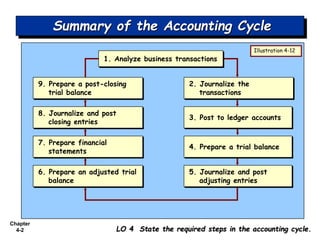
Summary of the Accounting Cycle
1. Analyze business transactions
2. Journalize the
transactions
6. Prepare an adjusted trial
balance
7. Prepare financial
statements
8. Journalize and post
closing entries
9. Prepare a post-closing
trial balance
4. Prepare a trial balance
3. Post to ledger accounts
5. Journalize and post
adjusting entries
Illustration 4-12
LO 4 State the required steps in the accounting cycle.
Chapter
4-3
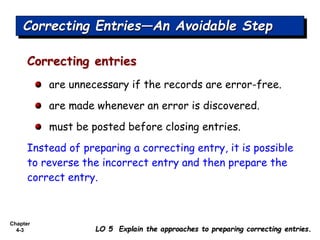
Correcting entries
are unnecessary if the records are error-free.
are made whenever an error is discovered.
must be posted before closing entries.
Instead of preparing a correcting entry, it is possible
to reverse the incorrect entry and then prepare the
correct entry.
Correcting Entries—An Avoidable Step
LO 5 Explain the approaches to preparing correcting entries.
Chapter
4-4
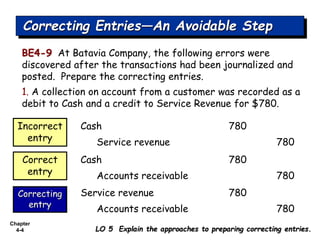
BE4-9 At Batavia Company, the following errors were
discovered after the transactions had been journalized and
posted. Prepare the correcting entries.
1. A collection on account from a customer was recorded as a
debit to Cash and a credit to Service Revenue for $780.
Correcting Entries—An Avoidable Step
LO 5 Explain the approaches to preparing correcting entries.
Cash 780
Incorrect
entry Service revenue 780
Cash 780
Correct
entry Accounts receivable 780
Service revenue 780
Correcting
entry
Accounts receivable 780
Chapter
4-5
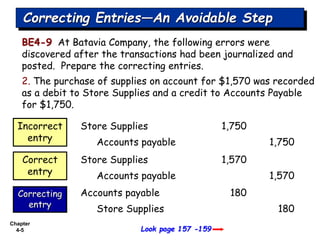
BE4-9 At Batavia Company, the following errors were
discovered after the transactions had been journalized and
posted. Prepare the correcting entries.
2. The purchase of supplies on account for $1,570 was recorded
as a debit to Store Supplies and a credit to Accounts Payable
for $1,750.
Correcting Entries—An Avoidable Step
Look page 157 -159
Store Supplies 1,750
Incorrect
entry Accounts payable 1,750
Store Supplies 1,570
Correct
entry Accounts payable 1,570
Accounts payable 180
Correcting
entry
Store Supplies 180
Chapter
4-6
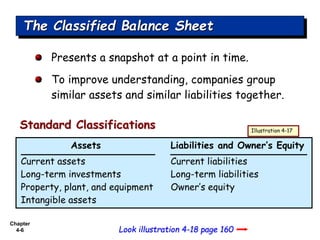
The Classified Balance Sheet
Look illustration 4-18 page 160
Presents a snapshot at a point in time.
To improve understanding, companies group
similar assets and similar liabilities together.
Assets Liabilities and Owner’s Equity
Current assets Current liabilities
Long-term investments Long-term liabilities
Property, plant, and equipment Owner’s equity
Intangible assets
Illustration 4-17
Standard Classifications
Chapter
4-7
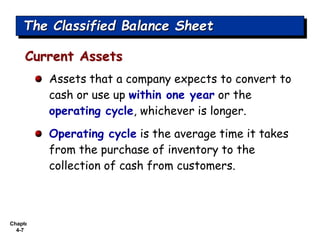
The Classified Balance Sheet
Assets that a company expects to convert to
cash or use up within one year or the
operating cycle, whichever is longer.
Operating cycle is the average time it takes
from the purchase of inventory to the
collection of cash from customers.
Current Assets
Chapter
4-8
The Classified Balance Sheet
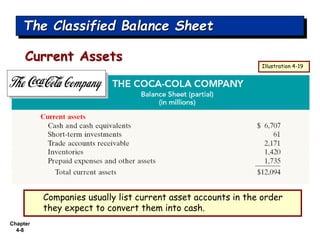
Companies usually list current asset accounts in the order
they expect to convert them into cash.
Illustration 4-19
Current Assets
Chapter
4-9
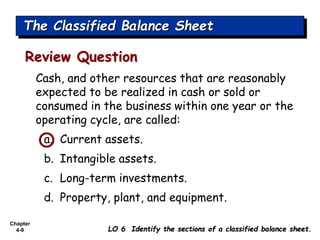
Cash, and other resources that are reasonably
expected to be realized in cash or sold or
consumed in the business within one year or the
operating cycle, are called:
a. Current assets.
b. Intangible assets.
c. Long-term investments.
d. Property, plant, and equipment.
Review Question
The Classified Balance Sheet
LO 6 Identify the sections of a classified balance sheet.

Accounting principle chapter 4.pptx

  • 1.
  • 2.
    Chapter 4-2 Summary of theAccounting Cycle 1. Analyze business transactions 2. Journalize the transactions 6. Prepare an adjusted trial balance 7. Prepare financial statements 8. Journalize and post closing entries 9. Prepare a post-closing trial balance 4. Prepare a trial balance 3. Post to ledger accounts 5. Journalize and post adjusting entries Illustration 4-12 LO 4 State the required steps in the accounting cycle.
  • 3.
    Chapter 4-3 Correcting entries are unnecessaryif the records are error-free. are made whenever an error is discovered. must be posted before closing entries. Instead of preparing a correcting entry, it is possible to reverse the incorrect entry and then prepare the correct entry. Correcting Entries—An Avoidable Step LO 5 Explain the approaches to preparing correcting entries.
  • 4.
    Chapter 4-4 BE4-9 At BataviaCompany, the following errors were discovered after the transactions had been journalized and posted. Prepare the correcting entries. 1. A collection on account from a customer was recorded as a debit to Cash and a credit to Service Revenue for $780. Correcting Entries—An Avoidable Step LO 5 Explain the approaches to preparing correcting entries. Cash 780 Incorrect entry Service revenue 780 Cash 780 Correct entry Accounts receivable 780 Service revenue 780 Correcting entry Accounts receivable 780
  • 5.
    Chapter 4-5 BE4-9 At BataviaCompany, the following errors were discovered after the transactions had been journalized and posted. Prepare the correcting entries. 2. The purchase of supplies on account for $1,570 was recorded as a debit to Store Supplies and a credit to Accounts Payable for $1,750. Correcting Entries—An Avoidable Step Look page 157 -159 Store Supplies 1,750 Incorrect entry Accounts payable 1,750 Store Supplies 1,570 Correct entry Accounts payable 1,570 Accounts payable 180 Correcting entry Store Supplies 180
  • 6.
    Chapter 4-6 The Classified BalanceSheet Look illustration 4-18 page 160 Presents a snapshot at a point in time. To improve understanding, companies group similar assets and similar liabilities together. Assets Liabilities and Owner’s Equity Current assets Current liabilities Long-term investments Long-term liabilities Property, plant, and equipment Owner’s equity Intangible assets Illustration 4-17 Standard Classifications
  • 7.
    Chapter 4-7 The Classified BalanceSheet Assets that a company expects to convert to cash or use up within one year or the operating cycle, whichever is longer. Operating cycle is the average time it takes from the purchase of inventory to the collection of cash from customers. Current Assets
  • 8.
    Chapter 4-8 The Classified BalanceSheet Companies usually list current asset accounts in the order they expect to convert them into cash. Illustration 4-19 Current Assets
  • 9.
    Chapter 4-9 Cash, and otherresources that are reasonably expected to be realized in cash or sold or consumed in the business within one year or the operating cycle, are called: a. Current assets. b. Intangible assets. c. Long-term investments. d. Property, plant, and equipment. Review Question The Classified Balance Sheet LO 6 Identify the sections of a classified balance sheet.