Accounting Information Systems Controls Processes 3rd Edition Turner Test Bank
Accounting Information Systems Controls Processes 3rd Edition Turner Test Bank
Accounting Information Systems Controls Processes 3rd Edition Turner Test Bank
Accounting Information Systems Controls Processes 3rd Edition Turner Test Bank
Accounting Information Systems Controls Processes 3rd Edition Turner Test Bank
1.
Visit https://testbankdeal.com todownload the full version and
explore more testbank or solutions manual
Accounting Information Systems Controls Processes
3rd Edition Turner Test Bank
_____ Click the link below to download _____
https://testbankdeal.com/product/accounting-information-
systems-controls-processes-3rd-edition-turner-test-bank/
Explore and download more testbank or solutions manual at testbankdeal.com
2.
Here are somerecommended products that we believe you will be
interested in. You can click the link to download.
Accounting Information Systems Controls Processes 3rd
Edition Turner Solutions Manual
https://testbankdeal.com/product/accounting-information-systems-
controls-processes-3rd-edition-turner-solutions-manual/
Accounting Information Systems The Processes Controls 2nd
Edition Turner Solutions Manual
https://testbankdeal.com/product/accounting-information-systems-the-
processes-controls-2nd-edition-turner-solutions-manual/
Accounting Information Systems The Processes and Controls
2nd Edition Turner Test Bank
https://testbankdeal.com/product/accounting-information-systems-the-
processes-and-controls-2nd-edition-turner-test-bank/
Intermediate Accounting 2014 FASB Update 15th Edition
Kieso Test Bank
https://testbankdeal.com/product/intermediate-accounting-2014-fasb-
update-15th-edition-kieso-test-bank/
3.
Introduction to MaternityPediatric Nursing 6th Edition
Leifer Solutions Manual
https://testbankdeal.com/product/introduction-to-maternity-pediatric-
nursing-6th-edition-leifer-solutions-manual/
International Economics Theory and Policy 10th Edition
Krugman Test Bank
https://testbankdeal.com/product/international-economics-theory-and-
policy-10th-edition-krugman-test-bank/
Biology Concepts and Investigations 3rd Edition Hoefnagels
Test Bank
https://testbankdeal.com/product/biology-concepts-and-
investigations-3rd-edition-hoefnagels-test-bank/
International Economics 13th Edition Carbaugh Test Bank
https://testbankdeal.com/product/international-economics-13th-edition-
carbaugh-test-bank/
Modern Marketing Research Concepts Methods and Cases 2nd
Edition Feinberg Test Bank
https://testbankdeal.com/product/modern-marketing-research-concepts-
methods-and-cases-2nd-edition-feinberg-test-bank/
4.
Child Psychology AContemporary View Point 7th Edition
Parke Test Bank
https://testbankdeal.com/product/child-psychology-a-contemporary-view-
point-7th-edition-parke-test-bank/
5.
Ch 7 Testbank – 3e Page 1 of 32
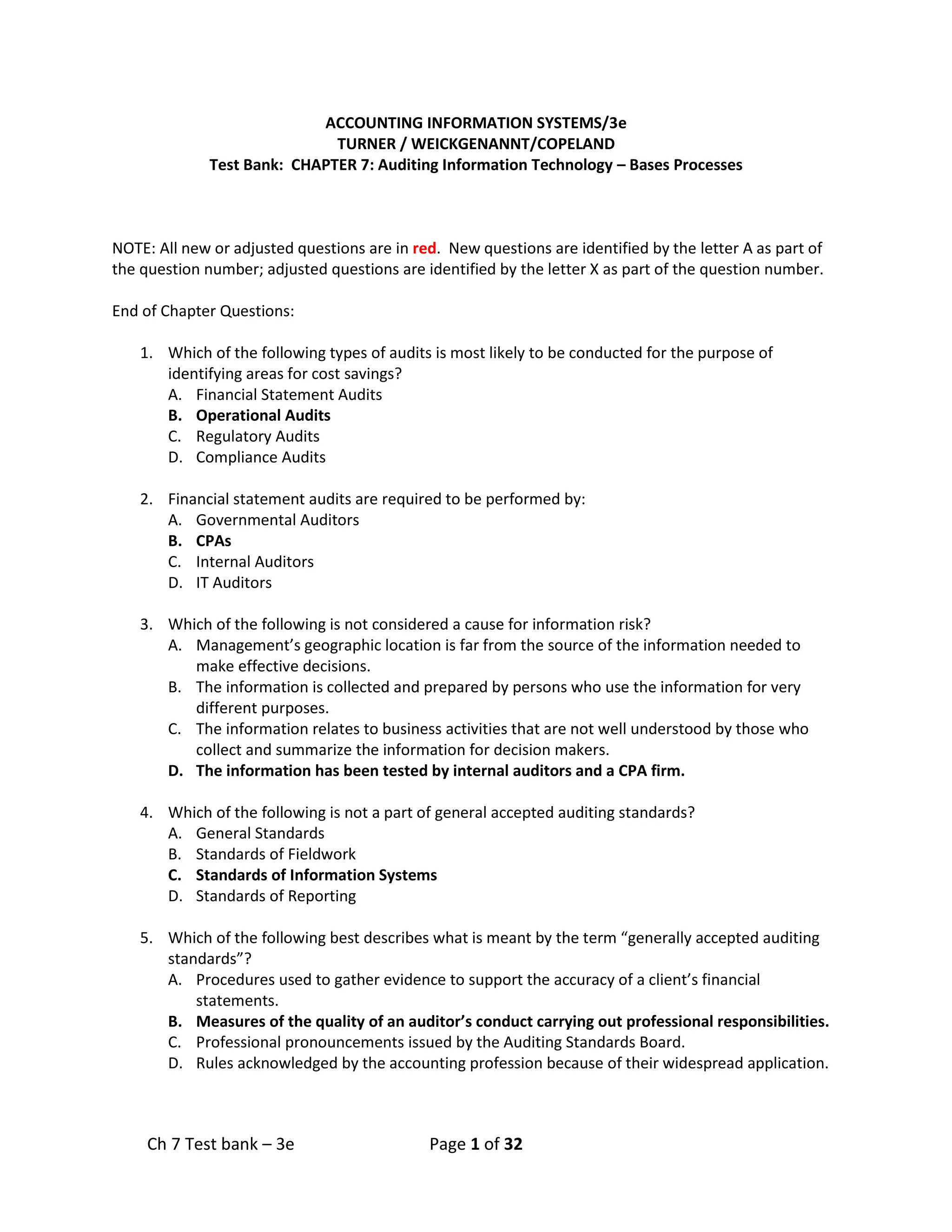
ACCOUNTING INFORMATION SYSTEMS/3e
TURNER / WEICKGENANNT/COPELAND
Test Bank: CHAPTER 7: Auditing Information Technology – Bases Processes
NOTE: All new or adjusted questions are in red. New questions are identified by the letter A as part of
the question number; adjusted questions are identified by the letter X as part of the question number.
End of Chapter Questions:
1. Which of the following types of audits is most likely to be conducted for the purpose of
identifying areas for cost savings?
A. Financial Statement Audits
B. Operational Audits
C. Regulatory Audits
D. Compliance Audits
2. Financial statement audits are required to be performed by:
A. Governmental Auditors
B. CPAs
C. Internal Auditors
D. IT Auditors
3. Which of the following is not considered a cause for information risk?
A. Management’s geographic location is far from the source of the information needed to
make effective decisions.
B. The information is collected and prepared by persons who use the information for very
different purposes.
C. The information relates to business activities that are not well understood by those who
collect and summarize the information for decision makers.
D. The information has been tested by internal auditors and a CPA firm.
4. Which of the following is not a part of general accepted auditing standards?
A. General Standards
B. Standards of Fieldwork
C. Standards of Information Systems
D. Standards of Reporting
5. Which of the following best describes what is meant by the term “generally accepted auditing
standards”?
A. Procedures used to gather evidence to support the accuracy of a client’s financial
statements.
B. Measures of the quality of an auditor’s conduct carrying out professional responsibilities.
C. Professional pronouncements issued by the Auditing Standards Board.
D. Rules acknowledged by the accounting profession because of their widespread application.
6.
Ch 7 Testbank – 3e Page 2 of 32
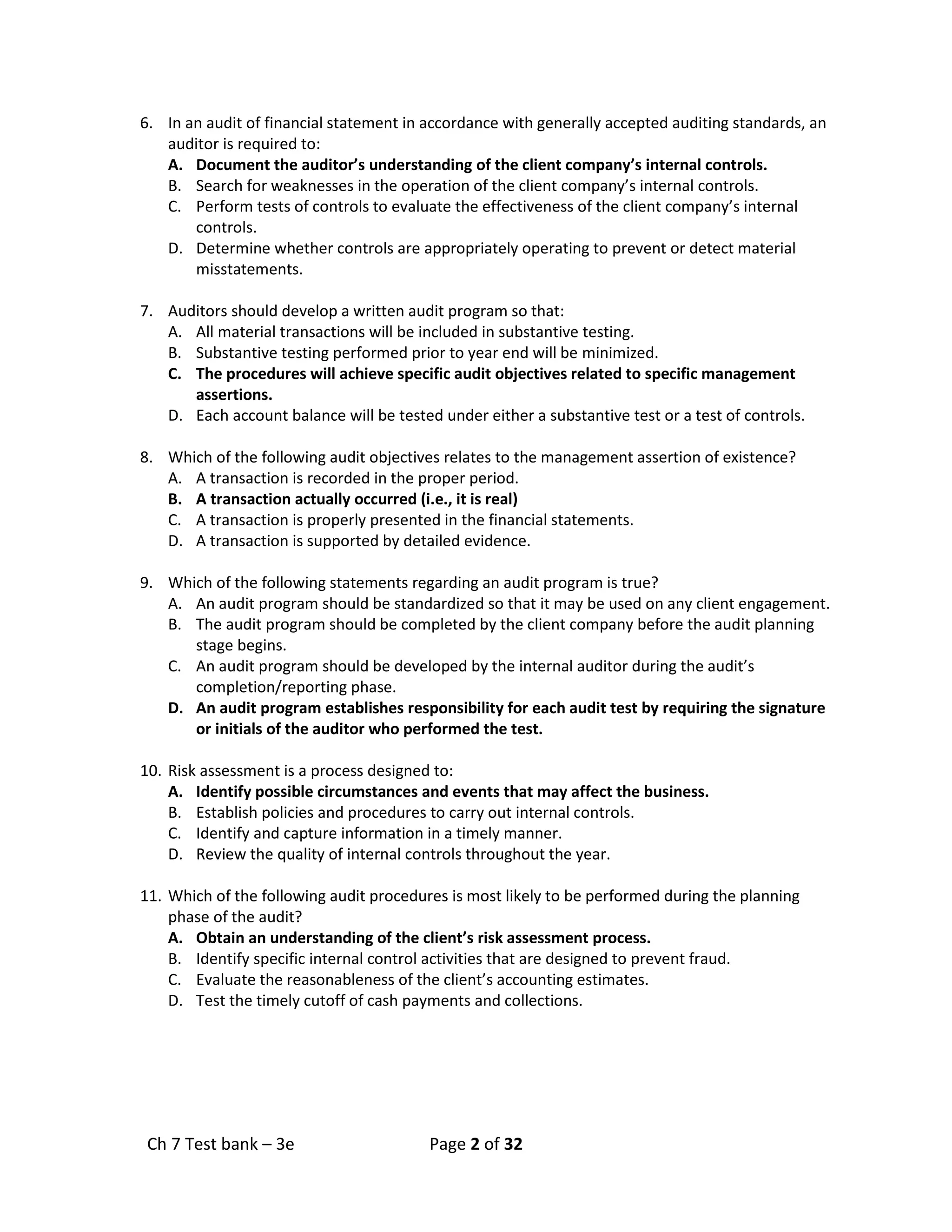
6. In an audit of financial statement in accordance with generally accepted auditing standards, an
auditor is required to:
A. Document the auditor’s understanding of the client company’s internal controls.
B. Search for weaknesses in the operation of the client company’s internal controls.
C. Perform tests of controls to evaluate the effectiveness of the client company’s internal
controls.
D. Determine whether controls are appropriately operating to prevent or detect material
misstatements.
7. Auditors should develop a written audit program so that:
A. All material transactions will be included in substantive testing.
B. Substantive testing performed prior to year end will be minimized.
C. The procedures will achieve specific audit objectives related to specific management
assertions.
D. Each account balance will be tested under either a substantive test or a test of controls.
8. Which of the following audit objectives relates to the management assertion of existence?
A. A transaction is recorded in the proper period.
B. A transaction actually occurred (i.e., it is real)
C. A transaction is properly presented in the financial statements.
D. A transaction is supported by detailed evidence.
9. Which of the following statements regarding an audit program is true?
A. An audit program should be standardized so that it may be used on any client engagement.
B. The audit program should be completed by the client company before the audit planning
stage begins.
C. An audit program should be developed by the internal auditor during the audit’s
completion/reporting phase.
D. An audit program establishes responsibility for each audit test by requiring the signature
or initials of the auditor who performed the test.
10. Risk assessment is a process designed to:
A. Identify possible circumstances and events that may affect the business.
B. Establish policies and procedures to carry out internal controls.
C. Identify and capture information in a timely manner.
D. Review the quality of internal controls throughout the year.
11. Which of the following audit procedures is most likely to be performed during the planning
phase of the audit?
A. Obtain an understanding of the client’s risk assessment process.
B. Identify specific internal control activities that are designed to prevent fraud.
C. Evaluate the reasonableness of the client’s accounting estimates.
D. Test the timely cutoff of cash payments and collections.
7.
Ch 7 Testbank – 3e Page 3 of 32
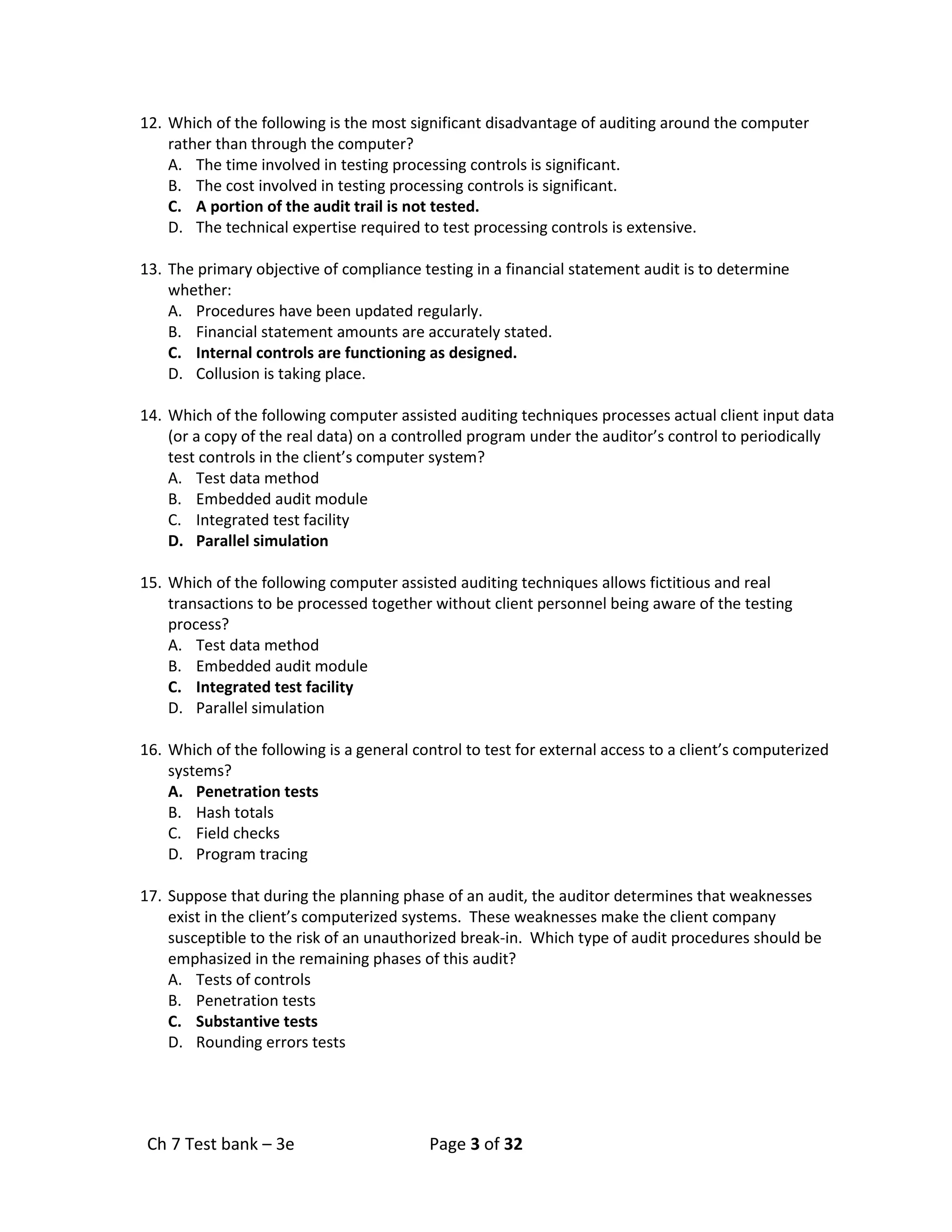
12. Which of the following is the most significant disadvantage of auditing around the computer
rather than through the computer?
A. The time involved in testing processing controls is significant.
B. The cost involved in testing processing controls is significant.
C. A portion of the audit trail is not tested.
D. The technical expertise required to test processing controls is extensive.
13. The primary objective of compliance testing in a financial statement audit is to determine
whether:
A. Procedures have been updated regularly.
B. Financial statement amounts are accurately stated.
C. Internal controls are functioning as designed.
D. Collusion is taking place.
14. Which of the following computer assisted auditing techniques processes actual client input data
(or a copy of the real data) on a controlled program under the auditor’s control to periodically
test controls in the client’s computer system?
A. Test data method
B. Embedded audit module
C. Integrated test facility
D. Parallel simulation
15. Which of the following computer assisted auditing techniques allows fictitious and real
transactions to be processed together without client personnel being aware of the testing
process?
A. Test data method
B. Embedded audit module
C. Integrated test facility
D. Parallel simulation
16. Which of the following is a general control to test for external access to a client’s computerized
systems?
A. Penetration tests
B. Hash totals
C. Field checks
D. Program tracing
17. Suppose that during the planning phase of an audit, the auditor determines that weaknesses
exist in the client’s computerized systems. These weaknesses make the client company
susceptible to the risk of an unauthorized break-in. Which type of audit procedures should be
emphasized in the remaining phases of this audit?
A. Tests of controls
B. Penetration tests
C. Substantive tests
D. Rounding errors tests
8.
Ch 7 Testbank – 3e Page 4 of 32
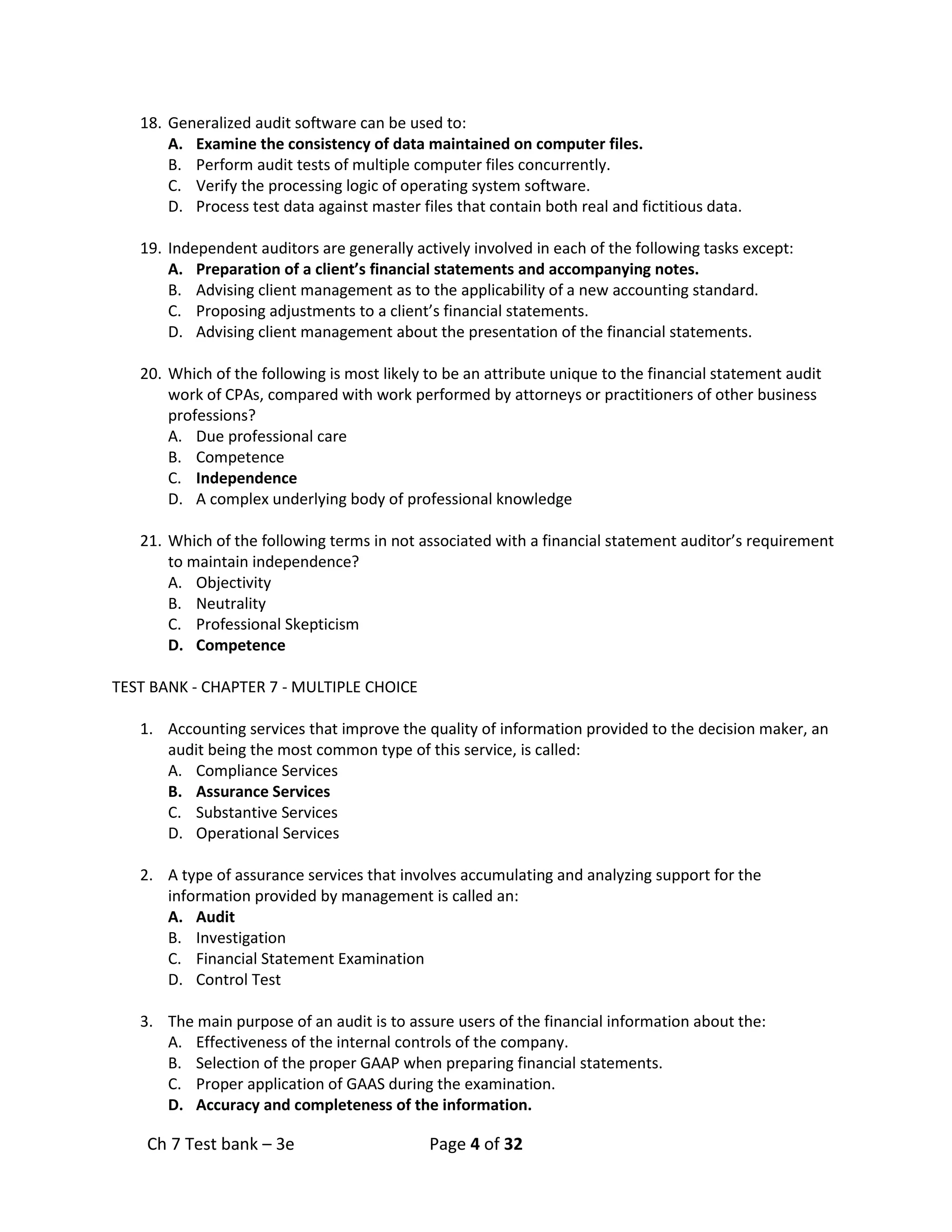
18. Generalized audit software can be used to:
A. Examine the consistency of data maintained on computer files.
B. Perform audit tests of multiple computer files concurrently.
C. Verify the processing logic of operating system software.
D. Process test data against master files that contain both real and fictitious data.
19. Independent auditors are generally actively involved in each of the following tasks except:
A. Preparation of a client’s financial statements and accompanying notes.
B. Advising client management as to the applicability of a new accounting standard.
C. Proposing adjustments to a client’s financial statements.
D. Advising client management about the presentation of the financial statements.
20. Which of the following is most likely to be an attribute unique to the financial statement audit
work of CPAs, compared with work performed by attorneys or practitioners of other business
professions?
A. Due professional care
B. Competence
C. Independence
D. A complex underlying body of professional knowledge
21. Which of the following terms in not associated with a financial statement auditor’s requirement
to maintain independence?
A. Objectivity
B. Neutrality
C. Professional Skepticism
D. Competence
TEST BANK - CHAPTER 7 - MULTIPLE CHOICE
1. Accounting services that improve the quality of information provided to the decision maker, an
audit being the most common type of this service, is called:
A. Compliance Services
B. Assurance Services
C. Substantive Services
D. Operational Services
2. A type of assurance services that involves accumulating and analyzing support for the
information provided by management is called an:
A. Audit
B. Investigation
C. Financial Statement Examination
D. Control Test
3. The main purpose of an audit is to assure users of the financial information about the:
A. Effectiveness of the internal controls of the company.
B. Selection of the proper GAAP when preparing financial statements.
C. Proper application of GAAS during the examination.
D. Accuracy and completeness of the information.
9.
Ch 7 Testbank – 3e Page 5 of 32
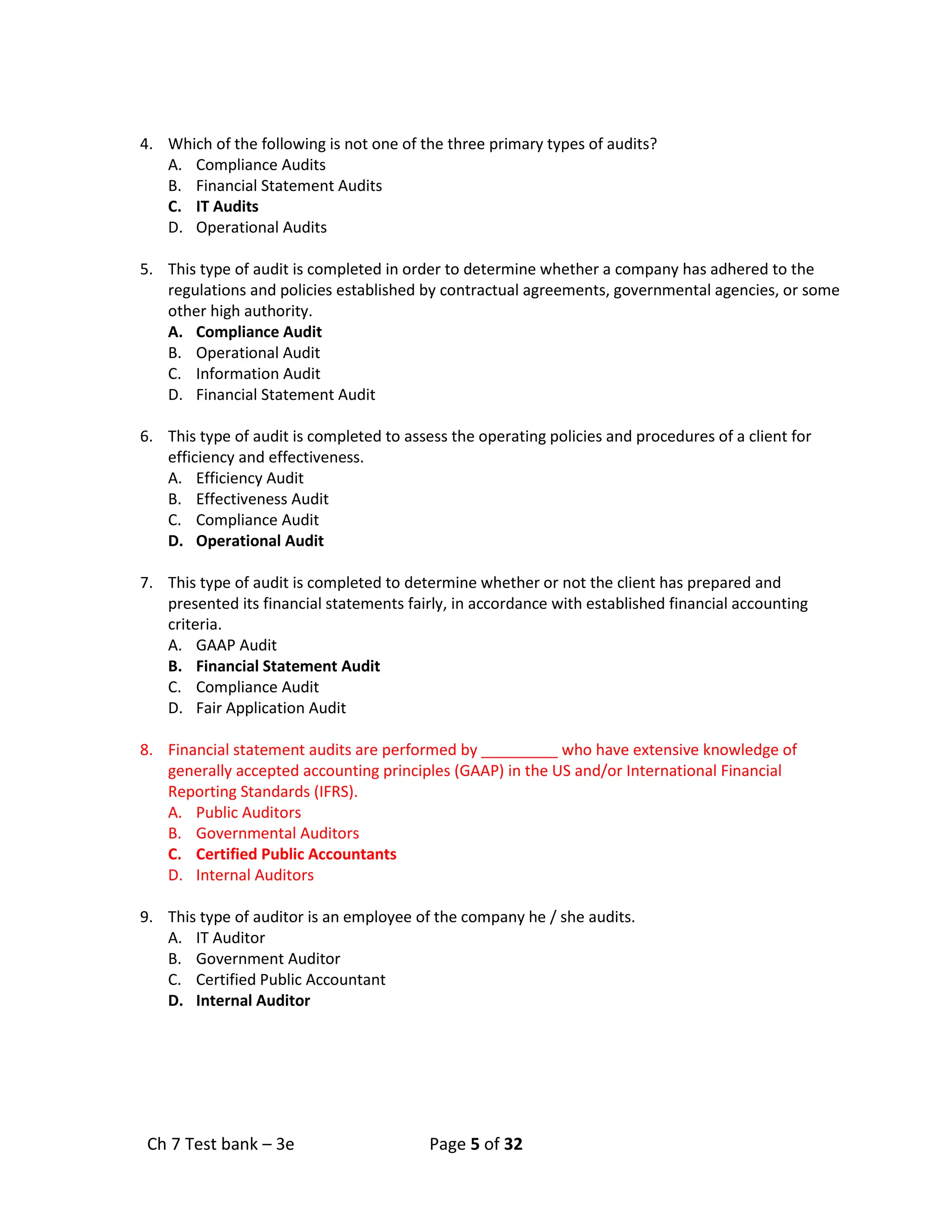
4. Which of the following is not one of the three primary types of audits?
A. Compliance Audits
B. Financial Statement Audits
C. IT Audits
D. Operational Audits
5. This type of audit is completed in order to determine whether a company has adhered to the
regulations and policies established by contractual agreements, governmental agencies, or some
other high authority.
A. Compliance Audit
B. Operational Audit
C. Information Audit
D. Financial Statement Audit
6. This type of audit is completed to assess the operating policies and procedures of a client for
efficiency and effectiveness.
A. Efficiency Audit
B. Effectiveness Audit
C. Compliance Audit
D. Operational Audit
7. This type of audit is completed to determine whether or not the client has prepared and
presented its financial statements fairly, in accordance with established financial accounting
criteria.
A. GAAP Audit
B. Financial Statement Audit
C. Compliance Audit
D. Fair Application Audit
8. Financial statement audits are performed by _________ who have extensive knowledge of
generally accepted accounting principles (GAAP) in the US and/or International Financial
Reporting Standards (IFRS).
A. Public Auditors
B. Governmental Auditors
C. Certified Public Accountants
D. Internal Auditors
9. This type of auditor is an employee of the company he / she audits.
A. IT Auditor
B. Government Auditor
C. Certified Public Accountant
D. Internal Auditor
10.
Ch 7 Testbank – 3e Page 6 of 32
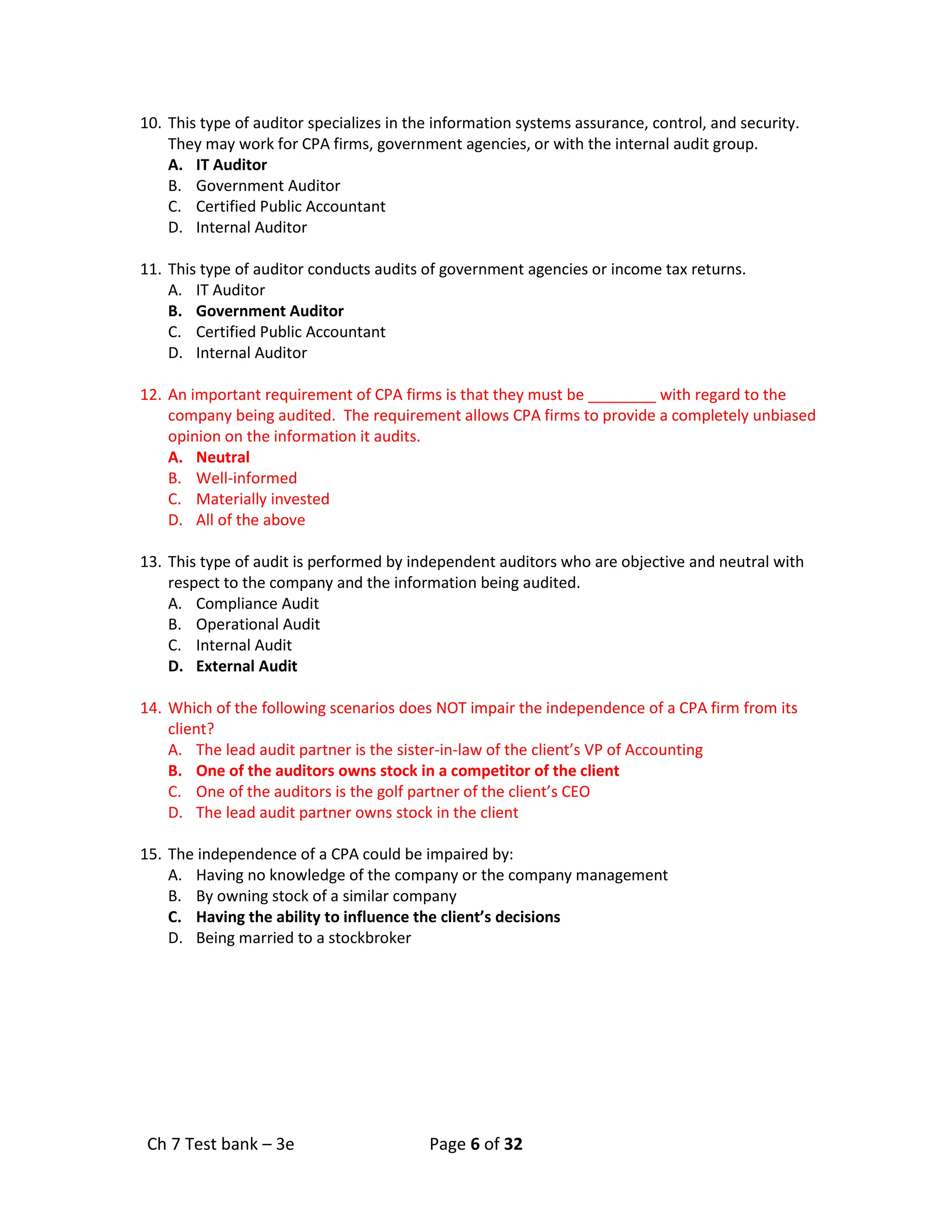
10. This type of auditor specializes in the information systems assurance, control, and security.
They may work for CPA firms, government agencies, or with the internal audit group.
A. IT Auditor
B. Government Auditor
C. Certified Public Accountant
D. Internal Auditor
11. This type of auditor conducts audits of government agencies or income tax returns.
A. IT Auditor
B. Government Auditor
C. Certified Public Accountant
D. Internal Auditor
12. An important requirement of CPA firms is that they must be ________ with regard to the
company being audited. The requirement allows CPA firms to provide a completely unbiased
opinion on the information it audits.
A. Neutral
B. Well-informed
C. Materially invested
D. All of the above
13. This type of audit is performed by independent auditors who are objective and neutral with
respect to the company and the information being audited.
A. Compliance Audit
B. Operational Audit
C. Internal Audit
D. External Audit
14. Which of the following scenarios does NOT impair the independence of a CPA firm from its
client?
A. The lead audit partner is the sister-in-law of the client’s VP of Accounting
B. One of the auditors owns stock in a competitor of the client
C. One of the auditors is the golf partner of the client’s CEO
D. The lead audit partner owns stock in the client
15. The independence of a CPA could be impaired by:
A. Having no knowledge of the company or the company management
B. By owning stock of a similar company
C. Having the ability to influence the client’s decisions
D. Being married to a stockbroker
11.
Ch 7 Testbank – 3e Page 7 of 32
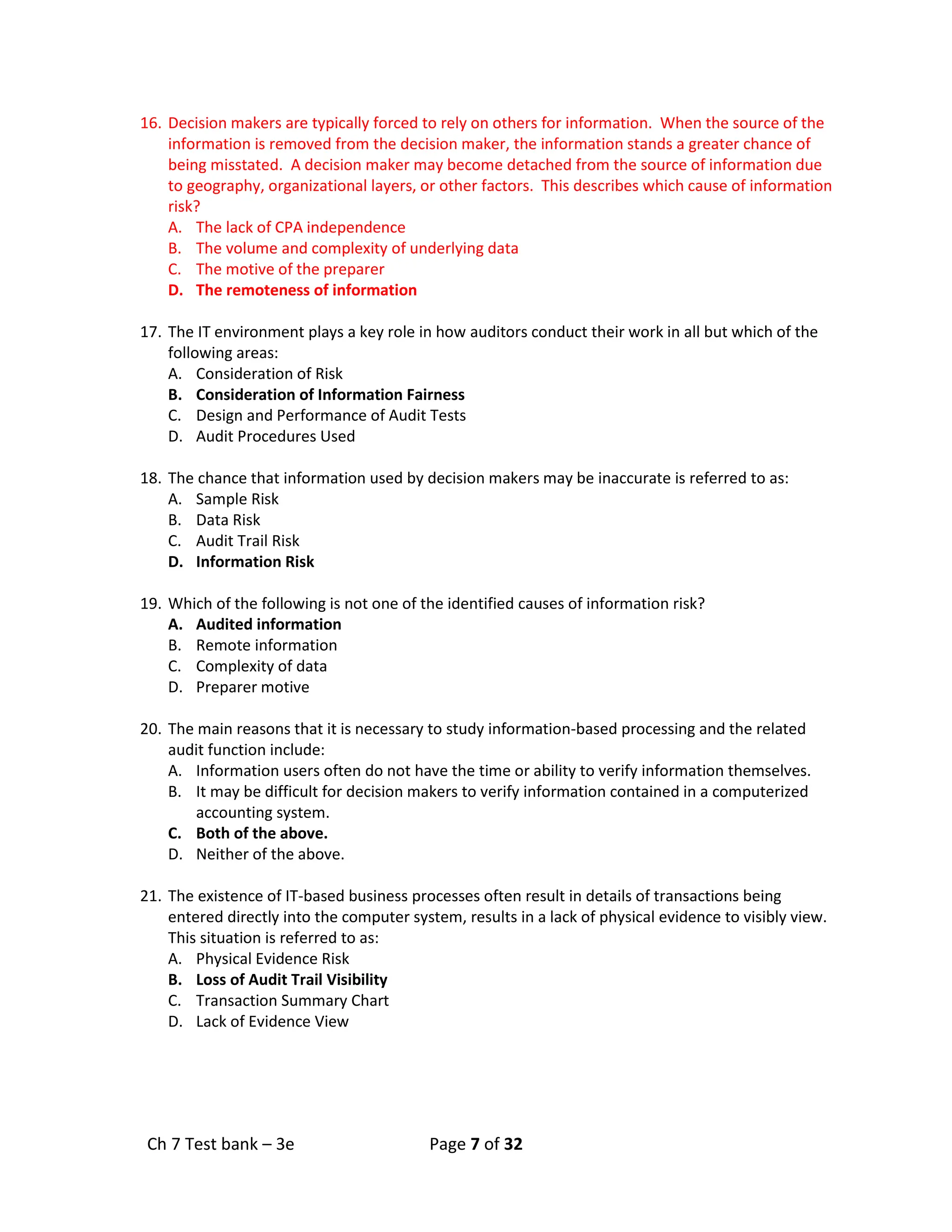
16. Decision makers are typically forced to rely on others for information. When the source of the
information is removed from the decision maker, the information stands a greater chance of
being misstated. A decision maker may become detached from the source of information due
to geography, organizational layers, or other factors. This describes which cause of information
risk?
A. The lack of CPA independence
B. The volume and complexity of underlying data
C. The motive of the preparer
D. The remoteness of information
17. The IT environment plays a key role in how auditors conduct their work in all but which of the
following areas:
A. Consideration of Risk
B. Consideration of Information Fairness
C. Design and Performance of Audit Tests
D. Audit Procedures Used
18. The chance that information used by decision makers may be inaccurate is referred to as:
A. Sample Risk
B. Data Risk
C. Audit Trail Risk
D. Information Risk
19. Which of the following is not one of the identified causes of information risk?
A. Audited information
B. Remote information
C. Complexity of data
D. Preparer motive
20. The main reasons that it is necessary to study information-based processing and the related
audit function include:
A. Information users often do not have the time or ability to verify information themselves.
B. It may be difficult for decision makers to verify information contained in a computerized
accounting system.
C. Both of the above.
D. Neither of the above.
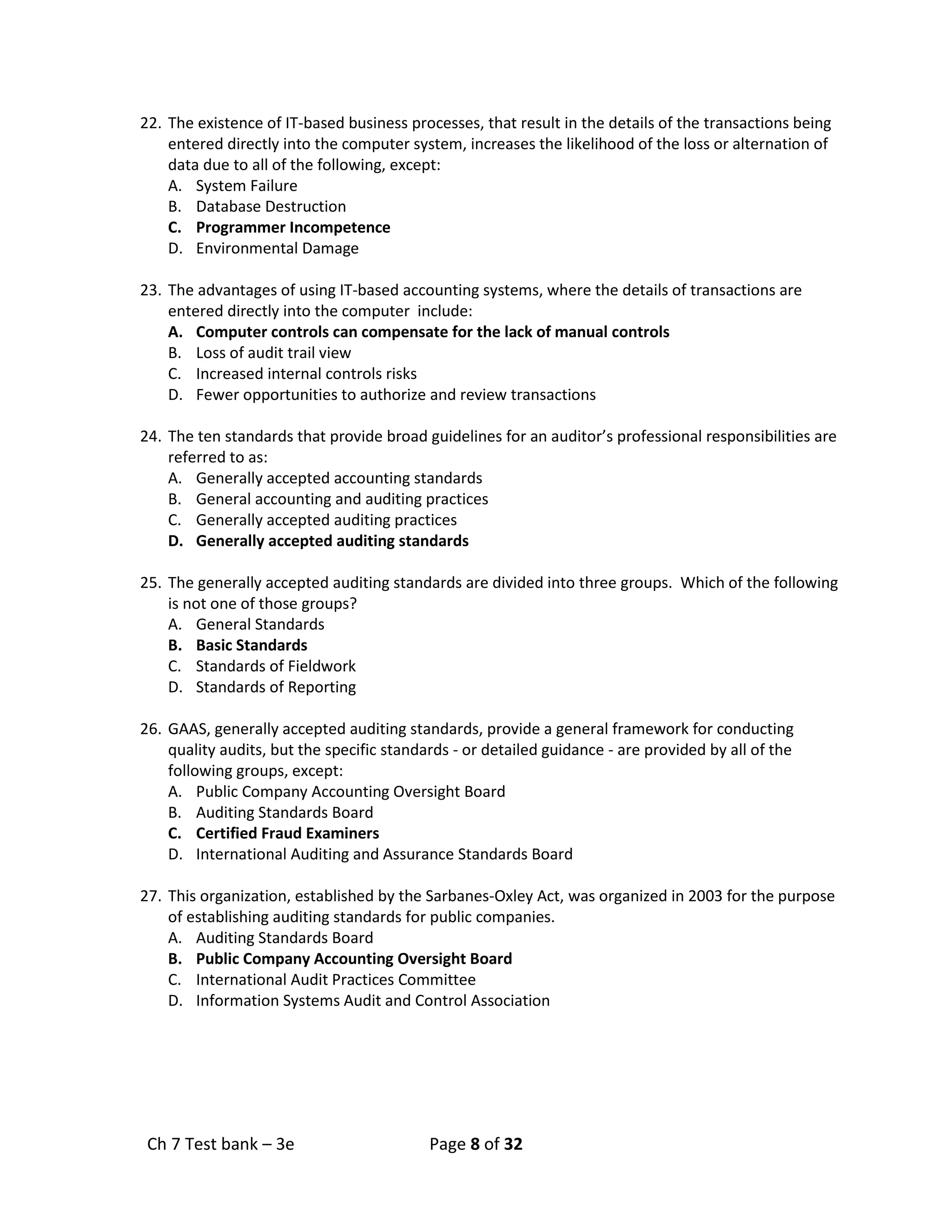
21. The existence of IT-based business processes often result in details of transactions being
entered directly into the computer system, results in a lack of physical evidence to visibly view.
This situation is referred to as:
A. Physical Evidence Risk
B. Loss of Audit Trail Visibility
C. Transaction Summary Chart
D. Lack of Evidence View
12.
Ch 7 Testbank – 3e Page 8 of 32
22. The existence of IT-based business processes, that result in the details of the transactions being
entered directly into the computer system, increases the likelihood of the loss or alternation of
data due to all of the following, except:
A. System Failure
B. Database Destruction
C. Programmer Incompetence
D. Environmental Damage
23. The advantages of using IT-based accounting systems, where the details of transactions are
entered directly into the computer include:
A. Computer controls can compensate for the lack of manual controls
B. Loss of audit trail view
C. Increased internal controls risks
D. Fewer opportunities to authorize and review transactions
24. The ten standards that provide broad guidelines for an auditor’s professional responsibilities are
referred to as:
A. Generally accepted accounting standards
B. General accounting and auditing practices
C. Generally accepted auditing practices
D. Generally accepted auditing standards
25. The generally accepted auditing standards are divided into three groups. Which of the following
is not one of those groups?
A. General Standards
B. Basic Standards
C. Standards of Fieldwork
D. Standards of Reporting
26. GAAS, generally accepted auditing standards, provide a general framework for conducting
quality audits, but the specific standards - or detailed guidance - are provided by all of the
following groups, except:
A. Public Company Accounting Oversight Board
B. Auditing Standards Board
C. Certified Fraud Examiners
D. International Auditing and Assurance Standards Board
27. This organization, established by the Sarbanes-Oxley Act, was organized in 2003 for the purpose
of establishing auditing standards for public companies.
A. Auditing Standards Board
B. Public Company Accounting Oversight Board
C. International Audit Practices Committee
D. Information Systems Audit and Control Association
13.
Ch 7 Testbank – 3e Page 9 of 32
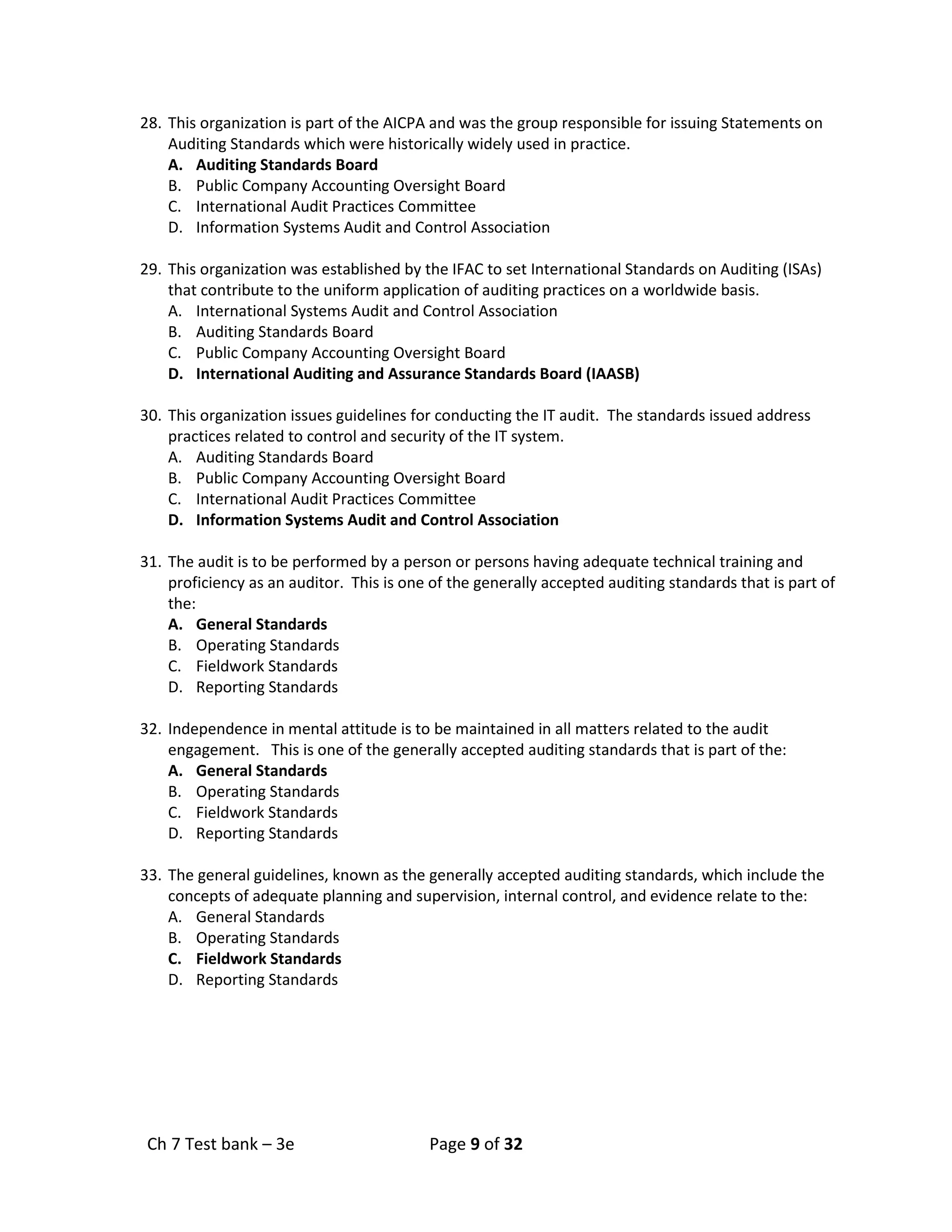
28. This organization is part of the AICPA and was the group responsible for issuing Statements on
Auditing Standards which were historically widely used in practice.
A. Auditing Standards Board
B. Public Company Accounting Oversight Board
C. International Audit Practices Committee
D. Information Systems Audit and Control Association
29. This organization was established by the IFAC to set International Standards on Auditing (ISAs)
that contribute to the uniform application of auditing practices on a worldwide basis.
A. International Systems Audit and Control Association
B. Auditing Standards Board
C. Public Company Accounting Oversight Board
D. International Auditing and Assurance Standards Board (IAASB)
30. This organization issues guidelines for conducting the IT audit. The standards issued address
practices related to control and security of the IT system.
A. Auditing Standards Board
B. Public Company Accounting Oversight Board
C. International Audit Practices Committee
D. Information Systems Audit and Control Association
31. The audit is to be performed by a person or persons having adequate technical training and
proficiency as an auditor. This is one of the generally accepted auditing standards that is part of
the:
A. General Standards
B. Operating Standards
C. Fieldwork Standards
D. Reporting Standards
32. Independence in mental attitude is to be maintained in all matters related to the audit
engagement. This is one of the generally accepted auditing standards that is part of the:
A. General Standards
B. Operating Standards
C. Fieldwork Standards
D. Reporting Standards
33. The general guidelines, known as the generally accepted auditing standards, which include the
concepts of adequate planning and supervision, internal control, and evidence relate to the:
A. General Standards
B. Operating Standards
C. Fieldwork Standards
D. Reporting Standards
14.
Ch 7 Testbank – 3e Page 10 of 32
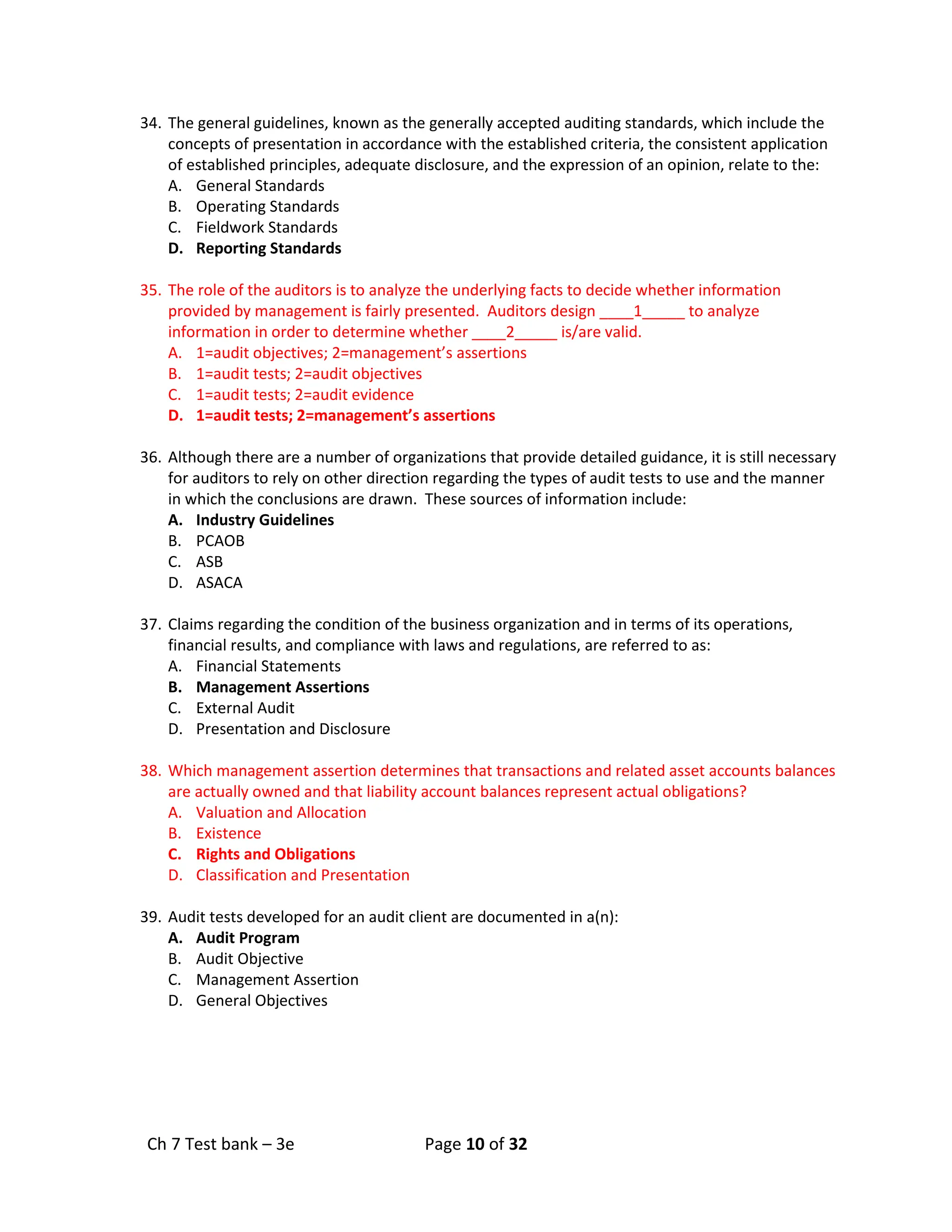
34. The general guidelines, known as the generally accepted auditing standards, which include the
concepts of presentation in accordance with the established criteria, the consistent application
of established principles, adequate disclosure, and the expression of an opinion, relate to the:
A. General Standards
B. Operating Standards
C. Fieldwork Standards
D. Reporting Standards
35. The role of the auditors is to analyze the underlying facts to decide whether information
provided by management is fairly presented. Auditors design ____1_____ to analyze
information in order to determine whether ____2_____ is/are valid.
A. 1=audit objectives; 2=management’s assertions
B. 1=audit tests; 2=audit objectives
C. 1=audit tests; 2=audit evidence
D. 1=audit tests; 2=management’s assertions
36. Although there are a number of organizations that provide detailed guidance, it is still necessary
for auditors to rely on other direction regarding the types of audit tests to use and the manner
in which the conclusions are drawn. These sources of information include:
A. Industry Guidelines
B. PCAOB
C. ASB
D. ASACA
37. Claims regarding the condition of the business organization and in terms of its operations,
financial results, and compliance with laws and regulations, are referred to as:
A. Financial Statements
B. Management Assertions
C. External Audit
D. Presentation and Disclosure
38. Which management assertion determines that transactions and related asset accounts balances
are actually owned and that liability account balances represent actual obligations?
A. Valuation and Allocation
B. Existence
C. Rights and Obligations
D. Classification and Presentation
39. Audit tests developed for an audit client are documented in a(n):
A. Audit Program
B. Audit Objective
C. Management Assertion
D. General Objectives
15.
Ch 7 Testbank – 3e Page 11 of 32
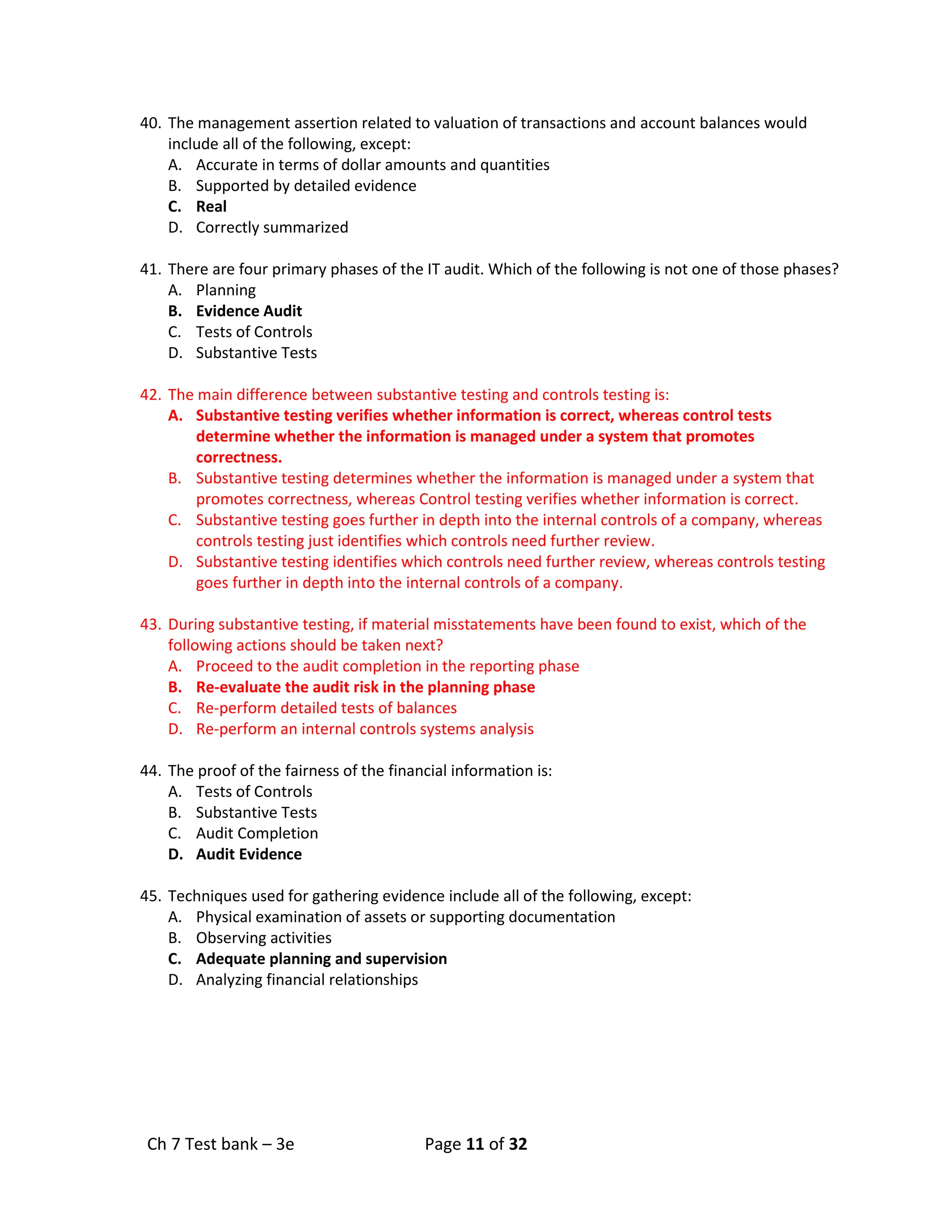
40. The management assertion related to valuation of transactions and account balances would
include all of the following, except:
A. Accurate in terms of dollar amounts and quantities
B. Supported by detailed evidence
C. Real
D. Correctly summarized
41. There are four primary phases of the IT audit. Which of the following is not one of those phases?
A. Planning
B. Evidence Audit
C. Tests of Controls
D. Substantive Tests
42. The main difference between substantive testing and controls testing is:
A. Substantive testing verifies whether information is correct, whereas control tests
determine whether the information is managed under a system that promotes
correctness.
B. Substantive testing determines whether the information is managed under a system that
promotes correctness, whereas Control testing verifies whether information is correct.
C. Substantive testing goes further in depth into the internal controls of a company, whereas
controls testing just identifies which controls need further review.
D. Substantive testing identifies which controls need further review, whereas controls testing
goes further in depth into the internal controls of a company.
43. During substantive testing, if material misstatements have been found to exist, which of the
following actions should be taken next?
A. Proceed to the audit completion in the reporting phase
B. Re-evaluate the audit risk in the planning phase
C. Re-perform detailed tests of balances
D. Re-perform an internal controls systems analysis
44. The proof of the fairness of the financial information is:
A. Tests of Controls
B. Substantive Tests
C. Audit Completion
D. Audit Evidence
45. Techniques used for gathering evidence include all of the following, except:
A. Physical examination of assets or supporting documentation
B. Observing activities
C. Adequate planning and supervision
D. Analyzing financial relationships
16.
Ch 7 Testbank – 3e Page 12 of 32
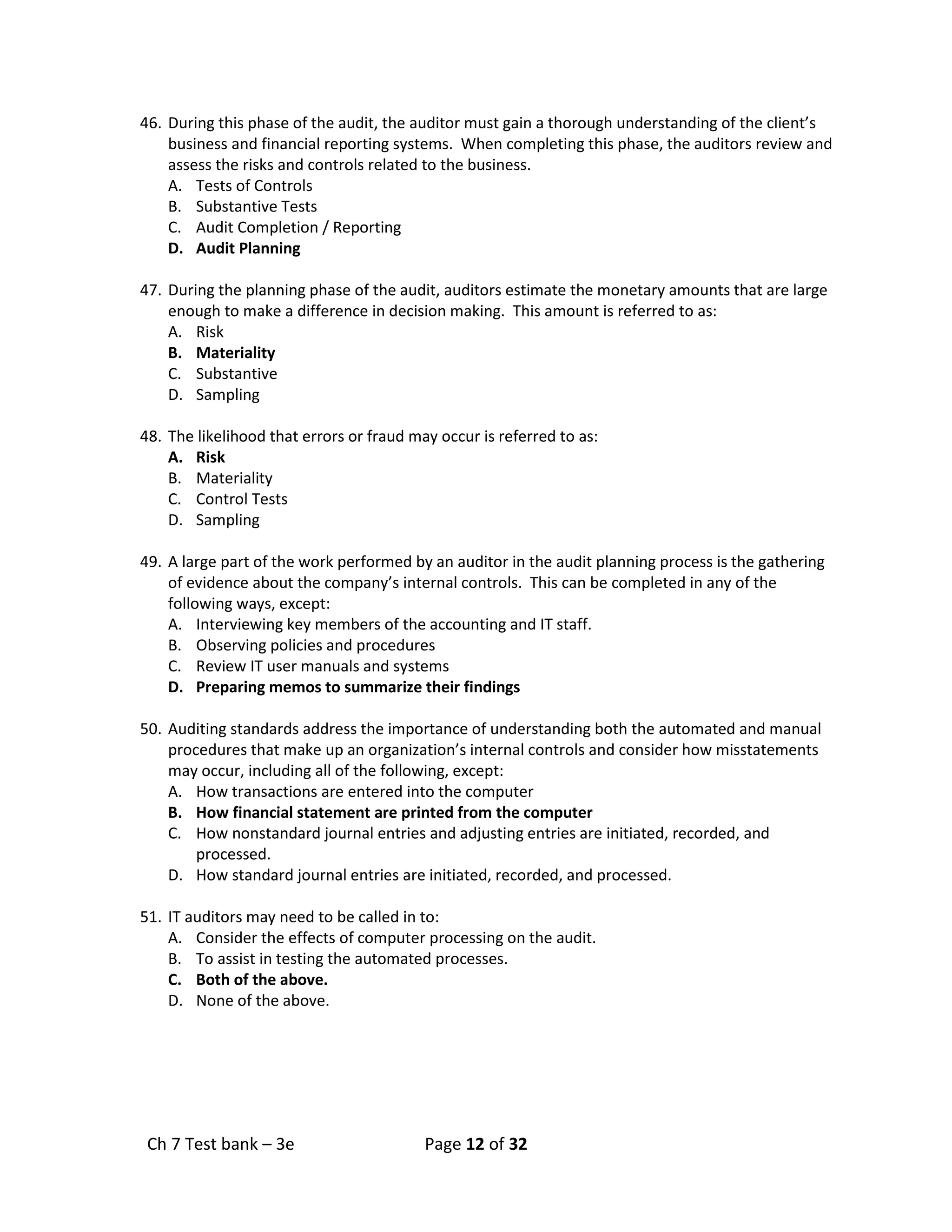
46. During this phase of the audit, the auditor must gain a thorough understanding of the client’s
business and financial reporting systems. When completing this phase, the auditors review and
assess the risks and controls related to the business.
A. Tests of Controls
B. Substantive Tests
C. Audit Completion / Reporting
D. Audit Planning
47. During the planning phase of the audit, auditors estimate the monetary amounts that are large
enough to make a difference in decision making. This amount is referred to as:
A. Risk
B. Materiality
C. Substantive
D. Sampling
48. The likelihood that errors or fraud may occur is referred to as:
A. Risk
B. Materiality
C. Control Tests
D. Sampling
49. A large part of the work performed by an auditor in the audit planning process is the gathering
of evidence about the company’s internal controls. This can be completed in any of the
following ways, except:
A. Interviewing key members of the accounting and IT staff.
B. Observing policies and procedures
C. Review IT user manuals and systems
D. Preparing memos to summarize their findings
50. Auditing standards address the importance of understanding both the automated and manual
procedures that make up an organization’s internal controls and consider how misstatements
may occur, including all of the following, except:
A. How transactions are entered into the computer
B. How financial statement are printed from the computer
C. How nonstandard journal entries and adjusting entries are initiated, recorded, and
processed.
D. How standard journal entries are initiated, recorded, and processed.
51. IT auditors may need to be called in to:
A. Consider the effects of computer processing on the audit.
B. To assist in testing the automated processes.
C. Both of the above.
D. None of the above.
17.
Ch 7 Testbank – 3e Page 13 of 32
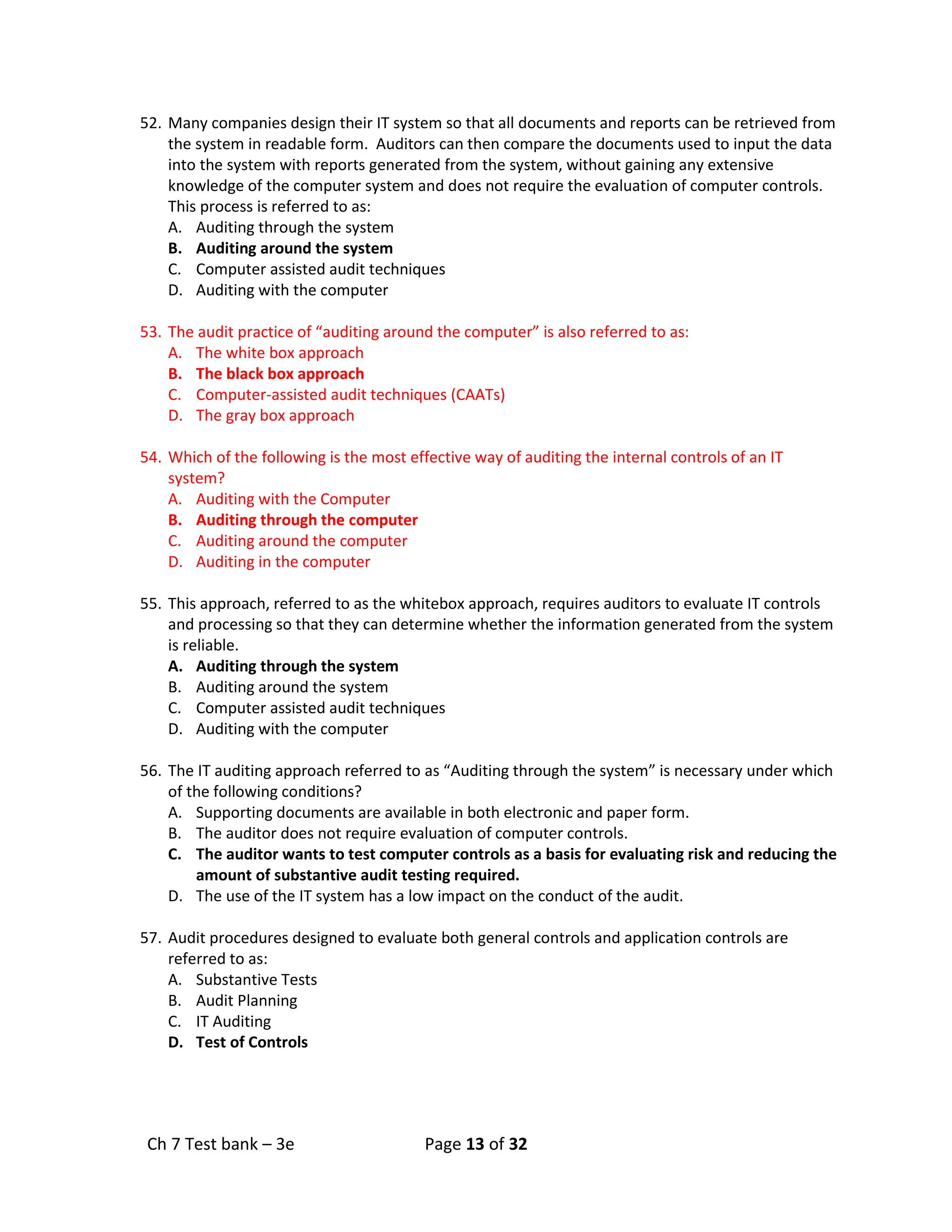
52. Many companies design their IT system so that all documents and reports can be retrieved from
the system in readable form. Auditors can then compare the documents used to input the data
into the system with reports generated from the system, without gaining any extensive
knowledge of the computer system and does not require the evaluation of computer controls.
This process is referred to as:
A. Auditing through the system
B. Auditing around the system
C. Computer assisted audit techniques
D. Auditing with the computer
53. The audit practice of “auditing around the computer” is also referred to as:
A. The white box approach
B. The black box approach
C. Computer-assisted audit techniques (CAATs)
D. The gray box approach
54. Which of the following is the most effective way of auditing the internal controls of an IT
system?
A. Auditing with the Computer
B. Auditing through the computer
C. Auditing around the computer
D. Auditing in the computer
55. This approach, referred to as the whitebox approach, requires auditors to evaluate IT controls
and processing so that they can determine whether the information generated from the system
is reliable.
A. Auditing through the system
B. Auditing around the system
C. Computer assisted audit techniques
D. Auditing with the computer
56. The IT auditing approach referred to as “Auditing through the system” is necessary under which
of the following conditions?
A. Supporting documents are available in both electronic and paper form.
B. The auditor does not require evaluation of computer controls.
C. The auditor wants to test computer controls as a basis for evaluating risk and reducing the
amount of substantive audit testing required.
D. The use of the IT system has a low impact on the conduct of the audit.
57. Audit procedures designed to evaluate both general controls and application controls are
referred to as:
A. Substantive Tests
B. Audit Planning
C. IT Auditing
D. Test of Controls
18.
Ch 7 Testbank – 3e Page 14 of 32
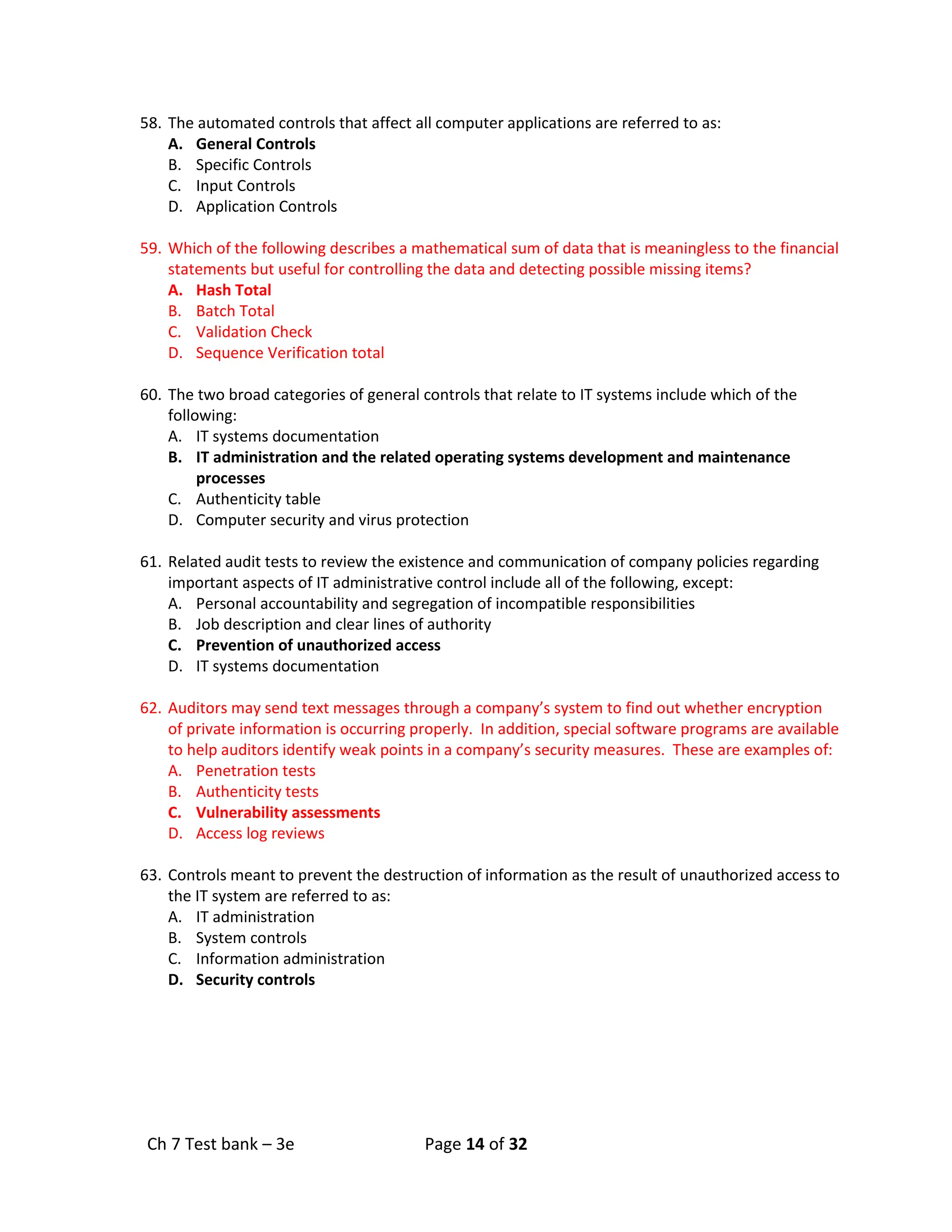
58. The automated controls that affect all computer applications are referred to as:
A. General Controls
B. Specific Controls
C. Input Controls
D. Application Controls
59. Which of the following describes a mathematical sum of data that is meaningless to the financial
statements but useful for controlling the data and detecting possible missing items?
A. Hash Total
B. Batch Total
C. Validation Check
D. Sequence Verification total
60. The two broad categories of general controls that relate to IT systems include which of the
following:
A. IT systems documentation
B. IT administration and the related operating systems development and maintenance
processes
C. Authenticity table
D. Computer security and virus protection
61. Related audit tests to review the existence and communication of company policies regarding
important aspects of IT administrative control include all of the following, except:
A. Personal accountability and segregation of incompatible responsibilities
B. Job description and clear lines of authority
C. Prevention of unauthorized access
D. IT systems documentation
62. Auditors may send text messages through a company’s system to find out whether encryption
of private information is occurring properly. In addition, special software programs are available
to help auditors identify weak points in a company’s security measures. These are examples of:
A. Penetration tests
B. Authenticity tests
C. Vulnerability assessments
D. Access log reviews
63. Controls meant to prevent the destruction of information as the result of unauthorized access to
the IT system are referred to as:
A. IT administration
B. System controls
C. Information administration
D. Security controls
19.
Ch 7 Testbank – 3e Page 15 of 32
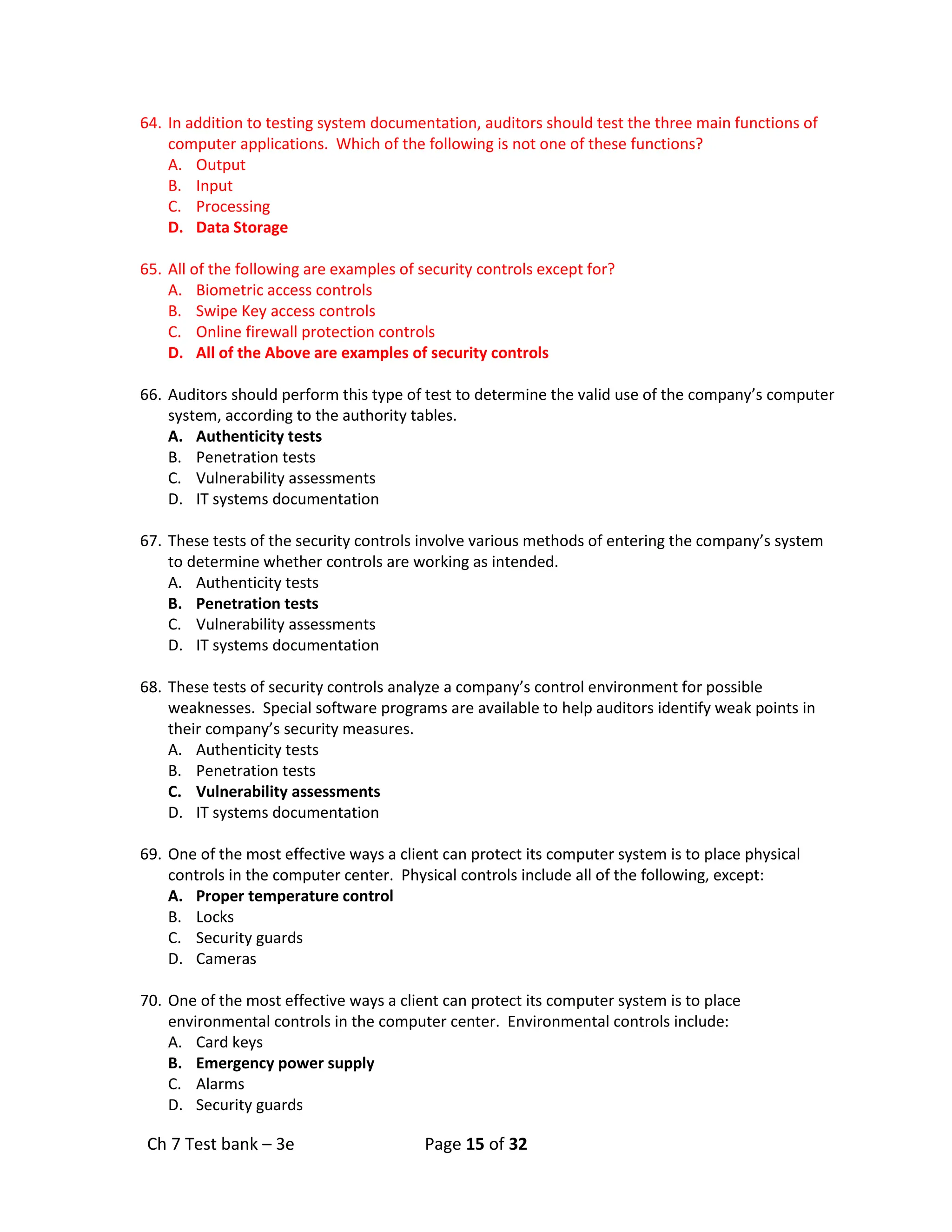
64. In addition to testing system documentation, auditors should test the three main functions of
computer applications. Which of the following is not one of these functions?
A. Output
B. Input
C. Processing
D. Data Storage
65. All of the following are examples of security controls except for?
A. Biometric access controls
B. Swipe Key access controls
C. Online firewall protection controls
D. All of the Above are examples of security controls
66. Auditors should perform this type of test to determine the valid use of the company’s computer
system, according to the authority tables.
A. Authenticity tests
B. Penetration tests
C. Vulnerability assessments
D. IT systems documentation
67. These tests of the security controls involve various methods of entering the company’s system
to determine whether controls are working as intended.
A. Authenticity tests
B. Penetration tests
C. Vulnerability assessments
D. IT systems documentation
68. These tests of security controls analyze a company’s control environment for possible
weaknesses. Special software programs are available to help auditors identify weak points in
their company’s security measures.
A. Authenticity tests
B. Penetration tests
C. Vulnerability assessments
D. IT systems documentation
69. One of the most effective ways a client can protect its computer system is to place physical
controls in the computer center. Physical controls include all of the following, except:
A. Proper temperature control
B. Locks
C. Security guards
D. Cameras
70. One of the most effective ways a client can protect its computer system is to place
environmental controls in the computer center. Environmental controls include:
A. Card keys
B. Emergency power supply
C. Alarms
D. Security guards
20.
Ch 7 Testbank – 3e Page 16 of 32
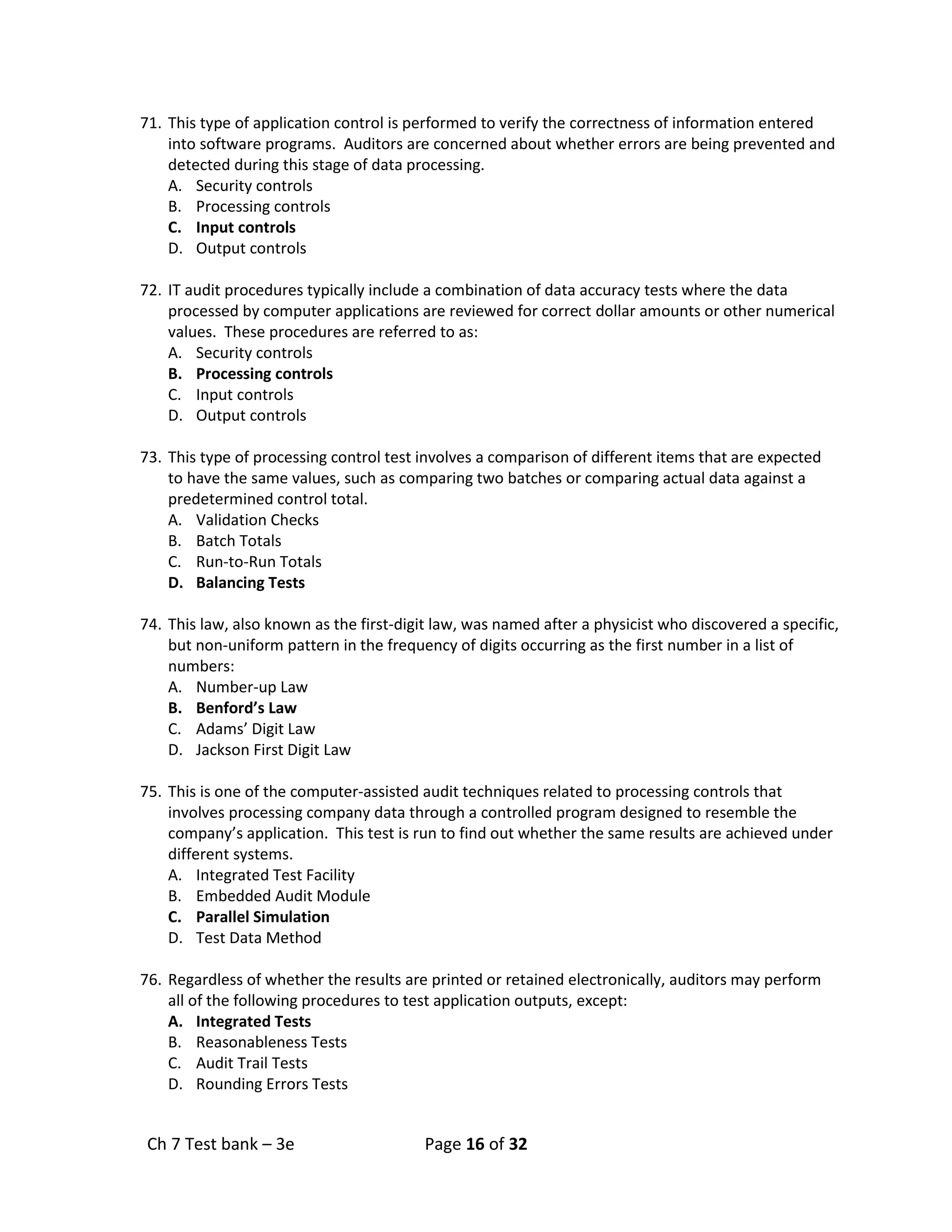
71. This type of application control is performed to verify the correctness of information entered
into software programs. Auditors are concerned about whether errors are being prevented and
detected during this stage of data processing.
A. Security controls
B. Processing controls
C. Input controls
D. Output controls
72. IT audit procedures typically include a combination of data accuracy tests where the data
processed by computer applications are reviewed for correct dollar amounts or other numerical
values. These procedures are referred to as:
A. Security controls
B. Processing controls
C. Input controls
D. Output controls
73. This type of processing control test involves a comparison of different items that are expected
to have the same values, such as comparing two batches or comparing actual data against a
predetermined control total.
A. Validation Checks
B. Batch Totals
C. Run-to-Run Totals
D. Balancing Tests
74. This law, also known as the first-digit law, was named after a physicist who discovered a specific,
but non-uniform pattern in the frequency of digits occurring as the first number in a list of
numbers:
A. Number-up Law
B. Benford’s Law
C. Adams’ Digit Law
D. Jackson First Digit Law
75. This is one of the computer-assisted audit techniques related to processing controls that
involves processing company data through a controlled program designed to resemble the
company’s application. This test is run to find out whether the same results are achieved under
different systems.
A. Integrated Test Facility
B. Embedded Audit Module
C. Parallel Simulation
D. Test Data Method
76. Regardless of whether the results are printed or retained electronically, auditors may perform
all of the following procedures to test application outputs, except:
A. Integrated Tests
B. Reasonableness Tests
C. Audit Trail Tests
D. Rounding Errors Tests
21.
Ch 7 Testbank – 3e Page 17 of 32
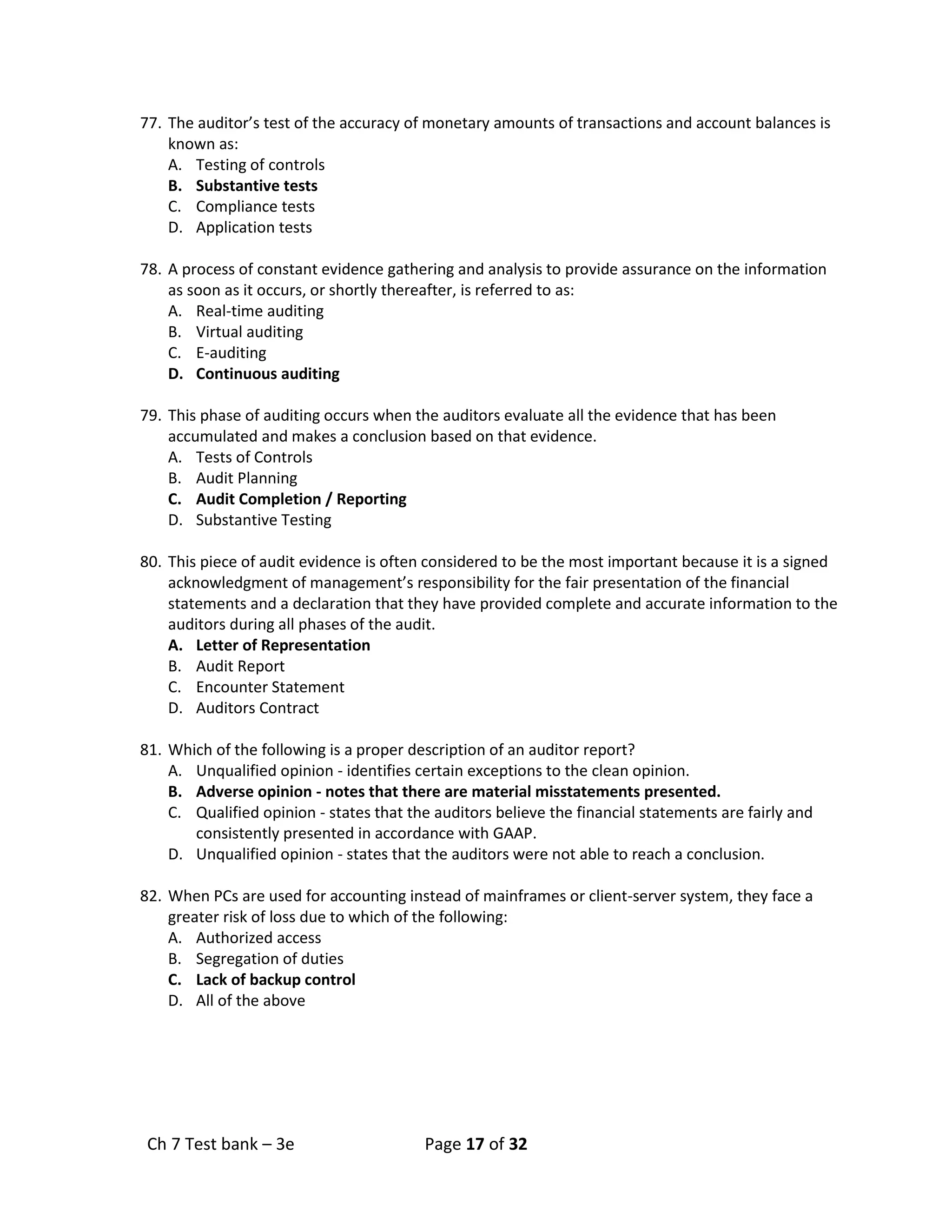
77. The auditor’s test of the accuracy of monetary amounts of transactions and account balances is
known as:
A. Testing of controls
B. Substantive tests
C. Compliance tests
D. Application tests
78. A process of constant evidence gathering and analysis to provide assurance on the information
as soon as it occurs, or shortly thereafter, is referred to as:
A. Real-time auditing
B. Virtual auditing
C. E-auditing
D. Continuous auditing
79. This phase of auditing occurs when the auditors evaluate all the evidence that has been
accumulated and makes a conclusion based on that evidence.
A. Tests of Controls
B. Audit Planning
C. Audit Completion / Reporting
D. Substantive Testing
80. This piece of audit evidence is often considered to be the most important because it is a signed
acknowledgment of management’s responsibility for the fair presentation of the financial
statements and a declaration that they have provided complete and accurate information to the
auditors during all phases of the audit.
A. Letter of Representation
B. Audit Report
C. Encounter Statement
D. Auditors Contract
81. Which of the following is a proper description of an auditor report?
A. Unqualified opinion - identifies certain exceptions to the clean opinion.
B. Adverse opinion - notes that there are material misstatements presented.
C. Qualified opinion - states that the auditors believe the financial statements are fairly and
consistently presented in accordance with GAAP.
D. Unqualified opinion - states that the auditors were not able to reach a conclusion.
82. When PCs are used for accounting instead of mainframes or client-server system, they face a
greater risk of loss due to which of the following:
A. Authorized access
B. Segregation of duties
C. Lack of backup control
D. All of the above
22.
Ch 7 Testbank – 3e Page 18 of 32
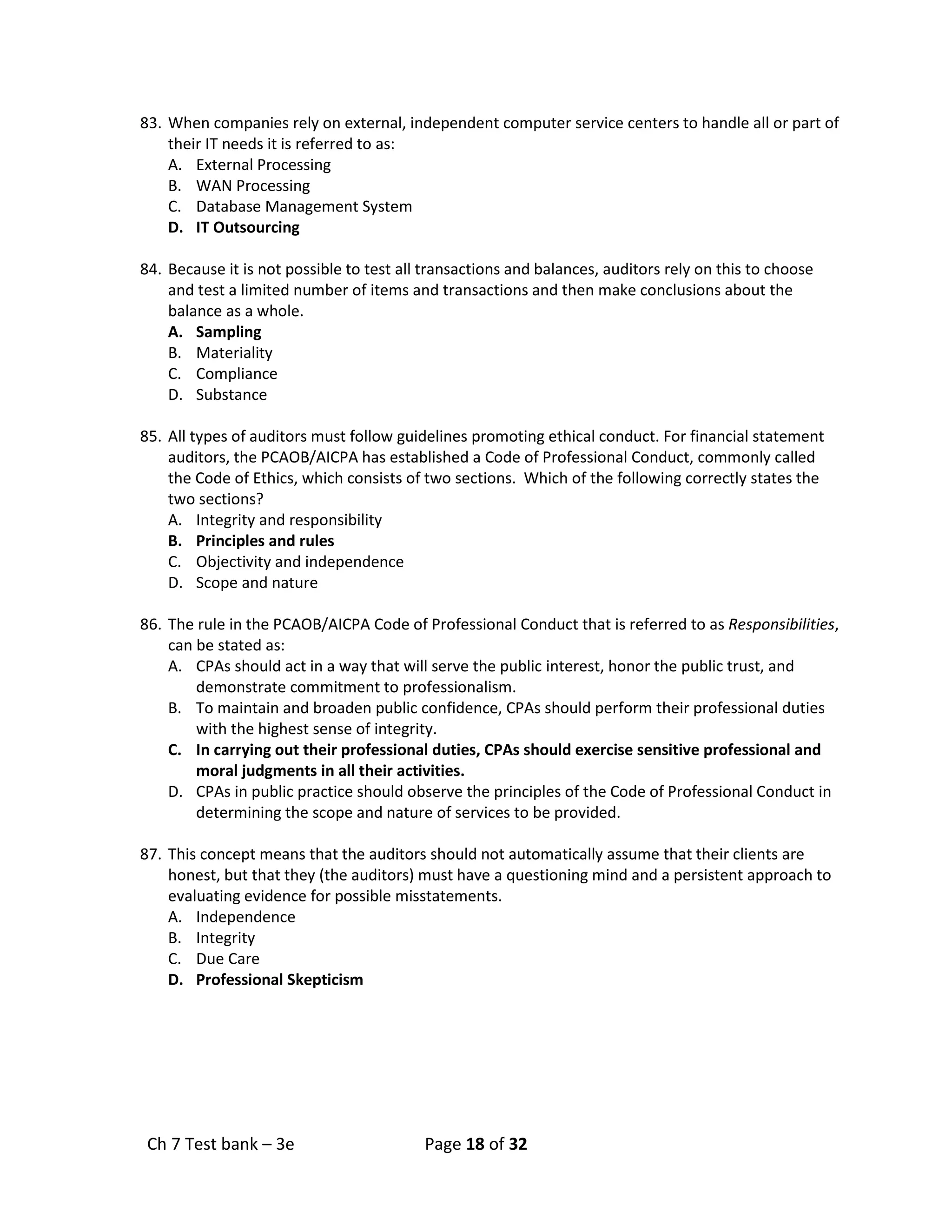
83. When companies rely on external, independent computer service centers to handle all or part of
their IT needs it is referred to as:
A. External Processing
B. WAN Processing
C. Database Management System
D. IT Outsourcing
84. Because it is not possible to test all transactions and balances, auditors rely on this to choose
and test a limited number of items and transactions and then make conclusions about the
balance as a whole.
A. Sampling
B. Materiality
C. Compliance
D. Substance
85. All types of auditors must follow guidelines promoting ethical conduct. For financial statement
auditors, the PCAOB/AICPA has established a Code of Professional Conduct, commonly called
the Code of Ethics, which consists of two sections. Which of the following correctly states the
two sections?
A. Integrity and responsibility
B. Principles and rules
C. Objectivity and independence
D. Scope and nature
86. The rule in the PCAOB/AICPA Code of Professional Conduct that is referred to as Responsibilities,
can be stated as:
A. CPAs should act in a way that will serve the public interest, honor the public trust, and
demonstrate commitment to professionalism.
B. To maintain and broaden public confidence, CPAs should perform their professional duties
with the highest sense of integrity.
C. In carrying out their professional duties, CPAs should exercise sensitive professional and
moral judgments in all their activities.
D. CPAs in public practice should observe the principles of the Code of Professional Conduct in
determining the scope and nature of services to be provided.
87. This concept means that the auditors should not automatically assume that their clients are
honest, but that they (the auditors) must have a questioning mind and a persistent approach to
evaluating evidence for possible misstatements.
A. Independence
B. Integrity
C. Due Care
D. Professional Skepticism
23.
Ch 7 Testbank – 3e Page 19 of 32
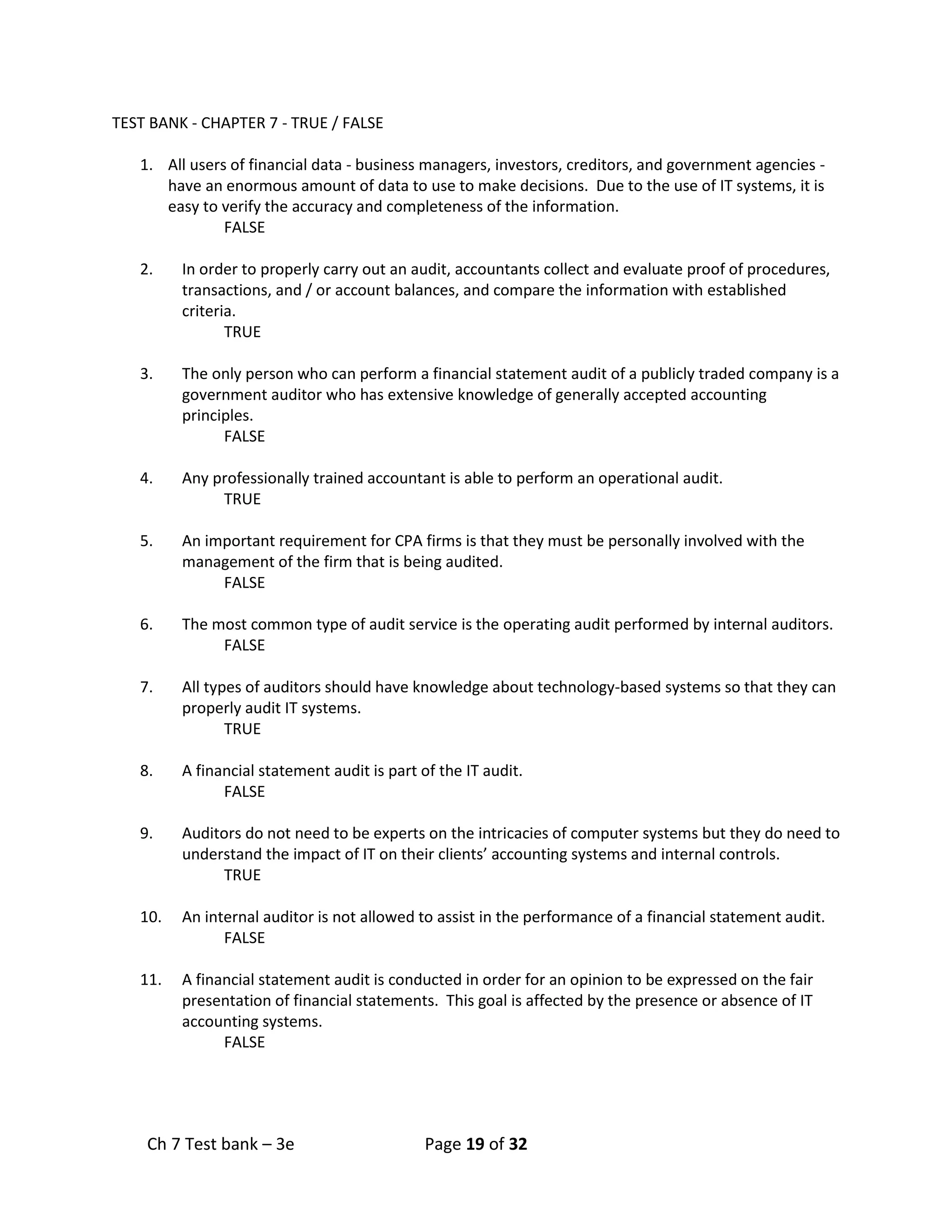
TEST BANK - CHAPTER 7 - TRUE / FALSE
1. All users of financial data - business managers, investors, creditors, and government agencies -
have an enormous amount of data to use to make decisions. Due to the use of IT systems, it is
easy to verify the accuracy and completeness of the information.
FALSE
2. In order to properly carry out an audit, accountants collect and evaluate proof of procedures,
transactions, and / or account balances, and compare the information with established
criteria.
TRUE
3. The only person who can perform a financial statement audit of a publicly traded company is a
government auditor who has extensive knowledge of generally accepted accounting
principles.
FALSE
4. Any professionally trained accountant is able to perform an operational audit.
TRUE
5. An important requirement for CPA firms is that they must be personally involved with the
management of the firm that is being audited.
FALSE
6. The most common type of audit service is the operating audit performed by internal auditors.
FALSE
7. All types of auditors should have knowledge about technology-based systems so that they can
properly audit IT systems.
TRUE
8. A financial statement audit is part of the IT audit.
FALSE
9. Auditors do not need to be experts on the intricacies of computer systems but they do need to
understand the impact of IT on their clients’ accounting systems and internal controls.
TRUE
10. An internal auditor is not allowed to assist in the performance of a financial statement audit.
FALSE
11. A financial statement audit is conducted in order for an opinion to be expressed on the fair
presentation of financial statements. This goal is affected by the presence or absence of IT
accounting systems.
FALSE
24.
Ch 7 Testbank – 3e Page 20 of 32
12. Information risk is the chance that information used by decision makers may be inaccurate.
TRUE
13. As a business grows, the volume and complexity of its transactions increase. At the same timed,
there is a decrease in the chance that misstated information may exist undetected.
FALSE
14. The remoteness of information, one of the causes of information risk, can relate to geographic
distance or organizational layers.
TRUE
15. The most common method for decision makers to reduce information risk is to rely on
information that has been audited by an independent party.
TRUE
16. Auditors have the primary responsibility to make sure that they comply with international
standards in all cases.
FALSE
17. There is not much room for professional judgement when performing audits, as a result of the
detailed guidance provided by organizations, such as the PCAOB.
FALSE
18. The responsibility for operations, compliance, and financial reporting lies with the auditors.
FALSE
19. The role of the auditor is to analyze the underlying facts to decide whether information
provided by management is fairly presented.
TRUE
20. Management assertions relate to the actual existence and proper valuation of transactions
and account balances.
TRUE
21. The same audit tests would test for completeness of a liability or an asset.
FALSE
22. Auditing testing for any single general auditing objective would involve the same testing
techniques even though there are different types of information collected to support different
accounts and transactions.
FALSE
23. Auditors must think about how the features of a company’s IT systems influence its
management assertions and the general audit objectives even though these matters have
little or no impact on the choice of audit methodologies used.
FALSE
24. Risk can be inherent in the company’s business, due to things such as the nature of
When you wanderaway to the dreamland fold.
(With all, even so,—ere to sleep we go,
The wavering heart wavers back to the old!)
II
OTHER CHILDREN
27.
THE APPLE-BLOSSOM SWITCH
Itwas the daughter of a fairy witch,—
A sweet, though wayward child.
“Go, naughty Elfinella, bring a switch
From yonder fruit tree wild!”
(It was the charming time of all the year,—
The darling month of May
And every bush and thicket, far and near,
With leaves and flowers was gay.)
Poor Elfinella heard, and off she went,
With lagging steps and slow,
To where, amidst the wild, a fruit tree bent,
Her branches spreading low.
With blossomy boughs the motherly old tree
The tearful child begirt:
“My twigs are clothed with flowers; and you will see
The switch will never hurt!”
She broke a branch, with blossoms thickly set,
And lightly homeward tripped,—
The switch was used—but little did she fret;
For she with flowers was whipped!
29.
THE INDIGNANT BABY
Babywas out with Papa for a walk.
When their friends they met, it was “Oh!” and “Ah!”
“What a darling she is!” “Can the little kid talk?”
“Well—no; I don’t think that she can,” said Papa,
“Though she seems to understand.”
She was only two, but she understood,
And her small, rosy mouth was made up to cry—
But no! she would talk—she would show that she could.
And, “Mamma,” and “pretty,” and “laly”—”by-by,”
She said with a wave of her hand!
30.
A QUESTION OFSPELLING
They were looking through their book
With pictures of the Zoo;
Both too young to read the text,
But each the pictures knew.
Will was three, and Ray was five—
And five years old is old!
When his wiser brother spoke,
Will did as he was told!
“Look! I’ve found the efalunt!”
“Don’t say efalunt,” said Ray.
Said their mother: “You should tell
Little brother what to say.”
“Don’t say efalunt—that’s wrong;
It’s efalint!” said Ray.
“Efalint!” said little Will,
In his confiding way.
31.
“YOURS SEVERELY”
(The Letterof a Five Year Old)
Once more she dipped her pen in ink,
And wrote: “I love you dearly.”
“And now,” she said, and stopped to think,
“I’ll put, ‘I’m
Yours severely.’”
32.
A LACK OFATTENTION
She had folded her hands, and had never stirred
Nor even spoken one little word.
In fact, she was good as good could be,
While the grown folks talked, and sipped their tea
At last, a small voice from the corner we heard:
“Nobody pays any pension to me!”
33.
“I OUGHT TOMUSTN’T”
The chair was so near, and the shelf was so low,
And I opened the door just in time to see
The last of the coveted caramels go,
While a look imploring was cast on me,
“I ought to mustn’t, I know!”
The chair was so near, and the shelf was so low,—
To punish, alas! no courage I had:
And I did as, perhaps, you yourself might do,—
I kissed her, right there, so sweet and so bad!
But “I ought to mustn’t,” I knew!
34.
A VAIN REGRET
Hewas six years old, just six that day,
And I saw he had something important to say,
As he held in his hand a broken toy:
He looked in my face for an instant, and then
He said, with a sigh, and a downcast eye,
“If I could live my life over again,
I think I could be a better boy!”
35.
IN THE DARKLITTLE FLAT AT
THE END OF THE COURT
What can the children in cities do,
The children shut in from wholesome sport—
The children that live, all winter through,
In the dark little flat at the end of the court?
Yet a comfort they have (and a beautiful one!),
Though the days are chill and the days are short;
At noon, for a moment, looks in the sun,
In the dark little flat at the end of the court.
Then, the dazzled baby drops his toy,
Down tumbles the four-year-old’s tottering fort—
“Sunshine!” they all cry out, in their joy,
In the dark little flat at the end of the court.
36.
THE LITTLE GIRLFROM TOWN
Us children liked her, though she was so queer,
When she came out to Pleasantville, last year;
She “mustn’t walk upon the grass,” she said:
We asked her why?—and she just shook her head!
Oh, yes, us children liked the little kid,
Although she didn’t know one thing we did,
And said the oddest things you ever heard;
She saw a goose, and asked, “What kind o’ bird?“
Us children liked the little kid, oh, yes!
She wa’n’t a bit afraid to tear her dress;
One day, when she went barefoot, just like us,
She got a stone-bruise; but she didn’t fuss!
Oh, yes! us children liked her, but oh, my!
We had to teach her how to play “high spy”;
She came to see us,—called our house “a flat“—
I wonder now—what could she mean by that?
37.
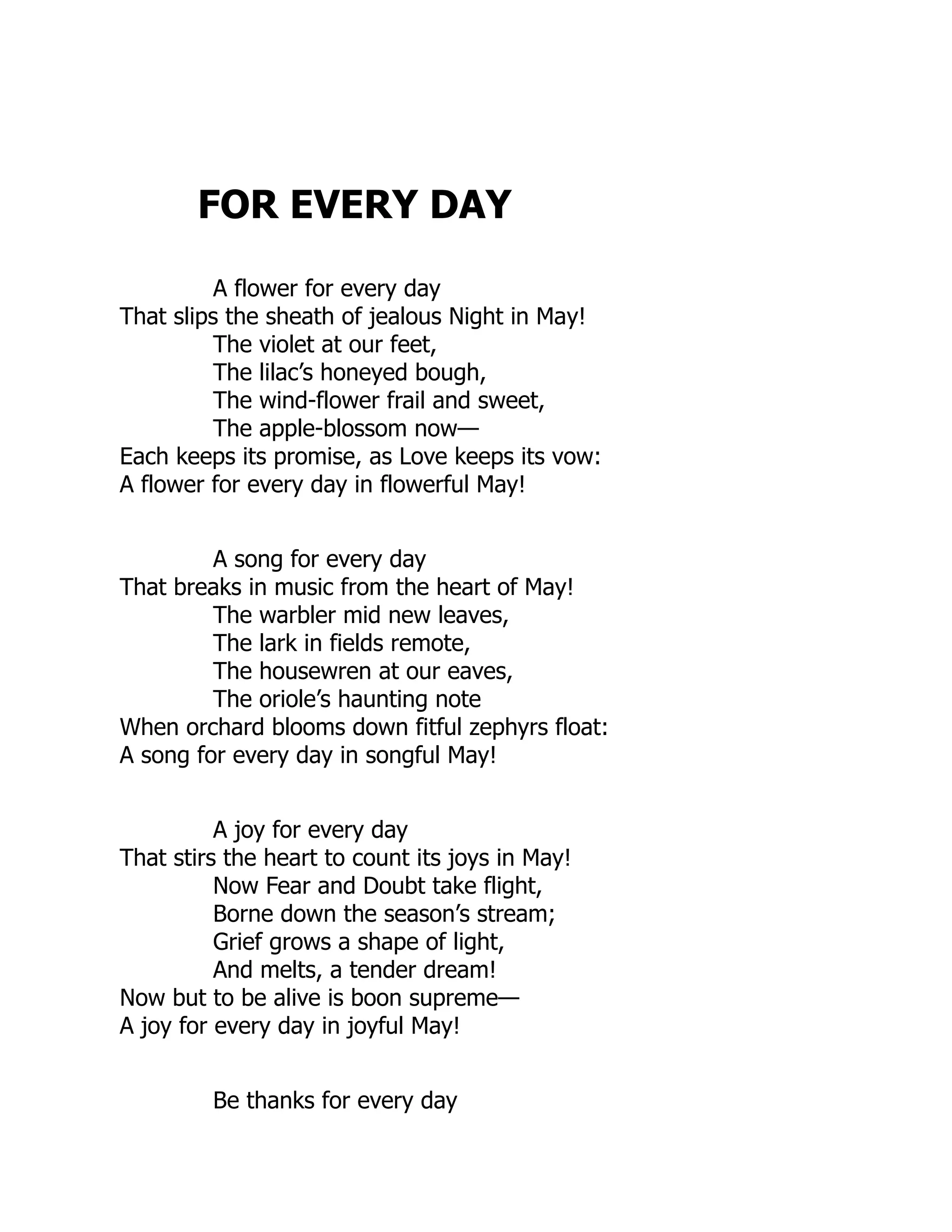
FOR EVERY DAY
Aflower for every day
That slips the sheath of jealous Night in May!
The violet at our feet,
The lilac’s honeyed bough,
The wind-flower frail and sweet,
The apple-blossom now—
Each keeps its promise, as Love keeps its vow:
A flower for every day in flowerful May!
A song for every day
That breaks in music from the heart of May!
The warbler mid new leaves,
The lark in fields remote,
The housewren at our eaves,
The oriole’s haunting note
When orchard blooms down fitful zephyrs float:
A song for every day in songful May!
A joy for every day
That stirs the heart to count its joys in May!
Now Fear and Doubt take flight,
Borne down the season’s stream;
Grief grows a shape of light,
And melts, a tender dream!
Now but to be alive is boon supreme—
A joy for every day in joyful May!
Be thanks for every day
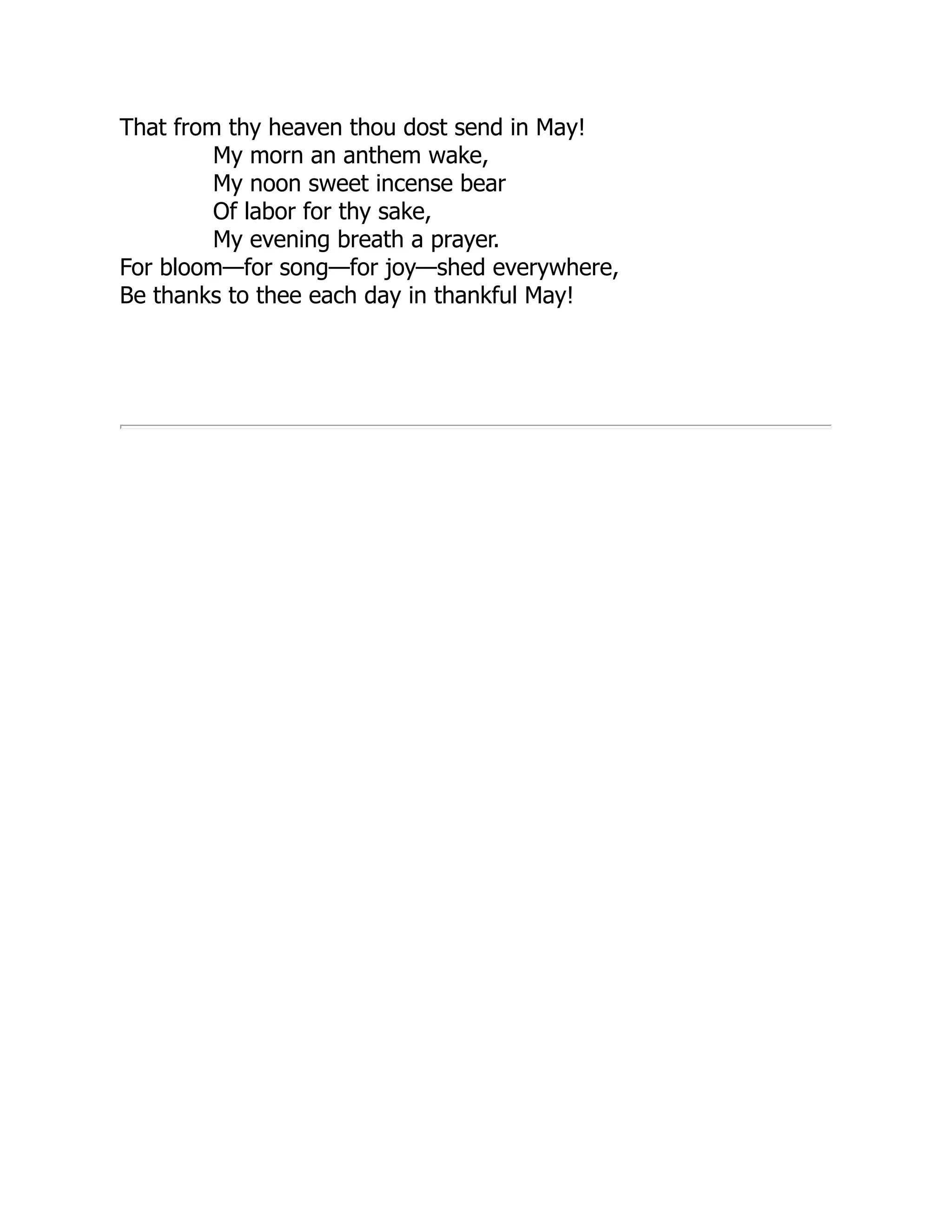
38.
That from thyheaven thou dost send in May!
My morn an anthem wake,
My noon sweet incense bear
Of labor for thy sake,
My evening breath a prayer.
For bloom—for song—for joy—shed everywhere,
Be thanks to thee each day in thankful May!
39.
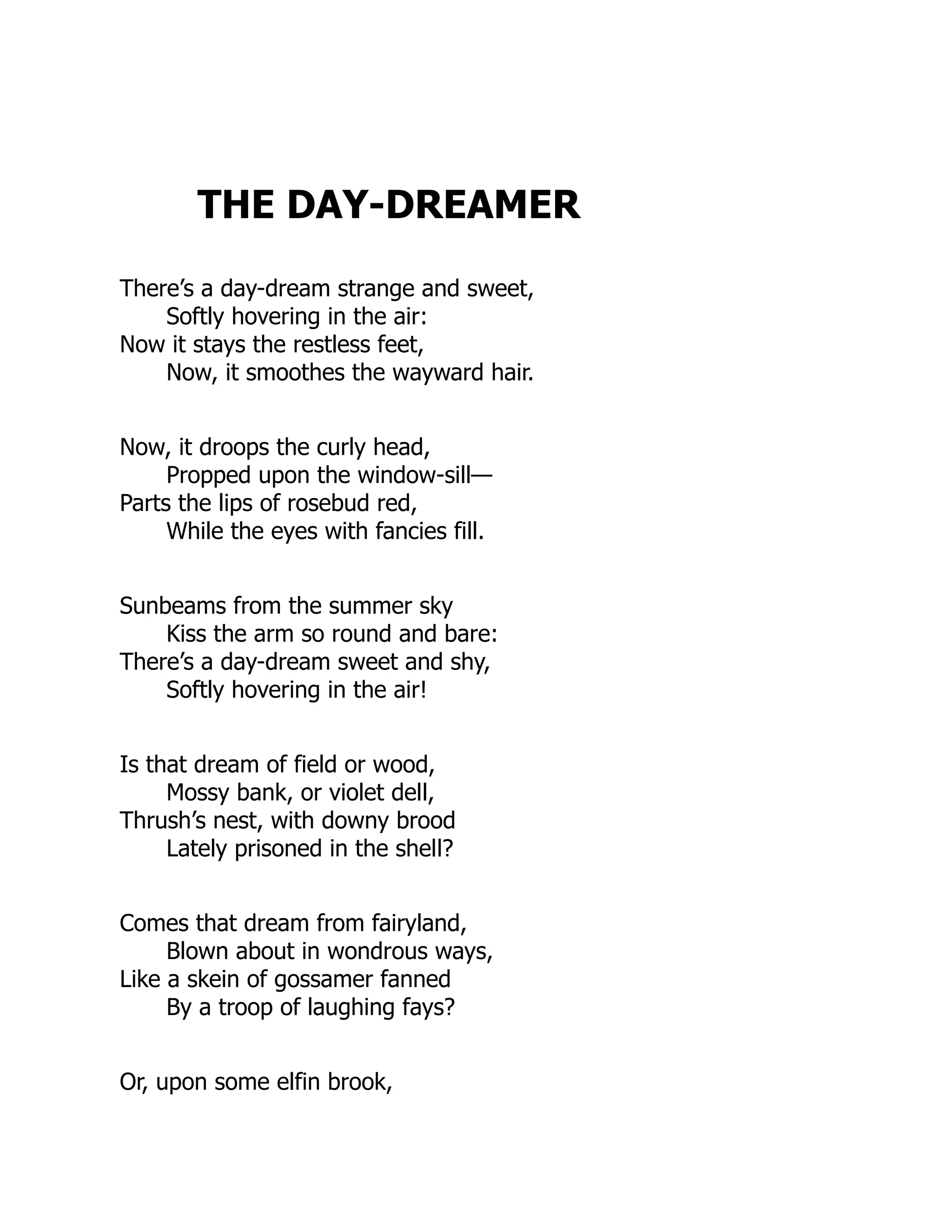
THE DAY-DREAMER
There’s aday-dream strange and sweet,
Softly hovering in the air:
Now it stays the restless feet,
Now, it smoothes the wayward hair.
Now, it droops the curly head,
Propped upon the window-sill—
Parts the lips of rosebud red,
While the eyes with fancies fill.
Sunbeams from the summer sky
Kiss the arm so round and bare:
There’s a day-dream sweet and shy,
Softly hovering in the air!
Is that dream of field or wood,
Mossy bank, or violet dell,
Thrush’s nest, with downy brood
Lately prisoned in the shell?
Comes that dream from fairyland,
Blown about in wondrous ways,
Like a skein of gossamer fanned
By a troop of laughing fays?
Or, upon some elfin brook,
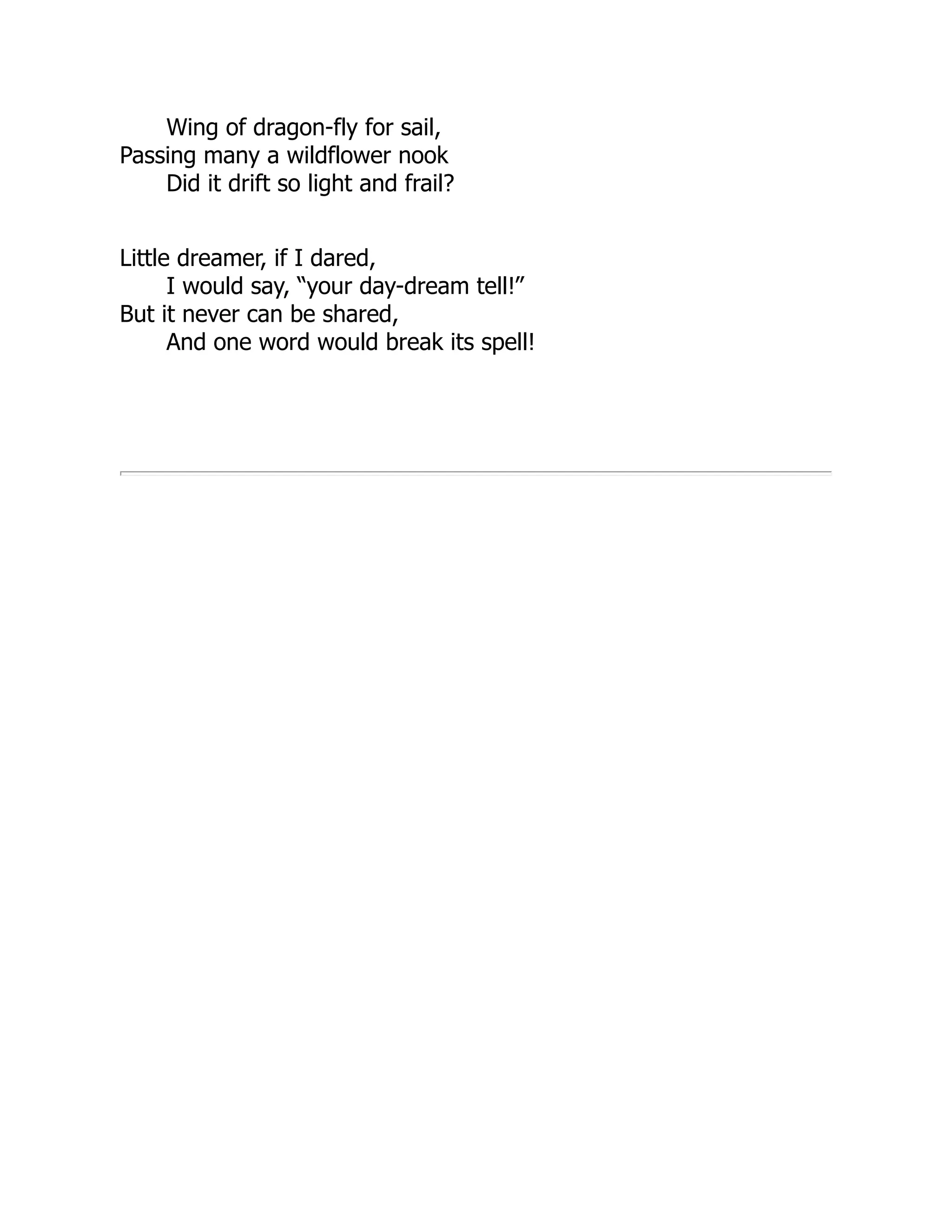
40.
Wing of dragon-flyfor sail,
Passing many a wildflower nook
Did it drift so light and frail?
Little dreamer, if I dared,
I would say, “your day-dream tell!”
But it never can be shared,
And one word would break its spell!
41.
BORN DEAF, DUMB,AND BLIND
(At an Asylum)
A flower-soft hand once took my own,—
That touch I never shall forget!
A strange voice spoke—so strange a tone
Mine ear had never met!
It said, “Come—see—my—garden,—Come!”
(The flower-soft fingers closer twined):
The voice of one born deaf and dumb,
The touch of one born blind!
They thrilled me so, the tears came fast;
But in glad haste she led the way;
Through hall and open door we passed
Into a garden gay.
Her share was but a little space.
It bloomed with pansies dark and bright;
And each looked up with elfin grace,
As though to win her sight.
She smiled—the pansy-faces smiled
Through tears—or was it morning dew?
Down knelt the deaf and dumb, blind child
“I do—give—all—to—you!”
42.
I could notstay those fingers swift,
She plucked me all the flowers she had!
I never shall have any gift
So sweet as this,—so sad!
43.
THE CRADLE-CHILD
Forgotten, ina chamber lone,
The hooded Cradle, brown and old,
Began to rock, began to moan,
“Where are the babes I used to hold?”
“To men and women they are grown,
And through the world their way must make.”
The Cradle rocked and made its moan,
“My babes no single step could take!”
“A helmsman one, on wide seas blown,
His sinewy hands the wheel employs."
The Cradle rocked and made its moan,
“My babes could scarcely grasp their toys.”
“And one, with words of winning tone,
God’s shepherd, goes the lost to seek.”
The Cradle rocked and still made moan,
“The babes I held no word could speak!”
“And one, with children of her own,—
Her life is toil and love and prayer!”
The Cradle rocked and still made moan,
“My babes of babes could take no care!”
“Now all that once were mine are flown
44.
But one, thatstill with me shall bide”—
(The Cradle ceased to rock, to moan)—
“The sweetest one—the babe who died!”
45.
SOME LADIES OFTHE OLDEN
TIME
A long time ago in Childhood’s Land,
A troop of sweet ladies I knew,
If the truth must be told, I myself
Was their lady’s maid, patient and true!
I served them, I dressed them, I took them to walk,
I made the fine clothes that they wore;
Very dainty,—and delicate, too, were they all,
For they never arose until four!
Wide were their flounces of crimson or white,
A little old fashioned for now;
Prim were their figures—ah, yes, I must own,
Their heads they never could bow!
Their heads were so round and so small and so green—
Not clever nor learnèd were they;
But then, they were only Four o’Clock Ladies,
And their life, ’twas a short one and gay!
47.
A WATER LILY
DidI behold the Lady of the Lake
Part the cool water with a slender hand?
And brought she for her loved knight errant’s sake
Out of some liquid crypt the magic brand?
I dreamed it was the Lady of the Lake—
I did but dream! Again I looked, and knew
The water lily, white as winter’s flake,
But with a heart all gold and fragrant dew.
48.
THE KINDERBANK[4]
The LittleMothers
It was a day in warm July,
It was a far countree;
The bees were humming in the flowers
That filled the linden tree.
The linden made a cooling shade
For many a yard around,
And flecks of sunlight here and there
Did dot the shady ground.
A long, low, easy seat there was
Beneath the linden green;
And Kinderbank across the back
In letters large was seen.
I did not need that word to read,
To know the Children’s Seat;
For there the grass was trodden down
By many little feet.
Upon this day the Kinderbank
Was full as it could be,
With children sitting in a row,
A pleasant sight to see.
49.
Each little womanbent her head,
Too busy far to speak;
Each had a lock of yellow hair
Slipped down across her cheek.
Each little woman pursed her lips
Into a rosebud small,
And never knew how fast time flew—
So busy were they all.
One made the knitting-needles click,
With shining head bent low,
And earnest eyes intent to see
The winter stocking grow.
Another, toiling at a seam,
The thread drew in and out;
And once she sighed—so hard she tried
To make the stitches stout!
But ever, as they worked away,
And would not look around,
They watched the little ones that played
Before them on the ground.
The little ones they laughed and cooed,
And talked their baby-talk;
Their feet so bare were rosy-fair—
For only one could walk!
His flaxen hair in ringlets stood
Upon his serious head;
50.
His eyes soblue were serious, too;
And, drawing near, I said:
“Whose precious baby boy is this,
So thoughtful and so sweet?”
Then up and spoke a little maid,
Of those upon the seat:
“This baby—he belongs to me.
He goes just where I go;
And I’m his Little Mother—yes,
My mother told me so!
“She said that he was mine ‘all day.’
And so it must be true;
I brushed his hair—I take good care,
As she herself would do.
“And I’m quite sure that I can cure,
And drive the pain away,
With kisses, if my baby hurts
His little hand at play!”
“And whose are all these babies here?
“Why—we—oh, don’t you know?”
We all are Little Mothers—yes,
Our mothers told us so!”
The Little Mothers all looked up,
And each did nod her head:
“Our mothers told us so!” “Ah, then
’Tis true, indeed,” I said.
51.
I left themas I found them, there
Beneath the linden tree;
And often since that day I’ve thought
I’d like to go and see
If still the Little Mothers sit
Upon the Children’s Seat,
And watch their babies as they play
And tumble at their feet.
[4] In German, the Children’s Seat.
52.
BUONAMICO
A Legend ofFlorence
I
When Monte Morello is capped with snow,
And the wind from the north comes whistling down,
It is chill to rise with the morning star,
In the “City of Flowers”—in Florence town.
II
Light is the sleep of the old, for they know
How brief are their few remaining days;
But when hearts are young, sleep lingers long,
And too sweet to leave are the dreamful ways.
III
So, Tafi, the master, awoke with the light,
But the prentice lad, Buonamico, was young,
And his dreaming ears were loath to hear
The daybreak bell’s awakening tongue.
IV
For it seemed to speak with old Tafi’s voice,
“Colors to grind, and the shop to be swept!”
Then, out of his bed, on the bare stone floor,
Poor Buonamico, shivering, crept.
V
53.
Welcome to ourwebsite – the ideal destination for book lovers and
knowledge seekers. With a mission to inspire endlessly, we offer a
vast collection of books, ranging from classic literary works to
specialized publications, self-development books, and children's
literature. Each book is a new journey of discovery, expanding
knowledge and enriching the soul of the reade
Our website is not just a platform for buying books, but a bridge
connecting readers to the timeless values of culture and wisdom. With
an elegant, user-friendly interface and an intelligent search system,
we are committed to providing a quick and convenient shopping
experience. Additionally, our special promotions and home delivery
services ensure that you save time and fully enjoy the joy of reading.
Let us accompany you on the journey of exploring knowledge and
personal growth!
testbankdeal.com


![THE KINDERBANK[4]
The Little Mothers
It was a day in warm July,
It was a far countree;
The bees were humming in the flowers
That filled the linden tree.
The linden made a cooling shade
For many a yard around,
And flecks of sunlight here and there
Did dot the shady ground.
A long, low, easy seat there was
Beneath the linden green;
And Kinderbank across the back
In letters large was seen.
I did not need that word to read,
To know the Children’s Seat;
For there the grass was trodden down
By many little feet.
Upon this day the Kinderbank
Was full as it could be,
With children sitting in a row,
A pleasant sight to see.](https://image.slidesharecdn.com/6836-250311031203-5eed6141/75/Accounting-Information-Systems-Controls-Processes-3rd-Edition-Turner-Test-Bank-48-2048.jpg)
![I left them as I found them, there
Beneath the linden tree;
And often since that day I’ve thought
I’d like to go and see
If still the Little Mothers sit
Upon the Children’s Seat,
And watch their babies as they play
And tumble at their feet.
[4] In German, the Children’s Seat.](https://image.slidesharecdn.com/6836-250311031203-5eed6141/75/Accounting-Information-Systems-Controls-Processes-3rd-Edition-Turner-Test-Bank-51-2048.jpg)