Accounting Information Systems Controls
Processes 3rd Edition Turner Test Bank pdf
download
https://testbankdeal.com/product/accounting-information-systems-
controls-processes-3rd-edition-turner-test-bank/
Download more testbank from https://testbankdeal.com
Instant digital products (PDF, ePub, MOBI) available
Download now and explore formats that suit you...
Accounting Information Systems Controls Processes 3rd
Edition Turner Solutions Manual
https://testbankdeal.com/product/accounting-information-systems-
controls-processes-3rd-edition-turner-solutions-manual/
testbankdeal.com
Accounting Information Systems The Processes Controls 2nd
Edition Turner Solutions Manual
https://testbankdeal.com/product/accounting-information-systems-the-
processes-controls-2nd-edition-turner-solutions-manual/
testbankdeal.com
Accounting Information Systems The Processes and Controls
2nd Edition Turner Test Bank
https://testbankdeal.com/product/accounting-information-systems-the-
processes-and-controls-2nd-edition-turner-test-bank/
testbankdeal.com
Intimate Relationships 7th Edition Miller Solutions Manual
https://testbankdeal.com/product/intimate-relationships-7th-edition-
miller-solutions-manual/
testbankdeal.com
Business Statistics 2nd Edition Donnelly Solutions Manual
https://testbankdeal.com/product/business-statistics-2nd-edition-
donnelly-solutions-manual/
testbankdeal.com
Reinforced Concrete Mechanics And Design 7th Edition Wight
Solutions Manual
https://testbankdeal.com/product/reinforced-concrete-mechanics-and-
design-7th-edition-wight-solutions-manual/
testbankdeal.com
Bucks Step by Step Medical Coding 2019 Edition 1st Edition
Elsevier Test Bank
https://testbankdeal.com/product/bucks-step-by-step-medical-
coding-2019-edition-1st-edition-elsevier-test-bank/
testbankdeal.com
Inquiry into Physics 8th Edition Ostdiek Solutions Manual
https://testbankdeal.com/product/inquiry-into-physics-8th-edition-
ostdiek-solutions-manual/
testbankdeal.com
Compact Literature Reading Reacting Writing 8th Edition
Kirszner Test Bank
https://testbankdeal.com/product/compact-literature-reading-reacting-
writing-8th-edition-kirszner-test-bank/
testbankdeal.com
Supply Chain Management Strategy Planning and Operation
6th Edition Chopra Solutions Manual
https://testbankdeal.com/product/supply-chain-management-strategy-
planning-and-operation-6th-edition-chopra-solutions-manual/
testbankdeal.com
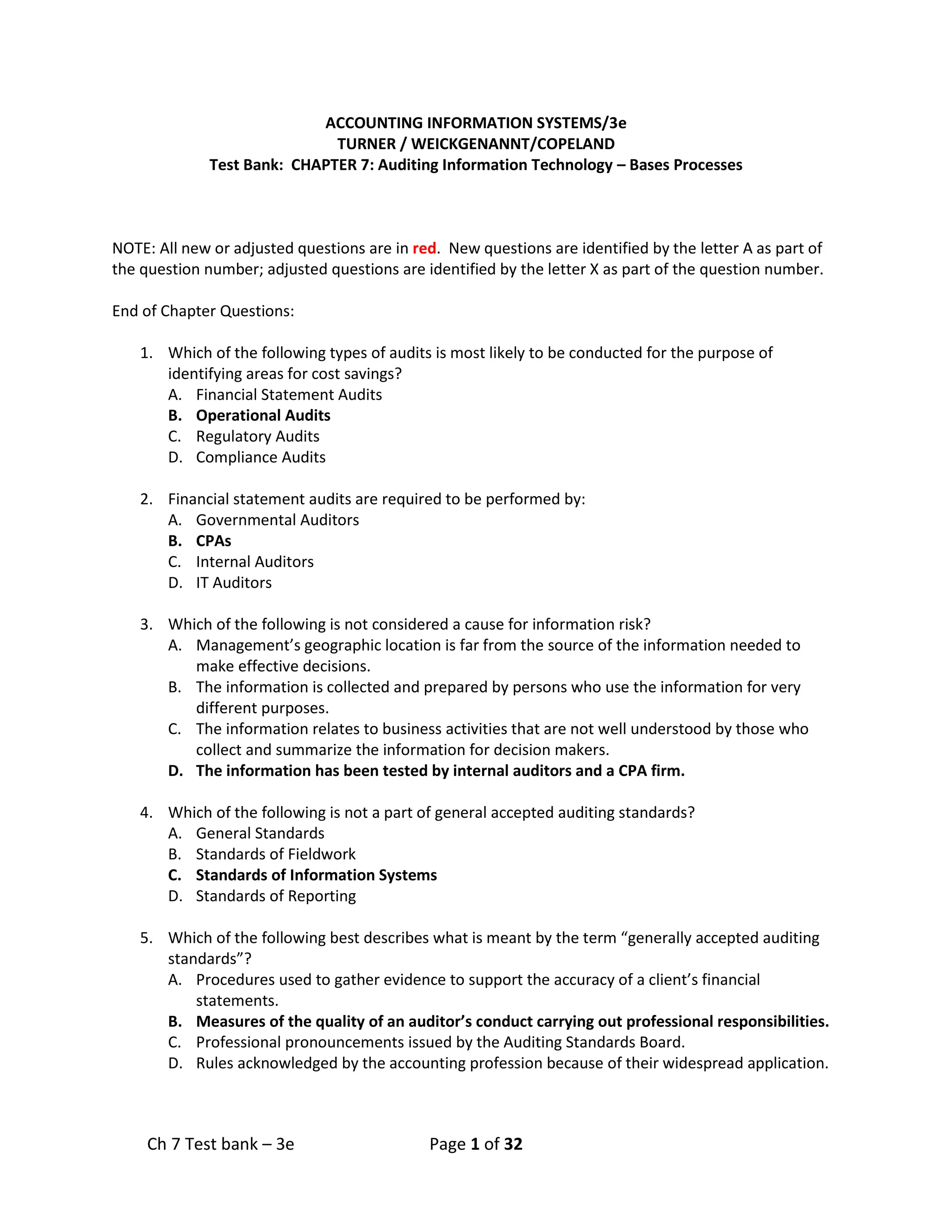
Ch 7 Test bank – 3e Page 1 of 32
ACCOUNTING INFORMATION SYSTEMS/3e
TURNER / WEICKGENANNT/COPELAND
Test Bank: CHAPTER 7: Auditing Information Technology – Bases Processes
NOTE: All new or adjusted questions are in red. New questions are identified by the letter A as part of
the question number; adjusted questions are identified by the letter X as part of the question number.
End of Chapter Questions:
1. Which of the following types of audits is most likely to be conducted for the purpose of
identifying areas for cost savings?
A. Financial Statement Audits
B. Operational Audits
C. Regulatory Audits
D. Compliance Audits
2. Financial statement audits are required to be performed by:
A. Governmental Auditors
B. CPAs
C. Internal Auditors
D. IT Auditors
3. Which of the following is not considered a cause for information risk?
A. Management’s geographic location is far from the source of the information needed to
make effective decisions.
B. The information is collected and prepared by persons who use the information for very
different purposes.
C. The information relates to business activities that are not well understood by those who
collect and summarize the information for decision makers.
D. The information has been tested by internal auditors and a CPA firm.
4. Which of the following is not a part of general accepted auditing standards?
A. General Standards
B. Standards of Fieldwork
C. Standards of Information Systems
D. Standards of Reporting
5. Which of the following best describes what is meant by the term “generally accepted auditing
standards”?
A. Procedures used to gather evidence to support the accuracy of a client’s financial
statements.
B. Measures of the quality of an auditor’s conduct carrying out professional responsibilities.
C. Professional pronouncements issued by the Auditing Standards Board.
D. Rules acknowledged by the accounting profession because of their widespread application.
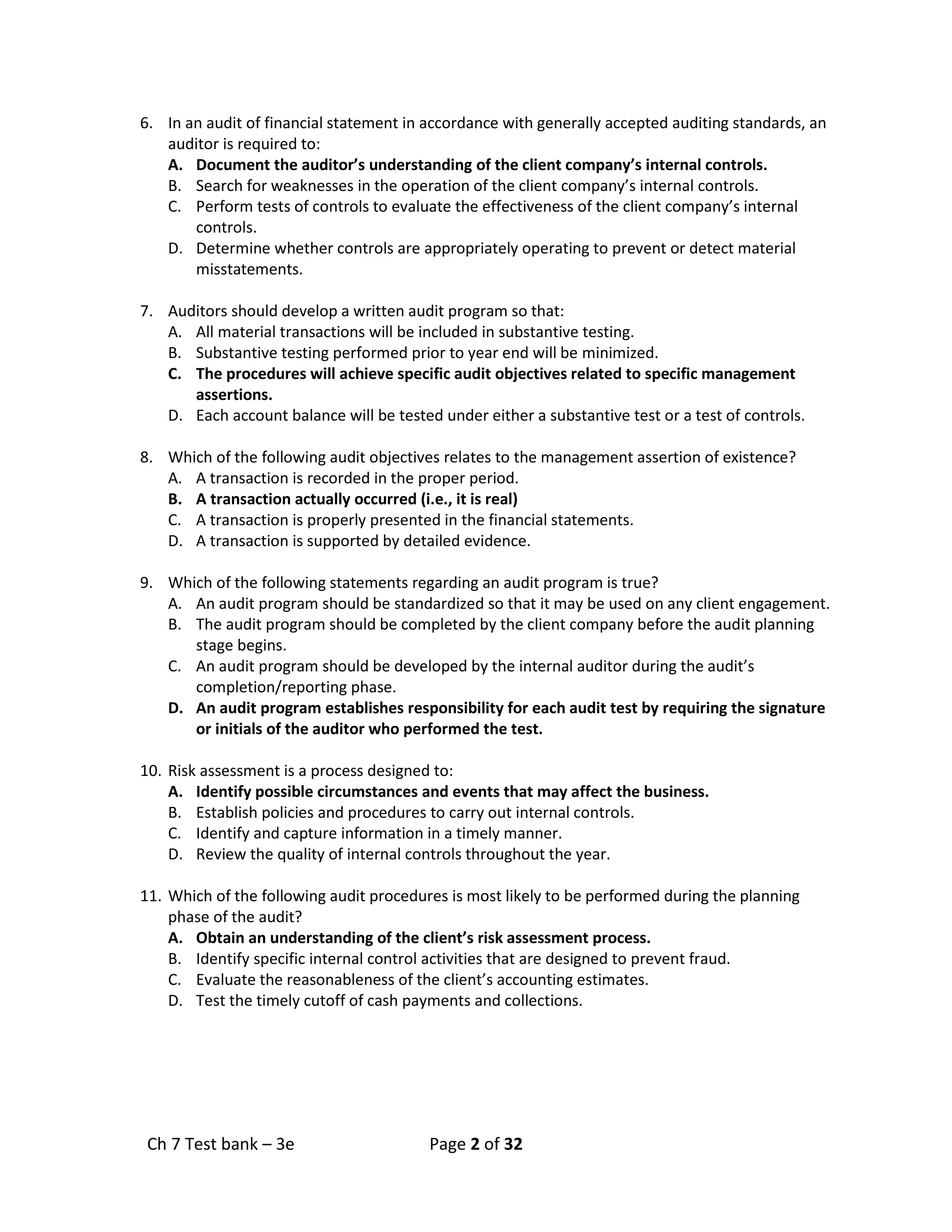
Ch 7 Test bank – 3e Page 2 of 32
6. In an audit of financial statement in accordance with generally accepted auditing standards, an
auditor is required to:
A. Document the auditor’s understanding of the client company’s internal controls.
B. Search for weaknesses in the operation of the client company’s internal controls.
C. Perform tests of controls to evaluate the effectiveness of the client company’s internal
controls.
D. Determine whether controls are appropriately operating to prevent or detect material
misstatements.
7. Auditors should develop a written audit program so that:
A. All material transactions will be included in substantive testing.
B. Substantive testing performed prior to year end will be minimized.
C. The procedures will achieve specific audit objectives related to specific management
assertions.
D. Each account balance will be tested under either a substantive test or a test of controls.
8. Which of the following audit objectives relates to the management assertion of existence?
A. A transaction is recorded in the proper period.
B. A transaction actually occurred (i.e., it is real)
C. A transaction is properly presented in the financial statements.
D. A transaction is supported by detailed evidence.
9. Which of the following statements regarding an audit program is true?
A. An audit program should be standardized so that it may be used on any client engagement.
B. The audit program should be completed by the client company before the audit planning
stage begins.
C. An audit program should be developed by the internal auditor during the audit’s
completion/reporting phase.
D. An audit program establishes responsibility for each audit test by requiring the signature
or initials of the auditor who performed the test.
10. Risk assessment is a process designed to:
A. Identify possible circumstances and events that may affect the business.
B. Establish policies and procedures to carry out internal controls.
C. Identify and capture information in a timely manner.
D. Review the quality of internal controls throughout the year.
11. Which of the following audit procedures is most likely to be performed during the planning
phase of the audit?
A. Obtain an understanding of the client’s risk assessment process.
B. Identify specific internal control activities that are designed to prevent fraud.
C. Evaluate the reasonableness of the client’s accounting estimates.
D. Test the timely cutoff of cash payments and collections.
Ch 7 Test bank – 3e Page 3 of 32
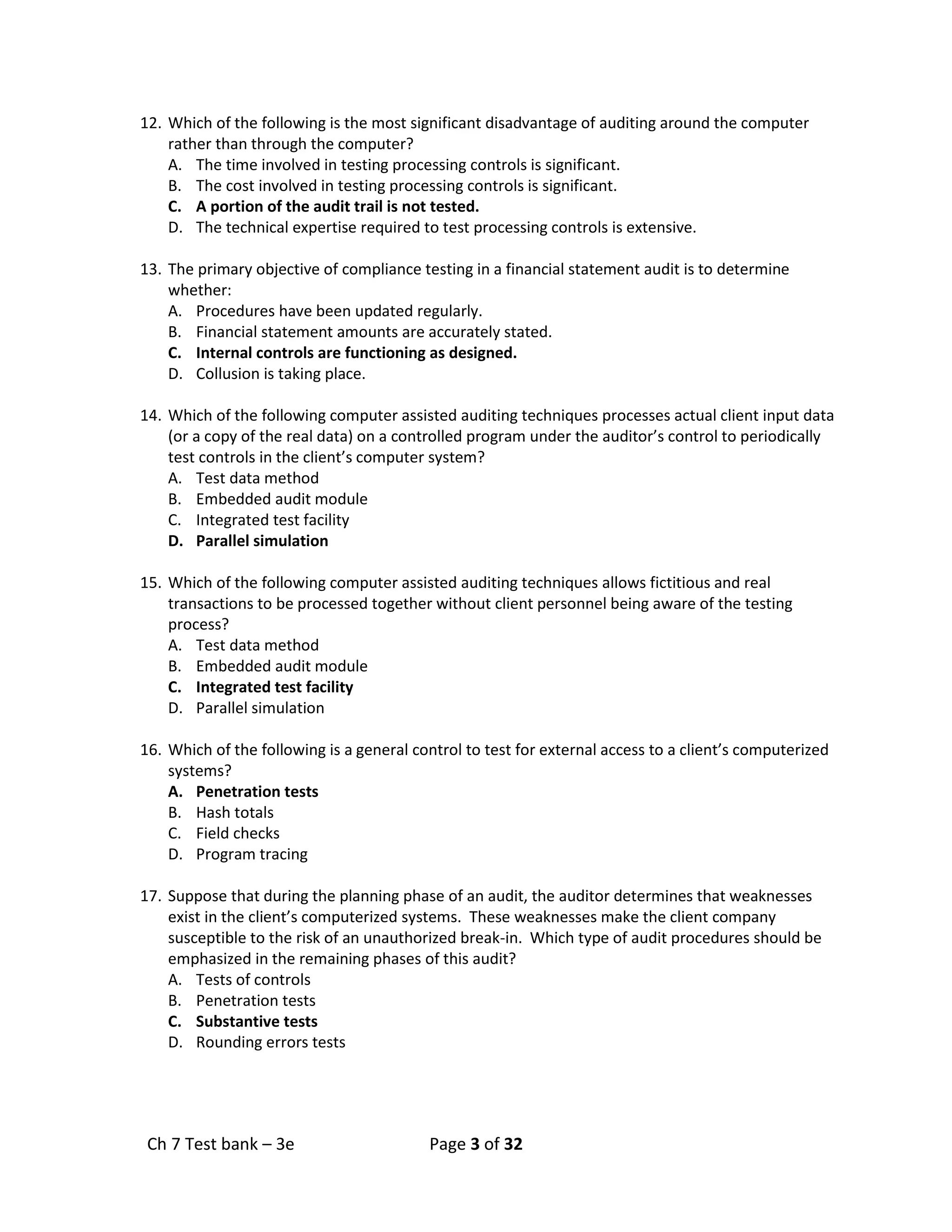
12. Which of the following is the most significant disadvantage of auditing around the computer
rather than through the computer?
A. The time involved in testing processing controls is significant.
B. The cost involved in testing processing controls is significant.
C. A portion of the audit trail is not tested.
D. The technical expertise required to test processing controls is extensive.
13. The primary objective of compliance testing in a financial statement audit is to determine
whether:
A. Procedures have been updated regularly.
B. Financial statement amounts are accurately stated.
C. Internal controls are functioning as designed.
D. Collusion is taking place.
14. Which of the following computer assisted auditing techniques processes actual client input data
(or a copy of the real data) on a controlled program under the auditor’s control to periodically
test controls in the client’s computer system?
A. Test data method
B. Embedded audit module
C. Integrated test facility
D. Parallel simulation
15. Which of the following computer assisted auditing techniques allows fictitious and real
transactions to be processed together without client personnel being aware of the testing
process?
A. Test data method
B. Embedded audit module
C. Integrated test facility
D. Parallel simulation
16. Which of the following is a general control to test for external access to a client’s computerized
systems?
A. Penetration tests
B. Hash totals
C. Field checks
D. Program tracing
17. Suppose that during the planning phase of an audit, the auditor determines that weaknesses
exist in the client’s computerized systems. These weaknesses make the client company
susceptible to the risk of an unauthorized break-in. Which type of audit procedures should be
emphasized in the remaining phases of this audit?
A. Tests of controls
B. Penetration tests
C. Substantive tests
D. Rounding errors tests
Ch 7 Test bank – 3e Page 4 of 32
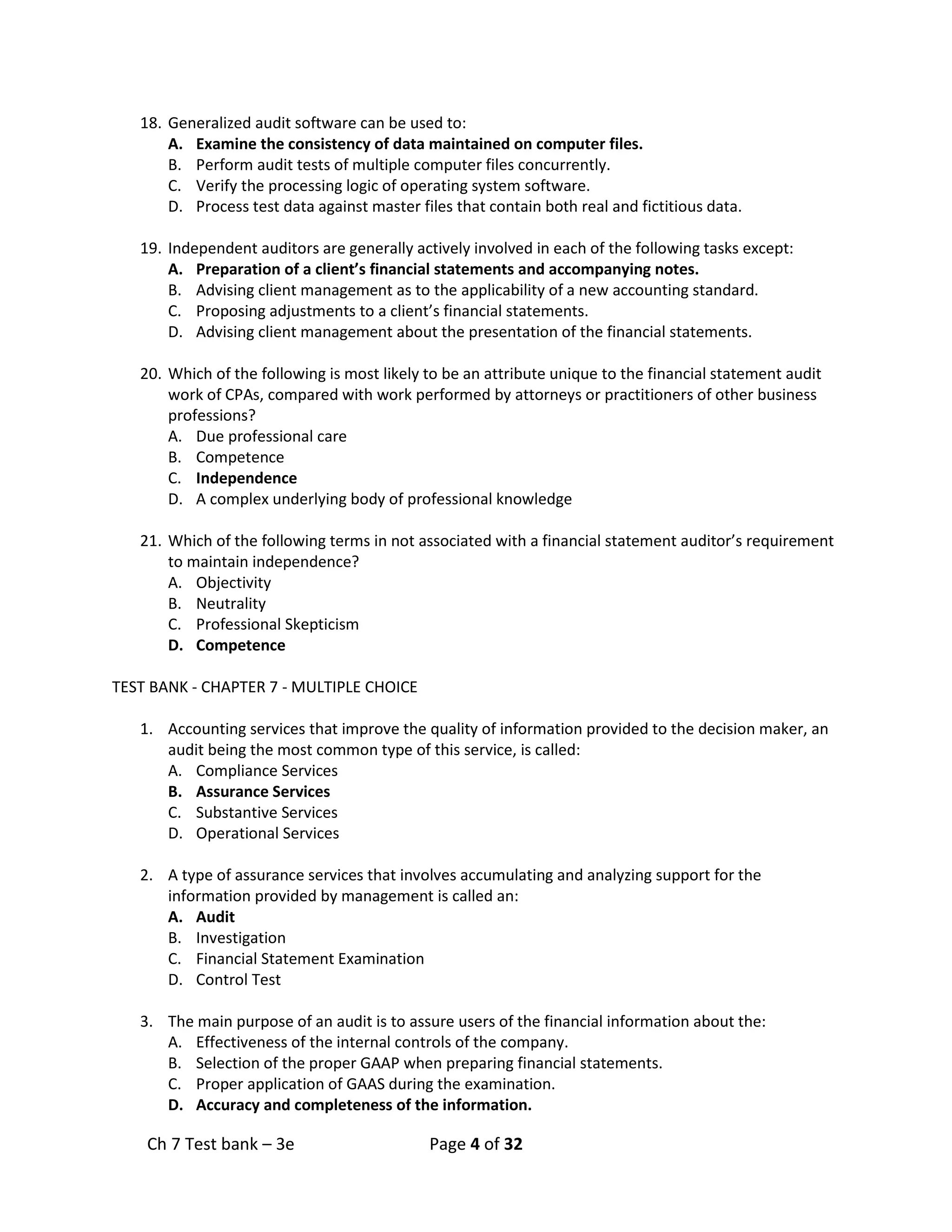
18. Generalized audit software can be used to:
A. Examine the consistency of data maintained on computer files.
B. Perform audit tests of multiple computer files concurrently.
C. Verify the processing logic of operating system software.
D. Process test data against master files that contain both real and fictitious data.
19. Independent auditors are generally actively involved in each of the following tasks except:
A. Preparation of a client’s financial statements and accompanying notes.
B. Advising client management as to the applicability of a new accounting standard.
C. Proposing adjustments to a client’s financial statements.
D. Advising client management about the presentation of the financial statements.
20. Which of the following is most likely to be an attribute unique to the financial statement audit
work of CPAs, compared with work performed by attorneys or practitioners of other business
professions?
A. Due professional care
B. Competence
C. Independence
D. A complex underlying body of professional knowledge
21. Which of the following terms in not associated with a financial statement auditor’s requirement
to maintain independence?
A. Objectivity
B. Neutrality
C. Professional Skepticism
D. Competence
TEST BANK - CHAPTER 7 - MULTIPLE CHOICE
1. Accounting services that improve the quality of information provided to the decision maker, an
audit being the most common type of this service, is called:
A. Compliance Services
B. Assurance Services
C. Substantive Services
D. Operational Services
2. A type of assurance services that involves accumulating and analyzing support for the
information provided by management is called an:
A. Audit
B. Investigation
C. Financial Statement Examination
D. Control Test
3. The main purpose of an audit is to assure users of the financial information about the:
A. Effectiveness of the internal controls of the company.
B. Selection of the proper GAAP when preparing financial statements.
C. Proper application of GAAS during the examination.
D. Accuracy and completeness of the information.
Ch 7 Test bank – 3e Page 5 of 32
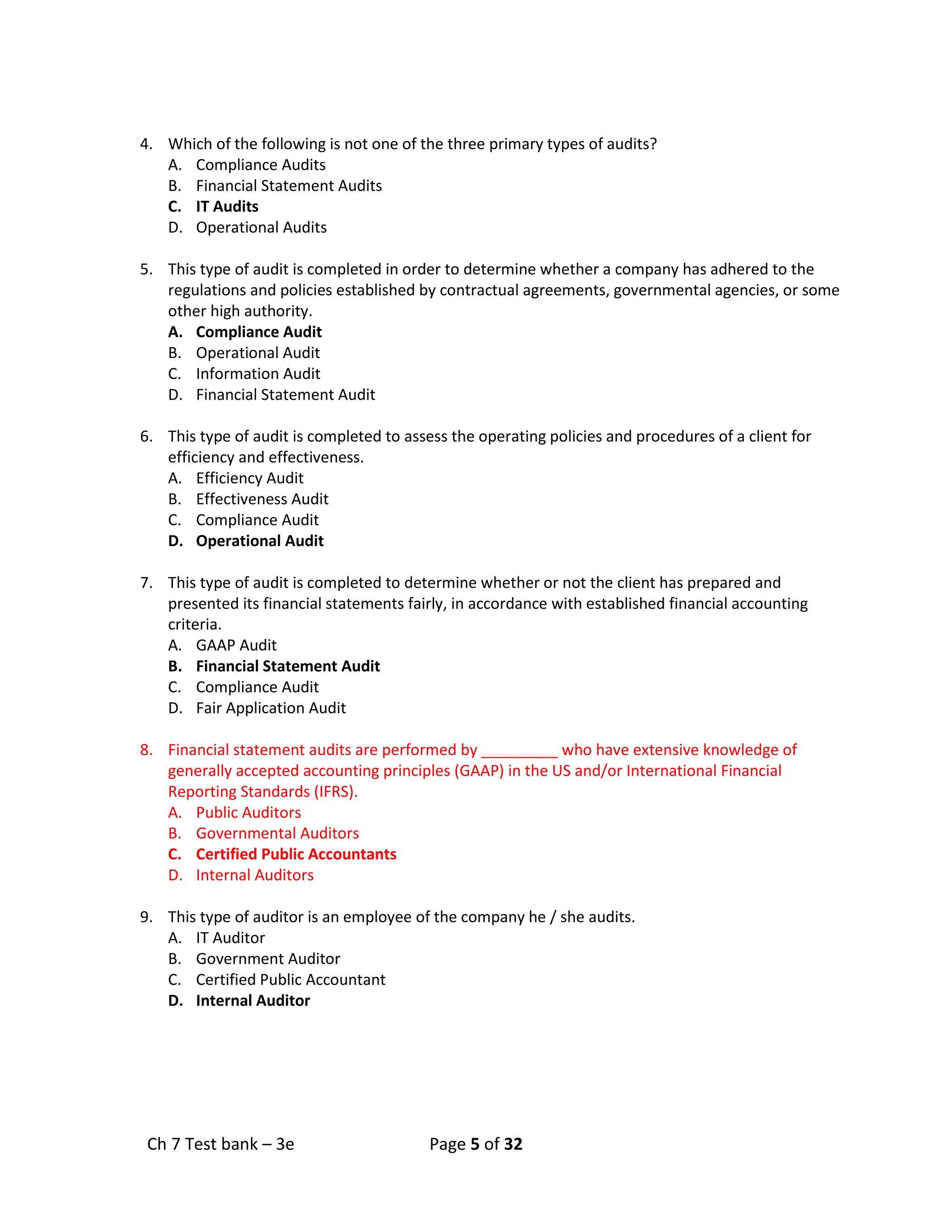
4. Which of the following is not one of the three primary types of audits?
A. Compliance Audits
B. Financial Statement Audits
C. IT Audits
D. Operational Audits
5. This type of audit is completed in order to determine whether a company has adhered to the
regulations and policies established by contractual agreements, governmental agencies, or some
other high authority.
A. Compliance Audit
B. Operational Audit
C. Information Audit
D. Financial Statement Audit
6. This type of audit is completed to assess the operating policies and procedures of a client for
efficiency and effectiveness.
A. Efficiency Audit
B. Effectiveness Audit
C. Compliance Audit
D. Operational Audit
7. This type of audit is completed to determine whether or not the client has prepared and
presented its financial statements fairly, in accordance with established financial accounting
criteria.
A. GAAP Audit
B. Financial Statement Audit
C. Compliance Audit
D. Fair Application Audit
8. Financial statement audits are performed by _________ who have extensive knowledge of
generally accepted accounting principles (GAAP) in the US and/or International Financial
Reporting Standards (IFRS).
A. Public Auditors
B. Governmental Auditors
C. Certified Public Accountants
D. Internal Auditors
9. This type of auditor is an employee of the company he / she audits.
A. IT Auditor
B. Government Auditor
C. Certified Public Accountant
D. Internal Auditor
Ch 7 Test bank – 3e Page 6 of 32
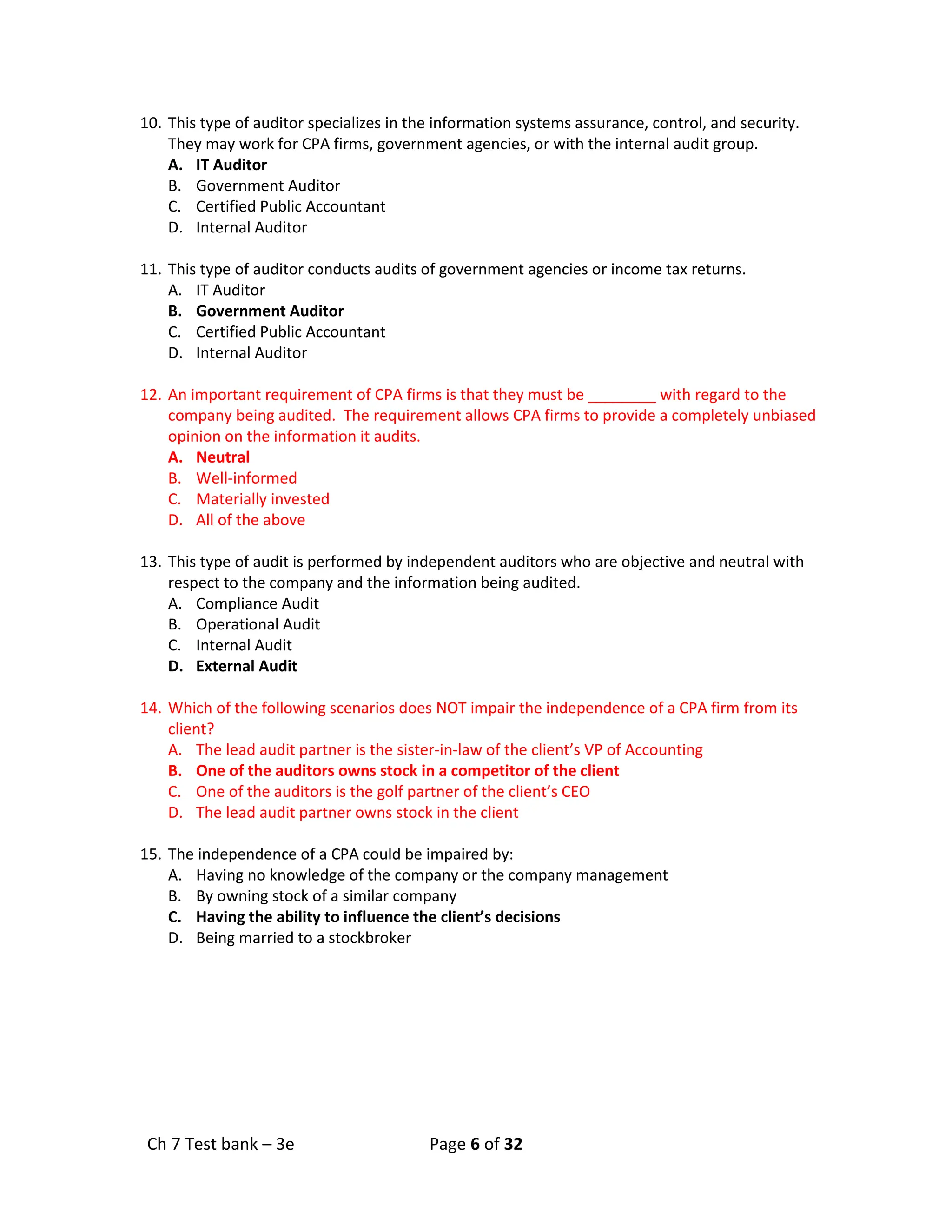
10. This type of auditor specializes in the information systems assurance, control, and security.
They may work for CPA firms, government agencies, or with the internal audit group.
A. IT Auditor
B. Government Auditor
C. Certified Public Accountant
D. Internal Auditor
11. This type of auditor conducts audits of government agencies or income tax returns.
A. IT Auditor
B. Government Auditor
C. Certified Public Accountant
D. Internal Auditor
12. An important requirement of CPA firms is that they must be ________ with regard to the
company being audited. The requirement allows CPA firms to provide a completely unbiased
opinion on the information it audits.
A. Neutral
B. Well-informed
C. Materially invested
D. All of the above
13. This type of audit is performed by independent auditors who are objective and neutral with
respect to the company and the information being audited.
A. Compliance Audit
B. Operational Audit
C. Internal Audit
D. External Audit
14. Which of the following scenarios does NOT impair the independence of a CPA firm from its
client?
A. The lead audit partner is the sister-in-law of the client’s VP of Accounting
B. One of the auditors owns stock in a competitor of the client
C. One of the auditors is the golf partner of the client’s CEO
D. The lead audit partner owns stock in the client
15. The independence of a CPA could be impaired by:
A. Having no knowledge of the company or the company management
B. By owning stock of a similar company
C. Having the ability to influence the client’s decisions
D. Being married to a stockbroker
Ch 7 Test bank – 3e Page 7 of 32
16. Decision makers are typically forced to rely on others for information. When the source of the
information is removed from the decision maker, the information stands a greater chance of
being misstated. A decision maker may become detached from the source of information due
to geography, organizational layers, or other factors. This describes which cause of information
risk?
A. The lack of CPA independence
B. The volume and complexity of underlying data
C. The motive of the preparer
D. The remoteness of information
17. The IT environment plays a key role in how auditors conduct their work in all but which of the
following areas:
A. Consideration of Risk
B. Consideration of Information Fairness
C. Design and Performance of Audit Tests
D. Audit Procedures Used
18. The chance that information used by decision makers may be inaccurate is referred to as:
A. Sample Risk
B. Data Risk
C. Audit Trail Risk
D. Information Risk
19. Which of the following is not one of the identified causes of information risk?
A. Audited information
B. Remote information
C. Complexity of data
D. Preparer motive
20. The main reasons that it is necessary to study information-based processing and the related
audit function include:
A. Information users often do not have the time or ability to verify information themselves.
B. It may be difficult for decision makers to verify information contained in a computerized
accounting system.
C. Both of the above.
D. Neither of the above.
21. The existence of IT-based business processes often result in details of transactions being
entered directly into the computer system, results in a lack of physical evidence to visibly view.
This situation is referred to as:
A. Physical Evidence Risk
B. Loss of Audit Trail Visibility
C. Transaction Summary Chart
D. Lack of Evidence View
Ch 7 Test bank – 3e Page 8 of 32
22. The existence of IT-based business processes, that result in the details of the transactions being
entered directly into the computer system, increases the likelihood of the loss or alternation of
data due to all of the following, except:
A. System Failure
B. Database Destruction
C. Programmer Incompetence
D. Environmental Damage
23. The advantages of using IT-based accounting systems, where the details of transactions are
entered directly into the computer include:
A. Computer controls can compensate for the lack of manual controls
B. Loss of audit trail view
C. Increased internal controls risks
D. Fewer opportunities to authorize and review transactions
24. The ten standards that provide broad guidelines for an auditor’s professional responsibilities are
referred to as:
A. Generally accepted accounting standards
B. General accounting and auditing practices
C. Generally accepted auditing practices
D. Generally accepted auditing standards
25. The generally accepted auditing standards are divided into three groups. Which of the following
is not one of those groups?
A. General Standards
B. Basic Standards
C. Standards of Fieldwork
D. Standards of Reporting
26. GAAS, generally accepted auditing standards, provide a general framework for conducting
quality audits, but the specific standards - or detailed guidance - are provided by all of the
following groups, except:
A. Public Company Accounting Oversight Board
B. Auditing Standards Board
C. Certified Fraud Examiners
D. International Auditing and Assurance Standards Board
27. This organization, established by the Sarbanes-Oxley Act, was organized in 2003 for the purpose
of establishing auditing standards for public companies.
A. Auditing Standards Board
B. Public Company Accounting Oversight Board
C. International Audit Practices Committee
D. Information Systems Audit and Control Association
Ch 7 Test bank – 3e Page 9 of 32
28. This organization is part of the AICPA and was the group responsible for issuing Statements on
Auditing Standards which were historically widely used in practice.
A. Auditing Standards Board
B. Public Company Accounting Oversight Board
C. International Audit Practices Committee
D. Information Systems Audit and Control Association
29. This organization was established by the IFAC to set International Standards on Auditing (ISAs)
that contribute to the uniform application of auditing practices on a worldwide basis.
A. International Systems Audit and Control Association
B. Auditing Standards Board
C. Public Company Accounting Oversight Board
D. International Auditing and Assurance Standards Board (IAASB)
30. This organization issues guidelines for conducting the IT audit. The standards issued address
practices related to control and security of the IT system.
A. Auditing Standards Board
B. Public Company Accounting Oversight Board
C. International Audit Practices Committee
D. Information Systems Audit and Control Association
31. The audit is to be performed by a person or persons having adequate technical training and
proficiency as an auditor. This is one of the generally accepted auditing standards that is part of
the:
A. General Standards
B. Operating Standards
C. Fieldwork Standards
D. Reporting Standards
32. Independence in mental attitude is to be maintained in all matters related to the audit
engagement. This is one of the generally accepted auditing standards that is part of the:
A. General Standards
B. Operating Standards
C. Fieldwork Standards
D. Reporting Standards
33. The general guidelines, known as the generally accepted auditing standards, which include the
concepts of adequate planning and supervision, internal control, and evidence relate to the:
A. General Standards
B. Operating Standards
C. Fieldwork Standards
D. Reporting Standards
Ch 7 Test bank – 3e Page 10 of 32
34. The general guidelines, known as the generally accepted auditing standards, which include the
concepts of presentation in accordance with the established criteria, the consistent application
of established principles, adequate disclosure, and the expression of an opinion, relate to the:
A. General Standards
B. Operating Standards
C. Fieldwork Standards
D. Reporting Standards
35. The role of the auditors is to analyze the underlying facts to decide whether information
provided by management is fairly presented. Auditors design ____1_____ to analyze
information in order to determine whether ____2_____ is/are valid.
A. 1=audit objectives; 2=management’s assertions
B. 1=audit tests; 2=audit objectives
C. 1=audit tests; 2=audit evidence
D. 1=audit tests; 2=management’s assertions
36. Although there are a number of organizations that provide detailed guidance, it is still necessary
for auditors to rely on other direction regarding the types of audit tests to use and the manner
in which the conclusions are drawn. These sources of information include:
A. Industry Guidelines
B. PCAOB
C. ASB
D. ASACA
37. Claims regarding the condition of the business organization and in terms of its operations,
financial results, and compliance with laws and regulations, are referred to as:
A. Financial Statements
B. Management Assertions
C. External Audit
D. Presentation and Disclosure
38. Which management assertion determines that transactions and related asset accounts balances
are actually owned and that liability account balances represent actual obligations?
A. Valuation and Allocation
B. Existence
C. Rights and Obligations
D. Classification and Presentation
39. Audit tests developed for an audit client are documented in a(n):
A. Audit Program
B. Audit Objective
C. Management Assertion
D. General Objectives
Ch 7 Test bank – 3e Page 11 of 32
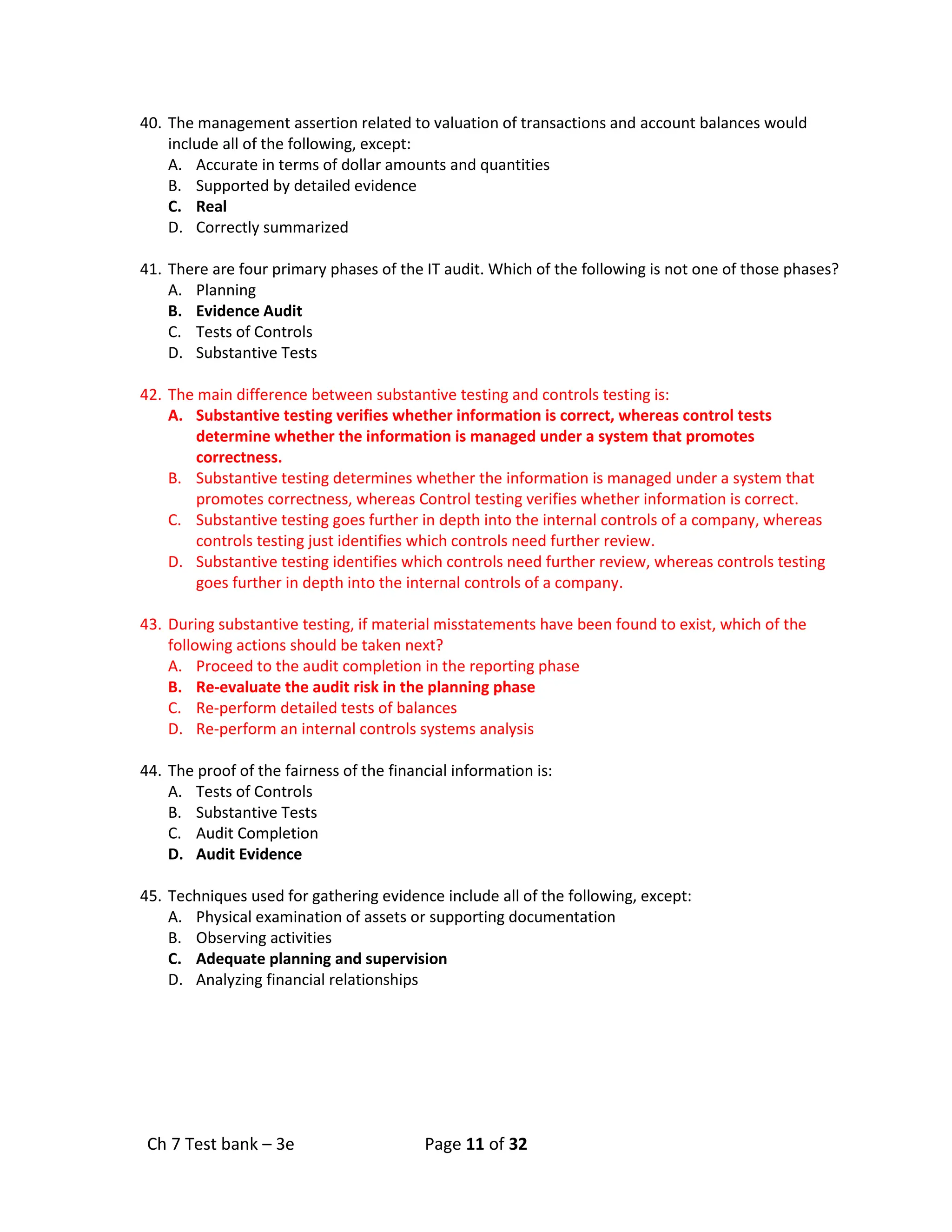
40. The management assertion related to valuation of transactions and account balances would
include all of the following, except:
A. Accurate in terms of dollar amounts and quantities
B. Supported by detailed evidence
C. Real
D. Correctly summarized
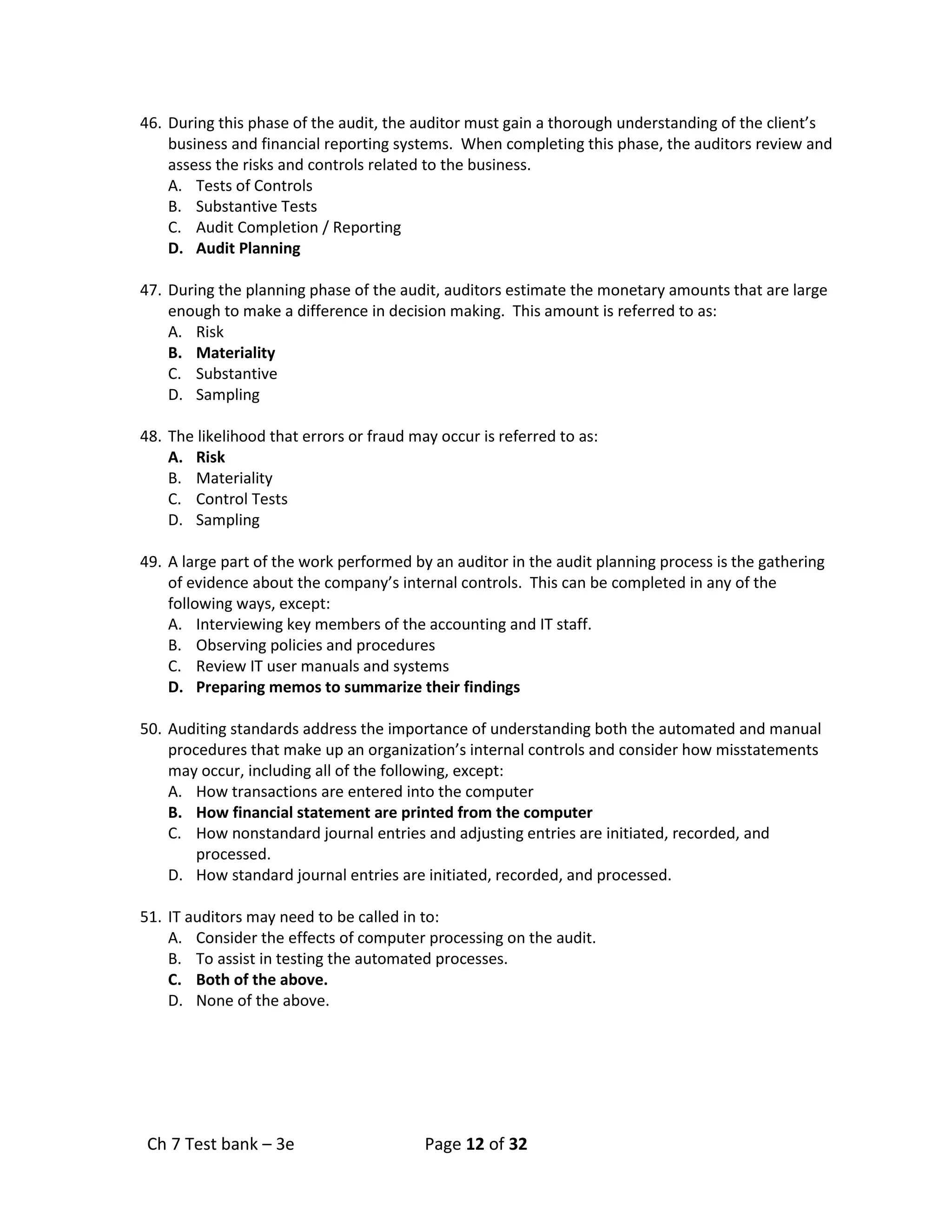
41. There are four primary phases of the IT audit. Which of the following is not one of those phases?
A. Planning
B. Evidence Audit
C. Tests of Controls
D. Substantive Tests
42. The main difference between substantive testing and controls testing is:
A. Substantive testing verifies whether information is correct, whereas control tests
determine whether the information is managed under a system that promotes
correctness.
B. Substantive testing determines whether the information is managed under a system that
promotes correctness, whereas Control testing verifies whether information is correct.
C. Substantive testing goes further in depth into the internal controls of a company, whereas
controls testing just identifies which controls need further review.
D. Substantive testing identifies which controls need further review, whereas controls testing
goes further in depth into the internal controls of a company.
43. During substantive testing, if material misstatements have been found to exist, which of the
following actions should be taken next?
A. Proceed to the audit completion in the reporting phase
B. Re-evaluate the audit risk in the planning phase
C. Re-perform detailed tests of balances
D. Re-perform an internal controls systems analysis
44. The proof of the fairness of the financial information is:
A. Tests of Controls
B. Substantive Tests
C. Audit Completion
D. Audit Evidence
45. Techniques used for gathering evidence include all of the following, except:
A. Physical examination of assets or supporting documentation
B. Observing activities
C. Adequate planning and supervision
D. Analyzing financial relationships
Ch 7 Test bank – 3e Page 12 of 32
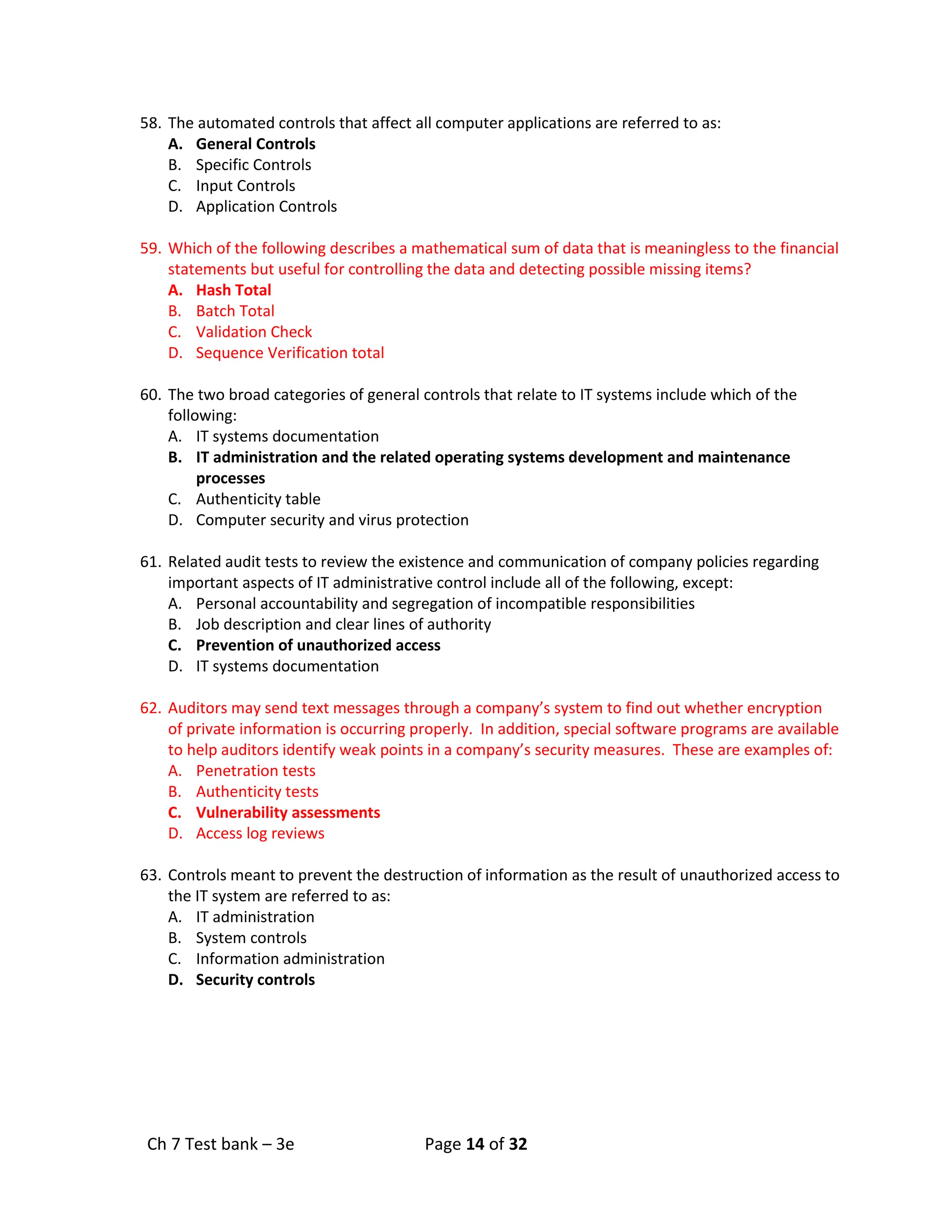
46. During this phase of the audit, the auditor must gain a thorough understanding of the client’s
business and financial reporting systems. When completing this phase, the auditors review and
assess the risks and controls related to the business.
A. Tests of Controls
B. Substantive Tests
C. Audit Completion / Reporting
D. Audit Planning
47. During the planning phase of the audit, auditors estimate the monetary amounts that are large
enough to make a difference in decision making. This amount is referred to as:
A. Risk
B. Materiality
C. Substantive
D. Sampling
48. The likelihood that errors or fraud may occur is referred to as:
A. Risk
B. Materiality
C. Control Tests
D. Sampling
49. A large part of the work performed by an auditor in the audit planning process is the gathering
of evidence about the company’s internal controls. This can be completed in any of the
following ways, except:
A. Interviewing key members of the accounting and IT staff.
B. Observing policies and procedures
C. Review IT user manuals and systems
D. Preparing memos to summarize their findings
50. Auditing standards address the importance of understanding both the automated and manual
procedures that make up an organization’s internal controls and consider how misstatements
may occur, including all of the following, except:
A. How transactions are entered into the computer
B. How financial statement are printed from the computer
C. How nonstandard journal entries and adjusting entries are initiated, recorded, and
processed.
D. How standard journal entries are initiated, recorded, and processed.
51. IT auditors may need to be called in to:
A. Consider the effects of computer processing on the audit.
B. To assist in testing the automated processes.
C. Both of the above.
D. None of the above.
Ch 7 Test bank – 3e Page 13 of 32
52. Many companies design their IT system so that all documents and reports can be retrieved from
the system in readable form. Auditors can then compare the documents used to input the data
into the system with reports generated from the system, without gaining any extensive
knowledge of the computer system and does not require the evaluation of computer controls.
This process is referred to as:
A. Auditing through the system
B. Auditing around the system
C. Computer assisted audit techniques
D. Auditing with the computer
53. The audit practice of “auditing around the computer” is also referred to as:
A. The white box approach
B. The black box approach
C. Computer-assisted audit techniques (CAATs)
D. The gray box approach
54. Which of the following is the most effective way of auditing the internal controls of an IT
system?
A. Auditing with the Computer
B. Auditing through the computer
C. Auditing around the computer
D. Auditing in the computer
55. This approach, referred to as the whitebox approach, requires auditors to evaluate IT controls
and processing so that they can determine whether the information generated from the system
is reliable.
A. Auditing through the system
B. Auditing around the system
C. Computer assisted audit techniques
D. Auditing with the computer
56. The IT auditing approach referred to as “Auditing through the system” is necessary under which
of the following conditions?
A. Supporting documents are available in both electronic and paper form.
B. The auditor does not require evaluation of computer controls.
C. The auditor wants to test computer controls as a basis for evaluating risk and reducing the
amount of substantive audit testing required.
D. The use of the IT system has a low impact on the conduct of the audit.
57. Audit procedures designed to evaluate both general controls and application controls are
referred to as:
A. Substantive Tests
B. Audit Planning
C. IT Auditing
D. Test of Controls
Ch 7 Test bank – 3e Page 14 of 32
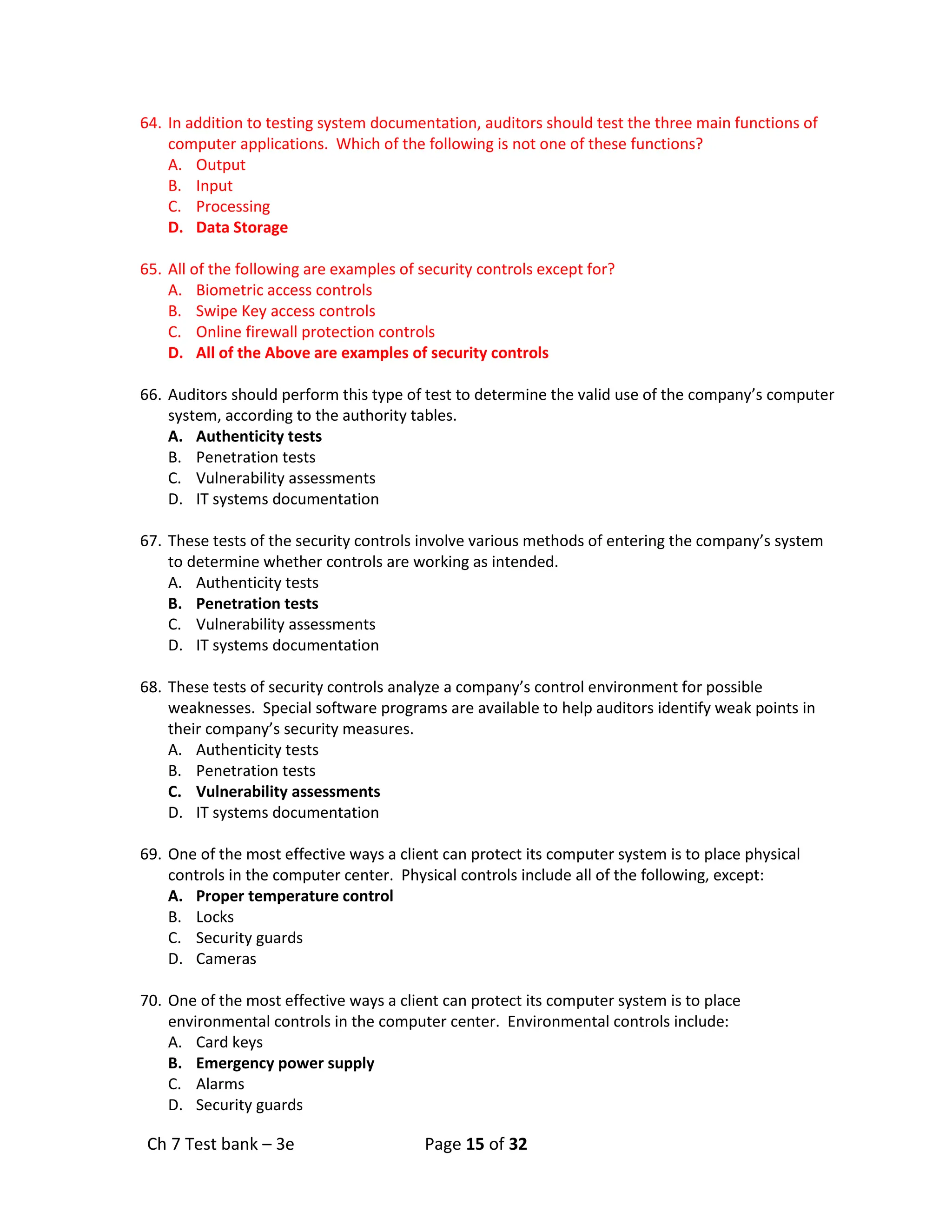
58. The automated controls that affect all computer applications are referred to as:
A. General Controls
B. Specific Controls
C. Input Controls
D. Application Controls
59. Which of the following describes a mathematical sum of data that is meaningless to the financial
statements but useful for controlling the data and detecting possible missing items?
A. Hash Total
B. Batch Total
C. Validation Check
D. Sequence Verification total
60. The two broad categories of general controls that relate to IT systems include which of the
following:
A. IT systems documentation
B. IT administration and the related operating systems development and maintenance
processes
C. Authenticity table
D. Computer security and virus protection
61. Related audit tests to review the existence and communication of company policies regarding
important aspects of IT administrative control include all of the following, except:
A. Personal accountability and segregation of incompatible responsibilities
B. Job description and clear lines of authority
C. Prevention of unauthorized access
D. IT systems documentation
62. Auditors may send text messages through a company’s system to find out whether encryption
of private information is occurring properly. In addition, special software programs are available
to help auditors identify weak points in a company’s security measures. These are examples of:
A. Penetration tests
B. Authenticity tests
C. Vulnerability assessments
D. Access log reviews
63. Controls meant to prevent the destruction of information as the result of unauthorized access to
the IT system are referred to as:
A. IT administration
B. System controls
C. Information administration
D. Security controls
Ch 7 Test bank – 3e Page 15 of 32
64. In addition to testing system documentation, auditors should test the three main functions of
computer applications. Which of the following is not one of these functions?
A. Output
B. Input
C. Processing
D. Data Storage
65. All of the following are examples of security controls except for?
A. Biometric access controls
B. Swipe Key access controls
C. Online firewall protection controls
D. All of the Above are examples of security controls
66. Auditors should perform this type of test to determine the valid use of the company’s computer
system, according to the authority tables.
A. Authenticity tests
B. Penetration tests
C. Vulnerability assessments
D. IT systems documentation
67. These tests of the security controls involve various methods of entering the company’s system
to determine whether controls are working as intended.
A. Authenticity tests
B. Penetration tests
C. Vulnerability assessments
D. IT systems documentation
68. These tests of security controls analyze a company’s control environment for possible
weaknesses. Special software programs are available to help auditors identify weak points in
their company’s security measures.
A. Authenticity tests
B. Penetration tests
C. Vulnerability assessments
D. IT systems documentation
69. One of the most effective ways a client can protect its computer system is to place physical
controls in the computer center. Physical controls include all of the following, except:
A. Proper temperature control
B. Locks
C. Security guards
D. Cameras
70. One of the most effective ways a client can protect its computer system is to place
environmental controls in the computer center. Environmental controls include:
A. Card keys
B. Emergency power supply
C. Alarms
D. Security guards
Ch 7 Test bank – 3e Page 16 of 32
71. This type of application control is performed to verify the correctness of information entered
into software programs. Auditors are concerned about whether errors are being prevented and
detected during this stage of data processing.
A. Security controls
B. Processing controls
C. Input controls
D. Output controls
72. IT audit procedures typically include a combination of data accuracy tests where the data
processed by computer applications are reviewed for correct dollar amounts or other numerical
values. These procedures are referred to as:
A. Security controls
B. Processing controls
C. Input controls
D. Output controls
73. This type of processing control test involves a comparison of different items that are expected
to have the same values, such as comparing two batches or comparing actual data against a
predetermined control total.
A. Validation Checks
B. Batch Totals
C. Run-to-Run Totals
D. Balancing Tests
74. This law, also known as the first-digit law, was named after a physicist who discovered a specific,
but non-uniform pattern in the frequency of digits occurring as the first number in a list of
numbers:
A. Number-up Law
B. Benford’s Law
C. Adams’ Digit Law
D. Jackson First Digit Law
75. This is one of the computer-assisted audit techniques related to processing controls that
involves processing company data through a controlled program designed to resemble the
company’s application. This test is run to find out whether the same results are achieved under
different systems.
A. Integrated Test Facility
B. Embedded Audit Module
C. Parallel Simulation
D. Test Data Method
76. Regardless of whether the results are printed or retained electronically, auditors may perform
all of the following procedures to test application outputs, except:
A. Integrated Tests
B. Reasonableness Tests
C. Audit Trail Tests
D. Rounding Errors Tests
Ch 7 Test bank – 3e Page 17 of 32
77. The auditor’s test of the accuracy of monetary amounts of transactions and account balances is
known as:
A. Testing of controls
B. Substantive tests
C. Compliance tests
D. Application tests
78. A process of constant evidence gathering and analysis to provide assurance on the information
as soon as it occurs, or shortly thereafter, is referred to as:
A. Real-time auditing
B. Virtual auditing
C. E-auditing
D. Continuous auditing
79. This phase of auditing occurs when the auditors evaluate all the evidence that has been
accumulated and makes a conclusion based on that evidence.
A. Tests of Controls
B. Audit Planning
C. Audit Completion / Reporting
D. Substantive Testing
80. This piece of audit evidence is often considered to be the most important because it is a signed
acknowledgment of management’s responsibility for the fair presentation of the financial
statements and a declaration that they have provided complete and accurate information to the
auditors during all phases of the audit.
A. Letter of Representation
B. Audit Report
C. Encounter Statement
D. Auditors Contract
81. Which of the following is a proper description of an auditor report?
A. Unqualified opinion - identifies certain exceptions to the clean opinion.
B. Adverse opinion - notes that there are material misstatements presented.
C. Qualified opinion - states that the auditors believe the financial statements are fairly and
consistently presented in accordance with GAAP.
D. Unqualified opinion - states that the auditors were not able to reach a conclusion.
82. When PCs are used for accounting instead of mainframes or client-server system, they face a
greater risk of loss due to which of the following:
A. Authorized access
B. Segregation of duties
C. Lack of backup control
D. All of the above
Ch 7 Test bank – 3e Page 18 of 32
83. When companies rely on external, independent computer service centers to handle all or part of
their IT needs it is referred to as:
A. External Processing
B. WAN Processing
C. Database Management System
D. IT Outsourcing
84. Because it is not possible to test all transactions and balances, auditors rely on this to choose
and test a limited number of items and transactions and then make conclusions about the
balance as a whole.
A. Sampling
B. Materiality
C. Compliance
D. Substance
85. All types of auditors must follow guidelines promoting ethical conduct. For financial statement
auditors, the PCAOB/AICPA has established a Code of Professional Conduct, commonly called
the Code of Ethics, which consists of two sections. Which of the following correctly states the
two sections?
A. Integrity and responsibility
B. Principles and rules
C. Objectivity and independence
D. Scope and nature
86. The rule in the PCAOB/AICPA Code of Professional Conduct that is referred to as Responsibilities,
can be stated as:
A. CPAs should act in a way that will serve the public interest, honor the public trust, and
demonstrate commitment to professionalism.
B. To maintain and broaden public confidence, CPAs should perform their professional duties
with the highest sense of integrity.
C. In carrying out their professional duties, CPAs should exercise sensitive professional and
moral judgments in all their activities.
D. CPAs in public practice should observe the principles of the Code of Professional Conduct in
determining the scope and nature of services to be provided.
87. This concept means that the auditors should not automatically assume that their clients are
honest, but that they (the auditors) must have a questioning mind and a persistent approach to
evaluating evidence for possible misstatements.
A. Independence
B. Integrity
C. Due Care
D. Professional Skepticism
Ch 7 Test bank – 3e Page 19 of 32
TEST BANK - CHAPTER 7 - TRUE / FALSE
1. All users of financial data - business managers, investors, creditors, and government agencies -
have an enormous amount of data to use to make decisions. Due to the use of IT systems, it is
easy to verify the accuracy and completeness of the information.
FALSE
2. In order to properly carry out an audit, accountants collect and evaluate proof of procedures,
transactions, and / or account balances, and compare the information with established
criteria.
TRUE
3. The only person who can perform a financial statement audit of a publicly traded company is a
government auditor who has extensive knowledge of generally accepted accounting
principles.
FALSE
4. Any professionally trained accountant is able to perform an operational audit.
TRUE
5. An important requirement for CPA firms is that they must be personally involved with the
management of the firm that is being audited.
FALSE
6. The most common type of audit service is the operating audit performed by internal auditors.
FALSE
7. All types of auditors should have knowledge about technology-based systems so that they can
properly audit IT systems.
TRUE
8. A financial statement audit is part of the IT audit.
FALSE
9. Auditors do not need to be experts on the intricacies of computer systems but they do need to
understand the impact of IT on their clients’ accounting systems and internal controls.
TRUE
10. An internal auditor is not allowed to assist in the performance of a financial statement audit.
FALSE
11. A financial statement audit is conducted in order for an opinion to be expressed on the fair
presentation of financial statements. This goal is affected by the presence or absence of IT
accounting systems.
FALSE
Ch 7 Test bank – 3e Page 20 of 32
12. Information risk is the chance that information used by decision makers may be inaccurate.
TRUE
13. As a business grows, the volume and complexity of its transactions increase. At the same timed,
there is a decrease in the chance that misstated information may exist undetected.
FALSE
14. The remoteness of information, one of the causes of information risk, can relate to geographic
distance or organizational layers.
TRUE
15. The most common method for decision makers to reduce information risk is to rely on
information that has been audited by an independent party.
TRUE
16. Auditors have the primary responsibility to make sure that they comply with international
standards in all cases.
FALSE
17. There is not much room for professional judgement when performing audits, as a result of the
detailed guidance provided by organizations, such as the PCAOB.
FALSE
18. The responsibility for operations, compliance, and financial reporting lies with the auditors.
FALSE
19. The role of the auditor is to analyze the underlying facts to decide whether information
provided by management is fairly presented.
TRUE
20. Management assertions relate to the actual existence and proper valuation of transactions
and account balances.
TRUE
21. The same audit tests would test for completeness of a liability or an asset.
FALSE
22. Auditing testing for any single general auditing objective would involve the same testing
techniques even though there are different types of information collected to support different
accounts and transactions.
FALSE
23. Auditors must think about how the features of a company’s IT systems influence its
management assertions and the general audit objectives even though these matters have
little or no impact on the choice of audit methodologies used.
FALSE
24. Risk can be inherent in the company’s business, due to things such as the nature of
Ch 7 Test bank – 3e Page 21 of 32
operations, or may be caused by weak internal controls.
TRUE
25. The audit planning process is unlikely to vary if the company has adopted IFRS, or is in the
process of convergence.
FALSE
26. Adapting to fair value measures in the preparation of IFRS-based financial statements will
likely cause auditors to evaluate supporting evidence differently than if US GAAP was used.
TRUE
27. IFRS does not allow as much use of judgment as is allowed under GAAP.
FALSE
28. Auditors do not need to concern themselves with risks unless there is an indication that there
is an internal control weakness.
FALSE
29. The auditor’s understanding of internal controls provides the basis for designing appropriate
audit tests to be used in the remaining phases of the audit.
TRUE
30. The process of evaluating internal controls and designing meaningful audit tests is more
complex for manual systems than for automated systems.
FALSE
31. Computer-assisted audit techniques are useful audit tools because they make it possible for
auditors to use computers to audit large amounts of evidence in less time.
TRUE
32. In order to enhance controls, reconciliations should be performed by company personnel who
are independent from the tasks of initiating or recording the transactions with the accounts
being reconciled.
TRUE
33. Substantive tests are also referred to as compliance tests.
FALSE
34. General controls relate to specific software and application controls relate to all aspects of the
IT environment.
FALSE
35. General controls must be tested before application controls.
TRUE
Ch 7 Test bank – 3e Page 22 of 32
36. Systems operators and users should not have access to the IT documentation containing
details about the internal logic of computer systems.
TRUE
37. Control tests verify whether financial information is accurate, where substantive tests
determine whether the financial information is managed under a system that promotes
accuracy.
FALSE
38. Regardless of the results of the control testing, some level of substantive testing must take
place.
TRUE
39. The use of generalized audit software is especially useful when there are large volumes of
data and when there is a need for accurate information.
TRUE
40. All of the risks and audit procedures that apply to a PC environment may also exist in
networks, but the risk of loss of much lower.
FALSE
41. Network operations typically involve a large number of computers, many users, and a high
volume of data transfers, so any lack of network controls could cause widespread damage.
Because of this, it is necessary for auditors to apply strict tests to a representative sample of
the network.
FALSE
42. When audit clients use a database system, the relating data is organized in a consistent
manner which tends to make it easier for auditors to select items for testing.
TRUE
43. When a client company is using IT outsourcing, and that service center has its own auditors
who report on internal control, the third-party report (from the independent auditors) cannot
be used as audit evidence without the auditor performing an adequate amount of compliance
testing.
FALSE
44. Risk assessment in cloud computing is particularly challenging because the threats to a
company’s data are uncontrolled, and often unforeseen, by the company.
TRUE
45. Within the cloud computing environment, the service provider is responsible to make sure
that all relevant risks have been identified and controlled. Because of this, the company using
the cloud computing does not need to repeat that evaluation.
FALSE
Ch 7 Test bank – 3e Page 23 of 32
46. Because there is no such thing as a standard cloud, it is not possible to standardize a risk
assessment process and audit procedures for a cloud computing environment.
TRUE
47. When an auditor is engaged to audit a company that uses cloud computing, the auditor must
rely on the SOC reports provided by the service company’s auditors.
FALSE
48. When a client changes the type of hardware or software used or in other ways modifies its IT
environment, the auditors need to test only the new system in order to determine the
effectiveness of the controls.
FALSE
49. When a client plans to implement new computerized systems, auditors will find it
advantageous to review the new system before it is placed in use.
TRUE
50. A sample is random when each item in the population has an equal chance of being chosen.
TRUE
51. Of all the principles applicable to auditors, the one that generally receives the most attention
is the requirement that financial statement auditors maintain integrity.
FALSE
52. The Sarbanes-Oxley Act has placed restrictions on auditors by prohibiting certain types of
services historically performed by auditors for their clients.
TRUE
53. The Sarbanes-Oxley Act decreased management’s responsibilities regarding the fair
presentation of the financial statements.
FALSE
54. The responsibility of the auditor to search for fraud is less than the responsibility to search for
errors.
FALSE
55. Management fraud is the intentional misstatement of financial information and may be
difficult for auditors to find because the perpetrator will attempt to hide the fraud.
TRUE
56. The PCAOB/AICPA Code of Professional Conduct is made up of two sections. One section, the
rules, are the foundations for the honorable behavior expected of CPAs while performing
professional duties.
FALSE
FOR SHORT ANSWER AND ESSAY QUESTIONS REFER TO THE NEXT PAGE.
ALL SHORT ANSWER AND ESSAY QUESTIONS ARE NEW IN THIS EDITION
Ch 7 Test bank – 3e Page 24 of 32
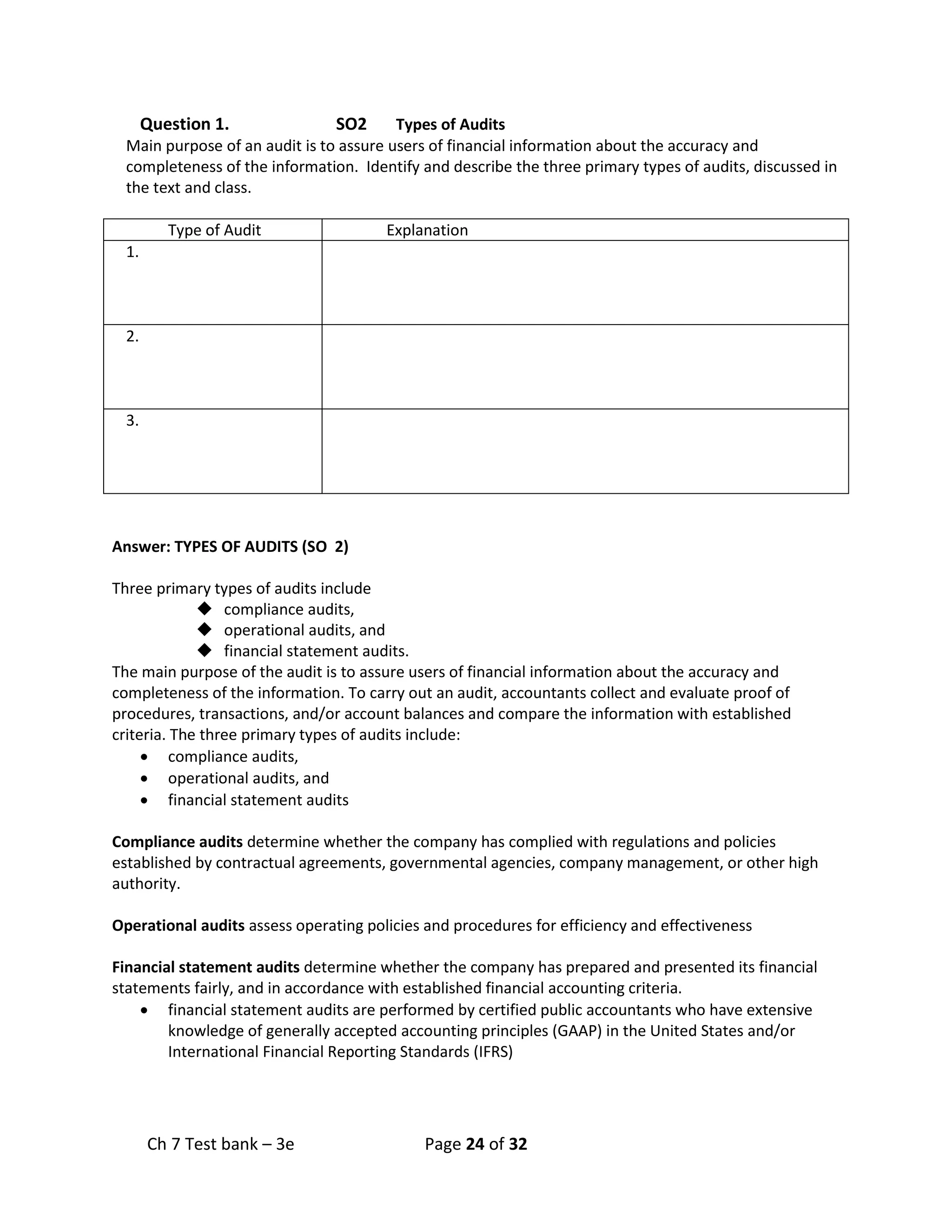
Question 1. SO2 Types of Audits
Main purpose of an audit is to assure users of financial information about the accuracy and
completeness of the information. Identify and describe the three primary types of audits, discussed in
the text and class.
Type of Audit Explanation
1.
2.
3.
Answer: TYPES OF AUDITS (SO 2)
Three primary types of audits include
◆ compliance audits,
◆ operational audits, and
◆ financial statement audits.
The main purpose of the audit is to assure users of financial information about the accuracy and
completeness of the information. To carry out an audit, accountants collect and evaluate proof of
procedures, transactions, and/or account balances and compare the information with established
criteria. The three primary types of audits include:
• compliance audits,
• operational audits, and
• financial statement audits
Compliance audits determine whether the company has complied with regulations and policies
established by contractual agreements, governmental agencies, company management, or other high
authority.
Operational audits assess operating policies and procedures for efficiency and effectiveness
Financial statement audits determine whether the company has prepared and presented its financial
statements fairly, and in accordance with established financial accounting criteria.
• financial statement audits are performed by certified public accountants who have extensive
knowledge of generally accepted accounting principles (GAAP) in the United States and/or
International Financial Reporting Standards (IFRS)
Ch 7 Test bank – 3e Page 25 of 32
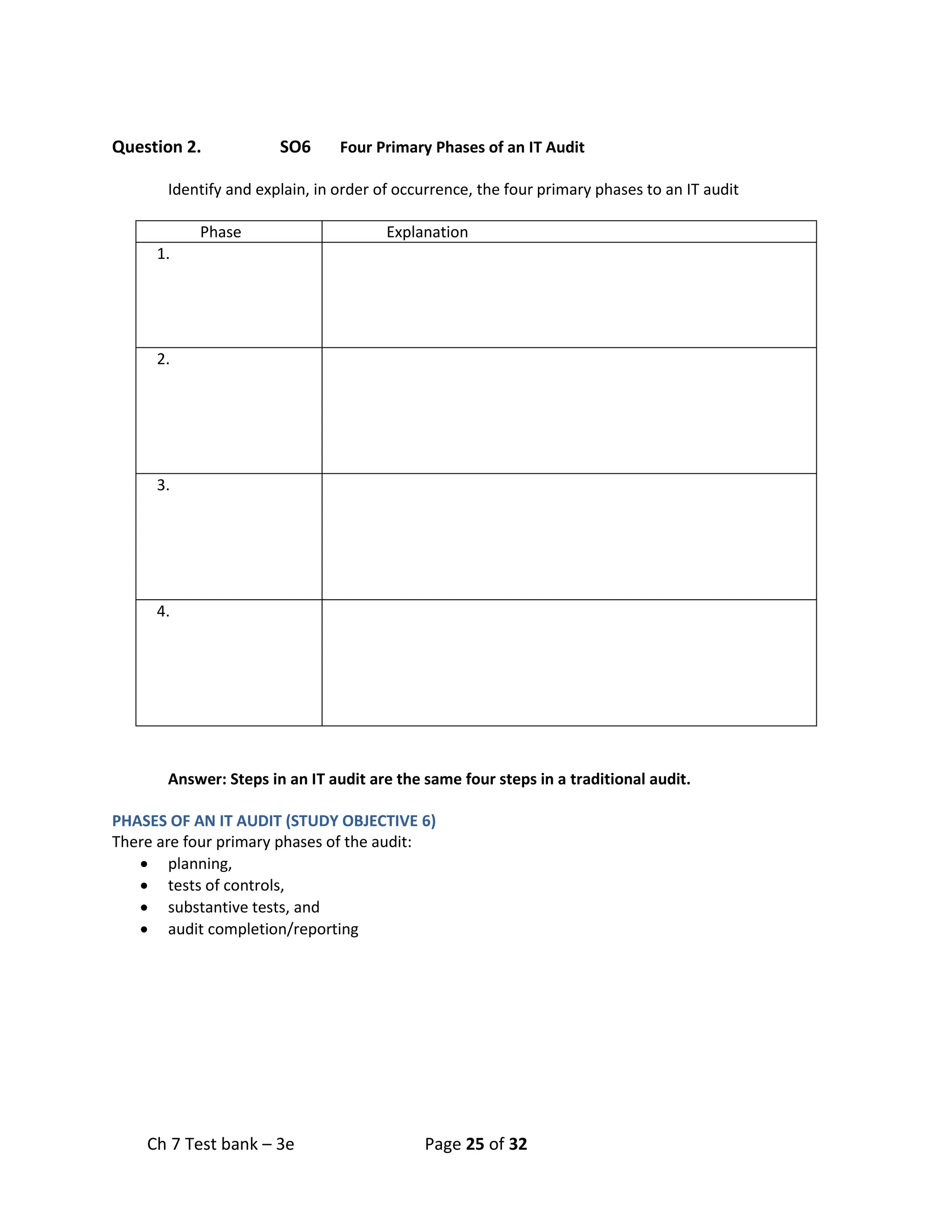
Question 2. SO6 Four Primary Phases of an IT Audit
Identify and explain, in order of occurrence, the four primary phases to an IT audit
Phase Explanation
1.
2.
3.
4.
Answer: Steps in an IT audit are the same four steps in a traditional audit.
PHASES OF AN IT AUDIT (STUDY OBJECTIVE 6)
There are four primary phases of the audit:
• planning,
• tests of controls,
• substantive tests, and
• audit completion/reporting
Ch 7 Test bank – 3e Page 26 of 32
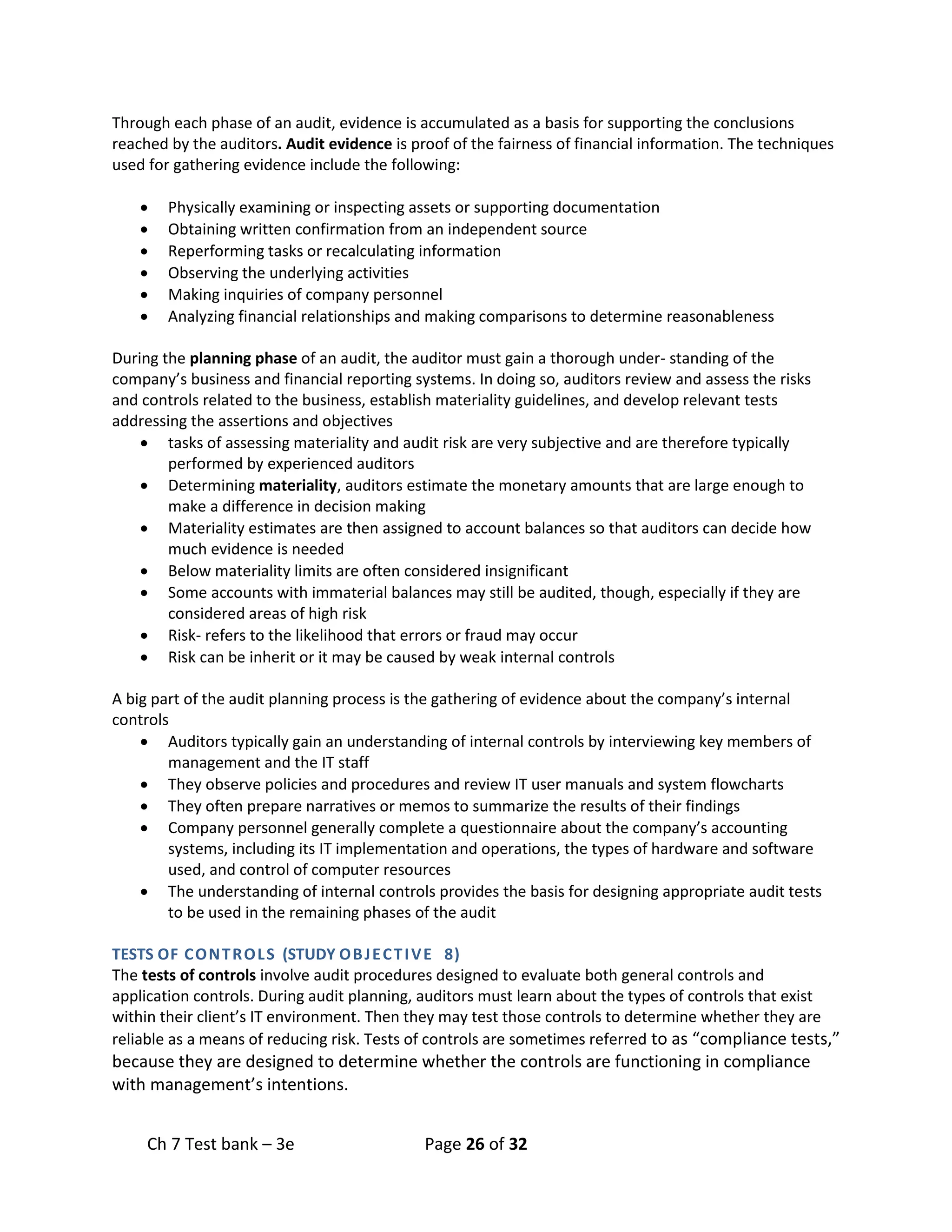
Through each phase of an audit, evidence is accumulated as a basis for supporting the conclusions
reached by the auditors. Audit evidence is proof of the fairness of financial information. The techniques
used for gathering evidence include the following:
• Physically examining or inspecting assets or supporting documentation
• Obtaining written confirmation from an independent source
• Reperforming tasks or recalculating information
• Observing the underlying activities
• Making inquiries of company personnel
• Analyzing financial relationships and making comparisons to determine reasonableness
During the planning phase of an audit, the auditor must gain a thorough under- standing of the
company’s business and financial reporting systems. In doing so, auditors review and assess the risks
and controls related to the business, establish materiality guidelines, and develop relevant tests
addressing the assertions and objectives
• tasks of assessing materiality and audit risk are very subjective and are therefore typically
performed by experienced auditors
• Determining materiality, auditors estimate the monetary amounts that are large enough to
make a difference in decision making
• Materiality estimates are then assigned to account balances so that auditors can decide how
much evidence is needed
• Below materiality limits are often considered insignificant
• Some accounts with immaterial balances may still be audited, though, especially if they are
considered areas of high risk
• Risk- refers to the likelihood that errors or fraud may occur
• Risk can be inherit or it may be caused by weak internal controls
A big part of the audit planning process is the gathering of evidence about the company’s internal
controls
• Auditors typically gain an understanding of internal controls by interviewing key members of
management and the IT staff
• They observe policies and procedures and review IT user manuals and system flowcharts
• They often prepare narratives or memos to summarize the results of their findings
• Company personnel generally complete a questionnaire about the company’s accounting
systems, including its IT implementation and operations, the types of hardware and software
used, and control of computer resources
• The understanding of internal controls provides the basis for designing appropriate audit tests
to be used in the remaining phases of the audit
TESTS OF CONTROLS (STUDY OBJECTIVE 8)
The tests of controls involve audit procedures designed to evaluate both general controls and
application controls. During audit planning, auditors must learn about the types of controls that exist
within their client’s IT environment. Then they may test those controls to determine whether they are
reliable as a means of reducing risk. Tests of controls are sometimes referred to as “compliance tests,”
because they are designed to determine whether the controls are functioning in compliance
with management’s intentions.
Ch 7 Test bank – 3e Page 27 of 32
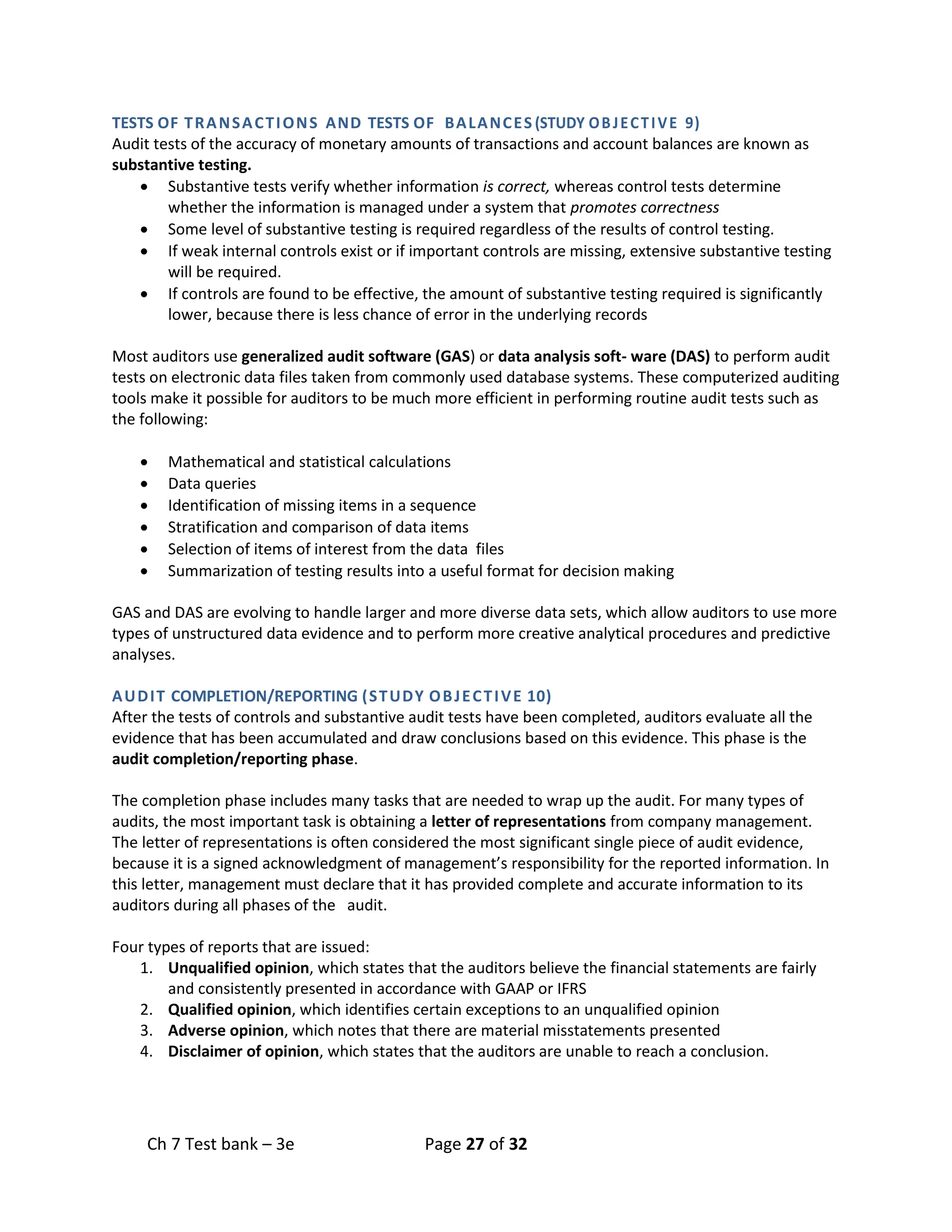
TESTS OF TRANSACTIONS AND TESTS OF BALANCES (STUDY OBJECTIVE 9)
Audit tests of the accuracy of monetary amounts of transactions and account balances are known as
substantive testing.
• Substantive tests verify whether information is correct, whereas control tests determine
whether the information is managed under a system that promotes correctness
• Some level of substantive testing is required regardless of the results of control testing.
• If weak internal controls exist or if important controls are missing, extensive substantive testing
will be required.
• If controls are found to be effective, the amount of substantive testing required is significantly
lower, because there is less chance of error in the underlying records
Most auditors use generalized audit software (GAS) or data analysis soft- ware (DAS) to perform audit
tests on electronic data files taken from commonly used database systems. These computerized auditing
tools make it possible for auditors to be much more efficient in performing routine audit tests such as
the following:
• Mathematical and statistical calculations
• Data queries
• Identification of missing items in a sequence
• Stratification and comparison of data items
• Selection of items of interest from the data files
• Summarization of testing results into a useful format for decision making
GAS and DAS are evolving to handle larger and more diverse data sets, which allow auditors to use more
types of unstructured data evidence and to perform more creative analytical procedures and predictive
analyses.
AUDIT COMPLETION/REPORTING (STUDY OBJECTIVE 10)
After the tests of controls and substantive audit tests have been completed, auditors evaluate all the
evidence that has been accumulated and draw conclusions based on this evidence. This phase is the
audit completion/reporting phase.
The completion phase includes many tasks that are needed to wrap up the audit. For many types of
audits, the most important task is obtaining a letter of representations from company management.
The letter of representations is often considered the most significant single piece of audit evidence,
because it is a signed acknowledgment of management’s responsibility for the reported information. In
this letter, management must declare that it has provided complete and accurate information to its
auditors during all phases of the audit.
Four types of reports that are issued:
1. Unqualified opinion, which states that the auditors believe the financial statements are fairly
and consistently presented in accordance with GAAP or IFRS
2. Qualified opinion, which identifies certain exceptions to an unqualified opinion
3. Adverse opinion, which notes that there are material misstatements presented
4. Disclaimer of opinion, which states that the auditors are unable to reach a conclusion.
Ch 7 Test bank – 3e Page 28 of 32
Question 3. SO Primary objectives of compliance testing
The primary objective of compliance testing in a financial statement audit of a company with an
automated AIS or ERP system is to determine whether
_______________________________________________________________________
_______________________________________________________________________
_______________________________________________________________________
_______________________________________________________________________
_______________________________________________________________________
_______________________________________________________________________
_______________________________________________________________________
_______________________________________________________________________
The purpose of compliance testing in a financial statement audit of a company with an automated AIS or
ERP system is to determine whether internal controls are in place and functioning as designed.
Question 4. SO7 Computers User in Audits
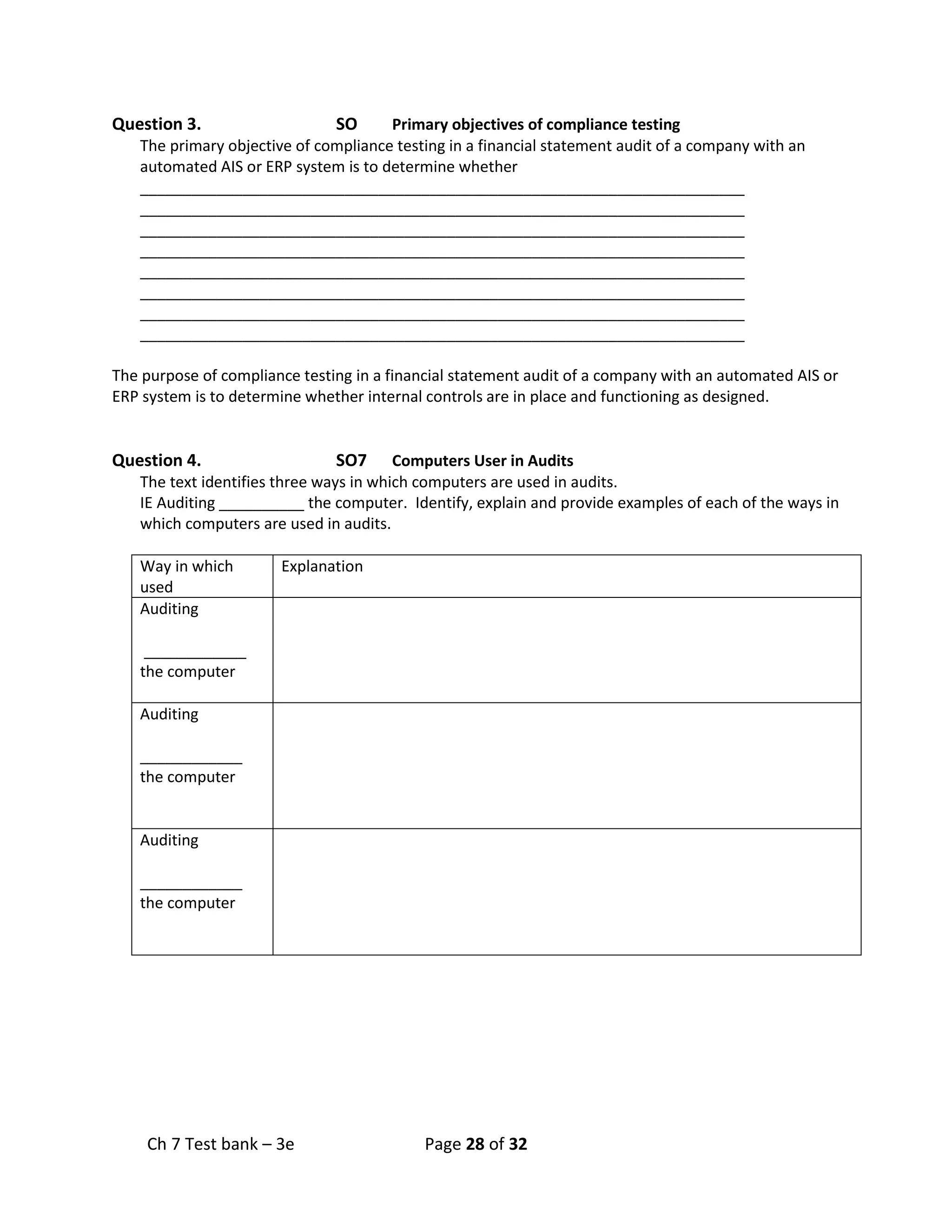
The text identifies three ways in which computers are used in audits.
IE Auditing __________ the computer. Identify, explain and provide examples of each of the ways in
which computers are used in audits.
Way in which
used
Explanation
Auditing
____________
the computer
Auditing
____________
the computer
Auditing
____________
the computer
Ch 7 Test bank – 3e Page 29 of 32
ANSWER
➢ Use of Computers in Audits. The audit planning tasks of evaluating internal controls and designing
meaningful audit tests is more complex for automated accounting systems than for manual systems.
In recognition of the fact that accounting records and files often exists in both paper and electronic
form, auditing standards address the importance of understanding both the automated and manual
procedures that make up an organization’s internal control. Misstatements may occur through the
data entry and processing functions of the system. Auditors must consider the effects of such
computer processing on the audit. Three options may exist for the auditor in deciding upon a testing
approach for a client’s automated process, including auditing around the computer, auditing
through the computer, and auditing with the computer.
• Auditing around the computer is commonly known as the “black box” approach because
auditors are not required to gain detailed knowledge about the company’s computer
system; rather, documents used to input data into the system can be compared with reports
generated from the system. Computer controls are not considered.
• Auditing through the computer is commonly known as the “white box” approach because it
involves directly testing the internal controls within the IT system. It requires the auditors to
understand the computer system logic and related IT controls. Auditing through the
computer is necessary when the auditor wants to test computer controls as a basis for
reducing the amount of substantive testing required, when the auditor is required to report
on internal controls of a public company, and when supporting documents are available only
in electronic form.
• Auditing with the computer involves the auditors’ use of their own computer systems and
audit software to perform audit testing. A variety of computer assisted audit techniques
(CAATs) are available for auditing with the computer.
USE OF COMPUTERS IN AUDITS (STUDY OBJECTIVE 7)
If the use of IT systems does not have a great impact on the conduct of the audit, since the auditor can
perform audit testing in the same manner as would be done for a manual system the practice is referred
to as auditing around the computer because it does not require evaluation of computer controls.
• Auditing around the computer merely uses and tests output of the computer system in the
same manner as the audit would be conducted if the information had been generated manually
• Because this approach does not consider the effectiveness of computer controls, auditing
around the computer has limited usefulness.
Auditing through the computer involves directly testing the internal controls within the IT system,
whereas auditing around the computer does not
• sometimes referred to as “the white box approach,” because it requires auditors to understand
the computer system logic
• This approach requires auditors to evaluate IT controls and processing so that they can
determine whether the information generated from the system is reliable
• Auditing through the computer is necessary under the following conditions:
o The auditor wants to test computer controls as a basis for evaluating risk and reducing
the amount of substantive audit testing required.
o The author is required to report on internal controls in connection with a financial
statement audit of a public company.
o Supporting documents are available only in electronic form.
Ch 7 Test bank – 3e Page 30 of 32
Auditors can use their own computer systems and audit software to help conduct the audit. This
approach is known as auditing with the computer.
• A variety of computer-assisted audit techniques (CAATs) are available for auditing with the
computer
• CAATs are useful audit tools because they make it possible for auditors to use computers to test
more evidence in less time.
Question 5. SO8 Compliance and Substantive Testing
Keperlsky and Bennuchi, and audit firm was auditing EDJ consulting. EDJ is a large consulting firm
that has consistently had very strong internal controls over IT functions at the company. The
company uses SAP, a sophisticated, Tier 1 ERP system that has not been customized. Keperlsky and
Bennuchi’s audit team has reviewed and tested the internal controls and concluded that the
controls are very effective (strong) and they can be relied upon. Mr Keperlsky, a partner, has said
that it is not necessary to complete substantive testing in this case, given the strength of the internal
controls and strong ERP system. Is Mr Keperlsky’s conclusion correct?
Answer: Yes No (Circle one)
Provide justification for your answer:
_____________________________________________________________________________________
____________________________________________________________________________________
_____________________________________________________________________________________
_____________________________________________________________________________________
____________________________________________________________________________________
_____________________________________________________________________________________
_____________________________________________________________________________________
____________________________________________________________________________________
_____________________________________________________________________________________
_____________________________________________________________________________________
____________________________________________________________________________________
_____________________________________________________________________________________
Answer: No
Mr Keperlsky is not correct. It is ALWAYS necessary to complete substantive testing. Compliance
testing tests if internal controls are in place and functioning. Substantive test verify the accuracy of
financial amounts. If controls are in place and functioning, su
Ch 7 Test bank – 3e Page 31 of 32
Question 6. SO7 Computer Assisted Audit Techniques (CAATs)
The text discusses several computer assisted audit techniques (CAAT’s). Lists 4 of the 5 CAAT’s and
describe the technique.
Technique Description of Computer Assisted Audit Technique
1.
2.
3.
4.
Ch 7 Test bank – 3e Page 32 of 32
SOLUTION
Another Random Scribd Document
with Unrelated Content
L.
Labor, division of, 123 ; effect of
attempts by government to limit the
hours of, 362 Major Moody's new
philosophy of, and its refutation, 373 398
Laboring classes (the), their condition
in England and on the Continent, 178 ; in
the United States, 180
Labourdonnais, his talents, 202 ; his
treatment by the French government,
294
Laedaunon. See Sparta.
La Fontaine, allusion to, 393
Lalla Kookli, 485
Lally, Governor, his treatment by the
French government, 294
Lamb, Charles, his defence cf the
dramatists of the Restoration, 357 ; his
kind nature, 358
Lampoons, Pope's, 408
Lancaster, Dr., his patronage of
Addison, 326
Landscape gardening, 374 389
Langton, Mr., his friendship with
Johnson, 204 219 ; his admiration of
Miss Burney, 271
Language, Drvden's command of, 367
; effect of its cultivation upon poetry, 337
338 Latin, its decadence, 55 ; its
characteristics, 55 Italian, Dante the first
to compose in, 56
Languedoc, description of it in the
twelfth century, 308 309 ; destruction of
its prosperity and literature by the
Normans, 310
Lansdowne, Lord, his friendship for
Hastings, 106
Latimer, Hugh, his popularity in
London, 423 428
Latin poems, excellence of Milton's,
211 Boileau's praise of, 342 343
Petrarch's, 96 ; language, its character
and literature, 347 349
Latinity, Croker's criticisms on, 381
Laud, Archbishop, his treatment by the
Parliament, 492 493 ; his
correspondence with Strafford, 492 ; his
character, 452 453 ; his diary, 453 ; his
impeachment and imprisonment, 468 ;
his rigor against the Puritans, and
tenderness towards the Catholics, 473
Lauderdale, Lord, 417
Laudohn, 235, 241
Law, its administration in the time of
James II., 520 ; its monstrous grievances
in India, 64 69
Lawrence, Major, his early notice of
Clive, 203, 241, ; his abilities, 203
Lawrence, Sir Thomas, 305
Laws, penal, of Elizabeth, 439 440
Lawsuit, imaginary, between the
parishes of St. Dennis and St. George-in-
the-water, 100, 111
Lawyers, their inconsistencies as
advocates and legislators, 414 415
Learning in Italy, revival of, 275 ;
causes of its decline, 278
Lebon, 483 484 503
Lee, Nathaniel, 361 362
Legerdemain, 353
Legge, Et. lion. H. B., 230 ; his return
to the Exchequer, 38 13 ; his dismissal,
28
Legislation, comparative views on, by
Plato and by Bacon, 456
Legitimacy, 237
Leibnitz, 324
Lemon, Mr., his discovery of Milton's
Treatise on Christian Doctrine, 202
Lennox, Charlotte, 24
Leo X., his character, 324 ; nature of
the war between him and Luther, 327
328
Lessing, 341
Letters of Phalaris, controversy
between Sir William Temple and Christ
Church College and Bentley upon their
merits and genuineness, 108 112 114
119
Libels on the court of George III., in
Bute's time, 42
Libertinism in the time of Charles II.,
517
Liberty, public, Milton's support of, 246
; its rise and progress in Italy, 274 ; its
real nature, 395 397 ; characteristics of
English, 399 68 71 ; of the Seas,
Barrere's work upon, 512
Life, human, increase in the time of,
177
Lincoln Cathedral, painted window in,
428
Lingard, Dr., his account of the conduct
of James II. towards Lord Rochester, 307
; his ability as a historian, 41 ; his
strictures on the Triple Alliance, 42
Literary men more independent than
formerly, 190-192; their influence, 193
194 ; abjectness of their condition during
the reign of George IL, 400 401 ; their
importance to contending parties in the
reign of Queen Anne, 304 ;
encouragement afforded to, by the
Revolution, 336 ; see also Criticism,
literary.
Literature of the Roundheads, 234 ; of
the Royalists, 234 ; of the Elizabethan
age, 341 346 ; of Spain in the 16th
century, 80 ; splendid patronage of, at
the close of the 17th and beginning of
the 18th centuries, 98 ; discouragement
of, on the accession of the House of
Hanover, 98 ; importance of classical in
the 16th century, 350 Petrarch, its
votary, 86 ; what its history displays in all
languages 340 341 ; not benefited by the
French Academy, 23
Literature, German, little known in
England sixty or seventy years ago, 341
Literature, Greek, 349 353
Literature, Italian, unfavorable
influence of Petrarch upon, 59 60 ;
characteristics of, in the 14th century,
278 ; and generally, down to Alfieri, 60
Literature, Roman, 347 349
Literature, Royal Society of, 202, 9
"Little Dickey," a nickname for Norris,
the actor, 417
Livy, Discourses on, by Machiavelli,
309 ; compared with Montesquieu's Spirit
of Laws, 313 314 ; his characteristics as
an historian, 402 403 ; meaning of the
expression lactece ubertus, as applied to
him, 403
Locke, 303 352
Logan, Mr., his ability in defending
Hastings, 139
Lollardism in England, 27
London, in the 17th century, 479 ;
devoted to the national cause, 480 481 ;
its public spirit, 18 ; its prosperity during
the ministry of Lord Chatham, 247 ;
conduct of, at the Restoration, 289 ;
effects of the Great Plague upon, 32 ; its
excitement on occasion of the tax on
cider proposed by Bute's ministry, 50
University of, see University.
Long Parliament (the), controversy on
its merits, 239 240 ; its first meeting,
457 ; ii.406; its early proceedings, 469
470 ; its conduct in reference to the civil
war, 471 ; its nineteen propositions, 486
; its faults, 490 494 ; censured by Mr.
Hallam, 491 ; its errors in the conduct of
the war, 494 ; treatment of it by the
army, 497 ; recapitulation of its acts, 408
; its attainder of Stratford defended, 471
; sent Hampden to Edinburgh to watch
the king, 479 ; refuses to surrender the
members ordered to be impeached, 477
; openly denies the king, 489 ; its
conditions of reconciliation, 480
Longinus, 149 148
Lope, his distinction as a writer and a
soldier, 81
Lords, the House of, its position
previous to the Restoration, 287 ; its
condition as a debating assembly in 177
420
Lorenzo de Medici, state of Italy in his
time, 278
Lorenzo de Medici (the younger),
dedication of Machiavelli's Prince to him,
309
Loretto, plunder of, 346
Louis XI., his conduct in respect to the
Spanish succession, 80 99 ; his
acknowledgment, on the death of James
II., of the Prince of Wales as King of
England, and its consequences, 102 ;
sent an army into Spain to the assistance
of his grandson, 109 ; his proceedings in
support of his grandson Philip, 109 127 ;
his reverses in Germany, Italy, and the
Netherlands, 129 ; his policy, 309 ;
character of his government, 308 311 ;
his military exploits, 5 ; his projects and
affected moderation, 36 ; his ill-humor at
the Triple Alliance, 41 ; his conquest of
Franche Comte, 42 ; his treaty with
Charles, 53 ; the early part of his reign a
time of license, 364 ; his devotion, 339 ;
his late regret for his extravagance, 39 ;
his character and person, 576 ; his
injurious influence upon religion, 64
Louis XV., his government, 646 6 293
Louis XVI., 441 ; to: 449 455 150 67
Louis XVIII., restoration of, compared
with that of Charles II., 282 ; seq.
Louisburg, fall of, 244
L'Ouverture, Toussaint, 366 390 392
Love, superiority of the. Romans over
the Greeks in their delineations of, 83 ;
change in the nature of the passion of,
84 ; earned by the introduction of the
Northern element, 83
"Love for Love," by Congreve, 392 ; its
moral, 402
"Love in a Wood," when acted, 371
Loyola, his energy, 320 336
Lucan, Dryden's resemblance to, 355
Lucian, 387
Luther, his declaration against the
ancient philosophy, 446 ; sketch of the
contest which began with his preaching
against the Indulgences and terminated
with the treaty of Westphalia, 314 338 ;
was the product of his age, 323 ;
defence of, by Atterbury, 113
Lysurgus, 185
Lysias, anecdote by Plutarch of his
"speech for the Athenian tribunals," 117
Lyttleton, Lord, 54
M.
Maebomey, original name of the
Burney family, 250 Machiavelli, his
works, by Périer, 267 ; general
odiousness of his name and works, 268
269 ; suffered for public liberty, 269 ; his
elevated sentiments and just views, 270
; held in high estimation by his
contemporaries. 271 ; state of moral
feeling ill Italy in his time, 272 ; his
character as a man, 291 ; as a poet, 293
; as a dramatist, 296 ; as a statesman,
291 300 309 313 309 ; excellence of his
precepts, 311 ; his candor, 313 ;
comparison between him and
Montesquieu, 314 ; his style, 314 ; his
levity, 316 ; his historical works, 316 ;
lived to witness the last struggle for
Florentine liberty, 319 ; his works and
character misrepresented, 319 ; his
remains dishonored till long after his
death, 319 ; monument erected to his
memory by an English nobleman, 319
Mackenzie, Henry, his ridicule of the
Nabob class, 283
Mackenzie, Mr., his dismissal insisted
on by Grenville, 70
Mackintosh, Sir James, review of his
History of the Revolution in England, 251
335 ; comparison with Fox's History of
James II., 252 ; character of his oratory,
253 ; his conversational powers, 256 ;
his qualities as an historian, 250 ; his
vindication from the imputations of the
editor, 262 270-278; change in his
opinions produced by the French
Revolution, 263 ; his moderation, 268
270 ; his historical justice, 277 278 ;
remembrance of him at Holland House,
425
Macleane, Colonel, agent in England
for Warren Hastings, 44 53
Macpherson, James, 77 331 210 ; a
favorite author with Napoleon, 515 ;
despised by Johnson, 116
Madras, description of it, 199 ; its
capitulation to the French, 202 ; restored
to the English, 203
Maand, capture of, by the English
army in 470 119
Mæandnus, of Samos, 132
Magazine, delightful invention for a
very idle or a very busy man, 156 ;
resembles the little angels of the
Rabbinical tradition, 156 157
Magdalen College, treatment of, by
James II., 413 Addison's connection with
it, 327
Mahon, Lord, Review of his History of
the War of the Succession in Spain, 75
142 ; his qualities as an historian, 75 77
; his explanation of the financial
condition of Spain, 85 ; his opinions on
the Partition Treaty, 90-92; his
representations of Cardinal Porto
Carrero, 104 ; his opinion of the peace
on the conclusion of the War of the
Spanish Succession, 131 ; his censure of
Harley, 132 ; and view of the
resemblance of the Tories of the present
day to the Whigs of the Revolution, 132
135
Mahrattas, sketch of their history, 207
58 ; expedition against them, 60
Maintenon, Madame de, 364 30
Malaga, naval battle near, in 170 110
Malcolm, Sir John, review of his Life of
Lord Clive, 194 299 ; value of his work,
190 ; his partiality for Clive, 237 ; his
defence of Clive's conduct towards
Ornichaud, 248
Mallet, David, patronage of by Bute,
41
Malthus, Mr., his theory of population,
and Sadler's objections to it, 217 218
222 223 228 244 271 272
Manchester, Countess of, 339
Manchester, Earl of, his patronage of
Addison, 338 350
Mandeville, his metaphysical powers,
208
Mandragola (the), of Maehiavelli, 293
Manilla, capitulation of, 32
Mannerism of Johnson, ii 423
Mansfield, Lord, his character and
talents, 223 ; his rejection of the
overtures of Newcastle, 234 ; his
elevation, 234 12 ; his friendship for
Hastings, 106 ; character of his
speeches, 104
Manso, Milton's Epistle to, 212
Manufactures and commerce of Italy in
the 14th century, 275 277
Manufacturing and agricultural
laborers, comparison of their condition,
147 149
Manufacturing system (the), Southey's
opinion upon, 145 ; its effect on the
health, 147
Marat, his bust substituted for the
statues of the Martyrs of Christianity, 345
; his language about Barère, 458 466 ;
his bust torn down, 502
Mareet, Mrs., her Dialogues on Political
Economy, 207
March, Lord, one of the persecutors of
Wilkes, 60
Maria Theresa, her accession to the
throne, 164 ; her situation and personal
qualities, 165 166 ; her unbroken spirit,
173 ; gives birth to the future emperor,
Joseph II., 173 ; her coronation, 173 ;
enthusiastic loyalty and war-cry of
Hungary, 174 ; her brother-in-law, Prince
Charles of Lorraine, defeated by Frederic
the Great, at Chotusitz, 174 ; she cedes
Silesia, 175 ; her husband, Francis,
raised to the Imperial Throne, 179 ; she
resolves to humble Frederic, 200 ;
succeeds in obtaining the adhesion of
Russia, 200 ; her letter to Madame
Pompadour, 211 ; signs the peace of
Hubertsburg, 245
Marie Antoinette, Barère's share in her
death, 401 434 409 470
Marino, San, visited by Addison, 340
Marlborough, Duchess of, her
friendship with Congreve, 408 ; her
inscription on his monument, 409
Marlborough, Duke of, 259 ; his
conversion to Whiggism, 129 ; his
acquaintance with the Duchess of
Cleveland,-and commencement of his
splendid fortune, 373 ; notice of
Addison's poem in his honor, 358
Marlborough and Godolphin, their
policy, 353
Maroons (the), of Surinam, 386 ; to:
388
Marsh, Bishop, his opposition to
Calvinistic doctrine, 170
Martinique, capture of, 32
Martin's illustrations of the Pilgrim's
Progress, and of Paradise Lost, 251
Marvel, Andrew, 333
Mary, Queen, 31
Masque, the Italian, 218
Massinger, allusion to his "Virgin
Martyr," 220 ; his fondness for the
Roman Catholic Church, 30 ; indelicate
writing in his dramas, 356
Mathematical reasoning, 103 ; studies,
their advantages and defects, 346
Mathematics, comparative estimate of,
by Plato and by Bacon, 451
Maximilian of Bavaria, 328
Maxims, general, their uselessness,
310
Maynooth, Mr. Gladstone's objections
to the vote of money for, 179
Mecca, 301
Medals, Addison's Treatise on, 329 351
Medici, Lorenzo de. See Lorenzo de
Medici.
Medicine, comparative estimate of the
science of, by Plato and by Bacon, 454
456
Meer Cossim, his talents, 260 ; his
deposition and revenge, 266
Meer Jatlier, his conspiracy, 240 ; his
conduct during the battle of Plassey, 243
240 ; his pecuniary transactions with
Clive, 251 ; his proceedings on being
threatened by the Great Mogul, 250 ; his
fears of the English, and intrigues with
the Dutch, 258 ; deposed and reseated
by the English, 266 ; his death, 270 ; his
large bequest to Lord Clive, 279
Melanethon, 7
Melville, Lord, his impeachment, 292
Meinmius, compared to Sir Wm.
Temple, 112
Memoirs of Sir "William Temple, review
of, 1 115 ; wanting in selection and
compression, 2
Memoirs of the Life of Warren
Hastings, review of, 1 148
Memoirs, writers of, neglected by
historians, 423
Memory, comparative views of the
importance of, by Plato and by Bacon,
454
Menander, the lost comedies of, 375
Mendaeium, different species of, 430
Mendoza, Hurtado de, 81
Mercenaries, employment of, in Italy,
283 ; its political consequences, 284 ;
and moral effects, 285
Messiah, Pope's, translated into Latin
verse by Johnson, 175
Metals, the precious, production of,
351
Metaphysical accuracy incompatible
with successful poetry, 225
Metcalfe, Sir Charles, his ability and
disinterestedness, 298
Methodists, their rise unnoticed by
some writers of the history of England
under George II., 426 ; their early
object, 318
Mexico, exactions of the Spanish
viceroys in, exceeded by the English
agents in Bengal, 266
Miehell, Sir Francis, 401
Middle ages, inconsistency in the
schoolmen of the, 415
Middlesex election, the constitutional
question in relation to it, 101 104
Middleton, Dr., remarks on his Life of
Cicero, 340 341 ; his controversies with
Bentley, 112
Midias, Demosthenes' speech against,
102
"Midsummer Night's Dream," sense in
which the word "translated" is therein
used, 180
Milan, Addison's visit to, 345
Military science, studied by Machiavelli,
306
Military service, relative adaptation of
different classes for, 280
Militia (the), control of, by Charles I. or
by the Parliament, 488
Mill, James, his merits as a historian,
277 278 ; defects of his History of British
India, 195 196 ; his unfairness towards
Clive's character, 237 ; his Essay on
Government reviewed, 5 51 ; his theory
and method of reasoning, 6 8 10 12 18
20 46 48 ; his style. 8 ; his erroneous
definition of the end of government, 11 ;
his objections to a Democracy only
practical ones, 12 ; attempts to
demonstrate that a purely aristocratic
form of government is necessarily bad,
12 13 ; so also an absolute monarchy, 13
14 ; refutation of these arguments, 15
16 18 ; his inconsistencies, 16 17 96 97
121; his narrow views, 19 20 ; his logical
deficiencies, 95 ; his want of precision in
the use of terms, 103 108 ; attempts to
prove that no combination of the simple
forms of government can exist, 21 22 ;
refutation of this argument., 22 29 ; his
ideas upon the representative system. 29
30 ; objections to them, 30-32; his views
upon the qualifications of voters, 32 36 ;
objections to them, 36 38 41 42 ;
confounds the interests of the present
generation with those of the human race,
38 39 ; attempts to prove that the
people understand their own interest, 42
; refutation of this argument, 43 ;
general objections to his theory, 44 47
122 ; defended by the Westminster
Review, 529 ; inconsistencies between
him and the reviewer, 56 58 ; the
reviewer mistakes the points at issue, 58
60 61 65 70 77 114 ; and misrepresents
arguments, 62 73 74 ; refutation of his
positions. 63 64 66 74 76 122 127 ; the
reviewer shifts the issue, 68 127 128 ;
fails to strengthen Mill's positions, 71 ;
and manifests great disingenuousness,
115 118 129 130
Millar, Lady, her vase for verses, 271
Milton, review of his Treatise on
Christian Doctrine, Mr. Lemon's discovery
of the MS. of it, 202 ; his style, "202; his
theological opinions, 204 ; his poetry his
great passport to general remembrance,
205 211 ; power of his imagination, 211
; the most striking characteristic of his
poetry, 213 375 ; his Allegro and
Penseroso, 215 ; his Cornus and Samson
Agonistes, 215 ; his minor poems, 219 ;
appreciated the literature of modern
Italy, 219 ; his Paradise Regained, 219 ;
parallel between him and Dante, 17 18 ;
his Sonnets most exhibit his peculiar
character, 232 ; his public conduct, 233 ;
his defence of the execution of Charles L,
246 ; his refutation of Salmasius, 248 ;
his conduct under the Protector, 249 ;
peculiarities which distinguished him
from his contemporaries, 253 ; noblest
qualities of every party combined in him,
260 ; his defence of the freedom of the
press, and the right of private judgment,
262 ; his boldness in the maintenance of
his opinions, 263 ; recapitulation of his
literary merits, 264 ; one of the most
"correct" poets, 338 ; his egotism, 82 ;
effect of his blindness upon his genius,
351 Dryden's admiration of, 369 370
Milton and Cowley, an imaginary
conversation between, touching the
great Civil War, 112 138
Milton and Shakspeare,character of,
Johnson's observations on, 417
Minden, battle of, 247
Minds, great, the product of their
times, 323 325
Mines, Spanish-American, 85 351
Ministers, veto by Parliament on their
appointment, 487 ; their responsibility
lessened by the Revolution, 531
Minorca, capture of, by the French,
232
Minority, period of, at Athens, 191 192
"Minute guns!" Diaries Townshend's
exclamation on hearing Bute's maiden
speech, 33
Mirabeau, Dumont's recollections of,
71 74 ; his habit of giving compound
nicknames, 72 ; compared with Wilkes,
72 ; with Chatham, 72 73
Missionaries, Catholic, their zeal and
spirit, 300
Mittford, Mr., his History of Greece
reviewed, 172 201 ; its popularity
greater than its merits, 172 ; his
characteristics, 173 174 177 420-422; his
scepticism and political prejudices, 178
188 ; his admiration of an oligarchy, and
preference of Sparta to Athens, 181 183
; his views in regard to Lyeurgus, 185 ;
reprobates the liturgic system of Athens,
190 ; his unfairness, 191 422; his
misrepresentation of Demosthenes, 191
193 195 197 ; his partiality for Æschines,
193 194 ; his admiration of monarchies,
195 ; his general preference of the
Barbarians to the Greeks, 190 ; his
deficiencies as an historian, 190 197; his
indifference for literature and literary
pursuits, 197 199
Modern history, the period of its
commencement, 532
Mogul, the Great, 27 ; plundered by
Hastings, 74
Mohammed Heza Khan, his character,
18 ; selected by Clive, 21 ; his capture,
confinement at Calcutta and release, 25
Molière, 385
Molwitz, battle of, 171
Mompesson, Sir Giles, conduct of
Bacon in regard to his patent, 401 402 ;
abandoned to the vengeance of the
Commons, 412
Monarch, absolute, establishment of, in
continental states, 481 Mitford's
admiration of, 195
Monarchy, the English, in the l6th
century, 15 20
Monjuieh, capture of the fort of, by
Peterborough, 115
Monmouth, Duke of, 300 ; his
supplication for life, 99
Monopolies, English, during the latter
end of Elizabeth's reign, multiplied under
James, 304 401 ; connived at by Bacon,
402
Monson, Mr., one of the new
councillors under the Regulating Act for
India, his opposition to Hastings, 40 ; his
death and its important consequences,
54
Accounting Information Systems Controls Processes 3rd Edition Turner Test Bank

  • 1.
    Accounting Information SystemsControls Processes 3rd Edition Turner Test Bank pdf download https://testbankdeal.com/product/accounting-information-systems- controls-processes-3rd-edition-turner-test-bank/ Download more testbank from https://testbankdeal.com
  • 2.
    Instant digital products(PDF, ePub, MOBI) available Download now and explore formats that suit you... Accounting Information Systems Controls Processes 3rd Edition Turner Solutions Manual https://testbankdeal.com/product/accounting-information-systems- controls-processes-3rd-edition-turner-solutions-manual/ testbankdeal.com Accounting Information Systems The Processes Controls 2nd Edition Turner Solutions Manual https://testbankdeal.com/product/accounting-information-systems-the- processes-controls-2nd-edition-turner-solutions-manual/ testbankdeal.com Accounting Information Systems The Processes and Controls 2nd Edition Turner Test Bank https://testbankdeal.com/product/accounting-information-systems-the- processes-and-controls-2nd-edition-turner-test-bank/ testbankdeal.com Intimate Relationships 7th Edition Miller Solutions Manual https://testbankdeal.com/product/intimate-relationships-7th-edition- miller-solutions-manual/ testbankdeal.com
  • 3.
    Business Statistics 2ndEdition Donnelly Solutions Manual https://testbankdeal.com/product/business-statistics-2nd-edition- donnelly-solutions-manual/ testbankdeal.com Reinforced Concrete Mechanics And Design 7th Edition Wight Solutions Manual https://testbankdeal.com/product/reinforced-concrete-mechanics-and- design-7th-edition-wight-solutions-manual/ testbankdeal.com Bucks Step by Step Medical Coding 2019 Edition 1st Edition Elsevier Test Bank https://testbankdeal.com/product/bucks-step-by-step-medical- coding-2019-edition-1st-edition-elsevier-test-bank/ testbankdeal.com Inquiry into Physics 8th Edition Ostdiek Solutions Manual https://testbankdeal.com/product/inquiry-into-physics-8th-edition- ostdiek-solutions-manual/ testbankdeal.com Compact Literature Reading Reacting Writing 8th Edition Kirszner Test Bank https://testbankdeal.com/product/compact-literature-reading-reacting- writing-8th-edition-kirszner-test-bank/ testbankdeal.com
  • 4.
    Supply Chain ManagementStrategy Planning and Operation 6th Edition Chopra Solutions Manual https://testbankdeal.com/product/supply-chain-management-strategy- planning-and-operation-6th-edition-chopra-solutions-manual/ testbankdeal.com
  • 5.
    Ch 7 Testbank – 3e Page 1 of 32 ACCOUNTING INFORMATION SYSTEMS/3e TURNER / WEICKGENANNT/COPELAND Test Bank: CHAPTER 7: Auditing Information Technology – Bases Processes NOTE: All new or adjusted questions are in red. New questions are identified by the letter A as part of the question number; adjusted questions are identified by the letter X as part of the question number. End of Chapter Questions: 1. Which of the following types of audits is most likely to be conducted for the purpose of identifying areas for cost savings? A. Financial Statement Audits B. Operational Audits C. Regulatory Audits D. Compliance Audits 2. Financial statement audits are required to be performed by: A. Governmental Auditors B. CPAs C. Internal Auditors D. IT Auditors 3. Which of the following is not considered a cause for information risk? A. Management’s geographic location is far from the source of the information needed to make effective decisions. B. The information is collected and prepared by persons who use the information for very different purposes. C. The information relates to business activities that are not well understood by those who collect and summarize the information for decision makers. D. The information has been tested by internal auditors and a CPA firm. 4. Which of the following is not a part of general accepted auditing standards? A. General Standards B. Standards of Fieldwork C. Standards of Information Systems D. Standards of Reporting 5. Which of the following best describes what is meant by the term “generally accepted auditing standards”? A. Procedures used to gather evidence to support the accuracy of a client’s financial statements. B. Measures of the quality of an auditor’s conduct carrying out professional responsibilities. C. Professional pronouncements issued by the Auditing Standards Board. D. Rules acknowledged by the accounting profession because of their widespread application.
  • 6.
    Ch 7 Testbank – 3e Page 2 of 32 6. In an audit of financial statement in accordance with generally accepted auditing standards, an auditor is required to: A. Document the auditor’s understanding of the client company’s internal controls. B. Search for weaknesses in the operation of the client company’s internal controls. C. Perform tests of controls to evaluate the effectiveness of the client company’s internal controls. D. Determine whether controls are appropriately operating to prevent or detect material misstatements. 7. Auditors should develop a written audit program so that: A. All material transactions will be included in substantive testing. B. Substantive testing performed prior to year end will be minimized. C. The procedures will achieve specific audit objectives related to specific management assertions. D. Each account balance will be tested under either a substantive test or a test of controls. 8. Which of the following audit objectives relates to the management assertion of existence? A. A transaction is recorded in the proper period. B. A transaction actually occurred (i.e., it is real) C. A transaction is properly presented in the financial statements. D. A transaction is supported by detailed evidence. 9. Which of the following statements regarding an audit program is true? A. An audit program should be standardized so that it may be used on any client engagement. B. The audit program should be completed by the client company before the audit planning stage begins. C. An audit program should be developed by the internal auditor during the audit’s completion/reporting phase. D. An audit program establishes responsibility for each audit test by requiring the signature or initials of the auditor who performed the test. 10. Risk assessment is a process designed to: A. Identify possible circumstances and events that may affect the business. B. Establish policies and procedures to carry out internal controls. C. Identify and capture information in a timely manner. D. Review the quality of internal controls throughout the year. 11. Which of the following audit procedures is most likely to be performed during the planning phase of the audit? A. Obtain an understanding of the client’s risk assessment process. B. Identify specific internal control activities that are designed to prevent fraud. C. Evaluate the reasonableness of the client’s accounting estimates. D. Test the timely cutoff of cash payments and collections.
  • 7.
    Ch 7 Testbank – 3e Page 3 of 32 12. Which of the following is the most significant disadvantage of auditing around the computer rather than through the computer? A. The time involved in testing processing controls is significant. B. The cost involved in testing processing controls is significant. C. A portion of the audit trail is not tested. D. The technical expertise required to test processing controls is extensive. 13. The primary objective of compliance testing in a financial statement audit is to determine whether: A. Procedures have been updated regularly. B. Financial statement amounts are accurately stated. C. Internal controls are functioning as designed. D. Collusion is taking place. 14. Which of the following computer assisted auditing techniques processes actual client input data (or a copy of the real data) on a controlled program under the auditor’s control to periodically test controls in the client’s computer system? A. Test data method B. Embedded audit module C. Integrated test facility D. Parallel simulation 15. Which of the following computer assisted auditing techniques allows fictitious and real transactions to be processed together without client personnel being aware of the testing process? A. Test data method B. Embedded audit module C. Integrated test facility D. Parallel simulation 16. Which of the following is a general control to test for external access to a client’s computerized systems? A. Penetration tests B. Hash totals C. Field checks D. Program tracing 17. Suppose that during the planning phase of an audit, the auditor determines that weaknesses exist in the client’s computerized systems. These weaknesses make the client company susceptible to the risk of an unauthorized break-in. Which type of audit procedures should be emphasized in the remaining phases of this audit? A. Tests of controls B. Penetration tests C. Substantive tests D. Rounding errors tests
  • 8.
    Ch 7 Testbank – 3e Page 4 of 32 18. Generalized audit software can be used to: A. Examine the consistency of data maintained on computer files. B. Perform audit tests of multiple computer files concurrently. C. Verify the processing logic of operating system software. D. Process test data against master files that contain both real and fictitious data. 19. Independent auditors are generally actively involved in each of the following tasks except: A. Preparation of a client’s financial statements and accompanying notes. B. Advising client management as to the applicability of a new accounting standard. C. Proposing adjustments to a client’s financial statements. D. Advising client management about the presentation of the financial statements. 20. Which of the following is most likely to be an attribute unique to the financial statement audit work of CPAs, compared with work performed by attorneys or practitioners of other business professions? A. Due professional care B. Competence C. Independence D. A complex underlying body of professional knowledge 21. Which of the following terms in not associated with a financial statement auditor’s requirement to maintain independence? A. Objectivity B. Neutrality C. Professional Skepticism D. Competence TEST BANK - CHAPTER 7 - MULTIPLE CHOICE 1. Accounting services that improve the quality of information provided to the decision maker, an audit being the most common type of this service, is called: A. Compliance Services B. Assurance Services C. Substantive Services D. Operational Services 2. A type of assurance services that involves accumulating and analyzing support for the information provided by management is called an: A. Audit B. Investigation C. Financial Statement Examination D. Control Test 3. The main purpose of an audit is to assure users of the financial information about the: A. Effectiveness of the internal controls of the company. B. Selection of the proper GAAP when preparing financial statements. C. Proper application of GAAS during the examination. D. Accuracy and completeness of the information.
  • 9.
    Ch 7 Testbank – 3e Page 5 of 32 4. Which of the following is not one of the three primary types of audits? A. Compliance Audits B. Financial Statement Audits C. IT Audits D. Operational Audits 5. This type of audit is completed in order to determine whether a company has adhered to the regulations and policies established by contractual agreements, governmental agencies, or some other high authority. A. Compliance Audit B. Operational Audit C. Information Audit D. Financial Statement Audit 6. This type of audit is completed to assess the operating policies and procedures of a client for efficiency and effectiveness. A. Efficiency Audit B. Effectiveness Audit C. Compliance Audit D. Operational Audit 7. This type of audit is completed to determine whether or not the client has prepared and presented its financial statements fairly, in accordance with established financial accounting criteria. A. GAAP Audit B. Financial Statement Audit C. Compliance Audit D. Fair Application Audit 8. Financial statement audits are performed by _________ who have extensive knowledge of generally accepted accounting principles (GAAP) in the US and/or International Financial Reporting Standards (IFRS). A. Public Auditors B. Governmental Auditors C. Certified Public Accountants D. Internal Auditors 9. This type of auditor is an employee of the company he / she audits. A. IT Auditor B. Government Auditor C. Certified Public Accountant D. Internal Auditor
  • 10.
    Ch 7 Testbank – 3e Page 6 of 32 10. This type of auditor specializes in the information systems assurance, control, and security. They may work for CPA firms, government agencies, or with the internal audit group. A. IT Auditor B. Government Auditor C. Certified Public Accountant D. Internal Auditor 11. This type of auditor conducts audits of government agencies or income tax returns. A. IT Auditor B. Government Auditor C. Certified Public Accountant D. Internal Auditor 12. An important requirement of CPA firms is that they must be ________ with regard to the company being audited. The requirement allows CPA firms to provide a completely unbiased opinion on the information it audits. A. Neutral B. Well-informed C. Materially invested D. All of the above 13. This type of audit is performed by independent auditors who are objective and neutral with respect to the company and the information being audited. A. Compliance Audit B. Operational Audit C. Internal Audit D. External Audit 14. Which of the following scenarios does NOT impair the independence of a CPA firm from its client? A. The lead audit partner is the sister-in-law of the client’s VP of Accounting B. One of the auditors owns stock in a competitor of the client C. One of the auditors is the golf partner of the client’s CEO D. The lead audit partner owns stock in the client 15. The independence of a CPA could be impaired by: A. Having no knowledge of the company or the company management B. By owning stock of a similar company C. Having the ability to influence the client’s decisions D. Being married to a stockbroker
  • 11.
    Ch 7 Testbank – 3e Page 7 of 32 16. Decision makers are typically forced to rely on others for information. When the source of the information is removed from the decision maker, the information stands a greater chance of being misstated. A decision maker may become detached from the source of information due to geography, organizational layers, or other factors. This describes which cause of information risk? A. The lack of CPA independence B. The volume and complexity of underlying data C. The motive of the preparer D. The remoteness of information 17. The IT environment plays a key role in how auditors conduct their work in all but which of the following areas: A. Consideration of Risk B. Consideration of Information Fairness C. Design and Performance of Audit Tests D. Audit Procedures Used 18. The chance that information used by decision makers may be inaccurate is referred to as: A. Sample Risk B. Data Risk C. Audit Trail Risk D. Information Risk 19. Which of the following is not one of the identified causes of information risk? A. Audited information B. Remote information C. Complexity of data D. Preparer motive 20. The main reasons that it is necessary to study information-based processing and the related audit function include: A. Information users often do not have the time or ability to verify information themselves. B. It may be difficult for decision makers to verify information contained in a computerized accounting system. C. Both of the above. D. Neither of the above. 21. The existence of IT-based business processes often result in details of transactions being entered directly into the computer system, results in a lack of physical evidence to visibly view. This situation is referred to as: A. Physical Evidence Risk B. Loss of Audit Trail Visibility C. Transaction Summary Chart D. Lack of Evidence View
  • 12.
    Ch 7 Testbank – 3e Page 8 of 32 22. The existence of IT-based business processes, that result in the details of the transactions being entered directly into the computer system, increases the likelihood of the loss or alternation of data due to all of the following, except: A. System Failure B. Database Destruction C. Programmer Incompetence D. Environmental Damage 23. The advantages of using IT-based accounting systems, where the details of transactions are entered directly into the computer include: A. Computer controls can compensate for the lack of manual controls B. Loss of audit trail view C. Increased internal controls risks D. Fewer opportunities to authorize and review transactions 24. The ten standards that provide broad guidelines for an auditor’s professional responsibilities are referred to as: A. Generally accepted accounting standards B. General accounting and auditing practices C. Generally accepted auditing practices D. Generally accepted auditing standards 25. The generally accepted auditing standards are divided into three groups. Which of the following is not one of those groups? A. General Standards B. Basic Standards C. Standards of Fieldwork D. Standards of Reporting 26. GAAS, generally accepted auditing standards, provide a general framework for conducting quality audits, but the specific standards - or detailed guidance - are provided by all of the following groups, except: A. Public Company Accounting Oversight Board B. Auditing Standards Board C. Certified Fraud Examiners D. International Auditing and Assurance Standards Board 27. This organization, established by the Sarbanes-Oxley Act, was organized in 2003 for the purpose of establishing auditing standards for public companies. A. Auditing Standards Board B. Public Company Accounting Oversight Board C. International Audit Practices Committee D. Information Systems Audit and Control Association
  • 13.
    Ch 7 Testbank – 3e Page 9 of 32 28. This organization is part of the AICPA and was the group responsible for issuing Statements on Auditing Standards which were historically widely used in practice. A. Auditing Standards Board B. Public Company Accounting Oversight Board C. International Audit Practices Committee D. Information Systems Audit and Control Association 29. This organization was established by the IFAC to set International Standards on Auditing (ISAs) that contribute to the uniform application of auditing practices on a worldwide basis. A. International Systems Audit and Control Association B. Auditing Standards Board C. Public Company Accounting Oversight Board D. International Auditing and Assurance Standards Board (IAASB) 30. This organization issues guidelines for conducting the IT audit. The standards issued address practices related to control and security of the IT system. A. Auditing Standards Board B. Public Company Accounting Oversight Board C. International Audit Practices Committee D. Information Systems Audit and Control Association 31. The audit is to be performed by a person or persons having adequate technical training and proficiency as an auditor. This is one of the generally accepted auditing standards that is part of the: A. General Standards B. Operating Standards C. Fieldwork Standards D. Reporting Standards 32. Independence in mental attitude is to be maintained in all matters related to the audit engagement. This is one of the generally accepted auditing standards that is part of the: A. General Standards B. Operating Standards C. Fieldwork Standards D. Reporting Standards 33. The general guidelines, known as the generally accepted auditing standards, which include the concepts of adequate planning and supervision, internal control, and evidence relate to the: A. General Standards B. Operating Standards C. Fieldwork Standards D. Reporting Standards
  • 14.
    Ch 7 Testbank – 3e Page 10 of 32 34. The general guidelines, known as the generally accepted auditing standards, which include the concepts of presentation in accordance with the established criteria, the consistent application of established principles, adequate disclosure, and the expression of an opinion, relate to the: A. General Standards B. Operating Standards C. Fieldwork Standards D. Reporting Standards 35. The role of the auditors is to analyze the underlying facts to decide whether information provided by management is fairly presented. Auditors design ____1_____ to analyze information in order to determine whether ____2_____ is/are valid. A. 1=audit objectives; 2=management’s assertions B. 1=audit tests; 2=audit objectives C. 1=audit tests; 2=audit evidence D. 1=audit tests; 2=management’s assertions 36. Although there are a number of organizations that provide detailed guidance, it is still necessary for auditors to rely on other direction regarding the types of audit tests to use and the manner in which the conclusions are drawn. These sources of information include: A. Industry Guidelines B. PCAOB C. ASB D. ASACA 37. Claims regarding the condition of the business organization and in terms of its operations, financial results, and compliance with laws and regulations, are referred to as: A. Financial Statements B. Management Assertions C. External Audit D. Presentation and Disclosure 38. Which management assertion determines that transactions and related asset accounts balances are actually owned and that liability account balances represent actual obligations? A. Valuation and Allocation B. Existence C. Rights and Obligations D. Classification and Presentation 39. Audit tests developed for an audit client are documented in a(n): A. Audit Program B. Audit Objective C. Management Assertion D. General Objectives
  • 15.
    Ch 7 Testbank – 3e Page 11 of 32 40. The management assertion related to valuation of transactions and account balances would include all of the following, except: A. Accurate in terms of dollar amounts and quantities B. Supported by detailed evidence C. Real D. Correctly summarized 41. There are four primary phases of the IT audit. Which of the following is not one of those phases? A. Planning B. Evidence Audit C. Tests of Controls D. Substantive Tests 42. The main difference between substantive testing and controls testing is: A. Substantive testing verifies whether information is correct, whereas control tests determine whether the information is managed under a system that promotes correctness. B. Substantive testing determines whether the information is managed under a system that promotes correctness, whereas Control testing verifies whether information is correct. C. Substantive testing goes further in depth into the internal controls of a company, whereas controls testing just identifies which controls need further review. D. Substantive testing identifies which controls need further review, whereas controls testing goes further in depth into the internal controls of a company. 43. During substantive testing, if material misstatements have been found to exist, which of the following actions should be taken next? A. Proceed to the audit completion in the reporting phase B. Re-evaluate the audit risk in the planning phase C. Re-perform detailed tests of balances D. Re-perform an internal controls systems analysis 44. The proof of the fairness of the financial information is: A. Tests of Controls B. Substantive Tests C. Audit Completion D. Audit Evidence 45. Techniques used for gathering evidence include all of the following, except: A. Physical examination of assets or supporting documentation B. Observing activities C. Adequate planning and supervision D. Analyzing financial relationships
  • 16.
    Ch 7 Testbank – 3e Page 12 of 32 46. During this phase of the audit, the auditor must gain a thorough understanding of the client’s business and financial reporting systems. When completing this phase, the auditors review and assess the risks and controls related to the business. A. Tests of Controls B. Substantive Tests C. Audit Completion / Reporting D. Audit Planning 47. During the planning phase of the audit, auditors estimate the monetary amounts that are large enough to make a difference in decision making. This amount is referred to as: A. Risk B. Materiality C. Substantive D. Sampling 48. The likelihood that errors or fraud may occur is referred to as: A. Risk B. Materiality C. Control Tests D. Sampling 49. A large part of the work performed by an auditor in the audit planning process is the gathering of evidence about the company’s internal controls. This can be completed in any of the following ways, except: A. Interviewing key members of the accounting and IT staff. B. Observing policies and procedures C. Review IT user manuals and systems D. Preparing memos to summarize their findings 50. Auditing standards address the importance of understanding both the automated and manual procedures that make up an organization’s internal controls and consider how misstatements may occur, including all of the following, except: A. How transactions are entered into the computer B. How financial statement are printed from the computer C. How nonstandard journal entries and adjusting entries are initiated, recorded, and processed. D. How standard journal entries are initiated, recorded, and processed. 51. IT auditors may need to be called in to: A. Consider the effects of computer processing on the audit. B. To assist in testing the automated processes. C. Both of the above. D. None of the above.
  • 17.
    Ch 7 Testbank – 3e Page 13 of 32 52. Many companies design their IT system so that all documents and reports can be retrieved from the system in readable form. Auditors can then compare the documents used to input the data into the system with reports generated from the system, without gaining any extensive knowledge of the computer system and does not require the evaluation of computer controls. This process is referred to as: A. Auditing through the system B. Auditing around the system C. Computer assisted audit techniques D. Auditing with the computer 53. The audit practice of “auditing around the computer” is also referred to as: A. The white box approach B. The black box approach C. Computer-assisted audit techniques (CAATs) D. The gray box approach 54. Which of the following is the most effective way of auditing the internal controls of an IT system? A. Auditing with the Computer B. Auditing through the computer C. Auditing around the computer D. Auditing in the computer 55. This approach, referred to as the whitebox approach, requires auditors to evaluate IT controls and processing so that they can determine whether the information generated from the system is reliable. A. Auditing through the system B. Auditing around the system C. Computer assisted audit techniques D. Auditing with the computer 56. The IT auditing approach referred to as “Auditing through the system” is necessary under which of the following conditions? A. Supporting documents are available in both electronic and paper form. B. The auditor does not require evaluation of computer controls. C. The auditor wants to test computer controls as a basis for evaluating risk and reducing the amount of substantive audit testing required. D. The use of the IT system has a low impact on the conduct of the audit. 57. Audit procedures designed to evaluate both general controls and application controls are referred to as: A. Substantive Tests B. Audit Planning C. IT Auditing D. Test of Controls
  • 18.
    Ch 7 Testbank – 3e Page 14 of 32 58. The automated controls that affect all computer applications are referred to as: A. General Controls B. Specific Controls C. Input Controls D. Application Controls 59. Which of the following describes a mathematical sum of data that is meaningless to the financial statements but useful for controlling the data and detecting possible missing items? A. Hash Total B. Batch Total C. Validation Check D. Sequence Verification total 60. The two broad categories of general controls that relate to IT systems include which of the following: A. IT systems documentation B. IT administration and the related operating systems development and maintenance processes C. Authenticity table D. Computer security and virus protection 61. Related audit tests to review the existence and communication of company policies regarding important aspects of IT administrative control include all of the following, except: A. Personal accountability and segregation of incompatible responsibilities B. Job description and clear lines of authority C. Prevention of unauthorized access D. IT systems documentation 62. Auditors may send text messages through a company’s system to find out whether encryption of private information is occurring properly. In addition, special software programs are available to help auditors identify weak points in a company’s security measures. These are examples of: A. Penetration tests B. Authenticity tests C. Vulnerability assessments D. Access log reviews 63. Controls meant to prevent the destruction of information as the result of unauthorized access to the IT system are referred to as: A. IT administration B. System controls C. Information administration D. Security controls
  • 19.
    Ch 7 Testbank – 3e Page 15 of 32 64. In addition to testing system documentation, auditors should test the three main functions of computer applications. Which of the following is not one of these functions? A. Output B. Input C. Processing D. Data Storage 65. All of the following are examples of security controls except for? A. Biometric access controls B. Swipe Key access controls C. Online firewall protection controls D. All of the Above are examples of security controls 66. Auditors should perform this type of test to determine the valid use of the company’s computer system, according to the authority tables. A. Authenticity tests B. Penetration tests C. Vulnerability assessments D. IT systems documentation 67. These tests of the security controls involve various methods of entering the company’s system to determine whether controls are working as intended. A. Authenticity tests B. Penetration tests C. Vulnerability assessments D. IT systems documentation 68. These tests of security controls analyze a company’s control environment for possible weaknesses. Special software programs are available to help auditors identify weak points in their company’s security measures. A. Authenticity tests B. Penetration tests C. Vulnerability assessments D. IT systems documentation 69. One of the most effective ways a client can protect its computer system is to place physical controls in the computer center. Physical controls include all of the following, except: A. Proper temperature control B. Locks C. Security guards D. Cameras 70. One of the most effective ways a client can protect its computer system is to place environmental controls in the computer center. Environmental controls include: A. Card keys B. Emergency power supply C. Alarms D. Security guards
  • 20.
    Ch 7 Testbank – 3e Page 16 of 32 71. This type of application control is performed to verify the correctness of information entered into software programs. Auditors are concerned about whether errors are being prevented and detected during this stage of data processing. A. Security controls B. Processing controls C. Input controls D. Output controls 72. IT audit procedures typically include a combination of data accuracy tests where the data processed by computer applications are reviewed for correct dollar amounts or other numerical values. These procedures are referred to as: A. Security controls B. Processing controls C. Input controls D. Output controls 73. This type of processing control test involves a comparison of different items that are expected to have the same values, such as comparing two batches or comparing actual data against a predetermined control total. A. Validation Checks B. Batch Totals C. Run-to-Run Totals D. Balancing Tests 74. This law, also known as the first-digit law, was named after a physicist who discovered a specific, but non-uniform pattern in the frequency of digits occurring as the first number in a list of numbers: A. Number-up Law B. Benford’s Law C. Adams’ Digit Law D. Jackson First Digit Law 75. This is one of the computer-assisted audit techniques related to processing controls that involves processing company data through a controlled program designed to resemble the company’s application. This test is run to find out whether the same results are achieved under different systems. A. Integrated Test Facility B. Embedded Audit Module C. Parallel Simulation D. Test Data Method 76. Regardless of whether the results are printed or retained electronically, auditors may perform all of the following procedures to test application outputs, except: A. Integrated Tests B. Reasonableness Tests C. Audit Trail Tests D. Rounding Errors Tests
  • 21.
    Ch 7 Testbank – 3e Page 17 of 32 77. The auditor’s test of the accuracy of monetary amounts of transactions and account balances is known as: A. Testing of controls B. Substantive tests C. Compliance tests D. Application tests 78. A process of constant evidence gathering and analysis to provide assurance on the information as soon as it occurs, or shortly thereafter, is referred to as: A. Real-time auditing B. Virtual auditing C. E-auditing D. Continuous auditing 79. This phase of auditing occurs when the auditors evaluate all the evidence that has been accumulated and makes a conclusion based on that evidence. A. Tests of Controls B. Audit Planning C. Audit Completion / Reporting D. Substantive Testing 80. This piece of audit evidence is often considered to be the most important because it is a signed acknowledgment of management’s responsibility for the fair presentation of the financial statements and a declaration that they have provided complete and accurate information to the auditors during all phases of the audit. A. Letter of Representation B. Audit Report C. Encounter Statement D. Auditors Contract 81. Which of the following is a proper description of an auditor report? A. Unqualified opinion - identifies certain exceptions to the clean opinion. B. Adverse opinion - notes that there are material misstatements presented. C. Qualified opinion - states that the auditors believe the financial statements are fairly and consistently presented in accordance with GAAP. D. Unqualified opinion - states that the auditors were not able to reach a conclusion. 82. When PCs are used for accounting instead of mainframes or client-server system, they face a greater risk of loss due to which of the following: A. Authorized access B. Segregation of duties C. Lack of backup control D. All of the above
  • 22.
    Ch 7 Testbank – 3e Page 18 of 32 83. When companies rely on external, independent computer service centers to handle all or part of their IT needs it is referred to as: A. External Processing B. WAN Processing C. Database Management System D. IT Outsourcing 84. Because it is not possible to test all transactions and balances, auditors rely on this to choose and test a limited number of items and transactions and then make conclusions about the balance as a whole. A. Sampling B. Materiality C. Compliance D. Substance 85. All types of auditors must follow guidelines promoting ethical conduct. For financial statement auditors, the PCAOB/AICPA has established a Code of Professional Conduct, commonly called the Code of Ethics, which consists of two sections. Which of the following correctly states the two sections? A. Integrity and responsibility B. Principles and rules C. Objectivity and independence D. Scope and nature 86. The rule in the PCAOB/AICPA Code of Professional Conduct that is referred to as Responsibilities, can be stated as: A. CPAs should act in a way that will serve the public interest, honor the public trust, and demonstrate commitment to professionalism. B. To maintain and broaden public confidence, CPAs should perform their professional duties with the highest sense of integrity. C. In carrying out their professional duties, CPAs should exercise sensitive professional and moral judgments in all their activities. D. CPAs in public practice should observe the principles of the Code of Professional Conduct in determining the scope and nature of services to be provided. 87. This concept means that the auditors should not automatically assume that their clients are honest, but that they (the auditors) must have a questioning mind and a persistent approach to evaluating evidence for possible misstatements. A. Independence B. Integrity C. Due Care D. Professional Skepticism
  • 23.
    Ch 7 Testbank – 3e Page 19 of 32 TEST BANK - CHAPTER 7 - TRUE / FALSE 1. All users of financial data - business managers, investors, creditors, and government agencies - have an enormous amount of data to use to make decisions. Due to the use of IT systems, it is easy to verify the accuracy and completeness of the information. FALSE 2. In order to properly carry out an audit, accountants collect and evaluate proof of procedures, transactions, and / or account balances, and compare the information with established criteria. TRUE 3. The only person who can perform a financial statement audit of a publicly traded company is a government auditor who has extensive knowledge of generally accepted accounting principles. FALSE 4. Any professionally trained accountant is able to perform an operational audit. TRUE 5. An important requirement for CPA firms is that they must be personally involved with the management of the firm that is being audited. FALSE 6. The most common type of audit service is the operating audit performed by internal auditors. FALSE 7. All types of auditors should have knowledge about technology-based systems so that they can properly audit IT systems. TRUE 8. A financial statement audit is part of the IT audit. FALSE 9. Auditors do not need to be experts on the intricacies of computer systems but they do need to understand the impact of IT on their clients’ accounting systems and internal controls. TRUE 10. An internal auditor is not allowed to assist in the performance of a financial statement audit. FALSE 11. A financial statement audit is conducted in order for an opinion to be expressed on the fair presentation of financial statements. This goal is affected by the presence or absence of IT accounting systems. FALSE
  • 24.
    Ch 7 Testbank – 3e Page 20 of 32 12. Information risk is the chance that information used by decision makers may be inaccurate. TRUE 13. As a business grows, the volume and complexity of its transactions increase. At the same timed, there is a decrease in the chance that misstated information may exist undetected. FALSE 14. The remoteness of information, one of the causes of information risk, can relate to geographic distance or organizational layers. TRUE 15. The most common method for decision makers to reduce information risk is to rely on information that has been audited by an independent party. TRUE 16. Auditors have the primary responsibility to make sure that they comply with international standards in all cases. FALSE 17. There is not much room for professional judgement when performing audits, as a result of the detailed guidance provided by organizations, such as the PCAOB. FALSE 18. The responsibility for operations, compliance, and financial reporting lies with the auditors. FALSE 19. The role of the auditor is to analyze the underlying facts to decide whether information provided by management is fairly presented. TRUE 20. Management assertions relate to the actual existence and proper valuation of transactions and account balances. TRUE 21. The same audit tests would test for completeness of a liability or an asset. FALSE 22. Auditing testing for any single general auditing objective would involve the same testing techniques even though there are different types of information collected to support different accounts and transactions. FALSE 23. Auditors must think about how the features of a company’s IT systems influence its management assertions and the general audit objectives even though these matters have little or no impact on the choice of audit methodologies used. FALSE 24. Risk can be inherent in the company’s business, due to things such as the nature of
  • 25.
    Ch 7 Testbank – 3e Page 21 of 32 operations, or may be caused by weak internal controls. TRUE 25. The audit planning process is unlikely to vary if the company has adopted IFRS, or is in the process of convergence. FALSE 26. Adapting to fair value measures in the preparation of IFRS-based financial statements will likely cause auditors to evaluate supporting evidence differently than if US GAAP was used. TRUE 27. IFRS does not allow as much use of judgment as is allowed under GAAP. FALSE 28. Auditors do not need to concern themselves with risks unless there is an indication that there is an internal control weakness. FALSE 29. The auditor’s understanding of internal controls provides the basis for designing appropriate audit tests to be used in the remaining phases of the audit. TRUE 30. The process of evaluating internal controls and designing meaningful audit tests is more complex for manual systems than for automated systems. FALSE 31. Computer-assisted audit techniques are useful audit tools because they make it possible for auditors to use computers to audit large amounts of evidence in less time. TRUE 32. In order to enhance controls, reconciliations should be performed by company personnel who are independent from the tasks of initiating or recording the transactions with the accounts being reconciled. TRUE 33. Substantive tests are also referred to as compliance tests. FALSE 34. General controls relate to specific software and application controls relate to all aspects of the IT environment. FALSE 35. General controls must be tested before application controls. TRUE
  • 26.
    Ch 7 Testbank – 3e Page 22 of 32 36. Systems operators and users should not have access to the IT documentation containing details about the internal logic of computer systems. TRUE 37. Control tests verify whether financial information is accurate, where substantive tests determine whether the financial information is managed under a system that promotes accuracy. FALSE 38. Regardless of the results of the control testing, some level of substantive testing must take place. TRUE 39. The use of generalized audit software is especially useful when there are large volumes of data and when there is a need for accurate information. TRUE 40. All of the risks and audit procedures that apply to a PC environment may also exist in networks, but the risk of loss of much lower. FALSE 41. Network operations typically involve a large number of computers, many users, and a high volume of data transfers, so any lack of network controls could cause widespread damage. Because of this, it is necessary for auditors to apply strict tests to a representative sample of the network. FALSE 42. When audit clients use a database system, the relating data is organized in a consistent manner which tends to make it easier for auditors to select items for testing. TRUE 43. When a client company is using IT outsourcing, and that service center has its own auditors who report on internal control, the third-party report (from the independent auditors) cannot be used as audit evidence without the auditor performing an adequate amount of compliance testing. FALSE 44. Risk assessment in cloud computing is particularly challenging because the threats to a company’s data are uncontrolled, and often unforeseen, by the company. TRUE 45. Within the cloud computing environment, the service provider is responsible to make sure that all relevant risks have been identified and controlled. Because of this, the company using the cloud computing does not need to repeat that evaluation. FALSE
  • 27.
    Ch 7 Testbank – 3e Page 23 of 32 46. Because there is no such thing as a standard cloud, it is not possible to standardize a risk assessment process and audit procedures for a cloud computing environment. TRUE 47. When an auditor is engaged to audit a company that uses cloud computing, the auditor must rely on the SOC reports provided by the service company’s auditors. FALSE 48. When a client changes the type of hardware or software used or in other ways modifies its IT environment, the auditors need to test only the new system in order to determine the effectiveness of the controls. FALSE 49. When a client plans to implement new computerized systems, auditors will find it advantageous to review the new system before it is placed in use. TRUE 50. A sample is random when each item in the population has an equal chance of being chosen. TRUE 51. Of all the principles applicable to auditors, the one that generally receives the most attention is the requirement that financial statement auditors maintain integrity. FALSE 52. The Sarbanes-Oxley Act has placed restrictions on auditors by prohibiting certain types of services historically performed by auditors for their clients. TRUE 53. The Sarbanes-Oxley Act decreased management’s responsibilities regarding the fair presentation of the financial statements. FALSE 54. The responsibility of the auditor to search for fraud is less than the responsibility to search for errors. FALSE 55. Management fraud is the intentional misstatement of financial information and may be difficult for auditors to find because the perpetrator will attempt to hide the fraud. TRUE 56. The PCAOB/AICPA Code of Professional Conduct is made up of two sections. One section, the rules, are the foundations for the honorable behavior expected of CPAs while performing professional duties. FALSE FOR SHORT ANSWER AND ESSAY QUESTIONS REFER TO THE NEXT PAGE. ALL SHORT ANSWER AND ESSAY QUESTIONS ARE NEW IN THIS EDITION
  • 28.
    Ch 7 Testbank – 3e Page 24 of 32 Question 1. SO2 Types of Audits Main purpose of an audit is to assure users of financial information about the accuracy and completeness of the information. Identify and describe the three primary types of audits, discussed in the text and class. Type of Audit Explanation 1. 2. 3. Answer: TYPES OF AUDITS (SO 2) Three primary types of audits include ◆ compliance audits, ◆ operational audits, and ◆ financial statement audits. The main purpose of the audit is to assure users of financial information about the accuracy and completeness of the information. To carry out an audit, accountants collect and evaluate proof of procedures, transactions, and/or account balances and compare the information with established criteria. The three primary types of audits include: • compliance audits, • operational audits, and • financial statement audits Compliance audits determine whether the company has complied with regulations and policies established by contractual agreements, governmental agencies, company management, or other high authority. Operational audits assess operating policies and procedures for efficiency and effectiveness Financial statement audits determine whether the company has prepared and presented its financial statements fairly, and in accordance with established financial accounting criteria. • financial statement audits are performed by certified public accountants who have extensive knowledge of generally accepted accounting principles (GAAP) in the United States and/or International Financial Reporting Standards (IFRS)
  • 29.
    Ch 7 Testbank – 3e Page 25 of 32 Question 2. SO6 Four Primary Phases of an IT Audit Identify and explain, in order of occurrence, the four primary phases to an IT audit Phase Explanation 1. 2. 3. 4. Answer: Steps in an IT audit are the same four steps in a traditional audit. PHASES OF AN IT AUDIT (STUDY OBJECTIVE 6) There are four primary phases of the audit: • planning, • tests of controls, • substantive tests, and • audit completion/reporting
  • 30.
    Ch 7 Testbank – 3e Page 26 of 32 Through each phase of an audit, evidence is accumulated as a basis for supporting the conclusions reached by the auditors. Audit evidence is proof of the fairness of financial information. The techniques used for gathering evidence include the following: • Physically examining or inspecting assets or supporting documentation • Obtaining written confirmation from an independent source • Reperforming tasks or recalculating information • Observing the underlying activities • Making inquiries of company personnel • Analyzing financial relationships and making comparisons to determine reasonableness During the planning phase of an audit, the auditor must gain a thorough under- standing of the company’s business and financial reporting systems. In doing so, auditors review and assess the risks and controls related to the business, establish materiality guidelines, and develop relevant tests addressing the assertions and objectives • tasks of assessing materiality and audit risk are very subjective and are therefore typically performed by experienced auditors • Determining materiality, auditors estimate the monetary amounts that are large enough to make a difference in decision making • Materiality estimates are then assigned to account balances so that auditors can decide how much evidence is needed • Below materiality limits are often considered insignificant • Some accounts with immaterial balances may still be audited, though, especially if they are considered areas of high risk • Risk- refers to the likelihood that errors or fraud may occur • Risk can be inherit or it may be caused by weak internal controls A big part of the audit planning process is the gathering of evidence about the company’s internal controls • Auditors typically gain an understanding of internal controls by interviewing key members of management and the IT staff • They observe policies and procedures and review IT user manuals and system flowcharts • They often prepare narratives or memos to summarize the results of their findings • Company personnel generally complete a questionnaire about the company’s accounting systems, including its IT implementation and operations, the types of hardware and software used, and control of computer resources • The understanding of internal controls provides the basis for designing appropriate audit tests to be used in the remaining phases of the audit TESTS OF CONTROLS (STUDY OBJECTIVE 8) The tests of controls involve audit procedures designed to evaluate both general controls and application controls. During audit planning, auditors must learn about the types of controls that exist within their client’s IT environment. Then they may test those controls to determine whether they are reliable as a means of reducing risk. Tests of controls are sometimes referred to as “compliance tests,” because they are designed to determine whether the controls are functioning in compliance with management’s intentions.
  • 31.
    Ch 7 Testbank – 3e Page 27 of 32 TESTS OF TRANSACTIONS AND TESTS OF BALANCES (STUDY OBJECTIVE 9) Audit tests of the accuracy of monetary amounts of transactions and account balances are known as substantive testing. • Substantive tests verify whether information is correct, whereas control tests determine whether the information is managed under a system that promotes correctness • Some level of substantive testing is required regardless of the results of control testing. • If weak internal controls exist or if important controls are missing, extensive substantive testing will be required. • If controls are found to be effective, the amount of substantive testing required is significantly lower, because there is less chance of error in the underlying records Most auditors use generalized audit software (GAS) or data analysis soft- ware (DAS) to perform audit tests on electronic data files taken from commonly used database systems. These computerized auditing tools make it possible for auditors to be much more efficient in performing routine audit tests such as the following: • Mathematical and statistical calculations • Data queries • Identification of missing items in a sequence • Stratification and comparison of data items • Selection of items of interest from the data files • Summarization of testing results into a useful format for decision making GAS and DAS are evolving to handle larger and more diverse data sets, which allow auditors to use more types of unstructured data evidence and to perform more creative analytical procedures and predictive analyses. AUDIT COMPLETION/REPORTING (STUDY OBJECTIVE 10) After the tests of controls and substantive audit tests have been completed, auditors evaluate all the evidence that has been accumulated and draw conclusions based on this evidence. This phase is the audit completion/reporting phase. The completion phase includes many tasks that are needed to wrap up the audit. For many types of audits, the most important task is obtaining a letter of representations from company management. The letter of representations is often considered the most significant single piece of audit evidence, because it is a signed acknowledgment of management’s responsibility for the reported information. In this letter, management must declare that it has provided complete and accurate information to its auditors during all phases of the audit. Four types of reports that are issued: 1. Unqualified opinion, which states that the auditors believe the financial statements are fairly and consistently presented in accordance with GAAP or IFRS 2. Qualified opinion, which identifies certain exceptions to an unqualified opinion 3. Adverse opinion, which notes that there are material misstatements presented 4. Disclaimer of opinion, which states that the auditors are unable to reach a conclusion.
  • 32.
    Ch 7 Testbank – 3e Page 28 of 32 Question 3. SO Primary objectives of compliance testing The primary objective of compliance testing in a financial statement audit of a company with an automated AIS or ERP system is to determine whether _______________________________________________________________________ _______________________________________________________________________ _______________________________________________________________________ _______________________________________________________________________ _______________________________________________________________________ _______________________________________________________________________ _______________________________________________________________________ _______________________________________________________________________ The purpose of compliance testing in a financial statement audit of a company with an automated AIS or ERP system is to determine whether internal controls are in place and functioning as designed. Question 4. SO7 Computers User in Audits The text identifies three ways in which computers are used in audits. IE Auditing __________ the computer. Identify, explain and provide examples of each of the ways in which computers are used in audits. Way in which used Explanation Auditing ____________ the computer Auditing ____________ the computer Auditing ____________ the computer
  • 33.
    Ch 7 Testbank – 3e Page 29 of 32 ANSWER ➢ Use of Computers in Audits. The audit planning tasks of evaluating internal controls and designing meaningful audit tests is more complex for automated accounting systems than for manual systems. In recognition of the fact that accounting records and files often exists in both paper and electronic form, auditing standards address the importance of understanding both the automated and manual procedures that make up an organization’s internal control. Misstatements may occur through the data entry and processing functions of the system. Auditors must consider the effects of such computer processing on the audit. Three options may exist for the auditor in deciding upon a testing approach for a client’s automated process, including auditing around the computer, auditing through the computer, and auditing with the computer. • Auditing around the computer is commonly known as the “black box” approach because auditors are not required to gain detailed knowledge about the company’s computer system; rather, documents used to input data into the system can be compared with reports generated from the system. Computer controls are not considered. • Auditing through the computer is commonly known as the “white box” approach because it involves directly testing the internal controls within the IT system. It requires the auditors to understand the computer system logic and related IT controls. Auditing through the computer is necessary when the auditor wants to test computer controls as a basis for reducing the amount of substantive testing required, when the auditor is required to report on internal controls of a public company, and when supporting documents are available only in electronic form. • Auditing with the computer involves the auditors’ use of their own computer systems and audit software to perform audit testing. A variety of computer assisted audit techniques (CAATs) are available for auditing with the computer. USE OF COMPUTERS IN AUDITS (STUDY OBJECTIVE 7) If the use of IT systems does not have a great impact on the conduct of the audit, since the auditor can perform audit testing in the same manner as would be done for a manual system the practice is referred to as auditing around the computer because it does not require evaluation of computer controls. • Auditing around the computer merely uses and tests output of the computer system in the same manner as the audit would be conducted if the information had been generated manually • Because this approach does not consider the effectiveness of computer controls, auditing around the computer has limited usefulness. Auditing through the computer involves directly testing the internal controls within the IT system, whereas auditing around the computer does not • sometimes referred to as “the white box approach,” because it requires auditors to understand the computer system logic • This approach requires auditors to evaluate IT controls and processing so that they can determine whether the information generated from the system is reliable • Auditing through the computer is necessary under the following conditions: o The auditor wants to test computer controls as a basis for evaluating risk and reducing the amount of substantive audit testing required. o The author is required to report on internal controls in connection with a financial statement audit of a public company. o Supporting documents are available only in electronic form.
  • 34.
    Ch 7 Testbank – 3e Page 30 of 32 Auditors can use their own computer systems and audit software to help conduct the audit. This approach is known as auditing with the computer. • A variety of computer-assisted audit techniques (CAATs) are available for auditing with the computer • CAATs are useful audit tools because they make it possible for auditors to use computers to test more evidence in less time. Question 5. SO8 Compliance and Substantive Testing Keperlsky and Bennuchi, and audit firm was auditing EDJ consulting. EDJ is a large consulting firm that has consistently had very strong internal controls over IT functions at the company. The company uses SAP, a sophisticated, Tier 1 ERP system that has not been customized. Keperlsky and Bennuchi’s audit team has reviewed and tested the internal controls and concluded that the controls are very effective (strong) and they can be relied upon. Mr Keperlsky, a partner, has said that it is not necessary to complete substantive testing in this case, given the strength of the internal controls and strong ERP system. Is Mr Keperlsky’s conclusion correct? Answer: Yes No (Circle one) Provide justification for your answer: _____________________________________________________________________________________ ____________________________________________________________________________________ _____________________________________________________________________________________ _____________________________________________________________________________________ ____________________________________________________________________________________ _____________________________________________________________________________________ _____________________________________________________________________________________ ____________________________________________________________________________________ _____________________________________________________________________________________ _____________________________________________________________________________________ ____________________________________________________________________________________ _____________________________________________________________________________________ Answer: No Mr Keperlsky is not correct. It is ALWAYS necessary to complete substantive testing. Compliance testing tests if internal controls are in place and functioning. Substantive test verify the accuracy of financial amounts. If controls are in place and functioning, su
  • 35.
    Ch 7 Testbank – 3e Page 31 of 32 Question 6. SO7 Computer Assisted Audit Techniques (CAATs) The text discusses several computer assisted audit techniques (CAAT’s). Lists 4 of the 5 CAAT’s and describe the technique. Technique Description of Computer Assisted Audit Technique 1. 2. 3. 4.
  • 36.
    Ch 7 Testbank – 3e Page 32 of 32 SOLUTION
  • 37.
    Another Random ScribdDocument with Unrelated Content
  • 38.
    L. Labor, division of,123 ; effect of attempts by government to limit the hours of, 362 Major Moody's new philosophy of, and its refutation, 373 398 Laboring classes (the), their condition in England and on the Continent, 178 ; in the United States, 180 Labourdonnais, his talents, 202 ; his treatment by the French government, 294 Laedaunon. See Sparta. La Fontaine, allusion to, 393 Lalla Kookli, 485 Lally, Governor, his treatment by the French government, 294 Lamb, Charles, his defence cf the dramatists of the Restoration, 357 ; his kind nature, 358 Lampoons, Pope's, 408 Lancaster, Dr., his patronage of Addison, 326 Landscape gardening, 374 389
  • 39.
    Langton, Mr., hisfriendship with Johnson, 204 219 ; his admiration of Miss Burney, 271 Language, Drvden's command of, 367 ; effect of its cultivation upon poetry, 337 338 Latin, its decadence, 55 ; its characteristics, 55 Italian, Dante the first to compose in, 56 Languedoc, description of it in the twelfth century, 308 309 ; destruction of its prosperity and literature by the Normans, 310 Lansdowne, Lord, his friendship for Hastings, 106 Latimer, Hugh, his popularity in London, 423 428 Latin poems, excellence of Milton's, 211 Boileau's praise of, 342 343 Petrarch's, 96 ; language, its character and literature, 347 349 Latinity, Croker's criticisms on, 381 Laud, Archbishop, his treatment by the Parliament, 492 493 ; his correspondence with Strafford, 492 ; his character, 452 453 ; his diary, 453 ; his impeachment and imprisonment, 468 ; his rigor against the Puritans, and tenderness towards the Catholics, 473 Lauderdale, Lord, 417 Laudohn, 235, 241
  • 40.
    Law, its administrationin the time of James II., 520 ; its monstrous grievances in India, 64 69 Lawrence, Major, his early notice of Clive, 203, 241, ; his abilities, 203 Lawrence, Sir Thomas, 305 Laws, penal, of Elizabeth, 439 440 Lawsuit, imaginary, between the parishes of St. Dennis and St. George-in- the-water, 100, 111 Lawyers, their inconsistencies as advocates and legislators, 414 415 Learning in Italy, revival of, 275 ; causes of its decline, 278 Lebon, 483 484 503 Lee, Nathaniel, 361 362 Legerdemain, 353 Legge, Et. lion. H. B., 230 ; his return to the Exchequer, 38 13 ; his dismissal, 28 Legislation, comparative views on, by Plato and by Bacon, 456 Legitimacy, 237 Leibnitz, 324 Lemon, Mr., his discovery of Milton's Treatise on Christian Doctrine, 202
  • 41.
    Lennox, Charlotte, 24 LeoX., his character, 324 ; nature of the war between him and Luther, 327 328 Lessing, 341 Letters of Phalaris, controversy between Sir William Temple and Christ Church College and Bentley upon their merits and genuineness, 108 112 114 119 Libels on the court of George III., in Bute's time, 42 Libertinism in the time of Charles II., 517 Liberty, public, Milton's support of, 246 ; its rise and progress in Italy, 274 ; its real nature, 395 397 ; characteristics of English, 399 68 71 ; of the Seas, Barrere's work upon, 512 Life, human, increase in the time of, 177 Lincoln Cathedral, painted window in, 428 Lingard, Dr., his account of the conduct of James II. towards Lord Rochester, 307 ; his ability as a historian, 41 ; his strictures on the Triple Alliance, 42 Literary men more independent than formerly, 190-192; their influence, 193
  • 42.
    194 ; abjectnessof their condition during the reign of George IL, 400 401 ; their importance to contending parties in the reign of Queen Anne, 304 ; encouragement afforded to, by the Revolution, 336 ; see also Criticism, literary. Literature of the Roundheads, 234 ; of the Royalists, 234 ; of the Elizabethan age, 341 346 ; of Spain in the 16th century, 80 ; splendid patronage of, at the close of the 17th and beginning of the 18th centuries, 98 ; discouragement of, on the accession of the House of Hanover, 98 ; importance of classical in the 16th century, 350 Petrarch, its votary, 86 ; what its history displays in all languages 340 341 ; not benefited by the French Academy, 23 Literature, German, little known in England sixty or seventy years ago, 341 Literature, Greek, 349 353 Literature, Italian, unfavorable influence of Petrarch upon, 59 60 ; characteristics of, in the 14th century, 278 ; and generally, down to Alfieri, 60 Literature, Roman, 347 349 Literature, Royal Society of, 202, 9 "Little Dickey," a nickname for Norris, the actor, 417
  • 43.
    Livy, Discourses on,by Machiavelli, 309 ; compared with Montesquieu's Spirit of Laws, 313 314 ; his characteristics as an historian, 402 403 ; meaning of the expression lactece ubertus, as applied to him, 403 Locke, 303 352 Logan, Mr., his ability in defending Hastings, 139 Lollardism in England, 27 London, in the 17th century, 479 ; devoted to the national cause, 480 481 ; its public spirit, 18 ; its prosperity during the ministry of Lord Chatham, 247 ; conduct of, at the Restoration, 289 ; effects of the Great Plague upon, 32 ; its excitement on occasion of the tax on cider proposed by Bute's ministry, 50 University of, see University. Long Parliament (the), controversy on its merits, 239 240 ; its first meeting, 457 ; ii.406; its early proceedings, 469 470 ; its conduct in reference to the civil war, 471 ; its nineteen propositions, 486 ; its faults, 490 494 ; censured by Mr. Hallam, 491 ; its errors in the conduct of the war, 494 ; treatment of it by the army, 497 ; recapitulation of its acts, 408 ; its attainder of Stratford defended, 471 ; sent Hampden to Edinburgh to watch the king, 479 ; refuses to surrender the members ordered to be impeached, 477
  • 44.
    ; openly deniesthe king, 489 ; its conditions of reconciliation, 480 Longinus, 149 148 Lope, his distinction as a writer and a soldier, 81 Lords, the House of, its position previous to the Restoration, 287 ; its condition as a debating assembly in 177 420 Lorenzo de Medici, state of Italy in his time, 278 Lorenzo de Medici (the younger), dedication of Machiavelli's Prince to him, 309 Loretto, plunder of, 346 Louis XI., his conduct in respect to the Spanish succession, 80 99 ; his acknowledgment, on the death of James II., of the Prince of Wales as King of England, and its consequences, 102 ; sent an army into Spain to the assistance of his grandson, 109 ; his proceedings in support of his grandson Philip, 109 127 ; his reverses in Germany, Italy, and the Netherlands, 129 ; his policy, 309 ; character of his government, 308 311 ; his military exploits, 5 ; his projects and affected moderation, 36 ; his ill-humor at the Triple Alliance, 41 ; his conquest of Franche Comte, 42 ; his treaty with Charles, 53 ; the early part of his reign a
  • 45.
    time of license,364 ; his devotion, 339 ; his late regret for his extravagance, 39 ; his character and person, 576 ; his injurious influence upon religion, 64 Louis XV., his government, 646 6 293 Louis XVI., 441 ; to: 449 455 150 67 Louis XVIII., restoration of, compared with that of Charles II., 282 ; seq. Louisburg, fall of, 244 L'Ouverture, Toussaint, 366 390 392 Love, superiority of the. Romans over the Greeks in their delineations of, 83 ; change in the nature of the passion of, 84 ; earned by the introduction of the Northern element, 83 "Love for Love," by Congreve, 392 ; its moral, 402 "Love in a Wood," when acted, 371 Loyola, his energy, 320 336 Lucan, Dryden's resemblance to, 355 Lucian, 387 Luther, his declaration against the ancient philosophy, 446 ; sketch of the contest which began with his preaching against the Indulgences and terminated with the treaty of Westphalia, 314 338 ; was the product of his age, 323 ; defence of, by Atterbury, 113
  • 46.
    Lysurgus, 185 Lysias, anecdoteby Plutarch of his "speech for the Athenian tribunals," 117 Lyttleton, Lord, 54
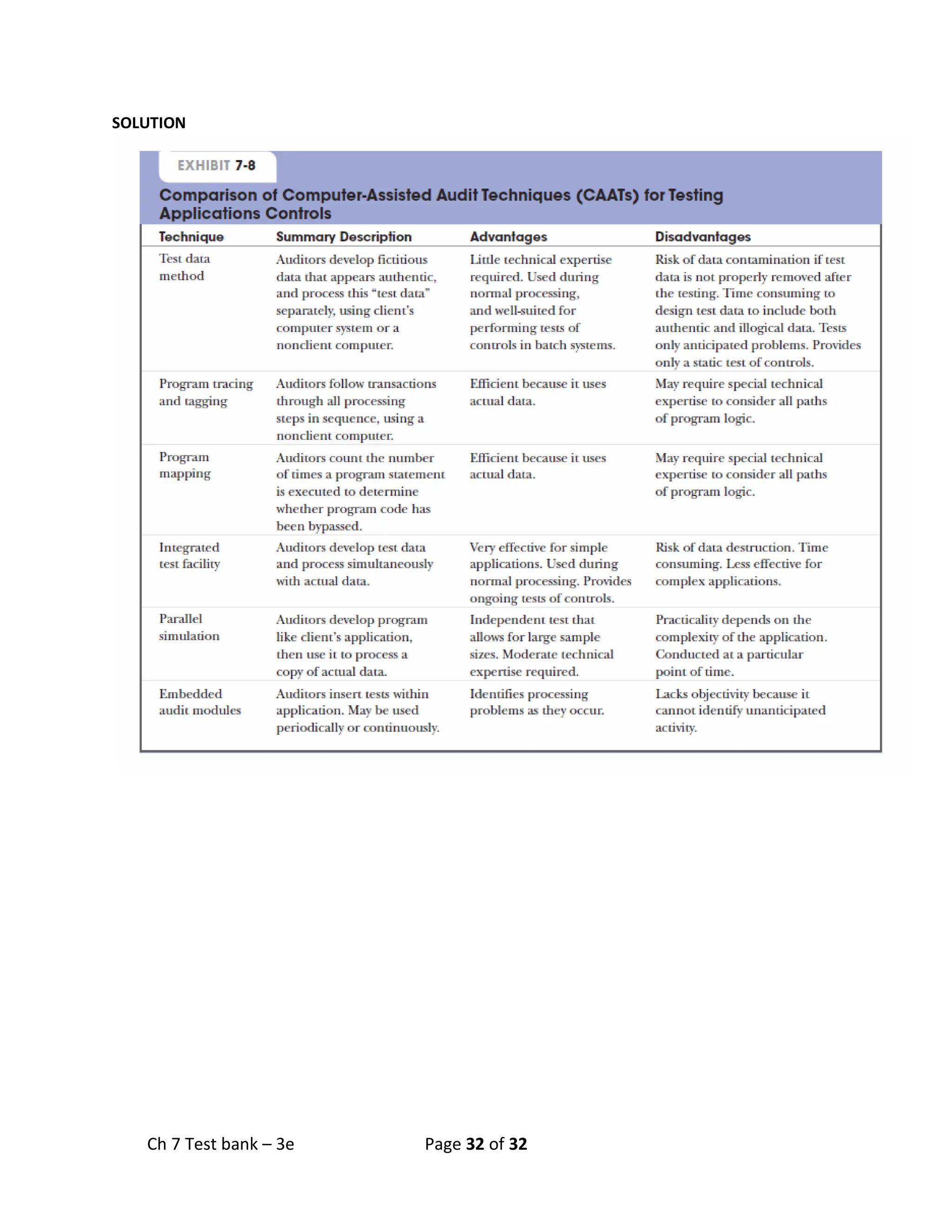
  • 47.
    M. Maebomey, original nameof the Burney family, 250 Machiavelli, his works, by Périer, 267 ; general odiousness of his name and works, 268 269 ; suffered for public liberty, 269 ; his elevated sentiments and just views, 270 ; held in high estimation by his contemporaries. 271 ; state of moral feeling ill Italy in his time, 272 ; his character as a man, 291 ; as a poet, 293 ; as a dramatist, 296 ; as a statesman, 291 300 309 313 309 ; excellence of his precepts, 311 ; his candor, 313 ; comparison between him and Montesquieu, 314 ; his style, 314 ; his levity, 316 ; his historical works, 316 ; lived to witness the last struggle for Florentine liberty, 319 ; his works and character misrepresented, 319 ; his remains dishonored till long after his death, 319 ; monument erected to his memory by an English nobleman, 319 Mackenzie, Henry, his ridicule of the Nabob class, 283 Mackenzie, Mr., his dismissal insisted on by Grenville, 70 Mackintosh, Sir James, review of his History of the Revolution in England, 251
  • 48.
    335 ; comparisonwith Fox's History of James II., 252 ; character of his oratory, 253 ; his conversational powers, 256 ; his qualities as an historian, 250 ; his vindication from the imputations of the editor, 262 270-278; change in his opinions produced by the French Revolution, 263 ; his moderation, 268 270 ; his historical justice, 277 278 ; remembrance of him at Holland House, 425 Macleane, Colonel, agent in England for Warren Hastings, 44 53 Macpherson, James, 77 331 210 ; a favorite author with Napoleon, 515 ; despised by Johnson, 116 Madras, description of it, 199 ; its capitulation to the French, 202 ; restored to the English, 203 Maand, capture of, by the English army in 470 119 Mæandnus, of Samos, 132 Magazine, delightful invention for a very idle or a very busy man, 156 ; resembles the little angels of the Rabbinical tradition, 156 157 Magdalen College, treatment of, by James II., 413 Addison's connection with it, 327 Mahon, Lord, Review of his History of the War of the Succession in Spain, 75
  • 49.
    142 ; hisqualities as an historian, 75 77 ; his explanation of the financial condition of Spain, 85 ; his opinions on the Partition Treaty, 90-92; his representations of Cardinal Porto Carrero, 104 ; his opinion of the peace on the conclusion of the War of the Spanish Succession, 131 ; his censure of Harley, 132 ; and view of the resemblance of the Tories of the present day to the Whigs of the Revolution, 132 135 Mahrattas, sketch of their history, 207 58 ; expedition against them, 60 Maintenon, Madame de, 364 30 Malaga, naval battle near, in 170 110 Malcolm, Sir John, review of his Life of Lord Clive, 194 299 ; value of his work, 190 ; his partiality for Clive, 237 ; his defence of Clive's conduct towards Ornichaud, 248 Mallet, David, patronage of by Bute, 41 Malthus, Mr., his theory of population, and Sadler's objections to it, 217 218 222 223 228 244 271 272 Manchester, Countess of, 339 Manchester, Earl of, his patronage of Addison, 338 350
  • 50.
    Mandeville, his metaphysicalpowers, 208 Mandragola (the), of Maehiavelli, 293 Manilla, capitulation of, 32 Mannerism of Johnson, ii 423 Mansfield, Lord, his character and talents, 223 ; his rejection of the overtures of Newcastle, 234 ; his elevation, 234 12 ; his friendship for Hastings, 106 ; character of his speeches, 104 Manso, Milton's Epistle to, 212 Manufactures and commerce of Italy in the 14th century, 275 277 Manufacturing and agricultural laborers, comparison of their condition, 147 149 Manufacturing system (the), Southey's opinion upon, 145 ; its effect on the health, 147 Marat, his bust substituted for the statues of the Martyrs of Christianity, 345 ; his language about Barère, 458 466 ; his bust torn down, 502 Mareet, Mrs., her Dialogues on Political Economy, 207 March, Lord, one of the persecutors of Wilkes, 60
  • 51.
    Maria Theresa, heraccession to the throne, 164 ; her situation and personal qualities, 165 166 ; her unbroken spirit, 173 ; gives birth to the future emperor, Joseph II., 173 ; her coronation, 173 ; enthusiastic loyalty and war-cry of Hungary, 174 ; her brother-in-law, Prince Charles of Lorraine, defeated by Frederic the Great, at Chotusitz, 174 ; she cedes Silesia, 175 ; her husband, Francis, raised to the Imperial Throne, 179 ; she resolves to humble Frederic, 200 ; succeeds in obtaining the adhesion of Russia, 200 ; her letter to Madame Pompadour, 211 ; signs the peace of Hubertsburg, 245 Marie Antoinette, Barère's share in her death, 401 434 409 470 Marino, San, visited by Addison, 340 Marlborough, Duchess of, her friendship with Congreve, 408 ; her inscription on his monument, 409 Marlborough, Duke of, 259 ; his conversion to Whiggism, 129 ; his acquaintance with the Duchess of Cleveland,-and commencement of his splendid fortune, 373 ; notice of Addison's poem in his honor, 358 Marlborough and Godolphin, their policy, 353 Maroons (the), of Surinam, 386 ; to: 388
  • 52.
    Marsh, Bishop, hisopposition to Calvinistic doctrine, 170 Martinique, capture of, 32 Martin's illustrations of the Pilgrim's Progress, and of Paradise Lost, 251 Marvel, Andrew, 333 Mary, Queen, 31 Masque, the Italian, 218 Massinger, allusion to his "Virgin Martyr," 220 ; his fondness for the Roman Catholic Church, 30 ; indelicate writing in his dramas, 356 Mathematical reasoning, 103 ; studies, their advantages and defects, 346 Mathematics, comparative estimate of, by Plato and by Bacon, 451 Maximilian of Bavaria, 328 Maxims, general, their uselessness, 310 Maynooth, Mr. Gladstone's objections to the vote of money for, 179 Mecca, 301 Medals, Addison's Treatise on, 329 351 Medici, Lorenzo de. See Lorenzo de Medici.
  • 53.
    Medicine, comparative estimateof the science of, by Plato and by Bacon, 454 456 Meer Cossim, his talents, 260 ; his deposition and revenge, 266 Meer Jatlier, his conspiracy, 240 ; his conduct during the battle of Plassey, 243 240 ; his pecuniary transactions with Clive, 251 ; his proceedings on being threatened by the Great Mogul, 250 ; his fears of the English, and intrigues with the Dutch, 258 ; deposed and reseated by the English, 266 ; his death, 270 ; his large bequest to Lord Clive, 279 Melanethon, 7 Melville, Lord, his impeachment, 292 Meinmius, compared to Sir Wm. Temple, 112 Memoirs of Sir "William Temple, review of, 1 115 ; wanting in selection and compression, 2 Memoirs of the Life of Warren Hastings, review of, 1 148 Memoirs, writers of, neglected by historians, 423 Memory, comparative views of the importance of, by Plato and by Bacon, 454 Menander, the lost comedies of, 375
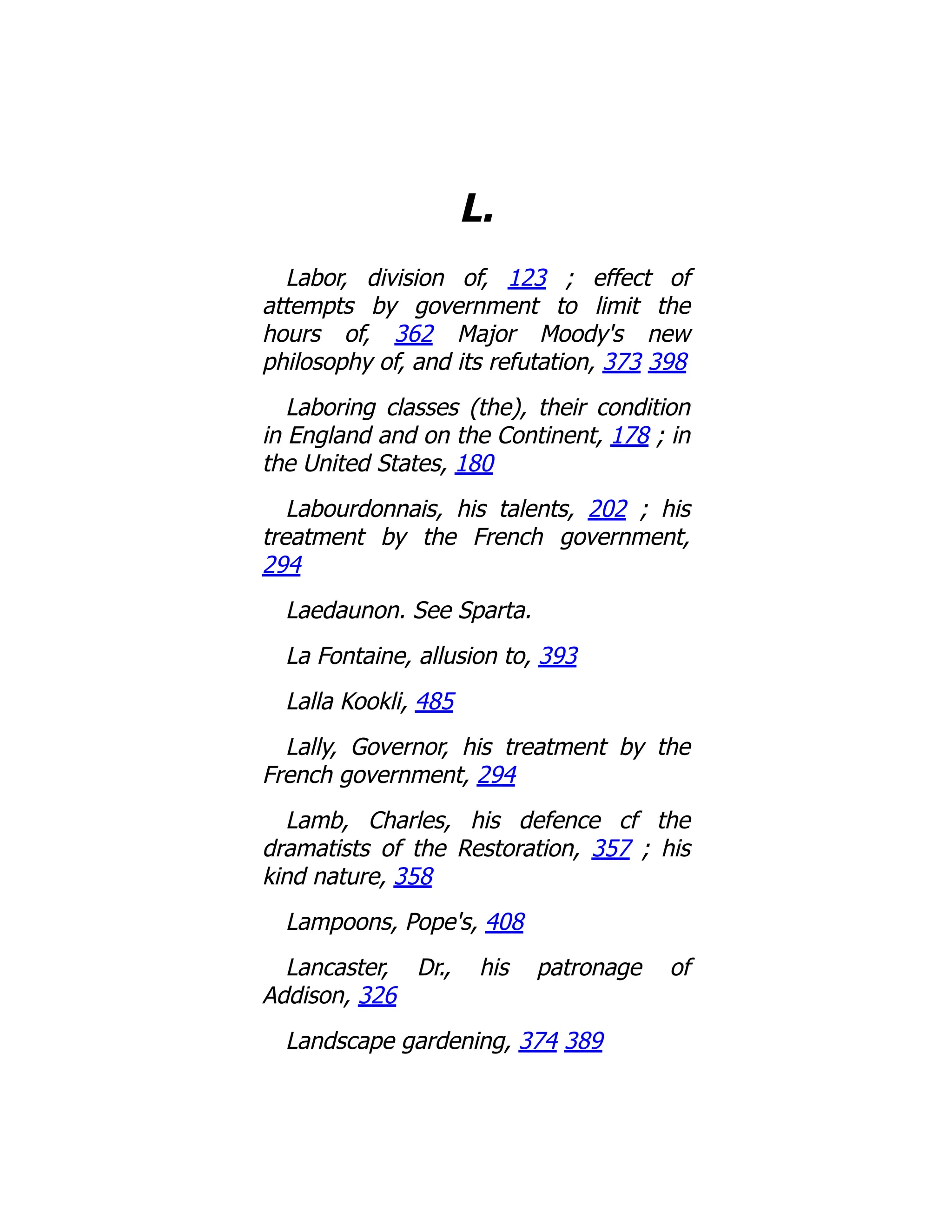
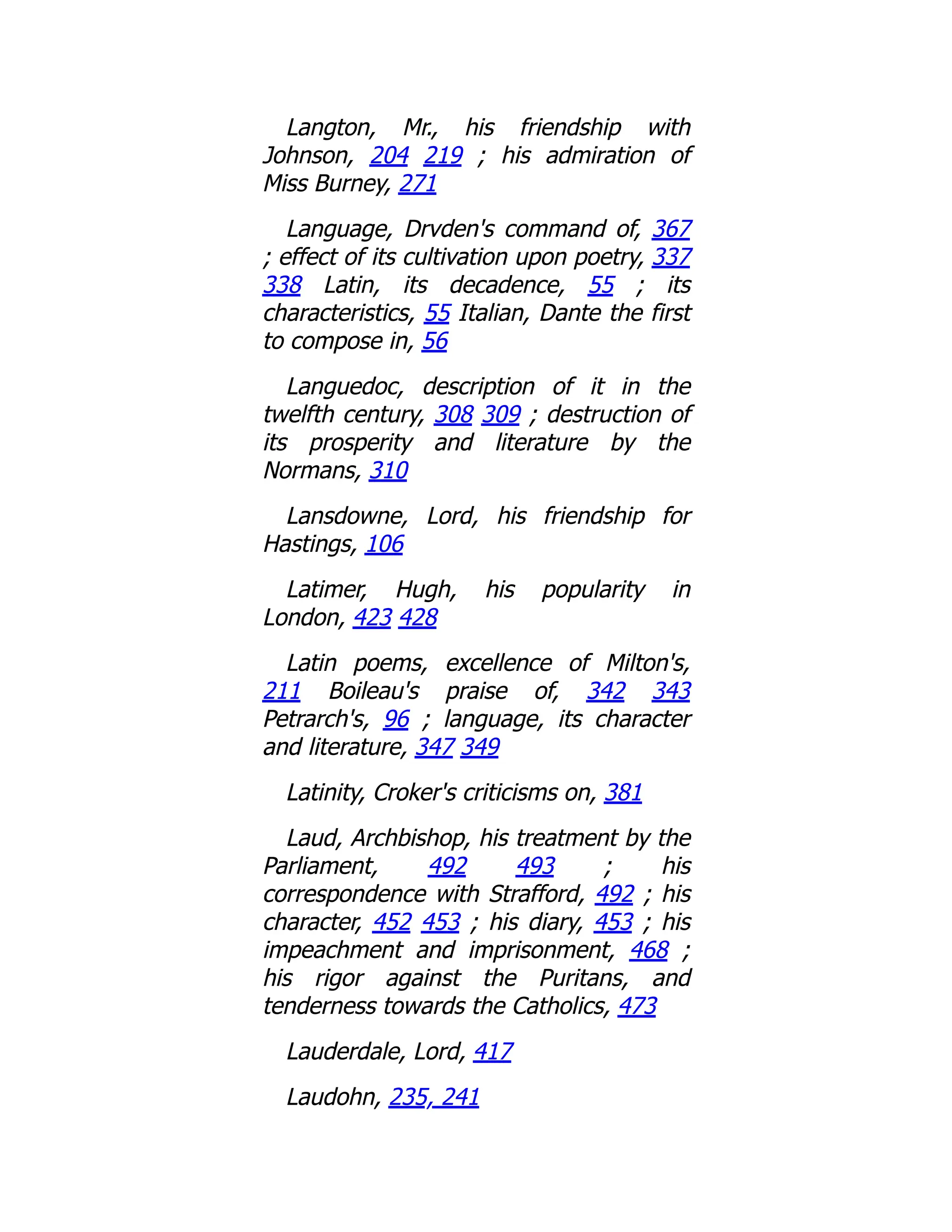
  • 54.
    Mendaeium, different speciesof, 430 Mendoza, Hurtado de, 81 Mercenaries, employment of, in Italy, 283 ; its political consequences, 284 ; and moral effects, 285 Messiah, Pope's, translated into Latin verse by Johnson, 175 Metals, the precious, production of, 351 Metaphysical accuracy incompatible with successful poetry, 225 Metcalfe, Sir Charles, his ability and disinterestedness, 298 Methodists, their rise unnoticed by some writers of the history of England under George II., 426 ; their early object, 318 Mexico, exactions of the Spanish viceroys in, exceeded by the English agents in Bengal, 266 Miehell, Sir Francis, 401 Middle ages, inconsistency in the schoolmen of the, 415 Middlesex election, the constitutional question in relation to it, 101 104 Middleton, Dr., remarks on his Life of Cicero, 340 341 ; his controversies with Bentley, 112
  • 55.
    Midias, Demosthenes' speechagainst, 102 "Midsummer Night's Dream," sense in which the word "translated" is therein used, 180 Milan, Addison's visit to, 345 Military science, studied by Machiavelli, 306 Military service, relative adaptation of different classes for, 280 Militia (the), control of, by Charles I. or by the Parliament, 488 Mill, James, his merits as a historian, 277 278 ; defects of his History of British India, 195 196 ; his unfairness towards Clive's character, 237 ; his Essay on Government reviewed, 5 51 ; his theory and method of reasoning, 6 8 10 12 18 20 46 48 ; his style. 8 ; his erroneous definition of the end of government, 11 ; his objections to a Democracy only practical ones, 12 ; attempts to demonstrate that a purely aristocratic form of government is necessarily bad, 12 13 ; so also an absolute monarchy, 13 14 ; refutation of these arguments, 15 16 18 ; his inconsistencies, 16 17 96 97 121; his narrow views, 19 20 ; his logical deficiencies, 95 ; his want of precision in the use of terms, 103 108 ; attempts to prove that no combination of the simple forms of government can exist, 21 22 ;
  • 56.
    refutation of thisargument., 22 29 ; his ideas upon the representative system. 29 30 ; objections to them, 30-32; his views upon the qualifications of voters, 32 36 ; objections to them, 36 38 41 42 ; confounds the interests of the present generation with those of the human race, 38 39 ; attempts to prove that the people understand their own interest, 42 ; refutation of this argument, 43 ; general objections to his theory, 44 47 122 ; defended by the Westminster Review, 529 ; inconsistencies between him and the reviewer, 56 58 ; the reviewer mistakes the points at issue, 58 60 61 65 70 77 114 ; and misrepresents arguments, 62 73 74 ; refutation of his positions. 63 64 66 74 76 122 127 ; the reviewer shifts the issue, 68 127 128 ; fails to strengthen Mill's positions, 71 ; and manifests great disingenuousness, 115 118 129 130 Millar, Lady, her vase for verses, 271 Milton, review of his Treatise on Christian Doctrine, Mr. Lemon's discovery of the MS. of it, 202 ; his style, "202; his theological opinions, 204 ; his poetry his great passport to general remembrance, 205 211 ; power of his imagination, 211 ; the most striking characteristic of his poetry, 213 375 ; his Allegro and Penseroso, 215 ; his Cornus and Samson Agonistes, 215 ; his minor poems, 219 ; appreciated the literature of modern
  • 57.
    Italy, 219 ;his Paradise Regained, 219 ; parallel between him and Dante, 17 18 ; his Sonnets most exhibit his peculiar character, 232 ; his public conduct, 233 ; his defence of the execution of Charles L, 246 ; his refutation of Salmasius, 248 ; his conduct under the Protector, 249 ; peculiarities which distinguished him from his contemporaries, 253 ; noblest qualities of every party combined in him, 260 ; his defence of the freedom of the press, and the right of private judgment, 262 ; his boldness in the maintenance of his opinions, 263 ; recapitulation of his literary merits, 264 ; one of the most "correct" poets, 338 ; his egotism, 82 ; effect of his blindness upon his genius, 351 Dryden's admiration of, 369 370 Milton and Cowley, an imaginary conversation between, touching the great Civil War, 112 138 Milton and Shakspeare,character of, Johnson's observations on, 417 Minden, battle of, 247 Minds, great, the product of their times, 323 325 Mines, Spanish-American, 85 351 Ministers, veto by Parliament on their appointment, 487 ; their responsibility lessened by the Revolution, 531
  • 58.
    Minorca, capture of,by the French, 232 Minority, period of, at Athens, 191 192 "Minute guns!" Diaries Townshend's exclamation on hearing Bute's maiden speech, 33 Mirabeau, Dumont's recollections of, 71 74 ; his habit of giving compound nicknames, 72 ; compared with Wilkes, 72 ; with Chatham, 72 73 Missionaries, Catholic, their zeal and spirit, 300 Mittford, Mr., his History of Greece reviewed, 172 201 ; its popularity greater than its merits, 172 ; his characteristics, 173 174 177 420-422; his scepticism and political prejudices, 178 188 ; his admiration of an oligarchy, and preference of Sparta to Athens, 181 183 ; his views in regard to Lyeurgus, 185 ; reprobates the liturgic system of Athens, 190 ; his unfairness, 191 422; his misrepresentation of Demosthenes, 191 193 195 197 ; his partiality for Æschines, 193 194 ; his admiration of monarchies, 195 ; his general preference of the Barbarians to the Greeks, 190 ; his deficiencies as an historian, 190 197; his indifference for literature and literary pursuits, 197 199 Modern history, the period of its commencement, 532
  • 59.
    Mogul, the Great,27 ; plundered by Hastings, 74 Mohammed Heza Khan, his character, 18 ; selected by Clive, 21 ; his capture, confinement at Calcutta and release, 25 Molière, 385 Molwitz, battle of, 171 Mompesson, Sir Giles, conduct of Bacon in regard to his patent, 401 402 ; abandoned to the vengeance of the Commons, 412 Monarch, absolute, establishment of, in continental states, 481 Mitford's admiration of, 195 Monarchy, the English, in the l6th century, 15 20 Monjuieh, capture of the fort of, by Peterborough, 115 Monmouth, Duke of, 300 ; his supplication for life, 99 Monopolies, English, during the latter end of Elizabeth's reign, multiplied under James, 304 401 ; connived at by Bacon, 402 Monson, Mr., one of the new councillors under the Regulating Act for India, his opposition to Hastings, 40 ; his death and its important consequences, 54