Accounting Information Systems Controls Processes 3rd Edition Turner Test Bank
Accounting Information Systems Controls Processes 3rd Edition Turner Test Bank
Accounting Information Systems Controls Processes 3rd Edition Turner Test Bank
Accounting Information Systems Controls Processes 3rd Edition Turner Test Bank
Accounting Information Systems Controls Processes 3rd Edition Turner Test Bank
1.
Visit https://testbankdeal.com todownload the full version and
explore more testbank or solution manual
Accounting Information Systems Controls
Processes 3rd Edition Turner Test Bank
_____ Click the link below to download _____
https://testbankdeal.com/product/accounting-
information-systems-controls-processes-3rd-edition-
turner-test-bank/
Explore and download more testbank at testbankdeal.com
2.
Here are somesuggested products you might be interested in.
Click the link to download
Accounting Information Systems Controls Processes 3rd
Edition Turner Solutions Manual
https://testbankdeal.com/product/accounting-information-systems-
controls-processes-3rd-edition-turner-solutions-manual/
Accounting Information Systems The Processes Controls 2nd
Edition Turner Solutions Manual
https://testbankdeal.com/product/accounting-information-systems-the-
processes-controls-2nd-edition-turner-solutions-manual/
Accounting Information Systems The Processes and Controls
2nd Edition Turner Test Bank
https://testbankdeal.com/product/accounting-information-systems-the-
processes-and-controls-2nd-edition-turner-test-bank/
Intermediate Accounting 2014 FASB Update 15th Edition
Kieso Test Bank
https://testbankdeal.com/product/intermediate-accounting-2014-fasb-
update-15th-edition-kieso-test-bank/
3.
Introduction to MaternityPediatric Nursing 6th Edition
Leifer Solutions Manual
https://testbankdeal.com/product/introduction-to-maternity-pediatric-
nursing-6th-edition-leifer-solutions-manual/
International Economics Theory and Policy 10th Edition
Krugman Test Bank
https://testbankdeal.com/product/international-economics-theory-and-
policy-10th-edition-krugman-test-bank/
Biology Concepts and Investigations 3rd Edition Hoefnagels
Test Bank
https://testbankdeal.com/product/biology-concepts-and-
investigations-3rd-edition-hoefnagels-test-bank/
International Economics 13th Edition Carbaugh Test Bank
https://testbankdeal.com/product/international-economics-13th-edition-
carbaugh-test-bank/
Modern Marketing Research Concepts Methods and Cases 2nd
Edition Feinberg Test Bank
https://testbankdeal.com/product/modern-marketing-research-concepts-
methods-and-cases-2nd-edition-feinberg-test-bank/
4.
Child Psychology AContemporary View Point 7th Edition
Parke Test Bank
https://testbankdeal.com/product/child-psychology-a-contemporary-view-
point-7th-edition-parke-test-bank/
5.
Ch 7 Testbank – 3e Page 1 of 32
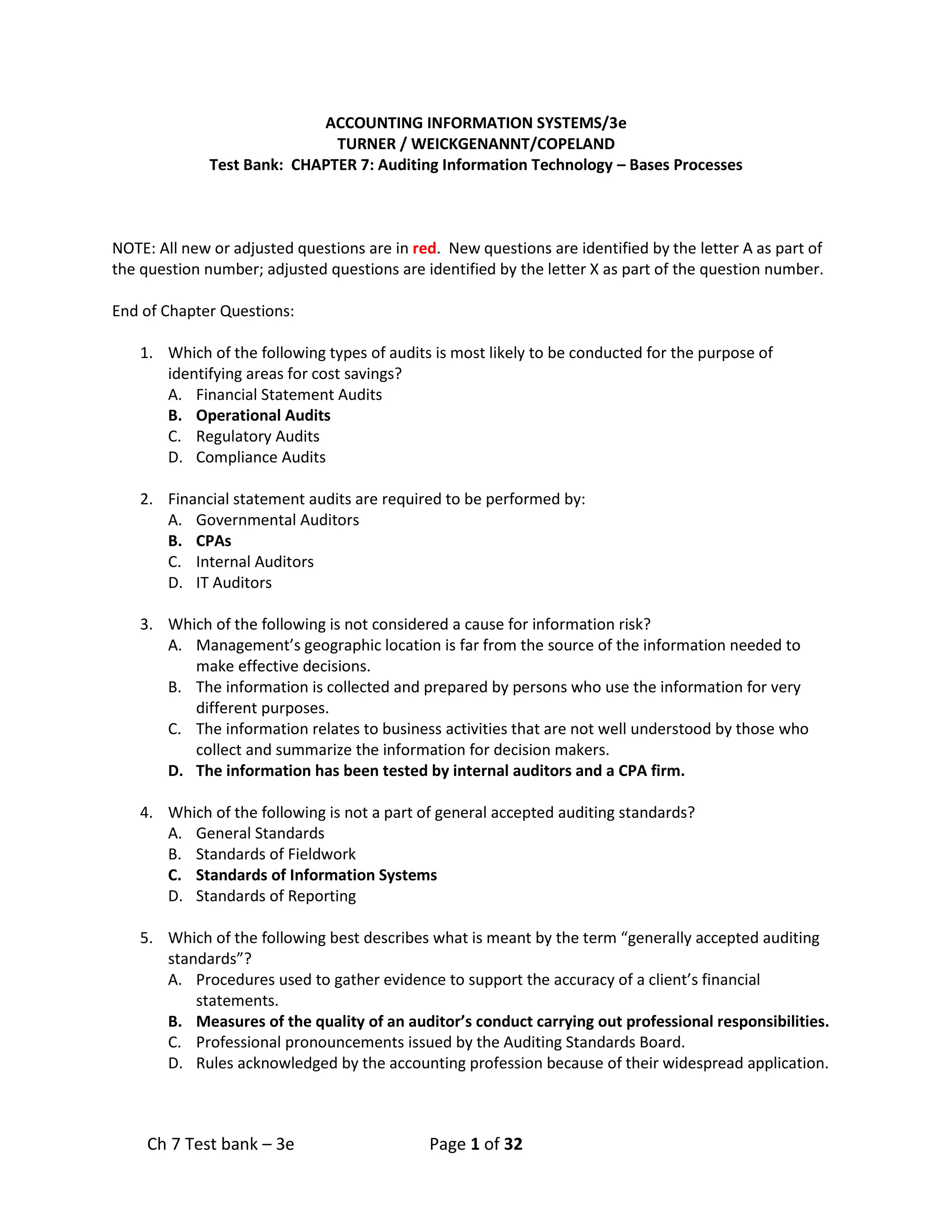
ACCOUNTING INFORMATION SYSTEMS/3e
TURNER / WEICKGENANNT/COPELAND
Test Bank: CHAPTER 7: Auditing Information Technology – Bases Processes
NOTE: All new or adjusted questions are in red. New questions are identified by the letter A as part of
the question number; adjusted questions are identified by the letter X as part of the question number.
End of Chapter Questions:
1. Which of the following types of audits is most likely to be conducted for the purpose of
identifying areas for cost savings?
A. Financial Statement Audits
B. Operational Audits
C. Regulatory Audits
D. Compliance Audits
2. Financial statement audits are required to be performed by:
A. Governmental Auditors
B. CPAs
C. Internal Auditors
D. IT Auditors
3. Which of the following is not considered a cause for information risk?
A. Management’s geographic location is far from the source of the information needed to
make effective decisions.
B. The information is collected and prepared by persons who use the information for very
different purposes.
C. The information relates to business activities that are not well understood by those who
collect and summarize the information for decision makers.
D. The information has been tested by internal auditors and a CPA firm.
4. Which of the following is not a part of general accepted auditing standards?
A. General Standards
B. Standards of Fieldwork
C. Standards of Information Systems
D. Standards of Reporting
5. Which of the following best describes what is meant by the term “generally accepted auditing
standards”?
A. Procedures used to gather evidence to support the accuracy of a client’s financial
statements.
B. Measures of the quality of an auditor’s conduct carrying out professional responsibilities.
C. Professional pronouncements issued by the Auditing Standards Board.
D. Rules acknowledged by the accounting profession because of their widespread application.
6.
Ch 7 Testbank – 3e Page 2 of 32
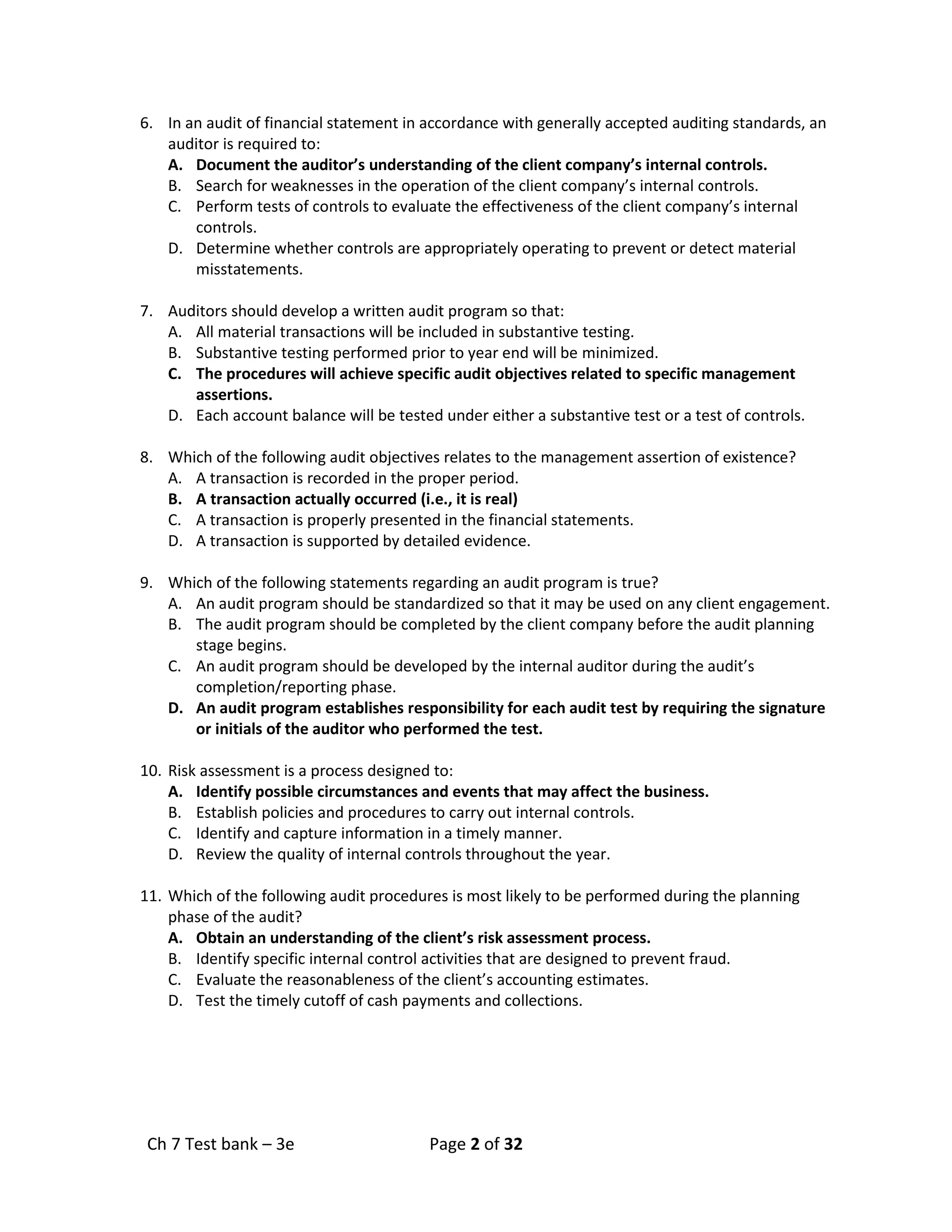
6. In an audit of financial statement in accordance with generally accepted auditing standards, an
auditor is required to:
A. Document the auditor’s understanding of the client company’s internal controls.
B. Search for weaknesses in the operation of the client company’s internal controls.
C. Perform tests of controls to evaluate the effectiveness of the client company’s internal
controls.
D. Determine whether controls are appropriately operating to prevent or detect material
misstatements.
7. Auditors should develop a written audit program so that:
A. All material transactions will be included in substantive testing.
B. Substantive testing performed prior to year end will be minimized.
C. The procedures will achieve specific audit objectives related to specific management
assertions.
D. Each account balance will be tested under either a substantive test or a test of controls.
8. Which of the following audit objectives relates to the management assertion of existence?
A. A transaction is recorded in the proper period.
B. A transaction actually occurred (i.e., it is real)
C. A transaction is properly presented in the financial statements.
D. A transaction is supported by detailed evidence.
9. Which of the following statements regarding an audit program is true?
A. An audit program should be standardized so that it may be used on any client engagement.
B. The audit program should be completed by the client company before the audit planning
stage begins.
C. An audit program should be developed by the internal auditor during the audit’s
completion/reporting phase.
D. An audit program establishes responsibility for each audit test by requiring the signature
or initials of the auditor who performed the test.
10. Risk assessment is a process designed to:
A. Identify possible circumstances and events that may affect the business.
B. Establish policies and procedures to carry out internal controls.
C. Identify and capture information in a timely manner.
D. Review the quality of internal controls throughout the year.
11. Which of the following audit procedures is most likely to be performed during the planning
phase of the audit?
A. Obtain an understanding of the client’s risk assessment process.
B. Identify specific internal control activities that are designed to prevent fraud.
C. Evaluate the reasonableness of the client’s accounting estimates.
D. Test the timely cutoff of cash payments and collections.
7.
Ch 7 Testbank – 3e Page 3 of 32
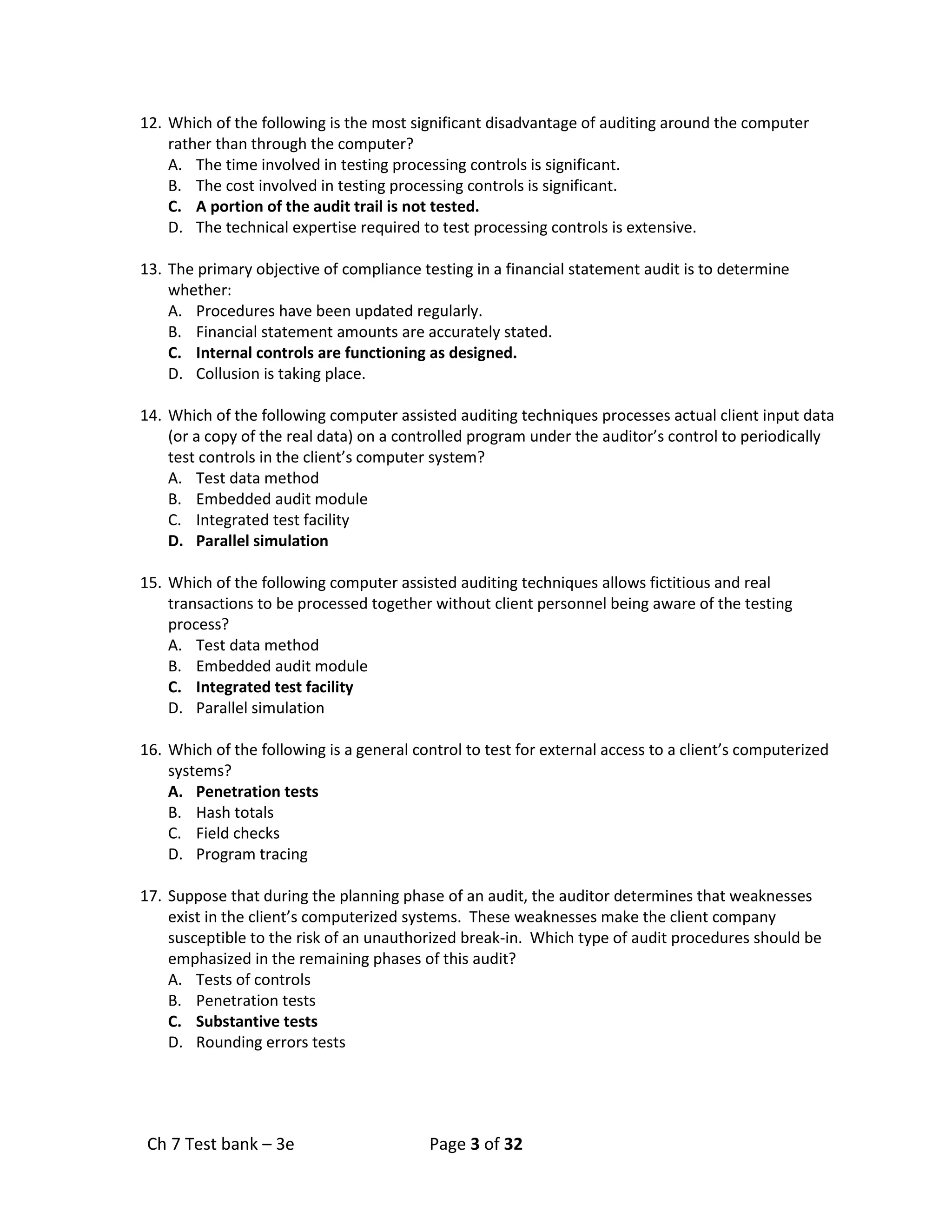
12. Which of the following is the most significant disadvantage of auditing around the computer
rather than through the computer?
A. The time involved in testing processing controls is significant.
B. The cost involved in testing processing controls is significant.
C. A portion of the audit trail is not tested.
D. The technical expertise required to test processing controls is extensive.
13. The primary objective of compliance testing in a financial statement audit is to determine
whether:
A. Procedures have been updated regularly.
B. Financial statement amounts are accurately stated.
C. Internal controls are functioning as designed.
D. Collusion is taking place.
14. Which of the following computer assisted auditing techniques processes actual client input data
(or a copy of the real data) on a controlled program under the auditor’s control to periodically
test controls in the client’s computer system?
A. Test data method
B. Embedded audit module
C. Integrated test facility
D. Parallel simulation
15. Which of the following computer assisted auditing techniques allows fictitious and real
transactions to be processed together without client personnel being aware of the testing
process?
A. Test data method
B. Embedded audit module
C. Integrated test facility
D. Parallel simulation
16. Which of the following is a general control to test for external access to a client’s computerized
systems?
A. Penetration tests
B. Hash totals
C. Field checks
D. Program tracing
17. Suppose that during the planning phase of an audit, the auditor determines that weaknesses
exist in the client’s computerized systems. These weaknesses make the client company
susceptible to the risk of an unauthorized break-in. Which type of audit procedures should be
emphasized in the remaining phases of this audit?
A. Tests of controls
B. Penetration tests
C. Substantive tests
D. Rounding errors tests
8.
Ch 7 Testbank – 3e Page 4 of 32
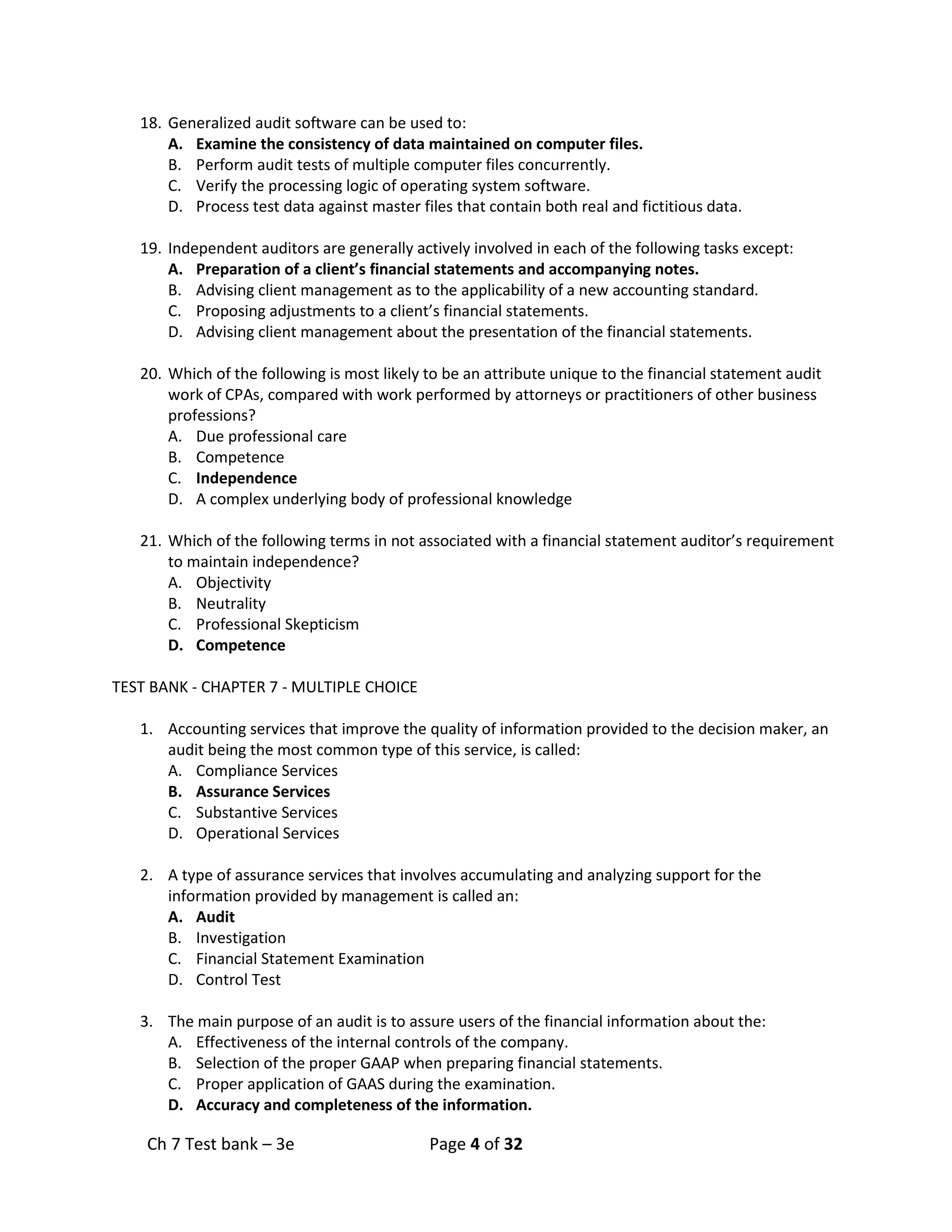
18. Generalized audit software can be used to:
A. Examine the consistency of data maintained on computer files.
B. Perform audit tests of multiple computer files concurrently.
C. Verify the processing logic of operating system software.
D. Process test data against master files that contain both real and fictitious data.
19. Independent auditors are generally actively involved in each of the following tasks except:
A. Preparation of a client’s financial statements and accompanying notes.
B. Advising client management as to the applicability of a new accounting standard.
C. Proposing adjustments to a client’s financial statements.
D. Advising client management about the presentation of the financial statements.
20. Which of the following is most likely to be an attribute unique to the financial statement audit
work of CPAs, compared with work performed by attorneys or practitioners of other business
professions?
A. Due professional care
B. Competence
C. Independence
D. A complex underlying body of professional knowledge
21. Which of the following terms in not associated with a financial statement auditor’s requirement
to maintain independence?
A. Objectivity
B. Neutrality
C. Professional Skepticism
D. Competence
TEST BANK - CHAPTER 7 - MULTIPLE CHOICE
1. Accounting services that improve the quality of information provided to the decision maker, an
audit being the most common type of this service, is called:
A. Compliance Services
B. Assurance Services
C. Substantive Services
D. Operational Services
2. A type of assurance services that involves accumulating and analyzing support for the
information provided by management is called an:
A. Audit
B. Investigation
C. Financial Statement Examination
D. Control Test
3. The main purpose of an audit is to assure users of the financial information about the:
A. Effectiveness of the internal controls of the company.
B. Selection of the proper GAAP when preparing financial statements.
C. Proper application of GAAS during the examination.
D. Accuracy and completeness of the information.
9.
Ch 7 Testbank – 3e Page 5 of 32
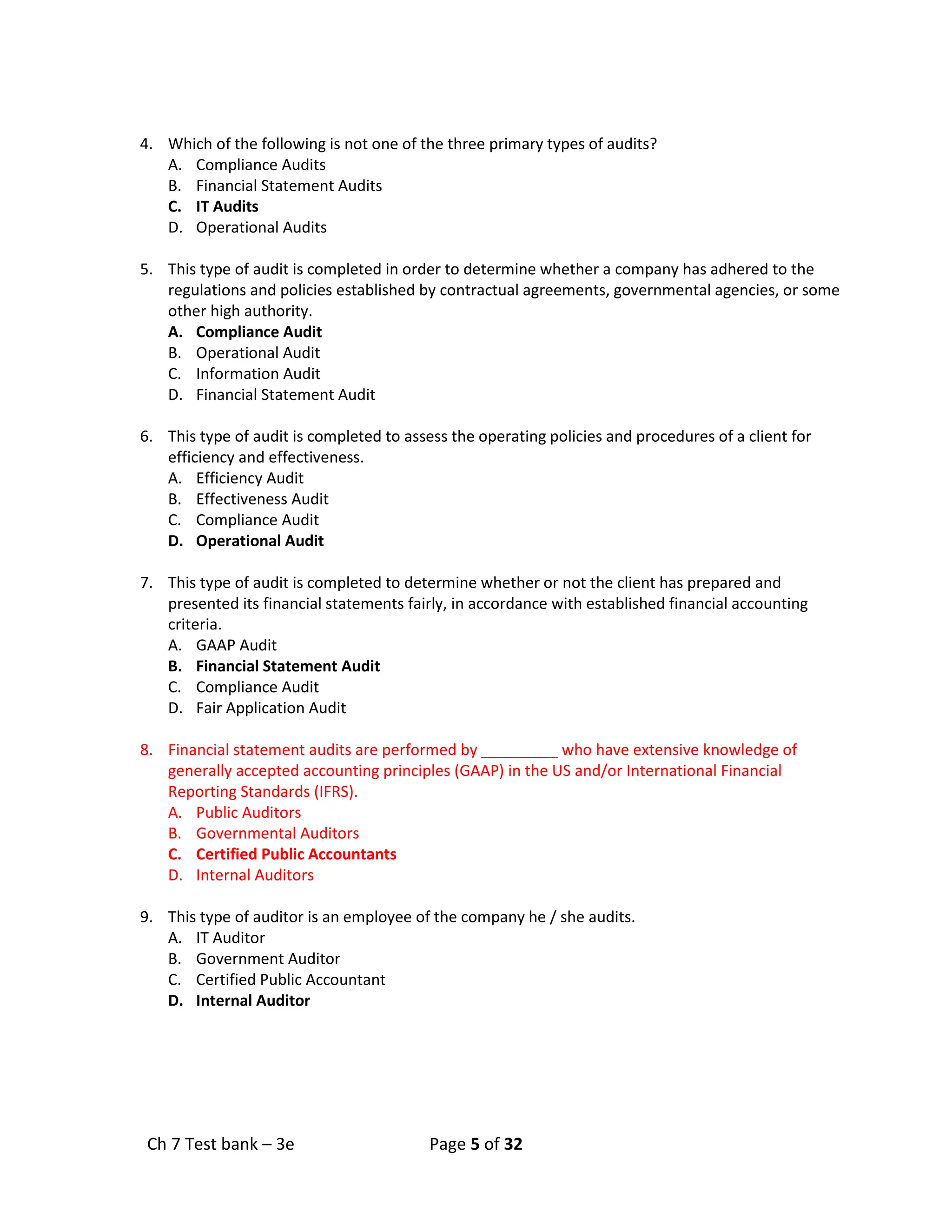
4. Which of the following is not one of the three primary types of audits?
A. Compliance Audits
B. Financial Statement Audits
C. IT Audits
D. Operational Audits
5. This type of audit is completed in order to determine whether a company has adhered to the
regulations and policies established by contractual agreements, governmental agencies, or some
other high authority.
A. Compliance Audit
B. Operational Audit
C. Information Audit
D. Financial Statement Audit
6. This type of audit is completed to assess the operating policies and procedures of a client for
efficiency and effectiveness.
A. Efficiency Audit
B. Effectiveness Audit
C. Compliance Audit
D. Operational Audit
7. This type of audit is completed to determine whether or not the client has prepared and
presented its financial statements fairly, in accordance with established financial accounting
criteria.
A. GAAP Audit
B. Financial Statement Audit
C. Compliance Audit
D. Fair Application Audit
8. Financial statement audits are performed by _________ who have extensive knowledge of
generally accepted accounting principles (GAAP) in the US and/or International Financial
Reporting Standards (IFRS).
A. Public Auditors
B. Governmental Auditors
C. Certified Public Accountants
D. Internal Auditors
9. This type of auditor is an employee of the company he / she audits.
A. IT Auditor
B. Government Auditor
C. Certified Public Accountant
D. Internal Auditor
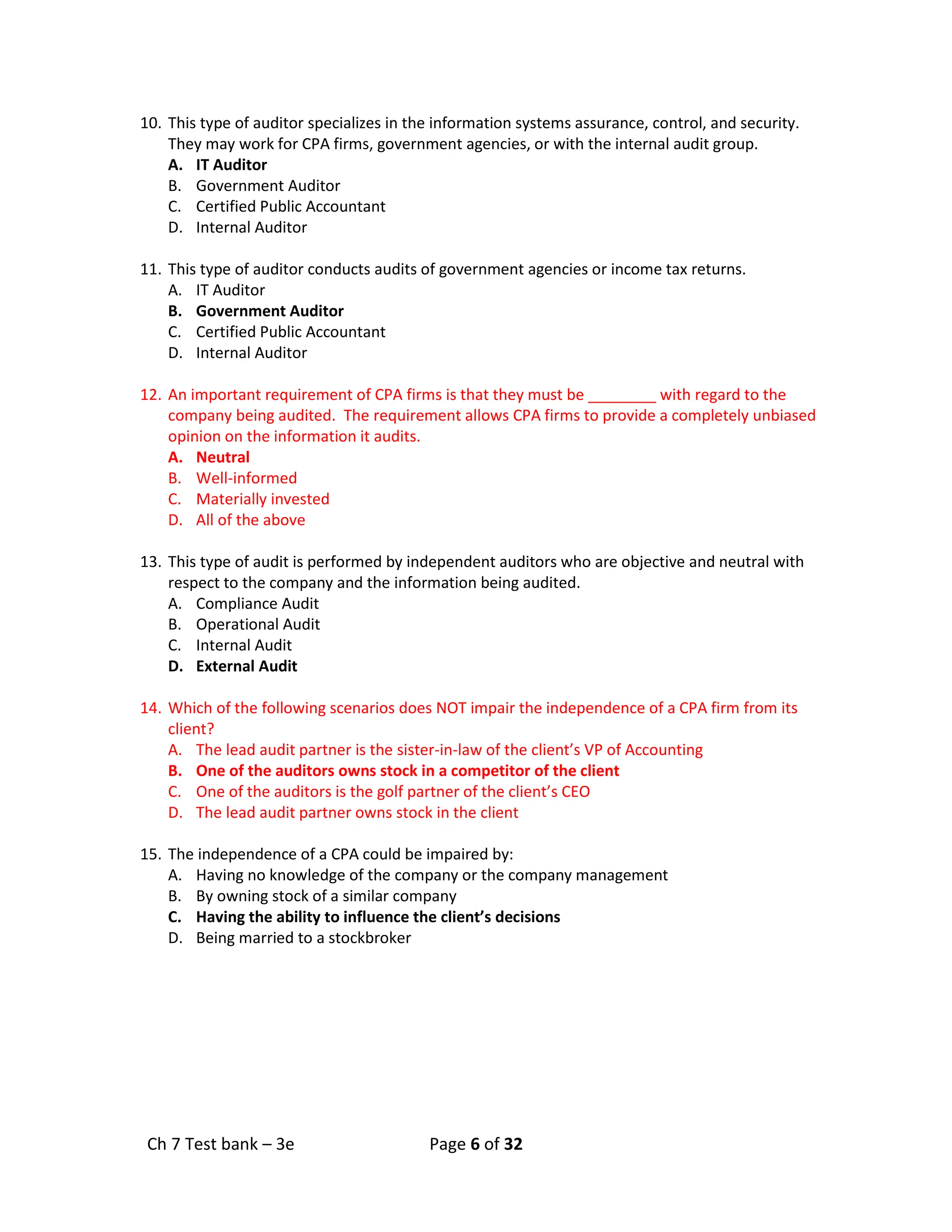
10.
Ch 7 Testbank – 3e Page 6 of 32
10. This type of auditor specializes in the information systems assurance, control, and security.
They may work for CPA firms, government agencies, or with the internal audit group.
A. IT Auditor
B. Government Auditor
C. Certified Public Accountant
D. Internal Auditor
11. This type of auditor conducts audits of government agencies or income tax returns.
A. IT Auditor
B. Government Auditor
C. Certified Public Accountant
D. Internal Auditor
12. An important requirement of CPA firms is that they must be ________ with regard to the
company being audited. The requirement allows CPA firms to provide a completely unbiased
opinion on the information it audits.
A. Neutral
B. Well-informed
C. Materially invested
D. All of the above
13. This type of audit is performed by independent auditors who are objective and neutral with
respect to the company and the information being audited.
A. Compliance Audit
B. Operational Audit
C. Internal Audit
D. External Audit
14. Which of the following scenarios does NOT impair the independence of a CPA firm from its
client?
A. The lead audit partner is the sister-in-law of the client’s VP of Accounting
B. One of the auditors owns stock in a competitor of the client
C. One of the auditors is the golf partner of the client’s CEO
D. The lead audit partner owns stock in the client
15. The independence of a CPA could be impaired by:
A. Having no knowledge of the company or the company management
B. By owning stock of a similar company
C. Having the ability to influence the client’s decisions
D. Being married to a stockbroker
11.
Ch 7 Testbank – 3e Page 7 of 32
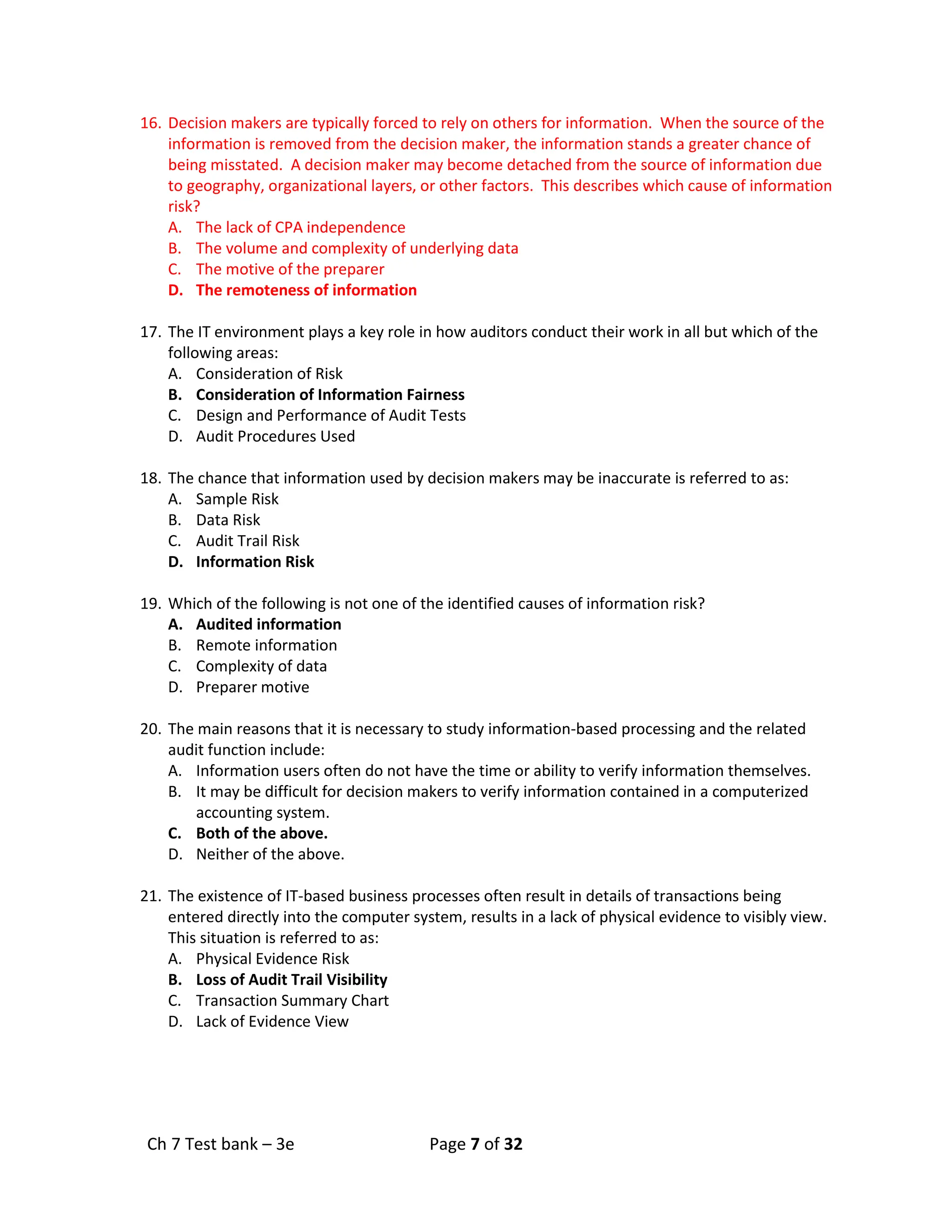
16. Decision makers are typically forced to rely on others for information. When the source of the
information is removed from the decision maker, the information stands a greater chance of
being misstated. A decision maker may become detached from the source of information due
to geography, organizational layers, or other factors. This describes which cause of information
risk?
A. The lack of CPA independence
B. The volume and complexity of underlying data
C. The motive of the preparer
D. The remoteness of information
17. The IT environment plays a key role in how auditors conduct their work in all but which of the
following areas:
A. Consideration of Risk
B. Consideration of Information Fairness
C. Design and Performance of Audit Tests
D. Audit Procedures Used
18. The chance that information used by decision makers may be inaccurate is referred to as:
A. Sample Risk
B. Data Risk
C. Audit Trail Risk
D. Information Risk
19. Which of the following is not one of the identified causes of information risk?
A. Audited information
B. Remote information
C. Complexity of data
D. Preparer motive
20. The main reasons that it is necessary to study information-based processing and the related
audit function include:
A. Information users often do not have the time or ability to verify information themselves.
B. It may be difficult for decision makers to verify information contained in a computerized
accounting system.
C. Both of the above.
D. Neither of the above.
21. The existence of IT-based business processes often result in details of transactions being
entered directly into the computer system, results in a lack of physical evidence to visibly view.
This situation is referred to as:
A. Physical Evidence Risk
B. Loss of Audit Trail Visibility
C. Transaction Summary Chart
D. Lack of Evidence View
12.
Ch 7 Testbank – 3e Page 8 of 32
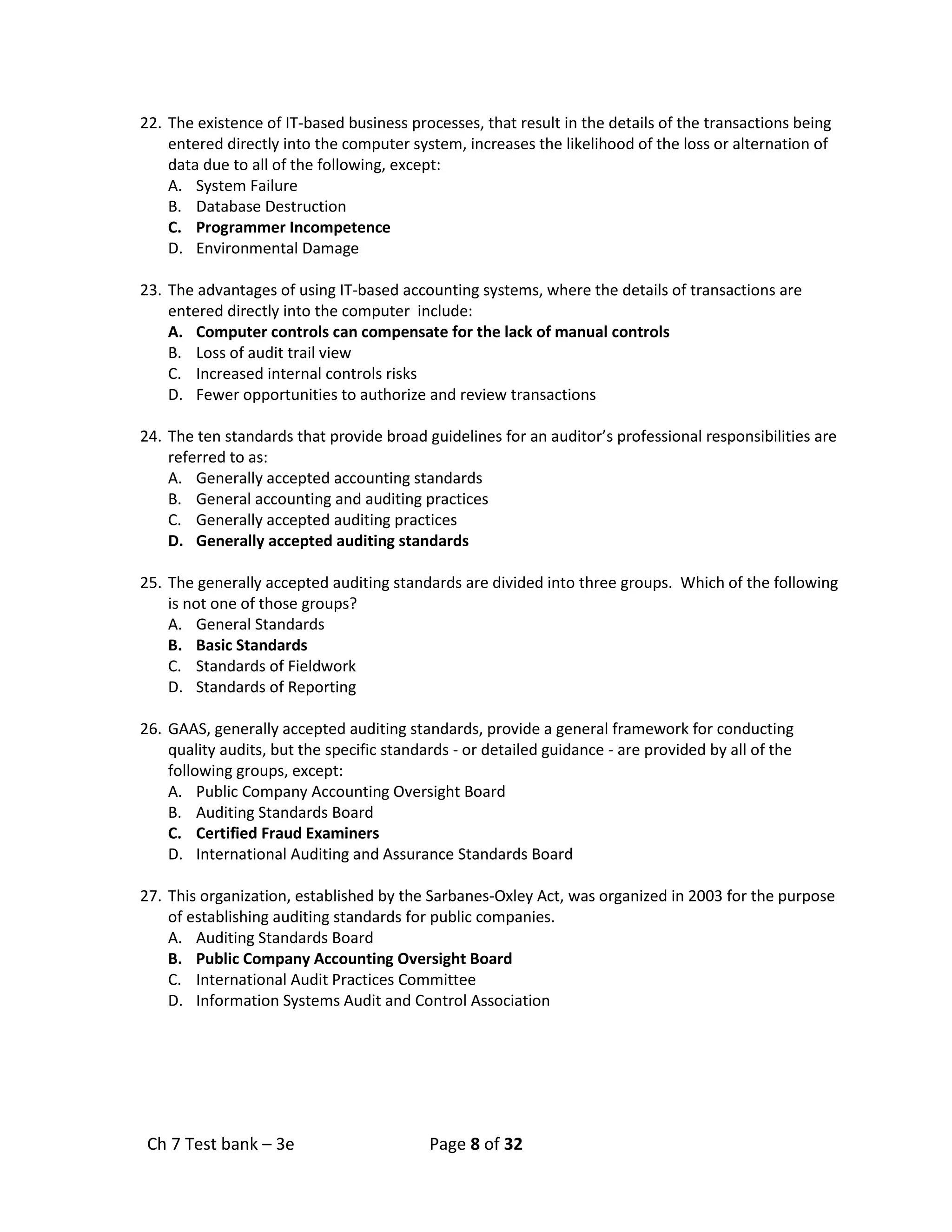
22. The existence of IT-based business processes, that result in the details of the transactions being
entered directly into the computer system, increases the likelihood of the loss or alternation of
data due to all of the following, except:
A. System Failure
B. Database Destruction
C. Programmer Incompetence
D. Environmental Damage
23. The advantages of using IT-based accounting systems, where the details of transactions are
entered directly into the computer include:
A. Computer controls can compensate for the lack of manual controls
B. Loss of audit trail view
C. Increased internal controls risks
D. Fewer opportunities to authorize and review transactions
24. The ten standards that provide broad guidelines for an auditor’s professional responsibilities are
referred to as:
A. Generally accepted accounting standards
B. General accounting and auditing practices
C. Generally accepted auditing practices
D. Generally accepted auditing standards
25. The generally accepted auditing standards are divided into three groups. Which of the following
is not one of those groups?
A. General Standards
B. Basic Standards
C. Standards of Fieldwork
D. Standards of Reporting
26. GAAS, generally accepted auditing standards, provide a general framework for conducting
quality audits, but the specific standards - or detailed guidance - are provided by all of the
following groups, except:
A. Public Company Accounting Oversight Board
B. Auditing Standards Board
C. Certified Fraud Examiners
D. International Auditing and Assurance Standards Board
27. This organization, established by the Sarbanes-Oxley Act, was organized in 2003 for the purpose
of establishing auditing standards for public companies.
A. Auditing Standards Board
B. Public Company Accounting Oversight Board
C. International Audit Practices Committee
D. Information Systems Audit and Control Association
13.
Ch 7 Testbank – 3e Page 9 of 32
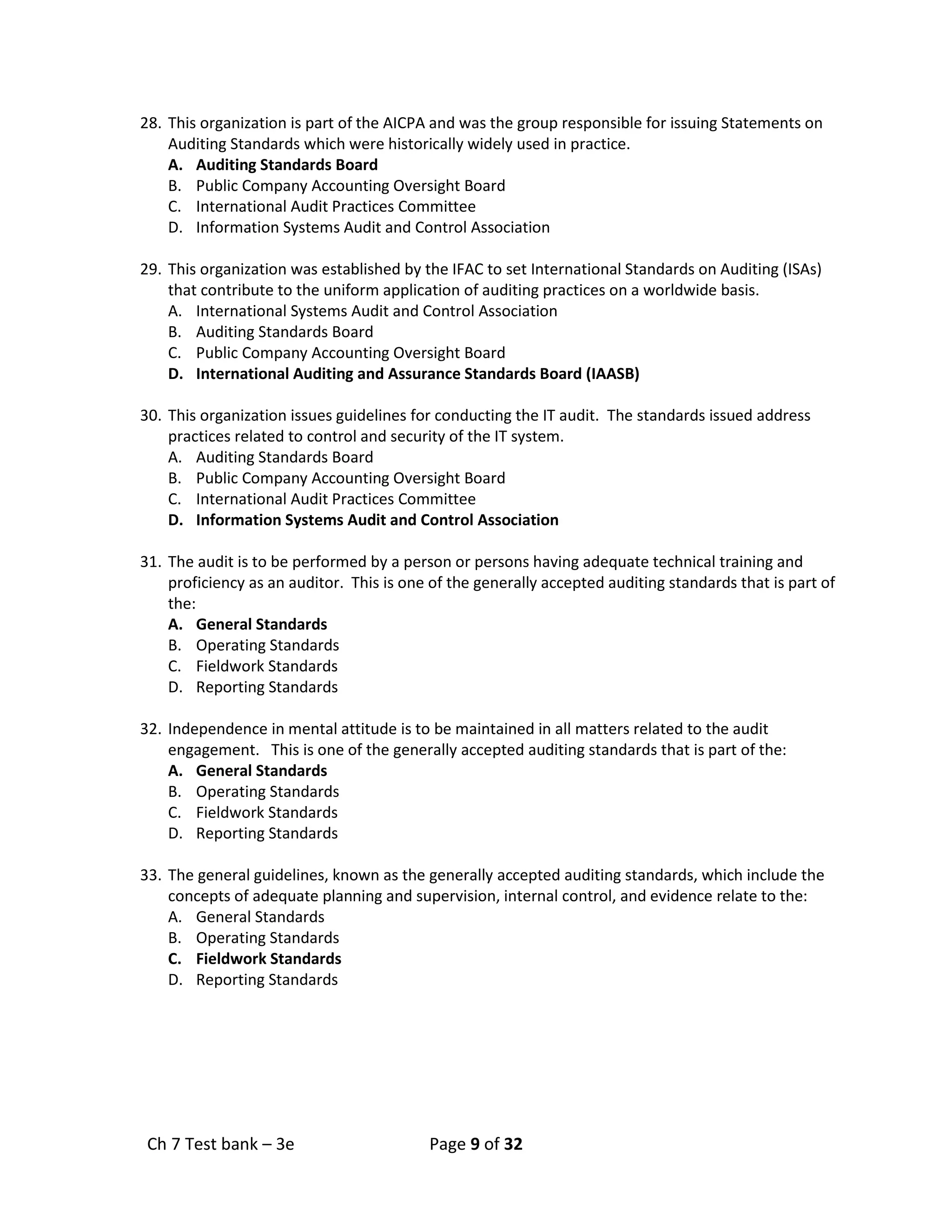
28. This organization is part of the AICPA and was the group responsible for issuing Statements on
Auditing Standards which were historically widely used in practice.
A. Auditing Standards Board
B. Public Company Accounting Oversight Board
C. International Audit Practices Committee
D. Information Systems Audit and Control Association
29. This organization was established by the IFAC to set International Standards on Auditing (ISAs)
that contribute to the uniform application of auditing practices on a worldwide basis.
A. International Systems Audit and Control Association
B. Auditing Standards Board
C. Public Company Accounting Oversight Board
D. International Auditing and Assurance Standards Board (IAASB)
30. This organization issues guidelines for conducting the IT audit. The standards issued address
practices related to control and security of the IT system.
A. Auditing Standards Board
B. Public Company Accounting Oversight Board
C. International Audit Practices Committee
D. Information Systems Audit and Control Association
31. The audit is to be performed by a person or persons having adequate technical training and
proficiency as an auditor. This is one of the generally accepted auditing standards that is part of
the:
A. General Standards
B. Operating Standards
C. Fieldwork Standards
D. Reporting Standards
32. Independence in mental attitude is to be maintained in all matters related to the audit
engagement. This is one of the generally accepted auditing standards that is part of the:
A. General Standards
B. Operating Standards
C. Fieldwork Standards
D. Reporting Standards
33. The general guidelines, known as the generally accepted auditing standards, which include the
concepts of adequate planning and supervision, internal control, and evidence relate to the:
A. General Standards
B. Operating Standards
C. Fieldwork Standards
D. Reporting Standards
14.
Ch 7 Testbank – 3e Page 10 of 32
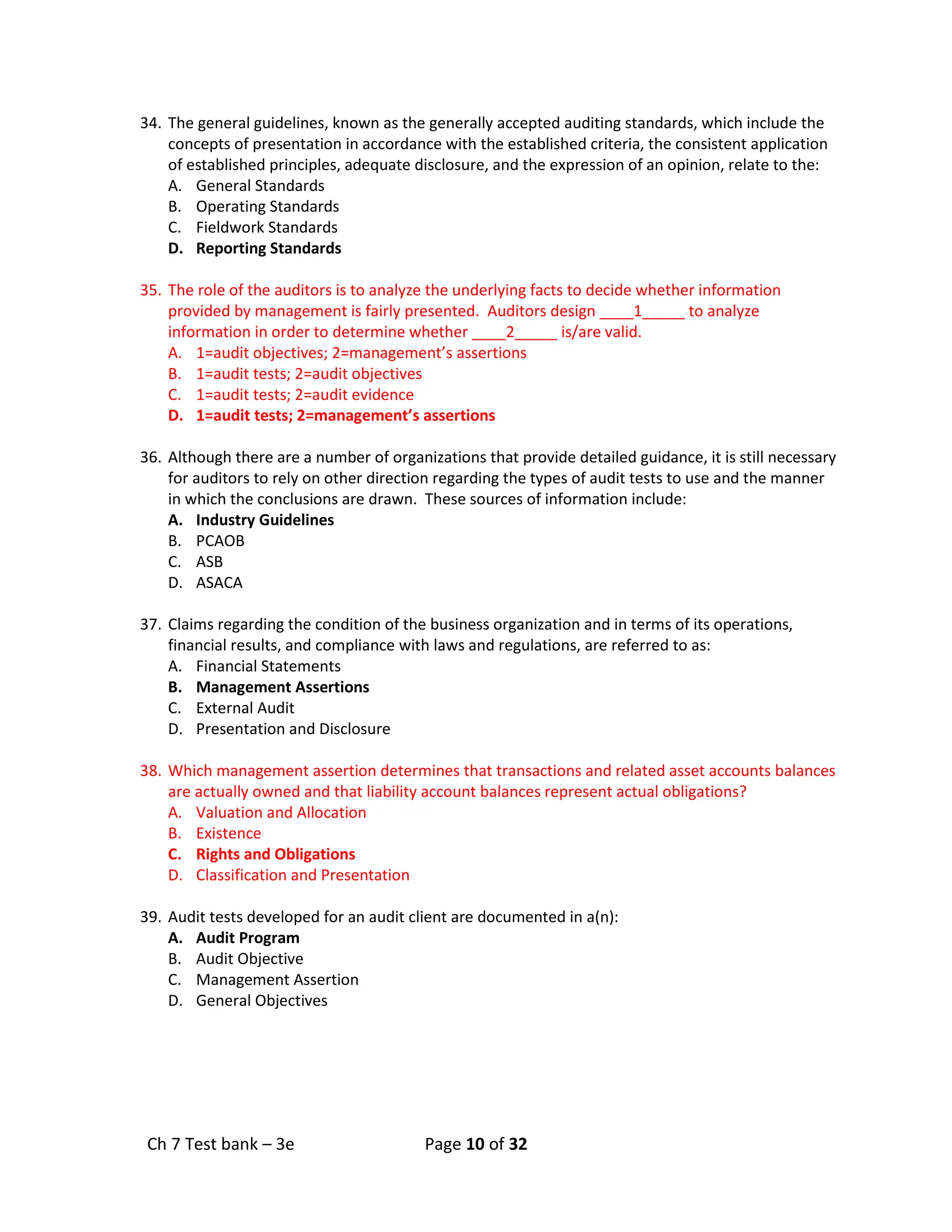
34. The general guidelines, known as the generally accepted auditing standards, which include the
concepts of presentation in accordance with the established criteria, the consistent application
of established principles, adequate disclosure, and the expression of an opinion, relate to the:
A. General Standards
B. Operating Standards
C. Fieldwork Standards
D. Reporting Standards
35. The role of the auditors is to analyze the underlying facts to decide whether information
provided by management is fairly presented. Auditors design ____1_____ to analyze
information in order to determine whether ____2_____ is/are valid.
A. 1=audit objectives; 2=management’s assertions
B. 1=audit tests; 2=audit objectives
C. 1=audit tests; 2=audit evidence
D. 1=audit tests; 2=management’s assertions
36. Although there are a number of organizations that provide detailed guidance, it is still necessary
for auditors to rely on other direction regarding the types of audit tests to use and the manner
in which the conclusions are drawn. These sources of information include:
A. Industry Guidelines
B. PCAOB
C. ASB
D. ASACA
37. Claims regarding the condition of the business organization and in terms of its operations,
financial results, and compliance with laws and regulations, are referred to as:
A. Financial Statements
B. Management Assertions
C. External Audit
D. Presentation and Disclosure
38. Which management assertion determines that transactions and related asset accounts balances
are actually owned and that liability account balances represent actual obligations?
A. Valuation and Allocation
B. Existence
C. Rights and Obligations
D. Classification and Presentation
39. Audit tests developed for an audit client are documented in a(n):
A. Audit Program
B. Audit Objective
C. Management Assertion
D. General Objectives
Ch 7 Testbank – 3e Page 11 of 32
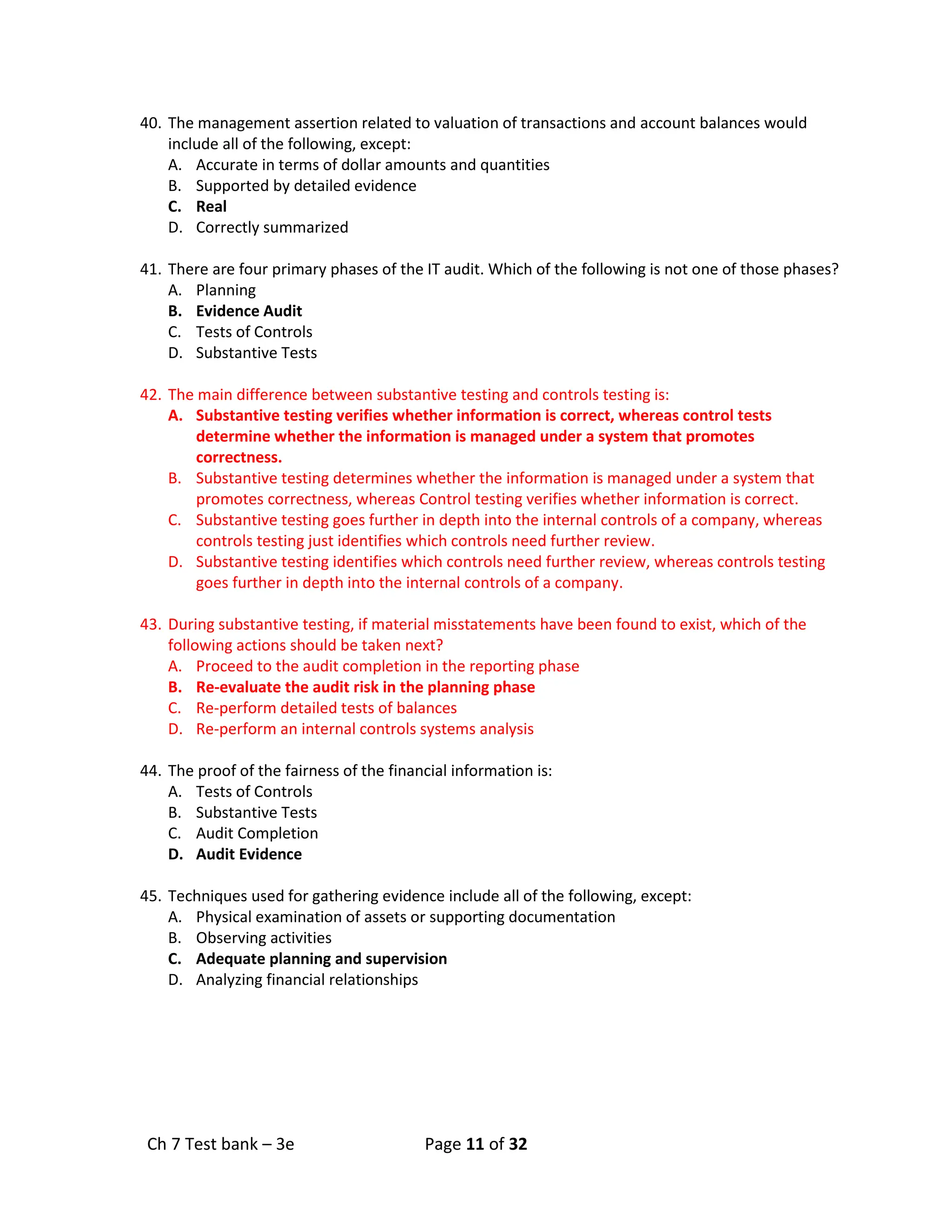
40. The management assertion related to valuation of transactions and account balances would
include all of the following, except:
A. Accurate in terms of dollar amounts and quantities
B. Supported by detailed evidence
C. Real
D. Correctly summarized
41. There are four primary phases of the IT audit. Which of the following is not one of those phases?
A. Planning
B. Evidence Audit
C. Tests of Controls
D. Substantive Tests
42. The main difference between substantive testing and controls testing is:
A. Substantive testing verifies whether information is correct, whereas control tests
determine whether the information is managed under a system that promotes
correctness.
B. Substantive testing determines whether the information is managed under a system that
promotes correctness, whereas Control testing verifies whether information is correct.
C. Substantive testing goes further in depth into the internal controls of a company, whereas
controls testing just identifies which controls need further review.
D. Substantive testing identifies which controls need further review, whereas controls testing
goes further in depth into the internal controls of a company.
43. During substantive testing, if material misstatements have been found to exist, which of the
following actions should be taken next?
A. Proceed to the audit completion in the reporting phase
B. Re-evaluate the audit risk in the planning phase
C. Re-perform detailed tests of balances
D. Re-perform an internal controls systems analysis
44. The proof of the fairness of the financial information is:
A. Tests of Controls
B. Substantive Tests
C. Audit Completion
D. Audit Evidence
45. Techniques used for gathering evidence include all of the following, except:
A. Physical examination of assets or supporting documentation
B. Observing activities
C. Adequate planning and supervision
D. Analyzing financial relationships
17.
Ch 7 Testbank – 3e Page 12 of 32
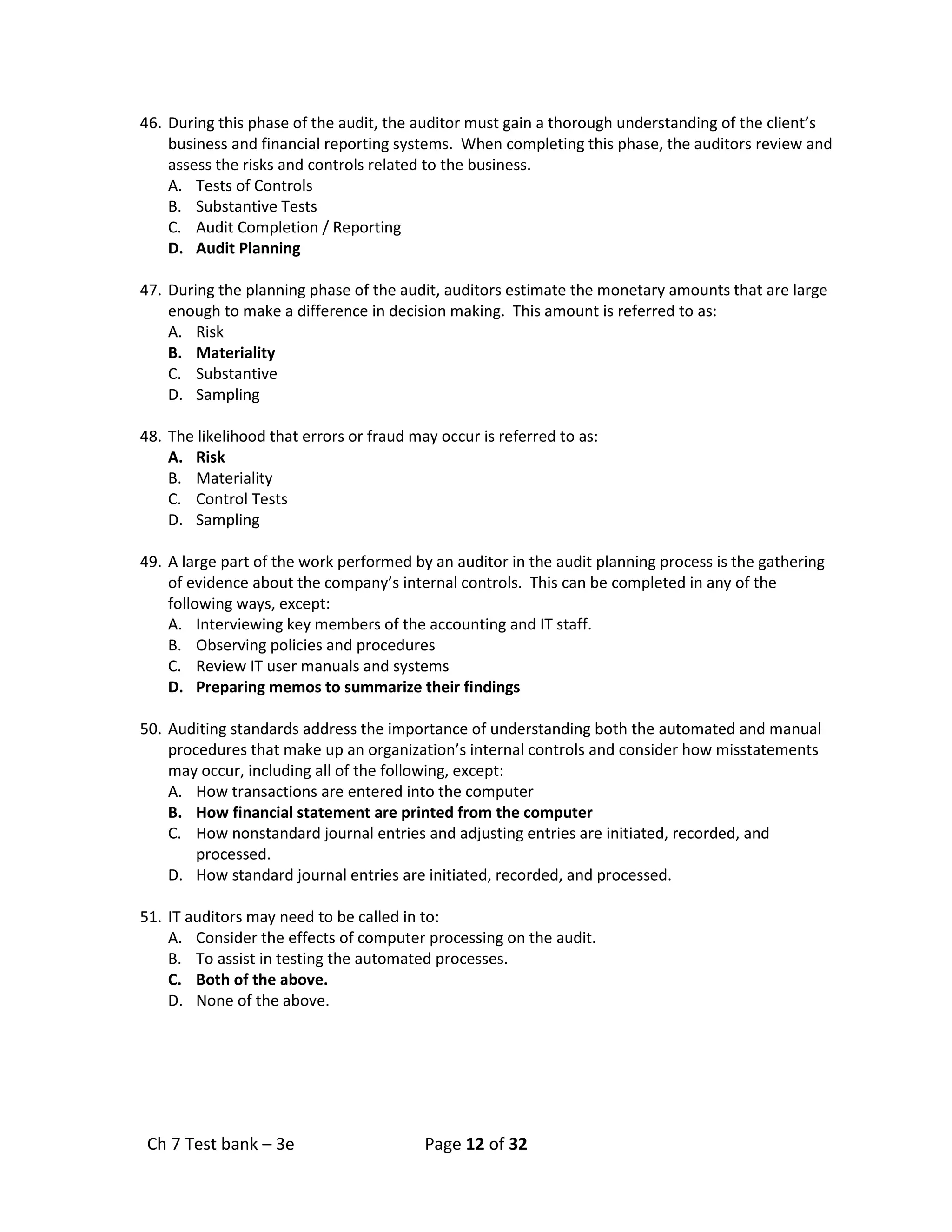
46. During this phase of the audit, the auditor must gain a thorough understanding of the client’s
business and financial reporting systems. When completing this phase, the auditors review and
assess the risks and controls related to the business.
A. Tests of Controls
B. Substantive Tests
C. Audit Completion / Reporting
D. Audit Planning
47. During the planning phase of the audit, auditors estimate the monetary amounts that are large
enough to make a difference in decision making. This amount is referred to as:
A. Risk
B. Materiality
C. Substantive
D. Sampling
48. The likelihood that errors or fraud may occur is referred to as:
A. Risk
B. Materiality
C. Control Tests
D. Sampling
49. A large part of the work performed by an auditor in the audit planning process is the gathering
of evidence about the company’s internal controls. This can be completed in any of the
following ways, except:
A. Interviewing key members of the accounting and IT staff.
B. Observing policies and procedures
C. Review IT user manuals and systems
D. Preparing memos to summarize their findings
50. Auditing standards address the importance of understanding both the automated and manual
procedures that make up an organization’s internal controls and consider how misstatements
may occur, including all of the following, except:
A. How transactions are entered into the computer
B. How financial statement are printed from the computer
C. How nonstandard journal entries and adjusting entries are initiated, recorded, and
processed.
D. How standard journal entries are initiated, recorded, and processed.
51. IT auditors may need to be called in to:
A. Consider the effects of computer processing on the audit.
B. To assist in testing the automated processes.
C. Both of the above.
D. None of the above.
18.
Ch 7 Testbank – 3e Page 13 of 32
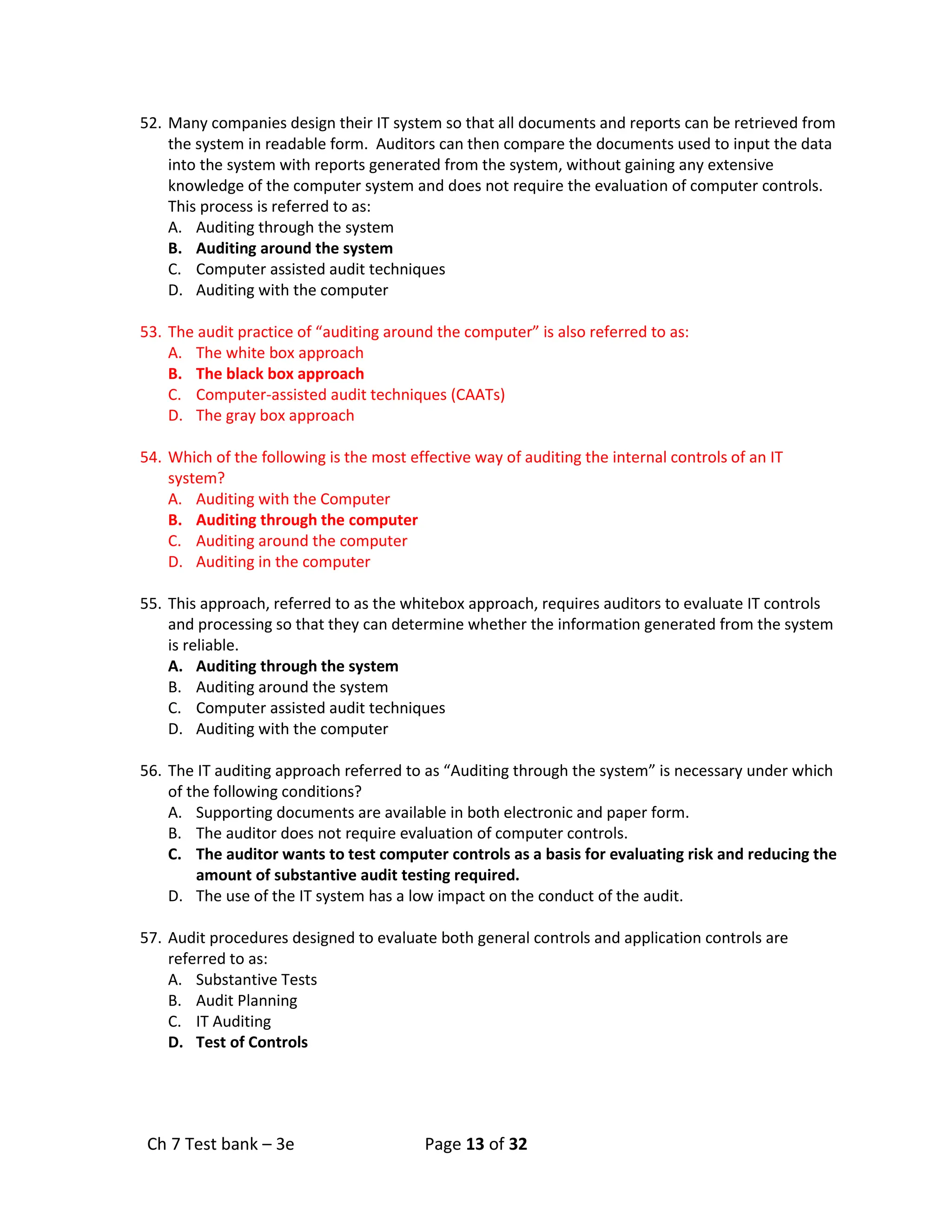
52. Many companies design their IT system so that all documents and reports can be retrieved from
the system in readable form. Auditors can then compare the documents used to input the data
into the system with reports generated from the system, without gaining any extensive
knowledge of the computer system and does not require the evaluation of computer controls.
This process is referred to as:
A. Auditing through the system
B. Auditing around the system
C. Computer assisted audit techniques
D. Auditing with the computer
53. The audit practice of “auditing around the computer” is also referred to as:
A. The white box approach
B. The black box approach
C. Computer-assisted audit techniques (CAATs)
D. The gray box approach
54. Which of the following is the most effective way of auditing the internal controls of an IT
system?
A. Auditing with the Computer
B. Auditing through the computer
C. Auditing around the computer
D. Auditing in the computer
55. This approach, referred to as the whitebox approach, requires auditors to evaluate IT controls
and processing so that they can determine whether the information generated from the system
is reliable.
A. Auditing through the system
B. Auditing around the system
C. Computer assisted audit techniques
D. Auditing with the computer
56. The IT auditing approach referred to as “Auditing through the system” is necessary under which
of the following conditions?
A. Supporting documents are available in both electronic and paper form.
B. The auditor does not require evaluation of computer controls.
C. The auditor wants to test computer controls as a basis for evaluating risk and reducing the
amount of substantive audit testing required.
D. The use of the IT system has a low impact on the conduct of the audit.
57. Audit procedures designed to evaluate both general controls and application controls are
referred to as:
A. Substantive Tests
B. Audit Planning
C. IT Auditing
D. Test of Controls
19.
Ch 7 Testbank – 3e Page 14 of 32
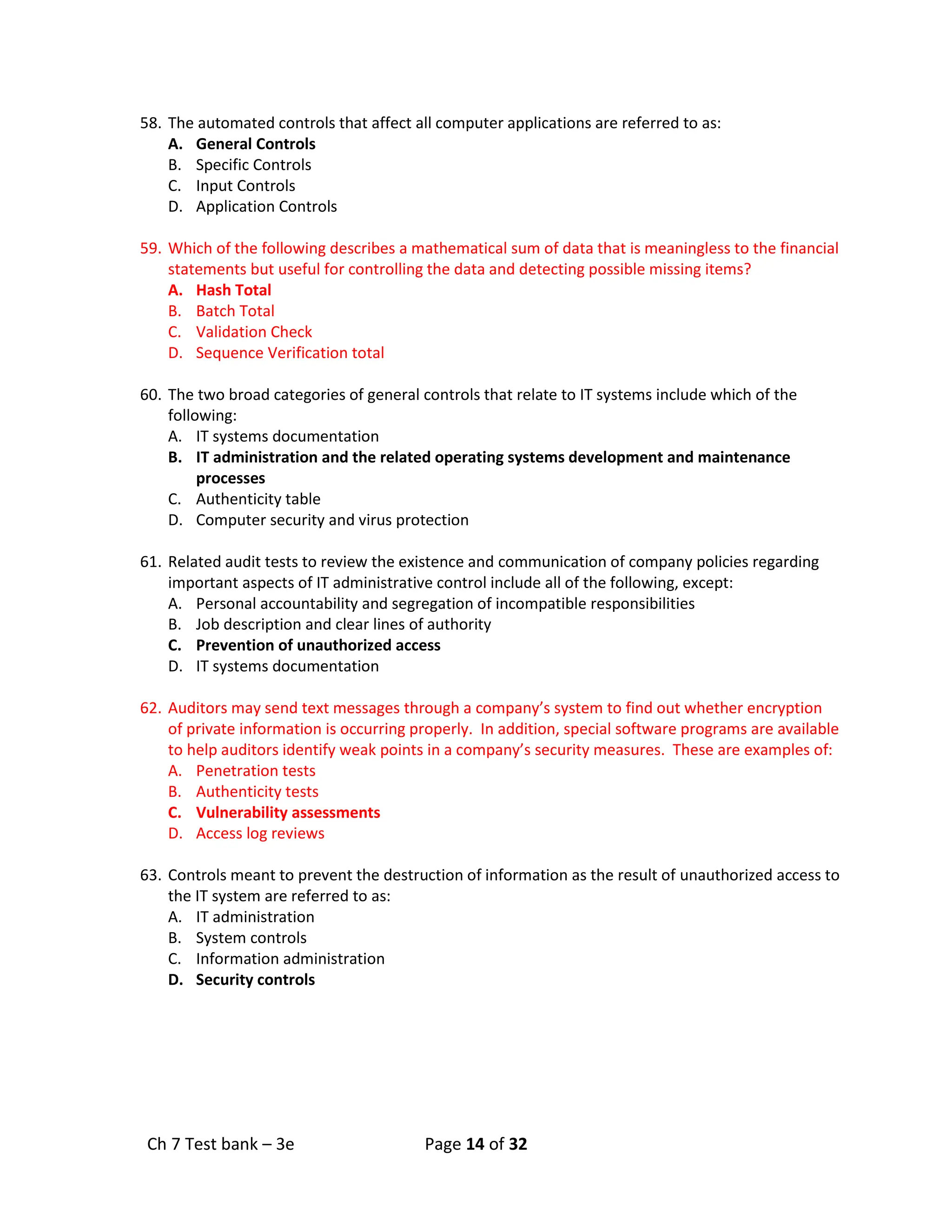
58. The automated controls that affect all computer applications are referred to as:
A. General Controls
B. Specific Controls
C. Input Controls
D. Application Controls
59. Which of the following describes a mathematical sum of data that is meaningless to the financial
statements but useful for controlling the data and detecting possible missing items?
A. Hash Total
B. Batch Total
C. Validation Check
D. Sequence Verification total
60. The two broad categories of general controls that relate to IT systems include which of the
following:
A. IT systems documentation
B. IT administration and the related operating systems development and maintenance
processes
C. Authenticity table
D. Computer security and virus protection
61. Related audit tests to review the existence and communication of company policies regarding
important aspects of IT administrative control include all of the following, except:
A. Personal accountability and segregation of incompatible responsibilities
B. Job description and clear lines of authority
C. Prevention of unauthorized access
D. IT systems documentation
62. Auditors may send text messages through a company’s system to find out whether encryption
of private information is occurring properly. In addition, special software programs are available
to help auditors identify weak points in a company’s security measures. These are examples of:
A. Penetration tests
B. Authenticity tests
C. Vulnerability assessments
D. Access log reviews
63. Controls meant to prevent the destruction of information as the result of unauthorized access to
the IT system are referred to as:
A. IT administration
B. System controls
C. Information administration
D. Security controls
20.
Ch 7 Testbank – 3e Page 15 of 32
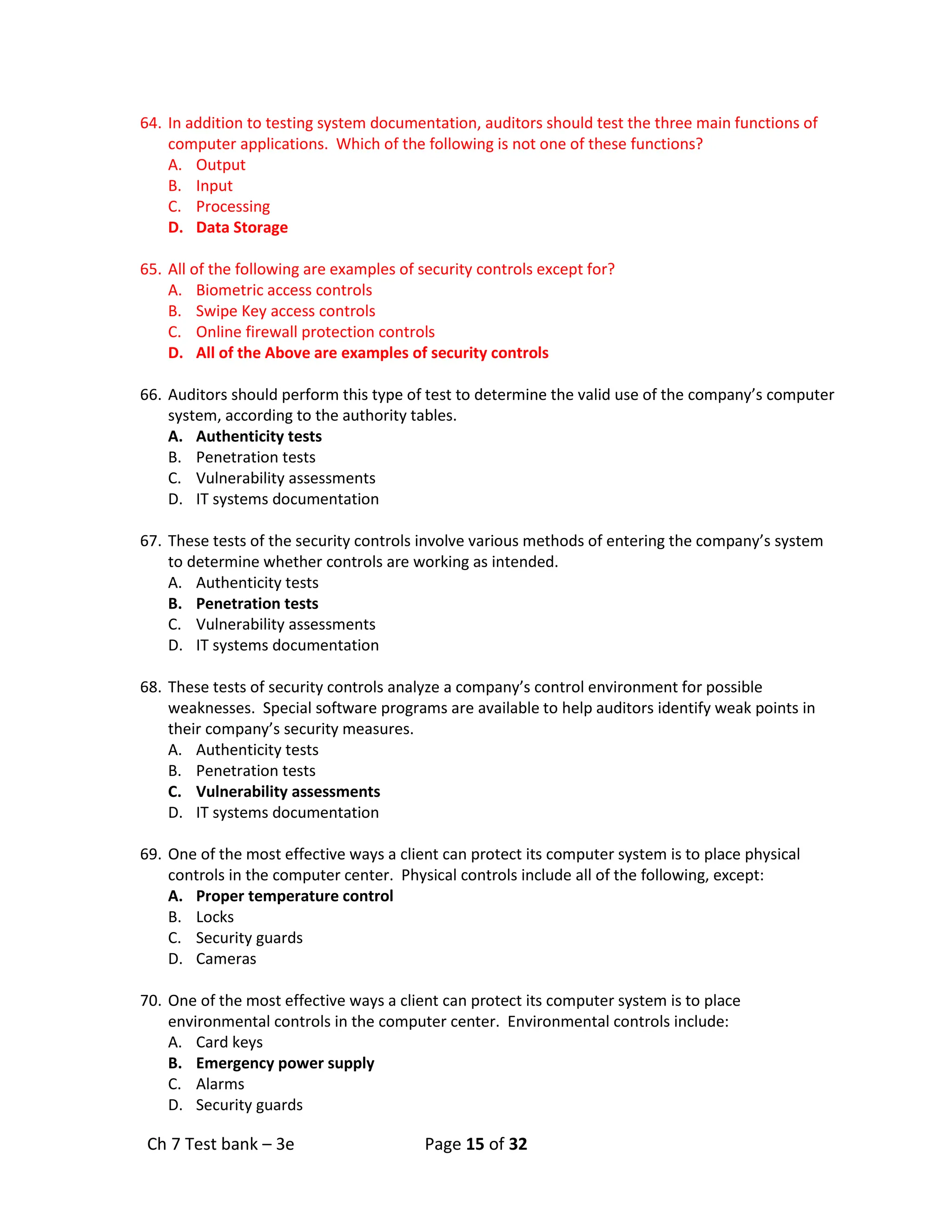
64. In addition to testing system documentation, auditors should test the three main functions of
computer applications. Which of the following is not one of these functions?
A. Output
B. Input
C. Processing
D. Data Storage
65. All of the following are examples of security controls except for?
A. Biometric access controls
B. Swipe Key access controls
C. Online firewall protection controls
D. All of the Above are examples of security controls
66. Auditors should perform this type of test to determine the valid use of the company’s computer
system, according to the authority tables.
A. Authenticity tests
B. Penetration tests
C. Vulnerability assessments
D. IT systems documentation
67. These tests of the security controls involve various methods of entering the company’s system
to determine whether controls are working as intended.
A. Authenticity tests
B. Penetration tests
C. Vulnerability assessments
D. IT systems documentation
68. These tests of security controls analyze a company’s control environment for possible
weaknesses. Special software programs are available to help auditors identify weak points in
their company’s security measures.
A. Authenticity tests
B. Penetration tests
C. Vulnerability assessments
D. IT systems documentation
69. One of the most effective ways a client can protect its computer system is to place physical
controls in the computer center. Physical controls include all of the following, except:
A. Proper temperature control
B. Locks
C. Security guards
D. Cameras
70. One of the most effective ways a client can protect its computer system is to place
environmental controls in the computer center. Environmental controls include:
A. Card keys
B. Emergency power supply
C. Alarms
D. Security guards
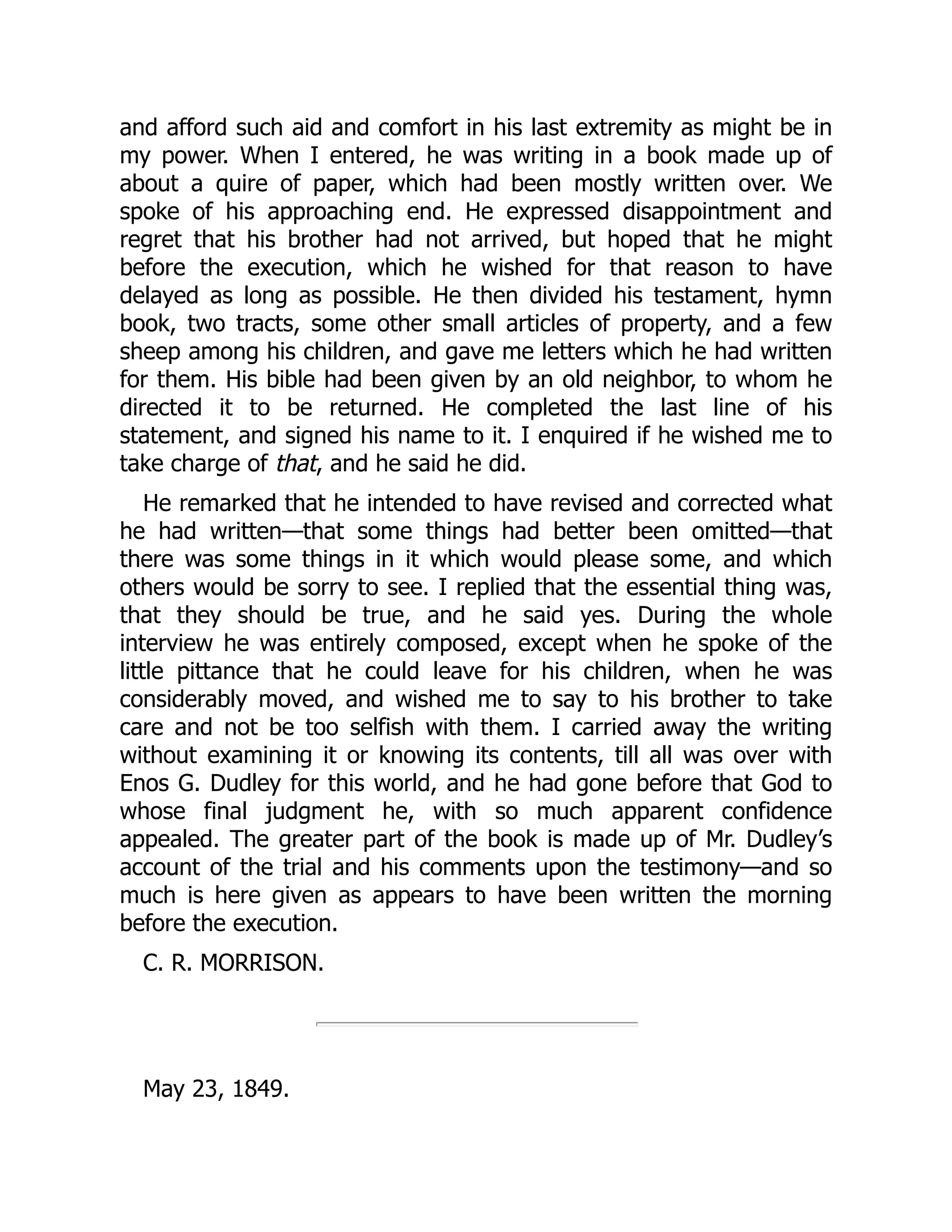
and afford suchaid and comfort in his last extremity as might be in
my power. When I entered, he was writing in a book made up of
about a quire of paper, which had been mostly written over. We
spoke of his approaching end. He expressed disappointment and
regret that his brother had not arrived, but hoped that he might
before the execution, which he wished for that reason to have
delayed as long as possible. He then divided his testament, hymn
book, two tracts, some other small articles of property, and a few
sheep among his children, and gave me letters which he had written
for them. His bible had been given by an old neighbor, to whom he
directed it to be returned. He completed the last line of his
statement, and signed his name to it. I enquired if he wished me to
take charge of that, and he said he did.
He remarked that he intended to have revised and corrected what
he had written—that some things had better been omitted—that
there was some things in it which would please some, and which
others would be sorry to see. I replied that the essential thing was,
that they should be true, and he said yes. During the whole
interview he was entirely composed, except when he spoke of the
little pittance that he could leave for his children, when he was
considerably moved, and wished me to say to his brother to take
care and not be too selfish with them. I carried away the writing
without examining it or knowing its contents, till all was over with
Enos G. Dudley for this world, and he had gone before that God to
whose final judgment he, with so much apparent confidence
appealed. The greater part of the book is made up of Mr. Dudley’s
account of the trial and his comments upon the testimony—and so
much is here given as appears to have been written the morning
before the execution.
C. R. MORRISON.
May 23, 1849.
23.
I am notthe first innocent victim that has wrongfully been hurried
from this to another world, through the prejudice of public opinion. I
am only one among the many that have been thrown from existence
on a charge of guess work and false supposition, and the falsehood
that always attends supposition, where prejudice dethrones and
becomes the master of the government. There is not much trouble
in gaining victory against the innocent, however falsely charged. The
charge against me has been perfectly false, falsely sustained by false
testimony. Yet, although I am just about to be hurled from time to
eternity, a curse forbidden both by the New and Old Testament,
Deut. 17, ii, viii. &c.—yet I am innocent of the charge—innocently
convicted, innocently sent into the presence of that God who knows
every thought, even of the human heart, thank God, too, that there
is nothing hid, and that my final sentence is not to be passed by the
base rabble of false witness, nor the base conjecture of supposition.
At that bar I stand an innocent man, and I hope all who have lent
their acts or voice in favor of such an achievement will not hide
under the witnesses, but remember they are accountable for lending
their aid or voice in favor of a course that is repugnant to the
Scriptures. These are given us for our guide, and they that lend their
influence in favor of a law repugnant to the Scriptures, inasmuch as
they deny the requirements of the Bible, disown the truth therein
contained, deny them as their rule and guide and assent to take the
life they cannot give.
O, may not such think they are innocent to take the life that God
has given and forbid others to take it away—though we may flee to
that law that was given to the Jews, which was bounded, inside the
land of Canaan, imposed on no other people but the Jews, and
those that dwelt in their land, and still we fail to support a case of
conjecture, Deut. ii, viii, &c. Then, when we assent to take human
life in a manner forbidden in this law even, do we consent that the
law is not good, and which God gave? Certainly we do—and refuse
to give it place in our hearts. But I forgive all.
24.
I hope thatall will seek for pardon at the hand of mercy, and
hereafter be more careful to secure the rights of the innocent, and
sure to detect the false testimony, guard themselves against
prejudice, give reason its throne, and let justice find its place in
every heart. I am glad this morning to tell all, my faith is unshaken;
I have no doubt to enjoy a home in Heaven, again to reunite in
singing praise to God in a more perfect world than this. Bless the
Lord. So I bid a long farewell until we meet at the bar of God.
ENOS G. DUDLEY.
Haverhill, May 21, 1849.
Dear Brother and Sister Hoit:
I am about to leave you. I rejoice that I feel within the fullest
assurance that I shall enjoy a far more desirable state of existence. I
feel as calm to day and my mind as clear as when you last saw me
at the school-house, endeavouring to exhort my fellow men to seek
an interest in that Savior, that I have found so precious to me,
during my soul-trying afflictions. The same gospel that I then
preached I find sufficient for me in all my trials, notwithstanding
their severity; and I doubt not that the same will sustain me until
death shall close the terrific scene through which I am about to
pass; yes! that same Jesus will go with and ever near me safely
across the valley and shadow of Death. The blessed prospect that is
before me smooths the roughness of the way. Bless God, I can say
with Paul, “I am ready to be offered. I am glad my sorrows end so
soon, then I shall enjoy the presence of Him that died to save us all,
and of my dear companion who has gone before me.” I have often
wondered how the martyrs could stand in the midst of flames and
shout praises to the Most High. It is no longer a wonder. “Christ was
with in them, the hope of glory.” And though I must die by the
gallows, yet I am confident it will be the passport from this ungodly
world, to one of bliss and beauty. Jesus has promised to stand by, if
25.
we will putour trust in him, I have found it so thus far, and have no
reason to fear that his promises will not all be fulfilled.
A little more than one year since, I was torn from my home to
which I had as good a right as any earthly being has to his home,
and by false accusation I was shut out of the pale of society, and
away from my children, who are as dear to me as ever children were
to a father. By the circulation of these false reports the public mind
has been prejudiced to so great an extent that I am condemned to
die for that which I never did. Many of these reports were so
completely false that they could not have been told but to injure me
designedly and at that time it stirred bitter feelings within me, but
they are all gone now; yes, now I love them, and I pray to God they
may prepare to meet their murdered subject at the bar of Him who
judgeth righteously. Thank God I am innocent of the crime for which
I am condemned to die, and innocent shall I stand before that
tribunal where conjecture and circumstance are not heard. But it is
not so here, therefore must I leave you, and by your request I leave
in your care that little girl. In tears I give her to you in all confidence
that I leave her in the hands of those who will be parents to one
whose father and mother can no longer guard her youthful years.
Teach her to pray daily, and O, may God be with and bless you and
her and together save you in heaven.
And now I bid you all—farewell.
Yours, in love,
ENOS G. DUDLEY.
Below is a copy of a note enclosed within the above and
addressed to the little girl above mentioned.
26.
Haverhill, May 22,1849.
My Dear Daughter Elizabeth;—I can no longer be your father nor
provide for your wants in childhood, nor protect you from
surrounding dangers therefore I have given you to your father and
mother Hoit; they will be kind parents to you and you must be a
good and dutiful child to them; always be obedient and good; love
them, and improve your mind daily—and read the Bible with great
care, you will there learn that God has said he will be a father to the
fatherless; with Him your mother now lives, and soon I shall live
with Him and her, where we shall die no more. Now, my dear, be a
good child, and when you are in the field or in the house, ask God to
bless you and save you in Heaven to dwell with your parents.
God loves little children, and you must love Him and ask Him to
purify your little heart, and fit it for the kingdom. Always love the
truth; be kind and loving to all your playmates, “do unto them as
you would have them do unto you.” I should be glad to see you but I
cannot; but if you are a good humble little Christian, you will soon
come to me, so I must command you to God, praying you will ever
trust in his grace and meet your parents in Heaven—there will be no
more parting.
And now, my dear, I must bid you farewell, until we meet in
heaven.
This is from your poor dying father—farewell! it makes my heart
ache to part with you, but oh! do well and it will be well with you
when you leave this world. May God be with you, and comfort you
all the time, and sanctify this afflicting dispensation to the spiritual
good of your brothers and sisters, and finally may all dwell together
at last at Christ’s right hand.
27.
CONFESSION OF
MARY RUNKLE,
WHOWAS HUNG FOR MURDER.
Mrs. Mary Runkle was born in the town of Root, Montgomery Co.
N. Y., and at the time of her execution was about fifty years of age.
She was married to her late husband in her native town, and says
she become jealous of him about a year after marriage, since which
time a continual series of difficulties have occurred between them.
She acknowledges that she obtained goods upon a forged order,
about ten years after her marriage, and says that it was her first
crime.
Not long afterward a pedlar passed through the section where she
resided, and sold goods on a credit of four or five weeks. Not
appearing at the expiration of that time to make his collection,
suspicions were aroused, and as the result of enquiry, the pedlar
was traced as far as the house of Mr. Runkle, but no further trace of
him could be obtained.
Her children, when spoken to about new dresses, said that their
mother had plenty of such cloth, and having repeated the remark in
their mother’s presence, were soon after found drowned in a tub of
water—the depth being but a few inches. It is generally believed
that she murdered the pedlar, and afterwards her own children, to
prevent detection. This she denies.
One of the offences she acknowledges, is the robbing of a church
in Fulton, of its cushions, &c. She was arrested, but evaded the law
by a settlement. She has also been charged with poisoning her son,
who, she says, died of the measles.
28.
The circumstances ofher husband’s death are yet fresh in the
memory of our readers. He was found dead in the morning, when
the neighbors were called, with bruises upon him, which afforded
sufficient evidence of her guilt in the mind of the Court. She
acknowledges a quarrel between them, but charges the blame upon
him, and avers that she did not intend to murder him, but did so in
defending herself from his assault. She gives the following version of
the affair.
“The general health of my husband was not good; on or about the
20 of August, he procured four vials of medicine, and one fourth
gallon of brandy; a portion of the brandy he applied externally. At
tea time, he became furiously mad, venting his feelings upon me. I
tried to quiet him, but all to no purpose; after tea, in his continued
rage, he caught hold of my hair and pulled me over on the floor,
continuing to kick and strike me, until I thought he would kill me. At
length I got free from him, suggesting that I would call for
assistance, he declaring that if I did so he would break my neck. At
the proper hour he prepared to retire for the night, calling for some
milk which was promptly furnished.
Within a very short time he took twice of the medicine,
complaining that the milk was sour, he then took a large drink of
brandy, and lay down, soon calling for the wash, which he applied to
his neck. I found myself in much distress from the bruises inflicted
upon me. While engaged in bathing my bruises he frequently called
upon me to come to bed.
Near eleven or twelve o’clock, he called me up to get some drink.
At his request I lay down with him; the first thing I was sensible of, I
found him on my stomach, clinching me by my throat. A desperate
fight ensued between us; I made every effort in my power to defend
myself; while the struggle lasted, I struck him with such force that
he fell over a chair. He beat me with such violence that I bled
profusely at the nose.
After the fight was over, I helped him up and he sat down, calling
for a dry shirt. There was a dry shirt hanging near him, which he
29.
procured himself, andpartly put on. I then helped him to put on the
other sleeve, after which he expressed a wish to lay down, as he
was tired; he accordingly did so. I then lay down with him, soon
after which I heard him make a strange noise. I immediately arose
and procured a light, when, discovering froth on his lips, I directed
my daughter to call in the neighbors, it being then about daylight.
I did not for one moment suppose that I should be suspected of
the crime of murder, as I had no intention of terminating his
existence. The representation that I made at the time, though not in
strict consonance with my present statement, was prompted by no
other motive, then that of suppressing his conduct from public gaze.”
A relation of the criminal, was present, to take charge of her body
for her friends, who are said to be respectable.
THE EXECUTION.
Mrs. Mary Runkle was executed at the Jail in Whitesboro; The
gallows was erected in the room over the Jailor’s office and
consisted of a strong lever about fourteen feet in length the long
arm of which eight feet in length, was held by a cord, and loaded
with weights.
To the short arm was attached the hanging, which was extended
down through the floor into the jailor’s office, the noose being
attached to it.
During the day, up to the time of her execution, she lay almost
motionless on her bed, her eyes half closed, and her right hand
resting upon the bed-clothes on her bosom. Her fingers only moved
slowly as if she was engaged in deep and unhappy thought. She
spoke only whispers, and assisted some in dressing herself for the
event.
She said she was prepared for death, having made peace with her
Maker.
30.
At two minutespast twelve o’clock she was carried down to the
room assigned for the execution, and placed in the chair under the
spot where the cord passed down.
Having been placed in this position, the jailor seated beside her,
she rested her head upon his shoulder, while a feeling and
appropriate prayer was made.
The sheriff then asked her,
“Mary Runkle, have you any word to say to this jury, to these
people.”
To which she gave no answer.
The bell rang the cord was cut, and she was launched into
eternity! Not a word, not a motion, but a very little heaving of the
chest.
After hanging twenty minutes, her body was cut down, put in the
coffin, and delivered to her friends.
Thus closed the earthly fate of Mary Runkle.
THE END.
Transcriber’s Notes:
Page 4: Changed “from which we principally quite so far as regards his career,” to
“from which we principally quote so far as regards his career,”. Changed “He then secretly
married a womao” to “He then secretly married a woman”. Changed “small estate af her
own” to “small estate of her own”. Changed “situatod on the St’ John’s River” to “situated
on the St. John’s River”.
Page 5: Changed “Mew York” to “New York”.
Page 7: Changed “came to tho room” to “came to the room”.
Page 10: Changed “of the illerate slave” to “of the illiterate slave”. Changed “secrted
from public censure” to “secreted from public censure”. Changed “induce slave-dealers
and other” to “induce slave dealers and others”.
Page 12: Changed “made his way to Texas, However” to “made his way to Texas.
However” Changed “frightning the travellers’ horses” to “frightening frightning the
31.
travellers’ horses”. Changed“of his earthly existance” to “of his earthly existence”.
Changed “beged a little time” to “begged a little time”.
Page 13: “An uncontrolable desire to leave home seized me,” changed to “An
uncontrollable desire to leave home seized me,”. “I dispised my father’s counsel” changed
to “I despised my father’s counsel”. Changed “what money watches” to “what money,
watches”. Changed “when he fell, exclaming” to “when he fell, exclaiming”. Changed
“persude her to elope” to “persuade her to elope”. Changed “house of ill repute called for
a room” to “house of ill repute, called for a room”.
Page 14: Changed “I would desist, This” to “I would desist. This” Changed “led to the
alter” to “led to the altar”. Changed “my heleish purpose” to “my hellish purpose”.
Changed “if she sohuld recover” to “if she should recover”. Changed “Ann’s cruelty and
attrocity” to “Ann’s cruelty and atrocity”. Changed “It happend to have one” to “It
happened to have one”.
Page 17: Changed “where James was statined” to “where James was stationed”.
Changed “where he was condemed” to “where he was condemned”.
Page 18: Changed “acts of the most blood thirsty” to “acts of the most blood-thirsty”.
Changed “nothing now satifised her” to “nothing now satisfied her”. Changed “a lettr
from his wife” to “a letter from his wife”. Changed “with disagreable dreams about him”
to “with disagreeable dreams about him”. Changed “who said they talked with Mr. Morse,
in Walter’s tavern” to “who said they talked with Mr. Morse, in Walters’ tavern”.
Page 19: Changed “make a private sarch” to “make a private search”. Changed “went
again to make enquiery” to “went again to make enquiry”. Changed “the demensions of
it” to “the dimensions of it”. Changed “with a warrant, She was taken” to “with a warrant.
She was taken” Changed “of the above atocious crimes” to “of the above atrocious
crimes”.
Page 20: Changed “by some private correspondant” to “by some private
correspondent”. Changed “awful death, After the poison” to “awful death. After the
poison” Changed “After these fits insanity” to “After these fits of insanity”. Changed
“hersef in the most bitter manner” to “herself in the most bitter manner”.
Page 21: Changed “home, About two months afterwards” to “home. About two months
afterwards” Changed “accessary to a great many others” to “accessory to a great many
others”.
Page 22: Changed “interesting tn our readers” to “interesting to our readers”. Changed
“crimes of the most henious” to “crimes of the most heinous”.
Page 23: Changed “kind but arbitary” to “kind but arbitrary”.
Page 25: Changed “Are you prepared!” to “Are you prepared?”.
Page 26: Changed “thrown from existance” to “thrown from existence”.
Page 27: Changed “Deut. 17 ii., viii. &c” to “Deut. 17 ii., viii. &c.”. Changed “of such an
acheivement” to “of such an achievement”. Changed “fordidden in this law” to “forbidden
in this law”. Changed “give reason its thorne” to “give reason its throne”. Changed “my
mind as clear sa” to “my mind as clear as”.
32.
Page 28: Changed“the terriffic scene” to “the terrific scene”. Changed “my sorrws end
so soon” to “my sorrows end so soon”. Changed “could sand in the middle” to “could
stand in the middle”. Changed “condemed to die” to “condemned to die”. Changed “who
judgeth righteously, Thank God” to “who judgeth righteously. Thank God” Changed “girl,
In tears” to “girl. In tears”.
Page 29: Changed “May 22 1849” to “May 22, 1849”. 5 lines that were printed upside
down were transcribed right-side up. Changed “yon will soon come” to “you will soon
come”. Changed “until we meet in heaven” to “until we meet in heaven.”
Page 30: Changed “about a year after marrige” to “about a year after marriage”.
Changed “suspicions ware aroused” to “suspicions were aroused”.
Page 31: Changed “health of my hsband” to “health of my husband”. Changed “he
declaing that if I” to “he declaring that if I”. Changed “being about daylight” to “being
about daylight.” Changed “for one moment suspose” to “for one moment suppose”.
Changed “relation of the crrminal” to “relation of the criminal”.
Page 32: Changed “into the jailors office” to “into the jailor’s office”. Changed “peace
with her Maker” to “peace with her Maker.”
Unbalanced quotation marks were remedied when the change was obvious, and
otherwise left unbalanced.
33.
*** END OFTHE PROJECT GUTENBERG EBOOK LIFE AND
CONFESSION OF ANN WALTERS, THE FEMALE MURDERESS!! ***
Updated editions will replace the previous one—the old editions will
be renamed.
Creating the works from print editions not protected by U.S.
copyright law means that no one owns a United States copyright in
these works, so the Foundation (and you!) can copy and distribute it
in the United States without permission and without paying
copyright royalties. Special rules, set forth in the General Terms of
Use part of this license, apply to copying and distributing Project
Gutenberg™ electronic works to protect the PROJECT GUTENBERG™
concept and trademark. Project Gutenberg is a registered trademark,
and may not be used if you charge for an eBook, except by following
the terms of the trademark license, including paying royalties for use
of the Project Gutenberg trademark. If you do not charge anything
for copies of this eBook, complying with the trademark license is
very easy. You may use this eBook for nearly any purpose such as
creation of derivative works, reports, performances and research.
Project Gutenberg eBooks may be modified and printed and given
away—you may do practically ANYTHING in the United States with
eBooks not protected by U.S. copyright law. Redistribution is subject
to the trademark license, especially commercial redistribution.
START: FULL LICENSE
PLEASE READ THISBEFORE YOU DISTRIBUTE OR USE THIS WORK
To protect the Project Gutenberg™ mission of promoting the free
distribution of electronic works, by using or distributing this work (or
any other work associated in any way with the phrase “Project
Gutenberg”), you agree to comply with all the terms of the Full
Project Gutenberg™ License available with this file or online at
www.gutenberg.org/license.
Section 1. General Terms of Use and
Redistributing Project Gutenberg™
electronic works
1.A. By reading or using any part of this Project Gutenberg™
electronic work, you indicate that you have read, understand, agree
to and accept all the terms of this license and intellectual property
(trademark/copyright) agreement. If you do not agree to abide by all
the terms of this agreement, you must cease using and return or
destroy all copies of Project Gutenberg™ electronic works in your
possession. If you paid a fee for obtaining a copy of or access to a
Project Gutenberg™ electronic work and you do not agree to be
bound by the terms of this agreement, you may obtain a refund
from the person or entity to whom you paid the fee as set forth in
paragraph 1.E.8.
1.B. “Project Gutenberg” is a registered trademark. It may only be
used on or associated in any way with an electronic work by people
who agree to be bound by the terms of this agreement. There are a
few things that you can do with most Project Gutenberg™ electronic
works even without complying with the full terms of this agreement.
See paragraph 1.C below. There are a lot of things you can do with
Project Gutenberg™ electronic works if you follow the terms of this
agreement and help preserve free future access to Project
Gutenberg™ electronic works. See paragraph 1.E below.
36.
1.C. The ProjectGutenberg Literary Archive Foundation (“the
Foundation” or PGLAF), owns a compilation copyright in the
collection of Project Gutenberg™ electronic works. Nearly all the
individual works in the collection are in the public domain in the
United States. If an individual work is unprotected by copyright law
in the United States and you are located in the United States, we do
not claim a right to prevent you from copying, distributing,
performing, displaying or creating derivative works based on the
work as long as all references to Project Gutenberg are removed. Of
course, we hope that you will support the Project Gutenberg™
mission of promoting free access to electronic works by freely
sharing Project Gutenberg™ works in compliance with the terms of
this agreement for keeping the Project Gutenberg™ name associated
with the work. You can easily comply with the terms of this
agreement by keeping this work in the same format with its attached
full Project Gutenberg™ License when you share it without charge
with others.
1.D. The copyright laws of the place where you are located also
govern what you can do with this work. Copyright laws in most
countries are in a constant state of change. If you are outside the
United States, check the laws of your country in addition to the
terms of this agreement before downloading, copying, displaying,
performing, distributing or creating derivative works based on this
work or any other Project Gutenberg™ work. The Foundation makes
no representations concerning the copyright status of any work in
any country other than the United States.
1.E. Unless you have removed all references to Project Gutenberg:
1.E.1. The following sentence, with active links to, or other
immediate access to, the full Project Gutenberg™ License must
appear prominently whenever any copy of a Project Gutenberg™
work (any work on which the phrase “Project Gutenberg” appears,
or with which the phrase “Project Gutenberg” is associated) is
accessed, displayed, performed, viewed, copied or distributed:
37.
This eBook isfor the use of anyone anywhere in the United
States and most other parts of the world at no cost and with
almost no restrictions whatsoever. You may copy it, give it away
or re-use it under the terms of the Project Gutenberg License
included with this eBook or online at www.gutenberg.org. If you
are not located in the United States, you will have to check the
laws of the country where you are located before using this
eBook.
1.E.2. If an individual Project Gutenberg™ electronic work is derived
from texts not protected by U.S. copyright law (does not contain a
notice indicating that it is posted with permission of the copyright
holder), the work can be copied and distributed to anyone in the
United States without paying any fees or charges. If you are
redistributing or providing access to a work with the phrase “Project
Gutenberg” associated with or appearing on the work, you must
comply either with the requirements of paragraphs 1.E.1 through
1.E.7 or obtain permission for the use of the work and the Project
Gutenberg™ trademark as set forth in paragraphs 1.E.8 or 1.E.9.
1.E.3. If an individual Project Gutenberg™ electronic work is posted
with the permission of the copyright holder, your use and distribution
must comply with both paragraphs 1.E.1 through 1.E.7 and any
additional terms imposed by the copyright holder. Additional terms
will be linked to the Project Gutenberg™ License for all works posted
with the permission of the copyright holder found at the beginning
of this work.
1.E.4. Do not unlink or detach or remove the full Project
Gutenberg™ License terms from this work, or any files containing a
part of this work or any other work associated with Project
Gutenberg™.
1.E.5. Do not copy, display, perform, distribute or redistribute this
electronic work, or any part of this electronic work, without
prominently displaying the sentence set forth in paragraph 1.E.1
38.
with active linksor immediate access to the full terms of the Project
Gutenberg™ License.
1.E.6. You may convert to and distribute this work in any binary,
compressed, marked up, nonproprietary or proprietary form,
including any word processing or hypertext form. However, if you
provide access to or distribute copies of a Project Gutenberg™ work
in a format other than “Plain Vanilla ASCII” or other format used in
the official version posted on the official Project Gutenberg™ website
(www.gutenberg.org), you must, at no additional cost, fee or
expense to the user, provide a copy, a means of exporting a copy, or
a means of obtaining a copy upon request, of the work in its original
“Plain Vanilla ASCII” or other form. Any alternate format must
include the full Project Gutenberg™ License as specified in
paragraph 1.E.1.
1.E.7. Do not charge a fee for access to, viewing, displaying,
performing, copying or distributing any Project Gutenberg™ works
unless you comply with paragraph 1.E.8 or 1.E.9.
1.E.8. You may charge a reasonable fee for copies of or providing
access to or distributing Project Gutenberg™ electronic works
provided that:
• You pay a royalty fee of 20% of the gross profits you derive
from the use of Project Gutenberg™ works calculated using the
method you already use to calculate your applicable taxes. The
fee is owed to the owner of the Project Gutenberg™ trademark,
but he has agreed to donate royalties under this paragraph to
the Project Gutenberg Literary Archive Foundation. Royalty
payments must be paid within 60 days following each date on
which you prepare (or are legally required to prepare) your
periodic tax returns. Royalty payments should be clearly marked
as such and sent to the Project Gutenberg Literary Archive
Foundation at the address specified in Section 4, “Information
39.
about donations tothe Project Gutenberg Literary Archive
Foundation.”
• You provide a full refund of any money paid by a user who
notifies you in writing (or by e-mail) within 30 days of receipt
that s/he does not agree to the terms of the full Project
Gutenberg™ License. You must require such a user to return or
destroy all copies of the works possessed in a physical medium
and discontinue all use of and all access to other copies of
Project Gutenberg™ works.
• You provide, in accordance with paragraph 1.F.3, a full refund of
any money paid for a work or a replacement copy, if a defect in
the electronic work is discovered and reported to you within 90
days of receipt of the work.
• You comply with all other terms of this agreement for free
distribution of Project Gutenberg™ works.
1.E.9. If you wish to charge a fee or distribute a Project Gutenberg™
electronic work or group of works on different terms than are set
forth in this agreement, you must obtain permission in writing from
the Project Gutenberg Literary Archive Foundation, the manager of
the Project Gutenberg™ trademark. Contact the Foundation as set
forth in Section 3 below.
1.F.
1.F.1. Project Gutenberg volunteers and employees expend
considerable effort to identify, do copyright research on, transcribe
and proofread works not protected by U.S. copyright law in creating
the Project Gutenberg™ collection. Despite these efforts, Project
Gutenberg™ electronic works, and the medium on which they may
be stored, may contain “Defects,” such as, but not limited to,
incomplete, inaccurate or corrupt data, transcription errors, a
copyright or other intellectual property infringement, a defective or
40.
damaged disk orother medium, a computer virus, or computer
codes that damage or cannot be read by your equipment.
1.F.2. LIMITED WARRANTY, DISCLAIMER OF DAMAGES - Except for
the “Right of Replacement or Refund” described in paragraph 1.F.3,
the Project Gutenberg Literary Archive Foundation, the owner of the
Project Gutenberg™ trademark, and any other party distributing a
Project Gutenberg™ electronic work under this agreement, disclaim
all liability to you for damages, costs and expenses, including legal
fees. YOU AGREE THAT YOU HAVE NO REMEDIES FOR
NEGLIGENCE, STRICT LIABILITY, BREACH OF WARRANTY OR
BREACH OF CONTRACT EXCEPT THOSE PROVIDED IN PARAGRAPH
1.F.3. YOU AGREE THAT THE FOUNDATION, THE TRADEMARK
OWNER, AND ANY DISTRIBUTOR UNDER THIS AGREEMENT WILL
NOT BE LIABLE TO YOU FOR ACTUAL, DIRECT, INDIRECT,
CONSEQUENTIAL, PUNITIVE OR INCIDENTAL DAMAGES EVEN IF
YOU GIVE NOTICE OF THE POSSIBILITY OF SUCH DAMAGE.
1.F.3. LIMITED RIGHT OF REPLACEMENT OR REFUND - If you
discover a defect in this electronic work within 90 days of receiving
it, you can receive a refund of the money (if any) you paid for it by
sending a written explanation to the person you received the work
from. If you received the work on a physical medium, you must
return the medium with your written explanation. The person or
entity that provided you with the defective work may elect to provide
a replacement copy in lieu of a refund. If you received the work
electronically, the person or entity providing it to you may choose to
give you a second opportunity to receive the work electronically in
lieu of a refund. If the second copy is also defective, you may
demand a refund in writing without further opportunities to fix the
problem.
1.F.4. Except for the limited right of replacement or refund set forth
in paragraph 1.F.3, this work is provided to you ‘AS-IS’, WITH NO
OTHER WARRANTIES OF ANY KIND, EXPRESS OR IMPLIED,
41.
INCLUDING BUT NOTLIMITED TO WARRANTIES OF
MERCHANTABILITY OR FITNESS FOR ANY PURPOSE.
1.F.5. Some states do not allow disclaimers of certain implied
warranties or the exclusion or limitation of certain types of damages.
If any disclaimer or limitation set forth in this agreement violates the
law of the state applicable to this agreement, the agreement shall be
interpreted to make the maximum disclaimer or limitation permitted
by the applicable state law. The invalidity or unenforceability of any
provision of this agreement shall not void the remaining provisions.
1.F.6. INDEMNITY - You agree to indemnify and hold the Foundation,
the trademark owner, any agent or employee of the Foundation,
anyone providing copies of Project Gutenberg™ electronic works in
accordance with this agreement, and any volunteers associated with
the production, promotion and distribution of Project Gutenberg™
electronic works, harmless from all liability, costs and expenses,
including legal fees, that arise directly or indirectly from any of the
following which you do or cause to occur: (a) distribution of this or
any Project Gutenberg™ work, (b) alteration, modification, or
additions or deletions to any Project Gutenberg™ work, and (c) any
Defect you cause.
Section 2. Information about the Mission
of Project Gutenberg™
Project Gutenberg™ is synonymous with the free distribution of
electronic works in formats readable by the widest variety of
computers including obsolete, old, middle-aged and new computers.
It exists because of the efforts of hundreds of volunteers and
donations from people in all walks of life.
Volunteers and financial support to provide volunteers with the
assistance they need are critical to reaching Project Gutenberg™’s
goals and ensuring that the Project Gutenberg™ collection will
42.
remain freely availablefor generations to come. In 2001, the Project
Gutenberg Literary Archive Foundation was created to provide a
secure and permanent future for Project Gutenberg™ and future
generations. To learn more about the Project Gutenberg Literary
Archive Foundation and how your efforts and donations can help,
see Sections 3 and 4 and the Foundation information page at
www.gutenberg.org.
Section 3. Information about the Project
Gutenberg Literary Archive Foundation
The Project Gutenberg Literary Archive Foundation is a non-profit
501(c)(3) educational corporation organized under the laws of the
state of Mississippi and granted tax exempt status by the Internal
Revenue Service. The Foundation’s EIN or federal tax identification
number is 64-6221541. Contributions to the Project Gutenberg
Literary Archive Foundation are tax deductible to the full extent
permitted by U.S. federal laws and your state’s laws.
The Foundation’s business office is located at 809 North 1500 West,
Salt Lake City, UT 84116, (801) 596-1887. Email contact links and up
to date contact information can be found at the Foundation’s website
and official page at www.gutenberg.org/contact
Section 4. Information about Donations to
the Project Gutenberg Literary Archive
Foundation
Project Gutenberg™ depends upon and cannot survive without
widespread public support and donations to carry out its mission of
increasing the number of public domain and licensed works that can
be freely distributed in machine-readable form accessible by the
widest array of equipment including outdated equipment. Many
43.
small donations ($1to $5,000) are particularly important to
maintaining tax exempt status with the IRS.
The Foundation is committed to complying with the laws regulating
charities and charitable donations in all 50 states of the United
States. Compliance requirements are not uniform and it takes a
considerable effort, much paperwork and many fees to meet and
keep up with these requirements. We do not solicit donations in
locations where we have not received written confirmation of
compliance. To SEND DONATIONS or determine the status of
compliance for any particular state visit www.gutenberg.org/donate.
While we cannot and do not solicit contributions from states where
we have not met the solicitation requirements, we know of no
prohibition against accepting unsolicited donations from donors in
such states who approach us with offers to donate.
International donations are gratefully accepted, but we cannot make
any statements concerning tax treatment of donations received from
outside the United States. U.S. laws alone swamp our small staff.
Please check the Project Gutenberg web pages for current donation
methods and addresses. Donations are accepted in a number of
other ways including checks, online payments and credit card
donations. To donate, please visit: www.gutenberg.org/donate.
Section 5. General Information About
Project Gutenberg™ electronic works
Professor Michael S. Hart was the originator of the Project
Gutenberg™ concept of a library of electronic works that could be
freely shared with anyone. For forty years, he produced and
distributed Project Gutenberg™ eBooks with only a loose network of
volunteer support.
44.
Project Gutenberg™ eBooksare often created from several printed
editions, all of which are confirmed as not protected by copyright in
the U.S. unless a copyright notice is included. Thus, we do not
necessarily keep eBooks in compliance with any particular paper
edition.
Most people start at our website which has the main PG search
facility: www.gutenberg.org.
This website includes information about Project Gutenberg™,
including how to make donations to the Project Gutenberg Literary
Archive Foundation, how to help produce our new eBooks, and how
to subscribe to our email newsletter to hear about new eBooks.
45.
Welcome to ourwebsite – the ideal destination for book lovers and
knowledge seekers. With a mission to inspire endlessly, we offer a
vast collection of books, ranging from classic literary works to
specialized publications, self-development books, and children's
literature. Each book is a new journey of discovery, expanding
knowledge and enriching the soul of the reade
Our website is not just a platform for buying books, but a bridge
connecting readers to the timeless values of culture and wisdom. With
an elegant, user-friendly interface and an intelligent search system,
we are committed to providing a quick and convenient shopping
experience. Additionally, our special promotions and home delivery
services ensure that you save time and fully enjoy the joy of reading.
Let us accompany you on the journey of exploring knowledge and
personal growth!
testbankdeal.com