Basel Institute on Governance I Steinenring 60 I CH-4051 Basel I Phone +41 (0)61 205 55 11 I info@baselgovernance.org
Participatory approaches to improving
accountability in public services: conceptual
and evidence-based guidelines.
Presentation for the workshop “Relevance of Transparency,
Accountability, and Participation since the Arab Spring” organized
by the World Bank and Partners in Development.
April 7-9, 2013, Cairo, Egypt.
Dr. Claudia Baez Camargo
Senior Researcher
Basel Institute on Governance
The starting point
“The idea of citizen participation is
a little like eating spinach: no one
is against it in principle because it
is good for you”(Arnstein
1969, 216)
Participation for Accountability: Defining the issue
area.
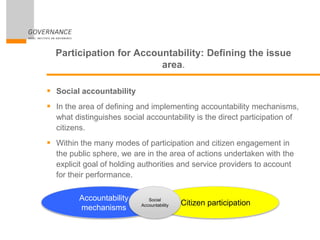
 Social accountability
 In the area of defining and implementing accountability mechanisms,
what distinguishes social accountability is the direct participation of
citizens.
 Within the many modes of participation and citizen engagement in
the public sphere, we are in the area of actions undertaken with the
explicit goal of holding authorities and service providers to account
for their performance.
Accountability
mechanisms
Citizen participation
Social
Accountability
The question is…..
 Can social accountability initiatives –through different
modalities of citizen participation- have an impact on the
quality of or access to basic public services?
 Yes, but…….
Citizen participation by itself is not enough
Need to adequately contextualize
Main elements involved in effective social
accountability interventions
 Effective social accountability involves at
the minimum three core elements:
voice, enforceability and
answerability, which together form part of
a cycle.
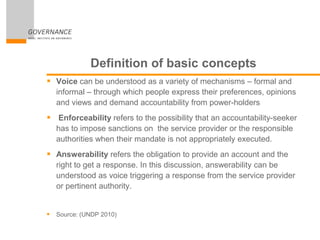
Definition of basic concepts
 Voice can be understood as a variety of mechanisms – formal and
informal – through which people express their preferences, opinions
and views and demand accountability from power-holders
 Enforceability refers to the possibility that an accountability-seeker
has to impose sanctions on the service provider or the responsible
authorities when their mandate is not appropriately executed.
 Answerability refers the obligation to provide an account and the
right to get a response. In this discussion, answerability can be
understood as voice triggering a response from the service provider
or pertinent authority.
 Source: (UNDP 2010)
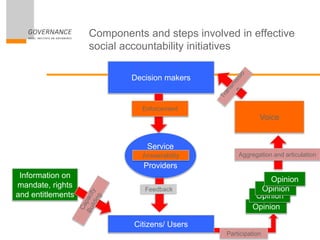
Components and steps involved in effective
social accountability initiatives
Citizens/ Users
Service
Providers
Decision makers
Opinion
Opinion
Opinion
Opinion
Voice
Information on
mandate, rights
and entitlements
Enforcement
Aggregation and articulationAnswerability
Participation
Examples of commonly used social
accountability tools
Citizen report cards
Community score cards
Community monitoring
Complaints mechanisms
Participatory budgeting
Public expenditure tracking surveys (PETS)
Working with the grain: demand-side elements to
optimize impact
 Local/indigenous pre-existing participatory mechanisms may be
harnessed to maximize effectiveness.
 How is community defined? Elements such as solidarity, protection,
self help but also possible reprisals within the community can pose
challenges to effective participation.
 How do citizens understand their relationship vis a vis the state?
Who do they trust?
 Urban/rural areas. Collective vs individual participatory actions.
Supply-side tools in support of and concomitant to
social accountability approaches
 Rights awareness campaigns are indispensable starting point.
 Focus on the direct factors that shape the incentives of the provider
in question.
 Ensuring adequate institutional mechanisms are available to
aggregate and transmit voice to the pertinent actors with decision
making authority.
 Formulating evidence based strategies to improve the providers’
capacity to respond.
Mexico: elements impacting performance of social
accountability initiatives
 Communitarian view of action and welfare.
 Traditional male-dominated hierarchies and organizations.
 State is seen as the great benefactor.
 History of political clientelism and cooptation
 History of corporatism, strong union commanding control health sector
workers’ career and remuneration opportunities.
Tanzania: elements impacting performance of social
accountability initiatives
 Extreme suspicion towards and disengagement from the state.
 Active civil society as expressed in highest levels of trust given to
NGOs and the existence of multiplicity of self help organizations.
 Media has high credibility. Is trusted and actively used to promote
accountability activities as a means to disseminate demands and
shortcomings.
 Budget monitoring activities have been successful.
 Institutionalization of social accountability mechanisms still
challenging.
Lessons learned
 Participation can be best promoted by contextualizing the channels
and mechanisms to participate to the greatest extent possible.
 Participation and generating voice alone are not enough. Improved
accountability outcomes are associated with a supportive public
sector.
 When public sector accountability mechanisms are unresponsive or
weak, positive outcomes are often associated with an
active, independent media and the existence of effective access to
information provisions.
Concluding remarks: challenges and opportunities for
the MENA region
 Mobilized citizenry and a sense of empowerment for
triggering changes provide fertile ground for participatory
approaches.
 Can provide democratic state-building opportunities by
generating positive synergies.
 Contextualization remains essential to achieve sustainability.
References and acknowledgements
 References:
 Arnstein, Sherry R. "A Ladder of Citizen Participation," JAIP, Vol. 35, No. 4, July 1969, pp. 216-
224.
 Baez-Camargo, Claudia. 2011. “Accountability for Better Healthcare Provision: a Framework and
Guidelines to Define, Understand and Assess Accountability in Health Systems.” Basel Institute on
Governance Working Paper Series No. 10 http://www.baselgovernance.org/publications/working-
papers/
 UNDP. 2010. “Fostering Social Accountability: From Principle to Practice. Guidance Note.”
 World Bank. 2004. “World Development Report 2004: Making Services Work for Poor People.”
 Acknowledgements:
The work presented here has been undertaken as part of the participation of the Basel
Institute on Governance in the ANTICORRP research consortium (anticorrp.eu), which is
financed by the European Union’s FP7 program.

Camargo baez on Participatory Approaches

  • 1.
    Basel Institute onGovernance I Steinenring 60 I CH-4051 Basel I Phone +41 (0)61 205 55 11 I info@baselgovernance.org Participatory approaches to improving accountability in public services: conceptual and evidence-based guidelines. Presentation for the workshop “Relevance of Transparency, Accountability, and Participation since the Arab Spring” organized by the World Bank and Partners in Development. April 7-9, 2013, Cairo, Egypt. Dr. Claudia Baez Camargo Senior Researcher Basel Institute on Governance
  • 2.
    The starting point “Theidea of citizen participation is a little like eating spinach: no one is against it in principle because it is good for you”(Arnstein 1969, 216)
  • 3.
    Participation for Accountability:Defining the issue area.  Social accountability  In the area of defining and implementing accountability mechanisms, what distinguishes social accountability is the direct participation of citizens.  Within the many modes of participation and citizen engagement in the public sphere, we are in the area of actions undertaken with the explicit goal of holding authorities and service providers to account for their performance. Accountability mechanisms Citizen participation Social Accountability
  • 4.
    The question is….. Can social accountability initiatives –through different modalities of citizen participation- have an impact on the quality of or access to basic public services?  Yes, but……. Citizen participation by itself is not enough Need to adequately contextualize
  • 5.
    Main elements involvedin effective social accountability interventions  Effective social accountability involves at the minimum three core elements: voice, enforceability and answerability, which together form part of a cycle.
  • 6.
    Definition of basicconcepts  Voice can be understood as a variety of mechanisms – formal and informal – through which people express their preferences, opinions and views and demand accountability from power-holders  Enforceability refers to the possibility that an accountability-seeker has to impose sanctions on the service provider or the responsible authorities when their mandate is not appropriately executed.  Answerability refers the obligation to provide an account and the right to get a response. In this discussion, answerability can be understood as voice triggering a response from the service provider or pertinent authority.  Source: (UNDP 2010)
  • 7.
    Components and stepsinvolved in effective social accountability initiatives Citizens/ Users Service Providers Decision makers Opinion Opinion Opinion Opinion Voice Information on mandate, rights and entitlements Enforcement Aggregation and articulationAnswerability Participation
  • 8.
    Examples of commonlyused social accountability tools Citizen report cards Community score cards Community monitoring Complaints mechanisms Participatory budgeting Public expenditure tracking surveys (PETS)
  • 9.
    Working with thegrain: demand-side elements to optimize impact  Local/indigenous pre-existing participatory mechanisms may be harnessed to maximize effectiveness.  How is community defined? Elements such as solidarity, protection, self help but also possible reprisals within the community can pose challenges to effective participation.  How do citizens understand their relationship vis a vis the state? Who do they trust?  Urban/rural areas. Collective vs individual participatory actions.
  • 10.
    Supply-side tools insupport of and concomitant to social accountability approaches  Rights awareness campaigns are indispensable starting point.  Focus on the direct factors that shape the incentives of the provider in question.  Ensuring adequate institutional mechanisms are available to aggregate and transmit voice to the pertinent actors with decision making authority.  Formulating evidence based strategies to improve the providers’ capacity to respond.
  • 11.
    Mexico: elements impactingperformance of social accountability initiatives  Communitarian view of action and welfare.  Traditional male-dominated hierarchies and organizations.  State is seen as the great benefactor.  History of political clientelism and cooptation  History of corporatism, strong union commanding control health sector workers’ career and remuneration opportunities.
  • 12.
    Tanzania: elements impactingperformance of social accountability initiatives  Extreme suspicion towards and disengagement from the state.  Active civil society as expressed in highest levels of trust given to NGOs and the existence of multiplicity of self help organizations.  Media has high credibility. Is trusted and actively used to promote accountability activities as a means to disseminate demands and shortcomings.  Budget monitoring activities have been successful.  Institutionalization of social accountability mechanisms still challenging.
  • 13.
    Lessons learned  Participationcan be best promoted by contextualizing the channels and mechanisms to participate to the greatest extent possible.  Participation and generating voice alone are not enough. Improved accountability outcomes are associated with a supportive public sector.  When public sector accountability mechanisms are unresponsive or weak, positive outcomes are often associated with an active, independent media and the existence of effective access to information provisions.
  • 14.
    Concluding remarks: challengesand opportunities for the MENA region  Mobilized citizenry and a sense of empowerment for triggering changes provide fertile ground for participatory approaches.  Can provide democratic state-building opportunities by generating positive synergies.  Contextualization remains essential to achieve sustainability.
  • 15.
    References and acknowledgements References:  Arnstein, Sherry R. "A Ladder of Citizen Participation," JAIP, Vol. 35, No. 4, July 1969, pp. 216- 224.  Baez-Camargo, Claudia. 2011. “Accountability for Better Healthcare Provision: a Framework and Guidelines to Define, Understand and Assess Accountability in Health Systems.” Basel Institute on Governance Working Paper Series No. 10 http://www.baselgovernance.org/publications/working- papers/  UNDP. 2010. “Fostering Social Accountability: From Principle to Practice. Guidance Note.”  World Bank. 2004. “World Development Report 2004: Making Services Work for Poor People.”  Acknowledgements: The work presented here has been undertaken as part of the participation of the Basel Institute on Governance in the ANTICORRP research consortium (anticorrp.eu), which is financed by the European Union’s FP7 program.