Accomplishments (Selected)
Venkatakrishna Shyamala, PhD
•Consultant: Novartis Dx- Scientific Affairs;
     Document writer - Molecular Diagnostics
•Innovative Biosensors, Inc.
  •Senior VP, Research and Development
• Digene Corporation
  •Director, Research and Development
• Chiron Corporation
  •Associate Director, Research
• Univ of California, Berkeley
  •Visiting Scientist
                        V. Shyamala             1
Accomplishments (Selected)
Venkatakrishna Shyamala, PhD

• Consultant: Scientific Affairs
Novartis Vaccines & Diagnostics

• Monitoring Procleix ® Blood Screening
Assay Testing and other NAT Trials
•Assist Asia-Pacific region through
Seminars, Conference Presentations,
Workshops, and Publication Support

                 V. Shyamala              2
Accomplishments (Selected)
Venkatakrishna Shyamala, PhD
• Document writer - Molecular Diagnostics
Clinical & Laboratory Standards Institute
Reviewer , Consensus Committee on Molecular Methods

Contributor:
MM06: Quantitative Molecular Methods for Infectious Diseases
MM19: Establishing Molecular Testing in Clinical Laboratories
MM01-A3: Diagnostic Molecular Methods for Genetic Diseases
MM09: Nucleic acid sequencing methods in Diagnostic
       Laboratory Medicine
MM22: Microarrays for Diagnosis and Monitoring of Infectious
       Diseases
POCT14: Point-of-Care Testing for Infectious Diseases
                          V. Shyamala                   3
•
Molecular Methods and Platforms for Infectious Diseases Testing
        A review of FDA Approved and Cleared Assays*

R. Emmadi, J. B. Boonyaratanakornkit, R. Selvarangan, V. Shyamala,
     B. L. Zimmer, L. Williams, B. Bryant, T. Schutzbank, M. M.
Schoonmaker, J. A. AmosWilson, L. Hall, P. Pancholi and K. Bernard
               J. Mol. Diagnostics 13, Nov. (2011)

•The performance of various assays as described in public forums,
Product Inserts and publications are reviewed
•The challenges, limitations, testing and indications related to
implementation of various assays in a clinical laboratory setting is
summarized
•The categories of diseases include Sexually Transmitted Diseases -
HPV, CT-GC, HIV-1, and HSV; Hospital Acquired Infections - MRSA,
VRE, C. difficile, Respiratory tract and CNS infections, MTB, and CNS
viral infections, other infections such as HCV, HBV, GBS, Culture tests
for fungal and bacterial identification.

*A by-product of CLSI MM19 document
                               V. Shyamala                          4
Accomplishments (Selected)
Venkatakrishna Shyamala, PhD
•Consultant: Novartis Dx- Scientific Affairs;
     Document writer - Molecular Diagnostics
•Innovative Biosensors, Inc.
  •Senior VP, Research and Development
• Digene Corporation
  •Director, Research and Development
• Chiron Corporation
  •Associate Director, Research
• Univ of California, Berkeley
  •Visiting Scientist
                        V. Shyamala             5
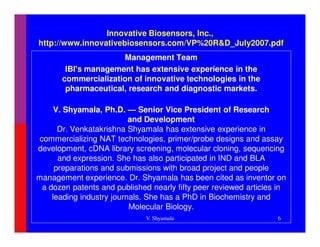
Innovative Biosensors, Inc.,
http://www.innovativebiosensors.com/VP%20R&D_July2007.pdf
                      Management Team
        IBI's management has extensive experience in the
       commercialization of innovative technologies in the
        pharmaceutical, research and diagnostic markets.

     V. Shyamala, Ph.D. — Senior Vice President of Research
                          and Development
      Dr. Venkatakrishna Shyamala has extensive experience in
commercializing NAT technologies, primer/probe designs and assay
development, cDNA library screening, molecular cloning, sequencing
      and expression. She has also participated in IND and BLA
     preparations and submissions with broad project and people
management experience. Dr. Shyamala has been cited as inventor on
 a dozen patents and published nearly fifty peer reviewed articles in
    leading industry journals. She has a PhD in Biochemistry and
                          Molecular Biology.
                              V. Shyamala                         6
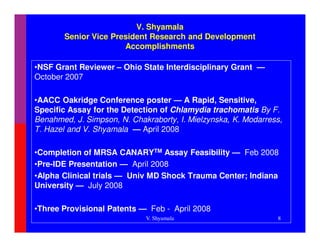
V. Shyamala
       Senior Vice President Research and Development
                       Accomplishments
               http://www.innovativebiosensors.
         com/pressreleases_pathogen_detection.html

•Innovative Biosensors Inc. Expands Scientific Advisory Board —
August 5, 2008

•Innovative Biosensors Inc. Raises $11.5 Million — Series B
Financing Combines Equity and Debt Capital — May 19, 2008

•Innovative Biosensors Inc. and ATCC® Partner to Develop High-
speed Test for Avian Flu — April 9, 2008

•Innovative Biosensors, Inc. and the University of Maryland
Receive Funding for Handheld Biosensor Development —
February 25, 2008
                            V. Shyamala                       7
V. Shyamala
       Senior Vice President Research and Development
                      Accomplishments

•NSF Grant Reviewer – Ohio State Interdisciplinary Grant —
October 2007

•AACC Oakridge Conference poster — A Rapid, Sensitive,
Specific Assay for the Detection of Chlamydia trachomatis By F.
Benahmed, J. Simpson, N. Chakraborty, I. Mielzynska, K. Modarress,
T. Hazel and V. Shyamala — April 2008

•Completion of MRSA CANARYTM Assay Feasibility — Feb 2008
•Pre-IDE Presentation — April 2008
•Alpha Clinical trials — Univ MD Shock Trauma Center; Indiana
University — July 2008

•Three Provisional Patents — Feb - April 2008
                             V. Shyamala                        8
Accomplishments (Selected)
Venkatakrishna Shyamala, PhD
•Consultant: Novartis Dx- Scientific Affairs;
     Document writer - Molecular Diagnostics
•Innovative Biosensors, Inc.
  •Senior VP, Research and Development
• Digene Corporation
  •Director, Research and Development
• Chiron Corporation
  •Associate Director, Research
• Univ of California, Berkeley
  •Visiting Scientist
                        V. Shyamala             9
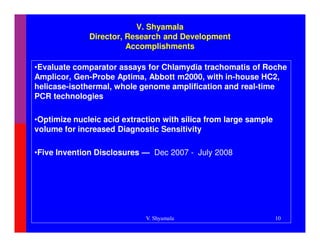
V. Shyamala
              Director, Research and Development
                        Accomplishments

•Evaluate comparator assays for Chlamydia trachomatis of Roche
Amplicor, Gen-Probe Aptima, Abbott m2000, with in-house HC2,
helicase-isothermal, whole genome amplification and real-time
PCR technologies

•Optimize nucleic acid extraction with silica from large sample
volume for increased Diagnostic Sensitivity

•Five Invention Disclosures — Dec 2007 - July 2008


                             V. Shyamala                          10
Accomplishments (Selected)
Venkatakrishna Shyamala, PhD
•Consultant: Novartis Dx- Scientific Affairs;
     Document writer - Molecular Diagnostics
•Innovative Biosensors, Inc.
  •Senior VP, Research and Development
• Digene Corporation
  •Director, Research and Development
• Chiron Corporation
  •Associate Director, Research
• Univ of California, Berkeley
  •Visiting Scientist
                        V. Shyamala             11
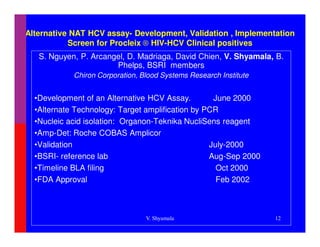
Alternative NAT HCV assay- Development, Validation , Implementation
           Screen for Procleix ® HIV-HCV Clinical positives
   S. Nguyen, P. Arcangel, D. Madriaga, David Chien, V. Shyamala, B.
                       Phelps, BSRI members
            Chiron Corporation, Blood Systems Research Institute


  •Development of an Alternative HCV Assay.        June 2000
  •Alternate Technology: Target amplification by PCR
  •Nucleic acid isolation: Organon-Teknika NucliSens reagent
  •Amp-Det: Roche COBAS Amplicor
  •Validation                                     July-2000
  •BSRI- reference lab                            Aug-Sep 2000
  •Timeline BLA filing                              Oct 2000
  •FDA Approval                                     Feb 2002


                                 V. Shyamala                       12
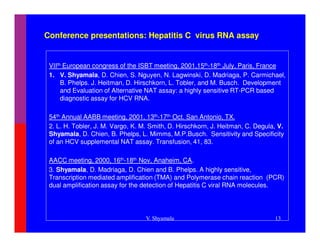
Conference presentations: Hepatitis C virus RNA assay


 VIIth European congress of the ISBT meeting, 2001,15th-18th July, Paris, France
 1. V. Shyamala, D. Chien, S. Nguyen, N. Lagwinski, D. Madriaga, P. Carmichael,
      B. Phelps. J. Heitman, D. Hirschkorn, L. Tobler, and M. Busch. Development
      and Evaluation of Alternative NAT assay: a highly sensitive RT-PCR based
      diagnostic assay for HCV RNA.

 54th Annual AABB meeting, 2001, 13th-17th Oct. San Antonio, TX.
 2. L. H. Tobler, J. M. Vargo, K. M. Smith, D. Hirschkorn, J. Heitman, C. Degula, V.
 Shyamala, D. Chien, B. Phelps, L. Mimms, M.P.Busch. Sensitivity and Specificity
 of an HCV supplemental NAT assay. Transfusion, 41, 83.

 AACC meeting, 2000, 16th-18th Nov, Anaheim, CA.
 3. Shyamala, D. Madriaga, D. Chien and B. Phelps. A highly sensitive,
 Transcription mediated amplification (TMA) and Polymerase chain reaction (PCR)
 dual amplification assay for the detection of Hepatitis C viral RNA molecules.


                                   V. Shyamala                                  13
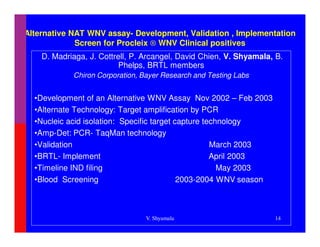
Alternative NAT WNV assay- Development, Validation , Implementation
             Screen for Procleix ® WNV Clinical positives
    D. Madriaga, J. Cottrell, P. Arcangel, David Chien, V. Shyamala, B.
                         Phelps, BRTL members
            Chiron Corporation, Bayer Research and Testing Labs


  •Development of an Alternative WNV Assay Nov 2002 – Feb 2003
  •Alternate Technology: Target amplification by PCR
  •Nucleic acid isolation: Specific target capture technology
  •Amp-Det: PCR- TaqMan technology
  •Validation                                        March 2003
  •BRTL- Implement                                   April 2003
  •Timeline IND filing                                 May 2003
  •Blood Screening                          2003-2004 WNV season


                                 V. Shyamala                        14
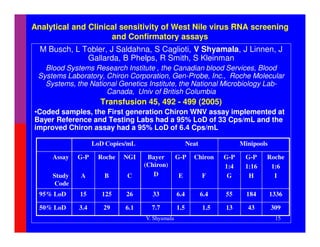
Analytical and Clinical sensitivity of West Nile virus RNA screening
                     and Confirmatory assays
  M Busch, L Tobler, J Saldahna, S Caglioti, V Shyamala, J Linnen, J
              Gallarda, B Phelps, R Smith, S Kleinman
   Blood Systems Research Institute , the Canadian blood Services, Blood
 Systems Laboratory, Chiron Corporation, Gen-Probe, Inc., Roche Molecular
   Systems, the National Genetics Institute, the National Microbiology Lab-
                     Canada, Univ of British Columbia
                     Transfusion 45, 492 - 499 (2005)
•Coded samples, the First generation Chiron WNV assay implemented at
Bayer Reference and Testing Labs had a 95% LoD of 33 Cps/mL and the
improved Chiron assay had a 95% LoD of 6.4 Cps/mL

                   LoD Copies/mL                       Neat               Minipools

     Assay   G-P    Roche   NGI     Bayer        G-P     Chiron     G-P    G-P    Roche
                                   (Chiron)                         1:4    1:16    1:6
     Study   A        B      C        D          E            F      G      H       I
     Code
  95% LoD    15       125    26      33          6.4          6.4   55      184       1336

  50% LoD    3.4      29     6.1     7.7         1.5          1.5   13      43        309
                                   V. Shyamala                                         15
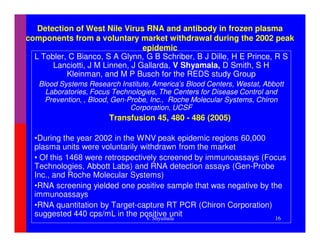
Detection of West Nile Virus RNA and antibody in frozen plasma
components from a voluntary market withdrawal during the 2002 peak
                                 epidemic
  L Tobler, C Bianco, S A Glynn, G B Schriber, B J Dille, H E Prince, R S
       Lanciotti, J M Linnen, J Gallarda, V Shyamala, D Smith, S H
           Kleinman, and M P Busch for the REDS study Group
   Blood Systems Research Institute, America’s Blood Centers, Westat, Abbott
     Laboratories, Focus Technologies, The Centers for Disease Control and
     Prevention, , Blood, Gen-Probe, Inc., Roche Molecular Systems, Chiron
                               Corporation, UCSF
                         Transfusion 45, 480 - 486 (2005) F
                                        o
  •During the year 2002 in the WNV peak epidemic regions 60,000
  plasma units were voluntarily withdrawn from the market
  • Of this 1468 were retrospectively screened by immunoassays (Focus
  Technologies, Abbott Labs) and RNA detection assays (Gen-Probe
  Inc., and Roche Molecular Systems)
  •RNA screening yielded one positive sample that was negative by the
  immunoassays
  •RNA quantitation by Target-capture RT PCR (Chiron Corporation)
  suggested 440 cps/mL in the positive unit
                                  V. Shyamala                      16
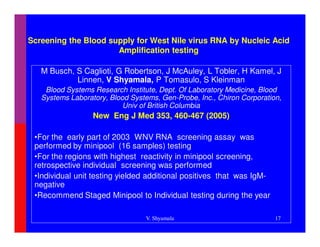
Screening the Blood supply for West Nile virus RNA by Nucleic Acid
                      Amplification testing

   M Busch, S Caglioti, G Robertson, J McAuley, L Tobler, H Kamel, J
            Linnen, V Shyamala, P Tomasulo, S Kleinman
    Blood Systems Research Institute, Dept. Of Laboratory Medicine, Blood
   Systems Laboratory, Blood Systems, Gen-Probe, Inc., Chiron Corporation,
                           Univ of British Columbia
                  New Eng J Med 353, 460-467 (2005)
                                                            ms Foundation
 •For the early part of 2003 WNV RNA screening assay was
 performed by minipool (16 samples) testing
 •For the regions with highest reactivity in minipool screening,
 retrospective individual screening was performed
 •Individual unit testing yielded additional positives that was IgM-
 negative
 •Recommend Staged Minipool to Individual testing during the year

                                 V. Shyamala                            17
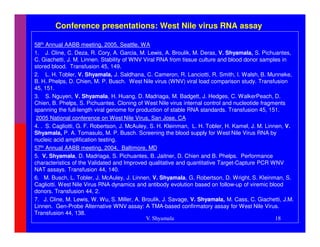
Conference presentations: West Nile virus RNA assay

58th Annual AABB meeting, 2005, Seattle, WA
1. J. Cline, C. Deza, R. Cory, A. Garcia, M. Lewis, A. Broulik, M. Deras, V. Shyamala, S. Pichuantes,
C. Giachetti, J. M. Linnen. Stability of WNV Viral RNA from tissue culture and blood donor samples in
stored blood. Transfusion 45, 149.
2. L. H. Tobler, V. Shyamala, J. Saldhana, C. Cameron, R. Lanciotti, R. Smith, I. Walsh, B. Munneke,
B. H. Phelps, D. Chien, M. P. Busch. West Nile virus (WNV) viral load comparison study. Transfusion
45, 151.
3. S. Nguyen, V. Shyamala, H. Huang, D. Madriaga, M. Badgett, J. Hedges, C. WalkerPeach, D.
Chien, B. Phelps, S. Pichuantes. Cloning of West Nile virus internal control and nucleotide fragments
spanning the full-length viral genome for production of stable RNA standards. Transfusion 45, 151.
 2005 National conference on West Nile Virus, San Jose, CA
4. . S. Cagliotti, G. F. Robertson, J. McAuley, S. H. Kleinman, L. H. Tobler, H. Kamel, J. M. Linnen, V.
Shyamala, P. A. Tomasulo, M. P. Busch. Screening the blood supply for West Nile Virus RNA by
nucleic acid amplification testing.
57th Annual AABB meeting, 2004, Baltimore, MD
5. V. Shyamala, D. Madriaga, S. Pichuantes, B. Jaitner, D. Chien and B. Phelps. Performance
characteristics of the Validated and Improved qualitative and quantitative Target-Capture PCR WNV
NAT assays. Transfusion 44, 140.
6. M. Busch, L. Tobler, J. McAuley, J. Linnen, V. Shyamala, G. Robertson, D. Wright, S. Kleinman, S.
Cagliotti. West Nile Virus RNA dynamics and antibody evolution based on follow-up of viremic blood
donors. Transfusion 44, 2.
7. J. Cline, M. Lewis, W. Wu, S. Miller, A. Broulik, J. Savage, V. Shyamala, M. Cass, C. Giachetti, J.M.
Linnen. Gen-Probe Alternative WNV assay: A TMA-based confirmatory assay for West Nile Virus.
Transfusion 44, 138.
                                              V. Shyamala                                         18
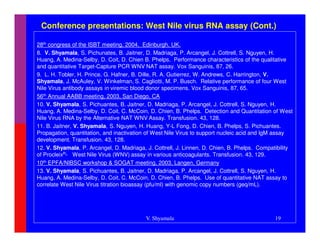
Conference presentations: West Nile virus RNA assay (Cont.)

28th congress of the ISBT meeting, 2004, Edinburgh, UK.
8. V. Shyamala, S. Pichunates, B. Jaitner, D. Madriaga, P. Arcangel, J. Cottrell, S. Nguyen, H.
Huang, A. Medina-Selby, D. Coit, D. Chien B. Phelps. Performance characteristics of the qualitative
and quantitative Target-Capture PCR WNV NAT assay. Vox Sanguinis, 87, 26.
9. L. H. Tobler, H. Prince, G. Hafner, B. Dille, R. A. Gutierrez, W. Andrews, C. Harrington, V.
Shyamala, J. McAuley, V. Winkelman, S. Cagliotti, M. P. Busch. Relative performance of four West
Nile Virus antibody assays in viremic blood donor specimens. Vox Sanguinis, 87, 65.
56th Annual AABB meeting, 2003, San Diego, CA
10. V. Shyamala, S. Pichuantes, B. Jaitner, D. Madriaga, P. Arcangel, J. Cottrell, S. Nguyen, H.
Huang, A. Medina-Selby, D. Coit, C. McCoin, D. Chien, B. Phelps. Detection and Quantitation of West
Nile Virus RNA by the Alternative NAT WNV Assay. Transfusion. 43, 128.
11. B. Jaitner, V. Shyamala, S. Nguyen, H. Huang, Y-L Fong, D. Chien, B. Phelps, S. Pichuantes.
Propagation, quantitation, and inactivation of West Nile Virus to support nucleic acid and IgM assay
development. Transfusion. 43, 128.
12. V. Shyamala, P. Arcangel, D. Madriaga, J. Cottrell, J. Linnen, D. Chien, B. Phelps. Compatibility
of ProcleixR- West Nile Virus (WNV) assay in various anticoagulants. Transfusion. 43, 129.
10th EPFA/NIBSC workshop & SOGAT meeting, 2003, Langen, Germany
13. V. Shyamala, S. Pichuantes, B. Jaitner, D. Madriaga, P. Arcangel, J. Cottrell, S. Nguyen, H.
Huang, A. Medina-Selby, D. Coit, C. McCoin, D. Chien, B. Phelps. Use of quantitative NAT assay to
correlate West Nile Virus titration bioassay (pfu/ml) with genomic copy numbers (geq/mL).


                                           V. Shyamala                                        19
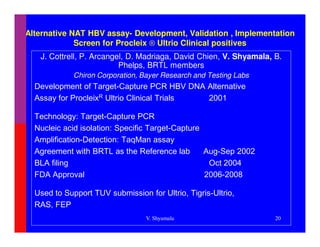
Alternative NAT HBV assay- Development, Validation , Implementation
             Screen for Procleix ® Ultrio Clinical positives
   J. Cottrell, P. Arcangel, D. Madriaga, David Chien, V. Shyamala, B.
                          Phelps, BRTL members
             Chiron Corporation, Bayer Research and Testing Labs
  Development of Target-Capture PCR HBV DNA Alternative
  Assay for ProcleixR Ultrio Clinical Trials 2001

  Technology: Target-Capture PCR
  Nucleic acid isolation: Specific Target-Capture
  Amplification-Detection: TaqMan assay
  Agreement with BRTL as the Reference lab        Aug-Sep 2002
  BLA filing                                       Oct 2004
  FDA Approval                                    2006-2008

  Used to Support TUV submission for Ultrio, Tigris-Ultrio,
  RAS, FEP
                                  V. Shyamala                       20
Assessment of the Target-Capture PCR Hepatitis B Virus (HBV) DNA
  Quantitative Assay and Comparison with Commercial HBV DNA
                       Quantitative Assays
   V. Shyamala, P. Arcangel, J. Cottrell, D. Coit, A. Medina-Selby, C.
           McCoin, D. Madriaga, D. Chien and B. Phelps
                           Chiron Corporation
              J. Clin. Microbiol. 42, 5199 - 5204 (2004)

 •The performance of the Target-Capture HBV assay was
 demonstrated with Reference panels and Standards
 •The range of Quantitation was 10-50 IU/mL
 •The accuracy of quantitation of several concentrations of serially
 diluted WHO standard was between 100-142% and of the QCMD 2003
 six member panel was in the 74-140% range
 •The comparative commercial assays included Roche Amplicor,
 National Genetics Institute SuperQuant, Bayer Quantiplex version 2.0,
 and Digene Hybrid Capture assay
 •The Target-Capture HBV assay was more sensitive, accurate, high-
 throughput, rapid, and reproducible.
                                V. Shyamala                         21
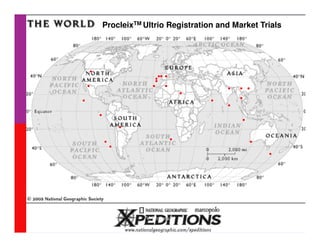
ProcleixTM Ultrio Registration and Market Trials


           V. Shyamala
External quality assessment for the detection of blood-borne viruses
 in plasma by nucleic acid amplification technology: the first human
immunodeficiency virus and hepatitis B virus studies (HIV EQA/1 and
    HBV EQA/1) and the fifth hepatitis C virus study (HCV EQA/5).
  G. Pisani, K. Cristiano, J. Saldanha, M. Wirz, G. M. Bisso, C. Mele, G.
                     Gentili and the EQA Participants.
   Department of Infectious, parasitic and immune-mediated Diseases, Rome,
               Italy, Canadian Blood services, Ottawa, Canada
                    Vox Sanguinis 87, 91- 95 (2004)


 • Sixteen laboratories received HBV EQA/1 coded panel of two HBV
 concentrations
 • All qualitative assays detected both members
 •The Chiron Target-Capture PCR assay (Lab 46) assigned a mean
 titer of 1506 IU/mL and 104 IU/mL to the 1000 IU/mL and 100 IU/mL
 samples respectively.


                                  V. Shyamala                          23
The risk of hepatitis B virus infection by transfusion in Kumasi, Ghana
        J.-P. Allain, D. Candotti, K. Soldan, F. Sarkodie, B. Phelps, C.
     Giachetti, V. Shyamala, F. Yeboah, M. Anokwa, S. Owusu-Ofori, and
                                 O. Opare-Sem
     Division of Transfusion Medicine, Cambridge, UK, Departments of Medicine
     and Biochemistry, Komfo Anokye Teaching Hospital, Kumasi, Ghana, Chiron
                             Corporation, Gen-Probe, Inc.
                         Blood 101, 2419-2425 (2003)

 • In Africa more than 50% of blood donors and recipients are HBV
 positive through natural exposure
 •There are currently no HBV screening programs
 •Relative merits of various antigen screening methods such as Particle
 agglutination, dipstick, and EIA assays were compared
 •The risk of HBV transmission was predicted by screening HBsAg
 negative donors and a group of potential blood recipients for HBV DNA
 (0.05% DNA positivity)
 •The risk of transmission for <10 years old ranged between 1:11 and
 1:326 for unscreened vs.EIA screened. This risk decreased four fold
 in adults due to natural exposure to HBV.
                                     V. Shyamala                          24
 •
Conference presentations: Hepatitis B virus DNA assay
59th Annual AABB meeting, 2006, Miami Beach, FL
1. Y.-L. Fong, D. Madriaga, V. Shyamala, J. Cottrell, R. Lewis, L. Eudey, G. Crutcher, N. Lelie, A.
Heaton, B. Phelps, D. Chien. Evaluation of Analytical Sensitivity of Chiron Target Capture HBV DNA
Assay for HBV Detection, and Comparison with NGI SuperQuantTM HBV DNA Assay. Transfusion 46,
96.
57th Annual AABB meeting, 2004, Baltimore, MD
2. V. Shyamala, P. Arcangel, J. Cottrell, D. Coit, A. Medina-Selby, C. McCoin, D. Chien, B.Phelps.
Performance characteristics of the qualitative and quantitative Target-Capture PCR HBV NAT assay.
Transfusion 44, 85.
56th Annual AABB meeting, 2003, San Diego, CA
3. V. Shyamala, J.Cottrell, P. Archangel, D. Coit, A. Medina-Selby, C. McCoin, J. Turczyn, D. Chien and
B. Phelps. Validation Of Alternative NAT HBV Assay: A Highly Sensitive PCR Based Assay For HBV
DNA. Transfusion. 43, 125.
27th congress of the ISBT meeting, 2002, Vancouver, Canada.
4. V. Shyamala, P. Arcangel, J. Cottrell, J. Linnen, C. Giachetti, D. Chien, B. Phelps. Performance
characteristics of hepatitis B virus DNA confirmatory assay for ProcleixR triplex assay. Vox Sanguinis,
83, 183.
5. J. Linnen, A. Umali, A. Broulik, D. Kolk, J. Dockter, S. McDonough, V. Shyamala, J. Cottrell, P.
Arcangel, L. Mimms and C. Giachetti. Effect of donor mini-pool size on closure of the HBV detection
window: A comparison of Triplex TMA to surface antigen detection. Vox Sanguinis, 83, 42.
54th Annual AABB meeting, 2001, San Antonio, TX.
6. J. Linnen, M. Ho-Sing-Lloy, M. Miyano, D. Kolk, A. Menez, A. Vaughn, E. Peterson, V. Shyamala, P.
Arcangel, D. Chien, B. Phelps. Performance of the TMA Triplex Assay which simultaneously detects
HIV-1, HCV and HBV nucleic acid. Transfusion, 41, 82.

                                            V. Shyamala                                        25
Prevalence and quantitation of Parvovirus B19 DNA levels in blood
         donors using a sensitive PCR screening assay

 S. Kleinman, S. Glynn, T.-H. Lee, L. Tobler, L. Montalvo, D. Todd, J.
                    Kiss, V. Shyamala, M. Busch
   Westat, Blood Systems Research Institute, The Institute for Transfusion
   Medicine, Chiron Corporation; National Heart, Lung, and Blood Institute
              Retrovirus Epidemiology Donor Study (REDS-II)
                  Transfusion 47, 1756- 1764 (2007)

•A retrospective study was conducted with 5020 plasma samples for
Parvo B19 DNA detection by Target Capture-PCR assay
•The Assay performance was 50% LoD at 1.6 IU/mL and 95% LoD at
16.5 IU/mL
•B19 DNA prevalence was 0.88 percent with 40 positives
•IgM positivity was associated with high DNA levels (median concn
105 IU/mL) indicating acute resolving infection
•IgG but not IgM positivity is indicative of chronic and persistent phase
of B19 infection
                                 V. Shyamala                             26
Characterization of the terminal regions of hepatitis C viral RNA:
Identification of conserved sequences in the 5' untranslated region
                    and poly(A) tails at the 3' end
           J. H. Han, V. Shyamala, K. H. Richman, M. J. Brauer, B.
  Irvine, M. S. Urdea, P. Tekamp-Olson, G. Kuo, Q.-L. Choo, and M.
                              Houghton
                           Chiron Corporation
           Proc. Natl. Acad. Sci. USA 88, 1711-1715 (1991)
• The nucleotide sequence at the 5' and 3' termini of the hepatitis C
virus (HCV) genome has been determined, with the sequence in the 5'
untranslated region highly conserved among geographical isolates
•There are several features indicating relatedness of HCV to pestivirus
but not to other flavi viruses such as, (a) blocks of 5’ nucleotide
sequence and position of short open reading frames, (b) poly(A) tails
present on 3' subgenomic RNAs, (c) RNAs truncated at the 5’ and 3’
end.
•However, HCV also appears to be substantially different from pesti
virus with assignment to a separate viral genus.
                               V. Shyamala                          27
Receptor recognition and specificity of interleukin-8 is determined by
 residues that cluster near a surface-accessible hydrophobic pocket
  M. E. Wernette-Hammond, V. Shyamala, M. A. Siani, C. A. Gallegos,,
  P. H. Feucht, J. Abbott, G. Reza-Lapointe, M. Moghadam, H. Khoja, J.
                      Zakel, and P. Tekamp-Olson
                           Chiron Corporation
                   J. Biol. Chem. 271, 8228-8235 (1996)
 •Chemokine IL8 (C-C) binds both R1 and R2 receptors and gro
 gamma (CXC) binds only R2 receptor. Chimeric C-C and CXC ligands
 were used to determine the specificity and affinity of binding to
 recombinant R1 and R2 cell lines
 •Substitution into C-C of CXC aa at the 1st beta sheet reduced binding
 to both R1 and R2, and of 3rd beta sheet reduced binding to R1 but not
 R2, with no effect of second beta sheet. Substitution into CXC of C-C
 aa at the second beta sheet conferred high affinity binding to both R1
 and R2, with no effect of 1st and 3rd beta sheets
 •Individual aa substitutions were made and the results explained
 through a homology model suggests that a hydrophobic pocket is
 essential for both R1 and R2 binding, while surrounding residues play
 an additional role for R1 binding.
                               V. Shyamala                         28
Interleukin-8 receptors R1 and R2 activate mitogen-activated protein
 kinases and induce c-fos, independent of Ras and Raf-1 in Chinese
                         hamster ovary cells
                        V. Shyamala, and H. Khoja
                             Chiron Corporation
                 Biochemistry 37, 15918-15924 (1998)

 • Biological effects of interleukin-8 (IL-8) are realized by binding to the
 two seven-transmembrane receptors IL-8 R1 and IL-8 R2.
 • IL-8 R1 and R2 have been shown to interact with Galphai2 and
 Galpha16, with activation of several mitogen-activated protein kinases
 •In CHO cells stably expressing either IL-8 R1 or R2 receptors results
 demonstrate that: (a) IL-8 activates ERK and ERK kinases (MEK)
 through R1. Both IL-8 and GROalpha activate ERK and MEK through
 R2, whereas MIP-1alpha, a beta chemokine, does not activate these
 kinases through either of these receptors. (b) ERK activation is
 inhibited by pertussis toxin and MEK1 inhibitor. (c) ERK activation is
 independent of the upstream mediators Ras and Raf-1. (d) The
 downstream effects of ERK activation result in increase of c-fos mRNA
 through both R1 and R2 receptors.
                                  V. Shyamala                           29
High-throughput screening for ligand-induced c-fos mRNA
expression by branched DNA assay in chinese hamster ovary cells
 V. Shyamala, H. Khoja, M. L. Anderson, J.-X. Wang, H. Cen, and W.
                          M. Kavanaugh
                             Chiron Corporation
                   Anal. Biochem. 266, 140-147 (1999)
• Cell based High-throughput screening requires use of standardized
cell lines for universal signal read-outs for use with a variety of targets.
• The screening assay for receptor agonists and antagonists is in
Chinese Hamster Ovary (CHO) cells overexpressing the relevant
receptors.
•A universal signal readout is of endogenous c-fos mRNA which
responds to a wide spectrum of stimuli.
•The signal readout was amplified with branched chain DNA (bDNA)
assay which is highly sensitive, quantifiable, amenable to high-
throughput analysis, and easy to execute.
•The combined benefit of the above three features was proven with
CHO cells overexpressing insulin receptor to compare conventional
signaling assays with the high-throughput c-fos branched DNA assay.
                                 V. Shyamala                            30
Tumor Necrosis factor alpha induced activation of c-jun N-terminal
                 kinase is mediated by TRAF2
          C. Reinhard, B. Shamoon, V. Shyamala, and L. T. Williams
                           Chiron Corporation
                        EMBO J. 16,1080-1092 (1997)
• Tumor necrosis factor alpha (TNF alpha) a pro-inflammatory cytokine is
an endogenous mediator of septic shock, inflammation, anti-viral
responses and apoptotic cell death through 55 kDa (TNF-RI) and 75 kDa
(TNF-RII) receptors.
•TNF-RII specific signaling was examined by chimeric receptor with
extracellular domain mouse CD4 antigen and intracellular domain TNF-
RII, and activated it through anti-CD4 antibodies
•Results show that: (i) TNF-RII activates ERK and JNK; (ii)
Overexpression of TRAF2, a molecule that binds TNF-RII activates JNK ;
(iii) dominant-negative TRAF2 blocks JNK activation ; (iv) TRAF2 signals
activation of JNK and NF-kappaB through different pathways.
•TNF alpha-mediated JNK activation in fibroblasts is independent of the
cell death pathway.
                                 V. Shyamala                       31
.
Cloning of CCRL1, an orphan seven transmembrane receptor related
    to chemokine receptors, expressed abundantly in the heart
     H. Khoja, G. Wang, C. T. Ng, J.Tucker, T. Brown, V. Shyamala
                           Chiron Corporation
                      Gene 246, 229-238 (2000)B
                           Involved in stroke
 • To identify novel chemokine receptor genes, cDNA expressed
 sequence tags (EST) were analyzed for a significant homology with
 mammalian chemokine receptors.
 •One EST clones sequence was used to generate a full-length cDNA
 encoding a putative seven transmembrane receptor, CCRL1-CC
 chemokine receptor like 1, encoding a polypeptide of 350 amino acids
 with 35% homology to the chemokine receptors CCR6 and CCR7.
 Coupled transcription-translation of CCRL1 cDNA yielded a
 glycosylated polypeptide of about 45kDa.
 •Northern blot analysis indicates predominant expression of about 5.0,
 2.0 and 1.3kb mRNA forms in human heart tissue. In-situ hybridization
 confirmed the presence of CCRL1 mRNA in cardiac muscle cells.
 •CCRL1 maps to chromosome 6 and has one intron in the 5'
 untranslated region.            V. Shyamala                        32
Semirational design of a potent, artificial agonist of fibroblast growth
                            factor receptors
  M.D. Ballinger, V. Shyamala, L. D. Forrest, M. Deuter-Reinhard, L. V.
  Doyle, J. X.Wang, L. Panganiban-Lustan, J. R. Stratton, G. Apell, J. A.
           Winter, M. V. Doyle, S. Rosenberg, W.M. Kavanaugh
                            Chiron Corporation
            Nature Biotechnology 17, 1199 - 1204 (1999)B
                            Involved in stroke
 • A 26 amino acid polypepetide with FGF receptor binding activity
 unrelated to any known FGF was identified through phage display.
 •A heparin binding, and dimerizaion enabling domain of c-jun leucine
 zipper was tailored onto this peptide
 •Such a synthetic polypeptide reproduced the intracellular kinase
 cascade, and mitogenic and morphogenic properties of bFGF with
 similar potency
 •The synthetic peptide also reproduced corneal vascularization
 properties of FGF
 •Artificial FGFR peptide and non-peptide agonists may be useful
 alternatives to FGF in the treatment of ischemic vascular disease.
                                V. Shyamala                          33
Accomplishments (Selected)
Venkatakrishna Shyamala, PhD
•Consultant: Novartis Dx- Scientific Affairs;
     Document writer - Molecular Diagnostics
•Innovative Biosensors, Inc.
  •Senior VP, Research and Development
• Digene Corporation
  •Director, Research and Development
• Chiron Corporation
  •Associate Director, Research
• Univ of California, Berkeley
  •Visiting Scientist
                        V. Shyamala             34
Amplification of bacterial genomic DNA by the polymerase chain
 reaction and direct sequencing after asymmetric amplification:
        application to the study of periplasmic permeases
                  V. Shyamala, and G. F.-L. Ames
                Dept. of Biochemistry, UC Berkeley, CA
                J. Bacteriol. 171, 1602-1608, (1989)

•The polymerase chain reaction (PCR) was used to amplify bacterial
genomic DNA and PCR amplicons of 4,400 base pairs obtained
•We discuss problems inherent in the direct sequencing of the
amplified product, and solved the problems by developing an
"asymmetric amplification" method in which one of the oligonucleotide
primers is used in limiting amounts, thus allowing the accumulation of
single-stranded copies of only one of the DNA strands.
•As an illustration of the use of PCR in bacteria, we have amplified,
sequenced, and subcloned several DNA fragments carrying mutations
in genes of the histidine permease operon. These mutations are part of
a preliminary approach to studying protein-protein interactions in
transport, and their nature is discussed.
                              V. Shyamala                         35
Genome walking by single-specific-primer polymerase chain
                    reaction: SSP-PCR

                   V. Shyamala, and G. F. L. Ames
     Division of Biochemistry and Molecular Biology, UC Berkeley, CA
                           Gene 84, 1-8, (1989)
•We have extended the use of the polymerase chain reaction (PCR) to
amplify double-stranded DNA when sequence information is available
only at one extremity sufficient to design a gene-specific primer.
• The unknown end is ligated to a vector and the gene-specific primer
is used in combination with a second generic vector primer.
•Restriction, ligation, amplification and sequencing of the products can
be achieved within three days.
•This method eliminates the laborious steps of shotgun cloning, colony
screening and culturing of cells.
•We demonstrate the usefulness of this technique for chromosome
walking in the absence of any restriction data.

                               V. Shyamala                             36
Tandem chromosomal duplications: role of REP sequences in the
            recombination event at the join-point

                V. Shyamala, E. Schneider and G. F. L. Ames
     Division of Biochemistry and Molecular Biology, UC Berkeley, CA
                      EMBO J. 9, 939 - 946 (1990)
•A family of prokaryotic repetitive sequences, called REP (repetitive
extragenic palindromic) is involved in the formation of chromosomal
rearrangements such as duplications.
•Here through SSP-PCR we have characterized the join-points of
seven RecA+ tandem duplications in Salmonella typhimurium, that
fuse the hisD gene to distant foreign promoters
• Such a recombination takes place even in a RecA-background. Thus,
REPs can recombine with each other by a RecA(-)-independent
mechanism
•Some RecA-duplications occurred outside of REP sequences by
recombination within a 7 bp homology.
•Possible roles for the known interaction between DNA gyrase and
REP in chromosomal rearrangements are discussed.
                               V. Shyamala                             37


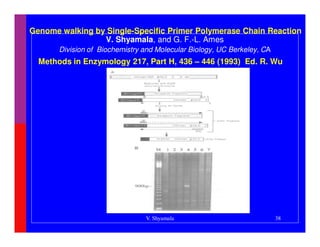
Blood
Genome walking by Single-Specific Primer Polymerase Chain Reaction
                 V. Shyamala, and G. F.-L. Ames
       Division of Biochemistry and Molecular Biology, UC Berkeley, CA
  Methods in Enzymology 217, Part H, 436 – 446 (1993) Ed. R. Wu B
                                    ood


                                V. Shyamala                              38
Use of exonuclease for rapid polymerase-chain-reaction-based
                     in vitro mutagenesis
                   V. Shyamala, and G. F.-L. Ames
     Division of Biochemistry and Molecular Biology, UC Berkeley, CA
                         Gene 97, 1-6, (1991)

• In a previous publication we proposed Asymmetric Amplification as a
method to preferentially amplify one of the two PCR strands to
facilitate direct sequencing
•Here the extended application of Asymmetric amplification for in vitro
mutagenesis has been demonstrated
•We also demonstrate a second method for in vitro mutagenesis
following treatment of PCR fragments with lambda exonuclease. This
requires kinasing one of the primers.
•The entire procedure of kinasing the primer, amplification by PCR,
Exo lambda digestion and second step of PCR can be performed in
less than 6 h. to generate a number of mutations in the S. typhimurium
hisP gene of the histidine transport operon.
                               V. Shyamala                             39
Antimalarial activity of optical isomers of quinacrine dihydrochloride
against chloroquine-sensitive and -resistant plasmodium falciparum
                                  in vitro
          R. V. Webster, J. C. Craig, V. Shyamala, G. C. Kirby, and D.
                               C. Warhurst
         Dept. of Pharmacology, UCSF, Pacific Presbyterian Hospital
             Biochem. Pharmacol. 42, S225-S227, (1991)

 • Both enantiomers of quinacrine and the racemic form of the drug
 showed equal activity in vitro against chloroquine-sensitive and -
 resistant strains of Plasmodium falciparum, without detectable
 stereoselectivity.
 •This contrasts with observations on chloroquine, where a similar lack
 of stereoselectivity in vitro is accompanied by a 10-fold loss of activity
 against the resistant strain.
 •The reported in vivo differences for the enantiomers of chloroquine
 and the observations on the optically active metabolites of chloroquine
 and quinacrine may be ascribed to a difference in the
 pharmacokinetics of their enantiomers.
                                 V. Shyamala                            40

Accomplishments V Shyamala

  • 1.
    Accomplishments (Selected) Venkatakrishna Shyamala,PhD •Consultant: Novartis Dx- Scientific Affairs; Document writer - Molecular Diagnostics •Innovative Biosensors, Inc. •Senior VP, Research and Development • Digene Corporation •Director, Research and Development • Chiron Corporation •Associate Director, Research • Univ of California, Berkeley •Visiting Scientist V. Shyamala 1
  • 2.
    Accomplishments (Selected) Venkatakrishna Shyamala,PhD • Consultant: Scientific Affairs Novartis Vaccines & Diagnostics • Monitoring Procleix ® Blood Screening Assay Testing and other NAT Trials •Assist Asia-Pacific region through Seminars, Conference Presentations, Workshops, and Publication Support V. Shyamala 2
  • 3.
    Accomplishments (Selected) Venkatakrishna Shyamala,PhD • Document writer - Molecular Diagnostics Clinical & Laboratory Standards Institute Reviewer , Consensus Committee on Molecular Methods Contributor: MM06: Quantitative Molecular Methods for Infectious Diseases MM19: Establishing Molecular Testing in Clinical Laboratories MM01-A3: Diagnostic Molecular Methods for Genetic Diseases MM09: Nucleic acid sequencing methods in Diagnostic Laboratory Medicine MM22: Microarrays for Diagnosis and Monitoring of Infectious Diseases POCT14: Point-of-Care Testing for Infectious Diseases V. Shyamala 3 •
  • 4.
    Molecular Methods andPlatforms for Infectious Diseases Testing A review of FDA Approved and Cleared Assays* R. Emmadi, J. B. Boonyaratanakornkit, R. Selvarangan, V. Shyamala, B. L. Zimmer, L. Williams, B. Bryant, T. Schutzbank, M. M. Schoonmaker, J. A. AmosWilson, L. Hall, P. Pancholi and K. Bernard J. Mol. Diagnostics 13, Nov. (2011) •The performance of various assays as described in public forums, Product Inserts and publications are reviewed •The challenges, limitations, testing and indications related to implementation of various assays in a clinical laboratory setting is summarized •The categories of diseases include Sexually Transmitted Diseases - HPV, CT-GC, HIV-1, and HSV; Hospital Acquired Infections - MRSA, VRE, C. difficile, Respiratory tract and CNS infections, MTB, and CNS viral infections, other infections such as HCV, HBV, GBS, Culture tests for fungal and bacterial identification. *A by-product of CLSI MM19 document V. Shyamala 4
  • 5.
    Accomplishments (Selected) Venkatakrishna Shyamala,PhD •Consultant: Novartis Dx- Scientific Affairs; Document writer - Molecular Diagnostics •Innovative Biosensors, Inc. •Senior VP, Research and Development • Digene Corporation •Director, Research and Development • Chiron Corporation •Associate Director, Research • Univ of California, Berkeley •Visiting Scientist V. Shyamala 5
  • 6.
    Innovative Biosensors, Inc., http://www.innovativebiosensors.com/VP%20R&D_July2007.pdf Management Team IBI's management has extensive experience in the commercialization of innovative technologies in the pharmaceutical, research and diagnostic markets. V. Shyamala, Ph.D. — Senior Vice President of Research and Development Dr. Venkatakrishna Shyamala has extensive experience in commercializing NAT technologies, primer/probe designs and assay development, cDNA library screening, molecular cloning, sequencing and expression. She has also participated in IND and BLA preparations and submissions with broad project and people management experience. Dr. Shyamala has been cited as inventor on a dozen patents and published nearly fifty peer reviewed articles in leading industry journals. She has a PhD in Biochemistry and Molecular Biology. V. Shyamala 6
  • 7.
    V. Shyamala Senior Vice President Research and Development Accomplishments http://www.innovativebiosensors. com/pressreleases_pathogen_detection.html •Innovative Biosensors Inc. Expands Scientific Advisory Board — August 5, 2008 •Innovative Biosensors Inc. Raises $11.5 Million — Series B Financing Combines Equity and Debt Capital — May 19, 2008 •Innovative Biosensors Inc. and ATCC® Partner to Develop High- speed Test for Avian Flu — April 9, 2008 •Innovative Biosensors, Inc. and the University of Maryland Receive Funding for Handheld Biosensor Development — February 25, 2008 V. Shyamala 7
  • 8.
    V. Shyamala Senior Vice President Research and Development Accomplishments •NSF Grant Reviewer – Ohio State Interdisciplinary Grant — October 2007 •AACC Oakridge Conference poster — A Rapid, Sensitive, Specific Assay for the Detection of Chlamydia trachomatis By F. Benahmed, J. Simpson, N. Chakraborty, I. Mielzynska, K. Modarress, T. Hazel and V. Shyamala — April 2008 •Completion of MRSA CANARYTM Assay Feasibility — Feb 2008 •Pre-IDE Presentation — April 2008 •Alpha Clinical trials — Univ MD Shock Trauma Center; Indiana University — July 2008 •Three Provisional Patents — Feb - April 2008 V. Shyamala 8
  • 9.
    Accomplishments (Selected) Venkatakrishna Shyamala,PhD •Consultant: Novartis Dx- Scientific Affairs; Document writer - Molecular Diagnostics •Innovative Biosensors, Inc. •Senior VP, Research and Development • Digene Corporation •Director, Research and Development • Chiron Corporation •Associate Director, Research • Univ of California, Berkeley •Visiting Scientist V. Shyamala 9
  • 10.
    V. Shyamala Director, Research and Development Accomplishments •Evaluate comparator assays for Chlamydia trachomatis of Roche Amplicor, Gen-Probe Aptima, Abbott m2000, with in-house HC2, helicase-isothermal, whole genome amplification and real-time PCR technologies •Optimize nucleic acid extraction with silica from large sample volume for increased Diagnostic Sensitivity •Five Invention Disclosures — Dec 2007 - July 2008 V. Shyamala 10
  • 11.
    Accomplishments (Selected) Venkatakrishna Shyamala,PhD •Consultant: Novartis Dx- Scientific Affairs; Document writer - Molecular Diagnostics •Innovative Biosensors, Inc. •Senior VP, Research and Development • Digene Corporation •Director, Research and Development • Chiron Corporation •Associate Director, Research • Univ of California, Berkeley •Visiting Scientist V. Shyamala 11
  • 12.
    Alternative NAT HCVassay- Development, Validation , Implementation Screen for Procleix ® HIV-HCV Clinical positives S. Nguyen, P. Arcangel, D. Madriaga, David Chien, V. Shyamala, B. Phelps, BSRI members Chiron Corporation, Blood Systems Research Institute •Development of an Alternative HCV Assay. June 2000 •Alternate Technology: Target amplification by PCR •Nucleic acid isolation: Organon-Teknika NucliSens reagent •Amp-Det: Roche COBAS Amplicor •Validation July-2000 •BSRI- reference lab Aug-Sep 2000 •Timeline BLA filing Oct 2000 •FDA Approval Feb 2002 V. Shyamala 12
  • 13.
    Conference presentations: HepatitisC virus RNA assay VIIth European congress of the ISBT meeting, 2001,15th-18th July, Paris, France 1. V. Shyamala, D. Chien, S. Nguyen, N. Lagwinski, D. Madriaga, P. Carmichael, B. Phelps. J. Heitman, D. Hirschkorn, L. Tobler, and M. Busch. Development and Evaluation of Alternative NAT assay: a highly sensitive RT-PCR based diagnostic assay for HCV RNA. 54th Annual AABB meeting, 2001, 13th-17th Oct. San Antonio, TX. 2. L. H. Tobler, J. M. Vargo, K. M. Smith, D. Hirschkorn, J. Heitman, C. Degula, V. Shyamala, D. Chien, B. Phelps, L. Mimms, M.P.Busch. Sensitivity and Specificity of an HCV supplemental NAT assay. Transfusion, 41, 83. AACC meeting, 2000, 16th-18th Nov, Anaheim, CA. 3. Shyamala, D. Madriaga, D. Chien and B. Phelps. A highly sensitive, Transcription mediated amplification (TMA) and Polymerase chain reaction (PCR) dual amplification assay for the detection of Hepatitis C viral RNA molecules. V. Shyamala 13
  • 14.
    Alternative NAT WNVassay- Development, Validation , Implementation Screen for Procleix ® WNV Clinical positives D. Madriaga, J. Cottrell, P. Arcangel, David Chien, V. Shyamala, B. Phelps, BRTL members Chiron Corporation, Bayer Research and Testing Labs •Development of an Alternative WNV Assay Nov 2002 – Feb 2003 •Alternate Technology: Target amplification by PCR •Nucleic acid isolation: Specific target capture technology •Amp-Det: PCR- TaqMan technology •Validation March 2003 •BRTL- Implement April 2003 •Timeline IND filing May 2003 •Blood Screening 2003-2004 WNV season V. Shyamala 14
  • 15.
    Analytical and Clinicalsensitivity of West Nile virus RNA screening and Confirmatory assays M Busch, L Tobler, J Saldahna, S Caglioti, V Shyamala, J Linnen, J Gallarda, B Phelps, R Smith, S Kleinman Blood Systems Research Institute , the Canadian blood Services, Blood Systems Laboratory, Chiron Corporation, Gen-Probe, Inc., Roche Molecular Systems, the National Genetics Institute, the National Microbiology Lab- Canada, Univ of British Columbia Transfusion 45, 492 - 499 (2005) •Coded samples, the First generation Chiron WNV assay implemented at Bayer Reference and Testing Labs had a 95% LoD of 33 Cps/mL and the improved Chiron assay had a 95% LoD of 6.4 Cps/mL LoD Copies/mL Neat Minipools Assay G-P Roche NGI Bayer G-P Chiron G-P G-P Roche (Chiron) 1:4 1:16 1:6 Study A B C D E F G H I Code 95% LoD 15 125 26 33 6.4 6.4 55 184 1336 50% LoD 3.4 29 6.1 7.7 1.5 1.5 13 43 309 V. Shyamala 15
  • 16.
    Detection of WestNile Virus RNA and antibody in frozen plasma components from a voluntary market withdrawal during the 2002 peak epidemic L Tobler, C Bianco, S A Glynn, G B Schriber, B J Dille, H E Prince, R S Lanciotti, J M Linnen, J Gallarda, V Shyamala, D Smith, S H Kleinman, and M P Busch for the REDS study Group Blood Systems Research Institute, America’s Blood Centers, Westat, Abbott Laboratories, Focus Technologies, The Centers for Disease Control and Prevention, , Blood, Gen-Probe, Inc., Roche Molecular Systems, Chiron Corporation, UCSF Transfusion 45, 480 - 486 (2005) F o •During the year 2002 in the WNV peak epidemic regions 60,000 plasma units were voluntarily withdrawn from the market • Of this 1468 were retrospectively screened by immunoassays (Focus Technologies, Abbott Labs) and RNA detection assays (Gen-Probe Inc., and Roche Molecular Systems) •RNA screening yielded one positive sample that was negative by the immunoassays •RNA quantitation by Target-capture RT PCR (Chiron Corporation) suggested 440 cps/mL in the positive unit V. Shyamala 16
  • 17.
    Screening the Bloodsupply for West Nile virus RNA by Nucleic Acid Amplification testing M Busch, S Caglioti, G Robertson, J McAuley, L Tobler, H Kamel, J Linnen, V Shyamala, P Tomasulo, S Kleinman Blood Systems Research Institute, Dept. Of Laboratory Medicine, Blood Systems Laboratory, Blood Systems, Gen-Probe, Inc., Chiron Corporation, Univ of British Columbia New Eng J Med 353, 460-467 (2005) ms Foundation •For the early part of 2003 WNV RNA screening assay was performed by minipool (16 samples) testing •For the regions with highest reactivity in minipool screening, retrospective individual screening was performed •Individual unit testing yielded additional positives that was IgM- negative •Recommend Staged Minipool to Individual testing during the year V. Shyamala 17
  • 18.
    Conference presentations: WestNile virus RNA assay 58th Annual AABB meeting, 2005, Seattle, WA 1. J. Cline, C. Deza, R. Cory, A. Garcia, M. Lewis, A. Broulik, M. Deras, V. Shyamala, S. Pichuantes, C. Giachetti, J. M. Linnen. Stability of WNV Viral RNA from tissue culture and blood donor samples in stored blood. Transfusion 45, 149. 2. L. H. Tobler, V. Shyamala, J. Saldhana, C. Cameron, R. Lanciotti, R. Smith, I. Walsh, B. Munneke, B. H. Phelps, D. Chien, M. P. Busch. West Nile virus (WNV) viral load comparison study. Transfusion 45, 151. 3. S. Nguyen, V. Shyamala, H. Huang, D. Madriaga, M. Badgett, J. Hedges, C. WalkerPeach, D. Chien, B. Phelps, S. Pichuantes. Cloning of West Nile virus internal control and nucleotide fragments spanning the full-length viral genome for production of stable RNA standards. Transfusion 45, 151. 2005 National conference on West Nile Virus, San Jose, CA 4. . S. Cagliotti, G. F. Robertson, J. McAuley, S. H. Kleinman, L. H. Tobler, H. Kamel, J. M. Linnen, V. Shyamala, P. A. Tomasulo, M. P. Busch. Screening the blood supply for West Nile Virus RNA by nucleic acid amplification testing. 57th Annual AABB meeting, 2004, Baltimore, MD 5. V. Shyamala, D. Madriaga, S. Pichuantes, B. Jaitner, D. Chien and B. Phelps. Performance characteristics of the Validated and Improved qualitative and quantitative Target-Capture PCR WNV NAT assays. Transfusion 44, 140. 6. M. Busch, L. Tobler, J. McAuley, J. Linnen, V. Shyamala, G. Robertson, D. Wright, S. Kleinman, S. Cagliotti. West Nile Virus RNA dynamics and antibody evolution based on follow-up of viremic blood donors. Transfusion 44, 2. 7. J. Cline, M. Lewis, W. Wu, S. Miller, A. Broulik, J. Savage, V. Shyamala, M. Cass, C. Giachetti, J.M. Linnen. Gen-Probe Alternative WNV assay: A TMA-based confirmatory assay for West Nile Virus. Transfusion 44, 138. V. Shyamala 18
  • 19.
    Conference presentations: WestNile virus RNA assay (Cont.) 28th congress of the ISBT meeting, 2004, Edinburgh, UK. 8. V. Shyamala, S. Pichunates, B. Jaitner, D. Madriaga, P. Arcangel, J. Cottrell, S. Nguyen, H. Huang, A. Medina-Selby, D. Coit, D. Chien B. Phelps. Performance characteristics of the qualitative and quantitative Target-Capture PCR WNV NAT assay. Vox Sanguinis, 87, 26. 9. L. H. Tobler, H. Prince, G. Hafner, B. Dille, R. A. Gutierrez, W. Andrews, C. Harrington, V. Shyamala, J. McAuley, V. Winkelman, S. Cagliotti, M. P. Busch. Relative performance of four West Nile Virus antibody assays in viremic blood donor specimens. Vox Sanguinis, 87, 65. 56th Annual AABB meeting, 2003, San Diego, CA 10. V. Shyamala, S. Pichuantes, B. Jaitner, D. Madriaga, P. Arcangel, J. Cottrell, S. Nguyen, H. Huang, A. Medina-Selby, D. Coit, C. McCoin, D. Chien, B. Phelps. Detection and Quantitation of West Nile Virus RNA by the Alternative NAT WNV Assay. Transfusion. 43, 128. 11. B. Jaitner, V. Shyamala, S. Nguyen, H. Huang, Y-L Fong, D. Chien, B. Phelps, S. Pichuantes. Propagation, quantitation, and inactivation of West Nile Virus to support nucleic acid and IgM assay development. Transfusion. 43, 128. 12. V. Shyamala, P. Arcangel, D. Madriaga, J. Cottrell, J. Linnen, D. Chien, B. Phelps. Compatibility of ProcleixR- West Nile Virus (WNV) assay in various anticoagulants. Transfusion. 43, 129. 10th EPFA/NIBSC workshop & SOGAT meeting, 2003, Langen, Germany 13. V. Shyamala, S. Pichuantes, B. Jaitner, D. Madriaga, P. Arcangel, J. Cottrell, S. Nguyen, H. Huang, A. Medina-Selby, D. Coit, C. McCoin, D. Chien, B. Phelps. Use of quantitative NAT assay to correlate West Nile Virus titration bioassay (pfu/ml) with genomic copy numbers (geq/mL). V. Shyamala 19
  • 20.
    Alternative NAT HBVassay- Development, Validation , Implementation Screen for Procleix ® Ultrio Clinical positives J. Cottrell, P. Arcangel, D. Madriaga, David Chien, V. Shyamala, B. Phelps, BRTL members Chiron Corporation, Bayer Research and Testing Labs Development of Target-Capture PCR HBV DNA Alternative Assay for ProcleixR Ultrio Clinical Trials 2001 Technology: Target-Capture PCR Nucleic acid isolation: Specific Target-Capture Amplification-Detection: TaqMan assay Agreement with BRTL as the Reference lab Aug-Sep 2002 BLA filing Oct 2004 FDA Approval 2006-2008 Used to Support TUV submission for Ultrio, Tigris-Ultrio, RAS, FEP V. Shyamala 20
  • 21.
    Assessment of theTarget-Capture PCR Hepatitis B Virus (HBV) DNA Quantitative Assay and Comparison with Commercial HBV DNA Quantitative Assays V. Shyamala, P. Arcangel, J. Cottrell, D. Coit, A. Medina-Selby, C. McCoin, D. Madriaga, D. Chien and B. Phelps Chiron Corporation J. Clin. Microbiol. 42, 5199 - 5204 (2004) •The performance of the Target-Capture HBV assay was demonstrated with Reference panels and Standards •The range of Quantitation was 10-50 IU/mL •The accuracy of quantitation of several concentrations of serially diluted WHO standard was between 100-142% and of the QCMD 2003 six member panel was in the 74-140% range •The comparative commercial assays included Roche Amplicor, National Genetics Institute SuperQuant, Bayer Quantiplex version 2.0, and Digene Hybrid Capture assay •The Target-Capture HBV assay was more sensitive, accurate, high- throughput, rapid, and reproducible. V. Shyamala 21
  • 22.
    ProcleixTM Ultrio Registrationand Market Trials V. Shyamala
  • 23.
    External quality assessmentfor the detection of blood-borne viruses in plasma by nucleic acid amplification technology: the first human immunodeficiency virus and hepatitis B virus studies (HIV EQA/1 and HBV EQA/1) and the fifth hepatitis C virus study (HCV EQA/5). G. Pisani, K. Cristiano, J. Saldanha, M. Wirz, G. M. Bisso, C. Mele, G. Gentili and the EQA Participants. Department of Infectious, parasitic and immune-mediated Diseases, Rome, Italy, Canadian Blood services, Ottawa, Canada Vox Sanguinis 87, 91- 95 (2004) • Sixteen laboratories received HBV EQA/1 coded panel of two HBV concentrations • All qualitative assays detected both members •The Chiron Target-Capture PCR assay (Lab 46) assigned a mean titer of 1506 IU/mL and 104 IU/mL to the 1000 IU/mL and 100 IU/mL samples respectively. V. Shyamala 23
  • 24.
    The risk ofhepatitis B virus infection by transfusion in Kumasi, Ghana J.-P. Allain, D. Candotti, K. Soldan, F. Sarkodie, B. Phelps, C. Giachetti, V. Shyamala, F. Yeboah, M. Anokwa, S. Owusu-Ofori, and O. Opare-Sem Division of Transfusion Medicine, Cambridge, UK, Departments of Medicine and Biochemistry, Komfo Anokye Teaching Hospital, Kumasi, Ghana, Chiron Corporation, Gen-Probe, Inc. Blood 101, 2419-2425 (2003) • In Africa more than 50% of blood donors and recipients are HBV positive through natural exposure •There are currently no HBV screening programs •Relative merits of various antigen screening methods such as Particle agglutination, dipstick, and EIA assays were compared •The risk of HBV transmission was predicted by screening HBsAg negative donors and a group of potential blood recipients for HBV DNA (0.05% DNA positivity) •The risk of transmission for <10 years old ranged between 1:11 and 1:326 for unscreened vs.EIA screened. This risk decreased four fold in adults due to natural exposure to HBV. V. Shyamala 24 •
  • 25.
    Conference presentations: HepatitisB virus DNA assay 59th Annual AABB meeting, 2006, Miami Beach, FL 1. Y.-L. Fong, D. Madriaga, V. Shyamala, J. Cottrell, R. Lewis, L. Eudey, G. Crutcher, N. Lelie, A. Heaton, B. Phelps, D. Chien. Evaluation of Analytical Sensitivity of Chiron Target Capture HBV DNA Assay for HBV Detection, and Comparison with NGI SuperQuantTM HBV DNA Assay. Transfusion 46, 96. 57th Annual AABB meeting, 2004, Baltimore, MD 2. V. Shyamala, P. Arcangel, J. Cottrell, D. Coit, A. Medina-Selby, C. McCoin, D. Chien, B.Phelps. Performance characteristics of the qualitative and quantitative Target-Capture PCR HBV NAT assay. Transfusion 44, 85. 56th Annual AABB meeting, 2003, San Diego, CA 3. V. Shyamala, J.Cottrell, P. Archangel, D. Coit, A. Medina-Selby, C. McCoin, J. Turczyn, D. Chien and B. Phelps. Validation Of Alternative NAT HBV Assay: A Highly Sensitive PCR Based Assay For HBV DNA. Transfusion. 43, 125. 27th congress of the ISBT meeting, 2002, Vancouver, Canada. 4. V. Shyamala, P. Arcangel, J. Cottrell, J. Linnen, C. Giachetti, D. Chien, B. Phelps. Performance characteristics of hepatitis B virus DNA confirmatory assay for ProcleixR triplex assay. Vox Sanguinis, 83, 183. 5. J. Linnen, A. Umali, A. Broulik, D. Kolk, J. Dockter, S. McDonough, V. Shyamala, J. Cottrell, P. Arcangel, L. Mimms and C. Giachetti. Effect of donor mini-pool size on closure of the HBV detection window: A comparison of Triplex TMA to surface antigen detection. Vox Sanguinis, 83, 42. 54th Annual AABB meeting, 2001, San Antonio, TX. 6. J. Linnen, M. Ho-Sing-Lloy, M. Miyano, D. Kolk, A. Menez, A. Vaughn, E. Peterson, V. Shyamala, P. Arcangel, D. Chien, B. Phelps. Performance of the TMA Triplex Assay which simultaneously detects HIV-1, HCV and HBV nucleic acid. Transfusion, 41, 82. V. Shyamala 25
  • 26.
    Prevalence and quantitationof Parvovirus B19 DNA levels in blood donors using a sensitive PCR screening assay S. Kleinman, S. Glynn, T.-H. Lee, L. Tobler, L. Montalvo, D. Todd, J. Kiss, V. Shyamala, M. Busch Westat, Blood Systems Research Institute, The Institute for Transfusion Medicine, Chiron Corporation; National Heart, Lung, and Blood Institute Retrovirus Epidemiology Donor Study (REDS-II) Transfusion 47, 1756- 1764 (2007) •A retrospective study was conducted with 5020 plasma samples for Parvo B19 DNA detection by Target Capture-PCR assay •The Assay performance was 50% LoD at 1.6 IU/mL and 95% LoD at 16.5 IU/mL •B19 DNA prevalence was 0.88 percent with 40 positives •IgM positivity was associated with high DNA levels (median concn 105 IU/mL) indicating acute resolving infection •IgG but not IgM positivity is indicative of chronic and persistent phase of B19 infection V. Shyamala 26
  • 27.
    Characterization of theterminal regions of hepatitis C viral RNA: Identification of conserved sequences in the 5' untranslated region and poly(A) tails at the 3' end J. H. Han, V. Shyamala, K. H. Richman, M. J. Brauer, B. Irvine, M. S. Urdea, P. Tekamp-Olson, G. Kuo, Q.-L. Choo, and M. Houghton Chiron Corporation Proc. Natl. Acad. Sci. USA 88, 1711-1715 (1991) • The nucleotide sequence at the 5' and 3' termini of the hepatitis C virus (HCV) genome has been determined, with the sequence in the 5' untranslated region highly conserved among geographical isolates •There are several features indicating relatedness of HCV to pestivirus but not to other flavi viruses such as, (a) blocks of 5’ nucleotide sequence and position of short open reading frames, (b) poly(A) tails present on 3' subgenomic RNAs, (c) RNAs truncated at the 5’ and 3’ end. •However, HCV also appears to be substantially different from pesti virus with assignment to a separate viral genus. V. Shyamala 27
  • 28.
    Receptor recognition andspecificity of interleukin-8 is determined by residues that cluster near a surface-accessible hydrophobic pocket M. E. Wernette-Hammond, V. Shyamala, M. A. Siani, C. A. Gallegos,, P. H. Feucht, J. Abbott, G. Reza-Lapointe, M. Moghadam, H. Khoja, J. Zakel, and P. Tekamp-Olson Chiron Corporation J. Biol. Chem. 271, 8228-8235 (1996) •Chemokine IL8 (C-C) binds both R1 and R2 receptors and gro gamma (CXC) binds only R2 receptor. Chimeric C-C and CXC ligands were used to determine the specificity and affinity of binding to recombinant R1 and R2 cell lines •Substitution into C-C of CXC aa at the 1st beta sheet reduced binding to both R1 and R2, and of 3rd beta sheet reduced binding to R1 but not R2, with no effect of second beta sheet. Substitution into CXC of C-C aa at the second beta sheet conferred high affinity binding to both R1 and R2, with no effect of 1st and 3rd beta sheets •Individual aa substitutions were made and the results explained through a homology model suggests that a hydrophobic pocket is essential for both R1 and R2 binding, while surrounding residues play an additional role for R1 binding. V. Shyamala 28
  • 29.
    Interleukin-8 receptors R1and R2 activate mitogen-activated protein kinases and induce c-fos, independent of Ras and Raf-1 in Chinese hamster ovary cells V. Shyamala, and H. Khoja Chiron Corporation Biochemistry 37, 15918-15924 (1998) • Biological effects of interleukin-8 (IL-8) are realized by binding to the two seven-transmembrane receptors IL-8 R1 and IL-8 R2. • IL-8 R1 and R2 have been shown to interact with Galphai2 and Galpha16, with activation of several mitogen-activated protein kinases •In CHO cells stably expressing either IL-8 R1 or R2 receptors results demonstrate that: (a) IL-8 activates ERK and ERK kinases (MEK) through R1. Both IL-8 and GROalpha activate ERK and MEK through R2, whereas MIP-1alpha, a beta chemokine, does not activate these kinases through either of these receptors. (b) ERK activation is inhibited by pertussis toxin and MEK1 inhibitor. (c) ERK activation is independent of the upstream mediators Ras and Raf-1. (d) The downstream effects of ERK activation result in increase of c-fos mRNA through both R1 and R2 receptors. V. Shyamala 29
  • 30.
    High-throughput screening forligand-induced c-fos mRNA expression by branched DNA assay in chinese hamster ovary cells V. Shyamala, H. Khoja, M. L. Anderson, J.-X. Wang, H. Cen, and W. M. Kavanaugh Chiron Corporation Anal. Biochem. 266, 140-147 (1999) • Cell based High-throughput screening requires use of standardized cell lines for universal signal read-outs for use with a variety of targets. • The screening assay for receptor agonists and antagonists is in Chinese Hamster Ovary (CHO) cells overexpressing the relevant receptors. •A universal signal readout is of endogenous c-fos mRNA which responds to a wide spectrum of stimuli. •The signal readout was amplified with branched chain DNA (bDNA) assay which is highly sensitive, quantifiable, amenable to high- throughput analysis, and easy to execute. •The combined benefit of the above three features was proven with CHO cells overexpressing insulin receptor to compare conventional signaling assays with the high-throughput c-fos branched DNA assay. V. Shyamala 30
  • 31.
    Tumor Necrosis factoralpha induced activation of c-jun N-terminal kinase is mediated by TRAF2 C. Reinhard, B. Shamoon, V. Shyamala, and L. T. Williams Chiron Corporation EMBO J. 16,1080-1092 (1997) • Tumor necrosis factor alpha (TNF alpha) a pro-inflammatory cytokine is an endogenous mediator of septic shock, inflammation, anti-viral responses and apoptotic cell death through 55 kDa (TNF-RI) and 75 kDa (TNF-RII) receptors. •TNF-RII specific signaling was examined by chimeric receptor with extracellular domain mouse CD4 antigen and intracellular domain TNF- RII, and activated it through anti-CD4 antibodies •Results show that: (i) TNF-RII activates ERK and JNK; (ii) Overexpression of TRAF2, a molecule that binds TNF-RII activates JNK ; (iii) dominant-negative TRAF2 blocks JNK activation ; (iv) TRAF2 signals activation of JNK and NF-kappaB through different pathways. •TNF alpha-mediated JNK activation in fibroblasts is independent of the cell death pathway. V. Shyamala 31 .
  • 32.
    Cloning of CCRL1,an orphan seven transmembrane receptor related to chemokine receptors, expressed abundantly in the heart H. Khoja, G. Wang, C. T. Ng, J.Tucker, T. Brown, V. Shyamala Chiron Corporation Gene 246, 229-238 (2000)B Involved in stroke • To identify novel chemokine receptor genes, cDNA expressed sequence tags (EST) were analyzed for a significant homology with mammalian chemokine receptors. •One EST clones sequence was used to generate a full-length cDNA encoding a putative seven transmembrane receptor, CCRL1-CC chemokine receptor like 1, encoding a polypeptide of 350 amino acids with 35% homology to the chemokine receptors CCR6 and CCR7. Coupled transcription-translation of CCRL1 cDNA yielded a glycosylated polypeptide of about 45kDa. •Northern blot analysis indicates predominant expression of about 5.0, 2.0 and 1.3kb mRNA forms in human heart tissue. In-situ hybridization confirmed the presence of CCRL1 mRNA in cardiac muscle cells. •CCRL1 maps to chromosome 6 and has one intron in the 5' untranslated region. V. Shyamala 32
  • 33.
    Semirational design ofa potent, artificial agonist of fibroblast growth factor receptors M.D. Ballinger, V. Shyamala, L. D. Forrest, M. Deuter-Reinhard, L. V. Doyle, J. X.Wang, L. Panganiban-Lustan, J. R. Stratton, G. Apell, J. A. Winter, M. V. Doyle, S. Rosenberg, W.M. Kavanaugh Chiron Corporation Nature Biotechnology 17, 1199 - 1204 (1999)B Involved in stroke • A 26 amino acid polypepetide with FGF receptor binding activity unrelated to any known FGF was identified through phage display. •A heparin binding, and dimerizaion enabling domain of c-jun leucine zipper was tailored onto this peptide •Such a synthetic polypeptide reproduced the intracellular kinase cascade, and mitogenic and morphogenic properties of bFGF with similar potency •The synthetic peptide also reproduced corneal vascularization properties of FGF •Artificial FGFR peptide and non-peptide agonists may be useful alternatives to FGF in the treatment of ischemic vascular disease. V. Shyamala 33
  • 34.
    Accomplishments (Selected) Venkatakrishna Shyamala,PhD •Consultant: Novartis Dx- Scientific Affairs; Document writer - Molecular Diagnostics •Innovative Biosensors, Inc. •Senior VP, Research and Development • Digene Corporation •Director, Research and Development • Chiron Corporation •Associate Director, Research • Univ of California, Berkeley •Visiting Scientist V. Shyamala 34
  • 35.
    Amplification of bacterialgenomic DNA by the polymerase chain reaction and direct sequencing after asymmetric amplification: application to the study of periplasmic permeases V. Shyamala, and G. F.-L. Ames Dept. of Biochemistry, UC Berkeley, CA J. Bacteriol. 171, 1602-1608, (1989) •The polymerase chain reaction (PCR) was used to amplify bacterial genomic DNA and PCR amplicons of 4,400 base pairs obtained •We discuss problems inherent in the direct sequencing of the amplified product, and solved the problems by developing an "asymmetric amplification" method in which one of the oligonucleotide primers is used in limiting amounts, thus allowing the accumulation of single-stranded copies of only one of the DNA strands. •As an illustration of the use of PCR in bacteria, we have amplified, sequenced, and subcloned several DNA fragments carrying mutations in genes of the histidine permease operon. These mutations are part of a preliminary approach to studying protein-protein interactions in transport, and their nature is discussed. V. Shyamala 35
  • 36.
    Genome walking bysingle-specific-primer polymerase chain reaction: SSP-PCR V. Shyamala, and G. F. L. Ames Division of Biochemistry and Molecular Biology, UC Berkeley, CA Gene 84, 1-8, (1989) •We have extended the use of the polymerase chain reaction (PCR) to amplify double-stranded DNA when sequence information is available only at one extremity sufficient to design a gene-specific primer. • The unknown end is ligated to a vector and the gene-specific primer is used in combination with a second generic vector primer. •Restriction, ligation, amplification and sequencing of the products can be achieved within three days. •This method eliminates the laborious steps of shotgun cloning, colony screening and culturing of cells. •We demonstrate the usefulness of this technique for chromosome walking in the absence of any restriction data. V. Shyamala 36
  • 37.
    Tandem chromosomal duplications:role of REP sequences in the recombination event at the join-point V. Shyamala, E. Schneider and G. F. L. Ames Division of Biochemistry and Molecular Biology, UC Berkeley, CA EMBO J. 9, 939 - 946 (1990) •A family of prokaryotic repetitive sequences, called REP (repetitive extragenic palindromic) is involved in the formation of chromosomal rearrangements such as duplications. •Here through SSP-PCR we have characterized the join-points of seven RecA+ tandem duplications in Salmonella typhimurium, that fuse the hisD gene to distant foreign promoters • Such a recombination takes place even in a RecA-background. Thus, REPs can recombine with each other by a RecA(-)-independent mechanism •Some RecA-duplications occurred outside of REP sequences by recombination within a 7 bp homology. •Possible roles for the known interaction between DNA gyrase and REP in chromosomal rearrangements are discussed. V. Shyamala 37 Blood
  • 38.
    Genome walking bySingle-Specific Primer Polymerase Chain Reaction V. Shyamala, and G. F.-L. Ames Division of Biochemistry and Molecular Biology, UC Berkeley, CA Methods in Enzymology 217, Part H, 436 – 446 (1993) Ed. R. Wu B ood V. Shyamala 38
  • 39.
    Use of exonucleasefor rapid polymerase-chain-reaction-based in vitro mutagenesis V. Shyamala, and G. F.-L. Ames Division of Biochemistry and Molecular Biology, UC Berkeley, CA Gene 97, 1-6, (1991) • In a previous publication we proposed Asymmetric Amplification as a method to preferentially amplify one of the two PCR strands to facilitate direct sequencing •Here the extended application of Asymmetric amplification for in vitro mutagenesis has been demonstrated •We also demonstrate a second method for in vitro mutagenesis following treatment of PCR fragments with lambda exonuclease. This requires kinasing one of the primers. •The entire procedure of kinasing the primer, amplification by PCR, Exo lambda digestion and second step of PCR can be performed in less than 6 h. to generate a number of mutations in the S. typhimurium hisP gene of the histidine transport operon. V. Shyamala 39
  • 40.
    Antimalarial activity ofoptical isomers of quinacrine dihydrochloride against chloroquine-sensitive and -resistant plasmodium falciparum in vitro R. V. Webster, J. C. Craig, V. Shyamala, G. C. Kirby, and D. C. Warhurst Dept. of Pharmacology, UCSF, Pacific Presbyterian Hospital Biochem. Pharmacol. 42, S225-S227, (1991) • Both enantiomers of quinacrine and the racemic form of the drug showed equal activity in vitro against chloroquine-sensitive and - resistant strains of Plasmodium falciparum, without detectable stereoselectivity. •This contrasts with observations on chloroquine, where a similar lack of stereoselectivity in vitro is accompanied by a 10-fold loss of activity against the resistant strain. •The reported in vivo differences for the enantiomers of chloroquine and the observations on the optically active metabolites of chloroquine and quinacrine may be ascribed to a difference in the pharmacokinetics of their enantiomers. V. Shyamala 40