Accident
Accident
Investigation
Investigation
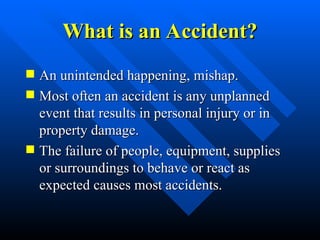
What is an Accident?
 An unintended happening, mishap.
An unintended happening, mishap.
 Most often an accident is any unplanned
Most often an accident is any unplanned
event that results in personal injury or in
property damage.
property damage.
 The failure of people, equipment, supplies
The failure of people, equipment, supplies
or surroundings to behave or react as
expected causes most accidents.
Accident Investigation
 Will determine how and why of failures.
Will determine how and why of failures.
 Examine possible corrective action.
Examine possible corrective action.
 Aid in the accident prevention and
Aid in the accident prevention and
elimination of a clearly identified hazard.
 Most important-
Most important-Investigation is not
Investigation is not
intended to place blame.
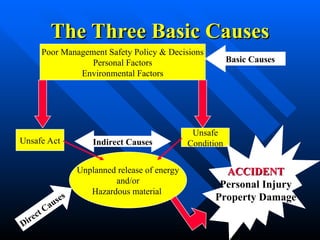
The Three Basic Causes
Poor Management Safety Policy & Decisions
Personal Factors
Environmental Factors
Unsafe Act
Unsafe
Condition
Unplanned release of energy
and/or
Hazardous material
Basic Causes
Indirect Causes
Direct Causes
ACCIDENT
ACCIDENT
Personal Injury
Property Damage
Be Prepared
Be Prepared
 Develop contingency plans prior to the accident.
Develop contingency plans prior to the accident.
 Designate an investigator
Designate an investigator
– This person should only be responsible for
This person should only be responsible for
investigating.
investigating.
– Should have a good working knowledge of operating
Should have a good working knowledge of operating
procedures.
procedures.
 Be equipped with the right tools to do the job
Be equipped with the right tools to do the job
thoroughly.
thoroughly.
Record the Facts
Record the Facts
 Interview witnesses as soon as possible.
Interview witnesses as soon as possible.
 Document the accident scene before any changes
Document the accident scene before any changes
are made.
are made.
– Take photos
Take photos
– Draw scaled sketches
Draw scaled sketches
– Record measurements
Record measurements
 Gather support documents such as maintenance
Gather support documents such as maintenance
records, reports, production schedules or process
diagrams.
diagrams.
Record the Facts
Record the Facts
 Keep all notes and remarks in a bound notebook
Keep all notes and remarks in a bound notebook
or three ring binder.
 Record:
Record:
– Pre-accident conditions
Pre-accident conditions
– Accident sequence
Accident sequence
– Post-accident conditions
Post-accident conditions
 Document victim location, witnesses, machinery,
Document victim location, witnesses, machinery,
energy sources and other contributing factors.
Record the Facts
Record the Facts
 Even the most insignificant detail may be
Even the most insignificant detail may be
useful.
useful.
 Document and then document some more.
Document and then document some more.
 The investigator should be concentrating
The investigator should be concentrating
solely on the investigation at hand.
Interviewing
Interviewing
 Excellent source of first hand knowledge.
Excellent source of first hand knowledge.
 May present pitfalls in the form of:
May present pitfalls in the form of:
– Bias
Bias
– Perspective
Perspective
– Embellishment
Embellishment
 It is important to maintain a clear thought
It is important to maintain a clear thought
process and control of the interview.
Interviewing
Interviewing
 Get preliminary statements as soon as
Get preliminary statements as soon as
possible from all witnesses.
 Locate the position of each witness on a
Locate the position of each witness on a
master chart (including the direction of view)
 Explain the purpose of the investigation
Explain the purpose of the investigation
(accident prevention) and put each witness at
ease.
ease.
Interviewing
Interviewing
 Let each witness speak freely and take notes
Let each witness speak freely and take notes
without distracting the witness (use a tape
recorder only with consent of the witness).
 Use sketches and diagrams to help the witness.
Use sketches and diagrams to help the witness.
 Emphasize areas of direct observation and
Emphasize areas of direct observation and
label hearsay accordingly.
 Record the exact words used by the witness to
Record the exact words used by the witness to
describe each observation.
Interviewing
Interviewing
 Word each question carefully and be sure the
Word each question carefully and be sure the
witness understands.
 Identify the qualifications of each witness
Identify the qualifications of each witness
(name, address, occupation, years of
experience, etc.).
experience, etc.).
 Supply each witness with a copy of their
Supply each witness with a copy of their
statements (signed statements are desirable).
Problem Solving Techniques
Change Analysis
Change Analysis
 This technique emphasizes change to
This technique emphasizes change to
correct the problem.
 Examination of deviations from the norm
Examination of deviations from the norm
are scrutinized.
are scrutinized.
 Consider all problems to result from some
Consider all problems to result from some
unanticipated change.
 Analyze the changes to determine its cause.
Analyze the changes to determine its cause.
Problem Solving Techniques
Change Analysis
Change Analysis
 Use the following steps in this method:
Use the following steps in this method:
– Define the problem (What happened?).
Define the problem (What happened?).
– Establish the norm (What should have happened?).
Establish the norm (What should have happened?).
– Identify, locate, and describe the change (What, where, when, to what
Identify, locate, and describe the change (What, where, when, to what
extent).
extent).
– Specify what was and what was not affected.
Specify what was and what was not affected.
– Identify the distinctive features of the change.
Identify the distinctive features of the change.
– List the possible causes.
List the possible causes.
– Select the most likely causes.
Select the most likely causes.
Problem Solving Techniques
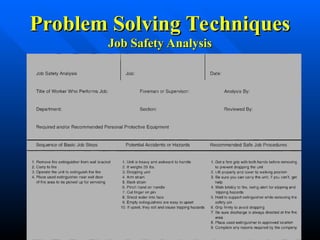
Job Safety Analysis
Job Safety Analysis
 Job safety analysis (JSA) is part of many existing accident
Job safety analysis (JSA) is part of many existing accident
prevention programs.
 In general, JSA breaks a job into basic steps, and identifies
In general, JSA breaks a job into basic steps, and identifies
the hazards associated with each step as well as prescribing
controls for each hazard.
 A JSA is a chart listing these steps, hazards, and controls.
A JSA is a chart listing these steps, hazards, and controls.
 Review the JSA during the investigation if a JSA has been
Review the JSA during the investigation if a JSA has been
conducted for the job involved in an accident.
 Perform a JSA if one is not available to determine the
Perform a JSA if one is not available to determine the
events and conditions that led to the accident.
Problem Solving Techniques
Job Safety Analysis
Job Safety Analysis
Investigation Report
 An accident investigation is not complete
An accident investigation is not complete
until a report is prepared and submitted to
the proper authorities.
 Suggestion of items to include in your
Suggestion of items to include in your
report.
report.
Investigation Report
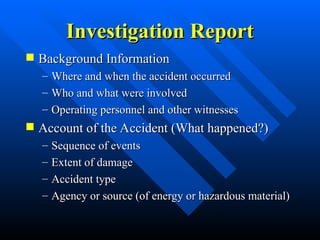
 Background Information
Background Information
– Where and when the accident occurred
Where and when the accident occurred
– Who and what were involved
Who and what were involved
– Operating personnel and other witnesses
Operating personnel and other witnesses
 Account of the Accident (What happened?)
Account of the Accident (What happened?)
– Sequence of events
Sequence of events
– Extent of damage
Extent of damage
– Accident type
Accident type
– Agency or source (of energy or hazardous material)
Agency or source (of energy or hazardous material)
Investigation Report
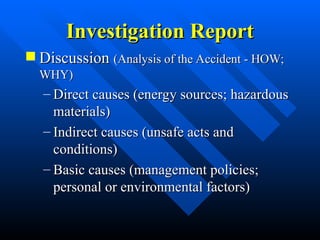
 Discussion
Discussion (Analysis of the Accident - HOW;
(Analysis of the Accident - HOW;
WHY)
WHY)
– Direct causes (energy sources; hazardous
Direct causes (energy sources; hazardous
materials)
materials)
– Indirect causes (unsafe acts and
Indirect causes (unsafe acts and
conditions)
conditions)
– Basic causes (management policies;
Basic causes (management policies;
personal or environmental factors)
Investigation Report
 Recommendations (to prevent a recurrence)
Recommendations (to prevent a recurrence)
for immediate and long-range action to
remedy:
remedy:
– Basic causes
Basic causes
– Indirect causes
Indirect causes
– Direct causes (such as reduced quantities or
Direct causes (such as reduced quantities or
protective equipment or structures)
Discussion of OSHA
Discussion of OSHA
Investigated Accidents
 Utilizing information collected by OSHA
Utilizing information collected by OSHA
investigated accidents and available at the
website:
website:
http://www.osha.gov/cgi-bin/inv/inv1
several accidents will be discussed.
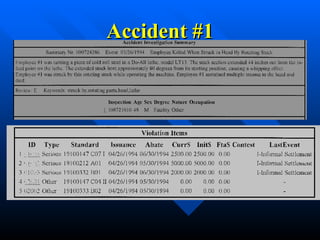
Accident #1
Accident #1
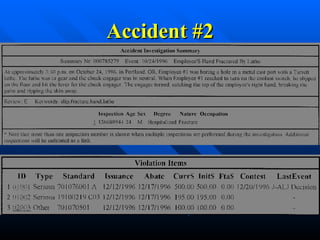
Accident #2
Accident #2
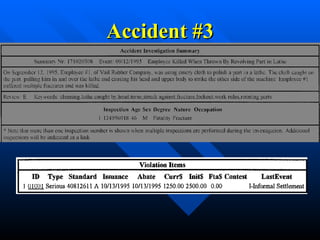
Accident #3
Accident #3
Any Questions
Any Questions
??
??

Accident Investigation protocol presentation

  • 1.
  • 2.
    What is anAccident? What is an Accident?  An unintended happening, mishap. An unintended happening, mishap.  Most often an accident is any unplanned Most often an accident is any unplanned event that results in personal injury or in event that results in personal injury or in property damage. property damage.  The failure of people, equipment, supplies The failure of people, equipment, supplies or surroundings to behave or react as or surroundings to behave or react as expected causes most accidents. expected causes most accidents.
  • 3.
    Accident Investigation Accident Investigation Will determine how and why of failures. Will determine how and why of failures.  Examine possible corrective action. Examine possible corrective action.  Aid in the accident prevention and Aid in the accident prevention and elimination of a clearly identified hazard. elimination of a clearly identified hazard.  Most important- Most important-Investigation is not Investigation is not intended to place blame. intended to place blame.
  • 4.
    The Three BasicCauses The Three Basic Causes Poor Management Safety Policy & Decisions Personal Factors Environmental Factors Unsafe Act Unsafe Condition Unplanned release of energy and/or Hazardous material Basic Causes Indirect Causes Direct Causes ACCIDENT ACCIDENT Personal Injury Property Damage
  • 5.
    Be Prepared Be Prepared Develop contingency plans prior to the accident. Develop contingency plans prior to the accident.  Designate an investigator Designate an investigator – This person should only be responsible for This person should only be responsible for investigating. investigating. – Should have a good working knowledge of operating Should have a good working knowledge of operating procedures. procedures.  Be equipped with the right tools to do the job Be equipped with the right tools to do the job thoroughly. thoroughly.
  • 6.
    Record the Facts Recordthe Facts  Interview witnesses as soon as possible. Interview witnesses as soon as possible.  Document the accident scene before any changes Document the accident scene before any changes are made. are made. – Take photos Take photos – Draw scaled sketches Draw scaled sketches – Record measurements Record measurements  Gather support documents such as maintenance Gather support documents such as maintenance records, reports, production schedules or process records, reports, production schedules or process diagrams. diagrams.
  • 7.
    Record the Facts Recordthe Facts  Keep all notes and remarks in a bound notebook Keep all notes and remarks in a bound notebook or three ring binder. or three ring binder.  Record: Record: – Pre-accident conditions Pre-accident conditions – Accident sequence Accident sequence – Post-accident conditions Post-accident conditions  Document victim location, witnesses, machinery, Document victim location, witnesses, machinery, energy sources and other contributing factors. energy sources and other contributing factors.
  • 8.
    Record the Facts Recordthe Facts  Even the most insignificant detail may be Even the most insignificant detail may be useful. useful.  Document and then document some more. Document and then document some more.  The investigator should be concentrating The investigator should be concentrating solely on the investigation at hand. solely on the investigation at hand.
  • 9.
    Interviewing Interviewing  Excellent sourceof first hand knowledge. Excellent source of first hand knowledge.  May present pitfalls in the form of: May present pitfalls in the form of: – Bias Bias – Perspective Perspective – Embellishment Embellishment  It is important to maintain a clear thought It is important to maintain a clear thought process and control of the interview. process and control of the interview.
  • 10.
    Interviewing Interviewing  Get preliminarystatements as soon as Get preliminary statements as soon as possible from all witnesses. possible from all witnesses.  Locate the position of each witness on a Locate the position of each witness on a master chart (including the direction of view) master chart (including the direction of view)  Explain the purpose of the investigation Explain the purpose of the investigation (accident prevention) and put each witness at (accident prevention) and put each witness at ease. ease.
  • 11.
    Interviewing Interviewing  Let eachwitness speak freely and take notes Let each witness speak freely and take notes without distracting the witness (use a tape without distracting the witness (use a tape recorder only with consent of the witness). recorder only with consent of the witness).  Use sketches and diagrams to help the witness. Use sketches and diagrams to help the witness.  Emphasize areas of direct observation and Emphasize areas of direct observation and label hearsay accordingly. label hearsay accordingly.  Record the exact words used by the witness to Record the exact words used by the witness to describe each observation. describe each observation.
  • 12.
    Interviewing Interviewing  Word eachquestion carefully and be sure the Word each question carefully and be sure the witness understands. witness understands.  Identify the qualifications of each witness Identify the qualifications of each witness (name, address, occupation, years of (name, address, occupation, years of experience, etc.). experience, etc.).  Supply each witness with a copy of their Supply each witness with a copy of their statements (signed statements are desirable). statements (signed statements are desirable).
  • 13.
    Problem Solving Techniques ProblemSolving Techniques Change Analysis Change Analysis  This technique emphasizes change to This technique emphasizes change to correct the problem. correct the problem.  Examination of deviations from the norm Examination of deviations from the norm are scrutinized. are scrutinized.  Consider all problems to result from some Consider all problems to result from some unanticipated change. unanticipated change.  Analyze the changes to determine its cause. Analyze the changes to determine its cause.
  • 14.
    Problem Solving Techniques ProblemSolving Techniques Change Analysis Change Analysis  Use the following steps in this method: Use the following steps in this method: – Define the problem (What happened?). Define the problem (What happened?). – Establish the norm (What should have happened?). Establish the norm (What should have happened?). – Identify, locate, and describe the change (What, where, when, to what Identify, locate, and describe the change (What, where, when, to what extent). extent). – Specify what was and what was not affected. Specify what was and what was not affected. – Identify the distinctive features of the change. Identify the distinctive features of the change. – List the possible causes. List the possible causes. – Select the most likely causes. Select the most likely causes.
  • 15.
    Problem Solving Techniques ProblemSolving Techniques Job Safety Analysis Job Safety Analysis  Job safety analysis (JSA) is part of many existing accident Job safety analysis (JSA) is part of many existing accident prevention programs. prevention programs.  In general, JSA breaks a job into basic steps, and identifies In general, JSA breaks a job into basic steps, and identifies the hazards associated with each step as well as prescribing the hazards associated with each step as well as prescribing controls for each hazard. controls for each hazard.  A JSA is a chart listing these steps, hazards, and controls. A JSA is a chart listing these steps, hazards, and controls.  Review the JSA during the investigation if a JSA has been Review the JSA during the investigation if a JSA has been conducted for the job involved in an accident. conducted for the job involved in an accident.  Perform a JSA if one is not available to determine the Perform a JSA if one is not available to determine the events and conditions that led to the accident. events and conditions that led to the accident.
  • 16.
    Problem Solving Techniques ProblemSolving Techniques Job Safety Analysis Job Safety Analysis
  • 17.
    Investigation Report Investigation Report An accident investigation is not complete An accident investigation is not complete until a report is prepared and submitted to until a report is prepared and submitted to the proper authorities. the proper authorities.  Suggestion of items to include in your Suggestion of items to include in your report. report.
  • 18.
    Investigation Report Investigation Report Background Information Background Information – Where and when the accident occurred Where and when the accident occurred – Who and what were involved Who and what were involved – Operating personnel and other witnesses Operating personnel and other witnesses  Account of the Accident (What happened?) Account of the Accident (What happened?) – Sequence of events Sequence of events – Extent of damage Extent of damage – Accident type Accident type – Agency or source (of energy or hazardous material) Agency or source (of energy or hazardous material)
  • 19.
    Investigation Report Investigation Report Discussion Discussion (Analysis of the Accident - HOW; (Analysis of the Accident - HOW; WHY) WHY) – Direct causes (energy sources; hazardous Direct causes (energy sources; hazardous materials) materials) – Indirect causes (unsafe acts and Indirect causes (unsafe acts and conditions) conditions) – Basic causes (management policies; Basic causes (management policies; personal or environmental factors) personal or environmental factors)
  • 20.
    Investigation Report Investigation Report Recommendations (to prevent a recurrence) Recommendations (to prevent a recurrence) for immediate and long-range action to for immediate and long-range action to remedy: remedy: – Basic causes Basic causes – Indirect causes Indirect causes – Direct causes (such as reduced quantities or Direct causes (such as reduced quantities or protective equipment or structures) protective equipment or structures)
  • 21.
    Discussion of OSHA Discussionof OSHA Investigated Accidents Investigated Accidents  Utilizing information collected by OSHA Utilizing information collected by OSHA investigated accidents and available at the investigated accidents and available at the website: website: http://www.osha.gov/cgi-bin/inv/inv1 http://www.osha.gov/cgi-bin/inv/inv1 several accidents will be discussed. several accidents will be discussed.
  • 22.
  • 23.
  • 24.
  • 25.