Accident
Investigation
What is an Accident?
 An unintended happening, mishap.
 Most often an accident is any unplanned
event that results in personal injury or in
property damage.
 The failure of people, equipment, supplies
or surroundings to behave or react as
expected causes most accidents.
Accident Investigation
 Will determine how and why of failures.
 Examine possible corrective action.
 Aid in the accident prevention and
elimination of a clearly identified hazard.
 Most important-Investigation is not
intended to place blame.
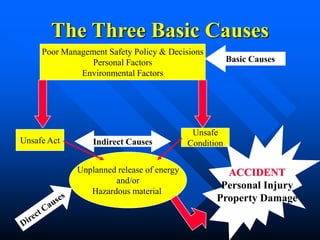
The Three Basic Causes
Poor Management Safety Policy & Decisions
Personal Factors
Environmental Factors
Unsafe Act
Unsafe
Condition
Unplanned release of energy
and/or
Hazardous material
Basic Causes
Indirect Causes
ACCIDENT
Personal Injury
Property Damage
Be Prepared
 Develop contingency plans prior to the
accident.
 Designate an investigator
– This person should only be responsible for
investigating.
– Should have a good working knowledge of
operating procedures.
 Be equipped with the right tools to do the
job thoroughly.
Record the Facts
 Interview witnesses as soon as possible.
 Document the accident scene before any
changes are made.
– Take photos
– Draw scaled sketches
– Record measurements
 Gather support documents such as
maintenance records, reports, production
schedules or process diagrams.
Record the Facts
 Keep all notes and remarks in a bound
notebook or three ring binder.
 Record:
– Pre-accident conditions
– Accident sequence
– Post-accident conditions
 Document victim location, witnesses,
machinery, energy sources and other
contributing factors.
Record the Facts
 Even the most insignificant detail may be
useful.
 Document and then document some more.
 The investigator should be concentrating
solely on the investigation at hand.
Interviewing
 Excellent source of first hand knowledge.
 May present pitfalls in the form of:
– Bias
– Perspective
– Embellishment
 It is important to maintain a clear thought
process and control of the interview.
Interviewing
 Get preliminary statements as soon as
possible from all witnesses.
 Locate the position of each witness on a
master chart (including the direction of
view)
 Explain the purpose of the investigation
(accident prevention) and put each witness
at ease.
Interviewing
 Let each witness speak freely and take notes
without distracting the witness (use a tape
recorder only with consent of the witness).
 Use sketches and diagrams to help the
witness.
 Emphasize areas of direct observation and
label hearsay accordingly.
 Record the exact words used by the witness
to describe each observation.
Interviewing
 Word each question carefully and be sure
the witness understands.
 Identify the qualifications of each witness
(name, address, occupation, years of
experience, etc.).
 Supply each witness with a copy of their
statements (signed statements are desirable).
Problem Solving Techniques
Change Analysis
 This technique emphasizes change to
correct the problem.
 Examination of deviations from the norm
are scrutinized.
 Consider all problems to result from some
unanticipated change.
 Analyze the changes to determine its cause.
Problem Solving Techniques
Change Analysis
 Use the following steps in this method:
– Define the problem (What happened?).
– Establish the norm (What should have happened?).
– Identify, locate, and describe the change (What, where, when, to
what extent).
– Specify what was and what was not affected.
– Identify the distinctive features of the change.
– List the possible causes.
– Select the most likely causes.
Problem Solving Techniques
Job Safety Analysis
 Job safety analysis (JSA) is part of many existing
accident prevention programs.
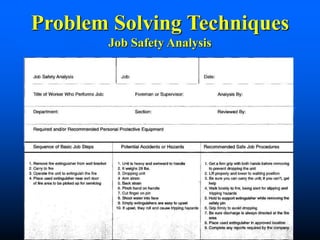
 In general, JSA breaks a job into basic steps, and
identifies the hazards associated with each step as well
as prescribing controls for each hazard.
 A JSA is a chart listing these steps, hazards, and
controls.
 Review the JSA during the investigation if a JSA has
been conducted for the job involved in an accident.
 Perform a JSA if one is not available to determine the
events and conditions that led to the accident.
Problem Solving Techniques
Job Safety Analysis
Investigation Report
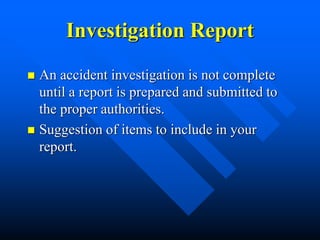
 An accident investigation is not complete
until a report is prepared and submitted to
the proper authorities.
 Suggestion of items to include in your
report.
Investigation Report
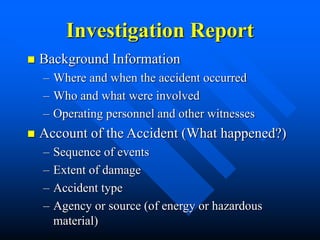
 Background Information
– Where and when the accident occurred
– Who and what were involved
– Operating personnel and other witnesses
 Account of the Accident (What happened?)
– Sequence of events
– Extent of damage
– Accident type
– Agency or source (of energy or hazardous
material)
Investigation Report
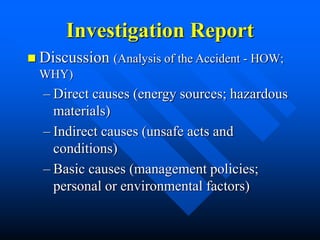
 Discussion (Analysis of the Accident - HOW;
WHY)
– Direct causes (energy sources; hazardous
materials)
– Indirect causes (unsafe acts and
conditions)
– Basic causes (management policies;
personal or environmental factors)
Investigation Report
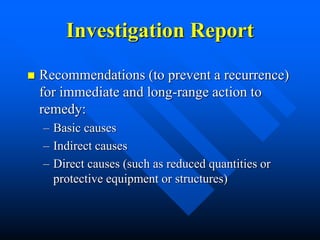
 Recommendations (to prevent a recurrence)
for immediate and long-range action to
remedy:
– Basic causes
– Indirect causes
– Direct causes (such as reduced quantities or
protective equipment or structures)
Discussion of OSHA
Investigated Accidents
 Utilizing information collected by OSHA
investigated accidents and available at the
website:
http://www.osha.gov/cgi-bin/inv/inv1
several accidents will be discussed.
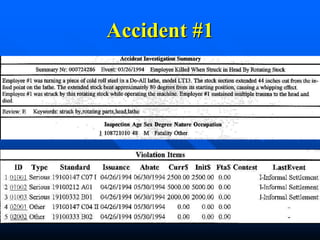
Accident #1
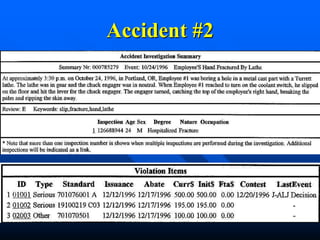
Accident #2
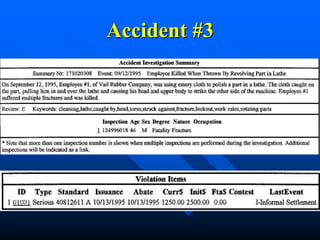
Accident #3
Any Questions

Accident_Investigation_5.ppt

  • 1.
  • 2.
    What is anAccident?  An unintended happening, mishap.  Most often an accident is any unplanned event that results in personal injury or in property damage.  The failure of people, equipment, supplies or surroundings to behave or react as expected causes most accidents.
  • 3.
    Accident Investigation  Willdetermine how and why of failures.  Examine possible corrective action.  Aid in the accident prevention and elimination of a clearly identified hazard.  Most important-Investigation is not intended to place blame.
  • 4.
    The Three BasicCauses Poor Management Safety Policy & Decisions Personal Factors Environmental Factors Unsafe Act Unsafe Condition Unplanned release of energy and/or Hazardous material Basic Causes Indirect Causes ACCIDENT Personal Injury Property Damage
  • 5.
    Be Prepared  Developcontingency plans prior to the accident.  Designate an investigator – This person should only be responsible for investigating. – Should have a good working knowledge of operating procedures.  Be equipped with the right tools to do the job thoroughly.
  • 6.
    Record the Facts Interview witnesses as soon as possible.  Document the accident scene before any changes are made. – Take photos – Draw scaled sketches – Record measurements  Gather support documents such as maintenance records, reports, production schedules or process diagrams.
  • 7.
    Record the Facts Keep all notes and remarks in a bound notebook or three ring binder.  Record: – Pre-accident conditions – Accident sequence – Post-accident conditions  Document victim location, witnesses, machinery, energy sources and other contributing factors.
  • 8.
    Record the Facts Even the most insignificant detail may be useful.  Document and then document some more.  The investigator should be concentrating solely on the investigation at hand.
  • 9.
    Interviewing  Excellent sourceof first hand knowledge.  May present pitfalls in the form of: – Bias – Perspective – Embellishment  It is important to maintain a clear thought process and control of the interview.
  • 10.
    Interviewing  Get preliminarystatements as soon as possible from all witnesses.  Locate the position of each witness on a master chart (including the direction of view)  Explain the purpose of the investigation (accident prevention) and put each witness at ease.
  • 11.
    Interviewing  Let eachwitness speak freely and take notes without distracting the witness (use a tape recorder only with consent of the witness).  Use sketches and diagrams to help the witness.  Emphasize areas of direct observation and label hearsay accordingly.  Record the exact words used by the witness to describe each observation.
  • 12.
    Interviewing  Word eachquestion carefully and be sure the witness understands.  Identify the qualifications of each witness (name, address, occupation, years of experience, etc.).  Supply each witness with a copy of their statements (signed statements are desirable).
  • 13.
    Problem Solving Techniques ChangeAnalysis  This technique emphasizes change to correct the problem.  Examination of deviations from the norm are scrutinized.  Consider all problems to result from some unanticipated change.  Analyze the changes to determine its cause.
  • 14.
    Problem Solving Techniques ChangeAnalysis  Use the following steps in this method: – Define the problem (What happened?). – Establish the norm (What should have happened?). – Identify, locate, and describe the change (What, where, when, to what extent). – Specify what was and what was not affected. – Identify the distinctive features of the change. – List the possible causes. – Select the most likely causes.
  • 15.
    Problem Solving Techniques JobSafety Analysis  Job safety analysis (JSA) is part of many existing accident prevention programs.  In general, JSA breaks a job into basic steps, and identifies the hazards associated with each step as well as prescribing controls for each hazard.  A JSA is a chart listing these steps, hazards, and controls.  Review the JSA during the investigation if a JSA has been conducted for the job involved in an accident.  Perform a JSA if one is not available to determine the events and conditions that led to the accident.
  • 16.
  • 17.
    Investigation Report  Anaccident investigation is not complete until a report is prepared and submitted to the proper authorities.  Suggestion of items to include in your report.
  • 18.
    Investigation Report  BackgroundInformation – Where and when the accident occurred – Who and what were involved – Operating personnel and other witnesses  Account of the Accident (What happened?) – Sequence of events – Extent of damage – Accident type – Agency or source (of energy or hazardous material)
  • 19.
    Investigation Report  Discussion(Analysis of the Accident - HOW; WHY) – Direct causes (energy sources; hazardous materials) – Indirect causes (unsafe acts and conditions) – Basic causes (management policies; personal or environmental factors)
  • 20.
    Investigation Report  Recommendations(to prevent a recurrence) for immediate and long-range action to remedy: – Basic causes – Indirect causes – Direct causes (such as reduced quantities or protective equipment or structures)
  • 21.
    Discussion of OSHA InvestigatedAccidents  Utilizing information collected by OSHA investigated accidents and available at the website: http://www.osha.gov/cgi-bin/inv/inv1 several accidents will be discussed.
  • 22.
  • 23.
  • 24.
  • 25.