Adrian’s Bio:
Dr. Adrian Stevens received his Ph.D. in computational chemistry at the
University of Portsmouth. After his Ph.D., he spent 9 years with BioFocus, a
contract research organization, specializing in small-molecule-based discovery
research. In this time, Adrian worked closely with a broad range of leading
Pharmaceutical companies in collaborative research projects. Following just
over a year at KuDOS, a company specializing in DNA-repair-based pathway
therapeutics and a wholly owned subsidiary of AstraZeneca, Adrian joined
Accelrys in 2008. Adrian is currently the Senior Product Marketing Manager,
responsible for the direction and development of the Discovery Studio product.


                                                                                 1
2
3
4
5
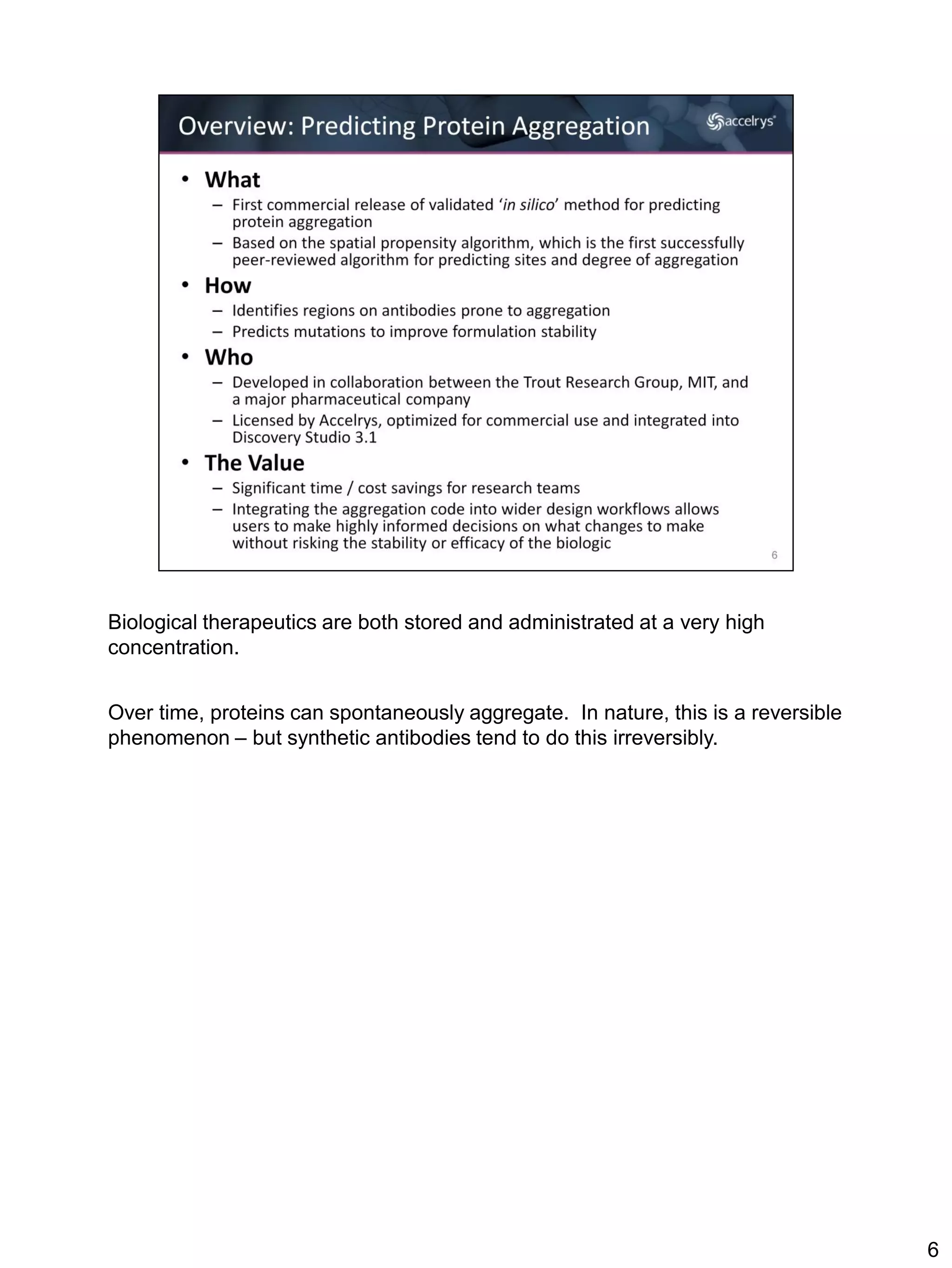
Biological therapeutics are both stored and administrated at a very high
concentration.


Over time, proteins can spontaneously aggregate. In nature, this is a reversible
phenomenon – but synthetic antibodies tend to do this irreversibly.


                                                                                   6
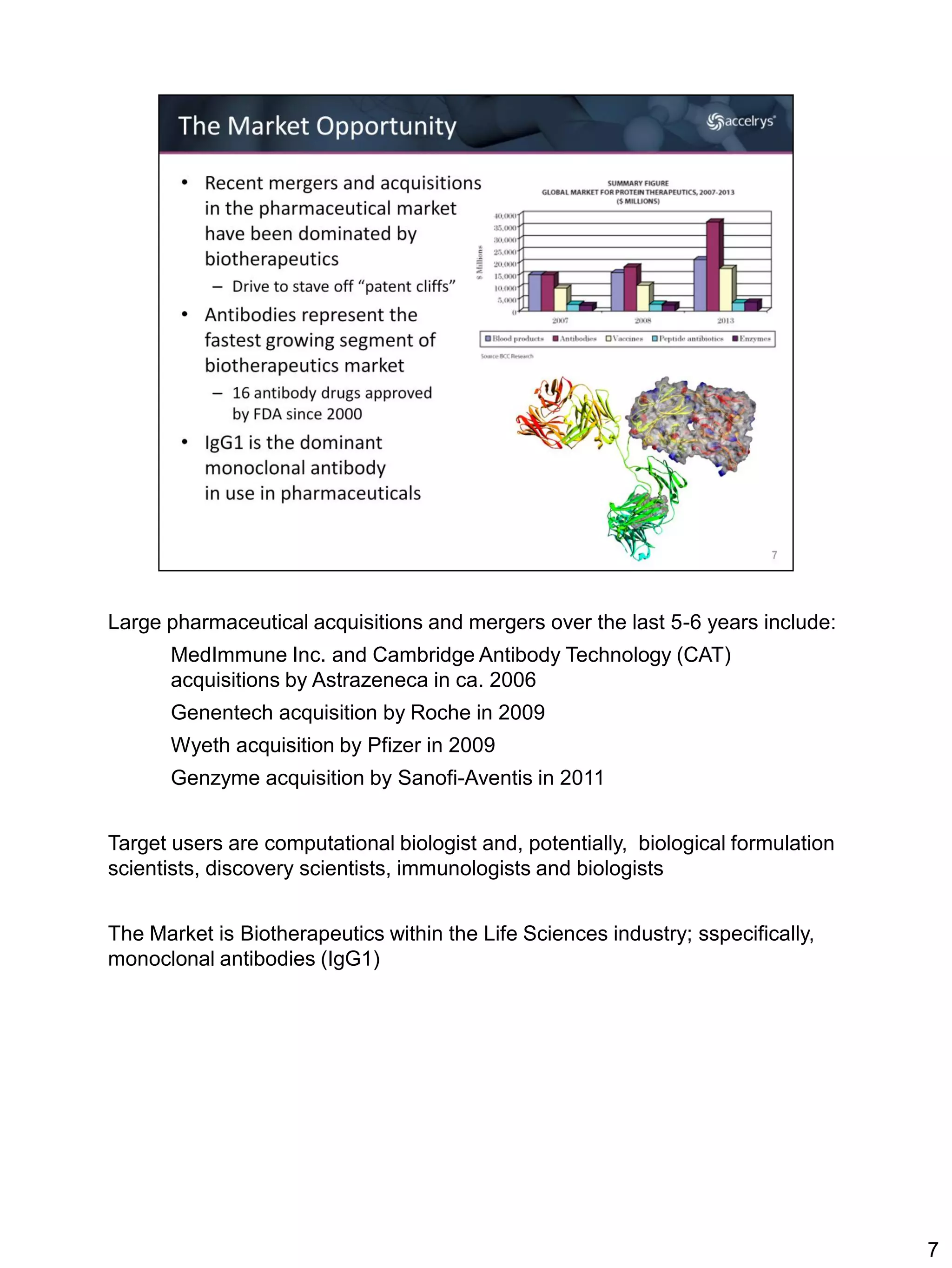
Large pharmaceutical acquisitions and mergers over the last 5-6 years include:
       MedImmune Inc. and Cambridge Antibody Technology (CAT)
       acquisitions by Astrazeneca in ca. 2006
       Genentech acquisition by Roche in 2009
       Wyeth acquisition by Pfizer in 2009
       Genzyme acquisition by Sanofi-Aventis in 2011


Target users are computational biologist and, potentially, biological formulation
scientists, discovery scientists, immunologists and biologists


The Market is Biotherapeutics within the Life Sciences industry; sspecifically,
monoclonal antibodies (IgG1)


                                                                                    7
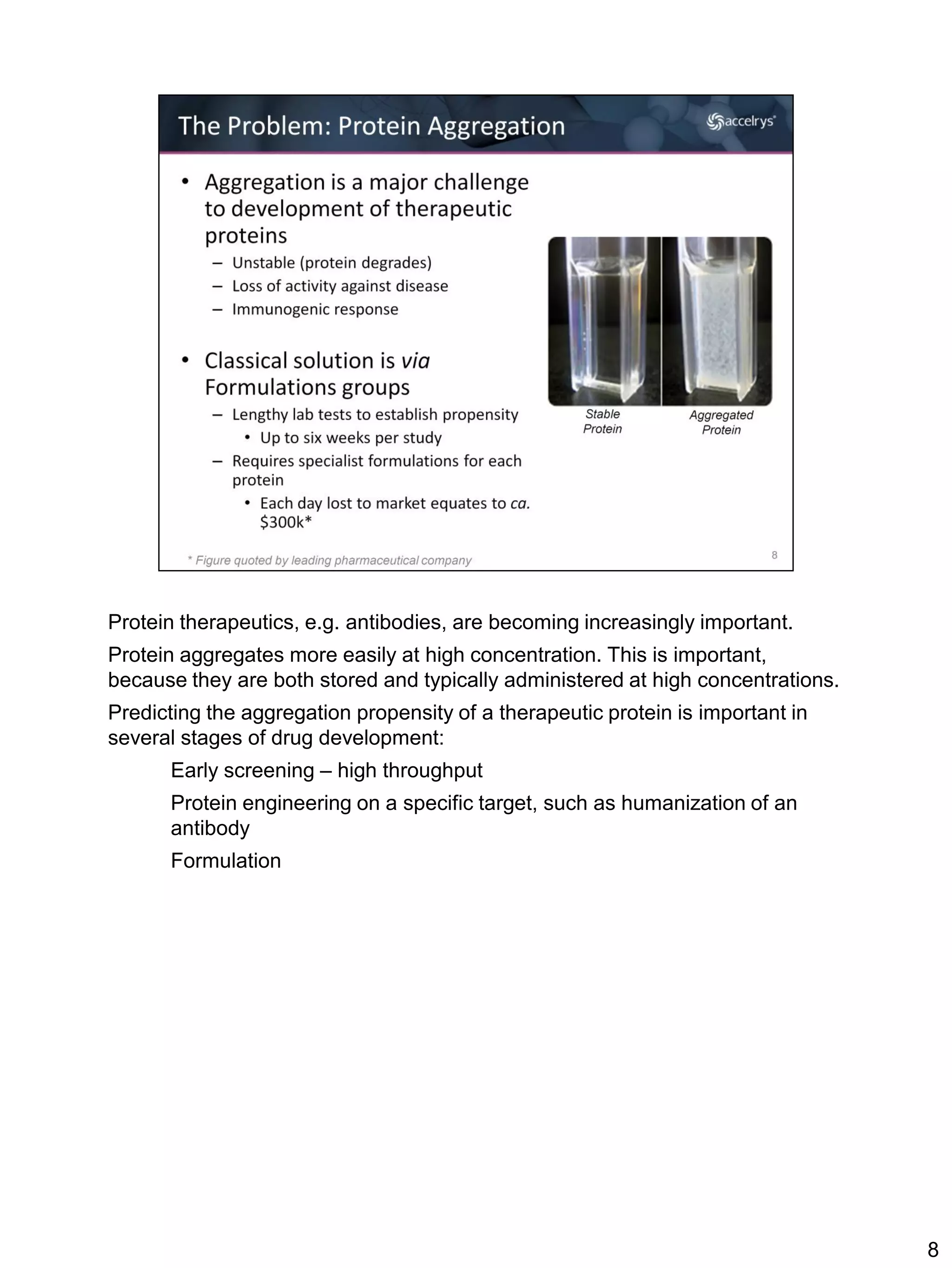
Protein therapeutics, e.g. antibodies, are becoming increasingly important.
Protein aggregates more easily at high concentration. This is important,
because they are both stored and typically administered at high concentrations.
Predicting the aggregation propensity of a therapeutic protein is important in
several stages of drug development:
      Early screening – high throughput
      Protein engineering on a specific target, such as humanization of an
      antibody
      Formulation


                                                                                  8
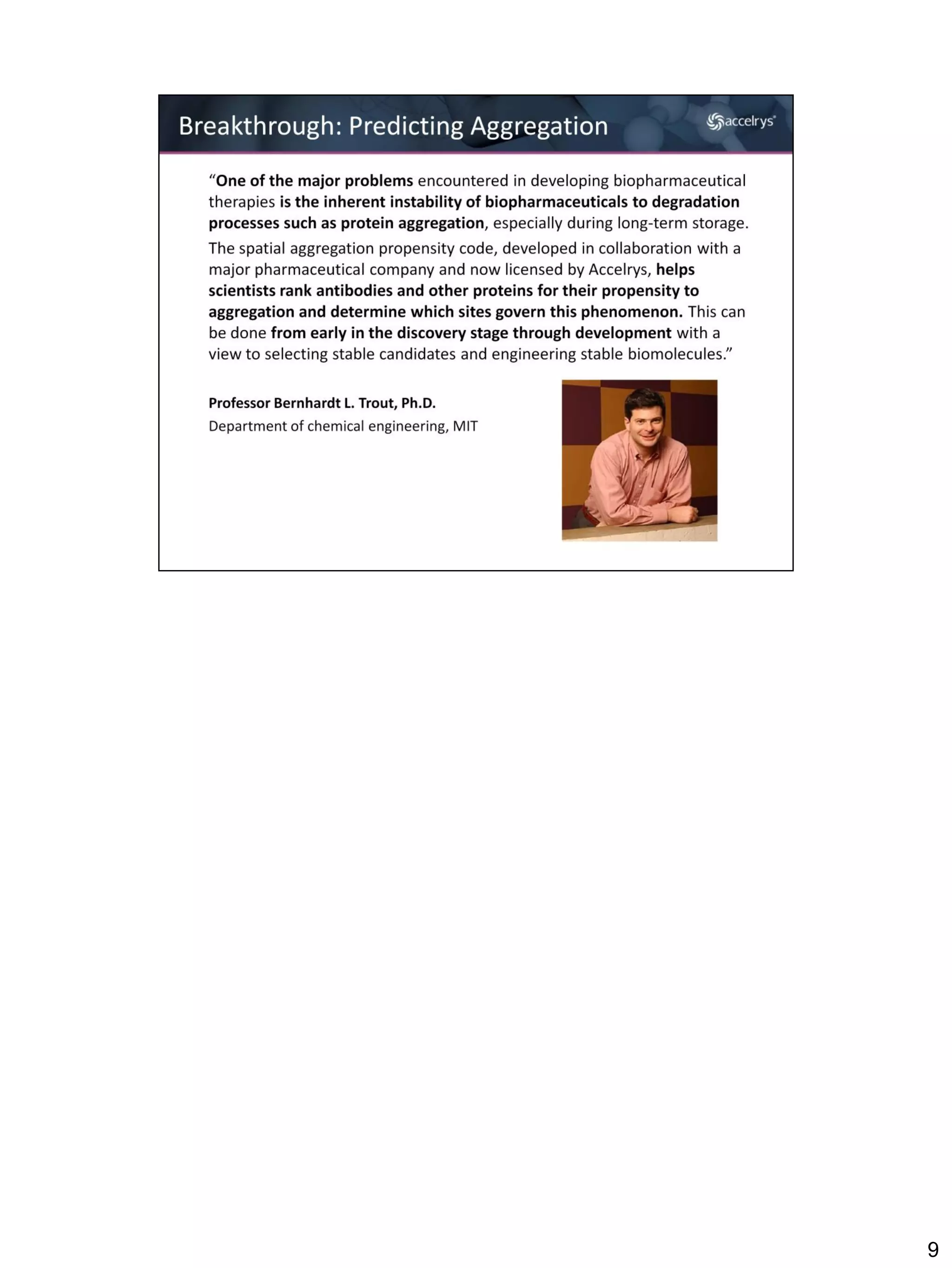
9
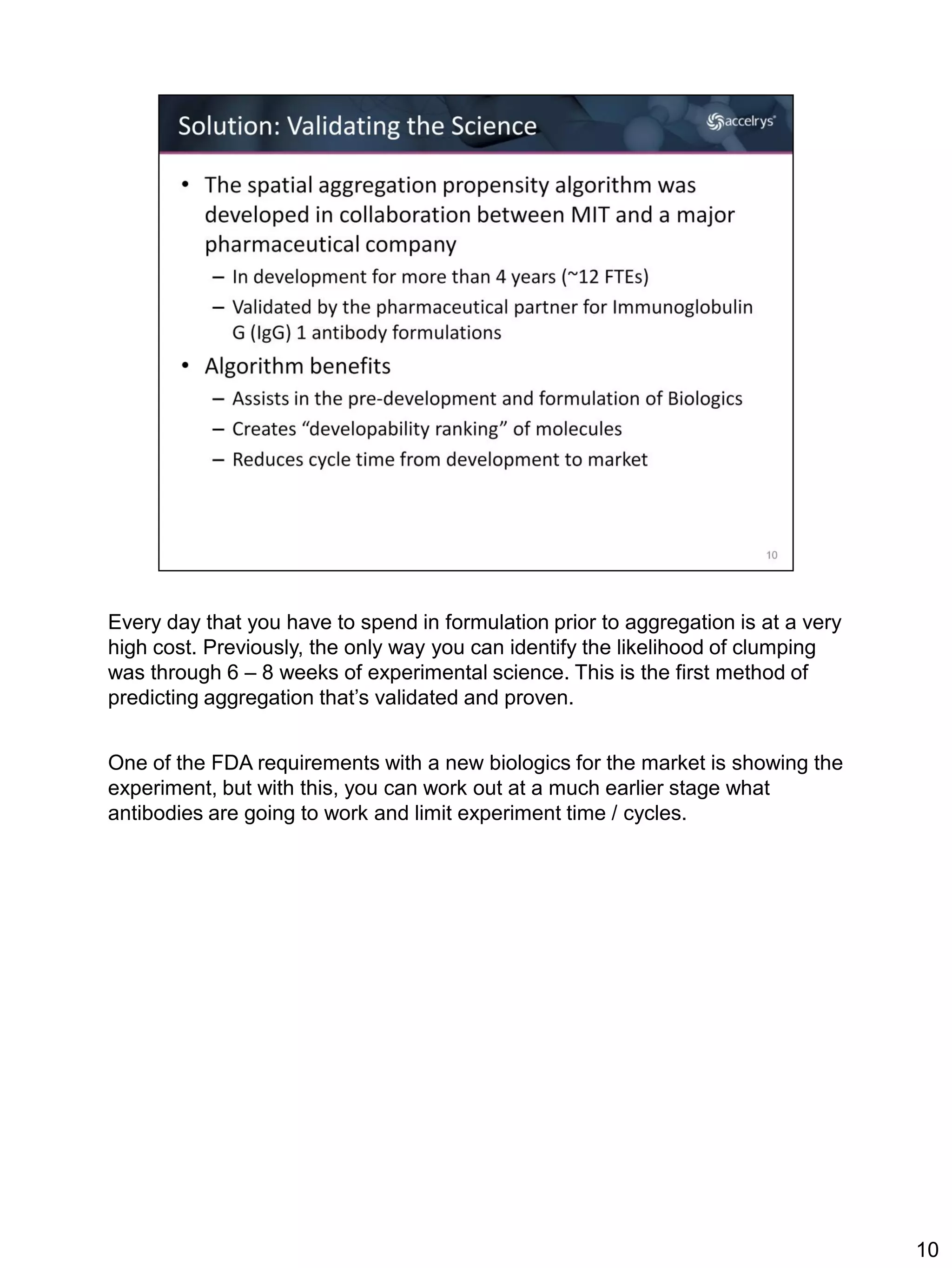
Every day that you have to spend in formulation prior to aggregation is at a very
high cost. Previously, the only way you can identify the likelihood of clumping
was through 6 – 8 weeks of experimental science. This is the first method of
predicting aggregation that’s validated and proven.


One of the FDA requirements with a new biologics for the market is showing the
experiment, but with this, you can work out at a much earlier stage what
antibodies are going to work and limit experiment time / cycles.


                                                                                    10
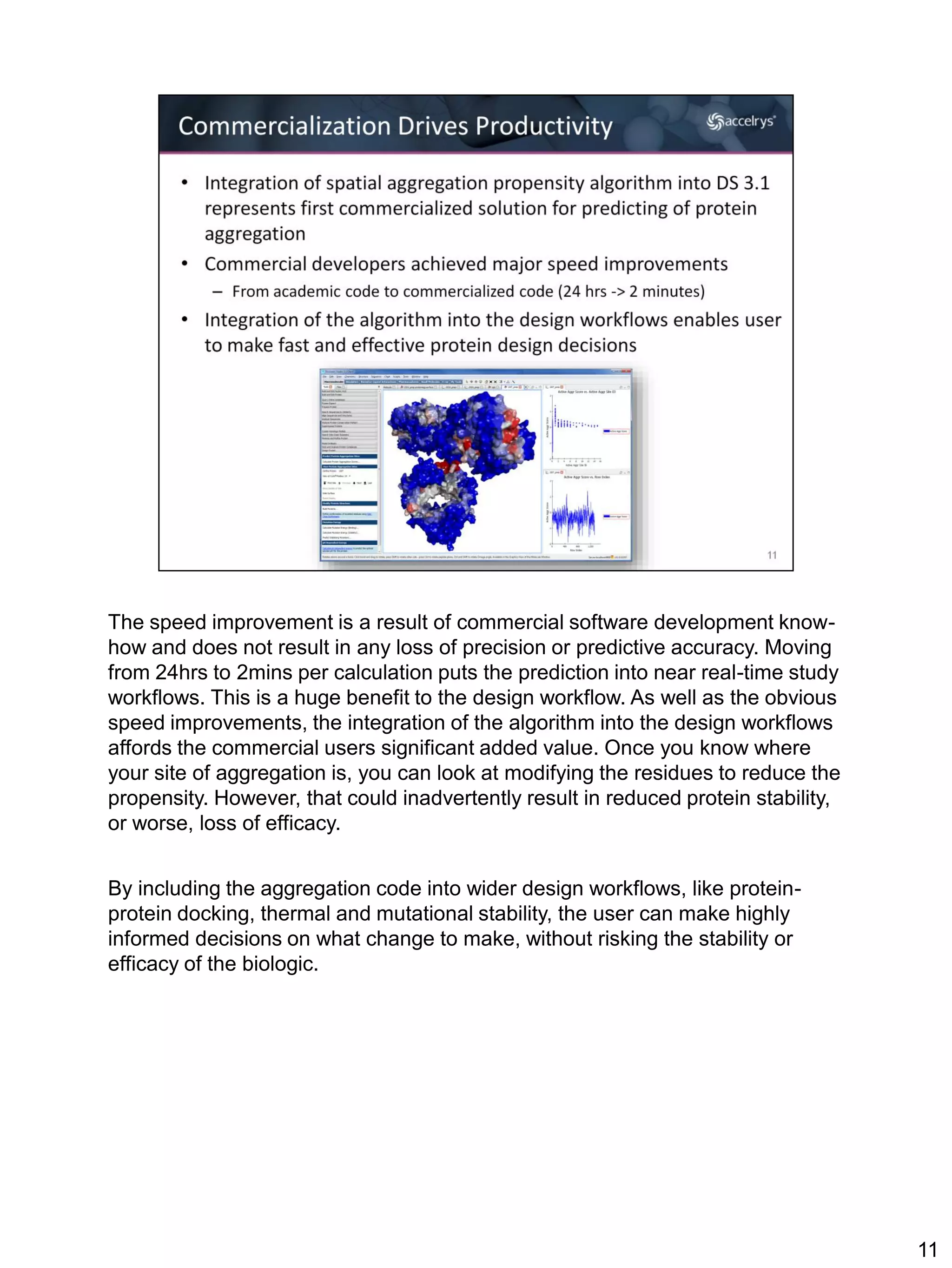
The speed improvement is a result of commercial software development know-
how and does not result in any loss of precision or predictive accuracy. Moving
from 24hrs to 2mins per calculation puts the prediction into near real-time study
workflows. This is a huge benefit to the design workflow. As well as the obvious
speed improvements, the integration of the algorithm into the design workflows
affords the commercial users significant added value. Once you know where
your site of aggregation is, you can look at modifying the residues to reduce the
propensity. However, that could inadvertently result in reduced protein stability,
or worse, loss of efficacy.


By including the aggregation code into wider design workflows, like protein-
protein docking, thermal and mutational stability, the user can make highly
informed decisions on what change to make, without risking the stability or
efficacy of the biologic.


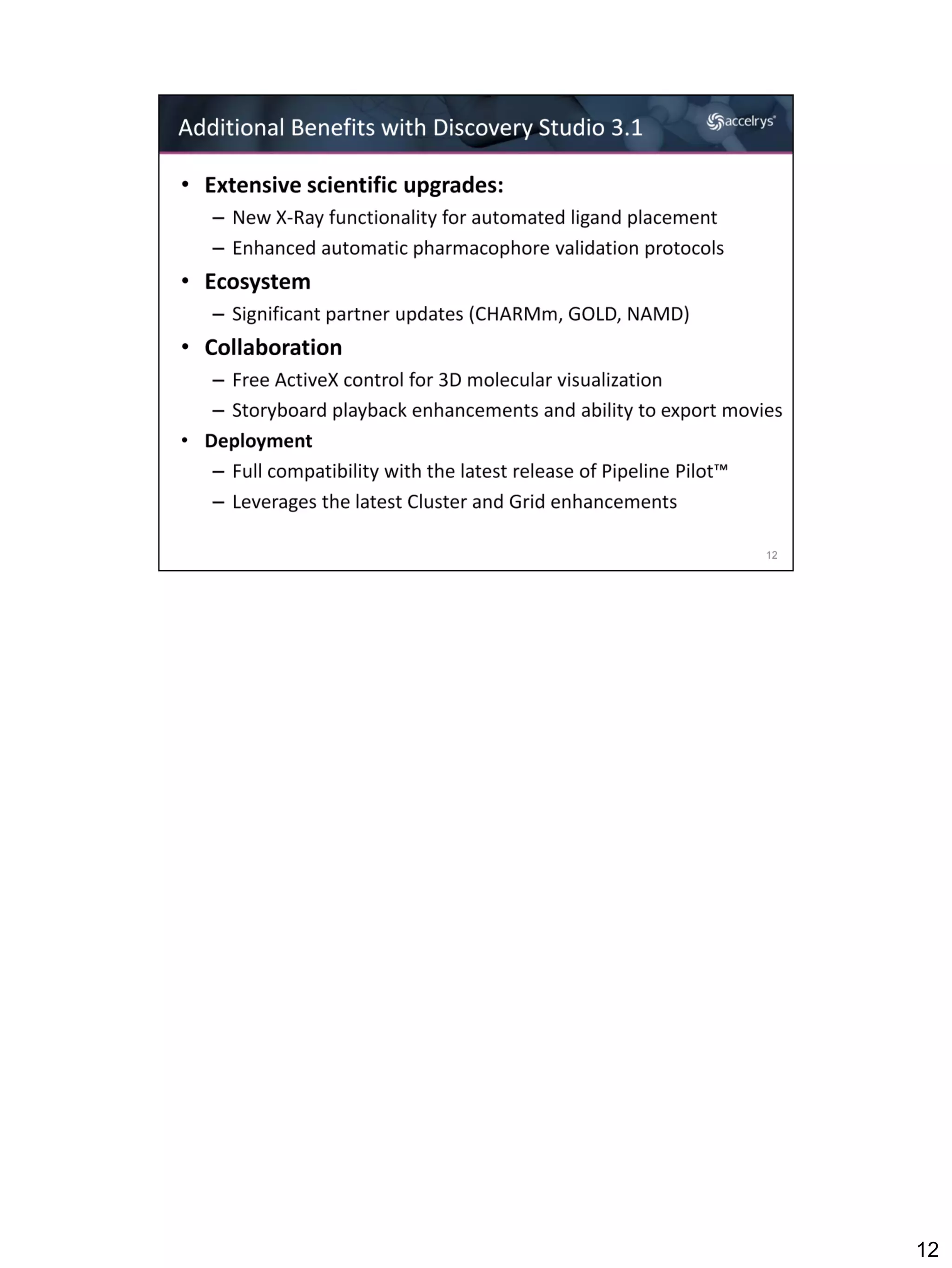
                                                                                     11
12
13
14
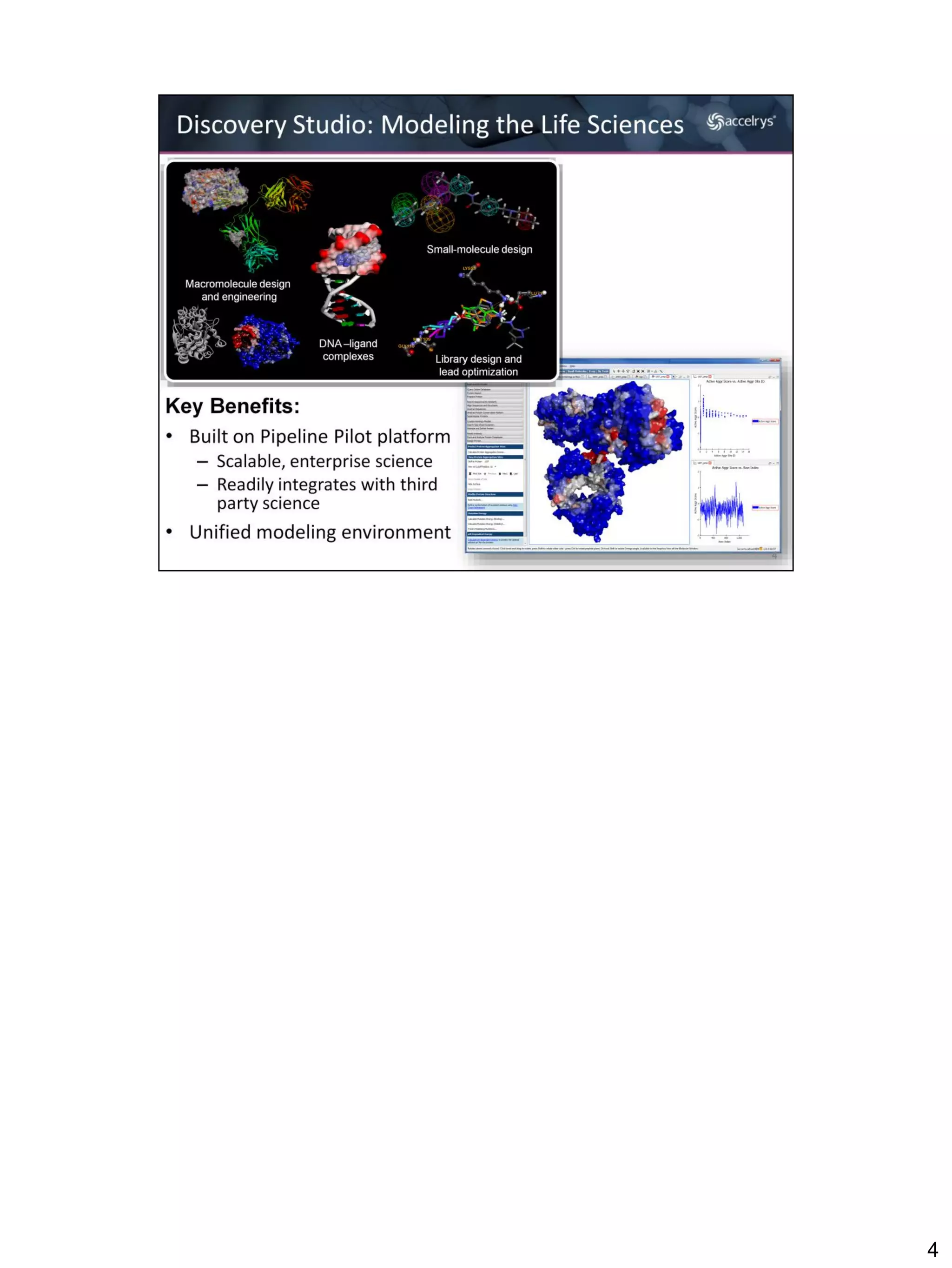
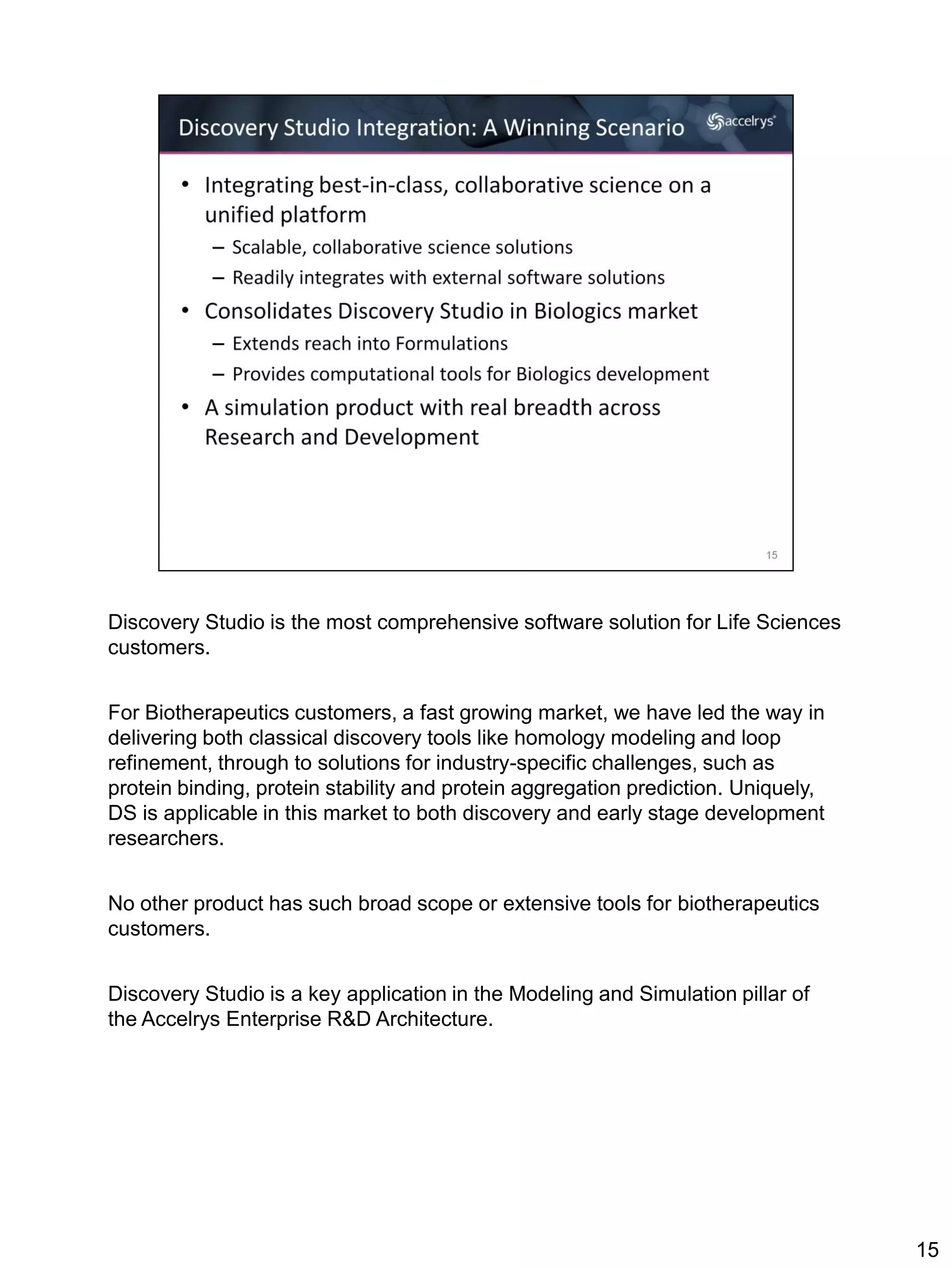
Discovery Studio is the most comprehensive software solution for Life Sciences
customers.


For Biotherapeutics customers, a fast growing market, we have led the way in
delivering both classical discovery tools like homology modeling and loop
refinement, through to solutions for industry-specific challenges, such as
protein binding, protein stability and protein aggregation prediction. Uniquely,
DS is applicable in this market to both discovery and early stage development
researchers.


No other product has such broad scope or extensive tools for biotherapeutics
customers.


Discovery Studio is a key application in the Modeling and Simulation pillar of
the Accelrys Enterprise R&D Architecture.


                                                                                   15

Accelrys Discovery Studio 3.1

  • 1.
    Adrian’s Bio: Dr. AdrianStevens received his Ph.D. in computational chemistry at the University of Portsmouth. After his Ph.D., he spent 9 years with BioFocus, a contract research organization, specializing in small-molecule-based discovery research. In this time, Adrian worked closely with a broad range of leading Pharmaceutical companies in collaborative research projects. Following just over a year at KuDOS, a company specializing in DNA-repair-based pathway therapeutics and a wholly owned subsidiary of AstraZeneca, Adrian joined Accelrys in 2008. Adrian is currently the Senior Product Marketing Manager, responsible for the direction and development of the Discovery Studio product. 1
  • 2.
  • 3.
  • 4.
  • 5.
  • 6.
    Biological therapeutics areboth stored and administrated at a very high concentration. Over time, proteins can spontaneously aggregate. In nature, this is a reversible phenomenon – but synthetic antibodies tend to do this irreversibly. 6
  • 7.
    Large pharmaceutical acquisitionsand mergers over the last 5-6 years include: MedImmune Inc. and Cambridge Antibody Technology (CAT) acquisitions by Astrazeneca in ca. 2006 Genentech acquisition by Roche in 2009 Wyeth acquisition by Pfizer in 2009 Genzyme acquisition by Sanofi-Aventis in 2011 Target users are computational biologist and, potentially, biological formulation scientists, discovery scientists, immunologists and biologists The Market is Biotherapeutics within the Life Sciences industry; sspecifically, monoclonal antibodies (IgG1) 7
  • 8.
    Protein therapeutics, e.g.antibodies, are becoming increasingly important. Protein aggregates more easily at high concentration. This is important, because they are both stored and typically administered at high concentrations. Predicting the aggregation propensity of a therapeutic protein is important in several stages of drug development: Early screening – high throughput Protein engineering on a specific target, such as humanization of an antibody Formulation 8
  • 9.
  • 10.
    Every day thatyou have to spend in formulation prior to aggregation is at a very high cost. Previously, the only way you can identify the likelihood of clumping was through 6 – 8 weeks of experimental science. This is the first method of predicting aggregation that’s validated and proven. One of the FDA requirements with a new biologics for the market is showing the experiment, but with this, you can work out at a much earlier stage what antibodies are going to work and limit experiment time / cycles. 10
  • 11.
    The speed improvementis a result of commercial software development know- how and does not result in any loss of precision or predictive accuracy. Moving from 24hrs to 2mins per calculation puts the prediction into near real-time study workflows. This is a huge benefit to the design workflow. As well as the obvious speed improvements, the integration of the algorithm into the design workflows affords the commercial users significant added value. Once you know where your site of aggregation is, you can look at modifying the residues to reduce the propensity. However, that could inadvertently result in reduced protein stability, or worse, loss of efficacy. By including the aggregation code into wider design workflows, like protein- protein docking, thermal and mutational stability, the user can make highly informed decisions on what change to make, without risking the stability or efficacy of the biologic. 11
  • 12.
  • 13.
  • 14.
  • 15.
    Discovery Studio isthe most comprehensive software solution for Life Sciences customers. For Biotherapeutics customers, a fast growing market, we have led the way in delivering both classical discovery tools like homology modeling and loop refinement, through to solutions for industry-specific challenges, such as protein binding, protein stability and protein aggregation prediction. Uniquely, DS is applicable in this market to both discovery and early stage development researchers. No other product has such broad scope or extensive tools for biotherapeutics customers. Discovery Studio is a key application in the Modeling and Simulation pillar of the Accelrys Enterprise R&D Architecture. 15