Academic Vocabulary:
Powerful Strategies and Digital
Connections
ANGELA PEERY, ED. D.
DRANGELAPEERY@GMAIL.COM
Two Forthcoming Books
BLENDED VOCABULARY
o Modeling and school culture
o Direct instruction
o Digital tools
o Incidental learning opportunities
IT’S A SNAP VOCABULARY
o Effective instruction
o Specific mini-lesson structure
o 100+ ideas for mini-lessons
The Importance of Vocabulary
Why do our students need to enlarge their vocabularies?
What will robust vocabularies help them do?
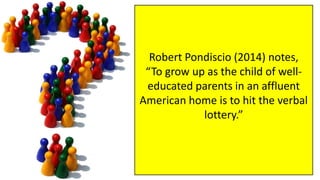
Robert Pondiscio (2014) notes,
“To grow up as the child of well-
educated parents in an affluent
American home is to hit the verbal
lottery.”
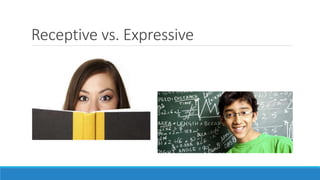
Receptive vs. Expressive
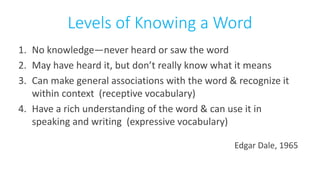
Levels of Knowing a Word
1. No knowledge—never heard or saw the word
2. May have heard it, but don’t really know what it means
3. Can make general associations with the word & recognize it
within context (receptive vocabulary)
4. Have a rich understanding of the word & can use it in
speaking and writing (expressive vocabulary)
Edgar Dale, 1965
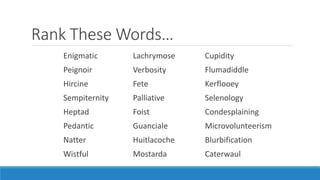
Rank These Words…
Enigmatic Lachrymose Cupidity
Peignoir Verbosity Flumadiddle
Hircine Fete Kerflooey
Sempiternity Palliative Selenology
Heptad Foist Condesplaining
Pedantic Guanciale Microvolunteerism
Natter Huitlacoche Blurbification
Wistful Mostarda Caterwaul
The Link to Instruction
How could you use the four stages of word learning with
your students?
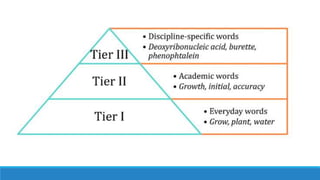
What Words To Teach?
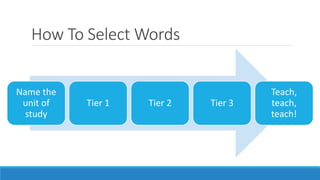
How To Select Words
Name the
unit of
study
Tier 1 Tier 2 Tier 3
Teach,
teach,
teach!
Sort the Words 1
A space probe is an unpiloted spacecraft that leaves Earth’s orbit to
explore the Moon, planets, asteroids, comets, or other objects in outer
space as directed by onboard computers and/or instructions sent from
Earth. The purpose of such missions is to make scientific observations,
such as taking pictures, measuring atmospheric conditions, and collecting
soil samples, and to bring or report the data back to Earth. Numerous
space probes have been launched since the former Soviet Union first fired
Luna I towards the Moon in 1959. Probes have now visited each of the
planets in the solar system.
Engelbert, 2009, as cited in All About Words
Sort the Words 1
A space probe is an unpiloted spacecraft that leaves Earth’s orbit to
explore the Moon, planets, asteroids, comets, or other objects in outer
space as directed by onboard computers and/or instructions sent from
Earth. The purpose of such missions is to make scientific observations,
such as taking pictures, measuring atmospheric conditions, and collecting
soil samples, and to bring or report the data back to Earth. Numerous
space probes have been launched since the former Soviet Union first fired
Luna I towards the Moon in 1959. Probes have now visited each of the
planets in the solar system.
Engelbert, 2009, as cited in All About Words
Sort the Words 2
Great whirling storms roar out of the oceans in many parts of the world. They are called
by several names—hurricane, typhoon, and cyclone are the three most familiar ones.
But no matter what they are called, they are all the same sort of storm. They are born in
the same way, in tropical waters. They develop the same way, feeding on warm, moist
air. And they do the same kind of damage, both ashore and at sea. Other storms may
cover a bigger area or have higher winds, but none can match both the size and the fury
of hurricanes. They are earth’s mightiest storms.
Like all storms, they take place in the atmosphere, the envelope of air that surrounds
the earth and presses on its surface. The pressure at any one place is always changing.
There are days when air is sinking and the atmosphere presses harder on the surface.
These are the times of high pressure. There are days when a lot of air is rising and the
atmosphere does not press down as hard. These are times of low pressure. Low-
pressure areas over warm oceans give birth to hurricanes.
Lauber, P. Hurricanes: Earth’s Mightiest Storms, 1996
Sort the Words 2
Great whirling storms roar out of the oceans in many parts of the world. They are called
by several names—hurricane, typhoon, and cyclone are the three most familiar ones.
But no matter what they are called, they are all the same sort of storm. They are born in
the same way, in tropical waters. They develop the same way, feeding on warm, moist
air. And they do the same kind of damage, both ashore and at sea. Other storms may
cover a bigger area or have higher winds, but none can match both the size and the fury
of hurricanes. They are earth’s mightiest storms.
Like all storms, they take place in the atmosphere, the envelope of air that surrounds
the earth and presses on its surface. The pressure at any one place is always changing.
There are days when air is sinking and the atmosphere presses harder on the surface.
These are the times of high pressure. There are days when a lot of air is rising and the
atmosphere does not press down as hard. These are times of low pressure. Low-
pressure areas over warm oceans give birth to hurricanes.
Lauber, P. Hurricanes: Earth’s Mightiest Storms, 1996
Remember…
“Teachable moments are important; however, they will not
be sufficient for students to engage in complex texts.
Rather, we will have to be much more strategic about word
learning than our previous standards or instructional
guidelines have acknowledged.”
S. Neuman & T. Wright, All About Words
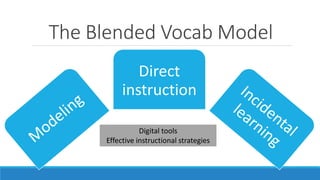
The Blended Vocab Model
Direct
instruction
Digital tools
Effective instructional strategies
Modeling
All adults in the school –
◦ Model robust vocabulary (how?)
◦ Show your interest in words (how?)
Reading Aloud
Reading aloud once a day exposes your students to an
additional 540 words per year.
Reading aloud twice a day exposes your students to more
than 1000 words per year.
Select three tier 2 words (general academic vocabulary) to
briefly instruct upon along with your read-alouds.
Recommendations from Isabel Beck
Connect-a-Word Strategy
To prepare, the teacher makes a set of words from the unit’s word
wall or list. During class time, she distributes one word card to each
student. To begin, a student places his word in the center of the floor
and provides a definition. Any student can follow, placing his/her
word on the floor touching the first word and tells the relationship
between the two words by using them in a sentence. Then the game
continues.
TIP Chart (S. Rollins, 2014)
Term
Information
Picture
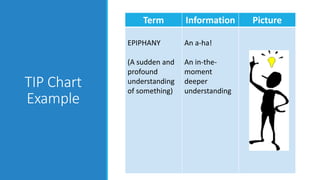
TIP Chart
Example
Term Information Picture
EPIPHANY
(A sudden and
profound
understanding
of something)
An a-ha!
An in-the-
moment
deeper
understanding
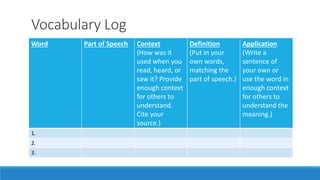
Vocabulary Log
Word Part of Speech Context
(How was it
used when you
read, heard, or
saw it? Provide
enough context
for others to
understand.
Cite your
source.)
Definition
(Put in your
own words,
matching the
part of speech.)
Application
(Write a
sentence of
your own or
use the word in
enough context
for others to
understand the
meaning.)
1.
2.
3.
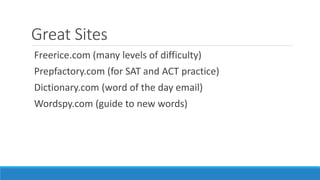
Great Sites
Freerice.com (many levels of difficulty)
Prepfactory.com (for SAT and ACT practice)
Dictionary.com (word of the day email)
Wordspy.com (guide to new words)
http://www.learningunlimitedllc.com/
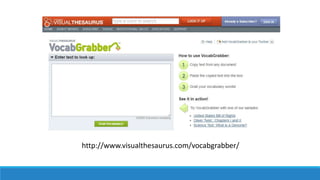
http://www.visualthesaurus.com/vocabgrabber/
Let’s Connect….
Website: drangelapeery.com
Facebook: Dr. Angela Peery
Twitter: @drangelapeery
Slideshare: slideshare.net/AngelaPeery1
Amazon: tinyurl.com/jdnpres

Academic vocabulary

  • 1.
    Academic Vocabulary: Powerful Strategiesand Digital Connections ANGELA PEERY, ED. D. DRANGELAPEERY@GMAIL.COM
  • 2.
    Two Forthcoming Books BLENDEDVOCABULARY o Modeling and school culture o Direct instruction o Digital tools o Incidental learning opportunities IT’S A SNAP VOCABULARY o Effective instruction o Specific mini-lesson structure o 100+ ideas for mini-lessons
  • 3.
    The Importance ofVocabulary Why do our students need to enlarge their vocabularies? What will robust vocabularies help them do?
  • 4.
    Robert Pondiscio (2014)notes, “To grow up as the child of well- educated parents in an affluent American home is to hit the verbal lottery.”
  • 5.
  • 6.
    Levels of Knowinga Word 1. No knowledge—never heard or saw the word 2. May have heard it, but don’t really know what it means 3. Can make general associations with the word & recognize it within context (receptive vocabulary) 4. Have a rich understanding of the word & can use it in speaking and writing (expressive vocabulary) Edgar Dale, 1965
  • 7.
    Rank These Words… EnigmaticLachrymose Cupidity Peignoir Verbosity Flumadiddle Hircine Fete Kerflooey Sempiternity Palliative Selenology Heptad Foist Condesplaining Pedantic Guanciale Microvolunteerism Natter Huitlacoche Blurbification Wistful Mostarda Caterwaul
  • 8.
    The Link toInstruction How could you use the four stages of word learning with your students?
  • 9.
  • 11.
    How To SelectWords Name the unit of study Tier 1 Tier 2 Tier 3 Teach, teach, teach!
  • 12.
    Sort the Words1 A space probe is an unpiloted spacecraft that leaves Earth’s orbit to explore the Moon, planets, asteroids, comets, or other objects in outer space as directed by onboard computers and/or instructions sent from Earth. The purpose of such missions is to make scientific observations, such as taking pictures, measuring atmospheric conditions, and collecting soil samples, and to bring or report the data back to Earth. Numerous space probes have been launched since the former Soviet Union first fired Luna I towards the Moon in 1959. Probes have now visited each of the planets in the solar system. Engelbert, 2009, as cited in All About Words
  • 13.
    Sort the Words1 A space probe is an unpiloted spacecraft that leaves Earth’s orbit to explore the Moon, planets, asteroids, comets, or other objects in outer space as directed by onboard computers and/or instructions sent from Earth. The purpose of such missions is to make scientific observations, such as taking pictures, measuring atmospheric conditions, and collecting soil samples, and to bring or report the data back to Earth. Numerous space probes have been launched since the former Soviet Union first fired Luna I towards the Moon in 1959. Probes have now visited each of the planets in the solar system. Engelbert, 2009, as cited in All About Words
  • 14.
    Sort the Words2 Great whirling storms roar out of the oceans in many parts of the world. They are called by several names—hurricane, typhoon, and cyclone are the three most familiar ones. But no matter what they are called, they are all the same sort of storm. They are born in the same way, in tropical waters. They develop the same way, feeding on warm, moist air. And they do the same kind of damage, both ashore and at sea. Other storms may cover a bigger area or have higher winds, but none can match both the size and the fury of hurricanes. They are earth’s mightiest storms. Like all storms, they take place in the atmosphere, the envelope of air that surrounds the earth and presses on its surface. The pressure at any one place is always changing. There are days when air is sinking and the atmosphere presses harder on the surface. These are the times of high pressure. There are days when a lot of air is rising and the atmosphere does not press down as hard. These are times of low pressure. Low- pressure areas over warm oceans give birth to hurricanes. Lauber, P. Hurricanes: Earth’s Mightiest Storms, 1996
  • 15.
    Sort the Words2 Great whirling storms roar out of the oceans in many parts of the world. They are called by several names—hurricane, typhoon, and cyclone are the three most familiar ones. But no matter what they are called, they are all the same sort of storm. They are born in the same way, in tropical waters. They develop the same way, feeding on warm, moist air. And they do the same kind of damage, both ashore and at sea. Other storms may cover a bigger area or have higher winds, but none can match both the size and the fury of hurricanes. They are earth’s mightiest storms. Like all storms, they take place in the atmosphere, the envelope of air that surrounds the earth and presses on its surface. The pressure at any one place is always changing. There are days when air is sinking and the atmosphere presses harder on the surface. These are the times of high pressure. There are days when a lot of air is rising and the atmosphere does not press down as hard. These are times of low pressure. Low- pressure areas over warm oceans give birth to hurricanes. Lauber, P. Hurricanes: Earth’s Mightiest Storms, 1996
  • 16.
    Remember… “Teachable moments areimportant; however, they will not be sufficient for students to engage in complex texts. Rather, we will have to be much more strategic about word learning than our previous standards or instructional guidelines have acknowledged.” S. Neuman & T. Wright, All About Words
  • 17.
    The Blended VocabModel Direct instruction Digital tools Effective instructional strategies
  • 18.
    Modeling All adults inthe school – ◦ Model robust vocabulary (how?) ◦ Show your interest in words (how?)
  • 19.
    Reading Aloud Reading aloudonce a day exposes your students to an additional 540 words per year. Reading aloud twice a day exposes your students to more than 1000 words per year. Select three tier 2 words (general academic vocabulary) to briefly instruct upon along with your read-alouds. Recommendations from Isabel Beck
  • 20.
    Connect-a-Word Strategy To prepare,the teacher makes a set of words from the unit’s word wall or list. During class time, she distributes one word card to each student. To begin, a student places his word in the center of the floor and provides a definition. Any student can follow, placing his/her word on the floor touching the first word and tells the relationship between the two words by using them in a sentence. Then the game continues.
  • 21.
    TIP Chart (S.Rollins, 2014) Term Information Picture
  • 22.
    TIP Chart Example Term InformationPicture EPIPHANY (A sudden and profound understanding of something) An a-ha! An in-the- moment deeper understanding
  • 23.
    Vocabulary Log Word Partof Speech Context (How was it used when you read, heard, or saw it? Provide enough context for others to understand. Cite your source.) Definition (Put in your own words, matching the part of speech.) Application (Write a sentence of your own or use the word in enough context for others to understand the meaning.) 1. 2. 3.
  • 24.
    Great Sites Freerice.com (manylevels of difficulty) Prepfactory.com (for SAT and ACT practice) Dictionary.com (word of the day email) Wordspy.com (guide to new words)
  • 25.
  • 28.
  • 29.
    Let’s Connect…. Website: drangelapeery.com Facebook:Dr. Angela Peery Twitter: @drangelapeery Slideshare: slideshare.net/AngelaPeery1 Amazon: tinyurl.com/jdnpres

Editor's Notes

  • #3 Solution Tree, 2016
  • #4 Ubiquitous vocabulary – what does this mean? present, appearing, or found everywhere "his ubiquitous influence was felt by all the family" synonyms: omnipresent, ever-present, everywhere, all over the place, pervasive, universal,worldwide, global; rife, prevalent, far-reaching, inescapable What does it mean to immerse students in words? dip or submerge in a liquid. "immerse the paper in water for twenty minutes" synonyms:submerge, dip, dunk, duck, sink, plunge; soak, drench, saturate, marinate, wet,douse, souse, steep "litmus paper turns red on being immersed in acid" 2. involve oneself deeply in a particular activity or interest. "she immersed herself in her work" synonyms:absorb in, engross in, occupy by/with, engage in, involve in/with, bury in, swamp with, lose oneself in; busy with, preoccupy with, fixate on/upon "Elliot was immersed in his work" There are large disparities in elementary curricula – in number of words taught, types of words, methods, etc. They are chosen in various ways, too, and sometimes by publishers. I believe there’s a better way….
  • #5 Highest rate of vocab development occurs during preschool years (Farkas & Beron, 2004). Early vocab intervention can help students catch up. Children whose deficits are resolved can achieve grade-level expectations in 4th grade and beyond (Bishop & Adams, 1990). The quantity and quality of adult talk (teachers, parents) cand mediate socioeconomic status (Mol & Neuman, 2012). Gains in oral vocab development can predict growth in comprehension and later, reading performance (Elleman, Lindo, Morphy, & Compton, 2009). Word learning is cumulative – there is no desired spurt or ideal time to grow it (Nagy & Scott, 2000). End of high school – a college-ready student needs to know about 80,000 words (Hirsch, 2003). Thus, students need to be continually immersed in words.
  • #8 From freerice.com Prepfactory.com Dictionary.com word of the day and Food Network And wordspy.com From freerice.com Prepfactory.com Dictionary.com word of the day and Food Network And wordspy.com Peignoir – pain noir – negligee Peignoir -- resembling a goat Sempiternity – synonym of eternity, infinity Heptad – a group or set of 7 Pedantic – synonym of finicky Fete – celebration, festival Flumadiddle – utter nonsense Kerflooey – falling apart or breaking down Selenology – study of the moon
  • #18 A. Modeling – model robust vocabulary and an interest in words (all adults) B. Teaching – teach targeted words using proven strategies, including using digital tools C. Incidental learning – provide a print-rich environment and literacy experiences, plus use digital tools for independent practice
  • #19 The first part of the framework, modeling, calls attention to what many excellent teachers of vocabulary do almost seamlessly. These teachers speak to students in ways that other teachers may not. For example, Angela once knew a teacher who would use all sorts of synonyms for basic or overused words with her students. If she needed a student to take the attendance information or some other document to the office, she might say something like, “Jackson, please ambulate to the main office and deliver this for me,” or “Please convey this document to the authority who is noted at the top.” She strove to use unfamiliar and sometimes far more sophisticated words to replace words like walk, go, take, say, good, and nice. Because she often accompanied unfamiliar words with a known task or exaggerated gestures, her students quickly grasped a basic definition. They enjoyed figuring out what she was saying, and many of them also delighted in using the terms they had learned in their other classes. Other teachers were impressed that these students, many of whom struggled mightily in reading and writing, learned useful, rich words through such indirect means. This is a great example of an intentional, embedded method of promoting rich word learning. Another part of modeling is attending to unusual or unknown words when they appear in text a class is reading aloud, a video they are viewing, in announcements coming over the loudspeaker—anywhere students see and hear words. That’s where teachers can find an opportunity to model enthusiasm about words and, if the moment is right, provide students with a quick synonym or summary for a word so that they can begin to understand it, at the least, on a surface level. In the current climate of demanding standards, abundant content, and countless hours of testing, teachers often say they don’t have enough time to teach. Remembering to be a good model of word learning takes very little extra time during the day. Instead, it’s an integrated approach to excite enthusiasm for word learning that can go far in enhancing literacy learning for our students. This portion of our model aligns most closely with Beck’s advice about providing many encounters with words over time. Teachers who remember to use certain synonyms for words like “walk” and “talk,” for example, will support their students in using the same more precise and less common words. This segment of our model also follows Graves’s suggestion to foster word consciousness. Teachers are, in our opinion, perhaps the best models of being interested in and delighted by words.
  • #20 According to Isabel Beck’s figures, if teachers read aloud once a day, students would be exposed to an additional 540 words a year, and for those teachers who read twice each day, students are introduced to more than one thousand additional words in the span of a school year. This is a perfect example of how to create exposure and provide incidental word learning opportunities. Beck (2002) suggests selecting three Tier 2 words each time you read aloud. Tier 2 words, as we discussed in length previously, are high-utility, cross-content words. This means that you should carefully select words from each read-aloud that you deem useful in many contexts. With little preparation and little additional time, teachers can easily incorporate the anchored word-learning strategy into everyday read-alouds. 1. Context: Read each targeted word in context and briefly bring attention to it. It is very important for students to hear a complete, fluent reading of the entire text first. Do not engage in lengthy discussion of any of the words as you read aloud. 2. Spelling and sound: Have students repeat each word aloud. Write the word on a sentence strip, saying the letters aloud as you write the word. Have students voice anything they notice that is unusual about the spelling, such as double letters, silent E, and so forth. Have young students air write the word while saying each letter aloud. Older students can spell the words by forming each letter on the palm of the opposite hand or tracing letters on their desks. 3. Provide the meaning: Reread the words in context and provide the meaning of each with a student-friendly definition. 4. Extended examples: Provide examples for each word beyond the context of the story. Encourage students to provide examples of their own so they personalize the word, relating it to their own context. 5. Read-aloud word wall: To create a simple way to review words and provide an opportunity for multiple exposures, create a community word wall featuring words specifically found in read-alouds.
  • #22 The TIP acronym stands for Term, Information, Picture. Basically, a TIP Chart (Rollins, 2014) is a three-column poster displayed so that students can quickly use it to remind them of the meaning of an important content-area word. In essence, it’s a vocabulary anchor chart. Unlike the original Frayer Model or the adapted one described previously, the TIP Chart is useful for words that are fairly straightforward in meaning – not ones that have heavy conceptual weight. The TIP Chart, after completion, needs to serve as an “at a glance” reference for important disciplinary words, and this overarching purpose must be kept in mind if the strategy is to be most beneficial.