Vocabulary
Summer 2014
Columbia Public Schools
Amanda Arens, amanda@arensconsulting.com
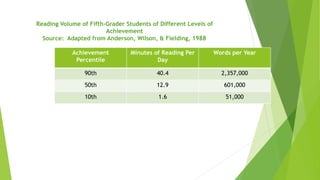
Achievement
Percentile
Minutes of Reading Per
Day
Words per Year
90th 40.4 2,357,000
50th 12.9 601,000
10th 1.6 51,000
Reading Volume of Fifth-Grader Students of Different Levels of
Achievement
Source: Adapted from Anderson, Wilson, & Fielding, 1988
What Reading
Does for the
Mind
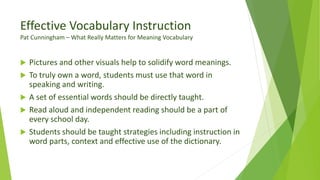
Effective Vocabulary Instruction
Pat Cunningham – What Really Matters for Meaning Vocabulary
 Pictures and other visuals help to solidify word meanings.
 To truly own a word, students must use that word in
speaking and writing.
 A set of essential words should be directly taught.
 Read aloud and independent reading should be a part of
every school day.
 Students should be taught strategies including instruction in
word parts, context and effective use of the dictionary.
Instructional Approach
Based on work by Graves (2006)
 Rich and Varied Language Experience
 Teaching Individual Words
 Teaching Word-Learning Strategies
 Roots, prefixes, suffixes, context
 Fostering Word Consciousness
 An awareness of and an interest in words and their meanings
Effective Vocabulary Instruction
Yopp, 2007
 Provide contextual information as well as definitional
information
 Provide repeated exposure to words under study and multiple
opportunities for students to use and practice the words
 Encourage students to think about relationships among words
and meanings
 Include active engagement in learning tasks
Choose Vocabulary Words as if You Were Paying for
Each Word and Needed to Keep Them Forever
 To maximize the effectiveness of vocabulary instruction during
reading lessons, select each word by asking these questions:
 Is this word one most of my students don’t have a rich
meaning for?
 Is this a word my students need to know and could use in
speaking and writing?
 Is this word essential to understanding the selection my
students will be reading?
 Does this word have a word part I want to focus on?
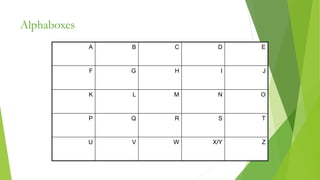
Alphaboxes
 An activity to collect related words
 Students tell words they think will appear in the text –
and tell WHY
 Write the word in the box corresponding with the first
letter
 While reading, students gather more words they feel
should be added
 Must be able to support their reasoning
Alphaboxes
A B C D E
F G H I J
K L M N O
P Q R S T
U V W X/Y Z
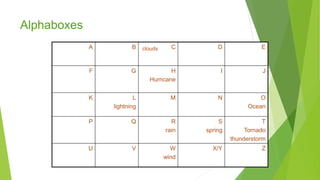
Alphaboxes
page 129
A B C D E
F G H
Hurricane
I J
K L
lightning
M N O
Ocean
P Q R
rain
S
spring
T
Tornado
thunderstorm
U V W
wind
X/Y Z
clouds
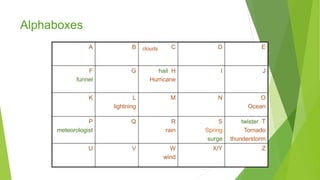
Alphaboxes
page 129
A B C D E
F
funnel
G hail H
Hurricane
I J
K L
lightning
M N O
Ocean
P
meteorologist
Q R
rain
S
Spring
surge
twister T
Tornado
thunderstorm
U V W
wind
X/Y Z
clouds
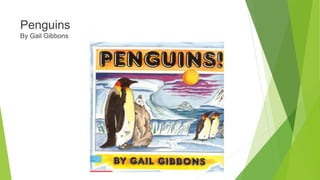
Penguins
By Gail Gibbons
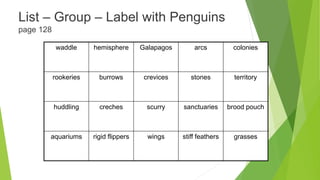
List – Group – Label with Penguins
page 128
waddle hemisphere Galapagos arcs colonies
rookeries burrows crevices stones territory
huddling creches scurry sanctuaries brood pouch
aquariums rigid flippers wings stiff feathers grasses
 Before: Read the list of words on the List Group Label. Work in groups of 3-4
to categorize the words on the sheet provided.
Penguins
By Gail Gibbons
Penguins
By Gail Gibbons
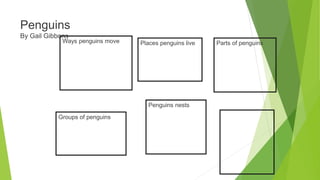
Ways penguins move Places penguins live Parts of penguins
Groups of penguins
Penguins nests
 During : Partner read to see if you placed the words in the right category
◦ Get back together in your groups of 4 to move any words you need to move
 After: Whole class shares where words go and where they found the proof in
the book.
◦ Quick Write: choose one category and take 2 minutes to write one thing you learned
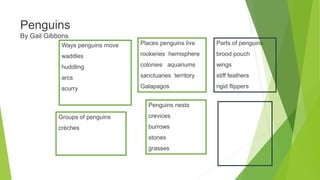
Penguins
By Gail Gibbons
Penguins
By Gail Gibbons
Ways penguins move
waddles
huddling
arcs
scurry
Places penguins live
rookeries hemisphere
colonies aquariums
sanctuaries territory
Galapagos
Parts of penguins
brood pouch
wings
stiff feathers
rigid flippers
Groups of penguins
crèches
Penguins nests
crevices
burrows
stones
grasses
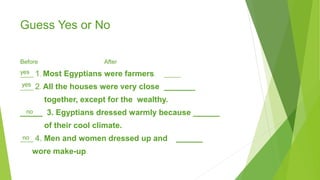
Guess Yes or No
(Anticipation Guide)
 Write 10 statements about the text
 Imbed vocabulary and content you want highlighted
 Prepare the statements to share with the students prior to
reading
 After direct instruction, give a hard copy to students
 Make a few statements easy guesses
Guess Yes or No
Before After
____ 1. Most Egyptians were farmers. _____
____ 2. All the houses were very close _______
together, except for the wealthy.
_____ 3. Egyptians dressed warmly because ______
of their cool climate.
____ 4. Men and women dressed up and ______
wore make-up.
yes
yes
no
no
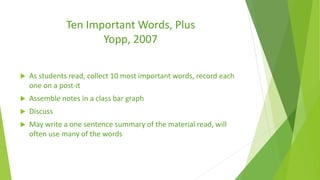
Ten Important Words, Plus
Yopp, 2007
 As students read, collect 10 most important words, record each
one on a post-it
 Assemble notes in a class bar graph
 Discuss
 May write a one sentence summary of the material read, will
often use many of the words
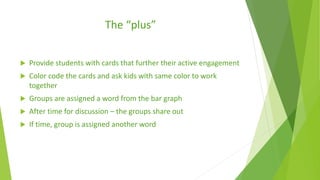
The “plus”
 Provide students with cards that further their active engagement
 Color code the cards and ask kids with same color to work
together
 Groups are assigned a word from the bar graph
 After time for discussion – the groups share out
 If time, group is assigned another word
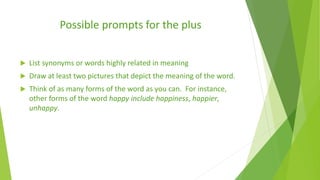
Possible prompts for the plus
 List synonyms or words highly related in meaning
 Draw at least two pictures that depict the meaning of the word.
 Think of as many forms of the word as you can. For instance,
other forms of the word happy include happiness, happier,
unhappy.
Word Webs
 After Activity – work in small groups with 4-5 of the words
from the selection
 Construct a word web with 4 – 6 spokes
 Each spoke should have something that helps them
remember the word
 Post a chart of possible word web categories
Word Webs
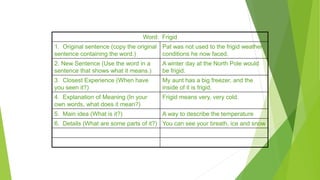
Word: Frigid
1. Original sentence (copy the original
sentence containing the word.)
Pat was not used to the frigid weather
conditions he now faced.
2. New Sentence (Use the word in a
sentence that shows what it means.)
A winter day at the North Pole would
be frigid.
3. Closest Experience (When have
you seen it?)
My aunt has a big freezer, and the
inside of it is frigid.
4. Explanation of Meaning (In your
own words, what does it mean?)
Frigid means very, very cold.
5. Main idea (What is it?) A way to describe the temperature
6. Details (What are some parts of it?) You can see your breath, ice and snow
Word Webs
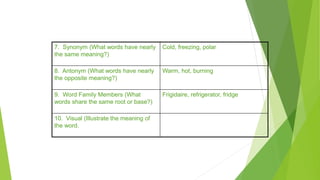
7. Synonym (What words have nearly
the same meaning?)
Cold, freezing, polar
8. Antonym (What words have nearly
the opposite meaning?)
Warm, hot, burning
9. Word Family Members (What
words share the same root or base?)
Frigidaire, refrigerator, fridge
10. Visual (Illustrate the meaning of
the word.
Word Webs
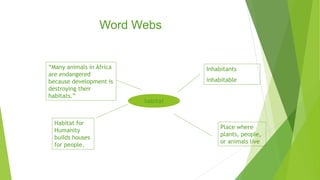
habitat
Inhabitants
inhabitable
Place where
plants, people,
or animals live
“Many animals in Africa
are endangered
because development is
destroying their
habitats.”
Habitat for
Humanity
builds houses
for people.
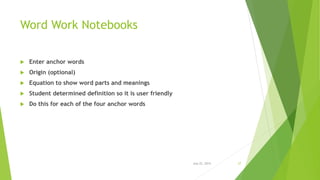
Word Work Notebooks
 Enter anchor words
 Origin (optional)
 Equation to show word parts and meanings
 Student determined definition so it is user friendly
 Do this for each of the four anchor words
July 22, 2014 27
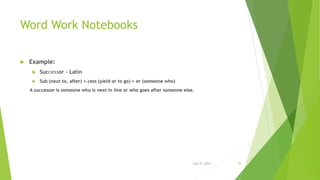
Word Work Notebooks
 Example:
 Successor – Latin
 Sub (next to, after) + cess (yield or to go) + or (someone who)
A successor is someone who is next in line or who goes after someone else.
July 22, 2014 28
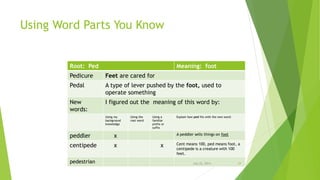
Using Word Parts You Know
Root: Ped Meaning: foot
Pedicure Feet are cared for
Pedal A type of lever pushed by the foot, used to
operate something
New
words:
I figured out the meaning of this word by:
Using my
background
knowledge
Using the
root word
Using a
familiar
prefix or
suffix
Explain how ped fits with the new word:
peddler x A peddler sells things on foot
centipede x x Cent means 100, ped means foot, a
centipede is a creature with 100
feet.
pedestrian July 22, 2014 29
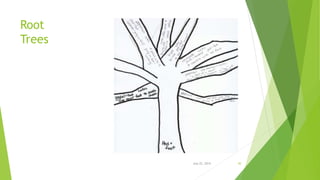
Root
Trees
July 22, 2014 30
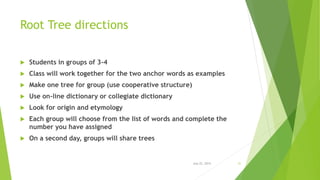
Root Tree directions
 Students in groups of 3-4
 Class will work together for the two anchor words as examples
 Make one tree for group (use cooperative structure)
 Use on-line dictionary or collegiate dictionary
 Look for origin and etymology
 Each group will choose from the list of words and complete the
number you have assigned
 On a second day, groups will share trees
July 22, 2014 31

Vocabulary

  • 1.
    Vocabulary Summer 2014 Columbia PublicSchools Amanda Arens, amanda@arensconsulting.com
  • 2.
    Achievement Percentile Minutes of ReadingPer Day Words per Year 90th 40.4 2,357,000 50th 12.9 601,000 10th 1.6 51,000 Reading Volume of Fifth-Grader Students of Different Levels of Achievement Source: Adapted from Anderson, Wilson, & Fielding, 1988
  • 3.
  • 4.
    Effective Vocabulary Instruction PatCunningham – What Really Matters for Meaning Vocabulary  Pictures and other visuals help to solidify word meanings.  To truly own a word, students must use that word in speaking and writing.  A set of essential words should be directly taught.  Read aloud and independent reading should be a part of every school day.  Students should be taught strategies including instruction in word parts, context and effective use of the dictionary.
  • 5.
    Instructional Approach Based onwork by Graves (2006)  Rich and Varied Language Experience  Teaching Individual Words  Teaching Word-Learning Strategies  Roots, prefixes, suffixes, context  Fostering Word Consciousness  An awareness of and an interest in words and their meanings
  • 6.
    Effective Vocabulary Instruction Yopp,2007  Provide contextual information as well as definitional information  Provide repeated exposure to words under study and multiple opportunities for students to use and practice the words  Encourage students to think about relationships among words and meanings  Include active engagement in learning tasks
  • 7.
    Choose Vocabulary Wordsas if You Were Paying for Each Word and Needed to Keep Them Forever  To maximize the effectiveness of vocabulary instruction during reading lessons, select each word by asking these questions:  Is this word one most of my students don’t have a rich meaning for?  Is this a word my students need to know and could use in speaking and writing?  Is this word essential to understanding the selection my students will be reading?  Does this word have a word part I want to focus on?
  • 8.
    Alphaboxes  An activityto collect related words  Students tell words they think will appear in the text – and tell WHY  Write the word in the box corresponding with the first letter  While reading, students gather more words they feel should be added  Must be able to support their reasoning
  • 9.
    Alphaboxes A B CD E F G H I J K L M N O P Q R S T U V W X/Y Z
  • 10.
    Alphaboxes page 129 A BC D E F G H Hurricane I J K L lightning M N O Ocean P Q R rain S spring T Tornado thunderstorm U V W wind X/Y Z clouds
  • 11.
    Alphaboxes page 129 A BC D E F funnel G hail H Hurricane I J K L lightning M N O Ocean P meteorologist Q R rain S Spring surge twister T Tornado thunderstorm U V W wind X/Y Z clouds
  • 12.
  • 13.
    List – Group– Label with Penguins page 128 waddle hemisphere Galapagos arcs colonies rookeries burrows crevices stones territory huddling creches scurry sanctuaries brood pouch aquariums rigid flippers wings stiff feathers grasses
  • 14.
     Before: Readthe list of words on the List Group Label. Work in groups of 3-4 to categorize the words on the sheet provided. Penguins By Gail Gibbons
  • 15.
    Penguins By Gail Gibbons Wayspenguins move Places penguins live Parts of penguins Groups of penguins Penguins nests
  • 16.
     During :Partner read to see if you placed the words in the right category ◦ Get back together in your groups of 4 to move any words you need to move  After: Whole class shares where words go and where they found the proof in the book. ◦ Quick Write: choose one category and take 2 minutes to write one thing you learned Penguins By Gail Gibbons
  • 17.
    Penguins By Gail Gibbons Wayspenguins move waddles huddling arcs scurry Places penguins live rookeries hemisphere colonies aquariums sanctuaries territory Galapagos Parts of penguins brood pouch wings stiff feathers rigid flippers Groups of penguins crèches Penguins nests crevices burrows stones grasses
  • 18.
    Guess Yes orNo (Anticipation Guide)  Write 10 statements about the text  Imbed vocabulary and content you want highlighted  Prepare the statements to share with the students prior to reading  After direct instruction, give a hard copy to students  Make a few statements easy guesses
  • 19.
    Guess Yes orNo Before After ____ 1. Most Egyptians were farmers. _____ ____ 2. All the houses were very close _______ together, except for the wealthy. _____ 3. Egyptians dressed warmly because ______ of their cool climate. ____ 4. Men and women dressed up and ______ wore make-up. yes yes no no
  • 20.
    Ten Important Words,Plus Yopp, 2007  As students read, collect 10 most important words, record each one on a post-it  Assemble notes in a class bar graph  Discuss  May write a one sentence summary of the material read, will often use many of the words
  • 21.
    The “plus”  Providestudents with cards that further their active engagement  Color code the cards and ask kids with same color to work together  Groups are assigned a word from the bar graph  After time for discussion – the groups share out  If time, group is assigned another word
  • 22.
    Possible prompts forthe plus  List synonyms or words highly related in meaning  Draw at least two pictures that depict the meaning of the word.  Think of as many forms of the word as you can. For instance, other forms of the word happy include happiness, happier, unhappy.
  • 23.
    Word Webs  AfterActivity – work in small groups with 4-5 of the words from the selection  Construct a word web with 4 – 6 spokes  Each spoke should have something that helps them remember the word  Post a chart of possible word web categories
  • 24.
    Word Webs Word: Frigid 1.Original sentence (copy the original sentence containing the word.) Pat was not used to the frigid weather conditions he now faced. 2. New Sentence (Use the word in a sentence that shows what it means.) A winter day at the North Pole would be frigid. 3. Closest Experience (When have you seen it?) My aunt has a big freezer, and the inside of it is frigid. 4. Explanation of Meaning (In your own words, what does it mean?) Frigid means very, very cold. 5. Main idea (What is it?) A way to describe the temperature 6. Details (What are some parts of it?) You can see your breath, ice and snow
  • 25.
    Word Webs 7. Synonym(What words have nearly the same meaning?) Cold, freezing, polar 8. Antonym (What words have nearly the opposite meaning?) Warm, hot, burning 9. Word Family Members (What words share the same root or base?) Frigidaire, refrigerator, fridge 10. Visual (Illustrate the meaning of the word.
  • 26.
    Word Webs habitat Inhabitants inhabitable Place where plants,people, or animals live “Many animals in Africa are endangered because development is destroying their habitats.” Habitat for Humanity builds houses for people.
  • 27.
    Word Work Notebooks Enter anchor words  Origin (optional)  Equation to show word parts and meanings  Student determined definition so it is user friendly  Do this for each of the four anchor words July 22, 2014 27
  • 28.
    Word Work Notebooks Example:  Successor – Latin  Sub (next to, after) + cess (yield or to go) + or (someone who) A successor is someone who is next in line or who goes after someone else. July 22, 2014 28
  • 29.
    Using Word PartsYou Know Root: Ped Meaning: foot Pedicure Feet are cared for Pedal A type of lever pushed by the foot, used to operate something New words: I figured out the meaning of this word by: Using my background knowledge Using the root word Using a familiar prefix or suffix Explain how ped fits with the new word: peddler x A peddler sells things on foot centipede x x Cent means 100, ped means foot, a centipede is a creature with 100 feet. pedestrian July 22, 2014 29
  • 30.
  • 31.
    Root Tree directions Students in groups of 3-4  Class will work together for the two anchor words as examples  Make one tree for group (use cooperative structure)  Use on-line dictionary or collegiate dictionary  Look for origin and etymology  Each group will choose from the list of words and complete the number you have assigned  On a second day, groups will share trees July 22, 2014 31