ACADEMIC
INTEGRITY
ANJENAY S KUMAR
EEE A S3
Roll no. 31
WHAT IS ACADEMIC
INTEGRITY?
Academic integrity means doing your
schoolwork and research honestly and fairly.
It's about being truthful and not cheating or
copying from others. It's important to give
credit to the sources you use and to be
trustworthy in your studies. This helps keep
schools and colleges respected and ensures
that learning and research are done in a fair
and honest way.
WHY IS ACADEMIC
INTEGRITY IMPORTANT?
❖Preserving Trust: It helps maintain trust and credibility
within educational institutions. When students, faculty,
and researchers uphold integrity, others can have
confidence in the academic system.
❖Fairness: Academic integrity ensures a level playing field
for all students. It promotes fairness by preventing
dishonest practices that could give some students an
unfair advantage.
❖Educational Value: Upholding integrity enhances the
educational value of assignments, research, and exams. It
encourages students to engage deeply with their studies
and develop critical thinking skills.
❖Ethical Development: It fosters ethical development and
character building by teaching students the importance of
honesty, responsibility, and respect for others' work.
❖Professional Reputation: Academic integrity is a
foundation for future professional success. Employers
value individuals with strong ethical values and integrity
in the workplace.
❖Research Credibility: In the realm of research and
academia, integrity is crucial for producing credible and
reliable knowledge. It ensures that research findings are
trustworthy and can be built upon by others.
❖Global Academic Community: Upholding academic
integrity contributes to the global reputation of
educational institutions. It allows for collaboration and
recognition on a worldwide scale.
EXAMPLES OF ACADEMIC
INTEGRITY VIOLATIONS
➢ Plagiarism
➢ Cheating on Exams
➢ Fabricating Data
➢ Ghostwriting
➢ Impersonation
➢ Bribery
PLAGIARISM
Plagiarism refers to the act of using someone else's
work, ideas, words, or intellectual property without
proper attribution or permission and presenting it as
one's own. It is a breach of academic integrity and
intellectual honesty.
o Copying and pasting text from a source without
citing it in a research paper or essay.
o Paraphrasing or rephrasing someone else's work
without giving appropriate credit.
o Submitting a purchased or pre-written essay as
one's own work.
Examples:
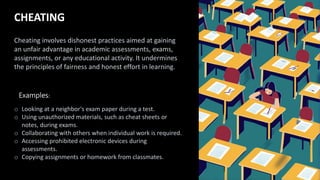
CHEATING
Cheating involves dishonest practices aimed at gaining
an unfair advantage in academic assessments, exams,
assignments, or any educational activity. It undermines
the principles of fairness and honest effort in learning.
o Looking at a neighbor's exam paper during a test.
o Using unauthorized materials, such as cheat sheets or
notes, during exams.
o Collaborating with others when individual work is required.
o Accessing prohibited electronic devices during
assessments.
o Copying assignments or homework from classmates.
Examples:
FABRICATION
Fabrication involves the act of inventing or falsifying
information, data, results, or details in academic work,
research, or assignments. It typically entails presenting
false or nonexistent information as if it were factual.
o Falsifying research data or experiment results to
support desired conclusions.
o Creating fictitious sources or references in a research
paper.
o Inventing quotations, citations, or information in
essays or reports.
Examples:
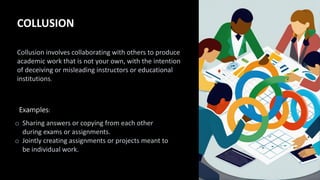
COLLUSION
Collusion involves collaborating with others to produce
academic work that is not your own, with the intention
of deceiving or misleading instructors or educational
institutions.
o Sharing answers or copying from each other
during exams or assignments.
o Jointly creating assignments or projects meant to
be individual work.
Examples:
How to avoid
academic integrity
violations?
➢ When you use someone else's work, ideas, or words
in your academic work, it's essential to provide
proper citations. This includes mentioning the
source's author, title, publication date, and the
specific page or location of the content you're
referencing.
➢ Citing sources not only gives credit to the original
author but also allows readers to locate and verify
the information you've used.
1. CITE YOUR SOURCES
PROPERLY:
➢ Instead of copying text verbatim from sources,
practice the art of paraphrasing and summarizing.
This involves reading and understanding the
original content and then expressing it in your
own words.
➢ Ensure that your paraphrased or summarized
version retains the original meaning and context
of the source but is distinctively in your voice.
2. PARAPHRASE AND SUMMARIZE
OTHER PEOPLE'S WORK IN YOUR
OWN WORDS:
➢ Maintain a systematic record of all the sources you
consult for your research or assignments. This
includes books, articles, websites, and any other
relevant materials.
➢ Taking thorough and organized notes is crucial. Note
the source's bibliographic details, key points, and
page numbers for easy reference. Having well-
organized notes will make it easier to create accurate
citations and avoid unintentional plagiarism.
3. KEEP TRACK OF YOUR SOURCES
AND TAKE GOOD NOTES:
➢ Instructors, tutors, and academic support centers are
valuable resources. They can provide guidance, clarify
expectations, and assist you in understanding the
assignment requirements.
➢ Communicating with your instructor about any
difficulties you encounter shows a commitment to
academic integrity.
4. ASK FOR HELP FROM YOUR
TUTOR IF YOU ARE STRUGGLING
WITH AN ASSIGNMENT:
Academic integrity is the foundation of an honest
and fair education system. Upholding it preserves
trust, ensures fairness, and fosters ethical growth. To
avoid violations, cite sources, paraphrase, track
references, and seek help when needed.
Let's stand up for honesty, fairness, and trust in our
academic pursuits.
CONCLUSION

ACADEMIC INTEGRITY

  • 1.
  • 2.
    WHAT IS ACADEMIC INTEGRITY? Academicintegrity means doing your schoolwork and research honestly and fairly. It's about being truthful and not cheating or copying from others. It's important to give credit to the sources you use and to be trustworthy in your studies. This helps keep schools and colleges respected and ensures that learning and research are done in a fair and honest way.
  • 3.
    WHY IS ACADEMIC INTEGRITYIMPORTANT? ❖Preserving Trust: It helps maintain trust and credibility within educational institutions. When students, faculty, and researchers uphold integrity, others can have confidence in the academic system. ❖Fairness: Academic integrity ensures a level playing field for all students. It promotes fairness by preventing dishonest practices that could give some students an unfair advantage. ❖Educational Value: Upholding integrity enhances the educational value of assignments, research, and exams. It encourages students to engage deeply with their studies and develop critical thinking skills.
  • 4.
    ❖Ethical Development: Itfosters ethical development and character building by teaching students the importance of honesty, responsibility, and respect for others' work. ❖Professional Reputation: Academic integrity is a foundation for future professional success. Employers value individuals with strong ethical values and integrity in the workplace. ❖Research Credibility: In the realm of research and academia, integrity is crucial for producing credible and reliable knowledge. It ensures that research findings are trustworthy and can be built upon by others. ❖Global Academic Community: Upholding academic integrity contributes to the global reputation of educational institutions. It allows for collaboration and recognition on a worldwide scale.
  • 5.
    EXAMPLES OF ACADEMIC INTEGRITYVIOLATIONS ➢ Plagiarism ➢ Cheating on Exams ➢ Fabricating Data ➢ Ghostwriting ➢ Impersonation ➢ Bribery
  • 6.
    PLAGIARISM Plagiarism refers tothe act of using someone else's work, ideas, words, or intellectual property without proper attribution or permission and presenting it as one's own. It is a breach of academic integrity and intellectual honesty. o Copying and pasting text from a source without citing it in a research paper or essay. o Paraphrasing or rephrasing someone else's work without giving appropriate credit. o Submitting a purchased or pre-written essay as one's own work. Examples:
  • 7.
    CHEATING Cheating involves dishonestpractices aimed at gaining an unfair advantage in academic assessments, exams, assignments, or any educational activity. It undermines the principles of fairness and honest effort in learning. o Looking at a neighbor's exam paper during a test. o Using unauthorized materials, such as cheat sheets or notes, during exams. o Collaborating with others when individual work is required. o Accessing prohibited electronic devices during assessments. o Copying assignments or homework from classmates. Examples:
  • 8.
    FABRICATION Fabrication involves theact of inventing or falsifying information, data, results, or details in academic work, research, or assignments. It typically entails presenting false or nonexistent information as if it were factual. o Falsifying research data or experiment results to support desired conclusions. o Creating fictitious sources or references in a research paper. o Inventing quotations, citations, or information in essays or reports. Examples:
  • 9.
    COLLUSION Collusion involves collaboratingwith others to produce academic work that is not your own, with the intention of deceiving or misleading instructors or educational institutions. o Sharing answers or copying from each other during exams or assignments. o Jointly creating assignments or projects meant to be individual work. Examples:
  • 10.
    How to avoid academicintegrity violations?
  • 11.
    ➢ When youuse someone else's work, ideas, or words in your academic work, it's essential to provide proper citations. This includes mentioning the source's author, title, publication date, and the specific page or location of the content you're referencing. ➢ Citing sources not only gives credit to the original author but also allows readers to locate and verify the information you've used. 1. CITE YOUR SOURCES PROPERLY:
  • 12.
    ➢ Instead ofcopying text verbatim from sources, practice the art of paraphrasing and summarizing. This involves reading and understanding the original content and then expressing it in your own words. ➢ Ensure that your paraphrased or summarized version retains the original meaning and context of the source but is distinctively in your voice. 2. PARAPHRASE AND SUMMARIZE OTHER PEOPLE'S WORK IN YOUR OWN WORDS:
  • 13.
    ➢ Maintain asystematic record of all the sources you consult for your research or assignments. This includes books, articles, websites, and any other relevant materials. ➢ Taking thorough and organized notes is crucial. Note the source's bibliographic details, key points, and page numbers for easy reference. Having well- organized notes will make it easier to create accurate citations and avoid unintentional plagiarism. 3. KEEP TRACK OF YOUR SOURCES AND TAKE GOOD NOTES:
  • 14.
    ➢ Instructors, tutors,and academic support centers are valuable resources. They can provide guidance, clarify expectations, and assist you in understanding the assignment requirements. ➢ Communicating with your instructor about any difficulties you encounter shows a commitment to academic integrity. 4. ASK FOR HELP FROM YOUR TUTOR IF YOU ARE STRUGGLING WITH AN ASSIGNMENT:
  • 15.
    Academic integrity isthe foundation of an honest and fair education system. Upholding it preserves trust, ensures fairness, and fosters ethical growth. To avoid violations, cite sources, paraphrase, track references, and seek help when needed. Let's stand up for honesty, fairness, and trust in our academic pursuits. CONCLUSION