Citation
Use and Abuse
Malibu Rohwani
"Not everything
that can be counted counts,
and not everything
that counts can be counted."
Albert Einstein
Overview
 Context - research /research evalution
 The power of citation tracking for your research
 Use and Abuse
What are we counting?
 Number of papers per individual
 Total number of citations, and cites per
paper
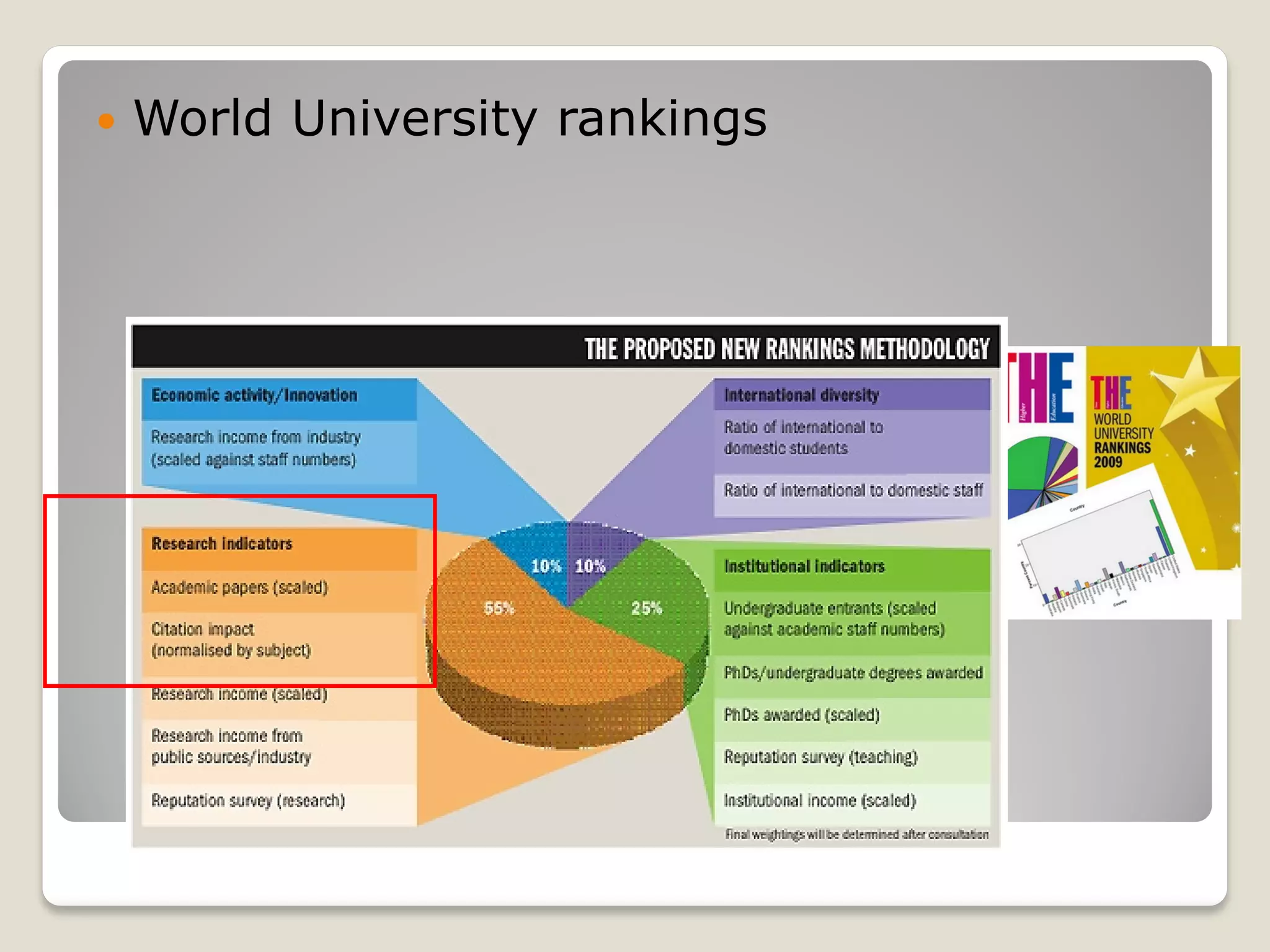
 World University rankings
Citations: use
Individual assessment (promotion and
tenure)
UCD: Selection criteria, senior lecturer post
◦ PhD completed in the area of Quantitative Finance or a
cognate area.
◦ Strong, demonstrable, commitment to research
and publication in their chosen field
◦ Strong, demonstrable, commitment to teaching
◦ Ability to communicate both technical and non-technical
material effectively in the classroom.
◦ Good international research network
◦ A number of publications in ranking journals
◦ Excellent administrative skills
Citations: use
Individual assessment, promotion etc
Senior Lecturer (DCU)
◦ Refereed publications
◦ Impact of publication on the discipline (citation
indexes)
Associate Professor (DCU)
 Excellence in Research & Scholarship
◦ Substantial number of articles in leading
refereed journals and international journals
Grant Funding
SFI Starting Investigator Research Grant
 The applicant must demonstrate a proven
record of internationally recognised
independent research accomplishments. The
applicant must be senior author (first, last or
corresponding) on at least 3 articles in
international peer-reviewed publications AND
be a named author on an average of at
least 1 international peer-reviewed
publication per year since the award of the
PhD (or equivalent).
Citations
 Use with caution!
 Do have shortcomings which will be
highlighted throughout this presentation
…..
Citation Tracking /
Searching
Citation tracking allows you to:
 Find out how many times a paper
has been cited
 Search backwards and forwards
in time to see how ideas develop
 Find the most highly cited papers
in your field
 Identify key researchers and
institutions by their citation
counts
Citation Tracking /
Searching
Collating this info is difficult
and not all databases or
websites do it
 Web of Science
 Scopus
 Google Scholar / Publish or
Perish
Research impact of individuals
Using Web of Science you can find out
an individual’s:
- top cited work
- what journals they have published in
- who is citing them
- their H-index
H-Index
 Developed by Hirsh in 2005:
"An index to quantify an individual's scientific research output,"
Proceedings of the National Academy of Sciences,
102(46):16569-16572, November 15, 2005
www.pnas.org/cgi/reprint/102/46/16569
 Means to evaluate research output
 Based on number or publications and
the number of citations per publication
 For example, an h-index of 10 means
that there are 10 published papers that
have 10 citations or more
Research impact of
individuals: Example
 Charles K Kao, Nobel Laureate for
Physics, 2009
◦ "Father of Fiber Optic Communications"
Lets search Web of Science for Kao CK
 What are his key works?
 Where has he published?
 What fields have been citing him?
 What’s his H-Index?
H-Index
Some high ranking physicists:
Martin Cohen, Berkeley 94
Philip Anderson, Princeton 91
Edward Witten, Princeton
110 (world’s highest)
But…
Charles K Kao (Nobel laureate,
physics, 2009) 6
Why? Mainly published in EE conferences,
monographs and patents.
H-Index
Mohamed El Naschie has an impressive H-Index of 33.
But why? Check his citations in Web of Science
Search for El Naschie M*
Further info: Schiermeier, Q. 2008. Self-publishing editor set to
retire. Nature. 456 (7221), pp432.
Use and Abuse
 Potential for manipulation
◦ Self-citations
◦ Strategy to improve one’s citations and H-
index
H-Index
 A scientist may artificially increase his/her
H-index by
 (1) Self citation
 (2) Double Publications
 (3) Conference papers
 (4) Citation club
 (5) Coercive citation
Self citations
 Thomson Reuters considers self-citation
beyond 20% as suspect of abuse
 Famous people:
 El-Naschie: 50%
 Nelson Tansu: 55%
Self citations
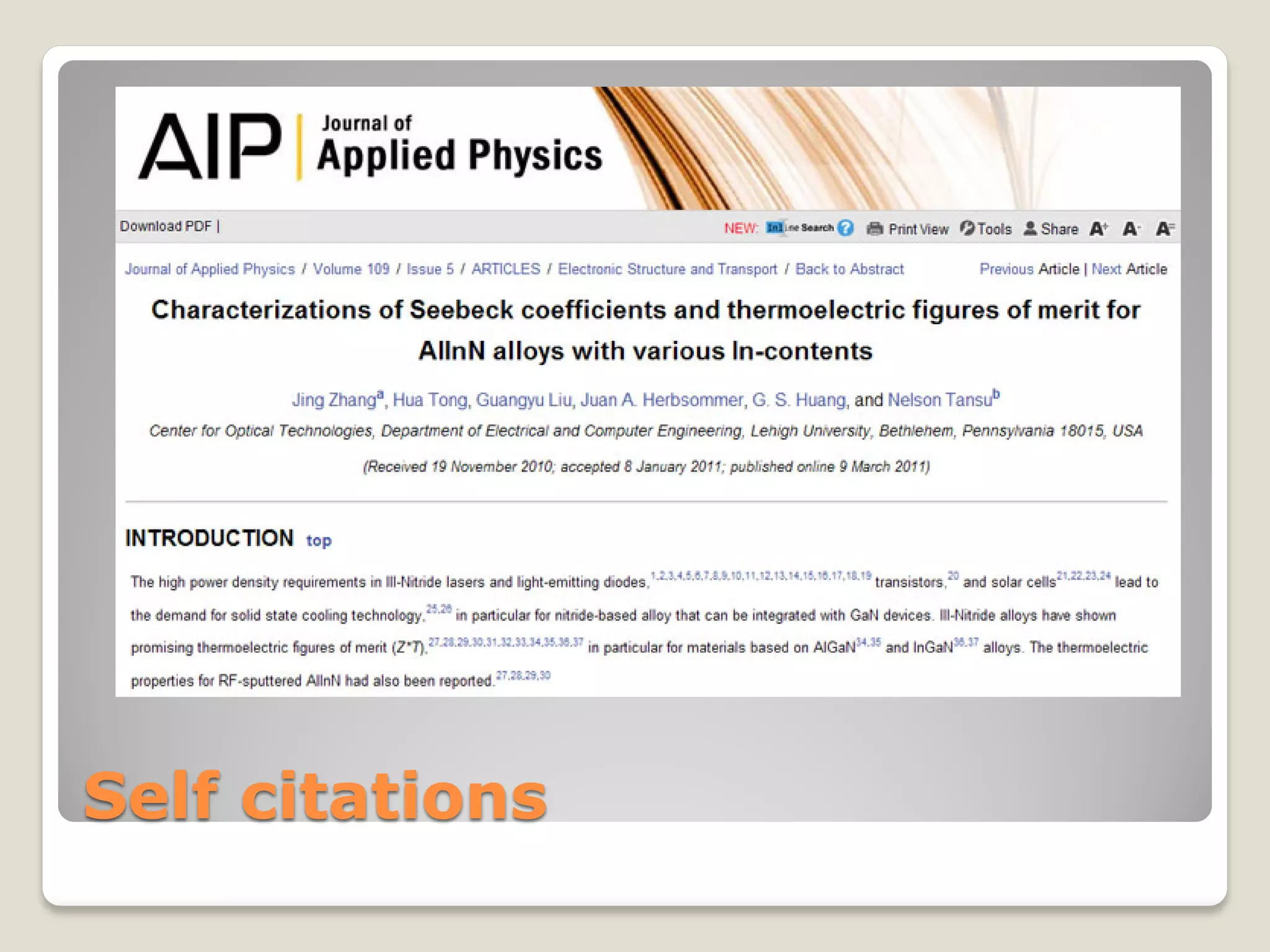
19 self citations
Out of 24
references
Duplicate Publications
SPIE Conferences
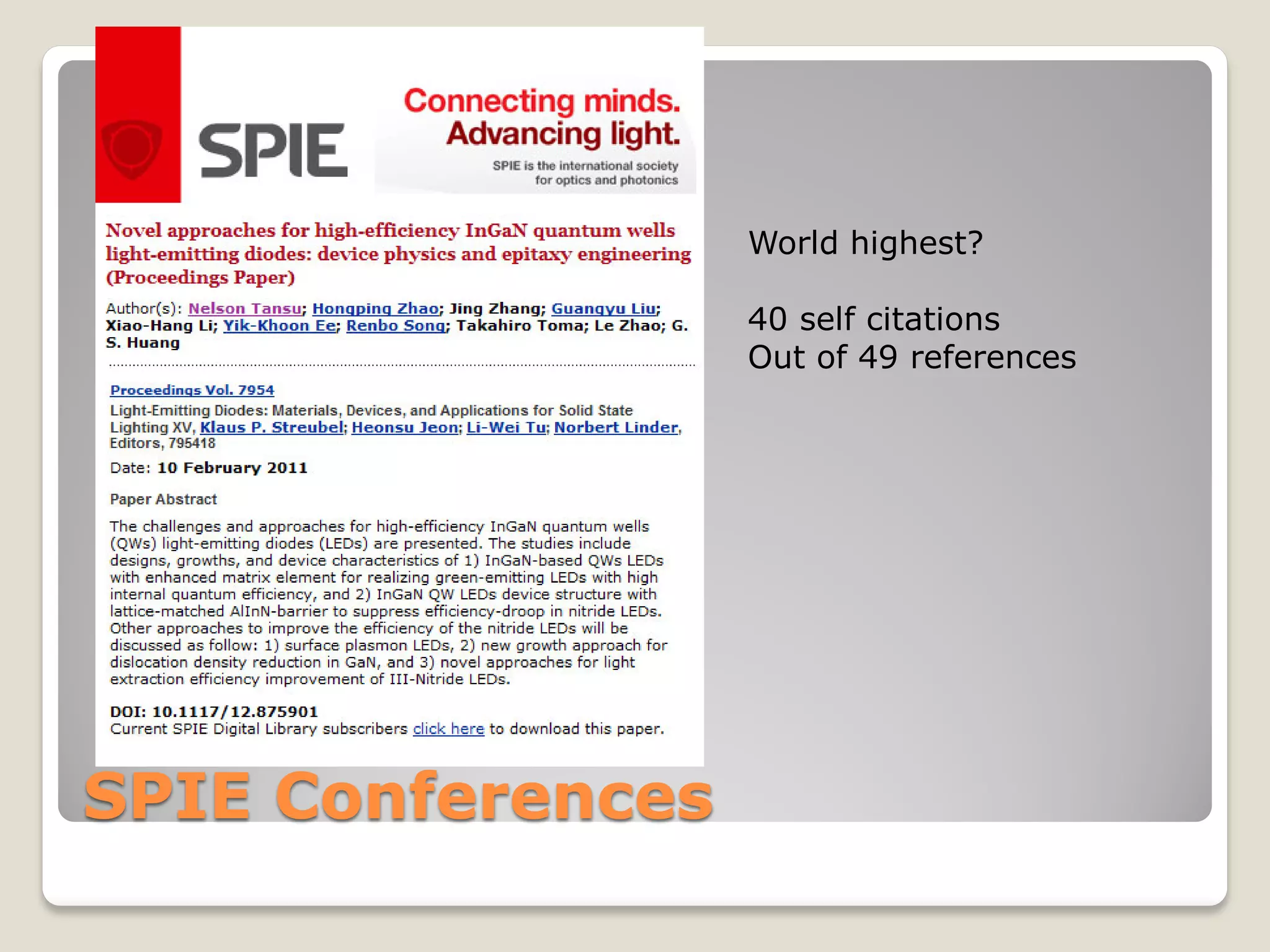
World highest?
40 self citations
Out of 49 references
SPIE Conferences
SPIE Conferences
 Novel approaches for high-efficiency InGaN quantum wells light-emitting diodes: Device physics and epitaxy engineering Tansu,
N., Zhao, H., Zhang, J., Liu, G., Li, X.-H., Ee, Y.-K., Song, R., Huang, G.S. 2011 Proceedings of SPIE - The International
Society for Optical Engineering 7954, art. no. 795418
 This paper has 40 self references to Tansu
 Zhang, J., Zhao, H., Tansu, N. 2011 Gain characteristics of deep UV AlGaN quantum wells lasers
 Proceedings of SPIE - The International Society for Optical Engineering 7953, art. no. 79530H
 This paper has 27 self references to Tansu
 Enhancement of light extraction efficiency of InGaN quantum wells light-emitting diodes using TiO2 microsphere arrays Li, X.-H.,
Ee, Y.-K., Song, R., Tansu, N. 2011 Proceedings of SPIE - The
 International Society for Optical Engineering 7954, art. no. 79540U
 This paper has 27 self references to Tansu
Thermoelectric properties of MOCVD-grown AlInN alloys with various compositions Zhang, J.,Tong, H., Liu, G., Herbsommer, J.A.,
Huang, G.S., Tansu, N. 2011 Proceedings of SPIE - TheInternational Society for Optical Engineering 7939, art. no. 79390O
 This paper has 27 self references to Tansu
 Cathodoluminescence characteristics of linearly shaped staggered InGaN quantum wells light-emitting diodes Zhao, H., Zhang, J.,
Liu, G., Toma, T., Poplawsky, J.D., Dierolf, V., Tansu, N.2011 Proceedings of SPIE - The International Society for Optical
Engineering 7939, art. no.793905
 This paper has 27 self references to Tansu
 Analysis of thermoelectric properties of AlInN semiconductor alloys Zhang, J., Tong, H.,Herbsommer, J.A., Tansu, N. 2011
Proceedings of SPIE - The International Society for OpticalEngineering 7933, art. no. 79330X
 This paper has 28 self references to Tansu
 176 self citations from 6 papers in a single SPIE Conference
Citation Club
 Of the 31 papers not written by El Naschie in a issue
of Chaos, Solitons and Fractals, at least 11 are
related to his theories and include 58 citations of his
work in the journal.
 Ji-Huan He, the journal's regional editor for China,
also cites El Naschie's work frequently.
 An issue of the journal has one paper by He that cites
himself 14 times and El Naschie twice.
 He is also editor of the International Journal of
Nonlinear Sciences and Numerical Simulation, which
in a 2005 editorial said: "Men of genius like Einstein
and Elnaschie very often ask some straightforward
and seemingly innocent questions, which may turn
out to have undreamed of answers."
Coercive Citations
 Becoming editor or guest editor of a
journal
 “you cite my article only once in your 40
references. Consequently, I kindly ask you
to add references of my articles to your
present article”.
Guest Editor
 IEEE OSA Journal of Display Technology
 Special Issue Volume 9, Issue 4 (April
2013).
 Recent advances in solid state lighting
 Guest Editor: Nelson Tansu
Some papers
 Effects of H2 in GaN barrier spacer layer of InGaN/GaN multiple
quantum-well light-emitting diodes. Lai, W.-C., Yang, Y.-Y. 2013
 10 citations to Tansu
 Investigating the effect of piezoelectric polarization on GaN-based
LEDs with different quantum barrier thickness. Wang, C.K.,
Chiang, T.H., Chen, K.Y., Chiou, Y.Z., Lin, T.K., Chang, S.P., Chang,
S.J.
 9 citations to Tansu
 Lateral current spreading effect on the efficiency droop in GaN
based light-emitting diodes. Huang, S., Fan, B., Chen, Z., Zheng,
Z., Luo, H., Wu, Z., Wang, G., Jiang, H.
 8 citations to Tansu
 Effect of polarization-matched n-type AlGaInN electron-blocking
layer on the optoelectronic properties of blue InGaN light-emitting
diodes. Li, Y., Gao, Y., He, M., Zhou, J., Lei, Y., Zhang, L., Zhu, K.,
Chen, Y.
 11 citations to Tansu
Special Issue
 All 17 papers have 6-10 citations to
Tansu, and all papers are from China,
Taiwan and Singapore
 A single special issue = 160 citations to
Tansu
Conclusions
 No single ‘perfect’ JIF
 Objective tools have a role and can
contribute to the evaluation of research
quality when used appropriately – must
be aware of their limitations!
 Abuse through self citations
 Ongoing debate….
SOCIAL MEDIA
 Share your
 findings…
 And get cited

Academic Citations: Use and abuse

  • 1.
  • 2.
    "Not everything that canbe counted counts, and not everything that counts can be counted." Albert Einstein
  • 3.
    Overview  Context -research /research evalution  The power of citation tracking for your research  Use and Abuse
  • 4.
    What are wecounting?  Number of papers per individual  Total number of citations, and cites per paper
  • 5.
  • 6.
    Citations: use Individual assessment(promotion and tenure) UCD: Selection criteria, senior lecturer post ◦ PhD completed in the area of Quantitative Finance or a cognate area. ◦ Strong, demonstrable, commitment to research and publication in their chosen field ◦ Strong, demonstrable, commitment to teaching ◦ Ability to communicate both technical and non-technical material effectively in the classroom. ◦ Good international research network ◦ A number of publications in ranking journals ◦ Excellent administrative skills
  • 7.
    Citations: use Individual assessment,promotion etc Senior Lecturer (DCU) ◦ Refereed publications ◦ Impact of publication on the discipline (citation indexes) Associate Professor (DCU)  Excellence in Research & Scholarship ◦ Substantial number of articles in leading refereed journals and international journals
  • 8.
    Grant Funding SFI StartingInvestigator Research Grant  The applicant must demonstrate a proven record of internationally recognised independent research accomplishments. The applicant must be senior author (first, last or corresponding) on at least 3 articles in international peer-reviewed publications AND be a named author on an average of at least 1 international peer-reviewed publication per year since the award of the PhD (or equivalent).
  • 9.
    Citations  Use withcaution!  Do have shortcomings which will be highlighted throughout this presentation …..
  • 10.
    Citation Tracking / Searching Citationtracking allows you to:  Find out how many times a paper has been cited  Search backwards and forwards in time to see how ideas develop  Find the most highly cited papers in your field  Identify key researchers and institutions by their citation counts
  • 11.
    Citation Tracking / Searching Collatingthis info is difficult and not all databases or websites do it  Web of Science  Scopus  Google Scholar / Publish or Perish
  • 12.
    Research impact ofindividuals Using Web of Science you can find out an individual’s: - top cited work - what journals they have published in - who is citing them - their H-index
  • 13.
    H-Index  Developed byHirsh in 2005: "An index to quantify an individual's scientific research output," Proceedings of the National Academy of Sciences, 102(46):16569-16572, November 15, 2005 www.pnas.org/cgi/reprint/102/46/16569  Means to evaluate research output  Based on number or publications and the number of citations per publication  For example, an h-index of 10 means that there are 10 published papers that have 10 citations or more
  • 14.
    Research impact of individuals:Example  Charles K Kao, Nobel Laureate for Physics, 2009 ◦ "Father of Fiber Optic Communications" Lets search Web of Science for Kao CK  What are his key works?  Where has he published?  What fields have been citing him?  What’s his H-Index?
  • 15.
    H-Index Some high rankingphysicists: Martin Cohen, Berkeley 94 Philip Anderson, Princeton 91 Edward Witten, Princeton 110 (world’s highest) But… Charles K Kao (Nobel laureate, physics, 2009) 6 Why? Mainly published in EE conferences, monographs and patents.
  • 16.
    H-Index Mohamed El Naschiehas an impressive H-Index of 33. But why? Check his citations in Web of Science Search for El Naschie M* Further info: Schiermeier, Q. 2008. Self-publishing editor set to retire. Nature. 456 (7221), pp432.
  • 18.
    Use and Abuse Potential for manipulation ◦ Self-citations ◦ Strategy to improve one’s citations and H- index
  • 19.
    H-Index  A scientistmay artificially increase his/her H-index by  (1) Self citation  (2) Double Publications  (3) Conference papers  (4) Citation club  (5) Coercive citation
  • 20.
    Self citations  ThomsonReuters considers self-citation beyond 20% as suspect of abuse  Famous people:  El-Naschie: 50%  Nelson Tansu: 55%
  • 21.
  • 22.
    19 self citations Outof 24 references
  • 23.
  • 24.
    SPIE Conferences World highest? 40self citations Out of 49 references
  • 25.
  • 26.
    SPIE Conferences  Novelapproaches for high-efficiency InGaN quantum wells light-emitting diodes: Device physics and epitaxy engineering Tansu, N., Zhao, H., Zhang, J., Liu, G., Li, X.-H., Ee, Y.-K., Song, R., Huang, G.S. 2011 Proceedings of SPIE - The International Society for Optical Engineering 7954, art. no. 795418  This paper has 40 self references to Tansu  Zhang, J., Zhao, H., Tansu, N. 2011 Gain characteristics of deep UV AlGaN quantum wells lasers  Proceedings of SPIE - The International Society for Optical Engineering 7953, art. no. 79530H  This paper has 27 self references to Tansu  Enhancement of light extraction efficiency of InGaN quantum wells light-emitting diodes using TiO2 microsphere arrays Li, X.-H., Ee, Y.-K., Song, R., Tansu, N. 2011 Proceedings of SPIE - The  International Society for Optical Engineering 7954, art. no. 79540U  This paper has 27 self references to Tansu Thermoelectric properties of MOCVD-grown AlInN alloys with various compositions Zhang, J.,Tong, H., Liu, G., Herbsommer, J.A., Huang, G.S., Tansu, N. 2011 Proceedings of SPIE - TheInternational Society for Optical Engineering 7939, art. no. 79390O  This paper has 27 self references to Tansu  Cathodoluminescence characteristics of linearly shaped staggered InGaN quantum wells light-emitting diodes Zhao, H., Zhang, J., Liu, G., Toma, T., Poplawsky, J.D., Dierolf, V., Tansu, N.2011 Proceedings of SPIE - The International Society for Optical Engineering 7939, art. no.793905  This paper has 27 self references to Tansu  Analysis of thermoelectric properties of AlInN semiconductor alloys Zhang, J., Tong, H.,Herbsommer, J.A., Tansu, N. 2011 Proceedings of SPIE - The International Society for OpticalEngineering 7933, art. no. 79330X  This paper has 28 self references to Tansu  176 self citations from 6 papers in a single SPIE Conference
  • 27.
    Citation Club  Ofthe 31 papers not written by El Naschie in a issue of Chaos, Solitons and Fractals, at least 11 are related to his theories and include 58 citations of his work in the journal.  Ji-Huan He, the journal's regional editor for China, also cites El Naschie's work frequently.  An issue of the journal has one paper by He that cites himself 14 times and El Naschie twice.  He is also editor of the International Journal of Nonlinear Sciences and Numerical Simulation, which in a 2005 editorial said: "Men of genius like Einstein and Elnaschie very often ask some straightforward and seemingly innocent questions, which may turn out to have undreamed of answers."
  • 28.
    Coercive Citations  Becomingeditor or guest editor of a journal  “you cite my article only once in your 40 references. Consequently, I kindly ask you to add references of my articles to your present article”.
  • 29.
    Guest Editor  IEEEOSA Journal of Display Technology  Special Issue Volume 9, Issue 4 (April 2013).  Recent advances in solid state lighting  Guest Editor: Nelson Tansu
  • 30.
    Some papers  Effectsof H2 in GaN barrier spacer layer of InGaN/GaN multiple quantum-well light-emitting diodes. Lai, W.-C., Yang, Y.-Y. 2013  10 citations to Tansu  Investigating the effect of piezoelectric polarization on GaN-based LEDs with different quantum barrier thickness. Wang, C.K., Chiang, T.H., Chen, K.Y., Chiou, Y.Z., Lin, T.K., Chang, S.P., Chang, S.J.  9 citations to Tansu  Lateral current spreading effect on the efficiency droop in GaN based light-emitting diodes. Huang, S., Fan, B., Chen, Z., Zheng, Z., Luo, H., Wu, Z., Wang, G., Jiang, H.  8 citations to Tansu  Effect of polarization-matched n-type AlGaInN electron-blocking layer on the optoelectronic properties of blue InGaN light-emitting diodes. Li, Y., Gao, Y., He, M., Zhou, J., Lei, Y., Zhang, L., Zhu, K., Chen, Y.  11 citations to Tansu
  • 31.
    Special Issue  All17 papers have 6-10 citations to Tansu, and all papers are from China, Taiwan and Singapore  A single special issue = 160 citations to Tansu
  • 32.
    Conclusions  No single‘perfect’ JIF  Objective tools have a role and can contribute to the evaluation of research quality when used appropriately – must be aware of their limitations!  Abuse through self citations  Ongoing debate….
  • 33.
    SOCIAL MEDIA  Shareyour  findings…  And get cited