











FINDING INFORMATION IN BIOMEDICAL ENGINEERING Bruce Slutsky Robert Van Houten Library
The Scientific Method The scientific method is the process by which scientists, collectively and over time, endeavor to construct an accurate representation of the world.  There are various thought processes that are used when the scientific method is employed. 
Information Retrieval We are flooded with scientific and technical information.  Scientists, engineers and students must be able to find information at all levels from a multitude of information resources available to them.
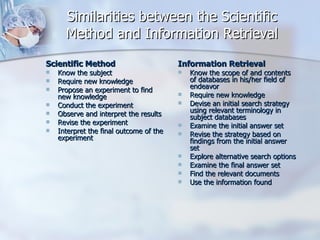
Similarities between the Scientific Method and Information Retrieval Scientific Method Know the subject  Require new knowledge  Propose an experiment to find new knowledge  Conduct the experiment  Observe and interpret the results  Revise the experiment  Interpret the final outcome of the experiment  Information Retrieval Know the scope of and contents of databases in his/her field of endeavor  Require new knowledge  Devise an initial search strategy using relevant terminology in subject databases  Examine the initial answer set  Revise the strategy based on findings from the initial answer set  Explore alternative search options  Examine the final answer set  Find the relevant documents  Use the information found
Formats of the Scientific and Technical Literature Journal  Conference Proceeding  Magazine  Review Journal  Research Level Book (monograph)  Encyclopedia  Data Compilation
What is a Journal? A  journal  is a publication issued periodically that reports original research. Manuscripts submitted by researchers are scrutinized by an editor and a referee before they are accepted for publication.  This is known as the  peer review process . The articles are very detailed and include detailed experimental procedures.  It is aimed at a very specialized audience of researchers in the field.
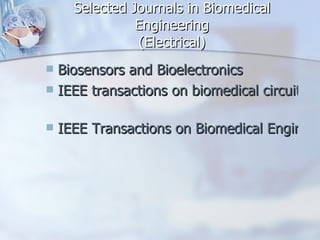
Selected Journals in Biomedical Engineering (Electrical) Biosensors and Bioelectronics IEEE transactions on biomedical circuits and systems      IEEE Transactions on Biomedical Engineering
Selected Journals in Biomedical Engineering Biological Cell and Tissue Banking  Journal of Stem Cells and Regenerative Medicine Cellular and molecular bioengineering
Selected Journals in Biomedical Engineering Chemical Biomaterials Bioprocess and  Biosystems  Engineering Biochemical Engineering Journal
Selected Journals in Biomedical Engineering Mechanical Journal of biomechanical engineering    
Professional Conferences Scientists and engineers regularly attend conferences to report recent research findings to their colleagues.  Most conferences are organized by professional societies such at the  Biomedical Engineering Society  (BMES) and the  American Society of Biomechanics  (ASB) Conferences may be held annually, bi-annually, or irregularly.   Some are one-time events.  
Conference Proceedings A  conference proceeding  is the permanent record of the papers presented at a conference.  They are held as books or as CD-ROMs in a library. A conference paper may appear in a journal
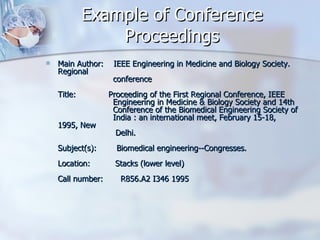
Example of Conference Proceedings Main Author:    IEEE Engineering in Medicine and Biology Society. Regional                       conference Title:             Proceeding of the First Regional Conference, IEEE                       Engineering in Medicine & Biology Society and 14th                       Conference of the Biomedical Engineering Society of                       India : an international meet, February 15-18, 1995, New                      Delhi. Subject(s):        Biomedical engineering--Congresses. Location:          Stacks (lower level) Call number:       R856.A2 I346 1995
Review Journal A  Review Journal  is a condensed version of a research journal.  It summarizes research in a field over a short period of time.  The articles omit the detailed experimental procedures but do provide lengthy bibliographies with references to the original research.
Review Journals Annual Review of Biomedical Engineering  Critical Reviews in Biomedical Engineering (available in print at NJIT)  Call Number: R856.A1 C5
Magazines A  magazine  is a publication issued periodically that has scientific and technical articles that are translated into a language suitable for a more general audience.  Magazine articles are usually written by a journalist rather than the scientist who has done the research.  Some magazines are orientated toward the business aspects of biomedical engineering while others are technical
Magazines Biomedical Sciences Instrumentation  IEEE Engineering in Medicine and Biology Magazine
Monographs A  monograph  is librarians' jargon for a book that is only published once.  Books are obviously written at levels ranging from elementary  to graduate school level.  Recent research done over a longer period of time is reported in monographs.  Now, the information is available to a much wider audience.  There are hundreds of monographs written for the disciplines related to biomedical engineering.
Handbooks and Encyclopedias Handbooks  provide find formulae, definitions and or often used as a starting point when researching an unfamiliar field.   Encyclopedias  (single or multi-volume) introduce researchers to specialize fields of study.   Many are now available in electronic formats.
Handbooks Title:             The biomedical engineering handbook / editor-in-chief,                       Joseph D. Bronzino. Subject(s):        Biomedical engineering--Handbooks, manuals, etc.                Publisher:         Boca Raton : CRC Press : IEEE Press, c2000. Location:          Ready Reference (behind the Ref Desk) Call number:       R856.15 .B56 2000
Encyclopedias Title:             Standard handbook of biomedical engineering and design /                       Myer Kutz, editor in chief. Subject(s):        Biomedical engineering--Handbooks, manuals, etc.                          Medical instruments and apparatus--Design and construction                       --Handbooks, manuals, etc. Publisher:         New York : McGraw-Hill, c2003. Description:       1 v. (various pagings) : ill. ; 25 cm. Series:            McGraw-Hill standard handbooks Location:          Stacks (lower level) Call number:       R856.15 .S73 2003
Flow of Scientific Information Scientists and engineers conceive ideas and perform experiments in the laboratory.  They want to make the results of their research public.  They will write a manuscript documenting their research results and submit to the editor of an appropriate journal for publication. The editor will refer the manuscript to an authority in the field who will review it and accept or deny it for publication. They may also present their findings at a professional conference.
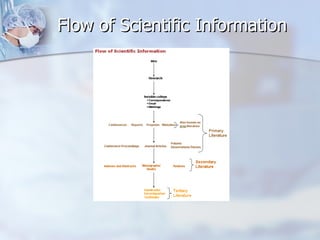
Flow of Scientific Information The published information flows from the top of the chart (on the next slide) to the bottom.  Students needing information must start their research at the bottom of the chart.  Tertiary literature such as handbooks, encyclopedias, and textbooks must be consulted first.  If the desired information is not found there, the researcher must try to find information in reviews, journals and conference proceedings.  Such publications are indexed in subject specific databases.
Flow of Scientific Information
Types of Databases Bibliographic  - includes the elements needed to identify the document  Author(s)  Title  Journal, Year, Volume, Issue Number, Pages  Abstract - a one paragraph summary of the article to help the researcher decide if it is relevant to the research question  Full-Text  - includes the entire article in electronic format  Numeric  (Data Compilation) - includes only specific data elements such as thermodynamic or spectral data
History of Database Formats Print  Very cumbersome and difficult to use  Online (1970s to the present)  Pay as you go.  Cost is based on amount of information retrieved  CD-ROM (1980s to the present)  Only so much information can fit on one disk  World Wide Web (1990s to the present)  Allows for remote access
Limitations of Databases Subject coverage  Journal Coverage  Dates of Publication  Not all databases are full-text or provide links to full-text of the retrieved documents
Databases for Biomedical Engineers Site for NJIT Databases IEEE/IEE Electronic Library  Scopus Medline (PubMed) Scifinder Scholar (Chemical Abstracts) Pubget
Scopus Scopus is a multidisciplinary database that contains records going back to the mid 1960s, offering newly-linked citations across the widest body of scientific abstracts available in one place.  Biomedical engineering is one of the many subjects covered in Scopus. Scopus has a 100% overlap with Medline titles.
IEEE/IEE Electronic Library A database of IEEE transactions, journals, magazines and conference proceedings published since 1988 plus select content back to 1950, and all current IEEE Standards.  Includes links to the  full-text  of the original documents  A single source to almost a third of the world's current electrical engineering and computer science literature.  Over 1 million references are included.  Some  of the database is related to biomedical engineering
Medline MEDLINE is the NLM's (National Library of Medicine) premier bibliographic database covering the fields of medicine, nursing, dentistry, veterinary medicine, the health care system, and the preclinical sciences. It does cover some aspects of biomedical engineering. 
Medline MEDLINE contains bibliographic citations and author abstracts from more than 4,800 biomedical journals published in the United States and 70 other countries. The database contains over 12 million citations dating back to the mid-1960's.  Scopus has a 100% overlap with Medline titles.
Scifinder Scholar Electronic Version of Chemical Abstracts (1907 to the present)  It contains many links to full-text articles  Searchable by chemical substance, reaction, research topic, author or affiliation  Its coverage of biomedical engineering is limited to "chemical aspects" such as biomaterials.  It would not cover topics such as rehabilitation, biomechanics, and instrumentation.
Scifinder Scholar Only one person at NJIT may search Scifinder Scholar at a time.  Please minimize time you are using it by:  Evaluating your answer set while you are off line  Using the database during off-peak hours.  It is available almost 24 hours a day/7 days a week  Waiting at least 10 minutes before attempting to login again.  How-to guides are available at:  http:// www.cas.org/support/academic/sf/htg/index.html
Pubget Pubget   is a search engine for PDFs in the life sciences. It indexes nearly 20 million life science research documents, including those in PubMed®. You search it like you would PubMed or Google Scholar. The difference is Pubget gets you the PDF right away.
Boolean Logic Boolean logic takes its name from British mathematician George Boole who wrote about a system of logic designed to produce better search results by formulating precise queries.  The Boolean Operators are:  AND   The Boolean AND narrows your search by retrieving only documents that contain every one of the keywords that you enter.  The more terms you enter, the narrower your search becomes.       EXAMPLE: biomechanics AND knee      EXAMPLE: biomechanics AND knee AND elbow  OR  The Boolean OR expands your search by returning documents in which either or both keywords appear.  The more keywords you enter, the more documents you retrieve.     EXAMPLE: knee OR elbow    EXAMPLE: knee OR elbow OR shoulder  NOT  The Boolean NOT limits your search by returning only the first keyword but not the second, even if the first word appears in that document, too     EXAMPLE knee NOT shoulder    EXAMPLE elbow NOT knee To do an effective search you must choose the most relevant database(s) and the appropriate Boolean Logic
Availability of Journals Once you do a search, you must locate the articles that you retrieved from the search that you think are relevant.  They may be available: Print only  Electronic Only  Print and Electronic  Dates of electronic availability vary  Not available at NJIT - order through  interlibrary loan
Devising Optimal Search Strategies Choose the proper database(s)  Be aware of the scope and limitations  Use all relevant search terms and appropriate Boolean logic  Think of concepts not words Devise a search strategy for:  Precise search  Expand strategy if too few are found  Exhaustive search  Cut down if too many citations are retrieved
Evaluating References Look at the abstract to judge if the paper is relevant to your topic If so, is the paper available from the NJIT Library? All papers from the IEEE Electronic Library are available in pdf Follow links in Scopus or Medline to check for availabilty
Citing Your Sources and Managing References Please See: http://library.njit.edu/researchhelpdesk/howto/cite.php
Guide to Resources in Biomedical Engineering http:// researchguides.njit.edu /biomedical-engineering
For Further Help Contact Bruce Slutsky Robert Van Houten Library [email_address] 973-642-4950 Reference desk at 973-596-3210

Biomedical engineering-tutorial-spring-2012

  • 1.
    FINDING INFORMATION INBIOMEDICAL ENGINEERING Bruce Slutsky Robert Van Houten Library
  • 2.
    The Scientific MethodThe scientific method is the process by which scientists, collectively and over time, endeavor to construct an accurate representation of the world.  There are various thought processes that are used when the scientific method is employed. 
  • 3.
    Information Retrieval Weare flooded with scientific and technical information.  Scientists, engineers and students must be able to find information at all levels from a multitude of information resources available to them.
  • 4.
    Similarities between theScientific Method and Information Retrieval Scientific Method Know the subject Require new knowledge Propose an experiment to find new knowledge Conduct the experiment Observe and interpret the results Revise the experiment Interpret the final outcome of the experiment Information Retrieval Know the scope of and contents of databases in his/her field of endeavor Require new knowledge Devise an initial search strategy using relevant terminology in subject databases Examine the initial answer set Revise the strategy based on findings from the initial answer set Explore alternative search options Examine the final answer set Find the relevant documents Use the information found
  • 5.
    Formats of theScientific and Technical Literature Journal Conference Proceeding Magazine Review Journal Research Level Book (monograph) Encyclopedia Data Compilation
  • 6.
    What is aJournal? A journal is a publication issued periodically that reports original research. Manuscripts submitted by researchers are scrutinized by an editor and a referee before they are accepted for publication.  This is known as the peer review process . The articles are very detailed and include detailed experimental procedures.  It is aimed at a very specialized audience of researchers in the field.
  • 7.
    Selected Journals inBiomedical Engineering (Electrical) Biosensors and Bioelectronics IEEE transactions on biomedical circuits and systems   IEEE Transactions on Biomedical Engineering
  • 8.
    Selected Journals inBiomedical Engineering Biological Cell and Tissue Banking Journal of Stem Cells and Regenerative Medicine Cellular and molecular bioengineering
  • 9.
    Selected Journals inBiomedical Engineering Chemical Biomaterials Bioprocess and Biosystems Engineering Biochemical Engineering Journal
  • 10.
    Selected Journals inBiomedical Engineering Mechanical Journal of biomechanical engineering  
  • 11.
    Professional Conferences Scientistsand engineers regularly attend conferences to report recent research findings to their colleagues.  Most conferences are organized by professional societies such at the Biomedical Engineering Society (BMES) and the American Society of Biomechanics (ASB) Conferences may be held annually, bi-annually, or irregularly.   Some are one-time events.  
  • 12.
    Conference Proceedings A conference proceeding is the permanent record of the papers presented at a conference.  They are held as books or as CD-ROMs in a library. A conference paper may appear in a journal
  • 13.
    Example of ConferenceProceedings Main Author:    IEEE Engineering in Medicine and Biology Society. Regional                       conference Title:             Proceeding of the First Regional Conference, IEEE                       Engineering in Medicine & Biology Society and 14th                       Conference of the Biomedical Engineering Society of                       India : an international meet, February 15-18, 1995, New                     Delhi. Subject(s):        Biomedical engineering--Congresses. Location:          Stacks (lower level) Call number:       R856.A2 I346 1995
  • 14.
    Review Journal A Review Journal is a condensed version of a research journal.  It summarizes research in a field over a short period of time.  The articles omit the detailed experimental procedures but do provide lengthy bibliographies with references to the original research.
  • 15.
    Review Journals AnnualReview of Biomedical Engineering Critical Reviews in Biomedical Engineering (available in print at NJIT) Call Number: R856.A1 C5
  • 16.
    Magazines A magazine is a publication issued periodically that has scientific and technical articles that are translated into a language suitable for a more general audience.  Magazine articles are usually written by a journalist rather than the scientist who has done the research.  Some magazines are orientated toward the business aspects of biomedical engineering while others are technical
  • 17.
    Magazines Biomedical SciencesInstrumentation IEEE Engineering in Medicine and Biology Magazine
  • 18.
    Monographs A monograph is librarians' jargon for a book that is only published once.  Books are obviously written at levels ranging from elementary  to graduate school level.  Recent research done over a longer period of time is reported in monographs.  Now, the information is available to a much wider audience.  There are hundreds of monographs written for the disciplines related to biomedical engineering.
  • 19.
    Handbooks and EncyclopediasHandbooks provide find formulae, definitions and or often used as a starting point when researching an unfamiliar field.  Encyclopedias (single or multi-volume) introduce researchers to specialize fields of study.   Many are now available in electronic formats.
  • 20.
    Handbooks Title:             Thebiomedical engineering handbook / editor-in-chief,                       Joseph D. Bronzino. Subject(s):        Biomedical engineering--Handbooks, manuals, etc.               Publisher:         Boca Raton : CRC Press : IEEE Press, c2000. Location:          Ready Reference (behind the Ref Desk) Call number:       R856.15 .B56 2000
  • 21.
    Encyclopedias Title:             Standardhandbook of biomedical engineering and design /                       Myer Kutz, editor in chief. Subject(s):        Biomedical engineering--Handbooks, manuals, etc.                          Medical instruments and apparatus--Design and construction                       --Handbooks, manuals, etc. Publisher:         New York : McGraw-Hill, c2003. Description:       1 v. (various pagings) : ill. ; 25 cm. Series:            McGraw-Hill standard handbooks Location:          Stacks (lower level) Call number:       R856.15 .S73 2003
  • 22.
    Flow of ScientificInformation Scientists and engineers conceive ideas and perform experiments in the laboratory.  They want to make the results of their research public.  They will write a manuscript documenting their research results and submit to the editor of an appropriate journal for publication. The editor will refer the manuscript to an authority in the field who will review it and accept or deny it for publication. They may also present their findings at a professional conference.
  • 23.
    Flow of ScientificInformation The published information flows from the top of the chart (on the next slide) to the bottom.  Students needing information must start their research at the bottom of the chart.  Tertiary literature such as handbooks, encyclopedias, and textbooks must be consulted first.  If the desired information is not found there, the researcher must try to find information in reviews, journals and conference proceedings.  Such publications are indexed in subject specific databases.
  • 24.
    Flow of ScientificInformation
  • 25.
    Types of DatabasesBibliographic - includes the elements needed to identify the document Author(s) Title Journal, Year, Volume, Issue Number, Pages Abstract - a one paragraph summary of the article to help the researcher decide if it is relevant to the research question Full-Text - includes the entire article in electronic format Numeric (Data Compilation) - includes only specific data elements such as thermodynamic or spectral data
  • 26.
    History of DatabaseFormats Print Very cumbersome and difficult to use Online (1970s to the present) Pay as you go.  Cost is based on amount of information retrieved CD-ROM (1980s to the present) Only so much information can fit on one disk World Wide Web (1990s to the present) Allows for remote access
  • 27.
    Limitations of DatabasesSubject coverage Journal Coverage Dates of Publication Not all databases are full-text or provide links to full-text of the retrieved documents
  • 28.
    Databases for BiomedicalEngineers Site for NJIT Databases IEEE/IEE Electronic Library Scopus Medline (PubMed) Scifinder Scholar (Chemical Abstracts) Pubget
  • 29.
    Scopus Scopus isa multidisciplinary database that contains records going back to the mid 1960s, offering newly-linked citations across the widest body of scientific abstracts available in one place.  Biomedical engineering is one of the many subjects covered in Scopus. Scopus has a 100% overlap with Medline titles.
  • 30.
    IEEE/IEE Electronic LibraryA database of IEEE transactions, journals, magazines and conference proceedings published since 1988 plus select content back to 1950, and all current IEEE Standards.  Includes links to the full-text of the original documents A single source to almost a third of the world's current electrical engineering and computer science literature.  Over 1 million references are included. Some of the database is related to biomedical engineering
  • 31.
    Medline MEDLINE isthe NLM's (National Library of Medicine) premier bibliographic database covering the fields of medicine, nursing, dentistry, veterinary medicine, the health care system, and the preclinical sciences. It does cover some aspects of biomedical engineering. 
  • 32.
    Medline MEDLINE containsbibliographic citations and author abstracts from more than 4,800 biomedical journals published in the United States and 70 other countries. The database contains over 12 million citations dating back to the mid-1960's. Scopus has a 100% overlap with Medline titles.
  • 33.
    Scifinder Scholar ElectronicVersion of Chemical Abstracts (1907 to the present) It contains many links to full-text articles Searchable by chemical substance, reaction, research topic, author or affiliation Its coverage of biomedical engineering is limited to "chemical aspects" such as biomaterials.  It would not cover topics such as rehabilitation, biomechanics, and instrumentation.
  • 34.
    Scifinder Scholar Onlyone person at NJIT may search Scifinder Scholar at a time.  Please minimize time you are using it by: Evaluating your answer set while you are off line Using the database during off-peak hours.  It is available almost 24 hours a day/7 days a week Waiting at least 10 minutes before attempting to login again. How-to guides are available at: http:// www.cas.org/support/academic/sf/htg/index.html
  • 35.
    Pubget Pubget is a search engine for PDFs in the life sciences. It indexes nearly 20 million life science research documents, including those in PubMed®. You search it like you would PubMed or Google Scholar. The difference is Pubget gets you the PDF right away.
  • 36.
    Boolean Logic Booleanlogic takes its name from British mathematician George Boole who wrote about a system of logic designed to produce better search results by formulating precise queries.  The Boolean Operators are: AND The Boolean AND narrows your search by retrieving only documents that contain every one of the keywords that you enter.  The more terms you enter, the narrower your search becomes.      EXAMPLE: biomechanics AND knee      EXAMPLE: biomechanics AND knee AND elbow OR The Boolean OR expands your search by returning documents in which either or both keywords appear.  The more keywords you enter, the more documents you retrieve.    EXAMPLE: knee OR elbow    EXAMPLE: knee OR elbow OR shoulder NOT The Boolean NOT limits your search by returning only the first keyword but not the second, even if the first word appears in that document, too    EXAMPLE knee NOT shoulder    EXAMPLE elbow NOT knee To do an effective search you must choose the most relevant database(s) and the appropriate Boolean Logic
  • 37.
    Availability of JournalsOnce you do a search, you must locate the articles that you retrieved from the search that you think are relevant.  They may be available: Print only Electronic Only Print and Electronic Dates of electronic availability vary Not available at NJIT - order through interlibrary loan
  • 38.
    Devising Optimal SearchStrategies Choose the proper database(s) Be aware of the scope and limitations Use all relevant search terms and appropriate Boolean logic Think of concepts not words Devise a search strategy for: Precise search Expand strategy if too few are found Exhaustive search Cut down if too many citations are retrieved
  • 39.
    Evaluating References Lookat the abstract to judge if the paper is relevant to your topic If so, is the paper available from the NJIT Library? All papers from the IEEE Electronic Library are available in pdf Follow links in Scopus or Medline to check for availabilty
  • 40.
    Citing Your Sourcesand Managing References Please See: http://library.njit.edu/researchhelpdesk/howto/cite.php
  • 41.
    Guide to Resourcesin Biomedical Engineering http:// researchguides.njit.edu /biomedical-engineering
  • 42.
    For Further HelpContact Bruce Slutsky Robert Van Houten Library [email_address] 973-642-4950 Reference desk at 973-596-3210