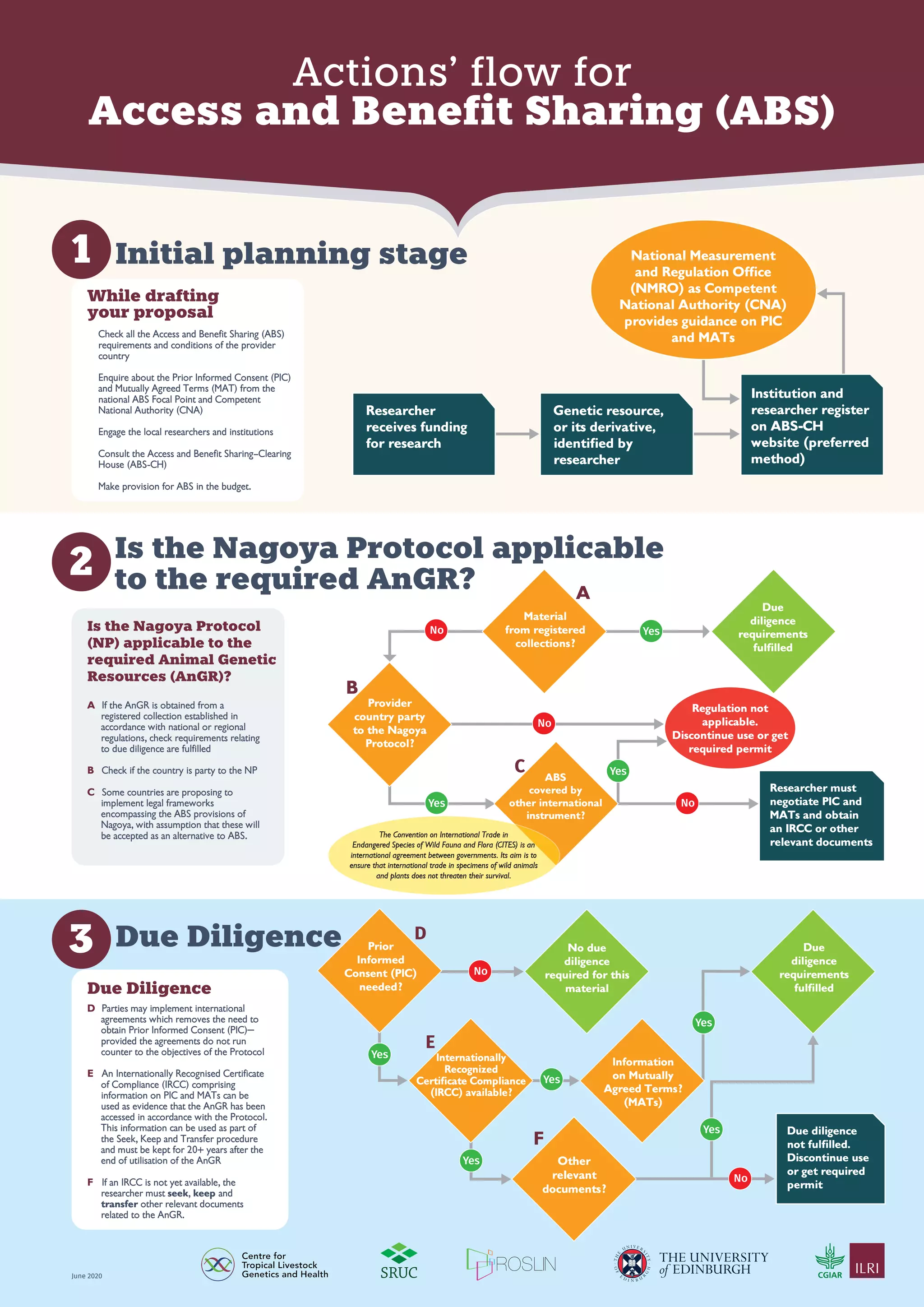
Actions’ flow for
Access and Benefit Sharing (ABS)
A If the AnGR is obtained from a
registered collection established in
accordance with national or regional
regulations, check requirements relating
to due diligence are fulfilled
B Check if the country is party to the NP
C Some countries are proposing to
implement legal frameworks
encompassing the ABS provisions of
Nagoya, with assumption that these will
be accepted as an alternative to ABS.
Is the Nagoya Protocol
(NP) applicable to the
required Animal Genetic
Resources (AnGR)?
2 Is the Nagoya Protocol applicable
to the required AnGR?
No due
diligence
required for this
material
Due diligence
not fulfilled.
Discontinue use
or get required
permit
No
Prior
Informed
Consent (PIC)
needed?
D
Yes
Yes
Yes
Yes
Due
diligence
requirements
fulfilled
Internationally
Recognized
Certificate Compliance
(IRCC) available?
E
Information
on Mutually
Agreed Terms?
(MATs)
Yes
Other
relevant
documents?
F
No
Due
diligence
requirements
fulfilled
Material
from registered
collections?
A
Provider
country party
to the Nagoya
Protocol?
B
ABS
covered by
other international
instrument?
C
Yes
Yes
No
No
No
Researcher must
negotiate PIC and
MATs and obtain
an IRCC or other
relevant documents
Regulation not
applicable.
Discontinue use or get
required permit
Yes
The Convention on International Trade in
Endangered Species of Wild Fauna and Flora (CITES) is an
international agreement between governments. Its aim is to
ensure that international trade in specimens of wild animals
and plants does not threaten their survival.
1 Initial planning stage
Check all the Access and Benefit Sharing (ABS)
requirements and conditions of the provider
country
Enquire about the Prior Informed Consent (PIC)
and Mutually Agreed Terms (MAT) from the
national ABS Focal Point and Competent
National Authority (CNA)
Engage the local researchers and institutions
Consult the Access and Benefit Sharing–Clearing
House (ABS-CH)
Make provision for ABS in the budget.
While drafting
your proposal
1
2
D Parties may implement international
agreements which removes the need to
obtain Prior Informed Consent (PIC)—
provided the agreements do not run
counter to the objectives of the Protocol
E An Internationally Recognised Certificate
of Compliance (IRCC) comprising
information on PIC and MATs can be
used as evidence that the AnGR has been
accessed in accordance with the Protocol.
This information can be used as part of
the Seek, Keep and Transfer procedure
and must be kept for 20+ years after the
end of utilisation of the AnGR
F If an IRCC is not yet available, the
researcher must seek, keep and
transfer other relevant documents
related to the AnGR.
Due Diligence
3 Due Diligence3
Researcher
receives funding
for research
Genetic resource,
or its derivative,
identified by
researcher
Institution and
researcher register
on ABS-CH
website (preferred
method)
National Measurement
and Regulation Office
(NMRO) as Competent
National Authority (CNA)
provides guidance on PIC
and MATs
June 2020

Actions’ flow for Access and Benefit Sharing (ABS)

  • 1.
    Actions’ flow for Accessand Benefit Sharing (ABS) A If the AnGR is obtained from a registered collection established in accordance with national or regional regulations, check requirements relating to due diligence are fulfilled B Check if the country is party to the NP C Some countries are proposing to implement legal frameworks encompassing the ABS provisions of Nagoya, with assumption that these will be accepted as an alternative to ABS. Is the Nagoya Protocol (NP) applicable to the required Animal Genetic Resources (AnGR)? 2 Is the Nagoya Protocol applicable to the required AnGR? No due diligence required for this material Due diligence not fulfilled. Discontinue use or get required permit No Prior Informed Consent (PIC) needed? D Yes Yes Yes Yes Due diligence requirements fulfilled Internationally Recognized Certificate Compliance (IRCC) available? E Information on Mutually Agreed Terms? (MATs) Yes Other relevant documents? F No Due diligence requirements fulfilled Material from registered collections? A Provider country party to the Nagoya Protocol? B ABS covered by other international instrument? C Yes Yes No No No Researcher must negotiate PIC and MATs and obtain an IRCC or other relevant documents Regulation not applicable. Discontinue use or get required permit Yes The Convention on International Trade in Endangered Species of Wild Fauna and Flora (CITES) is an international agreement between governments. Its aim is to ensure that international trade in specimens of wild animals and plants does not threaten their survival. 1 Initial planning stage Check all the Access and Benefit Sharing (ABS) requirements and conditions of the provider country Enquire about the Prior Informed Consent (PIC) and Mutually Agreed Terms (MAT) from the national ABS Focal Point and Competent National Authority (CNA) Engage the local researchers and institutions Consult the Access and Benefit Sharing–Clearing House (ABS-CH) Make provision for ABS in the budget. While drafting your proposal 1 2 D Parties may implement international agreements which removes the need to obtain Prior Informed Consent (PIC)— provided the agreements do not run counter to the objectives of the Protocol E An Internationally Recognised Certificate of Compliance (IRCC) comprising information on PIC and MATs can be used as evidence that the AnGR has been accessed in accordance with the Protocol. This information can be used as part of the Seek, Keep and Transfer procedure and must be kept for 20+ years after the end of utilisation of the AnGR F If an IRCC is not yet available, the researcher must seek, keep and transfer other relevant documents related to the AnGR. Due Diligence 3 Due Diligence3 Researcher receives funding for research Genetic resource, or its derivative, identified by researcher Institution and researcher register on ABS-CH website (preferred method) National Measurement and Regulation Office (NMRO) as Competent National Authority (CNA) provides guidance on PIC and MATs June 2020