ABNORMALITY TAGGING –
FUGUAI’S
LIBERATING THE THREAT OF WORKPLACE INEFFICIENCIES
RRG
CONCEPT OF EQUIPMENT/PROCESS
ABNORMALITY
• Any Abnormality is undesirable
• Abnormalities; anomalies eventually lead to
• Special cause performance variation
• reversible and/or irreversible damage
• Performance deterioration
• Inconsistency of production quality
• OEE losses
• Total Equipment Failure
CONCEPT OF EQUIPMENT ABNORMALITY
• Abnormality can be detected by
• SIGHT (Different) – color, shape, size, configuration , foreign
material, contamination
• FEEL (Vibration, Heat, Texture, etc.)
• HEARING (Noise, high frequency pitch)
• SMELL (Burnt; chemical gas leaking)
• TASTE (Acidic vs Basic)
• DISCOMFORT (Ergonomics / Safety issues or violations against
Working Standards)
• COST BURDEN – REPEATED EQUIPMENT REPAIR
• UN-OPTIMIZED SPACE
• TIME – MOTION
CONCEPT OF EQUIPMENT ABNORMALITY
• Elimination of Abnormalities will lead to:
• Better equipment performance
• Prolonging of continuous productive time
• More controlled Maintenance
• Reduction of Cost of Ownership
• Prolonging equipment usable life
• Repeatable Quality
• Lesser rejects/defects
• User-friendly equipment
• Operator productivity
• Ergonomic solutions
• Better safety features
WHAT IS AN ABNORMALITY?
• Parts wear-out
• Something is Dirty and Disorganized
• Something is performing not right
• Something is broken or about to be broken
• Something is missing
• Looks different ( “Batibot” ) from the rest
• Intermittent or Cyclic error manifestation
• Causes Discomfort
• Not safe
• Not ergonomic
HOW TO DETECT ABNORMALITIES
• Use your senses
• Observe closely; “deep dive”
• Uncover barriers (Cabinet doors/shields/filter traps)
• Look underneath with aid of white flashlight
• Use appropriate tools to expose hard to reach areas
• Take photos or videos or samples
• Cross-Compare observations with another equipment
• Compare with observation of others
• Compare against standards/drawing/specs
TECHNIQUES OF EQUIPMENT
ABNORMALITY TAGGING
• One common point of reference of observation
• Checklist method
• Equipment mapping and abnormality concentration chart
• Progressive recording (Example: markers on screw nuts or
measurements of noise/vibration levels)
• Take photo; explain abnormality & Data log
• Discuss abnormality findings with equipment owner
• Go back to the same abnormality to verify
countermeasures
• Fan-out (Bright Ideas) and standardize (globalization)
EXAMPLES OF LOW “HANGING FRUITS”
ABNORMALITIES
1. Missing screws
2. Loose screws
3. Grime Build-up
4. Squeaky Sound
5. High Frequency Sound
6. Excessive Vibration
7. Unusually hot surface
8. Unusual fumes
9. Narrow passage ways
10. Safety Pinch points
11. Dripping water/oil
12. Evidence of metal scraping/scratches
13. Paint or coating peel-off
14. Corrosion build-up
15. Loose threads
EXAMPLES OF LOW “HANGING FRUITS”
ABNORMALITIES
16. Non functioning detectors
17. By-passed safety interlocks
18. Non-aligned equipment
19. Lay-out discrepancy (Actual vs Plan)
20. Exposed conductive wires and cables
21. Unharnessed wires and cables
22. Tripping hazards
23. Sharp corners
24. Non-functioning equipment status tower lamps
25. Tight enclosure leaks (Gases)
26. Dirty /Clogged Filters
27. Discolorations
28. Blurred/ Non Functioning Meters
29. Foreign Objects inside the equipment panels and
cabinets
30. Missing components
31. Crowded working tables or workstations
32. Poor ventillation ; poor lighting
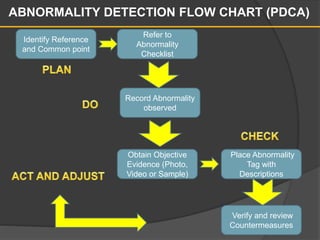
ABNORMALITY DETECTION FLOW CHART (PDCA)
Identify Reference
and Common point
Refer to
Abnormality
Checklist
Record Abnormality
observed
Obtain Objective
Evidence (Photo,
Video or Sample)
Place Abnormality
Tag with
Descriptions
Verify and review
Countermeasures

Abnormality tagging

  • 1.
    ABNORMALITY TAGGING – FUGUAI’S LIBERATINGTHE THREAT OF WORKPLACE INEFFICIENCIES RRG
  • 2.
    CONCEPT OF EQUIPMENT/PROCESS ABNORMALITY •Any Abnormality is undesirable • Abnormalities; anomalies eventually lead to • Special cause performance variation • reversible and/or irreversible damage • Performance deterioration • Inconsistency of production quality • OEE losses • Total Equipment Failure
  • 3.
    CONCEPT OF EQUIPMENTABNORMALITY • Abnormality can be detected by • SIGHT (Different) – color, shape, size, configuration , foreign material, contamination • FEEL (Vibration, Heat, Texture, etc.) • HEARING (Noise, high frequency pitch) • SMELL (Burnt; chemical gas leaking) • TASTE (Acidic vs Basic) • DISCOMFORT (Ergonomics / Safety issues or violations against Working Standards) • COST BURDEN – REPEATED EQUIPMENT REPAIR • UN-OPTIMIZED SPACE • TIME – MOTION
  • 4.
    CONCEPT OF EQUIPMENTABNORMALITY • Elimination of Abnormalities will lead to: • Better equipment performance • Prolonging of continuous productive time • More controlled Maintenance • Reduction of Cost of Ownership • Prolonging equipment usable life • Repeatable Quality • Lesser rejects/defects • User-friendly equipment • Operator productivity • Ergonomic solutions • Better safety features
  • 5.
    WHAT IS ANABNORMALITY? • Parts wear-out • Something is Dirty and Disorganized • Something is performing not right • Something is broken or about to be broken • Something is missing • Looks different ( “Batibot” ) from the rest • Intermittent or Cyclic error manifestation • Causes Discomfort • Not safe • Not ergonomic
  • 6.
    HOW TO DETECTABNORMALITIES • Use your senses • Observe closely; “deep dive” • Uncover barriers (Cabinet doors/shields/filter traps) • Look underneath with aid of white flashlight • Use appropriate tools to expose hard to reach areas • Take photos or videos or samples • Cross-Compare observations with another equipment • Compare with observation of others • Compare against standards/drawing/specs
  • 7.
    TECHNIQUES OF EQUIPMENT ABNORMALITYTAGGING • One common point of reference of observation • Checklist method • Equipment mapping and abnormality concentration chart • Progressive recording (Example: markers on screw nuts or measurements of noise/vibration levels) • Take photo; explain abnormality & Data log • Discuss abnormality findings with equipment owner • Go back to the same abnormality to verify countermeasures • Fan-out (Bright Ideas) and standardize (globalization)
  • 8.
    EXAMPLES OF LOW“HANGING FRUITS” ABNORMALITIES 1. Missing screws 2. Loose screws 3. Grime Build-up 4. Squeaky Sound 5. High Frequency Sound 6. Excessive Vibration 7. Unusually hot surface 8. Unusual fumes 9. Narrow passage ways 10. Safety Pinch points 11. Dripping water/oil 12. Evidence of metal scraping/scratches 13. Paint or coating peel-off 14. Corrosion build-up 15. Loose threads
  • 9.
    EXAMPLES OF LOW“HANGING FRUITS” ABNORMALITIES 16. Non functioning detectors 17. By-passed safety interlocks 18. Non-aligned equipment 19. Lay-out discrepancy (Actual vs Plan) 20. Exposed conductive wires and cables 21. Unharnessed wires and cables 22. Tripping hazards 23. Sharp corners 24. Non-functioning equipment status tower lamps 25. Tight enclosure leaks (Gases) 26. Dirty /Clogged Filters 27. Discolorations 28. Blurred/ Non Functioning Meters 29. Foreign Objects inside the equipment panels and cabinets 30. Missing components 31. Crowded working tables or workstations 32. Poor ventillation ; poor lighting
  • 11.
    ABNORMALITY DETECTION FLOWCHART (PDCA) Identify Reference and Common point Refer to Abnormality Checklist Record Abnormality observed Obtain Objective Evidence (Photo, Video or Sample) Place Abnormality Tag with Descriptions Verify and review Countermeasures