ABG INTERPRETATION - METABOLIC
DISORDER AND MIXED ACID BASE
DISORDER
DR JAYABHARATHI PALANIVEL
JUNIOR RESIDENT III
DEPARTMENT OF PULMONARY
MEDICINE
08/08/2022
WHAT TO LOOK IN ABG
• Oxygenation status ( po2- 80 to 100 ,
fio2, arteriolar alveolar gradient, RR )
• Ventilation status
• Acid base status
60- 80 : mild hypoxemia
40-60 : moderate hypoxemia
< 40 : severe
Sood P, Paul G, Puri S. Interpretation of arterial blood gas. Indian J Crit Care Med. 2010;14(2):57-64. doi:10.4103/0972-5229.68215
CHECK FOR CONSISTENCY OF ABG
• Modified Henderson equation:[H+−][HCO3]/PaCO2 = 24
• Subtract the last two digits of the pH from 80; this value is
approximately equal to the H+ concentration .
• Example :pH: 7.42, pCO2: 30.8, HCO3- : 19.3, H+ : 38.1.
• 80 - last 2 digits of pH = 80-42 = 38 = approximately equal to measured
H + in the report.
• https://www.thoracic.org/professionals/clinical-resources/critical-care/clinical-education/abgs.php
Sood P, Paul G, Puri S. Interpretation of arterial blood gas. Indian J Crit Care Med. 2010;14(2):57-64. doi:10.4103/0972-5229.68215
pH value and corresponding H+
ACIDEMIA VS ACIDOSIS
ALKALEMIA VS ALKALOSIS
• Acidemia and alkalemia - Physiological state dependent solely upon
arterial pH .
Acidemia pH <7.35
Alkalemia pH >7.45
Sood P, Paul G, Puri S. Interpretation of arterial blood gas. Indian J Crit Care Med. 2010;14(2):57-64. doi:10.4103/0972-5229.68215
ACIDOSIS VS ALKALOSIS
• Process which tend to drive pH towards Acidemia and Alkalemia
Sood P, Paul G, Puri S. Interpretation of arterial blood gas. Indian J Crit Care Med. 2010;14(2):57-64. doi:10.4103/0972-5229.68215
RESPIRATORY DISORDERS METABOLIC DISORDERS
ACIDOSIS - hypoventilation ACIDOSIS - HCO3 low
ALKALOSIS - Hyperventilation ALKALOSIS - HCO3- high
Disrupts acid base balance due to their effect on the
lungs
Disrupts acid base balance due to their effect on the
Kidneys, GI tract ,etc..,
https://www.thoracic.org/professionals/clinical-resources/critical-care/clinical-education/abgs.php
• Step 0 : Is this ABG Authentic?
• Step 1 : Acidosis or Alkalosis?
• Step 2 : Respiratory or Metabolic?
• Step 3 : If Respiratory, Acute or Chronic?
• Step 4 : Is Compensation adequate?
• Step 5 : If Metabolic - Anion Gap?
• Step 6 : Check “Gap Gap" Ratio
• Step 7 :if AG normal –urine anion gap
https://www.thoracic.org/professionals/clinical-resources/critical-care/clinical-education/abgs.php
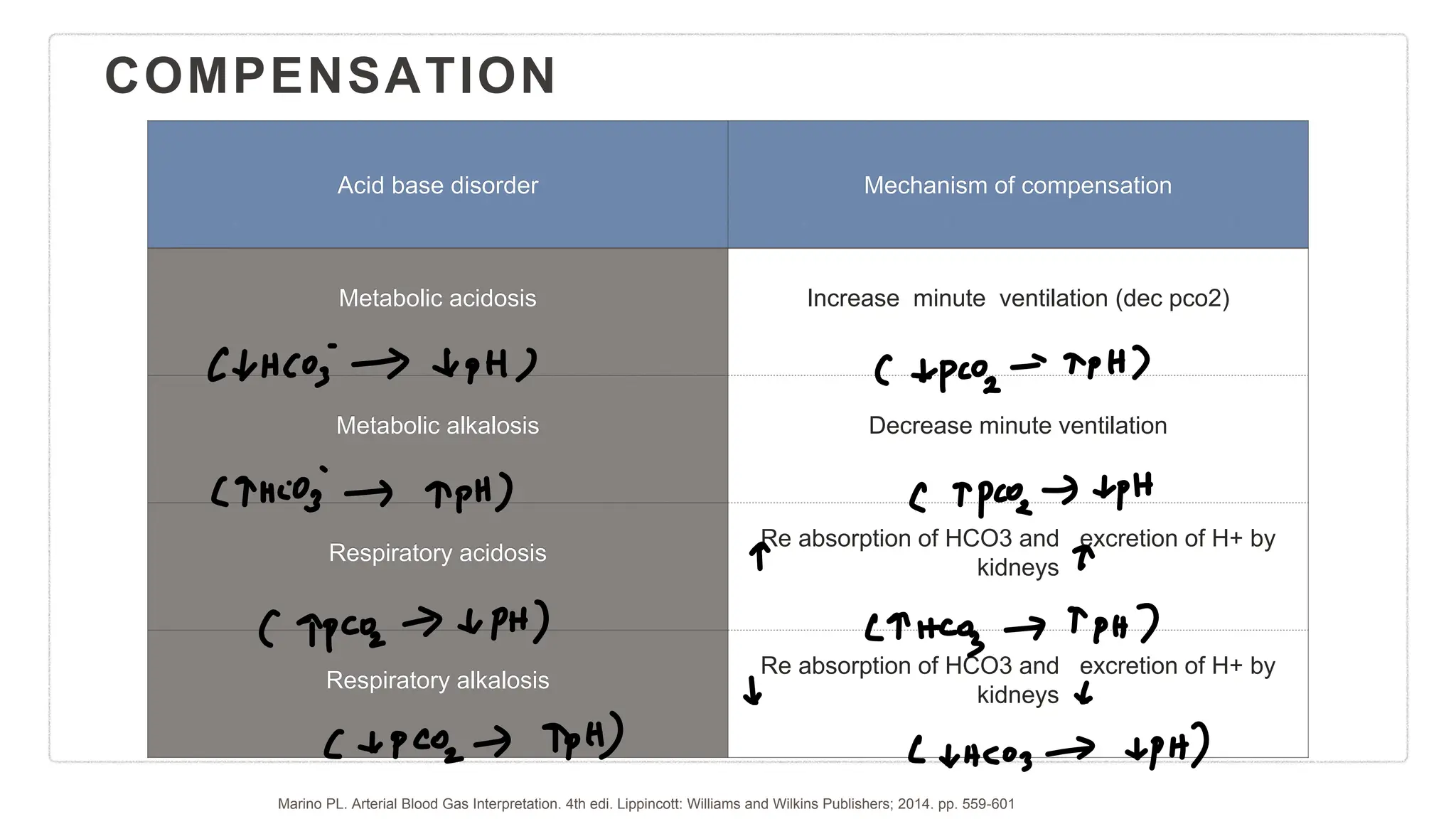
COMPENSATION
Acid base disorder Mechanism of compensation
Metabolic acidosis Increase minute ventilation (dec pco2)
Metabolic alkalosis Decrease minute ventilation
Respiratory acidosis
Re absorption of HCO3 and excretion of H+ by
kidneys
Respiratory alkalosis
Re absorption of HCO3 and excretion of H+ by
kidneys
Marino PL. Arterial Blood Gas Interpretation. 4th edi. Lippincott: Williams and Wilkins Publishers; 2014. pp. 559-601
WHICH IS DOMINANT DISORDER ?
• If the trend of change in paCO2 and HCO3- is the same, check the percent difference.
• pH = 7.25 HCO3- =16 paCO2 =60
• Here, the pH is acidotic and both paCO2 and HCO3- explain its acidosis: so look at the %
difference
• HCO3- % difference = (24 - 16)/24 = 0.33
• paCO2 % difference = (60 - 40)/40 = 0.5
RESPIRATO
RY
ACIDOSIS
AS THE
DOMINANT
DISORDER.
Marino PL. Arterial Blood Gas Interpretation. 4th edi. Lippincott: Williams and Wilkins Publishers; 2014. pp. 559-601
COMPENSATION
Compensatory
mechanism is poor in
which acid base
disorder ...?
METABOLIC
ALKALOSIS
ALVEOLAR GAS
EQUATION
Marino PL. Arterial Blood Gas Interpretation. 2nd edi. Lippincott: Williams and Wilkins Publishers; 1998. pp. 582–605
COMPENSATION FORMULA
Sood P, Paul G, Puri S. Interpretation of arterial blood gas. Indian J Crit Care Med. 2010;14(2):57-64. doi:10.4103/0972-5229.68215
COMPENSATION FORMULA
PRIMARY DISORDER FORMULA
Metabolic acidosis
PaCO2 = 1.5(HCO3 )+8
Metabolic alkalosis
PaCO2 = 40 + (0.6 ( HCO3 - 24))
Sood P, Paul G, Puri S. Interpretation of arterial blood gas. Indian J Crit Care Med. 2010;14(2):57-64. doi:10.4103/0972-5229.68215
COMPENSATION FORMULAS
Respiratory acidosis
Respiratory alkalosis
Acute 1 2
Chronic 4 5
Sood P, Paul G, Puri S. Interpretation of arterial blood gas. Indian J Crit Care Med. 2010;14(2):57-64. doi:10.4103/0972-5229.68215
PH : 7.50/ PaCO2 : 48 / HCO3 : 34
STEP 1: PH - alkalosis
STEP 2: pco2 - metabolic alkalosis
STEP 3 : evaluate compensationPaCO2 = 40 + (0.6 ( HCO3 - 24))
PRIMARY METABOLIC ALKALOSIS
PH : 7.12/ PaCO2 : 32/ HCO3 : 10
STEP 1: PH
STEP 2: pco2
STEP 3 : evaluate compensation PaCO2 = 1.5(HCO3 )+8
SIMPLE TO ADDITIONAL ACID BASE
DISORDER
• Explanation -additional respiratory acidosis
Primary acidosis
Hco3 = 10 mEq/l
Respiratory compensation
PCO2= 23 mmhg
Measured
PCO2 = 35 mmHg
PH :7.34/ PaCO2 : 65/ HCO3 : 34
STEP 1: PH
STEP 2: pco2
STEP 3 : evaluate compensation
24 year old man found unconscious on
the floor soiled with vomit . He was last
seen 4hrs prior , and appeared well at
that time
ANION GAP
Marino PL. Arterial Blood Gas Interpretation. 4th edi. Lippincott: Williams and Wilkins Publishers; 2014. pp. 559-601
NORMAL AG METABOLIC ACIDOSIS HIGH ANION GAP METABOLIC ACIDOSIS
Marino PL. Arterial Blood Gas Interpretation. 4th edi. Lippincott: Williams and Wilkins Publishers; 2014. pp. 559-601
ETIOLOGIES OF NORMAL ANION GAP
ACIDOSIS
LOSS OF HCO3 DECREASED RENAL H+ EXCRETION
Diarrhoea Renal tubular acidosis
Type 2 RTA Type 1RTA
Acetazolamide
TYPE 4 RTA
( hypoaldosteronism )
Urethral diversion
Sood P, Paul G, Puri S. Interpretation of arterial blood gas. Indian J Crit Care Med. 2010;14(2):57-64. doi:10.4103/0972-5229.68215
ETIOLOGIES OF HIGH ANION GAP ACIDOSIS
Sood P, Paul G, Puri S. Interpretation of arterial blood gas. Indian J Crit Care Med. 2010;14(2):57-64. doi:10.4103/0972-5229.68215
ALTERATION IN ANION GAP UNRELATED TO
METABOLIC ACIDOSIS
HIGH ANION GAP LOW ANION GAP
1) metabolic alkalosis Hypoalbuminemia
2)hyperphosphatemia Increased K/ ca/ Mg
3) anionic Paraproteinemia Severe lithium intoxication
Cationic paraproteinemia
Sood P, Paul G, Puri S. Interpretation of arterial blood gas. Indian J Crit Care Med. 2010;14(2):57-64. doi:10.4103/0972-5229.68215
URINE OSMOLAR GAP
• OG>10 mOsm/kg indicates the presence of abnormal, unmeasured
osmotically active molecules
• Measured osmolality – calculated osmolality
• Calculated osmolality = 2 x Na + RBS/18 + BUN/2.8
• ethanol, methanol, ethylene glycol, diethylene glycol, propylene glycol,
and isopropanol
Sood P, Paul G, Puri S. Interpretation of arterial blood gas. Indian J Crit Care Med. 2010;14(2):57-64. doi:10.4103/0972-5229.68215
URINE OSMOLAR GAP
• Urine anion gap=(Na+ + K+) – Cl−
• < 10 mEq/L
• negative urinary AG = GI cause
• positive urinary AG=renal cause
HYPOALBUMINEMIA
Sood P, Paul G, Puri S. Interpretation of arterial blood gas. Indian J Crit Care Med. 2010;14(2):57-64. doi:10.4103/0972-5229.68215
MAINTAINING NEUTRALITY DURING AN
ELEVATED GAP ACIDOSIS
• 1:1 ratio between increased anion gap and decreased bicarbonate .
SHIFTS OF DELTA RATIO
Marino PL. Arterial Blood Gas Interpretation. 4th edi. Lippincott: Williams and Wilkins Publishers; 2014. pp. 559-601
SHIFTS OF DELTA RATIO
Marino PL. Arterial Blood Gas Interpretation. 4th edi. Lippincott: Williams and Wilkins Publishers; 2014. pp. 559-601
DELTA RATIO
MEASURED DELTA RATIO
PATHOLOGICAL METABOLIC DISORDER
Lower than expected range HAGMA + NAGMA
Within expected range HAGMA
HIGHER HAGMA + METABOLIC ALKALOSIS
Marino PL. Arterial Blood Gas Interpretation. 4th edi. Lippincott: Williams and Wilkins Publishers; 2014. pp. 559-601
DELTA GAP
DELTA AG + HCO3 = 24 +/- 6
Delta gap equals 0+-6mEq/L
Marino PL. Arterial Blood Gas Interpretation. 4th edi. Lippincott: Williams and Wilkins Publishers; 2014. pp. 559-601
THE DELTA GAP: ADD DELTA AG TO THE
MEASURE HCO3
MEASURED DELTA RATIO
PATHOLOGICAL METABOLIC DISORDER
Lower than expected range (<18) HAGMA + NAGMA
Within expected range (18-30) HAGMA
HIGHER (>30) HAGMA + METABOLIC ALKALOSIS
Marino PL. Arterial Blood Gas Interpretation. 4th edi. Lippincott: Williams and Wilkins Publishers; 2014. pp. 559-601
PH :7.29/ PaCO2 : 30/ HCO3 : 14
Na: 128/ k: 3.2/ Cl: 94/ HCO3 : 14
STEP 1: PH
STEP 2: pco2
STEP 3 : evaluate compensation ( PaCO2 = 1.5(HCO3 )+8)
STEP 4 : calculate AG ( AG= NA-(cl+HCO3 )
STEP 5 : calculate DELTA RATIO ( delta ag / delta HCO3 )
75 yr old female presents with fever and
profuse diarrhea for 2 days , vitals T:
100.4; HR : 130, BP : 78/30
High anion gap
metabolic acidosis with
normal anion gap
metabolic acidosis
Marino PL. Arterial Blood Gas Interpretation. 4th edi. Lippincott: Williams and Wilkins Publishers; 2014. pp. 559-601
APPROACH TO METABOLIC ALKALOSIS
BARTER SYNDROME
HYPOKALAEMIA CAUSING METABOLIC ALKALOSIS
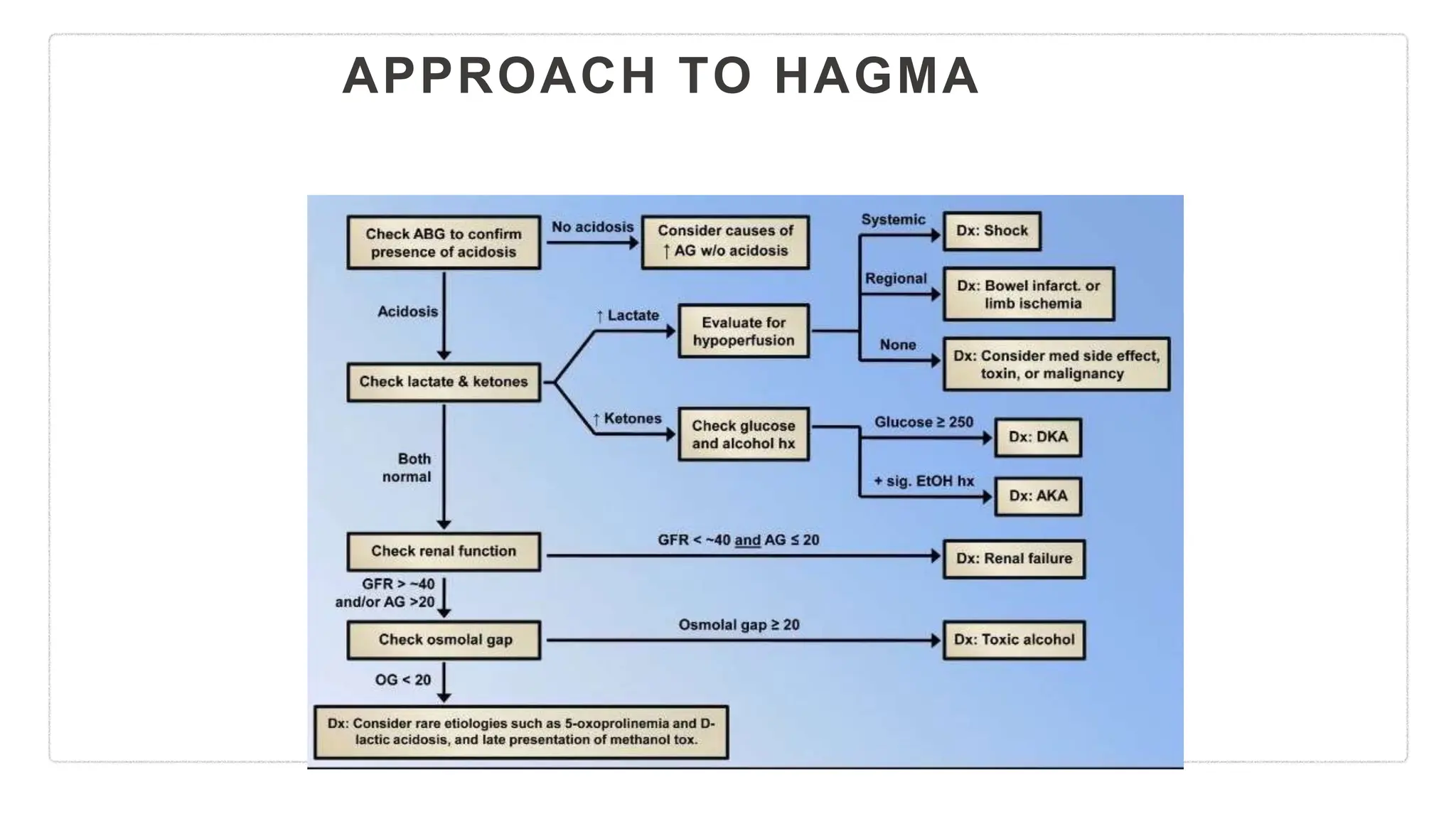
APPROACH TO HAGMA
APPROACH TO NAGMA
APPROACH TO
PATIENT WITH
NORMAL ANION GAP
ACIDOSIS
Sood P, Paul G, Puri S. Interpretation of arterial blood gas. Indian J Crit Care Med. 2010;14(2):57-64. doi:10.4103/0972-5229.68215
MIXED DISORDERS
MIXED DISORDERS
Sood P, Paul G, Puri S. Interpretation of arterial blood gas. Indian J Crit Care Med. 2010;14(2):57-64. doi:10.4103/0972-5229.68215
PH :7.17/ PaCO2 : 65/ HCO3 : 22
Na: 136/ k: 3.4/ Cl: 98/ albumin:1.6
STEP 1: PH - Acidemia
STEP 2: pco2 - RESPIRATORY ACIDOSIS
STEP 3 : evaluate compensation ( 1/10) --> Metabolic acidosis
STEP 4 : calculate AG ( AG= NA-(cl+HCO3 ) - ELEVATED AG METABOLIC ACIDOSIS (21)
STEP 5 : calculate DELTA RATIO ( delta ag / delta HCO3 ) =5 --> additional Metabolic alkalosis
48 year old alcoholic found unconscious
in his apartment ,soiled with vomit .he
was seen leaving a party 6hrs prior
Respiratory acidosis
with High anion gap
metabolic acidosis with
metabolic alkalosis
Marino PL. Arterial Blood Gas Interpretation. 4th edi. Lippincott: Williams and Wilkins Publishers; 2014. pp. 559-601
• Step 0 : Is this ABG Authentic?
• Step 1 : Acidosis or Alkalosis?
• Step 2 : Respiratory or Metabolic?
• Step 3 : If Respiratory, Acute or Chronic?
• Step 4 : Is Compensation adequate?
• Step 5 : If Metabolic - Anion Gap?
• Step 6 : Check “Gap Gap" Ratio
• Step 7 :if AG normal –urine anion gap
https://www.thoracic.org/professionals/clinical-resources/critical-care/clinical-education/abgs.php
Thank you

ABG - mixed disorders.pptx

  • 1.
    ABG INTERPRETATION -METABOLIC DISORDER AND MIXED ACID BASE DISORDER DR JAYABHARATHI PALANIVEL JUNIOR RESIDENT III DEPARTMENT OF PULMONARY MEDICINE 08/08/2022
  • 2.
    WHAT TO LOOKIN ABG • Oxygenation status ( po2- 80 to 100 , fio2, arteriolar alveolar gradient, RR ) • Ventilation status • Acid base status 60- 80 : mild hypoxemia 40-60 : moderate hypoxemia < 40 : severe Sood P, Paul G, Puri S. Interpretation of arterial blood gas. Indian J Crit Care Med. 2010;14(2):57-64. doi:10.4103/0972-5229.68215
  • 3.
    CHECK FOR CONSISTENCYOF ABG • Modified Henderson equation:[H+−][HCO3]/PaCO2 = 24 • Subtract the last two digits of the pH from 80; this value is approximately equal to the H+ concentration . • Example :pH: 7.42, pCO2: 30.8, HCO3- : 19.3, H+ : 38.1. • 80 - last 2 digits of pH = 80-42 = 38 = approximately equal to measured H + in the report. • https://www.thoracic.org/professionals/clinical-resources/critical-care/clinical-education/abgs.php
  • 4.
    Sood P, PaulG, Puri S. Interpretation of arterial blood gas. Indian J Crit Care Med. 2010;14(2):57-64. doi:10.4103/0972-5229.68215 pH value and corresponding H+
  • 5.
    ACIDEMIA VS ACIDOSIS ALKALEMIAVS ALKALOSIS • Acidemia and alkalemia - Physiological state dependent solely upon arterial pH . Acidemia pH <7.35 Alkalemia pH >7.45 Sood P, Paul G, Puri S. Interpretation of arterial blood gas. Indian J Crit Care Med. 2010;14(2):57-64. doi:10.4103/0972-5229.68215
  • 6.
    ACIDOSIS VS ALKALOSIS •Process which tend to drive pH towards Acidemia and Alkalemia Sood P, Paul G, Puri S. Interpretation of arterial blood gas. Indian J Crit Care Med. 2010;14(2):57-64. doi:10.4103/0972-5229.68215
  • 7.
    RESPIRATORY DISORDERS METABOLICDISORDERS ACIDOSIS - hypoventilation ACIDOSIS - HCO3 low ALKALOSIS - Hyperventilation ALKALOSIS - HCO3- high Disrupts acid base balance due to their effect on the lungs Disrupts acid base balance due to their effect on the Kidneys, GI tract ,etc.., https://www.thoracic.org/professionals/clinical-resources/critical-care/clinical-education/abgs.php
  • 8.
    • Step 0: Is this ABG Authentic? • Step 1 : Acidosis or Alkalosis? • Step 2 : Respiratory or Metabolic? • Step 3 : If Respiratory, Acute or Chronic? • Step 4 : Is Compensation adequate? • Step 5 : If Metabolic - Anion Gap? • Step 6 : Check “Gap Gap" Ratio • Step 7 :if AG normal –urine anion gap https://www.thoracic.org/professionals/clinical-resources/critical-care/clinical-education/abgs.php
  • 9.
    COMPENSATION Acid base disorderMechanism of compensation Metabolic acidosis Increase minute ventilation (dec pco2) Metabolic alkalosis Decrease minute ventilation Respiratory acidosis Re absorption of HCO3 and excretion of H+ by kidneys Respiratory alkalosis Re absorption of HCO3 and excretion of H+ by kidneys Marino PL. Arterial Blood Gas Interpretation. 4th edi. Lippincott: Williams and Wilkins Publishers; 2014. pp. 559-601
  • 10.
    WHICH IS DOMINANTDISORDER ? • If the trend of change in paCO2 and HCO3- is the same, check the percent difference. • pH = 7.25 HCO3- =16 paCO2 =60 • Here, the pH is acidotic and both paCO2 and HCO3- explain its acidosis: so look at the % difference • HCO3- % difference = (24 - 16)/24 = 0.33 • paCO2 % difference = (60 - 40)/40 = 0.5 RESPIRATO RY ACIDOSIS AS THE DOMINANT DISORDER. Marino PL. Arterial Blood Gas Interpretation. 4th edi. Lippincott: Williams and Wilkins Publishers; 2014. pp. 559-601
  • 11.
    COMPENSATION Compensatory mechanism is poorin which acid base disorder ...? METABOLIC ALKALOSIS ALVEOLAR GAS EQUATION Marino PL. Arterial Blood Gas Interpretation. 2nd edi. Lippincott: Williams and Wilkins Publishers; 1998. pp. 582–605
  • 12.
    COMPENSATION FORMULA Sood P,Paul G, Puri S. Interpretation of arterial blood gas. Indian J Crit Care Med. 2010;14(2):57-64. doi:10.4103/0972-5229.68215
  • 13.
    COMPENSATION FORMULA PRIMARY DISORDERFORMULA Metabolic acidosis PaCO2 = 1.5(HCO3 )+8 Metabolic alkalosis PaCO2 = 40 + (0.6 ( HCO3 - 24)) Sood P, Paul G, Puri S. Interpretation of arterial blood gas. Indian J Crit Care Med. 2010;14(2):57-64. doi:10.4103/0972-5229.68215
  • 14.
    COMPENSATION FORMULAS Respiratory acidosis Respiratoryalkalosis Acute 1 2 Chronic 4 5 Sood P, Paul G, Puri S. Interpretation of arterial blood gas. Indian J Crit Care Med. 2010;14(2):57-64. doi:10.4103/0972-5229.68215
  • 15.
    PH : 7.50/PaCO2 : 48 / HCO3 : 34 STEP 1: PH - alkalosis STEP 2: pco2 - metabolic alkalosis STEP 3 : evaluate compensationPaCO2 = 40 + (0.6 ( HCO3 - 24)) PRIMARY METABOLIC ALKALOSIS
  • 16.
    PH : 7.12/PaCO2 : 32/ HCO3 : 10 STEP 1: PH STEP 2: pco2 STEP 3 : evaluate compensation PaCO2 = 1.5(HCO3 )+8
  • 17.
    SIMPLE TO ADDITIONALACID BASE DISORDER • Explanation -additional respiratory acidosis Primary acidosis Hco3 = 10 mEq/l Respiratory compensation PCO2= 23 mmhg Measured PCO2 = 35 mmHg
  • 18.
    PH :7.34/ PaCO2: 65/ HCO3 : 34 STEP 1: PH STEP 2: pco2 STEP 3 : evaluate compensation 24 year old man found unconscious on the floor soiled with vomit . He was last seen 4hrs prior , and appeared well at that time
  • 19.
    ANION GAP Marino PL.Arterial Blood Gas Interpretation. 4th edi. Lippincott: Williams and Wilkins Publishers; 2014. pp. 559-601
  • 20.
    NORMAL AG METABOLICACIDOSIS HIGH ANION GAP METABOLIC ACIDOSIS Marino PL. Arterial Blood Gas Interpretation. 4th edi. Lippincott: Williams and Wilkins Publishers; 2014. pp. 559-601
  • 21.
    ETIOLOGIES OF NORMALANION GAP ACIDOSIS LOSS OF HCO3 DECREASED RENAL H+ EXCRETION Diarrhoea Renal tubular acidosis Type 2 RTA Type 1RTA Acetazolamide TYPE 4 RTA ( hypoaldosteronism ) Urethral diversion Sood P, Paul G, Puri S. Interpretation of arterial blood gas. Indian J Crit Care Med. 2010;14(2):57-64. doi:10.4103/0972-5229.68215
  • 22.
    ETIOLOGIES OF HIGHANION GAP ACIDOSIS Sood P, Paul G, Puri S. Interpretation of arterial blood gas. Indian J Crit Care Med. 2010;14(2):57-64. doi:10.4103/0972-5229.68215
  • 23.
    ALTERATION IN ANIONGAP UNRELATED TO METABOLIC ACIDOSIS HIGH ANION GAP LOW ANION GAP 1) metabolic alkalosis Hypoalbuminemia 2)hyperphosphatemia Increased K/ ca/ Mg 3) anionic Paraproteinemia Severe lithium intoxication Cationic paraproteinemia Sood P, Paul G, Puri S. Interpretation of arterial blood gas. Indian J Crit Care Med. 2010;14(2):57-64. doi:10.4103/0972-5229.68215
  • 24.
    URINE OSMOLAR GAP •OG>10 mOsm/kg indicates the presence of abnormal, unmeasured osmotically active molecules • Measured osmolality – calculated osmolality • Calculated osmolality = 2 x Na + RBS/18 + BUN/2.8 • ethanol, methanol, ethylene glycol, diethylene glycol, propylene glycol, and isopropanol Sood P, Paul G, Puri S. Interpretation of arterial blood gas. Indian J Crit Care Med. 2010;14(2):57-64. doi:10.4103/0972-5229.68215
  • 25.
    URINE OSMOLAR GAP •Urine anion gap=(Na+ + K+) – Cl− • < 10 mEq/L • negative urinary AG = GI cause • positive urinary AG=renal cause
  • 26.
    HYPOALBUMINEMIA Sood P, PaulG, Puri S. Interpretation of arterial blood gas. Indian J Crit Care Med. 2010;14(2):57-64. doi:10.4103/0972-5229.68215
  • 27.
    MAINTAINING NEUTRALITY DURINGAN ELEVATED GAP ACIDOSIS • 1:1 ratio between increased anion gap and decreased bicarbonate .
  • 28.
    SHIFTS OF DELTARATIO Marino PL. Arterial Blood Gas Interpretation. 4th edi. Lippincott: Williams and Wilkins Publishers; 2014. pp. 559-601
  • 29.
    SHIFTS OF DELTARATIO Marino PL. Arterial Blood Gas Interpretation. 4th edi. Lippincott: Williams and Wilkins Publishers; 2014. pp. 559-601
  • 30.
    DELTA RATIO MEASURED DELTARATIO PATHOLOGICAL METABOLIC DISORDER Lower than expected range HAGMA + NAGMA Within expected range HAGMA HIGHER HAGMA + METABOLIC ALKALOSIS Marino PL. Arterial Blood Gas Interpretation. 4th edi. Lippincott: Williams and Wilkins Publishers; 2014. pp. 559-601
  • 31.
    DELTA GAP DELTA AG+ HCO3 = 24 +/- 6 Delta gap equals 0+-6mEq/L Marino PL. Arterial Blood Gas Interpretation. 4th edi. Lippincott: Williams and Wilkins Publishers; 2014. pp. 559-601
  • 32.
    THE DELTA GAP:ADD DELTA AG TO THE MEASURE HCO3 MEASURED DELTA RATIO PATHOLOGICAL METABOLIC DISORDER Lower than expected range (<18) HAGMA + NAGMA Within expected range (18-30) HAGMA HIGHER (>30) HAGMA + METABOLIC ALKALOSIS Marino PL. Arterial Blood Gas Interpretation. 4th edi. Lippincott: Williams and Wilkins Publishers; 2014. pp. 559-601
  • 33.
    PH :7.29/ PaCO2: 30/ HCO3 : 14 Na: 128/ k: 3.2/ Cl: 94/ HCO3 : 14 STEP 1: PH STEP 2: pco2 STEP 3 : evaluate compensation ( PaCO2 = 1.5(HCO3 )+8) STEP 4 : calculate AG ( AG= NA-(cl+HCO3 ) STEP 5 : calculate DELTA RATIO ( delta ag / delta HCO3 ) 75 yr old female presents with fever and profuse diarrhea for 2 days , vitals T: 100.4; HR : 130, BP : 78/30 High anion gap metabolic acidosis with normal anion gap metabolic acidosis Marino PL. Arterial Blood Gas Interpretation. 4th edi. Lippincott: Williams and Wilkins Publishers; 2014. pp. 559-601
  • 34.
  • 36.
  • 37.
  • 38.
  • 39.
  • 40.
    APPROACH TO PATIENT WITH NORMALANION GAP ACIDOSIS Sood P, Paul G, Puri S. Interpretation of arterial blood gas. Indian J Crit Care Med. 2010;14(2):57-64. doi:10.4103/0972-5229.68215
  • 41.
  • 42.
    MIXED DISORDERS Sood P,Paul G, Puri S. Interpretation of arterial blood gas. Indian J Crit Care Med. 2010;14(2):57-64. doi:10.4103/0972-5229.68215
  • 43.
    PH :7.17/ PaCO2: 65/ HCO3 : 22 Na: 136/ k: 3.4/ Cl: 98/ albumin:1.6 STEP 1: PH - Acidemia STEP 2: pco2 - RESPIRATORY ACIDOSIS STEP 3 : evaluate compensation ( 1/10) --> Metabolic acidosis STEP 4 : calculate AG ( AG= NA-(cl+HCO3 ) - ELEVATED AG METABOLIC ACIDOSIS (21) STEP 5 : calculate DELTA RATIO ( delta ag / delta HCO3 ) =5 --> additional Metabolic alkalosis 48 year old alcoholic found unconscious in his apartment ,soiled with vomit .he was seen leaving a party 6hrs prior Respiratory acidosis with High anion gap metabolic acidosis with metabolic alkalosis Marino PL. Arterial Blood Gas Interpretation. 4th edi. Lippincott: Williams and Wilkins Publishers; 2014. pp. 559-601
  • 44.
    • Step 0: Is this ABG Authentic? • Step 1 : Acidosis or Alkalosis? • Step 2 : Respiratory or Metabolic? • Step 3 : If Respiratory, Acute or Chronic? • Step 4 : Is Compensation adequate? • Step 5 : If Metabolic - Anion Gap? • Step 6 : Check “Gap Gap" Ratio • Step 7 :if AG normal –urine anion gap https://www.thoracic.org/professionals/clinical-resources/critical-care/clinical-education/abgs.php
  • 45.