Fadi Farhat, Chairman of abc in
oncology
Head of Hematology-Oncology Division Hammoud
Hospital UMC
Lecturer Saint-Joseph University, Beirut
President of Cancer Research Group - CG
Mobile: +961 3 753155; Email: drfadi.clinic@gmail.com
abc in oncology
abc oncology
 What is it?
• Certificate
• Accreditation
 Aim
• Oncology for non oncologists
 All specialties, Qualified nurses, Pharmacists, Fellows,
• Knowledge in all fields on cancer
 Several Modules
• Generality on cancer
• Cancer per organs
abc oncology
 Duration
• Every 3-4 weeks
• 4 sessions to 2-4 hours, later 1/2 day
• 12 months
 Final evaluation
• Written evaluation,
• Presence, Active participation,
 Reward
• Participation to an international congress
 Number
• limited
AGENDA
 First Module
 Generalities
 Colon cancer
 Next modules
 Breast cancer
 Lung cancer
 G.U Cancers
 Etc…
 Evaluation
1- Generalities on Cancer
 Date: 05 October 2012
 Introduction,
 Etiology of Cancer,
 Pathophysiology of cancer
 Classification of tumor types,
 Methods of Diagnosis
 Goals of cancer treatment
 Modalities of cancer treatment
 Endpoint assessment (response/survival)
• Chemotherapy
02 November 2012
abc in Colorectal Cancer
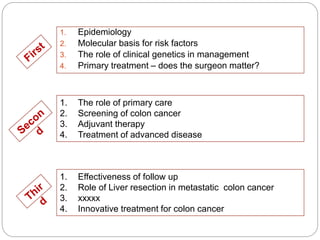
1. Epidemiology
2. Molecular basis for risk factors
3. The role of clinical genetics in management
4. Primary treatment – does the surgeon matter?
1. The role of primary care
2. Screening of colon cancer
3. Adjuvant therapy
4. Treatment of advanced disease
1. Effectiveness of follow up
2. Role of Liver resection in metastatic colon cancer
3. xxxxx
4. Innovative treatment for colon cancer
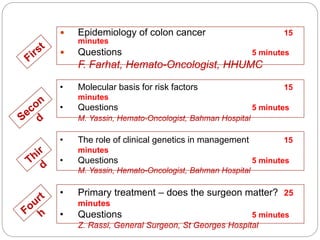
 Epidemiology of colon cancer 15
minutes
 Questions 5 minutes
F. Farhat, Hemato-Oncologist, HHUMC
• Molecular basis for risk factors 15
minutes
• Questions 5 minutes
M. Yassin, Hemato-Oncologist, Bahman Hospital
• Primary treatment – does the surgeon matter? 25
minutes
• Questions 5 minutes
Z. Rassi, General Surgeon, St Georges Hospital
• The role of clinical genetics in management 15
minutes
• Questions 5 minutes
M. Yassin, Hemato-Oncologist, Bahman Hospital
Preface
 Widely shared optimism of colorectal cancer
specialists
 after many decades of often painfully slow
progress (despite much action),
 We are at the brink of a new era with several
positive developments in the
 prevention,
 Diagnosis
 treatment of colorectal cancer,
 bringing hope to the hundreds of thousands of
people who develop the disease.
Preface -2
 Walk through contemporary knowledge in the
 prevention,
 diagnosis,
 prognosis & modalities of treatment for colorectal
cancer (other things besides)
 Also acknowledges & debates the numerous
uncertainties around the disease in a
balanced manner
 Peering into future approaches towards
 screening,
 molecular biology Genetics
 Therapies.
Preface -3
 In short, presents a concise story of the full
spectrum of CC in a kind of chronological
order.
 All of us who care for colorectal cancer
patients, should make it our duty to be
acquainted with the detail in order to provide
optimal patient care
Epidemiology
 In countries with a westernized lifestyle about
1/2 of all deaths are caused by circulatory
disease & a quarter by cancer.
 Cancer - important problem in both public
health & political terms worldwide, irrespective
of a country’s development.
 The most recent estimates: 8.1 million new
cases, excluding non-melanoma skin cancer,
worldwide in 1990.
 About 10 million new cases -diagnosed each
year.
Epidemiology -2
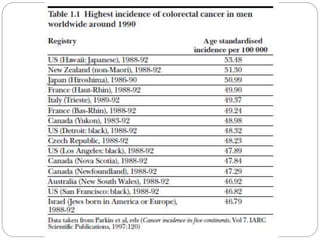
 Colorectal cancer is the 4th commonest form
of cancer occurring worldwide,
 estimated 783 000 new cases diagnosed in 1990,
 the most recent year for which international
estimates are available.
 It affects men & women almost equally,
 about 401 000 new cases in men annually & 381
000 in women.
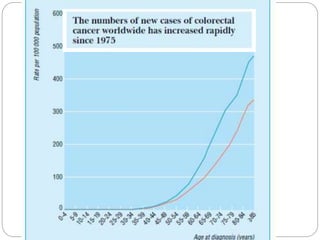
 The number of new cases of colorectal cancer
worldwide has been increasing rapidly since
1975 (when it was 500.000).
Epidemiology -3
 Worldwide, colorectal cancer represents 9.4%
of all incident cancer in men & 10.1% in
women.
 Colorectal cancer, however, is not equally
common throughout the world.
 If the westernized countries colorectal cancer
represents
 12.6% of all incident cancer in men
 & 14.1% in women.
 Elsewhere colorectal cancer represents 7.7%
& 7.9% of all incident cases in men & women
respectively.
Epidemiology -4
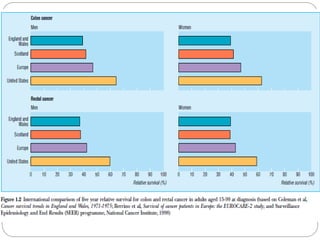
 Large differences exist in survival, according to the
stage of disease.
 It is estimated that 394 000 deaths from colorectal
cancer still occur worldwide annually, & colorectal
cancer is the 2nd commonest cause of death from any
cancer in men in the EU.
 Substantial differences in cancer survival seem to
exist between Great Britain, Europe as a whole, & the
United States.
 This variation in survival is not easily explained but
could be related to stage of disease at presentation or
treatment delivery, or both of these.
Survival & deprivation
 Relation between poverty & ill health has been
researched for more than 100 years.
 In Scotland, since the 1851 census, all cause
occupational mortality has been routinely reported, &
since 1911, inequalities in health, as shown by
mortality, have been examined in decennial reports
classified by social class (based on occupation) & by
occupational group alone.
 No single, generally agreed definition of deprivation
exists.
 Deprivation is a concept that overlaps but is not
synonymous with poverty.
Survival & deprivation
 Deprivation includes material, social, & multiple
deprivation.
 In Scotland the Carstairs & Morris index of
deprivation was derived from 1981 census data
with the postcode sector as the basic
geographical unit (covering a population of about
5000).
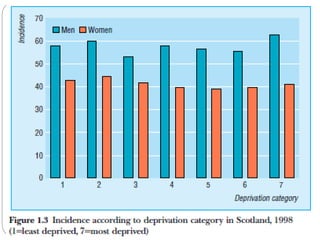
 This index describes a deprivation category on a
scale of 1 (least deprived) to 7 (most deprived) for
each household address in Scotland.
Survival & deprivation
 The incidence of colorectal cancer is higher in
men than women among each of the seven
deprivation categories in Scotland, although
incidence varies little with deprivation
category.
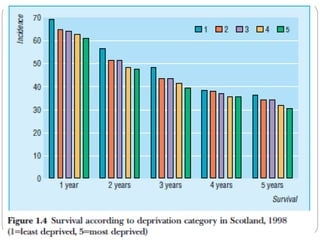
 Survival, however, clearly improves with
decreasing deprivation.
 At each milestone, there is a notable gradient
in survival, with the most affluent doing best &
the least affluent doing worst. The reasons
that such variations exist are unclear &
highlight an important priority for research.
Descriptive epidemiology
 Different populations worldwide experience
different levels of colorectal cancer, & these
levels change with time.
 Populations living in one community whose
lifestyles differ from those of others in the
same community also experience different
levels of colorectal cancer.
 Groups of migrants quickly lose the risk
associated with their original home community
& acquire the patterns of the new
community, often starting within one
generation of arrival.
Descriptive epidemiology
 Ethnic & racial differences in colorectal
cancer, as well as studies on migrants,
suggest that environmental factors play a
major part in the aetiology of the disease.
 Risk in the offspring of Japanese
populations who have migrated to the United
 States has changed - incidence now
approaches or surpasses that in white people
in the same population & is 3 or 4 times
higher than among the Japanese in Japan.
Descriptive epidemiology
 For reasons such as these, CC is widely
believed to be an environmental disease, with
“environmental” defined broadly to include a
wide range of ill defined cultural, social, &
lifestyle practices.
 As much as 70-80% of CC may owe their
appearance to such factors; this clearly
identifies colorectal cancer as one of the
major neoplasms in which causes may be
identified, & a large portion of the disease
is theoretically avoidable.
Descriptive epidemiology
 The move from theoretically avoidable
causes to implementation of preventive
strategies depends on the identification of
risk factors, exposures that have been
associated with an increased (or decreased)
risk of colorectal cancer, & the smaller subset
of risk determinants, whose alteration would
lead directly to a reduction in risk.
 From analytical epidemiology some clear
ideas have now emerged about measures for
reducing the risk of colorectal cancer.

Dietary & nutritional practices
 Evidence from epidem studies - consistently
that intake of dietary fat & meat is positively
related to risk of CC
 This evidence is obtained from ecological
studies, animal experiments, & case-control &
cohort studies.
 In 1990 Willett et al published the results from
the US nurses health study involving follow up
of 88 751 women aged 34-59 years who were
without cancer or inflammatory bowel disease
at recruitment.
 After adjustment for total energy intake,
Dietary & nutritional practices
 The trend in risk was highly significant (P =
0.01)
 No association was found with vegetable fat.
 The relative risk in women who ate beef, pork,
or lamb as a main dish every day was 2.49
(1.24 to 5.03) vs. women reporting
consumption less than once a month.
 The authors suggested that their data
supported the hypothesis that a high intake of
animal fat increases the risk of CC, & they
supported existing recommendations to
substitute fish & chicken for meats high in fat.
Intake of vegetables, fruit, & fibre
 Dietary fibre has been proposed as accounting
for the differences in the rates of colorectal
cancer between Africa & westernized countries -
on the basis that increased intake of dietary fibre
may increase faecal bulk & reduce transit time.
 Various other factors, related to risk of colorectal
cancer, are now thought to contribute to
explaining these differences.
 Fibre has many components, each of which has
specific physiological functions.
 commonly grouped into insoluble, non-degradable
constituents (mainly found in cereal fibre)
 & soluble, degradable constituents, such as pectin
& plant gums (mainly found in fruits & vegetables).
Intake of vegetables, fruit, & fibre
 Epidemiological studies have reported differences
in the effect of these components.
 Many studies, however, found no protective effect
of fibre in cereals but have consistently found a
protective effect of fibre in vegetables & perhaps
fruits.
 This might reflect an association with other
components of fruits & vegetables, with fibre
intake acting merely as an indicator of
consumption.
Physical activity, body mass index &
energy intake
 Evidence from epidemiological studies is strong
that men with high occupational or recreational
physical activity seem to have a decreased risk of
colon cancer.
 Such evidence comes from follow up studies of
cohorts who are physically active or who have
physically demanding jobs, as well as from case-
control studies that have assessed physical
activity by, for example, measurement of resting
heart rate or questionnaire.
 The association remains even after potential
confounding factors, such as diet & body mass
index, are controlled for.
Physical activity, body mass index, &
energy intake
 The available data show no consistent
association between obesity & risk of CC
(analysis & interpretation of this factor is difficult
in retrospective studies, where weight loss may
be a sign of the disease), although evidence now
suggests an association between obesity &
adenomas.
 This increased risk associated with energy intake
does not seem to be the result merely of
overeating; it may reflect differences in metabolic
efficiency.
 If the possibility that the association with energy
intake is a methodological artefact is excluded, it
QUESTIONS ?
Thank You

abc oncology . Colon session

  • 1.
    Fadi Farhat, Chairmanof abc in oncology Head of Hematology-Oncology Division Hammoud Hospital UMC Lecturer Saint-Joseph University, Beirut President of Cancer Research Group - CG Mobile: +961 3 753155; Email: drfadi.clinic@gmail.com abc in oncology
  • 2.
    abc oncology  Whatis it? • Certificate • Accreditation  Aim • Oncology for non oncologists  All specialties, Qualified nurses, Pharmacists, Fellows, • Knowledge in all fields on cancer  Several Modules • Generality on cancer • Cancer per organs
  • 3.
    abc oncology  Duration •Every 3-4 weeks • 4 sessions to 2-4 hours, later 1/2 day • 12 months  Final evaluation • Written evaluation, • Presence, Active participation,  Reward • Participation to an international congress  Number • limited
  • 4.
    AGENDA  First Module Generalities  Colon cancer  Next modules  Breast cancer  Lung cancer  G.U Cancers  Etc…  Evaluation
  • 5.
    1- Generalities onCancer  Date: 05 October 2012  Introduction,  Etiology of Cancer,  Pathophysiology of cancer  Classification of tumor types,  Methods of Diagnosis  Goals of cancer treatment  Modalities of cancer treatment  Endpoint assessment (response/survival) • Chemotherapy
  • 6.
    02 November 2012 abcin Colorectal Cancer
  • 7.
    1. Epidemiology 2. Molecularbasis for risk factors 3. The role of clinical genetics in management 4. Primary treatment – does the surgeon matter? 1. The role of primary care 2. Screening of colon cancer 3. Adjuvant therapy 4. Treatment of advanced disease 1. Effectiveness of follow up 2. Role of Liver resection in metastatic colon cancer 3. xxxxx 4. Innovative treatment for colon cancer
  • 8.
     Epidemiology ofcolon cancer 15 minutes  Questions 5 minutes F. Farhat, Hemato-Oncologist, HHUMC • Molecular basis for risk factors 15 minutes • Questions 5 minutes M. Yassin, Hemato-Oncologist, Bahman Hospital • Primary treatment – does the surgeon matter? 25 minutes • Questions 5 minutes Z. Rassi, General Surgeon, St Georges Hospital • The role of clinical genetics in management 15 minutes • Questions 5 minutes M. Yassin, Hemato-Oncologist, Bahman Hospital
  • 9.
    Preface  Widely sharedoptimism of colorectal cancer specialists  after many decades of often painfully slow progress (despite much action),  We are at the brink of a new era with several positive developments in the  prevention,  Diagnosis  treatment of colorectal cancer,  bringing hope to the hundreds of thousands of people who develop the disease.
  • 10.
    Preface -2  Walkthrough contemporary knowledge in the  prevention,  diagnosis,  prognosis & modalities of treatment for colorectal cancer (other things besides)  Also acknowledges & debates the numerous uncertainties around the disease in a balanced manner  Peering into future approaches towards  screening,  molecular biology Genetics  Therapies.
  • 11.
    Preface -3  Inshort, presents a concise story of the full spectrum of CC in a kind of chronological order.  All of us who care for colorectal cancer patients, should make it our duty to be acquainted with the detail in order to provide optimal patient care
  • 12.
    Epidemiology  In countrieswith a westernized lifestyle about 1/2 of all deaths are caused by circulatory disease & a quarter by cancer.  Cancer - important problem in both public health & political terms worldwide, irrespective of a country’s development.  The most recent estimates: 8.1 million new cases, excluding non-melanoma skin cancer, worldwide in 1990.  About 10 million new cases -diagnosed each year.
  • 13.
    Epidemiology -2  Colorectalcancer is the 4th commonest form of cancer occurring worldwide,  estimated 783 000 new cases diagnosed in 1990,  the most recent year for which international estimates are available.  It affects men & women almost equally,  about 401 000 new cases in men annually & 381 000 in women.  The number of new cases of colorectal cancer worldwide has been increasing rapidly since 1975 (when it was 500.000).
  • 14.
    Epidemiology -3  Worldwide,colorectal cancer represents 9.4% of all incident cancer in men & 10.1% in women.  Colorectal cancer, however, is not equally common throughout the world.  If the westernized countries colorectal cancer represents  12.6% of all incident cancer in men  & 14.1% in women.  Elsewhere colorectal cancer represents 7.7% & 7.9% of all incident cases in men & women respectively.
  • 15.
    Epidemiology -4  Largedifferences exist in survival, according to the stage of disease.  It is estimated that 394 000 deaths from colorectal cancer still occur worldwide annually, & colorectal cancer is the 2nd commonest cause of death from any cancer in men in the EU.  Substantial differences in cancer survival seem to exist between Great Britain, Europe as a whole, & the United States.  This variation in survival is not easily explained but could be related to stage of disease at presentation or treatment delivery, or both of these.
  • 19.
    Survival & deprivation Relation between poverty & ill health has been researched for more than 100 years.  In Scotland, since the 1851 census, all cause occupational mortality has been routinely reported, & since 1911, inequalities in health, as shown by mortality, have been examined in decennial reports classified by social class (based on occupation) & by occupational group alone.  No single, generally agreed definition of deprivation exists.  Deprivation is a concept that overlaps but is not synonymous with poverty.
  • 20.
    Survival & deprivation Deprivation includes material, social, & multiple deprivation.  In Scotland the Carstairs & Morris index of deprivation was derived from 1981 census data with the postcode sector as the basic geographical unit (covering a population of about 5000).  This index describes a deprivation category on a scale of 1 (least deprived) to 7 (most deprived) for each household address in Scotland.
  • 21.
    Survival & deprivation The incidence of colorectal cancer is higher in men than women among each of the seven deprivation categories in Scotland, although incidence varies little with deprivation category.  Survival, however, clearly improves with decreasing deprivation.  At each milestone, there is a notable gradient in survival, with the most affluent doing best & the least affluent doing worst. The reasons that such variations exist are unclear & highlight an important priority for research.
  • 24.
    Descriptive epidemiology  Differentpopulations worldwide experience different levels of colorectal cancer, & these levels change with time.  Populations living in one community whose lifestyles differ from those of others in the same community also experience different levels of colorectal cancer.  Groups of migrants quickly lose the risk associated with their original home community & acquire the patterns of the new community, often starting within one generation of arrival.
  • 25.
    Descriptive epidemiology  Ethnic& racial differences in colorectal cancer, as well as studies on migrants, suggest that environmental factors play a major part in the aetiology of the disease.  Risk in the offspring of Japanese populations who have migrated to the United  States has changed - incidence now approaches or surpasses that in white people in the same population & is 3 or 4 times higher than among the Japanese in Japan.
  • 26.
    Descriptive epidemiology  Forreasons such as these, CC is widely believed to be an environmental disease, with “environmental” defined broadly to include a wide range of ill defined cultural, social, & lifestyle practices.  As much as 70-80% of CC may owe their appearance to such factors; this clearly identifies colorectal cancer as one of the major neoplasms in which causes may be identified, & a large portion of the disease is theoretically avoidable.
  • 27.
    Descriptive epidemiology  Themove from theoretically avoidable causes to implementation of preventive strategies depends on the identification of risk factors, exposures that have been associated with an increased (or decreased) risk of colorectal cancer, & the smaller subset of risk determinants, whose alteration would lead directly to a reduction in risk.  From analytical epidemiology some clear ideas have now emerged about measures for reducing the risk of colorectal cancer.
  • 28.
    Dietary & nutritionalpractices  Evidence from epidem studies - consistently that intake of dietary fat & meat is positively related to risk of CC  This evidence is obtained from ecological studies, animal experiments, & case-control & cohort studies.  In 1990 Willett et al published the results from the US nurses health study involving follow up of 88 751 women aged 34-59 years who were without cancer or inflammatory bowel disease at recruitment.  After adjustment for total energy intake,
  • 29.
    Dietary & nutritionalpractices  The trend in risk was highly significant (P = 0.01)  No association was found with vegetable fat.  The relative risk in women who ate beef, pork, or lamb as a main dish every day was 2.49 (1.24 to 5.03) vs. women reporting consumption less than once a month.  The authors suggested that their data supported the hypothesis that a high intake of animal fat increases the risk of CC, & they supported existing recommendations to substitute fish & chicken for meats high in fat.
  • 30.
    Intake of vegetables,fruit, & fibre  Dietary fibre has been proposed as accounting for the differences in the rates of colorectal cancer between Africa & westernized countries - on the basis that increased intake of dietary fibre may increase faecal bulk & reduce transit time.  Various other factors, related to risk of colorectal cancer, are now thought to contribute to explaining these differences.  Fibre has many components, each of which has specific physiological functions.  commonly grouped into insoluble, non-degradable constituents (mainly found in cereal fibre)  & soluble, degradable constituents, such as pectin & plant gums (mainly found in fruits & vegetables).
  • 31.
    Intake of vegetables,fruit, & fibre  Epidemiological studies have reported differences in the effect of these components.  Many studies, however, found no protective effect of fibre in cereals but have consistently found a protective effect of fibre in vegetables & perhaps fruits.  This might reflect an association with other components of fruits & vegetables, with fibre intake acting merely as an indicator of consumption.
  • 32.
    Physical activity, bodymass index & energy intake  Evidence from epidemiological studies is strong that men with high occupational or recreational physical activity seem to have a decreased risk of colon cancer.  Such evidence comes from follow up studies of cohorts who are physically active or who have physically demanding jobs, as well as from case- control studies that have assessed physical activity by, for example, measurement of resting heart rate or questionnaire.  The association remains even after potential confounding factors, such as diet & body mass index, are controlled for.
  • 33.
    Physical activity, bodymass index, & energy intake  The available data show no consistent association between obesity & risk of CC (analysis & interpretation of this factor is difficult in retrospective studies, where weight loss may be a sign of the disease), although evidence now suggests an association between obesity & adenomas.  This increased risk associated with energy intake does not seem to be the result merely of overeating; it may reflect differences in metabolic efficiency.  If the possibility that the association with energy intake is a methodological artefact is excluded, it
  • 34.