Joint Commissioning Strategy

for Assistive Technology

Supporting Personalised
Outcomes through Assistive
Technology
2012-2017 (5 years)
November 2012
1
Contents Page

1.0	 Introduction…………………………………P3

2.0	 What is Assistive Technology…………….P4

3.0	 National and Local Context……………….P5-7

4.0	 Local Needs Analysis……………………...P8

5.0	 Consultation………………………………...P9-11

6.0	 Priorities……………………………………..P12-13

7.0	 Current Commissioned Suppliers

of Assistive Technology……………………P14

8.0	 Other Suppliers of Assistive

Technology………………………………….P14

9.0	 Governance Arrangements and

Action Plan…………………………............P15

2
1.0 Introduction

The Council and NHS Berkshire have developed this strategy to ensure that assistive
technology can contribute to meeting the needs of individuals.
The transformation of social care and the personalisation agenda set out in ‘Think
Local Act Personal’ establishes that Councils need to offer and provide support in
ways that ensure that people can exercise choice, and design the support and care
arrangements that best suit their specific needs. Personalisation puts people at the
centre of the planning process and recognises that they are best placed to
understand their own needs and how to meet them. Supporting people and carers to
access and use the opportunities that assistive technology can provide is a key
aspect to enabling choice and the council’s prevention strategy.
Health and social care organisations support people to meet their needs and lead
‘ordinary lives’. ‘Ordinary’ now includes a wide range of advanced technologies –
home computers for a variety of domestic entertainment, the mobile phone and
sophisticated domestic appliances. Some of these technologies have led to health
and social care related innovations such as the new generation of digital hearing
aids.
Such technologies present opportunities for health and social care organisations to
support people to have greater choice and control in their lives, as well as
opportunities for efficiency and economy in delivering support.
For many people who access support and services, assistive technology will be one
element of their support plan, which may also include regular visits by care staff and
other workers.
3
2.0 What is Assistive Technology
Assistive Technology is defined as:
“Any device or system that allows an individual to perform a task that they would
otherwise be unable to do, or increase the ease and safety with which a task can be
performed” (The Royal Commission on Long Term Care 1999)
Assistive technology sometimes referred to as adaptive technology, is an umbrella
term that includes assistive, adaptive, and rehabilitative devices for people with
disabilities and also includes the process used in selecting, locating and using them.
Assistive technology promotes greater independence by enabling people to perform
tasks that they were formerly unable to accomplish, or had great difficulty
accomplishing, by providing enhancements to, or changing methods of interacting
with devices needed to accomplish such tasks.
Examples of assistive technology include standing frames, text telephones,
accessible keyboards, large print, Braille and speech recognition software. More
commonly something as universal as dropped curbs, are an architectural application
of assistive technology.
The term “assistive technology” also includes technology that enables the use of
automatic, remote monitoring of emergencies as they happen, as well as general
practical equipment. The former includes the range of options often referred to as
‘Telecare’.
The benefits of ‘Telecare’ can play a role in maintaining independence and allowing
people to stay in their own homes. Examples include:
� raising an alarm through to a monitoring system in cases of emergencies
such as falls, or
� standalone equipment which does not send signals to a response centre
but supports carers through providing local alerts in a person's home, to
let the carer know when a person requires attention.
There are now a large range of Telecare services available with some of the most
well known being the pendant alarm, pill dispenser, telephone prompt service,
movement monitors and more.
4
3.0 National and Local Context

3.1 National
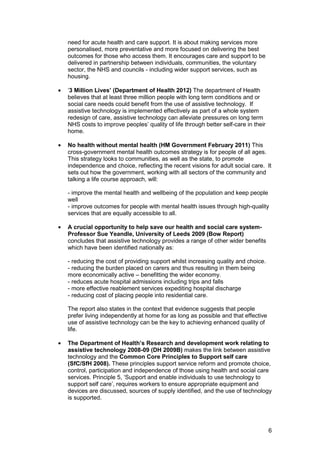
There is a wealth of government policy and initiatives that supports the use of
assistive technology in meeting peoples needs:
•	 The recent Caring for our Future: Reforming care and Support
(Department of Health 2012) white paper suggests that assistive technology
can support people to live independently and ensure individuals have greater
control over their health and wellbeing.
•	 Recognised, Valued and Supported: Next Steps for the Carers Strategy
(Department Of Health 2010) This strategy identifies priorities to
support carers in their role and enable them to have a life outside of caring.
One of the ways in which carers could be supported is through the use of
assistive technology.
•	 National Dementia Strategy: Living well with dementia (Department of
Health 2009) focuses on using assistive technology options to enable people
with dementia and their family carers to be supported to live independently
safer and longer at home. The usage of assistive technology can assist in
meeting the ambitions in this strategy.
•	 Healthy lives, healthy people: Our strategy for Public Health
(Department of Public health 2010) This white paper sets out the
Government’s long-term vision for the future of public health in England. The
aim is to create a ‘wellness’ service (Public Health England) and to strengthen
both national and local leadership. The Government’s vision for adult social
care sets out the ambition to increase preventive action, keeping people
active and independent in the community. Additional resources have been
made available from within the health system to support social care services,
such as evidence-based preventive services. At a local level, Directors of
Public Health and Directors of Adult Social Services will work together to
commission specific services for people and those who care for them. These
could range from services such as information and advice through to delivery
of assistive technology minimising deterioration or dependency.
•	 Supporting people with Long Term Conditions (Department of Health
2009) This policy on long term conditions seeks to support people to take a
preventative approach and developing services that enable people to remain
living independently in their own homes. A seen aspect of delivering this
ambition is through the use of assistive technology.
•	 Valuing People Now: A New Three-Year Strategy for People with
Learning Disabilities (Department of Health 2009) Giving people more
choice and control in their lives to meet their needs is at the heart of this
strategy noting the contribution assistive technology can play in this.
•	 Think Local, Act Personal: Next Steps for Transforming Adult Social
Care 2011 is a proposed sector wide partnership agreement moving further
towards personalisation and community based support. The priority for adult
social care is to ensure efficient, effective and integrated partnerships and
services that support individuals, families and the community and reduce the
5
need for acute health and care support. It is about making services more
personalised, more preventative and more focused on delivering the best
outcomes for those who access them. It encourages care and support to be
delivered in partnership between individuals, communities, the voluntary
sector, the NHS and councils - including wider support services, such as
housing.
•	 ‘3 Million Lives’ (Department of Health 2012) The department of Health
believes that at least three million people with long term conditions and or
social care needs could benefit from the use of assistive technology. If
assistive technology is implemented effectively as part of a whole system
redesign of care, assistive technology can alleviate pressures on long term
NHS costs to improve peoples’ quality of life through better self-care in their
home.
•	 No health without mental health (HM Government February 2011) This
cross-government mental health outcomes strategy is for people of all ages.
This strategy looks to communities, as well as the state, to promote
independence and choice, reflecting the recent visions for adult social care. It
sets out how the government, working with all sectors of the community and
talking a life course approach, will:
- improve the mental health and wellbeing of the population and keep people
well
- improve outcomes for people with mental health issues through high-quality
services that are equally accessible to all.
•	 A crucial opportunity to help save our health and social care system-
Professor Sue Yeandle, University of Leeds 2009 (Bow Report)
concludes that assistive technology provides a range of other wider benefits
which have been identified nationally as:
- reducing the cost of providing support whilst increasing quality and choice.

- reducing the burden placed on carers and thus resulting in them being

more economically active – benefitting the wider economy.

- reduces acute hospital admissions including trips and falls

- more effective reablement services expediting hospital discharge

- reducing cost of placing people into residential care.

The report also states in the context that evidence suggests that people

prefer living independently at home for as long as possible and that effective

use of assistive technology can be the key to achieving enhanced quality of

life.

•	 The Department of Health’s Research and development work relating to
assistive technology 2008-09 (DH 2009B) makes the link between assistive
technology and the Common Core Principles to Support self care
(SfC/SfH 2008). These principles support service reform and promote choice,
control, participation and independence of those using health and social care
services. Principle 5, ‘Support and enable individuals to use technology to
support self care’, requires workers to ensure appropriate equipment and
devices are discussed, sources of supply identified, and the use of technology
is supported.
6
3.2 Local

This strategy aligns with some of the priorities set out in a number of locally
developed strategies such as:
•	 The Commissioning Strategy for Adult Mental Health
•	 The Commissioning Strategy for people with Learning Disabilities ‘Making
Choices, Being In Control’
•	 Speaking Up, Speaking Out, Taking Action – A Strategy for commissioning
advocacy in Bracknell Forest
•	 Long Term Conditions Strategy
•	 Carers Strategy
•	 Supporting Carers NHS Berkshire Carers Plan 2011-2012
•	 Dementia Strategy
•	 Sensory Needs Strategy
•	 Adult Autism Joint Commissioning Strategy
•	 Older People’s Strategy
•	 Prevention and Intervention Strategy
•	 Stroke Strategy
These are available at http://www.bracknell-forest.gov.uk/healthandsocialcare
7
4.0 Local Needs Analysis
A needs analysis is a way of estimating the extent and nature of the needs of a
population so that appropriate support can be planned.
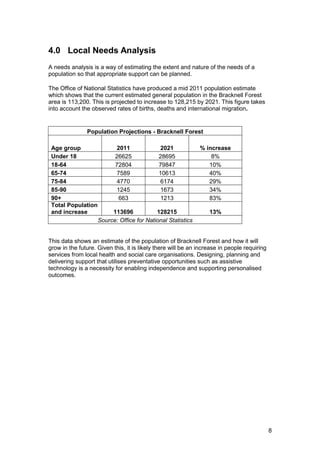
The Office of National Statistics have produced a mid 2011 population estimate
which shows that the current estimated general population in the Bracknell Forest
area is 113,200. This is projected to increase to 128,215 by 2021. This figure takes
into account the observed rates of births, deaths and international migration.
Population Projections - Bracknell Forest
Age group 2011 2021 % increase
Under 18 26625 28695 8%
18-64 72804 79847 10%
65-74 7589 10613 40%
75-84 4770 6174 29%
85-90 1245 1673 34%
90+ 663 1213 83%
Total Population
and increase 113696 128215 13%
Source: Office for National Statistics
This data shows an estimate of the population of Bracknell Forest and how it will
grow in the future. Given this, it is likely there will be an increase in people requiring
services from local health and social care organisations. Designing, planning and
delivering support that utilises preventative opportunities such as assistive
technology is a necessity for enabling independence and supporting personalised
outcomes.
8
5.0 Consultation
The Approach
A 12 week consultation was undertaken and focussed on the following groups:
•	 health and social care practitioners
•	 carers
•	 people who are, or may become eligible for services
The responses to the noted questions in the consultation have informed the priorities
for this strategy:
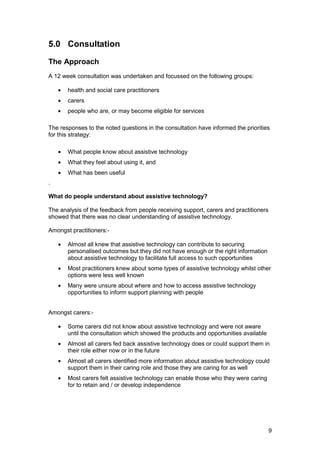
•	 What people know about assistive technology
•	 What they feel about using it, and
•	 What has been useful
.
What do people understand about assistive technology?
The analysis of the feedback from people receiving support, carers and practitioners
showed that there was no clear understanding of assistive technology.
Amongst practitioners:­
•	 Almost all knew that assistive technology can contribute to securing
personalised outcomes but they did not have enough or the right information
about assistive technology to facilitate full access to such opportunities
•	 Most practitioners knew about some types of assistive technology whilst other
options were less well known
•	 Many were unsure about where and how to access assistive technology
opportunities to inform support planning with people
Amongst carers:­
•	 Some carers did not know about assistive technology and were not aware
until the consultation which showed the products and opportunities available
•	 Almost all carers fed back assistive technology does or could support them in
their role either now or in the future
•	 Almost all carers identified more information about assistive technology could
support them in their caring role and those they are caring for as well
•	 Most carers felt assistive technology can enable those who they were caring
for to retain and / or develop independence
9
Amongst people receiving support:­
•	 Some people did not know about assistive technology and were not aware of
the products and opportunities available until the consultation
•	 Almost all people fed back assistive technology does or could support them to
either develop or retain independent living skills and general independence
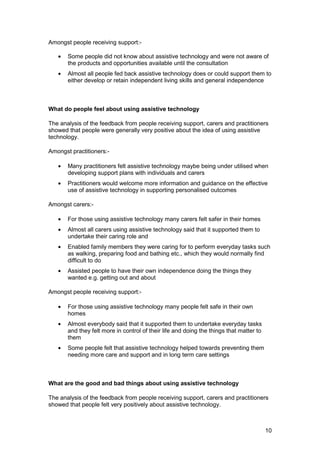
What do people feel about using assistive technology
The analysis of the feedback from people receiving support, carers and practitioners
showed that people were generally very positive about the idea of using assistive
technology.
Amongst practitioners:­
•	 Many practitioners felt assistive technology maybe being under utilised when
developing support plans with individuals and carers
•	 Practitioners would welcome more information and guidance on the effective
use of assistive technology in supporting personalised outcomes
Amongst carers:­
•	 For those using assistive technology many carers felt safer in their homes
•	 Almost all carers using assistive technology said that it supported them to
undertake their caring role and
•	 Enabled family members they were caring for to perform everyday tasks such
as walking, preparing food and bathing etc., which they would normally find
difficult to do
•	 Assisted people to have their own independence doing the things they

wanted e.g. getting out and about

Amongst people receiving support:­
•	 For those using assistive technology many people felt safe in their own
homes
•	 Almost everybody said that it supported them to undertake everyday tasks
and they felt more in control of their life and doing the things that matter to
them
•	 Some people felt that assistive technology helped towards preventing them
needing more care and support and in long term care settings
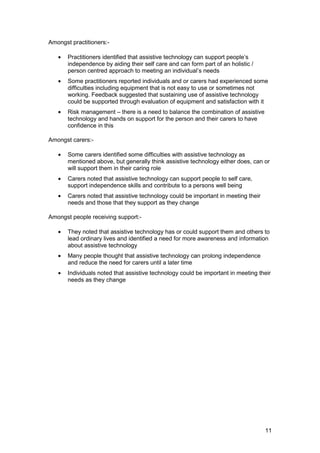
What are the good and bad things about using assistive technology
The analysis of the feedback from people receiving support, carers and practitioners
showed that people felt very positively about assistive technology.
10
Amongst practitioners:­
•	 Practitioners identified that assistive technology can support people’s
independence by aiding their self care and can form part of an holistic /
person centred approach to meeting an individual’s needs
•	 Some practitioners reported individuals and or carers had experienced some
difficulties including equipment that is not easy to use or sometimes not
working. Feedback suggested that sustaining use of assistive technology
could be supported through evaluation of equipment and satisfaction with it
•	 Risk management – there is a need to balance the combination of assistive
technology and hands on support for the person and their carers to have
confidence in this
Amongst carers:­
•	 Some carers identified some difficulties with assistive technology as
mentioned above, but generally think assistive technology either does, can or
will support them in their caring role
•	 Carers noted that assistive technology can support people to self care,
support independence skills and contribute to a persons well being
•	 Carers noted that assistive technology could be important in meeting their
needs and those that they support as they change
Amongst people receiving support:­
•	 They noted that assistive technology has or could support them and others to
lead ordinary lives and identified a need for more awareness and information
about assistive technology
•	 Many people thought that assistive technology can prolong independence
and reduce the need for carers until a later time
•	 Individuals noted that assistive technology could be important in meeting their
needs as they change
11
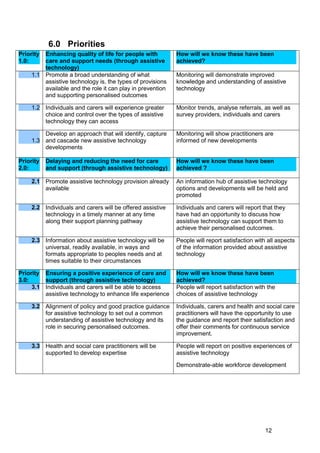
6.0 Priorities

Priority
1.0:
Enhancing quality of life for people with
care and support needs (through assistive
technology)
How will we know these have been
achieved?
1.1 Promote a broad understanding of what
assistive technology is, the types of provisions
available and the role it can play in prevention
and supporting personalised outcomes
Monitoring will demonstrate improved
knowledge and understanding of assistive
technology
1.2 Individuals and carers will experience greater
choice and control over the types of assistive
technology they can access
Monitor trends, analyse referrals, as well as
survey providers, individuals and carers
1.3
Develop an approach that will identify, capture
and cascade new assistive technology
developments
Monitoring will show practitioners are
informed of new developments
Priority
2.0:
Delaying and reducing the need for care
and support (through assistive technology)
How will we know these have been
achieved ?
2.1 Promote assistive technology provision already
available
An information hub of assistive technology
options and developments will be held and
promoted
2.2 Individuals and carers will be offered assistive
technology in a timely manner at any time
along their support planning pathway
Individuals and carers will report that they
have had an opportunity to discuss how
assistive technology can support them to
achieve their personalised outcomes.
2.3 Information about assistive technology will be
universal, readily available, in ways and
formats appropriate to peoples needs and at
times suitable to their circumstances
People will report satisfaction with all aspects
of the information provided about assistive
technology
Priority
3.0:
Ensuring a positive experience of care and
support (through assistive technology)
How will we know these have been
achieved?
3.1 Individuals and carers will be able to access
assistive technology to enhance life experience
People will report satisfaction with the
choices of assistive technology
3.2 Alignment of policy and good practice guidance
for assistive technology to set out a common
understanding of assistive technology and its
role in securing personalised outcomes.
Individuals, carers and health and social care
practitioners will have the opportunity to use
the guidance and report their satisfaction and
offer their comments for continuous service
improvement.
3.3 Health and social care practitioners will be
supported to develop expertise
People will report on positive experiences of
assistive technology
Demonstrate-able workforce development
12
Priority
4.0:
Safeguarding and protecting vulnerable
adults from harm (through assistive
technology)
4.1 By accessing assistive technology individuals
and family carers will feel protected and safe
Individuals will report that they had the
choices and outcomes they want based on
their needs
4.2 By accessing assistive technology individuals
and carers will be enabled to take measured
risks promoting independence and control
Feedback from individuals and carers about
their personalised outcomes
13
 
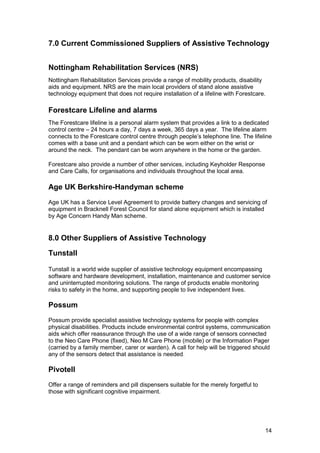
7.0 Current Commissioned Suppliers of Assistive Technology
Nottingham Rehabilitation Services (NRS)
Nottingham Rehabilitation Services provide a range of mobility products, disability
aids and equipment. NRS are the main local providers of stand alone assistive
technology equipment that does not require installation of a lifeline with Forestcare.
Forestcare Lifeline and alarms
The Forestcare lifeline is a personal alarm system that provides a link to a dedicated
control centre – 24 hours a day, 7 days a week, 365 days a year. The lifeline alarm
connects to the Forestcare control centre through people’s telephone line. The lifeline
comes with a base unit and a pendant which can be worn either on the wrist or
around the neck. The pendant can be worn anywhere in the home or the garden.
Forestcare also provide a number of other services, including Keyholder Response
and Care Calls, for organisations and individuals throughout the local area.
Age UK Berkshire-Handyman scheme
Age UK has a Service Level Agreement to provide battery changes and servicing of
equipment in Bracknell Forest Council for stand alone equipment which is installed
by Age Concern Handy Man scheme.
8.0 Other Suppliers of Assistive Technology
Tunstall
Tunstall is a world wide supplier of assistive technology equipment encompassing
software and hardware development, installation, maintenance and customer service
and uninterrupted monitoring solutions. The range of products enable monitoring
risks to safety in the home, and supporting people to live independent lives.
Possum
Possum provide specialist assistive technology systems for people with complex
physical disabilities. Products include environmental control systems, communication
aids which offer reassurance through the use of a wide range of sensors connected
to the Neo Care Phone (fixed), Neo M Care Phone (mobile) or the Information Pager
(carried by a family member, carer or warden). A call for help will be triggered should
any of the sensors detect that assistance is needed.
Pivotell
Offer a range of reminders and pill dispensers suitable for the merely forgetful to
those with significant cognitive impairment.
14
* There are other providers of assistive technology in the market and any
purchasing through ‘Other’ providers should be made only after
communication and advice from procurement.
9.0 Governance Arrangements and Action Plan
The Assistive Technology Steering Group will have oversight and responsibility for
the implementation of this strategy.
An implementation plan will be designed based on the priorities identified through the
consultation exercise and will be regularly monitored and reviewed.
For any further information or queries about the strategy or the contents
please contact:
Nick Ireland
Head of Learning Disability Services
Email: nick.ireland@brackell-forest.gov.uk
Telephone: 01344 351652
Amina Begum
Joint Commissioning Officer
Email: amina.begum@racknell-forest.gov.uk
Telephone: 01344 351204
15

AB assistive-technology-strategy-2012-2017

  • 1.
    Joint Commissioning Strategy forAssistive Technology Supporting Personalised Outcomes through Assistive Technology 2012-2017 (5 years) November 2012 1
  • 2.
    Contents Page 1.0 Introduction…………………………………P3 2.0 What is Assistive Technology…………….P4 3.0 National and Local Context……………….P5-7 4.0 Local Needs Analysis……………………...P8 5.0 Consultation………………………………...P9-11 6.0 Priorities……………………………………..P12-13 7.0 Current Commissioned Suppliers of Assistive Technology……………………P14 8.0 Other Suppliers of Assistive Technology………………………………….P14 9.0 Governance Arrangements and Action Plan…………………………............P15 2
  • 3.
    1.0 Introduction The Counciland NHS Berkshire have developed this strategy to ensure that assistive technology can contribute to meeting the needs of individuals. The transformation of social care and the personalisation agenda set out in ‘Think Local Act Personal’ establishes that Councils need to offer and provide support in ways that ensure that people can exercise choice, and design the support and care arrangements that best suit their specific needs. Personalisation puts people at the centre of the planning process and recognises that they are best placed to understand their own needs and how to meet them. Supporting people and carers to access and use the opportunities that assistive technology can provide is a key aspect to enabling choice and the council’s prevention strategy. Health and social care organisations support people to meet their needs and lead ‘ordinary lives’. ‘Ordinary’ now includes a wide range of advanced technologies – home computers for a variety of domestic entertainment, the mobile phone and sophisticated domestic appliances. Some of these technologies have led to health and social care related innovations such as the new generation of digital hearing aids. Such technologies present opportunities for health and social care organisations to support people to have greater choice and control in their lives, as well as opportunities for efficiency and economy in delivering support. For many people who access support and services, assistive technology will be one element of their support plan, which may also include regular visits by care staff and other workers. 3
  • 4.
    2.0 What isAssistive Technology Assistive Technology is defined as: “Any device or system that allows an individual to perform a task that they would otherwise be unable to do, or increase the ease and safety with which a task can be performed” (The Royal Commission on Long Term Care 1999) Assistive technology sometimes referred to as adaptive technology, is an umbrella term that includes assistive, adaptive, and rehabilitative devices for people with disabilities and also includes the process used in selecting, locating and using them. Assistive technology promotes greater independence by enabling people to perform tasks that they were formerly unable to accomplish, or had great difficulty accomplishing, by providing enhancements to, or changing methods of interacting with devices needed to accomplish such tasks. Examples of assistive technology include standing frames, text telephones, accessible keyboards, large print, Braille and speech recognition software. More commonly something as universal as dropped curbs, are an architectural application of assistive technology. The term “assistive technology” also includes technology that enables the use of automatic, remote monitoring of emergencies as they happen, as well as general practical equipment. The former includes the range of options often referred to as ‘Telecare’. The benefits of ‘Telecare’ can play a role in maintaining independence and allowing people to stay in their own homes. Examples include: � raising an alarm through to a monitoring system in cases of emergencies such as falls, or � standalone equipment which does not send signals to a response centre but supports carers through providing local alerts in a person's home, to let the carer know when a person requires attention. There are now a large range of Telecare services available with some of the most well known being the pendant alarm, pill dispenser, telephone prompt service, movement monitors and more. 4
  • 5.
    3.0 National andLocal Context 3.1 National There is a wealth of government policy and initiatives that supports the use of assistive technology in meeting peoples needs: • The recent Caring for our Future: Reforming care and Support (Department of Health 2012) white paper suggests that assistive technology can support people to live independently and ensure individuals have greater control over their health and wellbeing. • Recognised, Valued and Supported: Next Steps for the Carers Strategy (Department Of Health 2010) This strategy identifies priorities to support carers in their role and enable them to have a life outside of caring. One of the ways in which carers could be supported is through the use of assistive technology. • National Dementia Strategy: Living well with dementia (Department of Health 2009) focuses on using assistive technology options to enable people with dementia and their family carers to be supported to live independently safer and longer at home. The usage of assistive technology can assist in meeting the ambitions in this strategy. • Healthy lives, healthy people: Our strategy for Public Health (Department of Public health 2010) This white paper sets out the Government’s long-term vision for the future of public health in England. The aim is to create a ‘wellness’ service (Public Health England) and to strengthen both national and local leadership. The Government’s vision for adult social care sets out the ambition to increase preventive action, keeping people active and independent in the community. Additional resources have been made available from within the health system to support social care services, such as evidence-based preventive services. At a local level, Directors of Public Health and Directors of Adult Social Services will work together to commission specific services for people and those who care for them. These could range from services such as information and advice through to delivery of assistive technology minimising deterioration or dependency. • Supporting people with Long Term Conditions (Department of Health 2009) This policy on long term conditions seeks to support people to take a preventative approach and developing services that enable people to remain living independently in their own homes. A seen aspect of delivering this ambition is through the use of assistive technology. • Valuing People Now: A New Three-Year Strategy for People with Learning Disabilities (Department of Health 2009) Giving people more choice and control in their lives to meet their needs is at the heart of this strategy noting the contribution assistive technology can play in this. • Think Local, Act Personal: Next Steps for Transforming Adult Social Care 2011 is a proposed sector wide partnership agreement moving further towards personalisation and community based support. The priority for adult social care is to ensure efficient, effective and integrated partnerships and services that support individuals, families and the community and reduce the 5
  • 6.
    need for acutehealth and care support. It is about making services more personalised, more preventative and more focused on delivering the best outcomes for those who access them. It encourages care and support to be delivered in partnership between individuals, communities, the voluntary sector, the NHS and councils - including wider support services, such as housing. • ‘3 Million Lives’ (Department of Health 2012) The department of Health believes that at least three million people with long term conditions and or social care needs could benefit from the use of assistive technology. If assistive technology is implemented effectively as part of a whole system redesign of care, assistive technology can alleviate pressures on long term NHS costs to improve peoples’ quality of life through better self-care in their home. • No health without mental health (HM Government February 2011) This cross-government mental health outcomes strategy is for people of all ages. This strategy looks to communities, as well as the state, to promote independence and choice, reflecting the recent visions for adult social care. It sets out how the government, working with all sectors of the community and talking a life course approach, will: - improve the mental health and wellbeing of the population and keep people well - improve outcomes for people with mental health issues through high-quality services that are equally accessible to all. • A crucial opportunity to help save our health and social care system- Professor Sue Yeandle, University of Leeds 2009 (Bow Report) concludes that assistive technology provides a range of other wider benefits which have been identified nationally as: - reducing the cost of providing support whilst increasing quality and choice. - reducing the burden placed on carers and thus resulting in them being more economically active – benefitting the wider economy. - reduces acute hospital admissions including trips and falls - more effective reablement services expediting hospital discharge - reducing cost of placing people into residential care. The report also states in the context that evidence suggests that people prefer living independently at home for as long as possible and that effective use of assistive technology can be the key to achieving enhanced quality of life. • The Department of Health’s Research and development work relating to assistive technology 2008-09 (DH 2009B) makes the link between assistive technology and the Common Core Principles to Support self care (SfC/SfH 2008). These principles support service reform and promote choice, control, participation and independence of those using health and social care services. Principle 5, ‘Support and enable individuals to use technology to support self care’, requires workers to ensure appropriate equipment and devices are discussed, sources of supply identified, and the use of technology is supported. 6
  • 7.
    3.2 Local This strategyaligns with some of the priorities set out in a number of locally developed strategies such as: • The Commissioning Strategy for Adult Mental Health • The Commissioning Strategy for people with Learning Disabilities ‘Making Choices, Being In Control’ • Speaking Up, Speaking Out, Taking Action – A Strategy for commissioning advocacy in Bracknell Forest • Long Term Conditions Strategy • Carers Strategy • Supporting Carers NHS Berkshire Carers Plan 2011-2012 • Dementia Strategy • Sensory Needs Strategy • Adult Autism Joint Commissioning Strategy • Older People’s Strategy • Prevention and Intervention Strategy • Stroke Strategy These are available at http://www.bracknell-forest.gov.uk/healthandsocialcare 7
  • 8.
    4.0 Local NeedsAnalysis A needs analysis is a way of estimating the extent and nature of the needs of a population so that appropriate support can be planned. The Office of National Statistics have produced a mid 2011 population estimate which shows that the current estimated general population in the Bracknell Forest area is 113,200. This is projected to increase to 128,215 by 2021. This figure takes into account the observed rates of births, deaths and international migration. Population Projections - Bracknell Forest Age group 2011 2021 % increase Under 18 26625 28695 8% 18-64 72804 79847 10% 65-74 7589 10613 40% 75-84 4770 6174 29% 85-90 1245 1673 34% 90+ 663 1213 83% Total Population and increase 113696 128215 13% Source: Office for National Statistics This data shows an estimate of the population of Bracknell Forest and how it will grow in the future. Given this, it is likely there will be an increase in people requiring services from local health and social care organisations. Designing, planning and delivering support that utilises preventative opportunities such as assistive technology is a necessity for enabling independence and supporting personalised outcomes. 8
  • 9.
    5.0 Consultation The Approach A12 week consultation was undertaken and focussed on the following groups: • health and social care practitioners • carers • people who are, or may become eligible for services The responses to the noted questions in the consultation have informed the priorities for this strategy: • What people know about assistive technology • What they feel about using it, and • What has been useful . What do people understand about assistive technology? The analysis of the feedback from people receiving support, carers and practitioners showed that there was no clear understanding of assistive technology. Amongst practitioners:­ • Almost all knew that assistive technology can contribute to securing personalised outcomes but they did not have enough or the right information about assistive technology to facilitate full access to such opportunities • Most practitioners knew about some types of assistive technology whilst other options were less well known • Many were unsure about where and how to access assistive technology opportunities to inform support planning with people Amongst carers:­ • Some carers did not know about assistive technology and were not aware until the consultation which showed the products and opportunities available • Almost all carers fed back assistive technology does or could support them in their role either now or in the future • Almost all carers identified more information about assistive technology could support them in their caring role and those they are caring for as well • Most carers felt assistive technology can enable those who they were caring for to retain and / or develop independence 9
  • 10.
    Amongst people receivingsupport:­ • Some people did not know about assistive technology and were not aware of the products and opportunities available until the consultation • Almost all people fed back assistive technology does or could support them to either develop or retain independent living skills and general independence What do people feel about using assistive technology The analysis of the feedback from people receiving support, carers and practitioners showed that people were generally very positive about the idea of using assistive technology. Amongst practitioners:­ • Many practitioners felt assistive technology maybe being under utilised when developing support plans with individuals and carers • Practitioners would welcome more information and guidance on the effective use of assistive technology in supporting personalised outcomes Amongst carers:­ • For those using assistive technology many carers felt safer in their homes • Almost all carers using assistive technology said that it supported them to undertake their caring role and • Enabled family members they were caring for to perform everyday tasks such as walking, preparing food and bathing etc., which they would normally find difficult to do • Assisted people to have their own independence doing the things they wanted e.g. getting out and about Amongst people receiving support:­ • For those using assistive technology many people felt safe in their own homes • Almost everybody said that it supported them to undertake everyday tasks and they felt more in control of their life and doing the things that matter to them • Some people felt that assistive technology helped towards preventing them needing more care and support and in long term care settings What are the good and bad things about using assistive technology The analysis of the feedback from people receiving support, carers and practitioners showed that people felt very positively about assistive technology. 10
  • 11.
    Amongst practitioners:­ • Practitionersidentified that assistive technology can support people’s independence by aiding their self care and can form part of an holistic / person centred approach to meeting an individual’s needs • Some practitioners reported individuals and or carers had experienced some difficulties including equipment that is not easy to use or sometimes not working. Feedback suggested that sustaining use of assistive technology could be supported through evaluation of equipment and satisfaction with it • Risk management – there is a need to balance the combination of assistive technology and hands on support for the person and their carers to have confidence in this Amongst carers:­ • Some carers identified some difficulties with assistive technology as mentioned above, but generally think assistive technology either does, can or will support them in their caring role • Carers noted that assistive technology can support people to self care, support independence skills and contribute to a persons well being • Carers noted that assistive technology could be important in meeting their needs and those that they support as they change Amongst people receiving support:­ • They noted that assistive technology has or could support them and others to lead ordinary lives and identified a need for more awareness and information about assistive technology • Many people thought that assistive technology can prolong independence and reduce the need for carers until a later time • Individuals noted that assistive technology could be important in meeting their needs as they change 11
  • 12.
    6.0 Priorities Priority 1.0: Enhancing qualityof life for people with care and support needs (through assistive technology) How will we know these have been achieved? 1.1 Promote a broad understanding of what assistive technology is, the types of provisions available and the role it can play in prevention and supporting personalised outcomes Monitoring will demonstrate improved knowledge and understanding of assistive technology 1.2 Individuals and carers will experience greater choice and control over the types of assistive technology they can access Monitor trends, analyse referrals, as well as survey providers, individuals and carers 1.3 Develop an approach that will identify, capture and cascade new assistive technology developments Monitoring will show practitioners are informed of new developments Priority 2.0: Delaying and reducing the need for care and support (through assistive technology) How will we know these have been achieved ? 2.1 Promote assistive technology provision already available An information hub of assistive technology options and developments will be held and promoted 2.2 Individuals and carers will be offered assistive technology in a timely manner at any time along their support planning pathway Individuals and carers will report that they have had an opportunity to discuss how assistive technology can support them to achieve their personalised outcomes. 2.3 Information about assistive technology will be universal, readily available, in ways and formats appropriate to peoples needs and at times suitable to their circumstances People will report satisfaction with all aspects of the information provided about assistive technology Priority 3.0: Ensuring a positive experience of care and support (through assistive technology) How will we know these have been achieved? 3.1 Individuals and carers will be able to access assistive technology to enhance life experience People will report satisfaction with the choices of assistive technology 3.2 Alignment of policy and good practice guidance for assistive technology to set out a common understanding of assistive technology and its role in securing personalised outcomes. Individuals, carers and health and social care practitioners will have the opportunity to use the guidance and report their satisfaction and offer their comments for continuous service improvement. 3.3 Health and social care practitioners will be supported to develop expertise People will report on positive experiences of assistive technology Demonstrate-able workforce development 12
  • 13.
    Priority 4.0: Safeguarding and protectingvulnerable adults from harm (through assistive technology) 4.1 By accessing assistive technology individuals and family carers will feel protected and safe Individuals will report that they had the choices and outcomes they want based on their needs 4.2 By accessing assistive technology individuals and carers will be enabled to take measured risks promoting independence and control Feedback from individuals and carers about their personalised outcomes 13
  • 14.
      7.0 Current CommissionedSuppliers of Assistive Technology Nottingham Rehabilitation Services (NRS) Nottingham Rehabilitation Services provide a range of mobility products, disability aids and equipment. NRS are the main local providers of stand alone assistive technology equipment that does not require installation of a lifeline with Forestcare. Forestcare Lifeline and alarms The Forestcare lifeline is a personal alarm system that provides a link to a dedicated control centre – 24 hours a day, 7 days a week, 365 days a year. The lifeline alarm connects to the Forestcare control centre through people’s telephone line. The lifeline comes with a base unit and a pendant which can be worn either on the wrist or around the neck. The pendant can be worn anywhere in the home or the garden. Forestcare also provide a number of other services, including Keyholder Response and Care Calls, for organisations and individuals throughout the local area. Age UK Berkshire-Handyman scheme Age UK has a Service Level Agreement to provide battery changes and servicing of equipment in Bracknell Forest Council for stand alone equipment which is installed by Age Concern Handy Man scheme. 8.0 Other Suppliers of Assistive Technology Tunstall Tunstall is a world wide supplier of assistive technology equipment encompassing software and hardware development, installation, maintenance and customer service and uninterrupted monitoring solutions. The range of products enable monitoring risks to safety in the home, and supporting people to live independent lives. Possum Possum provide specialist assistive technology systems for people with complex physical disabilities. Products include environmental control systems, communication aids which offer reassurance through the use of a wide range of sensors connected to the Neo Care Phone (fixed), Neo M Care Phone (mobile) or the Information Pager (carried by a family member, carer or warden). A call for help will be triggered should any of the sensors detect that assistance is needed. Pivotell Offer a range of reminders and pill dispensers suitable for the merely forgetful to those with significant cognitive impairment. 14
  • 15.
    * There areother providers of assistive technology in the market and any purchasing through ‘Other’ providers should be made only after communication and advice from procurement. 9.0 Governance Arrangements and Action Plan The Assistive Technology Steering Group will have oversight and responsibility for the implementation of this strategy. An implementation plan will be designed based on the priorities identified through the consultation exercise and will be regularly monitored and reviewed. For any further information or queries about the strategy or the contents please contact: Nick Ireland Head of Learning Disability Services Email: nick.ireland@brackell-forest.gov.uk Telephone: 01344 351652 Amina Begum Joint Commissioning Officer Email: amina.begum@racknell-forest.gov.uk Telephone: 01344 351204 15