Quarterly publication of the Department of Management, AAU
1PageVolume2 Issue 3 MI Page| 5Issue 1: March 2013
Quarterly publication of the Department of management
MI Page| 1Issue 1: March 2013
Quarterly publication of the Department of management
MI
Management
Insight College of Business & Economics
Department of Management
Inside Pages ...
College of Business & Economics
Department of Management
Editorial
Welcoming speech
Opening Remarks
A keynote Address
Paper Presentations
Are we doing the Right thing
Right?
Discussions
Has BPR failed and is Kaizen
bound to fail in Ethiopia?
2
3
3
4
5
9
12
13
T
he Department of Management,
College of Business and
Economics of the Addis
Ababa University held its 3rd panel
discussion of the Executive Idea
Exchange Forum on Thursday, June
27, 2013 at 2:00 PM at the College
of Business and Economics Campus.
Thethemeofthethirdpaneldiscussion
was “Ethiopia’s Export Potential and
Challenges”. The Forum was keynote
addressed by the State Minister of
Trade, His Excellency Ato Yaekob
Yalla and research papers were
primed by the presentation of State
Minister of Industry, His Excellency
Ato Tadesse Haile.
Dr. Admasu Tsegaye, President of
AAU, in his speech noted that the
University is undergoing radical
reforms. He said that “ as part of the
TransformationTriggerFacilities(TTF)
program, the University has laid down
the foundation to establish Business
Incubation Center, and European and
Ethiopian Business School that will
be a center of business management
excellence. The President further
expressed AAU’s commitment to
support the Executive Idea Exchange
Forum (EIEF), and to strengthen and
expand programs of the department
of Management. Honorable guests
of the Forum were welcomed by
the Chairman of the department of
Management, Dr. Mohammed Seid.
The Forum was started through
The Third Executive Idea Exchange Forum Discussion Held
Volume 2 Issue 3							July 2013
EIEF 3rd
Panel discussion participants
AAU President DR. Admasu Tsegaye
Ministry of Industry State Minister, H.E Ato Tadesse Haile
Ministry of Trade State Minister, H.E Ato Yaekob Yalla(from left to right)
Quarterly publication of the Department of Management, AAU
2PageVolume2 Issue3 MI
journalist, business executives, and
the academia. The support gesture
demonstrated to the Forum from all
concerned were very encouraging
and inspiring to the Department and
those involved in organizing the
events.
The importance of research for
business and society cannot
be overemphasized. Although
knowledge and findings from research
will not relieve managers and policy
makers from making difficult decisions
in complex global environment, it can
provide them with insights that they
should factor in when making these
decisions.
Aside from drawing high level
government officials, the 3rd panel
was special in that three research
papers were presented and heated
discussions were made.
The Forum beyond part of the
Executive MBA program has been
established with the purpose of
further improving communications
and enhancing understanding among
stakeholders. The Forum aims to
do this by fostering open discussion
between the public policy arena, think
tanks, academia, media, the business
communities, and development
partners, particularly dialogue based
on Forum-supported business
management-oriented research on
various areas of common interests.
The 3rd panel was unanimous in its
support for sustained and intensified
engagement, communication,
and cooperation between the
stakeholders as a win-win opportunity
for all. Above all, Ethiopia’s impending
accession to WTO has generated
strong imperatives for all players to
deepen their collaborative spirit and
consultative engagement as a matter
of necessity. As a result of the EMBA
program and the resultant EIEF, a new
collaborative setting has materialized
for Ethiopians to reflect on the world
competitive landscape, create shared
visions of the future and formulate
innovative competitive strategies to
achieve these visions.
The 3rd Executive Idea Exchange
Forum (EIEF) discussion held on
June 27, 2013 under the stewardship
of the department of Management of
AAU and the auspices of Initiative
Africa was a grand success. It
brought high level government
officials, prominent business agents,
and the university around a platform
to pledge to work together for the
enhancement of management
excellence, understanding,
partnership, and economic growth.
It was evident from what were
observed during the EIEF
consecutive sessions that anyone
who is interested in expanding the
capacity of managing businesses,
elevating academics, and revitalizing
government organs – from young
academics/line managers to
executives in large organizations/
policy makers – will benefit from the
panel discussions.
The Forum is unique in bringing
to light personal anecdotes, best
practices, and thoughtful scholarship.
It focuses on the development and
dissemination of insights on the
management process, drawing the
untapped experience and wisdom of
participants, as well as on fostering
contacts, understanding, trust, and
partnership.
It is a platform filled with passion to
ensure the prevalence of managerial
excellence which will be instrumental
to economic growth and poverty
reduction. Without the economic
growth that the GTP and MDG laid
down, it is hard to imagine sustainable
development and improvements in
people’s lives. The EIEF seeks to
close the ostensible gap between
the business, the government, the
academia and development partners
and usher a new era of partnership
among them.
Building up on the previous two panel
discussion, the June 27 convention
was a leap forward in that it involved
two state ministers, Ethiopian
Chamber of Commerce president,
AAU president, as well as prominent
Editorial
While the core participants are leaders
in academia, business, politics
and civil society, promising young
members of these communities are
part of it as well.
The discussions had revealed
enormous untapped information,
knowledge and insight reserve
that participants can unleash if
this platform is sustained. Such
unearthed knowledge and insights
when brought to the surface will
be rich source of research topics,
further discussions, better policy and
enhanced management practice.
The Department as well as its EMBA
students should be proud of the
progress they have made towards
enhancing communication, trust,
understanding, and partnership
through dialogue among stakeholders
destined to be partners for their
common good. The Forum also
has created the opportunity for
participants to:
•	 Learn about the latest industry
updates, government posture,
and available business ideas
that may revolutionize our
management practice directly
from executives and other
industry experts.
•	 Interact with our peers in a
small group setting to learn
best
•	 Create invaluable relationships
with fellow executives, industry
experts, academics and
government officials and,
development partners.
•	 Meet people with whom we
may make business
It should be obvious that if all involved
can keep the momentum and passion
they demonstrated, the Forum can
unleash the fountain of knowledge,
insights, research based policy input
and practical solutions for sustainable
economic activity, cultivate young
academic talent; and establish
understanding, trust, networking and
partnership between academics,
business, politics, media, and the
public there by achieve management
excellence for prosperity.
Management Knowledge Reserves Unleashed
Quarterly publication of the Department of Management, AAU
3PageVolume2 Issue 3 MI
welcoming speech by Dr.
Mohammed, Chairman of Department
of Management by extending his
gratitude to the contributors of the
program and welcoming the guests
and guest of honors for their devotion
of time. He said the aim of the
Executive Idea Exchange Forum is
to advance Management excellence.
“As a pioneer of management
education in Ethiopia, the department
of Management of the Addis Ababa
University together with its executive
MBA students have launched this
forum to complement the executive
capacity development by bringing the
government together with the private
and the public sectors, management
professionals, the academic
community, and development
promoters”, Dr. Mohammed said.
He also stated this Forum is held
quarterly “to exchange views, best
practices, business encounters, and
new developments on matters of
common interests.”
“The ideas reflected, the findings
presented, the discussions made,
the insights gained are captured and
disseminated through the quarterly
publication called Management
Insight”, Dr. Mohammed promised
the participants on the occasion.
Dr. Admasu Tsegaye, president of
Addis Ababa University, opened the
workshop. The president appreciated
the concerted effort of department of
Management and it’s EMBA students.
Organizing such an event to promote
matured discussion on several
management topics of interest is
timely, he stressed. According to
the president, the purpose of this
Forum is “to enable the building of a
productive dialogue and experience
sharing between policy makers,
business executives, development
promoters and the academia.” The
president reassured the participants
the University’s commitment to this
inspiring initiative.
Ethiopia has embarked on the
Growth and Transformation Plan with
the aim of meeting the Millennium
Development Goals and becoming a
middle income country by 2025, the
president said. He cited the country’s
economy growth at twice the rate of
the rest of Africa, averaging 10.6%
GDP growth per year between 2004
and 2011 as a testimony for Ethiopia’s
progression on the right direction to
achieve its development goals.
Addis Ababa University envisaging
itself as a “pre-eminent African
research University has made
a decision to position graduate
programs at the heart of its strategic
plan.As part of meeting this vision, the
University put in place a new structure
that can enhance performance and
reduce resource wastages, according
the president. He added BPR is
implemented and BSC is finalized to
be employed.
“Appreciating the need to enhance
the managerial and competitive
capacity of Ethiopian business in a
global environment, the University
has launched an EMBA program”,
the president indicated. “As part of
the Transformation Trigger Facilities
(TTF) program, the University has
laid down the foundation to establish
Business Incubation Center, and
European and Ethiopian Business
School that will be a center of
business management excellence”,
he added.
The president also heralded the
launching of the PhD program
in Management in the coming
September. He described the program
as the first of its kind in the country
that is “expected to elevate the
Welcoming speech Opening RemarksBy Dr. Mohammed Seid, Chairman,
Department of Management By Dr. Admasu Tsegaye, President of AAU
“Appreciating
the need to
enhance the
managerial and
competitive
capacity of
Ethiopian
business in
a global
environment,
the University
has launched an
EMBA program”
Continued on page... 4
Quarterly publication of the Department of Management, AAU
4PageVolume2 Issue3 MI
Opening...
Continued from page... 3
capacity of management programs
of regional universities to a higher
level, set the stage for networking
and partnership with European and
American Universities, and hold back
the brain drain the county has been
experiencing”.
He extended his gratitude to the
Department of Management and
its EMBA students for their deep
involvement in organizing this
session, government officials for
availing themselves from their
crowded schedules, and Initiative
Africa and SIDA for sponsoring
the program. He expressed the
University’s management support to
the Forum and to the department of
Management effort to strengthen and
expand the programs it is running.
The president of Addis Ababa
University, Dr. Admasu Tsegay finally
called upon Ministry of Trade and
Ministry of Industry, the business
community, and development
promoters to partner with the
university to strengthen this initiative.
so as to make the achievement of the
GTP a reality, Ato Yaekob indicated.
Trade in the market oriented
economy will play a crucial role in the
effective execution of GTP, H.E. Ato
Yaekob said. “The Ministry of Trade
has been working in strengthening
domestic and foreign investment
and trade, eradicating rent seeking
behaviors, establishing a favorable
environment for productive investors,
promoting a competitive and efficient
domestic trade and distribution
system, ensuring customers
rights, transparency, fairness, and
accountability of the legal framework
for the trade activities”, the State
Minister said
The State Minister reminded
the audience that “in addition to
COMESA, SADC and the East
African Community (EAC), Ethiopia
can benefit from the duty and quota
free market access to the EU and
US markets through EBA and AGOA
respectively. The unilateral quota
and duty free market access offers
by Japan, China, India, Canada and
Korea under General System of
Preference (GSP), and its proximity to
huge Asian and Middle East markets
also benefit the country at large”.
He expressed the Government belief
that joining the WTO “will expedite
the process of Ethiopia’s effort in the
economic reforms and will also push
forward the in-depth structural reform
of foreign trade”. However, success
in international trade, achievement
of economic growth, and realization
of poverty reduction depends of
human capacity building particularly
enhancement of managerial capacity
beyond creating competitive trade
related infrastructure services and
improving Input and capital goods.
He emphasized the significance
of having a sustainable regular
gathering to exchange ideas, best
practices, policy issues, and research
findings to enhance management
education, managerial capacity of
our business to excel in the global
market. The role such a dialogue
among stakeholders will play to
export promotion, national poverty
reduction endeavor and realization of
our GTP was underscored.
Finally, the state minister commended
the Department of Management of the
College of Business and Economics
of the Addis Ababa University for
taking this initiative and pledged to
“continue to actively participate in
and partner with the Department to
enable it generate relevant policy
inputs, enhance problem solving
managerial capacity, and explore
business opportunities and assist
in areas where its involvement has
relevance.
A keynote Address
by H.E. Ato Yeakob Yalla, State
Minister of Ministry of Trade.
T
he State Minister expressed his
appreciation to Addis Ababa
University for giving him a
chance to deliver a keynote speech
on the occasion. “The Ethiopian
government has been pursuing
economic growth as one of principal
instruments for poverty eradication”,
Ato Yaekob said. Economic growth
is the ultimate goal of all countries in
the world. The Ethiopian government
proved its policies and strategies
right by making the country one of
the fastest growing economies in the
world, he added. The government
is also committed to sustain the
accelerating and growing economy
The Ministry will
“continue to actively
participate in and
partner with the
Department to
enable it generate
relevant policy
inputs, enhance
problem solving
managerial
capacity, and
explore business
opportunities and
assist in areas where
its involvement has
relevance”.
Quarterly publication of the Department of Management, AAU
5PageVolume2 Issue 3 MI
Continued on page... 6
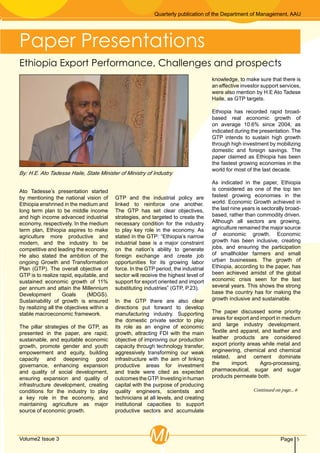
Ato Tadesse’s presentation started
by mentioning the national vision of
Ethiopia enshrined in the medium and
long term plan to be middle income
and high income advanced industrial
economy, respectively. In the medium
term plan, Ethiopia aspires to make
agriculture more productive and
modern, and the industry to be
competitive and leading the economy.
He also stated the ambition of the
ongoing Growth and Transformation
Plan (GTP). The overall objective of
GTP is to realize rapid, equitable, and
sustained economic growth of 11%
per annum and attain the Millennium
Development Goals (MDGS).
Sustainability of growth is ensured
by realizing all the objectives within a
stable macroeconomic framework.
The pillar strategies of the GTP, as
presented in the paper, are rapid,
sustainable, and equitable economic
growth, promote gender and youth
empowerment and equity, building
capacity and deepening good
governance, enhancing expansion
and quality of social development,
ensuring expansion and quality of
infrastructure development, creating
conditions for the industry to play
a key role in the economy, and
maintaining agriculture as major
source of economic growth.
GTP and the industrial policy are
linked to reinforce one another.
The GTP has set clear objectives,
strategies, and targeted to create the
necessary condition for the industry
to play key role in the economy. As
stated in the GTP: “Ethiopia’s narrow
industrial base is a major constraint
on the nation’s ability to generate
foreign exchange and create job
opportunities for its growing labor
force. In the GTP period, the industrial
sector will receive the highest level of
support for export oriented and import
substituting industries” (GTP, P.23).
In the GTP there are also clear
directions put forward to develop
manufacturing industry. Supporting
the domestic private sector to play
its role as an engine of economic
growth, attracting FDI with the main
objective of improving our production
capacity through technology transfer,
aggressively transforming our weak
infrastructure with the aim of linking
productive areas for investment
and trade were cited as expected
outcomestheGTP.Investinginhuman
capital with the purpose of producing
quality engineers, scientists and
technicians at all levels, and creating
institutional capacities to support
productive sectors and accumulate
knowledge, to make sure that there is
an effective investor support services,
were also mention by H.E Ato Tadese
Haile, as GTP targets.
Ethiopia has recorded rapid broad-
based real economic growth of
on average 10.6% since 2004, as
indicated during the presentation. The
GTP intends to sustain high growth
through high investment by mobilizing
domestic and foreign savings. The
paper claimed as Ethiopia has been
the fastest growing economies in the
world for most of the last decade.
As indicated in the paper, Ethiopia
is considered as one of the top ten
fastest growing economies in the
world. Economic Growth achieved in
the last nine years is sectorally broad-
based, rather than commodity driven.
Although all sectors are growing,
agriculture remained the major source
of economic growth. Economic
growth has been inclusive, creating
jobs, and ensuring the participation
of smallholder farmers and small
urban businesses. The growth of
Ethiopia, according to the paper, has
been achieved amidst of the global
economic crisis seen for the last
several years. This shows the strong
base the country has for making the
growth inclusive and sustainable.
The paper discussed some priority
areas for export and import in medium
and large industry development.
Textile and apparel, and leather and
leather products are considered
export priority areas while metal and
engineering, chemical and chemical
related, and cement dominate
the import. Agro-processing,
pharmaceutical, sugar and sugar
products permeate both.
Ethiopia Export Performance, Challenges and prospects
By: H.E. Ato Tadesse Haile, State Minister of Ministry of Industry
Paper Presentations
Quarterly publication of the Department of Management, AAU
6PageVolume2 Issue3 MI
Export is growing promisingly
in Ethiopia. Merchandise export
earnings grew on average by over
22% per annum between 2006
and 2012, more than triple over the
same period. In addition to tradition
export items like coffee, new export
products such as horticulture, leather
(including finished leather products),
and textile and garment products
are becoming good hard currency
earners. Ethiopia now is becoming
among the top flower exporters in
Africa. “Of course, sugar will come
very soon and it will be exported after
fulfilling local consumption. We are
diversifying our manufacturing export
products”, said the state Minister.
The paper presented the ‘support’
activities the government is rendering
at present to enhance export growth.
Supplying the necessary inputs for
the manufacturing industry, attracting
domestic and foreign investment in
places and areas where comparative
advantages are available, working
on logistics, capacity building to
improve productivity by implementing
various benchmarking, organizing
the exhibition & conference,
organizing trade fair, sending and
accepting business delegations and
putting permanent stands (samples)
at embassies abroad, preparing
exporters’ and importers’ Profile,
preparing brochures, booklets
and films are taken as support
activities(strategies) to further
enhance export.
As indicated in the paper, Ethiopia’s
export has shown a relative growth
over the years. For example,
Ethiopia’s export income rose to 3153
million USD in 2011/2012 from 483
million USD in 2002/2003, with an
average growth of 24%.
In terms of export destinations of
Ethiopian products, China took
number one place followed by
Germany, Somalia, Saudi Arabia, and
Netherlands. In terms of continent
Europe took the highest share
(35.06%), Asia (28.12%), Africa
(18.89%), and America (3.36%).
Key challenges of Ethiopia to the
development of export were identified
in the paper. The major challenge for
the export industry is the continuing
dominance of primary agricultural
commodities. Another key challenges
discussed in the paper was the
weak linkage between fellow sectors
such as agriculture, transport and
logistics, finance, and industry.
Transport and trade logistic problems
such as very high cost of transport,
long time transport so that goods
are vulnerable to dear charges,
and insufficient border regulation
affect the export growth and
competitiveness. The young private
sector, which is characterized by low
capacity, traditional management
style, poor level of technology transfer
and market linkages, inadequate
organizational structure, low level
of productivity, lack of inter-industry
linkages, and poor level of investment
in training, is not strong in pushing
forward for the development of export.
The prevalence of rent seeking
culture in terms of poor utilization of
land and financial resources, abuse
of incentives, and focus on short term
goals retard the growth of export.
Despite all the above challenges,
the paper tried to be optimistic about
export performance at the end of GTP
execution. The double digit growth
macro economic performance of the
country over the past 10 years and
the expected growth movement of the
economy in the same trajectory was
taken as a prospect to export growth in
the paper discussion. The paper also
indicted as prospects that by the end
of the GTP period structural shift in the
economy towards the manufacturing
sector is expected to be realized
through its increased share of GDP.
Rapid infrastructure development,
education expansion that enhances
productivity and competitiveness,
No. Sub-Sector Main Focus
Export Import
1 Textile & Apparel x
2 Leather and Leather Products x
3 Agro-Processing x x
4 Metal and Engineering x
5 Chemical and Chemical Related x
6 Cement x
7 Pharmaceutical x x
8 Sugar and Sugar Products x x
Medium and Large Industries Development;
Priority Industries
The growth of
Ethiopia, ...
has been
achieved
amidst of
the global
economic crisis
seen in the last
several years.
Continued on page... 7
Ethiopia Export ...
Continued from page...5
Quarterly publication of the Department of Management, AAU
7PageVolume2 Issue 3 MI
availability of industrial land through
the development and better use of
industrial zones, industrial parks and
clusters were also taken as prospects
for the development of export in
Ethiopia.
The paper stressed the need of
reforms and support activities from the
side of the government. It highlighted
government positive measures
taken to date: investment and export
promotion laws and regulations
have been revised; export promotion
incentives and instruments are
implemented; new export promotion
schemes such as establishing
bonded export factory, bonded supply
warehouse, and Industry zones have
been introduced.
It proposed private sector-led
development strategy to drive
economic growth as a result of
which export can be bolstered.
Property rights, the right to have
peace and stability in the country,
macroeconomic stability, the right to
have education and skill development,
and infrastructure development were
described as enablers for private
sector-led development. Trade and
credit policy incentives particularly for
selected investments; manufacturing
and export oriented investments;
facilitation at licensing, registration,
customs, taxation, land (industrial
zone development); promoting
privatization program where the
private sector is actively investing;
and dialogue and partnership with
the private sector were also cited as
important tasks the government and
stakeholders need to do to develop
export and the economy.
H.E. Ato Taddesse Haile concluded
the paper presentation by pointing
out “the great potential” Ethiopia
has in exporting service products.
He mentioned Ethiopian Airlines
as a significant contributor to the
service sector by providing high
quality transport and travel service.
ICT, tourism, and communications
are the service sectors Ethiopia will
make of export in the future, H.E. Ato
Taddesse Haile pointed out.
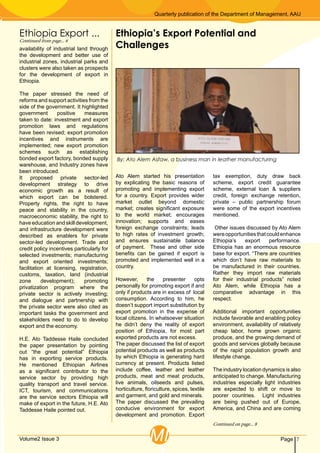
Ato Alem started his presentation
by explicating the basic reasons of
promoting and implementing export
for a country. Export provides wider
market outlet beyond domestic
market; creates significant exposure
to the world market; encourages
innovation; supports and eases
foreign exchange constraints; leads
to high rates of investment growth;
and ensures sustainable balance
of payment. These and other side
benefits can be gained if export is
promoted and implemented well in a
country.
However, the presenter opts
personally for promoting export if and
only if products are in excess of local
consumption. According to him, he
doesn’t support import substitution by
export promotion in the expense of
local citizens. In whatsoever situation
he didn’t deny the reality of export
position of Ethiopia, for most part
exported products are not excess.
The paper discussed the list of export
potential products as well as products
by which Ethiopia is generating hard
currency at present. Products listed
include coffee, leather and leather
products, meat and meat products,
live animals, oilseeds and pulses,
horticulture, floriculture, spices, textile
and garment, and gold and minerals.
The paper discussed the prevailing
conducive environment for export
development and promotion. Export
tax exemption, duty draw back
scheme, export credit guarantee
scheme, external loan & suppliers
credit, foreign exchange retention,
private – public partnership forum
were some of the export incentives
mentioned.
Other issues discussed by Ato Alem
wereopportunitiesthatcouldenhance
Ethiopia’s export performance.
Ethiopia has an enormous resource
base for export. “There are countries
which don’t have raw materials to
be manufactured in their countries.
Rather they import raw materials
for their industrial products” noted
Ato Alem, while Ethiopia has a
comparative advantage in this
respect.
Additional important opportunities
include favorable and enabling policy
environment, availability of relatively
cheap labor, home grown organic
produce, and the growing demand of
goods and services globally because
of the rapid population growth and
lifestyle change.
The industry location dynamics is also
anticipated to change. Manufacturing
industries especially light industries
are expected to shift or move to
poorer countries. Light industries
are being pushed out of Europe,
America, and China and are coming
Ethiopia’s Export Potential and
Challenges
By: Ato Alem Asfaw, a business man in leather manufacturing
Continued on page... 8
Ethiopia Export ...
Continued from page... 6
Quarterly publication of the Department of Management, AAU
8PageVolume2 Issue3 MI
to Africa. In this conjecture Ethiopia
will have and thus should grab the
opportunity to attract such industries.
The preferential market access of
the country to such platforms as
AGOWA, COMESA, and European
Union provide a great opportunity for
Ethiopian export.
Despite all the favorable export
environment and opportunities,
there are prevalent challenges that
could retard the growth of export
in Ethiopia, as presented on the
occasion. The lack of coherence
in the private sector due to varying
interest, size, and narrow focus,
insufficient understanding of global
environment, limited participation
in the international trade, limited
skills, low productivity, financial
constraints, inadequate marketing
and infrastructural facilities, inability
to offer export standard products, and
too much bureaucracy were cited as
most glaring challenges of Ethiopian
export.
Ato Alem suggested ways of
overcoming some of the problems.
The creation of business clusters was
indicated means of increasing the
productivity with which companies
can compete, nationally and globally.
The Mauritius experience was
used to demonstrate clustering
instrumentality for enhancing export.
“I was in Mauritius once. What I have
observed in Mauritius was that the
industrial zones have every materials
and needs in their compound.
Customs, garages, forwarding
agent, and other relevant people and
services are available in a compound
so that export will be faster”, said Ato
Alem.
Lowering internal costs, providing
international technical assistance
through specialized consultants,
improve quality of the product,
developing training programs,
developing small and medium
exporting companies, and
strengthening business associations
were the other focus areas put
forward by the presenter.
FinallyAtoAlem noted that “promoting
the competitiveness of the exporting
sector and increasing the number of
exporters in the Nation, will have a
direct impact on the development”.
By: Ato Tsegabirhan W.Giorgis,
Lecturer AAU-Department of
Economics
The objective of this paper is to
evaluate the performance of the
Ethiopian exports in terms of its
trend, structure and diversification
over the period of 1997-2012.
The paper embarked on showing
the current account of export as is
characterized by persistent deficit
in balance of payment. Structural
transformation of an economy is
inconceivable without the structural
change of the export sector in
favor of high-value, knowledge
intensive and diversified exports.
The development of a competitive
industrial and export sectors was
mentioned as one of the pillars for
the structural transformation of the
Ethiopian economy. The study relied
on secondary data from Ethiopian
Revenue and Customs Authority
(ERCA) and Ministry of Finance and
Economic Development (MoFED).
The study has complemented
the secondary data by intimate
discussions with higher government
officials, middle management
directors and experts from a number
of industry development institutes,
and industry associations.
Growth trends of the Ethiopian
export sector since the imperial
regime up to the present government
The Performance
of the Ethiopian
Exports: Trend,
Structure and
Diversification
Continued on page... 9
Ethiopia’s Export
Potential
Continued from page... 7
EIEF 3rd
Panel discussion participants
Quarterly publication of the Department of Management, AAU
9PageVolume2 Issue 3 MI
Continued on page...18
was reviewed by the paper. In
the imperial regime, Ethiopia got
US$116.8 million in 1965, US$123.2
million in 1970, and according World
Bank report (1971), coffee holding
about 59% of total exports. In the
Military period (1974-1991), Ethiopia
got US$418.2 million in 1977/78,
US$455.4 million in 1978/79 and
US$608.3 million in 1979/80. Among
these revenue, coffee accounted
about 71% of total export products.
At the end of the years of the military
rule, exports collapsed to the level
of late 1960s and early 1970s due
to political turmoil of the country it
experienced at that time. In 1991/92,
1992/1993 and 1993/94 Ethiopian
exports were in million, US$154.1,
222.4 and 279.6, respectively. In the
study period, 1997-2012, Ethiopian
exports has picked up from the order
of US$ 587million in 1997 to about
US$2.7billion in 2012, having an
average annual growth rate of 12.2%.
Though there is a consistent average
exportgrowthinthecountry,according
to the study, the achieved average
annual growth rate is by far lower than
the planned target of average annual
growth rate of 20-25% per annum
during both the PASDEP and GTP
plan periods In addition to this, the
export rate is fluctuating every year;
trade deficit is persistently increasing
with an average deficit growth rate
of 23.43%; while the average annual
growth rate of exports was 12.2%,
the average annual growth rate of
imports was 18%. With the same
analogy, average share of exports of
total imports between the study years
is 26%, declined from the order of
53% in 1997 to 19% in 2008 and 29%
in 2012.
The study compared Ethiopian
performance of export against low-
income countries. The average
percentage share of exports of GDP
of low-income countries for the period
2004-2013 is about 22% while that
of Ethiopia is less than 14% of its
GDP, signifying that Ethiopian export
performance is low even by the
standard of low income countries.
The paper discussed the export
structure over time. According to
the paper, the Hirschman Herfindahl
Index (HHI) has consistently fallen
from the order of 0.47 to 0.13 in 2010
and slightly rising to 0.18 in 2012,
showing the fact that there have been
quite visible diversification in the
Ethiopian export sector. For example,
share of coffee declined from the order
of 65% in 1997 to the order of 32% in
2012. Share of oil seeds increased
from the order of 10% in 1997 to
the order of 33% in 2012. However,
Agricultural commodities constituted
the lion’s share, ranging from the
order of about 80% in the early years
of the study period and declining to
only the lowest share of 52% in 2003
which then picked up to 86% in 2012.
The diversification towards non-
agricultural commodities has been
confined fewer than 14% throughout
the study period, specifically to the
export of leather and leather products
and to a limited extent to textile and
clothing. The study mentioned the
experience of other countries in this
regard. For example, the share of
exports of manufactured goods of
the year 2010, reached to the tune of
more than 90% for Bangladesh, 94%
for China, 64% for India and 67% for
Malaysia (World Bank, WDI 2012).
Ato Tsegabirhan, strongly
recommended Ethiopia to stop
comparing itself with Sub Saharan
Africa; rather it should compare itself
with other countries which have
been achieving better in structural
transformation “not because we do
not want to be African, but because
we have to think better than the poor
performers.”
By: Teshome Bekele,Senior Lecturer
In the beginning there was darkness
in our organization. Our CEOs and
managers told us that we did our job
in darkness. They “enlightened” us
that they have come with a new recipe
of management which they said, are
magic and will pull us out of darkness.
They called that management system
“Bureaucracy”. They said, “It is the
best, the most efficient, rational….”
We were happy believed them and
obeyed them for whatever they told us
about bureaucracy and we waited for
Are we doing the
Right thing Right?
Continued on page... 10
EIEF 3rd
Panel discussion participants
Quarterly publication of the Department of Management, AAU
10PageVolume2 Issue3 MI
In the conclusion of this paper, a
question was posed: “why is the
performance of the export sector
not up to the expectation?” It is
because the performance of the
export is not up to the expectation in
terms of addressing the persistently
increasing trade deficit of the country,
and accordingly the export plan of the
government is to grow at an average
of 20-25%. Another reason is that
the apparent trend of diversification
though encouraging in terms of its
quantitative achievement, it is still
confined to the export of primary
products, which are generally
believed to have inelastic (both price
and income) demand.
The major reason for lower
performance of the Ethiopian export
is the low responsiveness of the
private sector manifested in terms
of low investment, low effort to
enhance productivity and low effort
to upgrade into higher value creating
activities. This calls for further
research to understand the real and
genuine interest and problems of the
exporters as there are indications that
the export business are of secondary
importance to the business people,
having other business lines, to which
they give more attention like real
estate and import business.
Moreover, much needs to be done
to improve the business climate
of the country, as many of service
providing government institutions are
not operating up to what it is required
to create globally competitive export
sector. At the same time the paper
noted that there have been very
high diversifications of geographical
destinations of Ethiopian exports.
The increasing trend of South-South
trade is quite encouraging. There
has been a shift towards Asia, mainly
China, Japan and Korea which is one
indicator of an improvement in the
export outlet of the country.
The paper presented marketing
management capability as
indispensable element for export
success. “I don’t think export will
be successful without effective
marketing capability”, Ato Teshome
stressed. The paper indicated
marketing management capability is
a keystone for the success of export
earnings. Ethiopia regards export
in its transformation strategic plan
as a means of poverty reduction
and elevating Ethiopia to middle-
income country. At the same time
marketing management capability
have not gotten the attention it
deserves. However, it was noted
that successful countries use their
marketing management capabilities
to exploit the opportunities of export
and mitigate its challenges.
Though the role of marketing
capability is significant, developing
countries including Ethiopia underplay
the importance of marketing
management capabilities in steering
export performance. He expressed his
serious reservation on the prevailing
attitude of doing things traditionally
and the tendency to believe that
“marketing and management can be
done by anybody”. He demonstrated
how the Department of Management
of Addis Ababa University can
play a significant role in marketing
management capability building.
Export earning is the major source
of national development. Some
argue that countries need to pursue
export-led growth (ELG) strategy for
successful national development
(Bhagwatiand Srinivasan, 1978;
Krueger, 1978; Kavoussi, 1984).
Building Marketing
Management
Capability
for Export:
Opportunities &
Challenges
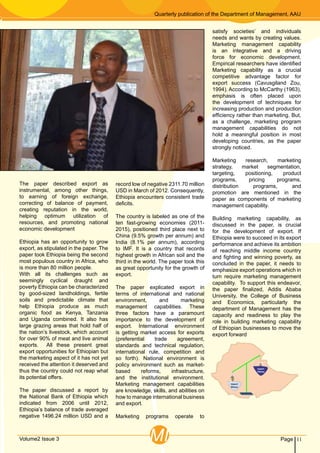
By: Teshome Bekele,
AAU-Department of Management
There has been
a shift towards
Asia, mainly
China, Japan
and Korea
which is one
indicator of an
improvement
in the export
outlet of the
country.
Continued on page... 11
The Performance
Continued from page... 9
EIEF 3rd
Panel discussion participants
Quarterly publication of the Department of Management, AAU
11PageVolume2 Issue 3 MI
The paper described export as
instrumental, among other things,
to earning of foreign exchange,
correcting of balance of payment,
creating reputation in the world,
helping optimum utilization of
resources, and promoting national
economic development
Ethiopia has an opportunity to grow
export, as stipulated in the paper. The
paper took Ethiopia being the second
most populous country in Africa, who
is more than 80 million people.
With all its challenges such as
seemingly cyclical draught and
poverty Ethiopia can be characterized
by good-sized landholdings, fertile
soils and predictable climate that
help Ethiopia produce as much
organic food as Kenya, Tanzania
and Uganda combined. It also has
large grazing areas that hold half of
the nation’s livestock, which account
for over 90% of meat and live animal
exports. All these present great
export opportunities for Ethiopian but
the marketing aspect of it has not yet
received the attention it deserved and
thus the country could not reap what
its potential offers.
The paper discussed a report by
the National Bank of Ethiopia which
indicated from 2006 until 2012,
Ethiopia’s balance of trade averaged
negative 1496.24 million USD and a
record low of negative 2311.70 million
USD in March of 2012. Consequently,
Ethiopia encounters consistent trade
deficits.
The country is labeled as one of the
ten fast-growing economies (2011-
2015), positioned third place next to
China (9.5% growth per annum) and
India (8.1% per annum), according
to IMF. It is a country that records
highest growth in African soil and the
third in the world. The paper took this
as great opportunity for the growth of
export.
The paper explicated export in
terms of international and national
environment, and marketing
management capabilities. These
three factors have a paramount
importance to the development of
export. International environment
is getting market access for exports
(preferential trade agreement,
standards and technical regulation,
international rule, competition and
so forth). National environment is
policy environment such as market-
based reforms, infrastructure,
and the institutional environment.
Marketing management capabilities
are knowledge, skills, and abilities on
how to manage international business
and export.
Marketing programs operate to
satisfy societies’ and individuals
needs and wants by creating values.
Marketing management capability
is an integrative and a driving
force for economic development.
Empirical researchers have identified
Marketing capability as a crucial
competitive advantage factor for
export success (Cavusgiland Zou,
1994). According to McCarthy (1963),
emphasis is often placed upon
the development of techniques for
increasing production and production
efficiency rather than marketing. But,
as a challenge, marketing program
management capabilities do not
hold a meaningful position in most
developing countries, as the paper
strongly noticed.
Marketing research, marketing
strategy, market segmentation,
targeting, positioning, product
programs, pricing programs,
distribution programs, and
promotion are mentioned in the
paper as components of marketing
management capability.
Building marketing capability, as
discussed in the paper, is crucial
for the development of export. If
Ethiopia were to succeed in its export
performance and achieve its ambition
of reaching middle income country
and fighting and winning poverty, as
concluded in the paper, it needs to
emphasize export operations which in
turn require marketing management
capability. To support this endeavor,
the paper finalized, Addis Ababa
University, the College of Business
and Economics, particularly the
department of Management has the
capacity and readiness to play the
role in building marketing capability
of Ethiopian businesses to move the
export forward
Quarterly publication of the Department of Management, AAU
12PageVolume2 Issue3 MI
.
Following all speeches, keynotes,
and paper presentations, participants
were invited to pose questions, to
provide comments and suggestions,
and to express their feelings on what
has been done in the half afternoon
day occasion.
The discussion began with
appreciation to the overall
management of the Forum. The event
was described as the best of its kind
in terms of organization and quality of
presentations. Following that issues
regarding export control particularly
in mining, lack of institutions and
institutional capacity to regulate
the export task, lack of strong and
committed private sector for export
were scrutinized. Clarity and policy
predictability related to foreign direct
investment, provision of land for
investment, and taxation were also
raised as concerns of businesses.
Flower export promotion experience
was cited during the discussion to
exemplify the lack of institutional
capacity (both government and the
private sector) and coordination
between the government offices
and the private sector. Once, the
government earmarked 3.1 billion
birr in the Development Bank of
Ethiopia for flower exporters. Some
exporters borrowed and used from
this fund 600 million birr but after long
seven years, the income from flower
export was only around 70 million birr,
panel participants reflected. Although
Discussions
Continued on page... 14
Ato Amare Aregawi, General Manager(MCC),Managing Editor, and HAPI Executive Director
EIEF 3rd
Panel discussion participants
Quarterly publication of the Department of Management, AAU
13PageVolume2 Issue 3 MI
1. Background
The Ethiopian Civil Service was
founded in 1961 when the Central
Personnel Agency (CPA) was
established modeled after the
American Civil Service. The first
radical measure to build the capacity
ofthecivilservicewasinitiatedwiththe
implementation at the Public Sector
Capacity Building Program that has
begun in earnest in 2005. Ethiopia
has been undergoing Business
Process Reengineering (BPR),
also known as Business Process
Redesign, Business Transformation,
or Business Process Change
Management, as a management
approach aiming at improvements
by means of elevating efficiency and
effectiveness of the processes that
exist within and across organisations.
BPR is defined as defined by Hammer
is the fundamental re-thinking and
radical re-design of business process
to achieve dramatic improvements in
critical, contemporary measures of
performance such as cost, quality,
service and speed.”
This definition contains four key
words. It is fundamental: a fresh start,
clean sheet, challenging the status
quo concentrating on “What should
be” -- unlearn all rules, assumptions,
principles and techniques that
underpin the way organisation is
organised. It is radical: going through
the root of things, not improving what
already exists, throw away the old
and restart the new one. It is dramatic:
not marginal, it is a quantum leap in
performance i.e. cost, speed, quality
and service, achieving break through:
50% and above. It is processes
oriented: inter related tasks or
activities that together create value for
the customer. The key to BPR is for
organisations to look at their business
processes from a “clean slate”
perspective and determine how they
can best construct these processes to
improve how they conduct business.
This will largely assist the nation to
accomplish most of the determinants
stated above except those that fall
within the government’s economic
policy of protecting the finance, power
and communication institutions from
foreign competition.
2. Achievements of the
Ethiopian BPR
A survey, which was conducted
between March and May in 2005,
reveals a notable transformation of
service delivery in each organisation.
Very high levels of user satisfaction
and spectacular improvements in
Has BPR failed and is Kaizen bound to fail in Ethiopia?
Costantinos BT Costantinos, PhD
College of Business & Economics,
AAU
Continued on page... 15
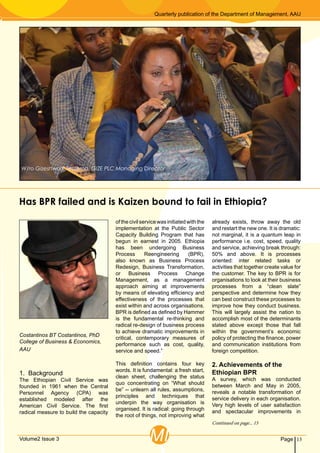
W/ro Gizeshwork Tessema, GIZE PLC Managing Director
Quarterly publication of the Department of Management, AAU
14PageVolume2 Issue3 MI
the marketing strategy employed,
consignment, was blamed for this
fiasco, absence of responsible body
to carry out the flower export plan
might have been the prime factor.
The institutional capacity and ethical
practices were also raised doubting
the quality of information the country
has regarding, for example, the
amount of bond that are being sold,
level of production, and amount of tax
being collected.
The paradox of exporting primary
products such as skin and hides and
oil seeds and importing leather bags
or edible oil was mentioned as matter
of utmost concern..
Ideas were also reflected on the
question “If we consider export
performance is low, who is to blame
for it?” Both the government and
the private sectors were considered
responsible for the low performance.
It was noted that the private sector
motive and performance measure
is rate of return and chasing high
return commensurate to the risk the
investment entails by the private
sector is natural and thus should not
be frowned upon. If the private sector
shies away from the export sector
because of profit motive, then the
strategy of those concerned should
be to create an environment that
will make export business attractive.
From experience, export is not
that much profitable business right
now when it is compared with other
business ventures of similar risks.
Cost of transportation as one
impediment to export was highlighted.
Considering export to china for
example, the cost of transporting a
shipment from Addis to Djibouti was
shown to be higher than transporting
the same shipment from Djibouti to
China.
The Ethiopian government export
relatedpolicies wereappreciated save
their implementation. To describe the
position of Ethiopian export products
in the global market, South American
and Asian countries were cited as
examples of nations producing similar
materials that Ethiopia is producing
in a better quantity and quality. The
existing poor infrastructure, lack of
sufficient electric power, frequent
black out of power, human capital,
and existing poor machineries,
and low productivity among others
were said to have fettered Ethiopian
private sector competitiveness in the
international market.
It was also mentioned that foreign
investors have taken unfair
advantages of the Ethiopian export
incentive schemes, exploiting our
enthusiasm for growth and lack of
institutional capacity to regulate such
behaviors. The countries of such
foreign companies who exposed
Ethiopia to capital flight and have
perpetrated unfair and dishonest
the cost of
transporting a
shipment from
Addis to Djibouti
was shown to
be higher than
transporting the
same shipment
from Djibouti to
China.
Discussions
Continued from page... 12
EIEF 3rd
Panel discussion participants
Ato Temesgen Genetu (ACCA,
FCCA)
Ato Tassew Bekele, Senior
Economist, CES Consulting
Engineers Salzgitter GmbH
Quarterly publication of the Department of Management, AAU
15PageVolume2 Issue 3 MI
The Ethiopian government was
reported to be one of the highest
investor in the world while the
private sector of Ethiopia is among
the six bottom-line countries in the
world. In addition, the private sector
involvement in and motivation
for manufacturing is described to
be low. Even the limited heavy
manufacturing machineries imported
are out of date and refurbished ones.
Given this reality combined with the
problems mentioned before such as
untrained labor, low productivity and
bureaucratic red tape, developing
competitive export industry and
achieving export growth were
reckoned challenges. Mechanisms to
regulate heavy machinery importing
practices and determine suitability of
machineries need to be introduced.
Further issues raised were regarding
the similitude between traditional
farmers and destitute mechanized
farming, enhancement of dialog and
partnership among stakeholders,
and WTO accession implications to
Ethiopian growth. The discussion
was warm, captivating, educational,
and binding.
Finally, the discussion concluded the
occasion with great satisfaction of
what was done on the day and hoped
that the next theme of the EIEF will
dwell on one of the major issues
raised.
business practices were mentioned
by name
Some of such companies borrow
huge amount of money in the name
of export and export their product to
their own affiliates in another country
which will rig the lowest possible
purchase price. While the product
is sold at handsome price in the
foreign country with awesome profit
for the affiliated company in effect the
exporter, Ethiopia receives a meager
foreign currency in return.
The recent abscondence of a Middle
East investor who borrowed huge
amount of money from Development
Bank was also mentioned as
challenges facing the export
promotion effort of the country. The
foreign investors have shown the
tendency to abuse the policy which
allows a foreign investor to switch
business lines after five years of
export activity. It was emphasized
that acquiring institutional capacity
and implementation regulations to
curb such scandals and close the
cracks amenable to national treasury
plunder should get attention sooner
than later.
Other issues raised include re-
institutionalization of internship and
the role of the private sector, media
coverage of the Forum, and stay the
course of the research presentation
session by government officials.
performance were also recorded
as a result of the introduction of
Business Process Reengineering.
Although the change process in
both organisations tended to be
sluggish, these improvements
appear to be outstanding within
the context of Ethiopia’s system of
public administration. However, one
challenge will be for the government
to maintain the momentum of reform
and to cascade BPR and other
elements of the reform to other
divisions, departments, and work units
in the government. Putting in place
incentive schemes and an appropriate
monitoring system should protect the
reform from backsliding. Despite the
pessimistic accounts of public sector
reform in African countries, this article
reveals that there are positive findings
of interest to the field of development
administration.
3. Shortcomings of the BPR
Process
3.1. Bad reputation
Re-engineering has earned a bad
reputation because such projects
have often resulted in massive layoffs.
In spite of the hype that surrounded
the introduction of Business Process
Reengineering, partially due to the
fact that the authors of Reengineering
the Corporation reportedly bought
huge numbers of copies to reach
the top of the bestseller lists, the
method has not entirely lived up to
its expectations. The main reasons
seem to be that: BPR assumes that
the factor that limits organisation’s
performance is the ineffectiveness of
its processes. This may or may not
always be true.
Also BPR offers no means to validate
this assumption. BPR assumes
the need to start the process of
performance improvement with a
clean slate, i.e., totally disregard the
status quo. BPR does not provide an
effectivewaytofocustheimprovement
efforts on the organisation’s
constraints. Sometimes, or maybe
quite often, a gradual and incremental
change may be a better approach
Continued on page... 17
BPR in Ethiopia:
Continued from page... 12
Ato Tamirat Shawoel, Head, Economic Research &
Planning, Wegagen Bank S.C.
Quarterly publication of the Department of Management, AAU
16PageVolume2 Issue3 MI
the light. After a while, our bosses told
us that bureaucracy is an iron cage
that fettered our organization and
kept us backward in darkness and
that they have a new management
system which they said is flexible and
participative and told us that they will
abolish bureaucracy-the iron cage.
Every time our organization failed
to achieve its objectives or what
they called strategy, they continued
to come up with series of new
management models like magicians,
which they say will shower us with
light and clean us from the sins of
mismanagement just like The Holly
Water. We believed them and obeyed
them and we did exactly as we were
told happily hopping for the light.
Sometimes we felt like asking our
bosses in earnest. “Are we doing the
right thing right?”
However, we were told that bosses
are always right, and we continued
believing in them.
Every time new bosses came they
continued telling us directly and
sometimes implied that our previous
managers (CEOs) have led us in
darkness. Time after time, again
and again they told us that their new
magic management formula will bring
a quantum leap success and pull us
out of darkness.
We obeyed them and we did
whatever they told us to do, hopping
for the light. But in vain, success
was not forthcoming. “Are we doing
the right thing right?”
Quite recently our bosses told us
about more management systems
which they said are magic and
“root pulling” systems that will take
us to light. Some of the recent
management systems are Business
Process Reengineering (BPR),
Lean and Mean Management,
TQM, Six Sigma, Restructuring,
Balanced Scorecard (BSC), Kaizen,
Result Oriented Performance
Management, Self Study, Achieving
Competitive Excellence (ACE)
and many more. The list of the
management systems seems
endless. It is surprising to note
some of the so called management
systems which are introduced by our
managers are old and have existed
for several years. However, they are
only publicized to an extreme level.
Some say that some of the new
models that our managers come
with are the same management
system that existed before except
they are in a new perhaps distorted
form. They are only like “old wines in
new bottles”.
However, if our bosses tell us their
systems and models are new, of
course they are new because the
“bosses are always right” although
they may not be right sometimes.
Every time bosses instruct us to
implement new and magic systems
which they said is a remedy, we
workers obeyed them.
Once our friends, who were working
in a construction firm told us that their
managers gave them a blueprint to
construct a railway line. The bosses
told the workers that the blue print
was the best and first of its kind. Our
friends obeyed them and did exactly
as they were instructed and without
question. However, the result of their
effort was awful and wasted as shown
in the figure bellow.
The bosses told our friends to “Do it
all over again.
We believe that management tools
such as strategy, BPR are like any
tools that people use to fix their
problems. For example like a hammer
used to drive a nail to fix an object.
Driving a nail into a hard object
requires the right type of of nail and
a and the right hammerer. A rubber
nail and a rubber hammer may not
be helpful to nail into a stiff and solid
object. And unskilled (unprofessional)
hammerer will spoil the nail and the
object,
Supposing we consider management
tools such as BPR, BSC and others
as nails, they need to be the right
nails and be produced execute by the
right professionals. There are several
instances where BPR and BSC have
failed for reasons they are not used
right.
Continued on page... 17
Are we doing ...?
Continued from page ... 9
Quarterly publication of the Department of Management, AAU
17PageVolume2 Issue 3 MI
Models to be used need to be the right
thing and they should be done right
also. Being the right thing means-
being the thing that drives both
performance and behavior towards
the accomplishment of organizational
objectives. Management models:
1.	 Need to be right stuff-that fit
the situation and capable of
solving the root problem.
2.	Need to be designed by
professionals.
3.	 Need to be implemented by the
right persons
According to Mary Parker Follet,
management is a process of getting
things done through people.
Thus, one cannot expect CEOs (top
managers) to be all knowledgeable
but they need to have certain level
of wit and intelligence to help them
carry out their role of being leaders
by working with and through other
people.
One of the big challenges managers
face is choosing the right people
professionals that help to produce
quality ideas and quality performance
output.
According to Crosby, quality is free.
Crosby stated that effective quality
management, to be practical and
achievable, must start at the top. As
Crosby emphasized, “do it right the
first time”. CEOs must make “Zero
defects” as standard of all of their
activities.
Doing things right saves an
organization from horror that may
ensue as sighted in the case of
the railway line presented above.
In many organizations, when new
bosses come, often they embark
in restructuring their organizations,
hatch new units, discard or rename
existing units etc,
Ventures such as structuring are
serious jobs that need professional
skills. One can take an organization
as a system-a living thing, for
example like a tree or a human being.
Restructuring living things say human
beings require sturdy and serious
qualified professionals (medical) who
(such as -- Kaizen). BPR is culturally
biased towards the US way of
thinking. When Kaizen is compared
with the BPR method is it clear the
Kaizen philosophy is more people-
oriented, more easy to implement,
but requires long-term discipline and
provides only a small pace of change.
The BPR approach on the other hand
is harder, technology-oriented, it
enables radical change but it requires
considerable change management
skills. It is doubtful whether it can be
implemented in the private sector.
3.2. Some observed challenges:
There is no as such survey and
assessment so far conducted on
the challenges of BPR. However,
since critical observation preferably
is accepted following challenges are
notified for this purpose.
•	 Planning phase: Leadership
problems have been
reflected in the essence of
not considering the change
as personal agenda. This is
supported with failing to get
focused and become too busy
with routine activities they tend
to delegate the transformation
agenda to others and failure
to start from end outcome
and starting at functional
department perspectives rather
than process perspective
and writing organisational
goals and confirming as
a process. Selecting the
designing teams who have no
sufficient knowledge, skill and
exemplary behaviour and yet
not assigning the designing
teams as full-time worker on
reengineering.
•	 Understanding phase:
Spending too much time
analysing the existing
processes and identifying
operational problems rather
than process problems;
•	 Redesigning Phase: Conduct
benchmarking without making
enough preparation, not
proceeding to the next step
withoutmakingabenchmarking
process, not clearly pin pointing
the distinction between
stretched objective of business
process and objectives of
an operational strategic
plan, using Problem-Rule-
Assumption for analysis or
solution rather than generating
creative idea that could break
the assumption and failure
to ensure well-designed and
well-organised new business
process;
•	 Implementation phase: Lack
preparing action plan that
include commutation plan
and change management
strategies, not ensuring the
partition or wall is rejected
and functional boundaries are
dissolved and not incorporating
feedback from employee,
customers and stakeholders to
the new process design;
3.3. Creating a meritorious civil
service
Ethiopia requires a proactive
and innovative managerial and
entrepreneurial team with capacities
and will power. The crux of the
challenge therefore, is creating,
retaining and putting to productive
use peoples with such qualities
throughout the economy. It is about
having the ability and willingness
to identify, sequence and execute
human-centered development
priorities and programs, to be able to
participate meaningfully in the global
economy. It boils down to formulating
and executing national and sectoral
policies that would enhance
Ethiopia’s aggregate commitment,
will power and capacities to mobilise,
develop, motivate, encourage and
utilise all segments of the population.
Hence neither BPR nor kaizen would
be a solution unless the recruitment
process, procedure and criteria are
transformed and the remuneration
structure transformed to match the
private sector and the cost of living
index.
Continued on page... 18
Has BPR failed...?
Continued from page... 12
Quarterly publication of the Department of Management, AAU
18PageVolume2 Issue3
Address
Department of Management, College of
Business and economics,
Addis Ababa University
Tel: +251-11-1229611
E-mail: ideaexchange.aau@gmail.com
	 Management.insight@yahoo.com
www.aau.edu.et/management
MI
“In the past, the U.K. got away with
selling things that weren’t unusual.
Now it’s no use trying to export
without having something that’s
unusual and better.” -
James Dyson
“Quality is doing the right thing
when no one is looking.”
Henry Ford
“When everything is a priority,
nothing is a priority.” -
Karen Martin
“Our greatest glory consists, not in
never falling, but in rising every time
we fall.”
Oliver Goldsmith
“If you’re in a bad situation, don’t
worry it’ll change. If you’re in a
good situation, don’t worry it’ll
change.”
John A. Simone, Sr.
Tips and Quotes
have the capacity to diagnose, define
the problems prescribe solutions and
take the right action, not witch doctors
or magicians. Changing names
of an organization or part of the
organization is just like changing the
name of a person. When names are
changed persons or organizations
lose their identity.
Managers are not expected to be
professionals in diagnosing the
problems of their organizations and
prescribing solutions. However, they
need to use the right professionals
which will do the right thing. Regarding
working with and through people, of
professionals, sidekicks, consultants
and advisors managers need to
know that there are Good, BAD and
Ugly professionals, consultants, and
sidekicks.
Managers need to avoid bad and
ugly professionals who distort
management models, incubate
and hatch unhealthy models, and
contaminate organizations with
malfunctioning.
Who are the good, bad and ugly
professionals, consultants and
advisors?
By the way, is bureaucracy gone
or reinforced, made tougher than
ever before? Are the new models
BSC, BPR, Kaizen etc. armors and
beautiful rappers, new bottles for the
old bureaucracy?
To be contin ued.
Dale, Ernest. (1981) Management
Theory and practice 4th Edition.
McGraw-Hill International Book
Company Tokyo.
Philip B. Crosby. Quality Is Free. The
Art of Making Quality Certain. (New
York: McGraw-Hill, 1979).
Up coming events
•	 4th
Executive Idea Exchange Forum on
“Implications of WTO Accession For Ethiopian
Businesses” will be conducted at Addis Ababa
universty, Eshetu Chole Hall on September 26,
2013
•	 PhD program in Management will commence
in September 2013
Are we doing...?
Continued from page... 18
Quarterly publication of the Department of Management, AAU
19PageVolume2 Issue 3 MI
Pictures Gallery
Quarterly publication of the Department of Management, AAU
20PageVolume2 Issue3 MI
Pictures Gallery

Aau gizeshwork

  • 1.
    Quarterly publication ofthe Department of Management, AAU 1PageVolume2 Issue 3 MI Page| 5Issue 1: March 2013 Quarterly publication of the Department of management MI Page| 1Issue 1: March 2013 Quarterly publication of the Department of management MI Management Insight College of Business & Economics Department of Management Inside Pages ... College of Business & Economics Department of Management Editorial Welcoming speech Opening Remarks A keynote Address Paper Presentations Are we doing the Right thing Right? Discussions Has BPR failed and is Kaizen bound to fail in Ethiopia? 2 3 3 4 5 9 12 13 T he Department of Management, College of Business and Economics of the Addis Ababa University held its 3rd panel discussion of the Executive Idea Exchange Forum on Thursday, June 27, 2013 at 2:00 PM at the College of Business and Economics Campus. Thethemeofthethirdpaneldiscussion was “Ethiopia’s Export Potential and Challenges”. The Forum was keynote addressed by the State Minister of Trade, His Excellency Ato Yaekob Yalla and research papers were primed by the presentation of State Minister of Industry, His Excellency Ato Tadesse Haile. Dr. Admasu Tsegaye, President of AAU, in his speech noted that the University is undergoing radical reforms. He said that “ as part of the TransformationTriggerFacilities(TTF) program, the University has laid down the foundation to establish Business Incubation Center, and European and Ethiopian Business School that will be a center of business management excellence. The President further expressed AAU’s commitment to support the Executive Idea Exchange Forum (EIEF), and to strengthen and expand programs of the department of Management. Honorable guests of the Forum were welcomed by the Chairman of the department of Management, Dr. Mohammed Seid. The Forum was started through The Third Executive Idea Exchange Forum Discussion Held Volume 2 Issue 3 July 2013 EIEF 3rd Panel discussion participants AAU President DR. Admasu Tsegaye Ministry of Industry State Minister, H.E Ato Tadesse Haile Ministry of Trade State Minister, H.E Ato Yaekob Yalla(from left to right)
  • 2.
    Quarterly publication ofthe Department of Management, AAU 2PageVolume2 Issue3 MI journalist, business executives, and the academia. The support gesture demonstrated to the Forum from all concerned were very encouraging and inspiring to the Department and those involved in organizing the events. The importance of research for business and society cannot be overemphasized. Although knowledge and findings from research will not relieve managers and policy makers from making difficult decisions in complex global environment, it can provide them with insights that they should factor in when making these decisions. Aside from drawing high level government officials, the 3rd panel was special in that three research papers were presented and heated discussions were made. The Forum beyond part of the Executive MBA program has been established with the purpose of further improving communications and enhancing understanding among stakeholders. The Forum aims to do this by fostering open discussion between the public policy arena, think tanks, academia, media, the business communities, and development partners, particularly dialogue based on Forum-supported business management-oriented research on various areas of common interests. The 3rd panel was unanimous in its support for sustained and intensified engagement, communication, and cooperation between the stakeholders as a win-win opportunity for all. Above all, Ethiopia’s impending accession to WTO has generated strong imperatives for all players to deepen their collaborative spirit and consultative engagement as a matter of necessity. As a result of the EMBA program and the resultant EIEF, a new collaborative setting has materialized for Ethiopians to reflect on the world competitive landscape, create shared visions of the future and formulate innovative competitive strategies to achieve these visions. The 3rd Executive Idea Exchange Forum (EIEF) discussion held on June 27, 2013 under the stewardship of the department of Management of AAU and the auspices of Initiative Africa was a grand success. It brought high level government officials, prominent business agents, and the university around a platform to pledge to work together for the enhancement of management excellence, understanding, partnership, and economic growth. It was evident from what were observed during the EIEF consecutive sessions that anyone who is interested in expanding the capacity of managing businesses, elevating academics, and revitalizing government organs – from young academics/line managers to executives in large organizations/ policy makers – will benefit from the panel discussions. The Forum is unique in bringing to light personal anecdotes, best practices, and thoughtful scholarship. It focuses on the development and dissemination of insights on the management process, drawing the untapped experience and wisdom of participants, as well as on fostering contacts, understanding, trust, and partnership. It is a platform filled with passion to ensure the prevalence of managerial excellence which will be instrumental to economic growth and poverty reduction. Without the economic growth that the GTP and MDG laid down, it is hard to imagine sustainable development and improvements in people’s lives. The EIEF seeks to close the ostensible gap between the business, the government, the academia and development partners and usher a new era of partnership among them. Building up on the previous two panel discussion, the June 27 convention was a leap forward in that it involved two state ministers, Ethiopian Chamber of Commerce president, AAU president, as well as prominent Editorial While the core participants are leaders in academia, business, politics and civil society, promising young members of these communities are part of it as well. The discussions had revealed enormous untapped information, knowledge and insight reserve that participants can unleash if this platform is sustained. Such unearthed knowledge and insights when brought to the surface will be rich source of research topics, further discussions, better policy and enhanced management practice. The Department as well as its EMBA students should be proud of the progress they have made towards enhancing communication, trust, understanding, and partnership through dialogue among stakeholders destined to be partners for their common good. The Forum also has created the opportunity for participants to: • Learn about the latest industry updates, government posture, and available business ideas that may revolutionize our management practice directly from executives and other industry experts. • Interact with our peers in a small group setting to learn best • Create invaluable relationships with fellow executives, industry experts, academics and government officials and, development partners. • Meet people with whom we may make business It should be obvious that if all involved can keep the momentum and passion they demonstrated, the Forum can unleash the fountain of knowledge, insights, research based policy input and practical solutions for sustainable economic activity, cultivate young academic talent; and establish understanding, trust, networking and partnership between academics, business, politics, media, and the public there by achieve management excellence for prosperity. Management Knowledge Reserves Unleashed
  • 3.
    Quarterly publication ofthe Department of Management, AAU 3PageVolume2 Issue 3 MI welcoming speech by Dr. Mohammed, Chairman of Department of Management by extending his gratitude to the contributors of the program and welcoming the guests and guest of honors for their devotion of time. He said the aim of the Executive Idea Exchange Forum is to advance Management excellence. “As a pioneer of management education in Ethiopia, the department of Management of the Addis Ababa University together with its executive MBA students have launched this forum to complement the executive capacity development by bringing the government together with the private and the public sectors, management professionals, the academic community, and development promoters”, Dr. Mohammed said. He also stated this Forum is held quarterly “to exchange views, best practices, business encounters, and new developments on matters of common interests.” “The ideas reflected, the findings presented, the discussions made, the insights gained are captured and disseminated through the quarterly publication called Management Insight”, Dr. Mohammed promised the participants on the occasion. Dr. Admasu Tsegaye, president of Addis Ababa University, opened the workshop. The president appreciated the concerted effort of department of Management and it’s EMBA students. Organizing such an event to promote matured discussion on several management topics of interest is timely, he stressed. According to the president, the purpose of this Forum is “to enable the building of a productive dialogue and experience sharing between policy makers, business executives, development promoters and the academia.” The president reassured the participants the University’s commitment to this inspiring initiative. Ethiopia has embarked on the Growth and Transformation Plan with the aim of meeting the Millennium Development Goals and becoming a middle income country by 2025, the president said. He cited the country’s economy growth at twice the rate of the rest of Africa, averaging 10.6% GDP growth per year between 2004 and 2011 as a testimony for Ethiopia’s progression on the right direction to achieve its development goals. Addis Ababa University envisaging itself as a “pre-eminent African research University has made a decision to position graduate programs at the heart of its strategic plan.As part of meeting this vision, the University put in place a new structure that can enhance performance and reduce resource wastages, according the president. He added BPR is implemented and BSC is finalized to be employed. “Appreciating the need to enhance the managerial and competitive capacity of Ethiopian business in a global environment, the University has launched an EMBA program”, the president indicated. “As part of the Transformation Trigger Facilities (TTF) program, the University has laid down the foundation to establish Business Incubation Center, and European and Ethiopian Business School that will be a center of business management excellence”, he added. The president also heralded the launching of the PhD program in Management in the coming September. He described the program as the first of its kind in the country that is “expected to elevate the Welcoming speech Opening RemarksBy Dr. Mohammed Seid, Chairman, Department of Management By Dr. Admasu Tsegaye, President of AAU “Appreciating the need to enhance the managerial and competitive capacity of Ethiopian business in a global environment, the University has launched an EMBA program” Continued on page... 4
  • 4.
    Quarterly publication ofthe Department of Management, AAU 4PageVolume2 Issue3 MI Opening... Continued from page... 3 capacity of management programs of regional universities to a higher level, set the stage for networking and partnership with European and American Universities, and hold back the brain drain the county has been experiencing”. He extended his gratitude to the Department of Management and its EMBA students for their deep involvement in organizing this session, government officials for availing themselves from their crowded schedules, and Initiative Africa and SIDA for sponsoring the program. He expressed the University’s management support to the Forum and to the department of Management effort to strengthen and expand the programs it is running. The president of Addis Ababa University, Dr. Admasu Tsegay finally called upon Ministry of Trade and Ministry of Industry, the business community, and development promoters to partner with the university to strengthen this initiative. so as to make the achievement of the GTP a reality, Ato Yaekob indicated. Trade in the market oriented economy will play a crucial role in the effective execution of GTP, H.E. Ato Yaekob said. “The Ministry of Trade has been working in strengthening domestic and foreign investment and trade, eradicating rent seeking behaviors, establishing a favorable environment for productive investors, promoting a competitive and efficient domestic trade and distribution system, ensuring customers rights, transparency, fairness, and accountability of the legal framework for the trade activities”, the State Minister said The State Minister reminded the audience that “in addition to COMESA, SADC and the East African Community (EAC), Ethiopia can benefit from the duty and quota free market access to the EU and US markets through EBA and AGOA respectively. The unilateral quota and duty free market access offers by Japan, China, India, Canada and Korea under General System of Preference (GSP), and its proximity to huge Asian and Middle East markets also benefit the country at large”. He expressed the Government belief that joining the WTO “will expedite the process of Ethiopia’s effort in the economic reforms and will also push forward the in-depth structural reform of foreign trade”. However, success in international trade, achievement of economic growth, and realization of poverty reduction depends of human capacity building particularly enhancement of managerial capacity beyond creating competitive trade related infrastructure services and improving Input and capital goods. He emphasized the significance of having a sustainable regular gathering to exchange ideas, best practices, policy issues, and research findings to enhance management education, managerial capacity of our business to excel in the global market. The role such a dialogue among stakeholders will play to export promotion, national poverty reduction endeavor and realization of our GTP was underscored. Finally, the state minister commended the Department of Management of the College of Business and Economics of the Addis Ababa University for taking this initiative and pledged to “continue to actively participate in and partner with the Department to enable it generate relevant policy inputs, enhance problem solving managerial capacity, and explore business opportunities and assist in areas where its involvement has relevance. A keynote Address by H.E. Ato Yeakob Yalla, State Minister of Ministry of Trade. T he State Minister expressed his appreciation to Addis Ababa University for giving him a chance to deliver a keynote speech on the occasion. “The Ethiopian government has been pursuing economic growth as one of principal instruments for poverty eradication”, Ato Yaekob said. Economic growth is the ultimate goal of all countries in the world. The Ethiopian government proved its policies and strategies right by making the country one of the fastest growing economies in the world, he added. The government is also committed to sustain the accelerating and growing economy The Ministry will “continue to actively participate in and partner with the Department to enable it generate relevant policy inputs, enhance problem solving managerial capacity, and explore business opportunities and assist in areas where its involvement has relevance”.
  • 5.
    Quarterly publication ofthe Department of Management, AAU 5PageVolume2 Issue 3 MI Continued on page... 6 Ato Tadesse’s presentation started by mentioning the national vision of Ethiopia enshrined in the medium and long term plan to be middle income and high income advanced industrial economy, respectively. In the medium term plan, Ethiopia aspires to make agriculture more productive and modern, and the industry to be competitive and leading the economy. He also stated the ambition of the ongoing Growth and Transformation Plan (GTP). The overall objective of GTP is to realize rapid, equitable, and sustained economic growth of 11% per annum and attain the Millennium Development Goals (MDGS). Sustainability of growth is ensured by realizing all the objectives within a stable macroeconomic framework. The pillar strategies of the GTP, as presented in the paper, are rapid, sustainable, and equitable economic growth, promote gender and youth empowerment and equity, building capacity and deepening good governance, enhancing expansion and quality of social development, ensuring expansion and quality of infrastructure development, creating conditions for the industry to play a key role in the economy, and maintaining agriculture as major source of economic growth. GTP and the industrial policy are linked to reinforce one another. The GTP has set clear objectives, strategies, and targeted to create the necessary condition for the industry to play key role in the economy. As stated in the GTP: “Ethiopia’s narrow industrial base is a major constraint on the nation’s ability to generate foreign exchange and create job opportunities for its growing labor force. In the GTP period, the industrial sector will receive the highest level of support for export oriented and import substituting industries” (GTP, P.23). In the GTP there are also clear directions put forward to develop manufacturing industry. Supporting the domestic private sector to play its role as an engine of economic growth, attracting FDI with the main objective of improving our production capacity through technology transfer, aggressively transforming our weak infrastructure with the aim of linking productive areas for investment and trade were cited as expected outcomestheGTP.Investinginhuman capital with the purpose of producing quality engineers, scientists and technicians at all levels, and creating institutional capacities to support productive sectors and accumulate knowledge, to make sure that there is an effective investor support services, were also mention by H.E Ato Tadese Haile, as GTP targets. Ethiopia has recorded rapid broad- based real economic growth of on average 10.6% since 2004, as indicated during the presentation. The GTP intends to sustain high growth through high investment by mobilizing domestic and foreign savings. The paper claimed as Ethiopia has been the fastest growing economies in the world for most of the last decade. As indicated in the paper, Ethiopia is considered as one of the top ten fastest growing economies in the world. Economic Growth achieved in the last nine years is sectorally broad- based, rather than commodity driven. Although all sectors are growing, agriculture remained the major source of economic growth. Economic growth has been inclusive, creating jobs, and ensuring the participation of smallholder farmers and small urban businesses. The growth of Ethiopia, according to the paper, has been achieved amidst of the global economic crisis seen for the last several years. This shows the strong base the country has for making the growth inclusive and sustainable. The paper discussed some priority areas for export and import in medium and large industry development. Textile and apparel, and leather and leather products are considered export priority areas while metal and engineering, chemical and chemical related, and cement dominate the import. Agro-processing, pharmaceutical, sugar and sugar products permeate both. Ethiopia Export Performance, Challenges and prospects By: H.E. Ato Tadesse Haile, State Minister of Ministry of Industry Paper Presentations
  • 6.
    Quarterly publication ofthe Department of Management, AAU 6PageVolume2 Issue3 MI Export is growing promisingly in Ethiopia. Merchandise export earnings grew on average by over 22% per annum between 2006 and 2012, more than triple over the same period. In addition to tradition export items like coffee, new export products such as horticulture, leather (including finished leather products), and textile and garment products are becoming good hard currency earners. Ethiopia now is becoming among the top flower exporters in Africa. “Of course, sugar will come very soon and it will be exported after fulfilling local consumption. We are diversifying our manufacturing export products”, said the state Minister. The paper presented the ‘support’ activities the government is rendering at present to enhance export growth. Supplying the necessary inputs for the manufacturing industry, attracting domestic and foreign investment in places and areas where comparative advantages are available, working on logistics, capacity building to improve productivity by implementing various benchmarking, organizing the exhibition & conference, organizing trade fair, sending and accepting business delegations and putting permanent stands (samples) at embassies abroad, preparing exporters’ and importers’ Profile, preparing brochures, booklets and films are taken as support activities(strategies) to further enhance export. As indicated in the paper, Ethiopia’s export has shown a relative growth over the years. For example, Ethiopia’s export income rose to 3153 million USD in 2011/2012 from 483 million USD in 2002/2003, with an average growth of 24%. In terms of export destinations of Ethiopian products, China took number one place followed by Germany, Somalia, Saudi Arabia, and Netherlands. In terms of continent Europe took the highest share (35.06%), Asia (28.12%), Africa (18.89%), and America (3.36%). Key challenges of Ethiopia to the development of export were identified in the paper. The major challenge for the export industry is the continuing dominance of primary agricultural commodities. Another key challenges discussed in the paper was the weak linkage between fellow sectors such as agriculture, transport and logistics, finance, and industry. Transport and trade logistic problems such as very high cost of transport, long time transport so that goods are vulnerable to dear charges, and insufficient border regulation affect the export growth and competitiveness. The young private sector, which is characterized by low capacity, traditional management style, poor level of technology transfer and market linkages, inadequate organizational structure, low level of productivity, lack of inter-industry linkages, and poor level of investment in training, is not strong in pushing forward for the development of export. The prevalence of rent seeking culture in terms of poor utilization of land and financial resources, abuse of incentives, and focus on short term goals retard the growth of export. Despite all the above challenges, the paper tried to be optimistic about export performance at the end of GTP execution. The double digit growth macro economic performance of the country over the past 10 years and the expected growth movement of the economy in the same trajectory was taken as a prospect to export growth in the paper discussion. The paper also indicted as prospects that by the end of the GTP period structural shift in the economy towards the manufacturing sector is expected to be realized through its increased share of GDP. Rapid infrastructure development, education expansion that enhances productivity and competitiveness, No. Sub-Sector Main Focus Export Import 1 Textile & Apparel x 2 Leather and Leather Products x 3 Agro-Processing x x 4 Metal and Engineering x 5 Chemical and Chemical Related x 6 Cement x 7 Pharmaceutical x x 8 Sugar and Sugar Products x x Medium and Large Industries Development; Priority Industries The growth of Ethiopia, ... has been achieved amidst of the global economic crisis seen in the last several years. Continued on page... 7 Ethiopia Export ... Continued from page...5
  • 7.
    Quarterly publication ofthe Department of Management, AAU 7PageVolume2 Issue 3 MI availability of industrial land through the development and better use of industrial zones, industrial parks and clusters were also taken as prospects for the development of export in Ethiopia. The paper stressed the need of reforms and support activities from the side of the government. It highlighted government positive measures taken to date: investment and export promotion laws and regulations have been revised; export promotion incentives and instruments are implemented; new export promotion schemes such as establishing bonded export factory, bonded supply warehouse, and Industry zones have been introduced. It proposed private sector-led development strategy to drive economic growth as a result of which export can be bolstered. Property rights, the right to have peace and stability in the country, macroeconomic stability, the right to have education and skill development, and infrastructure development were described as enablers for private sector-led development. Trade and credit policy incentives particularly for selected investments; manufacturing and export oriented investments; facilitation at licensing, registration, customs, taxation, land (industrial zone development); promoting privatization program where the private sector is actively investing; and dialogue and partnership with the private sector were also cited as important tasks the government and stakeholders need to do to develop export and the economy. H.E. Ato Taddesse Haile concluded the paper presentation by pointing out “the great potential” Ethiopia has in exporting service products. He mentioned Ethiopian Airlines as a significant contributor to the service sector by providing high quality transport and travel service. ICT, tourism, and communications are the service sectors Ethiopia will make of export in the future, H.E. Ato Taddesse Haile pointed out. Ato Alem started his presentation by explicating the basic reasons of promoting and implementing export for a country. Export provides wider market outlet beyond domestic market; creates significant exposure to the world market; encourages innovation; supports and eases foreign exchange constraints; leads to high rates of investment growth; and ensures sustainable balance of payment. These and other side benefits can be gained if export is promoted and implemented well in a country. However, the presenter opts personally for promoting export if and only if products are in excess of local consumption. According to him, he doesn’t support import substitution by export promotion in the expense of local citizens. In whatsoever situation he didn’t deny the reality of export position of Ethiopia, for most part exported products are not excess. The paper discussed the list of export potential products as well as products by which Ethiopia is generating hard currency at present. Products listed include coffee, leather and leather products, meat and meat products, live animals, oilseeds and pulses, horticulture, floriculture, spices, textile and garment, and gold and minerals. The paper discussed the prevailing conducive environment for export development and promotion. Export tax exemption, duty draw back scheme, export credit guarantee scheme, external loan & suppliers credit, foreign exchange retention, private – public partnership forum were some of the export incentives mentioned. Other issues discussed by Ato Alem wereopportunitiesthatcouldenhance Ethiopia’s export performance. Ethiopia has an enormous resource base for export. “There are countries which don’t have raw materials to be manufactured in their countries. Rather they import raw materials for their industrial products” noted Ato Alem, while Ethiopia has a comparative advantage in this respect. Additional important opportunities include favorable and enabling policy environment, availability of relatively cheap labor, home grown organic produce, and the growing demand of goods and services globally because of the rapid population growth and lifestyle change. The industry location dynamics is also anticipated to change. Manufacturing industries especially light industries are expected to shift or move to poorer countries. Light industries are being pushed out of Europe, America, and China and are coming Ethiopia’s Export Potential and Challenges By: Ato Alem Asfaw, a business man in leather manufacturing Continued on page... 8 Ethiopia Export ... Continued from page... 6
  • 8.
    Quarterly publication ofthe Department of Management, AAU 8PageVolume2 Issue3 MI to Africa. In this conjecture Ethiopia will have and thus should grab the opportunity to attract such industries. The preferential market access of the country to such platforms as AGOWA, COMESA, and European Union provide a great opportunity for Ethiopian export. Despite all the favorable export environment and opportunities, there are prevalent challenges that could retard the growth of export in Ethiopia, as presented on the occasion. The lack of coherence in the private sector due to varying interest, size, and narrow focus, insufficient understanding of global environment, limited participation in the international trade, limited skills, low productivity, financial constraints, inadequate marketing and infrastructural facilities, inability to offer export standard products, and too much bureaucracy were cited as most glaring challenges of Ethiopian export. Ato Alem suggested ways of overcoming some of the problems. The creation of business clusters was indicated means of increasing the productivity with which companies can compete, nationally and globally. The Mauritius experience was used to demonstrate clustering instrumentality for enhancing export. “I was in Mauritius once. What I have observed in Mauritius was that the industrial zones have every materials and needs in their compound. Customs, garages, forwarding agent, and other relevant people and services are available in a compound so that export will be faster”, said Ato Alem. Lowering internal costs, providing international technical assistance through specialized consultants, improve quality of the product, developing training programs, developing small and medium exporting companies, and strengthening business associations were the other focus areas put forward by the presenter. FinallyAtoAlem noted that “promoting the competitiveness of the exporting sector and increasing the number of exporters in the Nation, will have a direct impact on the development”. By: Ato Tsegabirhan W.Giorgis, Lecturer AAU-Department of Economics The objective of this paper is to evaluate the performance of the Ethiopian exports in terms of its trend, structure and diversification over the period of 1997-2012. The paper embarked on showing the current account of export as is characterized by persistent deficit in balance of payment. Structural transformation of an economy is inconceivable without the structural change of the export sector in favor of high-value, knowledge intensive and diversified exports. The development of a competitive industrial and export sectors was mentioned as one of the pillars for the structural transformation of the Ethiopian economy. The study relied on secondary data from Ethiopian Revenue and Customs Authority (ERCA) and Ministry of Finance and Economic Development (MoFED). The study has complemented the secondary data by intimate discussions with higher government officials, middle management directors and experts from a number of industry development institutes, and industry associations. Growth trends of the Ethiopian export sector since the imperial regime up to the present government The Performance of the Ethiopian Exports: Trend, Structure and Diversification Continued on page... 9 Ethiopia’s Export Potential Continued from page... 7 EIEF 3rd Panel discussion participants
  • 9.
    Quarterly publication ofthe Department of Management, AAU 9PageVolume2 Issue 3 MI Continued on page...18 was reviewed by the paper. In the imperial regime, Ethiopia got US$116.8 million in 1965, US$123.2 million in 1970, and according World Bank report (1971), coffee holding about 59% of total exports. In the Military period (1974-1991), Ethiopia got US$418.2 million in 1977/78, US$455.4 million in 1978/79 and US$608.3 million in 1979/80. Among these revenue, coffee accounted about 71% of total export products. At the end of the years of the military rule, exports collapsed to the level of late 1960s and early 1970s due to political turmoil of the country it experienced at that time. In 1991/92, 1992/1993 and 1993/94 Ethiopian exports were in million, US$154.1, 222.4 and 279.6, respectively. In the study period, 1997-2012, Ethiopian exports has picked up from the order of US$ 587million in 1997 to about US$2.7billion in 2012, having an average annual growth rate of 12.2%. Though there is a consistent average exportgrowthinthecountry,according to the study, the achieved average annual growth rate is by far lower than the planned target of average annual growth rate of 20-25% per annum during both the PASDEP and GTP plan periods In addition to this, the export rate is fluctuating every year; trade deficit is persistently increasing with an average deficit growth rate of 23.43%; while the average annual growth rate of exports was 12.2%, the average annual growth rate of imports was 18%. With the same analogy, average share of exports of total imports between the study years is 26%, declined from the order of 53% in 1997 to 19% in 2008 and 29% in 2012. The study compared Ethiopian performance of export against low- income countries. The average percentage share of exports of GDP of low-income countries for the period 2004-2013 is about 22% while that of Ethiopia is less than 14% of its GDP, signifying that Ethiopian export performance is low even by the standard of low income countries. The paper discussed the export structure over time. According to the paper, the Hirschman Herfindahl Index (HHI) has consistently fallen from the order of 0.47 to 0.13 in 2010 and slightly rising to 0.18 in 2012, showing the fact that there have been quite visible diversification in the Ethiopian export sector. For example, share of coffee declined from the order of 65% in 1997 to the order of 32% in 2012. Share of oil seeds increased from the order of 10% in 1997 to the order of 33% in 2012. However, Agricultural commodities constituted the lion’s share, ranging from the order of about 80% in the early years of the study period and declining to only the lowest share of 52% in 2003 which then picked up to 86% in 2012. The diversification towards non- agricultural commodities has been confined fewer than 14% throughout the study period, specifically to the export of leather and leather products and to a limited extent to textile and clothing. The study mentioned the experience of other countries in this regard. For example, the share of exports of manufactured goods of the year 2010, reached to the tune of more than 90% for Bangladesh, 94% for China, 64% for India and 67% for Malaysia (World Bank, WDI 2012). Ato Tsegabirhan, strongly recommended Ethiopia to stop comparing itself with Sub Saharan Africa; rather it should compare itself with other countries which have been achieving better in structural transformation “not because we do not want to be African, but because we have to think better than the poor performers.” By: Teshome Bekele,Senior Lecturer In the beginning there was darkness in our organization. Our CEOs and managers told us that we did our job in darkness. They “enlightened” us that they have come with a new recipe of management which they said, are magic and will pull us out of darkness. They called that management system “Bureaucracy”. They said, “It is the best, the most efficient, rational….” We were happy believed them and obeyed them for whatever they told us about bureaucracy and we waited for Are we doing the Right thing Right? Continued on page... 10 EIEF 3rd Panel discussion participants
  • 10.
    Quarterly publication ofthe Department of Management, AAU 10PageVolume2 Issue3 MI In the conclusion of this paper, a question was posed: “why is the performance of the export sector not up to the expectation?” It is because the performance of the export is not up to the expectation in terms of addressing the persistently increasing trade deficit of the country, and accordingly the export plan of the government is to grow at an average of 20-25%. Another reason is that the apparent trend of diversification though encouraging in terms of its quantitative achievement, it is still confined to the export of primary products, which are generally believed to have inelastic (both price and income) demand. The major reason for lower performance of the Ethiopian export is the low responsiveness of the private sector manifested in terms of low investment, low effort to enhance productivity and low effort to upgrade into higher value creating activities. This calls for further research to understand the real and genuine interest and problems of the exporters as there are indications that the export business are of secondary importance to the business people, having other business lines, to which they give more attention like real estate and import business. Moreover, much needs to be done to improve the business climate of the country, as many of service providing government institutions are not operating up to what it is required to create globally competitive export sector. At the same time the paper noted that there have been very high diversifications of geographical destinations of Ethiopian exports. The increasing trend of South-South trade is quite encouraging. There has been a shift towards Asia, mainly China, Japan and Korea which is one indicator of an improvement in the export outlet of the country. The paper presented marketing management capability as indispensable element for export success. “I don’t think export will be successful without effective marketing capability”, Ato Teshome stressed. The paper indicated marketing management capability is a keystone for the success of export earnings. Ethiopia regards export in its transformation strategic plan as a means of poverty reduction and elevating Ethiopia to middle- income country. At the same time marketing management capability have not gotten the attention it deserves. However, it was noted that successful countries use their marketing management capabilities to exploit the opportunities of export and mitigate its challenges. Though the role of marketing capability is significant, developing countries including Ethiopia underplay the importance of marketing management capabilities in steering export performance. He expressed his serious reservation on the prevailing attitude of doing things traditionally and the tendency to believe that “marketing and management can be done by anybody”. He demonstrated how the Department of Management of Addis Ababa University can play a significant role in marketing management capability building. Export earning is the major source of national development. Some argue that countries need to pursue export-led growth (ELG) strategy for successful national development (Bhagwatiand Srinivasan, 1978; Krueger, 1978; Kavoussi, 1984). Building Marketing Management Capability for Export: Opportunities & Challenges By: Teshome Bekele, AAU-Department of Management There has been a shift towards Asia, mainly China, Japan and Korea which is one indicator of an improvement in the export outlet of the country. Continued on page... 11 The Performance Continued from page... 9 EIEF 3rd Panel discussion participants
  • 11.
    Quarterly publication ofthe Department of Management, AAU 11PageVolume2 Issue 3 MI The paper described export as instrumental, among other things, to earning of foreign exchange, correcting of balance of payment, creating reputation in the world, helping optimum utilization of resources, and promoting national economic development Ethiopia has an opportunity to grow export, as stipulated in the paper. The paper took Ethiopia being the second most populous country in Africa, who is more than 80 million people. With all its challenges such as seemingly cyclical draught and poverty Ethiopia can be characterized by good-sized landholdings, fertile soils and predictable climate that help Ethiopia produce as much organic food as Kenya, Tanzania and Uganda combined. It also has large grazing areas that hold half of the nation’s livestock, which account for over 90% of meat and live animal exports. All these present great export opportunities for Ethiopian but the marketing aspect of it has not yet received the attention it deserved and thus the country could not reap what its potential offers. The paper discussed a report by the National Bank of Ethiopia which indicated from 2006 until 2012, Ethiopia’s balance of trade averaged negative 1496.24 million USD and a record low of negative 2311.70 million USD in March of 2012. Consequently, Ethiopia encounters consistent trade deficits. The country is labeled as one of the ten fast-growing economies (2011- 2015), positioned third place next to China (9.5% growth per annum) and India (8.1% per annum), according to IMF. It is a country that records highest growth in African soil and the third in the world. The paper took this as great opportunity for the growth of export. The paper explicated export in terms of international and national environment, and marketing management capabilities. These three factors have a paramount importance to the development of export. International environment is getting market access for exports (preferential trade agreement, standards and technical regulation, international rule, competition and so forth). National environment is policy environment such as market- based reforms, infrastructure, and the institutional environment. Marketing management capabilities are knowledge, skills, and abilities on how to manage international business and export. Marketing programs operate to satisfy societies’ and individuals needs and wants by creating values. Marketing management capability is an integrative and a driving force for economic development. Empirical researchers have identified Marketing capability as a crucial competitive advantage factor for export success (Cavusgiland Zou, 1994). According to McCarthy (1963), emphasis is often placed upon the development of techniques for increasing production and production efficiency rather than marketing. But, as a challenge, marketing program management capabilities do not hold a meaningful position in most developing countries, as the paper strongly noticed. Marketing research, marketing strategy, market segmentation, targeting, positioning, product programs, pricing programs, distribution programs, and promotion are mentioned in the paper as components of marketing management capability. Building marketing capability, as discussed in the paper, is crucial for the development of export. If Ethiopia were to succeed in its export performance and achieve its ambition of reaching middle income country and fighting and winning poverty, as concluded in the paper, it needs to emphasize export operations which in turn require marketing management capability. To support this endeavor, the paper finalized, Addis Ababa University, the College of Business and Economics, particularly the department of Management has the capacity and readiness to play the role in building marketing capability of Ethiopian businesses to move the export forward
  • 12.
    Quarterly publication ofthe Department of Management, AAU 12PageVolume2 Issue3 MI . Following all speeches, keynotes, and paper presentations, participants were invited to pose questions, to provide comments and suggestions, and to express their feelings on what has been done in the half afternoon day occasion. The discussion began with appreciation to the overall management of the Forum. The event was described as the best of its kind in terms of organization and quality of presentations. Following that issues regarding export control particularly in mining, lack of institutions and institutional capacity to regulate the export task, lack of strong and committed private sector for export were scrutinized. Clarity and policy predictability related to foreign direct investment, provision of land for investment, and taxation were also raised as concerns of businesses. Flower export promotion experience was cited during the discussion to exemplify the lack of institutional capacity (both government and the private sector) and coordination between the government offices and the private sector. Once, the government earmarked 3.1 billion birr in the Development Bank of Ethiopia for flower exporters. Some exporters borrowed and used from this fund 600 million birr but after long seven years, the income from flower export was only around 70 million birr, panel participants reflected. Although Discussions Continued on page... 14 Ato Amare Aregawi, General Manager(MCC),Managing Editor, and HAPI Executive Director EIEF 3rd Panel discussion participants
  • 13.
    Quarterly publication ofthe Department of Management, AAU 13PageVolume2 Issue 3 MI 1. Background The Ethiopian Civil Service was founded in 1961 when the Central Personnel Agency (CPA) was established modeled after the American Civil Service. The first radical measure to build the capacity ofthecivilservicewasinitiatedwiththe implementation at the Public Sector Capacity Building Program that has begun in earnest in 2005. Ethiopia has been undergoing Business Process Reengineering (BPR), also known as Business Process Redesign, Business Transformation, or Business Process Change Management, as a management approach aiming at improvements by means of elevating efficiency and effectiveness of the processes that exist within and across organisations. BPR is defined as defined by Hammer is the fundamental re-thinking and radical re-design of business process to achieve dramatic improvements in critical, contemporary measures of performance such as cost, quality, service and speed.” This definition contains four key words. It is fundamental: a fresh start, clean sheet, challenging the status quo concentrating on “What should be” -- unlearn all rules, assumptions, principles and techniques that underpin the way organisation is organised. It is radical: going through the root of things, not improving what already exists, throw away the old and restart the new one. It is dramatic: not marginal, it is a quantum leap in performance i.e. cost, speed, quality and service, achieving break through: 50% and above. It is processes oriented: inter related tasks or activities that together create value for the customer. The key to BPR is for organisations to look at their business processes from a “clean slate” perspective and determine how they can best construct these processes to improve how they conduct business. This will largely assist the nation to accomplish most of the determinants stated above except those that fall within the government’s economic policy of protecting the finance, power and communication institutions from foreign competition. 2. Achievements of the Ethiopian BPR A survey, which was conducted between March and May in 2005, reveals a notable transformation of service delivery in each organisation. Very high levels of user satisfaction and spectacular improvements in Has BPR failed and is Kaizen bound to fail in Ethiopia? Costantinos BT Costantinos, PhD College of Business & Economics, AAU Continued on page... 15 W/ro Gizeshwork Tessema, GIZE PLC Managing Director
  • 14.
    Quarterly publication ofthe Department of Management, AAU 14PageVolume2 Issue3 MI the marketing strategy employed, consignment, was blamed for this fiasco, absence of responsible body to carry out the flower export plan might have been the prime factor. The institutional capacity and ethical practices were also raised doubting the quality of information the country has regarding, for example, the amount of bond that are being sold, level of production, and amount of tax being collected. The paradox of exporting primary products such as skin and hides and oil seeds and importing leather bags or edible oil was mentioned as matter of utmost concern.. Ideas were also reflected on the question “If we consider export performance is low, who is to blame for it?” Both the government and the private sectors were considered responsible for the low performance. It was noted that the private sector motive and performance measure is rate of return and chasing high return commensurate to the risk the investment entails by the private sector is natural and thus should not be frowned upon. If the private sector shies away from the export sector because of profit motive, then the strategy of those concerned should be to create an environment that will make export business attractive. From experience, export is not that much profitable business right now when it is compared with other business ventures of similar risks. Cost of transportation as one impediment to export was highlighted. Considering export to china for example, the cost of transporting a shipment from Addis to Djibouti was shown to be higher than transporting the same shipment from Djibouti to China. The Ethiopian government export relatedpolicies wereappreciated save their implementation. To describe the position of Ethiopian export products in the global market, South American and Asian countries were cited as examples of nations producing similar materials that Ethiopia is producing in a better quantity and quality. The existing poor infrastructure, lack of sufficient electric power, frequent black out of power, human capital, and existing poor machineries, and low productivity among others were said to have fettered Ethiopian private sector competitiveness in the international market. It was also mentioned that foreign investors have taken unfair advantages of the Ethiopian export incentive schemes, exploiting our enthusiasm for growth and lack of institutional capacity to regulate such behaviors. The countries of such foreign companies who exposed Ethiopia to capital flight and have perpetrated unfair and dishonest the cost of transporting a shipment from Addis to Djibouti was shown to be higher than transporting the same shipment from Djibouti to China. Discussions Continued from page... 12 EIEF 3rd Panel discussion participants Ato Temesgen Genetu (ACCA, FCCA) Ato Tassew Bekele, Senior Economist, CES Consulting Engineers Salzgitter GmbH
  • 15.
    Quarterly publication ofthe Department of Management, AAU 15PageVolume2 Issue 3 MI The Ethiopian government was reported to be one of the highest investor in the world while the private sector of Ethiopia is among the six bottom-line countries in the world. In addition, the private sector involvement in and motivation for manufacturing is described to be low. Even the limited heavy manufacturing machineries imported are out of date and refurbished ones. Given this reality combined with the problems mentioned before such as untrained labor, low productivity and bureaucratic red tape, developing competitive export industry and achieving export growth were reckoned challenges. Mechanisms to regulate heavy machinery importing practices and determine suitability of machineries need to be introduced. Further issues raised were regarding the similitude between traditional farmers and destitute mechanized farming, enhancement of dialog and partnership among stakeholders, and WTO accession implications to Ethiopian growth. The discussion was warm, captivating, educational, and binding. Finally, the discussion concluded the occasion with great satisfaction of what was done on the day and hoped that the next theme of the EIEF will dwell on one of the major issues raised. business practices were mentioned by name Some of such companies borrow huge amount of money in the name of export and export their product to their own affiliates in another country which will rig the lowest possible purchase price. While the product is sold at handsome price in the foreign country with awesome profit for the affiliated company in effect the exporter, Ethiopia receives a meager foreign currency in return. The recent abscondence of a Middle East investor who borrowed huge amount of money from Development Bank was also mentioned as challenges facing the export promotion effort of the country. The foreign investors have shown the tendency to abuse the policy which allows a foreign investor to switch business lines after five years of export activity. It was emphasized that acquiring institutional capacity and implementation regulations to curb such scandals and close the cracks amenable to national treasury plunder should get attention sooner than later. Other issues raised include re- institutionalization of internship and the role of the private sector, media coverage of the Forum, and stay the course of the research presentation session by government officials. performance were also recorded as a result of the introduction of Business Process Reengineering. Although the change process in both organisations tended to be sluggish, these improvements appear to be outstanding within the context of Ethiopia’s system of public administration. However, one challenge will be for the government to maintain the momentum of reform and to cascade BPR and other elements of the reform to other divisions, departments, and work units in the government. Putting in place incentive schemes and an appropriate monitoring system should protect the reform from backsliding. Despite the pessimistic accounts of public sector reform in African countries, this article reveals that there are positive findings of interest to the field of development administration. 3. Shortcomings of the BPR Process 3.1. Bad reputation Re-engineering has earned a bad reputation because such projects have often resulted in massive layoffs. In spite of the hype that surrounded the introduction of Business Process Reengineering, partially due to the fact that the authors of Reengineering the Corporation reportedly bought huge numbers of copies to reach the top of the bestseller lists, the method has not entirely lived up to its expectations. The main reasons seem to be that: BPR assumes that the factor that limits organisation’s performance is the ineffectiveness of its processes. This may or may not always be true. Also BPR offers no means to validate this assumption. BPR assumes the need to start the process of performance improvement with a clean slate, i.e., totally disregard the status quo. BPR does not provide an effectivewaytofocustheimprovement efforts on the organisation’s constraints. Sometimes, or maybe quite often, a gradual and incremental change may be a better approach Continued on page... 17 BPR in Ethiopia: Continued from page... 12 Ato Tamirat Shawoel, Head, Economic Research & Planning, Wegagen Bank S.C.
  • 16.
    Quarterly publication ofthe Department of Management, AAU 16PageVolume2 Issue3 MI the light. After a while, our bosses told us that bureaucracy is an iron cage that fettered our organization and kept us backward in darkness and that they have a new management system which they said is flexible and participative and told us that they will abolish bureaucracy-the iron cage. Every time our organization failed to achieve its objectives or what they called strategy, they continued to come up with series of new management models like magicians, which they say will shower us with light and clean us from the sins of mismanagement just like The Holly Water. We believed them and obeyed them and we did exactly as we were told happily hopping for the light. Sometimes we felt like asking our bosses in earnest. “Are we doing the right thing right?” However, we were told that bosses are always right, and we continued believing in them. Every time new bosses came they continued telling us directly and sometimes implied that our previous managers (CEOs) have led us in darkness. Time after time, again and again they told us that their new magic management formula will bring a quantum leap success and pull us out of darkness. We obeyed them and we did whatever they told us to do, hopping for the light. But in vain, success was not forthcoming. “Are we doing the right thing right?” Quite recently our bosses told us about more management systems which they said are magic and “root pulling” systems that will take us to light. Some of the recent management systems are Business Process Reengineering (BPR), Lean and Mean Management, TQM, Six Sigma, Restructuring, Balanced Scorecard (BSC), Kaizen, Result Oriented Performance Management, Self Study, Achieving Competitive Excellence (ACE) and many more. The list of the management systems seems endless. It is surprising to note some of the so called management systems which are introduced by our managers are old and have existed for several years. However, they are only publicized to an extreme level. Some say that some of the new models that our managers come with are the same management system that existed before except they are in a new perhaps distorted form. They are only like “old wines in new bottles”. However, if our bosses tell us their systems and models are new, of course they are new because the “bosses are always right” although they may not be right sometimes. Every time bosses instruct us to implement new and magic systems which they said is a remedy, we workers obeyed them. Once our friends, who were working in a construction firm told us that their managers gave them a blueprint to construct a railway line. The bosses told the workers that the blue print was the best and first of its kind. Our friends obeyed them and did exactly as they were instructed and without question. However, the result of their effort was awful and wasted as shown in the figure bellow. The bosses told our friends to “Do it all over again. We believe that management tools such as strategy, BPR are like any tools that people use to fix their problems. For example like a hammer used to drive a nail to fix an object. Driving a nail into a hard object requires the right type of of nail and a and the right hammerer. A rubber nail and a rubber hammer may not be helpful to nail into a stiff and solid object. And unskilled (unprofessional) hammerer will spoil the nail and the object, Supposing we consider management tools such as BPR, BSC and others as nails, they need to be the right nails and be produced execute by the right professionals. There are several instances where BPR and BSC have failed for reasons they are not used right. Continued on page... 17 Are we doing ...? Continued from page ... 9
  • 17.
    Quarterly publication ofthe Department of Management, AAU 17PageVolume2 Issue 3 MI Models to be used need to be the right thing and they should be done right also. Being the right thing means- being the thing that drives both performance and behavior towards the accomplishment of organizational objectives. Management models: 1. Need to be right stuff-that fit the situation and capable of solving the root problem. 2. Need to be designed by professionals. 3. Need to be implemented by the right persons According to Mary Parker Follet, management is a process of getting things done through people. Thus, one cannot expect CEOs (top managers) to be all knowledgeable but they need to have certain level of wit and intelligence to help them carry out their role of being leaders by working with and through other people. One of the big challenges managers face is choosing the right people professionals that help to produce quality ideas and quality performance output. According to Crosby, quality is free. Crosby stated that effective quality management, to be practical and achievable, must start at the top. As Crosby emphasized, “do it right the first time”. CEOs must make “Zero defects” as standard of all of their activities. Doing things right saves an organization from horror that may ensue as sighted in the case of the railway line presented above. In many organizations, when new bosses come, often they embark in restructuring their organizations, hatch new units, discard or rename existing units etc, Ventures such as structuring are serious jobs that need professional skills. One can take an organization as a system-a living thing, for example like a tree or a human being. Restructuring living things say human beings require sturdy and serious qualified professionals (medical) who (such as -- Kaizen). BPR is culturally biased towards the US way of thinking. When Kaizen is compared with the BPR method is it clear the Kaizen philosophy is more people- oriented, more easy to implement, but requires long-term discipline and provides only a small pace of change. The BPR approach on the other hand is harder, technology-oriented, it enables radical change but it requires considerable change management skills. It is doubtful whether it can be implemented in the private sector. 3.2. Some observed challenges: There is no as such survey and assessment so far conducted on the challenges of BPR. However, since critical observation preferably is accepted following challenges are notified for this purpose. • Planning phase: Leadership problems have been reflected in the essence of not considering the change as personal agenda. This is supported with failing to get focused and become too busy with routine activities they tend to delegate the transformation agenda to others and failure to start from end outcome and starting at functional department perspectives rather than process perspective and writing organisational goals and confirming as a process. Selecting the designing teams who have no sufficient knowledge, skill and exemplary behaviour and yet not assigning the designing teams as full-time worker on reengineering. • Understanding phase: Spending too much time analysing the existing processes and identifying operational problems rather than process problems; • Redesigning Phase: Conduct benchmarking without making enough preparation, not proceeding to the next step withoutmakingabenchmarking process, not clearly pin pointing the distinction between stretched objective of business process and objectives of an operational strategic plan, using Problem-Rule- Assumption for analysis or solution rather than generating creative idea that could break the assumption and failure to ensure well-designed and well-organised new business process; • Implementation phase: Lack preparing action plan that include commutation plan and change management strategies, not ensuring the partition or wall is rejected and functional boundaries are dissolved and not incorporating feedback from employee, customers and stakeholders to the new process design; 3.3. Creating a meritorious civil service Ethiopia requires a proactive and innovative managerial and entrepreneurial team with capacities and will power. The crux of the challenge therefore, is creating, retaining and putting to productive use peoples with such qualities throughout the economy. It is about having the ability and willingness to identify, sequence and execute human-centered development priorities and programs, to be able to participate meaningfully in the global economy. It boils down to formulating and executing national and sectoral policies that would enhance Ethiopia’s aggregate commitment, will power and capacities to mobilise, develop, motivate, encourage and utilise all segments of the population. Hence neither BPR nor kaizen would be a solution unless the recruitment process, procedure and criteria are transformed and the remuneration structure transformed to match the private sector and the cost of living index. Continued on page... 18 Has BPR failed...? Continued from page... 12
  • 18.
    Quarterly publication ofthe Department of Management, AAU 18PageVolume2 Issue3 Address Department of Management, College of Business and economics, Addis Ababa University Tel: +251-11-1229611 E-mail: ideaexchange.aau@gmail.com Management.insight@yahoo.com www.aau.edu.et/management MI “In the past, the U.K. got away with selling things that weren’t unusual. Now it’s no use trying to export without having something that’s unusual and better.” - James Dyson “Quality is doing the right thing when no one is looking.” Henry Ford “When everything is a priority, nothing is a priority.” - Karen Martin “Our greatest glory consists, not in never falling, but in rising every time we fall.” Oliver Goldsmith “If you’re in a bad situation, don’t worry it’ll change. If you’re in a good situation, don’t worry it’ll change.” John A. Simone, Sr. Tips and Quotes have the capacity to diagnose, define the problems prescribe solutions and take the right action, not witch doctors or magicians. Changing names of an organization or part of the organization is just like changing the name of a person. When names are changed persons or organizations lose their identity. Managers are not expected to be professionals in diagnosing the problems of their organizations and prescribing solutions. However, they need to use the right professionals which will do the right thing. Regarding working with and through people, of professionals, sidekicks, consultants and advisors managers need to know that there are Good, BAD and Ugly professionals, consultants, and sidekicks. Managers need to avoid bad and ugly professionals who distort management models, incubate and hatch unhealthy models, and contaminate organizations with malfunctioning. Who are the good, bad and ugly professionals, consultants and advisors? By the way, is bureaucracy gone or reinforced, made tougher than ever before? Are the new models BSC, BPR, Kaizen etc. armors and beautiful rappers, new bottles for the old bureaucracy? To be contin ued. Dale, Ernest. (1981) Management Theory and practice 4th Edition. McGraw-Hill International Book Company Tokyo. Philip B. Crosby. Quality Is Free. The Art of Making Quality Certain. (New York: McGraw-Hill, 1979). Up coming events • 4th Executive Idea Exchange Forum on “Implications of WTO Accession For Ethiopian Businesses” will be conducted at Addis Ababa universty, Eshetu Chole Hall on September 26, 2013 • PhD program in Management will commence in September 2013 Are we doing...? Continued from page... 18
  • 19.
    Quarterly publication ofthe Department of Management, AAU 19PageVolume2 Issue 3 MI Pictures Gallery
  • 20.
    Quarterly publication ofthe Department of Management, AAU 20PageVolume2 Issue3 MI Pictures Gallery