VI Summer School“Achievements and Applicationsof Contemporary Informatics, Mathematics and Physics”(AACIMP-2011)Introductory lectures in CS-streamAugust 8, 2011Kyiv, Ukraine
General pointsAACIMPCS-streamRoom: 258 , build. #1Hours in stream:47 hCode in bookletCS-xxLecture duration50 minBreak duration10 min
Computer ScienceAACIMPCS-streamThe stream “Computer Science” introduces participants contemporary programming technologies, modern techniques and methodologies concerning the whole cycle of software development,  project management tools and approaches for working at IT-projects, latest researches, held by strong specialists in this area.
Program overview
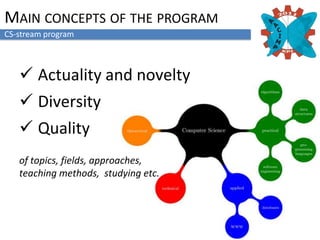
Main concepts of the programAACIMP-2010CS-stream programActuality and novelty
Diversity
Qualityof topics, fields, approaches,teaching methods,  studying etc.
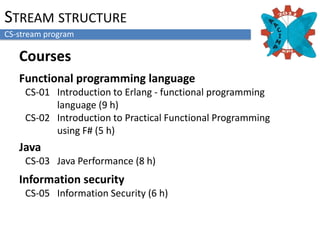
Stream structureCS-stream programCoursesFunctional programming languageCS-01	Introduction to Erlang - functional programming language (9 h)CS-02	Introduction to Practical Functional Programming using F# (5 h)JavaCS-03	Java Performance (8h)Information securityCS-05	Information Security (6 h)
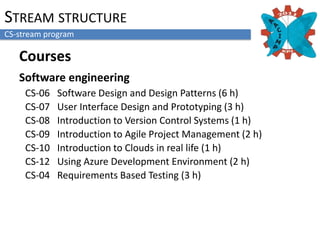
Stream structureCS-stream programCoursesSoftware engineeringCS-06	Software Design and Design Patterns (6 h)CS-07	User Interface Design and Prototyping(3 h)CS-08Introduction to Version Control Systems (1 h)CS-09	Introduction to Agile Project Management (2 h)CS-10	Introduction to Clouds in real life (1 h)CS-12	Using Azure Development Environment (2 h)CS-04	Requirements Based Testing (3 h)
Stream structureCS-stream programLecturesCS-11	Telecommunication Industry Transformation. Challenges and Opportunities (1 h)SGC-09	Numerical computations with infinite andinfinitesimal numbers and the Infinity Computer (2 h)SGC-11	Synchronization of clocks (2 h)SGC-14Siemens online project  “Smart Cities in Ukraine” (1 h)
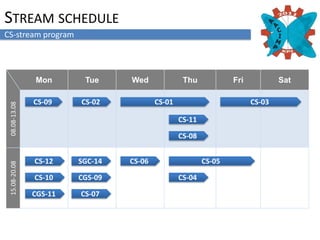
Stream scheduleCS-stream programCS-02CS-09CS-01CS-03CS-11CS-08CS-12CS-06CS-05SGC-14CS-10CGS-09CS-04CGS-11CS-07
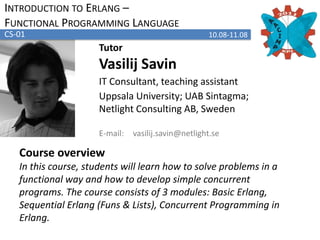
Introduction to Erlang– Functional Programming LanguageCS-0110.08-11.08TutorVasilijSavinIT Consultant, teaching assistant Uppsala University; UAB Sintagma;Netlight Consulting AB, SwedenE-mail: 	 vasilij.savin@netlight.seCourse overviewIn this course, students will learn how to solve problems in a functional way and how to develop simple concurrent programs. The course consists of 3 modules: Basic Erlang, Sequential Erlang (Funs & Lists), Concurrent Programming in Erlang.
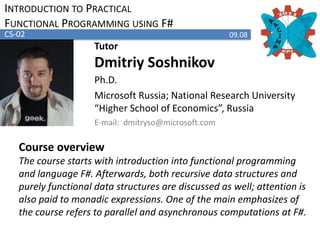
Introduction to Practical Functional Programming using F#CS-0209.08TutorDmitriy SoshnikovPh.D.Microsoft Russia; National Research University “Higher School of Economics”, RussiaE-mail:  dmitryso@microsoft.comCourse overviewThe course starts with introduction into functional programming and language F#. Afterwards, both recursive data structures and purely functional data structures are discussed as well; attention is also paid to monadic expressions. One of the main emphasizes of the course refers to parallel and asynchronous computations at F#.
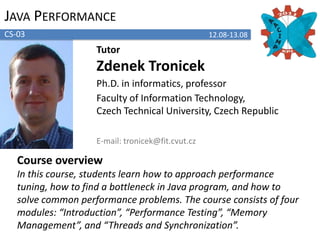
Java PerformanceCS-0312.08-13.08TutorZdenekTronicekPh.D. in informatics, professorFaculty of Information Technology,Czech Technical University, Czech RepublicE-mail:tronicek@fit.cvut.czCourse overviewIn this course, students learn how to approach performance tuning, how to find a bottleneck in Java program, and how to solve common performance problems. The course consists of four modules: “Introduction”, “Performance Testing”, “Memory Management”, and “Threads and Synchronization”.
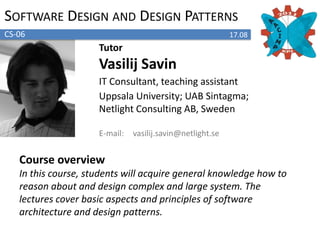
Software Design and Design PatternsCS-0617.08TutorVasilijSavinIT Consultant, teaching assistant Uppsala University; UAB Sintagma;Netlight Consulting AB, SwedenE-mail: 	vasilij.savin@netlight.seCourse overviewIn this course, students will acquire general knowledge how to reason about and design complex and large system. The lectures cover basic aspects and principles of software architecture and design patterns.
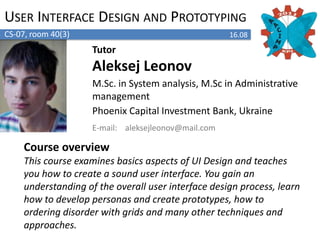
User Interface Design and PrototypingCS-07, room 40(3)16.08TutorAleksejLeonovM.Sc. in System analysis, M.Sc in Administrative managementPhoenix Capital Investment Bank, UkraineE-mail:   aleksejleonov@mail.comCourse overviewThis course examines basics aspects of UI Design and teaches you how to create a sound user interface. You gain an understanding of the overall user interface design process, learn how to develop personas and create prototypes, how to ordering disorder with grids and many other techniques and approaches.  
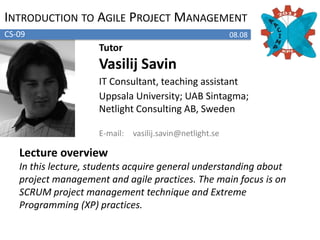
Introduction to Agile Project ManagementCS-0908.08TutorVasilijSavinIT Consultant, teaching assistant Uppsala University; UAB Sintagma;Netlight Consulting AB, SwedenE-mail: 	 vasilij.savin@netlight.seLecture overviewIn this lecture, students acquire general understanding about project management and agile practices. The main focus is on SCRUM project management technique and Extreme Programming (XP) practices.
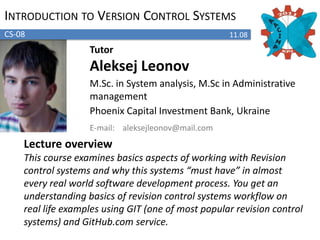
Introduction to Version Control SystemsCS-0811.08TutorAleksejLeonovM.Sc. in System analysis, M.Sc in Administrative managementPhoenix Capital Investment Bank, UkraineE-mail:   aleksejleonov@mail.comLecture overviewThis course examines basics aspects of working with Revision control systems and why this systems “must have” in almost every real world software development process. You get an understanding basics of revision control systems workflow on real life examples using GIT (one of most popular revision control systems) and GitHub.com service. 
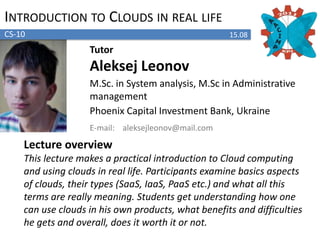
Introduction to Clouds in real lifeCS-1015.08TutorAleksejLeonovM.Sc. in System analysis, M.Sc in Administrative managementPhoenix Capital Investment Bank, UkraineE-mail:   aleksejleonov@mail.comLecture overviewThis lecture makes a practical introduction to Cloud computing and using clouds in real life. Participants examine basics aspects of clouds, their types (SaaS, IaaS, PaaS etc.) and what all this terms are really meaning. Students get understanding how one can use clouds in his own products, what benefits and difficulties he gets and overall, does it worth it or not. 
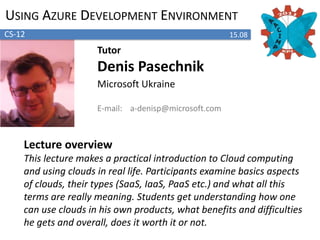
 Using Azure Development EnvironmentCS-1215.08TutorDenis PasechnikMicrosoft UkraineE-mail:   a-denisp@microsoft.comLecture overviewThis lecture makes a practical introduction to Cloud computing and using clouds in real life. Participants examine basics aspects of clouds, their types (SaaS, IaaS, PaaS etc.) and what all this terms are really meaning. Students get understanding how one can use clouds in his own products, what benefits and difficulties he gets and overall, does it worth it or not. 
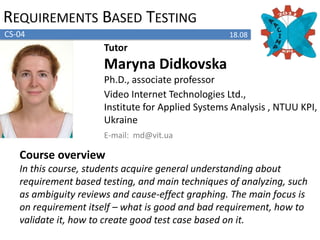
Requirements Based TestingCS-0418.08TutorMarynaDidkovska  Ph.D., associate professorVideo Internet Technologies Ltd., Institute for Applied Systems Analysis , NTUU KPI,UkraineE-mail: md@vit.uaCourse overviewIn this course, students acquire general understanding about requirement based testing, and main techniques of analyzing, such as ambiguity reviews and cause-effect graphing. The main focus is on requirement itself – what is good and bad requirement, how to validate it, how to create good test case based on it.
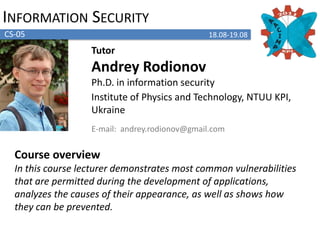
Information SecurityCS-0518.08-19.08TutorAndreyRodionovPh.D. in information securityInstitute of Physics and Technology, NTUU KPI, Ukraine E-mail:andrey.rodionov@gmail.com Course overviewIn this course lecturer demonstrates most common vulnerabilities that are permitted during the development of applications, analyzes the causes of their appearance, as well as shows how they can be prevented.
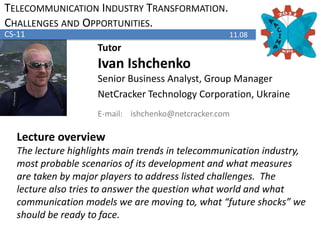
Telecommunication Industry Transformation. Challenges and Opportunities.CS-1111.08TutorIvan IshchenkoSenior Business Analyst, Group Manager NetCracker Technology Corporation, UkraineE-mail:   ishchenko@netcracker.comLecture overviewThe lecture highlights main trends in telecommunication industry, most probable scenarios of its development and what measures are taken by major players to address listed challenges.  The lecture also tries to answer the question what world and what communication models we are moving to, what “future shocks” we should be ready to face.
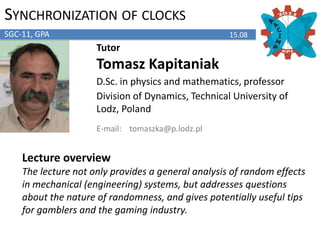
Synchronization of clocksSGC-11, GPA15.08TutorTomasz KapitaniakD.Sc. in physics and mathematics, professorDivision of Dynamics, Technical University of Lodz, PolandE-mail:   tomaszka@p.lodz.pl Lecture overviewThe lecture not only provides a general analysis of random effects in mechanical (engineering) systems, but addresses questions about the nature of randomness, and gives potentially useful tips for gamblers and the gaming industry.
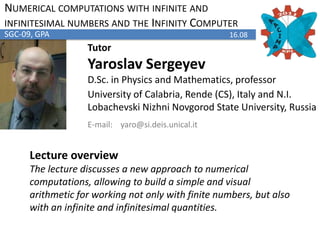
Numerical computations with infinite and infinitesimal numbers and the Infinity ComputerSGC-09, GPA16.08TutorYaroslav SergeyevD.Sc.in Physics and Mathematics, professorUniversity of Calabria, Rende (CS), Italy and N.I. Lobachevski Nizhni Novgorod State University, RussiaE-mail:   yaro@si.deis.unical.it Lecture overviewThe lecture discusses a new approach to numerical computations, allowing to build a simple and visual arithmetic for working not only with finite numbers, but also with an infinite and infinitesimal quantities.
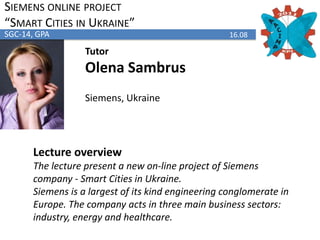
Siemens online project  “Smart Cities in Ukraine”SGC-14, GPA16.08TutorOlenaSambrusSiemens, UkraineLecture overviewThe lecture present a new on-line project of Siemens company - Smart Cities in Ukraine. Siemens is a largest of its kind engineering conglomerate in Europe. The company acts in three main business sectors: industry, energy and healthcare.
Organizational issues
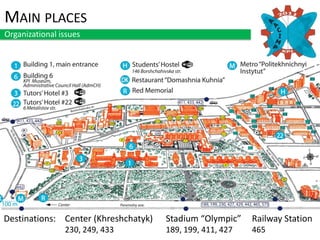
Main placesAACIMPOrganizational issuesCenter (Khreshchatyk)230, 249, 433Stadium “Olympic”189, 199, 411, 427Railway Station465Destinations:
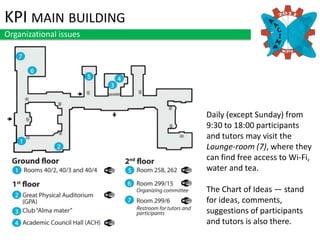
KPI main buildingAACIMPOrganizational issuesDaily (except Sunday) from 9:30 to 18:00 participants and tutors may visit the Lounge-room (7), where they can find free access to Wi-Fi, water and tea. The Chart of Ideas — stand for ideas, comments, suggestions of participants and tutors is also there.
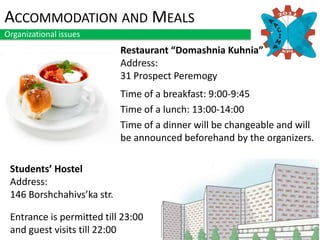
Accommodation and MealsAACIMPOrganizational issuesRestaurant “DomashniaKuhnia” Address:31 Prospect PeremogyTime of a breakfast: 9:00-9:45Time of a lunch: 13:00-14:00Time of a dinner will be changeable and will be announced beforehand by the organizers.Guidelines for participants:Participants, who live in hostels, have to follow rules of the campus (entrance is permitted till 23:00 and guest visits till 22:00).
Time of a dinner will be changeable and will be announced beforehand by the organizers.
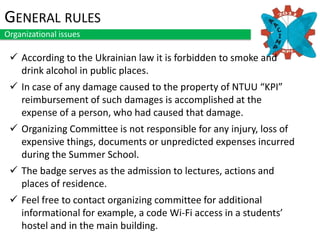
The badge serves as the admission to lectures, actions and places of residence.

AACIMP 2011 Computer Science

  • 1.
    VI Summer School“Achievementsand Applicationsof Contemporary Informatics, Mathematics and Physics”(AACIMP-2011)Introductory lectures in CS-streamAugust 8, 2011Kyiv, Ukraine
  • 2.
    General pointsAACIMPCS-streamRoom: 258, build. #1Hours in stream:47 hCode in bookletCS-xxLecture duration50 minBreak duration10 min
  • 3.
    Computer ScienceAACIMPCS-streamThe stream“Computer Science” introduces participants contemporary programming technologies, modern techniques and methodologies concerning the whole cycle of software development, project management tools and approaches for working at IT-projects, latest researches, held by strong specialists in this area.
  • 4.
  • 5.
    Main concepts ofthe programAACIMP-2010CS-stream programActuality and novelty
  • 6.
  • 7.
    Qualityof topics, fields,approaches,teaching methods, studying etc.
  • 8.
    Stream structureCS-stream programCoursesFunctionalprogramming languageCS-01 Introduction to Erlang - functional programming language (9 h)CS-02 Introduction to Practical Functional Programming using F# (5 h)JavaCS-03 Java Performance (8h)Information securityCS-05 Information Security (6 h)
  • 9.
    Stream structureCS-stream programCoursesSoftwareengineeringCS-06 Software Design and Design Patterns (6 h)CS-07 User Interface Design and Prototyping(3 h)CS-08Introduction to Version Control Systems (1 h)CS-09 Introduction to Agile Project Management (2 h)CS-10 Introduction to Clouds in real life (1 h)CS-12 Using Azure Development Environment (2 h)CS-04 Requirements Based Testing (3 h)
  • 10.
    Stream structureCS-stream programLecturesCS-11 TelecommunicationIndustry Transformation. Challenges and Opportunities (1 h)SGC-09 Numerical computations with infinite andinfinitesimal numbers and the Infinity Computer (2 h)SGC-11 Synchronization of clocks (2 h)SGC-14Siemens online project “Smart Cities in Ukraine” (1 h)
  • 11.
  • 12.
    Introduction to Erlang–Functional Programming LanguageCS-0110.08-11.08TutorVasilijSavinIT Consultant, teaching assistant Uppsala University; UAB Sintagma;Netlight Consulting AB, SwedenE-mail: vasilij.savin@netlight.seCourse overviewIn this course, students will learn how to solve problems in a functional way and how to develop simple concurrent programs. The course consists of 3 modules: Basic Erlang, Sequential Erlang (Funs & Lists), Concurrent Programming in Erlang.
  • 13.
    Introduction to PracticalFunctional Programming using F#CS-0209.08TutorDmitriy SoshnikovPh.D.Microsoft Russia; National Research University “Higher School of Economics”, RussiaE-mail: dmitryso@microsoft.comCourse overviewThe course starts with introduction into functional programming and language F#. Afterwards, both recursive data structures and purely functional data structures are discussed as well; attention is also paid to monadic expressions. One of the main emphasizes of the course refers to parallel and asynchronous computations at F#.
  • 14.
    Java PerformanceCS-0312.08-13.08TutorZdenekTronicekPh.D. ininformatics, professorFaculty of Information Technology,Czech Technical University, Czech RepublicE-mail:tronicek@fit.cvut.czCourse overviewIn this course, students learn how to approach performance tuning, how to find a bottleneck in Java program, and how to solve common performance problems. The course consists of four modules: “Introduction”, “Performance Testing”, “Memory Management”, and “Threads and Synchronization”.
  • 15.
    Software Design andDesign PatternsCS-0617.08TutorVasilijSavinIT Consultant, teaching assistant Uppsala University; UAB Sintagma;Netlight Consulting AB, SwedenE-mail: vasilij.savin@netlight.seCourse overviewIn this course, students will acquire general knowledge how to reason about and design complex and large system. The lectures cover basic aspects and principles of software architecture and design patterns.
  • 16.
    User Interface Designand PrototypingCS-07, room 40(3)16.08TutorAleksejLeonovM.Sc. in System analysis, M.Sc in Administrative managementPhoenix Capital Investment Bank, UkraineE-mail:   aleksejleonov@mail.comCourse overviewThis course examines basics aspects of UI Design and teaches you how to create a sound user interface. You gain an understanding of the overall user interface design process, learn how to develop personas and create prototypes, how to ordering disorder with grids and many other techniques and approaches.  
  • 17.
    Introduction to AgileProject ManagementCS-0908.08TutorVasilijSavinIT Consultant, teaching assistant Uppsala University; UAB Sintagma;Netlight Consulting AB, SwedenE-mail: vasilij.savin@netlight.seLecture overviewIn this lecture, students acquire general understanding about project management and agile practices. The main focus is on SCRUM project management technique and Extreme Programming (XP) practices.
  • 18.
    Introduction to VersionControl SystemsCS-0811.08TutorAleksejLeonovM.Sc. in System analysis, M.Sc in Administrative managementPhoenix Capital Investment Bank, UkraineE-mail:   aleksejleonov@mail.comLecture overviewThis course examines basics aspects of working with Revision control systems and why this systems “must have” in almost every real world software development process. You get an understanding basics of revision control systems workflow on real life examples using GIT (one of most popular revision control systems) and GitHub.com service. 
  • 19.
    Introduction to Cloudsin real lifeCS-1015.08TutorAleksejLeonovM.Sc. in System analysis, M.Sc in Administrative managementPhoenix Capital Investment Bank, UkraineE-mail:   aleksejleonov@mail.comLecture overviewThis lecture makes a practical introduction to Cloud computing and using clouds in real life. Participants examine basics aspects of clouds, their types (SaaS, IaaS, PaaS etc.) and what all this terms are really meaning. Students get understanding how one can use clouds in his own products, what benefits and difficulties he gets and overall, does it worth it or not. 
  • 20.
    Using AzureDevelopment EnvironmentCS-1215.08TutorDenis PasechnikMicrosoft UkraineE-mail:   a-denisp@microsoft.comLecture overviewThis lecture makes a practical introduction to Cloud computing and using clouds in real life. Participants examine basics aspects of clouds, their types (SaaS, IaaS, PaaS etc.) and what all this terms are really meaning. Students get understanding how one can use clouds in his own products, what benefits and difficulties he gets and overall, does it worth it or not. 
  • 21.
    Requirements Based TestingCS-0418.08TutorMarynaDidkovska Ph.D., associate professorVideo Internet Technologies Ltd., Institute for Applied Systems Analysis , NTUU KPI,UkraineE-mail: md@vit.uaCourse overviewIn this course, students acquire general understanding about requirement based testing, and main techniques of analyzing, such as ambiguity reviews and cause-effect graphing. The main focus is on requirement itself – what is good and bad requirement, how to validate it, how to create good test case based on it.
  • 22.
    Information SecurityCS-0518.08-19.08TutorAndreyRodionovPh.D. in informationsecurityInstitute of Physics and Technology, NTUU KPI, Ukraine E-mail:andrey.rodionov@gmail.com Course overviewIn this course lecturer demonstrates most common vulnerabilities that are permitted during the development of applications, analyzes the causes of their appearance, as well as shows how they can be prevented.
  • 23.
    Telecommunication Industry Transformation.Challenges and Opportunities.CS-1111.08TutorIvan IshchenkoSenior Business Analyst, Group Manager NetCracker Technology Corporation, UkraineE-mail:   ishchenko@netcracker.comLecture overviewThe lecture highlights main trends in telecommunication industry, most probable scenarios of its development and what measures are taken by major players to address listed challenges. The lecture also tries to answer the question what world and what communication models we are moving to, what “future shocks” we should be ready to face.
  • 24.
    Synchronization of clocksSGC-11,GPA15.08TutorTomasz KapitaniakD.Sc. in physics and mathematics, professorDivision of Dynamics, Technical University of Lodz, PolandE-mail:   tomaszka@p.lodz.pl Lecture overviewThe lecture not only provides a general analysis of random effects in mechanical (engineering) systems, but addresses questions about the nature of randomness, and gives potentially useful tips for gamblers and the gaming industry.
  • 25.
    Numerical computations withinfinite and infinitesimal numbers and the Infinity ComputerSGC-09, GPA16.08TutorYaroslav SergeyevD.Sc.in Physics and Mathematics, professorUniversity of Calabria, Rende (CS), Italy and N.I. Lobachevski Nizhni Novgorod State University, RussiaE-mail:   yaro@si.deis.unical.it Lecture overviewThe lecture discusses a new approach to numerical computations, allowing to build a simple and visual arithmetic for working not only with finite numbers, but also with an infinite and infinitesimal quantities.
  • 26.
    Siemens online project “Smart Cities in Ukraine”SGC-14, GPA16.08TutorOlenaSambrusSiemens, UkraineLecture overviewThe lecture present a new on-line project of Siemens company - Smart Cities in Ukraine. Siemens is a largest of its kind engineering conglomerate in Europe. The company acts in three main business sectors: industry, energy and healthcare.
  • 27.
  • 28.
    Main placesAACIMPOrganizational issuesCenter(Khreshchatyk)230, 249, 433Stadium “Olympic”189, 199, 411, 427Railway Station465Destinations:
  • 29.
    KPI main buildingAACIMPOrganizationalissuesDaily (except Sunday) from 9:30 to 18:00 participants and tutors may visit the Lounge-room (7), where they can find free access to Wi-Fi, water and tea. The Chart of Ideas — stand for ideas, comments, suggestions of participants and tutors is also there.
  • 30.
    Accommodation and MealsAACIMPOrganizationalissuesRestaurant “DomashniaKuhnia” Address:31 Prospect PeremogyTime of a breakfast: 9:00-9:45Time of a lunch: 13:00-14:00Time of a dinner will be changeable and will be announced beforehand by the organizers.Guidelines for participants:Participants, who live in hostels, have to follow rules of the campus (entrance is permitted till 23:00 and guest visits till 22:00).
  • 31.
    Time of adinner will be changeable and will be announced beforehand by the organizers.
  • 32.
    The badge servesas the admission to lectures, actions and places of residence.