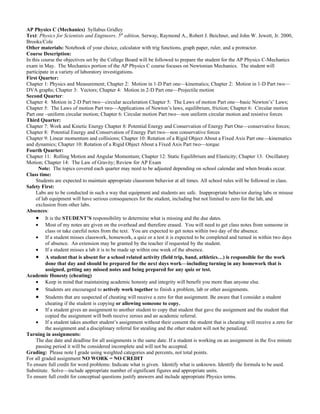
AP Physics C (Mechanics) Syllabus Gridley
Text: Physics for Scientists and Engineers. 5th edition, Serway, Raymond A., Robert J. Beichner, and John W. Jewett, Jr. 2000,
Brooks/Cole
Other materials: Notebook of your choice, calculator with trig functions, graph paper, ruler, and a protractor.
Course Description:
In this course the objectives set by the College Board will be followed to prepare the student for the AP Physics C-Mechanics
exam in May. The Mechanics portion of the AP Physics C course focuses on Newtonian Mechanics. The student will
participate in a variety of laboratory investigations.
First Quarter:
Chapter 1: Physics and Measurement; Chapter 2: Motion in 1-D Part one—kinematics; Chapter 2: Motion in 1-D Part two—
DVA graphs; Chapter 3: Vectors; Chapter 4: Motion in 2-D Part one—Projectile motion
Second Quarter:
Chapter 4: Motion in 2-D Part two—circular acceleration Chapter 5: The Laws of motion Part one—basic Newton’s’ Laws;
Chapter 5: The Laws of motion Part two—Applications of Newton’s laws, equilibrium, friction; Chapter 6: Circular motion
Part one –uniform circular motion; Chapter 6: Circular motion Part two—non uniform circular motion and resistive forces
Third Quarter:
Chapter 7: Work and Kinetic Energy Chapter 8: Potential Energy and Conservation of Energy Part One—conservative forces;
Chapter 8: Potential Energy and Conservation of Energy Part two—non conservative forces
Chapter 9: Linear momentum and collisions; Chapter 10: Rotation of a Rigid Object About a Fixed Axis Part one—kinematics
and dynamics; Chapter 10: Rotation of a Rigid Object About a Fixed Axis Part two—torque
Fourth Quarter:
Chapter 11: Rolling Motion and Angular Momentum; Chapter 12: Static Equilibrium and Elasticity; Chapter 13: Oscillatory
Motion; Chapter 14: The Law of Gravity; Review for AP Exam
      Note: The topics covered each quarter may need to be adjusted depending on school calendar and when breaks occur.
Class time:
     Students are expected to maintain appropriate classroom behavior at all times. All school rules will be followed in class.
Safety First:
     Labs are to be conducted in such a way that equipment and students are safe. Inappropriate behavior during labs or misuse
     of lab equipment will have serious consequences for the student, including but not limited to zero for the lab, and
     exclusion from other labs.
Absences:
     • It is the STUDENT’S responsibility to determine what is missing and the due dates.
     • Most of my notes are given on the overhead and therefore erased. You will need to get class notes from someone in
          class or take careful notes from the text. You are expected to get notes within two day of the absence.
     • If a student misses classwork, homework, a quiz or a test it is expected to be completed and turned in within two days
          of absence. An extension may be granted by the teacher if requested by the student.
     • If a student misses a lab it is to be made up within one week of the absence.
     • A student that is absent for a school related activity (field trip, band, athletics…) is responsible for the work
          done that day and should be prepared for the next days work—including turning in any homework that is
          assigned, getting any missed notes and being prepared for any quiz or test.
Academic Honesty (cheating)
     • Keep in mind that maintaining academic honesty and integrity will benefit you more than anyone else.
     • Students are encouraged to actively work together to finish a problem, lab or other assignments.
     • Students that are suspected of cheating will receive a zero for that assignment. Be aware that I consider a student
          cheating if the student is copying or allowing someone to copy.
     • If a student gives an assignment to another student to copy that student that gave the assignment and the student that
          copied the assignment will both receive zeroes and an academic referral.
     • If a student takes another student’s assignment without their consent the student that is cheating will receive a zero for
          the assignment and a disciplinary referral for stealing and the other student will not be penalized.
Turning in assignments:
     The due date and deadline for all assignments is the same date. If a student is working on an assignment in the five minute
     passing period it will be considered incomplete and will not be accepted.
Grading: Please note I grade using weighted categories and percents, not total points.
For all graded assignment NO WORK = NO CREDIT
To ensure full credit for word problems: Indicate what is given. Identify what is unknown. Identify the formula to be used.
Substitute. Solve—include appropriate number of significant figures and appropriate units.
To ensure full credit for conceptual questions justify answers and include appropriate Physics terms.
See additional handout regarding arriving at student grade

Policy apc 2010 2011

  • 1.
    AP Physics C(Mechanics) Syllabus Gridley Text: Physics for Scientists and Engineers. 5th edition, Serway, Raymond A., Robert J. Beichner, and John W. Jewett, Jr. 2000, Brooks/Cole Other materials: Notebook of your choice, calculator with trig functions, graph paper, ruler, and a protractor. Course Description: In this course the objectives set by the College Board will be followed to prepare the student for the AP Physics C-Mechanics exam in May. The Mechanics portion of the AP Physics C course focuses on Newtonian Mechanics. The student will participate in a variety of laboratory investigations. First Quarter: Chapter 1: Physics and Measurement; Chapter 2: Motion in 1-D Part one—kinematics; Chapter 2: Motion in 1-D Part two— DVA graphs; Chapter 3: Vectors; Chapter 4: Motion in 2-D Part one—Projectile motion Second Quarter: Chapter 4: Motion in 2-D Part two—circular acceleration Chapter 5: The Laws of motion Part one—basic Newton’s’ Laws; Chapter 5: The Laws of motion Part two—Applications of Newton’s laws, equilibrium, friction; Chapter 6: Circular motion Part one –uniform circular motion; Chapter 6: Circular motion Part two—non uniform circular motion and resistive forces Third Quarter: Chapter 7: Work and Kinetic Energy Chapter 8: Potential Energy and Conservation of Energy Part One—conservative forces; Chapter 8: Potential Energy and Conservation of Energy Part two—non conservative forces Chapter 9: Linear momentum and collisions; Chapter 10: Rotation of a Rigid Object About a Fixed Axis Part one—kinematics and dynamics; Chapter 10: Rotation of a Rigid Object About a Fixed Axis Part two—torque Fourth Quarter: Chapter 11: Rolling Motion and Angular Momentum; Chapter 12: Static Equilibrium and Elasticity; Chapter 13: Oscillatory Motion; Chapter 14: The Law of Gravity; Review for AP Exam Note: The topics covered each quarter may need to be adjusted depending on school calendar and when breaks occur. Class time: Students are expected to maintain appropriate classroom behavior at all times. All school rules will be followed in class. Safety First: Labs are to be conducted in such a way that equipment and students are safe. Inappropriate behavior during labs or misuse of lab equipment will have serious consequences for the student, including but not limited to zero for the lab, and exclusion from other labs. Absences: • It is the STUDENT’S responsibility to determine what is missing and the due dates. • Most of my notes are given on the overhead and therefore erased. You will need to get class notes from someone in class or take careful notes from the text. You are expected to get notes within two day of the absence. • If a student misses classwork, homework, a quiz or a test it is expected to be completed and turned in within two days of absence. An extension may be granted by the teacher if requested by the student. • If a student misses a lab it is to be made up within one week of the absence. • A student that is absent for a school related activity (field trip, band, athletics…) is responsible for the work done that day and should be prepared for the next days work—including turning in any homework that is assigned, getting any missed notes and being prepared for any quiz or test. Academic Honesty (cheating) • Keep in mind that maintaining academic honesty and integrity will benefit you more than anyone else. • Students are encouraged to actively work together to finish a problem, lab or other assignments. • Students that are suspected of cheating will receive a zero for that assignment. Be aware that I consider a student cheating if the student is copying or allowing someone to copy. • If a student gives an assignment to another student to copy that student that gave the assignment and the student that copied the assignment will both receive zeroes and an academic referral. • If a student takes another student’s assignment without their consent the student that is cheating will receive a zero for the assignment and a disciplinary referral for stealing and the other student will not be penalized. Turning in assignments: The due date and deadline for all assignments is the same date. If a student is working on an assignment in the five minute passing period it will be considered incomplete and will not be accepted. Grading: Please note I grade using weighted categories and percents, not total points. For all graded assignment NO WORK = NO CREDIT To ensure full credit for word problems: Indicate what is given. Identify what is unknown. Identify the formula to be used. Substitute. Solve—include appropriate number of significant figures and appropriate units. To ensure full credit for conceptual questions justify answers and include appropriate Physics terms.
  • 2.
    See additional handoutregarding arriving at student grade