Team / insight.

A World
First in Liver
Transplantation
Make this article come to life on your
smartphone or tablet, by downloading
the Team AR app. Hover over the image
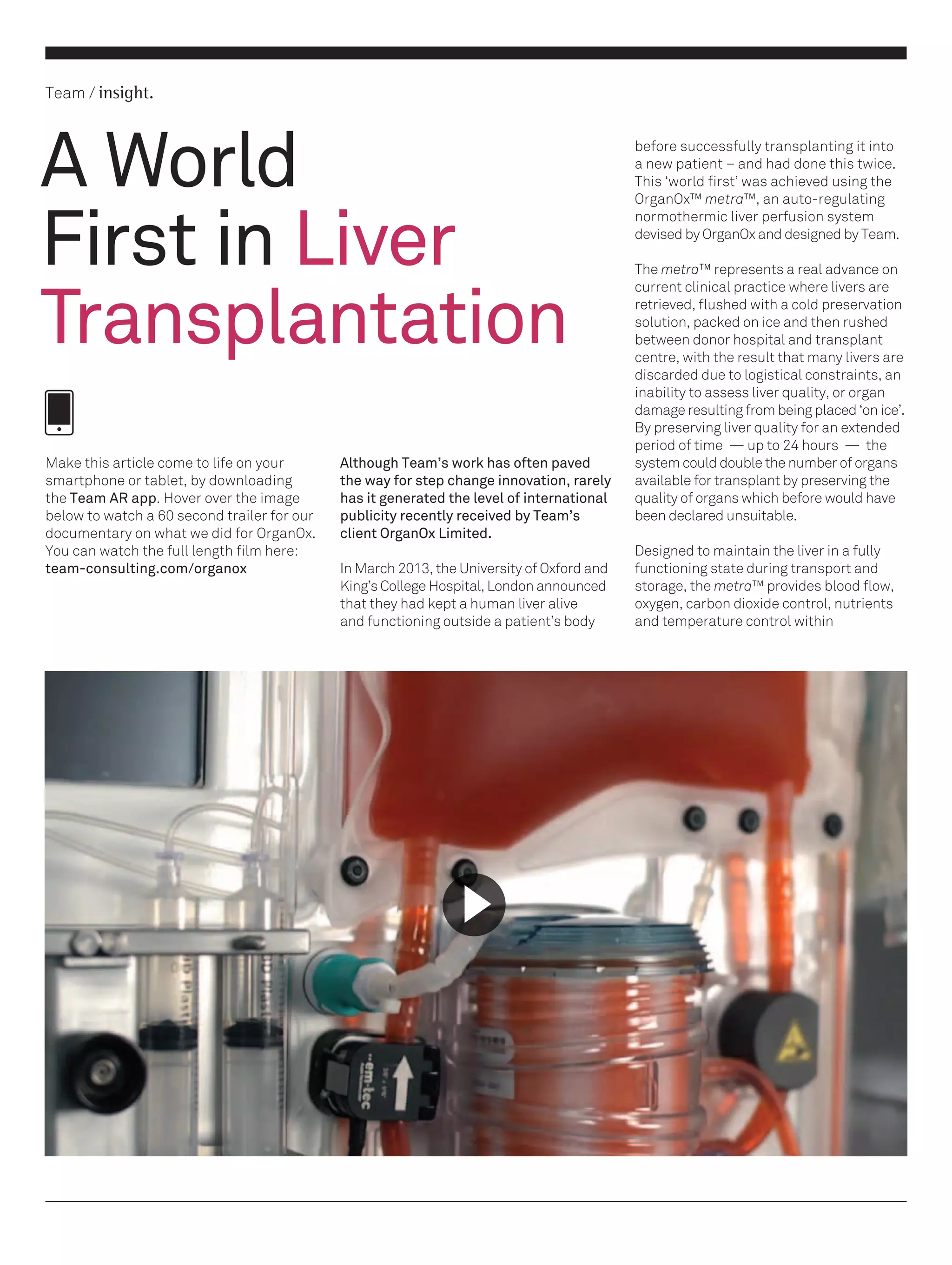
below to watch a 60 second trailer for our
documentary on what we did for OrganOx.
You can watch the full length film here:
team-consulting.com/organox

Although Team’s work has often paved
the way for step change innovation, rarely
has it generated the level of international
publicity recently received by Team’s
client OrganOx Limited.
In March 2013, the University of Oxford and
King’s College Hospital, London announced
that they had kept a human liver alive
and functioning outside a patient’s body

before successfully transplanting it into
a new patient – and had done this twice.
This ‘world first’ was achieved using the
OrganOx™ metra™, an auto-regulating
normothermic liver perfusion system
devised by OrganOx and designed by Team.
The metra™ represents a real advance on
current clinical practice where livers are
retrieved, flushed with a cold preservation
solution, packed on ice and then rushed
between donor hospital and transplant
centre, with the result that many livers are
discarded due to logistical constraints, an
inability to assess liver quality, or organ
damage resulting from being placed ‘on ice’.
By preserving liver quality for an extended
period of time — up to 24 hours — the
system could double the number of organs
available for transplant by preserving the
quality of organs which before would have
been declared unsuitable.
Designed to maintain the liver in a fully
functioning state during transport and
storage, the metra™ provides blood flow,
oxygen, carbon dioxide control, nutrients
and temperature control within
www.team-consulting.com

24 — 25
‘Our primary focus was to turn the original,
large, manual, clinician-dependent
process into a robust, autonomous system
controlled by embedded multi-tasking
software with a safety-critical architecture
— which meant that if a peripheral system
component failed for any reason then the
core system would continue to function. We
had to create a small system which could
survive road and air transport, a wide variety
of weather conditions as it was moved
around, and also — of great importance ­­
— a system which was quick and easy to
set up and use, despite its complexity and
sophistication.’

physiological parameters, while also
monitoring factors such as bile production.
By mimicking the body, the system can
potentially store the liver for up to 24 hours
while providing real-time and cumulative
data which the surgeon can use to assess
liver function and viability, something which
has never been possible before.
The development process began in 2009
when OrganOx, a University of Oxford spinout, appointed Team to assist in the design
and development of the system in order to
move from proof of concept to commercial
manufacture. ‘When first set up, OrganOx
was a very small company, closely linked to
the University, and it needed system design
and development capability in order to
take its invention ‘from bench to bedside’,’
explains Stuart Kay, Team’s Head of
Electro-Mechanical Engineering.

‘These first
clinical cases
confirm that we
can support human
livers outside
the body’

Team supported OrganOx throughout the
core design and development phases until
verification testing activities had been
completed. While the complete process
took four years between the original
meeting and MHRA approval to conduct
clinical trials, Team delivered the first fully
autonomous proof of principle system in
just nine months, which helped OrganOx
secure further funding. The first transplant
took place as part of a controlled clinical
study at King’s College Hospital in
London, home to Europe’s largest liver
transplant centre which carries out over
200 transplants every year. It is hoped that
the device could be useful for all patients
needing liver transplants, and Professor
Constantin Coussios, OrganOx Technical
Director and one of the system’s original
inventors, is delighted:
‘These first clinical cases confirm that we
can support human livers outside the body,
keep them alive and functioning on our
machine and then, hours later, successfully
transplant them into a patient. The system
is the very first completely automated liver
perfusion device of its kind; the organ is
perfused with oxygenated red blood cells at
normal body temperature, just as it would
be inside the body and can, for example,
be observed making bile which makes it
an extraordinary feat of engineering. It was
astonishing to see an initially cold grey liver
flushing with colour once hooked up to our
machine and performing as it would within
the body. What was even more amazing was
to see the same liver transplanted into a
patient who is now walking around.’
Mr Wayel Jassem, Consultant Liver
Transplant Surgeon who performed both

transplant operations, was also impressed:
‘There is always huge pressure to get a
donated liver to the right person within
a very short space of time. For the first
time, we now have a device that is
designed specifically to give us extra
time to test the liver, to help maximise
the chances of the recipient having a
successful outcome. This technology has
the potential to be hugely significant, and
could make sure livers are available for
transplant and, in turn, save lives.’
Team’s Stuart Kay explained that the
system could also provide a platform
for future development. ‘We have
designed a safety-critical system which
is robust, reliable and simple to use,
and which meets some very demanding
requirements. A system of this type had
never been attempted before, and is a
testament to our design and engineering
capabilities and to the dedication of the
whole project team.’

Ian Christie (62) was the first person to
receive a transplanted liver kept alive by
the OrganOx™ metra™ system as part of
a controlled clinical study:
‘In May 2012, I was told I had cirrhosis of
the liver and without a transplant I had
an estimated 12-18 months to live. I was
placed on the waiting list but I was told
there was about 12-18 months to wait for
a liver of my type. I was very worried it was
cutting it a bit too fine and I wouldn’t get a
transplant. The waiting is horrible … You’re
waiting for the phone to ring, wondering:
Are they ever going to call me?’
‘I took part in the trial because if the device
can help more people in my situation in
the future, it’s my duty to help. I feel better
than I’ve felt for 10-15 years, even allowing
for the pain and wound that’s got to heal. I’m
getting better day by day. I just feel so alive!’

A world first in liver transplantation | Insight, issue 4

  • 1.
    Team / insight. AWorld First in Liver Transplantation Make this article come to life on your smartphone or tablet, by downloading the Team AR app. Hover over the image below to watch a 60 second trailer for our documentary on what we did for OrganOx. You can watch the full length film here: team-consulting.com/organox Although Team’s work has often paved the way for step change innovation, rarely has it generated the level of international publicity recently received by Team’s client OrganOx Limited. In March 2013, the University of Oxford and King’s College Hospital, London announced that they had kept a human liver alive and functioning outside a patient’s body before successfully transplanting it into a new patient – and had done this twice. This ‘world first’ was achieved using the OrganOx™ metra™, an auto-regulating normothermic liver perfusion system devised by OrganOx and designed by Team. The metra™ represents a real advance on current clinical practice where livers are retrieved, flushed with a cold preservation solution, packed on ice and then rushed between donor hospital and transplant centre, with the result that many livers are discarded due to logistical constraints, an inability to assess liver quality, or organ damage resulting from being placed ‘on ice’. By preserving liver quality for an extended period of time — up to 24 hours — the system could double the number of organs available for transplant by preserving the quality of organs which before would have been declared unsuitable. Designed to maintain the liver in a fully functioning state during transport and storage, the metra™ provides blood flow, oxygen, carbon dioxide control, nutrients and temperature control within
  • 2.
    www.team-consulting.com 24 — 25 ‘Ourprimary focus was to turn the original, large, manual, clinician-dependent process into a robust, autonomous system controlled by embedded multi-tasking software with a safety-critical architecture — which meant that if a peripheral system component failed for any reason then the core system would continue to function. We had to create a small system which could survive road and air transport, a wide variety of weather conditions as it was moved around, and also — of great importance ­­ — a system which was quick and easy to set up and use, despite its complexity and sophistication.’ physiological parameters, while also monitoring factors such as bile production. By mimicking the body, the system can potentially store the liver for up to 24 hours while providing real-time and cumulative data which the surgeon can use to assess liver function and viability, something which has never been possible before. The development process began in 2009 when OrganOx, a University of Oxford spinout, appointed Team to assist in the design and development of the system in order to move from proof of concept to commercial manufacture. ‘When first set up, OrganOx was a very small company, closely linked to the University, and it needed system design and development capability in order to take its invention ‘from bench to bedside’,’ explains Stuart Kay, Team’s Head of Electro-Mechanical Engineering. ‘These first clinical cases confirm that we can support human livers outside the body’ Team supported OrganOx throughout the core design and development phases until verification testing activities had been completed. While the complete process took four years between the original meeting and MHRA approval to conduct clinical trials, Team delivered the first fully autonomous proof of principle system in just nine months, which helped OrganOx secure further funding. The first transplant took place as part of a controlled clinical study at King’s College Hospital in London, home to Europe’s largest liver transplant centre which carries out over 200 transplants every year. It is hoped that the device could be useful for all patients needing liver transplants, and Professor Constantin Coussios, OrganOx Technical Director and one of the system’s original inventors, is delighted: ‘These first clinical cases confirm that we can support human livers outside the body, keep them alive and functioning on our machine and then, hours later, successfully transplant them into a patient. The system is the very first completely automated liver perfusion device of its kind; the organ is perfused with oxygenated red blood cells at normal body temperature, just as it would be inside the body and can, for example, be observed making bile which makes it an extraordinary feat of engineering. It was astonishing to see an initially cold grey liver flushing with colour once hooked up to our machine and performing as it would within the body. What was even more amazing was to see the same liver transplanted into a patient who is now walking around.’ Mr Wayel Jassem, Consultant Liver Transplant Surgeon who performed both transplant operations, was also impressed: ‘There is always huge pressure to get a donated liver to the right person within a very short space of time. For the first time, we now have a device that is designed specifically to give us extra time to test the liver, to help maximise the chances of the recipient having a successful outcome. This technology has the potential to be hugely significant, and could make sure livers are available for transplant and, in turn, save lives.’ Team’s Stuart Kay explained that the system could also provide a platform for future development. ‘We have designed a safety-critical system which is robust, reliable and simple to use, and which meets some very demanding requirements. A system of this type had never been attempted before, and is a testament to our design and engineering capabilities and to the dedication of the whole project team.’ Ian Christie (62) was the first person to receive a transplanted liver kept alive by the OrganOx™ metra™ system as part of a controlled clinical study: ‘In May 2012, I was told I had cirrhosis of the liver and without a transplant I had an estimated 12-18 months to live. I was placed on the waiting list but I was told there was about 12-18 months to wait for a liver of my type. I was very worried it was cutting it a bit too fine and I wouldn’t get a transplant. The waiting is horrible … You’re waiting for the phone to ring, wondering: Are they ever going to call me?’ ‘I took part in the trial because if the device can help more people in my situation in the future, it’s my duty to help. I feel better than I’ve felt for 10-15 years, even allowing for the pain and wound that’s got to heal. I’m getting better day by day. I just feel so alive!’