









A user-centred view on how to leverage your assetsDr. Harry Brignull, MadgexSimon Devitt, Haymarket
So, what are your assets?
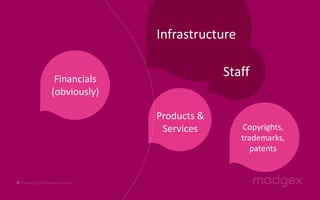
InfrastructureStaffFinancials (obviously)Copyrights, trademarks, patents Products & Services
These are all important, but at the end of the day, they all boil down to one thing.
“This looks good... I’ll use it.”“... And if I like it, I’ll become loyal.”
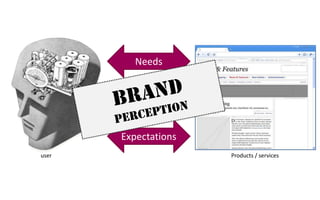
NeedsBrandPERCEPTIONGoalsExpectationsuserProducts / services
YOUR BRAND IS NOT YOUR LOGOIn mergers and acquisitions, companies are sold at many times the value of their books. Why? Because the brand is valuable.And where does the brand exist?
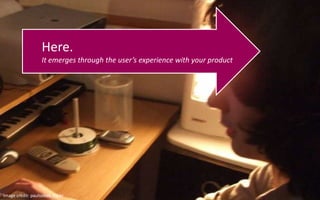
Here.It emerges through the user’s experience with your productImage credit: paulsobek, Flickr
Your users are your biggest assetsIf you understand your users, you know how to move forward.
Case StudyMadgex ‘CV Search & Match’ design process
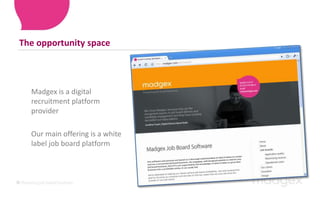
The opportunity spaceMadgex is a digital recruitment platform provider	Our main offering is a white label job board platform
The opportunity spaceJob Boards are all about trying to grab the attention of potential candidates – but nowadays many employers already have their attention. A more efficient approach for those employers is to allow them to take their pick of the appropriate candidates and contact them directly. Targeted  recruitment - not broadcast advertising
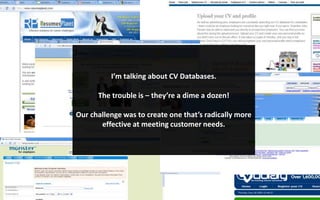
I’m talking about CV Databases.The trouble is – they’re a dime a dozen!Our challenge was to create one that’s radically more effective at meeting customer needs.
 A traditional approach to design: - review your competitors      - mix together their best features     - add your own visual identity
16    Fingers crossed!	“Fingers crossed that when the system finally gets built, it meets our users needs, so it’s popular and we make money!”	That’s not smart – it’s much more effective to start with user needs, and reality check your ideas as they evolve.
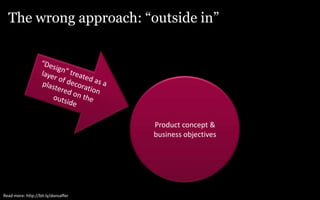
The wrong approach: “outside in”“Design” treated as a layer of decoration plastered on the outsideProduct concept & business objectivesRead more: http://bit.ly/dansaffer
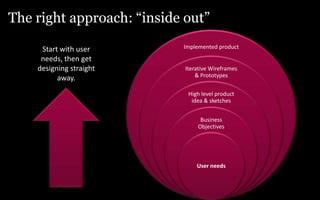
The right approach: “inside out”Start with user needs, then get designing straight away.
The Madgex “inside out” design processIdentify the broad opportunity spaceUnderstand potential userbase Carry out contextual interviewsElicit pain points, stopping points & complaints with status quoAnalyse findings to prioritise and clarify information into design goals
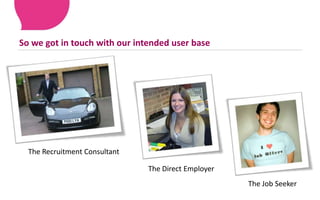
So we got in touch with our intended user baseThe Recruitment ConsultantThe Direct EmployerThe Job Seeker
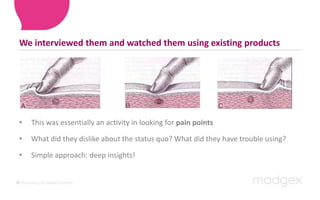
We interviewed them and watched them using existing productsThis was essentially an activity in looking for pain pointsWhat did they dislike about the status quo? What did they have trouble using? Simple approach: deep insights!
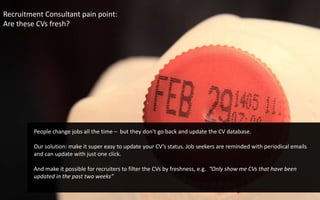
Recruitment Consultant pain point:Are these CVs fresh?People change jobs all the time –  but they don’t go back and update the CV database. Our solution: make it super easy to update your CV’s status. Job seekers are reminded with periodical emails and can update with just one click. And make it possible for recruiters to filter the CVs by freshness, e.g.  “Only show me CVs that have been updated in the past two weeks”
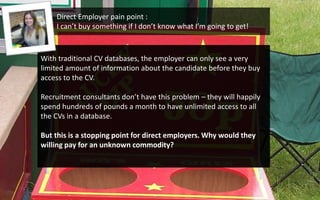
Direct Employer pain point : I can’t buy something if I don’t know what I’m going to get!With traditional CV databases, the employer can only see a very limited amount of information about the candidate before they buy access to the CV. Recruitment consultants don’t have this problem – they will happily spend hundreds of pounds a month to have unlimited access to all the CVs in a database.But this is a stopping point for direct employers. Why would they willing pay for an unknown commodity?
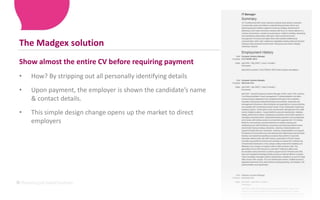
The Madgex solutionShow almost the entire CV before requiring paymentHow? By stripping out all personally identifying detailsUpon payment, the employer is shown the candidate’s name & contact details.This simple design change opens up the market to direct employers
Direct employers: a big revenue opportunityDirect employers account for up to 40% of job postings on some job boardsAs individuals they have low budgets – but there is a very large volume of themThey are currently shut out of current commercial models because of the pricing structure.
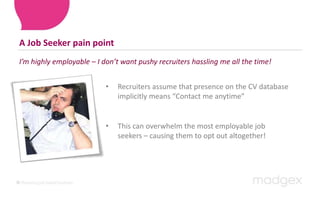
A Job Seeker pain pointI’m highly employable – I don’t want pushy recruiters hassling me all the time!Recruiters assume that presence on the CV database implicitly means “Contact me anytime”
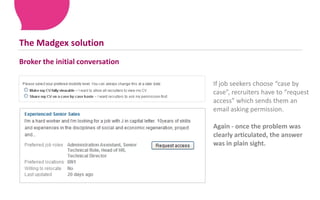
This can overwhelm the most employable job seekers – causing them to opt out altogether!The Madgex solutionBroker the initial conversation If job seekers choose “case by case”, recruiters have to “request access” which sends them an email asking permission.Again - once the problem was clearly articulated, the answer was in plain sight.
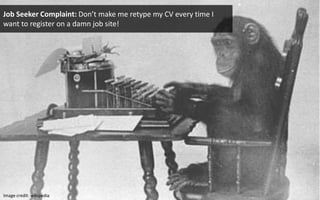
Job Seeker Complaint: Don’t make me retype my CV every time I want to register on a damn job site! Image credit: wikipedia
Our solution: allow import and exportWe allow users to import Word documents – or any page on the web! We allow job seekers to export their CV in various formats and take it elsewhere“Leave the cage door open and the bird will return” – Chinese proverb
Nobody was clamouring for these improvementsThe interviewees were capable of demonstrating the pain points but theyweren’t able to articulate solutionsThey accepted the pain as just “the way things are”The pain points became our list of design challenges.
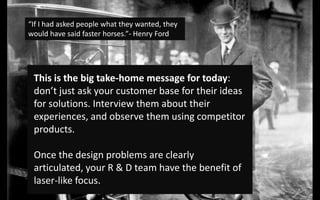
“If I had asked people what they wanted, they would have said faster horses.”- Henry FordThis is the big take-home message for today: don’t just ask your customer base for their ideas for solutions. Interview them about their experiences, and observe them using competitor products. Once the design problems are clearly articulated, your R & D team have the benefit of laser-like focus.
Cordis, a medical device manufacturer, used a very similar process to turn customer input into design. In a three year period, their shares went from to $20 per share to $109Read the Harvard Business Review case study here: http://bit.ly/cordis
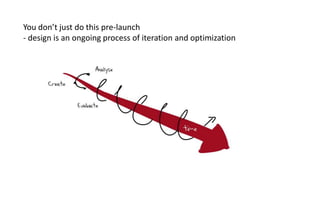
You don’t just do this pre-launch- design is an ongoing process of iteration and optimization
Haymarket case studySimon Devitt Online Publishing Director
Haymarket OverviewHistorically a large proportion of profit has come from recruitment in our weekly magazines. Now a high proportion of our online revenue is coming from the jobsites. We started out using in-house developed jobsites with customised interfaces based on individual publishers opinions of how a good jobsite should work. We also realised that our sites were underperforming because of an inconsistent approach, poor SEO and  poor User ExperienceWe needed to move faster and establish a best of breed suite of functionality. We moved 11 existing jobsites to the Madgex platform and have launched an additional 8 new jobsites since.
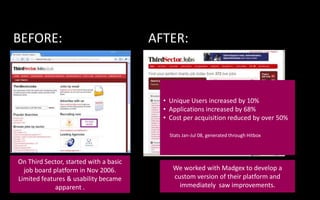
BEFORE:AFTER:  Unique Users increased by 10%
  Applications increased by 68%
  Cost per acquisition reduced by over 50%Stats Jan-Jul 08, generated through HitboxOn Third Sector, started with a basic job board platform in Nov 2006. Limited features & usability became apparent . We worked with Madgex to develop a custom version of their platform and immediately  saw improvements.
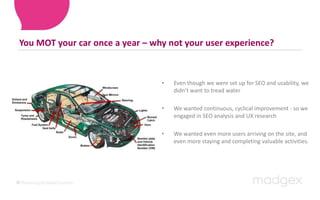
You MOT your car once a year – why not your user experience?Even though we were set up for SEO and usability, we didn’t want to tread waterWe wanted continuous, cyclical improvement - so we engaged in SEO analysis and UX researchWe wanted even more users arriving on the site, and even more staying and completing valuable activities.
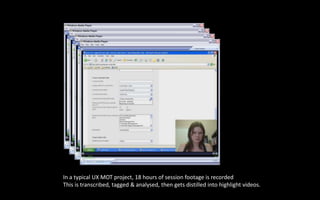
In a typical UX MOT project, 18 hours of session footage is recordedThis is transcribed, tagged & analysed, then gets distilled into highlight videos.
A typical UX study produces 20-30 optimisation opportunitiesHere’s just a couple of them
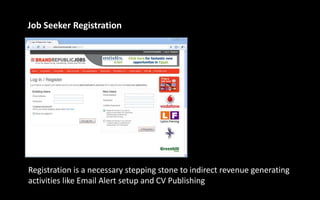
Job Seeker RegistrationRegistration is a necessary stepping stone to indirect revenue generating activities like Email Alert setup and CV Publishing
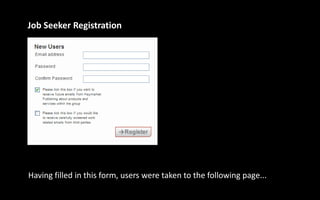
Job Seeker RegistrationHaving filled in this form, users were taken to the following page...
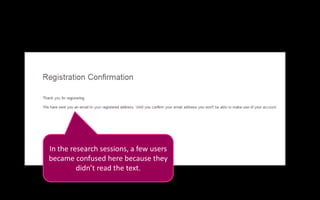
In the research sessions, a few users became confused here because they didn’t read the text.
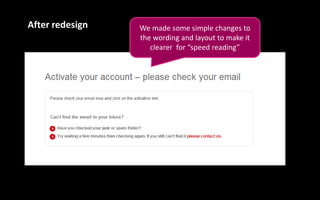
After redesignWe made some simple changes to the wording and layout to make it clearer  for “speed reading”
12% uplift in completed registrationsComparing stats for April, May  & June 2008 to the same months in 2009
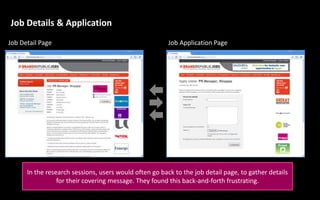
Job Details & ApplicationJob Detail PageJob Application PageIn the research sessions, users would often go back to the job detail page, to gather details for their covering message. They found this back-and-forth frustrating.
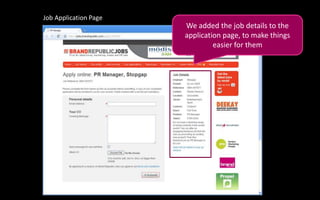
Job Application PageWe added the job details to the application page, to make things easier for them
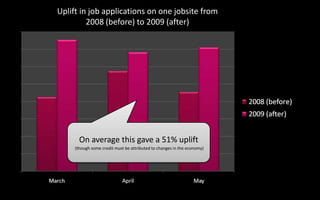
Uplift in job applications on one jobsite from 2008 (before) to 2009 (after)On average this gave a 51% uplift(though some credit must be attributed to changes in the economy)
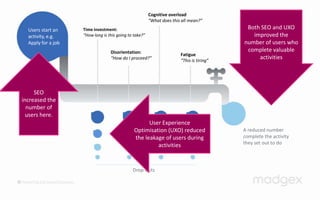
Cognitive overload“What does this all mean?”Both SEO and UXO improved the number of users who complete valuable activitiesTime investment:“How long is this going to take?”Users start an activity, e.g.Apply for a jobDisorientation:“How do I proceed?”Fatigue“This is tiring”SEO increased the number of users here. User Experience Optimisation (UXO) reduced the leakage of users during activitiesA reduced number complete the activity they set out to doDrop-outs

A user-centred view on how to leverage your assets

  • 1.
    A user-centred viewon how to leverage your assetsDr. Harry Brignull, MadgexSimon Devitt, Haymarket
  • 2.
    So, what areyour assets?
  • 3.
  • 4.
    These are allimportant, but at the end of the day, they all boil down to one thing.
  • 5.
    “This looks good...I’ll use it.”“... And if I like it, I’ll become loyal.”
  • 6.
  • 7.
    YOUR BRAND ISNOT YOUR LOGOIn mergers and acquisitions, companies are sold at many times the value of their books. Why? Because the brand is valuable.And where does the brand exist?
  • 8.
    Here.It emerges throughthe user’s experience with your productImage credit: paulsobek, Flickr
  • 9.
    Your users areyour biggest assetsIf you understand your users, you know how to move forward.
  • 10.
    Case StudyMadgex ‘CVSearch & Match’ design process
  • 11.
    The opportunity spaceMadgexis a digital recruitment platform provider Our main offering is a white label job board platform
  • 12.
    The opportunity spaceJobBoards are all about trying to grab the attention of potential candidates – but nowadays many employers already have their attention. A more efficient approach for those employers is to allow them to take their pick of the appropriate candidates and contact them directly. Targeted recruitment - not broadcast advertising
  • 13.
    I’m talking aboutCV Databases.The trouble is – they’re a dime a dozen!Our challenge was to create one that’s radically more effective at meeting customer needs.
  • 14.
    A traditionalapproach to design: - review your competitors - mix together their best features - add your own visual identity
  • 16.
    16 Fingers crossed! “Fingers crossed that when the system finally gets built, it meets our users needs, so it’s popular and we make money!” That’s not smart – it’s much more effective to start with user needs, and reality check your ideas as they evolve.
  • 17.
    The wrong approach:“outside in”“Design” treated as a layer of decoration plastered on the outsideProduct concept & business objectivesRead more: http://bit.ly/dansaffer
  • 18.
    The right approach:“inside out”Start with user needs, then get designing straight away.
  • 19.
    The Madgex “insideout” design processIdentify the broad opportunity spaceUnderstand potential userbase Carry out contextual interviewsElicit pain points, stopping points & complaints with status quoAnalyse findings to prioritise and clarify information into design goals
  • 20.
    So we gotin touch with our intended user baseThe Recruitment ConsultantThe Direct EmployerThe Job Seeker
  • 21.
    We interviewed themand watched them using existing productsThis was essentially an activity in looking for pain pointsWhat did they dislike about the status quo? What did they have trouble using? Simple approach: deep insights!
  • 22.
    Recruitment Consultant painpoint:Are these CVs fresh?People change jobs all the time – but they don’t go back and update the CV database. Our solution: make it super easy to update your CV’s status. Job seekers are reminded with periodical emails and can update with just one click. And make it possible for recruiters to filter the CVs by freshness, e.g. “Only show me CVs that have been updated in the past two weeks”
  • 23.
    Direct Employer painpoint : I can’t buy something if I don’t know what I’m going to get!With traditional CV databases, the employer can only see a very limited amount of information about the candidate before they buy access to the CV. Recruitment consultants don’t have this problem – they will happily spend hundreds of pounds a month to have unlimited access to all the CVs in a database.But this is a stopping point for direct employers. Why would they willing pay for an unknown commodity?
  • 24.
    The Madgex solutionShowalmost the entire CV before requiring paymentHow? By stripping out all personally identifying detailsUpon payment, the employer is shown the candidate’s name & contact details.This simple design change opens up the market to direct employers
  • 25.
    Direct employers: abig revenue opportunityDirect employers account for up to 40% of job postings on some job boardsAs individuals they have low budgets – but there is a very large volume of themThey are currently shut out of current commercial models because of the pricing structure.
  • 26.
    A Job Seekerpain pointI’m highly employable – I don’t want pushy recruiters hassling me all the time!Recruiters assume that presence on the CV database implicitly means “Contact me anytime”
  • 27.
    This can overwhelmthe most employable job seekers – causing them to opt out altogether!The Madgex solutionBroker the initial conversation If job seekers choose “case by case”, recruiters have to “request access” which sends them an email asking permission.Again - once the problem was clearly articulated, the answer was in plain sight.
  • 28.
    Job Seeker Complaint:Don’t make me retype my CV every time I want to register on a damn job site! Image credit: wikipedia
  • 29.
    Our solution: allowimport and exportWe allow users to import Word documents – or any page on the web! We allow job seekers to export their CV in various formats and take it elsewhere“Leave the cage door open and the bird will return” – Chinese proverb
  • 30.
    Nobody was clamouringfor these improvementsThe interviewees were capable of demonstrating the pain points but theyweren’t able to articulate solutionsThey accepted the pain as just “the way things are”The pain points became our list of design challenges.
  • 31.
    “If I hadasked people what they wanted, they would have said faster horses.”- Henry FordThis is the big take-home message for today: don’t just ask your customer base for their ideas for solutions. Interview them about their experiences, and observe them using competitor products. Once the design problems are clearly articulated, your R & D team have the benefit of laser-like focus.
  • 32.
    Cordis, a medicaldevice manufacturer, used a very similar process to turn customer input into design. In a three year period, their shares went from to $20 per share to $109Read the Harvard Business Review case study here: http://bit.ly/cordis
  • 33.
    You don’t justdo this pre-launch- design is an ongoing process of iteration and optimization
  • 34.
    Haymarket case studySimonDevitt Online Publishing Director
  • 36.
    Haymarket OverviewHistorically alarge proportion of profit has come from recruitment in our weekly magazines. Now a high proportion of our online revenue is coming from the jobsites. We started out using in-house developed jobsites with customised interfaces based on individual publishers opinions of how a good jobsite should work. We also realised that our sites were underperforming because of an inconsistent approach, poor SEO and poor User ExperienceWe needed to move faster and establish a best of breed suite of functionality. We moved 11 existing jobsites to the Madgex platform and have launched an additional 8 new jobsites since.
  • 37.
    BEFORE:AFTER: UniqueUsers increased by 10%
  • 38.
    Applicationsincreased by 68%
  • 39.
    Costper acquisition reduced by over 50%Stats Jan-Jul 08, generated through HitboxOn Third Sector, started with a basic job board platform in Nov 2006. Limited features & usability became apparent . We worked with Madgex to develop a custom version of their platform and immediately saw improvements.
  • 40.
    You MOT yourcar once a year – why not your user experience?Even though we were set up for SEO and usability, we didn’t want to tread waterWe wanted continuous, cyclical improvement - so we engaged in SEO analysis and UX researchWe wanted even more users arriving on the site, and even more staying and completing valuable activities.
  • 41.
    In a typicalUX MOT project, 18 hours of session footage is recordedThis is transcribed, tagged & analysed, then gets distilled into highlight videos.
  • 42.
    A typical UXstudy produces 20-30 optimisation opportunitiesHere’s just a couple of them
  • 43.
    Job Seeker RegistrationRegistrationis a necessary stepping stone to indirect revenue generating activities like Email Alert setup and CV Publishing
  • 44.
    Job Seeker RegistrationHavingfilled in this form, users were taken to the following page...
  • 45.
    In the researchsessions, a few users became confused here because they didn’t read the text.
  • 46.
    After redesignWe madesome simple changes to the wording and layout to make it clearer for “speed reading”
  • 47.
    12% uplift incompleted registrationsComparing stats for April, May  & June 2008 to the same months in 2009
  • 48.
    Job Details &ApplicationJob Detail PageJob Application PageIn the research sessions, users would often go back to the job detail page, to gather details for their covering message. They found this back-and-forth frustrating.
  • 49.
    Job Application PageWeadded the job details to the application page, to make things easier for them
  • 50.
    Uplift in jobapplications on one jobsite from 2008 (before) to 2009 (after)On average this gave a 51% uplift(though some credit must be attributed to changes in the economy)
  • 51.
    Cognitive overload“What doesthis all mean?”Both SEO and UXO improved the number of users who complete valuable activitiesTime investment:“How long is this going to take?”Users start an activity, e.g.Apply for a jobDisorientation:“How do I proceed?”Fatigue“This is tiring”SEO increased the number of users here. User Experience Optimisation (UXO) reduced the leakage of users during activitiesA reduced number complete the activity they set out to doDrop-outs
  • 52.
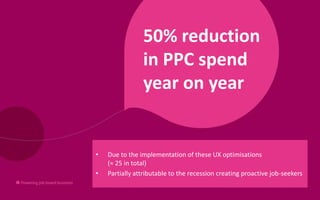
    50% reduction inPPC spend year on yearDue to the implementation of these UX optimisations (≈ 25 in total)
  • 53.
    Partially attributable tothe recession creating proactive job-seekersSimon DevittHarry BrignullHaymarketMadgex

Editor's Notes

  • #9 It is something that forms in your users’ minds when they experience your products.
  • #10 This is what I’m going to talk to you about today.