Bioinformatics and
Cheminformatics.
By,
Warda Khan
Unzeela
Yamna
BIOINFORMATICS:
History:
The term "Bioinformatics" was invented by
Paulien Hogeweg and Ben Hesper in 1970.
Introduction:
->Bioinformatics is the application of
Information technology to store, organize
and analyze the vast amount of biological
data.
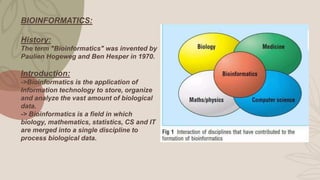
-> Bioinformatics is a field in which
biology, mathematics, statistics, CS and IT
are merged into a single discipline to
process biological data.
3
Bioinformatics Database:
Bioinformatic database refers to collection and of data which is Structured, presented and
Cross referenced across the world.
• The stored data is available in the form of sequences and structures of proteins and nucleic
acids (the information carrier).
• Sequences are represented in single dimension where as the structure contains the three
dimensional data of sequences.
• ►it helps scientists to understand the concepts Of biological phenomena.Some names of
bioinformatics database are Follows:*
• Genbank, Uniprot - Used in bological sequence analysis
• Inter pro pfam - Used in Finding protein families.
Software And Tools Of Bioinformatics:
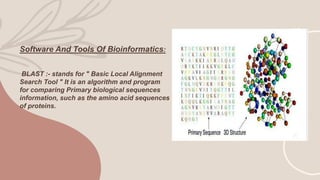
BLAST :- stands for " Basic Local Alignment
Search Tool " It is an algorithm and program
for comparing Primary biological sequences
information, such as the amino acid sequences
of proteins.
5
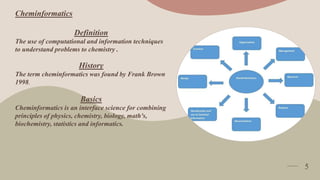
Cheminformatics
Definition
The use of computational and information techniques
to understand problems to chemistry .
History
The term cheminformatics was found by Frank Brown
1998.
Basics
Cheminformatics is an interface science for combining
principles of physics, chemistry, biology, math's,
biochemistry, statistics and informatics.
6
Advantages:
Cheminformatics strategies are useful in drug discovery where large numbers of
compounds are evaluated for interaction with the target cellular molecules.
Computer-aided drug design (CADD) where one looks for molecules with specific biological
and therapeutic properties.
Science has advanced so much that we are now talking of library of virtual molecules (runs
into billions of entries).
CAS (Chemical Abstracts Service), a division of American Chemical Society is the world’s
largest collection of chemistry insights. It is an authoritative source of chemical names,
structures and serves as a universal standard for chemists.
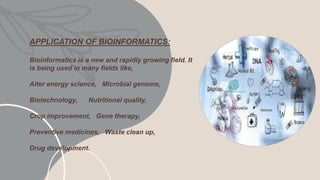
APPLICATION OF BIOINFORMATICS:
Bioinformatics is a new and rapidly growing field. It
is being used in many fields like,
Alter energy science, Microbial genome,
Biotechnology, Nutritional quality,
Crop improvement, Gene therapy,
Preventive medicines, Waste clean up,
Drug development.
Drug development:
Drugs target only 500 proteins. Now using
computational tools of bioinformatics and
diseases mechanisms, scientists trying to identify
new and validate drugs.
Crop Improvement:
Wise application of bioinformatics helps to
produce stronger and morfe drought and
insect-resistant crops and improve quality of
live stock, making them healthier and more
productive.
10
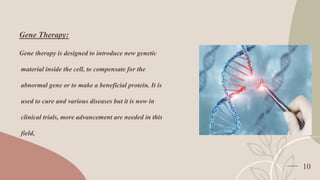
Gene Therapy:
Gene therapy is designed to introduce new genetic
material inside the cell, to compensate for the
abnormal gene or to make a beneficial protein. It is
used to cure and various diseases but it is now in
clinical trials, more advancement are needed in this
field,
Application of Cheminformatics:
Cheminformatics is the use of computer and informational techniques to solve
problems in chemistry, especially in the field of drug discovery and development.
1. Molecular modeling: Building and manipulating 3D structures of molecules to
predict their properties and interactions.
2. Chemical database management: Organizing and searching large collections of
chemical structures and properties.
3. Predictive toxicology: Using computer models to predict the toxicity of
compounds and identify potential safety issues.
4. 7. Metabolomics: Analyzing the metabolites present in a biological system to
understand disease mechanisms and drug effects.
Thank you

A study of bioinformatics And Cheminformatics

  • 1.
  • 2.
    BIOINFORMATICS: History: The term "Bioinformatics"was invented by Paulien Hogeweg and Ben Hesper in 1970. Introduction: ->Bioinformatics is the application of Information technology to store, organize and analyze the vast amount of biological data. -> Bioinformatics is a field in which biology, mathematics, statistics, CS and IT are merged into a single discipline to process biological data.
  • 3.
    3 Bioinformatics Database: Bioinformatic databaserefers to collection and of data which is Structured, presented and Cross referenced across the world. • The stored data is available in the form of sequences and structures of proteins and nucleic acids (the information carrier). • Sequences are represented in single dimension where as the structure contains the three dimensional data of sequences. • ►it helps scientists to understand the concepts Of biological phenomena.Some names of bioinformatics database are Follows:* • Genbank, Uniprot - Used in bological sequence analysis • Inter pro pfam - Used in Finding protein families.
  • 4.
    Software And ToolsOf Bioinformatics: BLAST :- stands for " Basic Local Alignment Search Tool " It is an algorithm and program for comparing Primary biological sequences information, such as the amino acid sequences of proteins.
  • 5.
    5 Cheminformatics Definition The use ofcomputational and information techniques to understand problems to chemistry . History The term cheminformatics was found by Frank Brown 1998. Basics Cheminformatics is an interface science for combining principles of physics, chemistry, biology, math's, biochemistry, statistics and informatics.
  • 6.
    6 Advantages: Cheminformatics strategies areuseful in drug discovery where large numbers of compounds are evaluated for interaction with the target cellular molecules. Computer-aided drug design (CADD) where one looks for molecules with specific biological and therapeutic properties. Science has advanced so much that we are now talking of library of virtual molecules (runs into billions of entries). CAS (Chemical Abstracts Service), a division of American Chemical Society is the world’s largest collection of chemistry insights. It is an authoritative source of chemical names, structures and serves as a universal standard for chemists.
  • 7.
    APPLICATION OF BIOINFORMATICS: Bioinformaticsis a new and rapidly growing field. It is being used in many fields like, Alter energy science, Microbial genome, Biotechnology, Nutritional quality, Crop improvement, Gene therapy, Preventive medicines, Waste clean up, Drug development.
  • 8.
    Drug development: Drugs targetonly 500 proteins. Now using computational tools of bioinformatics and diseases mechanisms, scientists trying to identify new and validate drugs.
  • 9.
    Crop Improvement: Wise applicationof bioinformatics helps to produce stronger and morfe drought and insect-resistant crops and improve quality of live stock, making them healthier and more productive.
  • 10.
    10 Gene Therapy: Gene therapyis designed to introduce new genetic material inside the cell, to compensate for the abnormal gene or to make a beneficial protein. It is used to cure and various diseases but it is now in clinical trials, more advancement are needed in this field,
  • 11.
    Application of Cheminformatics: Cheminformaticsis the use of computer and informational techniques to solve problems in chemistry, especially in the field of drug discovery and development. 1. Molecular modeling: Building and manipulating 3D structures of molecules to predict their properties and interactions. 2. Chemical database management: Organizing and searching large collections of chemical structures and properties. 3. Predictive toxicology: Using computer models to predict the toxicity of compounds and identify potential safety issues. 4. 7. Metabolomics: Analyzing the metabolites present in a biological system to understand disease mechanisms and drug effects.
  • 12.