A Story of Continuous Integration
jcharlety@salesforce.com
cmourot@salesforce.com
Your speakers
C. Mourot
20142005
JB Charlety
20132004
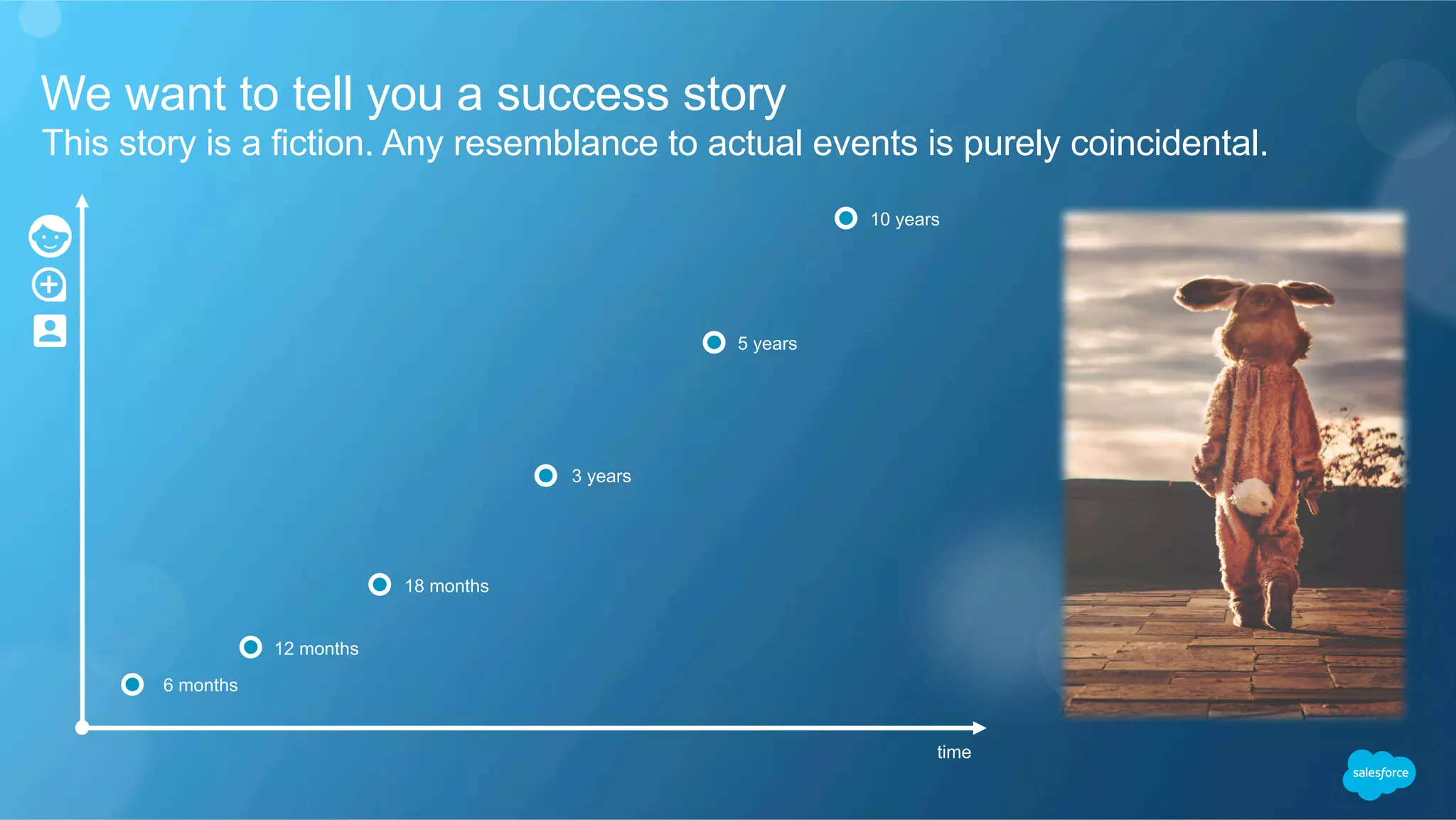
We want to tell you a success story
​ This story is a fiction. Any resemblance to actual events is purely coincidental.
6 months
12 months
18 months
3 years
5 years
10 years
time
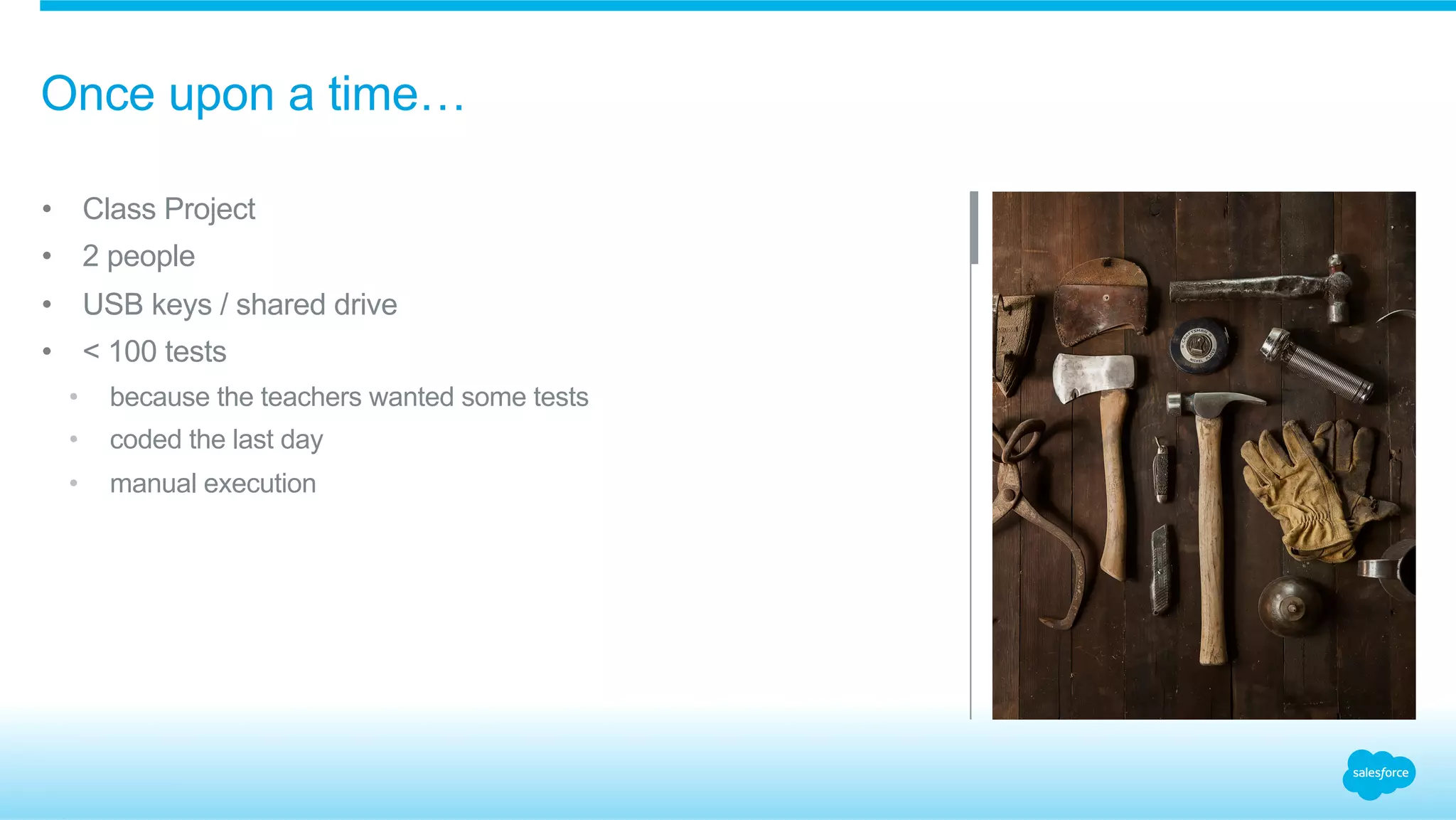
Once upon a time…
•  Class Project
•  2 people
•  USB keys / shared drive
•  < 100 tests
•  because the teachers wanted some tests
•  coded the last day
•  manual execution
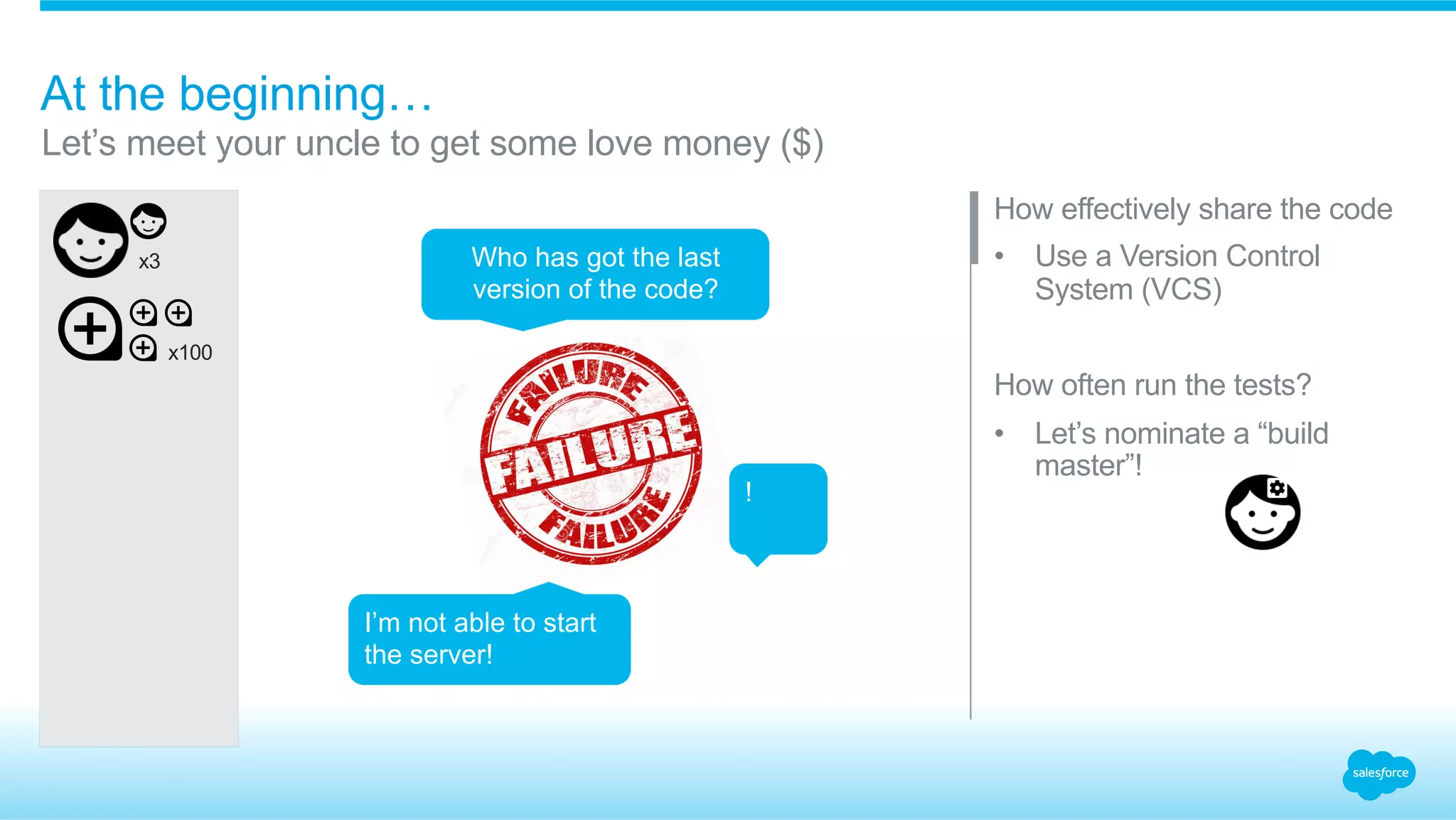
At the beginning…
​ How effectively share the code
•  Use a Version Control
System (VCS)
​ How often run the tests?
•  Let’s nominate a “build
master”!
​ Let’s meet your uncle to get some love money ($)
​ x100
​ x3
I’m not able to start
the server!
Who has got the last
version of the code?
!
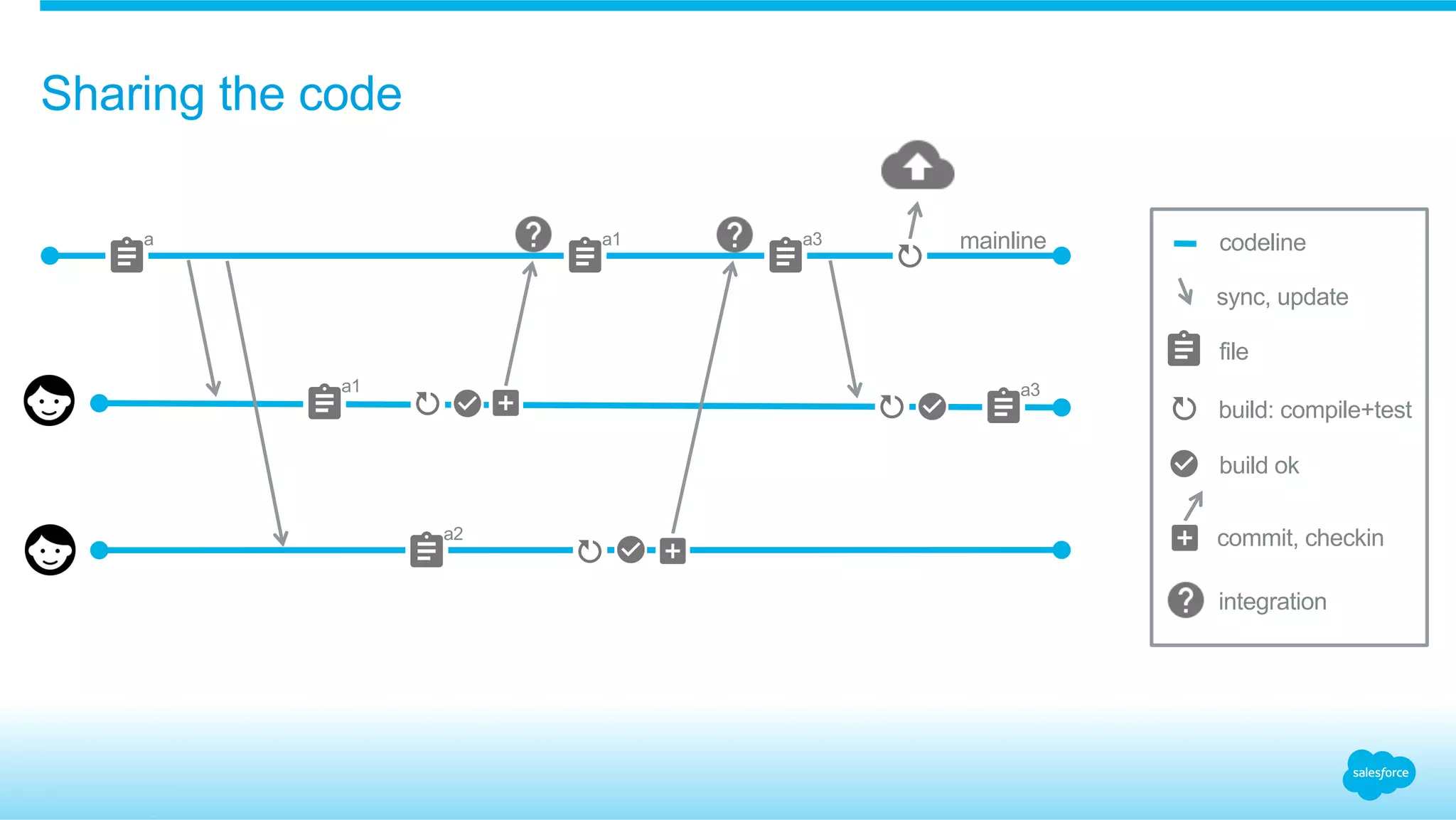
Sharing the code
mainlinea1 a3
a1
a
a2
a3
integration
commit, checkin
build ok
build: compile+test
file
sync, update
codeline
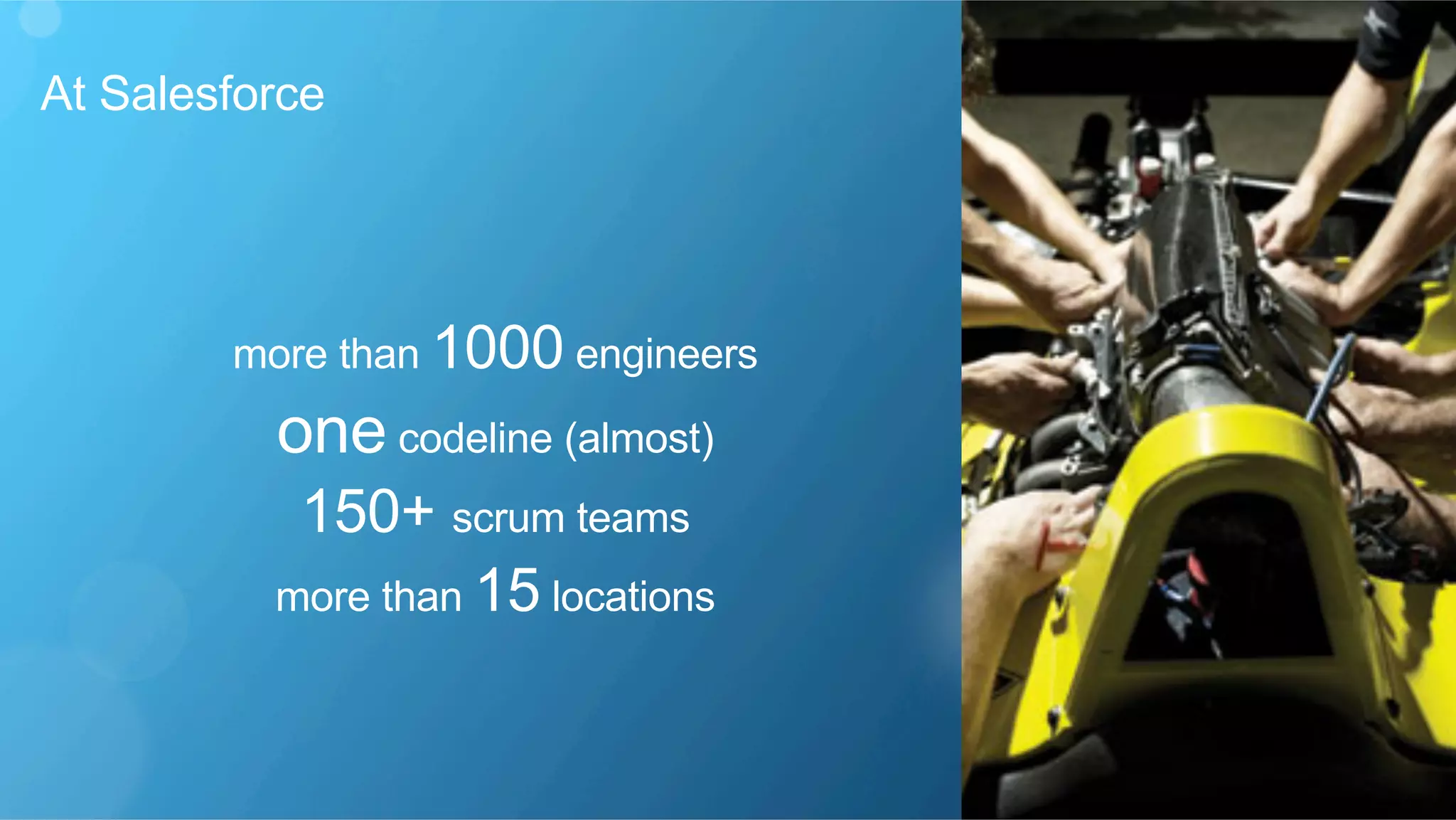
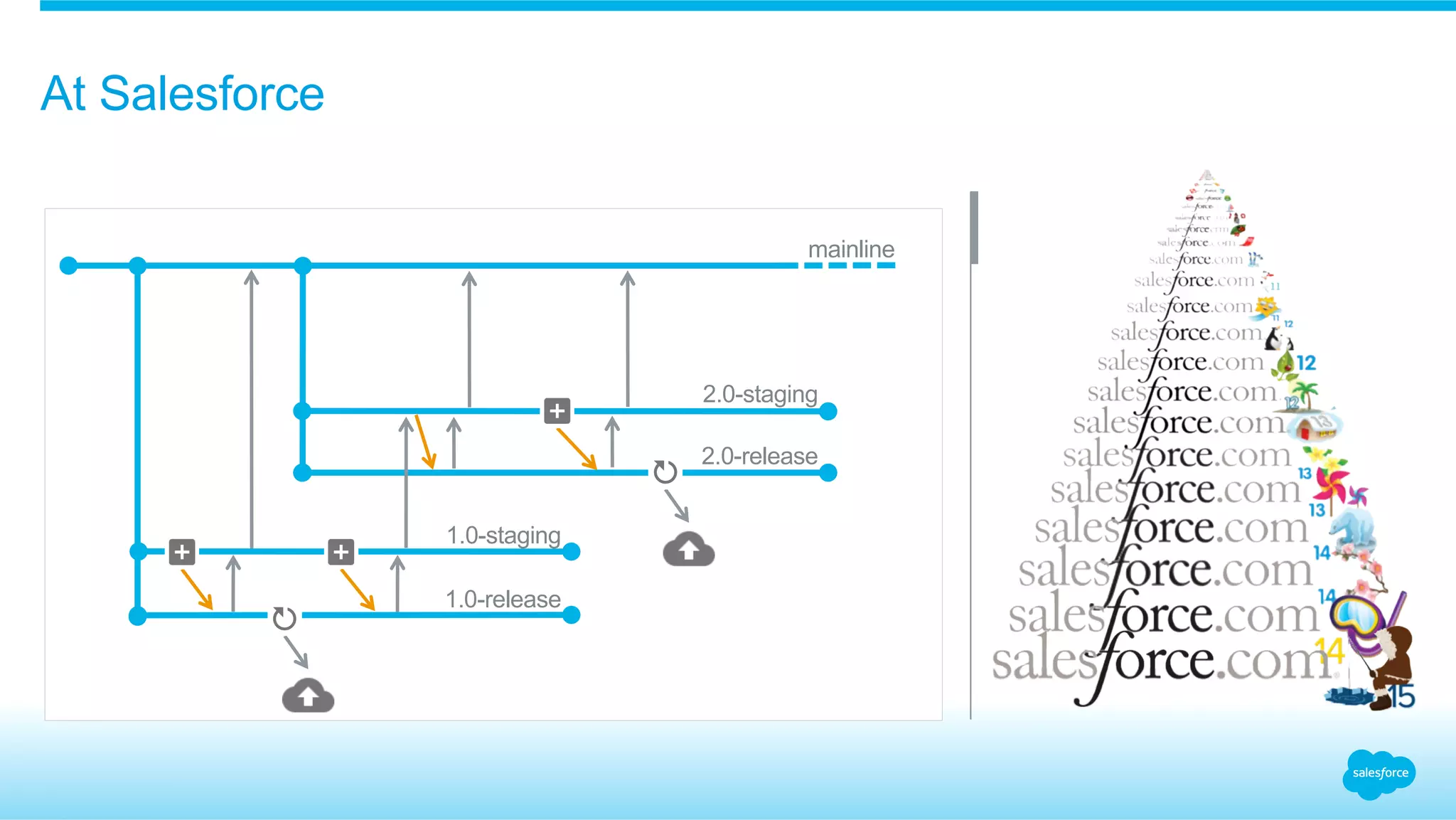
At Salesforce
more than 1000 engineers
one codeline (almost)
150+ scrum teams
more than 15 locations
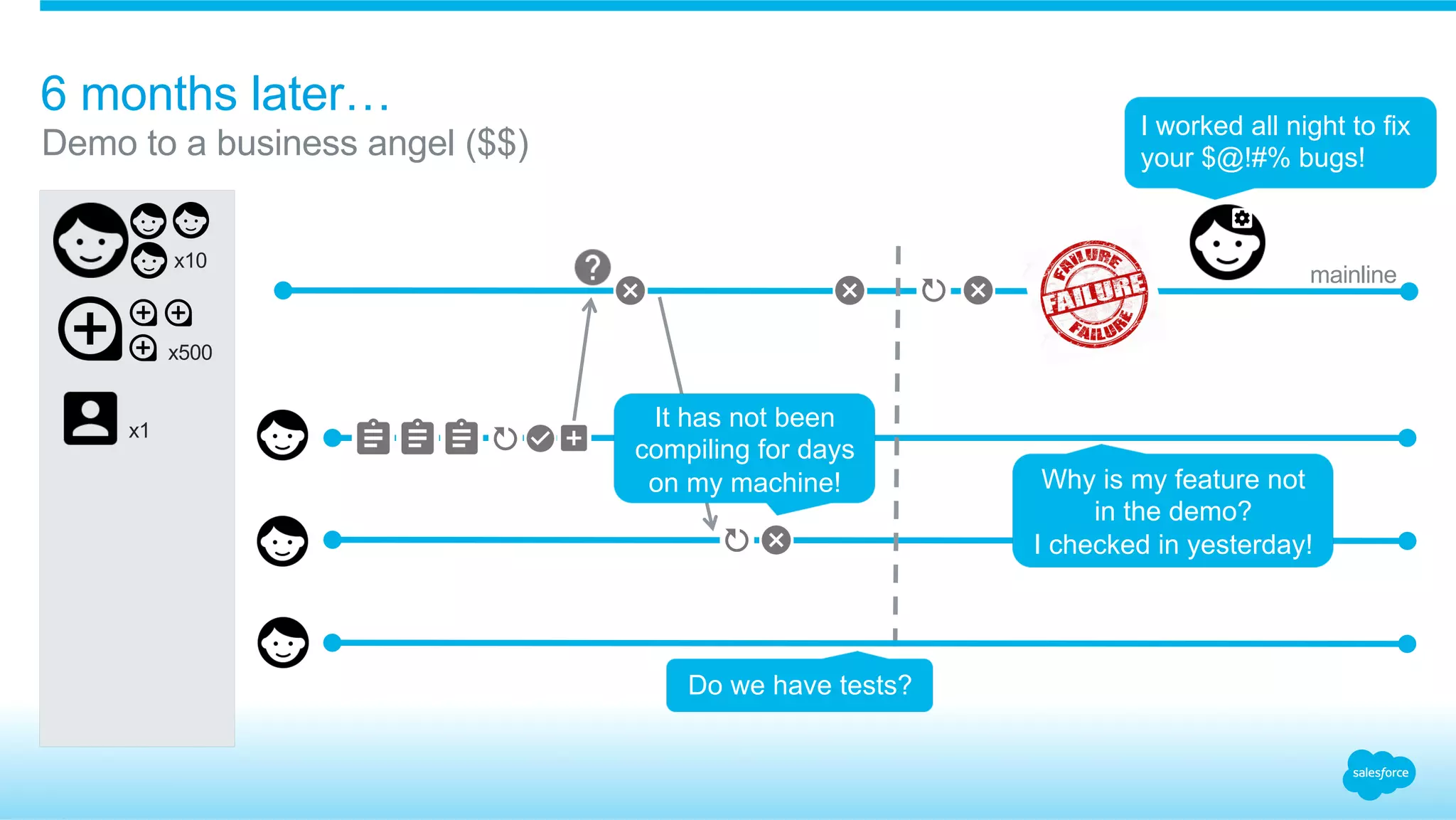
Demo to a business angel ($$)
6 months later…
​ x500
I worked all night to fix
your $@!#% bugs!
​ x10
​ x1
It has not been
compiling for days
on my machine! Why is my feature not
in the demo?
I checked in yesterday!
mainline
Do we have tests?
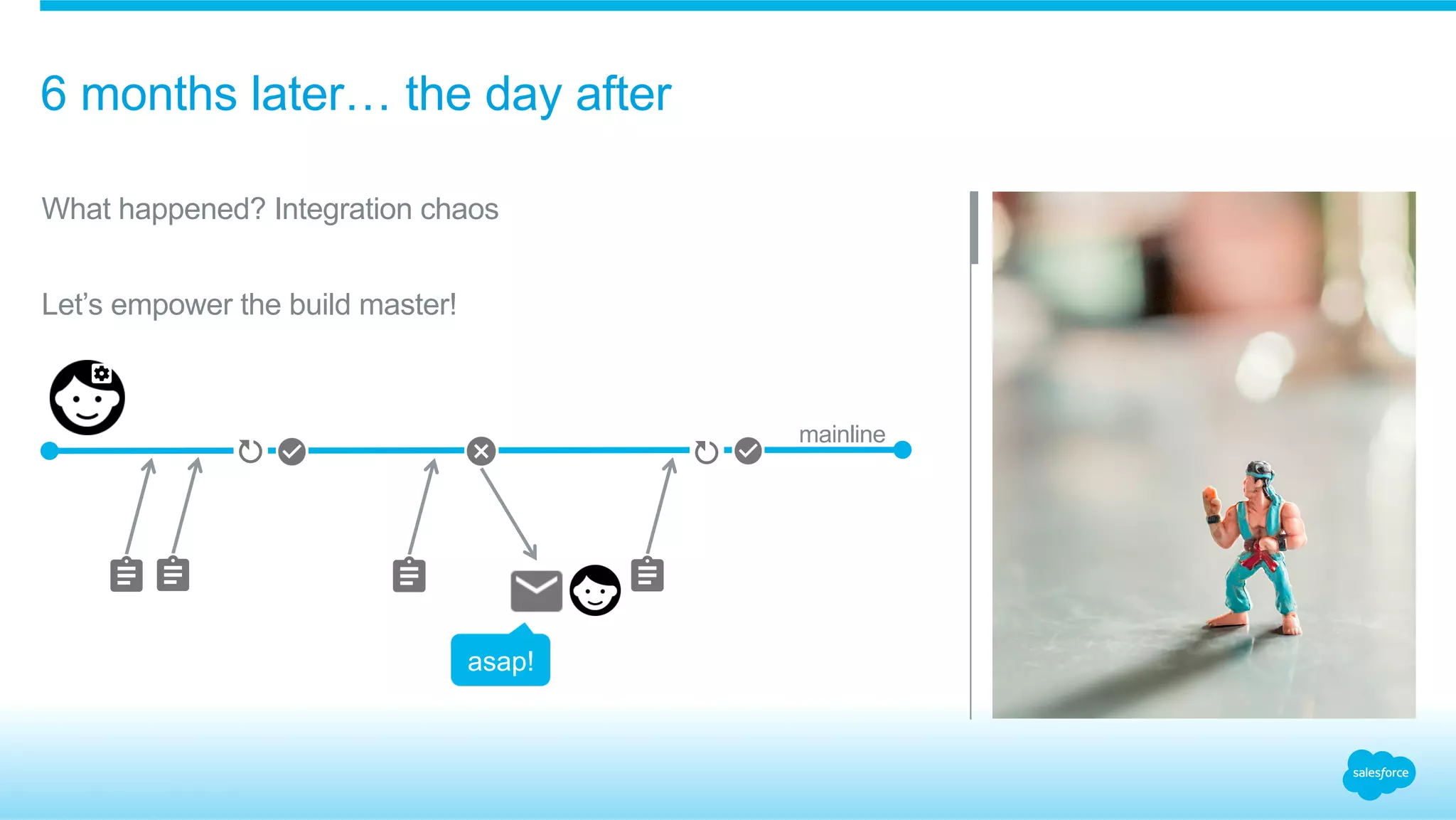
6 months later… the day after
​ What happened? Integration chaos
​ Let’s empower the build master!
mainline
asap!
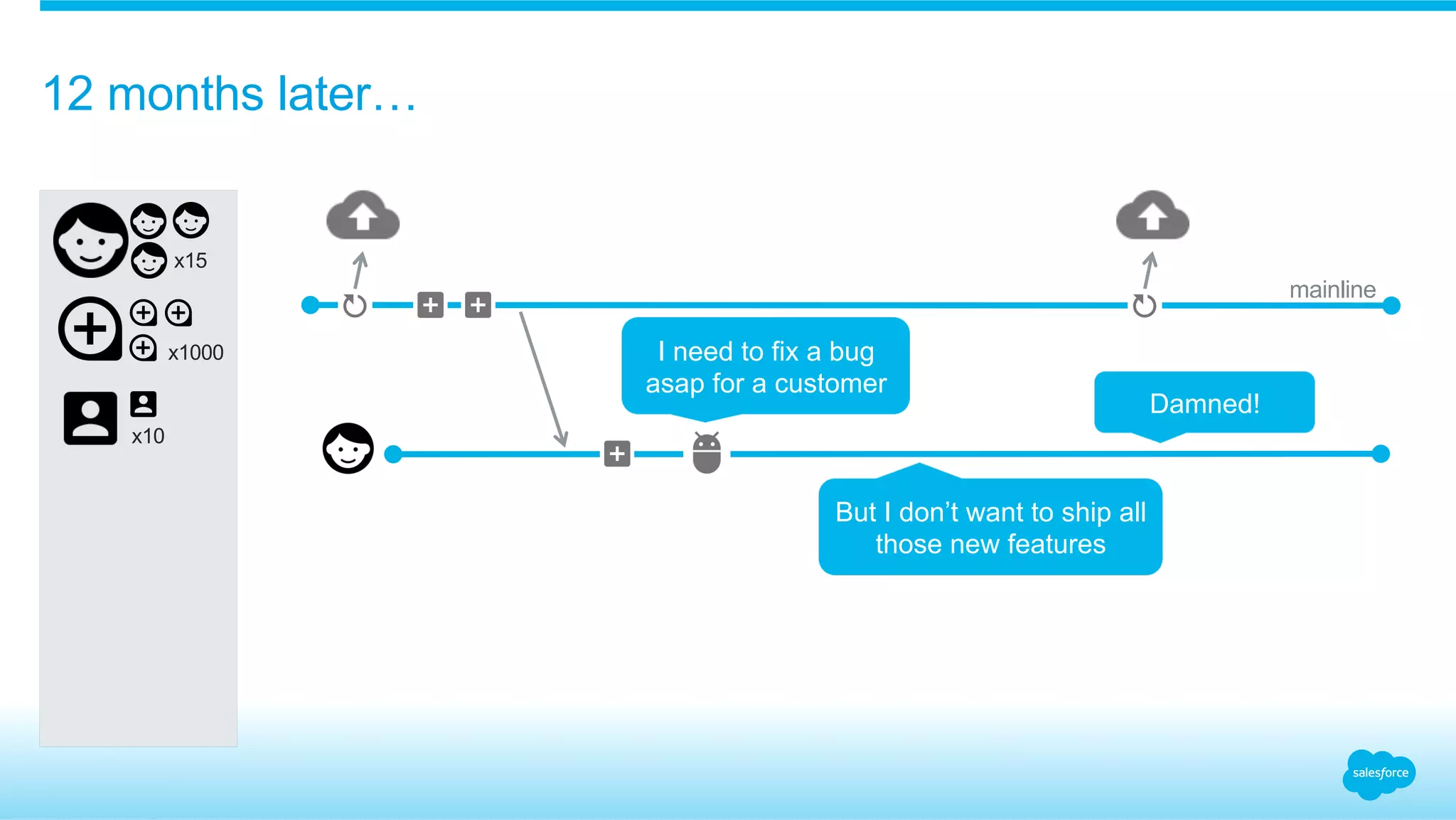
12 months later…
​ x1000
​ x15
I need to fix a bug
asap for a customer
​ x10
Damned!
But I don’t want to ship all
those new features
mainline
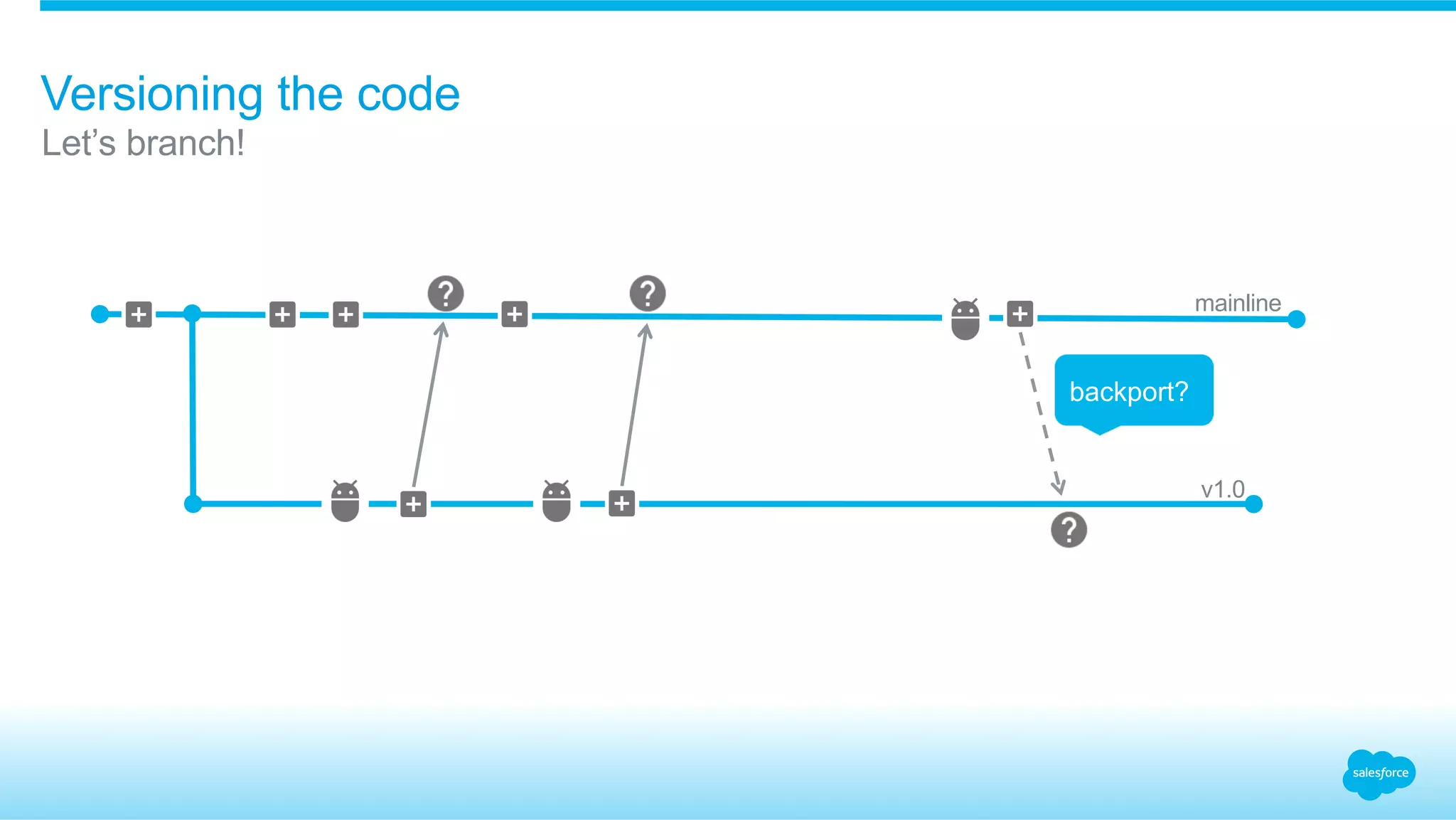
Let’s branch!
Versioning the code
mainline
v1.0
backport?
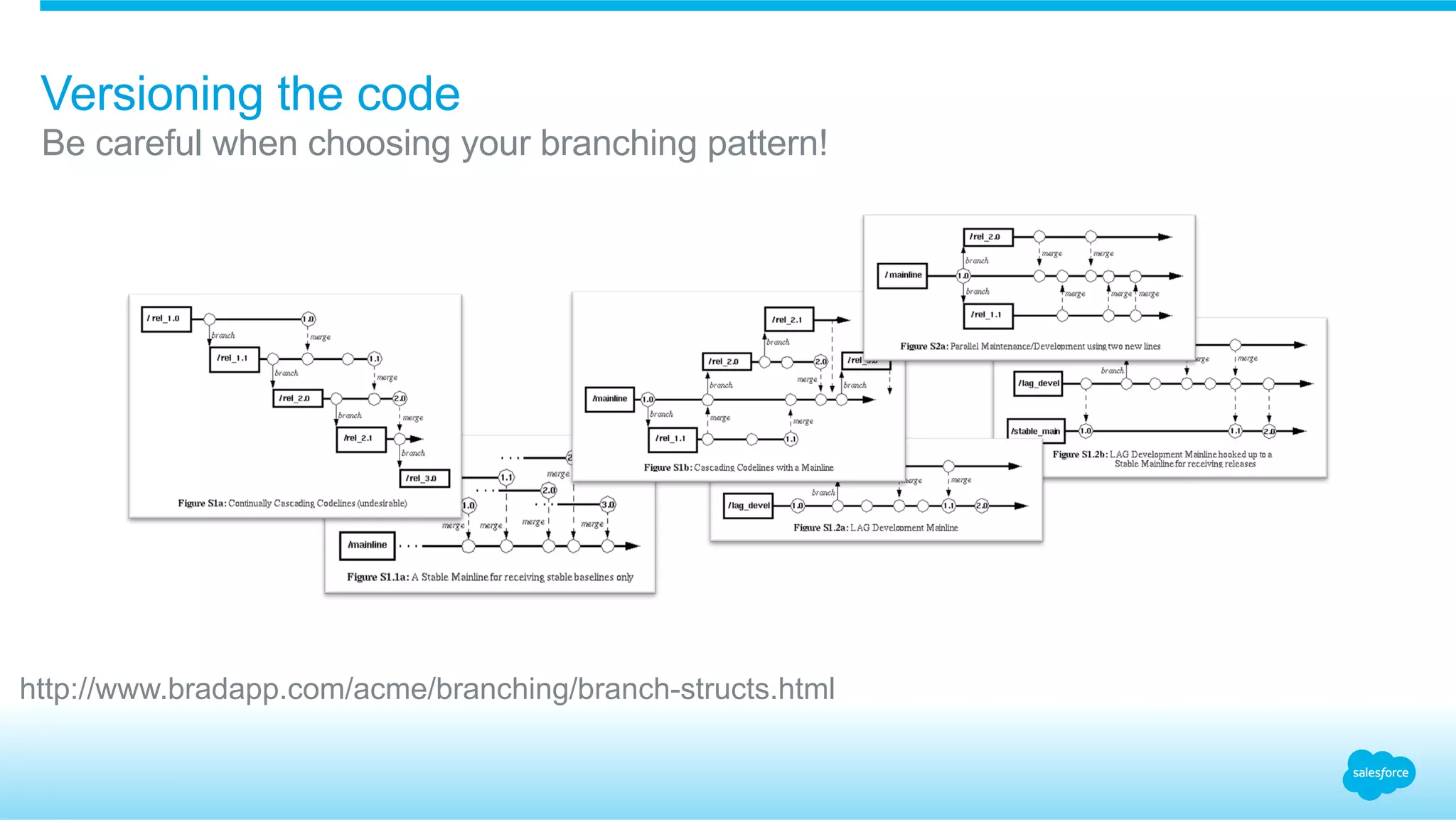
Be careful when choosing your branching pattern!
Versioning the code
http://www.bradapp.com/acme/branching/branch-structs.html
1.0-release
mainline
1.0-staging
2.0-release
2.0-staging
At Salesforce
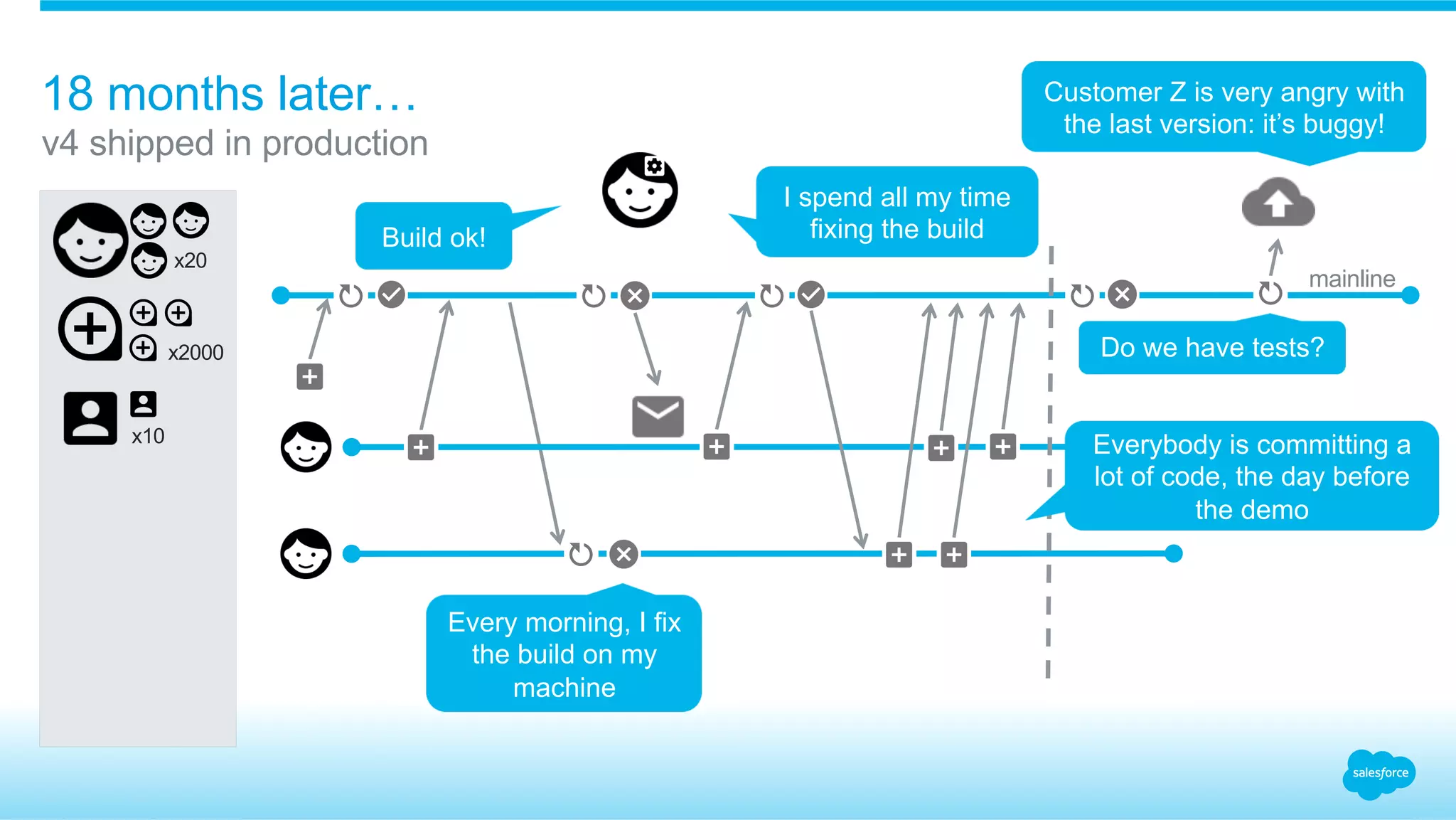
​ v4 shipped in production
18 months later…
​ x2000
Customer Z is very angry with
the last version: it’s buggy!
​ x20
​ x10
Every morning, I fix
the build on my
machine
mainline
I spend all my time
fixing the build
Everybody is committing a
lot of code, the day before
the demo
Build ok!
Do we have tests?
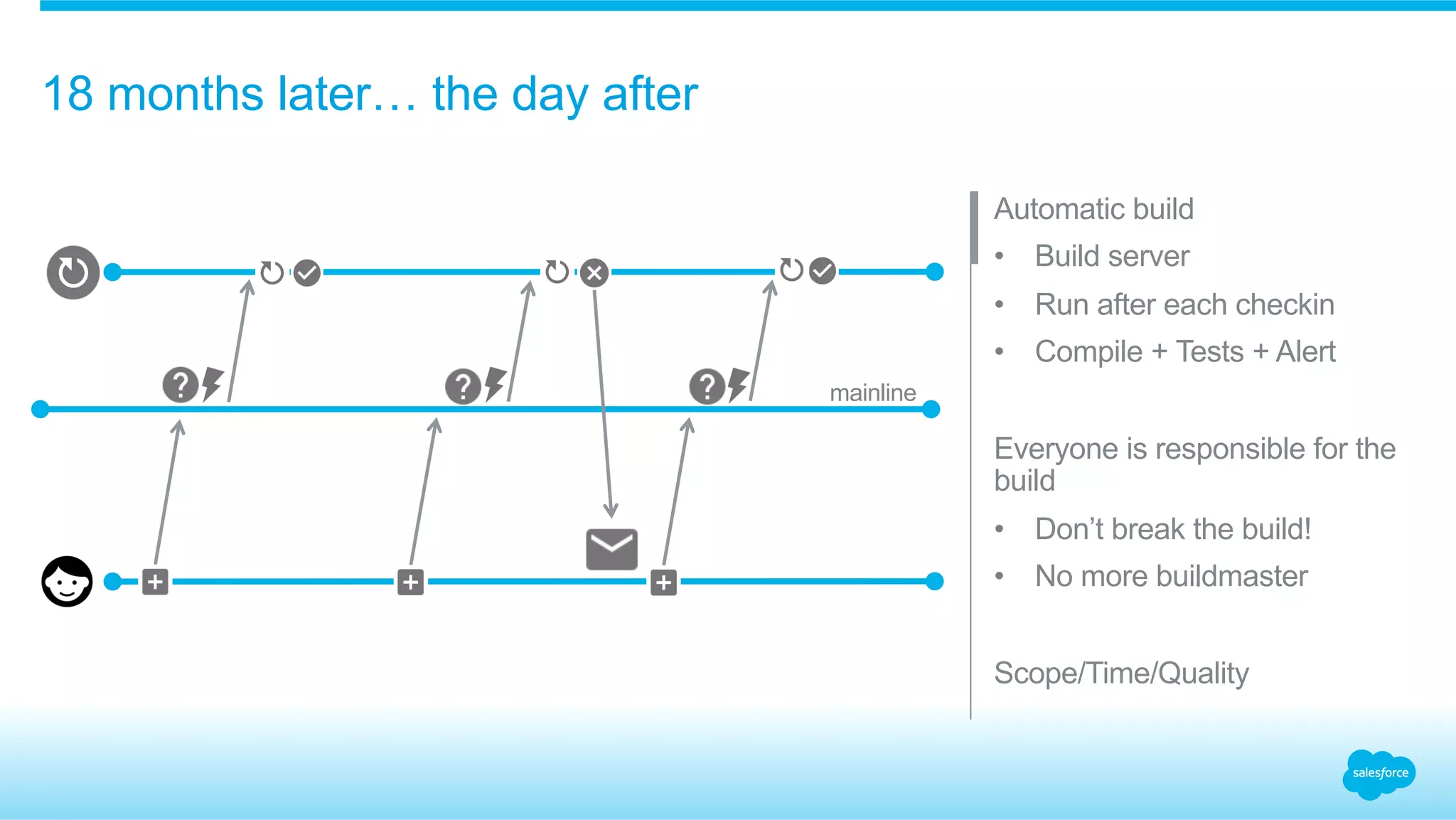
18 months later… the day after
Automatic build
•  Build server
•  Run after each checkin
•  Compile + Tests + Alert
Everyone is responsible for the
build
•  Don’t break the build!
•  No more buildmaster
Scope/Time/Quality
mainline
At Salesforce
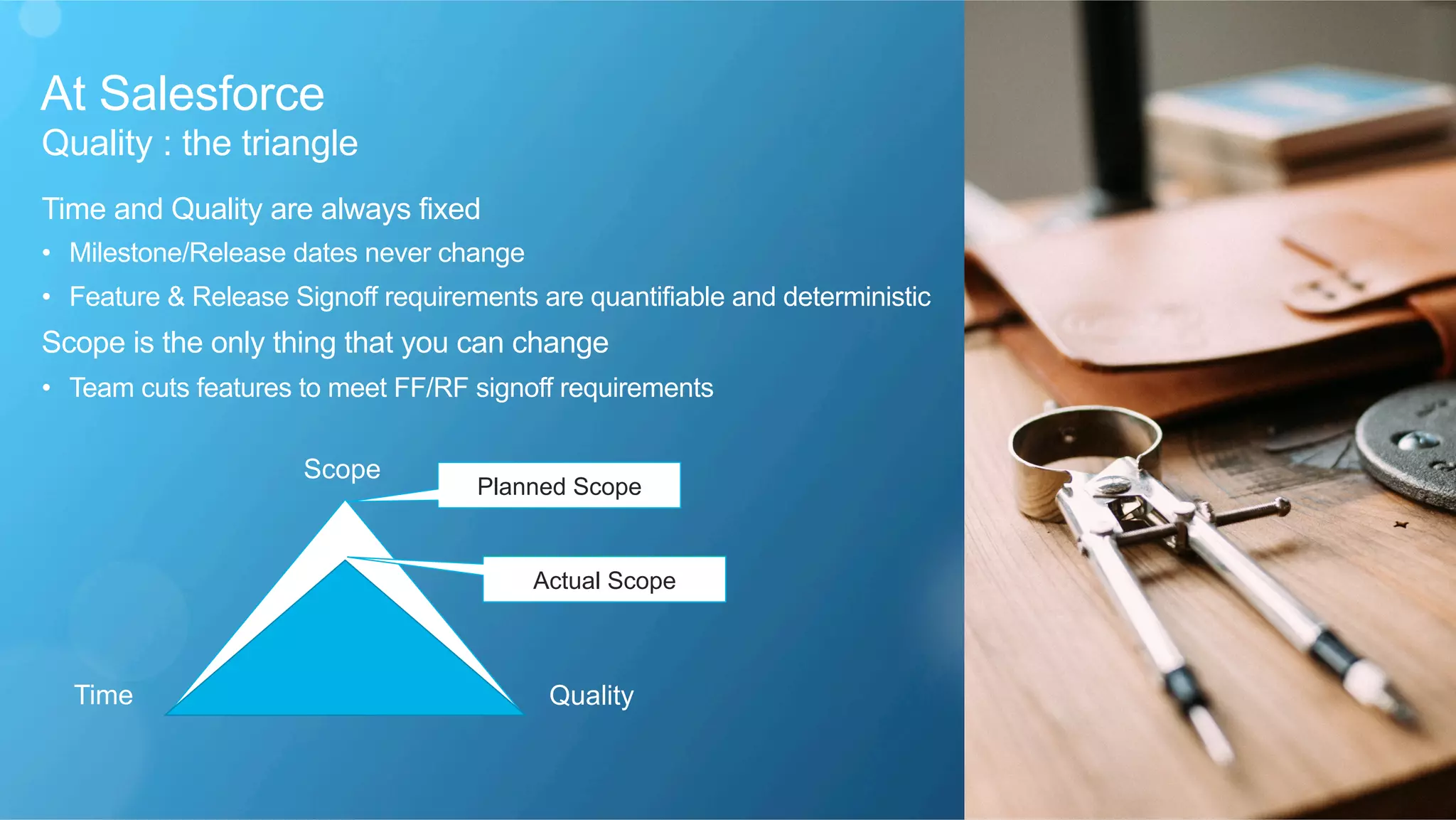
​ Quality : the triangle
​ Time and Quality are always fixed
•  Milestone/Release dates never change
•  Feature & Release Signoff requirements are quantifiable and deterministic
​ Scope is the only thing that you can change
•  Team cuts features to meet FF/RF signoff requirements
Scope
Time Quality
Planned Scope
Actual Scope
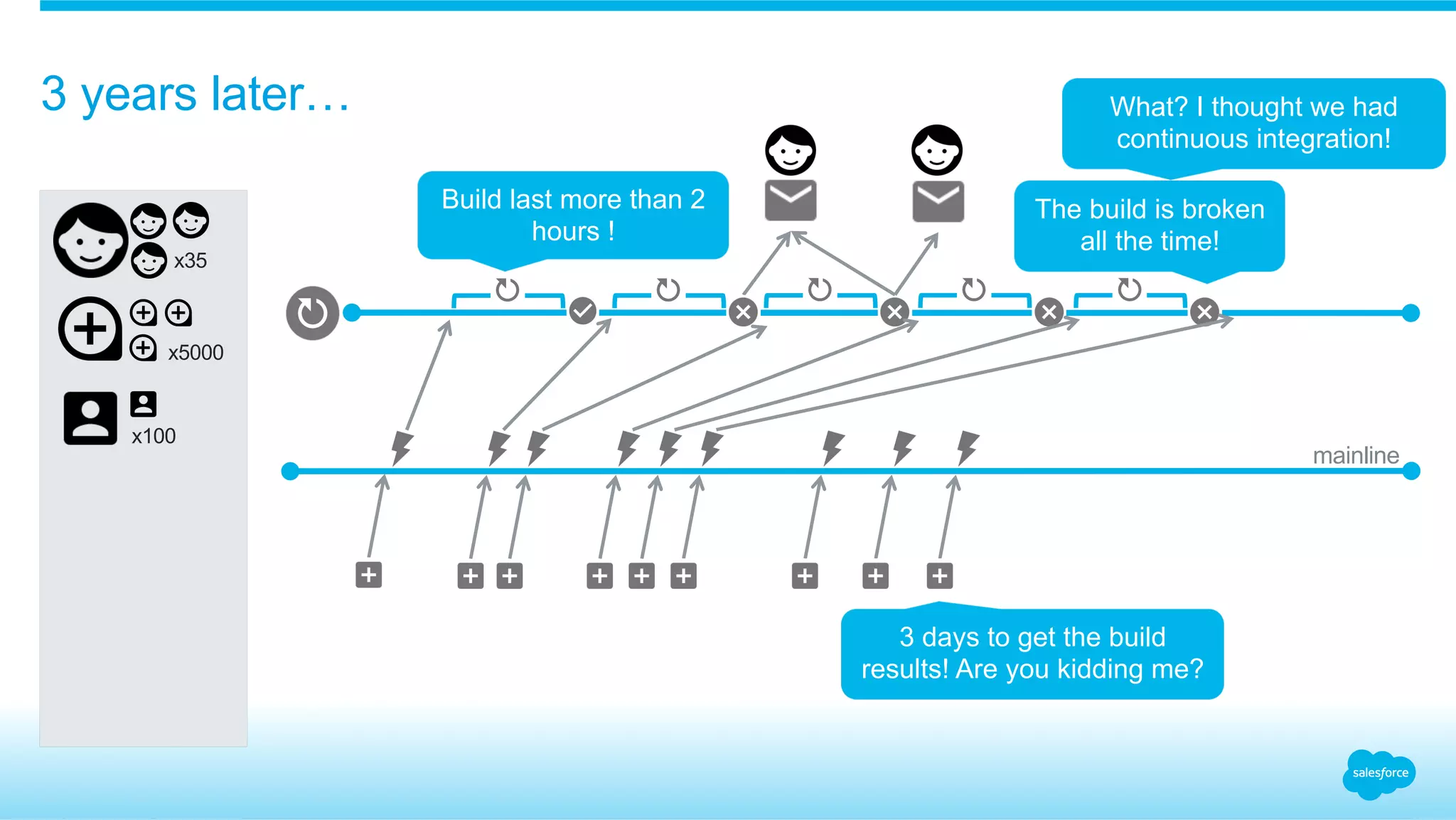
3 years later…
​ x5000
​ x35
Build last more than 2
hours !
​ x100
mainline
3 days to get the build
results! Are you kidding me?
What? I thought we had
continuous integration!
The build is broken
all the time!
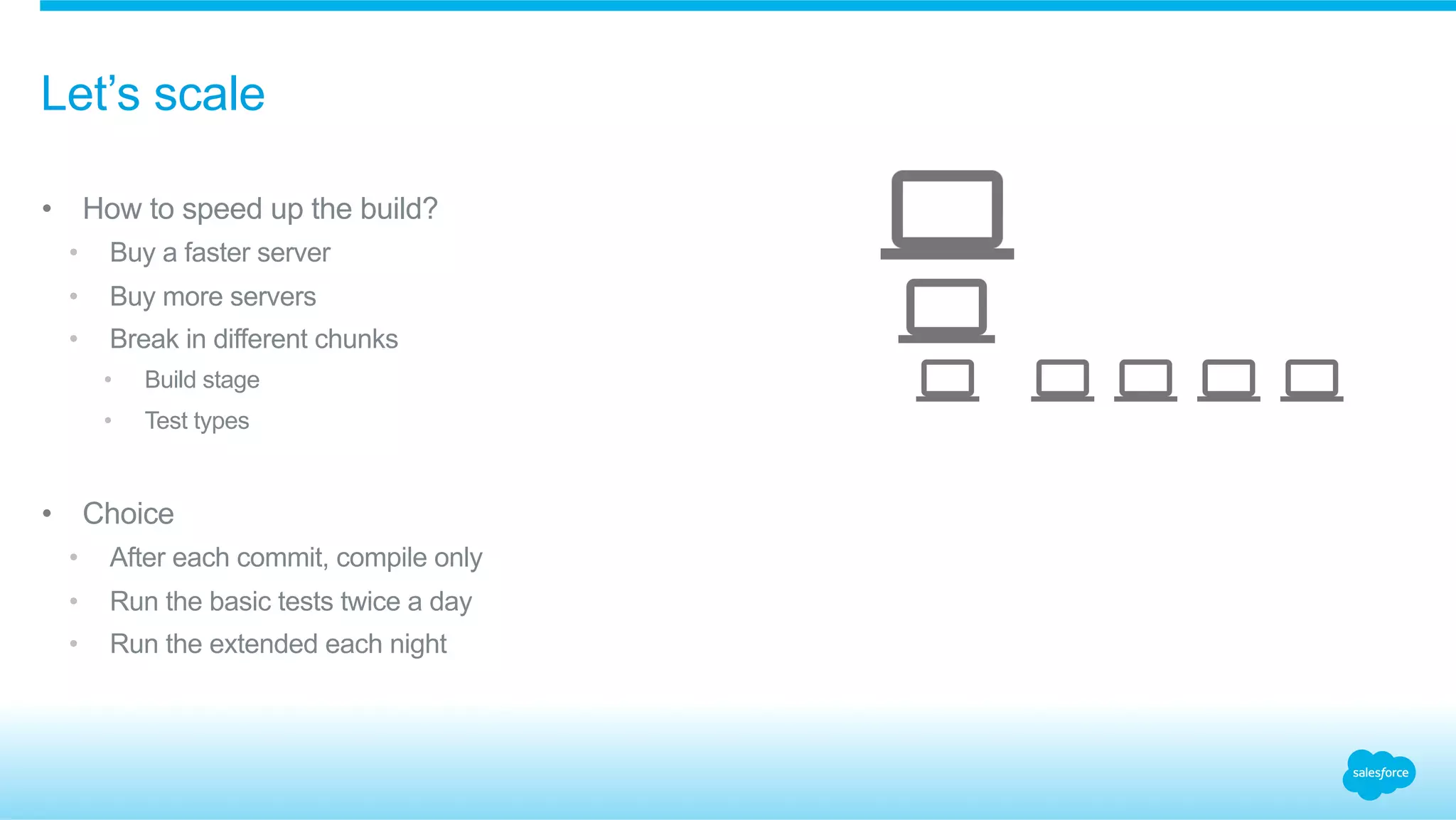
•  How to speed up the build?
•  Buy a faster server
•  Buy more servers
•  Break in different chunks
•  Build stage
•  Test types
•  Choice
•  After each commit, compile only
•  Run the basic tests twice a day
•  Run the extended each night
Let’s scale
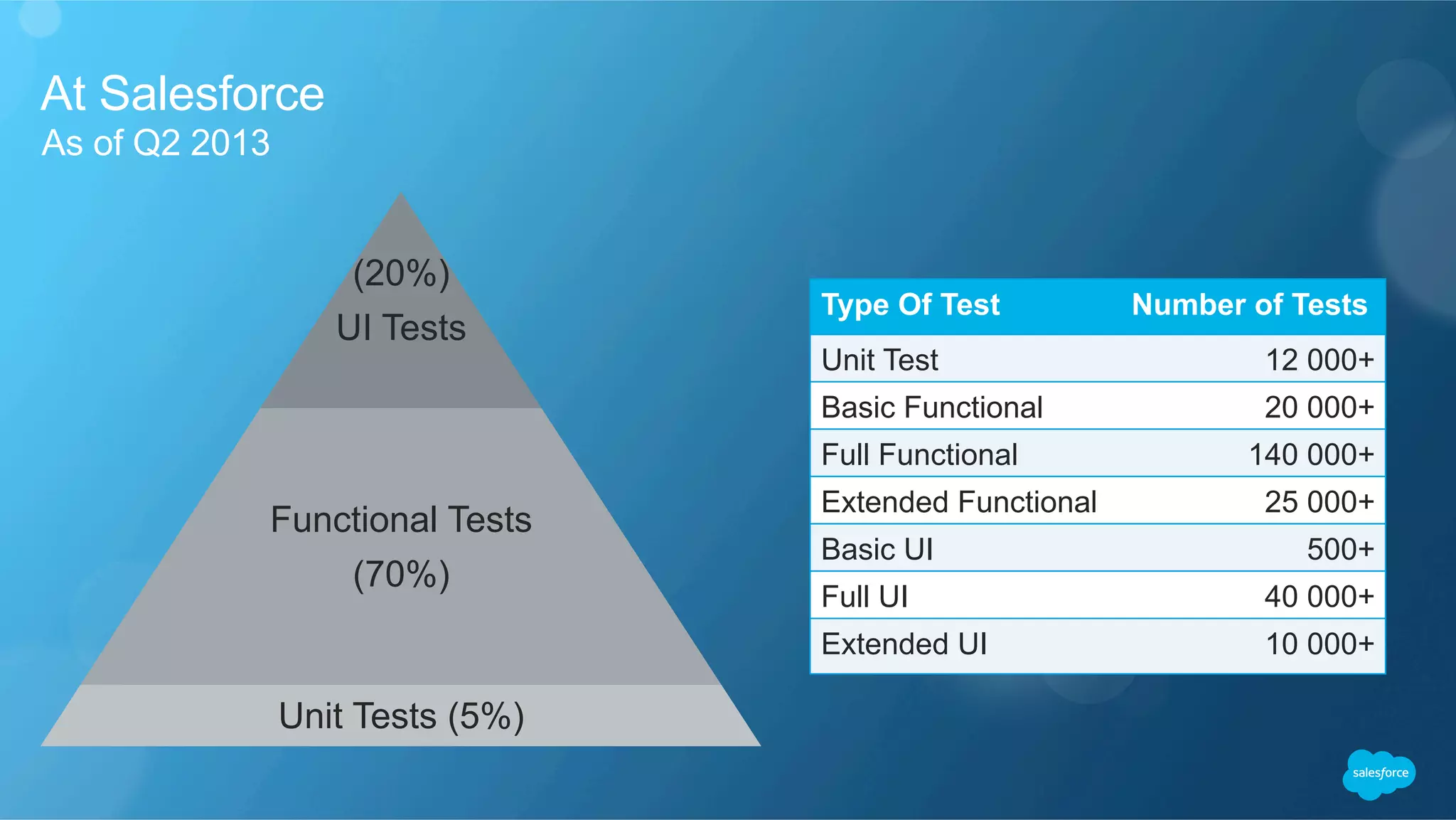
At Salesforce
​ As of Q2 2013
(20%)
UI Tests
Functional Tests
(70%)
Unit Tests (5%)
Type Of Test	
   Number of Tests	
  
Unit Test	
   12 000+	
  
Basic Functional	
   20 000+	
  
Full Functional	
   140 000+	
  
Extended Functional	
   25 000+	
  
Basic UI	
   500+	
  
Full UI	
   40 000+	
  
Extended UI	
   10 000+	
  
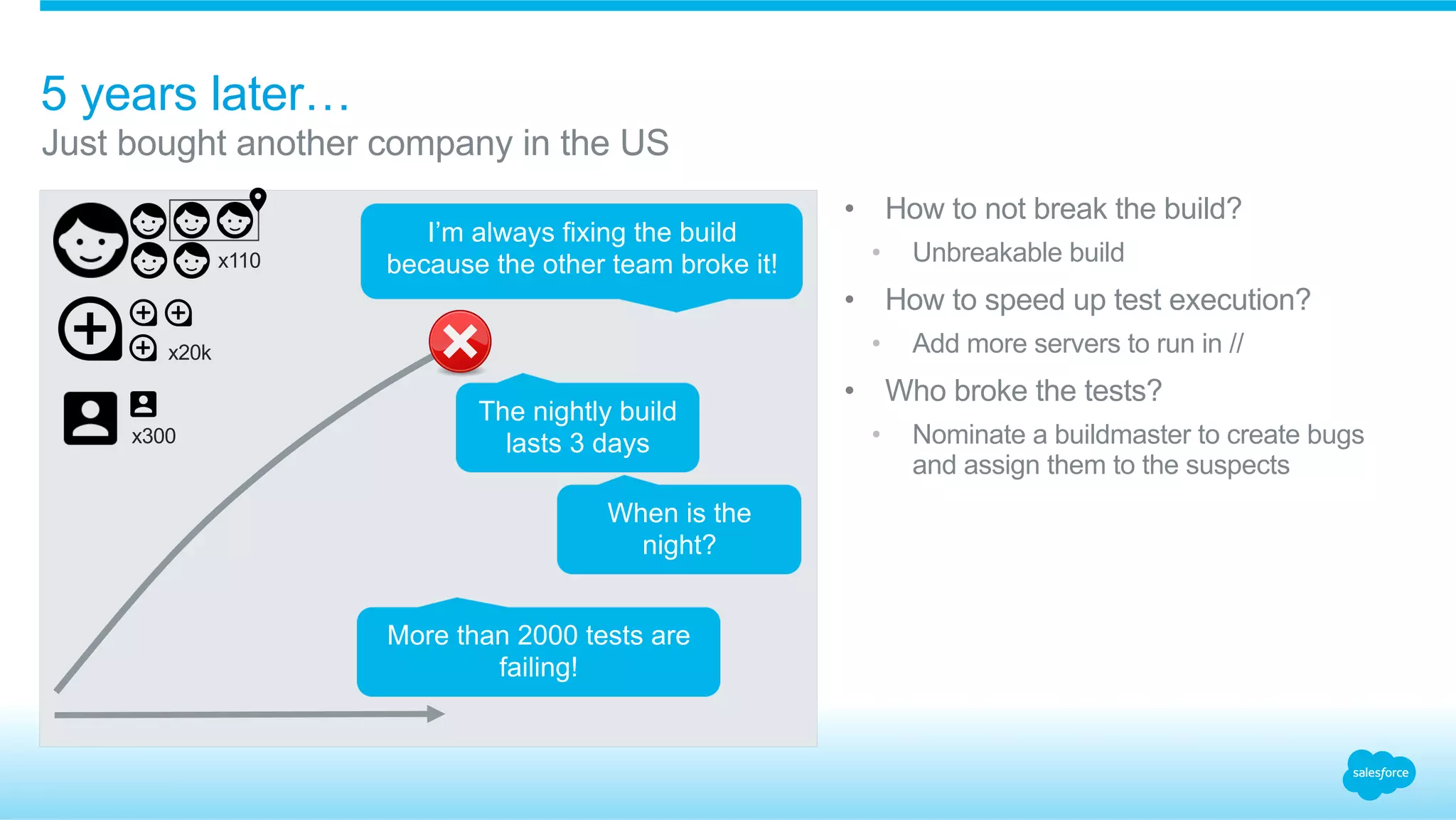
•  How to not break the build?
•  Unbreakable build
•  How to speed up test execution?
•  Add more servers to run in //
•  Who broke the tests?
•  Nominate a buildmaster to create bugs
and assign them to the suspects
​ Just bought another company in the US
5 years later…
​ x20k
​ x110
I’m always fixing the build
because the other team broke it!
​ x300
When is the
night?
The nightly build
lasts 3 days
More than 2000 tests are
failing!
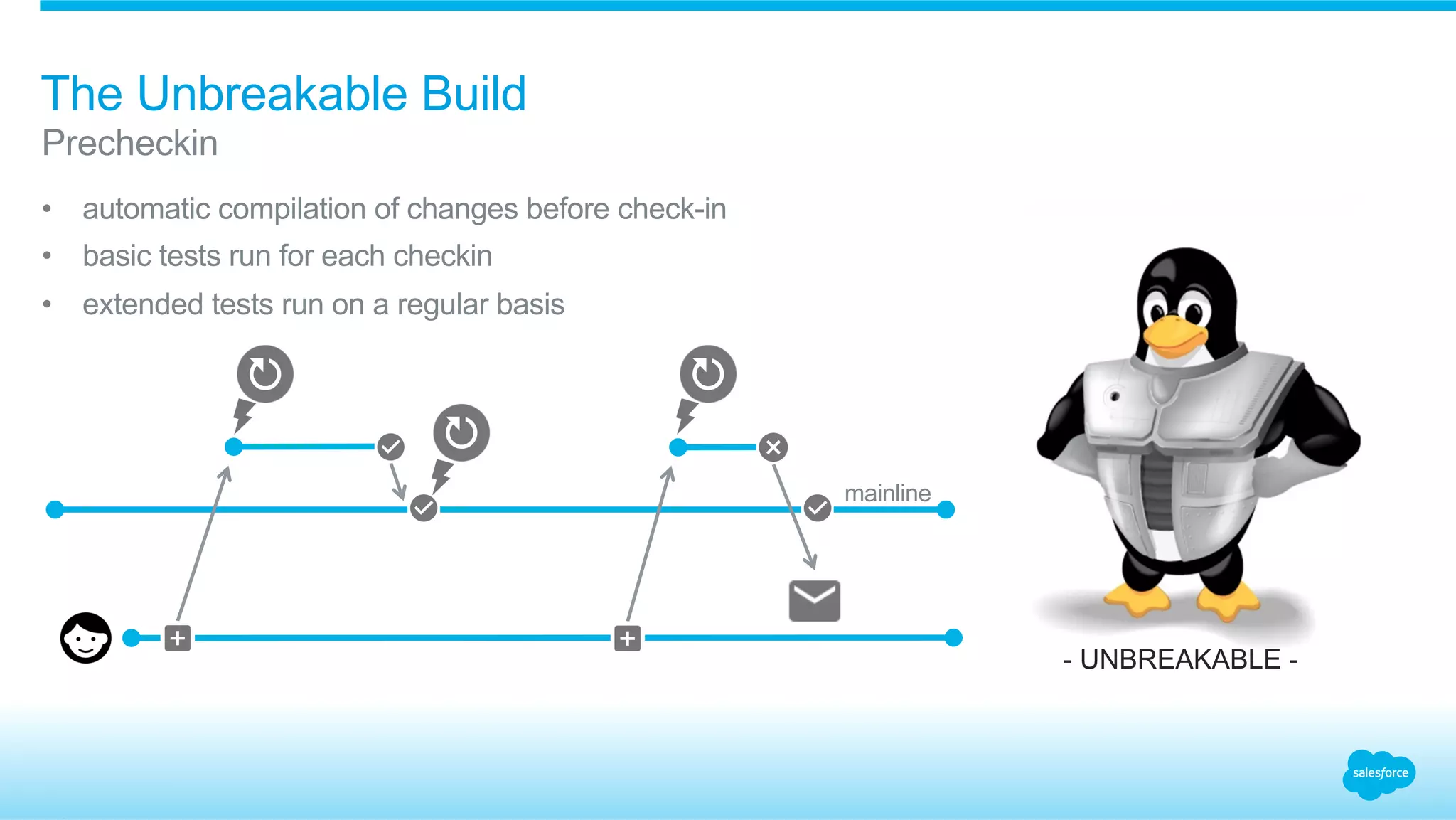
•  automatic compilation of changes before check-in
•  basic tests run for each checkin
•  extended tests run on a regular basis
​ 
Precheckin
The Unbreakable Build
- UNBREAKABLE -
mainline
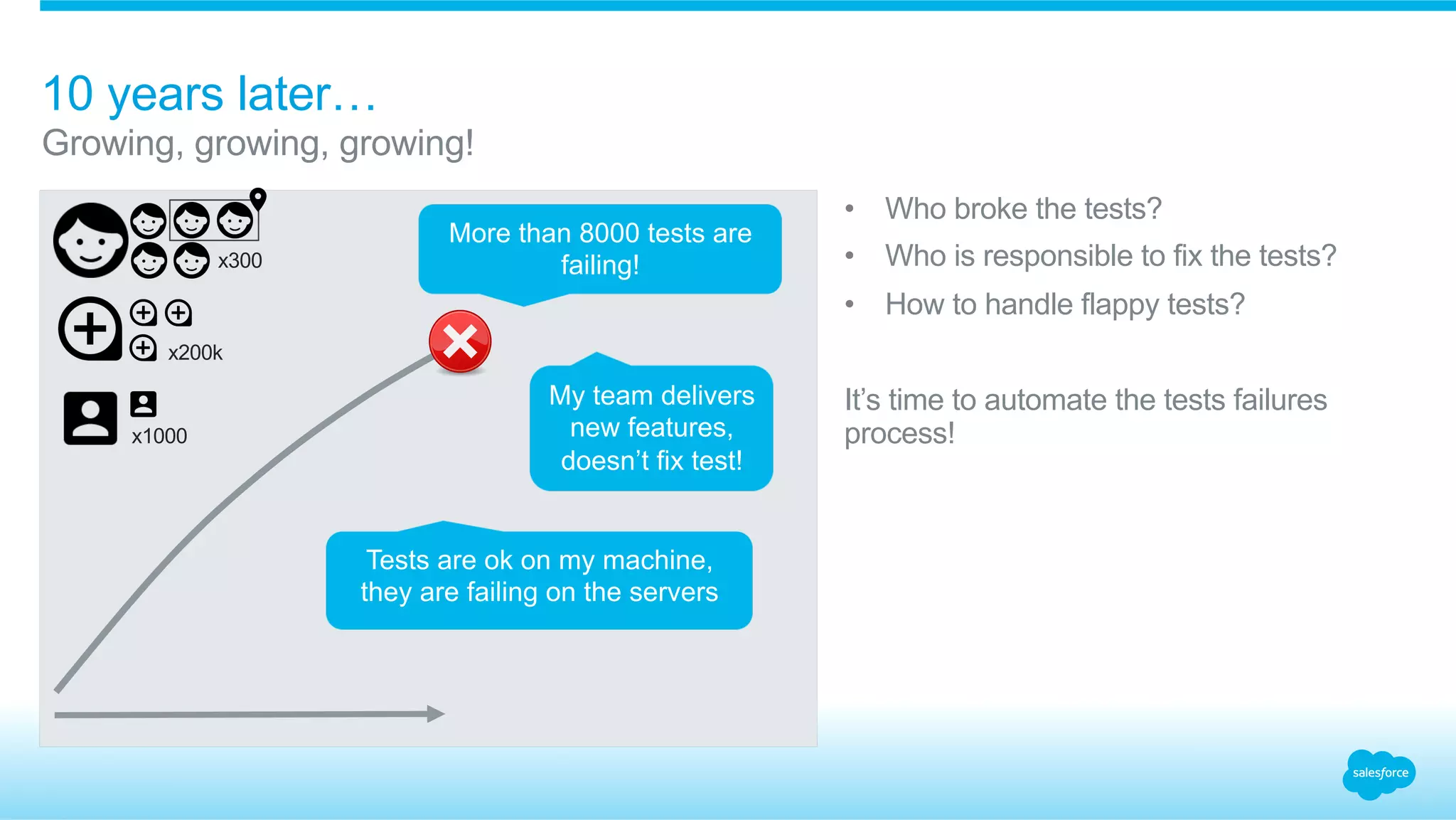
•  Who broke the tests?
•  Who is responsible to fix the tests?
•  How to handle flappy tests?
It’s time to automate the tests failures
process!
​ Growing, growing, growing!
10 years later…
​ x200k
​ x1000
My team delivers
new features,
doesn’t fix test!
More than 8000 tests are
failing!​ x300
Tests are ok on my machine,
they are failing on the servers
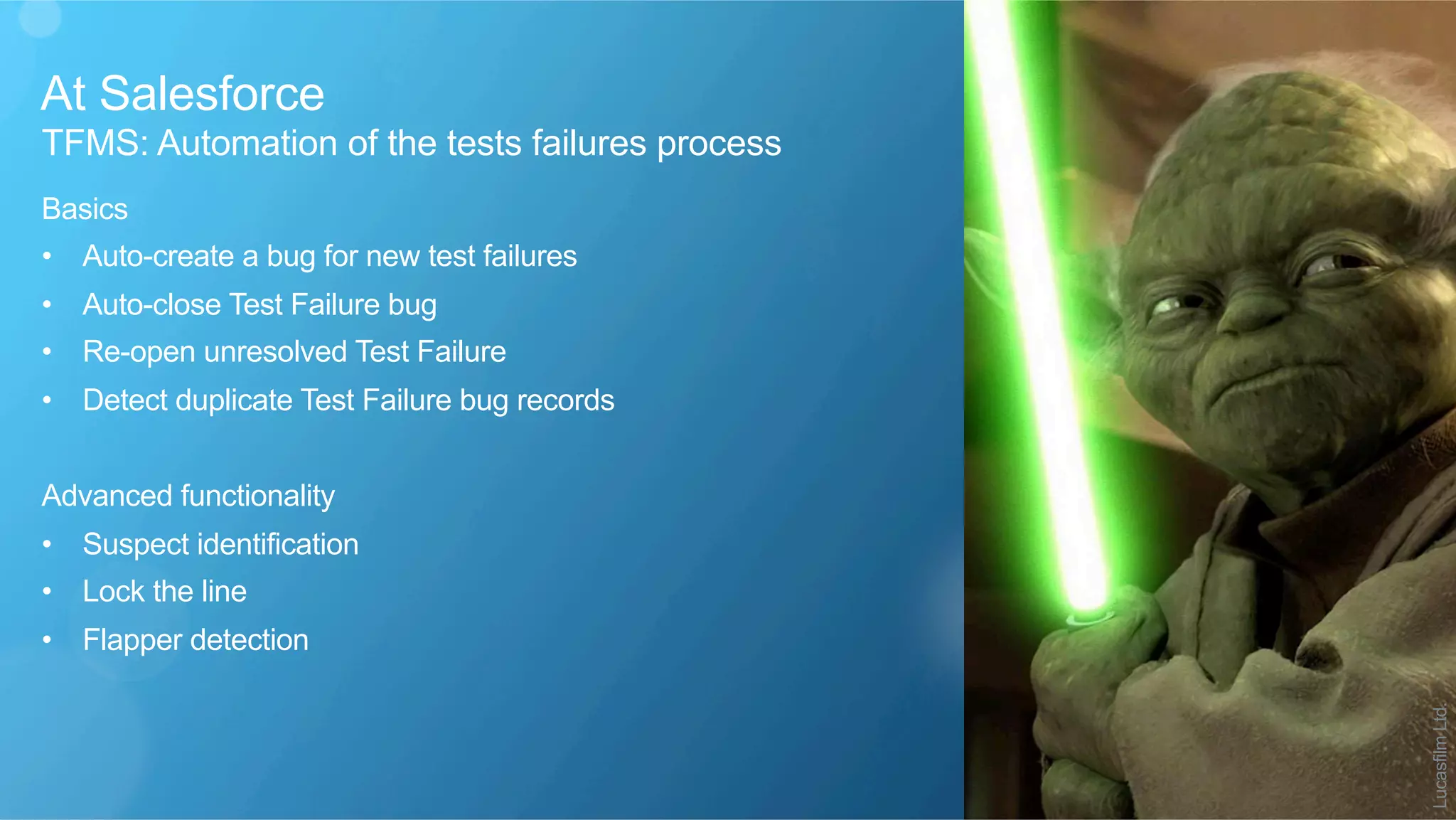
At Salesforce
​ TFMS: Automation of the tests failures process
​ Basics
•  Auto-create a bug for new test failures
•  Auto-close Test Failure bug
•  Re-open unresolved Test Failure
•  Detect duplicate Test Failure bug records
​ Advanced functionality
•  Suspect identification
•  Lock the line
•  Flapper detection
LucasfilmLtd.
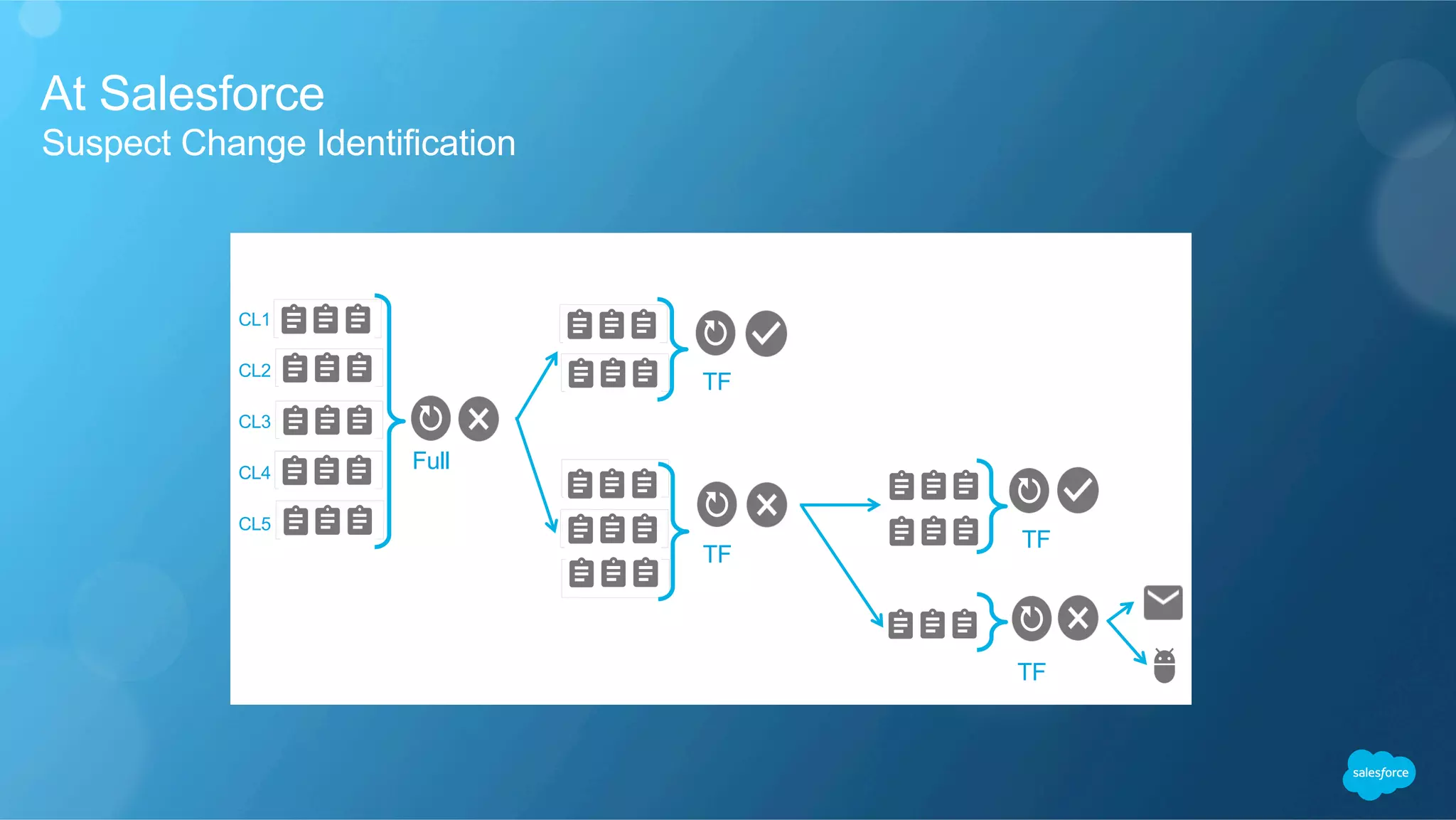
At Salesforce
​ Suspect Change Identification
Full
TF
TF
TF
TF
CL1
CL2
CL5
CL4
CL3
At Salesforce
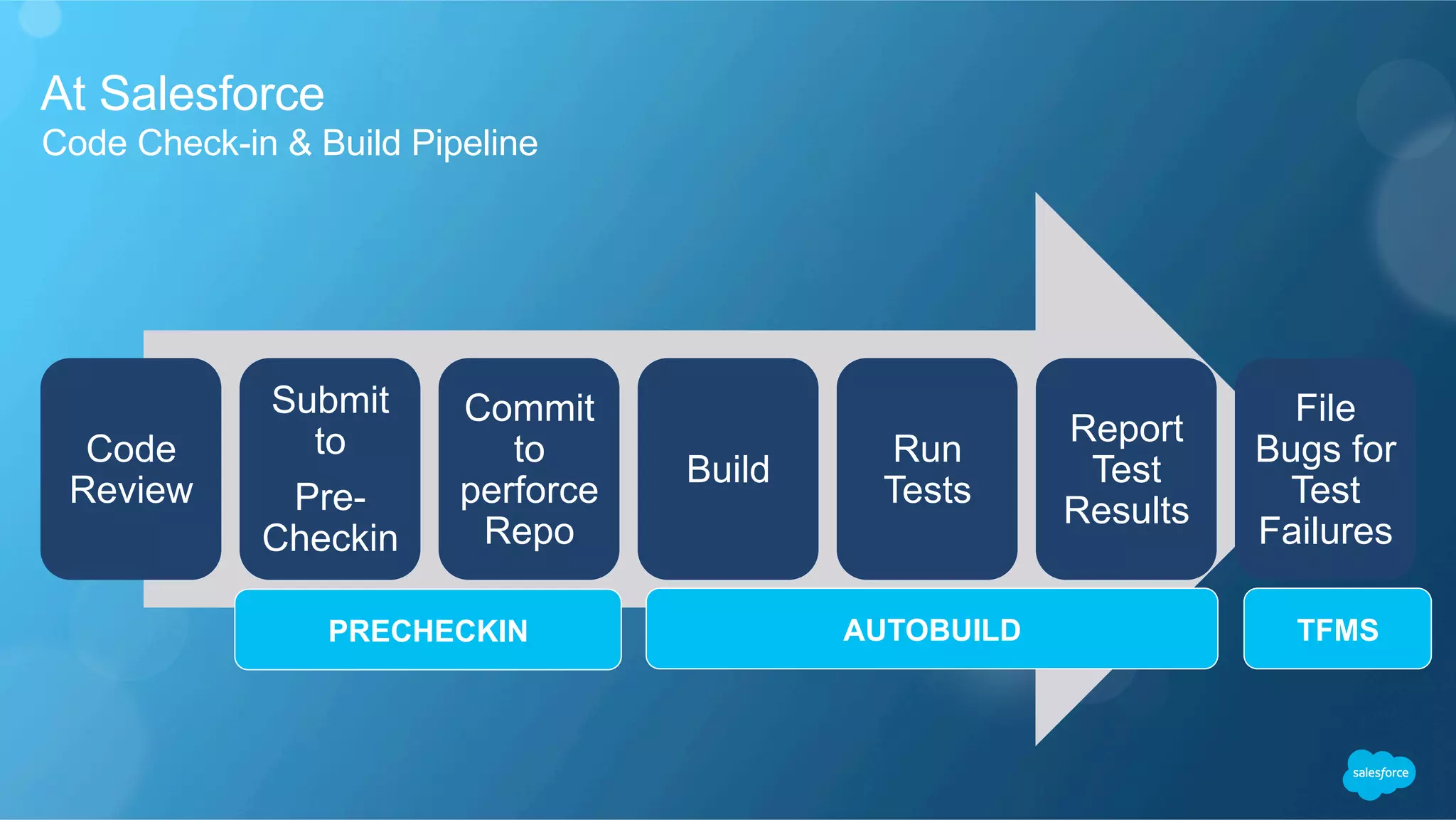
​ Code Check-in & Build Pipeline
Code
Review
Submit
to
Pre-
Checkin
Commit
to
perforce
Repo
Build
Run
Tests
Report
Test
Results
File
Bugs for
Test
Failures
PRECHECKIN AUTOBUILD TFMS
At Salesforce
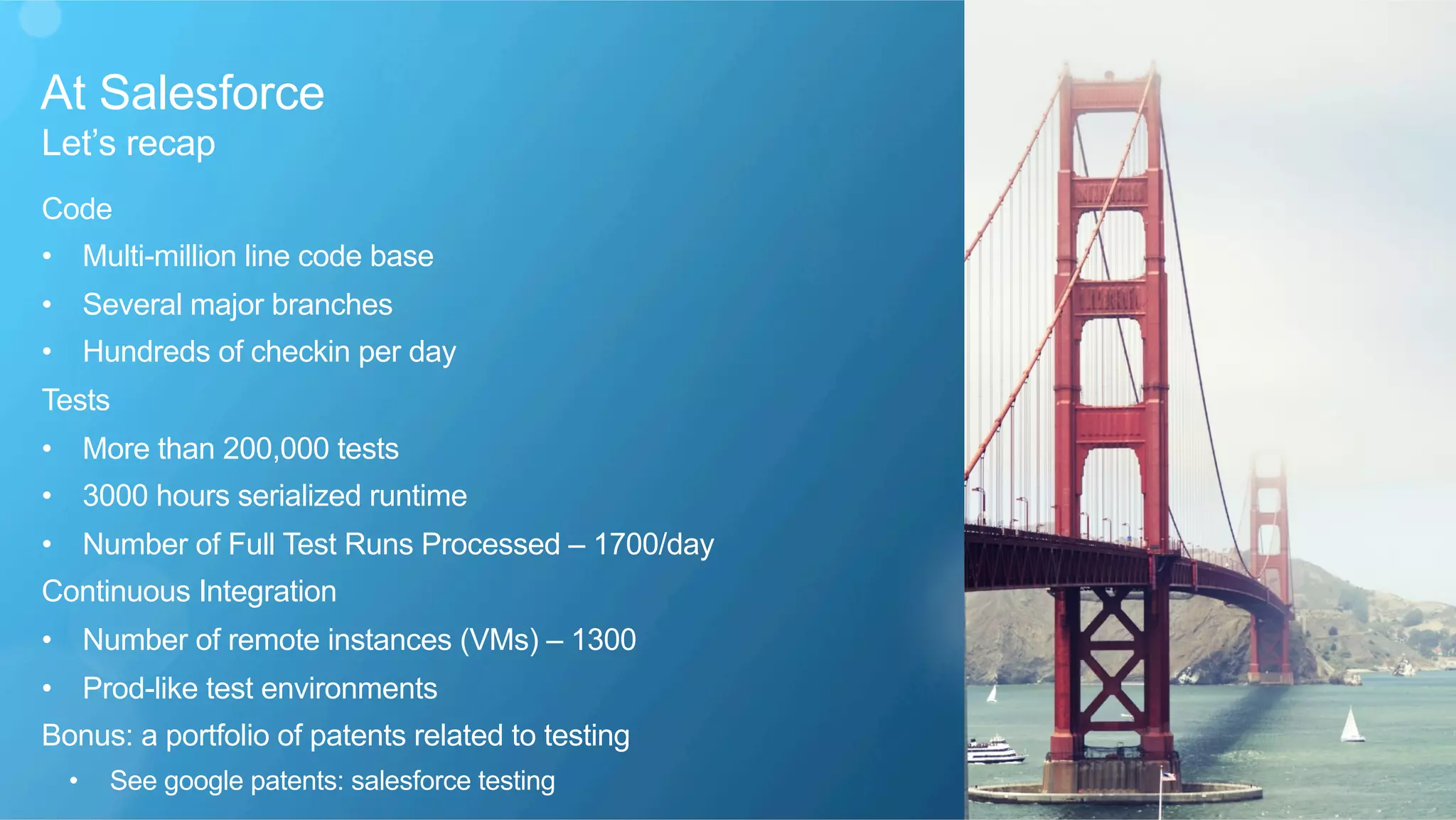
​ Let’s recap
Code
•  Multi-million line code base
•  Several major branches
•  Hundreds of checkin per day
Tests
•  More than 200,000 tests
•  3000 hours serialized runtime
•  Number of Full Test Runs Processed – 1700/day
Continuous Integration
•  Number of remote instances (VMs) – 1300
•  Prod-like test environments
Bonus: a portfolio of patents related to testing
•  See google patents: salesforce testing
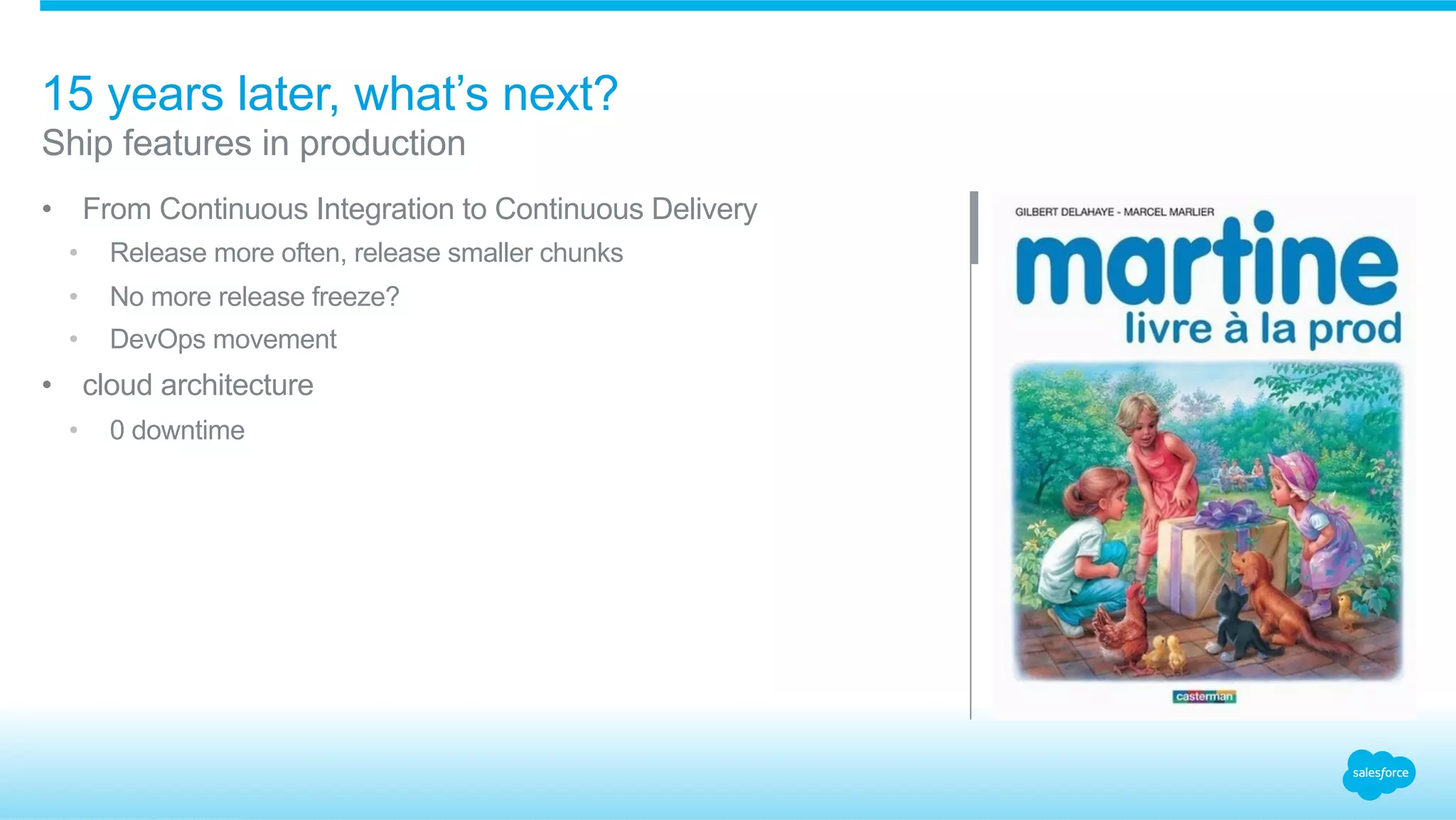
15 years later, what’s next?
•  From Continuous Integration to Continuous Delivery
•  Release more often, release smaller chunks
•  No more release freeze?
•  DevOps movement
•  cloud architecture
•  0 downtime
​ Ship features in production
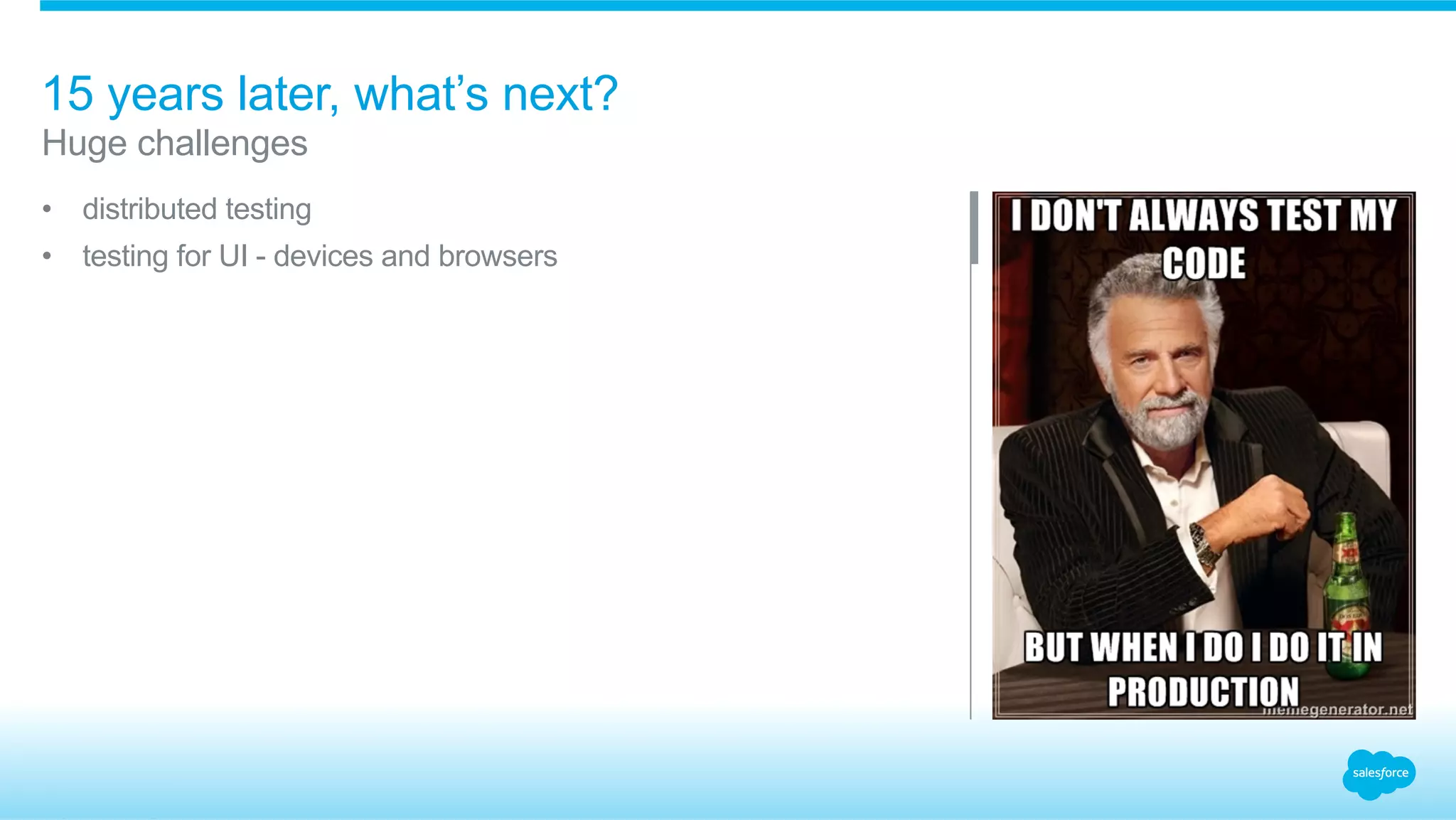
15 years later, what’s next?
•  distributed testing
•  testing for UI - devices and browsers
​ Huge challenges
Key takeaways
​ Shorten the feedback loops
•  Compilation
•  Tests
•  Customers
​ Key principles of continuous integration
•  Version Control everything
•  If it hurts, do it more frequently
•  Automate everything
​ A solution for each scale
Thank you
Resources
​ http://www.martinfowler.com/articles/continuousIntegration.html
​ http://continuousdelivery.com/

A Story of Continuous Integration

  • 1.
    A Story ofContinuous Integration jcharlety@salesforce.com cmourot@salesforce.com
  • 2.
  • 3.
    We want totell you a success story ​ This story is a fiction. Any resemblance to actual events is purely coincidental. 6 months 12 months 18 months 3 years 5 years 10 years time
  • 4.
    Once upon atime… •  Class Project •  2 people •  USB keys / shared drive •  < 100 tests •  because the teachers wanted some tests •  coded the last day •  manual execution
  • 5.
    At the beginning… ​ Howeffectively share the code •  Use a Version Control System (VCS) ​ How often run the tests? •  Let’s nominate a “build master”! ​ Let’s meet your uncle to get some love money ($) ​ x100 ​ x3 I’m not able to start the server! Who has got the last version of the code? !
  • 6.
    Sharing the code mainlinea1a3 a1 a a2 a3 integration commit, checkin build ok build: compile+test file sync, update codeline
  • 7.
    At Salesforce more than1000 engineers one codeline (almost) 150+ scrum teams more than 15 locations
  • 8.
    Demo to abusiness angel ($$) 6 months later… ​ x500 I worked all night to fix your $@!#% bugs! ​ x10 ​ x1 It has not been compiling for days on my machine! Why is my feature not in the demo? I checked in yesterday! mainline Do we have tests?
  • 9.
    6 months later…the day after ​ What happened? Integration chaos ​ Let’s empower the build master! mainline asap!
  • 10.
    12 months later… ​ x1000 ​ x15 Ineed to fix a bug asap for a customer ​ x10 Damned! But I don’t want to ship all those new features mainline
  • 11.
    Let’s branch! Versioning thecode mainline v1.0 backport?
  • 12.
    Be careful whenchoosing your branching pattern! Versioning the code http://www.bradapp.com/acme/branching/branch-structs.html
  • 13.
  • 14.
    ​ v4 shipped inproduction 18 months later… ​ x2000 Customer Z is very angry with the last version: it’s buggy! ​ x20 ​ x10 Every morning, I fix the build on my machine mainline I spend all my time fixing the build Everybody is committing a lot of code, the day before the demo Build ok! Do we have tests?
  • 15.
    18 months later…the day after Automatic build •  Build server •  Run after each checkin •  Compile + Tests + Alert Everyone is responsible for the build •  Don’t break the build! •  No more buildmaster Scope/Time/Quality mainline
  • 16.
    At Salesforce ​ Quality :the triangle ​ Time and Quality are always fixed •  Milestone/Release dates never change •  Feature & Release Signoff requirements are quantifiable and deterministic ​ Scope is the only thing that you can change •  Team cuts features to meet FF/RF signoff requirements Scope Time Quality Planned Scope Actual Scope
  • 17.
    3 years later… ​ x5000 ​ x35 Buildlast more than 2 hours ! ​ x100 mainline 3 days to get the build results! Are you kidding me? What? I thought we had continuous integration! The build is broken all the time!
  • 18.
    •  How tospeed up the build? •  Buy a faster server •  Buy more servers •  Break in different chunks •  Build stage •  Test types •  Choice •  After each commit, compile only •  Run the basic tests twice a day •  Run the extended each night Let’s scale
  • 19.
    At Salesforce ​ As ofQ2 2013 (20%) UI Tests Functional Tests (70%) Unit Tests (5%) Type Of Test   Number of Tests   Unit Test   12 000+   Basic Functional   20 000+   Full Functional   140 000+   Extended Functional   25 000+   Basic UI   500+   Full UI   40 000+   Extended UI   10 000+  
  • 20.
    •  How tonot break the build? •  Unbreakable build •  How to speed up test execution? •  Add more servers to run in // •  Who broke the tests? •  Nominate a buildmaster to create bugs and assign them to the suspects ​ Just bought another company in the US 5 years later… ​ x20k ​ x110 I’m always fixing the build because the other team broke it! ​ x300 When is the night? The nightly build lasts 3 days More than 2000 tests are failing!
  • 21.
    •  automatic compilationof changes before check-in •  basic tests run for each checkin •  extended tests run on a regular basis ​  Precheckin The Unbreakable Build - UNBREAKABLE - mainline
  • 22.
    •  Who brokethe tests? •  Who is responsible to fix the tests? •  How to handle flappy tests? It’s time to automate the tests failures process! ​ Growing, growing, growing! 10 years later… ​ x200k ​ x1000 My team delivers new features, doesn’t fix test! More than 8000 tests are failing!​ x300 Tests are ok on my machine, they are failing on the servers
  • 23.
    At Salesforce ​ TFMS: Automationof the tests failures process ​ Basics •  Auto-create a bug for new test failures •  Auto-close Test Failure bug •  Re-open unresolved Test Failure •  Detect duplicate Test Failure bug records ​ Advanced functionality •  Suspect identification •  Lock the line •  Flapper detection LucasfilmLtd.
  • 24.
    At Salesforce ​ Suspect ChangeIdentification Full TF TF TF TF CL1 CL2 CL5 CL4 CL3
  • 25.
    At Salesforce ​ Code Check-in& Build Pipeline Code Review Submit to Pre- Checkin Commit to perforce Repo Build Run Tests Report Test Results File Bugs for Test Failures PRECHECKIN AUTOBUILD TFMS
  • 26.
    At Salesforce ​ Let’s recap Code • Multi-million line code base •  Several major branches •  Hundreds of checkin per day Tests •  More than 200,000 tests •  3000 hours serialized runtime •  Number of Full Test Runs Processed – 1700/day Continuous Integration •  Number of remote instances (VMs) – 1300 •  Prod-like test environments Bonus: a portfolio of patents related to testing •  See google patents: salesforce testing
  • 27.
    15 years later,what’s next? •  From Continuous Integration to Continuous Delivery •  Release more often, release smaller chunks •  No more release freeze? •  DevOps movement •  cloud architecture •  0 downtime ​ Ship features in production
  • 28.
    15 years later,what’s next? •  distributed testing •  testing for UI - devices and browsers ​ Huge challenges
  • 29.
    Key takeaways ​ Shorten thefeedback loops •  Compilation •  Tests •  Customers ​ Key principles of continuous integration •  Version Control everything •  If it hurts, do it more frequently •  Automate everything ​ A solution for each scale
  • 30.
  • 31.