Fundamental Concepts
of International Politics
Spring 2013
Prof. H. Steven Green
Toyo University
Faculty of Law
Class 5,Lecture 6
May 11th, 2015
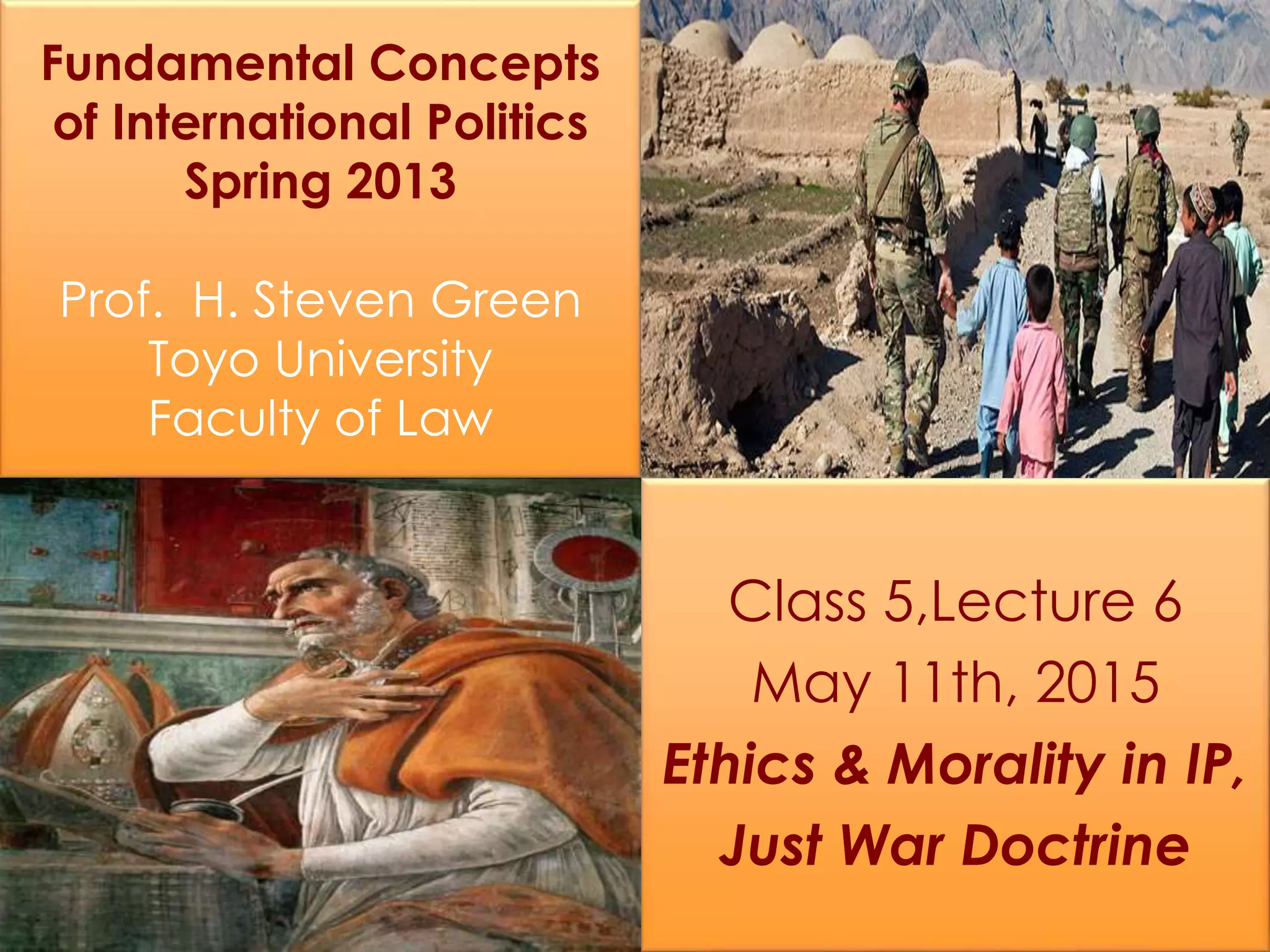
Ethics & Morality in IP,
Just War Doctrine
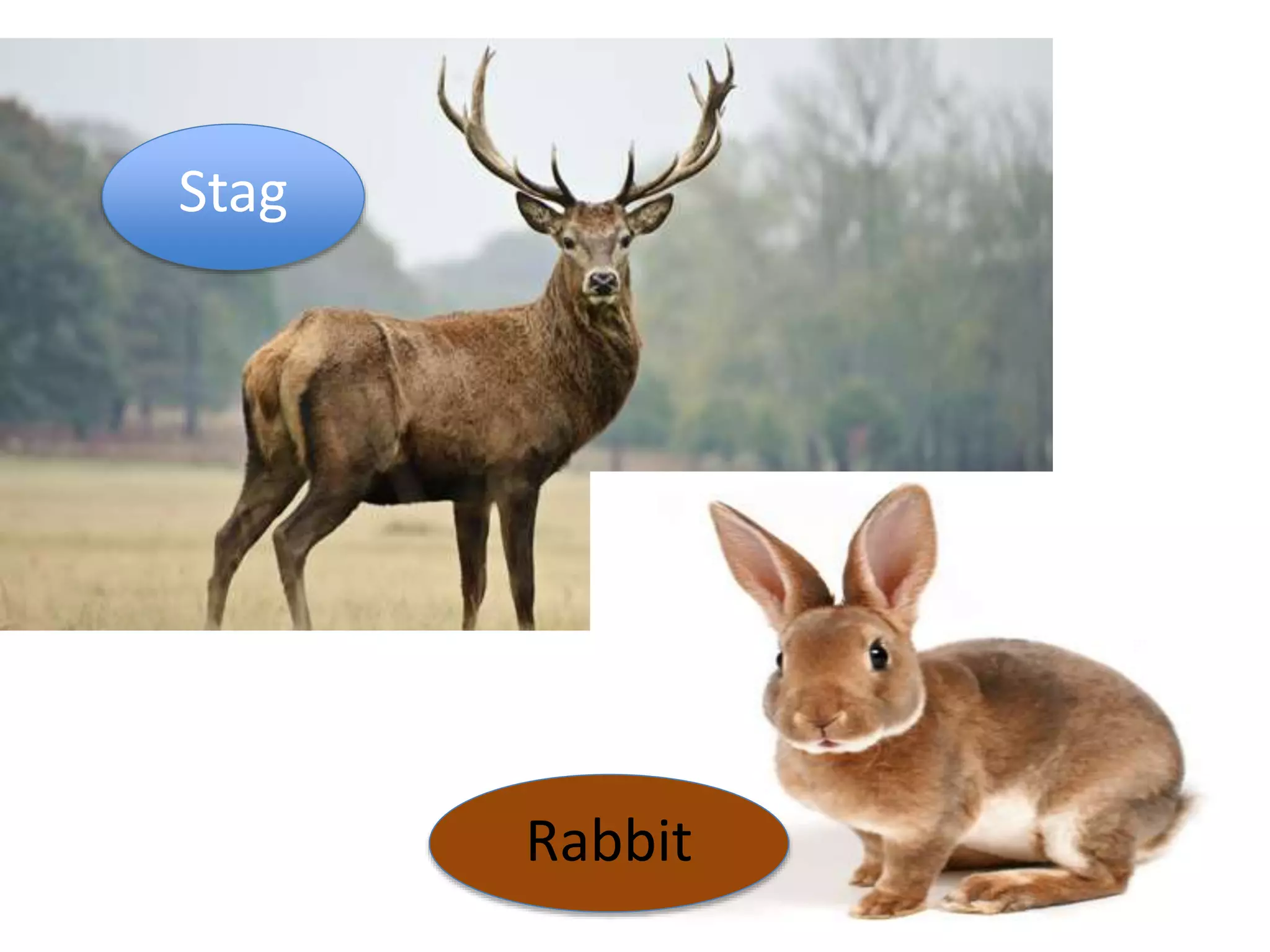
Stag
Rabbit
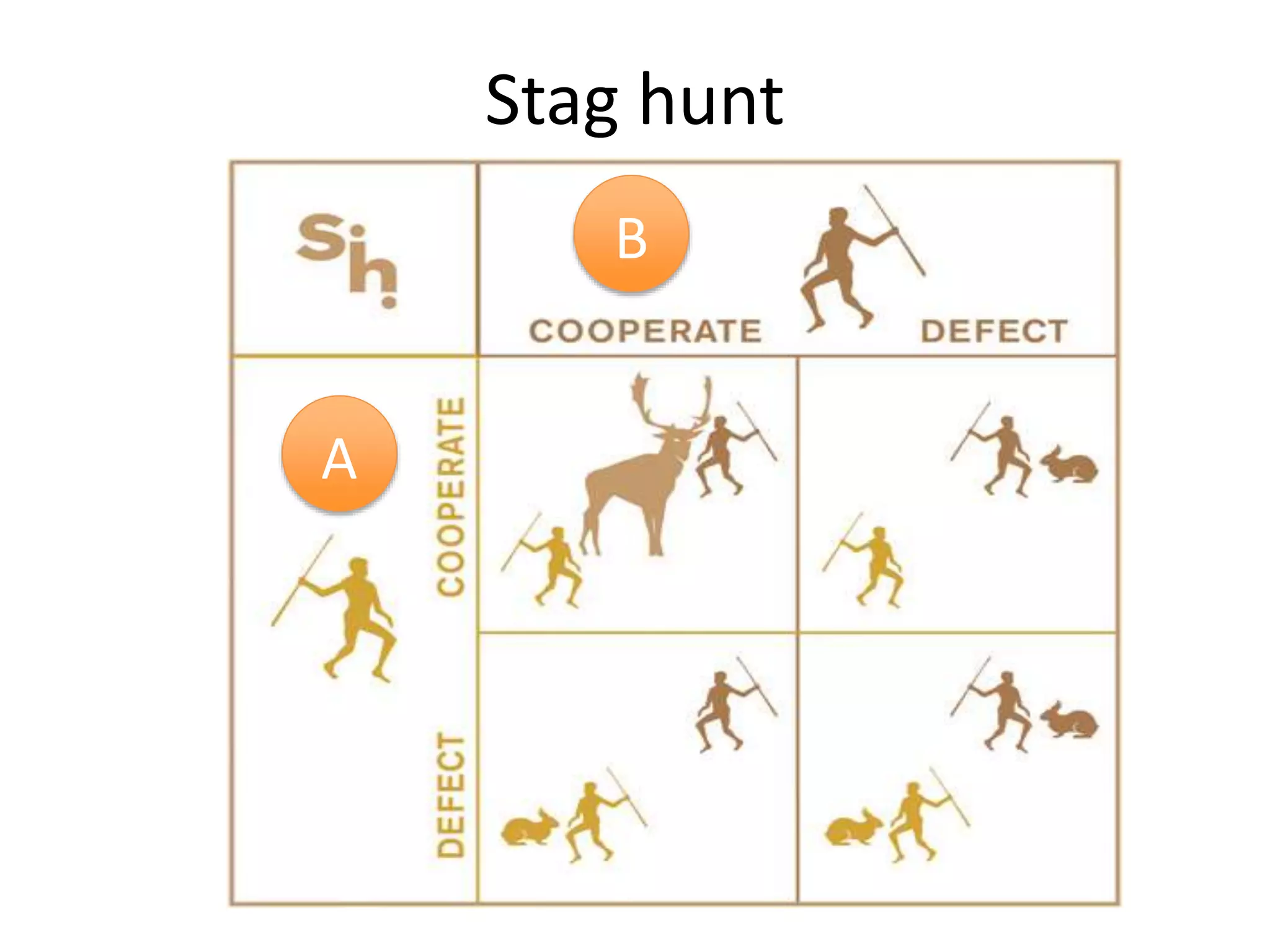
Stag Hunt
• Two hunters can either hunt one stag together or
hunt rabbits separately.
• Stags provide more food, but...
• Hunting a stag is difficult and requires patience and
cooperation.
• It is easy to catch a rabbit, but the rabbit provides
less food.
• The hunters must cooperate to get the most food.
Stag Hunt
• Cooperation requires patience and trust.
• Patience: The hunters must wait quietly for a very
long time until a stag comes.
• Trust: It is easy to catch a rabbit, so it is tempting to
quit waiting, hunt a rabbit and enjoy the rest of the
day.
Stag hunt
B
A
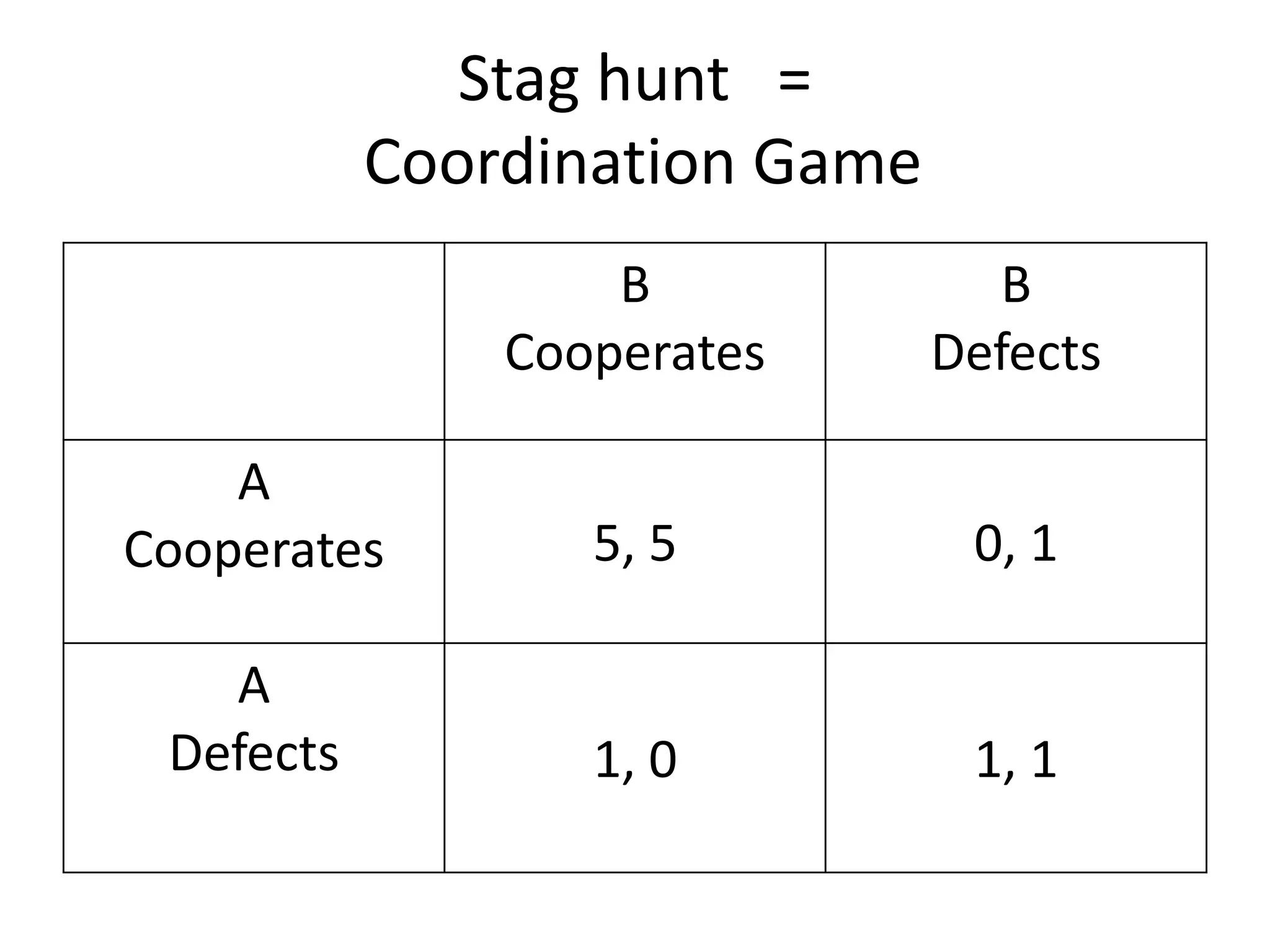
Stag hunt =
Coordination Game
B
Cooperates
B
Defects
A
Cooperates 5, 5 0, 1
A
Defects 1, 0 1, 1
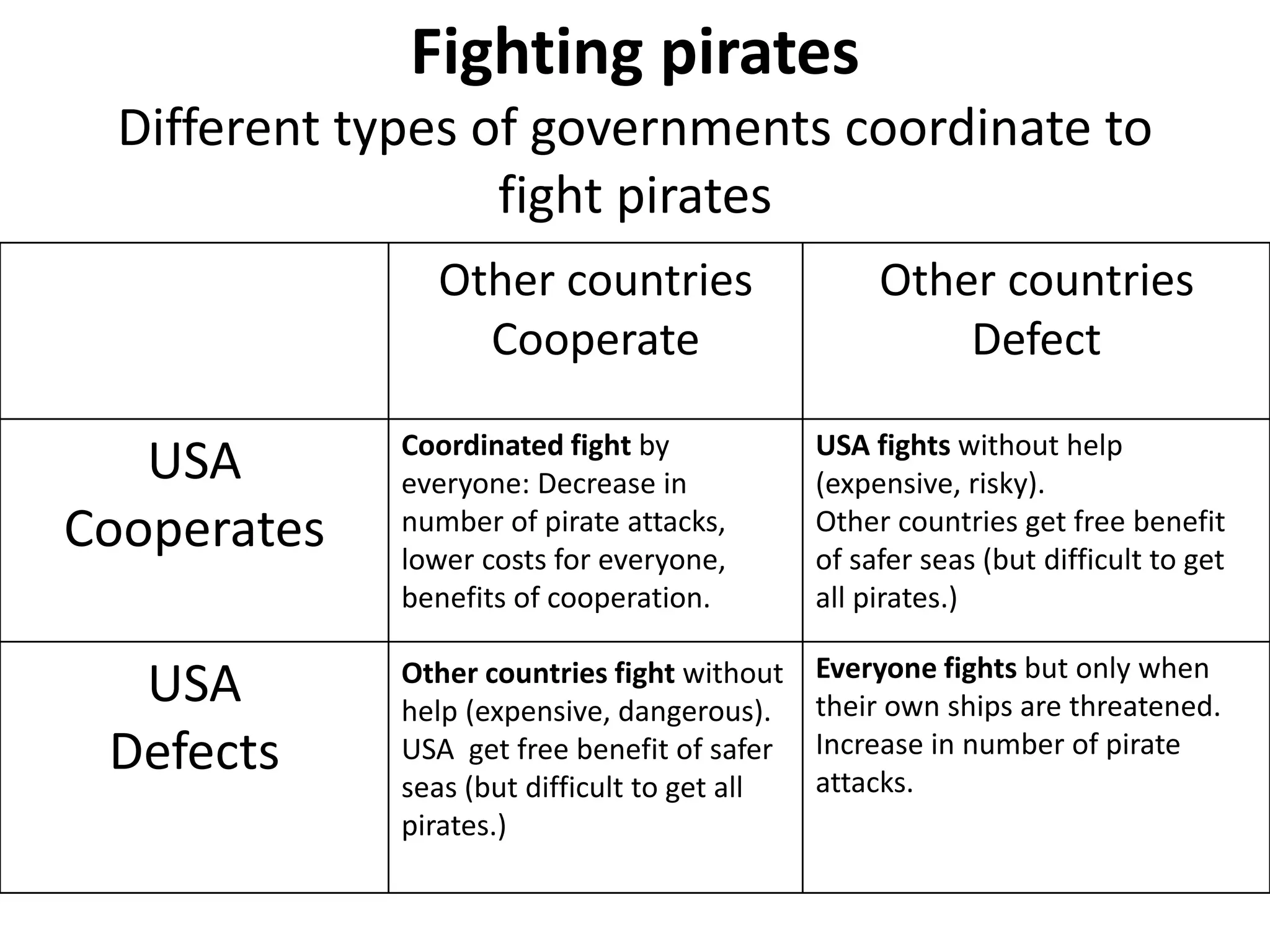
Fighting pirates
Different types of governments coordinate to
fight pirates
Other countries
Cooperate
Other countries
Defect
USA
Cooperates
Coordinated fight by
everyone: Decrease in
number of pirate attacks,
lower costs for everyone,
benefits of cooperation.
USA fights without help
(expensive, risky).
Other countries get free benefit
of safer seas (but difficult to get
all pirates.)
USA
Defects
Other countries fight without
help (expensive, dangerous).
USA get free benefit of safer
seas (but difficult to get all
pirates.)
Everyone fights but only when
their own ships are threatened.
Increase in number of pirate
attacks.
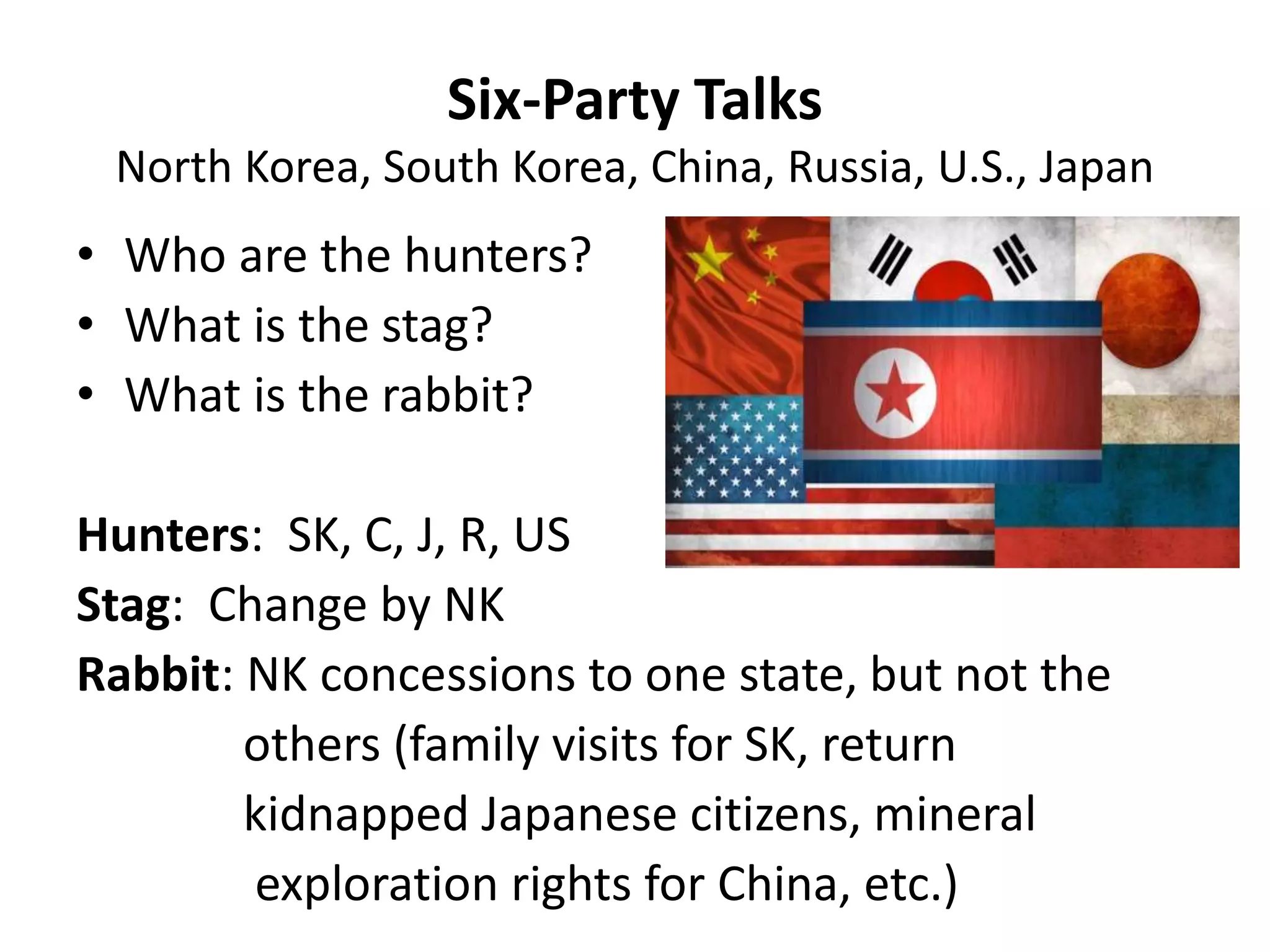
Six-Party Talks*
North Korea, South Korea, China, Russia, U.S., Japan
• Who are the hunters?
• What is the stag?
• What is the rabbit?
Hunters: SK, C, J, R, US
Stag: Change by NK
Rabbit: NK concessions to one state, but not the
others (family visits for SK, return
kidnapped Japanese citizens, mineral
exploration rights for China, etc.)
*Slides 8-10: CREDIT TO ROBERT KELLEY
https://asiansecurityblog.wordpress.com/2010/04/26/six-party-talks-
as-a-game-theoretic-stag-hunt-1-n-korea-is-the-stag/
Six-Party Talks
North Korea, South Korea, China, Russia, U.S., Japan
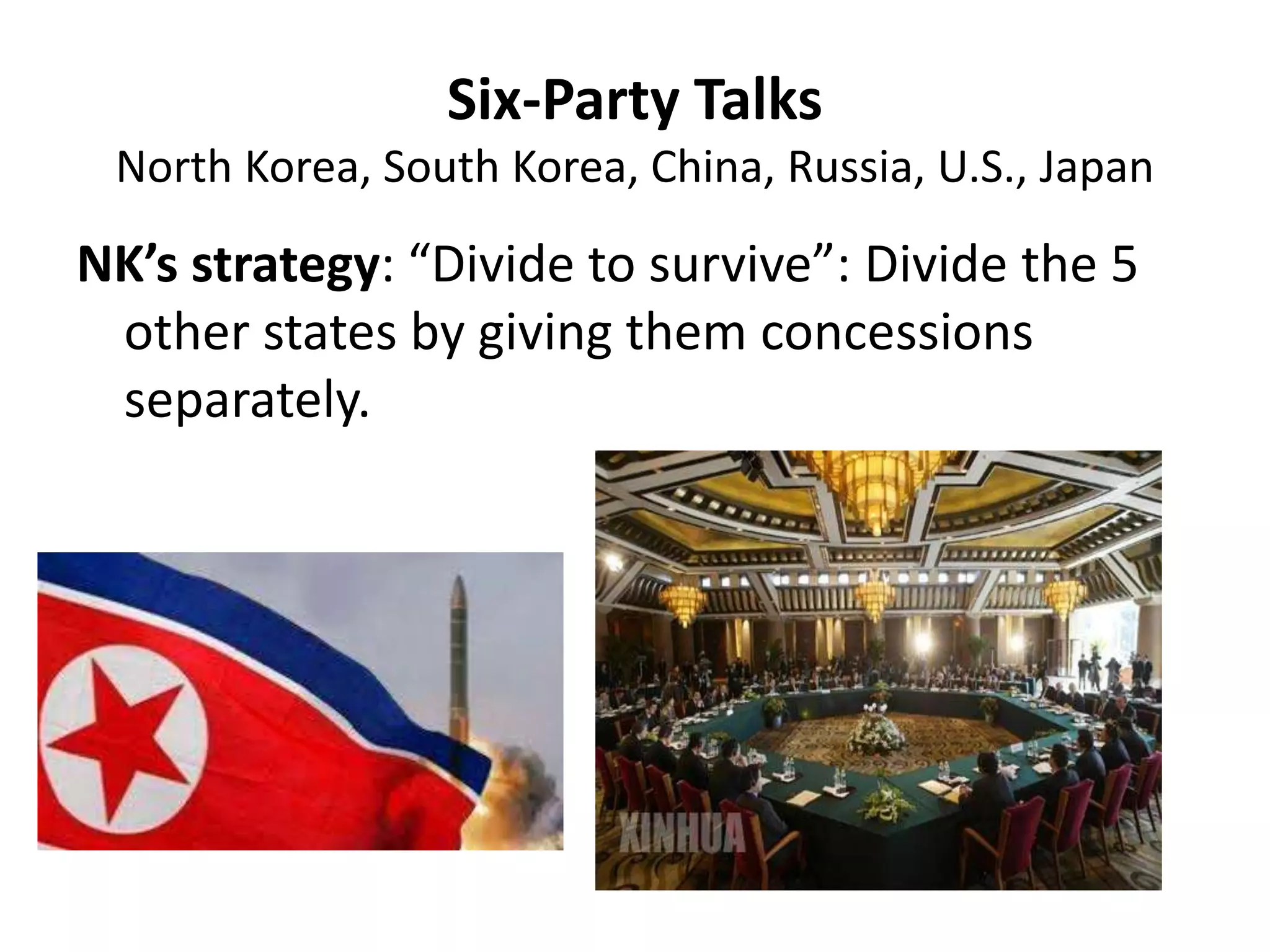
NK’s strategy: “Divide to survive”: Divide the 5
other states by giving them concessions
separately.
Six-Party Talks
North Korea, South Korea, China, Russia, U.S., Japan
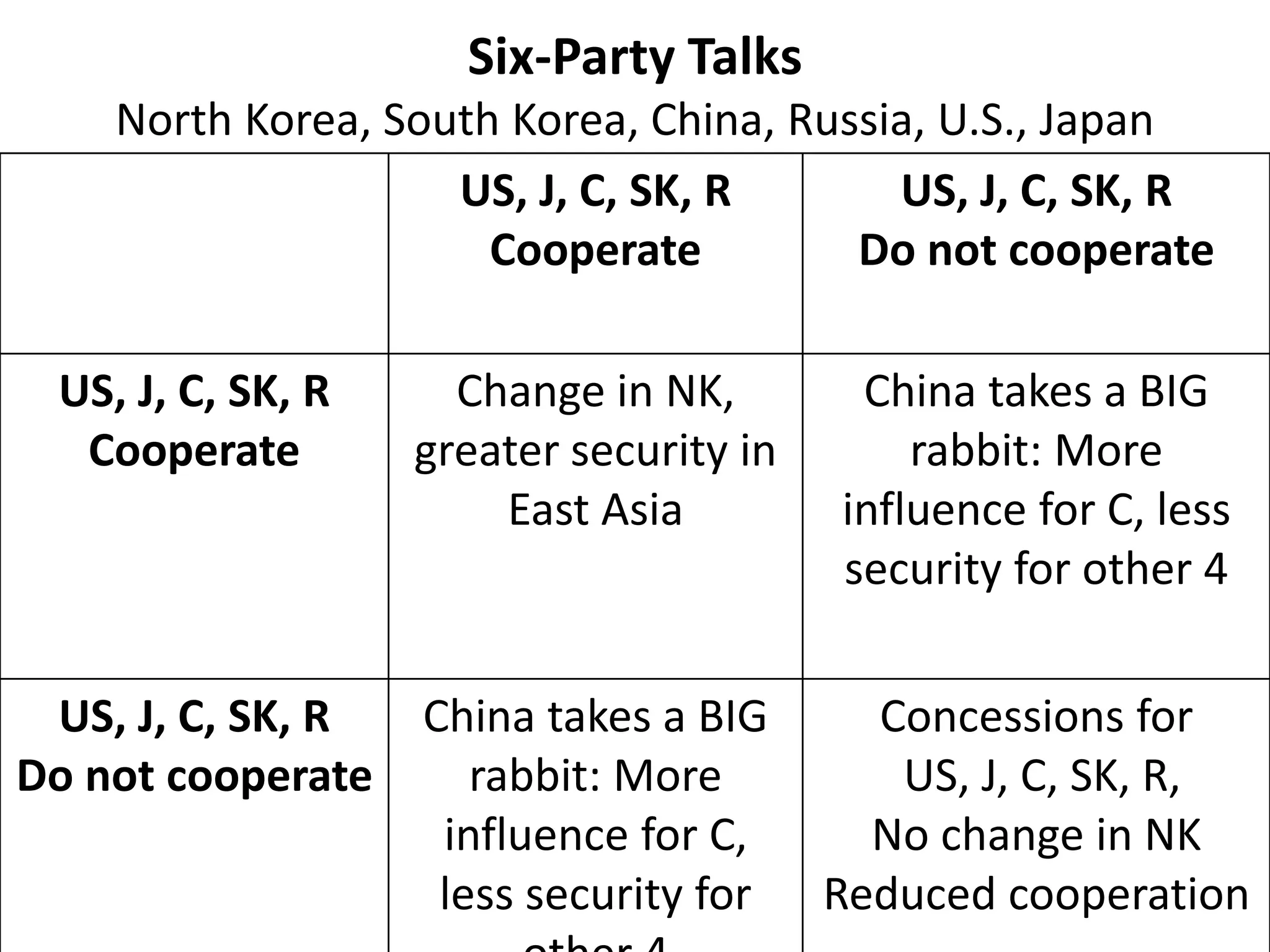
US, J, C, SK, R
Cooperate
US, J, C, SK, R
Do not cooperate
US, J, C, SK, R
Cooperate
Change in NK,
greater security in
East Asia
China takes a BIG
rabbit: More
influence for C, less
security for other 4
US, J, C, SK, R
Do not cooperate
China takes a BIG
rabbit: More
influence for C,
less security for
Concessions for
US, J, C, SK, R,
No change in NK
Reduced cooperation
Six-Party Talks
North Korea, South Korea, China, Russia, U.S., Japan
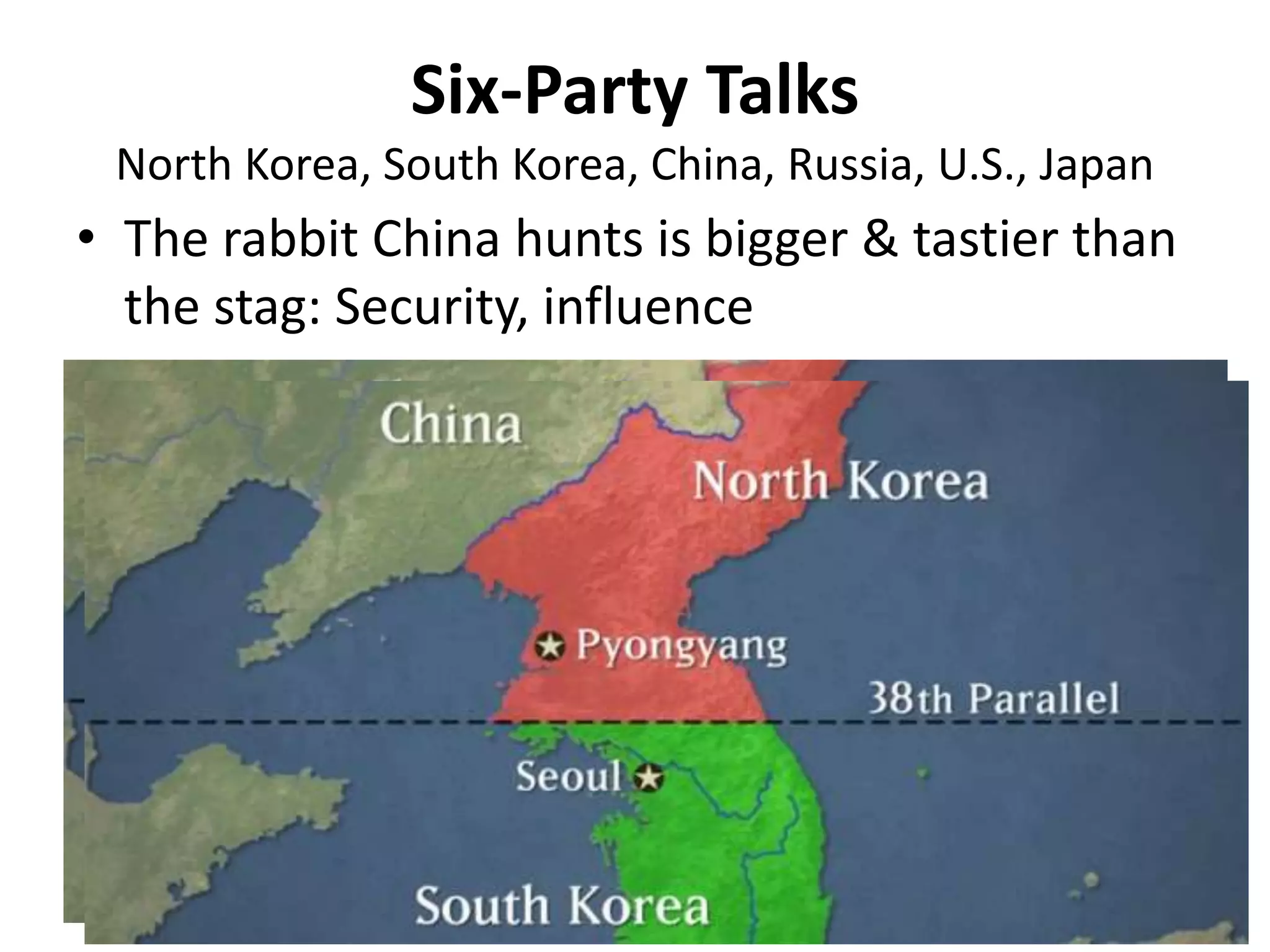
• The rabbit China hunts is bigger & tastier than
the stag: Security, influence
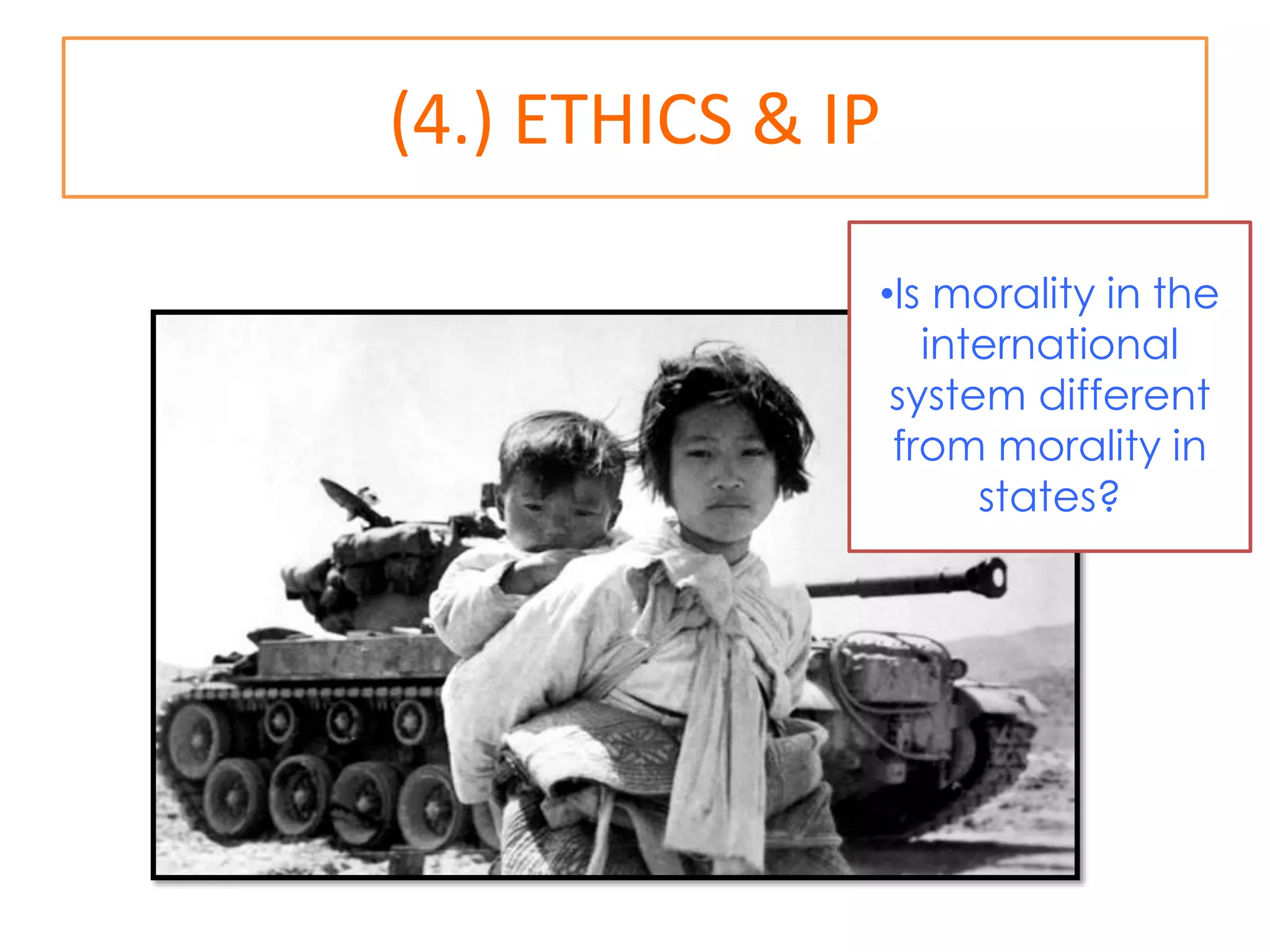
(4.) ETHICS & IP
•Is morality in the
international
system different
from morality in
states?
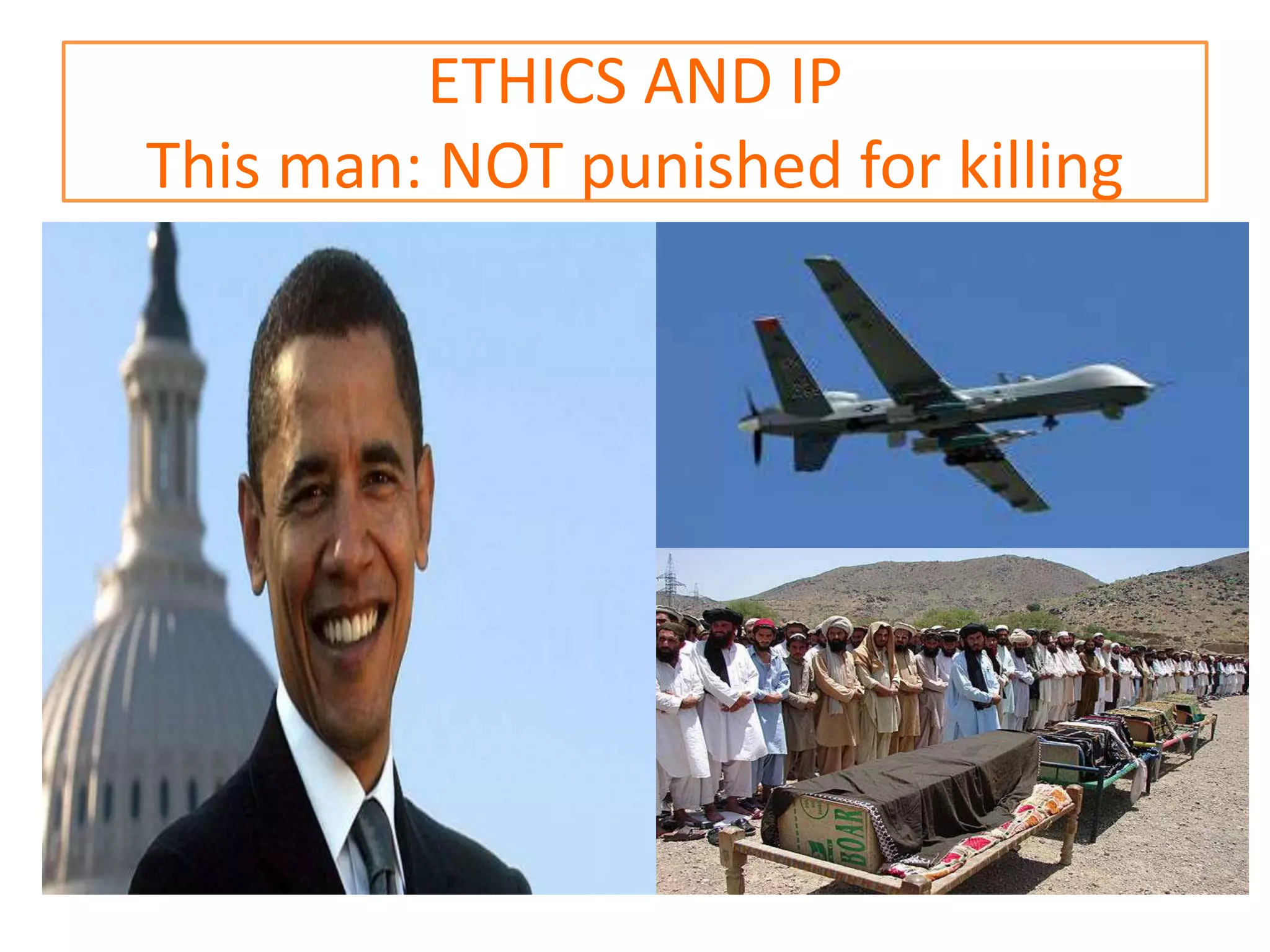
ETHICS AND IP
This man: NOT punished for killing
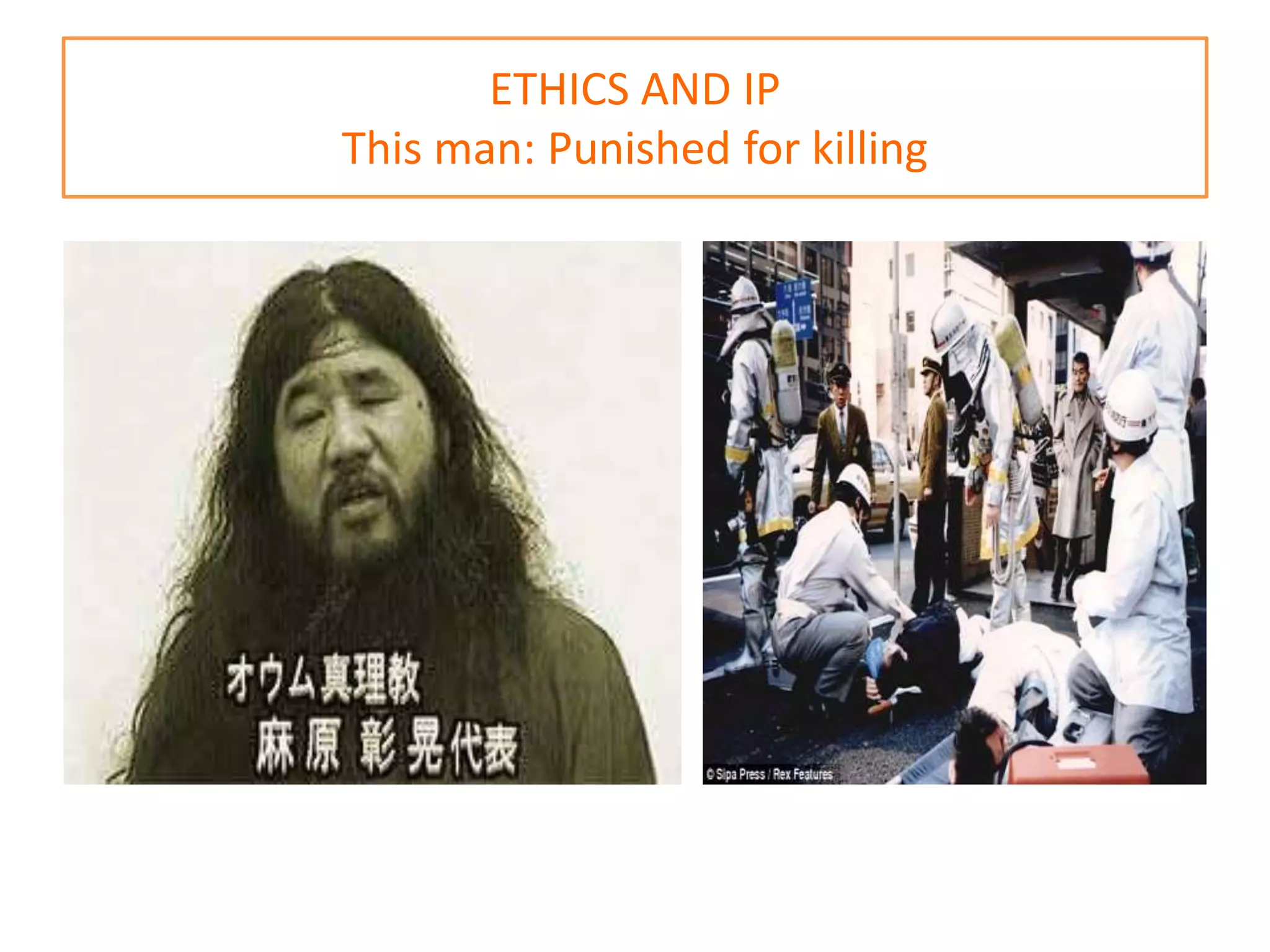
ETHICS AND IP
This man: Punished for killing
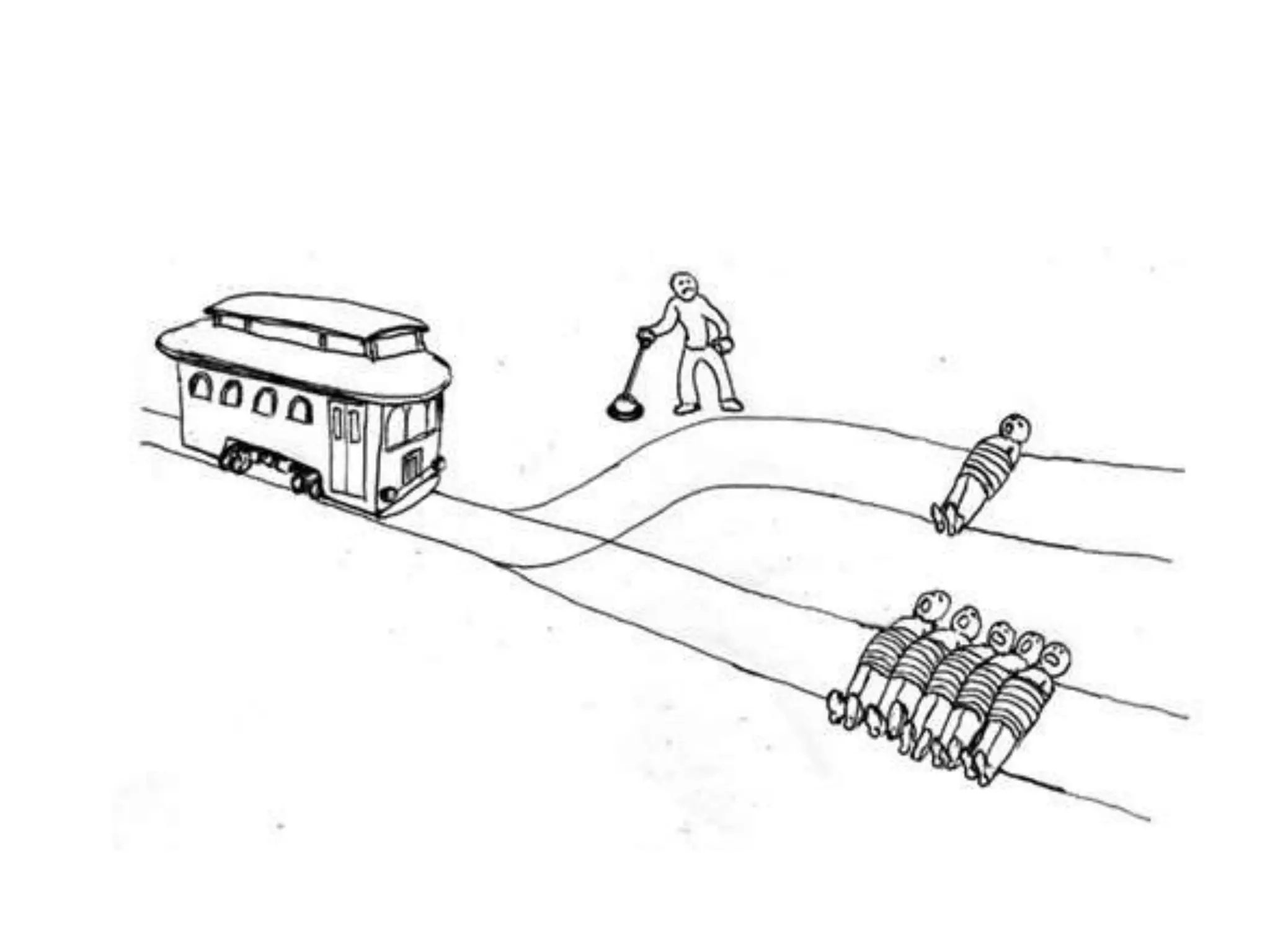
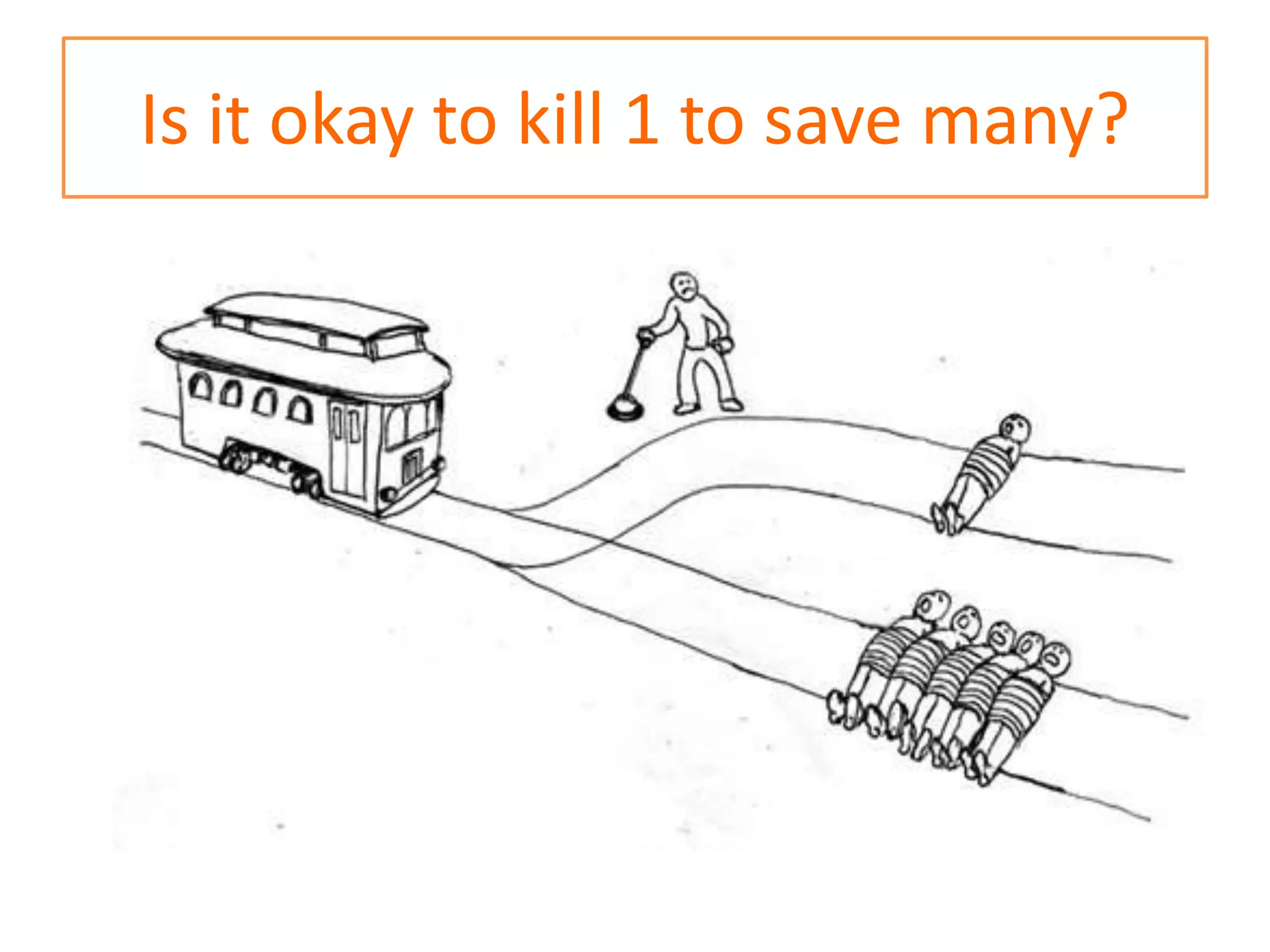
Is it okay to kill 1 to save many?
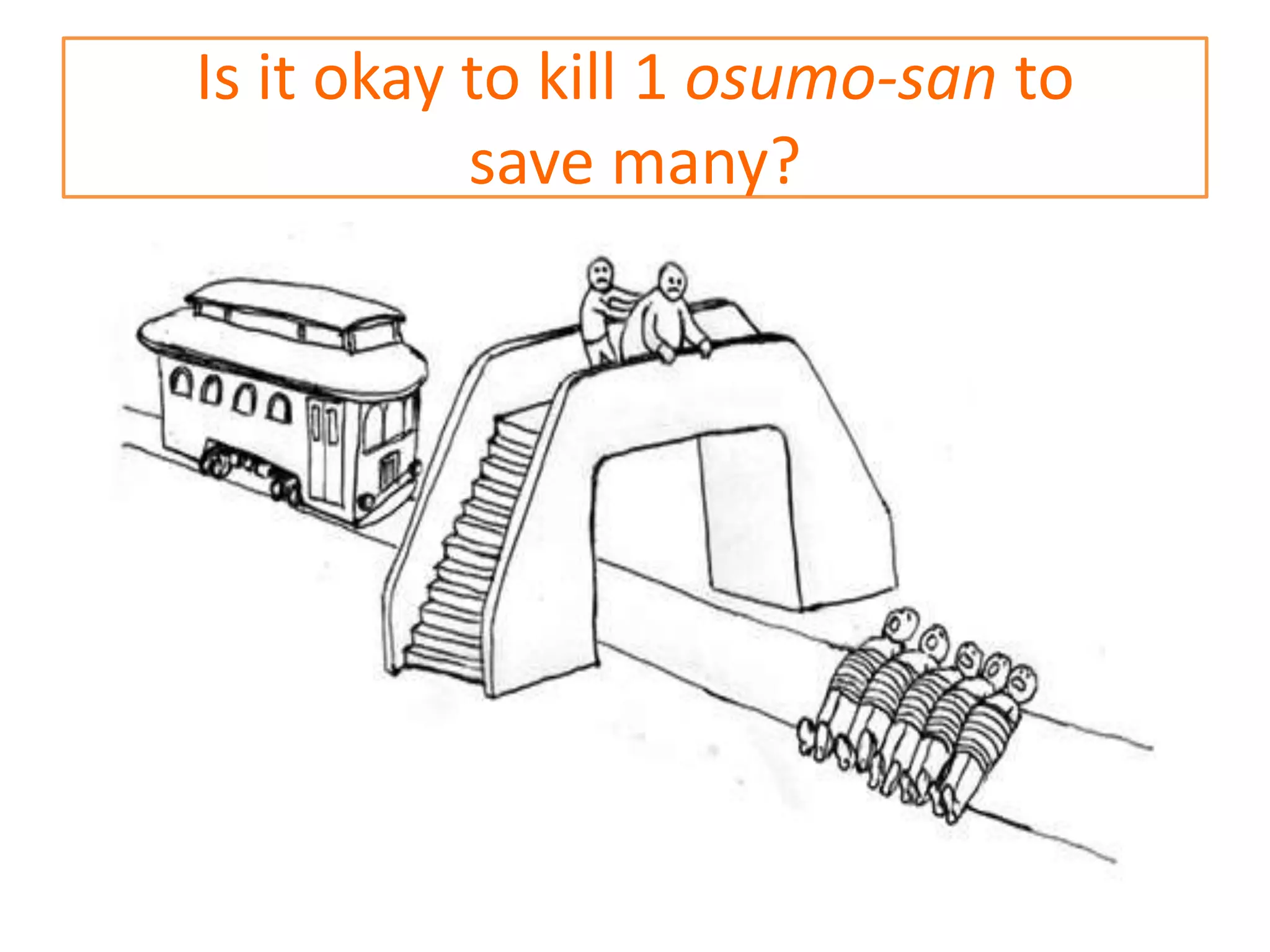
Is it okay to kill 1 osumo-san to
save many?
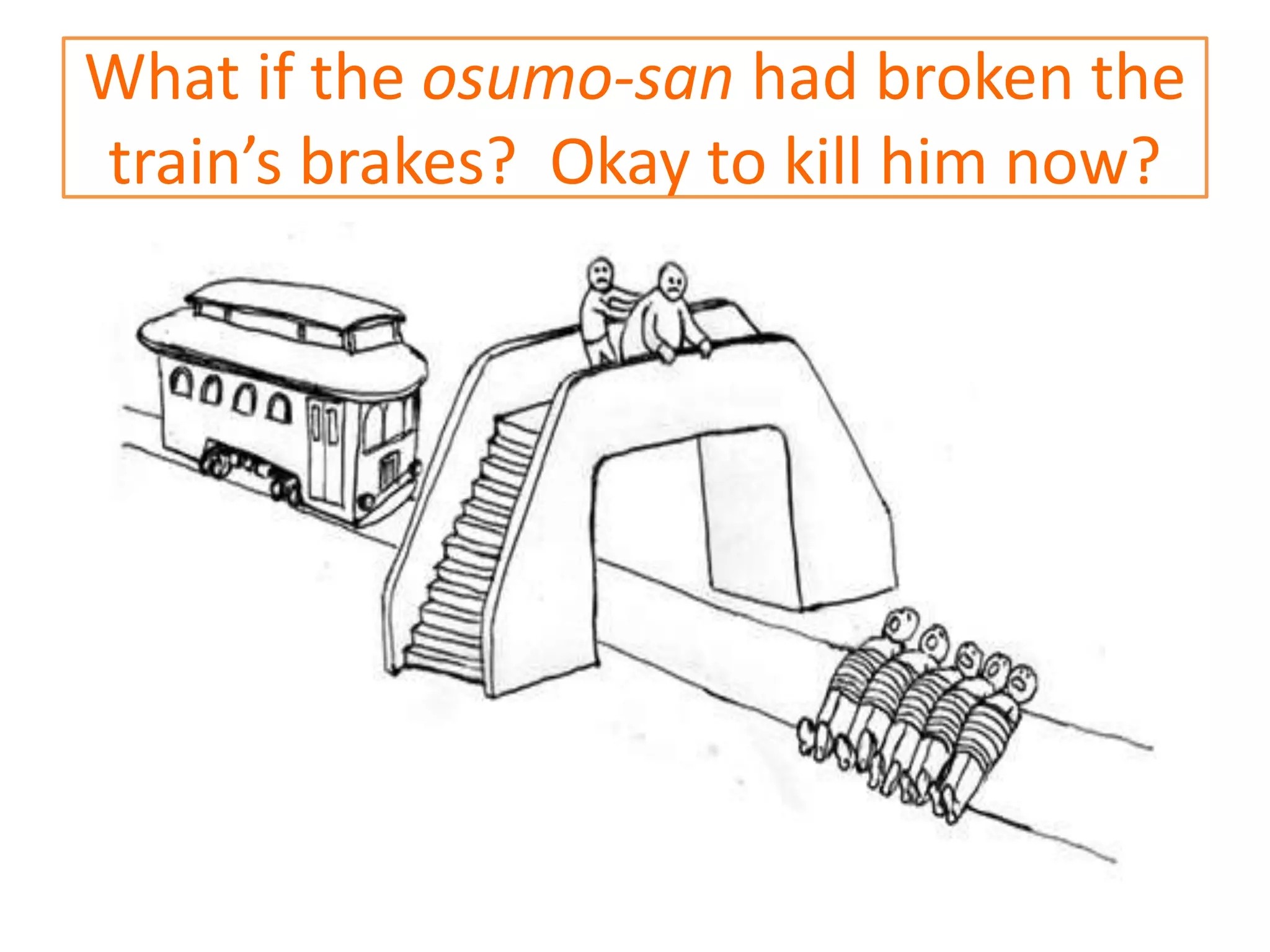
What if the osumo-san had broken the
train’s brakes? Okay to kill him now?
ETHICS AND IP
Ethics in international politics ARE not the same
as ethics in domestic politics
• Is it wrong to kill 1 person in order to save
100?
• Is it wrong to kill one person who has a bomb
that will destroy Tokyo?
• Is it wrong to kill many people in order to save
your country or to stop genocide (大虐殺)?
DISCUSSION
What are FOUR reasons why ethics play less of a
role in IP than in domestic politics?
ETHICS AND IP
FOUR REASONS ETHICS PLAY LESS OF A ROLE IN
IP THAN IN DOMESTIC POLITICS
1. Weak international consensus about values
(国際的に一致した意見はない)
• Cultural and religious differences
• Examples: whaling (捕鯨), death penalty (死刑)
ETHICS AND IP
FOUR REASONS ETHICS PLAY LESS OF A ROLE IN IP
THAN IN DOMESTIC POLITICS
2. States are not individuals:
• Leaders of states are judged as leaders of states,
not as individuals (リーダは、個人ではなく、国の
リーダとして、裁かれる)
• Killing is wrong but…
• Sometimes we want our leaders to tell our army
to kill people
ETHICS AND IP
FOUR REASONS ETHICS PLAY LESS OF A ROLE IN
IP THAN IN DOMESTIC POLITICS
3. “Complexity of causation*”
Very difficult to understand which actions(行動)
cause which consequences(結果)
*causation = 原因
ETHICS AND IP
FOUR REASONS ETHICS PLAY LESS OF A ROLE IN
IP THAN IN DOMESTIC POLITICS
3. “Complexity of causation” (continued):
• 1933 Oxford debate: Students promise not to
fight for their country  Hitler thinks British
people are soft
• READ about the “hamburger argument”
ETHICS AND IP
FOUR REASONS ETHICS PLAY LESS OF A ROLE IN
IP THAN IN DOMESTIC POLITICS
4. Less order, so there is less justice in IP
• Justice (公正) requires order (秩序)
• International society does not have enough
institutions to create order (平和と秩序を維持
する国際組織はない)
The Role of Morality in IP
Which statement do you agree with and why?
A. Morality in the international system should
be the same as morality in our society.
B. Morality in the international system should
not be the same as morality in our society.
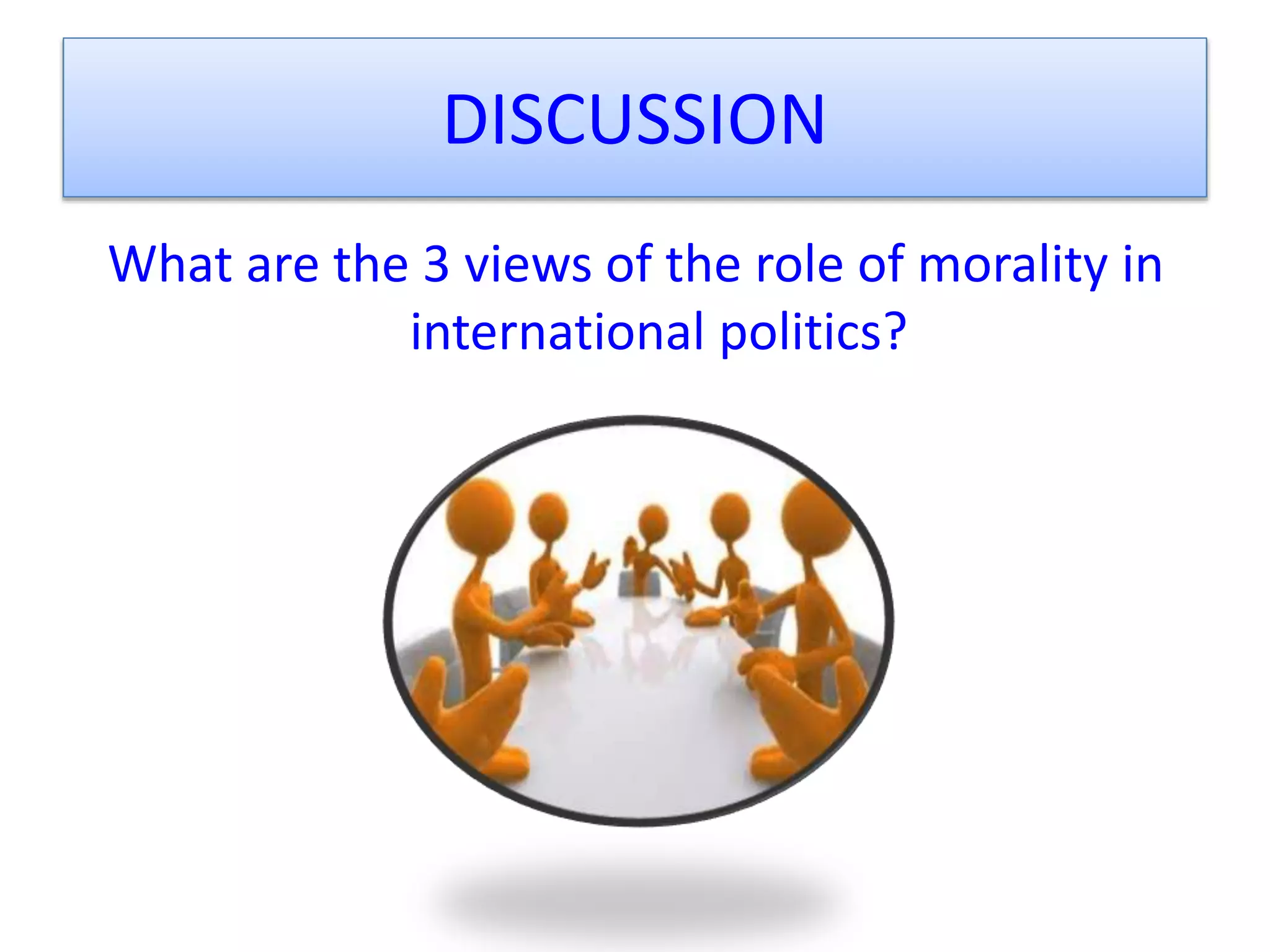
DISCUSSION
What are the 3 views of the role of morality in
international politics?
3 Views of the Role of Morality
1. SKEPTICS
2. STATE MORALISTS
3. COSMOPOLITANS
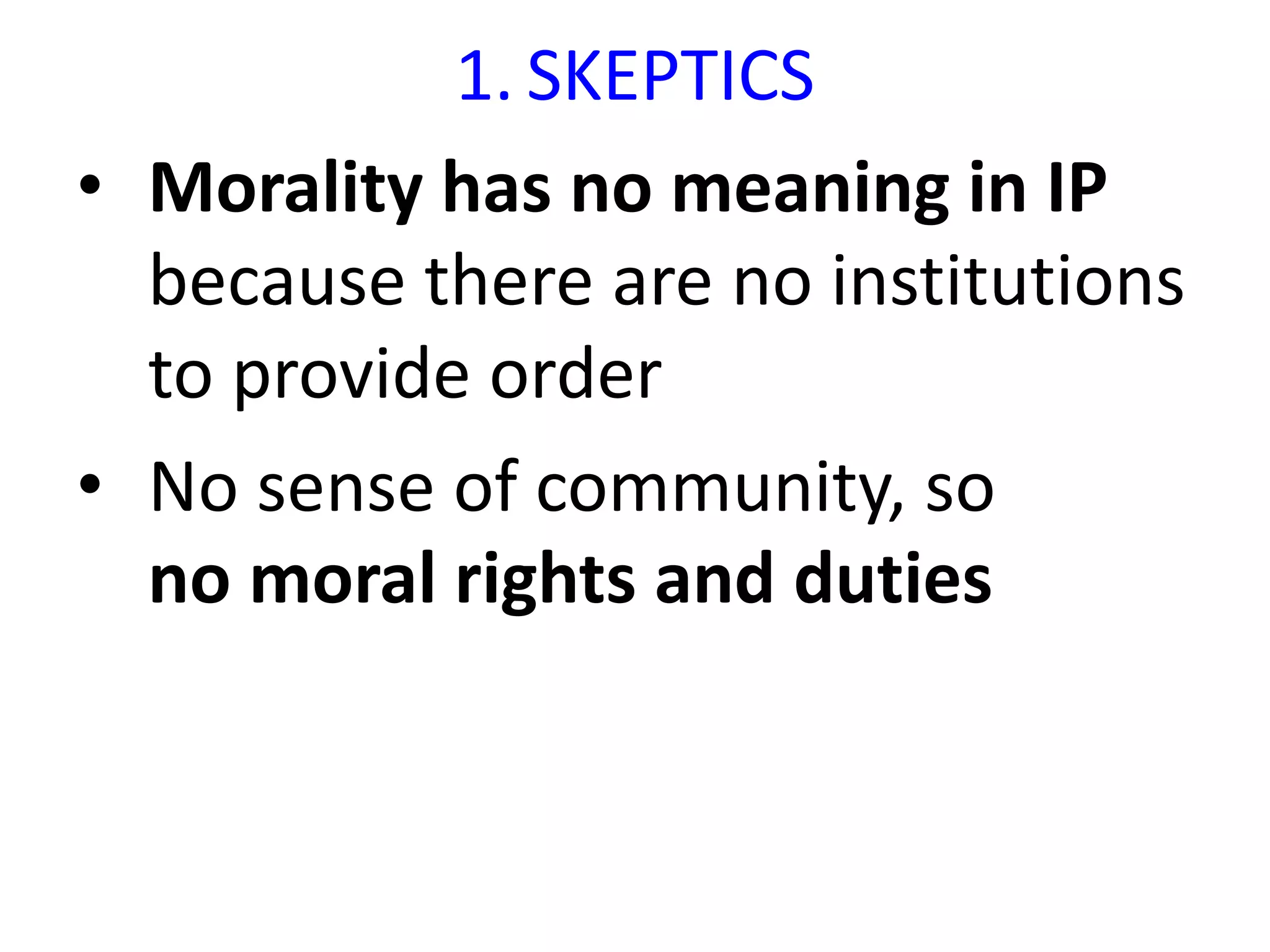
1. SKEPTICS
• Morality has no meaning in IP
because there are no institutions
to provide order
• No sense of community, so
no moral rights and duties
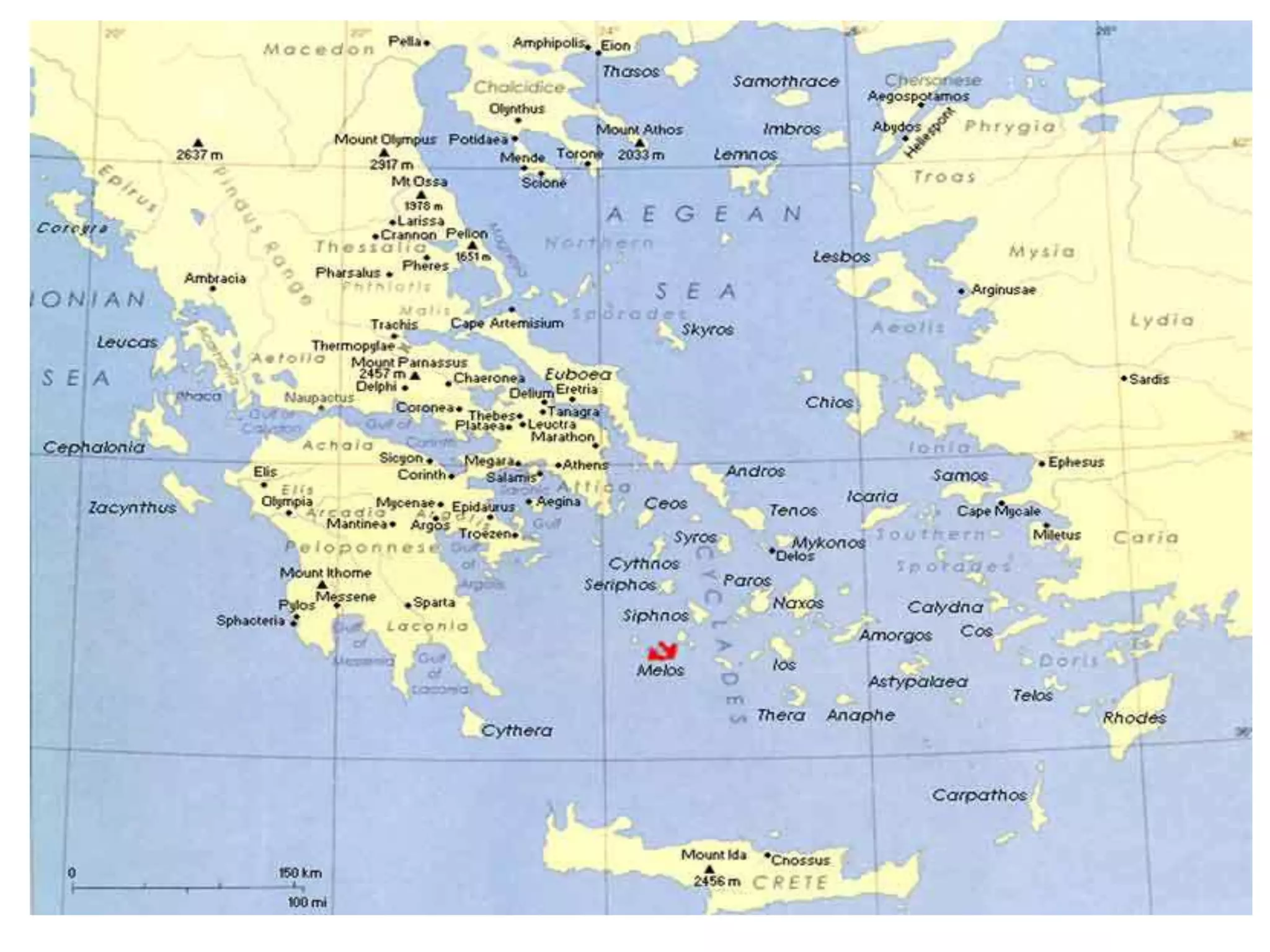
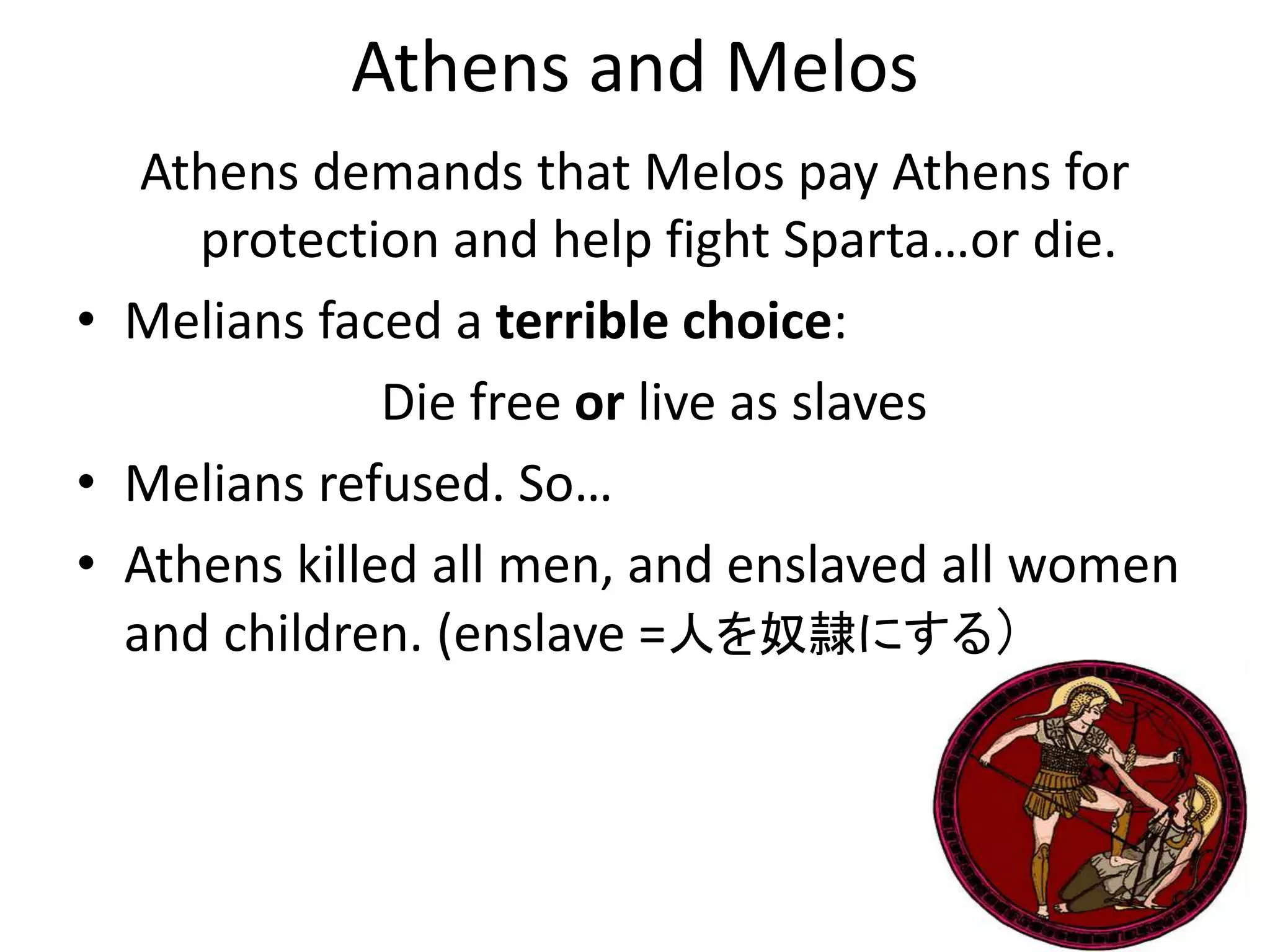
Athens and Melos
Athens demands that Melos pay Athens for
protection and help fight Sparta…or die.
• Melians faced a terrible choice:
Die free or live as slaves
• Melians refused. So…
• Athens killed all men, and enslaved all women
and children. (enslave =人を奴隷にする)
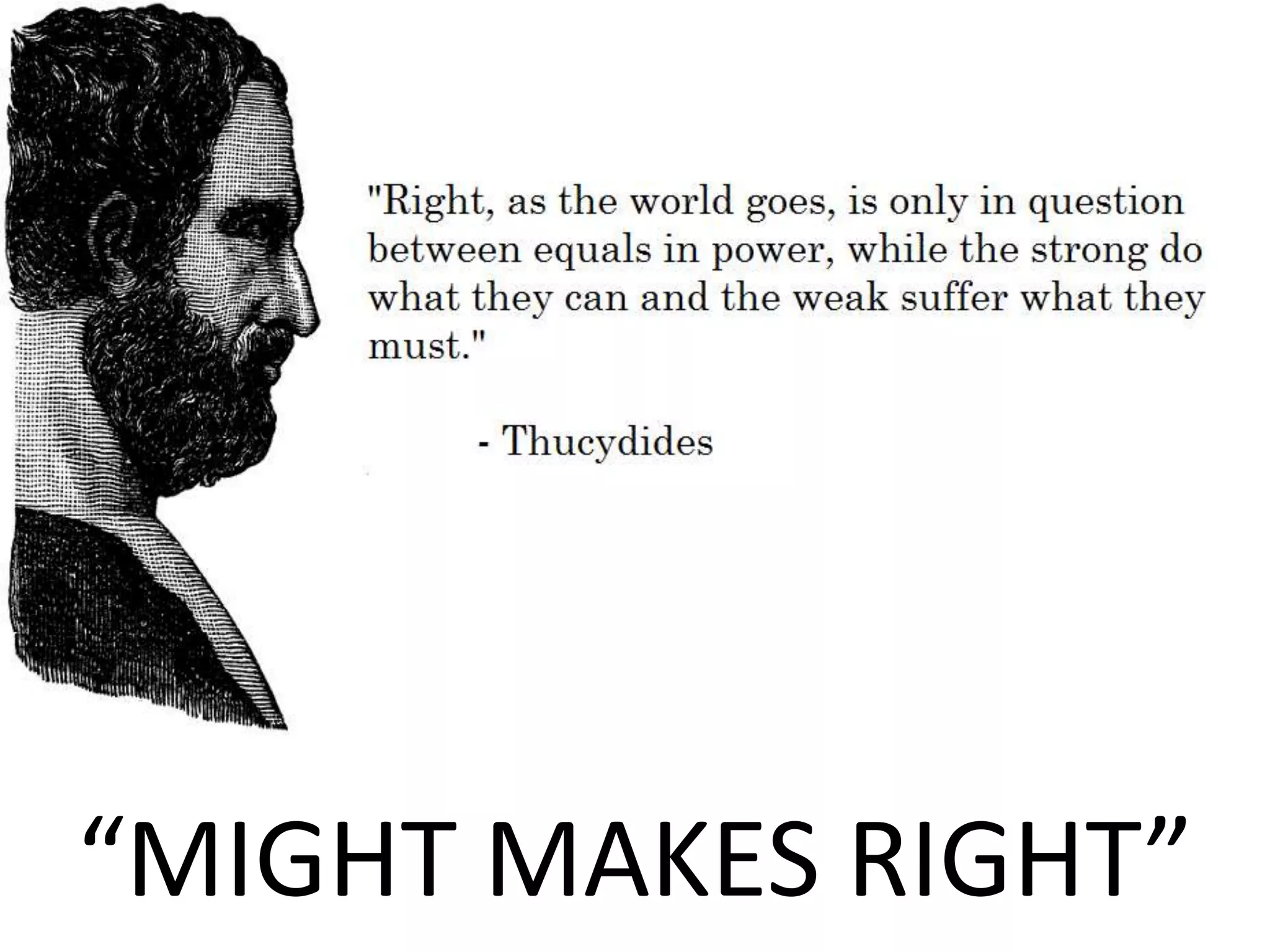
“MIGHT MAKES RIGHT”
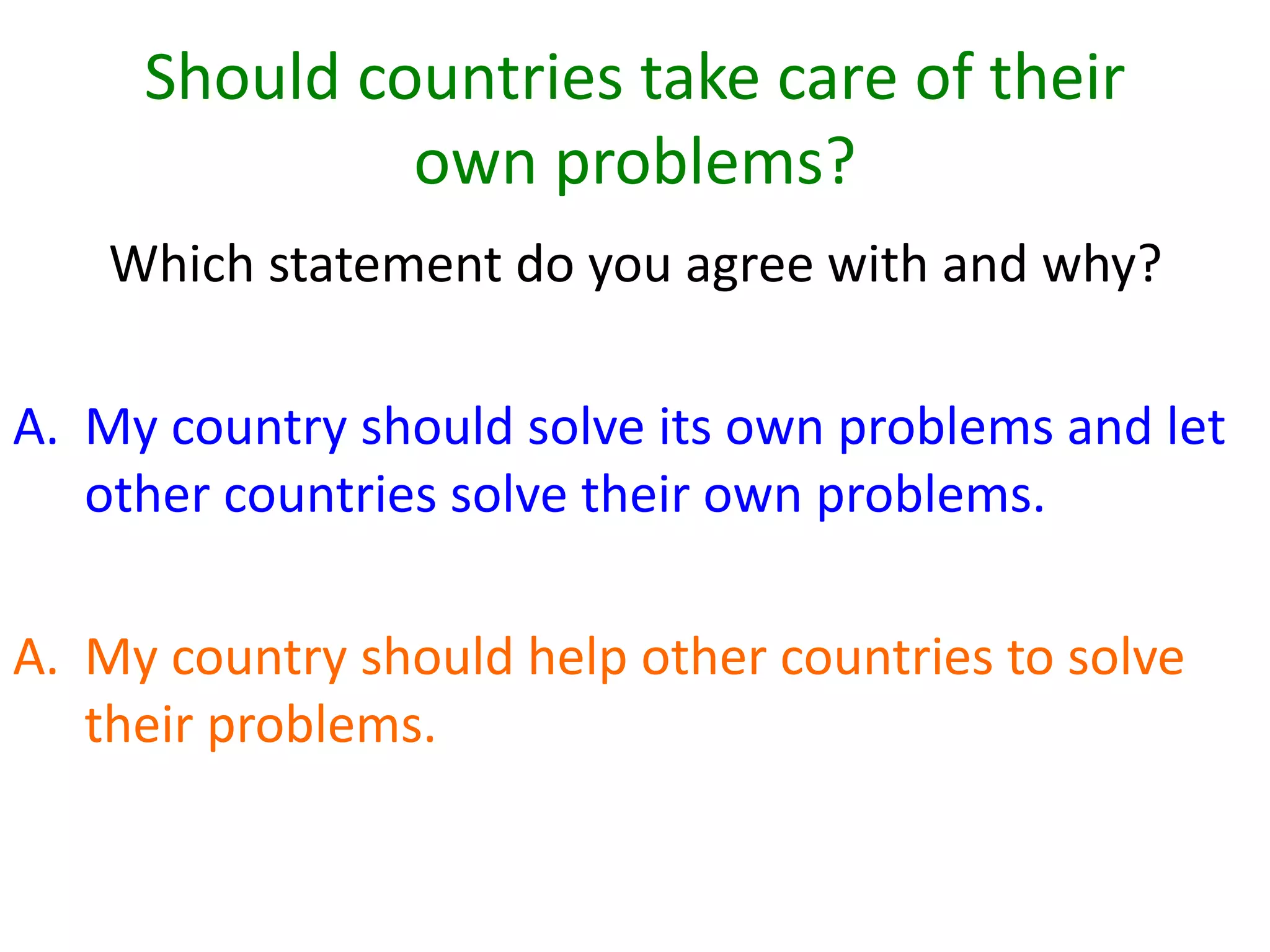
Should countries take care of their
own problems?
Which statement do you agree with and why?
A. My country should solve its own problems and let
other countries solve their own problems.
A. My country should help other countries to solve
their problems.
Should countries take care of their
own problems?
Which statement do you agree with and why?
A. My country should solve its own problems and let
other countries solve their own problems.
A. My country should help other countries to solve
their problems.
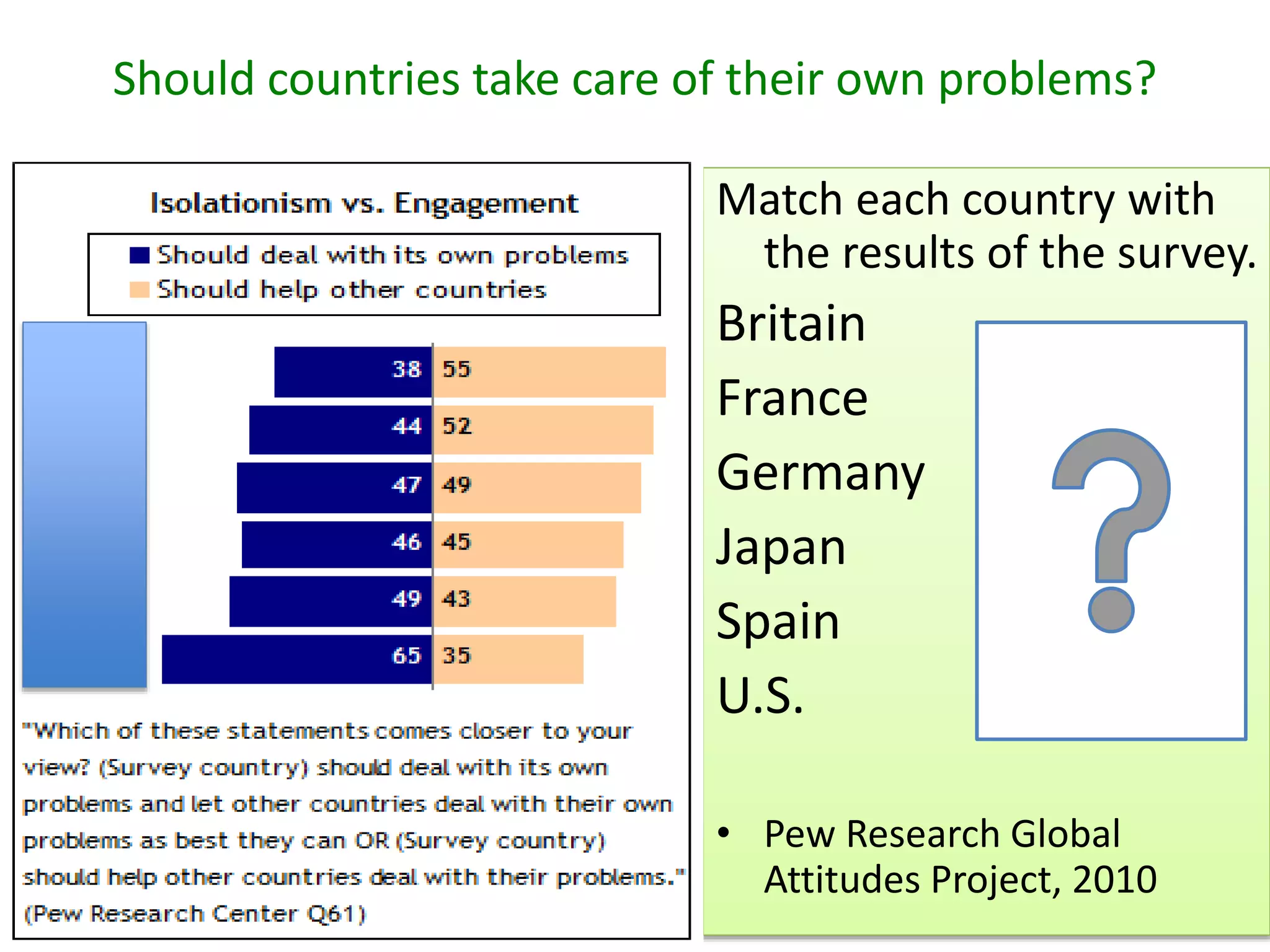
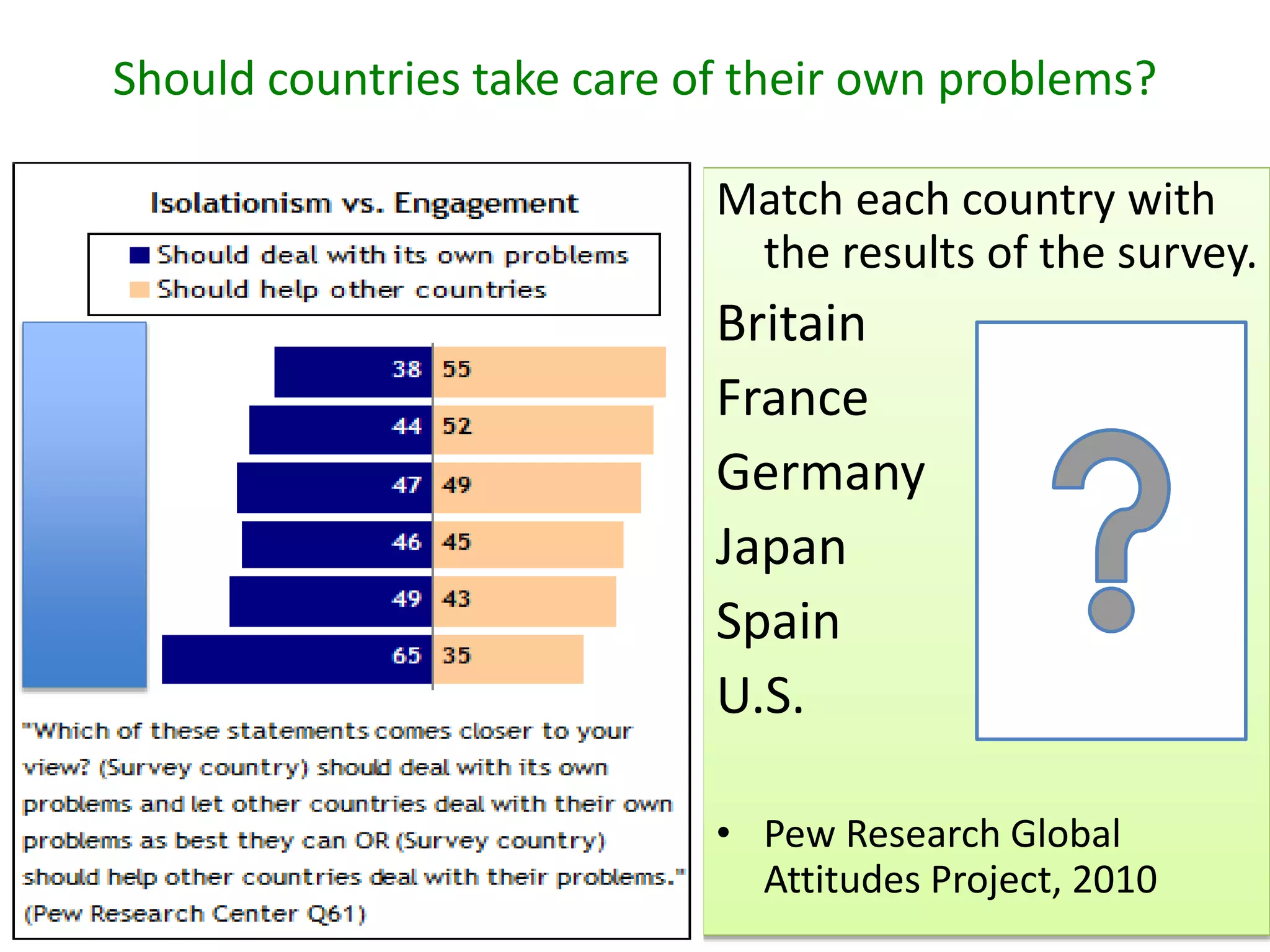
Should countries take care of their own problems?
Match each country with
the results of the survey.
Britain
France
Germany
Japan
Spain
U.S.
• Pew Research Global
Attitudes Project, 2010
Should countries take care of their
own problems?
Which statement do you agree with and why?
A. My country should solve its own problems and let
other countries solve their own problems.
A. My country should help other countries to solve
their problems.
Should countries take care of their own problems?
Match each country with
the results of the survey.
Britain
France
Germany
Japan
Spain
U.S.
• Pew Research Global
Attitudes Project, 2010
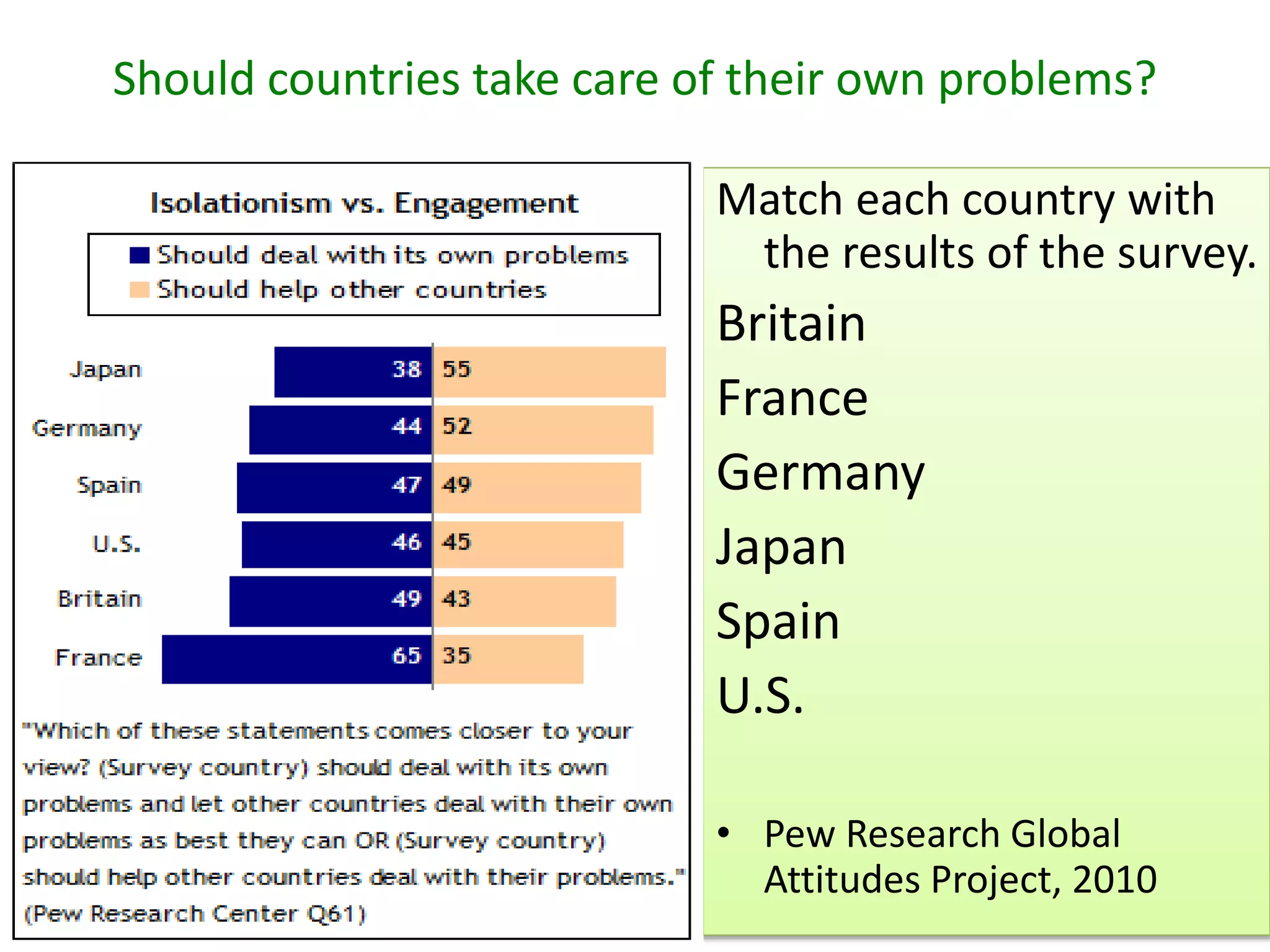
Should countries take care of their own problems?
Match each country with
the results of the survey.
Britain
France
Germany
Japan
Spain
U.S.
• Pew Research Global
Attitudes Project, 2010
2. STATE MORALISTS
• IP is based on society of states
• Protect individuals by protecting state
sovereignty
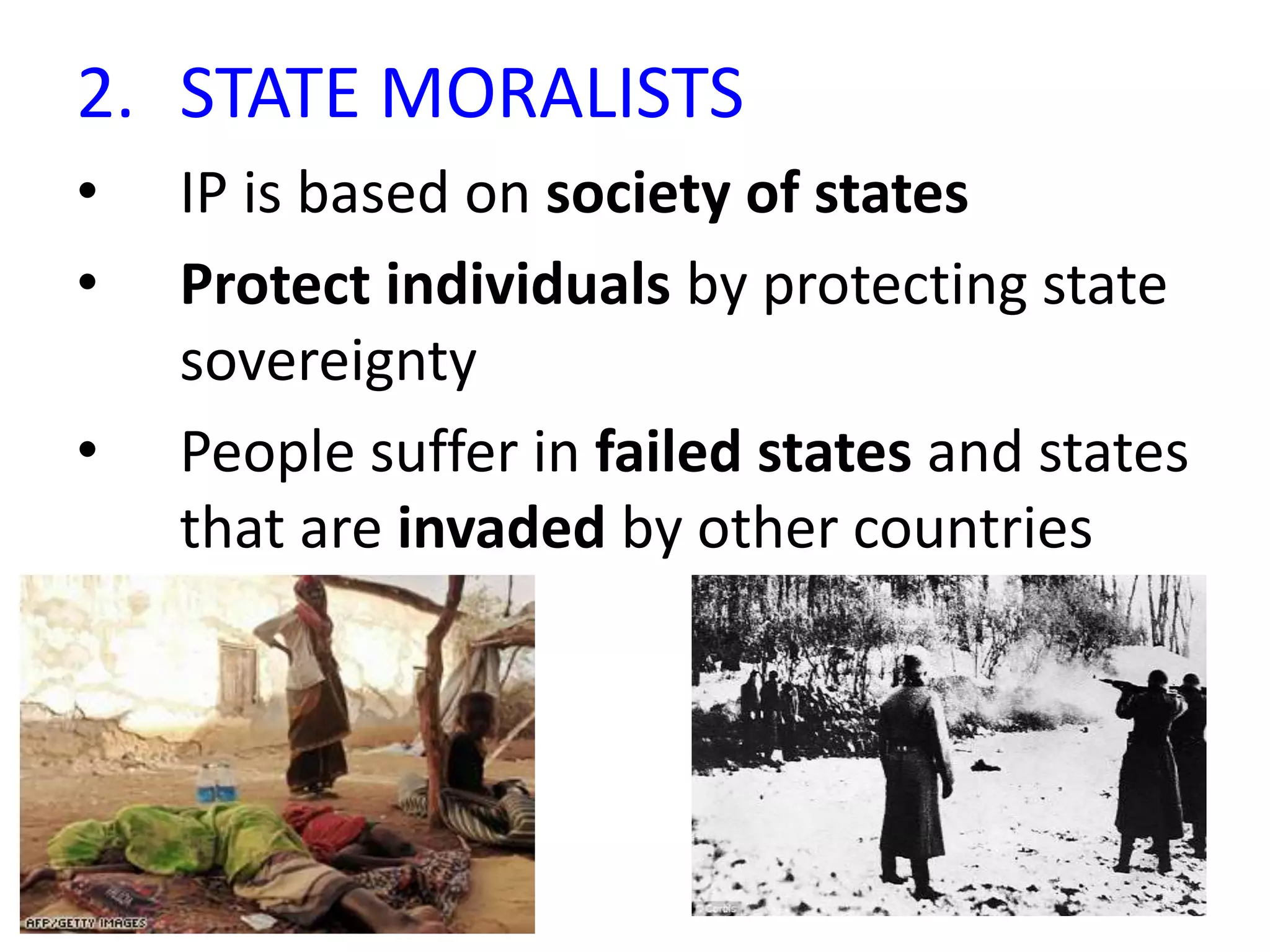
• People suffer in failed states and states
that are invaded by other countries
3. COSMOPOLITANS
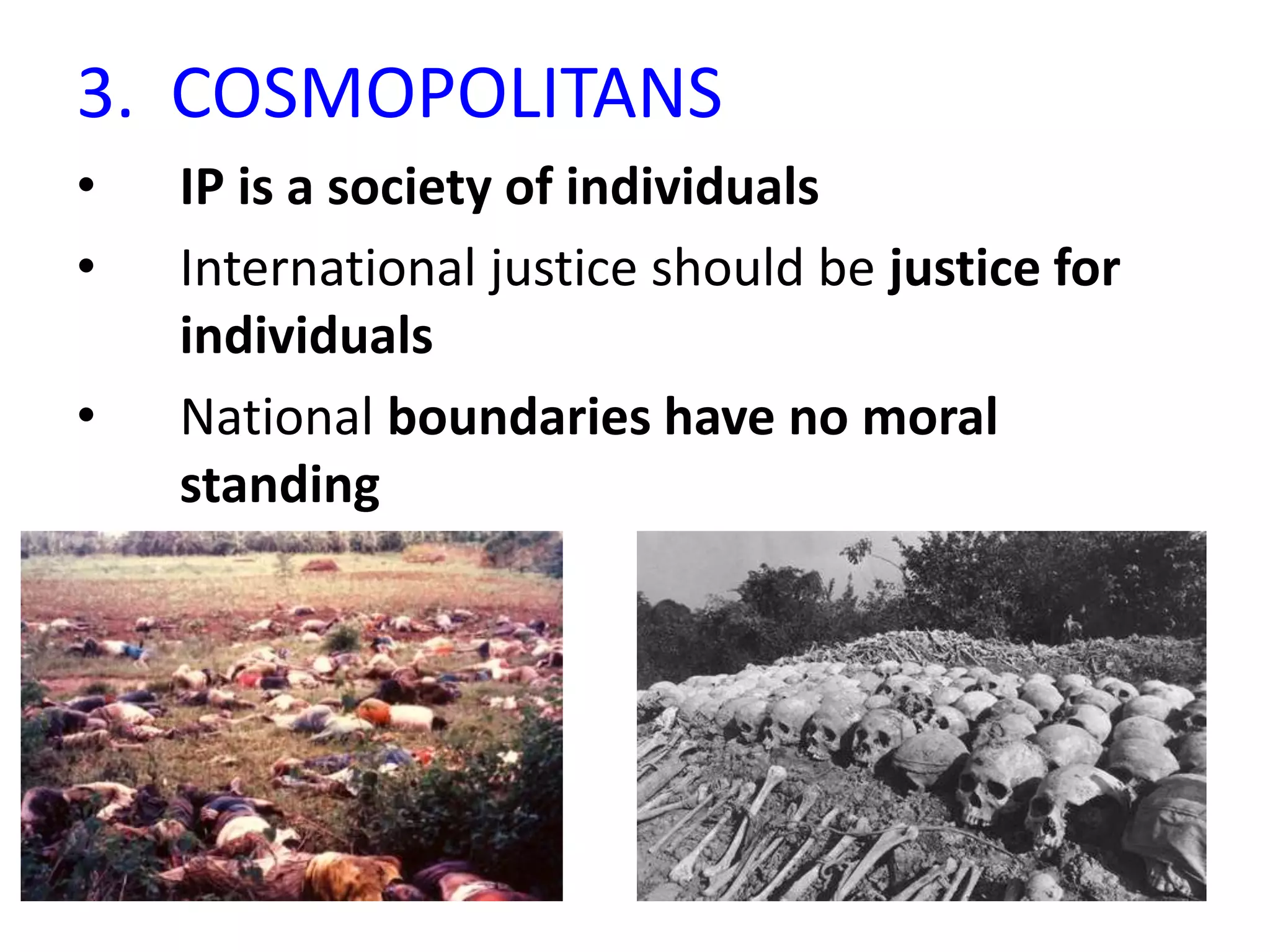
• IP is a society of individuals
• International justice should be justice for
individuals
• National boundaries have no moral
standing
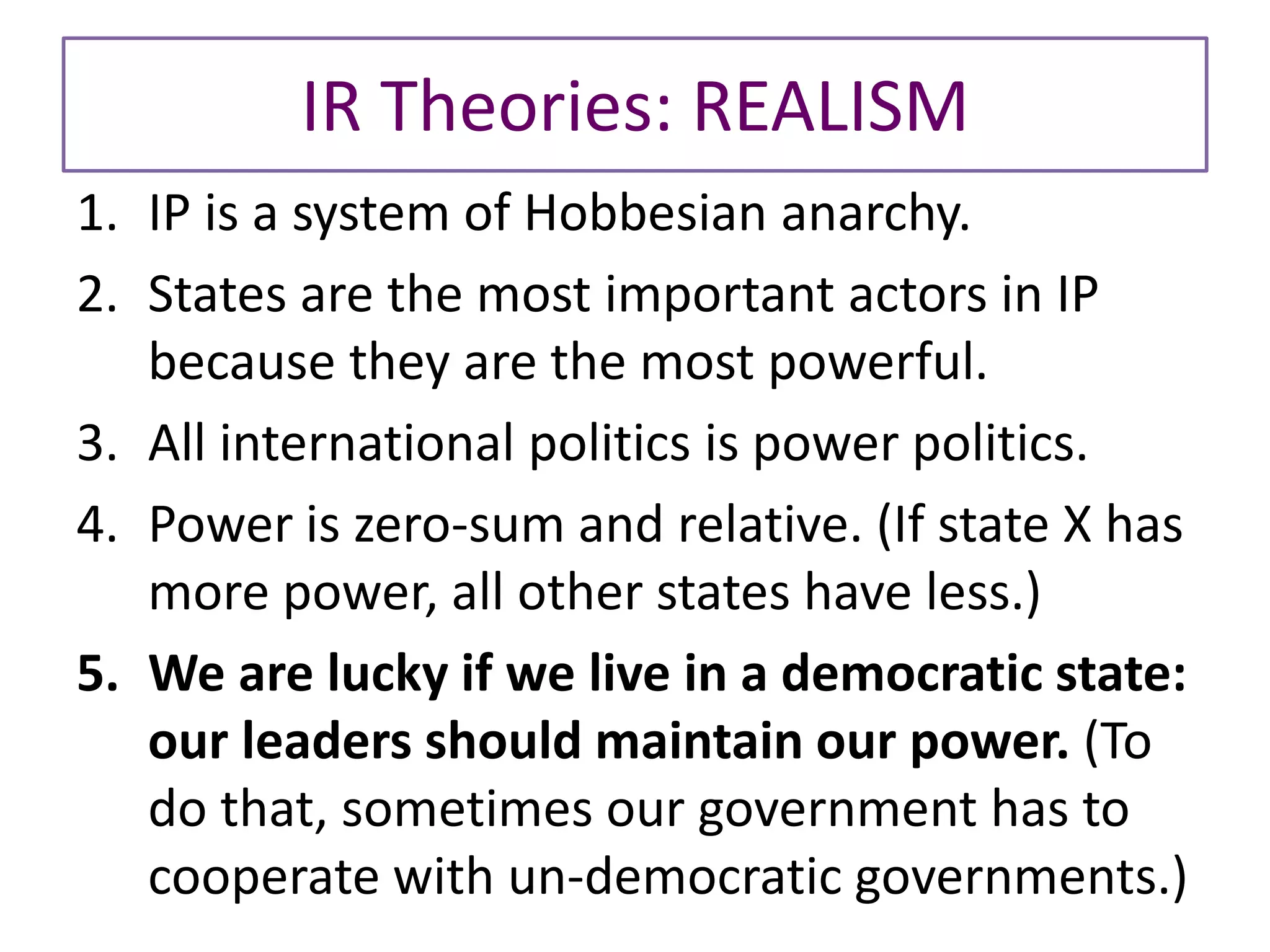
IR Theories: REALISM
1. IP is a system of Hobbesian anarchy.
2. States are the most important actors in IP
because they are the most powerful.
3. All international politics is power politics.
4. Power is zero-sum and relative. (If state X has
more power, all other states have less.)
5. We are lucky if we live in a democratic state:
our leaders should maintain our power. (To
do that, sometimes our government has to
cooperate with un-democratic governments.)
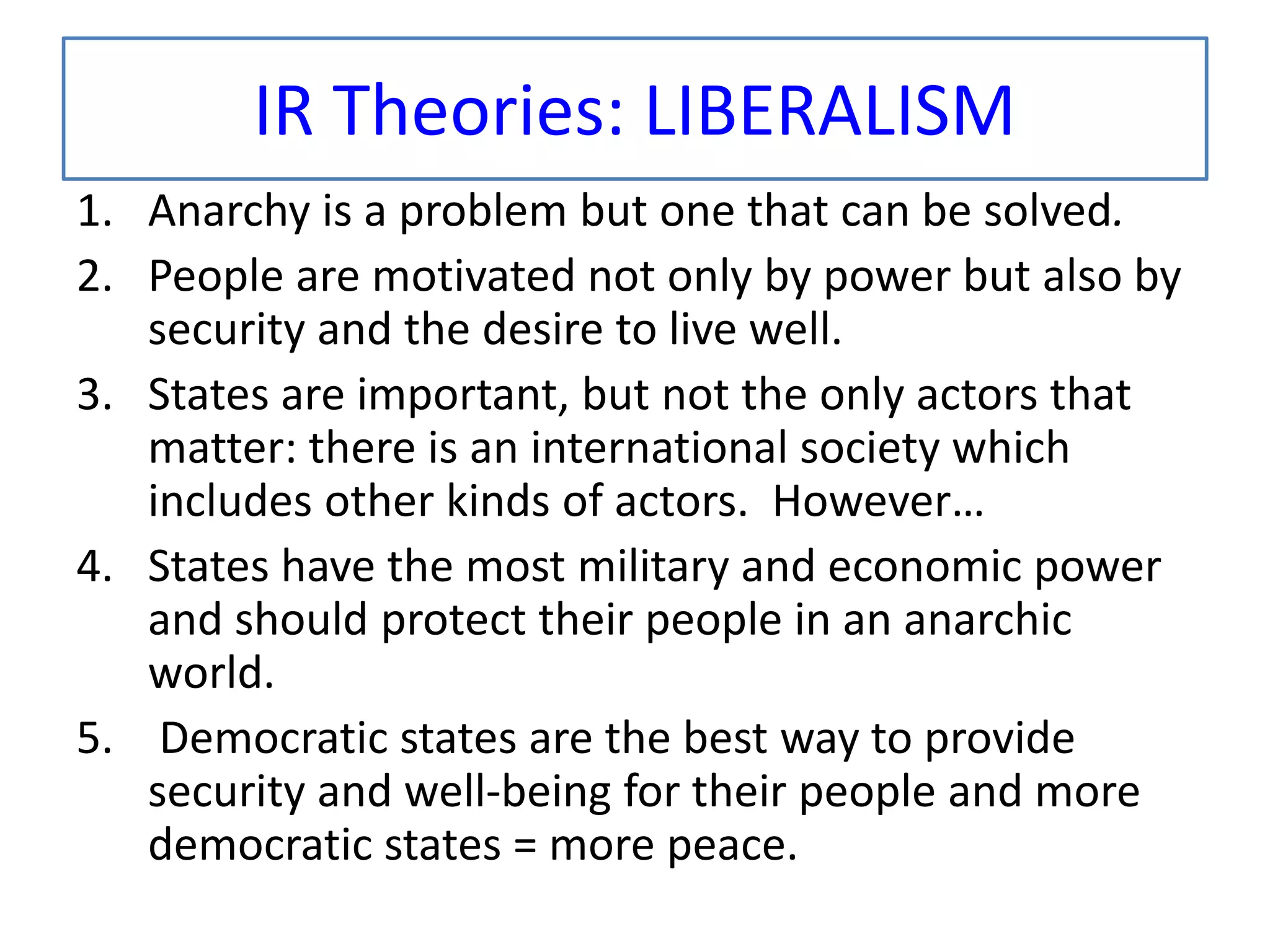
IR Theories: LIBERALISM
1. Anarchy is a problem but one that can be solved.
2. People are motivated not only by power but also by
security and the desire to live well.
3. States are important, but not the only actors that
matter: there is an international society which
includes other kinds of actors. However…
4. States have the most military and economic power
and should protect their people in an anarchic
world.
5. Democratic states are the best way to provide
security and well-being for their people and more
democratic states = more peace.
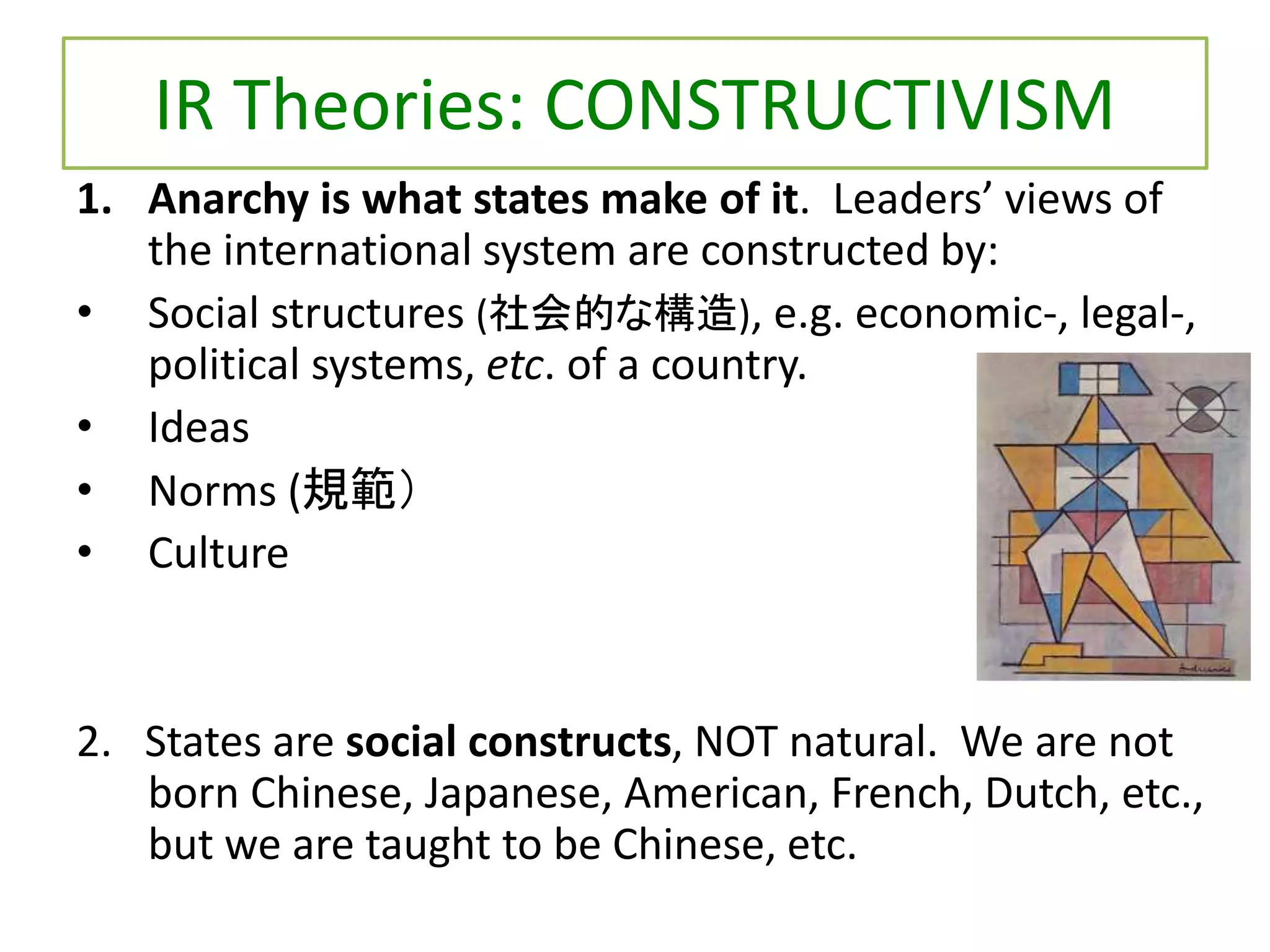
IR Theories: CONSTRUCTIVISM
1. Anarchy is what states make of it. Leaders’ views of
the international system are constructed by:
• Social structures (社会的な構造), e.g. economic-, legal-,
political systems, etc. of a country.
• Ideas
• Norms (規範)
• Culture
2. States are social constructs, NOT natural. We are not
born Chinese, Japanese, American, French, Dutch, etc.,
but we are taught to be Chinese, etc.
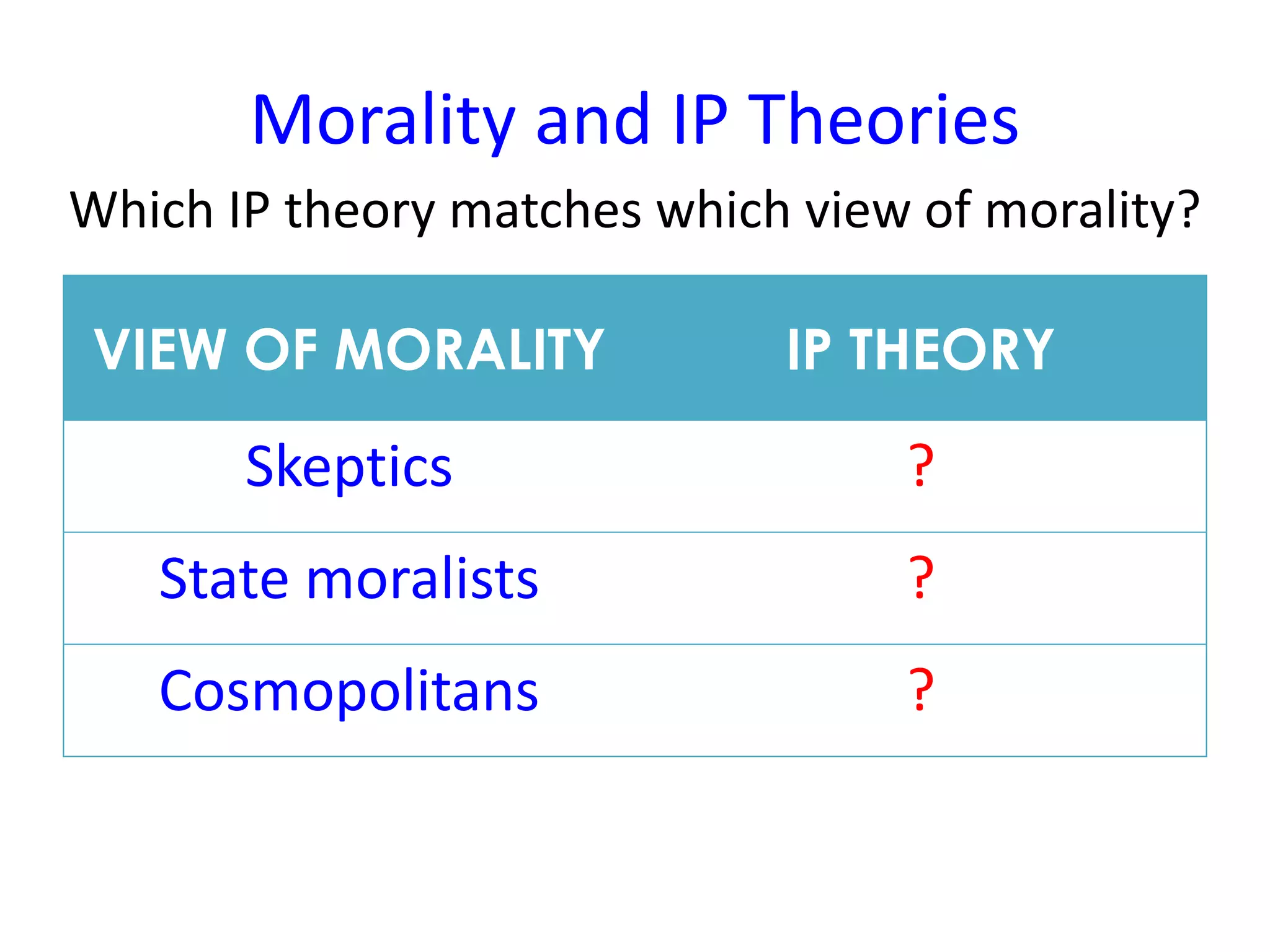
Morality and IP Theories
Which IP theory matches which view of morality?
VIEW OF MORALITY IP THEORY
Skeptics ?
State moralists ?
Cosmopolitans ?
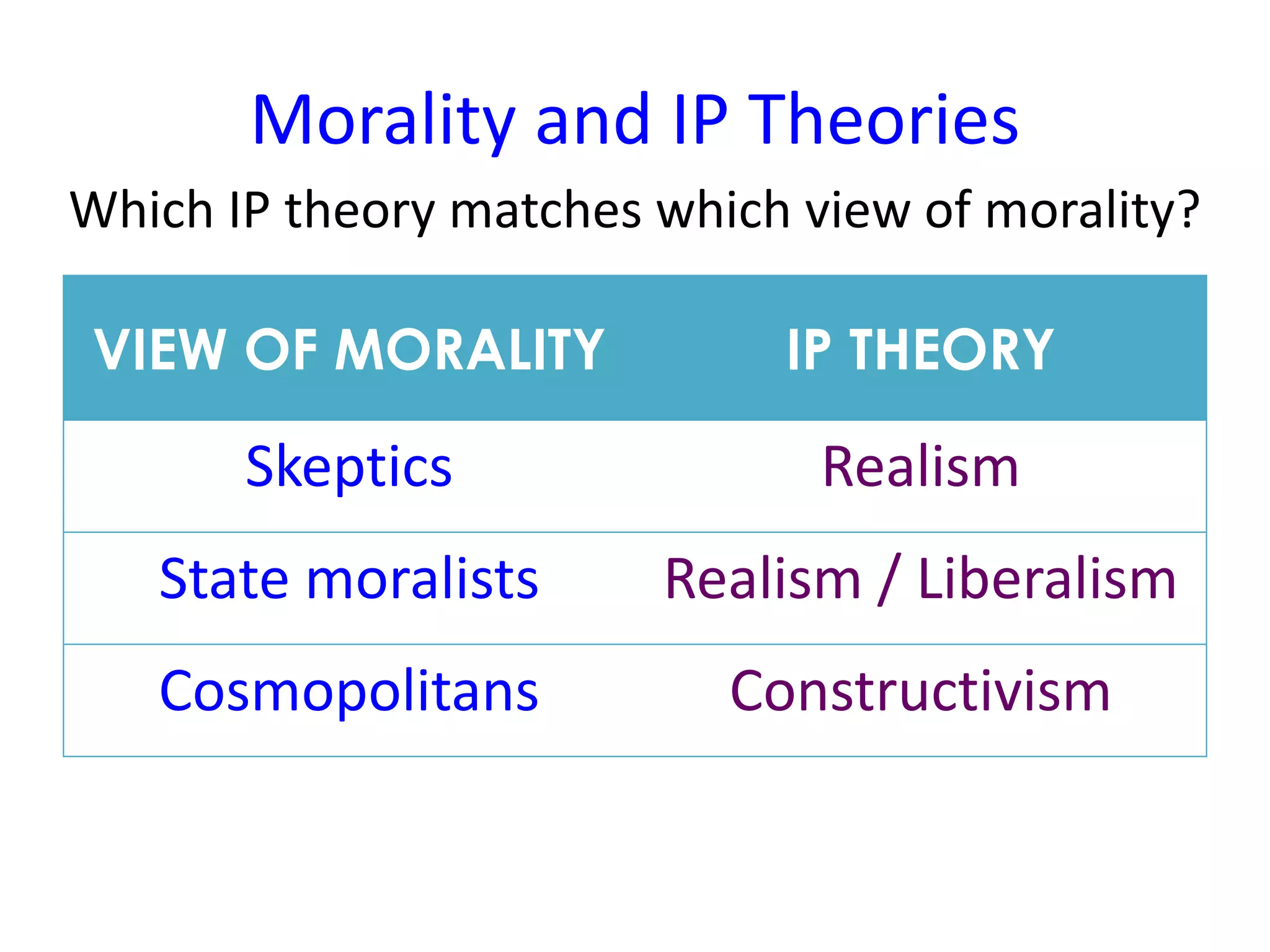
Morality and IP Theories
Which IP theory matches which view of morality?
VIEW OF MORALITY IP THEORY
Skeptics Realism
State moralists Realism / Liberalism
Cosmopolitans Constructivism
Discussion Questions
Is war always wrong?
Why or why not?
If it is not always wrong, when is it okay to kill?
Who is it okay to kill?
How is it okay to kill (e.g. with guns, chemical
weapons, nuclear weapons)?
chemical weapons =化学兵器
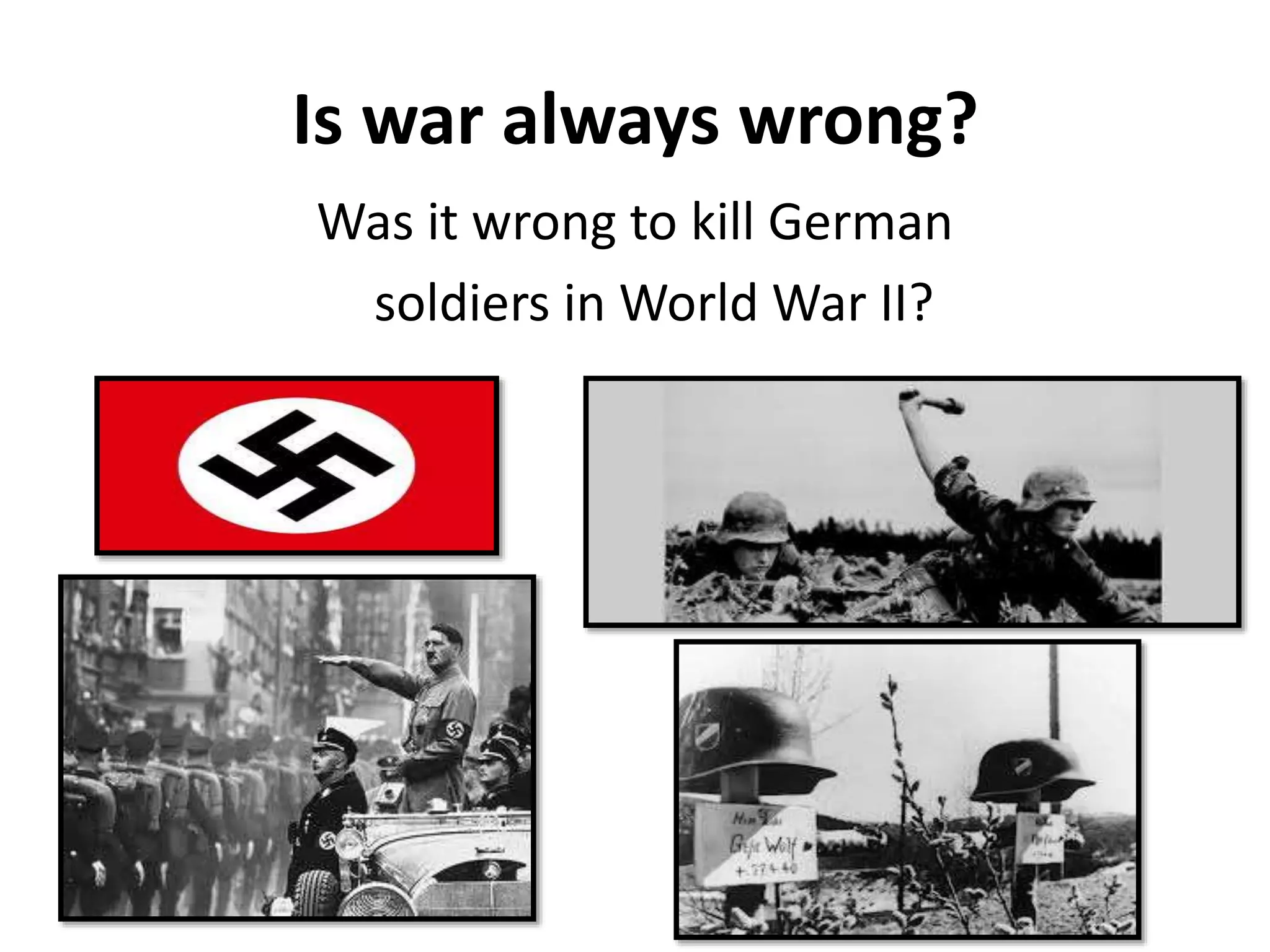
Is war always wrong?
Was it wrong to kill German
soldiers in World War II?
Is war always wrong?
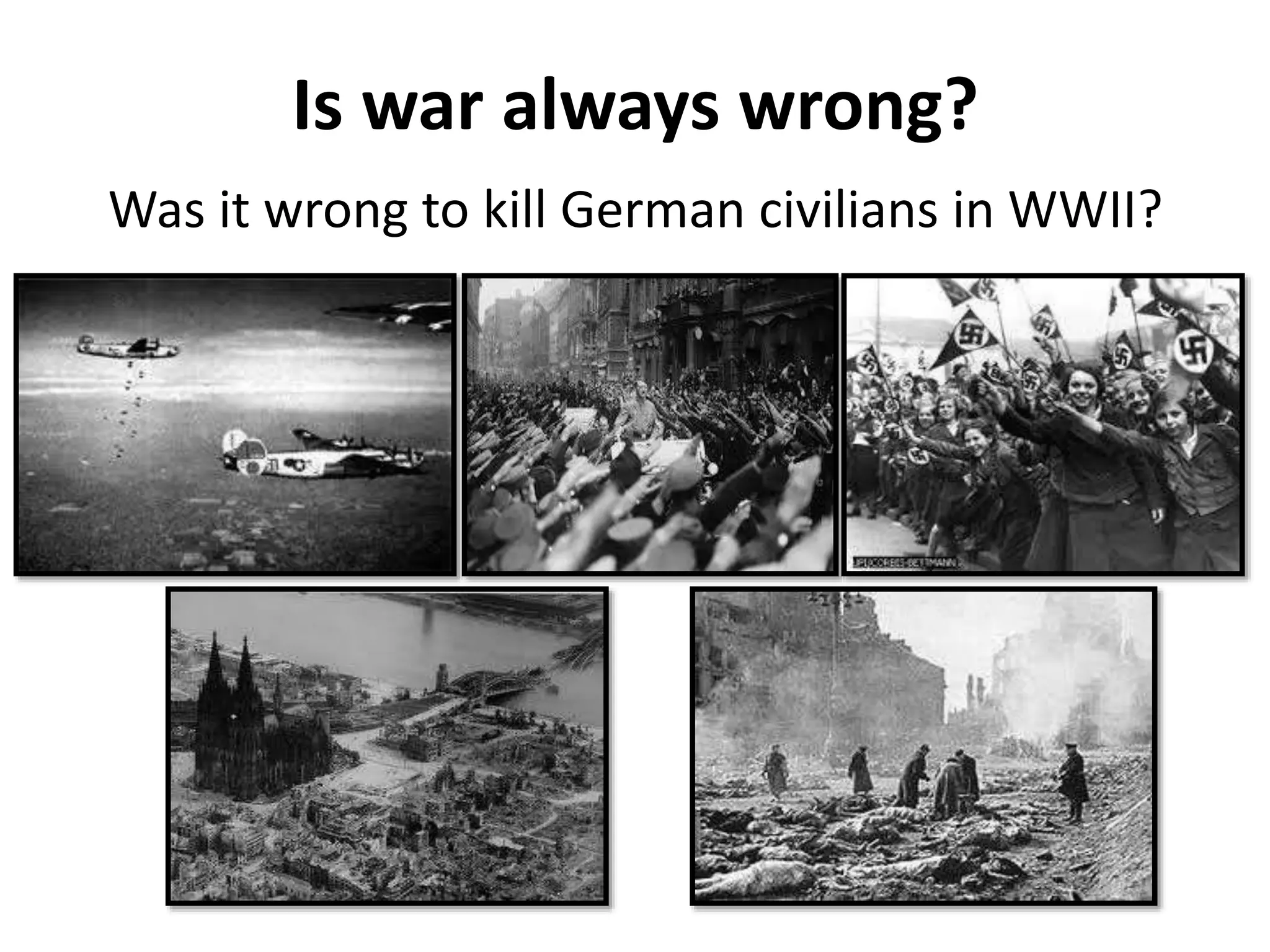
Was it wrong to kill German civilians in WWII?
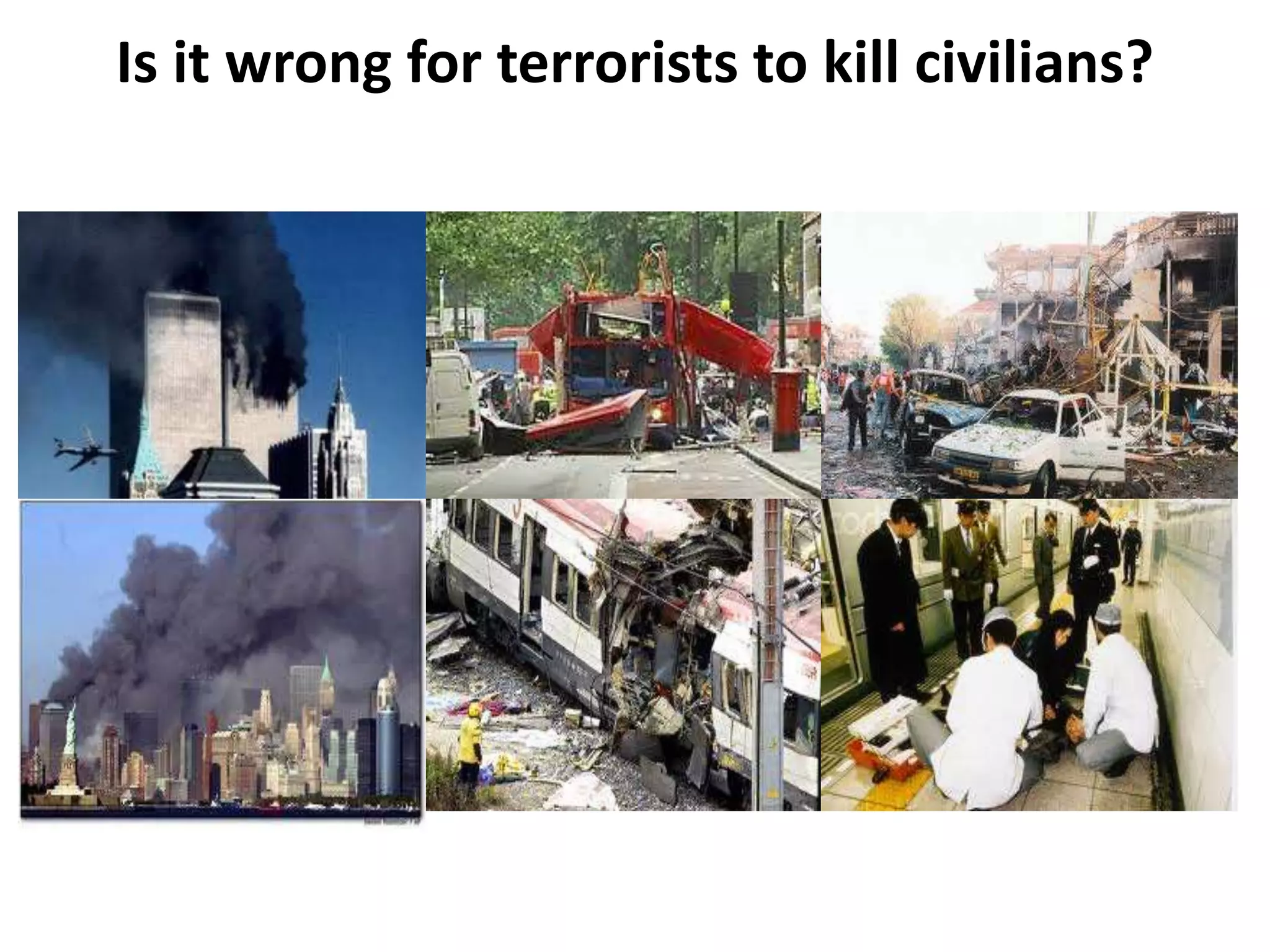
Is it wrong for terrorists to kill civilians?
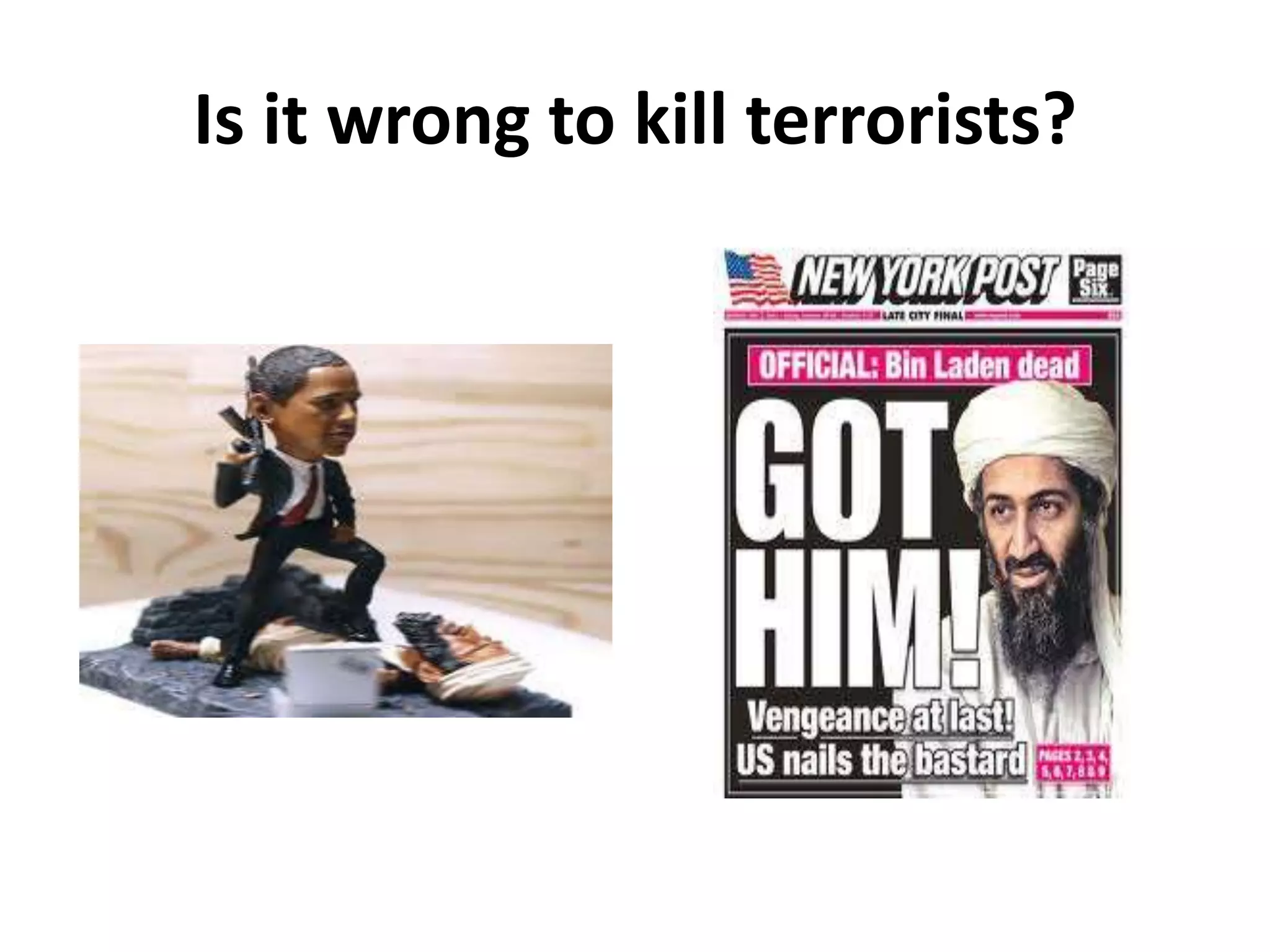
Is it wrong to kill terrorists?
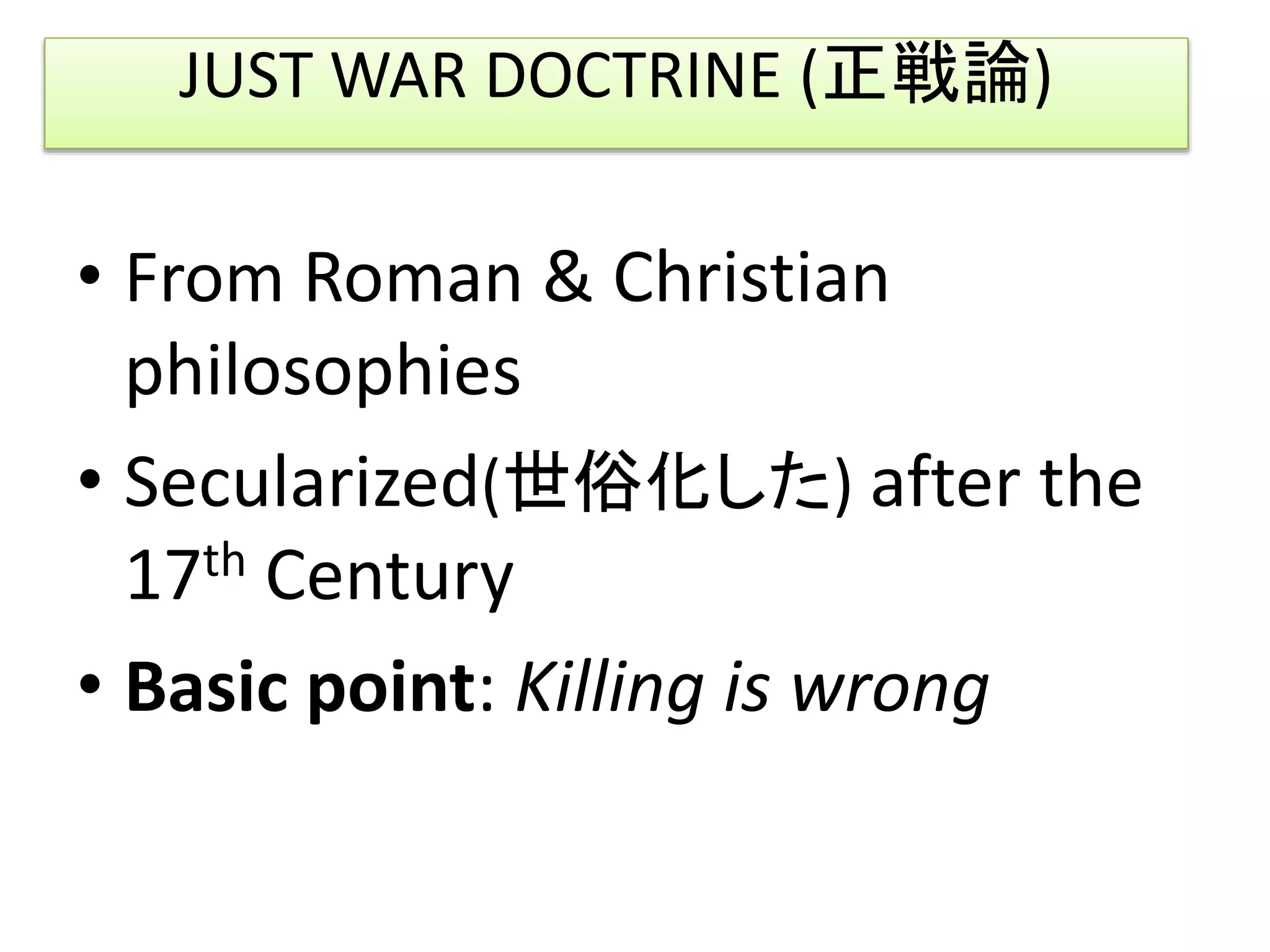
JUST WAR DOCTRINE (正戦論)
Is war always wrong?
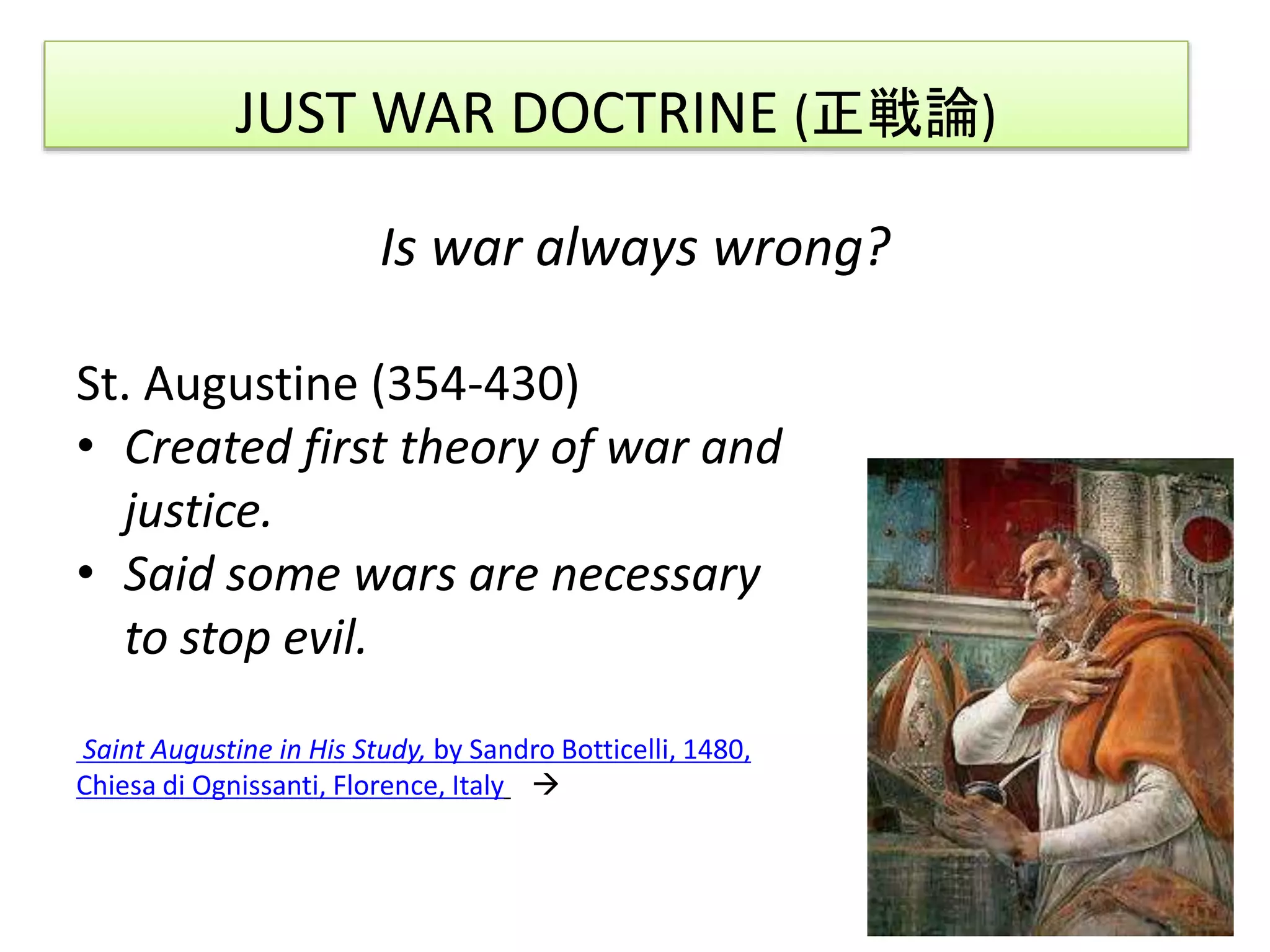
St. Augustine (354-430)
• Created first theory of war and
justice.
• Said some wars are necessary
to stop evil.
Saint Augustine in His Study, by Sandro Botticelli, 1480,
Chiesa di Ognissanti, Florence, Italy 
JUST WAR DOCTRINE (正戦論)
• From Roman & Christian
philosophies
• Secularized(世俗化した) after the
17th Century
• Basic point: Killing is wrong
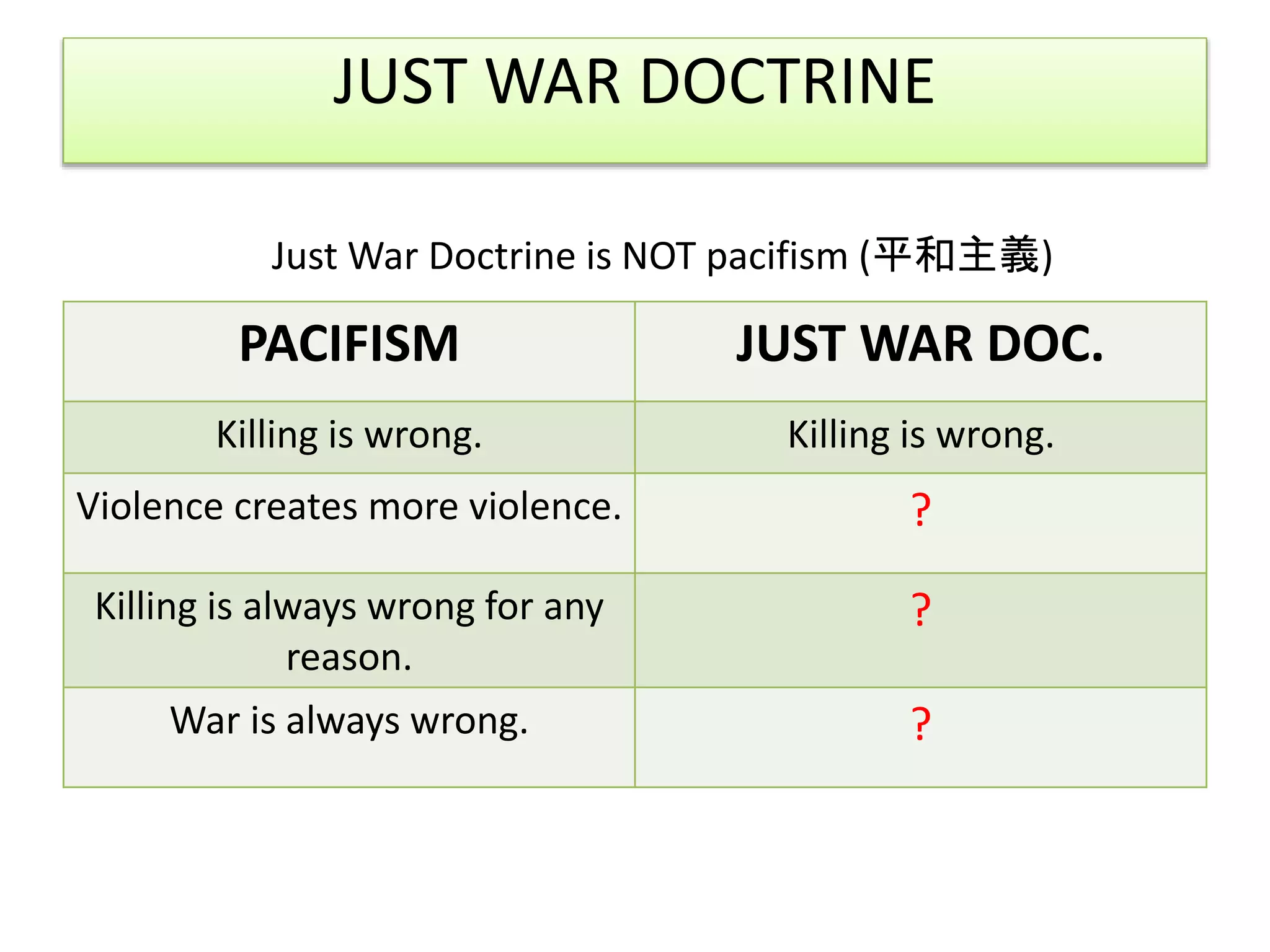
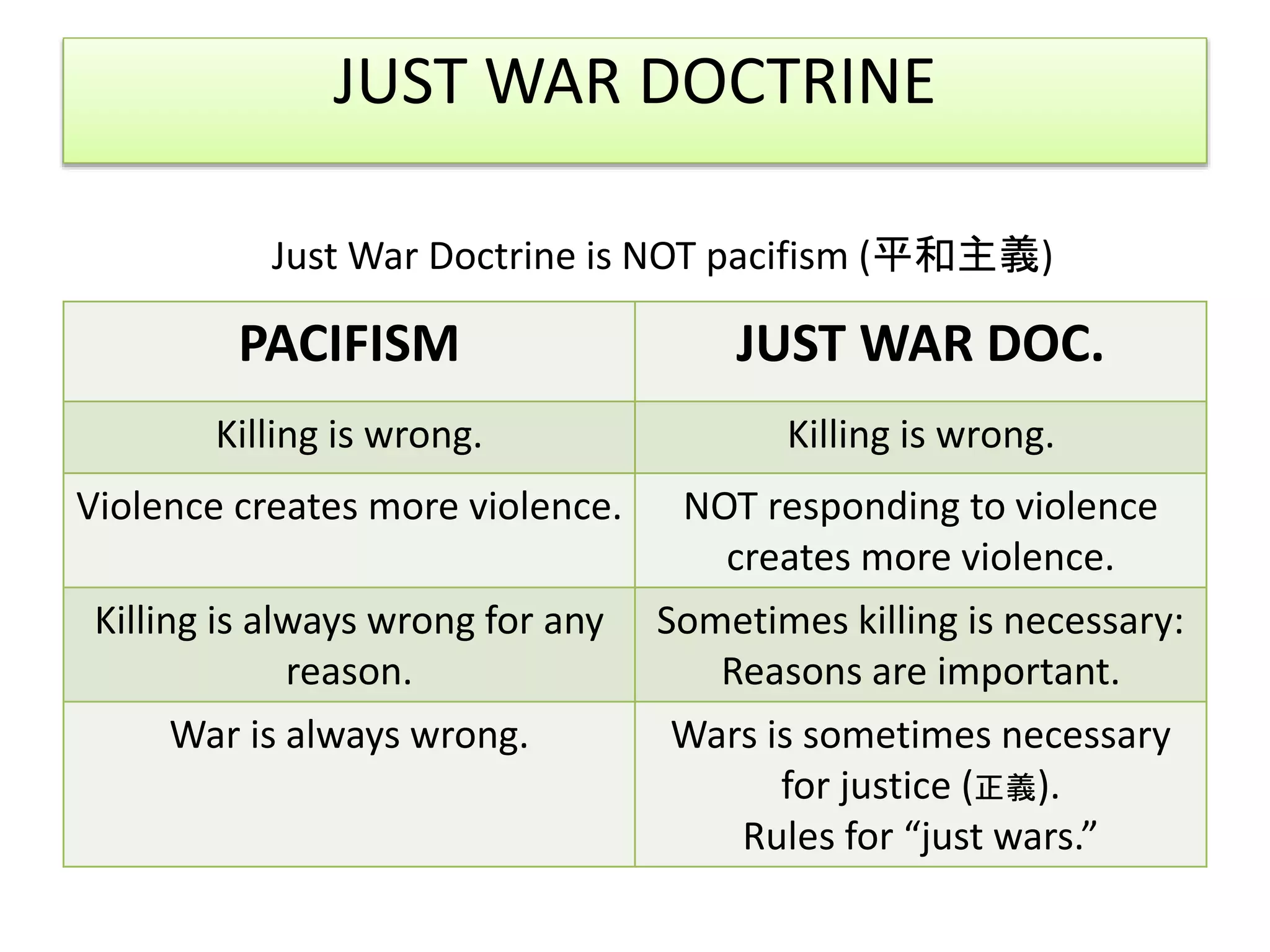
JUST WAR DOCTRINE
Just War Doctrine is NOT pacifism (平和主義)
PACIFISM JUST WAR DOC.
Killing is wrong. Killing is wrong.
Violence creates more violence. ?
Killing is always wrong for any
reason.
?
War is always wrong. ?
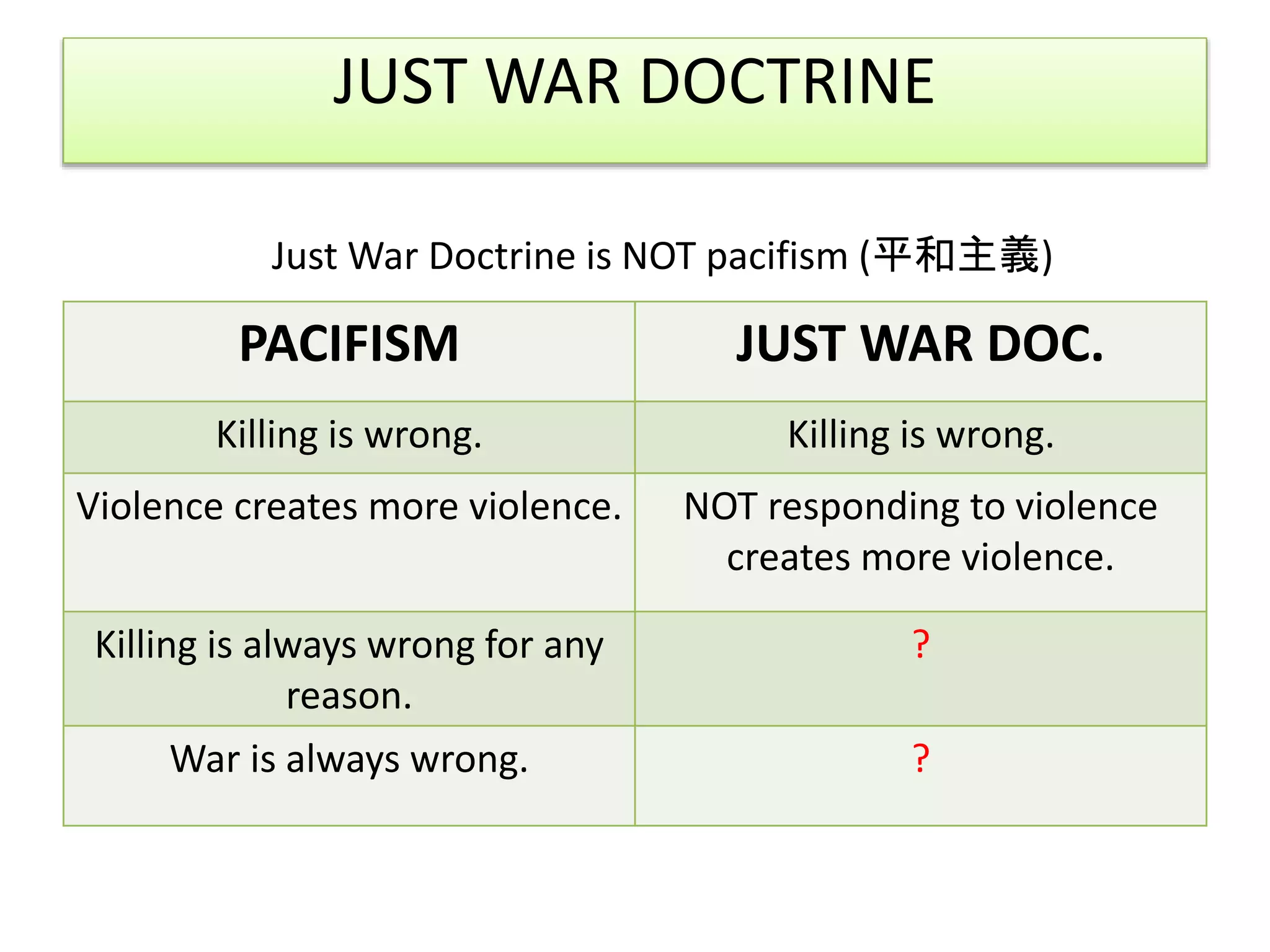
JUST WAR DOCTRINE
Just War Doctrine is NOT pacifism (平和主義)
PACIFISM JUST WAR DOC.
Killing is wrong. Killing is wrong.
Violence creates more violence. NOT responding to violence
creates more violence.
Killing is always wrong for any
reason.
?
War is always wrong. ?
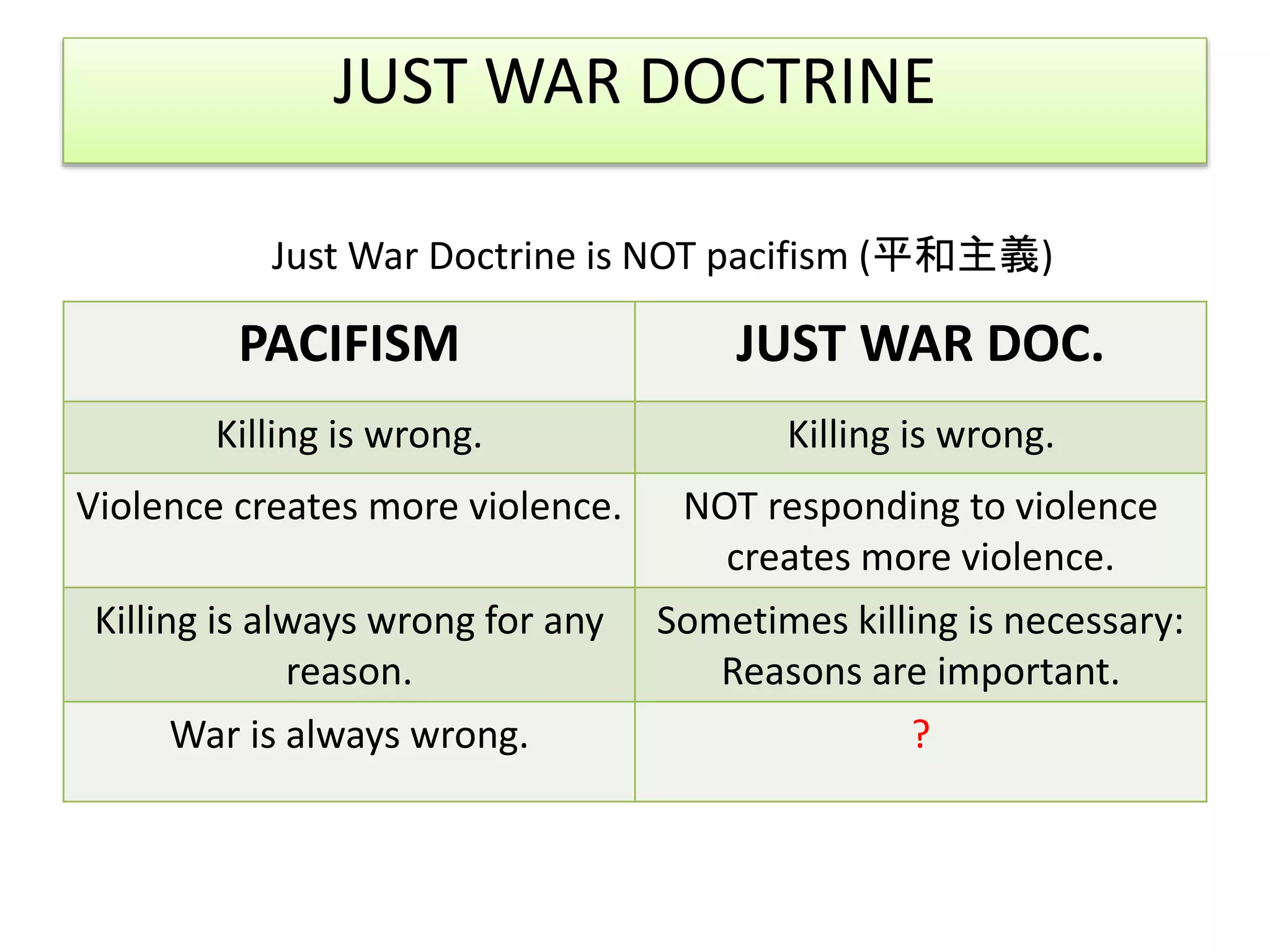
JUST WAR DOCTRINE
Just War Doctrine is NOT pacifism (平和主義)
PACIFISM JUST WAR DOC.
Killing is wrong. Killing is wrong.
Violence creates more violence. NOT responding to violence
creates more violence.
Killing is always wrong for any
reason.
Sometimes killing is necessary:
Reasons are important.
War is always wrong. ?
JUST WAR DOCTRINE
Just War Doctrine is NOT pacifism (平和主義)
PACIFISM JUST WAR DOC.
Killing is wrong. Killing is wrong.
Violence creates more violence. NOT responding to violence
creates more violence.
Killing is always wrong for any
reason.
Sometimes killing is necessary:
Reasons are important.
War is always wrong. Wars is sometimes necessary
for justice (正義).
Rules for “just wars.”
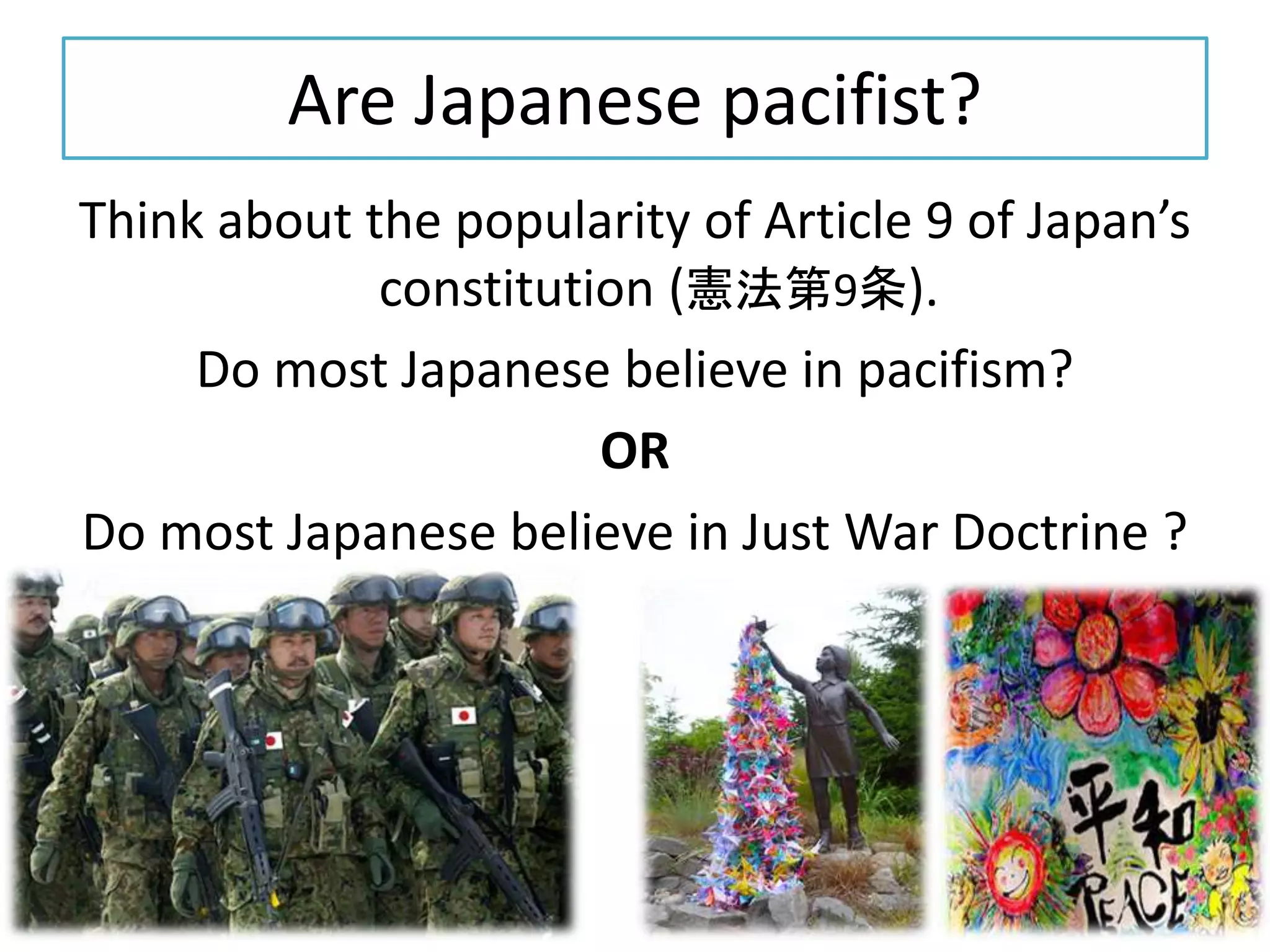
Are Japanese pacifist?
Think about the popularity of Article 9 of Japan’s
constitution (憲法第9条).
Do most Japanese believe in pacifism?
OR
Do most Japanese believe in Just War Doctrine ?
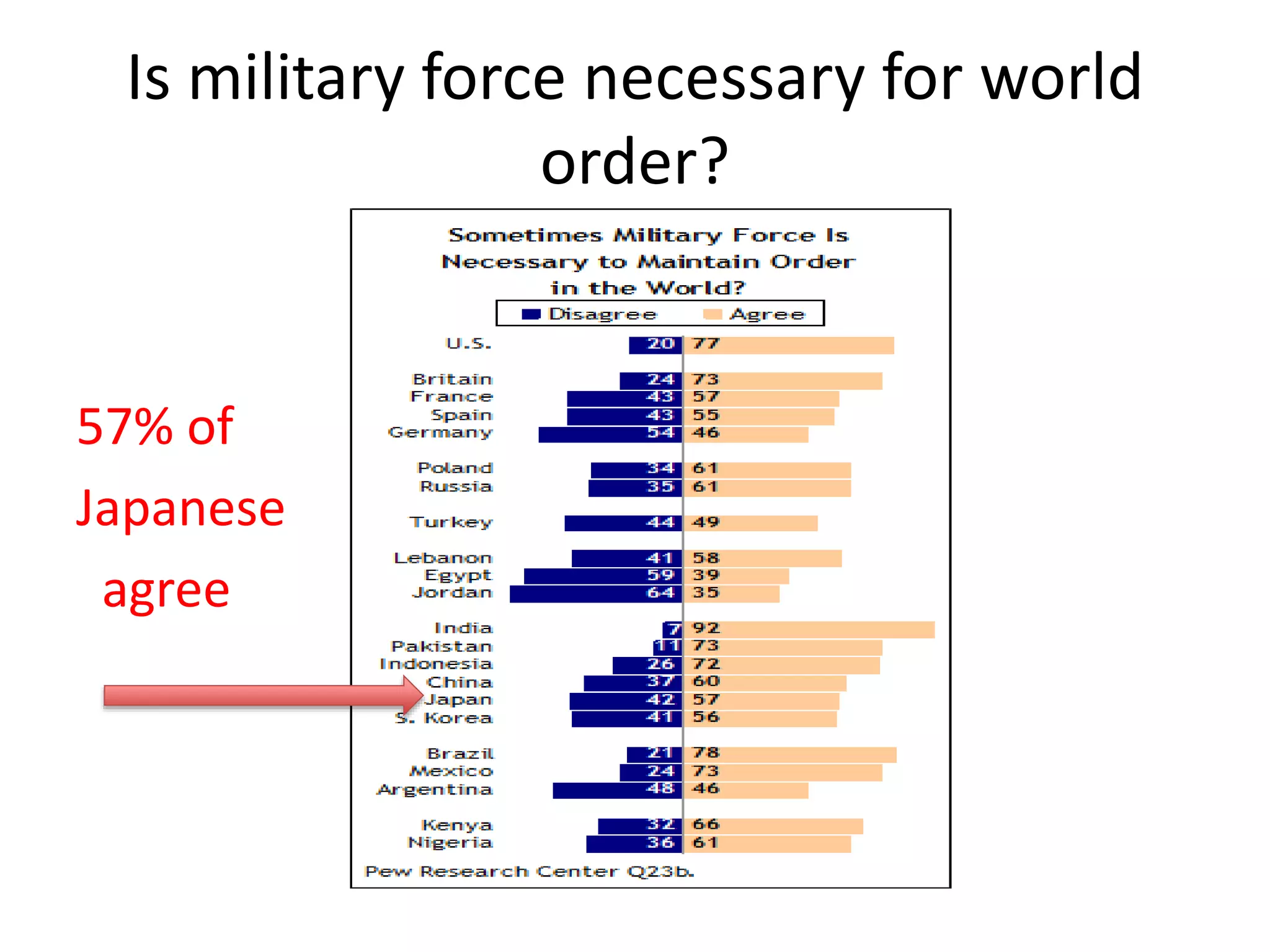
Is military force necessary for world
order?
57% of
Japanese
agree
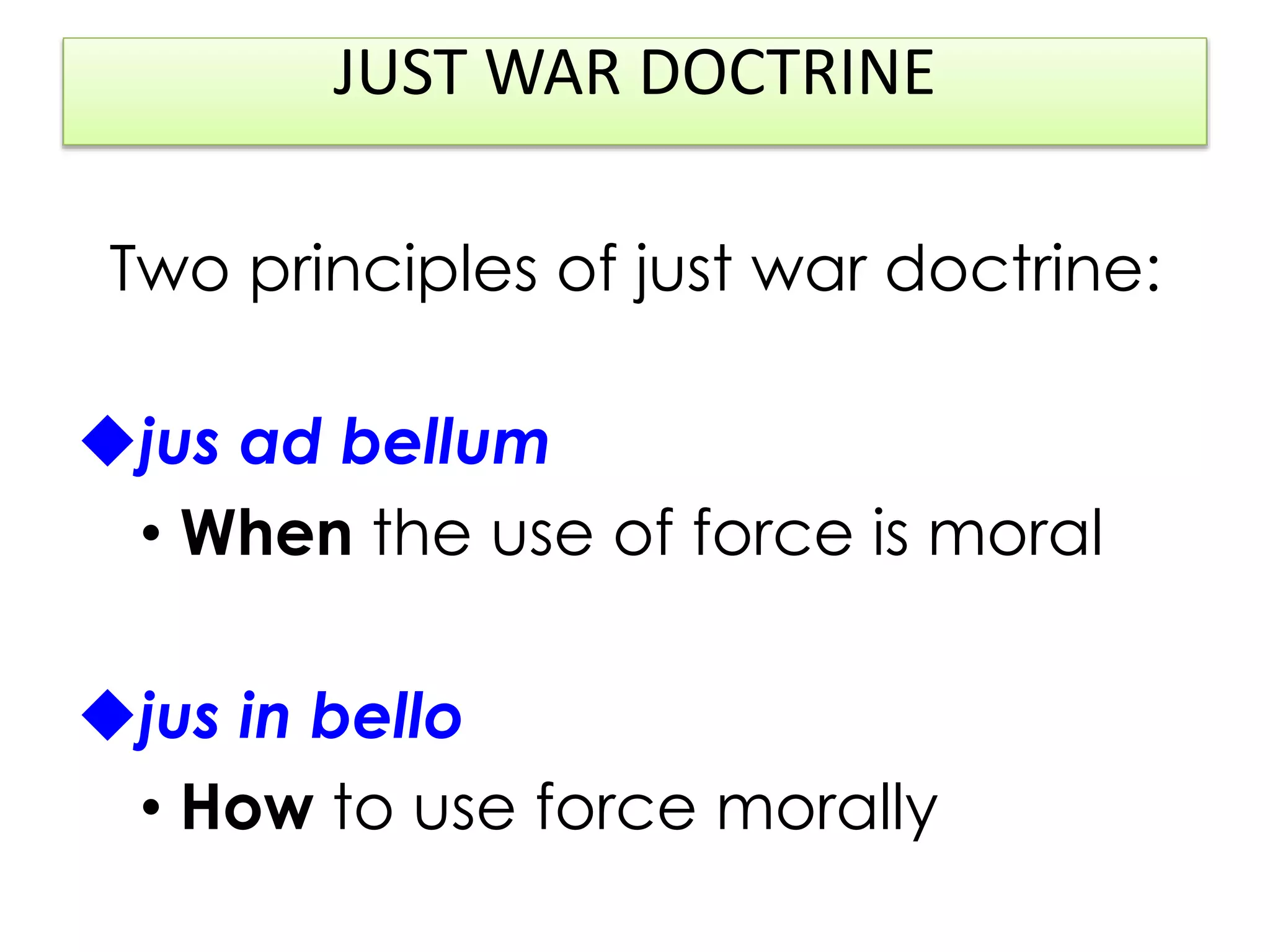
JUST WAR DOCTRINE
Two principles of just war doctrine:
jus ad bellum
• When the use of force is moral
jus in bello
• How to use force morally
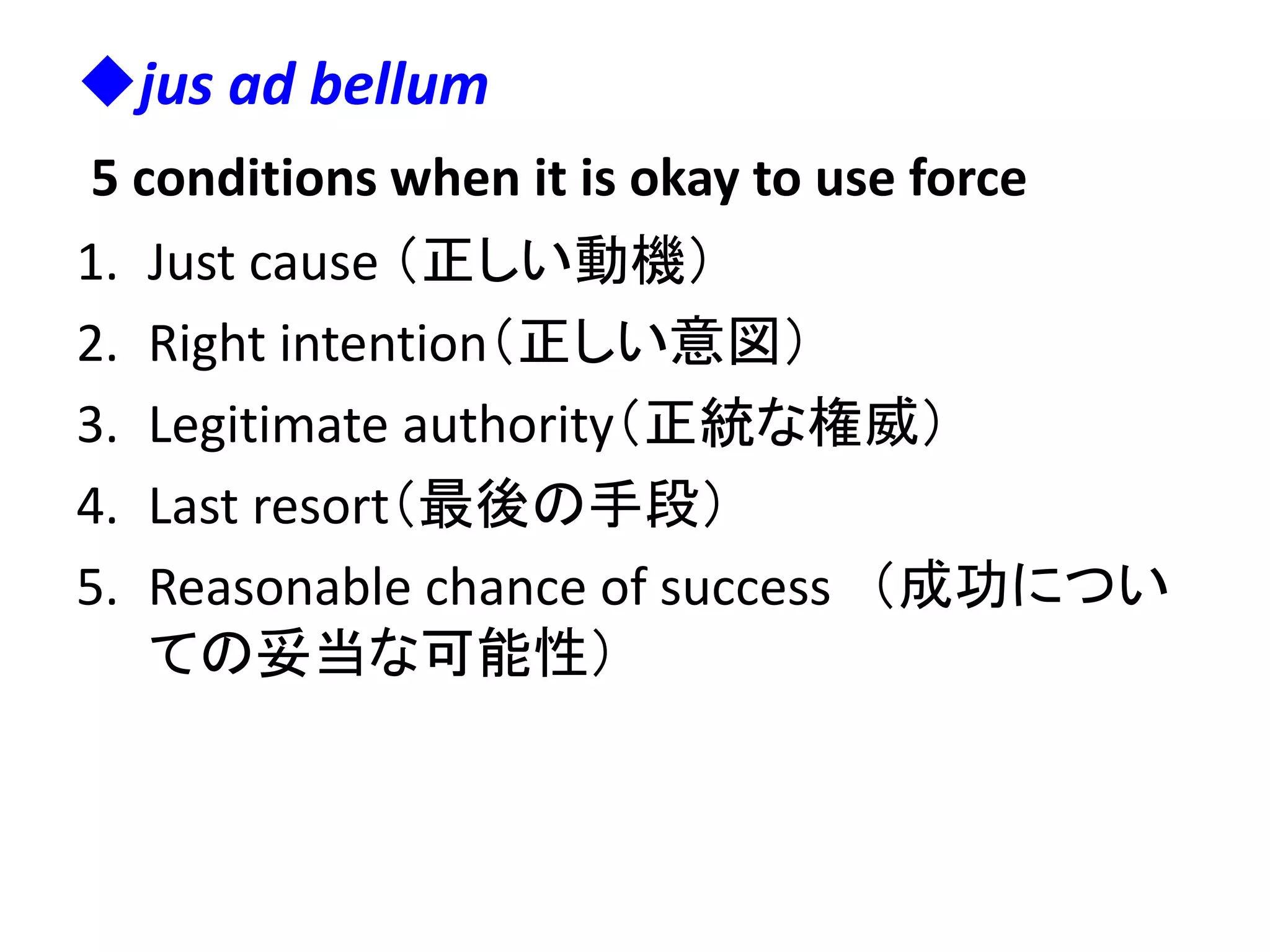
jus ad bellum
5 conditions when it is okay to use force
1. Just cause (正しい動機)
2. Right intention(正しい意図)
3. Legitimate authority(正統な権威)
4. Last resort(最後の手段)
5. Reasonable chance of success (成功につい
ての妥当な可能性)
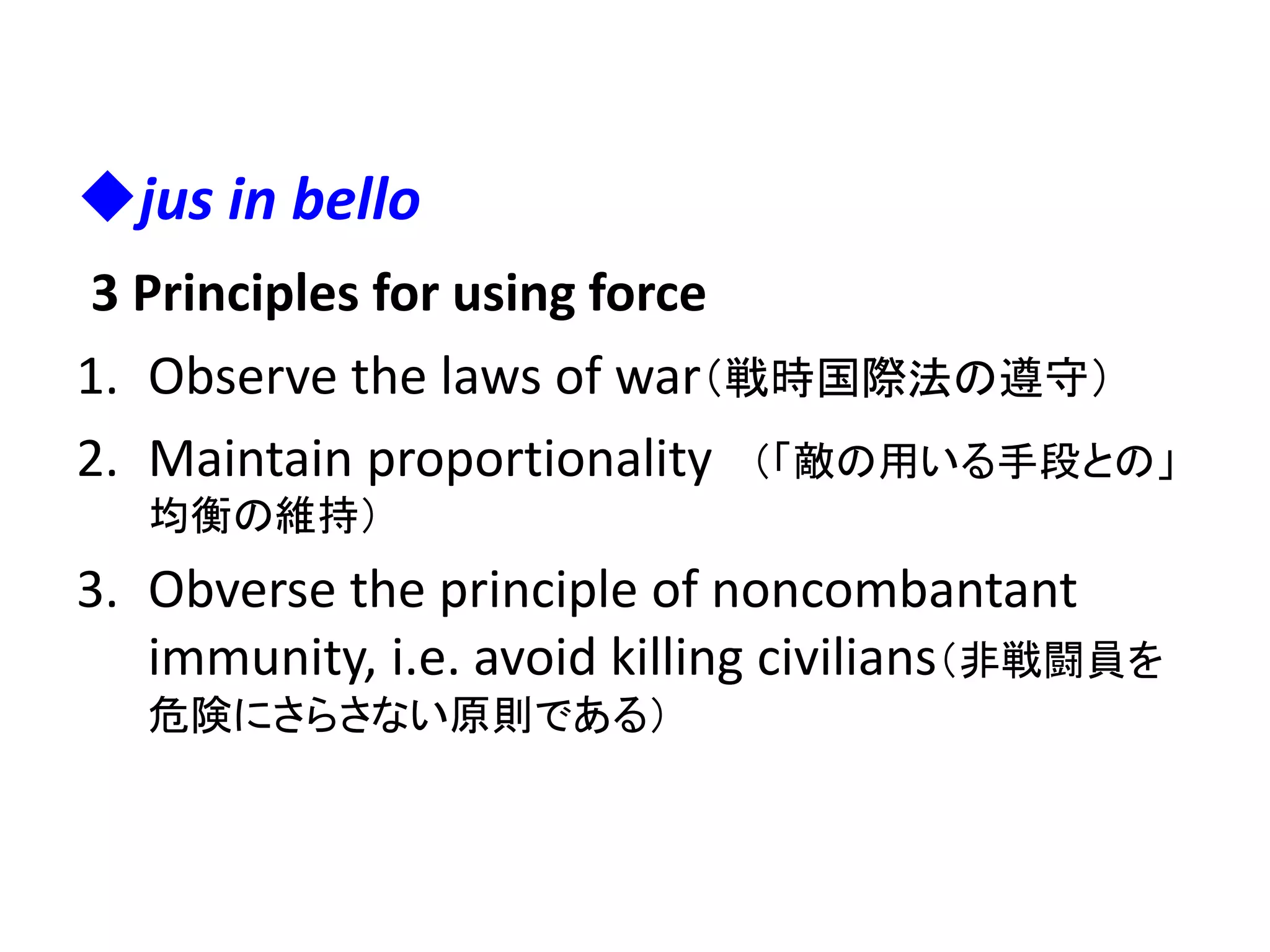
jus in bello
3 Principles for using force
1. Observe the laws of war(戦時国際法の遵守)
2. Maintain proportionality (「敵の用いる手段との」
均衡の維持)
3. Obverse the principle of noncombantant
immunity, i.e. avoid killing civilians(非戦闘員を
危険にさらさない原則である)
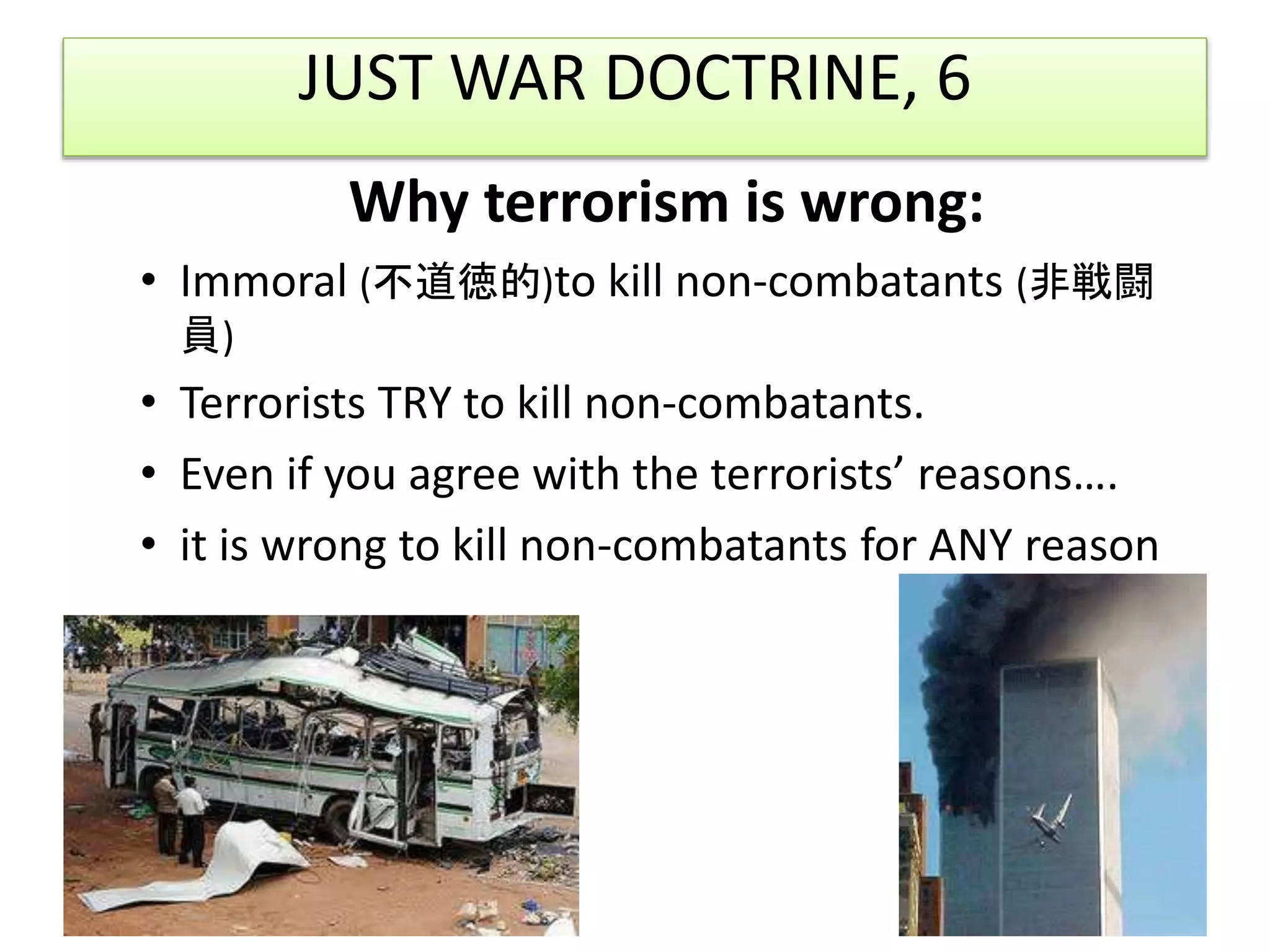
JUST WAR DOCTRINE, 6
Why terrorism is wrong:
• Immoral (不道徳的)to kill non-combatants (非戦闘
員)
• Terrorists TRY to kill non-combatants.
• Even if you agree with the terrorists’ reasons….
• it is wrong to kill non-combatants for ANY reason
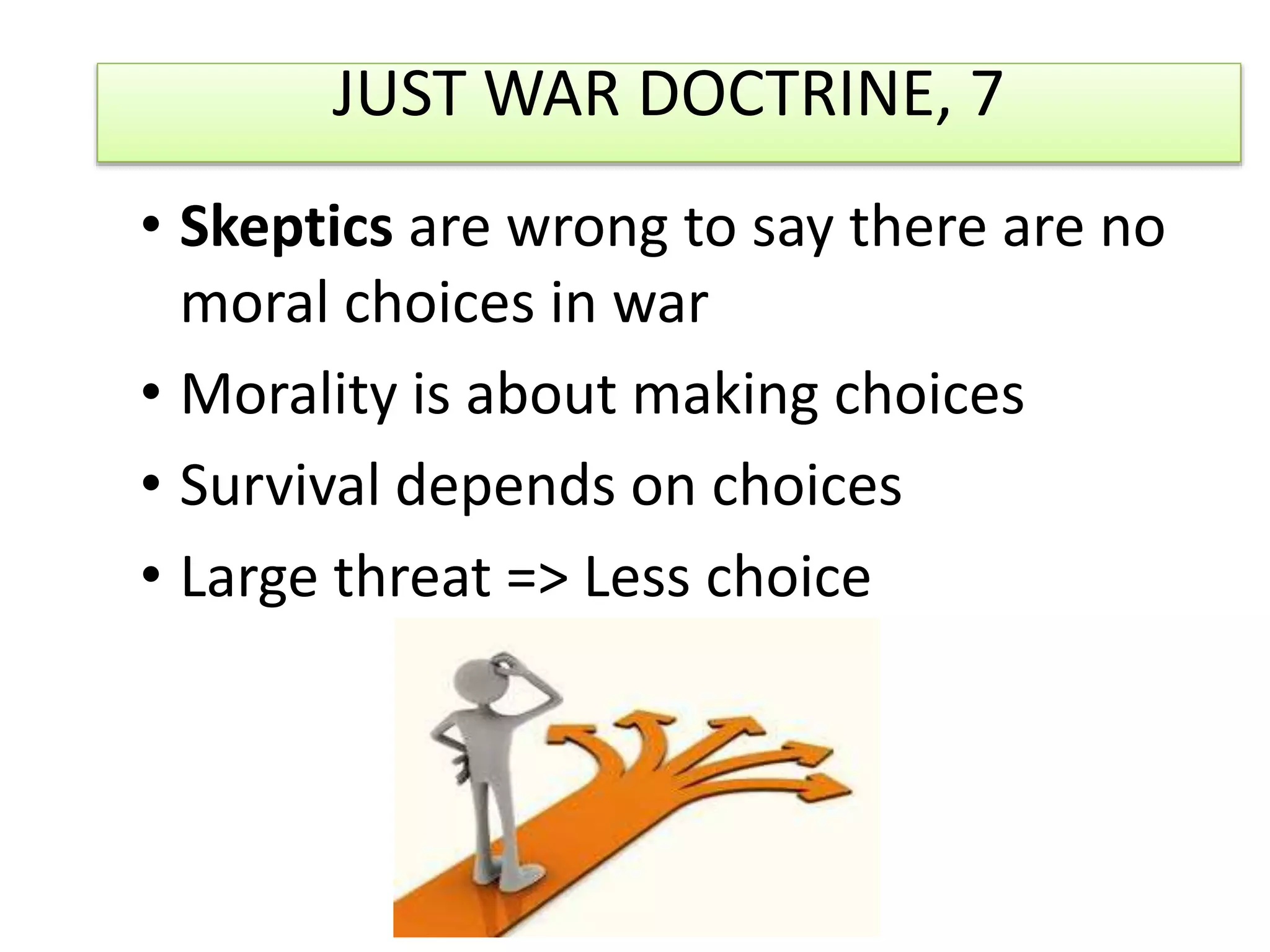
JUST WAR DOCTRINE, 7
• Skeptics are wrong to say there are no
moral choices in war
• Morality is about making choices
• Survival depends on choices
• Large threat => Less choice
 See you next week! 
DON’T BE LATE!!!!
• Study with your friends.
• If you study, this test will NOT be difficult.
REMEMBER:
Good luck is
the result of
good
planning!

You’ve worked hard since April.
Thank you, and good luck
on the test!!

国際政治基礎A spring 2015 class 5 lect 5

  • 1.
    Fundamental Concepts of InternationalPolitics Spring 2013 Prof. H. Steven Green Toyo University Faculty of Law Class 5,Lecture 6 May 11th, 2015 Ethics & Morality in IP, Just War Doctrine
  • 2.
  • 3.
    Stag Hunt • Twohunters can either hunt one stag together or hunt rabbits separately. • Stags provide more food, but... • Hunting a stag is difficult and requires patience and cooperation. • It is easy to catch a rabbit, but the rabbit provides less food. • The hunters must cooperate to get the most food.
  • 4.
    Stag Hunt • Cooperationrequires patience and trust. • Patience: The hunters must wait quietly for a very long time until a stag comes. • Trust: It is easy to catch a rabbit, so it is tempting to quit waiting, hunt a rabbit and enjoy the rest of the day.
  • 5.
  • 6.
    Stag hunt = CoordinationGame B Cooperates B Defects A Cooperates 5, 5 0, 1 A Defects 1, 0 1, 1
  • 7.
    Fighting pirates Different typesof governments coordinate to fight pirates Other countries Cooperate Other countries Defect USA Cooperates Coordinated fight by everyone: Decrease in number of pirate attacks, lower costs for everyone, benefits of cooperation. USA fights without help (expensive, risky). Other countries get free benefit of safer seas (but difficult to get all pirates.) USA Defects Other countries fight without help (expensive, dangerous). USA get free benefit of safer seas (but difficult to get all pirates.) Everyone fights but only when their own ships are threatened. Increase in number of pirate attacks.
  • 8.
    Six-Party Talks* North Korea,South Korea, China, Russia, U.S., Japan • Who are the hunters? • What is the stag? • What is the rabbit? Hunters: SK, C, J, R, US Stag: Change by NK Rabbit: NK concessions to one state, but not the others (family visits for SK, return kidnapped Japanese citizens, mineral exploration rights for China, etc.) *Slides 8-10: CREDIT TO ROBERT KELLEY https://asiansecurityblog.wordpress.com/2010/04/26/six-party-talks- as-a-game-theoretic-stag-hunt-1-n-korea-is-the-stag/
  • 9.
    Six-Party Talks North Korea,South Korea, China, Russia, U.S., Japan NK’s strategy: “Divide to survive”: Divide the 5 other states by giving them concessions separately.
  • 10.
    Six-Party Talks North Korea,South Korea, China, Russia, U.S., Japan US, J, C, SK, R Cooperate US, J, C, SK, R Do not cooperate US, J, C, SK, R Cooperate Change in NK, greater security in East Asia China takes a BIG rabbit: More influence for C, less security for other 4 US, J, C, SK, R Do not cooperate China takes a BIG rabbit: More influence for C, less security for Concessions for US, J, C, SK, R, No change in NK Reduced cooperation
  • 11.
    Six-Party Talks North Korea,South Korea, China, Russia, U.S., Japan • The rabbit China hunts is bigger & tastier than the stag: Security, influence
  • 13.
    (4.) ETHICS &IP •Is morality in the international system different from morality in states?
  • 14.
    ETHICS AND IP Thisman: NOT punished for killing
  • 15.
    ETHICS AND IP Thisman: Punished for killing
  • 17.
    Is it okayto kill 1 to save many?
  • 18.
    Is it okayto kill 1 osumo-san to save many?
  • 19.
    What if theosumo-san had broken the train’s brakes? Okay to kill him now?
  • 20.
    ETHICS AND IP Ethicsin international politics ARE not the same as ethics in domestic politics • Is it wrong to kill 1 person in order to save 100? • Is it wrong to kill one person who has a bomb that will destroy Tokyo? • Is it wrong to kill many people in order to save your country or to stop genocide (大虐殺)?
  • 21.
    DISCUSSION What are FOURreasons why ethics play less of a role in IP than in domestic politics?
  • 22.
    ETHICS AND IP FOURREASONS ETHICS PLAY LESS OF A ROLE IN IP THAN IN DOMESTIC POLITICS 1. Weak international consensus about values (国際的に一致した意見はない) • Cultural and religious differences • Examples: whaling (捕鯨), death penalty (死刑)
  • 23.
    ETHICS AND IP FOURREASONS ETHICS PLAY LESS OF A ROLE IN IP THAN IN DOMESTIC POLITICS 2. States are not individuals: • Leaders of states are judged as leaders of states, not as individuals (リーダは、個人ではなく、国の リーダとして、裁かれる) • Killing is wrong but… • Sometimes we want our leaders to tell our army to kill people
  • 24.
    ETHICS AND IP FOURREASONS ETHICS PLAY LESS OF A ROLE IN IP THAN IN DOMESTIC POLITICS 3. “Complexity of causation*” Very difficult to understand which actions(行動) cause which consequences(結果) *causation = 原因
  • 25.
    ETHICS AND IP FOURREASONS ETHICS PLAY LESS OF A ROLE IN IP THAN IN DOMESTIC POLITICS 3. “Complexity of causation” (continued): • 1933 Oxford debate: Students promise not to fight for their country  Hitler thinks British people are soft • READ about the “hamburger argument”
  • 26.
    ETHICS AND IP FOURREASONS ETHICS PLAY LESS OF A ROLE IN IP THAN IN DOMESTIC POLITICS 4. Less order, so there is less justice in IP • Justice (公正) requires order (秩序) • International society does not have enough institutions to create order (平和と秩序を維持 する国際組織はない)
  • 27.
    The Role ofMorality in IP Which statement do you agree with and why? A. Morality in the international system should be the same as morality in our society. B. Morality in the international system should not be the same as morality in our society.
  • 28.
    DISCUSSION What are the3 views of the role of morality in international politics?
  • 29.
    3 Views ofthe Role of Morality 1. SKEPTICS 2. STATE MORALISTS 3. COSMOPOLITANS
  • 30.
    1. SKEPTICS • Moralityhas no meaning in IP because there are no institutions to provide order • No sense of community, so no moral rights and duties
  • 32.
    Athens and Melos Athensdemands that Melos pay Athens for protection and help fight Sparta…or die. • Melians faced a terrible choice: Die free or live as slaves • Melians refused. So… • Athens killed all men, and enslaved all women and children. (enslave =人を奴隷にする)
  • 33.
  • 34.
    Should countries takecare of their own problems? Which statement do you agree with and why? A. My country should solve its own problems and let other countries solve their own problems. A. My country should help other countries to solve their problems.
  • 35.
    Should countries takecare of their own problems? Which statement do you agree with and why? A. My country should solve its own problems and let other countries solve their own problems. A. My country should help other countries to solve their problems.
  • 36.
    Should countries takecare of their own problems? Match each country with the results of the survey. Britain France Germany Japan Spain U.S. • Pew Research Global Attitudes Project, 2010
  • 37.
    Should countries takecare of their own problems? Which statement do you agree with and why? A. My country should solve its own problems and let other countries solve their own problems. A. My country should help other countries to solve their problems.
  • 38.
    Should countries takecare of their own problems? Match each country with the results of the survey. Britain France Germany Japan Spain U.S. • Pew Research Global Attitudes Project, 2010
  • 39.
    Should countries takecare of their own problems? Match each country with the results of the survey. Britain France Germany Japan Spain U.S. • Pew Research Global Attitudes Project, 2010
  • 40.
    2. STATE MORALISTS •IP is based on society of states • Protect individuals by protecting state sovereignty • People suffer in failed states and states that are invaded by other countries
  • 41.
    3. COSMOPOLITANS • IPis a society of individuals • International justice should be justice for individuals • National boundaries have no moral standing
  • 45.
    IR Theories: REALISM 1.IP is a system of Hobbesian anarchy. 2. States are the most important actors in IP because they are the most powerful. 3. All international politics is power politics. 4. Power is zero-sum and relative. (If state X has more power, all other states have less.) 5. We are lucky if we live in a democratic state: our leaders should maintain our power. (To do that, sometimes our government has to cooperate with un-democratic governments.)
  • 46.
    IR Theories: LIBERALISM 1.Anarchy is a problem but one that can be solved. 2. People are motivated not only by power but also by security and the desire to live well. 3. States are important, but not the only actors that matter: there is an international society which includes other kinds of actors. However… 4. States have the most military and economic power and should protect their people in an anarchic world. 5. Democratic states are the best way to provide security and well-being for their people and more democratic states = more peace.
  • 47.
    IR Theories: CONSTRUCTIVISM 1.Anarchy is what states make of it. Leaders’ views of the international system are constructed by: • Social structures (社会的な構造), e.g. economic-, legal-, political systems, etc. of a country. • Ideas • Norms (規範) • Culture 2. States are social constructs, NOT natural. We are not born Chinese, Japanese, American, French, Dutch, etc., but we are taught to be Chinese, etc.
  • 48.
    Morality and IPTheories Which IP theory matches which view of morality? VIEW OF MORALITY IP THEORY Skeptics ? State moralists ? Cosmopolitans ?
  • 49.
    Morality and IPTheories Which IP theory matches which view of morality? VIEW OF MORALITY IP THEORY Skeptics Realism State moralists Realism / Liberalism Cosmopolitans Constructivism
  • 50.
    Discussion Questions Is waralways wrong? Why or why not? If it is not always wrong, when is it okay to kill? Who is it okay to kill? How is it okay to kill (e.g. with guns, chemical weapons, nuclear weapons)? chemical weapons =化学兵器
  • 51.
    Is war alwayswrong? Was it wrong to kill German soldiers in World War II?
  • 52.
    Is war alwayswrong? Was it wrong to kill German civilians in WWII?
  • 53.
    Is it wrongfor terrorists to kill civilians?
  • 54.
    Is it wrongto kill terrorists?
  • 55.
    JUST WAR DOCTRINE(正戦論) Is war always wrong? St. Augustine (354-430) • Created first theory of war and justice. • Said some wars are necessary to stop evil. Saint Augustine in His Study, by Sandro Botticelli, 1480, Chiesa di Ognissanti, Florence, Italy 
  • 56.
    JUST WAR DOCTRINE(正戦論) • From Roman & Christian philosophies • Secularized(世俗化した) after the 17th Century • Basic point: Killing is wrong
  • 57.
    JUST WAR DOCTRINE JustWar Doctrine is NOT pacifism (平和主義) PACIFISM JUST WAR DOC. Killing is wrong. Killing is wrong. Violence creates more violence. ? Killing is always wrong for any reason. ? War is always wrong. ?
  • 58.
    JUST WAR DOCTRINE JustWar Doctrine is NOT pacifism (平和主義) PACIFISM JUST WAR DOC. Killing is wrong. Killing is wrong. Violence creates more violence. NOT responding to violence creates more violence. Killing is always wrong for any reason. ? War is always wrong. ?
  • 59.
    JUST WAR DOCTRINE JustWar Doctrine is NOT pacifism (平和主義) PACIFISM JUST WAR DOC. Killing is wrong. Killing is wrong. Violence creates more violence. NOT responding to violence creates more violence. Killing is always wrong for any reason. Sometimes killing is necessary: Reasons are important. War is always wrong. ?
  • 60.
    JUST WAR DOCTRINE JustWar Doctrine is NOT pacifism (平和主義) PACIFISM JUST WAR DOC. Killing is wrong. Killing is wrong. Violence creates more violence. NOT responding to violence creates more violence. Killing is always wrong for any reason. Sometimes killing is necessary: Reasons are important. War is always wrong. Wars is sometimes necessary for justice (正義). Rules for “just wars.”
  • 61.
    Are Japanese pacifist? Thinkabout the popularity of Article 9 of Japan’s constitution (憲法第9条). Do most Japanese believe in pacifism? OR Do most Japanese believe in Just War Doctrine ?
  • 62.
    Is military forcenecessary for world order? 57% of Japanese agree
  • 63.
    JUST WAR DOCTRINE Twoprinciples of just war doctrine: jus ad bellum • When the use of force is moral jus in bello • How to use force morally
  • 64.
    jus ad bellum 5conditions when it is okay to use force 1. Just cause (正しい動機) 2. Right intention(正しい意図) 3. Legitimate authority(正統な権威) 4. Last resort(最後の手段) 5. Reasonable chance of success (成功につい ての妥当な可能性)
  • 65.
    jus in bello 3Principles for using force 1. Observe the laws of war(戦時国際法の遵守) 2. Maintain proportionality (「敵の用いる手段との」 均衡の維持) 3. Obverse the principle of noncombantant immunity, i.e. avoid killing civilians(非戦闘員を 危険にさらさない原則である)
  • 66.
    JUST WAR DOCTRINE,6 Why terrorism is wrong: • Immoral (不道徳的)to kill non-combatants (非戦闘 員) • Terrorists TRY to kill non-combatants. • Even if you agree with the terrorists’ reasons…. • it is wrong to kill non-combatants for ANY reason
  • 67.
    JUST WAR DOCTRINE,7 • Skeptics are wrong to say there are no moral choices in war • Morality is about making choices • Survival depends on choices • Large threat => Less choice
  • 68.
     See younext week!  DON’T BE LATE!!!! • Study with your friends. • If you study, this test will NOT be difficult. REMEMBER: Good luck is the result of good planning!
  • 69.
     You’ve worked hardsince April. Thank you, and good luck on the test!!