A Project 
Work on 
1
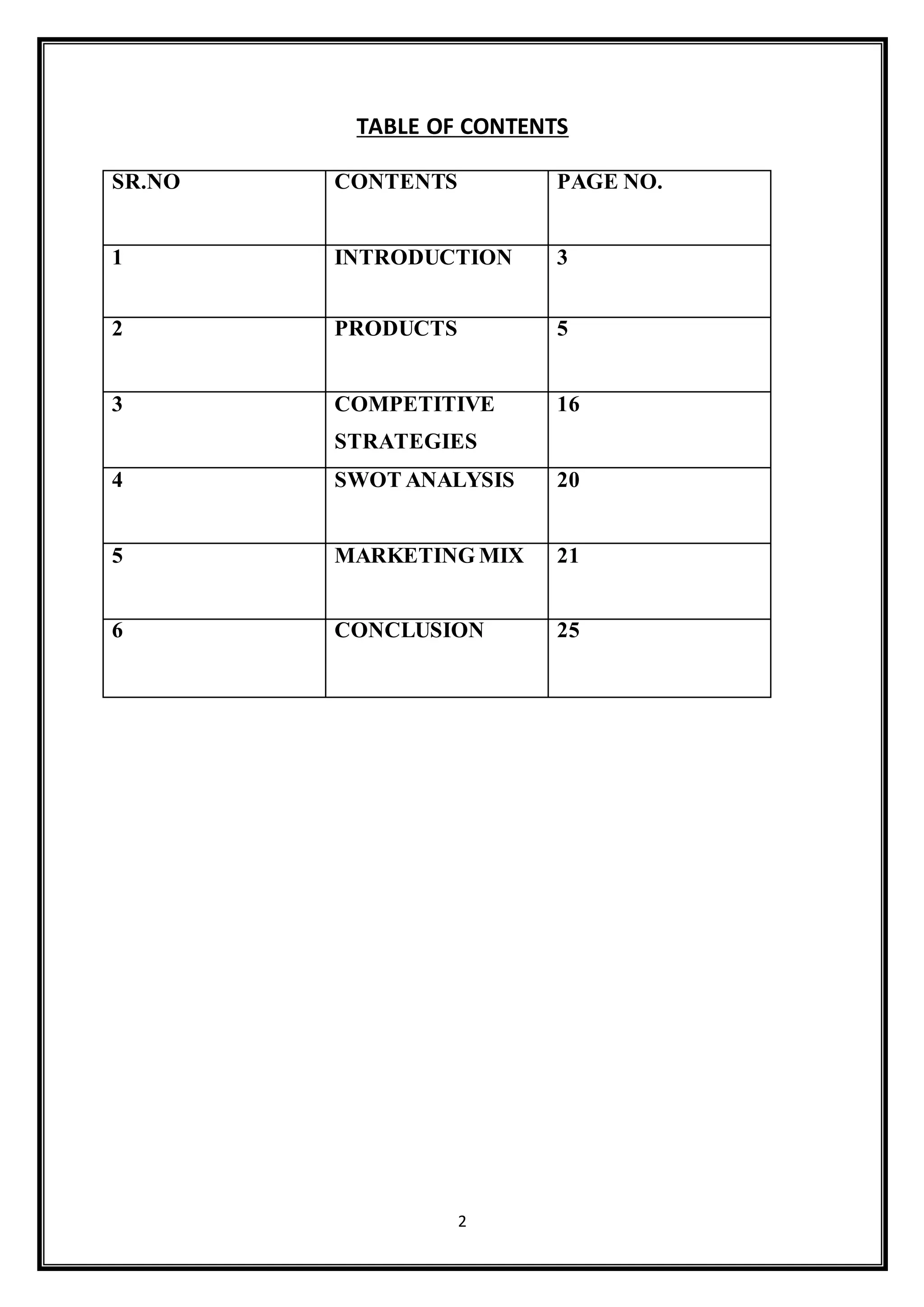
TABLE OF CONTENTS 
SR.NO CONTENTS PAGE NO. 
1 INTRODUCTION 3 
2 PRODUCTS 5 
3 COMPETITIVE 
STRATEGIES 
2 
16 
4 SWOT ANALYSIS 20 
5 MARKETING MIX 21 
6 CONCLUSION 25
INTRODUCTION 
3 
PepsiCo 
PepsiCo Inc. is an American multinational food and beverage corporation headquartered 
in Purchase, New York, United States, with interests in the manufacturing, marketing and 
distribution of grain-based snack foods, beverages, and other products. PepsiCo was formed 
in 1965 with the merger of the Pepsi-Cola Company and Frito-Lay, Inc. PepsiCo has since 
expanded from its namesake product Pepsi to a broader range of food and beverage brands, 
the largest of which includes an acquisition of Tropicana in 1998 and a merger with Quaker 
Oats in 2001—which added the Gatorade brand to its portfolio. 
PepsiCo's brands generated retail sales of more than $1 billion apiece,and the company's 
products were distributed across more than 200 countries, resulting in annual net revenues of 
$43.3 billion. Based on net revenue, PepsiCo is the second largest food and beverage 
business in the world. Within North America, PepsiCo is ranked (by net revenue) as the 
largest food and beverage business. 
Indra Krishnamurthy Nooyi has been the chief executive of PepsiCo since 2006, and the 
company employed approximately 274,000 people worldwide as of 2013. The company's 
beverage distribution and bottling is conducted by PepsiCo as well as by licensed bottlers in 
certain regions. 
PepsiCo Americas Beverages (PAB) makes, markets, sells and distributes beverage 
concentrates, fountain syrups and finished goods under various beverage brands. Through 
strategic acquisitions, partnerships and new product development, PAB has expanded its 
beverage lineup over the past 20 years to offer top-selling choices for every occasion and 
lifestyle. As a result, Pepsi-Cola today is the flagship brand in a portfolio of liquid 
refreshment beverages that includes 14 billion-dollar brands and spans carbonated soft drinks, 
juices and juice drinks, ready-to-drink teas and coffees, sports drinks and bottled waters. 
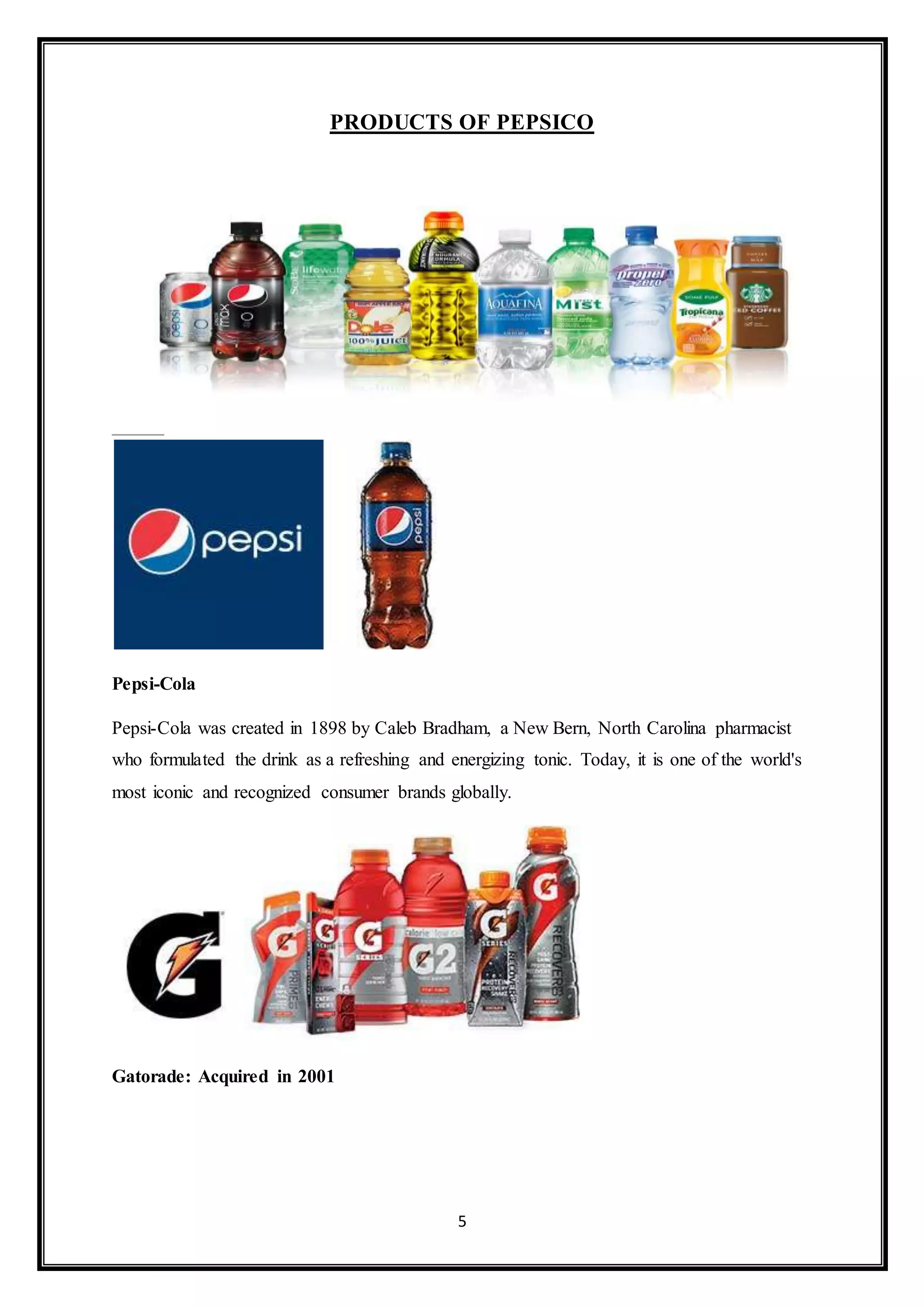
Its brands include Pepsi-Cola, Mountain Dew, Gatorade, Sierra Mist, Aquafina, Tropicana 
Pure Premium, AMP Energy, Propel, Mug, SoBe, IZZE and Naked Juice. PAB also 
distributes and sells in the United States a leading portfolio of ready-to-drink teas and coffees 
through strategic joint ventures with Unilever and Starbucks, with brands that include Lipton 
Iced Tea, Pure Leaf and Brisk, Tazo Iced Tea, Starbucks Frappuccino, Starbucks Iced Coffee, 
Seattle's Best Iced Lattes and Starbucks Refreshers. In 2012, PepsiCo announced that
Starbuck's ready-to-drink beverages and Lipton Brisk had grown to more than $1 billion in 
estimated annual retail sales, expanding PepsiCo's portfolio of billion-dollar brands. 
PAB offers reduced-calorie options for virtually every drink it makes and for every occasion. 
Today, nearly half of PAB sales volume in the United States comes from no- or low-calorie 
beverages, healthy juices, and active hydration beverages. 
4
PRODUCTS OF PEPSICO 
5 
Pepsi-Cola 
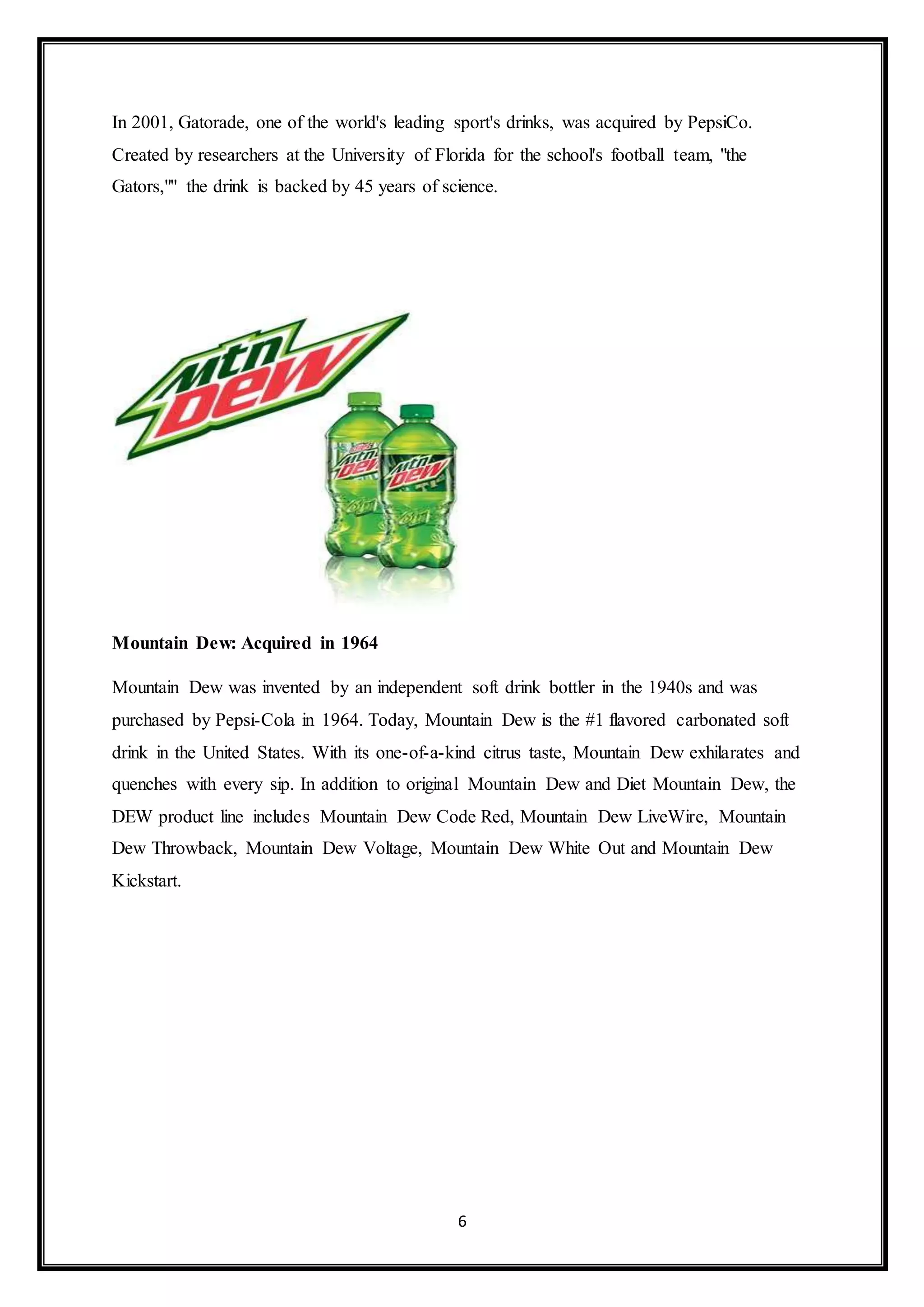
Pepsi-Cola was created in 1898 by Caleb Bradham, a New Bern, North Carolina pharmacist 
who formulated the drink as a refreshing and energizing tonic. Today, it is one of the world's 
most iconic and recognized consumer brands globally. 
Gatorade: Acquired in 2001
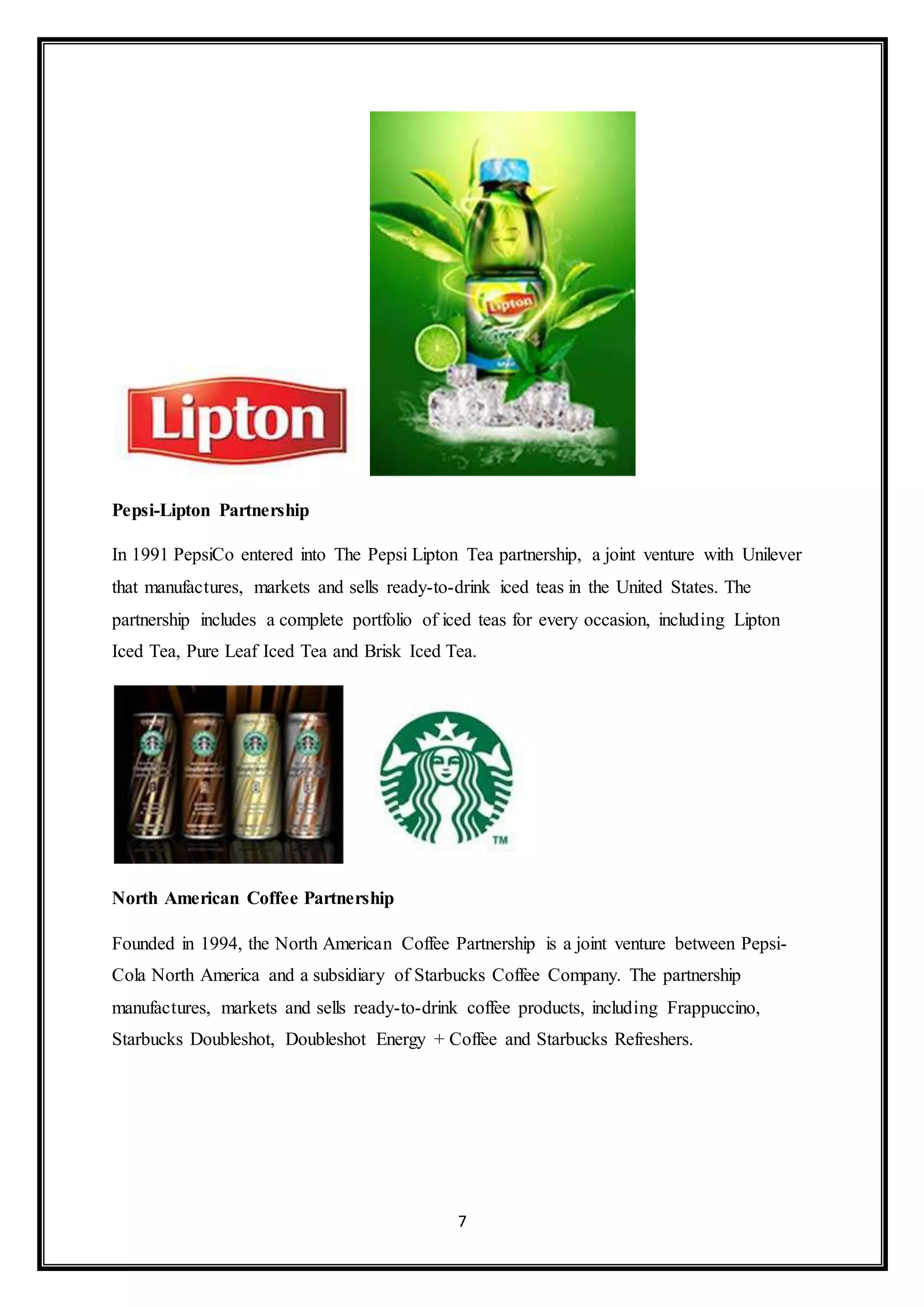
In 2001, Gatorade, one of the world's leading sport's drinks, was acquired by PepsiCo. 
Created by researchers at the University of Florida for the school's football team, "the 
Gators,"" the drink is backed by 45 years of science. 
6 
Mountain Dew: Acquired in 1964 
Mountain Dew was invented by an independent soft drink bottler in the 1940s and was 
purchased by Pepsi-Cola in 1964. Today, Mountain Dew is the #1 flavored carbonated soft 
drink in the United States. With its one-of-a-kind citrus taste, Mountain Dew exhilarates and 
quenches with every sip. In addition to original Mountain Dew and Diet Mountain Dew, the 
DEW product line includes Mountain Dew Code Red, Mountain Dew LiveWire, Mountain 
Dew Throwback, Mountain Dew Voltage, Mountain Dew White Out and Mountain Dew 
Kickstart.
7 
Pepsi-Lipton Partnership 
In 1991 PepsiCo entered into The Pepsi Lipton Tea partnership, a joint venture with Unilever 
that manufactures, markets and sells ready-to-drink iced teas in the United States. The 
partnership includes a complete portfolio of iced teas for every occasion, including Lipton 
Iced Tea, Pure Leaf Iced Tea and Brisk Iced Tea. 
North American Coffee Partnership 
Founded in 1994, the North American Coffee Partnership is a joint venture between Pepsi- 
Cola North America and a subsidiary of Starbucks Coffee Company. The partnership 
manufactures, markets and sells ready-to-drink coffee products, including Frappuccino, 
Starbucks Doubleshot, Doubleshot Energy + Coffee and Starbucks Refreshers.
8 
Tropicana: Acquired in 1998 
In 1947, Anthony Rossi started a local fruit packaging business called Tropicana. Seven years 
later, Rossi pioneered a revolutionary pasteurization process for orange juice. For the first 
time, consumers could enjoy the fresh taste of pure, not-from-concentrate, 100% Florida 
orange juice in a ready-to-serve package. The juice, Tropicana Pure Premium, became the 
company's flagship product. PepsiCo acquired Tropicana and the Dole juice business in 1998. 
PepsiCo Americas Foods 
PepsiCo Americas Foods is the provider of many of the most popular food and snacks 
throughout North and Latin America. Its portfolio of businesses includes Frito-Lay North 
America, Quaker Foods North America, and all of our Latin American food and snack 
businesses.
9 
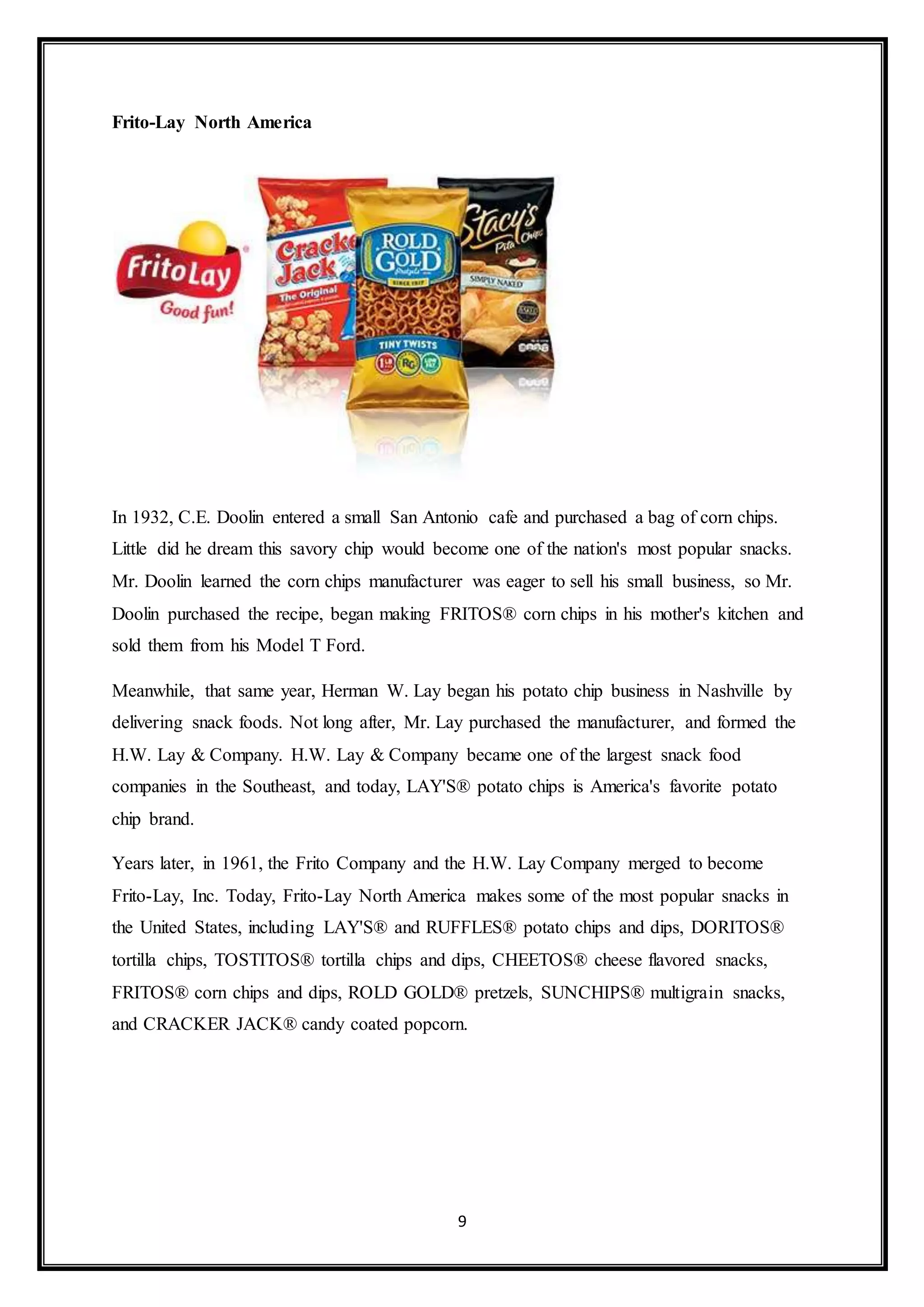
Frito-Lay North America 
In 1932, C.E. Doolin entered a small San Antonio cafe and purchased a bag of corn chips. 
Little did he dream this savory chip would become one of the nation's most popular snacks. 
Mr. Doolin learned the corn chips manufacturer was eager to sell his small business, so Mr. 
Doolin purchased the recipe, began making FRITOS® corn chips in his mother's kitchen and 
sold them from his Model T Ford. 
Meanwhile, that same year, Herman W. Lay began his potato chip business in Nashville by 
delivering snack foods. Not long after, Mr. Lay purchased the manufacturer, and formed the 
H.W. Lay & Company. H.W. Lay & Company became one of the largest snack food 
companies in the Southeast, and today, LAY'S® potato chips is America's favorite potato 
chip brand. 
Years later, in 1961, the Frito Company and the H.W. Lay Company merged to become 
Frito-Lay, Inc. Today, Frito-Lay North America makes some of the most popular snacks in 
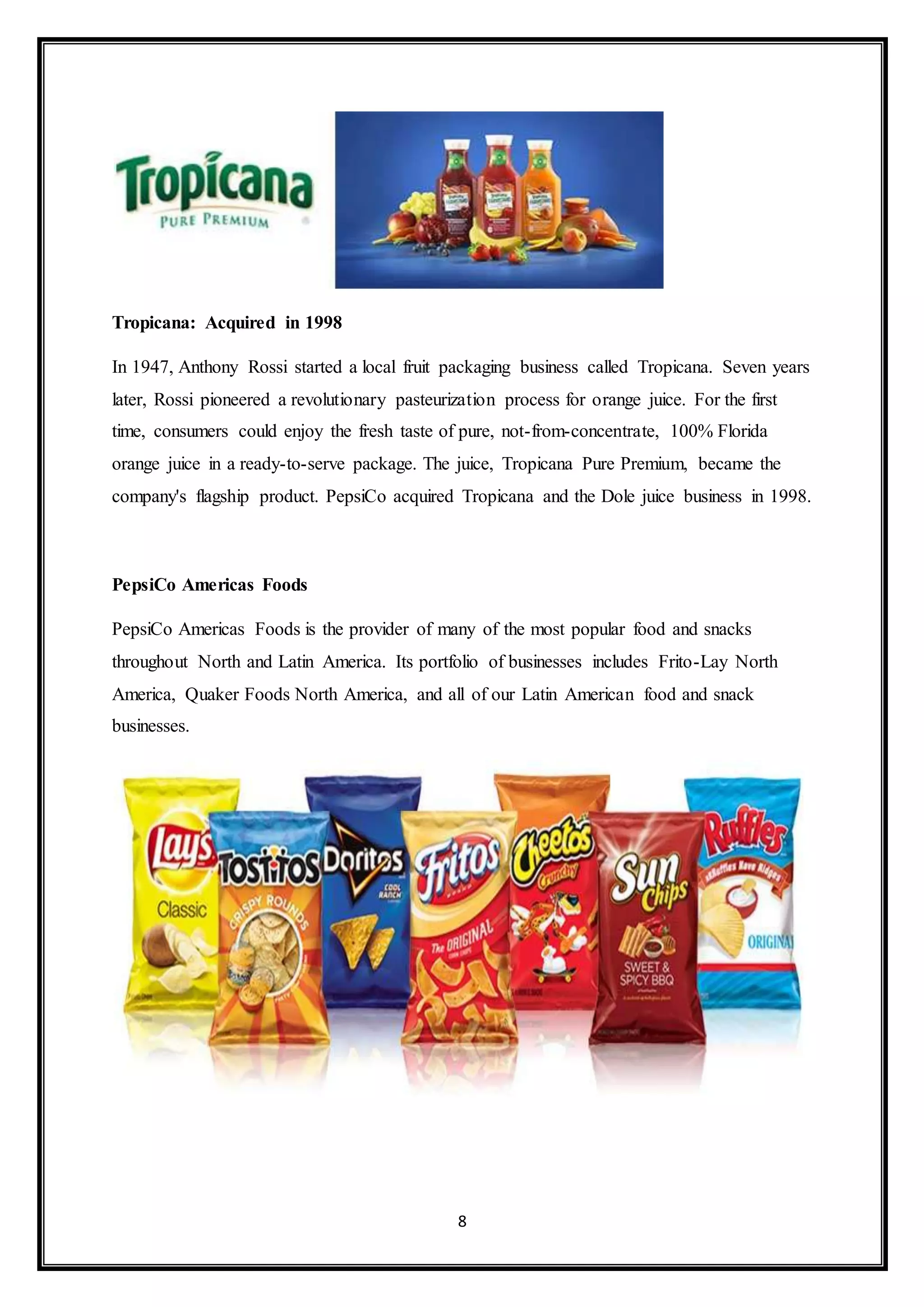
the United States, including LAY'S® and RUFFLES® potato chips and dips, DORITOS® 
tortilla chips, TOSTITOS® tortilla chips and dips, CHEETOS® cheese flavored snacks, 
FRITOS® corn chips and dips, ROLD GOLD® pretzels, SUNCHIPS® multigrain snacks, 
and CRACKER JACK® candy coated popcorn.
10 
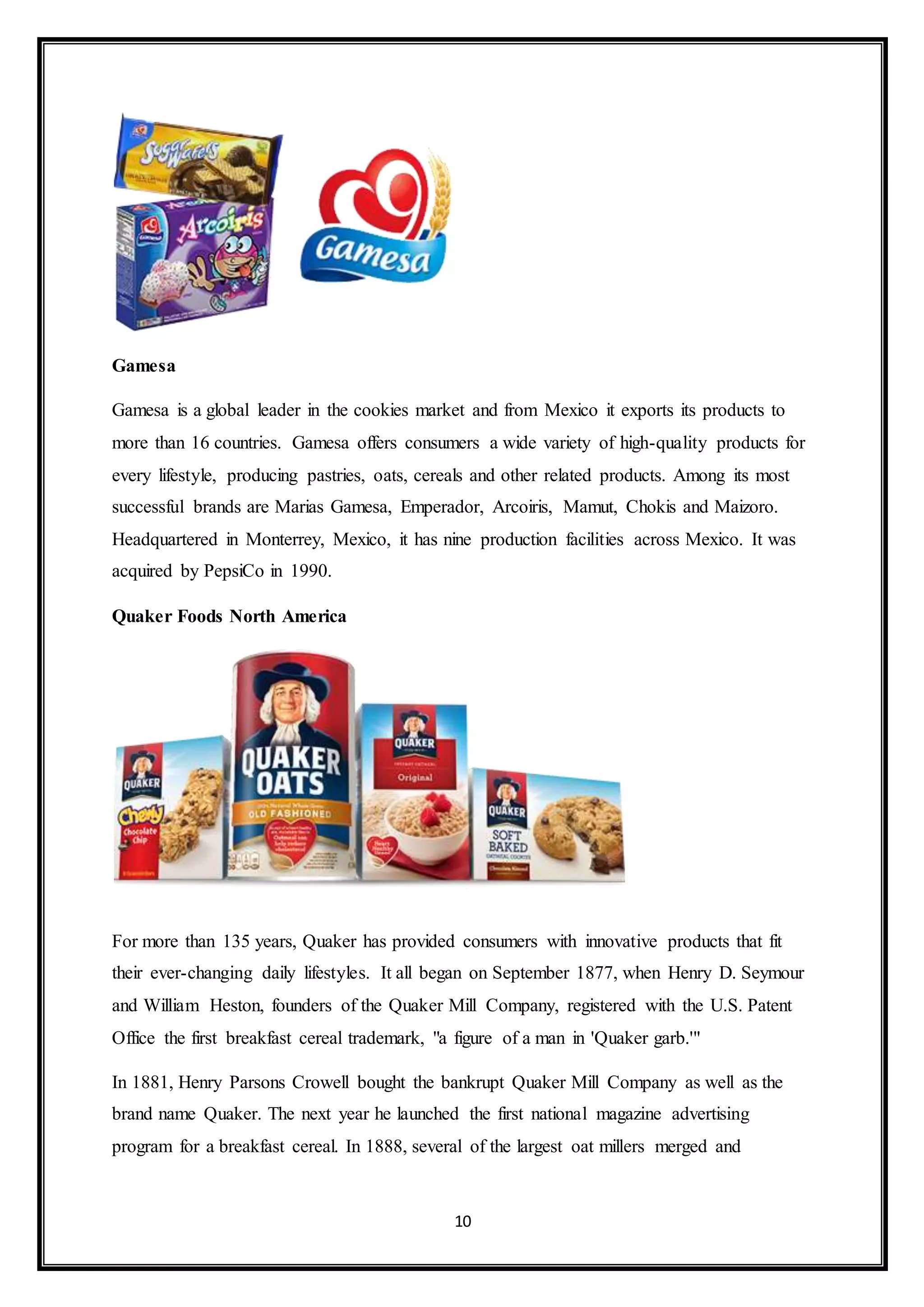
Gamesa 
Gamesa is a global leader in the cookies market and from Mexico it exports its products to 
more than 16 countries. Gamesa offers consumers a wide variety of high-quality products for 
every lifestyle, producing pastries, oats, cereals and other related products. Among its most 
successful brands are Marias Gamesa, Emperador, Arcoiris, Mamut, Chokis and Maizoro. 
Headquartered in Monterrey, Mexico, it has nine production facilities across Mexico. It was 
acquired by PepsiCo in 1990. 
Quaker Foods North America 
For more than 135 years, Quaker has provided consumers with innovative products that fit 
their ever-changing daily lifestyles. It all began on September 1877, when Henry D. Seymour 
and William Heston, founders of the Quaker Mill Company, registered with the U.S. Patent 
Office the first breakfast cereal trademark, "a figure of a man in 'Quaker garb.'" 
In 1881, Henry Parsons Crowell bought the bankrupt Quaker Mill Company as well as the 
brand name Quaker. The next year he launched the first national magazine advertising 
program for a breakfast cereal. In 1888, several of the largest oat millers merged and
established the American Cereal Company. And in 1901, the American Cereal Company 
changed its name to The Quaker Oats Company. 
The iconic Quaker Oats round packaging first appeared in 1915 and Quaker Quick Oats, one 
of America's first convenience products, was introduced in 1922. The first major acquisition 
of the company was Aunt Jemima Mills Company in 1926, which is today one of the leading 
manufacturers of pancake mixes and syrup. Gatorade was later acquired in 1983 and the 
Golden Grain Company, producers of Rice-A-Roni, in 1986. 
PepsiCo merged with The Quaker Oats Company in 2001. 
Today, Quaker Foods North America makes, markets, sells and distributes products spanning 
several categories such as hot and ready-to-eat cereals, rice, pasta and other branded products. 
Some of its best known and beloved brands include Quaker oatmeal, Quaker Chewy granola 
bars, Life cereal, and Rice-A-Roni and Pasta Roni. 
11 
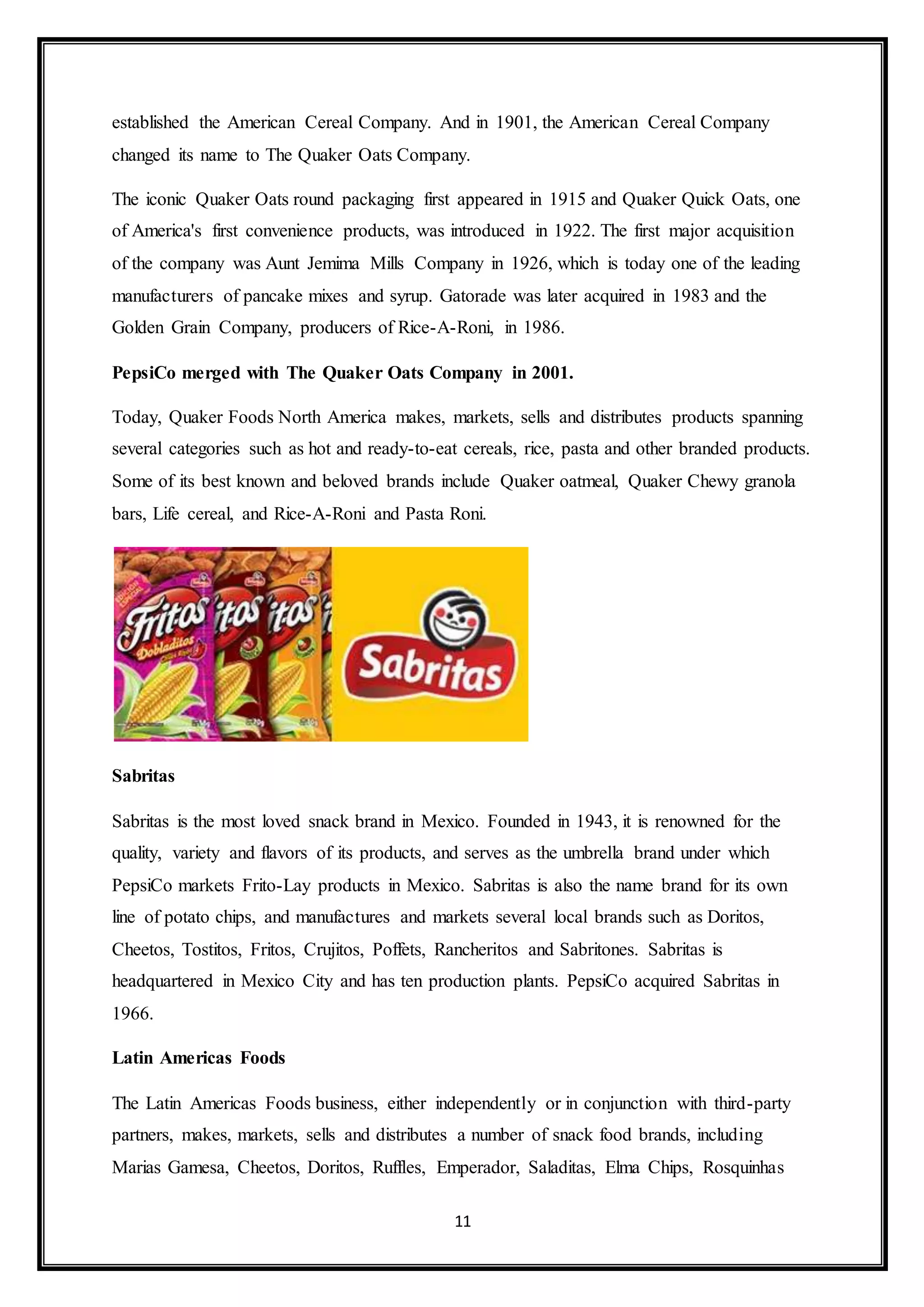
Sabritas 
Sabritas is the most loved snack brand in Mexico. Founded in 1943, it is renowned for the 
quality, variety and flavors of its products, and serves as the umbrella brand under which 
PepsiCo markets Frito-Lay products in Mexico. Sabritas is also the name brand for its own 
line of potato chips, and manufactures and markets several local brands such as Doritos, 
Cheetos, Tostitos, Fritos, Crujitos, Poffets, Rancheritos and Sabritones. Sabritas is 
headquartered in Mexico City and has ten production plants. PepsiCo acquired Sabritas in 
1966. 
Latin Americas Foods 
The Latin Americas Foods business, either independently or in conjunction with third-party 
partners, makes, markets, sells and distributes a number of snack food brands, including 
Marias Gamesa, Cheetos, Doritos, Ruffles, Emperador, Saladitas, Elma Chips, Rosquinhas
Mabel, Sabritas and Tostitos, as well as many Quaker-branded cereals and snacks. These 
branded products are sold to independent distributors and retailers. 
PepsiCo Europe includes all beverage, food and snack businesses in Europe and South 
Africa. Either independently or in conjunction with third-party partners, PepsiCo Europe 
makes, markets, sells and distributes some of the most respected household brands, including 
Lay's, Walkers, Doritos, Cheetos and Ruffles, many Quaker-branded cereals and snacks, 
beverage concentrates, fountain syrups and finished goods under various beverage brands, 
including Pepsi, Pepsi Max, 7UP, Diet Pepsi and Tropicana. These branded products are sold 
to authorized bottlers, independent distributors and retailers. In certain markets, PepsiCo 
Europe operates its own bottling plants and distribution facilities. PepsiCo Europe also, either 
independently or in conjunction with third-party partners, makes, markets and sells ready-to-drink 
tea products through an international joint venture with Unilever (under the Lipton 
brand name), and sells and distributes a number of leading dairy products, including Domik v 
Derevne, Chudo and Agusha. 
12 
Milestones 
Wimm-Bill-Dann: Acquired in 2011 
In 2011 acquisition of Wimm-Bill-Dann, Russia's leading branded food-and-beverage 
company, made PepsiCo the #1 food and beverage business in Russia.
13 
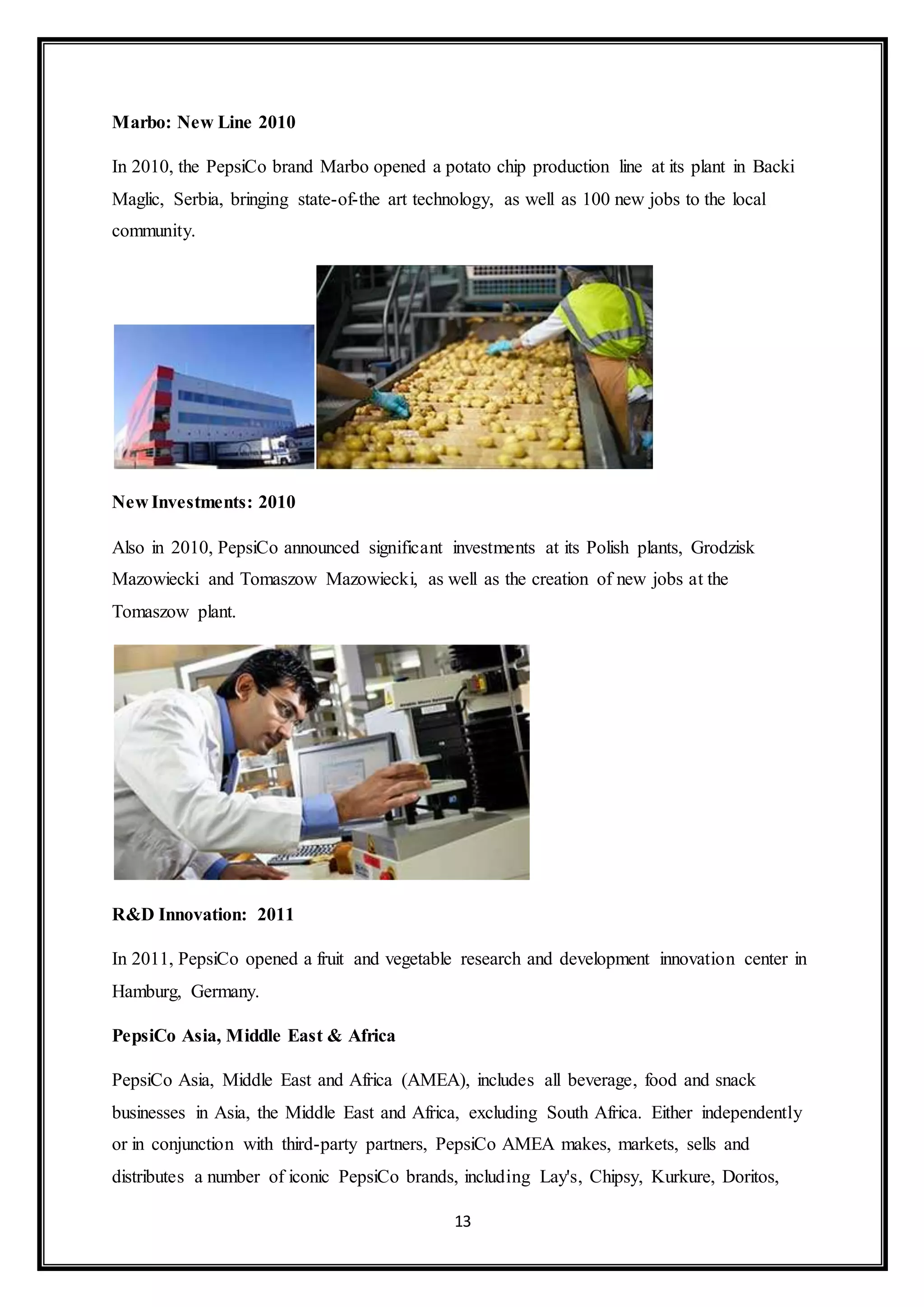
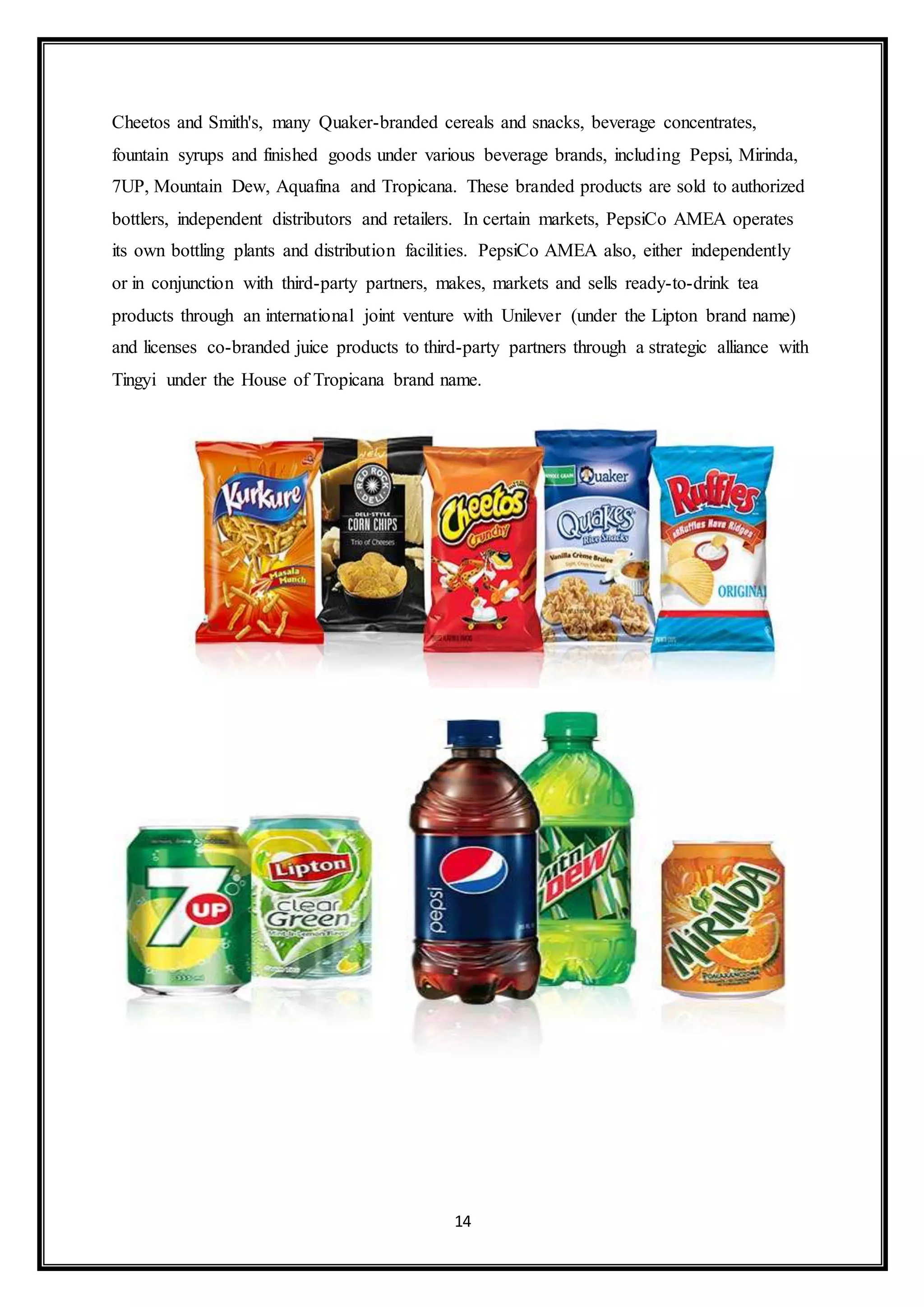
Marbo: New Line 2010 
In 2010, the PepsiCo brand Marbo opened a potato chip production line at its plant in Backi 
Maglic, Serbia, bringing state-of-the art technology, as well as 100 new jobs to the local 
community. 
New Investments: 2010 
Also in 2010, PepsiCo announced significant investments at its Polish plants, Grodzisk 
Mazowiecki and Tomaszow Mazowiecki, as well as the creation of new jobs at the 
Tomaszow plant. 
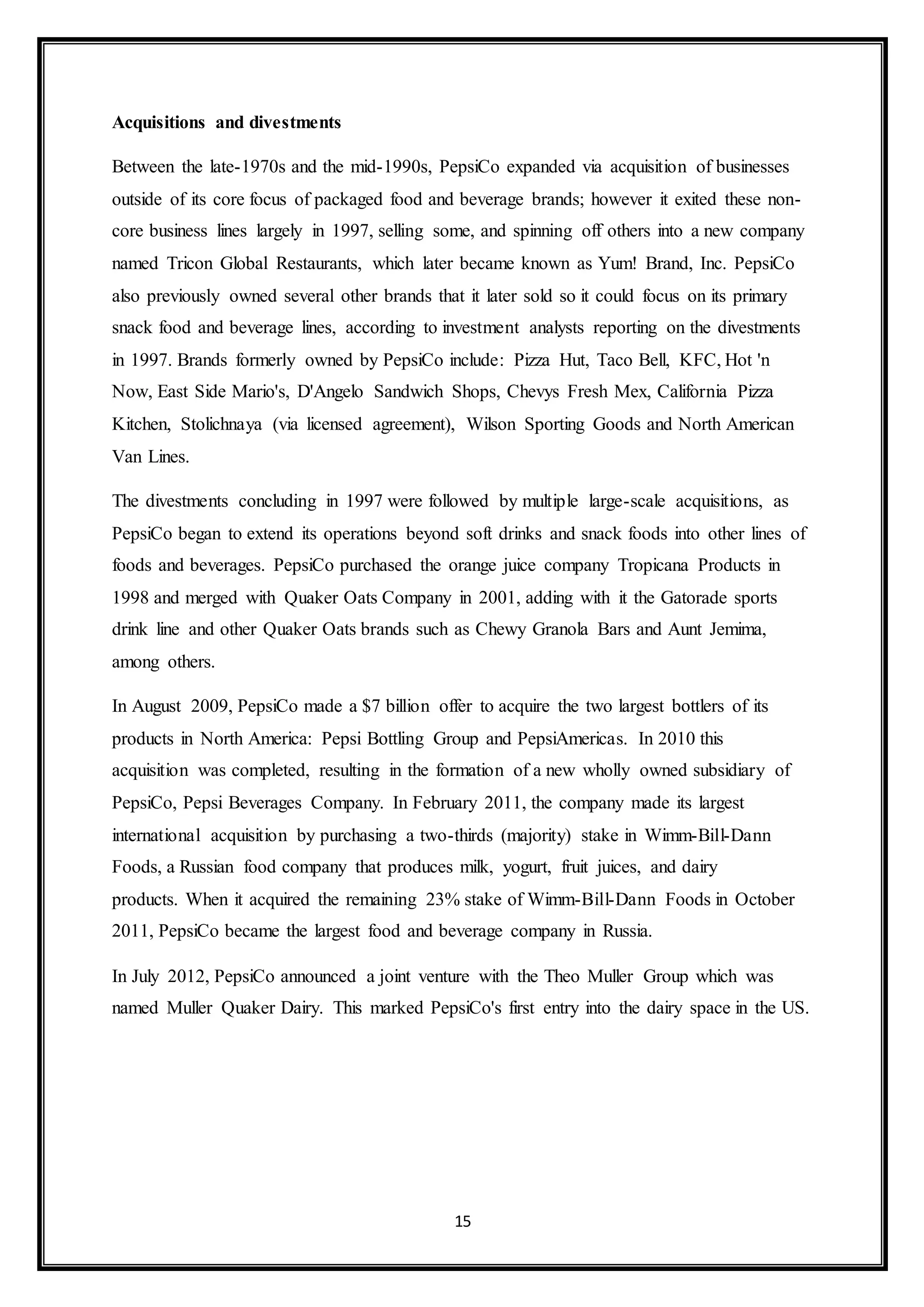
R&D Innovation: 2011 
In 2011, PepsiCo opened a fruit and vegetable research and development innovation center in 
Hamburg, Germany. 
PepsiCo Asia, Middle East & Africa 
PepsiCo Asia, Middle East and Africa (AMEA), includes all beverage, food and snack 
businesses in Asia, the Middle East and Africa, excluding South Africa. Either independently 
or in conjunction with third-party partners, PepsiCo AMEA makes, markets, sells and 
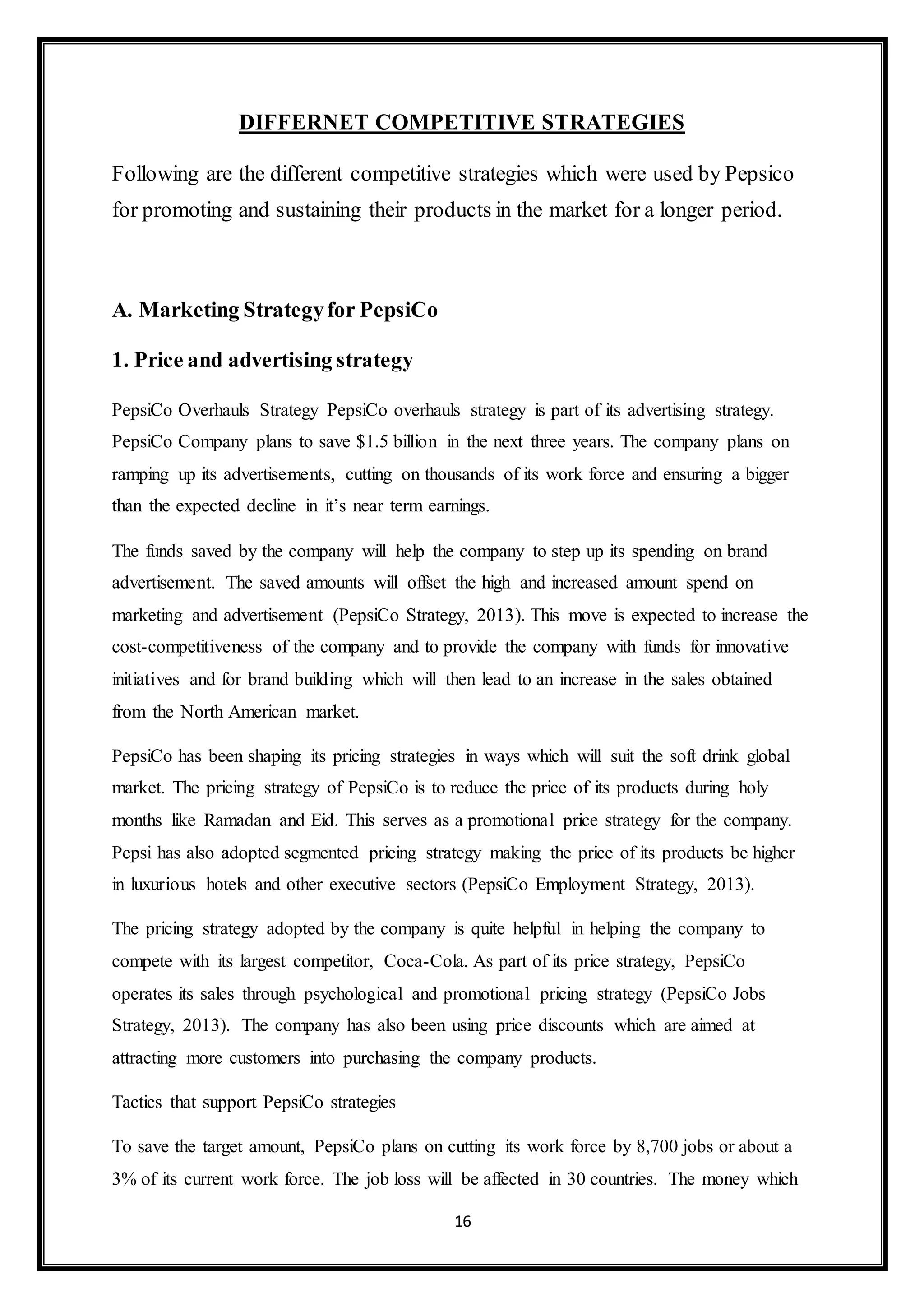
distributes a number of iconic PepsiCo brands, including Lay's, Chipsy, Kurkure, Doritos,
Cheetos and Smith's, many Quaker-branded cereals and snacks, beverage concentrates, 
fountain syrups and finished goods under various beverage brands, including Pepsi, Mirinda, 
7UP, Mountain Dew, Aquafina and Tropicana. These branded products are sold to authorized 
bottlers, independent distributors and retailers. In certain markets, PepsiCo AMEA operates 
its own bottling plants and distribution facilities. PepsiCo AMEA also, either independently 
or in conjunction with third-party partners, makes, markets and sells ready-to-drink tea 
products through an international joint venture with Unilever (under the Lipton brand name) 
and licenses co-branded juice products to third-party partners through a strategic alliance with 
Tingyi under the House of Tropicana brand name. 
14
15 
Acquisitions and divestments 
Between the late-1970s and the mid-1990s, PepsiCo expanded via acquisition of businesses 
outside of its core focus of packaged food and beverage brands; however it exited these non-core 
business lines largely in 1997, selling some, and spinning off others into a new company 
named Tricon Global Restaurants, which later became known as Yum! Brand, Inc. PepsiCo 
also previously owned several other brands that it later sold so it could focus on its primary 
snack food and beverage lines, according to investment analysts reporting on the divestments 
in 1997. Brands formerly owned by PepsiCo include: Pizza Hut, Taco Bell, KFC, Hot 'n 
Now, East Side Mario's, D'Angelo Sandwich Shops, Chevys Fresh Mex, California Pizza 
Kitchen, Stolichnaya (via licensed agreement), Wilson Sporting Goods and North American 
Van Lines. 
The divestments concluding in 1997 were followed by multiple large-scale acquisitions, as 
PepsiCo began to extend its operations beyond soft drinks and snack foods into other lines of 
foods and beverages. PepsiCo purchased the orange juice company Tropicana Products in 
1998 and merged with Quaker Oats Company in 2001, adding with it the Gatorade sports 
drink line and other Quaker Oats brands such as Chewy Granola Bars and Aunt Jemima, 
among others. 
In August 2009, PepsiCo made a $7 billion offer to acquire the two largest bottlers of its 
products in North America: Pepsi Bottling Group and PepsiAmericas. In 2010 this 
acquisition was completed, resulting in the formation of a new wholly owned subsidiary of 
PepsiCo, Pepsi Beverages Company. In February 2011, the company made its largest 
international acquisition by purchasing a two-thirds (majority) stake in Wimm-Bill-Dann 
Foods, a Russian food company that produces milk, yogurt, fruit juices, and dairy 
products. When it acquired the remaining 23% stake of Wimm-Bill-Dann Foods in October 
2011, PepsiCo became the largest food and beverage company in Russia. 
In July 2012, PepsiCo announced a joint venture with the Theo Muller Group which was 
named Muller Quaker Dairy. This marked PepsiCo's first entry into the dairy space in the US.
DIFFERNET COMPETITIVE STRATEGIES 
Following are the different competitive strategies which were used by Pepsico 
for promoting and sustaining their products in the market for a longer period. 
16 
A. Marketing Strategy for PepsiCo 
1. Price and advertising strategy 
PepsiCo Overhauls Strategy PepsiCo overhauls strategy is part of its advertising strategy. 
PepsiCo Company plans to save $1.5 billion in the next three years. The company plans on 
ramping up its advertisements, cutting on thousands of its work force and ensuring a bigger 
than the expected decline in it’s near term earnings. 
The funds saved by the company will help the company to step up its spending on brand 
advertisement. The saved amounts will offset the high and increased amount spend on 
marketing and advertisement (PepsiCo Strategy, 2013). This move is expected to increase the 
cost-competitiveness of the company and to provide the company with funds for innovative 
initiatives and for brand building which will then lead to an increase in the sales obtained 
from the North American market. 
PepsiCo has been shaping its pricing strategies in ways which will suit the soft drink global 
market. The pricing strategy of PepsiCo is to reduce the price of its products during holy 
months like Ramadan and Eid. This serves as a promotional price strategy for the company. 
Pepsi has also adopted segmented pricing strategy making the price of its products be higher 
in luxurious hotels and other executive sectors (PepsiCo Employment Strategy, 2013). 
The pricing strategy adopted by the company is quite helpful in helping the company to 
compete with its largest competitor, Coca-Cola. As part of its price strategy, PepsiCo 
operates its sales through psychological and promotional pricing strategy (PepsiCo Jobs 
Strategy, 2013). The company has also been using price discounts which are aimed at 
attracting more customers into purchasing the company products. 
Tactics that support PepsiCo strategies 
To save the target amount, PepsiCo plans on cutting its work force by 8,700 jobs or about a 
3% of its current work force. The job loss will be affected in 30 countries. The money which
would have been used for salaries and wages will instead be channeled to brand 
advertisements. 
The strategy will focus on 12 brands which includes Pepsi-Cola, Tropicana, Doritos, 
Gatorade and 7-Up among many other brands. Price cuts are the tactics which PepsiCo has 
adopted to enhance its pricing strategies. For example, it reduces the prices of its brands 
during certain seasons after which the price increases (PepsiCo Strategy, 2013). 
17 
2. International strategy 
PepsiCo’s international activities in Saudi Arabia, China, Mexico, India and Eastern Europe 
account for more than half of the company revenue and its operating profit. As a result, the 
company has been increasing its global advertisements all over the 190 countries in which it 
runs its businesses. 
The global advertisement is an international strategy used by the company to create brand 
awareness. The company has recognized the need to have a careful integration of high 
standards in its various supply chains and more so at the retail level across the world as a 
strategy of increasing its competitive advantage (PepsiCo Strategy, 2013). 
The company also strives to ensure excellence and specifically for the brands or products 
together with the packaging, advertising and marketing as a way of ensuring customer loyalty 
and brand loyalty. The rational behind this company strategy is to ensure that all customer get 
high quality products and this is because quality controls are highly realized in the process of 
bottling, packaging and from the warehouses to the shelves. 
As part of its international strategy, PepsiCo markets its products using the localization 
process where the local bottlers in the subsequent countries determine which products to pact 
in order to sell in their locality. The strategy behind this is to ensure that its products are 
produced in the country where they will be consumed. 
PepsiCo balances its communication and promotions through 
celebrity 
endorsers, newspapers, sponsorships and internet. With this the company is assured of 
customer awareness in the global market (PepsiCo Business Strategy, 2013). The company
also promotes it products and brand through supermarkets across the world by giving 
fantastic prizes and discounts to attract the attention of the buyers. 
PepsiCo has also adopted a new international strategy as a way of getting ahead of its main 
rival Coca-Cola Company. The company has been in the recent past partnered with its 
customers through TV networks across the globe like the NBC and also strategically places 
its commercials in order to closely relate to its audiences. 
International expansion has been the main international strategy for Pepsi Company in its bid 
to beating its rivals (PepsiCo Corporate Strategy, 2013). Another international strategy 
adopted by PepsiCo is its brand flexibility where the company tailors its brands to local 
cultures and tastes. All the international strategies adopted by PepsiCo are aimed at 
increasing its global operations and global growth. PepsiCo Strategy: Marketing, 
International, Competitive, Jobs 2013 
18 
B. PepsiCo’s competitive strategy 
1. Cola warsCola wars started back in the 1980 and describe the marketing and advertising 
tactics which have pitted the Coca-Cola Company against PepsiCo (PepsiCo Cola 
Employment Strategy, 2013). Even to date, the two soft drink companies continue to battle 
for the international and the 
national 
stages in food service and in retail. 
Cola wars have made PepsiCo adopt complex and sophisticated advertising and promotions 
in order to defeat the Coca-Cola Company. The competitive strategy adopted by PepsiCo as a 
result of cola wars is the production of healthy drinks. The consumption of carbonated drinks 
in USA has declined steadily in the past decade due to health concerns in the country where 
obesity has been a health issue. 
As a result, PepsiCo has had to devise a new competitive strategy of making a variety of 
beverages in order to sell the US market. For example, the company has focused on the 
production of water juices, sport drinks and teas as a way of targeting US and similar 
markets.As part of its complex and sophisticated advertising and promotions tools, the 
company has hired a Global Nutrition Group as its marketing tool.
The nutritionists were to direct the company efforts to reduce sodium, sugar and fat in its 
products. The nutritionists were also to develop a campaign to create an awareness to 
consumers on the healthier foods produced by the company. To do this, the nutritionists were 
required to analyze the sugar, fat and sodium content in each of the products or the drinks and 
explain to the consumers whether those percentages had any health impact (PepsiCo Strategy, 
2013). 
Cola wars have made PepsiCo diversify its business operations and to increase its reliance on 
other brands like Tropicana, Frito Lay and Quaker in order to increase its sales revenue. The 
company has adopted the complex and sophisticated advertising and promotions as a way of 
competing for a market share with Coca-Cola. These complex and sophisticated advertising 
and promotions are mainly to ensure uniqueness in its marketing and differentiate its brands 
from those of its competitors. 
19
20 
PEPSICO SWOT Analysis: 
Pepsico SWOT: 
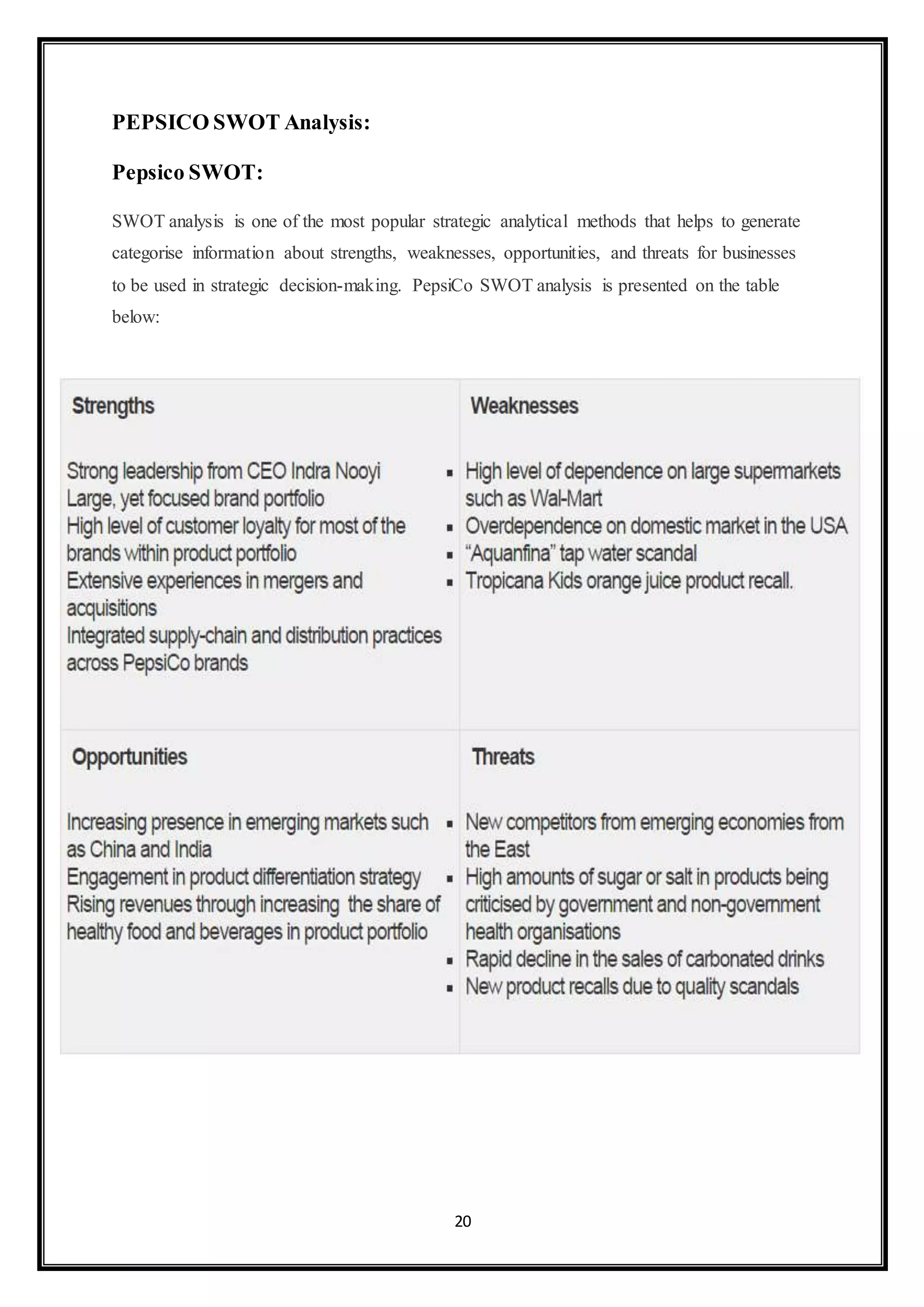
SWOT analysis is one of the most popular strategic analytical methods that helps to generate 
categorise information about strengths, weaknesses, opportunities, and threats for businesses 
to be used in strategic decision-making. PepsiCo SWOT analysis is presented on the table 
below:
21 
Marketing Mix of Pepsi 
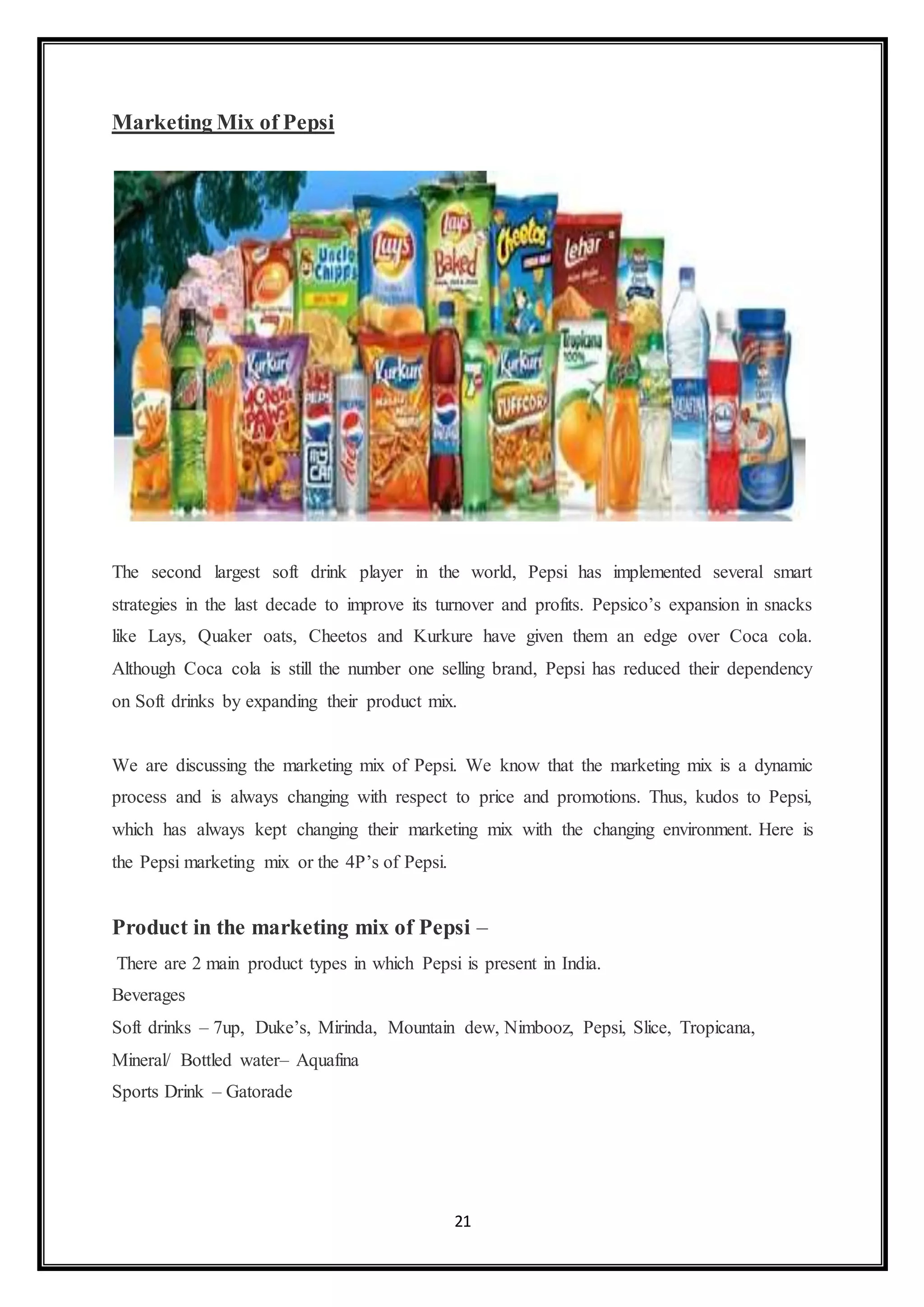
The second largest soft drink player in the world, Pepsi has implemented several smart 
strategies in the last decade to improve its turnover and profits. Pepsico’s expansion in snacks 
like Lays, Quaker oats, Cheetos and Kurkure have given them an edge over Coca cola. 
Although Coca cola is still the number one selling brand, Pepsi has reduced their dependency 
on Soft drinks by expanding their product mix. 
We are discussing the marketing mix of Pepsi. We know that the marketing mix is a dynamic 
process and is always changing with respect to price and promotions. Thus, kudos to Pepsi, 
which has always kept changing their marketing mix with the changing environment. Here is 
the Pepsi marketing mix or the 4P’s of Pepsi. 
Product in the marketing mix of Pepsi – 
There are 2 main product types in which Pepsi is present in India. 
Beverages 
Soft drinks – 7up, Duke’s, Mirinda, Mountain dew, Nimbooz, Pepsi, Slice, Tropicana, 
Mineral/ Bottled water– Aquafina 
Sports Drink – Gatorade
Food Products 
Snacks – Cheetos, Kurkure, Lays, Lehar, Uncle chipps 
Breakfast – Quaker oats 
Thus, Pepsi, unlike its major competitor Coca cola, has expanded in the breakfast as well as 
snacks segment. Coca cola on the other hand is present only in the beverages section. The 
advantage of Pepsi’s snacks segment is that brands like Lays, Kurkure and Cheetos are in 
great demand. Quaker oats which is a recent addition is also increasing in demand. Thus the 
turnover resulting from the Food products is helping the bottom line of the company. 
Price in the marketing mix of Pepsi – Pepsi is in an industry which is dominated by 
the two biggies – Coca cola and Pepsi. Thus the pricing of Pepsi is competitive. In a war 
between Coca cola and pepsi, neither of the brands can win if they enter a price war. This is 
because the cost of manufacturing and transportation is huge. Thus, these companies are 
likely to enter a brand war rather than enter a price war. 
Pepsi is known to give promotional discounts as well as discounts on bulk buying. For 
customers, as the container size rises, the discounts also rise. Thus a 2 litre bottle of Pepsi 
will be relatively cheaper per 100ml as compared to a 250 ml pack. For distributors, the 
discount is based on the quantity as well as the payment terms. The better the payment terms 
or the higher the quantity, the more is the discount given thereby keeping the distributor 
motivated. 
However, Pepsi has to lower its price for the top retailers and bulk buyers. For example – 
Indian retailers like Big Bazaar, Reliance fresh, as well as hypercity are bulk buyers. 
Similarly fast food chains like Mc donalds , KFC are also bulk buyers. These bulk buyers 
negotiate with the soft drink brands on the basis of price and sell their products in huge 
quantities. Thus, pepsi has to drop prices in these places which affects the operating margin 
of the brand. The margins of the company are better through the distributors and lesser 
through bulk buyers. However, the sales of the company are higher to bulk buyers as 
compared to distributors. 
Place in the marketing mix of Pepsi – Pepsi has a huge distribution network in India. 
It has to be huge because the brand needs to be present in every nook and corner of the 
country to increase its sales. The primary mode of distribution is through distributors who in 
turn give it to retailers, restaurants, and convenience stores. The secondary mode of 
22
distribution is directly through the company to bulk buyers and major retailers who buy 
directly from the company. 
Thus distribution channel is as follows 
1) Company > Distributor > Small retailers / Small buyers > End customer 
2) Company > Bulk buyers > End customer 
As cost is saved in the 2nd example, companies are able to give better margins to Bulk 
buyers. The major challenge in distribution is the cost of bottling as well as the cost of 
transportation. 
Bottling of Pepsi is done at bottling plants. In India, Pepsi has 36 bottling plants out of which 
13 are franchisees whereas 23 are company owned. The soft drink once packed is moved to 
the company warehouse from where it goes to distributors and bulk buyers. 
Several of pepsi’s soft drink distributors themselves might act as distributors of Kurkure, 
Lays and other snacks products as the distribution is through the same channel. The products 
are also sold from the same convenience store. Thus, it makes sense if the distributor of the 
soft drink is given the authority to distribute snacks as well. However, in some cases, the 
distributor of soft drink might be separate from that of Snacks. 
Promotions in the marketing mix of Pepsi. 
One of the strongest reason Pepsi retains its brand image is its promotions. Pepsi targets 
mainly youngsters through various Brand ambassadors. In India, the brand ambassadors have 
been the best celebrities as well as sports person of the country including Sachin tendulkar, M 
S Dhoni, Amitabh Bacchan, Ranbir kapoor and others. 
Mountain dew has a message of “Darr ke age jeet hai” which is again focused on adventure 
sports thereby targeting youngsters. Snacks like Kurkure and Lays target different segments. 
Kurkure is known to target household snacks and middle aged group whereas Lays targets 
youngsters and the party mood. Gatorade targets only sports as it is a sports drink. And 
Quaker oats, which is a recent launch as compared to the other products, targets breakfast 
with a bit of masala. 
Pepsi uses all the media channels for its promotions. Along with ATL, pepsi is also present in 
BTL marketing. Furthermore, along with traditional media channels, Pepsi also uses trade 
promotions and sales promotions at point of purchase. Discounts and packaging are always 
23
being bundled to give the best combination and value to the customer to increase purchases 
as well as the brand equity. 
The bottomline is that Pepsi cannot exist without the proper promotions. This is because 
Pepsi belongs in the FMCG market, and in FMCG, you either perform or perish. The FMCG 
market is one of the toughest market for businesses. However, Pepsi is not only surviving, but 
it is thriving in the FMCG market. Thus, hoping that Pepsi keeps re inventing its marketing 
mix so that it remains in the top 2 category of soft drinks. 
24
25 
CONCLUSION 
From the above project we conclude that Pepsico has adopted one of the finest competitive 
strategies. Pepsico plays an important role in Marketing Mix, Product Differentiation as well 
as low cost leadership. Its strategies are the main which can compete and because of its 
strategy Pepsi is competing with Coco cola. Through various competitive strategies Pepsico 
has entered in to different segments. 
Also we can conclude that how Pepsico penetrates in to different markets and how its 
distribution channels plays an important role in distributing its products worldwide.

A Project Work on Pepsico

  • 1.
  • 2.
    TABLE OF CONTENTS SR.NO CONTENTS PAGE NO. 1 INTRODUCTION 3 2 PRODUCTS 5 3 COMPETITIVE STRATEGIES 2 16 4 SWOT ANALYSIS 20 5 MARKETING MIX 21 6 CONCLUSION 25
  • 3.
    INTRODUCTION 3 PepsiCo PepsiCo Inc. is an American multinational food and beverage corporation headquartered in Purchase, New York, United States, with interests in the manufacturing, marketing and distribution of grain-based snack foods, beverages, and other products. PepsiCo was formed in 1965 with the merger of the Pepsi-Cola Company and Frito-Lay, Inc. PepsiCo has since expanded from its namesake product Pepsi to a broader range of food and beverage brands, the largest of which includes an acquisition of Tropicana in 1998 and a merger with Quaker Oats in 2001—which added the Gatorade brand to its portfolio. PepsiCo's brands generated retail sales of more than $1 billion apiece,and the company's products were distributed across more than 200 countries, resulting in annual net revenues of $43.3 billion. Based on net revenue, PepsiCo is the second largest food and beverage business in the world. Within North America, PepsiCo is ranked (by net revenue) as the largest food and beverage business. Indra Krishnamurthy Nooyi has been the chief executive of PepsiCo since 2006, and the company employed approximately 274,000 people worldwide as of 2013. The company's beverage distribution and bottling is conducted by PepsiCo as well as by licensed bottlers in certain regions. PepsiCo Americas Beverages (PAB) makes, markets, sells and distributes beverage concentrates, fountain syrups and finished goods under various beverage brands. Through strategic acquisitions, partnerships and new product development, PAB has expanded its beverage lineup over the past 20 years to offer top-selling choices for every occasion and lifestyle. As a result, Pepsi-Cola today is the flagship brand in a portfolio of liquid refreshment beverages that includes 14 billion-dollar brands and spans carbonated soft drinks, juices and juice drinks, ready-to-drink teas and coffees, sports drinks and bottled waters. Its brands include Pepsi-Cola, Mountain Dew, Gatorade, Sierra Mist, Aquafina, Tropicana Pure Premium, AMP Energy, Propel, Mug, SoBe, IZZE and Naked Juice. PAB also distributes and sells in the United States a leading portfolio of ready-to-drink teas and coffees through strategic joint ventures with Unilever and Starbucks, with brands that include Lipton Iced Tea, Pure Leaf and Brisk, Tazo Iced Tea, Starbucks Frappuccino, Starbucks Iced Coffee, Seattle's Best Iced Lattes and Starbucks Refreshers. In 2012, PepsiCo announced that
  • 4.
    Starbuck's ready-to-drink beveragesand Lipton Brisk had grown to more than $1 billion in estimated annual retail sales, expanding PepsiCo's portfolio of billion-dollar brands. PAB offers reduced-calorie options for virtually every drink it makes and for every occasion. Today, nearly half of PAB sales volume in the United States comes from no- or low-calorie beverages, healthy juices, and active hydration beverages. 4
  • 5.
    PRODUCTS OF PEPSICO 5 Pepsi-Cola Pepsi-Cola was created in 1898 by Caleb Bradham, a New Bern, North Carolina pharmacist who formulated the drink as a refreshing and energizing tonic. Today, it is one of the world's most iconic and recognized consumer brands globally. Gatorade: Acquired in 2001
  • 6.
    In 2001, Gatorade,one of the world's leading sport's drinks, was acquired by PepsiCo. Created by researchers at the University of Florida for the school's football team, "the Gators,"" the drink is backed by 45 years of science. 6 Mountain Dew: Acquired in 1964 Mountain Dew was invented by an independent soft drink bottler in the 1940s and was purchased by Pepsi-Cola in 1964. Today, Mountain Dew is the #1 flavored carbonated soft drink in the United States. With its one-of-a-kind citrus taste, Mountain Dew exhilarates and quenches with every sip. In addition to original Mountain Dew and Diet Mountain Dew, the DEW product line includes Mountain Dew Code Red, Mountain Dew LiveWire, Mountain Dew Throwback, Mountain Dew Voltage, Mountain Dew White Out and Mountain Dew Kickstart.
  • 7.
    7 Pepsi-Lipton Partnership In 1991 PepsiCo entered into The Pepsi Lipton Tea partnership, a joint venture with Unilever that manufactures, markets and sells ready-to-drink iced teas in the United States. The partnership includes a complete portfolio of iced teas for every occasion, including Lipton Iced Tea, Pure Leaf Iced Tea and Brisk Iced Tea. North American Coffee Partnership Founded in 1994, the North American Coffee Partnership is a joint venture between Pepsi- Cola North America and a subsidiary of Starbucks Coffee Company. The partnership manufactures, markets and sells ready-to-drink coffee products, including Frappuccino, Starbucks Doubleshot, Doubleshot Energy + Coffee and Starbucks Refreshers.
  • 8.
    8 Tropicana: Acquiredin 1998 In 1947, Anthony Rossi started a local fruit packaging business called Tropicana. Seven years later, Rossi pioneered a revolutionary pasteurization process for orange juice. For the first time, consumers could enjoy the fresh taste of pure, not-from-concentrate, 100% Florida orange juice in a ready-to-serve package. The juice, Tropicana Pure Premium, became the company's flagship product. PepsiCo acquired Tropicana and the Dole juice business in 1998. PepsiCo Americas Foods PepsiCo Americas Foods is the provider of many of the most popular food and snacks throughout North and Latin America. Its portfolio of businesses includes Frito-Lay North America, Quaker Foods North America, and all of our Latin American food and snack businesses.
  • 9.
    9 Frito-Lay NorthAmerica In 1932, C.E. Doolin entered a small San Antonio cafe and purchased a bag of corn chips. Little did he dream this savory chip would become one of the nation's most popular snacks. Mr. Doolin learned the corn chips manufacturer was eager to sell his small business, so Mr. Doolin purchased the recipe, began making FRITOS® corn chips in his mother's kitchen and sold them from his Model T Ford. Meanwhile, that same year, Herman W. Lay began his potato chip business in Nashville by delivering snack foods. Not long after, Mr. Lay purchased the manufacturer, and formed the H.W. Lay & Company. H.W. Lay & Company became one of the largest snack food companies in the Southeast, and today, LAY'S® potato chips is America's favorite potato chip brand. Years later, in 1961, the Frito Company and the H.W. Lay Company merged to become Frito-Lay, Inc. Today, Frito-Lay North America makes some of the most popular snacks in the United States, including LAY'S® and RUFFLES® potato chips and dips, DORITOS® tortilla chips, TOSTITOS® tortilla chips and dips, CHEETOS® cheese flavored snacks, FRITOS® corn chips and dips, ROLD GOLD® pretzels, SUNCHIPS® multigrain snacks, and CRACKER JACK® candy coated popcorn.
  • 10.
    10 Gamesa Gamesais a global leader in the cookies market and from Mexico it exports its products to more than 16 countries. Gamesa offers consumers a wide variety of high-quality products for every lifestyle, producing pastries, oats, cereals and other related products. Among its most successful brands are Marias Gamesa, Emperador, Arcoiris, Mamut, Chokis and Maizoro. Headquartered in Monterrey, Mexico, it has nine production facilities across Mexico. It was acquired by PepsiCo in 1990. Quaker Foods North America For more than 135 years, Quaker has provided consumers with innovative products that fit their ever-changing daily lifestyles. It all began on September 1877, when Henry D. Seymour and William Heston, founders of the Quaker Mill Company, registered with the U.S. Patent Office the first breakfast cereal trademark, "a figure of a man in 'Quaker garb.'" In 1881, Henry Parsons Crowell bought the bankrupt Quaker Mill Company as well as the brand name Quaker. The next year he launched the first national magazine advertising program for a breakfast cereal. In 1888, several of the largest oat millers merged and
  • 11.
    established the AmericanCereal Company. And in 1901, the American Cereal Company changed its name to The Quaker Oats Company. The iconic Quaker Oats round packaging first appeared in 1915 and Quaker Quick Oats, one of America's first convenience products, was introduced in 1922. The first major acquisition of the company was Aunt Jemima Mills Company in 1926, which is today one of the leading manufacturers of pancake mixes and syrup. Gatorade was later acquired in 1983 and the Golden Grain Company, producers of Rice-A-Roni, in 1986. PepsiCo merged with The Quaker Oats Company in 2001. Today, Quaker Foods North America makes, markets, sells and distributes products spanning several categories such as hot and ready-to-eat cereals, rice, pasta and other branded products. Some of its best known and beloved brands include Quaker oatmeal, Quaker Chewy granola bars, Life cereal, and Rice-A-Roni and Pasta Roni. 11 Sabritas Sabritas is the most loved snack brand in Mexico. Founded in 1943, it is renowned for the quality, variety and flavors of its products, and serves as the umbrella brand under which PepsiCo markets Frito-Lay products in Mexico. Sabritas is also the name brand for its own line of potato chips, and manufactures and markets several local brands such as Doritos, Cheetos, Tostitos, Fritos, Crujitos, Poffets, Rancheritos and Sabritones. Sabritas is headquartered in Mexico City and has ten production plants. PepsiCo acquired Sabritas in 1966. Latin Americas Foods The Latin Americas Foods business, either independently or in conjunction with third-party partners, makes, markets, sells and distributes a number of snack food brands, including Marias Gamesa, Cheetos, Doritos, Ruffles, Emperador, Saladitas, Elma Chips, Rosquinhas
  • 12.
    Mabel, Sabritas andTostitos, as well as many Quaker-branded cereals and snacks. These branded products are sold to independent distributors and retailers. PepsiCo Europe includes all beverage, food and snack businesses in Europe and South Africa. Either independently or in conjunction with third-party partners, PepsiCo Europe makes, markets, sells and distributes some of the most respected household brands, including Lay's, Walkers, Doritos, Cheetos and Ruffles, many Quaker-branded cereals and snacks, beverage concentrates, fountain syrups and finished goods under various beverage brands, including Pepsi, Pepsi Max, 7UP, Diet Pepsi and Tropicana. These branded products are sold to authorized bottlers, independent distributors and retailers. In certain markets, PepsiCo Europe operates its own bottling plants and distribution facilities. PepsiCo Europe also, either independently or in conjunction with third-party partners, makes, markets and sells ready-to-drink tea products through an international joint venture with Unilever (under the Lipton brand name), and sells and distributes a number of leading dairy products, including Domik v Derevne, Chudo and Agusha. 12 Milestones Wimm-Bill-Dann: Acquired in 2011 In 2011 acquisition of Wimm-Bill-Dann, Russia's leading branded food-and-beverage company, made PepsiCo the #1 food and beverage business in Russia.
  • 13.
    13 Marbo: NewLine 2010 In 2010, the PepsiCo brand Marbo opened a potato chip production line at its plant in Backi Maglic, Serbia, bringing state-of-the art technology, as well as 100 new jobs to the local community. New Investments: 2010 Also in 2010, PepsiCo announced significant investments at its Polish plants, Grodzisk Mazowiecki and Tomaszow Mazowiecki, as well as the creation of new jobs at the Tomaszow plant. R&D Innovation: 2011 In 2011, PepsiCo opened a fruit and vegetable research and development innovation center in Hamburg, Germany. PepsiCo Asia, Middle East & Africa PepsiCo Asia, Middle East and Africa (AMEA), includes all beverage, food and snack businesses in Asia, the Middle East and Africa, excluding South Africa. Either independently or in conjunction with third-party partners, PepsiCo AMEA makes, markets, sells and distributes a number of iconic PepsiCo brands, including Lay's, Chipsy, Kurkure, Doritos,
  • 14.
    Cheetos and Smith's,many Quaker-branded cereals and snacks, beverage concentrates, fountain syrups and finished goods under various beverage brands, including Pepsi, Mirinda, 7UP, Mountain Dew, Aquafina and Tropicana. These branded products are sold to authorized bottlers, independent distributors and retailers. In certain markets, PepsiCo AMEA operates its own bottling plants and distribution facilities. PepsiCo AMEA also, either independently or in conjunction with third-party partners, makes, markets and sells ready-to-drink tea products through an international joint venture with Unilever (under the Lipton brand name) and licenses co-branded juice products to third-party partners through a strategic alliance with Tingyi under the House of Tropicana brand name. 14
  • 15.
    15 Acquisitions anddivestments Between the late-1970s and the mid-1990s, PepsiCo expanded via acquisition of businesses outside of its core focus of packaged food and beverage brands; however it exited these non-core business lines largely in 1997, selling some, and spinning off others into a new company named Tricon Global Restaurants, which later became known as Yum! Brand, Inc. PepsiCo also previously owned several other brands that it later sold so it could focus on its primary snack food and beverage lines, according to investment analysts reporting on the divestments in 1997. Brands formerly owned by PepsiCo include: Pizza Hut, Taco Bell, KFC, Hot 'n Now, East Side Mario's, D'Angelo Sandwich Shops, Chevys Fresh Mex, California Pizza Kitchen, Stolichnaya (via licensed agreement), Wilson Sporting Goods and North American Van Lines. The divestments concluding in 1997 were followed by multiple large-scale acquisitions, as PepsiCo began to extend its operations beyond soft drinks and snack foods into other lines of foods and beverages. PepsiCo purchased the orange juice company Tropicana Products in 1998 and merged with Quaker Oats Company in 2001, adding with it the Gatorade sports drink line and other Quaker Oats brands such as Chewy Granola Bars and Aunt Jemima, among others. In August 2009, PepsiCo made a $7 billion offer to acquire the two largest bottlers of its products in North America: Pepsi Bottling Group and PepsiAmericas. In 2010 this acquisition was completed, resulting in the formation of a new wholly owned subsidiary of PepsiCo, Pepsi Beverages Company. In February 2011, the company made its largest international acquisition by purchasing a two-thirds (majority) stake in Wimm-Bill-Dann Foods, a Russian food company that produces milk, yogurt, fruit juices, and dairy products. When it acquired the remaining 23% stake of Wimm-Bill-Dann Foods in October 2011, PepsiCo became the largest food and beverage company in Russia. In July 2012, PepsiCo announced a joint venture with the Theo Muller Group which was named Muller Quaker Dairy. This marked PepsiCo's first entry into the dairy space in the US.
  • 16.
    DIFFERNET COMPETITIVE STRATEGIES Following are the different competitive strategies which were used by Pepsico for promoting and sustaining their products in the market for a longer period. 16 A. Marketing Strategy for PepsiCo 1. Price and advertising strategy PepsiCo Overhauls Strategy PepsiCo overhauls strategy is part of its advertising strategy. PepsiCo Company plans to save $1.5 billion in the next three years. The company plans on ramping up its advertisements, cutting on thousands of its work force and ensuring a bigger than the expected decline in it’s near term earnings. The funds saved by the company will help the company to step up its spending on brand advertisement. The saved amounts will offset the high and increased amount spend on marketing and advertisement (PepsiCo Strategy, 2013). This move is expected to increase the cost-competitiveness of the company and to provide the company with funds for innovative initiatives and for brand building which will then lead to an increase in the sales obtained from the North American market. PepsiCo has been shaping its pricing strategies in ways which will suit the soft drink global market. The pricing strategy of PepsiCo is to reduce the price of its products during holy months like Ramadan and Eid. This serves as a promotional price strategy for the company. Pepsi has also adopted segmented pricing strategy making the price of its products be higher in luxurious hotels and other executive sectors (PepsiCo Employment Strategy, 2013). The pricing strategy adopted by the company is quite helpful in helping the company to compete with its largest competitor, Coca-Cola. As part of its price strategy, PepsiCo operates its sales through psychological and promotional pricing strategy (PepsiCo Jobs Strategy, 2013). The company has also been using price discounts which are aimed at attracting more customers into purchasing the company products. Tactics that support PepsiCo strategies To save the target amount, PepsiCo plans on cutting its work force by 8,700 jobs or about a 3% of its current work force. The job loss will be affected in 30 countries. The money which
  • 17.
    would have beenused for salaries and wages will instead be channeled to brand advertisements. The strategy will focus on 12 brands which includes Pepsi-Cola, Tropicana, Doritos, Gatorade and 7-Up among many other brands. Price cuts are the tactics which PepsiCo has adopted to enhance its pricing strategies. For example, it reduces the prices of its brands during certain seasons after which the price increases (PepsiCo Strategy, 2013). 17 2. International strategy PepsiCo’s international activities in Saudi Arabia, China, Mexico, India and Eastern Europe account for more than half of the company revenue and its operating profit. As a result, the company has been increasing its global advertisements all over the 190 countries in which it runs its businesses. The global advertisement is an international strategy used by the company to create brand awareness. The company has recognized the need to have a careful integration of high standards in its various supply chains and more so at the retail level across the world as a strategy of increasing its competitive advantage (PepsiCo Strategy, 2013). The company also strives to ensure excellence and specifically for the brands or products together with the packaging, advertising and marketing as a way of ensuring customer loyalty and brand loyalty. The rational behind this company strategy is to ensure that all customer get high quality products and this is because quality controls are highly realized in the process of bottling, packaging and from the warehouses to the shelves. As part of its international strategy, PepsiCo markets its products using the localization process where the local bottlers in the subsequent countries determine which products to pact in order to sell in their locality. The strategy behind this is to ensure that its products are produced in the country where they will be consumed. PepsiCo balances its communication and promotions through celebrity endorsers, newspapers, sponsorships and internet. With this the company is assured of customer awareness in the global market (PepsiCo Business Strategy, 2013). The company
  • 18.
    also promotes itproducts and brand through supermarkets across the world by giving fantastic prizes and discounts to attract the attention of the buyers. PepsiCo has also adopted a new international strategy as a way of getting ahead of its main rival Coca-Cola Company. The company has been in the recent past partnered with its customers through TV networks across the globe like the NBC and also strategically places its commercials in order to closely relate to its audiences. International expansion has been the main international strategy for Pepsi Company in its bid to beating its rivals (PepsiCo Corporate Strategy, 2013). Another international strategy adopted by PepsiCo is its brand flexibility where the company tailors its brands to local cultures and tastes. All the international strategies adopted by PepsiCo are aimed at increasing its global operations and global growth. PepsiCo Strategy: Marketing, International, Competitive, Jobs 2013 18 B. PepsiCo’s competitive strategy 1. Cola warsCola wars started back in the 1980 and describe the marketing and advertising tactics which have pitted the Coca-Cola Company against PepsiCo (PepsiCo Cola Employment Strategy, 2013). Even to date, the two soft drink companies continue to battle for the international and the national stages in food service and in retail. Cola wars have made PepsiCo adopt complex and sophisticated advertising and promotions in order to defeat the Coca-Cola Company. The competitive strategy adopted by PepsiCo as a result of cola wars is the production of healthy drinks. The consumption of carbonated drinks in USA has declined steadily in the past decade due to health concerns in the country where obesity has been a health issue. As a result, PepsiCo has had to devise a new competitive strategy of making a variety of beverages in order to sell the US market. For example, the company has focused on the production of water juices, sport drinks and teas as a way of targeting US and similar markets.As part of its complex and sophisticated advertising and promotions tools, the company has hired a Global Nutrition Group as its marketing tool.
  • 19.
    The nutritionists wereto direct the company efforts to reduce sodium, sugar and fat in its products. The nutritionists were also to develop a campaign to create an awareness to consumers on the healthier foods produced by the company. To do this, the nutritionists were required to analyze the sugar, fat and sodium content in each of the products or the drinks and explain to the consumers whether those percentages had any health impact (PepsiCo Strategy, 2013). Cola wars have made PepsiCo diversify its business operations and to increase its reliance on other brands like Tropicana, Frito Lay and Quaker in order to increase its sales revenue. The company has adopted the complex and sophisticated advertising and promotions as a way of competing for a market share with Coca-Cola. These complex and sophisticated advertising and promotions are mainly to ensure uniqueness in its marketing and differentiate its brands from those of its competitors. 19
  • 20.
    20 PEPSICO SWOTAnalysis: Pepsico SWOT: SWOT analysis is one of the most popular strategic analytical methods that helps to generate categorise information about strengths, weaknesses, opportunities, and threats for businesses to be used in strategic decision-making. PepsiCo SWOT analysis is presented on the table below:
  • 21.
    21 Marketing Mixof Pepsi The second largest soft drink player in the world, Pepsi has implemented several smart strategies in the last decade to improve its turnover and profits. Pepsico’s expansion in snacks like Lays, Quaker oats, Cheetos and Kurkure have given them an edge over Coca cola. Although Coca cola is still the number one selling brand, Pepsi has reduced their dependency on Soft drinks by expanding their product mix. We are discussing the marketing mix of Pepsi. We know that the marketing mix is a dynamic process and is always changing with respect to price and promotions. Thus, kudos to Pepsi, which has always kept changing their marketing mix with the changing environment. Here is the Pepsi marketing mix or the 4P’s of Pepsi. Product in the marketing mix of Pepsi – There are 2 main product types in which Pepsi is present in India. Beverages Soft drinks – 7up, Duke’s, Mirinda, Mountain dew, Nimbooz, Pepsi, Slice, Tropicana, Mineral/ Bottled water– Aquafina Sports Drink – Gatorade
  • 22.
    Food Products Snacks– Cheetos, Kurkure, Lays, Lehar, Uncle chipps Breakfast – Quaker oats Thus, Pepsi, unlike its major competitor Coca cola, has expanded in the breakfast as well as snacks segment. Coca cola on the other hand is present only in the beverages section. The advantage of Pepsi’s snacks segment is that brands like Lays, Kurkure and Cheetos are in great demand. Quaker oats which is a recent addition is also increasing in demand. Thus the turnover resulting from the Food products is helping the bottom line of the company. Price in the marketing mix of Pepsi – Pepsi is in an industry which is dominated by the two biggies – Coca cola and Pepsi. Thus the pricing of Pepsi is competitive. In a war between Coca cola and pepsi, neither of the brands can win if they enter a price war. This is because the cost of manufacturing and transportation is huge. Thus, these companies are likely to enter a brand war rather than enter a price war. Pepsi is known to give promotional discounts as well as discounts on bulk buying. For customers, as the container size rises, the discounts also rise. Thus a 2 litre bottle of Pepsi will be relatively cheaper per 100ml as compared to a 250 ml pack. For distributors, the discount is based on the quantity as well as the payment terms. The better the payment terms or the higher the quantity, the more is the discount given thereby keeping the distributor motivated. However, Pepsi has to lower its price for the top retailers and bulk buyers. For example – Indian retailers like Big Bazaar, Reliance fresh, as well as hypercity are bulk buyers. Similarly fast food chains like Mc donalds , KFC are also bulk buyers. These bulk buyers negotiate with the soft drink brands on the basis of price and sell their products in huge quantities. Thus, pepsi has to drop prices in these places which affects the operating margin of the brand. The margins of the company are better through the distributors and lesser through bulk buyers. However, the sales of the company are higher to bulk buyers as compared to distributors. Place in the marketing mix of Pepsi – Pepsi has a huge distribution network in India. It has to be huge because the brand needs to be present in every nook and corner of the country to increase its sales. The primary mode of distribution is through distributors who in turn give it to retailers, restaurants, and convenience stores. The secondary mode of 22
  • 23.
    distribution is directlythrough the company to bulk buyers and major retailers who buy directly from the company. Thus distribution channel is as follows 1) Company > Distributor > Small retailers / Small buyers > End customer 2) Company > Bulk buyers > End customer As cost is saved in the 2nd example, companies are able to give better margins to Bulk buyers. The major challenge in distribution is the cost of bottling as well as the cost of transportation. Bottling of Pepsi is done at bottling plants. In India, Pepsi has 36 bottling plants out of which 13 are franchisees whereas 23 are company owned. The soft drink once packed is moved to the company warehouse from where it goes to distributors and bulk buyers. Several of pepsi’s soft drink distributors themselves might act as distributors of Kurkure, Lays and other snacks products as the distribution is through the same channel. The products are also sold from the same convenience store. Thus, it makes sense if the distributor of the soft drink is given the authority to distribute snacks as well. However, in some cases, the distributor of soft drink might be separate from that of Snacks. Promotions in the marketing mix of Pepsi. One of the strongest reason Pepsi retains its brand image is its promotions. Pepsi targets mainly youngsters through various Brand ambassadors. In India, the brand ambassadors have been the best celebrities as well as sports person of the country including Sachin tendulkar, M S Dhoni, Amitabh Bacchan, Ranbir kapoor and others. Mountain dew has a message of “Darr ke age jeet hai” which is again focused on adventure sports thereby targeting youngsters. Snacks like Kurkure and Lays target different segments. Kurkure is known to target household snacks and middle aged group whereas Lays targets youngsters and the party mood. Gatorade targets only sports as it is a sports drink. And Quaker oats, which is a recent launch as compared to the other products, targets breakfast with a bit of masala. Pepsi uses all the media channels for its promotions. Along with ATL, pepsi is also present in BTL marketing. Furthermore, along with traditional media channels, Pepsi also uses trade promotions and sales promotions at point of purchase. Discounts and packaging are always 23
  • 24.
    being bundled togive the best combination and value to the customer to increase purchases as well as the brand equity. The bottomline is that Pepsi cannot exist without the proper promotions. This is because Pepsi belongs in the FMCG market, and in FMCG, you either perform or perish. The FMCG market is one of the toughest market for businesses. However, Pepsi is not only surviving, but it is thriving in the FMCG market. Thus, hoping that Pepsi keeps re inventing its marketing mix so that it remains in the top 2 category of soft drinks. 24
  • 25.
    25 CONCLUSION Fromthe above project we conclude that Pepsico has adopted one of the finest competitive strategies. Pepsico plays an important role in Marketing Mix, Product Differentiation as well as low cost leadership. Its strategies are the main which can compete and because of its strategy Pepsi is competing with Coco cola. Through various competitive strategies Pepsico has entered in to different segments. Also we can conclude that how Pepsico penetrates in to different markets and how its distribution channels plays an important role in distributing its products worldwide.