International Journal of Trend in Scientific Research and Development (IJTSRD)
Volume 6 Issue 3, March-April 2022 Available Online: www.ijtsrd.com e-ISSN: 2456 – 6470
@ IJTSRD | Unique Paper ID – IJTSRD49459 | Volume – 6 | Issue – 3 | Mar-Apr 2022 Page 288
A New Approach for Securely Sharing
Data between Cloud Users with Dual Keys
Varsha K N1
, Prof Ganeshan M2
1
Research Scholar, 2
Mentor and Program Coordinator,
1,2
School of Computer Science and Information Technology,
Jain (Deemed to be University), Bangalore, Karnataka, India
ABSTRACT
In this project, we propose the Secure Data Sharing in Clouds
(sedasc) methodology that provides data confidentiality and integrity;
access control; data sharing (forwarding) without using compute-
intensive re-encryption; insider threat security; and forward and
backward access control. The Sedasc methodology encrypts a file
with a single encryption key. Two different key shares for each of the
users are generated, with the user only getting one share. The
possession of a single share of a key allows the Sedasc methodology
to counter the insider threats. The other key share is stored by a
trusted third party, which is called the cryptographic server. We
implement a working prototype of the Sedasc methodology and
evaluate its performance based on the time consumed during various
operations.
How to cite this paper: Varsha K N |
Prof Ganeshan M "A New Approach for
Securely Sharing Data between Cloud
Users with Dual
Keys" Published in
International Journal
of Trend in
Scientific Research
and Development
(ijtsrd), ISSN: 2456-
6470, Volume-6 |
Issue-3, April 2022, pp.288-290, URL:
www.ijtsrd.com/papers/ijtsrd49459.pdf
Copyright © 2022 by author(s) and
International Journal of Trend in
Scientific Research and Development
Journal. This is an
Open Access article
distributed under the
terms of the Creative Commons
Attribution License (CC BY 4.0)
(http://creativecommons.org/licenses/by/4.0)
1. INTRODUCTION
Cloud computing is rapidly emerging due to the
provisioning of elastic, flexible, and on demand
storage and computing services for customers. The
data are usually encrypted before storing to the cloud.
The access control, key management, encryption, and
decryption processes are handled by the customers to
ensure data security. A single key shared between all
group members will result in the access of past data to
a newly joining member. The SeDaSC methodology
works with three entities as follows: 1) users; 2) a
cryptographic server (CS); and 3) the cloud. The data
are decrypted and sent back to the user. For a newly
joining member, the two portions of the key are
generated, and the user is added to the ACL.
2. LITERATURE SERVEY
“Distributing Data for Secure Database Services”
Vignesh Ganapathy, Dilys Thomas, Dilys Thomas,
Rajeev Motwani, Published In 2010
The advent of database services has resulted in
privacy concerns on the part of the client storing data
with third party database service providers. Previous
approaches to enabling such a service have been
based on data encryption, causing a large overhead in
query processing. A distributed architecture for
secure database services is proposed as a solution to
this problem where data was stored at multiple sites.
The distributed architecture provides both privacy as
well as fault tolerance to the client. In this paper we
provide algorithms for distributing data: our results
include hardness of approximation results and hence a
heuristic greedy hill climbing algorithm for the
distribution problem partitioning the query at the
client to queries for the various sites is done by a
bottom-up state-based algorithm we provide. Finally,
the results at the sites are integrated to obtain the
answer at the client. We provide an experimental
validation and performance study of our algorithms.
3. EXISTINGSYSTEM
The Secured BaaS architecture is tailored to cloud
platforms and does not introduce any intermediary
proxy or broker server between the client and the
IJTSRD49459
International Journal of Trend in Scientific Research and Development @ www.ijtsrd.com eISSN: 2456-6470
@ IJTSRD | Unique Paper ID – IJTSRD49459 | Volume – 6 | Issue – 3 | Mar-Apr 2022 Page 289
cloud provider. Secured BaaS relates more closely to
work using encryption to protect data managed by UN
trusted databases. Main issue to address is that
cryptographic techniques cannot be nativelyapplied to
standard DBaaS. Secured BaaS moves away from
existing architectures that store just tenant data in the
cloud database and save metadata in the client
machine or split metadata between the cloud database
and a trusted proxy.
3.1. Disadvantages of the existing system
Even though they are using secure DBaaS means
Distributing data among different providers and it
give more secure, but its functions cannot be
taking advantage of secret sharing outsourced to
an untrusted cloud provider.
It Cannot Store them in encrypted format.
When considering scenarios where multiple
clients can access the same database concurrently.
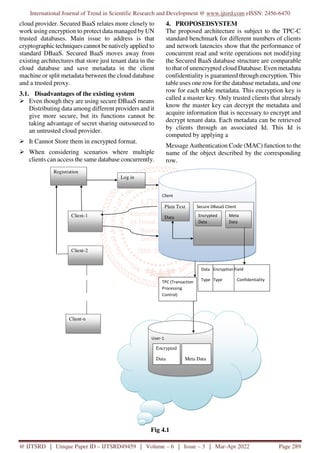
4. PROPOSEDSYSTEM
The proposed architecture is subject to the TPC-C
standard benchmark for different numbers of clients
and network latencies show that the performance of
concurrent read and write operations not modifying
the Secured BaaS database structure are comparable
to that of unencrypted cloud Database. Even metadata
confidentiality is guaranteed through encryption. This
table uses one row for the database metadata, and one
row for each table metadata. This encryption key is
called a master key. Only trusted clients that already
know the master key can decrypt the metadata and
acquire information that is necessary to encrypt and
decrypt tenant data. Each metadata can be retrieved
by clients through an associated Id. This Id is
computed by applying a
Message Authentication Code (MAC) function to the
name of the object described by the corresponding
row.
Registration
Client-1
Client-2
Log in
Client
User-1
Encrypted
Data Meta Data
Client-n
Plain Text
Data
Secure DBasaS Client
Encrypted
Data
Meta
Data
TPC (Transaction
Processing
Control)
Data Encryption Field
Type Type Confidentiality
Fig 4.1
International Journal of Trend in Scientific Research and Development @ www.ijtsrd.com eISSN: 2456-6470
@ IJTSRD | Unique Paper ID – IJTSRD49459 | Volume – 6 | Issue – 3 | Mar-Apr 2022 Page 290
5. CONCLUSION
To conclude in this project, Open network,
virtualization, monitoring, and security technologies
to deploy multi-tier services (e.g., compute clusters)
as machines on distributed infrastructures, combining
both data center resources and remote cloud
resources, according to allocation policies.
6. ACKNOWLEDGEMENT
I should convey my real tendency and obligation to
Dr M N Nachappa and Prof. Ganeshan M undertaking
facilitators for their effective steerage and consistent
inspirations all through my assessment work. Their
ideal bearing, absolute co-action and second
discernment have made my work Gainful.
REFERENCES
[1] M. Armbrust et al., “A View of Cloud
Computing,” Comm. of the ACM, vol. 53, no.
4, pp. 50-58, 2010.
[2] W. Jansen and T. Grance, “Guidelines on
Security and Privacy in Public Cloud
Computing,” Technical Report Special
Publication 800-144, NIST, 2011.
[3] A.J. Feldman, W.P. Zeller, M.J. Freedman, and
E.W. Felten, “SPORC: Group Collaboration
Using Untrusted Cloud Resources,” Proc. Ninth
USENIX Conf. Operating Systems Design and
Implementation, Oct. 2010.
[4] J. Li, M. Krohn, D. Mazie`res, and D. Shasha,
“Secure Untrusted Data Repository(SUNDR),”
Proc. Sixth USENIX Conf. Opearting Systems
Design and Implementation, Oct. 2004.
[5] P. Mahajan, S. Setty, S. Lee, A. Clement, L.
Alvisi, M. Dahlin, and M. Walfish, “Depot:
Cloud Storage with Minimal Trust,” ACM
Trans. Computer Systems, vol. 29, no. 4, article
12, 2011.
[6] H. Hacigu¨mu¨ s¸, B. Iyer, and S. Mehrotra,
“Providing Database as a Service,” Proc. 18th
IEEE Int’l Conf. Data Eng., Feb. 2002.
[7] C. Gentry, “Fully Homomorphic Encryption
Using Ideal Lattices,” Proc. 41st Ann. ACM
Symp. Theory of Computing, May 2009.
[8] R.A. Popa, C.M.S. Redfield, N. Zeldovich, and
H. Balakrishnan, “CryptDB: Protecting
Confidentiality with Encrypted Query
Processing,” Proc. 23rd ACM Symp. Operating
Systems Principles, Oct. 2011.
[9] https://www.w3schools.com/js/
[10] https://ieeexplore.ieee.org/document/5071626

A New Approach for Securely Sharing Data between Cloud Users with Dual Keys

  • 1.
    International Journal ofTrend in Scientific Research and Development (IJTSRD) Volume 6 Issue 3, March-April 2022 Available Online: www.ijtsrd.com e-ISSN: 2456 – 6470 @ IJTSRD | Unique Paper ID – IJTSRD49459 | Volume – 6 | Issue – 3 | Mar-Apr 2022 Page 288 A New Approach for Securely Sharing Data between Cloud Users with Dual Keys Varsha K N1 , Prof Ganeshan M2 1 Research Scholar, 2 Mentor and Program Coordinator, 1,2 School of Computer Science and Information Technology, Jain (Deemed to be University), Bangalore, Karnataka, India ABSTRACT In this project, we propose the Secure Data Sharing in Clouds (sedasc) methodology that provides data confidentiality and integrity; access control; data sharing (forwarding) without using compute- intensive re-encryption; insider threat security; and forward and backward access control. The Sedasc methodology encrypts a file with a single encryption key. Two different key shares for each of the users are generated, with the user only getting one share. The possession of a single share of a key allows the Sedasc methodology to counter the insider threats. The other key share is stored by a trusted third party, which is called the cryptographic server. We implement a working prototype of the Sedasc methodology and evaluate its performance based on the time consumed during various operations. How to cite this paper: Varsha K N | Prof Ganeshan M "A New Approach for Securely Sharing Data between Cloud Users with Dual Keys" Published in International Journal of Trend in Scientific Research and Development (ijtsrd), ISSN: 2456- 6470, Volume-6 | Issue-3, April 2022, pp.288-290, URL: www.ijtsrd.com/papers/ijtsrd49459.pdf Copyright © 2022 by author(s) and International Journal of Trend in Scientific Research and Development Journal. This is an Open Access article distributed under the terms of the Creative Commons Attribution License (CC BY 4.0) (http://creativecommons.org/licenses/by/4.0) 1. INTRODUCTION Cloud computing is rapidly emerging due to the provisioning of elastic, flexible, and on demand storage and computing services for customers. The data are usually encrypted before storing to the cloud. The access control, key management, encryption, and decryption processes are handled by the customers to ensure data security. A single key shared between all group members will result in the access of past data to a newly joining member. The SeDaSC methodology works with three entities as follows: 1) users; 2) a cryptographic server (CS); and 3) the cloud. The data are decrypted and sent back to the user. For a newly joining member, the two portions of the key are generated, and the user is added to the ACL. 2. LITERATURE SERVEY “Distributing Data for Secure Database Services” Vignesh Ganapathy, Dilys Thomas, Dilys Thomas, Rajeev Motwani, Published In 2010 The advent of database services has resulted in privacy concerns on the part of the client storing data with third party database service providers. Previous approaches to enabling such a service have been based on data encryption, causing a large overhead in query processing. A distributed architecture for secure database services is proposed as a solution to this problem where data was stored at multiple sites. The distributed architecture provides both privacy as well as fault tolerance to the client. In this paper we provide algorithms for distributing data: our results include hardness of approximation results and hence a heuristic greedy hill climbing algorithm for the distribution problem partitioning the query at the client to queries for the various sites is done by a bottom-up state-based algorithm we provide. Finally, the results at the sites are integrated to obtain the answer at the client. We provide an experimental validation and performance study of our algorithms. 3. EXISTINGSYSTEM The Secured BaaS architecture is tailored to cloud platforms and does not introduce any intermediary proxy or broker server between the client and the IJTSRD49459
  • 2.
    International Journal ofTrend in Scientific Research and Development @ www.ijtsrd.com eISSN: 2456-6470 @ IJTSRD | Unique Paper ID – IJTSRD49459 | Volume – 6 | Issue – 3 | Mar-Apr 2022 Page 289 cloud provider. Secured BaaS relates more closely to work using encryption to protect data managed by UN trusted databases. Main issue to address is that cryptographic techniques cannot be nativelyapplied to standard DBaaS. Secured BaaS moves away from existing architectures that store just tenant data in the cloud database and save metadata in the client machine or split metadata between the cloud database and a trusted proxy. 3.1. Disadvantages of the existing system Even though they are using secure DBaaS means Distributing data among different providers and it give more secure, but its functions cannot be taking advantage of secret sharing outsourced to an untrusted cloud provider. It Cannot Store them in encrypted format. When considering scenarios where multiple clients can access the same database concurrently. 4. PROPOSEDSYSTEM The proposed architecture is subject to the TPC-C standard benchmark for different numbers of clients and network latencies show that the performance of concurrent read and write operations not modifying the Secured BaaS database structure are comparable to that of unencrypted cloud Database. Even metadata confidentiality is guaranteed through encryption. This table uses one row for the database metadata, and one row for each table metadata. This encryption key is called a master key. Only trusted clients that already know the master key can decrypt the metadata and acquire information that is necessary to encrypt and decrypt tenant data. Each metadata can be retrieved by clients through an associated Id. This Id is computed by applying a Message Authentication Code (MAC) function to the name of the object described by the corresponding row. Registration Client-1 Client-2 Log in Client User-1 Encrypted Data Meta Data Client-n Plain Text Data Secure DBasaS Client Encrypted Data Meta Data TPC (Transaction Processing Control) Data Encryption Field Type Type Confidentiality Fig 4.1
  • 3.
    International Journal ofTrend in Scientific Research and Development @ www.ijtsrd.com eISSN: 2456-6470 @ IJTSRD | Unique Paper ID – IJTSRD49459 | Volume – 6 | Issue – 3 | Mar-Apr 2022 Page 290 5. CONCLUSION To conclude in this project, Open network, virtualization, monitoring, and security technologies to deploy multi-tier services (e.g., compute clusters) as machines on distributed infrastructures, combining both data center resources and remote cloud resources, according to allocation policies. 6. ACKNOWLEDGEMENT I should convey my real tendency and obligation to Dr M N Nachappa and Prof. Ganeshan M undertaking facilitators for their effective steerage and consistent inspirations all through my assessment work. Their ideal bearing, absolute co-action and second discernment have made my work Gainful. REFERENCES [1] M. Armbrust et al., “A View of Cloud Computing,” Comm. of the ACM, vol. 53, no. 4, pp. 50-58, 2010. [2] W. Jansen and T. Grance, “Guidelines on Security and Privacy in Public Cloud Computing,” Technical Report Special Publication 800-144, NIST, 2011. [3] A.J. Feldman, W.P. Zeller, M.J. Freedman, and E.W. Felten, “SPORC: Group Collaboration Using Untrusted Cloud Resources,” Proc. Ninth USENIX Conf. Operating Systems Design and Implementation, Oct. 2010. [4] J. Li, M. Krohn, D. Mazie`res, and D. Shasha, “Secure Untrusted Data Repository(SUNDR),” Proc. Sixth USENIX Conf. Opearting Systems Design and Implementation, Oct. 2004. [5] P. Mahajan, S. Setty, S. Lee, A. Clement, L. Alvisi, M. Dahlin, and M. Walfish, “Depot: Cloud Storage with Minimal Trust,” ACM Trans. Computer Systems, vol. 29, no. 4, article 12, 2011. [6] H. Hacigu¨mu¨ s¸, B. Iyer, and S. Mehrotra, “Providing Database as a Service,” Proc. 18th IEEE Int’l Conf. Data Eng., Feb. 2002. [7] C. Gentry, “Fully Homomorphic Encryption Using Ideal Lattices,” Proc. 41st Ann. ACM Symp. Theory of Computing, May 2009. [8] R.A. Popa, C.M.S. Redfield, N. Zeldovich, and H. Balakrishnan, “CryptDB: Protecting Confidentiality with Encrypted Query Processing,” Proc. 23rd ACM Symp. Operating Systems Principles, Oct. 2011. [9] https://www.w3schools.com/js/ [10] https://ieeexplore.ieee.org/document/5071626