A multi-tenant Architecture
            for
       Apache Axis2
A multi-tenant Architecture
                      for
                 Apache Axis2

        Afkham Azeez                  Senaka Fernando

azeez@{apache.org , wso2.com}   senaka@{apache.org, wso2.com}
          WSO2 Inc                        WSO2 Inc
About the Presenters
• Afkham Azeez
   –   PMC member Apache Axis, Committer Synapse & Web Services
   –   Member, Apache Software Foundation
   –   Co-author, Axis2 Web Services
   –   Director of Architecture, WSO2 Inc
   –   Blog: http://blog.afkham.org


• Senaka Fernando
   – PMC member Apache Axis & incubator, committer Web Services
   – Member, Apache Software Foundation
   – Product Manager & Associate Tech Lead, WSO2 Inc


                                  Š WSO2 2011
Agenda
• Core Axis2 architectural concepts
• How Axis2 has been multi-tenanted
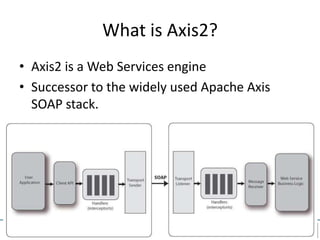
What is Axis2?
• Axis2 is a Web Services engine
• Successor to the widely used Apache Axis
  SOAP stack.
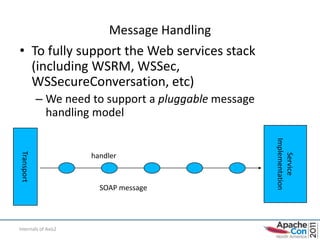
Message Handling
• To fully support the Web services stack
  (including WSRM, WSSec,
  WSSecureConversation, etc)
            – We need to support a pluggable message
              handling model


                                                       Implementation
Transport


                      handler


                                                           Service
                        SOAP message


Internals of Axis2
Composability


Advanced Web Services                   7
Composability

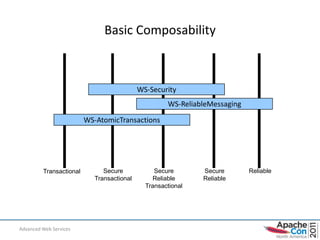
• The whole architecture of WS-* has been
  designed around this model
      – Use what you need
             • And no more
      – Don’t replicate technology in different standards
      – All the standards should work together


Advanced Web Services                                       8
Basic Composability


                                            WS-Security
                                                     WS-ReliableMessaging

                         WS-AtomicTransactions


         Transactional         Secure            Secure       Secure        Reliable
                            Transactional       Reliable      Reliable
                                              Transactional


Advanced Web Services                                                                  9
Composability

• SOAP Headers that work together
• Common usage of base components
      – SOAP
      – WS-Addressing
• The right building blocks, e.g.
      – Reliable pub/sub
             • WSRM + WS-Eventing
      – Secure Single Sign-on
             • WS-Trust + WS-Security

Advanced Web Services                       10
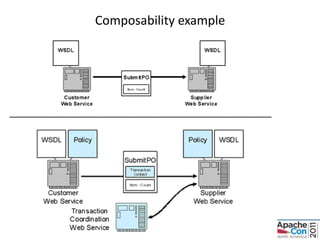
Composability example


Advanced Web Services       Core Axis: WS with Apache Axis2   11
                                     Š WSO2 Inc. 2006
Composability

• The aim is to be able to plug in different
  capabilities independently
• For example:
       – Add reliable messaging support and security at
         the same time
• However, the combinations can be complex
       – Validate the signature
       – Store the message
       – Decrypt the body
       – Invoke the service

Internals of Axis2
Axis2 and composability

• Axis1 had a simple handler chain model
• The only way to compose different handlers
  was to manually add and get the order correct
• Axis2 has a more flexible model; that means
  adding a new capability is just a matter of
  plugging in a module


Internals of Axis2
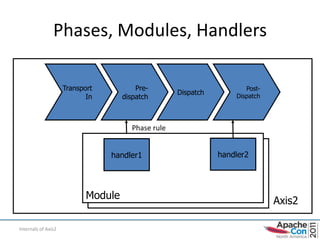
Phases, Modules, Handlers

                     Transport           Pre-                         Post-
                                                    Dispatch       Dispatch
                            In       dispatch


                                       Phase rule


                                 handler1                      handler2


                            Module                                            Axis2

Internals of Axis2
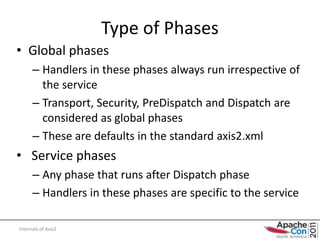
Type of Phases
• Global phases
      – Handlers in these phases always run irrespective of
        the service
      – Transport, Security, PreDispatch and Dispatch are
        considered as global phases
      – These are defaults in the standard axis2.xml
• Service phases
      – Any phase that runs after Dispatch phase
      – Handlers in these phases are specific to the service

Internals of Axis2                                         15
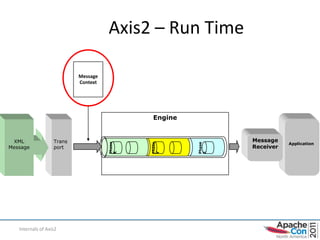
Axis2 – Run Time

                           Message
                           Context


                                              Engine


 XML               Trans                                       Message
                                                                          Application
                                     Phase


                                             Phase


                                                       Phase
Message            port                                        Receiver
                                     X


                                             Y


                                                       Z


   Internals of Axis2                                                       16
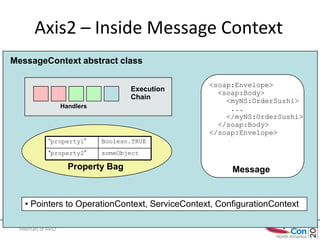
Axis2 – Inside Message Context
MessageContext abstract class

                                                    <soap:Envelope>
                                        Execution
                                                      <soap:Body>
                                        Chain
                                                        <myNS:OrderSushi>
                      Handlers                           ...
                                                        </myNS:OrderSushi>
                                                      </soap:Body>
                                                    </soap:Envelope>
               “property1”       Boolean.TRUE
               “property2”       someObject

                        Property Bag                     Message


   • Pointers to OperationContext, ServiceContext, ConfigurationContext

 Internals of Axis2                                                     17
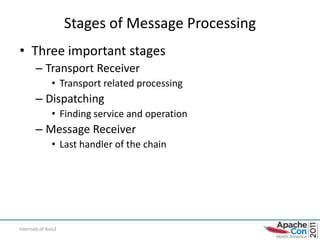
Stages of Message Processing
• Three important stages
       – Transport Receiver
               • Transport related processing
       – Dispatching
               • Finding service and operation
       – Message Receiver
               • Last handler of the chain


Internals of Axis2
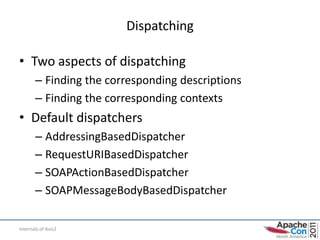
Dispatching

• Two aspects of dispatching
       – Finding the corresponding descriptions
       – Finding the corresponding contexts
• Default dispatchers
       – AddressingBasedDispatcher
       – RequestURIBasedDispatcher
       – SOAPActionBasedDispatcher
       – SOAPMessageBodyBasedDispatcher

Internals of Axis2
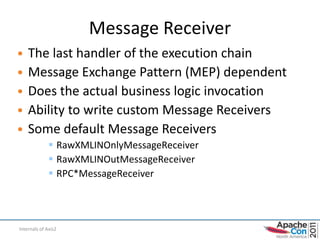
Message Receiver
• The last handler of the execution chain
• Message Exchange Pattern (MEP) dependent
• Does the actual business logic invocation
• Ability to write custom Message Receivers
• Some default Message Receivers
               RawXMLINOnlyMessageReceiver
               RawXMLINOutMessageReceiver
               RPC*MessageReceiver


Internals of Axis2                            20
MessageReceiver


Internals of Axis2
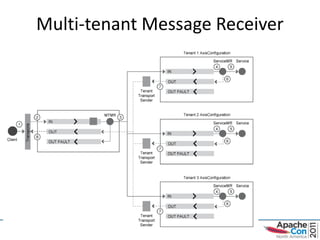
Multi-tenant Message Receiver
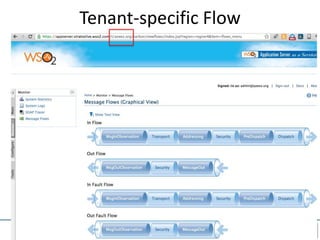
Tenant-specific Flow
Description & Context Hierarchy
• Descriptions keep static information
      – Information extracted from deployment descriptors
              • An example is the class that a specific MessageReceiver
                will call
• Contexts keep runtime information
      – This information needs to be managed for various
        scopes
              • For example session specific data
• Essential to keep them separate! :)

Internals of Axis2                                                    25
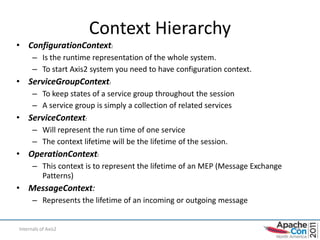
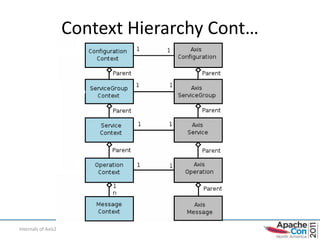
Context Hierarchy
• ConfigurationContext:
      – Is the runtime representation of the whole system.
      – To start Axis2 system you need to have configuration context.
• ServiceGroupContext:
      – To keep states of a service group throughout the session
      – A service group is simply a collection of related services
• ServiceContext:
      – Will represent the run time of one service
      – The context lifetime will be the lifetime of the session.
• OperationContext:
      – This context is to represent the lifetime of an MEP (Message Exchange
        Patterns)
• MessageContext:
      – Represents the lifetime of an incoming or outgoing message


Internals of Axis2                                                              26
Context Hierarchy Cont…


Internals of Axis2                             27
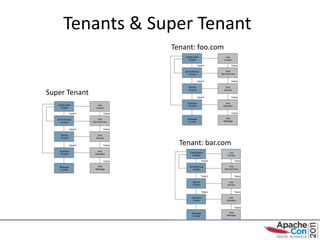
Tenants & Super Tenant
                Tenant: foo.com


Super Tenant


                  Tenant: bar.com
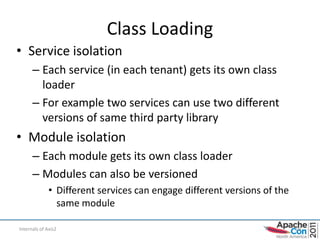
Class Loading
• Service isolation
      – Each service (in each tenant) gets its own class
        loader
      – For example two services can use two different
        versions of same third party library
• Module isolation
      – Each module gets its own class loader
      – Modules can also be versioned
              • Different services can engage different versions of the
                same module

Internals of Axis2                                                        29
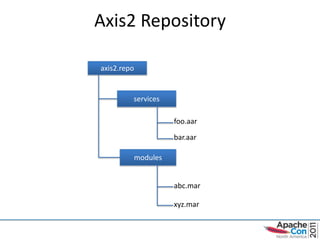
Axis2 Repository

axis2.repo


         services

                       foo.aar

                       bar.aar

             modules


                       abc.mar

                       xyz.mar
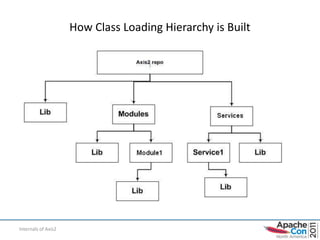
How Class Loading Hierarchy is Built


Internals of Axis2
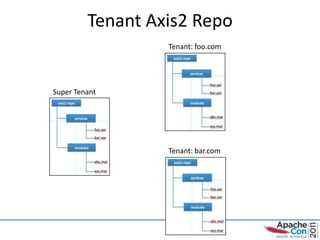
Tenant Axis2 Repo
                  Tenant: foo.com


Super Tenant


                  Tenant: bar.com
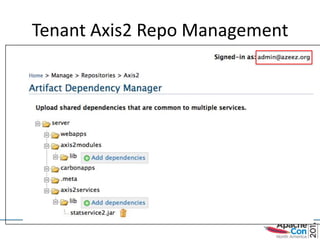
Tenant Axis2 Repo Management
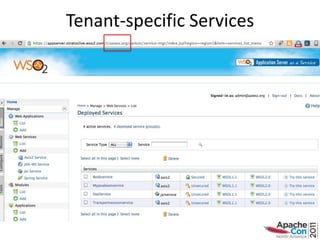
Tenant-specific Services
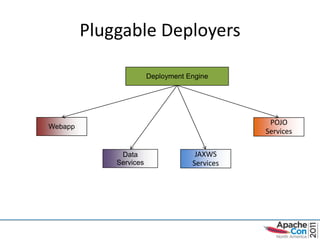
Pluggable Deployers

                        Deployment Engine


                                                POJO
Webapp
                                               Services

              Data                   JAXWS
             Services               Services
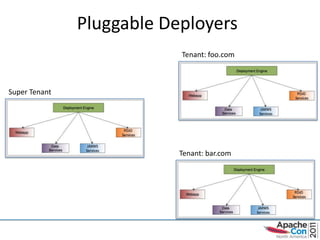
Pluggable Deployers
                           Tenant: foo.com


Super Tenant


                           Tenant: bar.com
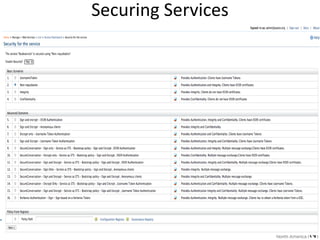
Securing Services
Lazy Loading

• Tenant AxisConfiguration &
  ConfigurationContext are created only when
  required
• If a tenant is inactive for sometime, these will be
  unloaded & GCd
• Instances when lazy loading happens
  – First request received
  – Tenant management console is loaded
  – A scheduled tenant task is executed
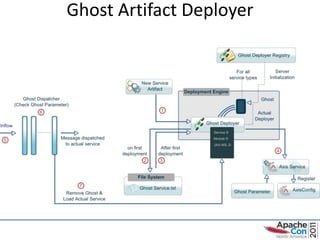
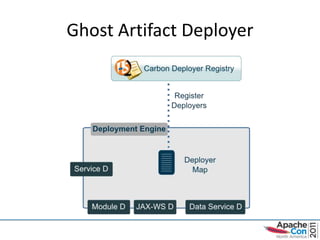
Ghost Artifact Deployer
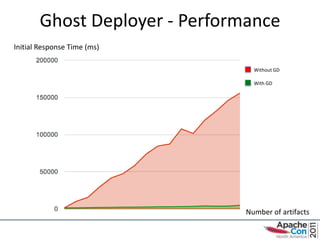
Ghost Deployer - Performance
Initial Response Time (ms)

                                Without GD

                                With GD


                              Number of artifacts
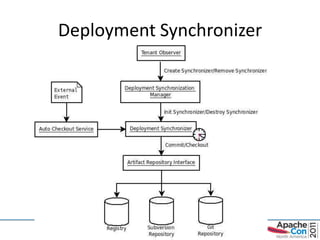
Deployment Synchronizer
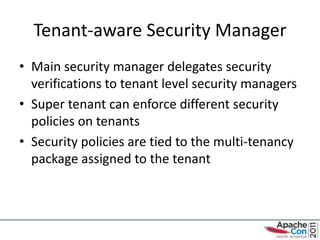
Tenant-aware Security Manager
• Main security manager delegates security
  verifications to tenant level security managers
• Super tenant can enforce different security
  policies on tenants
• Security policies are tied to the multi-tenancy
  package assigned to the tenant
Distributed Logging
• Every service and custom applications logs are
  captured by the log4j/commons loggings
  settings
• Logs are partitioned & stored by tenant
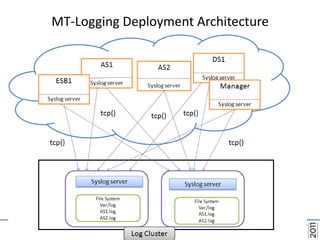
• Logs are sent to the Manager service via
  syslog
• Logs are then viewable / downloadable by
  tenant admins
MT-Logging Deployment Architecture
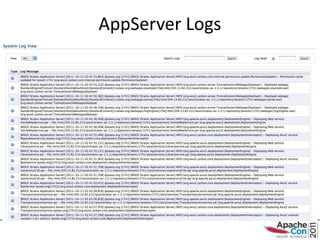
AppServer Logs
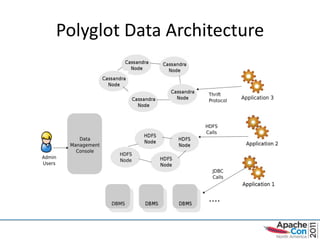
Polyglot Data Architecture
Metering, Throttling & Billing
• Some of the key cloud-native attributes
• In a multi-tenanted setup, you should be able
  to meter all important aspects
  • e.g. service request count, request/response sizes
    etc
• You may decide to throttle certain aspects
• You may decide to bill for certain aspects
  • e.g. bandwidth/CPU time usage
Recap
• Axis2 concepts
  – Messaging, deployment, configurations & contexts
• How Axis2 has been multi-tenanted
  – MultitenantMessageReceiver, lazy loading, ghost
    artifact deployer, data, logging,
    metering/throttling/billing
QUESTIONS?
Thank You!

A multi-tenant architecture for Apache Axis2

  • 1.
  • 2.
    A multi-tenant Architecture for Apache Axis2 Afkham Azeez Senaka Fernando azeez@{apache.org , wso2.com} senaka@{apache.org, wso2.com} WSO2 Inc WSO2 Inc
  • 3.
    About the Presenters •Afkham Azeez – PMC member Apache Axis, Committer Synapse & Web Services – Member, Apache Software Foundation – Co-author, Axis2 Web Services – Director of Architecture, WSO2 Inc – Blog: http://blog.afkham.org • Senaka Fernando – PMC member Apache Axis & incubator, committer Web Services – Member, Apache Software Foundation – Product Manager & Associate Tech Lead, WSO2 Inc © WSO2 2011
  • 4.
    Agenda • Core Axis2architectural concepts • How Axis2 has been multi-tenanted
  • 5.
    What is Axis2? •Axis2 is a Web Services engine • Successor to the widely used Apache Axis SOAP stack.
  • 6.
    Message Handling • Tofully support the Web services stack (including WSRM, WSSec, WSSecureConversation, etc) – We need to support a pluggable message handling model Implementation Transport handler Service SOAP message Internals of Axis2
  • 7.
  • 8.
    Composability • The wholearchitecture of WS-* has been designed around this model – Use what you need • And no more – Don’t replicate technology in different standards – All the standards should work together Advanced Web Services 8
  • 9.
    Basic Composability WS-Security WS-ReliableMessaging WS-AtomicTransactions Transactional Secure Secure Secure Reliable Transactional Reliable Reliable Transactional Advanced Web Services 9
  • 10.
    Composability • SOAP Headersthat work together • Common usage of base components – SOAP – WS-Addressing • The right building blocks, e.g. – Reliable pub/sub • WSRM + WS-Eventing – Secure Single Sign-on • WS-Trust + WS-Security Advanced Web Services 10
  • 11.
    Composability example Advanced WebServices Core Axis: WS with Apache Axis2 11 Š WSO2 Inc. 2006
  • 12.
    Composability • The aimis to be able to plug in different capabilities independently • For example: – Add reliable messaging support and security at the same time • However, the combinations can be complex – Validate the signature – Store the message – Decrypt the body – Invoke the service Internals of Axis2
  • 13.
    Axis2 and composability •Axis1 had a simple handler chain model • The only way to compose different handlers was to manually add and get the order correct • Axis2 has a more flexible model; that means adding a new capability is just a matter of plugging in a module Internals of Axis2
  • 14.
    Phases, Modules, Handlers Transport Pre- Post- Dispatch Dispatch In dispatch Phase rule handler1 handler2 Module Axis2 Internals of Axis2
  • 15.
    Type of Phases •Global phases – Handlers in these phases always run irrespective of the service – Transport, Security, PreDispatch and Dispatch are considered as global phases – These are defaults in the standard axis2.xml • Service phases – Any phase that runs after Dispatch phase – Handlers in these phases are specific to the service Internals of Axis2 15
  • 16.
    Axis2 – RunTime Message Context Engine XML Trans Message Application Phase Phase Phase Message port Receiver X Y Z Internals of Axis2 16
  • 17.
    Axis2 – InsideMessage Context MessageContext abstract class <soap:Envelope> Execution <soap:Body> Chain <myNS:OrderSushi> Handlers ... </myNS:OrderSushi> </soap:Body> </soap:Envelope> “property1” Boolean.TRUE “property2” someObject Property Bag Message • Pointers to OperationContext, ServiceContext, ConfigurationContext Internals of Axis2 17
  • 18.
    Stages of MessageProcessing • Three important stages – Transport Receiver • Transport related processing – Dispatching • Finding service and operation – Message Receiver • Last handler of the chain Internals of Axis2
  • 19.
    Dispatching • Two aspectsof dispatching – Finding the corresponding descriptions – Finding the corresponding contexts • Default dispatchers – AddressingBasedDispatcher – RequestURIBasedDispatcher – SOAPActionBasedDispatcher – SOAPMessageBodyBasedDispatcher Internals of Axis2
  • 20.
    Message Receiver • Thelast handler of the execution chain • Message Exchange Pattern (MEP) dependent • Does the actual business logic invocation • Ability to write custom Message Receivers • Some default Message Receivers  RawXMLINOnlyMessageReceiver  RawXMLINOutMessageReceiver  RPC*MessageReceiver Internals of Axis2 20
  • 21.
  • 22.
  • 23.
  • 25.
    Description & ContextHierarchy • Descriptions keep static information – Information extracted from deployment descriptors • An example is the class that a specific MessageReceiver will call • Contexts keep runtime information – This information needs to be managed for various scopes • For example session specific data • Essential to keep them separate! :) Internals of Axis2 25
  • 26.
    Context Hierarchy • ConfigurationContext: – Is the runtime representation of the whole system. – To start Axis2 system you need to have configuration context. • ServiceGroupContext: – To keep states of a service group throughout the session – A service group is simply a collection of related services • ServiceContext: – Will represent the run time of one service – The context lifetime will be the lifetime of the session. • OperationContext: – This context is to represent the lifetime of an MEP (Message Exchange Patterns) • MessageContext: – Represents the lifetime of an incoming or outgoing message Internals of Axis2 26
  • 27.
  • 28.
    Tenants & SuperTenant Tenant: foo.com Super Tenant Tenant: bar.com
  • 29.
    Class Loading • Serviceisolation – Each service (in each tenant) gets its own class loader – For example two services can use two different versions of same third party library • Module isolation – Each module gets its own class loader – Modules can also be versioned • Different services can engage different versions of the same module Internals of Axis2 29
  • 30.
    Axis2 Repository axis2.repo services foo.aar bar.aar modules abc.mar xyz.mar
  • 31.
    How Class LoadingHierarchy is Built Internals of Axis2
  • 32.
    Tenant Axis2 Repo Tenant: foo.com Super Tenant Tenant: bar.com
  • 33.
  • 34.
  • 35.
    Pluggable Deployers Deployment Engine POJO Webapp Services Data JAXWS Services Services
  • 36.
    Pluggable Deployers Tenant: foo.com Super Tenant Tenant: bar.com
  • 37.
  • 38.
    Lazy Loading • TenantAxisConfiguration & ConfigurationContext are created only when required • If a tenant is inactive for sometime, these will be unloaded & GCd • Instances when lazy loading happens – First request received – Tenant management console is loaded – A scheduled tenant task is executed
  • 39.
  • 40.
  • 41.
    Ghost Deployer -Performance Initial Response Time (ms) Without GD With GD Number of artifacts
  • 42.
  • 43.
    Tenant-aware Security Manager •Main security manager delegates security verifications to tenant level security managers • Super tenant can enforce different security policies on tenants • Security policies are tied to the multi-tenancy package assigned to the tenant
  • 44.
    Distributed Logging • Everyservice and custom applications logs are captured by the log4j/commons loggings settings • Logs are partitioned & stored by tenant • Logs are sent to the Manager service via syslog • Logs are then viewable / downloadable by tenant admins
  • 45.
  • 46.
  • 47.
  • 48.
    Metering, Throttling &Billing • Some of the key cloud-native attributes • In a multi-tenanted setup, you should be able to meter all important aspects • e.g. service request count, request/response sizes etc • You may decide to throttle certain aspects • You may decide to bill for certain aspects • e.g. bandwidth/CPU time usage
  • 49.
    Recap • Axis2 concepts – Messaging, deployment, configurations & contexts • How Axis2 has been multi-tenanted – MultitenantMessageReceiver, lazy loading, ghost artifact deployer, data, logging, metering/throttling/billing
  • 50.
  • 51.